Fact Checking Obama’s Misleading Answer About Warrantless Wiretapping on The Daily Show
By Trevor Timm | EFF | October 24, 2012
On last Thursday’s Daily Show, Jon Stewart boldly went where no mainstream reporter has gone so far this election cycle: asking President Barack Obama why has he embraced Bush’s warrantless wiretapping program after campaigning against it on the grounds that it violated Americans’ civil liberties. While Stewart’s question was commendable, Obama’s answer was puzzling because it seems so obviously untrue.
Stewart first reminded Obama of his Bush-era statements that “we don’t have to trade our values and ideals for our security,” and pointedly asked the President, “do you still believe that?” He then specifically raised warrantless wiretapping, which Obama frequently criticized as a presidential candidate in 2008:
STEWART: I think people have been surprised to see the strength of the Bush era warrantless wiretapping laws and those types of things not also be lessened—That the structures he put in place that people might have thought were government overreach and maybe they had a mind you would tone down, you haven’t.
OBAMA: The truth is we have modified them and built a legal structure and safeguards in place that weren’t there before on a whole range issues.
To the contrary, there’s no indication that the still-active warrantless wiretapping program—which includes a warrantless dragnet on millions of innocent Americans’ communications—has significantly changed from the day Obama took office. With regard to the FISA Amendments Act, the Obama Administration has actively opposed all proposed safeguards in Congress. All the while, his Administration has been even more aggressive than President Bush in trying to prevent warrantless wiretapping victims from having their day in court and has continued building the massive national security infrastructure needed to support it.
But let’s take a closer look at the President’s actions on wiretapping and related issues:
Voting against FISA Amendments Act, Filibuster Telecom Immunity
Early in his first presidential campaign, then-Senator Obama was a leading critic of giving telecom companies like AT&T immunity for breaking the law to assist in the government in warrantless wiretapping. He repeatedly promised to filibuster any bill that contained retroactive immunity for telecom companies. Yet in 2008, when Congress debated the FISA Amendments Act—the law that allowed the President to give telecom companies full, retroactive immunity—Obama not only refused to filibuster the bill, but voted for it.
That decision came full circle just two weeks ago, when Obama’s Justice Department successfully convinced the Supreme Court to deny EFF’s appeal challenging the law’s constitutionality, ensuring AT&T and other telecommunications companies will never face legal consequences for breaking the law, both in the past and in the future.
Fixing FISA Amendments Act After Elected
Despite voting for the FISA Amendments Act, then-candidate Obama still promised to reform the law when he was elected president. But four years later, the FISA Amendments Act is up for renewal in Congress, as it expires at the end of this year. This would be perfect time to implement the reforms Obama promised, and there are several common sense amendments that would do so.
The Obama administration, however, is actively opposing any new privacy safeguards or transparency provisions, saying it is their “top priority” to renew it with no changes.
Stopping the Use of the State Secrets Privilege
Congress isn’t the only place where the President has been hostile to any “legal structure or safeguards” for the warrantless wiretapping. He has steadfastly sought to prevent the courts from engaging in any meaningful review
In EFF’s long-running lawsuit Jewel v. NSA, along with several related lawsuits, the Obama administration has continued the Bush Administration strategy of invoking the ‘state secrets’ privilege and demanding immediate dismissal (a practice which Obama specifically criticized on his 2008 campaign website). This, plus many other invocations of the privilege occurred even after a supposed internal policy change that was supposed to restrict its use.
Using the state secrets privilege for electronic surveillance is plainly wrong, since FISA specifically requires courts to determine the legality of national security spying. And of course the argument that the spying is a secret is increasingly untenable, as multiple whistleblowers, hundreds of pages of already-public evidence—including government admissions—and a massive construction project in Utah attest to its ongoing existence.
Sovereign Immunity
In addition, in both Jewel and other cases, the government has raised extremely technical legal arguments that the cases must be dismissed because it has “sovereign immunity.”In Al-Haramain v. Obama, a case where the government was caught red-handed illegally wiretapping attorneys, the Obama Administration was even able to convince the Ninth Circuit to dismiss the case because, according to the court, only government individuals can be sued, not the agencies that actually did the spying.
Declassifying Secret FISA Court Opinions
Both in 2010 and 2011, Obama administration officials promised to work to all declassify secret FISA court opinions that contained “important rulings of law.” These opinions would shed light whether and how Americans’ communications have been illegally spied on.
Since then, the administration has since refused to declassify a single opinion and still refuses to release the full (rescinded) legal memo written by Bush administration lawyer John Yoo that attempted to justify the illegal and unconstitutional program in 2001.
FISA court secrecy has never been more troubling, given the administration admitted in July that the FISA court ruled that collection done by the NSA violated the Fourth Amendment rights of some unknown American on at least one occasion. EFF has since filed a Freedom of Information Act lawsuit for that opinion, plus any others discussing the constitutionality of warrantless surveillance, but the Obama administration is fighting mightily against it.
Secret Safeguards Aren’t Safeguards
Some have suggested it’s possible when Obama said “safeguards” on the Daily Show, he is referring to some unspecified secret administrative rules he has put into place. Yet if these “safeguards” exist, they have been kept completely secret from the American public, and at the same, the administration is refusing to codify them into the law or create any visible chain of accountability if they are violated. But given the ample evidence of Constitutional violations since Obama took office (see: here, here, and here), these secret safeguards we don’t know exist are clearly inconsequential.
Here’s hoping other reporters follows up on Stewart’s question soon and ask Obama to be much more specific about his past and future plans to make sure the American people are not illegally spied on.
Related articles
- Warrantless Wiretapping Worse Under Obama; Fascism on the Rise (tenthamendmentcenter.com)
- Supreme Court Allows NSA’s Warrantless Wiretapping to Continue (thenewamerican.com)
- The New York Times Reminds Us the NSA Still Warrantlessly Wiretaps Americans, and Congress Has the Power to Stop It (eff.org)
Those Despicable Foreigners
By Craig Murray on October 23, 2012
I have travelled this world much more extensively than either Obama or Romney, and I still do. I find everywhere, even in areas of conflict and economic difficulty, the vast majority of people are friendly, even kind, and have very similar aspirations, across cultures, to personal development and emotional fulfilment.
The striking thing about tonight’s US Presidential “foreign policy” debate, is when it did occasionally discuss foreign policy, the world out there was discussed not as a place of vast potential, but as a deeply disturbing place full of foreigners who are, apparently, all evil except the Israelis, who are perfect.
The vast benefits from cooperation and trade with “abroad” were not mentioned once that I noticed (though I confess the thing was so awful my attention wandered occasionally). Europe apparently doesn’t exist, other than Greece which is nothing more than a terrible warning of the dangers of not being right wing enough.
The correct attitude to all these foreigners that God so unfortunately and inexplicably placed on this planet, is apparently to maintain incredibly large armed forces, murder people with drones (they were both very enthusiastic on this one), place sanctions on them and declare them “currency manipulators”. The only surprising note was that both agreed that they could not kill everyone in Iran.
But “We can’t just kill our way out of this mess” was spoken with regret, rather than as an affirmation of the possibilities of cooperation instead. What a grim and joyless world view. Maybe I had better not step out of this hotel into Africa this morning; those Islamists might get me.
America’s Drone Terrorism
By Sheldon Richman | FFF | October 19, 2012
In the United States, the dominant narrative about the use of drones in Pakistan is of a surgically precise and effective tool that makes the U.S. safer by enabling “targeted killing” of terrorists, with minimal downsides or collateral impacts.
This narrative is false.
Those are the understated opening words of a disturbing, though unsurprising, nine-month study of the Obama administration’s official, yet unacknowledged, remote-controlled bombing campaign in the North Waziristan region of Pakistan, near Afghanistan. The report, “Living Under Drones,” is a joint effort by the New York University School of Law’s Global Justice Clinic and Stanford Law School’s International Human Rights and Conflict Resolution Clinic.
The NYU/Stanford report goes beyond reporting estimates of the civilian casualties inflicted by the deadly and illegal U.S. campaign. It also documents the hell the Pakistanis endure under President Barack Obama’s policy, which includes a “kill list” from which he personally selects targets. That hell shouldn’t be hard to imagine. Picture yourself living in an area routinely visited from the air by pilotless aircraft carrying Hellfire missiles. This policy is hardly calculated to win friends for the United States.
Defenders of the U.S. campaign say that militants in Pakistan threaten American troops in Afghanistan as well as Pakistani civilians. Of course, there is an easy way to protect American troops: bring them home. The 11-year-long Afghan war holds no benefits whatever for the security of the American people. On the contrary, it endangers Americans by creating hostility and promoting recruitment for anti-American groups.
The official U.S. line is that America’s invasion of Afghanistan was intended to eradicate al-Qaeda and the Taliban, who harbored them. Yet the practical effect of the invasion and related policies, including the invasion of Iraq and the bombing in Yemen and Somalia, has been to facilitate the spread of al-Qaeda and like-minded groups.
U.S. policy is a textbook case of precisely how to magnify the very threat that supposedly motivated the policy. The Obama administration now warns of threats from Libya — where the U.S. consulate was attacked and the ambassador killed — and Syria. Thanks to U.S. policy, al-Qaeda in Afghanistan spawned al-Qaeda in Iraq, al-Qaeda in the Arabian Peninsula, and al-Qaeda in the Islamic Maghreb.
If that’s success, what would failure look like?
Regarding Pakistani civilians, the report states,
While civilian casualties are rarely acknowledged by the U.S. government, there is significant evidence that U.S. drone strikes have injured and killed civilians.… It is difficult to obtain data on strike casualties because of U.S. efforts to shield the drone program from democratic accountability, compounded by the obstacles to independent investigation of strikes in North Waziristan. The best currently available public aggregate data on drone strikes are provided by The Bureau of Investigative Journalism (TBIJ), an independent journalist organization. TBIJ reports that from June 2004 through mid-September 2012, available data indicate that drone strikes killed 2,562–3,325 people in Pakistan, of whom 474–881 were civilians, including 176 children. TBIJ reports that these strikes also injured an additional 1,228–1,362 individuals.
The Obama administration denies that it has killed civilians, but bear in mind that it considers any male of military age a “militant.” This is not to be taken seriously.
The report goes on,
U.S. drone strike policies cause considerable and under-accounted-for harm to the daily lives of ordinary civilians, beyond death and physical injury.Drones hover twenty-four hours a day over communities in northwest Pakistan, striking homes, vehicles, and public spaces without warning. Their presence terrorizes men, women, and children, giving rise to anxiety and psychological trauma among civilian communities. Those living under drones have to face the constant worry that a deadly strike may be fired at any moment, and the knowledge that they are powerless to protect themselves.
It’s even worse than it sounds:
The U.S. practice of striking one area multiple times, and evidence that it has killed rescuers, makes both community members and humanitarian workers afraid or unwilling to assist injured victims. Some community members shy away from gathering in groups.
How can Americans tolerate this murder and trauma committed in their name? But don’t expect a discussion of this in Monday night’s foreign-policy debate. Mitt Romney endorses America’s drone terrorism.
Related articles
US missile defense: ‘global, mobile and threatening’ – Russia
RT | October 18, 2012
NATO’s missile defense system presents a threat to Russia’s national security and may trigger the militarization of Europe, Deputy Prime Minister Dmitry Rogozin told a NATO Parliamentary Assembly delegation on Thursday.
“This missile defense concept is global and mobile, and it creates unpredictability,” Rogozin said at a meeting with NATO officials at the Federation Council. “That is the real Figaro; Figaro here and Figaro there.”
Rogozin said Moscow is “awaiting explanations from NATO and Washington concerning the real purpose [of the system],” he stressed.
The Deputy Prime Minister remarked on the military defense components “that are being deployed around Norway, the bases in Romania,” which are aimed at intercepting “strategic rockets according to speed, range and altitude characteristics.”
Rogozin then mentioned the US naval group – the core of European missile defense – which “may be deployed in European ports rather far from the Russian territory (such as a base in Spain).”
However, “the same fleet will invariably appear in our northern seas under particular circumstances.”
“The radius of use of these weapons makes them a real threat to us,” Rogozin noted. “The strategic potential of Russia is a guarantee of its sovereignty and independence.”
The US missile defense system, first shelved then repackaged under the Obama administration, has been a thorn in the side of the Russia-US reset. Indeed, Russia has warned that the issue has all the potential to escalate into another arms race.
If new threats to Russia’s strategic potential appear, Russia will simply have to consider the threatening prospect of a militarized Europe.
Rogozin implored the NATO delegation not to push Russia into a position where it will be forced to respond.
“We request you don’t do that,” he stressed. “The Russian response has a…political and diplomatic nature at the moment, but you will not like the technical response we may have to pursue under certain circumstances.”
Although the Vice Premier said Russia has no reason to fear for the security of its western borders, he acknowledged there are threats that both Russia and the European Union share alike.
“We see new threats arising in Russia and European countries and… these threats are practically identical to both you and us,” Rogozin told the NATO delegation. “Russia is not an exporter of such threats to NATO states, and we can hardly reproach NATO for the presence of such threats.”
Russia regards the European Union as its unconditional strategic partner and Moscow is not interested in any conflicts or controversies disrupting the bilateral partnership, he stressed.
“The 21st century should…represent the revival of Russia’s full-scale presence in Europe’s common political affairs, which would be of much benefit both for Russia and Europe,” he declared.
Related articles
On U.S. Efforts to Take Away Iran’s Rights by (Unilaterally) Rewriting the NPT: And the Complicity of America’s Iran “Experts” in the Charade
By Flynt Leverett and Hillary Mann Leverett | The Race for Iran | October 14th, 2012

One of the more striking passages in President Obama’s address to the United Nations General Assembly last month presented Obama’s view of Iran’s nuclear rights. Specifically, the President noted, “We respect the right of nations to access peaceful nuclear power, but one of the purposes of the United States is to see that we harness that power for peace.”
This is a more restrictive formulation than Obama and senior officials in his administration have deployed in previous statements, which emphasized that Iran has a right to “pursue peaceful nuclear energy.” In normal English usage, the verb “to pursue” implies that, in the official American view, Iran might at least have a right to generate its own “peaceful nuclear energy.” By contrast, Obama’s more recent phrasing implies that, in Washington’s current reading, Iran does not even have a right to generate its own nuclear power, but may have to content itself with trying to “access to peaceful nuclear power” that is generated by others.
Needless to say, all of this is far removed from Iran’s longstanding insistence on its right to enrich uranium if it chooses to do so. And, of course, Iran has long recognized that, as a signatory to the Treaty on the Non-Proliferation of Nuclear Weapons (NPT), it must exercise that right under international monitoring.
Initially, even the George W. Bush administration acknowledged that there was, somewhere in a vague legal ether, an Iranian right to enrich—but it argued that Tehran had somehow managed to “forfeit” this right. Such an argument did not persuade most of the lawyers working on the issue in the Bush administration, much less most of the other nations of the world. Eventually, the Bush administration retreated to a rigid demand that the Islamic Republic obey Security Council resolutions calling on it to suspend enrichment before the United States would negotiate with Tehran—and without ever stipulating that a negotiated settlement would include an explicit recognition of Iran’s nuclear rights. Predictably, this stance was diplomatically dysfunctional.
When the Obama administration came in, it dropped the Bush administration’s insistence on suspension as a precondition for negotiations. But it has been even less willing than the Bush administration to acknowledge Iran’s nuclear rights—and it, too, has the diplomatic (non)results to show for its obtuseness.
From a global perspective, the positions of the Bush and Obama administrations on Iran’s right to develop indigenous nuclear fuel cycle capabilities and to pursue internationally safeguarded enrichment of uranium on its own territory make the United States a real outlier. This reality was underscored in August at the Non-Aligned Movement (NAM) summit, convened in Tehran, where NAM members—including the vast majority of the world’s nation-states—strongly endorsed the Islamic Republic’s right to pursue uranium enrichment. Although hardly covered in the American media, the NAM summit marked a significant international repudiation of U.S. policy regarding the nuclear rights of Iran and, by extension, other non-Western NPT signatories.
In the United States, this prompted defenders of the Bush/Obama line to spring into action. One of them, David Albright of the Institute for Science and International Security, co-wrote a piece for the U.S. government-sponsored Iran Primer last month, see here, which argued that the NAM communique “misconstrues the NPT.” This sparked a vigorous online exchange between Albright—who is not a lawyer or student of international legal regimes—and Daniel Joyner, professor at the University of Alabama’s School of Law and one of the legal academy’s most accomplished scholars of the NPT. That exchange reveals much about the contribution of many Western Iran “experts” to America’s Iran debate.
According to Albright and his co-author,
“Under Article IV [of the NPT], Iran cannot claim the right to nuclear energy production—or a right to enrich at all—while under investigation for possible non-peaceful uses of these capabilities. Iran’s right to nuclear energy is qualified—a long as there are no major lapses in its Article II obligations…the NAM communique failed to acknowledge the need for Iran to fully comply with the international treaty on nuclear weapons. Iran tried to portray that the final communique represented a diplomatic victory for Tehran and its controversial nuclear program. But the summit’s resolution instead undermined the Non-Aligned Movement’s credibility, since it demonstrated that developing nations cannot be counted on to deal seriously with nuclear nonproliferation issues.”
Leaving aside the patronizing tone of the last sentence—in effect, Albright and his co-author are positing that responsible Americans and Europeans (the rightful masters of the universe) cannot possibly think non-Westerners are “dealing seriously” with important international issues unless those non-Westerners simply accept, uncritically, the views advanced by their Western superiors—this statement is wrong on several substantive points. Among other things, it is wrong as an interpretation of the NPT and in its assertion that there have been “major lapses” in Iran’s Article II obligations. These features prompted Daniel Joyner to offer the following observations on his blog, Arms Control Law, see here:
“Why is it that in the nonproliferation area everyone, including engineers, physicists, chemists and general policy wonks, think they can do legal interpretation? You won’t find me writing articles about the technical aspects of missile capabilities, or the internal physics of a warhead core. I know these things are outside of my training and qualification to do. But apparently everyone thinks they can do legal analysis. With respect, I think David should stick to obsessing over satellite pictures of tarps at random military bases in Iran.”
On our own, we found Joyner’s comment mildly amusing. But it clearly touched a nerve in David Albright, see here, who responded with a remarkable broadside characterized by ad hominem invective and fallacious arguments from authority:
“I have belatedly read Joyner’s rant about our Iran Primer article with amusement and likewise find his chorus of lackeys a pathetic bunch. Now I understand that Joyner’s blogging is supposed to be an ego trip for him and a safe haven for commentators, but Joyner’s blogging is particularly egotistical and, with respect, off-the-wall. In the comments and in Joyner’s writings, I can see the deep ignorance of the NPT. I certainly see no need to revise our analysis and statements in our Iran Primer article. We have consulted with many lawyers who find Joyner’s analysis deeply flawed and agenda driven… I would recommend that Joyner have his work reviewed by competent lawyers. He would need to revise most of his work.”
Joyner responded vigorously, see here, making the point, among his other rejoinders, that he has published two peer-reviewed books, with Oxford University Press, on interpreting the NPT. But, for our purposes, the most important part of his response concerns the public posture adopted by too many Washington, DC-based policy “experts” and the motives for their adoption of such a posture. Joyner’s analysis focuses on nonproliferation specialists, but, in our view, it also applies very well to many who claim expertise on other Iran-related issues:
”A colleague in D.C. once said this to me about the U.S. nonproliferation epistemic community—and by this community we both meant the entirety of the various NGOs and think tanks and the few University based centers that focus on nonproliferation studies in the U.S.: that the community is very D.C. centric, cliquish, incestuous and self-referential, to its detriment. These words have really stuck with me, because I find them to be absolutely true, and both insightful and parsimonious as I’ve observed the community over the years.
I would take it even further and say that in addition, in my opinion, the whole U.S. based nonproliferation experts community—with few exception—is systematically biased toward support of USG positions on all the top nonproliferation issues. They maintain an essentially common narrative and set of emphases that is in line with, and that provides support for, the narrative and emphases of the USG, with only the smallest amounts of quibbling around the edges (Albright will talk all day long about his “aluminum tubes” work). I think that there is in the work of the U.S. nonproliferation epistemic community far too little real, independent evaluation and criticism of USG positions. As I see it, the U.S. nonproliferation community almost acts as a second wave of apologists for U.S. policy, after the USG itself—though it sometimes shrouds this effort in a lot of technical and sometimes academic-looking jargon. But in the end what the U.S. nonproliferation community ABSOLUTELY DOES NOT DO is serve in the role of an independent, rigorous, analytical check on USG nonproliferation positions, as it could and should do, and as the nongovernmental nonproliferation community in other countries does. And I think there are some clear reasons for this. Much more so than in other countries, the members of the U.S. based nonproliferation community tend, with very few exceptions, to
1) have been employed by the USG in the past;
2) want to be employed by the USG in the future;
3) be funded by or hope to be funded by the USG; and/or
4) want to maintain the access and good favor they have with USG officials, for the sake of information and for the sake of invitations to cool events, etc.
Basically what I’m saying is that they are biased towards the positions of the USG, because of their overly close personal and institutional associations with the USG, and because they see their own professional success as being tied to the favor of the USG.
I think there’s also a significant degree of media whorishness at work here as well. As a colleague once wrote to me while we were discussing this topic: ‘I think there is another—very important—aspect you may be missing that may even over-ride the ones you mention: aside from taking USG positions, the non-proliferation community likes the high-media profile allotted it, when it loudly tut-tuts 3rd world nuclear arms capacities (or enemies of the west’s nuclear arms capacities), whether or not such capacities are consistent w/ NPT and/or CSAs. People like being quoted, appearing on TV, and generally feeling important. The Non-proliferation community “loves” the attention and basks in this glow, and though they would “privately” acknowledge that Iran is not so far outside bounds (if at all), they nonetheless pass on statements and innuendo to media indicating the alleged dangers and thus wittingly or not, fan the flames. Others like ISIS simply pass on opinions dressed as expert findings. It just would not do for Non-proliferation types to tell the media: “well, no, Iran’s program is actually not a threat to world peace yet” like the DNI did.’”
Not surprisingly, Joyner sees David Albright as embodying this description, as he points out in criticizing some of Albright’s analysis on Iran’s nuclear activities:
“All [Albright] really does is make provocative speculations about what “could” be happening at locations in Iran, and what “maybe” Iran will do in the future. And it’s so clear that he’s working on the basis of a set of unproven, but firmly held assumptions about Iran—the same assumptions he had about Iraq, for which his work has been widely discredited—that they have a nuclear weapons program, and he is ginning up all the evidence he can that might support that assumption, speculating about what that evidence may mean, but only in a direction that would tend to support his preexisting assumption. There’s no rigor here in thoroughly considering and evaluating other possible explanations for the same observations—like a real academic or even a real, quality NGO analysis would. Maybe it’s because David has never done PhD level academic work, and so he doesn’t understand what is expected of quality scientific analysis. But this is an assumption-driven piece of provocative speculation that serves only to provide support for the USG’s contentions about Iran’s nuclear program. That’s just what he infamously did in the lead up to the 2003 Iraq war too. That’s not rigorous and independent analysis. That’s biased and low quality work…
I know very well how the D.C. nonproliferation crowd feels about me… They think my work is pro-Iranian and generally pro-developing country, and anti-U.S. They say I’m biased and agenda driven… Am I personally sympathetic to or biased towards the policies of the Iranian government? Absolutely not… However, do I think that the legal arguments of the current government of Iran deserve a fair and independent and rigorous hearing and analysis by the international community, just as the legal arguments of any other government do? Yes I do, for many reasons, not least of which is the prevention of unnecessary and unjust economic sanctions and possibly war against the Iranian people, and the fairness and perceived legitimacy and relevance of international law. I don’t see anyone else stepping up to make these arguments, and make sure that they are taken seriously in the West, and that’s why I keep doing it.
Am I sympathetic to developing countries’ positions in the nuclear energy area generally? Yes I am. I admit that freely. And it’s because I genuinely think that they are bullied by the West in the nuclear area, as in many other areas, for a whole range of political and economic reasons, and that the legal advisors of Western governments have concocted erroneous legal arguments to give perceived credibility to these policies. I can’t change the policies and the politics they’re based on, but I think there is a real need to lend whatever professional abilities I have to making sure that their legal arguments are made at a high level of competence and sophistication, and are given due consideration by the international community. Again, no one else seems to be doing this in the West, and so I keep doing it. But I maintain that my legal analysis is independent and essentially objective, and that I follow the proper analysis of a legal source to its most persuasively correct conclusion, no matter what that conclusion is.
I think that the U.S. nonproliferation community, linked so closely as it is to the USG itself, generally takes a negative view of my work for a number of reasons. One of the primary reasons is that they are so used to being able to effectively tell the rest of the world what to think about the NPT regime, and how to interpret the law associated with it, that when someone independent comes along and poses a genuine intellectual challenge to the warped and USG driven legal views of the NPT regime that they’ve been spouting for decades, they genuinely don’t know what to do about it. With the errors and intellectual bankruptcy of their legal arguments laid bare, they make only feeble attempts to defend themselves substantively because, honestly, they don’t have very good substantive arguments to make and they never have. The only argument they have left to make is to argue in desperation that the challenger is biased and agenda driven—which is in the end the ultimate irony, because it’s precisely their own bias and USG-centric agenda that has made their arguments so weak, and has provided the legal errors that the challenger now corrects, to the persuasion of everyone else in the world.”
Our compliments to Prof. Joyner.
Related articles
- NAM demands that Israel join the NPT without further delay (alethonews.wordpress.com)
- IAEA resolution casts doubt on benefit of NPT: Iran (alethonews.wordpress.com)
- Iran Urges Israel to Join NPT (en.rian.ru)
- NAM calls for total nuclear disarmament (alethonews.wordpress.com)
- What If Iran Leaves the NPT? (nationalinterest.org)
The Goldberg Predilections: Ignoring Decades of Iranian Statements on Nuclear Weapons for the Sake of Propaganda
By Nima Shirazi | Wide Asleep in America | October 10, 2012
Jeffrey Goldberg is confident in Barack Obama’s oft-stated commitment to stop Iran from building the nuclear weapon that everyone, including his own intelligence agencies (and others) and Defense Secretary know it isn’t building. Why? Well, basically because Obama’s said so. A lot.
Explaining that anyone who doesn’t recognize that Obama has “promised to do ‘whatever it takes’ to prevent Iran from crossing the nuclear threshold…hasn’t been listening,” Goldberg wrote last week that he takes the American President “at his word, in part because he’s repeated himself on the subject so many times and in part because he has laid out such an effective argument against containment and for disruption, by force, if necessary.”
That Goldberg trusts Obama’s seriousness comes as no surprise considering what Goldberg wrote on June 6, 2011 in a dazzlingly alarmist (and factually-lacking) article for Bloomberg entitled “Iran Wants the Bomb, and It’s Well on Its Way.” “I believe firmly, after two years of reporting on the Iranian nuclear program,” Goldberg declared, “that President Barack Obama would order air strikes if he thought Iran was moving definitively to become a nuclear-armed state.”
To better illustrate his point, Goldberg enlisted the aid of his trusty, colleague Armin Rosen to track down a litany of Obama’s statements from the past four years that demonstrate a consistent commitment to using “military force to prevent Iran from getting the bomb.” The catalog of twenty quotations (admittedly only “a partial accounting of Obama’s statements on the subject”) is effective and yes, Obama has been consistent.* Goldberg writes that, sure, Obama could potentially “change his mind on the subject,” but for now, “the record is the record: Given the number of times he’s told the American public, and the world, that he will stop Iran from going nuclear, it is hard to believe that he will suddenly change his mind and back out of his promise.”
So if consistency and repetition are what make Jeffrey Goldberg believe what Obama says – what he terms as a “crystal-clear promise” – about preventing an imaginary Iranian bomb, wouldn’t it logically follow that the constantly repeated statements by senior Iranian officials regarding their own promise never to obtain such a diabolical and destructive device would hold similar sway?
Clearly that’s too much to ask.
Goldberg has written for years now that Iran “is on the verge of gaining the technology to detonate nukes” and that the “Iranian mullahs…want the nukes because they expect the apocalypse.” As far back as 2006, he insisted, “It’s time we took their views seriously.”
So what are the Iranian leadership’s repeatedly stated views on nuclear weapons that should be taken so seriously?
Using the Goldberg format and culling statements from the past two decades, here goes:
Iranian Vice President and head of the Atomic Energy Organization Reza Amrollahi, August 3, 1991:”Iran is not capable of making atomic bombs…Our objective in promoting nuclear industries is merely its peaceful use specially in the field of atomic energy and its application in agriculture and medicine.” (IRNA, BBC Summary of World Broadcasts)
Senior adviser to Khamenei and National Security Council member Mohammad Javad Larijani, September 18, 1991: “[Acquiring nuclear capability has been] erased from Iran’s policy.”
IAEO head Amrollahi, November 6, 1991: “Iran is not after nuclear arms. On the contrary, it believes that such lethal arms in the region should be destroyed…We are ready for any type of cooperation for establishing a region free of mass-destruction weapons…Iran, as a member of the IAEA, is committed to the regulations for the inspections of the nuclear installations, and naturally respects them.” (IRNA, BBC Summary of World Broadcasts)
IAEO head Amrollahi, February 9, 1992: “We have never had nor will ever have other intentions” [than using nuclear equipment for peace purposes].
Iranian Deputy Foreign Minister Ali Mohammad Besharati, November 27, 1992: “We have no need for nuclear weapons.” Besharati also described allegations that Iran was planning to acquire nuclear weapons as “a lie and a plot.”
Iranian Vice President for Economic Affairs Mohsen Nurbakhsh, September 29, 1993: “Iran will not seek to acquire weapons of mass destruction under any circumstances.”
Iranian President Rafsanjani, March 23, 1997: “We’re not after nuclear bombs and we won’t go after biological and chemical weapons.”
Iranian President Seyyed Mohammad Khatami, January 7, 1998: “We are not planning on building nuclear weapons and only aim to employ nuclear energy for peaceful purposes…We are not a nuclear [-armed] power and do not intend to become one.”
President Khatami, September 21, 1998: “[The world should] be liberated from the nightmare of nuclear war and weapons of mass destruction…the idea of attaining security through the acquisition of such armaments is nothing but an illusion.”
Iranian Supreme National Security Council chief and top presidential advisor Hassan Rohani, September 2002: “When we have signed international treaties, it means we are not pursuing making nuclear weapons. We are not pursuing making chemical weapons. We are not pursuing making biological weapons. Iran is not interested in any of these.”
Supreme Leader Ayatollah Sayyid Ali Khamenei, March 21, 2003: “The statement that the Islamic Republic wants to obtain chemical weapons and the atomic bomb is totally false…[W]e are not interested in an atomic bomb. We are opposed to chemical weapons. When Iraq was using chemical weapons against us we refused to produce chemical weapons. These things are against our principles.”
President Khatami, September 15, 2003: “[N]ot only are we not aiming to produce weapons of mass destruction, but we want the region and the world to be free of weapons of mass destruction…We don’t need atomic bombs, and based on our religious teaching we will not pursue them. But at the same time we want to be strong, and being strong means having knowledge and technology.”
Iranian Supreme National Security Council official Hussein Musavian, September 12, 2004: “The religious verdict of our leader is that using mass destruction weapons is forbidden, is haram.”
Iranian Foreign Ministry spokesman Hamid Reza Assefi, September 12, 2004: “We believe that the use of nuclear weapons is religiously forbidden. This is the leader’s fatwa.”
Iranian Ambassador and Permanent Representative to the United Nations Javad Zarif, November 5, 2004: “[Iran has] serious ideological restrictions against weapons of mass destruction, including a religious decree issued by Ayatollah Ali Khamenei, the leader of the Islamic Republic of Iran, prohibiting the development and use of nuclear weapons.”
Iranian nuclear negotiator Sirus Naseri, August 10, 2005: “The Leader of the Islamic Republic of Iran, Ayatollah Ali Khamenei has issued the fatwa that the production, stockpiling, and use of nuclear weapons are forbidden under Islam and that the Islamic Republic of Iran shall never acquire these weapons. President Mahmud Ahmadinejad, who took office just recently, in his inaugural address reiterated that his government is against weapons of mass destruction and will only pursue nuclear activities in the peaceful domain…The leadership of Iran has pledged at the highest level that Iran will remain a non-nuclear-weapon state party to the NPT.”
Iranian President Mahmoud Ahmadinejad, September 17, 2005: “[Iran’s] previously and repeatedly declared position [is] that in accordance with our religious principles, pursuit of nuclear weapons is prohibited.”
UN Ambassador Javad Zarif, April 6, 2006: “Iran’s reliance on the nonproliferation regime is based on legal commitments, sober strategic calculations and spiritual and ideological doctrine. Ayatollah Ali Khamenei, the leader of the Islamic Republic, has issued a decree against the development, production, stockpiling and use of nuclear weapons.”
Ayatollah Khamenei, June 4, 2006: “We do not need a nuclear bomb. We do not have any objectives or aspirations for which we will need to use a nuclear bomb. We consider using nuclear weapons against Islamic rules. We have announced this openly. We think imposing the costs of building and maintaining nuclear weapons on our nation is unnecessary.”
President Ahmadinejad, August 2006: “Nuclear weapons have no place in Iran’s defense doctrine and Iran is not a threat to any country.”
President Ahmadinejad, August 2006: “Basically we are not looking for – working for the bomb…The time of the bomb is in the past.”
President Ahmadinejad September 20, 2006: “You must know that, because of our beliefs and our religion…[w]e are against the atomic bomb.”
UN Ambassador Javad Zarif, December 23, 2006: “[Iran has] categorically rejected development, stockpiling and use of nuclear weapons on ideological and strategic grounds…The Islamic Republic of Iran firmly believes that the days of weapons of mass murder have long passed; that these inhumane instruments of indiscriminate slaughter have not brought internal stability or external security for anyone and they will not be able to do so in the future.”
President Ahmadinejad, September 20, 2007: “I want to address all politicians around the world, statesmen. Any party who uses national revenues to make a bomb, a nuclear bomb, will make a mistake. Because in political relations right now, the nuclear bomb is of no use….we don’t need such weapons. In fact, we think that this is inhuman.”
President Ahmadinejad, September 25, 2007: “Making nuclear, chemical and biological bombs and weapons of mass destruction is yet another result of the misuse of science and research by the big powers…We do not believe in nuclear weapons, period. It goes against the whole grain of humanity.”
President Ahmadinejad, September 27, 2007: “We’ve said many times before, we don’t need the weapon. It’s not enshrined in our defense doctrine, nuclear defense. And ideologically, we don’t believe in it either. We have actually rejected it on an ideological basis. And politically, we know that it is useless.”
President Ahmadinejad, August 22, 2008: “We want nuclear disarmament [for all countries]…and we consider it to be against humanity to manufacture nuclear weapons…we oppose that strongly…Our position is very clear…We believe that a nuclear weapon has no use, obsolete. Anyone who has a nuclear weapons does not create any political advantage for themselves.”
President Ahmadinejad, September 23, 2008: “We believe, as a matter of religious teaching, that we must be against any form of weapons of mass destruction, including nuclear weapons. The production and the usage of nuclear weapons is one of the most abhorrent acts to our eyes…The time for a nuclear bomb has ended. Whoever who invests in it is going the wrong way.”
President Ahmadinejad, September 17, 2009: “We don’t have such a need for nuclear weapons. We don’t need nuclear weapons. Without such weapons, we are very much able to defend ourselves…It’s not a part of our any – of our programs and plans.”
Ayatollah Khamenei, September 20, 2009: “We fundamentally reject nuclear weapons and prohibit the use and production of nuclear weapons. This is because of our ideology, not because of politics or fear of arrogant powers or an onslaught of international propaganda. We stand firm for our ideology.”
President Ahmadinejad, December 18, 2009: “[W]e do not want to make a bomb…Our policy is transparent. If we wanted to make a bomb we would be brave enough to say so. When we say that we are not making one, we are not. We do not believe in it.”
Ayatollah Khamenei, February 19, 2010: “[W]e have often said that our religious tenets and beliefs consider these kinds of weapons of mass destruction to be symbols of genocide and are, therefore, forbidden and considered to be haram…This is why we do not believe in atomic bombs and weapons and do not seek them.”
Iranian Foreign Minister Manouchehr Mottaki, April 7, 2010: “Iran does not believe in nuclear weapons nor does it need one…Iran believes that the era of nuclear weapons is over. These weapons are not even of use to those who possess them.”
Ayatollah Khamenei, April 17, 2010: “Any use of or even threat to use nuclear weapons is a serious and material violation of indisputable rules of humanitarian law and a cogent example of a war crime…We regard the use of these weapons to be illegal and haram, and it is incumbent on all to protect humankind from this grave disaster.”
President Ahmadinejad, May 3, 2010: “The nuclear bomb is a fire against humanity rather than a weapon for defense…The possession of nuclear bombs is not a source of pride; it is rather disgusting and shameful. And even more shameful is the threat to use or to use such weapons, which is not even comparable to any crime committed throughout the history.”
President Ahmadinejad, May 3, 2010: “We are opposed to the bomb, the nuclear bomb, and we will not build it. If we want to build it, we have the guts to say it…So when we say we don’t want it, we don’t want it.”
Iranian Ambassador and Permanent Representative to the United Nations Mohammad Khazaee, June 9, 2010: “Iran as a victim of the use of weapons of mass destruction in recent history has rejected and opposed the development and use of all these inhuman weapons on religious as well as security grounds.”
Iranian Parliament (Majlis) Speaker Ali Larijani, July 23, 2010: “[B]eing a nuclear power does not mean that we are going to make a bomb.”
President Ahmadinejad, September 22, 2010: “We are not seeking the bomb. We have no interest in it. And we do not think that it is useful. We are standing firm over the issue that both the Zionist regime and the United States government should be disarmed.”
President Ahmadinejad, September 23, 2010: “The nuclear bomb is the worst inhumane weapon and which must totally be eliminated.”
Ayatollah Khamenei, December 22, 2010: “We don’t have any belief in the atomic bomb and don’t pursue it. Our religious principles and beliefs forbid the acquisition and use of such weapons of mass murder. We consider such weapons to be a symbol of destruction.”
President Ahmadinejad, August 4, 2011: “When we say we don’t have any intention to build a bomb, we’re honest and sincere. We believe that today if someone wants to build a bomb he’s crazy and insane…An atomic bomb is against all humans.”
President Ahmadinejad, August 14, 2011: “Never, never. We do not want nuclear weapons. We do not seek nuclear weapons. This is an inhumane weapon. Because of our beliefs we are against that. Firstly, our religion says it is prohibited. We are a religious people. Secondly, nuclear weapons have no capability today. If any country tries to build a nuclear bomb, they in fact waste their money and resources and they create great danger for themselves.”
President Ahmadinejad, September 13, 2011: “When we say we are not going to build nuclear weapons, we mean it. Because we consider it an evil thing and we do not need those items.”
President Ahmadinejad, September 20, 2011: “I’ve said many times we don’t want a bomb and we are against any nuclear bombs.”
President Ahmadinejad, September 22, 2011: “We are not seeking the weapon. We are not seeking the nuclear weapon.”
President Ahmadinejad, November 9, 2011: “The Iranian nation is wise. It won’t build two [nuclear] bombs against the 20,000 you have. But it builds something you can’t respond to: ethics, decency, monotheism and justice.”
Senior adviser to Khamenei Mohammad Javad Larijani, November 18, 2011: “[Iran seeks] advancement in science and technology related to nuclear area, not directed toward the weapon area…We are a signatory of NPT, we are a sincere signatory to the NPT. We think non-proliferation is a benefit of Iran and all of us…We are an advocate of a Middle East free of nuclear weapons.”
Majlis Speaker Ali Larijani, January 12, 2012: “We are not after nuclear weapons. We do not find nuclear weapons right from a religious perspective.”
Iranian Foreign Minister Ali Akbar Salehi, January 30, 2012: “Iran is never, ever after nuclear weapons.”
Ayatollah Khamenei, February 22, 2012: “The Iranian nation has never sought and will never seek nuclear weapons…Iran does not seek nuclear weapons since the Islamic Republic of Iran regards the possession of nuclear weapons as a great sin, in terms of thought, theory and religious edict, and also believes that holding such weapons is useless, costly and dangerous.”
Iranian Foreign Minister Ali Akbar Salehi, February 28, 2012: “[Nuclear weapons are] immoral and illegitimate…I would like to re-emphasize that we do not see any glory, pride or power in the nuclear weapons, quite the opposite based on the religious decree issued by our supreme leader, the production, possession, use or threat of use of nuclear weapons, are illegitimate, futile, harmful, dangerous and prohibited as a great sin.”
Former Iranian President Akbar Hashemi Rafsanjani, March 2012: “We really do not want to make nuclear weapons and a nuclear weapon program…We deeply believe that nuclear weapons must not exist, and this has been part of our policy.”
Foreign Minister Ali Akbar Salehi, April 12, 2012: “We have strongly marked our opposition to weapons of mass destruction on many occasions. Almost seven years ago, Iranian Supreme Leader Ayatollah Ali Khamenei made a binding commitment. He issued a religious edict — a fatwa — forbidding the production, stockpiling and use of nuclear weapons. Our stance against weapons of mass destruction, which is far from new, has been put to the test.” (“Iran: We do not want nuclear weapons,” The Washington Post)
Ayatollah Mohammad Emami-Kashani, April 13, 2012: “As the Ayatollah Seyyed Ali Khamenei has said and other Iranian officials have reiterated, the work done in the field of nuclear energy is not meant for making nuclear weapons…These activities are for scientific purposes; you must realize and believe this.”
Senior adviser to Khamenei, Mohammad Javad Larijani, April 13, 2012: “Iran is not after nuclear weapon[s]. Nuclear weapon is not an asset for us, it is more [of a] liability. Pakistan has nuclear weapons, you see is a shambled country in terms of security. It doesn’t add to our security. We are secure enough, we are strong enough, without nuclear weapon. And it is against the fatwa of Ayatollah Khamenei. Nobody [would dare] do that…This is the fatwa of Iman Khomeini and the fatwa of Ayatollah Khamenei.”
President Ahmadinejad, May 23, 2012: “[P]roduction and use of weapons of mass destruction is forbidden…There is no room for these weapons in Iran’s defense doctrine.”
Iran’s chief negotiator Saeed Jalili, June 16, 2012: “Firstly, we are strongly against weapons of mass destruction. Today, the Islamic Republic of Iran has the capacities to cooperate in disarmament and nuclear non-proliferation, so these capacities should be used by the international community.”
Ayatollah Khamenei, August 30, 2012: “Nuclear weapons neither ensure security, nor do they consolidate political power; rather they are a threat to both security and political power…The Islamic Republic of Iran considers the use of nuclear, chemical and similar weapons as a great and unforgivable sin. We proposed the idea of [a] “Middle East free of nuclear weapons” and we are committed to it…I stress that the Islamic Republic has never been after nuclear weapons and that it will never give up the right of its people to use nuclear energy for peaceful purposes.”
Iranian Vice President and head of the Atomic Energy Organization Fereydoon Abbasi-Davani, September 17, 2012: “The Islamic Republic of Iran…has always opposed and will always denounce the manufacture and use of weapons of mass destruction.”
President Ahmadinejad, September 23, 2012: “We will never use the wealth of our nation for these [nuclear weapons] objectives.”
President Ahmadinejad, September 24, 2012: “At the end of the day, everyone knows that Iran is not seeking a nuclear bomb. The scene resembles one of a comedy show. Those who accuse us are those whose warehouses have nuclear stockpiles. They talk of security. If you are so preoccupied with this, why not do away with your own nuclear stockpiles?”
President Ahmadinejad, September 24, 2012: “Let’s even imagine that we have an atomic weapon, a nuclear weapon. What would we do with it? What intelligent person would fight 5,000 American bombs with one bomb? Also, because of our beliefs, we do not believe in a nuclear weapon. We are against it.”
Iranian Deputy Ambassador to the United Nations Eshagh Al Habib, September 27, 2012: “[The] nuclear program of my country [] is exclusively peaceful and in full conformity with our international obligations and in exercising our inalienable right to use nuclear science and technology for peaceful purposes.”
Iranian Foreign Minister Ali Akbar Salehi, October 1, 2012: “Had Iran chosen to [go] nuclear in the sense of weaponization, it would not be a deterrent for Iran. It would attract more threats from the other side.”
Iranian Ambassador and Permanent Representative to the United Nations Mohammad Khazaee, October 1, 2012: “Nuclear activities of my country are, and always have been, exclusively for peaceful purposes and the non-diversion of declared nuclear material in Iran has been repeatedly confirmed by the IAEA.”
Furthermore, Supreme Leader Ayatollah Khamenei’s own website has had, for some time now, an entire page specifically dedicated to Iran’s official policy on nuclear energy and nuclear weapons. It states clearly, “According to our logic, it is not right for a country to use its knowledge to produce such weapons as nuclear bombs which annihilate armed soldiers, innocent civilians, children, babies and oppressed people indiscriminately once they are dropped somewhere,” adding, “Iran is not after an atomic bomb, and it is even opposed to possession of chemical weapons. Even when Iraq used chemical weapons against Iran, we did not try to manufacture chemical weapons. Such things are not in line with the principles of the Islamic Republic of Iran.”
Khamenei’s official statement repeatedly affirms, “The Islamic Republic of Iran does not have this motivation, and it has never been after nuclear weapons. Iran does not need a nuclear bomb” and “We believe that using nuclear weapons is haram and prohibited.”
Referring to the American use of nuclear weapons to murder hundreds of thousands of Japanese civilians at Hiroshima and Nagasaki, Khamenei explains that the “anti-human effects went beyond political and geographic borders, even inflicting irreparable harm on future generations. Therefore, using or even threatening to use such weapons is considered a serious violation of the most basic humanitarian rules and is a clear manifestation of war crimes.”
Reading this litany, it is no wonder President Ahmadinejad recently told journalists in New York that the nuclear issue “is a very tiresome subject.”
But naturally, these constantly repeated statements by Iranian officials have had no affect on Jeffrey Goldberg. He still regularly frets about “the threat posed by Iran’s nuclear ambitions to world peace” and somehow believes that a nuclear-armed Iran would actually threaten the “existence” of his once-adopted nation, Israel.
Why is that?
It is because, according to Goldberg, Iranian leaders – like all Orientals – are wily and deceitful by nature and therefore any clear, unequivocal statements like the ones reiterated for decades are not to be trusted. Goldberg refuses to believe that Iranian officials are anything other than “crazy,” “mystically minded,” “bloody minded,” “comprehensively evil,” “eliminationist anti-Semites”, despite (a) how manifestly ignorant and bigoted that sentiment inherently is, and (b) the admonitions of both U.S. and Israeli officials against such myopia:
General Martin Dempsey, Chairman of the U.S. Joint Chiefs of Staff: “We are of the opinion that the Iranian regime is a rational actor. They act and behave as a rational nation-state.”
Lieutenant General Benny Gantz, Israeli Defense Forces Chief of Staff: “I think the Iranian leadership is composed of very rational people.”
Lieutenant General Ron Burgess, U.S. Defense Intelligence Agency Director: “Iran is unlikely to initiate or provoke a conflict.”
General Meir Dagan, former Director of the Mossad: “The regime is a very rational regime. There is no doubt they are considering all the implications of their actions.”
General Gabi Ashkenazi, former Israeli Defense Forces Chief of Staff: “The Iranian regime is radical, but it’s not irrational.”
Lieutenant General James Clapper, U.S. Director of National Intelligence: “We continue to judge that Iran’s nuclear decision-making is guided by a cost-benefit approach. Iranian leaders undoubtedly consider Iran’s security, prestige, and influence, as well as the international political and security environment, when making decisions about its nuclear program.”
Lieutenant General Ehud Barak, Israeli Defense Minister: “I don’t think the Iranians, even if they got the bomb, (would) drop it in the neighborhood. They fully understand what might follow. They are radical but not totally crazy. They have a quite sophisticated decision-making process, and they understand reality.”
Efraim Halevy, former Director of the Mossad: “I don’t think they are irrational, I think they are very rational. To label them as irrational is escaping from reality, and it gives you kind of an escape clause.”
Admiral Dennis Blair, former U.S. Director of National Intelligence: “Iran hasn’t made up its mind [to acquire a nuclear weapon]…But I’m telling you, I think they will pull back, add up all of the different factors. Iran has made rational decisions in terms of pros and cons and pluses and minuses in the long run.”
The claim that Iran is a martyr state, hell-bent on obtaining a nuclear weapon in order to obliterate Israel, literally makes no sense and is used solely as a bludgeon against any rational commentary about Iranian national rights, sovereignty and potential intentions. The hysteria and selective outrage over boilerplate rhetoric from Iranian leaders is yet another prong of this strategy.
The overall effect is to paint the Iranian leadership as a one-dimensional caricature devoid of reason, pragmatism or concerns unrelated to Israel or the United States. In essence, Iran as a whole is depicted with cartoonish simplicity, much like Netanyahu’s buffoonish bomb drawing.
In his capacity as the Israeli Prime Minister’s dutiful mouthpiece here in the United States, Goldberg consistently allows himself to be willfully used by the Israeli leadership to promote whatever public image it seeks to show at any given time.
To put it simply, Goldberg is nothing but a propagandist.
His adherence to Israeli government talking points, fealty to the concept that American aggression should be never be hampered by law or morality, and his blinkered understanding and incessant demonization of Iran are testaments to this fact.
Consequently, when a Nobel Peace Prize-winning President repeatedly affirms his commitment to authorize the supreme international crime of initiating a war of aggression, Goldberg lauds this determination as a consistent, crystal-clear promise. When Iranian leaders consistently declare they have no intention of acquiring nuclear weapons or attacking any country, they are either dismissed as liars or, more often, totally ignored.
It is clear that, for Jeffrey Goldberg, along with a large majority of the mainstream press, the record is only the record if it conforms to and reinforces predetermined assumptions and a political agenda.
* The very first quote listed in Rosen’s catalog has the incorrect date applied to it. It’s actually from a meeting in Cairo on June 4, 2009, not – as Rosen labeled it – June 5, 2008. Also, Rosen could have included Obama’s 2004 statement that while “launching some missile strikes into Iran is not the optimal position,” he said his “instinct would be to err on not having those weapons in the possession of the ruling clerics of Iran.” Goldberg himself is aware of this statement, but it didn’t make the list, which probably means he outsourced his post almost entirely to Rosen’s mildly-capable hands.
Honduras: Now Open for Political Murder
By NICK ALEXANDROV | CounterPunch | October 9, 2012
Last Wednesday’s presidential debate, and the flurry of fact-checking that followed, helped sustain the illusion that Republicans and Democrats are bitter rivals. Reporters and analysts obsessed over the accuracy of each candidate’s claims, ignoring the two parties’ broadly similar goals, which mainstream political scientists now take for granted. “Government”—both parties are implicated—“has had a huge hand in nurturing America’s winner-take-all economy,” Jacob S. Hacker and Paul Pierson write in Winner-Take-All Politics, their study of the massive transfer of wealth to the richest Americans since the 1970s. George Farah’s research has shown how cross-party collaboration extends from economic issues to the debate’s structure. The Commission on Presidential Debates, a private corporation both parties created, ensures independent candidates will be excluded, and more generally that the events will remain the sterile, predictable spectacles familiar to viewers.
No doubt the foreign policy debate in a few weeks will offer much of the same. In the real world, meanwhile, Obama embraced and extended Bush’s foreign policy, as the case of Honduras illustrates especially well. After the Honduran military staged a coup against democratically-elected President Manuel Zelaya on June 28, 2009, Obama and Secretary of State Clinton backed the ensuing fraudulent elections the Organization of American States and European Union refused to observe. Porfirio Lobo won the phony contest, and now holds power. “The conclusion from the Honduras episode,” British scholar Julia Brixton wrote in Latin American Perspectives, “was that the Obama administration had as weak a commitment to democracy, human rights, and the rule of law as the preceding U.S. presidency.”
The coup’s plotters, it should be emphasized, knew exactly what they were doing. Colonel Bayardo Inestroza, a military lawyer who advised them on legal issues, was very open about it, informing the Salvadoran newspaper El Faro, “We committed a crime, but we had to do it.” U.S. officials seem to have taken slightly longer to recognize the obvious, but Wikileaks documents indicate that, by late July, they understood that what had transpired was “an illegal and unconstitutional coup.” Obama’s legal training, cosmopolitan background and cabinet stuffed with intellectuals were all irrelevant in this situation, like so many others. A different set of factors drives U.S. foreign policy, which is precisely why, to cite just one example, Matt Bai’s analysis of “Obama’s Enthusiasm Gap” is featured prominently on the New York Times homepage as I write, below the Ralph Lauren ads and feature about a Pennsylvanian high school’s underdog football team. In determining what’s “fit to print,” triviality seems to be one of the crucial considerations.
A more serious analysis of Obama might start, for example, by observing that his “enthusiasm gap” failed to materialize as he drafted lists of people to murder. It also was mysteriously absent when he stood firmly behind the Honduran coup’s leaders, two of whom graduated from the School of the Americas (SOA) at Fort Benning, Georgia. Renamed the Western Hemisphere for Security Cooperation (WHINSEC) in 2001, the name-change was, predictably, just a rebranding. Nico Udu-Gama, one of the leading activists working to close the institution, emphasized recently on Al Jazeera that the school’s graduates have continued to violate human rights over the past decade. This is the main reason why Udu-Gama and others organize for School of the Americas Watch, and currently are gearing up for its annual demonstrations at Fort Benning the weekend of November 16-18.
Returning to Honduras, we see that conditions there are beginning to call to mind those of, say, El Salvador in the ’80s—good news, perhaps, for aspiring financial executives eager to launch the next Bain Capital. But as the business climate improves, everyday life for Hondurans working to secure basic rights has become nightmarish. Dina Meza’s case is just one example. A journalist and founder of the Committee of Families of Detainees and Disappeared in Honduras (COFADEH), Meza received two text messages from the Comando Álvarez Martinez (CAM) last February. The group, named for an SOA graduate, threatened her: “We are going to burn your ‘pipa’ (vagina) with caustic lime until you scream and then the whole squad will have fun.” The follow-up warning told her she would “end up dead like the Aguán people,” referring to the poor campesinos that are being slaughtered on land owned mainly by Miguel Facussé, one of the richest Hondurans.
Conflicts over land, to be sure, are nothing new in Central America. The most recent government-led assault on Honduran farmworker rights can be traced back to the 1992 Law of Agricultural Modernization. International finance lobbied aggressively for that decision, which reversed the limited land reform implemented in the preceding decades, and drove the desperately poor into city slums or out of the country, inspiring those who remained to form self-defense organizations. The Unified Campesino Movement of Aguán (MUCA) is one of these groups. With the help of Antonio Trejo Cabrera, a human rights lawyer, the campesinos recently won back legal rights to several plantations. On September 23, Trejo took some time off to celebrate a friend’s wedding at a church in Tegucigalpa. During the event he received a call, and stepped outside to take it. The gunmen were waiting for him. They shot him several times, and he died soon after arriving at the hospital. “Since they couldn’t beat him in the courts,” Vitalino Alvarez, a spokesman for Bajo Aguán’s peasants, explained, “they killed him.” They killed Eduardo Diaz Madariaga, a human rights lawyer, the following day, presumably for similar reasons.
It is in these conditions that Honduras has been opened for business. The American economist Paul Romer proposed recently that several neoliberal “charter cities”—complete with their own police, laws, and government—be built there, and an NPR reporter recently reviewed this idea enthusiastically in a piece for the New York Times. But despite much misleading discussion of what is considered Romer’s bold entrepreneurial vision, his plan is directly in line with longstanding US goals for the region, as the constitutional chamber of Honduras’ Supreme Court explained recently. Voting 4-to-1 that the charter cities are unconstitutional, the judges concluded that Romer’s plan “implies transferring national territory, which is expressly prohibited in the constitution;” worth recalling is that Zelaya was thrown out for allegedly violating the same document. But this fact and others are considered beyond debate this election season, an indication of how much change we can expect, regardless of November’s winner.
Related articles
- Honduras: A Second Human Rights Attorney Is Murdered (alethonews.wordpress.com)
- Honduras: Lawyer for Aguán and “Model Cities” Struggles Is Murdered (alethonews.wordpress.com)
- Honduras: “Model Cities” Project Set to Begin? (alethonews.wordpress.com)
US waives sanctions on states using child soldiers for security interests
Press TV – October 2, 2012
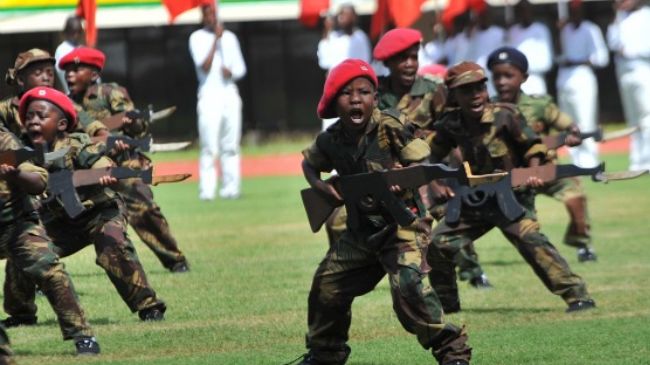
The Obama administration has waived nearly all US sanctions against countries using child soldiers despite a recent executive order to fight human trafficking.
US President Barack Obama issued a presidential memorandum on Friday waiving sanctions under the Child Soldiers Protection Act of 2008 for Libya, South Sudan and Yemen that Congress legislated to halt US arms sales to countries that are “worst abusers of child soldiers in their militaries,” the US-based periodical Foreign Policy reports Tuesday.
According to the report, Obama also partially waived penalties against the Democratic Republic of the Congo in an effort to allow continued military training and arms sales to the African country.
Angered by Washington’s move, human rights activists say the waivers are damaging to the aim of using US influence to discourage nations that get American military support from using child soldiers. They also insist the measure contradicts the rhetoric Obama used in a speech he delivered on Friday when signing the executive order.
“When a little boy is kidnapped, turned into a child soldier, forced to kill or be killed — that’s slavery,” Obama claimed during his address. “It is barbaric, and it is evil, and it has no place in a civilized world. Now, as a nation, we’ve long rejected such cruelty.”
Many among the American human rights community are upset that despite such forceful oratory against the use of child soldiers, the US president has waived for the third consecutive years all penalties against states that are major abusers of the human rights violation.
“After such a strong statement against the exploitation of children, it seems bizarre that Obama would give a pass to countries using children in their armed forces and using U.S. tax money to do that,” said Jesse Eaves, the senior policy advisor for child protection at World Vision, as quoted in the report.
Eaves insists that the Obama administration wants to maintain its ties with regimes that it needs for security cooperation and that such blanket use of US waivers allows the administration to avert the objective of the law, which was supposedly to uphold internationally recognized human rights and child protection protocols when dishing out American military aid to other nations.
“The intent in this law was to use this waiver authority only in extreme circumstances, yet this has become an annual thing and this has become the default of this administration,” Eaves was quoted as saying in the report.
According to the periodical, Obama first waived the sanctions in 2010, the first year they were to go into effect. At the time, the White House failed to inform Congress of its decision in advance, triggering a strong backlash. A reported justification memo pointed to a number of security-related excuses for the waivers. Sudan was going through a fragile transition, for instance. Yemen was crucial to counterterrorism cooperation, the administration argued.
Related articles
- Obama waives sanctions on countries that use child soldiers (thecable.foreignpolicy.com)
- Obama Demands Right to Recruit Minors for Military (infowars)
- White House Says Child Soldiers Are Ok, if They Fight Terrorists (alethonews)
‘Most transparent administration’ violates federal transparency laws
RT | September 28, 2012
Nineteen out of 20 cabinet-level agencies under the Obama administration have failed to follow the requirements of the Freedom of Information Act, thereby disobeying the law that demands disclosure of public information.
White House Chief of Staff Jack Lew said in July that the Obama administration “has been the most transparent ever.” But an analysis of government requests filed by Bloomberg News has found an alarming number of transparency violations, particularly when it comes to the taxpayer-funded cost of travel by top officials.
“When it comes to implementation of Obama’s wonderful transparency policy goals, especially FOIA policy in particular, there has been far more ‘talk the talk’ rather than ‘walk the walk,’’ Daniel Metcalfe, director of the Department of Justice’s office monitoring the government’s compliance with FOIA requests, told the news agency.
In 2009, the newly sworn in President Obama promised a new standard of transparency that his administration has not upheld – even accepting awards for what he oversaw as “the most transparent administration in history.”
“I will hold myself as president to a new standard of openness… Let me say it as simply as I can: Transparency and the rule of law will be the touchstones of this presidency,” he said while welcoming his senior staff and cabinet secretaries to his office. Two years later, the administration continued to boast about its supposed transparency.
“This president has demonstrated a commitment to transparency and openness that is greater than any administration has shown in the past, and he’s been committed to that since he ran for president and he’s taken a significant number of measures to demonstrate that,” White House Press Secretary Jay Carney said in May 2011, before the president accepted an award for transparency.
But Bloomberg’s report highlights specific instances in which secrecy was a normal part of the regime. Under FOIA, the news agency requested documents from 57 federal agencies regarding taxpayer-funded travel. Only eight of 57 agencies responded within the 20-day time frame required by the Act. The other agencies are under violation of FOIA for failing to submit the documents on time.
And Eric Newtown, senior advisor at the Knight Foundation, said there should be no excuses.
“In a 24/7 world, it should take two days, it should take two hours,” he said. “If it’s public, it should be just there.”
Bloomberg eventually received documents disclosing fiscal year 2011 travel costs from about half of the agencies, although most came well past the legal deadline.
Travel costs by top Obama officials, including the transportation secretary, energy secretary, environmental protection agency administrator and homeland security chief, remain undisclosed.
The lack of public disclosure regarding travel costs of many cabinet-level top officials has become concerning since the General Services Administration’s inspector general spent $823,000 of taxpayer money on a one-day event in Las Vegas in 2010.
Another one of Bloomberg’s FOIA request also found that federal agencies have increased their use of exemptions to block the release of information under the Obama administration. Cabinet agencies employed exemptions 466,402 times during Obama’s first year in office, which is a 50 percent jump from the last year of George W. Bush’s presidency.
“I don’t think the administration has been very good at all on open-government issues,” said Katherine Meyer, a Washington attorney. “The Obama administration is as bad as any of them, and to some extent worse.”
Related articles
Americans already detained under NDAA?
RT | September 28, 2012
The plaintiffs that are suing US President Barack Obama over his insistence on keeping the National Defense Authorization Act on the books said Thursday that they fear Americans are already being held indefinitely and without trial under the NDAA.
US President Barack Obama refrained from even once commenting on his efforts to keep his power to indefinitely detain Americans without charge when he appeared on Reddit.com recently and urged users to “Ask Me Anything.” His opponents in the matter aren’t shying away from speaking up online, though.
The plaintiffs in the case to ban the White House from imprisoning Americans indefinitely without trial or due justice took to Reddit on Thursday to answer questions involving the National Defense Authorization Act of Fiscal Year 2012, or the NDAA, and blamed corrupt media and a broken governmental establishment for letting the Obama administration maintain its [power] to book Americans in military prisons without charge.
On December 31, 2011, President Obama authorized the NDAA, and with it he approved a controversial provision that permits the government to indefinitely detain US citizens without trial for mere allegations of ties to suspected terrorists. Journalists and activists filed a lawsuit against the president earlier this year over the provision, Section 1021, which US Federal Judge Katherine Forrest in turn agreed was unconstitutional. Last month Judge Forrest decided that an earlier, temporary injunction on the clause should be made permanent, but the Obama Justice Department pleaded for an emergency stay only hours later. A lone federal appeals judge has since heard that plea and has momentarily blocked Judge Forrest’s injunction. Now pending the results of an appeals panel’s formal investigation, the NDAA’s indefinite detention provision remains on the books.
On Thursday, the plaintiffs in the case — journalist Chris Hedges, activist Tangerine Bolen, Pentagon Papers leaker Dan Ellsberg, their attorneys and others — told users of Reddit to ask them anything.
“The Obama DOJ has vigorously opposed these efforts, and immediately appealed her ruling and requested an emergency stay on the injunction – claiming the US would incur ‘irreparable harm’ if the president lost the power to use Section 1021 – and detain anyone, anywhere until the end of hostilities on a whim. This case will probably make its way to the Supreme Court,” the plaintiffs acknowledged in their introduction.
From there, President Obama’s opponents in federal court combed through hundreds of posts to answer questions regarding the NDAA over the course of several hours. And although the plaintiffs have not exactly been silent with the status of their fight since suing the White House earlier this year, the insight they offered on Reddit provided a fresh update on the case against the NDAA amid some of the government’s most unusual legal maneuvers yet.
Offering his take on the case, Hedges said that he even believes the NDAA’s indefinite detention clause is already being used to imprison Americans, “because they filed an emergency appeal.”
“If the Obama administration simply appealed it, as we expected, it would have raised this red flag,” Hedges added. “But since they were so aggressive it means that once Judge Forrest declared the law invalid, if they were using it, as we expect, they could be held in contempt of court. This was quite disturbing, for it means, I suspect, that US citizens, probably dual nationals, are being held in military detention facilities almost certainly overseas and maybe at home.”
“The signing statement is the most ridiculous part to this for me. He writes this statement saying he’s not happy about the power existing, but then his administration fights so hard to keep that specific power in place,” a Reddit user responded.
“If Obama didn’t want it to happen, he would not have signed it, especially after stating that he would veto it,” co-counsel Carl Mayer explained. Mayer has represented the plaintiffs in the case of Hedges v. Obama and said that he plans on continuing his pursuit to take indefinite detention off the books.
“We will do whatever it takes,” Mayers added. “We are prepared for a Supreme Court battle.”
Activist and journalist Tangerine Bolen is also insistent on prevailing over the Obama administration, but says “The biggest obstruction to our winning this case . . . is our broken systems.” Bolen blames a lack of media coverage, insufficient public awareness “and the government behaving very badly, even in court, on the record,” for the difficulties the plaintiffs have had to endure, adding that the Obama administration’s constant missteps have been noticed by no one except “seven plaintiffs, four attorneys, one federal judge and the activists who have been following this case.”
“Amazing,” she added.
Journalist Chris Hedges extrapolated on Bolen’s opinion, singling out “a corporate-owned system of information” for not informing Americans that they can be imprisoned without trial at this very moment.
“MSNBC, which is a propaganda arm of the Democratic establishment, just as Fox is a propaganda arm of the Republican establishment, is not going to raise this as Obama is as guilty as Romney. If we had a healthy press this would have gotten more coverage, although the print media, and in particular my old paper the NY Times, finally did good coverage,” Hedges wrote. […]
A three-judge appeals panel is expected to soon weigh in on the stay placed on Judge Forrest’s injunction, in the meantime keeping Section 1021 and the rest of the NDAA applicable to every American. – Full article
Related articles
- White House demands military prisons for Americans under NDAA (alethonews.wordpress.com)
- Obama Administration Argues That Blocking the NDAA’s Indefinite Detainment Provision Will Harm the U.S. (reason.com)
Featured Video

More Bombs, More Talks Zelensky Rejects Trump’s Plan
or go to
Aletho News Archives – Video-Images
Book Review
In 2007, Michael Parenti Called Out The Greater Israel Project

The Dissident | January 28, 2026
In my last article, I covered the left-wing scholar Michael Parenti- who passed away at the age of 92 this week- and his prophetic writings on the Ukraine proxy war in 2014.
Parenti’s writings on the Israel lobby and the greater Israel project were equally prophetic.
In his 2007 book “Contrary Notions” Parenti called out “Israel First” Neo-cons and Israel’s role in the Iraq war, and predicted to a tee the future Israeli/American wars in the Middle East in service of Greater Israel and the ethnic cleansing of Palestine.
In a section of the book aptly titled “Israel First”, Parenti wrote… continue
Blog Roll
Recent Comments
loongtip on Hamas never agreed to lay down… eddieb on Conspiracy Denial eddieb on WEF Calls for ‘Cultural Revolu… loongtip on Trump wanted to play peacemake… Coronistan on EU member to sue bloc over ‘su… loongtip on Vicious loongtip on EU turns to India for defense… Coronistan on Donald Trump Is No Peace … seversonebcfb985d9 on French court jails pro-Palesti… eddieb on Fourteen Incredible Facts Abou… Bill Francis on European leaders’ shift in the… seversonebcfb985d9 on Villains of Judea: Philip Esfo…


 Aletho News
- Europeans oppose Brussels’ Russian energy ban, survey finds
- Russia Vows to Protect Its Oil Tankers
- In 2007, Michael Parenti Called Out The Greater Israel Project
- Hamas never agreed to lay down arms in truce talks: Official
- Iran, China and Russia sign trilateral strategic pact
- After Years Of Denial, The IDF Admits The Gaza Health Ministry’s Numbers Are Accurate
- Riyadh and Hezbollah: A rapprochement forged in fire
- Criminal Conspiracy: How the U.S. and Israel Turned Iran into a Proving Ground for Bloody Experiments
- EU labels Iran’s Revolutionary Guard ‘terrorist organization’
- Security Guarantees Supported by Russia Agreed on in Istanbul in 2022 – Lavrov
- If Americans Knew
- Playful Post on Tel Aviv Park Omits That It Was Built on Ruins of Palestinian Neighborhood
- Palestinian developer gains massive user support for app challenging censorship claims criticising US and Israel after losing over 60 relatives in Gaza
- Gaza’s ‘Board of Peace’ – A New Phase of Palestinian Dispossession and Genocide
- Mike Huckabee is interfering with the work and witness of churches in the Holy Land with a goal of silencing Palestinian Christians
- “Hey ChatGPT, is Israel building a concentration camp?” (spoiler: yes) – Not a ceasefire Day 111
- “The Gaza ceasefire is a minefield” – Not a ceasefire Day 110
- Israel to seek new security deal from US, official says
- Leaked “Board of Peace” Resolution Outlines U.S.-Led Plan to Rule Over Gaza
- Jonathan Greenblatt Rolls Out Plan to Activate Hispanic Evangelical Golems
- Violence against hundreds of Gazan remains to find one Israeli – Not a ceasefire Day 109
- No Tricks Zone
- 130 Years Later: The CO2 Greenhouse Effect Is Still Only An Imaginary-World Thought Experiment
- New Study Affirms Rising CO2’s Greening Impact Across India – A Region With No Net Warming In 75 Years
- Germany’s Natural Gas Crisis Escalates … One Storage Site Near Empty …Government Silent
- Polar Colding…Antarctica Saw Its Coldest October In 44 Years!
- New Study: Sea Levels Rose 20 Times The Modern Rate During The Roman Warm Period
- As German Gas Storage Dips Dangerously Low…Shortage Hardly Avoidable
- New Study: Brazil’s Relative Sea Level Was 2+ Meters Higher And SSTs 3-4°C Warmer 6000 Years Ago
- Philosopher Schopenhauer: Climate Science Certainty Stems From Stupidity, Ignorance
- New Study: Species Extinction Rates Declining Since 1980 – ‘Climate Change Is Not An Important Threat’
- Denmark Places Climate Protection Above Animal Welfare, Poisoning And Culling Cows
 Aletho News