Tata Group’s ties with Israel: How Indian capital fuels occupation and genocide
By Ranjan Solomon | MEMO | November 6, 2025
The mask of modernity
For over a century, the Tata Group has been celebrated as the conscience of Indian capitalism — a family of companies that fused profit with philanthropy, progress with ethics. To millions of Indians, “Tata” evokes trust: a brand woven into the very narrative of modern India. Yet behind this carefully cultivated image of virtue lies a darker reality – one that now links Tata directly to the Israeli war machine devastating Gaza.
A new report released by the U.S.-based South Asian collective Salam, titled “Architects of Occupation: The Tata Group, Indian Capital, and the India–Israel Alliance,” alleges that Tata is “at the heart” of the India–Israel military partnership and is “fundamentally embedded in the architecture of occupation, surveillance, and dispossession.” TRT World’s coverage of the report further details how the conglomerate’s various subsidiaries feed directly into Israel’s military-industrial complex.
The findings: A web of complicity
The report identifies several subsidiaries of the Tata Group as active participants in Israel’s defence and security ecosystem.
Tata Advanced Systems Limited (TASL), one of India’s largest private defence manufacturers, has long-standing partnerships with Israel Aerospace Industries (IAI). Together, they manufacture key components for the Barak-8 surface-to-air missile system, which forms the backbone of Israel’s naval defence and is used in strikes on Gaza. TASL also produces aerostructures for F-16 fighter jets and fuselages for Apache attack helicopters, both extensively deployed by the Israeli Air Force.
Jaguar Land Rover (JLR), another Tata subsidiary, is alleged to provide the chassis for MDT David light armoured vehicles used by Israeli forces in West Bank patrols and urban crowd-suppression.
Tata Consultancy Services (TCS), the IT giant, is reportedly involved in building digital infrastructure for Israel’s governmental and financial sectors, including participation in Project Nimbus — the controversial cloud-computing contract co-run by Google and Amazon that facilitates Israeli state surveillance.
The Salam report argues that these are not isolated commercial arrangements but part of a systemic integration of Indian capital within Israel’s “occupation economy.”
Tata’s public sponsorship of global events, such as the New York City Marathon, is described as “sports-washing” — a means of masking its participation in war profiteering behind gestures of global modernity and social responsibility. Despite repeated inquiries, Tata Group has not issued a public response to the allegations.
From state to corporation: The India–Israel nexus
Tata’s complicity does not exist in a vacuum. It is the corporate mirror of a larger state transformation in India’s foreign and defence policy.
Since the 1990s, and more assertively under Narendra Modi, India has shifted from quiet engagement with Israel to a full-blown strategic partnership. India is now the largest buyer of Israeli arms, accounting for roughly 40–45 per cent of Israel’s defence exports.
Joint ventures proliferate:
- The Barak-8 missile project, co-developed by DRDO and IAI, is assembled in part at Tata facilities.
- India’s purchase of Heron drones, Phalcon AWACS systems, and Spike anti-tank missiles are products of the same industrial network that sustains Israel’s occupation of Palestine.
- Several of these systems are used by India in Kashmir, linking one occupation to another — and revealing a disturbing symmetry between the surveillance of Palestinians and Kashmiris.
In this geopolitical alignment, Hindutva nationalism and Zionism converge on the ideological front. Both justify domination through a rhetoric of “security” and “counter-terrorism.” Both normalise militarism as a form of patriotism. And both have turned their societies into laboratories of digital surveillance and ethno-religious control.
Thus, the Tata Group’s partnerships are not merely commercial. They are the economic expression of a shared political project — where corporate capital, state power, and ideology intertwine.
Corporate complicity and ethical evasion
Tata is hardly alone. Global corporations have long buttressed the Israeli state’s apparatus of control. Hewlett-Packard, Caterpillar, and now Google and Amazon have all been accused of enabling occupation and surveillance. What makes Tata’s case particularly striking is its moral posture.
A company that invokes Gandhi and philanthropy in its advertising now profits from an economy of death. Its own code of conduct commits it to the UN Guiding Principles on Business and Human Rights, which prohibit participation in human-rights violations. Yet there is no visible accountability mechanism — no disclosure of its defence revenues, no public audit of ethical compliance, and no internal oversight on the human impact of its contracts.
The Salam report calls this “ethical evasion through corporate nationalism”: the idea that Indian companies can deflect scrutiny by invoking patriotism and “Make in India” rhetoric. This is a convenient cover for profiteering from war.
Silence and complicity in India
Mainstream Indian media have barely reported on the Tata revelations. Nor has the Indian government shown any interest in investigating them. On the contrary, officials continue to trumpet the India–Israel “strategic embrace” as a model of technological progress.
Civil society, too, has grown hesitant. Decades ago, India was a vocal defender of the Palestinian cause. Today, solidarity has been replaced by silence, fear, and a dangerous normalization of genocide. Universities that once hosted discussions on occupation now avoid the subject. Protesters risk arrest under draconian laws.
The corporate capture of conscience mirrors a broader moral collapse in public life.
What accountability looks like
International law is clear: any company knowingly supplying equipment or services that enable war crimes may be complicit in those crimes. The Rome Statute of the International Criminal Court and the UN Guiding Principles both outline corporate responsibilities in situations of armed conflict.
Tata’s alleged manufacturing of components for weapons used in Gaza should therefore be subject to independent investigation. Investors, trade unions, and consumers have the right — and duty — to demand transparency.
There are precedents: in the 1980s, global campaigns pressured companies to divest from apartheid South Africa. A similar moral movement must emerge against those profiteering from Israeli apartheid. The boycott, divestment, and sanctions (BDS) campaign is one such call, and Indian civil society should not remain absent from it.
When conscience is outsourced
Tata’s silence in the face of genocide is not just a corporate failure; it reflects the hollowness of India’s moral claim to be the land of Gandhi. What remains of that heritage when its flagship corporation contributes to the machinery of ethnic cleansing?
As Gaza’s children starve and entire families are buried under rubble, the Tata empire continues to sell technology to the state that kills them — while its advertisements preach compassion and “building a better tomorrow.”
No nation can claim moral leadership while its corporations build profit from the blood of the oppressed. The time for polite silence is over. India must confront what it has become — and reclaim the humanity it once pledged to the world.
NATO chief urges West to prepare for long-term confrontation with Russia
RT | November 6, 2025
NATO member-states must boost military production to be ready for a prolonged standoff with Russia, China, Iran, and North Korea, which are challenging the “global rules,” the bloc’s secretary-general, Mark Rutte, has said.
Speaking to Western defense contractors at the NATO-Industry Forum in Bucharest on Thursday, Rutte told the bloc’s arms makers that “there is more cash on the table and even more will flow” amid NATO’s rearmament push.
Moscow has rejected claims it harbors any aggressive intentions towards the US-led military bloc, saying such allegations are being used by politicians in the US and EU to scare the populations and justify huge increases in military spending. Russia also believes that NATO’s deepening involvement in Ukraine was instrumental in escalating the conflict in 2022.
Rutte labeled the fighting between Moscow and Kiev a “threat” to the bloc and he claimed that “the danger posed by Russia will not end when this war does. For the foreseeable future, Russia will remain a destabilizing force in Europe and the world.”
“And Russia is not alone in its efforts to undermine the global rules. As you know, it is working with China, with North Korea, with Iran, and others. They are increasing their defense industrial collaboration to unprecedented levels. They are preparing for long-term confrontation,” the secretary-general said.
He noted the pledge by NATO members to hike military spending to 5% of GDP by 2035, but claimed that “cash alone cannot provide security. We need the capabilities. We need the equipment, real firepower, and of course… the most advanced tech.” This would require the bloc’s defense industry “increasing production and shortening delivery times,” Rutte stressed.
Russian Foreign Ministry spokeswoman Maria Zakharova reacted to Rutte’s comments by asking him to clarify what “global rules” he was talking about and publish their “full list” on NATO’s website.
Moscow, Beijing, and the rest of “the global majority, have always declared their commitment to international law, while NATO has repeatedly violated this law with its aggressive actions and illegitimate coalitions: the invasion of Iraq under false pretenses, the bombing of Yugoslavia, and so on,” Zakharova wrote on Telegram.
Norbert Bolz: ‘The EU has become a monster’
Those who fight against Brussels ‘are not anti-Europeans, but good Europeans’
Weltwoche | October 19, 2025
The European Union has become a “monster” that is increasingly undermining freedom and democracy—this is the criticism leveled by media scholar Norbert Bolz in an opinion piece for the newspaper Die Welt. He argues that the EU is no longer a community of free states, but a centralized “machine that constantly produces regulations and prohibitions,” which follows a “script” reminiscent of Kafka and Orwell.
Bolz, a professor emeritus and one of Germany’s most prominent conservative intellectuals, sees the original idea of a peaceful and economically united Europe as having been perverted. What began with free trade and freedom of movement has been replaced by bureaucratization, a lack of transparency, and authoritarian tendencies. As a concrete example, he cites the Digital Services Act and the planned chat surveillance: “This is about the methods of a totalitarian surveillance state that reads private communications and thus destroys privacy and freedom of expression.”
At the center of his criticism is EU Commission President Ursula von der Leyen. For Bolz, she embodies the “cold German face of a failed Europe.” He finds it particularly outrageous that she refuses to disclose the text messages she exchanged with the Pfizer CEO during the coronavirus pandemic.
Furthermore, he states that the EU lacks democratic legitimacy. “There is no separation of powers and no democracy,” writes Bolz. He contends that Brussels serves as a lever to push through nationally unpopular measures—for example, in the name of climate protection and corporate social responsibility. This practice enables left-wing and green parties, in particular, to circumvent the political will of their own populations.
According to Bolz, those who rebel against this development are not anti-Europeans, but good Europeans.
New Hungarian play shows key Orbán ally locked in box and beaten to death
By Liz Heflin | Remix News | October 29, 2025
A new play in Budapest, written and directed by Béla Pintér, shows a character being put in a box and beaten to death.
As graphic and perhaps unappealing as that may be for many theater-goers, there is an even bigger problem with “Kabuki”: Everyone agrees the character is made up to look like Maria Schmidt, a major ally of Hungarian PM Viktor Orbán and director of a few institutions, namely, the 20th Century Institute, the 21st Century Institute, and the House of Terror Museum.
As the opposition-friendly portal 444 wrote: “But then everything gets really rough when the Fidesz oligarch, Schanda (!) Vera, who looks like Mária Schmidt, asks the poet to be their party’s candidate. The man (…) reluctantly admits that he is unable to run, as he finds the way the government party is treating the martyred (Russian opposition leader) Alexei Navalny so outrageous. The woman is completely upset about this, as she doesn’t think Navalny is worth anything and believes that Russia has free elections, unlike the West.”
The portal continues, stating that “the woman annoys him so much” that he “throws her into a large box and beats her to death with a stick.”
One commentary in Mandiner hit home as to the boundaries being crossed “in the name of art.”
“Béla Pintér’s latest play, in which the beating of the director of the House of Terror Museum is played out on stage, is not art: it is at once hate speech, political incitement, and moral corruption. The play doesn’t make you think, it doesn’t invite dialogue – it just hits you. Both literally and figuratively.
“For someone to dramatize the death of a living, public figure and elevate it to a theatrical experience is not a brave gesture, but a tasteless, inhumane provocation,” wrote Katalin Szily, a member of Fidesz’s coalition partner, KDNP.
“Béla Pintér and his company have now abused this responsibility. This is not satire, not social criticism, but cold cynicism and intellectual vandalism. And the viewer, who watches and applauds, unwittingly becomes part of this ritual of hatred,” she continued.
“Where is the line? Where do we draw the line? Tomorrow, maybe they’ll stage the execution of politicians and journalists and applaud?”
Szily also poignantly asks, “Where, oh where, are the voices in the name female solidarity?”
Author Gabor Bokor also wrote: “Béla Pintér is an important figure in the Hungarian theater world, a pioneer of alternative stage plays, with which he has gained many fans.”
“We can think whatever we want about Mária Schmidt’s statements, we can criticize her in a play, this is part of artistic freedom, but I beg you: Kill her?” he asks.
Germany on the Geopolitical Stage of the Global South: Between Media Image and Real Capacities
By Ramiz Khodzhatov – New Eastern Outlook – October 21, 2025
The attempts of Friedrich Merz’s government to “relaunch” Germany’s role as a global political actor in the Global South without revising its conceptual foundations risk leaving the country stranded on the margins of international diplomacy – caught between formal participation and substantive isolation.
The Gaza Summit and the New Security Architecture
On October 13, 2025, under the auspices of President Abdel Fattah al-Sisi, a peace summit on Gaza took place in Sharm el-Sheikh, Egypt. The event, co-chaired by U.S. President Donald Trump, gathered representatives from over twenty nations to observe and validate the signing of the first phase of the American initiative for conflict resolution. Egypt and the United States, alongside Qatar and Turkey, acted as the principal mediators of the emerging architecture of multilateral diplomacy. Serving both as brokers of the ceasefire and as the de jure guarantors of the “Declaration on Lasting Peace and Prosperity,” they oversaw a framework that encompassed bilateral agreements on the release of hostages and prisoners, coordination of humanitarian aid, and a detailed roadmap for demilitarization and post-conflict reconstruction of Gaza’s infrastructure.
A wave of criticism followed the paradoxical absence of the conflict’s key parties, the Israeli cabinet and Hamas. At the same time, attention focused on the participation of several unorthodox players in the Middle Eastern geopolitical arena, notably the United Kingdom, France, and Germany. The German presence drew disproportionate attention due to an evident dissonance between its media portrayal and its actual diplomatic standing. Chancellor Friedrich Merz, standing to the side of the main participants, appeared frozen in an uneasy, almost constrained posture, smiling politely yet refraining from engaging any of the leaders. The image quickly spread through German and international media, sparking debate. This scene became emblematic of Berlin’s uncertain role within the emerging security architecture. The question arises: what position does Germany seek to claim, and why, despite shifting geopolitical realities and the lessons of history, it risks remaining a “paper player,” bereft of real influence or credibility across the Global South and the Middle East?
From “Feminist Foreign Policy” to the Merz Plan
To understand Germany’s current trajectory, one must revisit the recent phase of its foreign policy. Under Chancellor Scholz and Foreign Minister Annalena Baerbock, diplomacy was anchored in the doctrine of so-called “feminist foreign policy,” framed as a flagship direction of global engagement. Yet in practice, this approach revealed its conceptual inadequacy. Its normative and universalist foundations clashed with the political cultures and socio-cultural frameworks of the Global South. Gender and humanitarian rhetoric, imported indiscriminately into conflict zones, failed to take root, particularly when juxtaposed with Western double standards evident in the humanitarian catastrophe of Gaza.
Another blow to Berlin’s image came from its insistence on the “green agenda” as an alternative to traditional energy models. Amid a domestic energy crisis, this stance not only weakened Germany’s position in international negotiations but also eroded its reputation as a reliable and autonomous economic actor. To many states of the Global South, German initiatives in climate and energy diplomacy appeared declarative and unsupported by functional mechanisms.
Against this backdrop, Russia’s advocacy of “multipolarity” gained increasing traction, widely perceived as an attractive alternative to the neo-colonial logic of the West. Moscow succeeded in institutionalizing this discourse through frameworks such as BRICS, which evolved into both an economic and symbolic vehicle of a new international subjectivity. Germany and its European partners failed to propose an equivalent model, thereby cementing their peripheral status in dialogue with the Global South.
The Old–New Architecture of Irrelevance
Despite its declining relevance, Berlin continues to undertake institutional steps aimed at restoring its international agency. Notable measures include expanding humanitarian assistance, covering medical support and the establishment of temporary camps for displaced persons—participating in prospective Palestinian self-governance structures, co-organizing an international conference on Gaza’s reconstruction, and devising instruments for monitoring and coordinating humanitarian aid. Germany aspires to act not merely as a donor but as a mediator, presenting itself simultaneously as a humanitarian and political broker.
However, these ambitions collide with structural constraints. Key mechanisms for monitoring, hostage exchange, and aid distribution depend on the consent of regional actors who, tellingly, were absent from the summit. Germany’s declarative and instrumental efforts to secure influence falter against the realities of local political culture, where situational alliances, pragmatism, and realpolitik shape diplomacy far more than normative idealism. Berlin still relies on a logic of moral universalism inherited from previous decades, cloaked in new labels and narratives yet perpetuating the same disconnect between ambition and capability.
This pattern mirrors the systemic flaws observed during Baerbock’s “feminist foreign policy.” The persistent refusal to engage with regional geopolitical realities produces a gap between Germany’s ambitions and its actual leverage. The now-famous image from Sharm el-Sheikh thus becomes a visual metaphor for deeper structural dysfunction: the fragmentation of the Western course, wherein the American line retains strategic dominance while Europe’s voice fades amid inconsistency and moral self-contradiction.
The declarative support for Israel expressed by the Merz cabinet within the Middle East peace process has triggered a crisis of trust toward Germany as a would-be neutral actor. Rooted in the concept of Staatsräson and the moral logic of historical atonement, this stance increasingly contradicts the disposition of public opinion. Recent YouGov data reveal that 62% of Germans consider Israel’s actions in Gaza an act of genocide, a view shared across party lines, including 60% of supporters of Merz’s CDU/CSU bloc. Over two-thirds of the population now hold a negative view of Israel, while sympathizers account for only 19%. Support for Palestinian recognition has climbed to 44%. This gap between domestic consensus and foreign policy undermines the legitimacy of Germany’s global agency and weakens its credibility as an impartial mediator.
Internationally, the erosion of trust is even more pronounced. Since 2023, Germany has increasingly been seen across the Global South and the Middle East as a partisan ally that has abandoned neutrality for rigid pro-Israeli alignment. Decisions such as boosting arms supplies to Tel Aviv and abstaining from U.N. ceasefire resolutions are widely interpreted in Arab and African contexts as emblematic of Western double standards. Meanwhile, as several EU states, including Spain, Ireland, and Norway, have recognized Palestine, Germany finds itself isolated even within Europe. This loss of trust is quantifiable: Arab Barometer surveys show Germany’s favorable rating in the Middle East has plunged from 70% to 35% over just two years.
The position intended to affirm moral leadership has, paradoxically, curtailed Berlin’s diplomatic efficacy. Bereft of real leverage, Germany remains a participant without presence – a formally engaged yet substantively excluded actor on the geopolitical stage of the Global South.
Friedrich Merz’s attempt to “reboot” German foreign policy reveals a structural impasse: institutional innovations without conceptual transformation cannot yield genuine agency. Without a fundamental rethinking of its diplomatic worldview, Germany risks remaining on the periphery of international affairs, caught between symbolic involvement and strategic irrelevance. The image from Sharm el-Sheikh may thus endure as more than a fleeting moment of awkwardness, it embodies Berlin’s broader crisis of orientation in an increasingly multipolar world.
Ramiz Khodzhatov – political scientist, international observer, expert in geopolitics, international security and Russian-German relations
Iranian strike hit secret Israeli-US military bunker beneath Tel Aviv tower: Report
Press TV | October 14, 2025
An investigation by The Grayzone has revealed that Iran’s June 13 missile strike on Tel Aviv directly hit a secret underground military command center jointly operated by Israel and the United States, buried beneath a luxury apartment complex in the heart of the city.
According to geolocation analysis, leaked emails, and public records, the bunker, known as “Site 81”, is located underneath the Da Vinci Towers, a high-end residential and office complex built over what was once a ministry compound.
The facility reportedly serves as a command and control node for Israeli military intelligence, with US Army engineers having overseen its construction over a decade ago.
When Iranian missiles struck multiple locations across north Tel Aviv in June, Israeli authorities immediately sealed off the impact zone and prevented journalists from filming.
Fox News correspondent Trey Yingst was among those forced away by police near the HaKirya compound and the Azrieli Center.
Hours later, Iranian state media announced that military and intelligence targets had been precisely hit in retaliation for earlier Israeli strikes on Iranian soil.
The Grayzone report links the Da Vinci complex to a 2013 US Army Corps of Engineers project that expanded “Site 81” into a 6,000-square-meter electromagnetically shielded intelligence facility.
A photo from the US Army study was geolocated to the site using surrounding landmarks such as the Kannarit (Canarit) Air Force towers, located just meters away.
The site is less than 100 meters from a children’s playground and a community center, raising concerns that Israel embedded a sensitive military installation within a densely populated area, effectively using civilians as human shields, a practice Israel has long accused Palestinians of engaging in.
Satellite imagery of the area remains blurred on Google and Yandex Maps, with no street-view access, suggesting ongoing censorship of strategic sites inside Tel Aviv.
Leaked correspondence obtained by The Grayzone between former NATO Commander James Stavridis and former Israeli military chief Gabi Ashkenazi confirms that the bunker served as a command and control hub for Israel’s military network.
In the 2015 exchange, Stavridis mentioned a US company, ThinkLogical, which had “won a big contract out at Site 81 with the IDF.”
The Da Vinci complex and its surrounding towers were financed by a web of Israeli-American investors and firms with close ties to the Israeli security establishment, including Check Point Technologies and AI21 Labs, the latter founded by veterans of Israel’s Unit 8200, the military’s elite signals intelligence corps.
France 24’s analysis of post-strike coverage highlighted Israeli censorship, with Haaretz delaying reports on the Da Vinci hit by two weeks despite circulating images.
The pirates of Israeli supremacy: The West’s favorite rogue state has done it again
By Tarik Cyril Amar | RT | October 2, 2025
The long-expected if perfectly criminal has happened again: Israel’s navy has intercepted the Gaza-bound Sumud Flotilla by force, stopping almost 50 boats and, in effect, kidnapping hundreds of their crews and passengers.
In terms of law – which, of course, are never really applied in practice to Israel – everything is exceedingly clear: The Sumud Flotilla was a volunteer operation to bring humanitarian aid to Gaza which has been subjected to Israeli genocide for now almost two years. Israel had a clear obligation to let that aid pass.
But then what to expect from the world’s most aggressive rogue state that is not “only” committing genocide, but also waging regional wars of aggression and running terrorist assassination campaigns in the face of the global public? And Israel has a well-established track-record of this kind of piracy, of course, having stopped several attempts to bring aid by sea since 2010, sometimes with casualties among the humanitarian activists.
Stopping the Sumud Flotilla wasn’t merely criminal but criminal in every regard lawyers can imagine, a typical Israeli super-whopper of legal nihilism: Israel attacked the flotilla ships in international waters where it has no jurisdiction. Even if the ships had gotten closer to the Gaza coast, they would, by the way, still not have been inside any Israeli territorial waters because there are no such waters off Gaza, over which Israel has no sovereignty as clearly confirmed by the International Court of Justice last year. What you find off the coast of Gaza, as a matter of fact, are Palestinian territorial waters.
The blockade of Gaza, which has lasted not “merely” for the duration of the current high-intensity genocide-ethnic cleansing campaign but for close to two decades now, is illegal. Because the blockade has been in place for so long, Israel is simply lying – surprise, surprise – when arguing it is a short-term measure covered by the San Remo rules, which summarize “International Law Applicable to Armed Conflicts at Sea.” And even if those rules applied, under them as well Israel would have to let humanitarian aid through.
Finally, as Israel has attacked ships and citizens belonging to over 40 countries, Israel has committed aggression under international law against all of them and, less obvious but a fact, also crimes under each of these countries’ domestic laws, because they apply on those ships.
So far for the law, but then again, Israel is de facto outside and above the law. That much we have known for a long time. Indeed, Israel could not exist without constantly breaking international law and getting away with it. For Israel, lawlessness and impunity are not luxuries but vital necessities.
The reason why it has been able to exist in this manner is well-known, too: It is protected by the West and, in particular, the US. The latter is Israel’s single worst co-perpetrator, facilitating its crimes like no other state on Earth. Soon, for instance, the recent war of aggression waged by America and Israel together against Iran will probably be followed by a second, even worse assault.
In this regard, what has happened to the Sumud Flotilla has been a test: Clearly, recent moves by various Western governments, including the UK, France, and Australia to “recognize” – in an extremely dishonest manner – a Palestinian state and add some cautious rhetorical criticism of Israel make no difference to their absolute deference in practice to both Israel and its backers in the US.
What seemed like a glimmer of hope for a moment, the appearance of warships from various nations to apparently escort the humanitarian flotilla, has turned into just another humiliation: the escort abandoned their charges well in time to allow Israel a free hand.
The same Western leaders responsible for this cowardly retreat cannot stop waffling about the need not to “reward the aggressor,” when dialing up the war hysteria against Russia, as they have been doing mightily again recently, from mystery drones to declaring unconstitutional states of “not-peace” to chatter of states of emergency.
What about, for once, not rewarding the genocider for a change? But that’s hard, isn’t it? Once all Western governments are accomplices of Israel.
The Sumud Flotilla will not have been the last attempt to break both Israel’s genocidal blockade and its aura of impunity. There is hope, because even in NATO-EU Europe and the US ever more people understand what Israel really is and what it really does: a settler-colonial apartheid state that won’t stop committing genocide and ethnic cleansing. Israel’s systematic campaigns of propaganda and information war are escalating in response, as the case of TikTok has just demonstrated. But even Israel and its American friends cannot reverse history and an experience that the whole world has made. The Gaza Genocide is a fact already. It will not be forgotten. The resistance to Israel will never end.
Tarik Cyril Amar is a historian from Germany working at Koç University, Istanbul, on Russia, Ukraine, and Eastern Europe, the history of World War II, the cultural Cold War, and the politics of memory.
The Nature of hypocrisy: pharma-funded journals smearing independent voices
Nature alleges that I endanger public health, but it is the journal — steeped in pharma money — that ought to be looking inward.
By Maryanne Demasi, PhD | October 1, 2025
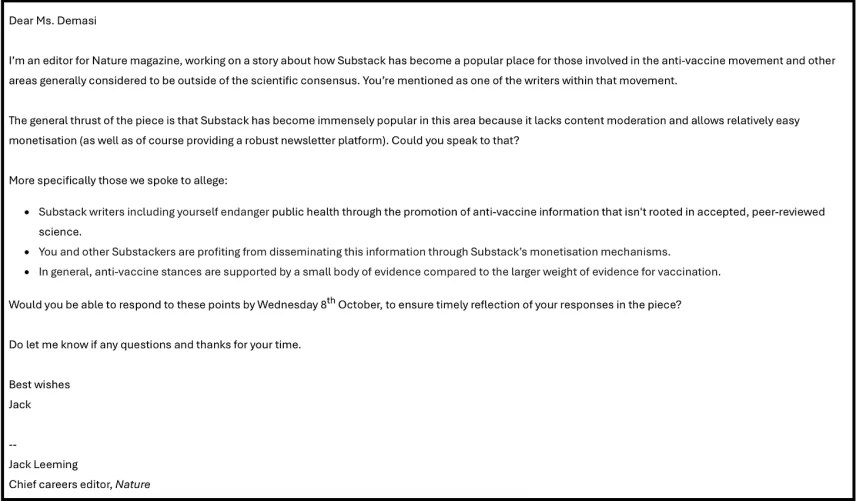
When an editor from Nature emailed me this week, it wasn’t a neutral request for comment. It was a prelude to a hit piece — filled with defamatory accusations and framed around a predetermined narrative.
According to the email, I was being lumped into an “anti-vaccine movement,” accused of “endangering public health,” and “profiting from disseminating misinformation.”
No evidence was provided. No articles were cited. No definition of “anti-vaccine” was offered. No complainants were named. Just blanket accusations intended as a character assassination.
Conflict of interest at the heart of Nature
And who is casting these stones?
Nature — a journal that publishes vaccine research while pocketing revenue from pharmaceutical advertising and sponsored content.
To then assign an editor to target independent journalists who scrutinise that very industry is a glaring conflict of interest.
A medical journal acting as both mouthpiece and judge of what counts as “misinformation” is like a tobacco company funding lung health studies while attacking anyone who questions them.
The hypocrisy is staggering.
On its own website, Nature boasts of partnerships with Johnson & Johnson, Merck, AstraZeneca and other vaccine companies, dressing them up as “pioneering collaborations” to “support science.” It even publishes paid advertising features.

Meanwhile, I’ve never taken a cent from the drug industry. My work is sustained by readers who choose to support independent journalism.
Yet Nature accuses me of “profiting” — as if being funded by the public is more corrupting than raking in thousands, if not millions, from the very companies you’re supposed to scrutinise.
To test how deep the rot runs, I’ve requested that Nature disclose its advertising revenue for the past decade, broken down by pharmaceutical corporations, government agencies, and NGOs.
I will publish those figures if and when they are provided.
Loaded language
Nature’s email branded me part of an “anti-vaccine movement.” But what does that actually mean?
Is questioning regulatory capture “anti-vaccine”?
Is demanding the timely publication of safety signals “anti-vaccine”?
Is exposing the failures of the vaccine injury compensation scheme “anti-vaccine”?
Is pointing out the poor oversight of vaccine trials “anti-vaccine”?
By that logic, critics of arsenic in drinking water would be “anti-arsenic,” and anyone calling for safer driving would be “anti-car.” The absurdity is obvious, yet the label is useful to silence debate.
And the email’s language was revealing.
Phrases like “scientific consensus” and “peer-reviewed science” are waved around like trump cards, but in practice they are red flags — appeals to authority rather than evidence.
‘Consensus’ can be manufactured. And ‘peer review’ is no shield against corruption when journals themselves are compromised.
I have documented journal–pharma ties, the retraction of inconvenient studies, and the use of pharma-funded “fact checks” masquerading as science to discredit politically uncomfortable findings.
So when an editor of Nature hides behind these clichés instead of addressing the evidence I present, it tells you everything. This isn’t about protecting science, it’s about protecting a narrative.
And I’m clearly not the only target.
Dr Robert Malone — also a Substack publisher and now a member of the CDC’s Advisory Committee on Immunisation Practice — received the same media request from Nature.
The journal’s smear campaign extends even to those who now sit on America’s top vaccine advisory body.
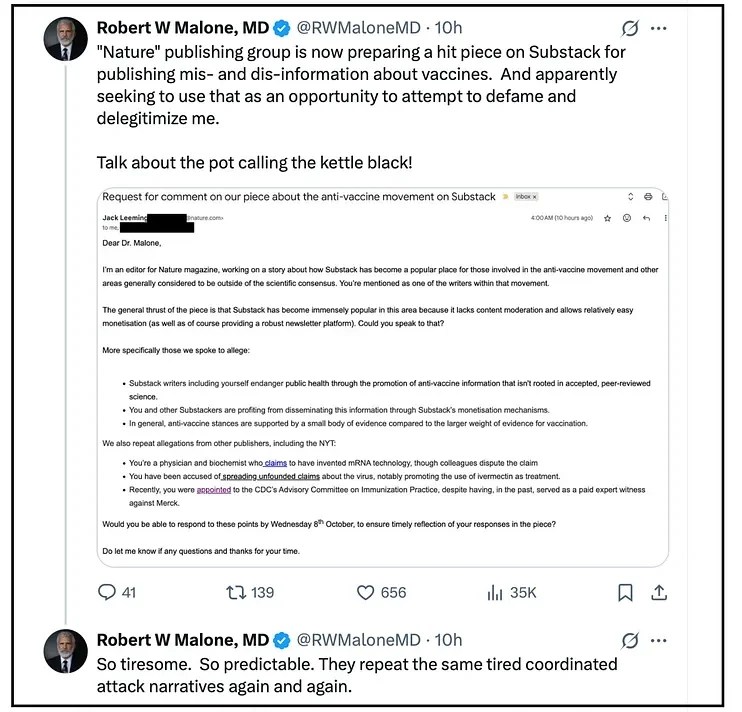
Nature insists that “anti-vaccine stances are supported by a small body of evidence compared to the larger weight of evidence for vaccination.”
But that’s probably because journals act as gatekeepers, blocking challenges to orthodoxy and shutting out novel viewpoints. Studies that raise concerns are rejected, buried or retracted, while industry-friendly findings sail through unopposed.
It isn’t the science that’s lacking — it’s the willingness of journals to let inconvenient results see the light of day. The house of cards is collapsing, and that is why the attacks on dissent are more aggressive than ever.
And those attacks often come from self-proclaimed experts who are themselves conflicted, embedded in institutions sustained by the teat of industry, and unwilling to disclose their own conflicts.
Pot calling the kettle black: the Proximal Origin scandal
Notably, while Nature postures as a guardian against “misinformation,” it bears responsibility for one of the pandemic’s most notorious scandals.
In March 2020, Nature Medicine — part of the Nature portfolio — published “The proximal origin of SARS-CoV-2,” which declared the virus could not have been engineered in a lab.
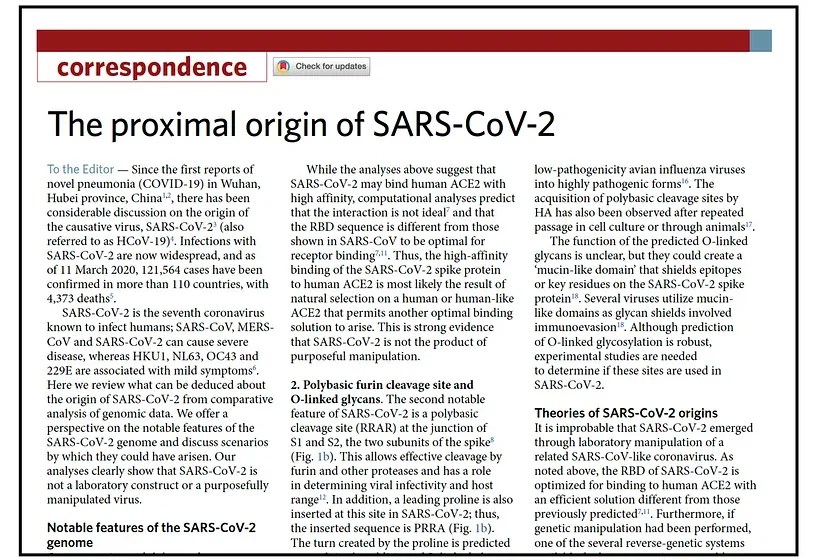
The paper was splashed across headlines and weaponised to dismiss the lab-leak theory as a “conspiracy.”
But private emails and Slack chats told another story. The authors harboured serious doubts and admitted a lab origin could not be ruled out.
Hundreds of scientists now call the paper a ‘political tract’ dressed up as science, and thousands have petitioned for its retraction. Yet Nature Medicine refuses, brushing it aside as a “point of view” piece.
If that isn’t misinformation, then what is?
Even the White House has distanced itself. Its website now acknowledges that the Proximal Origin paper was used to suppress debate, and alleges the authors were nudged by Dr Fauci to push the “preferred” zoonotic origin narrative.
Time for accountability
Make no mistake, this is ‘the system’ at work.
Powerful journals with financial ties to industry unleashing hatchet men to smear independent journalists and scientists, rather than engaging with evidence.
I won’t play along. My job is to hold institutions accountable, not to curry their favour. If Nature wants to brand that “misinformation,” so be it. History shows that today’s heresy is often tomorrow’s truth.
This goes to the heart of the corruption of medical publishing — a system Robert F. Kennedy Jr has repeatedly warned about, and one that now demands scrutiny at the highest levels.
With Dr Jay Bhattacharya at the helm of the National Institutes of Health, there is finally an opportunity to investigate the conflicts of interest, selective censorship, and financial entanglements that journals like Nature have normalised.
When those who profit from pharma partnerships claim the authority to police what lies “outside the scientific consensus,” public trust in science collapses.
And that collapse is not the fault of independent journalists asking hard questions. It is the fault of journals that serve industry interests over science.
Recognise a state and prevent it from existing?
By José Goulão | Strategic Culture Foundation | October 2, 2025
And suddenly, the overwhelming majority of countries in the so-called Collective West decided to recognise the State of Palestine. Among them were some of the most loyal allies of the Zionist regime and accomplices to its atrocities, such as France, the United Kingdom, Australia, Canada and even, despite its negligible specific weight, the government of the Portuguese Republic. We know that consistency is not the strong point of the Montenegro clique: recognition was declared just a few weeks after the Minister of Foreign Affairs, Paulo Rangel, went to bless the crimes of the Israeli regime, precisely at one of the most intense stages of human and physical devastation in the Gaza Strip.
Any reader will naturally wonder what has now led so many important countries, the guardians of “our civilisation”, to adopt a stance that they could, and should, have taken years ago. Was it the blatant and dramatic exposure of the decades-old genocide of the Palestinian people, which is ravaging the Gaza Strip and which the hypocrisy of fine words and the most beautiful intentions can no longer hide? Perhaps a little, although we should not attach too much importance to this response because shame is not something that abounds in Western governments.
Another reason, this one with a much more important political and strategic significance, is the certainty of all those making the declarations that their decision, apart from being couched in plenty of half-truths, has no practical effect on the real recognition of Palestinian rights and on the murderous conduct of the State of Israel. On the same days that the declarations of recognition were made, the Zionist Prime Minister, Benjamin Netanyahu, assured with complete conviction that there would never be a Palestinian state. This was a challenge to the attitudes of Western countries, which they received with the most devout silence.
And now?
The most relevant situation, and also the one that raises the most doubts about the genuineness of Western governments’ intentions regarding the restoration of the rights of the Palestinian people, is based on a simple question: What now?
Yes, what could these declarations of recognition of the State of Palestine change in the current situation, controlled by the fascist impulses of the Israeli government and the US administration, this time under Trump’s baton – as it could be, with the same effects, under Biden’s orders?
At first glance, they will change nothing. Colonial and expansionist arbitrariness continues unabated in East Jerusalem and from north to south in the West Bank, while the human and physical levelling of Gaza continues unhindered, except for the guerrilla pockets of Hamas.
Western governments have recognised an abstract state with no effective powers over what should be its territory, disappearing every day in the face of the genocidal advances of hordes of settlers imported from all over the planet. Are Western governments doing anything concrete to force Israel to stop colonisation? Are they stopping sending weapons to Israel? Are they considering imposing sanctions capable of suffocating a state run by a criminal clique that is incapable of living on its own?
So far, there is no indication that any of the Western powers are willing to take these steps, which are essential if any qualitative changes in the balance of power throughout Palestine are to lead to negotiations capable of defining the paths for establishing and applying international law in the region. This would imply that, at least in this case, Western leaders would have to put aside their bureaucratic adherence to the ‘rules-based international order’ defined in Washington. The truth is that no government seems willing to take this risk, which, in practice and under these conditions, reveals that recognising or not recognising the State of Palestine will amount to the same thing, that is, more of the same.
Recognise, yes, but…
Western governments have been careful (which opens the door to backtracking) not to recognise the State of Palestine unconditionally, thus continuing to put the strict application of the principles established by international law on hold. Endowed with authority and power granted by five centuries of colonial violence, which allowed them to invent an entity such as the State of Israel, Western governments have attached a series of conditions to the decision. Taken literally, these translate into recognition without recognition because they effectively limit the Palestinian people’s decision-making powers on matters that concern them and on which only they have the right to deliberate.
In a manoeuvre that transfigures much of what is positive about recognition, Western governments are attempting to breathe new life into Mahmoud Abbas’s moribund Palestinian Authority, confined to Ramallah, by giving it powers that it will be unable to exercise. They also demand its absolute surrender to Israel – a demand that is unnecessary in the situation that has been dragging on throughout this century – and they attribute sole responsibility for terrorism in Palestine to Hamas, while ignoring Israeli terror – disguised as ‘security’ and ‘right to exist’. As always, this double standard vitiates the very declarations of recognition from the outset.
The condition that demonstrates how hypocritical and, for now, useless the declarations of recognition are, however, relates to the demand for the disarmament not only of Hamas but of all structures of the Palestinian Resistance. Such demands leave the entire Palestinian people even more helpless and at the mercy of the criminal free will of the Zionist regime, which can thus pursue its genocidal goal, free from any hindrance, while remaining exempt from accountability before international bodies. In the practical consequences of the measures imposed by Western governments in exchange for the recognition of the State of Palestine, the Zionist state would find the best of all worlds and the full realisation of all its objectives.
The shadow of collaborationism
The most recent developments in the recognition process help to dispel some uncertainties about the interests that lie behind the decision, which are not favourable to the Palestinian people.
It was clear from the outset that the recognition of Palestinian independence by Western governments was not, it bears repeating, unconditional. Most of the speeches on the subject clearly overvalued the Palestinian Authority, which is inactive in practice and, more seriously, entirely conditioned by Israel’s demands. The “shared” management of much of the West Bank between the Ramallah government and the Zionist occupation forces means, in fact, that the former has been placed at the service of the latter’s interests. This is often confirmed by the actions of the Palestinian police forces in repressive actions against the Palestinian population itself.
This situation suits Western governments because it means that the ‘autonomous’ authorities are willing to collaborate in ways that run counter to the legitimate interests of the Palestinian people, which have never been recognised by Western states.
At the same time, the West attributes sole representation of the Palestinians to the decrepit Palestinian Authority and its leader Mahmoud Abbas, who is in fact perpetuated in power despite being completely hamstrung by Israel and the United States. It should be remembered, as it is a fact, that his accession to the presidency was achieved through a soft coup organised in 1994 by the United States, Israel and Western powers, as a result of which the historic leader of the Resistance, Yasser Arafat, was removed from the main positions of power (to which he had been elected) and assassinated a few months later.
It should also be remembered that Mahmoud Abbas, very recently described as ‘pragmatic’ by a pro-Israeli publication such as the weekly newspaper Expresso, was received at the White House, from where Arafat had been banned, shortly after taking office as president of the so-called ‘Autonomy’ in 1994.
These circumstances help to better understand the Western constraints that accompanied the recognition of independence. And they lead to the elementary conclusion that there will be no representative entity that reflects the will of the Palestinian people without the holding of free, open and democratic general elections under the control of international bodies supervised by the UN. This process cannot involve the intervention of Israel and the United States of America, which is by definition biased and self-serving.
Another demand common to Western governments is that the Resistance (wrongly and maliciously equated with Hamas) should ‘renounce’ terrorism, that is, armed struggle, while, it should be repeated, sparing Israeli terrorism. This ‘renunciation’ must be accompanied by the disarmament of the Resistance, which means the total surrender of the Palestinian people to the discretionary and genocidal power of Israel. From this perspective, the recognition of Palestine becomes a poisoned gift.
Abbas’ recent speech to the UN General Assembly, delivered via the internet because, this time, the Trump administration illegally refused to grant the Palestinian president a visa to travel to New York, confirmed the existence of dangerous collaboration with Israeli and Western colonial interests.
Mahmoud Abbas, as Palestinian president, promised that ‘Hamas will never be the government’. But how can the most prominent Palestinian leader, whose party was defeated in the last general elections held in the occupied territories, promise that the most voted political force (according to the last poll, held more than 15 years ago) will not be able to govern the state? By manipulating the election results? By adopting a single-party regime or a personal dictatorship? By preventing a party with significant popular support, Hamas or any other, from being a legitimate and necessary part of a majority government? Let us remember that Abbas and his Western and Arab allies prevented Hamas from governing after it won an absolute majority in free elections; and that, despite multiple negotiations and supposed draft agreements, they always sabotaged the creation of ‘national unity governments’ that would have brought Gaza, the West Bank and East Jerusalem under the same ‘autonomous government’. ‘One of our strategic objectives is to maintain the separation between Gaza and the West Bank,’ Netanyahu confessed to his Likud party’s parliamentary group.
None of these paths implied in the content of the recognition statements correspond to the ‘democratic values’ proclaimed by the Western world, which seems willing to impose, through its latest decision, an authoritarian and undemocratic ‘solution’ centred on Abbas.
In his speech, the Palestinian president stated that he does not want Palestine to be ‘an armed state’. What does this idea mean, which is incompatible with the existence of a full state as established in international law? Would the defence and security of Palestine be handed over to Israel? Would the Palestinian people no longer have anyone to defend them, whether it be the armed resistance or the state apparatus?
In his time, shortly before being assassinated by Zionism in 1995, Israeli Prime Minister Isaac Rabin admitted that the maximum status he would grant to a Palestinian entity at the end of the ‘peace process’ would be ‘less than a state’. Have Mahmoud Abbas and the Western leaders who manipulate him revived this idea? Will Palestine ‘less than a state’ be the future state of Palestine as understood? There will be no better way, then, already considered as the ‘final solution’ to the problem, for the continuation of genocide and the creation of Greater Israel – throughout Palestine, as a first step.
The fundamental question, however, remains: what will come after the recognition of independence, given that Israel occupies almost the entire territory where this state would be created? What will Western countries do to give substance to their decision? It should be remembered that international law requires the creation of an ‘independent and viable’ Palestinian state. In prosaic terms, a state like any other. However, this is not what is being planned, with the collaboration of the incompetent Palestinian Authority. Israel’s dizzying policy of creating settlements is gradually eating away at the territory that is essential for the creation of a viable state. Taking a clear-headed view, the Portuguese head of state admitted that one day there will be no territory left to establish a state. This is a reality that I began denouncing many years ago, because it is obvious and Israel makes no secret of it. Despite recognising these circumstances, the Western world is doing nothing concrete to stop the colonisation and make the state it claims to recognise viable.
Once again, the West’s main objective has been to create propaganda and delaying tactics and, with them, to try to neutralise the increasingly strong, active and genuine solidarity of Western peoples with the Palestinian people. This solidarity cannot be allowed to wane; it must be strengthened, because if we rely on the promises and decisions of our governments, the Palestinian people will continue to be the biggest victims. And we cannot allow that to happen.
Samantha Power brags about funding ‘democratic brightspot’ in Moldova
RT | October 1, 2025
American taxpayer money played a crucial role in keeping Moldovan President Maia Sandu in power, former USAID chief Samantha Power has claimed in a prank call with Russian comedians Vovan and Lexus.
Power, who led the US Agency for International Development under President Joe Biden, was recorded speaking to the pranksters as they posed as former Ukrainian President Pyotr Poroshenko. In the video, released Wednesday, she reflected on her time overseeing an agency with 15,000 staff and a multibillion-dollar budget, and cited expanded aid to Moldova as one of her successes.
“This was not a country that USAID had really had much of a presence in, very small,” Power said. “We expanded it massively, both for the sake of Ukraine, but of course also for Moldova. And it was a democratic brightspot with President Sandu, a Kennedy School graduate and a real reformer.”
According to Power, Sandu “narrowly squeaked by the last time,” though she did not specify whether she was referring to last year’s presidential election or the recent parliamentary vote in Moldova. Sandu and her party secured both contests with strong support from Moldovan expatriates in Western nations, while failing to secure a majority in the popular vote at home. Opposition figures argue the process was skewed to limit turnout in anti-government areas.
Sandu, a Romanian citizen, has faced criticism for what opponents describe as authoritarian tactics, including shutting down opposition media and branding rivals as Moscow-backed criminals. She has maintained that Moldova’s path to the European Union depends on her leadership.
Power said the Biden administration folded tens of millions of dollars for Moldova into broader Ukraine aid appropriation requests. “That money went much, much further in Moldova than it did in Ukraine because it’s such a small country,” she noted.
She also suggested people tend to associate Washington’s support with “arms, and maybe with Tori Nuland and interference,” but they overlook “forms of more subtle support.” Former US Under Secretary of State Victoria Nuland is widely described as a key architect of the 2014 coup in Kiev and the subsequent escalation of tensions with Russia.
Moscow reiterated criticisms of Sandu after her latest victory, which Foreign Minister Sergey Lavrov branded a blatant example of “electoral fraud.”
Impeach RFK Jr.? Critics Pan Congresswoman’s Plan to Launch Impeachment Bid
By Michael Nevradakis, Ph.D. | The Defender | September 25, 2025
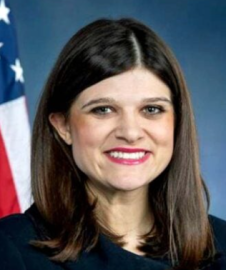 Michigan Congresswoman Haley Stevens today said she will introduce articles of impeachment against U.S. Health Secretary Robert F. Kennedy Jr., claiming his leadership of the U.S. Department of Health and Human Services (HHS) has resulted in “health care chaos” and “reckless cuts.”
Stevens, a Democrat, first announced her intent in a post earlier today on X. She followed up with a statement citing four reasons why she seeks to impeach Kennedy.
Stevens alleged that Kennedy is “severely restricting access to vaccines and spreading absurd conspiracies,” including withdrawing “federal recommendations for COVID shots for pregnant women and healthy children” and promoting “wild and unfounded claims” about the risks of acetaminophen.
She also claimed that Kennedy has abdicated his duty as HHS secretary by “cutting funding for lifesaving research,” including cancer research and studies on sudden infant death syndrome (SIDS).
According to Stevens, Kennedy has failed to “carry out statutory duties of HHS” in administering the U.S. Food and Drug Administration and the Centers for Disease Control and Prevention (CDC), and lied during his confirmation hearing before the U.S. Senate earlier this year.
Stevens also claimed Kennedy’s policies are “making our country less safe and making healthcare less affordable and accessible” and are reflective of his “contempt for science” and “the constant spreading of conspiracy theories.”
“Enough is enough — we need leaders who put science over chaos, facts over lies, and people over politics, which is why I am announcing today that I have begun drafting articles of impeachment against Secretary Kennedy,” Stevens stated.
A spokesperson for Stevens’ office told The Defender the articles of impeachment are being drafted and “will be introduced soon.”
Stevens has repeatedly advocated for Kennedy’s removal, including a call for Kennedy’s resignation earlier this month.
In a statement provided to The Defender, Andrew Nixon, communications director for the HHS said, “Secretary Kennedy remains focused on the work of improving Americans’ health and lowering costs, not on partisan political stunts.”
‘Founders did not want people removed from office over policy disagreements’
According to The Detroit News, it is “unlikely that Stevens’ call for impeachment will be successful, given Republican majorities in Congress.”
A simple majority in the U.S. House of Representatives and a two-thirds majority in the U.S. Senate after a trial are required for an impeachment effort to succeed. Republicans hold majorities in both chambers.
Sayer Ji, chairman of the Global Wellness Forum and founder of GreenMedInfo, said that, “with a Republican-controlled House, impeachment is a political non-starter,” but that the goal is “to generate headlines, stigmatize dissent, and chill debate — reputational warfare disguised as constitutional accountability.”
Attorney Rick Jaffe suggested Stevens’ effort may be an inappropriate use of the impeachment process and may set a “dangerous” precedent. He said:
“Those are the kinds of disputes the political process is supposed to resolve. If Congress thinks HHS policy is wrong, it holds hearings, passes oversight statutes or uses the purse. ‘Impeachment as policy veto’ is dangerous.
“Normalizing impeachment for contested scientific positions would chill executive-branch debate and weaponize impeachment as a routine tool. The Constitution reserves impeachment for treason, bribery or comparable abuses. If this standard becomes ‘I disagree with your science,’ every Secretary of HHS under either party will face perpetual impeachment threats. That destabilizes public health governance.”
The Detroit Free Press also called into question the legality of Stevens’ impeachment attempt, writing:
“Given that the Constitution limits impeachment to charges of ‘treason, bribery, or other high crimes and misdemeanors,’ with the presumption being the founders did not want people removed from office over policy disagreements, there almost certainly would be question as to the legality of an impeachment drive.”
Jaffe said that the impeachment push is unlikely to succeed but may further fuel the political divide in the U.S. He said:
“This, in all likelihood, will not remove Kennedy, since the votes aren’t there in the House, and there does not appear to be a path to two-thirds in the Senate. But it will harden lanes. Expect more hearings, subpoenas and media escalation aimed at discrediting HHS leadership.
“If Congress wants to change policy, it should legislate. If it wants accountability, it should investigate. Impeachment is a constitutional last resort, not a press release.”
Stevens eyeing Michigan’s open Senate seat next year
Ji and Jaffe noted that Stevens may also have a political motive in attempting to impeach Kennedy, as she will run for Michigan’s open Senate seat next year.
“Stevens herself is not acting in a vacuum,” Ji said. “This gambit delivers national visibility as a ‘defender of science.’ But her language mirrors pharma-aligned talking points so closely it reads like a continuation of the script.”
According to Jaffe, “Filing impeachment in a GOP-run House is a branding exercise. She gets the headline, tests a message with the primary electorate and positions herself as a ‘defender of science.’ Smart politics from the Democrats’ point of view. They want to keep that Senate seat.”
The Detroit Free Press reported that Stevens faces a Democratic primary along with two other major candidates for the open Senate seat. Her impeachment push “makes clear that Democrats intend to use disapproval of Kennedy with the voters against Republicans in next year’s midterm elections.”
According to The Daily Beast, recent moves by Kennedy and other public health officials have “raised concerns, including among some Republican lawmakers.” The Hill reported today that unnamed Republican senators “are growing increasingly uncomfortable with health actions being taken by the Trump administration.”
Stevens’ donors include Pfizer, medical organizations, health insurers
Data from Open Secrets shows that Stevens received $98,739 in donations from “health professionals” during the 2023-2024 donation cycle, making this one of the top five industries that donated to her.
She also received $17,756 from pharmaceutical and health products companies during the same period.
Open Secrets data also show that Stevens received a $1,500 donation from Pfizer last year — and donations from medical and health organizations including the American Medical Association and the American College of Emergency Physicians.
Stevens has also received donations from pharmacy chains including CVS Health and Target, major insurers including Blue Cross/Blue Shield of Michigan and UnitedHealth, and from BlackRock, Google, Mastercard, McDonald’s and Microsoft.
Are calls for impeachment part of ‘hybrid warfare’ aiming to oust RFK Jr.?
According to Ji, the effort to impeach Kennedy is part of a broader, coordinated attempt by multiple actors, including political figures, pharmaceutical companies and their lobbyists, and some legacy media outlets, to oppose Kennedy.
“Stevens’ announcement is not genuine ‘oversight’ — it is the next front in a coordinated influence operation,” which includes the recent Senate hearing in which Susan Monarez, Ph.D., operated and a series of op-eds published in prominent outlets, Ji said.
These efforts mirror proposals contained within a leaked document — purportedly the minutes of an April meeting of the Biotechnology Innovation Organization (BIO), a major pharmaceutical lobbying organization. BIO has denied the authenticity of the document.
In June, research scientist and author James Lyons-Weiler, Ph.D., first went public with the alleged minutes of an April meeting of BIO’s Vaccine Policy Steering Committee. He said the document was sent “anonymously by whistleblowers.”
According to the BIO document, John F. Crowley, president and CEO of BIO, allegedly participated in the meeting and proposed a “creative communication campaign” targeting legislators and influencers while isolating Kennedy.
Crowley also allegedly suggested that BIO spend $2 million on such lobbying efforts.
Participants in the BIO meeting, including current employees and board members of vaccine manufacturers, also allegedly said, “It is time to go to The Hill and lobby that it is time for RFK Jr to go … communicate what’s going on in business.”
‘Looks like a part of the coordinated action’ against Kennedy
Ji connected efforts targeting Kennedy to the U.K.-based Center for Countering Digital Hate (CCDH), a nongovernmental organization that, in 2021, included Kennedy on its “Disinformation Dozen” list of the 12 “leading online anti-vaxxers.”
According to documents leaked by a whistleblower last year, CCDH planned “black ops” against Kennedy. “Black ops” are defined as a “secret mission or campaign carried out by a military, governmental or other organization, typically one in which the organization conceals or denies its involvement.”
The leaked documents, containing minutes from internal CCDH staff meetings held between January and October 2024, revealed that CCDH planned these “black ops” in response to “Nervousness about the impact of him on the election.”
CCDH, currently under investigation by Congress, and its founder and CEO Imran Ahmed, maintain ties to members of the Democratic Party.
Ji said core components of this coordinated campaign include “congressional convergence” and the dissemination of a narrative opposing Kennedy in the media.
Last month, MedPageToday reported that doctors and “public health advocates” were calling for Kennedy’s impeachment. Later in August, USA Today published an op-ed titled, “RFK Jr. is an anti-vaccine kook destroying the CDC. Impeach him.”
Earlier this month, a Mother Jones op-ed stated, “Impeach RFK Jr.,” characterizing him as one of several “unqualified extremists” in Trump’s cabinet. On Sept. 15, Free Speech for People cited unnamed “constitutional law experts” in calling for Kennedy’s impeachment, accusing him of “abuses of power.”
“Far from independent analysis, this is narrative warfare — reputational framing masquerading as journalism, designed to normalize impeachment talk before it even reached Congress,” Ji said, calling this an example of “hybrid warfare — reputational, legislative and media-based.”
Jaffe called the string of op-eds calling for Kennedy’s impeachment “an unmistakable pile-on” that “looks like a part of the coordinated action” against Kennedy.
Stevens has a controversial congressional past. In March 2020, House leadership ruled Stevens was “out of order” following a speech that ran over time on a proposed COVID-19 relief package. The Detroit News described the speech, during which Stevens wore pink latex gloves, as a “yelling spree.”
This article was originally published by The Defender — Children’s Health Defense’s News & Views Website under Creative Commons license CC BY-NC-ND 4.0. Please consider subscribing to The Defender or donating to Children’s Health Defense.
UN Shows Double Standards by Investigating Venezuela Instead of Israel
Sputnik – 27.09.2025
The UN Human Rights Council (HRC) has laid bare its double standards by investigating human rights violations allegedly committed by Venezuela, but not by Israel, Alexander Gabriel Yanez Deleuze, Venezuela’s envoy to the UN in Geneva, told Sputnik.
“The HRC has approved 10 areas of action against Venezuela and allocated $10 million for this. At the same time, you will not find a single mandate that would sound like an ‘investigation of human rights violations by the Israeli government’,” the diplomat stressed.
“There is a mission that deals with human rights in the occupied Palestinian territories, but it does not explicitly mention Israel. This proves the HRC’s double standards,” Deleuze stressed.
On Monday, the Independent International Fact-finding Mission in Venezuela presented a report on human rights violations in the South American country, which was rejected as politicized by Caracas.
The Russian Permanent Mission to the United Nations said that Russia opposed efforts to politicize the UN Human Rights Council and condemned its use to exert pressure on Venezuela.
Featured Video

No Threat Can Force Iran’s Surrender /Trita Parsi & Lt Cl Daniel Davis
or go to
Aletho News Archives – Video-Images
From the Archives
What is the Israeli Lobby in Australia Doing in Interfaith Dialogue?
By Ali Kazak | Dissident Voice | October 11, 2015
For years Israel and its lobby around the world have been trying to normalise their relations with Arabs and Muslims without solving the Palestine Question.
One of the methods they resorted to in the last few years is using human rights and community organizations such as interfaith dialogue and Multiculturalism to achieve this objective and to: isolate the Palestinians, marginalise the Palestine question, end Israel’s isolation, and prevent criticism of Israel, knowing that these organisations will be the first to stand against Israel’s violations, racial and religious discrimination.
The group responsible for this task in Australia is The Australia/Israel & Jewish Affairs Council (AIJAC); its Director of International & Community Affairs, Jeremy Jones is in charge of lobbying religious community organizations, specifically Muslims and Christians. Consequently he convened the Faith Communities for Reconciliation, founding participant in the Australian Partnership of Religious Organisations and the Australian National Dialogue of Christians, Muslims & Jews.
AIJAC is a private political propaganda group. It is recognised as the main Israeli lobby in Australia. It coordinates its activities and works intimately with the Israeli embassy in Canberra and different institutions in Israel. It is privately funded by some Jewish businessmen. It monitors closely Australian politicians, the media, ethnic and religious groups, (especially Arabs and Muslims), unions and academics on their stands towards Israel and the Palestine question. … continue
Blog Roll
 Aletho News
- ‘Economic terrorism’: Steel facilities hit again in US-Israeli strike
- ‘War Crime’: Iran condemns attacks on Arak, Ardakan nuclear sites
- Two-thirds of Americans want quick end to Iran war even if goals unmet
- Trump to Give “Important Update on Iran” Wednesday in Prime-Time Speech
- Theodore Postol: Iran’s Missiles & Drones Were Underestimated
- Iran To Target Military Industrial-Tech Complex That Facilitated Gaza Genocide
- Collapsing Empire: The Resistance Disarms ‘Israel’
- Suicide Should Not Be a Government Service
- Rethinking America’s greatest threat: Iran vs. Israel-Firsters
- Iran accuses adversaries of false flags to strain Turkey ties
- If Americans Knew
- Ann Coulter Rips Into Fox News for Iran War Coverage
- Joe Kent Urges Americans To Call White House and Congress To Object To Sending Troops Into Iran
- DNC Resolution to Reject AIPAC Funding Puts Democratic Leaders in the Hot Seat
- Swedish foundation to build 400 schools as over 650,000 Gaza children remain without education for 2 years
- Israeli army admits photshopping image of slain Lebanese journalist
- This is how Israel is systematically killing health workers under the cover of war in Lebanon
- Carrying life under fire: Israeli invasion of Lebanon leaves pregnant women facing deadly risks
- Champagne all around for the new death penalty (for Palestinians) law – Not a ceasefire Day 172
- Why are Palestinian books struggling to be seen on Amazon?
- The Line Between Affinity and Conspiracy
- No Tricks Zone
- New Study Finds Warming Saves Lives…Cold Temperatures 12 Times More Deadly Than Excess Heat
- German Science Blog Accuses PIK Climate Institute Of Hallucinating Climate Tipping Points
- Devastating Assessment Of Comirnaty Vaccine By Former Senior Pfizer Europe Toxicologist
- New Study: CO2 Is ‘Effectively Negligible’ As An Explanatory Climate Change Factor Since 2000
- Former Pfizer Toxicologist Dr. Helmut Sterz Tells Bundestag Hearing Pfizer Vaccine Should Have Never Been Approved
- Energy Expert: Germany’s Nuclear Phaseout Was A “500 Billion Euro Mistake”
- New Research: South Australia’s Mid-Holocene Sea Surface Temperatures Were 4°C Warmer Than Today
- Storing Green Energy To Last Germany 10 Days Would Require A 60-Million Tonne Battery
- New Studies: UK Sea Levels Were 4 Meters Higher Than Today During The Mid-Holocene
- Destructive Green New Deal: German Energy And Metal Group Warns Of Drastic Crisis
 Aletho News