The Bizarre, Unanimous Dem Support for the $40b War Package to Raytheon and CIA: “For Ukraine”
By Glenn Greenwald | May 14, 2022
After Joe Biden announced his extraordinary request for $33 billion more for the war in Ukraine — on top of the $14 billion the U.S. has already spent just ten weeks into this war — congressional leaders of both parties immediately decided the amount was insufficient. They arbitrarily increased the amount by $7 billion to a total of $40 billion, then fast-tracked the bill for immediate approval. As we reported on Tuesday night, the House overwhelmingly voted to approve the bill by a vote of 388-57. All fifty-seven NO votes came from Republican House members. Except for two missing members, all House Democrats — every last one, including all six members of the revolutionary, subversive Squad — voted for this gigantic war package, one of the largest the U.S. has spent at once in decades.
While a small portion of these funds will go to humanitarian aid for Ukraine, the vast majority will go into the coffers of weapons manufacturers such as Raytheon, Lockheed Martin, Boeing and the usual suspects. Some of it will go to the CIA for unspecified reasons. The extreme speed with which this was all approved means there is little to no oversight over how the funds will be spent, who will profit and how much, and what the effects will be for Ukraine and the world.
To put this $54 billion amount in perspective, it is (a) larger than the average annual amount that the U.S. spent on its own war in Afghanistan ($46 billion), (b) close to the overall amount Russia spends on its entire military for the year ($69 billion), (c) close to 7% of the overall U.S. military budget, by far the largest in the world ($778 billion), and (d) certain to be far, far higher — easily into the hundreds of billions of dollars and likely the trillion dollar level — given that U.S. officials insist that this war will last not months but years, and that it will stand with Ukraine until the bitter end.
What made this Democratic Party unanimity so bizarre, even surreal, is that many of these House Democrats who voted YES have spent years vehemently denouncing exactly these types of war expenditures. Some of them — very recently — even expressed specific opposition to pouring large amounts of U.S. money and weaponry into Ukraine on the grounds that doing so would be unprecedentedly dangerous, and that Americans are suffering far too severely at home to justify such massive amounts to weapons manufacturers and intelligence agencies. Here, for instance, is the shocking-in-hindsight warning of Rep. Ilhan Omar (D-MN) on March 8 — just two months before she voted YES on this $40 billion weapons package:
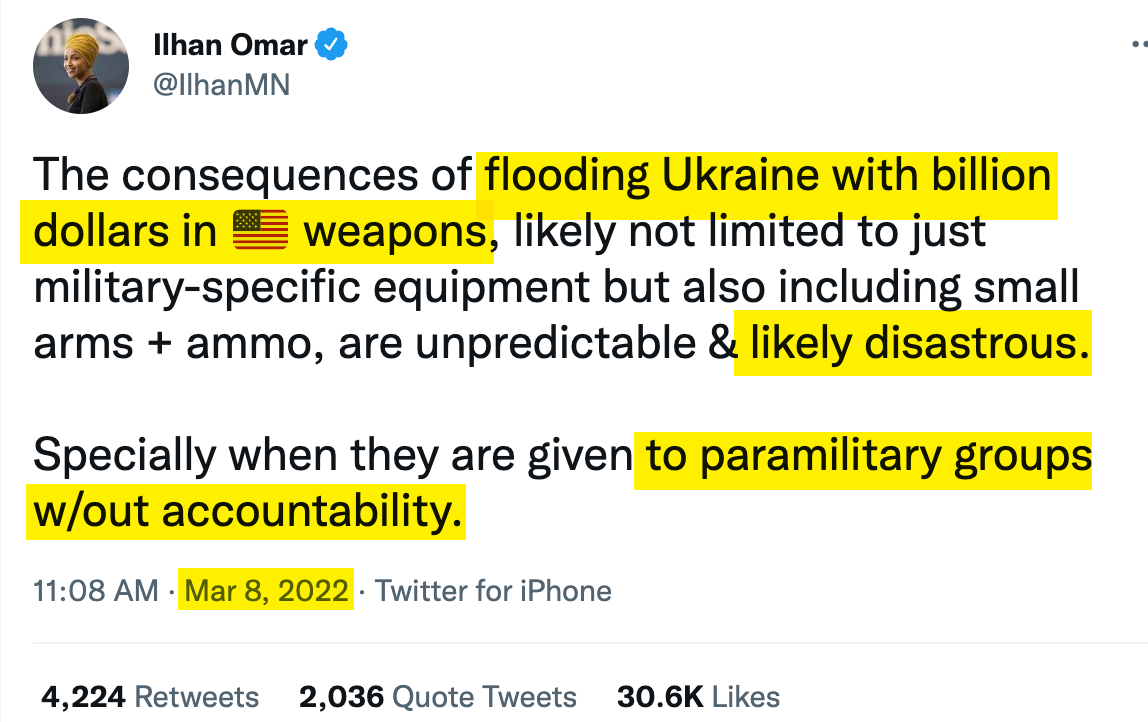
Just as stridently, her progressive House Democratic colleague, Rep. Ro Khanna (D-CA), appeared on Democracy Now on February 8 to discuss the imminent Russian invasion of Ukraine, and he explicitly and repeatedly demanded that no lethal arms be sent by the U.S. into Ukraine. Indeed, Khanna, while repeatedly denouncing Putin’s aggression, heaped praise on former President Obama for long resisting bipartisan demands to send lethal arms to Ukraine — based on Obama’s oft-stated belief that Ukraine is and always will be a vital interest to Russia, but will never be to the U.S. — and argued that such a move would be dangerously escalatory:
I certainly join [House progressives] in the concerns of having increased aid, lethal aid, into that area. That will only inflame the situation. I also join them in the concern that we need restraint, that the last thing the American people want is an escalation which could lead us to some long war in Ukraine with Russia, that that’s a very dangerous situation, and no one in this country — or, very few people in this country would want that. There’s a reason President Obama didn’t send lethal aid into Ukraine and had a greater restraint in his approach. So, I do think we should do everything possible not to escalate the situation, while having the moral clarity that Putin is in the wrong in this case….
The arguments Khanna was endorsing from House progressive leaders came in the form of a January 26 press release from co-caucus-leaders Reps. Barbara Lee (D-CA) and Pramila Jayapal (D-WA). The progressive duo argued: “There is no military solution out of this crisis — diplomacy needs to be the focus.” Then they added this: “We have significant concerns that new troop deployments, sweeping and indiscriminate sanctions, and a flood of hundreds of millions of dollars in lethal weapons will only raise tensions and increase the chance of miscalculation. Russia’s strategy is to inflame tensions; the United States and NATO must not play into this strategy.” Just over three months later, both Lee and Jayapal voted not for a “flood of hundreds of millions of dollars in lethal weapons,” but to flood Ukraine with tens of billions of dollars in lethal weapons.
One would think that when a member of Congress engages in such a remarkable and radical shift in their position, they would at least deign to provide some explanation for why they did so. In the case of the Squad and dozens of House progressives, one would be very wrong. On Friday morning, I emailed and/or texted the press representatives of the five Squad members who have said nothing about their vote (only Rep. Cori Bush (D-MO), in a doozy of a statement discussed below, bothered to explain), and directly texted both Omar and Khanna. Other reporters also have requested statements. More than seventy-two hours after they cast this enormously consequential war vote, they still have refused to explain themselves or even issue a cursory statement as to why they supported this (see update below).
This vote, and their silence about it, is particularly confounding — one could, without hyperbole, even say chilling — given how rapidly Democrats’ rhetoric about Ukraine is escalating. As we noted on Tuesday, many leading Democrats, such as Rep. Jason Crow (D-CO), have begun speaking about this war not only as an American proxy war — which it has long been — but as “our war” that we must fight to the end in order for “victory” to be ours, while Sen. Lindsey Graham (R-SC) vows that there be “no off ramps” to end the war diplomatically, since the real goal of the war is regime change in Moscow.
Even worse, the eighty-two-year-old House Democratic Majority Leader Steny Hoyer (D-MD), now in his twentieth term in Congress, went to the House floor on Friday to twice say that “we are at war” — meaning the U.S is now at war with Russia — and that it is therefore inappropriate to heavily criticize our president:
As the Bulletin of Atomic Scientists has spent decades pointing out, there is nothing more dangerous to humanity than a war between the two nations with the planet’s largest nuclear stockpiles. One might think that those who just voted to dangerously escalate such a war would at least deign to explain themselves, especially those who have repeatedly made recent statements violently at odds with the YES vote they just cast. Even Sen. Bernie Sanders (I-VT), who has thus far said nothing about this House vote, warned in The Guardian in early February, that while Putin is immoral and tyrannical, the West bears some blame for provoking this war with reckless NATO expansion and, more importantly, warned of the grave and unpredictable dangers of having the U.S. pursue a strategy of fueling the war rather than trying to solve it diplomatically.
So exceptional is this headlong rush into this war that even The New York Times — usually loyally supportive of U.S. war policies and the Democratic establishment — published a highly unusual news article about the House vote which repeatedly and harshly criticized Congress for being too frightened to ask questions or express skepticism about Biden’s war policy. The NYT took the members of Congress voting YES in both parties to task for being cowed into submission, meekly falling into line. The headline of the article told the story — “House Passes $40 Billion More in Ukraine Aid, With Few Questions Asked” — as the Paper of Record all but called these YES-voting members of Congress cowards and abdicators:
The escalating brutality of the war in Ukraine has dampened voices on both the right and left skeptical of the United States’ involving itself in armed conflict overseas, fueling a rush by Congress to pour huge amounts of money into a potentially lengthy and costly offensive against Russia with few questions or reservations raised….[L]awmakers in both political parties who have previously railed against skyrocketing military budgets and entanglements in intractable conflicts abroad have gone largely silent about what is fast becoming a major military effort drawing on American resources….
That total — roughly $53 billion over two months — goes beyond what President Biden requested and is poised to amount to the largest foreign aid package to move through Congress in at least two decades….But stunned by the grisly images from Ukraine and leery of turning their backs on a country whose suffering has been on vivid display for the world, many lawmakers have put aside their skepticism and quietly agreed to the sprawling tranches of aid, keeping to themselves their concerns about the war and questions about the Biden administration’s strategy for American involvement…..
And as Mr. Biden’s requests to Congress for money to fund the war effort have spiraled upward, leaders in both parties have largely refrained from questioning them…..The result has been that, at least for now, Congress is quickly and nearly unanimously embracing historic tranches of foreign aid with little public debate about the Biden administration’s strategy, whether the volume of military assistance could escalate the conflict, or whether domestic priorities are being pushed aside to accommodate the huge expenditures overseas.
Perhaps the most remarkable part of this surreal episode is the statement issued by Rep. Bush, ostensibly explaining and justifying her YES vote. If you are able to discern some sort of cogent explanation from this statement, it means that you have better reading skills than I. While Rep. Bush at least deserves credit for bothering to try to explain her vote — in contrast to her fellow Squad members who have thus far refused to do so — by far the clearest and most significant part of what she says are her admissions of the horrible and dangerous parts of this bill, for which she just voted YES. Behold these admissions:
Additionally, at $40 billion, this is an extraordinary amount of military assistance, a large percentage of which will go directly to private defense contractors. In the last year alone, the United States will have provided Ukraine with more military aid than any country in the last two decades, and twice as much military assistance as the yearly cost of war in Afghanistan, even when American troops were on the ground. The sheer size of the package given an already inflated Pentagon budget should not go without critique. I remain concerned about the increased risks of direct war and the potential for direct military confrontation.
Imagine saying this about a bill — recognizing how wasteful and dangerous it is — and then snapping into line behind Nancy Pelosi and voting for it anyway to ensure Democratic Party unanimity in support of this war. Credit to Rep. Bush for candor, I suppose.
One person whose name has not yet appeared in this article is Rep. Alexandria Ocasio-Cortez (D-NY). That is because we published on Wednesday a comprehensive video report on Rumble, documenting how AOC’s YES vote on this war package so violently contradicts virtually everything she has ever claimed to believe about questions of war, militarism and military spending. AOC, needless to say, has not bothered to reconcile this vote with the drastically divergent body of statements she has uttered her entire adult life because her blind followers do not demand anything of her, let alone explanations for why she does what she does (which is why she knew she could, in the middle of the COVID pandemic, attend the Met Gala — the nation’s most gluttonous celebration of capitalist excess and celebrity culture — and attended to indoors by a team of masked servants while she and her boyfriend remained comfortably and glamorously unmasked, and then show total contempt for her fans by hilariously spray-painting a banal, inoffensive phrase on the back of her designer gown, knowing this would make them not only accept her behavior but celebrate her heroic subversiveness).
The full video about how the Squad and AOC just permanently killed whatever was left of the U.S. left-wing anti-war movement can be seen on our Rumble page.
Only two months ago, those who observed that this was not a war between Russia and Ukraine, but really a proxy war between Russia and the U.S./NATO, were vilified as Kremlin propagandists. Now, U.S. leaders openly boast of this fact, and go further, claiming that the U.S. is actually at war with Russia and must secure full victory. That there is not a single Democratic politician willing to object to or even question any of this speaks volumes about what that party is, as well how dangerous this war has become for Americans and the world generally.
Rep. Khanna provided the following comment in response to our question of how he can reconcile his argument in his February 8 Democracy Now interview that the U.S. should not send lethal arms to Ukraine with his vote on Monday to send lethal arms:
I wanted to do everything we could to prevent conflict through diplomacy and so did not want to escalate prior to invasion. But once Putin invaded and has been barbarically destroying towns and cities, I believe it is morally justified to stand firmly with Ukraine in defense of their territory and provide them with military and economic assistance. We at the same time need to be aggressively encouraging diplomatic talks and a ceasefire and enlisting countries who can play a mediating role to help us bring this brutal war to an end.
Note that the assumption of that entire interview was that Russia would invade Ukraine. Indeed, the first question to which Rep. Khanna responded, when arguing that the U.S. should not send lethal aid to Ukraine, was this one: “And do you support the threat of devastating sanctions against Russia in the event of any kind of Russian invasion of Ukraine?” Nonetheless, in contrast to many of his House colleagues, at least he is willing to account for the vote he cast. We will add any further comments in response to our requests for comment if and when we receive them.
Russia accuses Lithuania of extremism
Samizdat | May 11, 2022
The Lithuanian parliament’s resolution branding Russia a “supporter of terrorism” amounts to “provocation, extremism and political hypocrisy,” Russian Foreign Ministry spokeswoman Maria Zakharova said.
Earlier this week, the Baltic country’s lawmakers unanimously passed a resolution stating that “the Russian Federation, whose military forces deliberately and systematically bomb civilian targets, is a state that supports and practices terrorism.”
Since the beginning of the conflict in late February, Ukraine and Russia have accused each other of shelling residential areas. Kiev denies that it targets civilians, while Moscow insists that it only hits military targets.
On her show on Sputnik radio on Wednesday, Zakharova said the three Baltic countries, all NATO members, have expressed “neither concern, condemnation nor at least bewilderment” over the actions of the alliance in Afghanistan, Iraq, and Yugoslavia, which led to “hundreds of thousands of casualties among the civilian population,” and to the “emergence of conflicts in places where they were not even contemplated.”
Because of this, Zakharova argued, there is no point in believing that the Lithuanian parliament’s resolution has anything to do with pacifism or with any desire “to resolve the extremely difficult situation in Ukraine.”
“This should be treated exactly as an element of provocation, extremism and political hypocrisy,” the foreign ministry spokeswoman said, adding: if Lithuania is truly concerned of the fate of Ukraine and of “its own European continent,” it should not have engaged in “provocative activities” over the last eight years, but instead care about the fate of people in Donbass and urge Kiev to observe the Minsk agreements.
If Lithuania is really concerned now, it would call for a ceasefire, oppose the supply of weapons to Kiev, and offer intermediary services, Zakharova said. “Instead, they are doing exactly the opposite.”
Russia attacked the neighboring state following Ukraine’s failure to implement the terms of the Minsk agreements, first signed in 2014, and Moscow’s eventual recognition of the Donbass republics of Donetsk and Lugansk. The German and French brokered protocols were designed to give the breakaway regions special status within the Ukrainian state.
The Kremlin has since demanded that Ukraine officially declare itself a neutral country that will never join the US-led NATO military bloc. Kiev insists that the Russian offensive was completely unprovoked and has denied claims it was planning to retake the two republics by force.
Biden Wanted $33B More For Ukraine. Congress Quickly Raised it to $40B. Who Benefits?
Tens of billions, soon to be much more, are flying out of US coffers to Ukraine as Americans suffer, showing who runs the government.
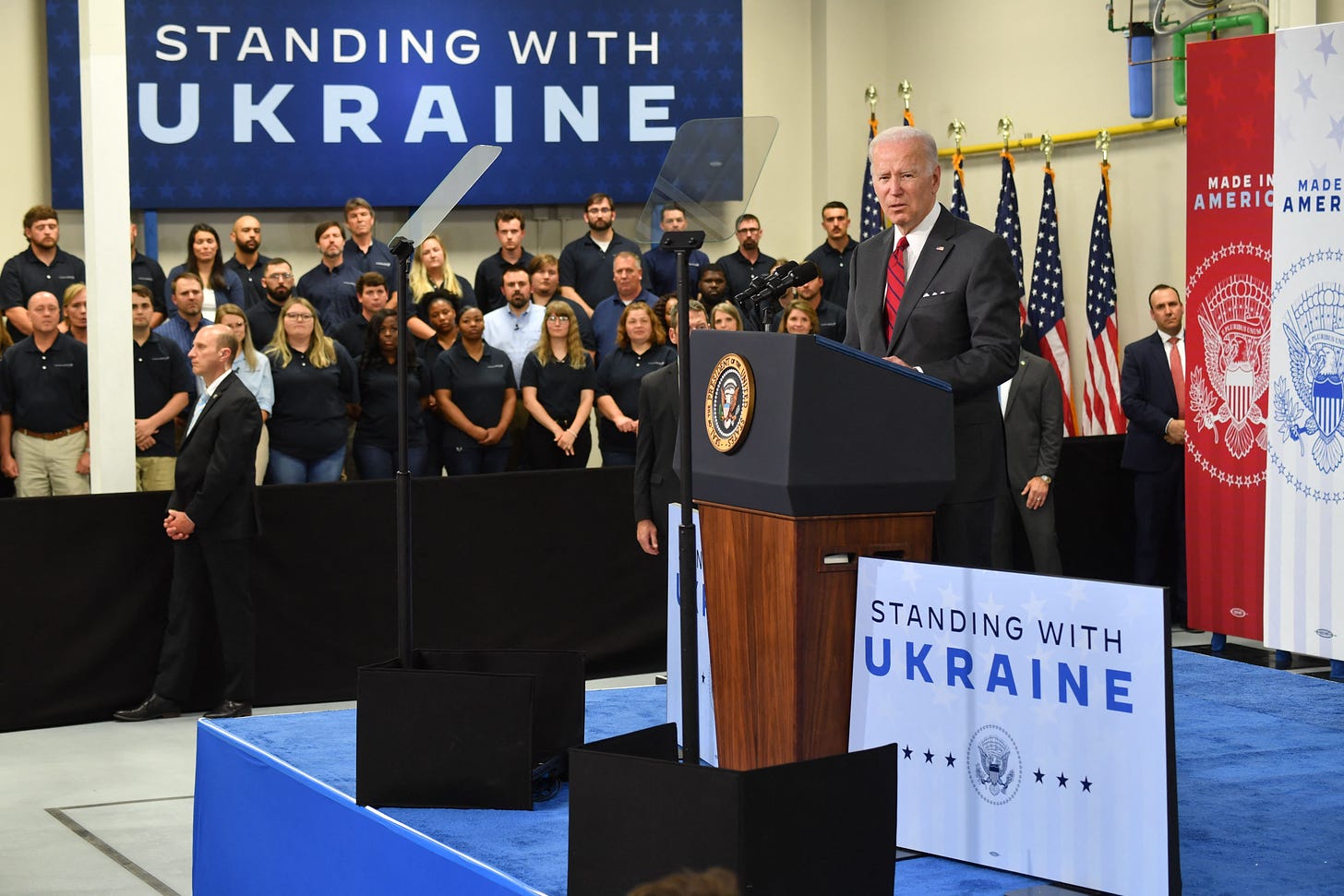
Joe Biden speaks about the conflict in Ukraine during a visit to Lockheed Martins’ Pike County Operations facility on May 3, 2022 (Photo: Nicholas Kamm/AFP via Getty Images)
By Glenn Greenwald | May 10, 2022
From the start of the Russian invasion of Ukraine on February 24, the Biden White House has repeatedly announced large and seemingly random amounts of money that it intends to send to fuel the war in Ukraine. The latest such dispatch of large amounts of U.S. funds, pursuant to an initial $3.5 billion fund authorized by Congress early on, was announced on Friday; “Biden says U.S. will send $1.3 billion in additional military and economic support to Ukraine,” read the CNBC headline. This was preceded by a series of new lavish spending packages for the war, unveiled every two to three weeks, starting on the third day of the war:
- Feb. 26: “Biden approves $350 million in military aid for Ukraine”: Reuters ;
- Mar. 16: “Biden announces $800 million in military aid for Ukraine”: The New York Times ;
- Mar. 30: “Ukraine to receive additional $500 million in aid from U.S., Biden announces”: NBC News;
- Apr. 12: “U.S. to announce $750 million more in weapons for Ukraine, officials say”: Reuters ;
- May 6: “Biden announces new $150 million weapons package for Ukraine”: Reuters.
Those amounts by themselves are in excess of $3 billion; by the end of April, the total U.S. expenditure on the war in Ukraine was close to $14 billion, drawn from the additional $13.5 billion Congress authorized in mid-March. While some of that is earmarked for economic and humanitarian assistance for Ukraine, most of it will go into the coffers of the weapons industry — including Raytheon, on whose Board of Directors the current Secretary of Defense, Lloyd Austin, sat immediately before being chosen by Biden to run the Pentagon. As CNN put it: “about $6.5 billion, roughly half of the aid package, will go to the US Department of Defense so it can deploy troops to the region and send defense equipment to Ukraine.”
As enormous as those sums already are, they were dwarfed by the Biden administration’s announcement on April 28 that it “is asking Congress for $33 billion in funding to respond to the Russian invasion of Ukraine, more than double the $14 billion in support authorized so far.” The White House itself acknowledges that the vast majority of that new spending package will go to the purchase of weaponry and other military assets: “$20.4 billion in additional security and military assistance for Ukraine and for U.S. efforts to strengthen European security in cooperation with our NATO allies and other partners in the region.”
It is difficult to put into context how enormous these expenditures are — particularly since the war is only ten weeks old, and U.S. officials predict/hope that this war will last not months but years. That ensures that the ultimate amounts will be significantly higher still.
The amounts allocated thus far — the new Biden request of $33 billion combined with the $14 billion already spent — already exceed the average annual amount the U.S. spent for its own war in Afghanistan ($46 billion). In the twenty-year U.S. war in Afghanistan which ended just eight months ago, there was at least some pretense of a self-defense rationale given the claim that the Taliban had harbored Osama bin Laden and Al Qaeda at the time of the 9/11 attack. Now the U.S. will spend more than that annual average after just ten weeks of a war in Ukraine that nobody claims has any remote connection to American self-defense.
Even more amazingly, the total amount spent by the U.S. on the Russia/Ukraine war in less than three months is close to the Russia’s total military budget for the entire year ($65.9 million). While Washington depicts Russia as some sort of grave and existential menace to the U.S., the reality is that the U.S. spends more than ten times on its military what Russia spends on its military each year; indeed, the U.S. spends three times more than the second-highest military spender, China, and more than the next twelve countries combined.
But as gargantuan as Biden’s already-spent and newly requested sums are — for a ten-week war in which the U.S. claims not to be a belligerent — it was apparently woefully inadequate in the eyes of the bipartisan establishment in Congress, who is ostensibly elected to serve the needs and interests of American citizens, not Ukrainians. Leaders of both parties instantly decreed that Biden’s $33 billion request was not enough. They thus raised it to $40 billion — a more than 20% increase over the White House’s request — and are now working together to create an accelerated procedure to ensure immediate passage and disbursement of these weapons and funds to the war zone in Ukraine. “Time is of the essence – and we cannot afford to wait,” House Speaker Nancy Pelosi said in a letter to House members, adding: “This package, which builds on the robust support already secured by Congress, will be pivotal in helping Ukraine defend not only its nation but democracy for the world.”
We have long ago left the realm of debating why it is in the interest of American citizens to pour our country’s resources into this war, to say nothing of risking a direct war and possibly catastrophic nuclear escalation with Russia, the country with the largest nuclear stockpile, with US close behind. Indeed, one could argue that the U.S. government entered this war and rapidly escalated its involvement without this critical question — which should be fundamental to any policy decision of the U.S. government — being asked at all.
This omission — a failure to address how the interests of ordinary Americans are served by the U.S. government’s escalating role in this conflict — is particularly glaring given the steadfast and oft-stated view of former President Barack Obama that Ukraine is and always will be of vital interest to Russia, but is not of vital interest to the U.S. For that reason, Obama repeatedly resisted bipartisan demands that he send lethal arms to Ukraine, a step he was deeply reluctant to take due to his belief that the U.S. should not provoke Moscow over an interest as remote as Ukraine (ironically, Trump — who was accused by the U.S. media for years of being a Kremlin asset, controlled by Putin through blackmail — did send lethal arms to Ukraine despite how provocative doing so was to Russia).
While it is extremely difficult to isolate any benefit to ordinary American citizens from all of this, it requires no effort to see that there is a tiny group of Americans who do benefit greatly from this massive expenditure of funds. That is the industry of weapons manufacturers. So fortunate are they that the White House has met with them on several occasions to urge them to expand their capacity to produce sophisticated weapons so that the U.S. government can buy them in massive quantities:
Top U.S. defense officials will meet with the chief executives of the eight largest U.S. defense contractors to discuss industry’s capacity to meet Ukraine’s weapons needs if the war with Russia continues for years.
Deputy Defense Secretary Kathleen Hicks told reporters Tuesday she plans to participate in a classified roundtable with defense CEOs on Wednesday to discuss “what can we do to help them, what do they need to generate supply”….
“We will discuss industry proposals to accelerate production of existing systems and develop new, modernized capabilities critical to the Department’s ongoing security assistance to Ukraine and long-term readiness of U.S. and ally/partner forces,” the official added.
On May 3, Biden visited a Lockheed Martin facility (see lead photo) and “praised the… plant that manufactures Javelin anti-tank missiles, saying their work was critical to the Ukrainian war effort and to the defense of democracy itself.”
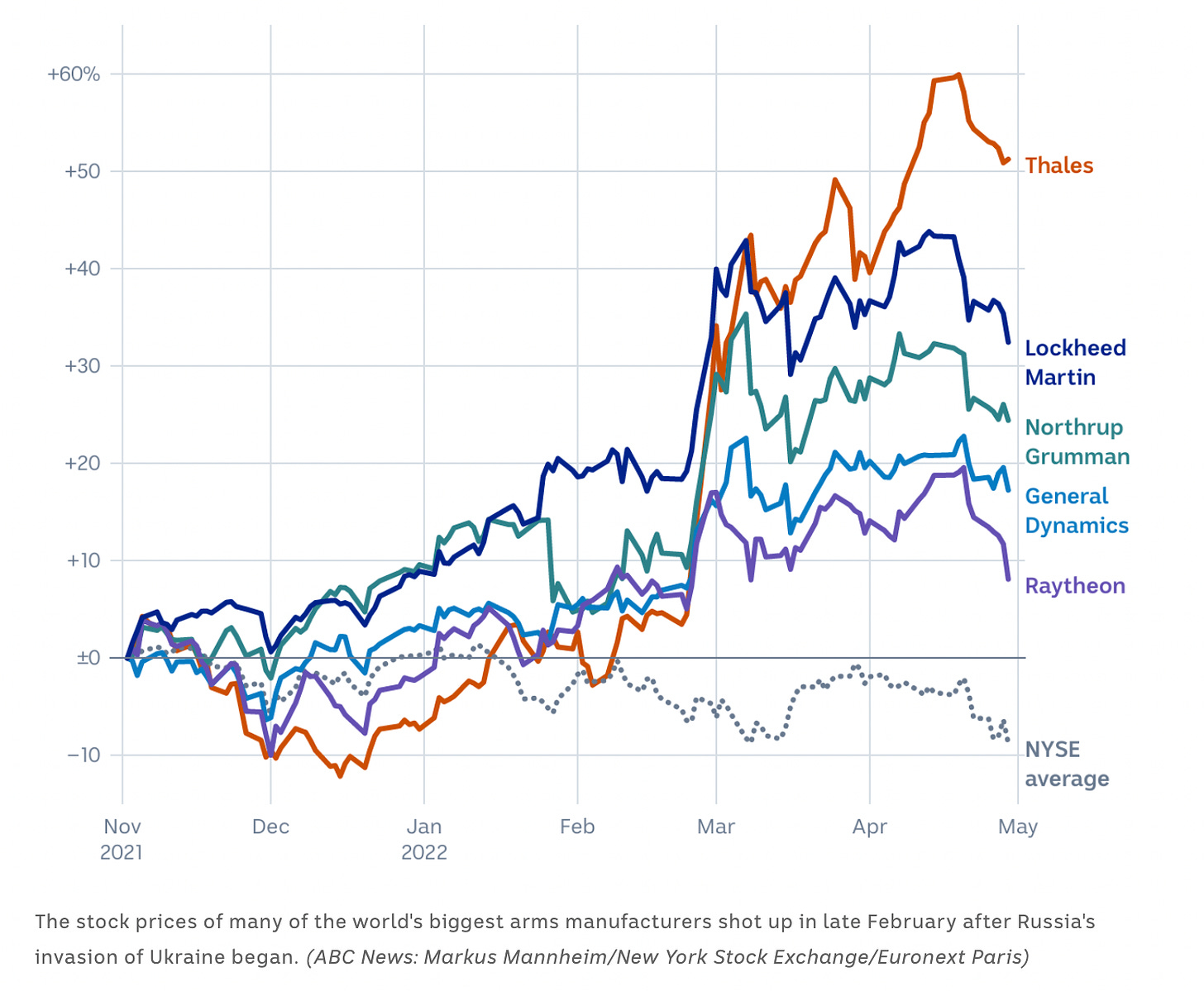
Indeed, by transferring so much military equipment to Ukraine, the U.S. has depleted its own stockpiles, necessitating their replenishment with mass government purchases. One need not be a conspiracy theorist to marvel at the great fortune of this industry, having lost their primary weapons market just eight months ago when the U.S. war in Afghanistan finally ended, only to now be gifted with an even greater and more lucrative opportunity to sell their weapons by virtue of the protracted and always-escalating U.S. role in Ukraine. Raytheon, the primary manufacturer of Javelins along with Lockheed, has been particularly fortunate that its large stockpile, no longer needed for Afghanistan, is now being ordered in larger-than-ever quantities by its former Board member, now running the Pentagon, for shipment to Ukraine. Their stock prices have bulged nicely since the start of the war:
But how does any of this benefit the vast majority of Americans? Does that even matter? As of 2020, almost 30 million Americans are without any health insurance. Over the weekend, USA Today warned of “the ongoing infant formula shortage,” in which “nearly 40% of popular baby formula brands were sold out at retailers across the U.S. during the week starting April 24.” So many Americans are unable to afford college for their children that close to a majority are delaying plans or eliminating them all together. Meanwhile, “monthly poverty remained elevated in February 2022, with a 14.4 percent poverty rate for the total US population… Overall, 6 million more individuals were in poverty in February relative to December.” The latest data from the U.S. Census Bureau found that “approximately 42.5 million Americans [are] living below the poverty line.” Americans with diabetes often struggle to buy life-saving insulin. And on and on and on.
Now, if the U.S. were invaded or otherwise attacked by another country, or its vital interests were directly threatened, one would of course expect the U.S. government to expend large sums in order to protect and defend the national security of the country and its citizens. But can anyone advance a cogent argument, let alone a persuasive one, that Americans are somehow endangered by the war in Ukraine? Clearly, they are far more endangered by the U.S. response to the war in Ukraine than the war itself; after all, a nuclear confrontation between the U.S. and Russia has long been ranked by the Bulletin of Atomic Scientists as one of the two greatest threats facing humanity.
One would usually expect the American left, or whatever passes for it these days, to be indignant about the expenditure of tens of billions of dollars for weapons while ordinary Americans suffer. But the American left, such that it exists, is barely visible when it comes to debates over the war in Ukraine, while American liberals stand in virtual unity with the establishment wing of the Republican Party behind the Biden administration in support for the escalating U.S. role in the war in Ukraine. A few stray voices (such as Noam Chomsky) have joined large parts of the international left in urging a diplomatic solution in lieu of war and criticizing Biden for insufficient efforts to forge one, but the U.S. left and American liberals are almost entirely silent if not supportive.
That has left the traditionally left-wing argument about war opposition to the populist right. “You can’t find baby formula in the United States right now but Congress is voting today to send $40 billion to Ukraine,” said Donald Trump, Jr. on Tuesday, echoing what one would expect to hear from the 2016 version of Bernie Sanders or the pre-victory AOC. “In the America LAST $40 BILLION Ukraine FIRST bill that we are voting on tonight, there is authorization for funds to be given to the CIA for who knows what and who knows how much? But NO BABY FORMULA for American mothers!,” explained Rep. Marjorie Taylor Greene (R-GA). Christian Walker, the conservative influencer and son of GOP Senate candidate Herschel Walker in Georgia, today observed: “Biden should go apply to be the President of Ukraine since he clearly cares more about them than the U.S.” Chomsky himself caused controversy last week when he said that there is only one statesman of any stature in the West urging a diplomatic solution “and his name is Donald J. Trump.”
Meanwhile, the only place where dissent is heard over the Biden administration’s war policy is on the 8:00 p.m. and 10:00 p.m. programs on Fox News, hosted, respectively, by Tucker Carlson and Laura Ingraham, who routinely demand to know how ordinary Americans are benefiting from this increasing U.S. involvement. On CNN, NBC, and in the op-ed pages of The New York Times and The Washington Post, there is virtually lockstep unity in favor of the U.S. role in this war; the only question that is permitted, as usual, is whether the U.S. is doing enough or whether it should do more.
That the U.S. has no legitimate role to play in this war, or that its escalating involvement comes at the expense of American citizens, the people they are supposed to be serving, provokes immediate accusations that one is spreading Russian propaganda and is a Kremlin agent. That is therefore an anti-war view that is all but prohibited in those corporate liberal media venues. Meanwhile, mainstream Democratic House members, such as Rep. Jason Crow (D-CO), are now openly talking about the war in Ukraine as if it is the U.S.’s own:
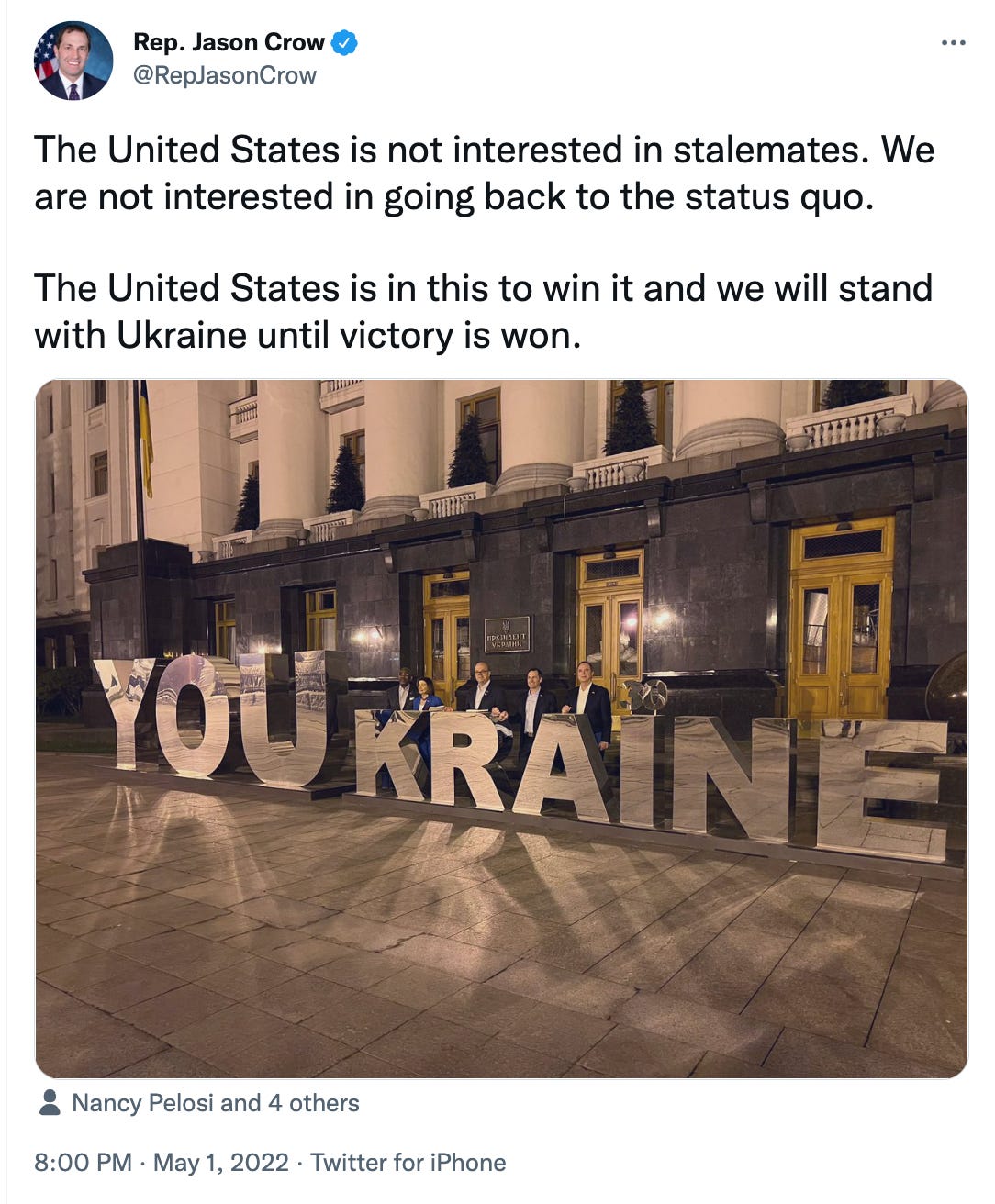
Whatever else is true, the claim with which we are bombarded by the corporate press — the two parties agree on nothing; they are constantly at each other’s throats; they have radically different views of the world — is patently untrue, at least when it comes time for the U.S. to join in new wars. Typically, what we see in such situations is what we are seeing now: the establishment wings of both parties are in complete lockstep unity, always breathlessly supporting the new proposed U.S. role in any new war, eager to empty the coffers of the U.S. Treasury and transfer it to the weapons industry while their constituents suffer.
One can believe that Russia’s invasion of Ukraine is profoundly unjust and has produced horrific outcomes while still questioning what legitimate interests the U.S. has in participating in this war to this extent. Even if one fervently believes that helping Ukrainians fight Russia is a moral good, surely the U.S. government should be prioritizing the ability of its own citizens to live above the poverty line, have health insurance, send their kids to college, and buy insulin and baby formula.
There are always horrific wars raging, typically with a clear aggressor, but that does not mean that the U.S. can or should assume responsibility for the war absent its own vital interests and the interests of its citizens being directly at stake. In what conceivable sense are American citizens benefiting from this enormous expenditure of their resources and the increasing energy and attention being devoted by their leaders to Ukraine rather than to their lives and the multi-pronged deprivations that define it?
Germany warns of global famine
Samizdat | May 9, 2022
The world is about to face an acute food crisis due to skyrocketing food prices, German Economic Cooperation and Development Minister Svenja Schulze told the Bild newspaper on Saturday, warning about a looming famine not seen since World War II. The minister has named the Covid-19 pandemic and Russia’s ongoing military operation in Ukraine as its causes.
“The situation is highly dramatic,” the minister told the German tabloid in a late Saturday interview, adding that, according to the UN World Food Program, “more than 300 million people” are already suffering from acute hunger and the UN has to “constantly revise” this data upwards.
Food prices around the world have grown by a third and have reached “record levels,” Schulze has warned, adding that the “bitter message is that we are facing the worst famine since World War II,” which could see “millions” die.
In its May 6 statement, the World Food Program has warned that “44 million people around the world are marching towards starvation” because Ukrainian grain cannot reach them, and called for the Black Sea ports to be opened so that this grain could be delivered to the needy.
Minister Schulze was quick to blame Moscow for the development by accusing Russian President Vladimir Putin of “waging a war through hunger.” She claimed that Russia had “stolen grain from Ukraine” and is now taking advantage of nations depending on Russian and Ukrainian agricultural products by supposedly offering food only to those, who are “unequivocally pro-Russian.”
The minister has also claimed that the fact that 40 nations that are “home to half of the world’s population” did not condemn Russia’s actions in Ukraine was supposedly a result of their “vulnerability to food blackmail.” She didn’t offer any specific evidence to support this statement, though.
At the same time, she did admit that some nations’ focus on green energy has contributed to the food shortage as well. Germany in particular should stop using food as fuel, she has suggested. Up to 4% of the so-called biofuel in Germany is made from food and animal feed, she said, adding that “it needs to be reduced to zero, and not just in Germany but potentially internationally.”
Germany “pours 2.7 billion liters of fuel [made] from vegetable oils into car tanks every year,” she pointed out, adding that this alone amounts to “almost a half of Ukraine’s sunflower oil production.”
The ongoing conflict in Ukraine has prompted fears of global grain shortages as wheat prices soared to multiple-year highs in March. Both Russia and Ukraine are major wheat suppliers, accounting for some 30% of global exports.
In mid-April, however, German Agriculture Minister Cem Ozdemir insisted that supplying Kiev with “more effective” weaponry was precisely what would have helped the world to avoid the supposedly looming “global famine.” Ozdemir, a member of the strongly pro-US/NATO Alliance 90/The Greens party, also accused Moscow of “starvation strategy” at that time.
His position appears to be quite different from at least two groups of German public figures, politicians and celebrities, who have called on Chancellor Olaf Scholz to stop arms supplies to Ukraine and to focus on a speedy diplomatic solution instead.
Continued arms deliveries would only prolong the suffering of Ukrainians as well as risk potentially devastating consequences, ranging from a possible global war to a “catastrophic” impact on global health and climate change, the co-authors of two open letters have warned. Berlin has not reacted to any of the letters so far.
Insights On Progressive Thinking From The Climate Action Council Public Hearing

By Francis Menton | Manhattan Contrarian | May 6, 2022
My previous post on Tuesday contained some highlights from the May 3 public hearing of New York’s Climate Action Council. The CAC is the body that is charged with devising a “Scoping Plan” to inform all us New Yorkers how we will achieve “zero carbon” electricity by 2030 and a “zero carbon” economy by 2050. I attended the hearing for about two and a half hours, during which about 60 people spoke.
Reflecting on the hearing a few days later, I think there are a few more highlights that would interest the readers, and will give some more insights into the nature of progressive thinking.
As stated in my prior post, of the 60 or so speakers, all but myself and four others were vigorous supporters of the critical necessity of achieving the stated zero carbon goals by the given dates as an urgent matter of saving our planet and our children. This was so despite what appeared to me to be manifestly huge issues of physical feasibility and cost that are almost certain to cause these grand “net zero” energy schemes to fail. The CAC’s draft “Scoping Plan,” as it currently exists for public comment, does not consider these feasibility or cost issues in any remotely adequate fashion, if at all. That fact did not appear to bother the overwhelming majority of the speakers.
So what are the things that do drive the thinking of these other 55 or so speakers, who apparently represent the large majority of New York City’s citizenry? The previous post mentioned fear as a common theme — fear that use of fossil fuels by us New Yorkers will bring on storms, floods and other disasters to threaten our lives and livelihoods. But what I failed to mention was another emotion that was even more prevalent in the comments — anger.
Anger at what, you might ask? Good question. I admit that this doesn’t make any sense, but here it is. The anger is directed at the fossil fuel producers and distributors who the commenters, with near unanimity, seemed to believe were hell-bent on destroying the planet. A substantial majority of the 60 or so comments that I listened to expressed this anger in one form or another, and it was an implicit undercurrent in most of the rest.
But, you might say, all of these people are in fact the users of the fossil fuels. Essentially all of them use electricity, which in New York currently comes about 60% from fossil fuels. The large majority of them drive cars, of which some 99% in New York use gasoline. Most of them heat their homes with natural gas, and cook with natural gas. Aren’t they themselves the ones who are responsible for the problem, if there is a problem? They use fossil-fuel-burning cars and furnaces and stoves because those vehicles and appliances are cheaper and/or work better than the alternatives. And yet, somehow these people have convinced themselves that they have no responsibility at all, and the use of gasoline and natural gas by them and others is a fault of evil producers and utilities.
On this theme, two commenters in particular stand out in my mind. First was a youngish (probably in her 30s) woman from Brooklyn who described herself as having a toddler in the apartment. After relating her fears for the toddler’s future in a world of changing climate, she got to the crux of her personal testimony, which was much more about anger than fear. The gas company was putting a dangerous substance into her stove, which when burned to cook gave off toxic substances and fumes that were putting the toddler’s health at risk. Her intense rage was palpable. She urged the CAC in the strongest terms to impose legal prohibitions that would prevent this kind of conduct going forward.
Put aside for the moment that this woman apparently had no idea that there is nothing toxic about the combustion products of natural gas, which are CO2 and water. But even more bizarre was that she apparently hadn’t figured out that if she is concerned about this subject, however irrationally, she can just go out and buy an electric stove tomorrow. And why hadn’t she done that? She didn’t say. The only reasons I can think of are that natural gas stoves work better than electric ones and are cheaper. Those are perfectly good reasons. But I wouldn’t recommend that you try to argue with this woman about why she has a gas stove. She is completely convinced that it has been foisted upon her by the evil gas companies who are intent on destroying the health of her toddler, let alone the planet. I doubt that any amount of logic or reason could talk her out of that belief.
And then there was the case of an equally irrational 60-something man, who said he was from Cedarhurst, Long Island. For those unfamiliar, Cedarhurst is a very wealthy suburb of large homes just outside the New York City limits. You may have seen Cedarhurst out the window of an airplane approaching JFK airport on a flight back from Europe. The guy in question styled his testimony as a confessional. He candidly admitted to his extreme climate guilt. But he claimed that he was unable to do anything about his large carbon footprint right now because the state had failed to compel the suppliers to provide him with zero emissions alternatives. He didn’t give us any details of what fuel he currently uses to heat his home, or to cook, but chose to focus on his driving. He stated that he wanted to buy an electric car, and was ready to do it, but was prevented from doing it. How was he prevented? Because there were no electric vehicle charging stations in his town! Needless to say, he was angry about that, and demanded that the state step up to order somebody to provide the charging stations, and provide funding to be sure that the charging stations got built.
Huh? Why didn’t this guy just get his own charging station at his own house? He didn’t mention that, so we are left to speculate. Again, the only thing I can think of is that he doesn’t want to spend his own money on this. Better to gin up some anger and demand that somebody else pay for it.
The thinking is that not only perfect fairness and justice, but also perfect climate, are easily within our reach if only our leaders summon the political will to order the evil people and companies to do the right thing, and perhaps provide some funding from the infinite free pile of government money. I guess, if you believe that, you are right to be angry that the leaders haven’t yet issued the necessary orders to get the job done. What’s wrong with them?
Climate Colonialists Disrupt African Pipeline, Perpetuate Poverty

Vanessa Nakate
By Vijay Jayaraj | RealClear Energy | April 28, 2022
Climate activists’ ill-founded opposition to fossil fuels threatens to stop a major pipeline project in East Africa and stymie economic growth in Uganda and Tanzania — home to some of the world’s poorest people.
Uganda is betting big on its fossil fuel reserves. In February, China National Offshore Oil Corporation (CNOOC) and France’s TotalEnergies agreed to invest $10 billion to develop two Ugandan oil reserves. But the landlocked country needs the East African Crude Oil Pipeline project (EACOP) to transport its product to a port in Tanzania.
The 895-mile-long pipeline from Uganda’s Lake Alberta region to the seaport of Tanga will be the longest electrically heated crude oil pipeline in the world and will carry 216,000 barrels per day. The project received a green light for construction after the completion of an Environment and Social Impact Assessment.
The Africa Report says that the investment will be huge: “(A)bout $10 billion will be invested in the sector (oil and gas) before first oil is produced in 2025, mainly on the pipeline, refinery, and infrastructure. The government has been commissioning road construction in the region where oil will be produced, in Buliisa and Hoima districts, and an airport is also being constructed in the region.” The project is expected to generate around 10,000 jobs even after the construction phase.
The Government of Uganda expects massive employment of its citizens during construction: “This will be through direct employment of about 14,000 people by the companies, indirect employment of about 45,000 people by the contractors, and induced employment of about 105,000 people as a result of utilization of other services by the oil and gas sector. Of the direct employment, 57 percent are expected to be Ugandans, which is expected to result in an estimated $48.5 million annual payment to Ugandan employees.”
However, the global war against fossil fuel has now reached Ugandan soil and extremists are determined to stop this lifesaving, economically critical project.
Vanessa Nakate of StopEACOP rants against the pipeline in a recent column in the New York Times, saying the project would bring poverty and destruction to the people of Africa. She also references extreme weather in implying the pipeline will worsen the climate.
During a visit to the ultra-rich Vatican, Vanessa says: “It is evident that there is no future in the fossil fuel industry…. we know the impacts on our food. We know the impacts on our water. We know the impacts on our livelihood…… the climate crisis is already affecting so many people not only in Uganda, but the African continent.”
But her reasons for opposing the pipeline are scientifically inaccurate and logically senseless.
She points to a forecast by the Intergovernmental Panel on Climate Change (IPCC) that predicts African droughts. But IPCC, by its own admission, has indicated that extreme weather events have no significant correlation with rising global average temperatures. Neither has there been any significant increase in the frequency of extreme cyclones, droughts, rainfall, and fires. Even if droughts and cyclones were to increase, a better socio-economic condition would enable people to adapt more effectively.
Contrary to Vanessa’s hyperbole, the world is experiencing near optimum temperatures for global food production and the advancement of human society, much as it did 1,000 years ago during the Medieval Warm Period and 2,000 years ago during the Roman Warm Period. Globally, we now have better access to clean water, better access to nutritious food, people with higher income, and a very rapid increase in life expectancy rates. How are we in a crisis if climate is aiding the improvement of every metric used to measure the quality of people’s lives?
It is shocking how Vanessa ignores the plight of millions of her own people dwelling in persistent poverty and in need of affordable, dependable energy sources like coal, oil, and gas. It is less shocking if we understand the DNA of climate extremists, which has them deny the reality of energy needs and promote unreliable, primitive, and expensive wind turbines that even economic giants like Germany and the U.S. hesitate to adopt completely.
Climate extremists like Vanessa are fostering the continuation of abject poverty in Africa — a continent with the lowest level of electrification and highest rates of poverty in the world. Vanessa claims that the pipeline is another colonial project subjecting Africans to slavery. But, it is Vanessa and her ilk who are the colonialists and would-be slave masters.
Vijay Jayaraj is a Research Associate at the CO2 Coalition, Arlington, Va., and holds a Master’s degree in environmental sciences from the University of East Anglia, England. He resides in Bengaluru, India.
American progressives join the War Party
Some leftist commentators can barely conceal their enthusiasm for American involvement in the Ukraine war

US representative Alexandra Ocasia-Cortez is among the Democratic Party members to vote in favor of a Republican sponsored Ukraine war bill
By James W Carden | Asia Times | May 6, 2022
Russia’s war on Ukraine has, among many other things, highlighted a consequential, indeed historic, shift taking place in American politics with regard to foreign policy.
A recent vote in the House of Representatives helps tell the tale. On April 28, Congress voted by an overwhelming majority of 417-10 to pass Republican Senator John Cornyn’s bill that would revive Lend Lease and apply it to Ukraine.
As is well known, Lend Lease was the brainchild of Franklin D Roosevelt as a way to get around the series of Neutrality Acts passed by Congress in the 1930s, in order to help supply the British war effort against Nazi Germany.
One might be forgiven for wondering if such legislation is really necessary today; after all, according to numbers released by the State Department, the US has provided more than $6.4 billion in “security assistance” to Ukraine since 2014. And last week President Joe Biden put forward a request for another $20.4 billion in “additional security and military assistance” as part of a $33 billion aid package to Ukraine.
So what was the actual point of reviving Lend Lease? Well, it was in part, as is the case with many things that happen on Capitol Hill, performative: a way to signal to US arms manufacturers that constitute much of the political donor class that the money spigot will remain wide open for the foreseeable future.
But the Cornyn bill also tells us that the center of gravity of the anti-war movement is shifting away from its traditional home on the progressive left.
In the century since the US embarked on its journey to global hegemony with the Spanish-American War of choice in 1898, it was most often progressive Democrats who rallied under the banner of peace.
Jeanette Rankin of Montana, the first woman elected to Congress, was one of 50 dissenting votes against American entering the First World War. Progressive magazines such as The Nation were a thorn in the side of proud American imperialists like Henry Cabot Lodge, Brooks Adams and Theodore Roosevelt.
The historian Barbara Tuchman noted that Roosevelt in particular “confused the desire for peace with physical cowardice.” Roosevelt took delight in targeting papers and magazines like the Evening Post and The Nation, which he wrote, “in all of whom there exists absolute physical dread of danger and hardship and who therefore tend to hysterical denunciation and fear of war.”
The Vietnam era marked perhaps the high point of progressive dissent against the American war machine. The anti-war movement was certainly well represented (especially by today’s standards) in the US Senate, where J William Fulbright, William Proxmire, Wayne Morse, Robert F Kennedy, George McGovern, Eugene McCarthy and Frank Church opposed president Lyndon B Johnson’s war.
Perhaps the most recent example of exemplary progressive bravery on Capitol Hill is that of Representative Barbara Lee, who cast the sole vote in the House against granting the George W Bush administration practically unrestricted power to wage war (via the Authorization for the Use of Military Force, or AUMF) in the wake of the attacks of September 11, 2001.
Now, it seems we have entered a new era.

The House’s overwhelming passage of the Cornyn bill will in effect cement Washington’s status as a co-belligerent in a war against a nuclear-armed and increasingly unpredictable Russia.
A look at the roll-call vote in the House shows that only 10 members voted against Cornyn’s bill, all of whom were Republicans.
Not a single Democratic progressive voted against the legislation. All the leaders of the progressive left in Congress, including Ro Khanna (D-CA), Jamie Raskin (D-MD) and Pramila Jaypal (D-MI), voted for Lend Lease – as did every member of the so-called “Squad,” including Alexandria Ocasio-Cortez (D-NY), Ayanna Pressley (D-MA), Ilhan Omar (D-MN), Jamaal Bowman (D-NY), Rashida Tlaib (D-MI), and Cori Bush (D-MO).
But perhaps most important of all was the vote cast by Representative Barbara Lee.
Not only did Lee vote for the Cornyn bill, she accompanied Speaker Nancy Pelosi and the House’s leading Russia hawk Adam Schiff on a trip to Kiev last weekend, where they paid homage to the Ukrainian president and promised US support “until victory is won.”
Lee’s vote takes on additional significance since she chairs the House Appropriations Subcommittee on State and Foreign Operations, which oversees foreign-aid programs such as those funneling billions of taxpayer dollars to Ukraine.
Still worse, progressive activists, journalists and thought leaders have likewise joined the American War Party. A longtime progressive hero and anti-poverty activist, the Reverend Dr William J Barber II, recently released a statement that attempted to leverage the tragedy of the war to drum up support for his grassroots campaign of poor people’s marches.
In a fundraising letter, Barber writes that “Russia’s assault on Ukraine has produced scenes that demand action from people who want to hold on to our humanity.”
“If Russia’s atrocities in Ukraine demand action,” said Barber, “then so too does the failure of the US Senate to pass Build Back Better’s provisions for affordable housing, green jobs, living wages for care workers, and a child tax credit that will immediately lift 4 million children out of poverty.”
After reading the statement, a Chicago-based labor activist wrote to me in disgust. “This [expletive] happens all the time in the left-wing non-profit industrial complex,” he wrote. “They have a really, really bad sense of history, and specious moral claims and comparisons like these are made all the time – usually done to raise money.”
The darling of the progressive foreign policy community, Bernie Sanders’ foreign-policy adviser Matt Duss, recently defended the policy that arguably brought us to this point, NATO expansion.
Brooklyn lefties were once so besotted by Duss that he landed on the cover of the The Nation magazine. His recent comments will no doubt keep him high in their esteem because, with few exceptions, progressive writers and activists have abandoned their commitment to peace: We are all Ukrainians now, or so we are told.
Some progressive commentators can barely conceal their enthusiasm for American involvement. Here is the chickenhawk founding editor of the progressive magazine American Prospect, Robert Kuttner:
“It is appalling that the West keeps lionizing Zelensky, giving him standing ovations after he addresses national parliaments, but denying him what he needs to save his country.
“What does he need? He needs warplanes.
“Sooner or later, NATO will have to give Ukraine planes powerful enough to annihilate Russia’s invading armies. It might as well be sooner.”
Quincy Institute non-resident fellow Joe Cirincione, a longtime nuclear-arms-control expert, has, like Kuttner, embraced his inner chickenhawk. He recently praised the US and North Atlantic Treaty Organization for supplying more arms to Ukraine, and hence prolonging the war in blithe disregard of the possible consequences, including Russia resorting to the use of tactical nuclear weapons, writing:
“Supplying Ukraine with artillery that can out-range Russian artillery can be a dramatic shift in the war. It may save cities now threatened by brutal Russian bombardment. Smart move by US/NATO.”
In the end, the unanimous Democratic support for the Ukrainian Lend Lease bill and the calls for more and more weapons by leading progressives shows they have abandoned their traditional and long-held opposition to American wars of choice.
What a shame.
James W Carden is a former adviser to the US-Russia Bilateral Presidential Commission at the US Department of State. His articles and essays have appeared in a wide variety of publications including The Nation, The American Conservative, Responsible Statecraft, The Spectator, UnHerd, The National Interest, Quartz, the Los Angeles Times and American Affairs.
US invasion threats over Solomon Islands deal expose Western hypocrisy in Ukraine
By Drago Bosnic | May 5, 2022
When Ukraine announced it will join NATO after the CIA-orchestrated Orange Revolution in 2004, it prompted Russia to respond by voicing its strong condemnation, which later culminated in Vladimir Putin’s historical 2007 Munich Security Conference speech. Still, just a year later, Ukraine was invited to join NATO. The former Soviet republic officially applied to integrate within a framework of a NATO Membership Action Plan (MAP) in 2008. However, plans for NATO membership were shelved following the 2010 presidential election in which Viktor Yanukovych triumphed, coming back to power after spending over half a decade in the political opposition.
Before the 2010 election, Russia’s concerns were completely ignored and every time Russia stated Ukraine’s NATO ascension would severely undermine and weaken its security, leading members such as the US and the UK stated that it’s Ukraine’s “sovereign right” to choose which alliances it wants to join and that Ukraine’s NATO membership wasn’t aimed against Russia. These claims were put to the test after the 2010 election, because Yanukovych preferred to keep the country non-aligned. A little over 4 years into his presidency, he was ousted in yet another CIA-orchestrated coup, this time the infamous Maidan Revolution, also known as the so-called “Revolution of Dignity” in recent years. So much for Ukraine’s “sovereign right” to choose alliances or worse yet in this case, to stay neutral.
Even if there was any notion of respect for the sovereignty of nations by the US and NATO before 2014, it became glaringly obvious that wasn’t the case. Soon, anti-Russian violence erupted all across the country, which was now firmly in the grip of its NATO (primarily US) overlords and openly Neo-Nazi groups which were promptly integrated into various security institutions, including the military and intelligence services. Again, Ukraine’s “sovereign right” to choose alliances was back on the table during various Russia-US security talks, including the Geneva summit in 2021. The rest is history which we are witnessing as we speak.
However, the Ukraine crisis isn’t the only one unfolding in the context of a broader “the West vs the Rest” clash. The political West doesn’t only bring “peace, stability, freedom and democracy” to Europe and Russia’s near abroad. There are many other such places. While Russia is allegedly being “aggressive” in its own backyard, so is China in the South and East CHINA sea, Iran (previously known as Persia) in the PERSIAN Gulf, etc. Because in the mind of the “indispensable” NATO planners, only other countries can be “aggressive” mere miles away from their coasts, at their borders or even inside their own sovereign territories. NATO, on the other hand, brings only “peace, stability, freedom and democracy” no matter how many thousands or even tens of thousands of kilometers away from its borders, regardless of how negatively that affects any country. And if any of the small vassal countries is to try and get the shackles of “freedom and democracy” off, the reaction is almost immediate.
The most recent such example is the tiny island country called the Solomon Islands. It’s safe to assume most people haven’t even heard of this peaceful Pacific island state, a former UK colony situated some 2000 km northeast of Australia. In late April, the Solomon Islands had the “audacity” to sign a security agreement with China, which would allow Beijing to send military and police personnel to the island country, as well as open the door to a Chinese naval presence in the South Pacific. Or at least that’s what the United States, Australia and New Zealand claim the agreement is all about. My esteemed colleague Uriel Araujo wrote an excellent analysis with a more in-depth focus on the agreement, its causes and possible consequences.
The strategic implications of this agreement might be too soon to evaluate in a precise manner, but it does expose the sheer hypocrisy of the political West, primarily its Anglo-American portion. The Solomon Islands are around 2,000 km away from the Australian coast, over 5,500 km from the US State of Hawaii and nearly 10,000 km away from the US mainland. The Pacific island country was not on the US and Australia’s radar for decades. US embassy in Honiara, the country’s capital, was closed in 1993, nearly 30 years ago. Australia seemed equally uninterested up until just a few weeks ago. And yet, both the US and Australia are now fuming over even the slightest notion that the Solomon Islands could make such an agreement with China.
“We won’t be having Chinese military naval bases in our region on our doorstep,” Australian PM Scott Morrison said, calling it a “red line” both for his government and Washington DC. A US envoy that visited the Honiara in late April said that his government would have “significant concerns and respond accordingly” to any “permanent military presence, power-projection capabilities, or a military installation” by China. After ignoring the country and its security and economic problems for decades, the increasingly belligerent AUKUS allies have now suddenly decided to renew their geopolitical interest in the Solomon Islands by openly threatening the island country.
The question is, why do the US and Australia think they have the right to interfere or even intervene in the affairs of another country which is thousands of kilometers away? Why is the US allowed to conduct so-called “freedom of navigation” naval patrols in the immediate vicinity of Chinese waters in the South China Sea, but it’s “problematic” when China signs agreements with sovereign nations which have nothing to do with the United States and its vassals? After all, isn’t this the “sovereign right” of the Solomon Islands? Why is the legitimate government of the island country being threatened and denied the actual sovereign right to choose allies, but a puppet coup regime in Kiev isn’t?
Drago Bosnic is an independent geopolitical and military analyst.
YouTube CEO announces “misinformation research and initiatives” partnership with Latino rights group
By Tom Parker | Reclaim The Net | May 4, 2022
YouTube CEO Susan Wojcicki has revealed that the platform will be partnering with the largest national Latino civil rights and advocacy organization in the United States, UnidosUS, on “misinformation research and initiatives.”
While Wojcicki didn’t reveal any further details of this partnership, she reiterated that YouTube is “working every day to fight misinformation.”
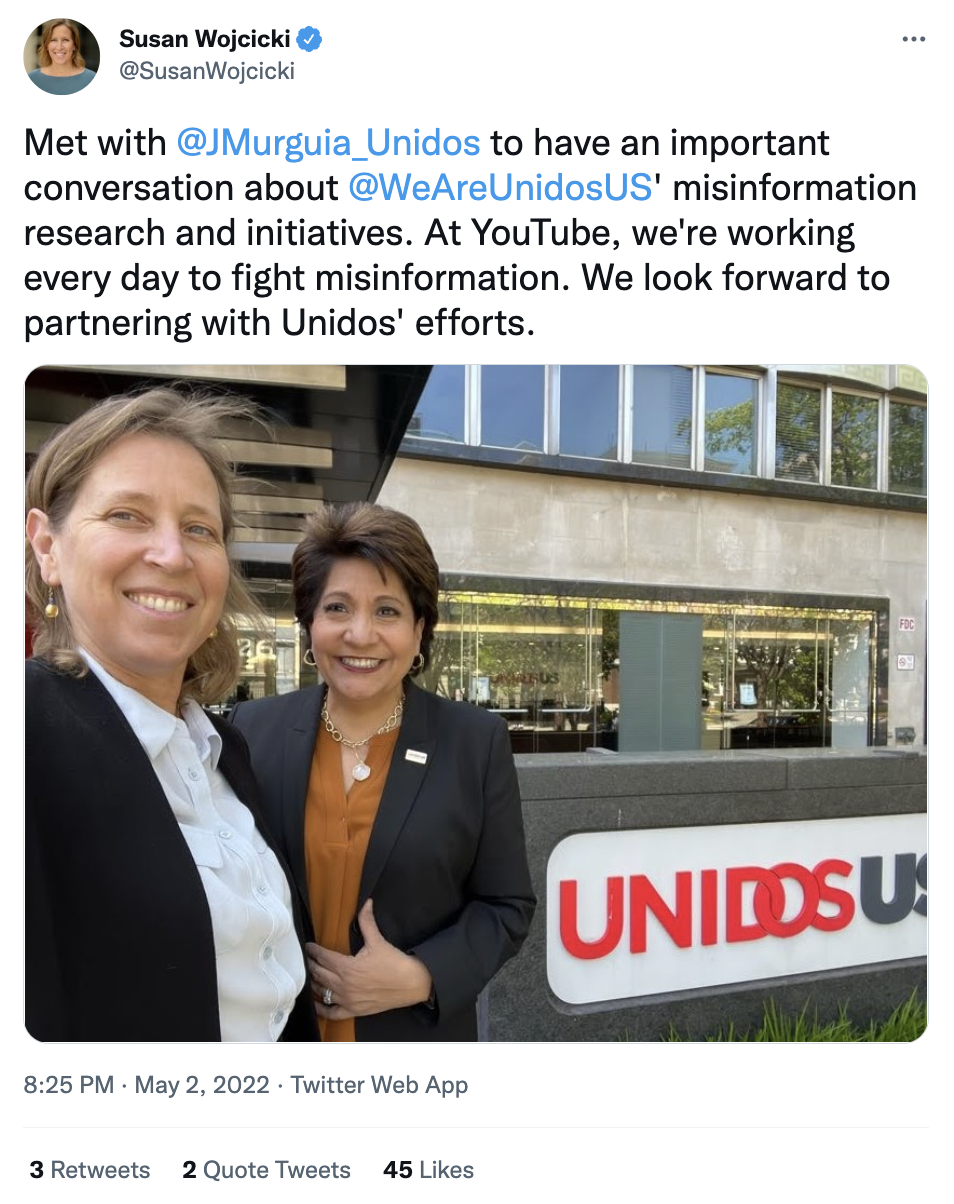
Wojcicki previously described tackling misinformation as one of her top priorities and YouTube has deleted more than a million videos for containing what it deems to be “COVID misinformation.”
UnidosUS President and CEO Janet Murguía echoed Wojcicki’s enthusiasm for targeting online misinformation in a tweet about the partnership.
“Eager as well to move forward on the key issue of addressing disinfo & misinformation in English & Spanish,” Murguía tweeted.
Murguía added that she’s united with the Congressional Hispanic Caucus (CHC) on UnidosUS’s efforts.
Wojcicki met with members of the CHC last week to discuss Spanish-language misinformation. After the meeting, the CHC said that addressing Spanish-language “dis/misinformation” is an “urgent priority.”
Although the specifics of YouTube and UnidosUS’s partnership have yet to be disclosed, UnidosUS has previously pressured Big Tech platforms to “address” misinformation.
Last October, the group cut ties with Facebook after former employee Frances Haugen’s shared internal documents that suggested the tech giant was aware of the platform having a negative impact on some users.
“We have called attention repeatedly to concerns about the negative impact that the proliferation of hate and misinformation on the platform has had on the Latino community,” Murguía stated at the time. “We know now that Facebook’s failure to adequately address those concerns was deliberate and resulted in even greater levels of hate and misinformation on the site.”
Last December, Murguía lamented that Congress has never held a hearing dedicated to Facebook’s “failure to address Spanish-language misinformation” and demanded that Meta CEO Mark Zuckerberg “tell Congress why Facebook perpetuates Spanish-language misinformation.”
Ukrainian strike on Donetsk market was a terrorist act

© Eva Bartlett
By Eva Bartlett | Samizdat | April 30, 2022
If the Donetsk marketplace that was hit by rocket artillery on Thursday had been in a city controlled by Kiev, the names and faces of the five civilians killed would be on all major news sites. But because it was another Ukrainian attack on civilians in the Donetsk People’s Republic (DPR), the deaths and 23 additional civilians injured will almost certainly go unreported, as has the been the norm during the regime’s eight years of the Donbass and Western media’s eight years of ignoring the attacks.
According to the DPR’s Healthcare Ministry, “The strike at the Tekstilschik neighbourhood in the Kirovsky district killed four people on the spot. One patient died in an ambulance during the transportation.”
With another journalist, I went in a taxi to the bombed markets. Two of the dead still lay at the site when we arrived, splayed on the ground. The other bodies had already been removed, but traces of their blood remained on the ground, doors nearby were riddled with shrapnel holes and debris from the strike was all around.
Presumably, rescue workers dealt with the injured first and didn’t prioritize retrieving all the dead as further Ukrainian strikes were possible. I saw this during my experience in Gaza, where Israeli’s waited for people to come to the scene of their attack, then bombed again.
According to Gennady Andreevich, a local employee of the district’s safety commission, at 11:40 am Grad missiles struck two different nearby markets: the vegetable and clothing market where the bodies lay, and a household chemicals and building materials market across and down the street. The latter was far more damaged, stalls completely burnt out, but no one was killed there.
Gennady walked with us to the vegetable market, speaking about previous Ukrainian attacks–which have been happening since 2014. More recent shellings hit near a gas station outside the market, at a residential building beyond the market, and in his own market administrative building, killing two colleagues.
He noted that at this time of day the market would have been filled with people, and that Ukraine knows very well what it is firing at.
“They know there is a market here and that from 10am to 1pm there are many people here,” Gennady said as we walked past shops.
This is a completely civilian area, no military installations.
Who else attacks markets and public spaces?
Striking crowded markets and streets at a busy time of the day is something terrorists in Syria did for years, to the silence of Western media. It is something Israel has also done for a long time, hitting residential and public areas of Gaza–one of the most densely inhabited places on earth.
During the 2009 war on Gaza, Israel bombed crowded mosques, hospitals, and buildings housing displaced Palestinians. One of the more notable incidents was when Tel Aviv targeted a UN-run school in Jabaliya sheltering nearly 1,500 people. At least 40 were killed. Another horrific attack on a crowded place was in the Zeitoun district, after Israeli soldiers forced at gunpoint nearly 100 of the extended Samouni family into one home and later bombed it, killing 48 members of the clan.
During the war, I accompanied medics in their ambulances, documenting Israel’s war crimes. A medic (Arafa abd al-Dayem) I had accompanied was killed one day when the Israeli army fired a prohibited flechette (dart) shell directly at him and the ambulance he stood beside. The following day, Israel struck the crowded mourning tents, also with flechettes, killing six and injuring 25 of the relatives and friends who had gathered in one small space to mourn Arafa’s death.
Damascus’ old city is a maze of twisting lanes, overlapping houses, churches, mosques, schools, crowded outdoor eateries, and markets. Terrorist factions occupying eastern Ghouta shelled most frequently when children would be going to or from school, people to markets.
Having spent a lot of time in the East Gate and Thomas Gate areas of the old city, I experienced the shelling and, unfortunately, acquired many accounts of the terrorists shelling crowded places.
Even today, walking around Old Damascus, you’ll find the imprint of mortar blasts. And if you do walk those lanes, you’ll see how crowded they usually are, meaning many people would have been injured and killed per single mortar blast.
In mid April 2014, for example, they hit an elementary school and a kindergarten, killing one child and injuring 65 more, just some of the countless children killed and injured by shelling over the years.
Incidentally, I later wrote about how the BBC were present at the same hospital where I saw these injured children, and were told explicitly that terrorists were mortaring the city every single day. The BBC article that later followed included the line: “the government is also accused of launching them into neighborhoods under its control.”
I also wrote about terrorist bombings of Aleppo, citing one day in November 2016 when I was in the city, which by the end of the day killed 18 and injured more than 200 civilians. These were some of the nearly 11,000 civilians killed in Aleppo alone by terrorist attacks on homes and public places.
I could continue citing such acts of terrorism in Syria, in Palestine, elsewhere, but I’ve made my point: when Ukraine bombs a crowded market, it is an intentional act of terrorism. As is Ukraine’s relentless bombing of homes in the Donbass republics these past eight years.
Western Media won’t report on this; Western politicians won’t condemn this; virtue signallers won’t speak about this. And when you actually go and document it, they will silence you relentlessly.

© Eva Bartlett
My initial tweet about the market attack was predictably trolled, with comments claiming the bodies were fakes, the bombing never occurred, “prove it” sort of remarks.
Since my observations and photos, as well as Gennady’s testimony, will still not be proof enough, in my video I also included footage taken by a local who was in the market when it was bombed and filmed the immediate aftermath. Gennady himself showed photos on his phone of firefighters dousing the flames, and scenes of the wounded and dead, clearly surrounded by new bomb debris.
But this is what we’ve come to today: Ukraine, often using weapons acquired from the West, can continue to bomb busy civilian areas of the Donbass republics, killing still more civilians, and not only do the hypocrites of the West so keen to accuse Russia of war crimes (which they can never prove and often contradict themselves over), but media and troll farms work in lockstep to gaslight the public and whitewash Ukraine’s war crimes.
Eva Bartlett is a Canadian independent journalist. She has spent years on the ground covering conflict zones in the Middle East, especially in Syria and Palestine (where she lived for nearly four years).
Featured Video

Max Otte: How Germany Destroyed Itself – No Turning Back
or go to
Aletho News Archives – Video-Images
From the Archives
Three Reasons Macron is a Hypocrite when it Comes to Venezuela
By Jim Carey | Geopolitics Alert | January 29, 2019
Paris – French President Emmanuel Macron recently voiced support for protesters in Venezuela as his own country has been ground to a halt by protests every weekend.
There is an overused saying that “people in glass houses shouldn’t throw stones.” While these few words may be cliche there is definitely one man that they can be applied to after this weekend: Emmanuel Macron.
Even though the French President is into the third month of protests against his government, he has decided to weigh in on the legitimacy of another country’s government and his latest outrageous statements just highlight the hypocrisy of Macron and Western leaders in general. … continue
Blog Roll
Recent Comments
loongtip on A Funny Thing Happened on the… loongtip on EU free trade pact on hold as… John Edward Kendrick on Regime Change In Iran Is The F… Bill Francis on Australia Passes New Hate Spee… seversonebcfb985d9 on Australia Passes New Hate Spee… Bill Francis on Britain’s AI Policing Plan Tur… loongtip on Miami Beach Resident Questione… loongtip on Israeli agricultural export co… loongtip on The War On Free Speech In Aust… seversonebcfb985d9 on Scott Ritter Hiding the Domina… Richard Ong on Europe Economic Panic Kate on Bird Flu Outbreak 40 Miles Fro…


 Aletho News
- Max Otte: How Germany Destroyed Itself – No Turning Back
- Why Trump’s ‘Board Of Peace’ Is Destined To Crash And Burn
- ‘Board of Peace’ resembles a club that turns the world into the ‘law of the jungle’
- After the headlines fade: Gaza, abandoned while the genocide persists
- Introducing Mossad Farsi, the Motto and the Methods
- How Syria’s Kurds were erased from the US-led endgame
- Trump presses aides to draw up ‘decisive options’ for strikes on Iran: Report
- Regime Change In Iran Is The Final Phase Of The ‘Clean Break’ Strategy
- How many regime change wars before we wake up?
- When Greenland divides the North Atlantic allies, the world is astonished!
- If Americans Knew
- Another baby dies of cold in Gaza, as Rafah crossing remains locked down – Not a ceasefire Day 103
- Brutal Beatings, Arson, and Impunity: A Palestinian Plant Nursery Becomes a Target for Settler Pogroms
- On Iran’s protests, Israeli hypocrisy knows no limits
- A Cease-fire for Israelis and a War for Palestinians
- ‘When will Baba come back?’ Gaza’s widows and orphans struggle to survive
- Genocide research institute levels accusations against Germany for denying Israel’s genocide against Palestinians
- Over 1,200 Israeli truce violations in Gaza – Not a ceasefire Day 102
- Trump has created a monster: Gaza Board of Peace – Not a ceasefire Day 101
- As world leaders squabble over controlling Gaza, another baby freezes to death – Not a ceasefire Day 100
- Trump “Board of Peace” for Gaza is stacked with Israel supporters – Not a ceasefire Day 99
- No Tricks Zone
- As German Gas Storage Dips Dangerously Low…Shortage Hardly Avoidable
- New Study: Brazil’s Relative Sea Level Was 2+ Meters Higher And SSTs 3-4°C Warmer 6000 Years Ago
- Philosopher Schopenhauer: Climate Science Certainty Stems From Stupidity, Ignorance
- New Study: Species Extinction Rates Declining Since 1980 – ‘Climate Change Is Not An Important Threat’
- Denmark Places Climate Protection Above Animal Welfare, Poisoning And Culling Cows
- New Study: Greenland Was 3-7°C Warmer And Far Less Glaciated Than Today 6000-8000 Years Ago
- German Media Report That Current Frigid Weather Can Be Explained By Arctic Warming!
- Berlin Blackout Shows Germany’s $5 Trillion Green Scheme Is “Left-Green Ideological Pipe Dream”
- Modeling Error In Estimating How Clouds Affect Climate Is 8700% Larger Than Alleged CO2 Forcing
- Berlin’s Terror-Blackout Enters 4th Day As Tens Of Thousands Suffer In Cold Without Heat!
 Aletho News