Europe’s Perverted Logic: Israel Has the ‘Right’ to Attack, Iran Is ‘Guilty’ for Defending Itself
By Ekaterina Blinova – Sputnik – 15.06.2025
European leaders have effectively blamed Iran for being attacked, Responsible Statecraft reports.
Israel’s strike violated Article 2(4) of the UN Charter — it was launched with no legal basis for self-defense, per Responsible Statecraft.
But instead of condemning it, Europe parroted Israeli justifications.
The claim that Iran is building nuclear weapons was dismissed by US intelligence chief Tulsi Gabbard in March: “Iran is not building a nuclear weapon.”
Still, EU leaders leaned on a June 12 IAEA resolution accusing Iran of Non-Proliferation Treaty violations to rationalize Israel’s actions.
What Do European Leaders Say?
French President Emmanuel Macron: “France has repeatedly condemned Iran’s ongoing nuclear program… In this context, France reaffirms Israel’s right to defend itself and ensure its security.”
German Chancellor Friedrich Merz: “[Iran’s] nuclear program violates the provisions of the Nuclear Non-Proliferation Treaty… We reaffirm that Israel has the right to defend its existence and the security of its citizens.”
EC President Ursula von der Leyen: “I reiterated Israel’s right to defend itself and protect its people.”
None of these leaders addressed the legality of Israel’s initial strike. None acknowledged Iran’s right to defend its own sovereignty.
Western hypocrisy: ‘Israel’ bombs Iran, Tehran told not to retaliate
Al Mayadeen | June 13, 2025
Top Western leaders have called for restraint in the wake of the ongoing Israeli aggression on Iranian territory. Brutal strikes targeted military, nuclear, and civilian infrastructure and led to multiple casualties. Yet, while urging de-escalation, these leaders have largely avoided condemning “Israel’s” violation of international law, choosing instead to direct their diplomatic pressure on Tehran not to retaliate.
The double standard is stark: while Iran has consistently operated within the framework of international law and the UN Charter, the Israeli entity has carried out cross-border aggression with impunity. Under Article 51 of the UN Charter, Iran has a recognized legal right to self-defense, a point conspicuously absent from most Western statements.
Europe avoids accountability for ‘Israel’
EU foreign policy chief Kaja Kallas called the situation, not Israeli attacks, “dangerous” and appealed for restraint from “all sides”, despite Iran being the target of the aggression. Kallas, who reportedly spoke with Israeli Foreign Minister Gideon Sa’ar shortly after the attack, did not denounce the strikes or the violations of Iranian sovereignty.
European Commission President Ursula von der Leyen echoed the vague language, urging parties to “exercise maximum restraint, de-escalate immediately, and refrain from retaliation.” The call placed the burden on Iran to avoid a response, while the Israeli entity’s unlawful actions were met with silence.
On his part, French Foreign Minister Jean-Noel Barrot and Italian Foreign Minister Antonio Tajani both stressed the need for “diplomacy”, but neither condemned the unilateral Israeli aggression. Tajani stated, “There is no solution but a diplomatic one. Actions and reactions are dangerous,” drawing false parity between attacker and victim.
Meanwhile, French President Emmanuel Macron convened a special defense meeting but offered no criticism of “Israel’s” blatant breach of international norms.
Australia and NATO echo the US line
Australian Prime Minister Anthony Albanese, speaking from Fiji, framed the issue around Iran’s nuclear program rather than the illegal nature of the Israeli strike. “We are very conscious of the threat that Iran becoming a nuclear state would represent,” he said, further aligning with Washington’s narrative. Australia’s Department of Foreign Affairs updated travel advisories, urging Australians to leave “Israel” and the occupied Palestinian territories.
NATO Secretary-General Mark Rutte, while warning of escalation, also avoided assigning blame, waving the “de-escalation” card for vague purposes.
“De-escalation is now the first order of the day,” he said, reflecting a Western consensus that implicitly tolerates Israeli militarism while expecting Iranian restraint.
Walking a delicate line
Former US President Donald Trump confirmed that he had been briefed ahead of the strikes and stated, “Iran cannot have a nuclear bomb. We are hoping to get back to the negotiating table,” again shifting the narrative away from Israeli accountability.
Secretary of State Marco Rubio claimed that the United States had no involvement in the strikes but issued a warning to Tehran, “Israel took unilateral action against Iran,” and any retaliation must not target US interests.
“We are not involved in strikes against Iran, and our top priority is protecting American forces in the region,” Rubio said in an official statement. “Israel advised us that they believe this action was necessary for its self-defense, Rubio added, although it was “Israel” that always initiated attacks against the Islamic Republic.
“Let me be clear: Iran should not target US interests or personnel,” Rubio said, without addressing whether Washington would defend “Israel” in the event of Iranian retaliation, departing from traditional US messaging that often emphasizes unwavering support for the Israeli regime. This support came directly from the US president himself, who rushed to “Israel’s” rescue.
‘Both sides’ should avoid further destabilization
UK Prime Minister Keir Starmer labeled the attacks “concerning” but urged all sides to reduce tensions, stopping short of condemning the aggression.
German Chancellor Friedrich Merz, who received a direct call from Netanyahu, affirmed “Israel’s” so-called right to “self-defense” and echoed longstanding Western concerns over Iran’s nuclear program. He, too, urged both sides to avoid further destabilization, without acknowledging who initiated the escalation.
Tehran maintains right to self-defense
Iranian officials have underscored that the Islamic Republic has not initiated the war and that its actions have consistently adhered to international law. Tehran has emphasized that its right to respond is enshrined in Article 51 of the UN Charter, asserting that “Israel’s” continued violations of international law, coupled with Western silence, further undermine the credibility of global institutions.
The widespread Western calls for restraint, directed almost exclusively at Iran, highlight a longstanding hypocrisy: that Israeli violations of international law are tolerated, while Iranian sovereignty and legal rights are dismissed or ignored.
It is worth noting that this is happening as Oman was planning to host the sixth round of US‑Iran nuclear talks this Sunday in Muscat.
Tehran and Washington have held five rounds of talks since April to carve a new nuclear deal to replace the 2015 accord that Trump unilaterally withdrew from during his first term in 2018.
Iran has always reiterated its commitment to diplomacy while upholding its commitments under the Non-Proliferation Treaty (NPT) and the Comprehensive Safeguards Agreement, while the West has manipulated the agency to serve geopolitical goals.
It is worth noting that Iranian media outlets on Thursday published a series of documents that reveal covert coordination between IAEA Director General Rafael Grossi and “Israel”, a collaboration Iranian officials say was designed to politicize the agency’s oversight of Iran’s peaceful nuclear program.
AEOI slams IAEA’s silence despite Israeli aggression on nuclear site
Al Mayadeen | June 13, 2025
The Atomic Energy Organization of Iran (AEOI) has issued a sharp rebuke of the International Atomic Energy Agency (IAEA) and its Director General, Rafael Grossi, denouncing the agency’s failure to condemn the Israeli aggression on Iran, most notably its Natanz nuclear facility. The AEOI called the IAEA’s silence a “form of cooperation” with the Israeli entity.
The condemnation came in the aftermath of the ongoing Israeli aggression on Friday, which targeted the Shahid Ahmadi Roshan enrichment complex at Natanz, in addition to residential buildings, military sites, and nuclear facilities.
In a statement, the AEOI confirmed that although sections of the site sustained damage, no casualties occurred and no radiation or chemical leaks were detected. “Investigations are underway to determine the level of the damage,” the agency said.
Iran’s nuclear authority stated that the attack violated international law and multiple resolutions issued by the UN Security Council, the IAEA Board of Governors, and the IAEA General Conference. The AEOI also denounced the IAEA’s longstanding inaction in the face of repeated Israeli threats against Iranian nuclear facilities.
“The Agency has practically distanced itself from professionalism and impartiality by preparing biased political reports based on fake information received from the Zionist regime,” the AEOI emphasized.
IAEA ‘lost its credibility’
The organization further accused the IAEA of having “lost its credibility as a valid international organization,” warning that its continued inaction has turned it into “a tool in the hands of the Zionist regime.” The attack, the statement noted, represents a “setback for the IAEA due to the Director General’s unjustifiable shortcomings and failure to play a professional and impartial role.”
Reaffirming Iran’s commitment to peaceful nuclear advancement, the AEOI declared that “political and military pressure will not derail Iran’s nuclear program” and added, “These great people, much to the enemies’ chagrin, will pursue the country’s lofty goals in further advancing the nuclear industry with double motivation.”
‘Nuclear sites must never be attacked’
Shortly after Iran’s statement, IAEA Director General Rafael Grossi remarked that “nuclear sites must never be attacked,” yet pointedly refrained from condemning the Israeli aggression on Iran’s nuclear facility, an omission that Tehran views as tacit complicity.
Meanwhile, a growing number of states denounced the Israeli aggression against Iran, warning against escalation risks and far-reaching international consequences.
“This development is deeply concerning… I reiterate that any military action that jeopardizes the safety and security of nuclear facilities risks grave consequences for the people of Iran, the region, and beyond,” Grossi said in a message to the IAEA Board of Governors.
He added that he was “ready to travel to Iran at the earliest” to assess the situation and reaffirm the agency’s oversight. Grossi confirmed that Iran’s Fordow enrichment plant and a site in Esfahan were not impacted and that radiation levels at Natanz remained normal.
After Israeli attack, Grossi calls for restraint
Calling for restraint, Grossi urged both sides to step back from escalation. “Despite the current military actions and heightened tensions, it is clear that the only sustainable path forward, for Iran, for Israel, the entire region, and the international community, is one grounded in dialogue and diplomacy to ensure peace, stability, and cooperation,” he said.
Earlier today, the IAEA announced that Iran’s Bushehr Nuclear Power Plant remains unharmed and that no increase in radiation has been detected at the Natanz nuclear site, despite the massive Israeli aggression on Iran.
Iran condemns ‘biased’ IAEA, announces enrichment countermeasures
Al Mayadeen | June 12, 2025
Iran has sharply rejected a resolution passed by the International Atomic Energy Agency’s (IAEA) Board of Governors, accusing it of being “politically driven” and “biased”. In a joint statement released Thursday by the Foreign Ministry and the Atomic Energy Organization of Iran (AEOI), Iranian officials condemned the resolution and unveiled a series of countermeasures aimed at accelerating the country’s nuclear program.
This comes shortly after the IAEA Board of Governors passed a resolution against Iran on Thursday, claiming Iran was in breach of non-proliferation obligations. The vote passed with 19 countries voting in favor, 3 opposing, and 11 abstaining, according to diplomats cited by Reuters. Two countries were absent and thus did not vote.
The resolution, marking the first formal accusation in nearly two decades that Iran has violated its nuclear non-proliferation obligations, was passed during a closed-door session of the 35-member board. The move, described as “politically motivated” by Iranian officials, was initiated by the United States along with the E3, Britain, France, and Germany.
IAEA resolution lacks ‘neutrality’
The joint statement asserted that Iran remains committed to its obligations under the Safeguards Agreement, adding that no IAEA report to date has ever confirmed any deviation or non-compliance. Iranian authorities described the IAEA’s latest move as lacking “neutrality” and being manipulated by Western powers, particularly the United States, Britain, France, and Germany, to pursue geopolitical goals.
In a direct response, Iran announced the activation of a new uranium enrichment facility at a secure site and plans to upgrade the Fordow nuclear plant by replacing older centrifuges with sixth-generation advanced models.
Iran blasts Western double standards on nuclear disarmament
Iranian officials criticized the IAEA and its Western backers for what they described as selective enforcement of nuclear obligations. The joint statement accused the US and its European allies of reviving “25-year-old allegations” that had already been settled under the 2015 nuclear deal, while turning a blind eye to “Israel’s” undeclared nuclear arsenal and refusal to adhere to the Non-Proliferation Treaty (NPT).
“The United States, Britain, and France have failed to comply with Article VI of the NPT regarding nuclear disarmament,” the statement read, adding that Germany remains in possession of “inhumane weapons of mass destruction.”
Iran further warned that continued political maneuvering within the IAEA would render any future engagement futile. “This political approach toward Iran, which has always honored its obligations and cooperated extensively with the Agency, forces us to conclude that the path of engagement and cooperation is futile,” the statement asserted.
Iran thanks allies opposing the resolution
Iran’s Foreign Ministry spokesperson, Esmaeil Baghaei, strongly condemned the resolution passed Thursday by the IAEA Board of Governors, calling it a politically motivated effort by Western powers to undermine the peaceful nature of Iran’s nuclear program.
Baghaei specifically denounced the role of the United States, the United Kingdom, France, and Germany, accusing them of exploiting the IAEA to “cast doubt on the peaceful nature of Iran’s nuclear program.”
He firmly rejected the allegations outlined in the resolution, which he said were based on “baseless and unfounded claims” and stemmed from a political report by the IAEA Director General. The resolution, jointly submitted by the four Western states, was described as “an unjustified, groundless, and cruel move,” aimed at exerting “maximum pressure on Iran to deviate from the legitimate rights and interests of the Iranian people in the peaceful use of nuclear energy.”
Baghaei warned that those behind the resolution will be held accountable for its repercussions. “The Islamic Republic of Iran will take proportionate measures in response to this move to secure and protect the interests and inalienable rights of the Iranian nation in benefiting from peaceful nuclear energy,” he said.
He also expressed deep concern over the conduct of the IAEA Director General, criticizing his public statements and what he described as provocative interviews on Iran’s nuclear activities. Baghaei accused the agency chief of undermining the organization’s neutrality, stating that he “must adhere to his missions and duties in accordance with the Agency’s statute.”
Furthermore, the Iranian diplomat extended gratitude to China, Russia, Venezuela, Cuba, Nicaragua, and Belarus for issuing a joint statement rejecting the resolution. He praised their “responsible and legal positions” and reaffirmed the Iranian nation’s determination to defend its rights and interests as outlined in the United Nations Charter and the Non-Proliferation Treaty.
Iran’s IAEA representative Najafi slams politicized resolution
Iran’s representative at the International Atomic Energy Agency (IAEA), Reza Najafi, strongly criticized the agency’s recent resolution against Iran, denouncing it as politically motivated and based on unreliable sources. Speaking on Thursday, Najafi warned that such moves undermine the IAEA’s credibility and threaten the rights of member states under its founding charter.
Najafi emphasized that any draft resolution brought forward by the Board of Governors should rely strictly on unbiased, verifiable evidence, not intelligence supplied by specific states with vested interests. “Basing reports on questionable or politicized information undermines the agency’s objectivity,” he stated, in clear reference to data provided by Western governments and the Israeli occupation.
US current approach risks setting a dangerous precedent
He warned that the United States’ current approach risks setting a dangerous precedent, one that could erode trust and cooperation between the agency and its member states. Najafi asserted that such behavior contradicts the IAEA’s stated commitment to impartiality and transparency.
Reaffirming Iran’s position, Najafi made it clear that the Islamic Republic would not tolerate any attempt to erode its sovereignty through international pressure.
“Iran categorically rejects any pressure or mediation that seeks to undermine its sovereignty. We will defend our national interests, independence, and dignity,” he declared.
Politicized resolution in disguise
Najafi also expressed Iran’s outright rejection of what he described as a politicized resolution disguised as a technical safeguard concern, echoing Tehran’s longstanding understanding that the IAEA is being used as a tool for Western geopolitical agendas.
In a pointed warning to the E3, Britain, France, and Germany, as well as the United States, Najafi made it clear that Iran’s response would be firm. “These measures will not pass without consequences. They must take full responsibility for the repercussions and Iran’s strong reaction,” he said.
Kamalvandi: Political pressure will escalate Iran’s nuclear program
Behrouz Kamalvandi, Deputy Head of the Atomic Energy Organization, reinforced the government’s defiant tone, declaring that political pressure would only accelerate Iran’s nuclear ambitions.
“It is a strategic mistake to think that political pressure will push Iran to abandon its legitimate positions,” Kamalvandi said, warning that the current approach would “backfire”.
He confirmed that Iran would soon launch a third uranium enrichment facility, in addition to boosting enrichment capacity at existing sites. “We will develop sixth-generation centrifuges and increase uranium enrichment significantly,” he stated.
More Western pressure, more Iranian countermeasures
Iran’s latest response underscores its growing rejection of Western pressure and marks a new phase in the country’s nuclear trajectory, one increasingly independent of multilateral negotiations and oversight mechanisms perceived by Tehran as compromised.
This development comes just days ahead of the sixth round of indirect nuclear talks between Iran and the United States, set to take place this Sunday in Muscat, Oman. The announcement was confirmed by Omani Foreign Minister Badr Albusaidi, who wrote in a post on X: “I am pleased to confirm the 6th round of Iran-US talks will be held in Muscat this Sunday, the 15th.”
Tehran and Washington have held five rounds of talks since April to carve a new nuclear deal to replace the 2015 accord that Trump unilaterally withdrew from during his first term in 2018.
Iran Says Europe Funded Israel’s Bomb Program
Sputnik – 09.06.2025
TEHRAN – Several European countries participated in Israel’s military nuclear program, Iranian Foreign Ministry spokesman Esmail Baghaei said on Monday, citing documents obtained by Iranian intelligence in Israel.
“What was previously clear to us will now become clearer to others with the publication of these documents — they will openly confirm the active involvement of several European countries in Israel’s nuclear military program. These are the same countries that constantly speak about nuclear non-proliferation and cast doubt on Iran’s peaceful nuclear program, while they themselves play a role in Israel’s military nuclear program,” Baghaei said during a press conference.
On Saturday, Iranian state news agency Tasnim reported that the country’s intelligence services obtained in Israel a wide range of confidential military-strategic documents related to Israel’s nuclear sector. Iranian authorities will publish a series of these documents in the near future.
Former German top diplomat and Zionist cheerleader rewarded with top UN job
By Ivan Kesic | Press TV | June 3, 2025
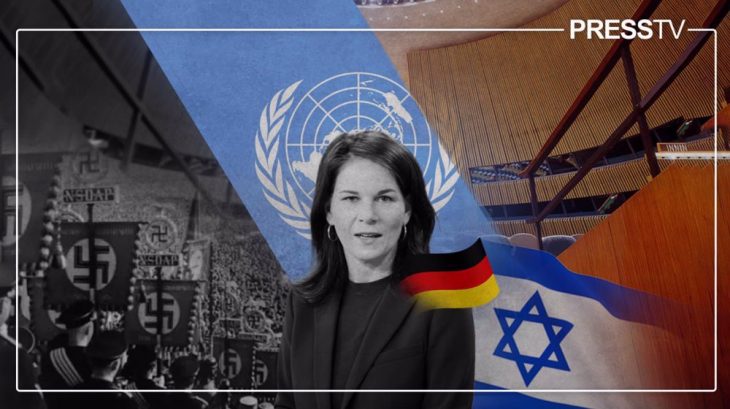
Former German Foreign Minister Annalena Baerbock, a well-known Zionist cheerleader and warmonger, has been elected as the new president of the United Nations General Assembly (UNSC), raising eyebrows worldwide.
Human rights activists and pro-Palestine advocates see it as an affront to the Palestinian victims of the ongoing Israeli-American genocidal war that has claimed more than 54,000 lives since October 2023, most of them children and women.
Craig Mokhiber, a human rights lawyer and former United Nations human rights official, in a post on X, slammed the appointment of Baerbock by the world body to “oversee its accelerating decline.”
“The United Nations was born in opposition to German war criminals. Today, it has elected a German war criminal to oversee its accelerating decline,” he wrote.
“80 years later, the Reich takes its revenge with Annalena Baerbock as UNGA President, in the midst of a genocide that she has enthusiastically abetted.”
He was referring to the Nazi Germany’s horrendous war crimes in the World War II, which prompted world leaders to form a body called United Nations in the aftermath of the war.
The United Nations (UN) was established in 1945 with the signing of the UN Charter by 51 countries, replacing the ineffective League of Nations, and essentially against German war criminals.
Annalena Baerbock, a prominent Green Party politician in Germany, will serve as the president of the United Nations General Assembly for its 80th session, starting in September 2025.
The election took place on June 2, 2025, where she ran unopposed and secured the position with a simple majority of 167 votes. Her inauguration is scheduled for September 9, 2025, just before the UN General Assembly’s general debate.
The role, which lasts one year, is primarily ceremonial and involves organizing and presiding over plenary sessions of the 193 member states, ensuring all voices are heard, and facilitating diplomatic consensus.
Baerbock’s nomination by the German government, led by Chancellor Olaf Scholz, came after the Green Party’s exclusion from the new German coalition government following the February 2025 elections.
The decision sparked controversy, as Germany had initially nominated diplomat Helga Schmid for the role. Schmid, a former OSCE Secretary-General, had been preparing for the position for nearly a year, meeting over 100 UN ambassadors.
Baerbock’s last-minute nomination was criticized by many, including former German UN ambassador Christoph Heusgen, who called it a “self-serving” move that undermined Germany’s credibility.
Polls indicated 57% of Germans viewed her nomination negatively, which is reflected by social media posts calling her the “dumbest minister ever.”
“German woman Annalena Baerbock, who can’t even speak German properly, let alone English, who was the dumbest minister ever, and even her university degree is fake, now gets the top UN job, proving the West to be a declining entity,” wrote journalist Sonja Van Den Ende.
Zionist cheerleader
In addition to her home country, Baerbock’s nomination and election have drawn criticism around the world, particularly for her approving views of the Zionist regime and its no-holds-barred genocidal war against the Palestinians in Gaza.
As German Foreign Minister from December 2021 to early 2025, she faced significant condemnation for her statements and positions from activists, academics, and political commentators.
Baerbock’s staunch support for the Israeli regime, rooted in Germany’s post-WW2 Zionist policy and the concept of Staatsräson (Israeli “security” as a German national interest), drew sharp criticism for bias and disregard for Palestinian rights.
Her statements often emphasized the so-called Israeli “right to self-defense” while offering limited critique of its genocidal actions, particularly after the events of October 7, 2023.
She legitimized Israeli attacks on civilians and on October 10, 2024, stated in the German Bundestag that “civilian sites in Gaza could lose their protected status if used by Hamas,” which drew widespread backlash.
A letter from 300 academics, organized by the Palestine Academic Group, accused her of “parroting Israel’s old narrative of human shielding,” a Zionist claim that has repeatedly been debunked as a pretext for targeting civilians in Gaza.
They argued that Baerbock disregarded international law, under which the Israeli regime, as an occupying power, cannot claim “self-defense,” and demanded she retract her statement and apologize to Palestinian civilians.
Protests in Berlin on October 21, 2024, echoed this sentiment, with demonstrators chanting, “Annalena Baerbock, shooting pregnant women in the stomach is not self-defense,” accusing her of justifying Israeli genocidal attacks on civilian infrastructure like hospitals and schools.
Francesca Albanese, UN Special Rapporteur on the occupied Palestinian territories, criticized Baerbock’s October 2024 speech, noting that while civilian sites can lose protected status under international law if used militarily, disproportionate harm to civilians remains illegal, a nuance Baerbock’s statements overlooked.
Journalist Afshin Rattansi said she was “enthusiastically backing Israel’s bombing of schools and innocent Palestinians in Gaza, justifying it as targeting Hamas.”
“The fact that this war criminal is allowed to assume the title of President of the UN General Assembly, instead of spending the rest of her days locked away in The Hague, is proof that the ‘rules-based order’ was nothing but a codeword for colonial barbarism,” he wrote on X.
British activist Sarah Wilkinson also took to her social media handle to decry her appointment.
“A disaster for the UN & Int’l Law, if Annalena Baerbock, who funded, armed & endorsed the #GazaGenocide is set to be UNGA’s President,” wrote Wilkinson.
Enabler of genocide in Gaza
Activists worldwide have highlighted Baerbock’s hypocrisy in supporting Israel’s genocidal actions while offering limited humanitarian aid to Palestinians in Gaza.
Protesters in Berlin accused Germany of “feeding Israel with weapons and money” while sending aid to Palestine to “wash your bloody hands.”
Baerbock was denounced for failing to balance Germany’s support for the Israeli regime with equal concern for Palestinian suffering, with many calling her a “Zionist cheerleader” who led the Green Party to reactionary policies.
Media outlets reported that her six solidarity visits to the occupied Palestinian territories, contrasted with her minimal critique of Israeli genocidal actions, ignored diplomatic decorum and international law, in which she is supposed to hold an academic degree.
MERA25 and DiEM25, two German political parties, launched a petition on October 22, 2024, demanding Baerbock’s resignation, accusing her of complicity in “genocide and apartheid” through Germany’s diplomatic and military support for the Israeli crimes.
They cited her failure to address findings by the Lemkin Institute and UN experts on Israeli genocidal actions in Gaza, where over 42,600 people were killed by October 2024, mostly women and children.
Her “feminist foreign policy” was deemed a mockery, as she dehumanized Palestinian victims, tarnishing Germany’s international reputation.
In March 2024, the US-based Carnegie Endowment noted that Germany’s unconditional support for the Israeli regime under Baerbock isolated it globally, contradicting its stated commitment to international law and democracy.
Critics also accused her of a “Täter-Opfer-Umkehr” (perpetrator-victim reversal), showing little understanding of international security while ignoring Palestinian rights.
Her mild criticism of Israeli settler violence in the occupied West Bank, calling for prosecution but not imposing sanctions, was seen as insufficient, especially as Germany increased military exports to the Israeli regime tenfold from 2022 levels.
Baerbock’s approach to Iran, particularly her support for the Israeli stance against Iran and the Axis of Resistance, also drew scrutiny. Her critics argued her policies risked fueling a regional war.
North Korea slams ‘hostile’ Western report on ties with Russia
RT | June 2, 2025
North Korea has slammed a report by a Western sanctions monitoring group’s on its ties with Russia, calling it a “political provocation.” Cooperation with Moscow is a “legitimate exercise of the DPRK’s sovereign rights,” Pyongyang has insisted.
The report was released last week by the Multilateral Sanctions Monitoring Group (MSMT), created by the US and South Korea to monitor enforcement of UN sanctions against North Korea.
It alleges “illegal” military cooperation between Moscow and Pyongyang, including purported arms transfers from North Korea to Russia, troop deployments and training, excess petroleum shipments, and financial coordination.
Citing data from its 11 members and open-source intelligence, the report claims these actions violate UN Security Council resolutions aimed at curbing North Korea’s nuclear and missile programs.
Pyongyang considers the MSMT report a “hostile act” and the organization a “ghost group without any legitimacy” and a “political tool” operating “according to the geopolitical interests of the West.”
“The hostile acts of the MSMT… are a flagrant violation of the international legal principles of sovereign equality and non-interference in internal affairs and a mockery of the fair and just international community,” the country’s Foreign Affairs Ministry said in its statement on Sunday, as cited by the Korean Central News Agency (KCNA). The ministry called the report a fabrication and denounced it as politically biased and “provocative.”
Military cooperation between Moscow and Pyongyang is “aimed at protecting the sovereignty, territorial integrity, and security interests” of the countries and “ensuring peace and stability in the Eurasian region,” the ministry claimed. It stressed that it is a “legitimate exercise of sovereign rights” of both countries in accordance with the UN Charter.
Moscow has not yet commented on the MSMT report.
In June 2024, Russia and North Korea signed the Comprehensive Strategic Partnership Agreement, which includes a clause providing for military and other assistance in the event of armed invasion of either side. Several weeks later, South Korean and US media reported the deployment of North Korean troops to Russia’s Kursk Region, which at the time was under Ukrainian attack. Moscow and Pyongyang confirmed the military presence in late April after Russian forces declared the region fully liberated.
The MSMT group was created last October after the disbandment of the UN Panel of Experts on DPRK, which had monitored the implementation of UN sanctions on North Korea until a Russian veto ended its mandate. Russian Foreign Ministry spokeswoman Maria Zakharova at the time called MSMT “illegal,” saying it was created by “uninvited enthusiasts bypassing the UN Security Council” who “demonstrate blatant disregard for international law.”
Elite Western universities are a corrupt, parasitic empire
Instead of high-quality education, these institutions are fostering a global neo-feudal system reminiscent of the British Raj
By Dr. Mathew Maavak | RT | May 30, 2025
In a move that has ignited a global uproar, US President Donald Trump banned international students from Harvard University, citing “national security” and ideological infiltration. The decision, which has been widely condemned by academics and foreign governments alike, apparently threatens to undermine America’s “intellectual leadership and soft power.” At stake is not just Harvard’s global appeal, but the very premise of open academic exchange that has long defined elite higher education in the US.
But exactly how ‘open’ is Harvard’s admissions process? Every year, highly qualified students – many with top-tier SAT or GMAT test scores – are rejected, often with little explanation. Critics argue that behind the prestigious Ivy League brand lies an opaque system shaped by legacy preferences, DEI imperatives, geopolitical interests, and outright bribes. George Soros, for instance, once pledged $1 billion to open up elite university admissions to drones who would read from his Open Society script.
China’s swift condemnation of Trump’s policy added a layer of geopolitical irony to the debate. Why would Beijing feign concern for “America’s international standing” amid a bitter trade war? The international standing of US universities has long been tarnished by a woke psychosis which spread like cancer to all branches of the government.
So, what was behind China’s latest gripe? The answer may lie in the unspoken rules of soft power: Ivy League campuses are battlegrounds for influence. The US deep state has long recruited foreign students to promote its interests abroad – subsidized by American taxpayers no less. China is apparently playing the same game, leveraging elite US universities to co-opt future leaders on its side of the geostrategic fence.
For the time being, a judge has granted Harvard’s request for a temporary restraining order against Trump’s proposed ban. Come what may, there is one commonsense solution that all parties to this saga would like to avoid: Forcing Ivy League institutions to open their admissions process to public scrutiny. The same institutions that champion open borders, open societies, and open everything will, however, not tolerate any suggestion of greater openness to its admissions process. That would open up a Pandora’s Box of global corruption that is systemically ruining nations today.
Speaking of corruption – how is this for irony? A star Harvard professor who built her career researching decision-making and dishonesty was just fired and stripped of tenure for fabricating her own data!
Concentration of wealth and alumni networks
The Ivy League has a vested interest in perpetuating rising wealth and educational inequalities. It is the only way they can remain atop the global rankings list at the expense of less-endowed peers.
Elite universities like Harvard, Stanford, and MIT dominate lists of institutions with the most ultra-wealthy alumni (net worth over $30mn). For example, Harvard alone has 18,000 ultra-high-net-worth (UHNW) alumni, representing 4% of the global UHNW population.
These alumni networks provide major donations, corporate partnerships, and exclusive opportunities, reinforcing institutional wealth. If the alma mater’s admissions process was rigged in their favor, they have no choice but to cough it up, at least for the sake of their offspring who will perpetuate this exclusivist cycle.
The total endowment of Princeton University – $34.1 billion in 2024 – translated to $3.71 million per student, enabling generous financial aid and state-of-the-art facilities. Less prestigious institutions just cannot compete on this scale.
Rankings, graft, and ominous trends
Global university rankings (QS, THE, etc.) heavily favor institutions with large endowments, high spending per student, and wealthy student bodies. For example, 70% of the top 50 US News & World Report Best Colleges overlap with universities boasting the largest endowments and the highest percentage of students from the top 1% of wealthy families.
According to the Social Mobility Index (SMI), climbing rankings requires tens of millions in annual spending, driving tuition hikes and exacerbating inequality. Lower-ranked schools which prioritize affordability and access are often overshadowed in traditional rankings, which reward wealth over social impact. Besides, social mobility these days is predetermined at birth, as the global wealth divide becomes unbridgeable.
Worse, the global ranking system itself thrives on graft, with institutions gaming audits, inflating data, and even bribing reviewers. Take the case of a Southeast Asian diploma mill where some of its initial batch of female students had been arrested for prostitution. Despite its flagrant lack of academic integrity, it grew rapidly to secure an unusually high QS global ranking – ahead of venerable institutions like the University of Pavia, where Leonardo da Vinci studied, and which boasts three Nobel Laureates among its ranks.
Does this grotesque inversion of merit make any sense?
Government policies increasingly favor elite institutions. Recent White House tax cuts and deregulation may further widen gaps by benefiting corporate-aligned universities while reducing public funding for others. This move was generally welcomed by the Ivy League until Trump took on Harvard.
With such ominous trends on the horizon, brace yourselves for an implosion of the global education sector by 2030 – a reckoning mirroring the 2008 financial crisis, but with far graver consequences. And touching on the 2008 crisis, didn’t someone remark that “behind every financial disaster, there’s a Harvard economist?”
Nobody seems to be learning from previous contretemps. In fact, I dare say that ‘learning’ is merely a coincidental output of the Ivy League brand
The credentialism trap
When Lehman Brothers and its lesser peers collapsed in 2008, many Singapore-based corporations eagerly scooped up their laid-off executives. The logic? Fail upward.
If these whizz kids were truly talented, why did they miss the glaring warning signs during the lead up to the greatest economic meltdown since the Great Depression? The answer lies in the cult of credentialism and an entrenched patronage system. Ivy League MBAs and Rolodexes of central banker contacts are all that matters. The consequences are simply disastrous: A runaway global talent shortage will hit $8.452 trillion in unrealized annual revenues by 2030, more than the projected GDP of India for the same year.
Ivy League MBAs often justify their relevance by overcomplicating simple objectives into tedious bureaucratic grinds – all in the name of efficiency, smart systems, and ever-evolving ‘best practices’. The result? Doctors now spend more time on paperwork than treating patients, while teachers are buried under layers of administrative work.
Ultimately, Ivy League technocrats often function as a vast bureaucratic parasite, siphoning public and private wealth into elite hands. What kind of universal socioeconomic model are these institutions bequeathing to the world? I can only think of one historical analogue as a future cue: Colonial India, aka the British Raj. This may be a stretch, but bear with me.
Lessons from the Raj
As Norman Davies pointed out, the Austro-Hungarians had more bureaucrats managing Prague than the British needed to run all of colonial India – a subcontinent that included modern-day Pakistan and Bangladesh. In fact, it took only 1,500-odd white Indian Civil Service (ICS) officials to govern colonial India until WWI.
That is quite staggering to comprehend, unless one grasps how the British and Indian societies are organized along rigid class (and caste) lines. When two corrupt feudal systems mate, their offspring becomes a blueprint for dystopia.
India never recovered from this neo-feudal arrangement. If the reader thinks I am exaggerating, let’s compare the conditions in the British Raj and China from 1850 to 1976 (when the Cultural Revolution officially ended). During this period, China endured numerous societal setbacks – including rebellions, famines, epidemics, lawlessness, and a world war – which collectively resulted in the deaths of nearly 150 million Chinese. The Taiping Rebellion alone – the most destructive civil war in history – resulted in 20 to 30 million dead, representing 5-10% of China’s population at the time.
A broad comparison with India during the same period reveals a death toll of 50-70 million, mainly from epidemics and famines. Furthermore, unlike colonial India, many parts of China also lacked central governance.
Indian nationalists are quick to blame a variety of bogeymen for their society’s lingering failings. Nevertheless, they should ask themselves why US Big Tech-owned news platforms, led by upper-caste Hindu CEOs, no less, showed a decidedly pro-Islamabad bias during the recent Indo-Pakistani military standoff. Maybe, these CEOs are supine apparatchiks, much like their predecessors during the British Raj? Have they been good stewards of the public domain (i.e. internet)? Have they promoted meritocracy in foreign lands? (You can read some stark examples here, here and here).
These Indian Big Tech bros, however, showed a lot of vigor and initiative during the Covid-19 pandemic, forcing their employees to take the vaccine or face the pink slip. They led the charge behind the Global Task Force on Pandemic Response, which included an “unprecedented corporate sector initiative to help India successfully fight COVID-19.” Just check out the credentials of the ‘experts’ involved here. Shouldn’t this task be left to accomplished Indian virologists and medical experts?
A tiny few, in the service of a hegemon, can control the fate of billions. India’s income inequality is now worse than it was under British rule.
A way out?
As global university inequalities widen further, it is perhaps time to rethink novel approaches to level the education field as many brick and mortar institutions may simply fold during the volatile 2025-30 period.
I am optimistic that the use of AI in education will be a great equalizer, but I also fear that Big Tech will force governments into using its proprietary EdTech solutions that are already showing signs of runaway AI hallucinations – simply because the bold new world is all about control and power, not empowerment. Much like the British Raj, I would say.
Dr. Mathew Maavak researches systems science, global risks, geopolitics, strategic foresight, governance and Artificial Intelligence.
Iran draws red line as Europe threatens nuclear ‘snapback’
As indirect US–Iran nuclear talks inch forward, Europe’s fear of marginalization prompts a risky diplomatic maneuver in Istanbul.
By Vali Kaleji | The Cradle | May 26, 2025
In the backdrop of indirect nuclear negotiations between Tehran and Washington, Iranian Deputy Foreign Ministers Majid Takht-Ravanchi and Kazem Gharibabadi met with their European counterparts from France, Germany, and Britain – the so-called E3 of the Joint Comprehensive Plan of Action (JCPOA) – on 16 May in Istanbul.
The meeting, held at Iran’s Consulate General and hosted by Turkiye, brought together EU Deputy Secretary-General for Political Affairs Enrique Mora and his colleague Olof Skoog, alongside Turkish Deputy Foreign Minister Abdullah Celik. The discussions focused on the future of the 2015 nuclear agreement, the status of indirect Iran–US negotiations, and collective efforts to avert further escalation through diplomacy.
Although three earlier rounds of consultations between Tehran and the E3 occurred on 29 November 2024, 13 January, and 24 February 2025, the Istanbul session marked a pivotal moment: the first engagement since the revival of the Iran–US indirect dialogue.
Europe cut out of nuclear talks
Crucially, the EU, much like in the Ukraine peace process, found itself bypassed by Washington. This diplomatic exclusion has intensified Brussels’s urgency to reclaim relevance within the nuclear negotiations framework, apparently even if this means acting as spoiler.
At the heart of the Istanbul summit lies the snapback mechanism – an instrument embedded in the JCPOA allowing any signatory to reimpose all UN sanctions that existed before the 2015 agreement. The clause, originally intended as a safeguard, now threatens to become a geopolitical cudgel.
With the JCPOA’s expiration looming in October 2025, Tehran fears that the E3 may invoke the mechanism as early as this summer, citing Iran’s alleged enrichment beyond 60 percent and its growing stockpile of enriched uranium.
French Foreign Minister Jean-Noel Barrot minced no words during a 28 April address to the UN Security Council, stating that if European security interests are compromised, France “will not hesitate for a single second to reapply all the sanctions that were lifted 10 years ago.” His statement, which reverberated through diplomatic circles, was widely interpreted in Tehran as a stark ultimatum.
Iran’s permanent representative to the UN responded forcefully, accusing France of hypocrisy and warning that Paris’s own breaches of the agreement render any activation of the snapback legally indefensible.
Iranian Foreign Minister Abbas Araghchi echoed this stance in an op-ed for Le Point, characterizing the Istanbul discussions as “a fragile but promising beginning” while cautioning that “time is running out.” He wrote:
“The decisions we make now will shape Iran–Europe relations in ways that go far beyond this agreement. Iran is prepared to move forward – we hope Europe is, too.”
Following the talks, Gharibabadi wrote on X: “We exchanged views and discussed the latest state of play on nuclear & sanctions lifting indirect negotiations. Iran and the E3 are determined to sustain and make best use of diplomacy. We will meet again, as appropriate, to continue our dialogue.”
British envoy Christian Turner echoed this sentiment, affirming the shared commitment to maintaining open channels of communication.
‘Trigger Plus’
Yet not all assessments of the Istanbul summit were diplomatic. Tehran-based daily Farhikhtegan, aligned with Iran’s conservative establishment, described the session as tense and combative.
According to its report, the E3 tabled severe threats, including a proposal for what they termed “trigger plus” – an augmentation of the original snapback mechanism that would allow preemptive punitive measures without requiring technical justification.
Iranian officials, the newspaper reported, dismissed this demand as not only illegal and baseless but also presented in an “inappropriate” tone. The Iranian side reiterated that while they remain open to EU participation in broader nuclear negotiations, any activation of the snapback mechanism would trigger an immediate Iranian withdrawal from the Nuclear Non-Proliferation Treaty (NPT).
Mohammad Ghaderi, former editor-in-chief of Nour News – a media outlet close to Iran’s Supreme National Security Council – summarized the stance bluntly on social media:
“In the tense talks with Iran on Friday, [the E3] while requesting to participate in Iran–US talks, made non-technical & illegal requests, calling it trigger plus. But Iran’s response: Emphasizing the activation of the Trigger Mechanism will lead to Iran’s withdrawal from the NPT.”
The Iranian Foreign Ministry, in characteristic fashion, neither confirmed nor denied these reports, opting for strategic ambiguity to maintain leverage over multiple negotiation tracks.
The October deadline: Strategic implications
As the October 2025 expiration date draws closer, Iran has accelerated efforts to engage the remaining members of the 4+1 framework – China, Russia, France, Britain, and Germany. Trilateral meetings with Moscow and Beijing have underscored Tehran’s strategy of building a multilateral diplomatic buffer against US-European pressure.
However, the snapback clause remains the most potent lever in the E3’s arsenal. According to Article 36 of the JCPOA, any signatory can escalate a compliance dispute to the UN Security Council. Once initiated, this process does not require a vote or consensus, meaning that Russian and Chinese vetoes are nullified.
Should the snapback be triggered, all seven UN Security Council sanctions previously lifted would automatically be reinstated – a scenario with grave consequences for Iran’s economy and its broader regional strategy.
Analysts suggest the E3 may push for this mechanism’s activation as early as July or August, thereby maximizing diplomatic pressure while allowing time to shape global opinion. If that happens, Tehran’s recourse to NPT withdrawal – a threat repeatedly made since 2019 – would likely materialize.
Deputy Foreign Minister Kazem Gharibabadi reinforced this red line in response to a recent International Atomic Energy Agency (IAEA) resolution: “If Europe implements snapback, our answer is to withdraw from the NPT.” As Araghchi, writing again in Le Point, stated unequivocally:
“Iran has officially warned all JCPOA signatories that abuse of the snapback mechanism will lead to consequences – not only the end of Europe’s role in the agreement but also an escalation of tensions that could become irreversible.”
Europe’s desperation for relevance
Europe’s insistence on asserting itself in the JCPOA talks stems from its declining influence across global affairs. From the Ukraine war to the Persian Gulf, the EU has been reduced to a secondary actor. In the Iran file, this marginalization is especially stark.
While Washington and Tehran inch closer to a bilateral formula, Brussels finds itself largely ignored. Nosratollah Tajik, a former Iranian diplomat, argues:
“Europe’s main concern is that Iran and the United States will reach a bilateral agreement without considering European interests. Many of the Middle East [West Asian] crises spill over into Europe.”
The lack of a coordinated EU Iran policy only compounds this anxiety. Theo Nencini, an Iran expert at Sciences Po Grenoble and Paris Catholic University, concurs:
“The E3 countries have not yet managed to define a coherent and relevant ‘Iran policy.’ From Trump 1.0 to Biden, they have always been accustomed to flatly following American positions.”
Nencini believes that unexpected US–Iran direct talks caught Europeans off guard, prompting them to scramble to get involved in the negotiation process despite the fact that “they have always maintained a very strict attitude towards Iran.”
Diplomacy or detonation?
The Istanbul talks, despite their challenges, represent one of the few remaining diplomatic lifelines between Tehran and the E3.
Should these efforts collapse, the consequences would be profound: Iran could withdraw from the NPT, revise its nuclear doctrine, and prompt potential military escalation involving the US and Israel.
Such a scenario would spell the total disintegration of the JCPOA framework and shatter the fragile architecture of non-proliferation diplomacy built over the past two decades.
With less than five months to avert this trajectory, the onus lies on both parties to preserve what little remains of mutual trust. Yet the margin for error continues to shrink by the day.
How Peace-Oriented Norway Learned to Stop Worrying and Love War
By Prof. Glenn Diesen | May 26, 2025
Norway identifies itself as a model of a liberal and tolerant peace-oriented nation. Yet, a collective mindset has developed with intense distrust and loathing of anyone who deviates from the government’s official truth and war narratives.
Here is a social experiment to test the claim above. I am a professor of political science, but I am also a politician running for Parliament. My recently established political party is primarily an anti-war party, and we started a poster campaign on public transportation in Oslo. The core message was that we are for negotiations and against weapons for the war in Ukraine. This seemed like a reasonable position as Norway previously had a policy of not sending weapons to countries at war (as it escalates and can make us a participant), and our country used to advocate for diplomacy and negotiations as the path to peace. Norway has abandoned these policies and unified under the new mantra that “weapons are the path to peace”, and we have boycotted basic diplomacy with Russia even as hundreds of thousands of young men died in the trenches. Was our peace-oriented nation ready to at least consider the argument that we should return to our former policies of negotiating instead of fueling the war with more weapons to fight the world’s largest nuclear power?
The country lost its collective mind… Politicians called it a dangerous Russian influence operation. I had taken the side of Russia in supporting the invasion. I am an agent for Russia spreading Russian propaganda. It was argued that the national intelligence services should get involved, as I am likely financed by the Russian state. Soon thereafter, the national intelligence agency, PST, reassured the public that they are looking into people who may, at the behest of a foreign power, attempt to make Norwegians critical of the government’s policies on sending weapons to Ukraine.[1] Almost every media outlet in the country framed the issue on the premise that I am “pro-Russian” and “anti-Ukrainian”. People began tearing down the posters, and some compared their political vandalism with liberating the country from Hitler during the Second World War. People were intoxicated with self-righteousness and moral superiority as the tribe united in virtue and the fight for freedom. Their hatred of the evil “other” was celebrated as evidence of their righteousness as they formed a resistance against us, fascist agents of Russia who support the destruction of Ukraine and would like to see Russia conquer Europe.
At this point, it should be noted that I consider myself a friend of Ukraine. I have warned against war in Ukraine for the past 20 years, and I have obviously not supported the invasion of Ukraine. Much like many political leaders across the West have argued over the past 30 years, I believe that NATO expansion triggers a security competition and eventually war, much like it would if Russia established its military infrastructure in Mexico. My argument is that Russia considers NATO expansion an existential threat and responds based on these convictions, irrespective of NATO not agreeing with Russia’s threat assessments. I therefore argue for diplomacy and against sending weapons, as it will only escalate the war, destroy Ukraine, and take us closer to nuclear war.
I consider this to be a pro-Ukrainian position and a pro-Western position, to speak in the language of my tribal countrymen who do not care for arguments about security competition. It should be noted that our own Prime Minister argued after the Russian invasion that it was “out of the question” to send weapons, yet this position has since been criminalised and reserved for agents of Russia. I discovered that my position is not sufficiently anti-Russian, since I believe the broken security architecture is the source of the war, and the discourse in Norway is reduced to basic tribal loyalties of picking one side or the other. Norwegian society only tolerates arguments that are based on the premise that we are not to blame and our solidarity must be based on condemning the “other”. The premise of an “unprovoked invasion” is therefore sacred. Consequently, enhancing our security by mitigating the security competition with Russia is impossible, as we are not allowed to discuss Russian security concerns. War predictably becomes the only path to peace.
The political campaign resulted in a televised public debate where our former defence minister / foreign minister was represented on the other side. In what resembled a show from Jerry Springer rather than a debate, her tactic was to be condescending and accuse me of being a propagandist for Russia. Whatever could have resembled an actual argument was premised on the idea that I am “pro-Russian”, while the government is “pro-Ukraine”. My dissent was thus a threat to national security. The purpose was never to discuss whether Russia is pursuing an empire or responding to what it considers to be an existential threat, and the purpose was certainly not to discuss whether weapons and boycott of diplomacy are the path to peace.
Then the media, functioning as a branch of government, stepped in to “fact-check” the debate. Or more precisely, the media only “fact-checked” one side, while the obvious lies told by our former defence minister / foreign minister went unchecked. Also, the “fact-checkers” were more like narrative checkers, as I was accused of “using several arguments that fit Russia’s most important narratives about the war in Ukraine”.[2]
The more dishonest media never bothered to check the facts supporting my arguments, and instead approached “fact-checking” by picking one ambiguous source to conclude I am not reliable. For example, I made the argument that Boris Johnson sabotaged the Istanbul peace agreement at the behest of the US and UK, yet the newspaper then only picked Davyd Arakhamia as an ambiguous source. Why did they not mention the two mediating sides, the Turkish (the foreign minister and President Erdoğan) or the Israeli (former Prime Minister Bennett), who confirm the negotiations were sabotaged to use Ukrainians to weaken a strategic rival? Why did they not cite the former head of the German military, General Kujat, who says the same? Why not reference interviews with American and British leaders who argued that the only acceptable outcome was regime change in Moscow? Why did they not cite the words of Boris Johnson himself as he expressed his disdain for the negotiations and warned against a “bad peace”?
The more honest media had the decency to at least publish the facts I presented, although they still had to muddy the waters. For example, I argued that the West knew that we backed the coup in Kiev in 2014 and pushed NATO expansion, despite knowing that only a small minority of Ukrainians (about 20%) wanted NATO membership and despite knowing it would likely trigger a war. The evidence cannot be disputed, so the fact-checker argues the Ukrainians were “ignorant” of NATO’s mission and had been propagandised, and points out that after the Russian invasion, there has been a majority support. This information and these claims have absolutely nothing to do with the argument that we knew only a small minority wanted NATO membership in 2014, and we knew it would likely result in war. All the “fact-checking” was intended to discredit.
The considerations of the rational individual have been defeated in Norway by the tribal mindset and groupthink. The government’s policies and war narratives represent virtue and truth, and all opposition is thus immoral and deceptive. The premise of every argument from politicians and their stenographers in the media was that they were on the side of the innocent Ukrainian victim, and I represented the evil Russian aggressor. There is no interest in engaging with arguments; rather, there is an obsession with exposing the hidden evil intentions of their opponents. Toward this end, anything is permitted in the “good fight”. The national intelligence services warned, with a not-so-subtle hint to me, that they are aware of efforts to polarise the public. Not only is it completely unacceptable for me to enter Parliament as I allegedly represent Putin, but my employment as a professor at a Norwegian university is also problematic, as I repeat “Russian narratives. How did Norway become authoritarian and gung-ho about war?
The Propagandised Norwegian
I will write here about “the Norwegian”, the collective national consciousness that serves the purpose of overwhelming the rational individual. Sigmund Freud famously recognised that the individual is rational, although human beings are also influenced by an irrational group psychology. Human beings have throughout their entire history organised in groups for security and meaning, and adjusting to the group is one of the dominant instincts in human nature. Carl Jung famously wrote about the limits of reason: “Free will only exists within the limits of consciousness. Beyond those limits there is mere compulsion”.[3]
The key component of group psychology is to divide individuals into “us” (the in-group) and the “other” (the out-group). When human beings are exposed to uncertainty and fear, there is an instinct to demand internal solidarity and denounce the out-group. Authoritarian tendencies tend to thrive when exposed to external threats.
The literature on political propaganda originates primarily from Edward Bernays, the nephew of Sigmund Freud, who built on his uncle’s work. Bernays recognised that manipulating the stereotypes of what represents “us” and the “other” diminishes the relevance of objective reality and the considerations of the rational individual. When we use military force, is it for freedom, and when our adversaries do the exact same thing, it is to advance empire and destroy freedom. The core of propaganda is therefore to present the world as good versus evil, and as superior versus inferior. The Western political propaganda that previously framed the world as the civilised versus the barbaric has been recast as the struggle of liberal democracy versus authoritarianism. If the public accepts this basic premise, the complexity of the world is simplified and dumbed down to the extent that dissent is immoral and dangerous. All that matters then is that you display loyalty to the in-group.
Walter Lippmann famously argued that political propaganda had the benefit of mobilising the public for conflict, yet it had the disadvantage of preventing a workable peace. When the public has bought into the premise that they are in a struggle between good and evil, how could they accept mutual understanding and compromise? The propagandised public reaches the conclusion that peace depends on the good defeating the evil. In almost every conflict and war of the West, the opponent is presented as a reincarnation of Hitler, and the Western political-media establishment lives perpetually in the 1930s as negotiations are appeasement and war is peace. This is profoundly problematic as the first step in reducing the security competition is recognising mutual security concerns.
Carl Schmitt, the scholar from Hitler’s Nazi Party, argued that organising politics along the friend-enemy binary also enabled governments to purge dissent. Schmitt’s concept of the enemy within strengthens political unity by purging those who do not display in-group loyalty and fail to conform to the beliefs and behaviour of the social order. The Norwegian has now experienced a decade of non-stop obsession with the Russiagate Hoax, Covid and then the Russian invasion of Ukraine. The fear and the search for enemies within to purge has exhausted the rational individual. We have now outsourced our critical thinking to the government and seek comfort in Orwell’s two-minute hate, in which we join the media-fuelled moral outrage against the enemies of the state. The moral indignation gives safety, meaning and unity.
The problem is spreading across Europe. In France, the main opposition leader has been arrested in what is seemingly a politically motivated attack. In Germany, the largest political opposition party has been labelled an “extremist organisation”, which enables the intelligence agencies can go after members. It is likely also a first step to banning the opposition party. In Romania, the election results in the presidential election were cancelled, and the winner was not allowed to run again. In the do-over of the Romanian elections, France and the EU were accused of interfering in the election to make sure the Romanians would [not] vote the wrong way again. Interference in Moldova and Georgia was also done under the banner of defending democracy from Russia. The irony is that the internal solidarity of the West as a “liberal democratic community” is, to a large extent, reliant on the Russian “other” playing the role of the bogeyman, which creates the groupthink that tears away at the liberal character of the West.
People tend to exaggerate what they have in common with the in-group, and exaggerate the differences with the out-group. The Norwegian has some contempt for America when compared with Norway, especially when they vote the wrong way. The Norwegian can, for example, not understand why the Americans would vote for Trump. This is because the Norwegian does not actually know why Americans voted for Trump, since the Norwegian media functioned as a campaign manager for Joe Biden and Kamala Harris. It is common to portray Americans as stupid, aggressive, and under Trump, it is not uncommon to introduce the word fascism. However, when in conflict with Russia, the American transforms into the in-group. With the simplistic division of good versus evil, the American is cast as the good guy. The US has a security strategy of global primacy, yet the Norwegian is suspicious of arguments that the US security strategy does not consist of advancing liberal democratic values. By extension, NATO is a “force for good”, and you would not question it unless you are seeking to sow divisions to undermine our goodness. NATO occupied Afghanistan for 20 years in a strategic part of Central Asia so small girls would be allowed to go to school, Libya and Syria were destroyed to defend human rights, and the expansion of the military bloc is solely motivated by the goal of offering protection to other peoples. Moscow could not possibly think the US would ever attack Russia, while ignoring the current proxy war and the continuous talk of possible wars with Iran and China. The Norwegian must refer to NATO as a defensive alliance even whilst it is bombing countries that never threatened a NATO country. Leading NATO countries are now complicit in genocide in Gaza, yet the benign liberal democratic identity we have assigned to ourselves is impervious to reality. If you criticise the West, it is not because you advocate for course correction, but because you stand with our enemies.
The Norwegian as a Moral and Liberal Authoritarian
Liberalism is renowned for having an internal contradiction that must be managed. Liberalism is based on tolerance to accommodate the rights of the individual to deviate from the group, yet liberalism is also based on the assumption of universalism in terms of all societies conforming to the liberal ideals.
The Norwegian accepts that all people are different and tolerate diversity, yet his liberal convictions are universal and more developed in Norway, others must thus follow the same path. We are all equal, but some are more equal than others. The Norwegian has embraced liberal principles such as mass immigration, radical secularism, gay marriage, gender ideology and humanitarian wars, and will ostracise and crush anyone who does not follow the same conviction. For example, believing that marriage is between a man and a woman was an acceptable opinion 15 years ago, but today it makes you intolerant and there is no tolerance for your intolerance. The Norwegian politician may not know the first thing about China, with its thousands of years of history and population of 1.4 billion, yet the Norwegian politician has a remarkable confidence in knowing exactly how China should be run as a country.
The Norwegian has been trained to speak in the language of morality to suppress factual discussion. Framing all arguments as moral implies that the opponents are immoral. Critical debate and open debate suffer as rational arguments, and nuance is replaced with moral righteousness and condemnations.
“Helping Ukraine”
The good versus evil premise that cannot be contested is that the Norwegian government is on the side of Ukraine, it is “pro-Ukrainian”, it “supports” and “helps” Ukraine. In contrast, dissidents such as myself who criticise the government’s policies are “anti-Ukrainian” who legitimise or support the invasion in solidarity with Russia. For the Norwegian, even a democratic debate between the two sides is morally repugnant as it gives voice to Russian propaganda.
I usually counter the false premise by arguing that NATO’s “help” entailed supporting the toppling of Ukraine’s government in 2014, which did not have the support of the majority of Ukrainians or their constitution. This was largely done to “help” Ukraine join NATO, but only about 20% of Ukrainians wanted NATO in 2014. The US merely “helped” when it took control over key governmental positions in Ukraine and had to rebuild Ukrainian intelligence services from scratch as an ally against Russia, from the first day after the regime change in 2014.
When 73% of Ukrainians voted for the peace platform of Zelensky in 2019, NATO decided to “help” destroy the popular peace mandate as it represented “capitulation”. Nationalists, supported by the “NGO” Ukraine Crisis Media Centre, presented “red lines” that Zelensky was not allowed to cross.[4] Zelensky had his life threatened repeatedly and publicly if he dared to cross these red lines, and he eventually abandoned his peace mandate. Several Western governments, including the Norwegian government, finance this “non-governmental organisation”.[5] There is an abundance of evidence that the US sabotaged the Istanbul peace negotiations in April 2022 and wanted a long war that uses Ukrainians to bleed Russia, yet the proxy war is fought under the banner of solely “helping” Ukraine. Criticising the idea that NATO, the world’s largest military alliance and an important instrument to advance US global hegemony, is solely preoccupied with helping Ukraine, is a key premise that cannot be challenged. Anyone attempting to question it is met with vicious attacks and accusations of standing with the enemy.
To ensure that the groupthink is managed, “democratic institutions” such as government-funded NGOs are tasked to herd the masses. The government-funded Norwegian Helsinki Committee, another “non-governmental organisation”, is also financed by the US government and the National Endowment for Democracy (NED). Reagan and the CIA Director established NED in 1983 as a “human rights organisation” to manipulate civil society in other countries. It is an ideal propaganda arm for the government, as competing power interests in the world and subsequent conflicts can be sold to the public as a struggle between good and evil. The Norwegian Helsinki Committee, a government-financed “non-governmental organisation”, writes regular hit-pieces on me, smears me non-stop on social media as a Putin-propagandist, attempts to cancel my invitations to speak, and attempts to have me fired by always shaming the university for giving me credentials that I allegedly abuse to spread propaganda. This includes calling and sending letters to the university. I must hide my address and phone number as the public is regularly told I am “anti-Ukrainian”, while an employee at this “human rights organisation” posted a picture of the sales advertisement of my house on social media. The leader of this NGO that has spent more than four years to smear, intimidate, censor and cancel me explained to the media that it was done as a nice gesture to help me sell my house. When I compared their intimidation to the intimidation of the brownshirts at universities, the scandal was that I compared this virtuous “democratic institution” to the brownshirts.
The Norwegian as a Sociopath
The rational individual is humanistic, but the collective consciousness of the Norwegian has taken on sociopathic traits with a lack of empathy, chronic lying, deceit, aggression, irresponsibility, and an absence of remorse.
The Norwegian is taught to express empathy for Afghans when it justifies occupation, Syrians when it justifies regime change, Libyans when it justifies military intervention, etc. However, once the strategic objective is achieved, there is no attention or empathy expressed. As we leave behind death and destruction, there is no remorse, as our alleged intentions were good. In Ukraine, the Norwegian is taught to have great empathy when it comes to advancing the war efforts. In contrast, the Norwegian will react with suspicion and anger if anyone mentions the suffering of the people in Donbas over the past decade, “military recruiters” dragging people off the streets and out of their homes, the attacks on the media, the denial of political rights, language rights, cultural rights or religious rights. The empathy for Ukrainians is instrumental, it is evoked or suppressed based on the purpose it serves.
Ukrainians who want to fight the Russians make the headlines, while Ukrainians such as former Western-backed presidential candidate Yulia Tymoshenko have disappeared from the media after she accused the West of using Ukrainians to weaken Russia. Ukrainians who fail to play the role of wanting to fight to the last man are also met with suspicion and should not be allowed to speak on behalf of their country. The narrative must be defended from facts, and in the good fight, it is virtuous to lie and deceive. Irresponsibility is now framed as being principled, as, for example, Russia’s nuclear deterrent must be referred to as an unacceptable nuclear blackmail that must be rejected. Insisting on continuing to fight a losing war in which Ukrainians lose more men and territory every day is “pro-Ukrainian”, because the alternative is a Russian victory that is “pro-Russian”. The deeper the belief in the righteousness of the cause, the easier it becomes to love the war that serves it.
[1]
PST snakker om utenlandsk påvirkning etter FOR-debatten
[2]
Faktasjekk: Partiet Fred og rettferdighet (FOR) og russiske påstander om krigen i Ukraina
[3] Jung, C.G., 1973. Letters 1: 1906-1950. Princeton University Press, Princeton, p.227.
[4]
[5]
Will the international community rethink its support for Israel’s security narrative?
By Ramona Wadi | MEMO | May 24, 2025
Earlier this week, Israel fired warning shots at an international diplomatic delegation in the occupied West Bank. According to the Israeli military, the delegation “deviated from the approved route and entered an area where they were not authorised to be”. The delegation was visiting the Jenin refugee camp, which both Israel and the Palestinian Authority have targeted in a bid to extinguish the Palestinian anti-colonial resistance. Over 22,000 Palestinians have been displaced from Jenin.
The diplomatic delegation was targeted just a day after the EU said it would be reviewing the EU-Israel Association Agreement. In response to the Israeli military’s actions, several governments spoke up immediately, condemning the threat to the diplomats’ lives and asking for immediate investigations. Diplomats, after all, have diplomatic immunity, as UN spokesperson Stephanie Dujarric swiftly reminded. “Diplomats who are doing their work should never be shot at, attacked in any way, shape or form,” Dujarric stated.
But what governments and UN representatives are leaving out is the fact that diplomats witnessed Israel’s security narrative in action against them. Israel’s action was not a mere breach of diplomatic immunity. It was a taste of what the settler-colonial entity feels entitled to impart to anyone who oversteps its imagined boundaries.
The question is, therefore, how far has the international community normalised Israel’s security narrative? The answer will give an idea of how far reaching Israel perceives its security narrative to be.
When the international community upholds Israel’s purported right to defend itself, it automatically applies Israel’s security narrative against the Palestinians who have the right to resist colonisation by all means. The same warped politics was applied to the genocide in Gaza since October 2023.
But Israel internationalised its security narrative. It exported the narrative to all corners of the world, marketed it when the US embarked on its War on Terror, and consolidated the principle through the sales of military and surveillance technology. The UN endorsed it at a global level; individual countries followed suit. Diplomacy became beholden to Israel’s security narrative, as did the Palestinian right of return, the two-state paradigm and even mere symbolic recognition of a Palestinian state. The EU’s illusory state-building, associated with the PA and the occupied West Bank, was also controlled by Israel’s security narrative. As were the EU’s infrastructure and development projects, many of which were destroyed by Israel under the pretext of security. When diplomats and UN personnel were refused entry by Israel, international condemnation was softer than a lullaby. And when Israel’s targeted assassinations involved violating other nations’ sovereignty, Israel’s security narrative took precedence. After all, Israel had a reason that the international community pledged to support – the complete colonisation of Palestine.
Through complicity and silence, the international community enabled a colonial ideology to shape all political and humanitarian initiatives. By enabling and being complicit in colonisation, the international community assumed immunity from Israel’s bullets. But nothing and no one is immune in a colonial framework.
Of course, the countries whose diplomats were targeted in Jenin are expected to take care of their own. But have world leaders paused to realise that ignoring or normalising the consequences of Israel’s security narrative can spill out to endanger the entire world?
Unlike the limits within which Palestinian anti-colonial resistance fights its battle, Israel has embroiled the entire world in its colonial violence and genocide. Israel presented Palestinians as a threat to its colonial establishment that must be annihilated. To promote its security narrative, Israel equated the Palestinian people with international terror. It sold genocide in Gaza as moral and the world acquiesced. After Gaza, does the international community really think that Israel will shy away from firing at diplomats?
We must also take note of the fact that Israel fired warning shots at diplomats in the occupied West Bank, which is the international community’s playground when it comes to its donor funding schemes. Far removed from Gaza, the international community would have us believe, simply because of its investments which create an illusion of prosperity. It only took a few Israeli bullets targeting international diplomats for governments to shatter the illusion they promote.
Will the international community now pause to at least rethink who Israel considers an enemy? Alongside Palestinians, UN personnel have been killed in Gaza, as have humanitarian workers. Yet even in these cases, the international community was more concerned with enabling Israel to continue its genocide. Besides normalising Israel’s genocide of Palestinians in Gaza, the deliberate, targeted killing of international aid workers, despite the initial outcry, was also normalised as collateral damage.
Without safeguarding Palestinians from genocide and all forms of Israel colonial violence, the international community’s safety will be breached over and over again. And while international safety is gradually eroded, Palestinians are being murdered, forcibly displaced and ethnically cleansed, in the name of security.
Israel’s security narrative is a dangerous spectrum that must be seen as a whole. To see the entirety of it, the international community must turn its attention to the colonised Palestinian population, who have been beaten, shot at, detained, tortured and murdered, merely for inhabiting their own land. Not by sending delegations on exploitative tours that do nothing to end colonialism, but by protecting Palestinians and their anti-colonial resistance.
Can the international community at least acknowledge that, despite the support it has given to Israel, it finds itself in a position where power and vulnerability meet in a space that is still controlled by Israel and its colonial violence? How profitable is it to support the colonisation of Palestine and the genocide of its people, when Israel’s aggression against the international community remains unacknowledged except through stale condemnations?
A breach of diplomatic immunity is an offence. Genocide is a war crime. This is the spectrum that Israel’s security narrative dominates, financed by the same governments who paid money into colonisation and genocide. The only difference is that the international community endorses the illusion of a single enemy as fabricated by Israel – the Palestinians – even though Israel targets anything and anyone standing in its way. Israel is a threat to security, but unfortunately for Palestinians and the rest of the world, it doesn’t stand alone.
Featured Video
Theodore Postol: Iran’s Missiles & Drones Were Underestimated
or go to
Aletho News Archives – Video-Images
From the Archives
What is the Israeli Lobby in Australia Doing in Interfaith Dialogue?
By Ali Kazak | Dissident Voice | October 11, 2015
For years Israel and its lobby around the world have been trying to normalise their relations with Arabs and Muslims without solving the Palestine Question.
One of the methods they resorted to in the last few years is using human rights and community organizations such as interfaith dialogue and Multiculturalism to achieve this objective and to: isolate the Palestinians, marginalise the Palestine question, end Israel’s isolation, and prevent criticism of Israel, knowing that these organisations will be the first to stand against Israel’s violations, racial and religious discrimination.
The group responsible for this task in Australia is The Australia/Israel & Jewish Affairs Council (AIJAC); its Director of International & Community Affairs, Jeremy Jones is in charge of lobbying religious community organizations, specifically Muslims and Christians. Consequently he convened the Faith Communities for Reconciliation, founding participant in the Australian Partnership of Religious Organisations and the Australian National Dialogue of Christians, Muslims & Jews.
AIJAC is a private political propaganda group. It is recognised as the main Israeli lobby in Australia. It coordinates its activities and works intimately with the Israeli embassy in Canberra and different institutions in Israel. It is privately funded by some Jewish businessmen. It monitors closely Australian politicians, the media, ethnic and religious groups, (especially Arabs and Muslims), unions and academics on their stands towards Israel and the Palestine question. … continue
Blog Roll
 Aletho News
- Iran’s friends are about to make life much more difficult for Israel and the US
- The war of liberation of the Arab and Islamic peoples expands across the Gulf
- Envoy warns UN on Trump’s threat to ‘obliterate’ Iran’s civilian infrastructure
- The Larak Corridor: Iran’s Rial Gate With No US, No Israel, and No Way Around
- ‘Economic terrorism’: Steel facilities hit again in US-Israeli strike
- ‘War Crime’: Iran condemns attacks on Arak, Ardakan nuclear sites
- Two-thirds of Americans want quick end to Iran war even if goals unmet
- Trump to Give “Important Update on Iran” Wednesday in Prime-Time Speech
- Theodore Postol: Iran’s Missiles & Drones Were Underestimated
- Iran To Target Military Industrial-Tech Complex That Facilitated Gaza Genocide
- If Americans Knew
- Israel wants US to bomb more of Iran’s civilian structures (113,000 is not enough) – Not a ceasefire Day 173
- Ann Coulter Rips Into Fox News for Iran War Coverage
- Joe Kent Urges Americans To Call White House and Congress To Object To Sending Troops Into Iran
- DNC Resolution to Reject AIPAC Funding Puts Democratic Leaders in the Hot Seat
- Swedish foundation to build 400 schools as over 650,000 Gaza children remain without education for 2 years
- Israeli army admits photshopping image of slain Lebanese journalist
- This is how Israel is systematically killing health workers under the cover of war in Lebanon
- Carrying life under fire: Israeli invasion of Lebanon leaves pregnant women facing deadly risks
- Champagne all around for the new death penalty (for Palestinians) law – Not a ceasefire Day 172
- Why are Palestinian books struggling to be seen on Amazon?
- No Tricks Zone
- New Study Finds Warming Saves Lives…Cold Temperatures 12 Times More Deadly Than Excess Heat
- German Science Blog Accuses PIK Climate Institute Of Hallucinating Climate Tipping Points
- Devastating Assessment Of Comirnaty Vaccine By Former Senior Pfizer Europe Toxicologist
- New Study: CO2 Is ‘Effectively Negligible’ As An Explanatory Climate Change Factor Since 2000
- Former Pfizer Toxicologist Dr. Helmut Sterz Tells Bundestag Hearing Pfizer Vaccine Should Have Never Been Approved
- Energy Expert: Germany’s Nuclear Phaseout Was A “500 Billion Euro Mistake”
- New Research: South Australia’s Mid-Holocene Sea Surface Temperatures Were 4°C Warmer Than Today
- Storing Green Energy To Last Germany 10 Days Would Require A 60-Million Tonne Battery
- New Studies: UK Sea Levels Were 4 Meters Higher Than Today During The Mid-Holocene
- Destructive Green New Deal: German Energy And Metal Group Warns Of Drastic Crisis
 Aletho News