Canada Backs Pro-US Puppet Party in Venezuela

Canadian Prime Minister Justin Trudeau poses with Voluntad Popular’s Antonieta López and Lilian Tintori. (Twitter/@liliantintori)
By Yves Engler | Venezuelanalysis | June 3, 2019
Not only has Canada financed and otherwise supported opposition parties in Venezuela, Ottawa has allied itself with some of its most anti-democratic, hardline elements. While the Liberal government has openly backed Voluntad Popular’s bid to seize power since January, Ottawa has supported the electorally marginal party for years.
Juan Guaidó’s VP (Popular Will in English) party has repeatedly instigated violent protests. Not long after the Democratic Unity Roundtable opposition coalition presidential candidate Henrique Capriles effectively conceded defeat in January 2014, VP leader Leopoldo López launched La Salida (exit/departure) in a bid to oust Nicolas Maduro. VP activists formed the shock troops of “guarimbas” protests that left forty-three Venezuelans dead, 800 hurt and a great deal of property damaged in 2014. Dozens more were killed in a new wave of VP backed protests in 2017.
Effective at stoking violence, VP has failed to win many votes. It took 8% of the seats in the 2015 elections that saw the opposition win control of the National Assembly. With 14 out of 167 deputies in the Assembly, it won the fourth most seats in the Democratic Unity Roundtable coalition. In the December 2012 regional elections VP was the sixth most successful party and did little better in the next year’s municipal elections. More recently, in the October 2017 regional elections the party failed to secure a single governorship.
VP was founded at the end of 2009 by Leopoldo López who “has long had close contact with American diplomats”, reported the Wall Street Journal. A great-great-grand nephew of independence leader Simón Bolívar, grandson of a former cabinet member and great-grandson of a president, López was schooled at Harvard’s Kennedy School of Government. Between 2000 and 2008, López was the relatively successful and popular mayor of the affluent 65,000 person municipality of Chacao in eastern Caracas.
During the 2002 military coup, López “orchestrated the public protests against [President Hugo] Chávez and he played a central role in the citizen’s arrest of Chavez’s interior minister.” He was given a 13-year jail sentence for inciting and planning violence during the 2014 “guarimbas” protests.
Canadian officials have had significant contact with López’s emissaries and party. In November 2014, Lilian Tintori visited Ottawa to meet Foreign Minister John Baird, Conservative cabinet colleague Jason Kenney and opposition MPs. After meeting López’s wife, Baird called for his release and other “political prisoners,” which referred to a number of other VP representatives.
Three months later, VP National Political Coordinator Carlos Vecchio visited Ottawa with Leopoldo López’s sister, Diana López, and Orlando Viera-Blanco to speak to the Subcommittee on International Human Rights of the Standing Committee on Foreign Affairs and International Development. At a press conference, “Popular Will’s international wing” denounced the Venezuelan government and spoke at a McGill University forum on “Venezuela in Crisis: The Decline of Democracy and the Repression of Human Rights.”
Vecchio was appointed as the Guaidó phantom government’s “ambassador” to the US and Orlando Viera-Blanco was named its “ambassador” to Canada. In October 2017, Vecchio and VP deputy Bibiana Lucas attended the anti-Maduro Lima Group meeting in Toronto.
In June 2015, VP councillor of Sucre, Dario Eduardo Ramirez, spoke to the Standing Senate Committee on Foreign Affairs and International Trade. In May 2016, VP Assistant National Political Coordinator Freddy Guevara and VP founding member Luis Germán Florido met Foreign Minister Stéphane Dion and members of the Senate’s Foreign Relations Committee to denounce Maduro’s government. During the trip, VP’s Coordinator of International Relations Manuel Avendaño and an aide Abraham Valencia published an opinion in the Hill Times titled, “Venezuela is on the brink of disaster. Here’s how Canada can help.”
The Canadian embassy in Caracas and former Ambassador Ben Rowswell worked with VP officials pushing for the overthrow of the elected government. The runner-up for the embassy’s 2012 “Human Rights Prize,” Tamara Adrián, represents VP in the National Assembly. At the embassy during the presentation of the 2014 human rights award to anti-government groups were López’s lawyers and wife. In response, then President of the National Assembly Diosdado Cabello accused Rowswell of supporting coup plotters.
The leader of VP in Yaracuy State, Gabriel Gallo, was runner-up for the embassy’s 2015 human rights award. A coordinator of the Foro Penal NGO, Gallo was also photographed with Rowswell at the embassy’s 2017 human rights prize ceremony.
The Montreal-based Canadian Venezuelan Engagement Foundation is closely aligned with VP. Its president is Guaidó’s “ambassador” to Canada — Viera-Blanco — and its founding director is Alessa Polga whose LinkedIn page describes her as VP Canada’s Subcoordinator and Intergovernmental Relations. Polga has been invited to speak before the House of Commons and in 2017 demanded Canada follow the US in adopting sanctions on Venezuela. Justin Trudeau offered words of solidarity for a recent Canadian Venezuelan Engagement Foundation “Gala for Venezuela” in Toronto.
In 2014, 2016, 2017 and 2018, VP youth outreach leader and former Mayor David Smolansky spoke at the Halifax International Security Conference. During his 2018 trip to Nova Scotia, Smolansky published an opinion piece in the Halifax Chronicle Herald claiming, “more than just a failed state, Venezuela is a criminal state.”
In May 2017, Tintori met Prime Minister Justin Trudeau and the leaders of the opposition parties. In response, Venezuela’s Foreign Affairs Minister Delcy Rodríguez described Lopez’s wife as an “agent of intervention” who claims the “false position of victim” while she’s aligned with “fascist” forces in Venezuela.
Three months earlier, Tintori met US President Donald Trump and The Guardian reported on her role in building international support for the plan to anoint VP deputy Guaidó interim president. According to the Canadian press, Canadian diplomats spent “months” working on that effort and the Associated Press described Canada’s “key role” in building international support for claiming a relatively marginal National Assembly member was Venezuela’s president. Presumably, Canada’s “special coordinator for Venezuela” organized these efforts which included foreign minister Chrystia Freeland speaking to Guaidó “the night before Maduro’s swearing-in ceremony to offer her government’s support should he confront the socialist leader.” Prime Minister Justin Trudeau has spoken with Guaidó at least twice since.
Canada has strengthened VP’s hardline position within the opposition. A February Wall Street Journal article noted that leading opposition figures on stage with Guaidó when he declared himself interim president had no idea of his plan despite it being reliant on the Democratic Unity Roundtable’s agreement to rotate the National Assembly presidency within the coalition. (VP’s turn came due in January).
Venezuelans require a vibrant opposition that challenges the government. They don’t need Canada to boost an electorally marginal party that drives the country into increasing conflict.
Yves Engler is the author of 10 books including his latest, Left, Right — Marching to the Beat of Imperial Canada.
Bipartisan Support for Trump’s Aggressive Iran Policy Reveals the Hollowness of Russiagate
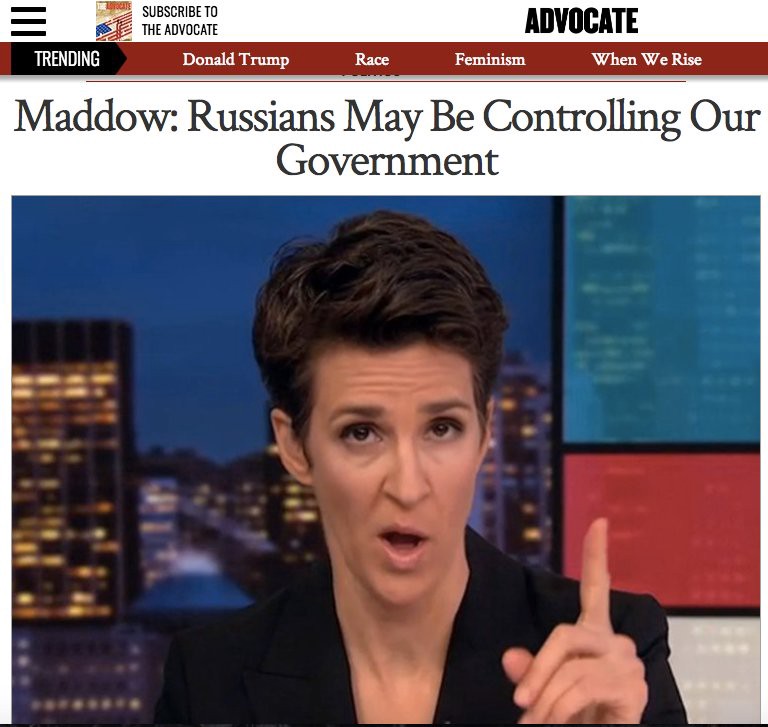
By Whitney Webb | MintPress News | June 3, 2019
In early May, MSNBC news host Rachel Maddow — known as one of the top promoters of the new Cold War and Russiagate in American media — emphatically endorsed regime change in Venezuela after she claimed that President Donald Trump’s hawkishness towards the South American country had changed, all because of a single phone call with his Russian counterpart Vladimir Putin.
Though Maddow’s claims were arguably the most extreme in suggesting that Trump was “taking orders” from Putin on Venezuela, she wasn’t alone in making them. For instance, Cenk Uygur of the Young Turks also made the claim that the Trump-Putin phone call on Venezuela was “direct evidence that he is literally taking orders from Putin.” In addition, several corporate media outlets supported this narrative by suggesting that Trump “echoed” Putin’s Venezuela stance after the phone call and directly contradicted his top staffers and even himself in doing so.
Yet now, strangely, those same corporate media voices remain silent on the Trump administration’s other regime-change project — in Iran — despite the fact that the Putin-led Russian government is set to be the biggest winner as tensions between the U.S. and the Islamic Republic boil over and threaten to send the Middle East into a fresh bout of destruction and chaos.
How Russia wins
As tensions between the U.S. and Iran have grown in recent months, analysts in both corporate and independent media have speculated about what country is set to benefit the most from the U.S.’ campaign of “maximum pressure” and regime change against the Islamic Republic. Of the many analyses, two countries have stood out as likely beneficiaries: Russia and China.
The cases for China and Russia’s benefit are somewhat similar given that the Trump administration’s focus on Iran results in less pressure on both Russia and China. This is despite the fact that, officially, the U.S.’ current National Defense Strategy explicitly calls for focusing attention on preparing for a “long war” against Russia and China to prevent either from superseding the U.S. as a global superpower. Yet, with the U.S. focused on regime change in Iran and Venezuela, Russia and China can avoid bearing the brunt of U.S. military adventurism, either directly or by proxy, while the U.S. wears itself thin by trying to do it all at once.
Several U.S. military analysts have been warning against war with Iran for precisely this reason. Nikolas Gvosdev, a professor of national security affairs at the U.S. Naval War College, recently wrote in The Hill that the U.S. faces a lose-lose scenario by pursuing a militaristic, aggressive Iran policy:
To gear up for a major conflict with Iran, the U.S. would be forced to de-emphasize Europe’s eastern flank, allowing Russia more time and breathing space to consolidate its position. On the other hand, a U.S. campaign that is defined more by bellicose rhetoric and less by action will buttress Russia’s claim, already seemingly validated in Syria and in Venezuela, that the U.S. talks a good game but has no real stomach for projecting its power.”
Both countries also stand to benefit from Iran’s increasing desperation for trading partners unwilling to bow to the U.S. Currently, China represents 30 percent of Iran’s international trade and the current U.S. sanctions on Iran have pushed Tehran to rely more heavily on Russia, especially for weapons purchases, than it had while the Iran nuclear deal (officially the Joint Comprehensive Plan of Action, JCPOA) was in force.
However, upon closer examination, it becomes clear that China, though it benefits to some degree, is not a clear winner amid current tensions, while Russia stands to gain the most. The reason for this is the effect of current and future U.S.-Iran tensions on the oil market. While China trusts Iran to be a key oil supplier even if there is a breach in U.S.-China relations, any shock to the oil market and any jump in oil prices — both of which are likely to occur if U.S.-Iran tensions continue to escalate — will spell disaster for the Chinese economy, given that China is now the world’s largest importer of oil.
Russia, on the other hand, stands to benefit massively from the chaos that U.S.-Iran tensions are set to unleash on the oil market and, by extension, oil prices. With the U.S. seeking to starve Iran of any and all oil export revenue, all countries that had been purchasing Iranian oil must seek new suppliers. Yet, with the prospect of a U.S-Iran conflict still ever-present, it will be those oil producers outside of the Middle East that will come out on top, since oil supply routes that do not pass through the Middle East do not risk supply disruptions that would be caused by a war in the region. Thus, Russia, owing to its location, will emerge as an oil producer of extreme importance. Furthermore, given that such instability in the Middle East will lead to a surge in global oil prices, Russia will be able to export more oil at a higher price and will see its economy and geopolitical clout benefit greatly as a result.
A potential geopolitical killing
In addition to a great boost to its oil sector, Russia also stands to make unique geopolitical gains, particularly in the Middle East and beyond. For instance, in Syria, Russia is increasingly seeking to use its pull with Syria’s government as a major bargaining chip with Israel and the U.S., as made clear by the upcoming trilateral summit on the Middle East between Russia, Israel and the U.S. The main focus of that summit will likely be the fate of the presence of foreign militaries in Syria, particularly Iranian and U.S. forces.
The summit will likely be dominated by Russia and Israel, given Israel’s influence over the U.S., and particularly over National Security Adviser John Bolton, who will represent the U.S. at the summit. Israel’s key interest in Syria at this stage of the conflict is the removal of Iranian forces from Syria. Russia is likely to oblige that request, as doing so would allow Russia to dominate a post-war Syria at Iran’s expense. This seems to be a current Russian objective in Syria, given recent reports of in-fighting among Russian and Iranian forces in Northern Syria.
However, Russia is unlikely to help reduce Iran’s Syria presence if doing so would favor the United States’ occupation of Syrian territory or threaten to upset Russia’s own interests in Syria. Thus, in this case, Russia is counting on Israel’s influence on the Trump administration to ensure that, if Iranian forces vacate Syria, it will be Russia that will dominate the country post-conflict.
Russia also stands to gain geopolitically from the isolationism being forced on Iran by the Trump administration. Indeed, U.S. pressure on Iran has already served Russian interests by pushing Iran further towards Russia, giving Moscow the status of an increasingly important economic partner of Tehran. While benefiting the Russian economy, closer economic ties between Moscow and Iran would also give Russia a leg up in discussions with the U.S., as Washington may then need to make concessions to or coordinate with Russia in future efforts to pressure Iran.
Meanwhile, Russia stands to reap major profits by selling more weapons to Iran, and to gain geopolitical clout by further cementing its role as a mediator of conflict by promoting compliance with the JCPOA and opposing regime change. Iran’s dwindling options for strategic alliances with non-U.S. aligned countries will make it difficult for Tehran to resist Russian demands on key issues, including the Syria conflict.
Another major geopolitical win for Russia that has resulted from the U.S.’ current Iran policy is the tension that that policy has engendered between the U.S. and its European allies. When the U.S. unilaterally withdrew from the JCPOA, it began the development of a rift between the U.S. and its key European allies who are also JCPOA signatories — particularly France, Germany and the United Kingdom. As a signatory, Russia’s stance on Iran has revolved around the JCPOA, with Russia having urged Iran to remain in the deal “no matter what,” advice that Iran does not now seem keen to follow.
Russia’s stance on JCPOA is likely aimed just as much at Europe as it is at Iran, since promoting the agreement amid the U.S. unilateral withdrawal paints Russia as more predictable and stable in terms of its political stances and diplomacy in comparison to the U.S. If nothing else, Putin is known for excelling at taking advantage of the missteps made by his geopolitical adversaries.
This is all part of a careful public image that Russia is seeking to cultivate with European countries as it hopes to attract them to do business with Russian oil and gas companies as the Middle East now seemingly approaches another era of extreme instability. By promoting the JCPOA alongside Europe, Russia makes increased Russo-European cooperation seem more attractive.
As U.S.-Iran tensions mount, particularly if armed conflict breaks out, importing goods from Russia, especially oil and gas, will appear more attractive and safer in comparison to goods that originate from or pass through the Middle East before arriving in Europe. Depending on how the situation plays out, Europe — driven by concerns about stability and reliability — may be willing to risk angering the U.S. to pursue increased economic cooperation with Russia, even though doing so would run counter to current U.S. and NATO objectives.
Putin plays Netanyahu
While it is often difficult to find accurate, honest reporting on Vladimir Putin –reporting that is neither too biased against him nor too much in his favor — it is generally acknowledged that Putin, above all else, is interested in advancing Russia’s national interest and is a cunning strategist who often thinks several steps ahead of both his allies and his adversaries.
In viewing the ratcheting up of tensions between the U.S. and Iran, Putin’s modus operandi remains unchanged and, upon closer examination, it is clear that he is giving the hotheads driving this still-escalating situation just enough rope to hang themselves. Meanwhile, Russia is waiting in the wings to pick up the pieces and further cement its already acknowledged role as the new foreign “peacemaker” in the Middle East while gaining economic and geopolitical clout in the process.
Prior to the Israeli election earlier this year, Israeli media noted on several occasions that Putin was backing the reelection of Israeli Prime Minister Benjamin Netanyahu, including when Putin hosted Netanyahu at a sudden pre-election summit. Israeli newspaper Haaretz described Putin’s decision to host Netanyahu at the time as aimed at helping Netanyahu secure the “crucial Russian vote” among Russian-Israeli Jews in order to “outflank” his competitors. In another instance, Putin was alleged to have further helped Netanyahu’s reelection odds by having Russian special forces find and deliver the remains of Zachary Baumel — an Israeli soldier who had gone missing in Lebanon in 1982 — to Israel just ahead of the election.
Putin’s direct support of Netanyahu may seem odd to observers of geopolitics, given that the two have often been at odds over Syria. However, Putin and Netanyahu have developed an effective working relationship and Russia and Israel enjoy relatively strong bilateral ties and economic agreements.
Yet, beyond the ties that have been forged between the two countries in recent years, Putin likely knows that he can play Netanyahu’s weaknesses to his advantage. For instance, Putin is acutely aware of the benefits to be reaped from increasing tensions between the U.S. and Iran and is also aware of the key role that Netanyahu has played and continues to play in driving the Trump administration’s Iran policy. Netanyahu’s near-obsession with regime change in Iran and the practical likelihood that a U.S.-Iran war would be “unwinnable” for the U.S. and would leave its military weakened and distracted are points that Putin is likely eager to exploit in pursuance of Russian geopolitical goals.
Russia seeks to play the role of mediator but only to a certain extent and has kept its attitude towards Iran intentionally vague when dealing with the Israeli government, so much so that Israeli officials have cited Russia’s unknown stance towards Iran as a major difficulty in negotiating the deconfliction of Russian and Israeli forces in Syria. This is likely because Russia doesn’t seek to aid either side amid escalating tensions, instead waiting for the current tensions to play out, as it stands to make gains in either case.
That Russia stands to gain from current U.S.-Iran tensions hasn’t been lost on all Israeli officials, however. Earlier this month, a former Israeli intelligence official, Yakkov Kedmi, openly stated that not only is a war against Iran “unwinnable” for the U.S. and its regional allies, but further that Russia would be the only major country to benefit from any military conflict pitting the Americans against the Iranians. Appearing on Russian television program Evening with Vladimir Solovyov, Kedmi stated that, if war does break out, the U.S. “won’t remain whole” after the conflict and that “if anyone wins, it’ll be Russia.”
“If the price of oil exceeds $100 per barrel, it hits the Chinese economy. Most of all, it hits the European and American economies,” Kedmi stated. “If you double the price,” he added, “[global] industry will be ruined. First of all, it will happen in the U.S.” To that, the program’s host, Vladimir Solovyov, asserted that “Their [American] industry will be [ruined]. It’ll be the opposite in our country. Our economy will begin to develop. We’ll feel like kings with golden diamond-studded wheels on our cars.”
Why the Russiagaters are silent on Iran
Given Russia — and Putin’s — clear benefit from the continuing U.S. escalation with Iran and a potential military conflict, it is striking that Putin’s fiercest critics in the American media have remained silent about this clear pay-off as the Trump administration continues to pursue an aggressive, hawkish Iran policy that hardly benefits the U.S. and instead benefits its supposed adversary. This is especially notable in light of the fact that these same American critics of Russia and Putin’s leadership were recently accusing Trump of “taking orders” from Putin by altering his Venezuela policy in a way that was perceived to benefit Russian over American interests.
This dichotomy is most easily deconstructed by noting that top promoters of Russiagate and news personalities known for their hyperfocus on Putin rarely call for any policy that would involve a reduction in tensions or less militarism abroad. Indeed, all too often, the “solutions” offered by these journalists involve sending weapons to U.S. proxy forces, shooting missiles at Russian allies, sanctioning Russia and its allies, and other “useful reminders of the military strength of the Western alliance” between the U.S. and NATO.
Without fail, the suggested solutions of how to counter Putin from the U.S. media and political establishment almost always involve “pushing back” with force equal to or greater than the perceived aggression. Rarely do they involve backing down or unwinding tensions, even in the cases where doing so would clearly challenge key geopolitical objectives of the Russian government.
In the case of Russia’s benefit from Trump’s Iran policy, the benefit is so clear that it has been voiced in several mainstream media outlets — including CNN, The Hill, Forbes and Bloomberg — with most of those reports focusing exclusively on the oil angle. However, while Russia’s advantage has been noted, it is also clear that Trump’s current Iran policy has avoided inflaming the Russiagate hysteria that has marked media coverage of other Trump policies and statements that were perceived as being “pro-Putin” for the past few years.
One reason that the media has skipped a prime opportunity for another Russiagate frenzy is the fact that many of the driving forces behind Russiagate are also supportive of regime change in Iran. Indeed, while Russiagate has recently been cast by Trump and prominent Republicans as a “hoax” narrative exclusive to Democrats, prominent neoconservatives have long been pivotal in creating and fomenting Russigate for over five years.
For instance, the origins of the infamous Steele dossier — which was used to assert that Russia’s government had a litany of salacious blackmail on Trump that it would use to manipulate him as president — trace back to top neoconservative Republican donor Paul Singer. That dossier was subsequently circulated within the Obama administration during the 2016 campaign by neoconservatives Victoria Nuland and the late Senator John McCain.
Many of the same neoconservative figures who have helped stoke Russiagate and pounced on the resulting climate of hysteria to promote increased militarism as the solution, also support regime change in Iran. Michael McFaul — U.S. Ambassador to Russia during the Obama administration — is both a strong advocate for aggressive U.S. measures to counter Putin and also a vocal proponent of U.S.-led regime change in Iran. Similarly, on the supposed other side of the political spectrum, Bill Kristol — well-known neoconservative writer, an icon of the establishment “resistance” to Trump, and a promoter of Russiagate — also strongly supports hawkish measures to contain Russia and is a long-time, vocal supporter of regime change in Iran.
While the tense situation between the U.S. and Iran is undeniably troubling, the relative silence among figures in U.S. media and politics who claim to be Putin’s fiercest critics with regard to Trump’s aggressive Iran policy reveals a stark truth about Russiagate. The goal of Russiagate is not actually about “countering” Putin or Russian geopolitical influence; it is about promoting the expansion and widespread adoption of hyper-militarism by both the establishment left and establishment right in the United States.
While Russia often serves as a useful “boogeyman” in service to this agenda of promoting militaristic policies, the odd moments when those same policies actually benefit Russia and do not run into hysterical opposition from the political and media establishment provide a rare glimpse into the real motivations behind Cold War 2.0 and the dubious validity of the media-driven narratives upon which current anti-Russian hysteria is based.
Whitney Webb is a MintPress News journalist based in Chile. She has contributed to several independent media outlets including Global Research, EcoWatch, the Ron Paul Institute and 21st Century Wire, among others. She has made several radio and television appearances and is the 2019 winner of the Serena Shim Award for Uncompromised Integrity in Journalism.
Who cares how war criminals vote?
By Kit Knightly | OffGuardian | May 30, 2019
Alastair Campbell has been kicked out of the Labour Party.
Apparently, he voted for the Liberal Democrats in the recent European Parliamentary elections, and then announced he had done so on Sky News. Thus putting him in breach of paragraph 2 of Labour’s Membership Rules, which states:
A member of the Party who joins and/ or supports a political organisation other than an official Labour group or other unit of the Party, or supports any candidate who stands against an official Labour candidate, or publicly declares their intent to stand against a Labour candidate, shall automatically be ineligible to be or remain a Party member, subject to the provisions of Chapter 6.I.2 below of the disciplinary rules.”
It’s a fairly open and shut case, to be honest.
And so ends the Labour career of Alastair Campbell, Tony Blair’s PR man, one of the key architects of the “dodgy dossier”, a man complicit in every death that resulted from the US/UK illegal invasion of Iraq.
The reaction of anyone, with even the most rudimentary grasp of ethics, should be “good riddance”.
Clearly therefore, the vast majority of the pundits, “journalists” and talking heads do not have a rudimentary grasp of ethics.
Yes, Campbell was actually defended. By journalists. And celebrities. And members of parliament.
Campbell is a “strong voice for Labour values” according to some, his expulsion is “Stalinist” according to others.
It’s time for a very serious reality check: Alastair Campbell should not be in the Labour Party.
He shouldn’t be tweeting his thoughts or giving interviews or writing columns. He shouldn’t have any power or influence or authority. He shouldn’t even be breathing free air.
He should be in the dock at the Hague, briefly. And then – hopefully – spending the rest of his time in eternity’s waiting room, carving tally marks on a cell wall.
Who cares who he voted for? He’s a fucking monster.
This is not “silly” or “old fashioned” or “predictable”. It’s just true.
As a society it’s important we try and recognise principles and morality. Virtue matters. Truth matters. There ARE absolutes. Most of the Labour MPs defending Campbell voted FOR that war. They all voted against investigations into it.
They are complicit in crimes against humanity. That is a statement of fact. And yet their opinions are treated as if they carry weight. They are assumed to have ideals, to be sincere, when their actions demonstrate this is simply not the case.
We don’t talk about Pinochet’s economic reforms.
We don’t isolate Pol Pot’s opinion on free healthcare.
We don’t defend Mussolini’s well organised internal transport infrastructure.
It is accepted that crimes of a certain scale put a mark on you that you can’t scrub off. That doesn’t change because these criminals are all well-spoken chaps with open shirt collars, it doesn’t change because they managed to slime their way out of punishment, it doesn’t change because our national ego lifts Britain above the law, and it doesn’t change because we’re all so English and confrontation makes us uncomfortable.
These people are monsters. Who they vote for does not matter. What they say does not matter. They have no values. They have no standing. They have no place in a decent world. If it were any other crime of the same magnitude that would not need to be explained.
“Progressives” will vilify Tulsi Gabbard for even daring to speak to Narendra Modi, or visit Assad’s Syria. Corbyn has been raked over the coals for talking with the IRA. Nigel Farage is considered a “Russian stooge” for deigning to even vaguely compliment Vladimir Putin.
All those people combined don’t add up to the butcher’s bill Campbell racked up in the Middle East. Not even in the most fevered, deceitful propaganda of the Western press.
But no one is talking about Iraq. When Momentum tweeted about it, they were accused of being “shallow” and “stuck in the past”.
Maybe people are just divorced from the reality. Maybe the scale warps in their minds. Maybe it’s just too big, too dreadful to actually picture.
One. Million. Dead.
The entire population of Birmingham dropping dead tomorrow.
More than double the British losses in World War 2.
9/11 happening every single day, for a whole year.
Alastair Campbell helped make that happen. He did it dishonestly. He did it deliberately. He did it for personal and political gain.
And he has not, to this day, faced any kind of punishment. In all likelihood, he never will.
If you EVER find yourself defending him, whether opportunistically to undermine Corbyn or earnestly because you see no problem with his actions, then you are through the looking glass. Your morality is tonaly inverted.
Alastair Campbell’s voting record is an irrelevance. I don’t know who he voted for, or if he voted at all. I don’t care. It probably was the Lib Dems. It’s the mootest of moot, and the media outcry about it is beyond absurd.
Every time any person who played a part in the crimes of the Iraq war is allowed to exist in our society, without reference to the immense crime they committed, we normalise the idea that murder is OK when WE do it to THEM. That our wars are mistakes, or misjudgments or “foreign policy blunders”. They don’t really count. We don’t really mean it. We’re nice.
Blair and Campbell are given column inches. Their enablers in parliament rail against “antisemitism” and for the “people’s vote”, or talk about the evil “dictators” in Venezuela or North Korea who don’t share our “values”. Their cheerleaders in the press talk up Vladimir Putin as a “pariah” because of the totally bloodless Crimean referendum, but happily chuckle through interviews with Campbell as if he isn’t soaked to the bone in the blood of innocents.
Criminals discussing Brexit and football and Love Island, like it’s all a big joke. Campbell talks “candidly” about his “battles with depression” and we’re all supposed to go “awwww!”
All the while the man who proved their criminality rots in jail, barely able to move.
The world of the media is upside down.
It is disgusting, but wholly expected. The Establishment is rallying to defend one its own, it always does.
But most people know the truth: The only thing wrong with Alastair Campbell being kicked out of the Labour party, is that it’s fifteen years too late.
Hungary’s Foreign Minister Calls Western Europe ‘Hypocrites’ for China Criticism
teleSUR | May 23, 2019
Hungary’s foreign minister Thursday accused major Western European nations of “hypocrisy” and “hysteria” for criticizing central European countries’ business dealings with China, and defended Hungary’s use of Huawei 5G mobile phone technology.
Sixteen central and eastern European countries, including 11 European Union members, held a summit with China in April during which it pledged to increase trade and provide more support for big cross-border infrastructure projects.
The area is part of China’s Belt and Road Initiative, which aims to link China by sea and land with Southeast and Central Asia, the Middle East, Europe and Africa.
France and Germany oppose such independent moves, which they fear might make Europe appear disunited at a time when the EU is trying to forge a more defensive strategy towards China.
On Tuesday, speaking to reporters in Paris, France’s Finance Minister Bruno Le Maire criticized “negotiations of 16 states from the east with China in parallel to negotiations that the EU is leading with China”.
But Hungarian Foreign Minister Peter Szijjarto, who is serving in the government of far-right Prime Minister Victor Orban, rejected such criticism, saying Germany and France do far more business with China than the central European states, and often negotiate directly with Beijing.
“There is such a bad hypocrisy in the European Union when it comes to China,” Szijjarto told Reuters on the sidelines of an OECD meeting in Paris. “The 11 central and eastern European member states … represent 9.9 percent of EU trade with China.”
“When the German chancellor and French president meet China’s leadership nobody thinks that’s a problem,” he said. “Nobody raises a question about how it is possible that they sell 300 aircraft to China, which is a bigger deal than the (entire) trade represented by the 11 central European countries.”
He said it was also unfair for Western European states to criticize Hungary for using technology from Chinese firm Huawei in its 5G mobile phone networks, when those networks were being built under license by German and British companies, Deutsche Telekom and Vodafone.
Hungary’s government has been at odds with Brussels for the erosion of media and judicial independence, attacks on civil organizations, treatment of migrants, laws against poverty, and the ousting of educational institutions like the progressive Central European University.
Government Accountability Project engages in projection
Anonymous allegations are republished by an allegedly respectable website.

By Donna Laframboise | Big Picture News | May 20, 2019
A reader has alerted me to the fact that a Washington, D.C. organization called the Government Accountability Project is bad-mouthing me. It says I’m part of the “global warming denial machine.”
I almost never respond to accusations of this kind. It’s time-consuming, draining, and distracting. I prefer to make a positive contribution to the world through my writing, and to let my record speak for itself. In the end, one must trust in the ability of the public to sort sense from nonsense.
In this case, though, I’m making an exception. So let’s start with some basics.
WHO AM I?
1. I am not a US citizen.
2. I have never held a government job (unless one counts part-time clerical work in libraries and hospitals during my teens and early twenties).
3. My journalism career includes four years as a columnist with the Toronto Star, Canada’s largest newspaper. I’m a former columnist and member of the editorial board of the National Post. My investigative work has appeared in several newspapers and magazines, and I am the author of three books.
4. I’m a longtime proponent of free speech, having joined the board of the Canadian Civil Liberties Association in 1993, and served as a vice president from 1998 to 2001.
WHO IS SMEARING ME?
The Government Accountability Project (henceforth I’ll call it The GAP), says it helps whistleblowers “hold the government and corporations accountable.” That’s marvellous and admirable.

I, however, am not a government. I’m not a corporation. Having worked with my share of whistleblowers over the years, I line up squarely on their side.
So why is this Washington-based organization trashing me – a journalist in a foreign country, who currently writes out of her home office and receives no regular pay cheque from anywhere?
Lamentably, the GAP has morphed into something rather different than what its name implies. The fine print on its website tells us:
As more attorneys joined the team, Government Accountability Project increased its litigation work, setting up its unique capacity to launch both political advocacy and legal campaigns. [bold added by me]
Political advocacy campaigns. Keep that phrase in mind.
The GAP now focuses its attention on six subject areas, including ding-ding-ding climate change. A section of its website therefore talks about sustainability and “the dangers posed by fossil fuel dependence.”
In other words, one arm of The GAP behaves like a politically-motivated, green advocacy group.
WHO REALLY AUTHORED THESE ACCUSATIONS?
In very large letters, the Government Accountability Project declares: Donna Laframboise recycles old attacks on IPCC. Holding a particular government to account is grand in The GAP universive. But blowing the whistle on a group of governments involved in the UN’s Intergovernmental Panel on Climate Change (IPCC) is villainous. Yeah, that’s coherent.
At the bottom of the page bearing that headline we see a September 2013 date. It turns out everything here was actually cut-and-pasted from a now defunct website called ClimateScienceWatch.org, which used to be run by The GAP.
Five-year-old content has simply been transferred from ClimateScienceWatch over to The GAP’s main website. In other words, The GAP’s remarks about me have been recycled – an activity its own headline suggests is contemptible. It’s all so confusing. Green activists vigorously promote recycling. Until they want to insult someone.
Unfortunately for me, The GAP’s main website exudes respectability. There’s an impressive logo, a muted palette, and a professional design. A reader in a hurry might well form the mistaken impression that I’m opposed to government accountability. In fact, I’ve spent my career striving to keep government institutions – including criminal and family courts – honest.
So what does The GAP actually say about me? Those first-published-in-2013 remarks consist of two parts. Here’s the introductory paragraph:
In a Wall Street Journal editorial on the upcoming Intergovernmental Panel on Climate Change Fifth Assessment Report, IPCC critic Donna Laframboise sinks to the lowest common denominator of overused attacks. Repeated and unfounded attempts to taint the IPCC’s credibility should be seen as what they are: a distraction from the real issue – the science.
This paragraph is immediately followed by a 600-word “guest post by Climate Nexus.” Who is Climate Nexus? It’s yet another green advocacy group, funded via the Rockefeller Foundation’s billions. Correcting “misinformation about climate change” is part of its mission.
So that’s what happened here. The WSJ published my opinion piece and Climate Nexus produced a response, which was published by ClimateScienceWatch back in 2013. Today, that material appears on The GAP’s main website.
This response, please note, is unsigned.
That’s because Climate Nexus is essentially a PR firm devoted to squelching non-conformist climate views. Its employees police the boundaries of what journalists are allowed to say. Anyone who colours outside the lines is targeted, accused of sinking “to the lowest common denominator of overused attacks.” Whatever that might mean.
Climate Nexus personnel don’t take responsibility for their own words. The people who are cavalierly smearing me – a real journalist, with a real reputation – aren’t identified.
Five years later, we still don’t know who they are. These are anonymous accusers. Anonymous cowards.
To be continued…
Trudeau continues push to overthrow Venezuela’s government
By Yves Engler · May 10, 2019
The effort Justin Trudeau is putting into overthrowing Venezuela’s government is remarkable.
During the past 12 days the prime minister has raised the issue separately with the leaders of the EU, Spain, Japan and Cuba. On Tuesday Trudeau had a phone conversation with European Council President Donald Tusk focused almost entirely on Venezuela, according to the communiqué .“Prime Minister Trudeau reiterated his support for Interim President Juan Guaidó”, it noted.
The next day Trudeau talked to Spanish Prime Minister Pedro Sánchez about ousting president Nicolás Maduro. Venezuela is the only subject mentioned in the official release about the call.
Venezuela was also on the agenda during Japanese Prime Minister Shinzo Abe’s visit to Ottawa on April 28. The post meeting release noted, “during the visit, Prime Minister Abe announced Japan’s endorsement of the Ottawa Declaration on Venezuela.” Produced at an early February meeting of the “Lima Group” of governments opposed to Maduro, the “Ottawa Declaration” called on Venezuela’s armed forces “to demonstrate their loyalty to the interim president” and remove the elected president.
On May 3 Trudeau called Cuban president Miguel Díaz-Canel to pressure him to join Ottawa’s effort to oust Maduro. The release noted, “the Prime Minister, on behalf of the Lima Group, underscored the desire to see free and fair elections and the constitution upheld in Venezuela.”
Four days later foreign affairs minister Chrystia Freeland added to the diplomatic pressure on Havana. She told reporters, “Cuba needs to not be part of the problem in Venezuela, but become part of the solution.”
Freeland was highly active after Guaidó, Leopoldo Lopez and others sought to stoke a military uprising in Caracas on April 30. Hours into the early morning effort Freeland tweeted, “watching events today in Venezuela very closely. The safety and security of Juan Guaido and Leopoldo López must be guaranteed. Venezuelans who peacefully support Interim President Guaido must do so without fear of intimidation or violence.” She followed that up with a statement to the press noting, “Venezuelans are in the streets today demonstrating their desire for a return to democracy even in the face of a violent crackdown. Canada commends their courage and we call on the Maduro regime to step aside now.” Then Freeland put out a video calling on Venezuelans to rise up and requested an emergency video conference meeting of the Lima Group. Later that evening the coalition issued a statement labeling the attempted putsch an effort “to restore democracy” and demanded the military “cease being instruments of the illegitimate regime for the oppression of the Venezuelan people.”
Three days later Freeland attended an emergency meeting of the Lima Group in Peru. The coalition released a communique after that get together accusing Maduro’s government of protecting “terrorist groups” in Colombia.
At another Lima Group meeting in Chile on April 15 Freeland announced the fourth round of Canadian sanctions against Venezuelan officials. Forty-three individuals were added to the list of 70 leaders Canada had already sanctioned. CBC reported that the latest round of (illegal) sanctions were designed to “punish Venezuelan judges who rubber-stamped Maduro’s moves” and “lower-ranking police officials who took prominent roles in suppressing the attempt by Venezuela’s opposition to bring humanitarian aid into the country on February 23.”
The Venezuelan government responded to Canadian sanctions by denouncing Ottawa’s “alliance with war criminals that have declared their intention to destroy the Venezuelan economy to inflict suffering on the people and loot the country’s riches.” A recent Center for Economic and Policy Research report gives credence to this perspective. Written by Jeffrey Sachs and Mark Weisbrot, “Economic Sanctions as Collective Punishment: The Case of Venezuela” concluded that 40,000 Venezuelans may have died over the past two years as a result of US sanctions.
The Liberals want us to believe their campaign to oust Venezuela’s government is motivated by support for democracy and human rights. Yet in recent weeks the Trudeau government has deepened ties to repressive Middle East monarchies, gutted its promise to rein in international abuses by Canadian mining companies’ and justified Israeli violence against those living in the open-air prison known as the Gaza Strip.
Last month members of Mouvement Québécois pour la Paix interrupted a speech by Freeland at the University of Montréal to criticize Canada’s policy towards Venezuela. Activists should be disrupting Freeland and other Liberal MPs public events across the country to demand an end to their effort to overthrow the government of Venezuela.
The West Is in No Position to Lecture Turkey on Democracy or Human Rights
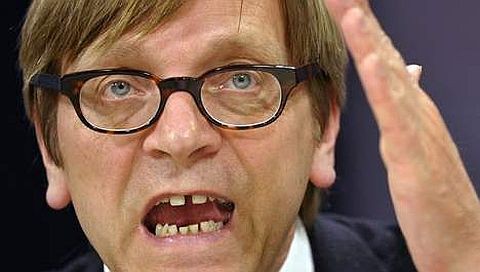
Euro-elitist Guy Verhofstadt
By Martin Jay | Strategic Culture Foundation | May 10, 2019
April fool’s day passed a few weeks ago but when we see news from Turkey that President Erdogan is going to do a re-run of elections in Istanbul, some of us are left doing a double take. But then the jaw dropping moment which follows is not what’s going on in Turkey, a country that certainly has human rights issues, no question – but how the West lines up to chastise the country. The hypocrisy is quite amazing.
And which particular moron should stand first in line with the hilarious opprobrium other than the European Union’s own clown MEP, Guy Verhofstadt a euro-elite type who is hard ignore but well worth the effort. This former Belgian PM recently ejaculated in the European parliament his important thoughts on Turkey and Erdogan, in line with former MEPs who jump on this bandwagon when it suits their federalist interests – before retreating and allowing the circus of EU accession to rumble on in Brussels when it also suits. Right now, with only days before EU elections and record gains expected for populist parties, it was hardly surprising the odious Belgian liberal would take the stage and dutifully pour scorn on Turkey.
But there are times in the EU bubble when reality seems to have been taken over by The Truman Show. Is this for real?
The European Union, probably the most corrupt, anti-democratic, white supremacist, freemason, autocratic organization which has practically invented the handbook on fake news, corruption cover ups and how to bribe journalists and fund despots around the world, is actually holding Turkey to account on its democracy score?
“This outrageous decision highlights how Erdogan’s #Turkey is drifting towards a dictatorship” gushed the Belgian MEP in a tweet. “Under such leadership, accession talks are impossible. Full support to the Turkish people protesting for their democratic rights and for a free and open Turkey!”.
But wait. Is this the same European Union which, when questioned about Romania and Bulgaria’s colossal corruption problem in 2004 (whose judiciaries are run by mafia mobs) said “we’ll let them in and then reform them” only for journalists to be later gunned down in Bulgaria and for Romania to have so many anti-corruption organizations that hacks there joke about getting an EU grant to export it? Or, for that matter, the same EU which repeatedly calls for second elections itself when it doesn’t get the result that it requires, like in Ireland and more recently in the UK with Brexit?
This is the same European Union which signed the arrest warrant of German journalist Hans Martin-Tillack in 2003 – and handed it to Belgian police – so that the journalist’s house could be raided and his computer seized, only for him to be thrown into the back of a police van where a cop tells him “well, it’s not Burmah”?
Or the same EU, which, in the same period where it started a reform process actually just rounded up all its whistleblowers and hung them up on a meat hook as an example to deter others in the EU institutions?
The European Union has a shocking history of human rights abuses not only on its own turf but more poignantly around the world with the regimes it supports with aid. Most central African despots are supported by EU cash, which, in turn, leads to intensified human rights abuses on a grand scale – which then leads to an exodus of migrants who end up in Libya sold as slaves, raped and abused. In many country’s its own environmental programs are bogus so as to funnel slush funds to dictatorships it supports, like in Lebanon for example where its recycling and composting schemes are actually so bad that they are poisoning the country’s water and linked to increased numbers of cancer.
This is the reality of the EU’s human rights record and its own check on democracy. The list just goes on and on and befittingly it is curious that the EU’s own ‘third word country’ (Belgium) which has a shocking deficit on press freedom and is a country infamous for industrial scale pedophilia which historically was the financial basis (blackmail) to fund political parties, is the very country which produced Verhofstadt and accommodates his pathetic ramblings in the European parliament, the only assembly in the world which is so useless that MEPs can’t even initiate legislation in it.
Verhofstadt is a signed up member of the Wet Dream Society, or as it is formerly know the ‘Spinelli Group’ – a sort of freemason’s talk shop of those who believe the EU could one day be a super power and have a real foreign policy. And so it is normal for him to take the floor and deliver such stupendously boring and utterly ludicrous speeches which are delusional at best and simply an old man’s fantasy at worse. Rather like Verhofstadt’s dream in 2004 of being European Commission president – a bid blocked by Tony Blair.
But here’s the real cherry on top if you like your irony in triple doses. The European parliament operates a scheme where it subsidizes all media in their production expenses, running into hundreds of millions of euros. If it didn’t do that, most broadcasters wouldn’t report on the mind numbingly boring events there. Some might call this bribing the press as there is obviously a ‘pay back’ there in helping the EU promote itself. But Euronews, which reported in Verhofstadt’s speech and gave it great prominence, not only profits from the scheme but actually gets a massive subsidy from the Brussels annual budget itself to report on MEPs – a double whammy, so in fact, the Verhofstadt ramble is actually fake news itself. This is an institution – the European Parliament – which voted just recently to actually finance media operations to write propaganda about the EU.
You can’t actually make this stuff up.
But meanwhile, there is news from the other side of the Atlantic, a real super power, which suggests that CNN in Atlanta might send journalists to CNN Turk to train them in the art of journalism. Given that nearly all of its big named foreign reporters make up their stories when they travel the globe – Anderson Cooper, Christiana Ammanpour and Parisa Khosravi – as I was informed by Elise Labott, a ex CNN ‘reporter’ not handicapped herself by journalistic skills, then this could also be a parody, or fake news. CNN Turk is attacked by the West for being pro Erdogan, without any acknowledgement that CNN Atlanta is entirely partisan itself and regularly rigs the news in favour of Clinton or whoever will slip into her peep toes.
At least CNN will not send Labott to Istanbul, a reporter who made a career out of making stories up to such an extent that Atlanta finally had to let her go earlier in the year after at least three investigations into her fabulous lack of journalist ethics, broke all records.
Washington Post Begs Trump to Save al-Qaeda in Syria Before It’s Too Late
“Time is running out”

By Marko Marjanović | Checkpoint Asia | May 10, 2019
Washington Post’s Josh Rogin:
There is little that can stop the brutal assault underway in northwest Syria, where Russian, Iranian and Assad regime forces have launched a major military offensive as millions of civilians flee for their lives. But the record shows that if President Trump acts to try to halt the slaughter, it will have real impact on the ground. Even a presidential tweet could save lives. Time is of the essence.
LOL, “millions” of civilians? There are about 2.5 million under rebels in Idlib, if millions are fleeing who is left?
Of course every Syrian/Russian offensive is a “brutal assault”. The Empire meanhile plants flowers and throws candy from its aeroplanes. It must have been diabates that killed 1,600 civilians in Raqqa and 9,000 in Mosul.
There’s a lot going on right now in U.S. foreign policy. The Trump administration is dealing with an escalating Iran crisis, North Korea missile firings, a shaky China trade negotiation and an attempt to oust the Venezuelan regime. It’s no mere coincidence that Bashar al-Assad and Moscow chose this moment to retake the last rebel-held area of Syria using scorched-earth tactics, committing atrocities along the way.
The region of Idlib holds about 3 million civilians, including 1 million children, who were moved there from across the country because they would not submit to the Assad regime. And now there is deafening silence from the international community about their brutal slaughter.
James F. Jeffrey, the State Department’s special envoy for Syria, told me the U.S. government sees a “major escalation” by the regime and its allies in Idlib and is working diplomatic channels to de-escalate the fighting.
“We are raising this at every level with the Russians,” he said. “Any major operation into Idlib would be a reckless escalation of the conflict.”
It’s a reckless escalation to smash al-Qaeda when it’s the Syrians/Russians doing it. And when al-Qaeda is Empire’s battering ram against Damscus.
Assad is dependent on Russian air power, and Moscow has committed a lot of it to the assault, Jeffrey said. That means Moscow is flagrantly violating the cease-fire and de-escalation agreement it signed with Turkey last year in Sochi, Russia.
Why is an agreement Russia signed with Turkey any business of the US and the Washington Post ?
So far, Moscow is ignoring Jeffrey’s warnings. The Turkish government, which saw its outpost in Idlib shelled, seems unable or unwilling to stop the onslaught.
In other words, Russians and Turks have an understanding and there is no breech of agreement.
But history shows that when Trump decides to intervene in Syria to protect civilians, Moscow listens.
In April 2017, when Trump first launched missiles at the Syrian regime, he was responding to a chemical weapons attack in Idlib that looked to be the beginning of the very offensive we are seeing now. Trump’s actions persuaded Assad and Russia to back down.
After a Syrian activist told Trump at a fundraiser that the assault on Idlib was beginning again, the president tweeted last September that Assad “must not recklessly attack Idlib” and that Russia and Iran must not support a “potential human tragedy.” The tweet worked.
“It stopped. You saw that. And nobody’s going to give me credit, but that’s okay,” Trump said at the time. “Millions of people would have been killed. And that would have been a shame,” he said.
Erdogan did most of the work to halt that offensive, but it’s possible Trump’s threats played a part as well.
Now Moscow is testing Trump again. So far, the president is silent. That has a cascading effect inside the U.S. national security system. Several people who work with U.S. government agencies on the ground in Syria told me that U.S. officials throughout the bureaucracy are waiting on Trump to signal his intent before they move to engage in Idlib.
Actually Moscow is doing no such thing. Defending al-Qaeda in Idlib does not have to be America’s job if Washington doesn’t make it so.
Sen. Lindsey O. Graham (R-S.C.) understands the importance of Trump’s verbal cues. He tweeted at the president this week asking him to speak up and protect Idlib. Putin surely also understands that in the United States’ Syria policy, only Trump’s words really matter. Trump and Putin spoke for about an hour last week, but it is unknown what, if anything, they discussed about Syria.
Meanwhile, Russian planes are targeting residential areas and hospitals and then killing aid workers responding to those attacks, said Raed Al Saleh, founder of the Syria Civil Defense, a civilian rescue organization better known as the White Helmets. In Idlib, he said, the regime has resumed the use of barrel bombs and white phosphorus, weapons of mass atrocity and mass displacement.
Don’t forget the kitten shelters.
Public estimates of 150,000 newly displaced people are just the beginning, said Saleh. Millions of people are preparing to “form caravans like in El Salvador” to head for Europe. “These people see the international community is not willing to do anything to keep them safe in their homes,” he said.
Syria has 5 million refugees outside the country and 6 million displaced internally courtesy of the Empire weaponizing salafi jihad against it. Would crushing al-Qaeda and stabilizing the country encourage them to return? Would the US tolerate al-Qaeda carving out an enclave of 2 million people on its territory?
Several schools in Idlib supported by U.S. aid organizations are now at grave risk. Thirty of those organizations wrote to Trump asking him to give the signal so the U.S. government can snap into action.
“Only you are able to direct our government to use every tool and resource at our disposal for the protection of civilians in Idlib Province,” they wrote.
Syrians will remember that the world abandoned them in their time of most dire need. The fresh atrocities will fuel more extremism. The new refugee crisis will further destabilize Turkey, the Middle East and Europe.
It’s bizarre that the fate of millions could hinge on whether Trump decides to speak up to protect them. But that is where we are. So please, Mr. President, tweet something, say something, do something — anything — before it’s too late. The people of Idlib will give you credit, if they survive.
You kind of lose the moral high ground of being an “aid organization” when you start begging your government to cruise missile another country.
The Same Guy Verhofstadt Who Wants a New Brexit Vote Decries a New Vote For Istanbul’s Mayoral Election
By Adam Garrie | Eurasia Future | 2019-05-07
The leader of the Liberal faction in the European Parliament, Guy Verhofstadt has just decried a decision by Turkish officials to conduct a re-vote in the contentious Istanbul Mayoral race. During the initial vote on 31 March, it was proclaimed that CH Party candidate Ekrem İmamoğlu beat AK Party candidate Binali Yıldırım by a razor thin margin.
Since the initial tally, AK representatives have challenged the result alleging serious irregularities that could have influenced the vote in favour of İmamoğlu. Today, the Turkish Supreme Election Council (YSK) annulled the result of the 31 March election for the Mayoralty in Istanbul and have scheduled a new election to take place on 23 June.
Although such re-run elections are never ideal, in circumstance when a preponderance of evidence indicates that there were enough irregularities present that could have changed the result, re-run elections become the least bad of no good options. This is what the YSK has decided upon in a manner consistent with the principles of mainstream 21st century democracy.
But while the re-run election will be conducted according to normal democratic principles, this has failed to satisfy the notoriously vocal Guy Verhofstadt. The EU Liberal big wig has taken to Twitter to say the following:
“This outrageous decision highlights how Erdogan’s Turkey is drifting towards a dictatorship. Under such leadership, accession talks are impossible. Full support to the Turkish people protesting for their democratic rights and for a free and open Turkey!”
First of all, it was not President Erdoğan who made the decision to hold a new election. It was the YSK’s decision, a body made up of members from multiple parties who then vote on a majoritarian basis in order to enact a decision. In this case, the democratic decision to hold a new election passed by a margin of seven against four.
Secondly, if Turkey’s long stalled quest to join the EU would portend future anti-democratic interference from the likes of Guy Verhofstadt, perhaps many in Turkey ought to be thankful that Brussels has recently leaned against full Turkish membership of the EU. Finally, it is not the “Turkish people” protesting. Those protesting are CH Party workers and supporters who are naturally upset by the electoral re-run. Likewise, supporters of the AK Party had peacefully protested in favour of a re-run. There is nothing unusual about this and of course the protests are occurring freely and without violence.
But the greatest absurdity of Guy Verhofstadt’s meddlesome comments is that while he decries a second vote in a local Turkish election, he has consistently agitated for Britain to hold a re-run vote in order to overturn the Brexit decision made by voters in 2016.
Unlike in the Istanbul election, the British government and opposition parties all accept that the 2016 election was without any worrisome irregularities. In other words, the Brexit referendum was a free and fair vote whilst Turkish authorities have decided that there were too many irregularities in the Istanbul vote for the initial result to be accepted as legitimate.
And yet, Verhofstadt is allying himself with forces that want to overturn a universally acknowledged legitimate vote whilst complaining that a vote in Turkey found to be illegitimate must be set in stone. Once again, double standards rule the day in Brussels.
Different when we do it: Why re-voting is ‘dictatorship’ in Turkey & ‘unity’ in EU

EU Brexit negotiator Guy Verhofstadt © Reuters / Eric Vidal
RT | May 7, 2019
The decision to rerun a local mayoral election in Istanbul has sparked scathing criticism in Brussels — ironically, from none other than the EU’s Brexit negotiator Guy Verhofstadt.
Tweeting about the move, which was branded a “coup” by a Turkish opposition newspaper, Verhofstadt said it highlighted that Turkey was “drifting towards a dictatorship” and offered “full support to the Turkish people protesting for their democratic rights.” Along with the verbal slap on the wrist, he said that under President Recep Tayyip Erdogan’s leadership, talks on Turkey joining the EU are “impossible.”
The irony in Verhofstadt’s outrage, is that the EU itself has a long history of either totally ignoring referendum votes — or just making people vote again until the ‘correct’ result is achieved. But that, of course, does not make the EU a dictatorship. It’s still a “bastion of hope, freedom, prosperity & stability” (as per another recent Verhofstadt tweet). Twitter users wasted no time in pointing out the “irony” and “hypocrisy.”
“How dare [Erdogan] use EU tactics,” one irritated Verhofstadt follower responded, with another saying that the UK itself was currently “battling for its democracy” — a reference to EU officials (including Verhofstadt) who have frequently voiced their personal opposition to Brexit and the ‘Remain’ factions in Britain who have been calling for a re-run of the 2016 referendum.
While there may be at least some merit to the idea of Brexit referendum re-run after two years of failed negotiations and with more accurate information now available to British voters, the idea of simply re-doing EU-related votes is hardly a one-off.
Maybe Verhofstadt should take a trip down memory lane.
France voted ‘no’ to accepting a proposed ‘EU Constitution’ by 54.9 percent in 2005, but the outcome was ignored. The same thing happened in the Netherlands, which rejected it by 61.5 percent. The ‘EU Constitution’ was later repackaged into the Lisbon Treaty and presented to the French parliament where it was adopted, without being put to the people this time (much easier!).
This new Lisbon Treaty was then rejected by Irish voters in 2008, once again sending Brussels into meltdown mode, as the pact needed to be ratified by all member states before taking effect. So, of course, they made some tweaks and asked people to vote again — and got the ‘right’ result the next time. It wasn’t the first time Ireland was asked to re-vote after giving the wrong answer, either. The country also rejected the Nice Treaty in 2001 and accepted it in a second vote a year later.
Greece voted overwhelmingly to reject severe austerity measures desired by the EU in 2015 in exchange for a multi-billion euro bailout. Not long after, under pressure from Brussels, the country’s government agreed to implement even harsher methods — totally ignoring the will of the Greek people.
But way before all that in 1992, Danes, displeased with plans for a single currency, common European defense policies and for joint rules on crime and immigration, rejected the Maastricht Treaty — and were asked to vote again.
Ironically, many European voters voted ‘no’ to these treaties because they were worried that the EU would be turned into some kind of undemocratic superstate where the wills of individual countries and people would be ignored. Being forced to vote until you give the ‘right’ answer doesn’t exactly put those worries to bed. It’s part of the reason why the British voted for Brexit in the first place.
Then there’s Catalonia, where pro-independence leaders were thrown in jail for their role in holding an independence referendum in 2017. One tweeter scolded Verhofstadt and other EU leaders for believing that they have some “moral authority” over Turkey while abuse of pro-independence forces in Catalonia is ignored. “Our leaders are still in prison because they let citizens vote,” they wrote.
With a history like that, maybe it’s a bit rich for Verhofstadt to be going around lamenting the lack of democracy in other countries.
Featured Video
NEW FAUCI EMAILS EXPOSE ATTACK ON NATURAL IMMUNITY
or go to
Aletho News Archives – Video-Images
From the Archives
Elite Western universities are a corrupt, parasitic empire
Instead of high-quality education, these institutions are fostering a global neo-feudal system reminiscent of the British Raj
By Dr. Mathew Maavak | RT | May 30, 2025
In a move that has ignited a global uproar, US President Donald Trump banned international students from Harvard University, citing “national security” and ideological infiltration. The decision, which has been widely condemned by academics and foreign governments alike, apparently threatens to undermine America’s “intellectual leadership and soft power.” At stake is not just Harvard’s global appeal, but the very premise of open academic exchange that has long defined elite higher education in the US.
But exactly how ‘open’ is Harvard’s admissions process? Every year, highly qualified students – many with top-tier SAT or GMAT test scores – are rejected, often with little explanation. Critics argue that behind the prestigious Ivy League brand lies an opaque system shaped by legacy preferences, DEI imperatives, geopolitical interests, and outright bribes. George Soros, for instance, once pledged $1 billion to open up elite university admissions to drones who would read from his Open Society script.
China’s swift condemnation of Trump’s policy added a layer of geopolitical irony to the debate. Why would Beijing feign concern for “America’s international standing” amid a bitter trade war? The international standing of US universities has long been tarnished by a woke psychosis which spread like cancer to all branches of the government.
So, what was behind China’s latest gripe? ... continue
Blog Roll
Recent Comments
seversonebcfb985d9 on Villains of Judea: Philip Esfo… loongtip on Report warns that ‘Jewish terr… Craig Nelms on New study shows that toxic gas… loongtip on A Funny Thing Happened on the… loongtip on EU free trade pact on hold as… John Edward Kendrick on Regime Change In Iran Is The F… Bill Francis on Australia Passes New Hate Spee… seversonebcfb985d9 on Australia Passes New Hate Spee… Bill Francis on Britain’s AI Policing Plan Tur… loongtip on Miami Beach Resident Questione… loongtip on Israeli agricultural export co… loongtip on The War On Free Speech In Aust…


 Aletho News
- NEW FAUCI EMAILS EXPOSE ATTACK ON NATURAL IMMUNITY
- Why is the US using Jordan as the main base in possible Iran attack?
- American Academy of Pediatrics Hit With Federal RICO Lawsuit for Vaccine Safety Fraud
- Mom Tells Trump: Dumping Sewage Sludge on Farmland Won’t Make America Healthy Again
- NIAID Funds Gain-of-Function Study Engineering Novel Influenza Viruses
- Villains of Judea: Philip Esformes and the Largest Healthcare Fraud in American History
- US sanctions Popular Conference for Palestinians Abroad over alleged Hamas links
- You reap what you sow: Ukraine’s blackout is Zelensky’s failure
- Ukraine Blackouts Caused by Zelensky’s Terrorist Attacks on Russia
- Orban Hits Out at EU Green Light for $1.5 Trillion Ukraine Aid
- If Americans Knew
- Oppose Israel’s Abuses While You Still Can
- UNRWA Heads Tell Ha’aretz: ‘We Don’t Radicalize Palestinians – Their Lived Existence Does’
- Plans Call for “New Rafah” Built in Israel’s Image — Without Palestinians
- Posing as priest, reporter is spat at many times, highlighting anti-Christian sentiment in Israel
- Leaked Documents: “Planned Community” in Rafah Would Force Palestinians Into Israeli Panopticon
- ‘Permits of Humiliation’: How Israel Strangles Christian Education in Jerusalem
- “The world sees death, destruction and injustice – and they see dollar signs” – Not a ceasefire Day 105
- War criminal Netanyahu kills 11 in Gaza, joins Board of Peace – Not a ceasefire Day 104
- Another baby dies of cold in Gaza, as Rafah crossing remains locked down – Not a ceasefire Day 103
- Brutal Beatings, Arson, and Impunity: A Palestinian Plant Nursery Becomes a Target for Settler Pogroms
- No Tricks Zone
- New Study: Sea Levels Rose 20 Times The Modern Rate During The Roman Warm Period
- As German Gas Storage Dips Dangerously Low…Shortage Hardly Avoidable
- New Study: Brazil’s Relative Sea Level Was 2+ Meters Higher And SSTs 3-4°C Warmer 6000 Years Ago
- Philosopher Schopenhauer: Climate Science Certainty Stems From Stupidity, Ignorance
- New Study: Species Extinction Rates Declining Since 1980 – ‘Climate Change Is Not An Important Threat’
- Denmark Places Climate Protection Above Animal Welfare, Poisoning And Culling Cows
- New Study: Greenland Was 3-7°C Warmer And Far Less Glaciated Than Today 6000-8000 Years Ago
- German Media Report That Current Frigid Weather Can Be Explained By Arctic Warming!
- Berlin Blackout Shows Germany’s $5 Trillion Green Scheme Is “Left-Green Ideological Pipe Dream”
- Modeling Error In Estimating How Clouds Affect Climate Is 8700% Larger Than Alleged CO2 Forcing
 Aletho News