Democrats Ignore Trump’s Real Violations
By Ron Paul | February 10, 2020
This week the latest Democratic Party attempt to remove President Trump from office – impeachment over Trump allegedly holding up an arms deal to Ukraine – flopped. Just like “Russiagate” and the Mueller investigation, and a number of other attempts to overturn the 2016 election.
We’ve had three years of accusations and investigations with untold millions of dollars spent in a never-ending Democratic Party effort to remove President Trump from office.
Why do the Democrats keep swinging and missing at Trump? They can’t make a good case for abuse of power because they don’t really oppose Trump’s most egregious abuses of power. Congress, with a few exceptions, strongly supports the President flouting the Constitution when it comes to overseas aggression and shoveling more money into the military-industrial complex.
In April, 2018, President Trump fired 100 Tomahawk missiles into Syria allegedly as punishment for a Syrian government chemical attack in Douma. Though the US was not under imminent threat of attack from Syria, Trump didn’t wait for a Congressional declaration of war on Syria or even an authorization for a missile strike. In fact, he didn’t even wait for an investigation of the event to find out what actually happened! He just decided to send a hundred missiles – at a cost of hundreds of millions of dollars – into Syria.
We are now finding out from whistleblowers on the UN team that investigated the alleged attack that the report blaming the Syrian government was falsified and that the whole “attack” was nothing but a false flag operation.
Is such unauthorized aggression against a country with which we are not at war not worth investigating as a potential “high crime” or “misdemeanor”?
Last month, President Trump authorized the assassination of a top Iranian General, Qassim Soleimani, and a top Iraqi military officer inside Iraqi territory while Soleimani was on a diplomatic mission. Trump and his Administration tried to claim that the attack was essential because of an “imminent threat” of a Soleimani attack on US troops in the region.
We found out shortly afterward that they lied about the “imminent threat.” The assassination was not “urgent” – it was planned back in June. Trump then claimed it didn’t matter whether there was an imminent threat: Soleimani was a bad guy so he deserved to be assassinated.
But the attack was an act of war on Iran without Congressional declaration or authorization for war. Is that not perhaps a “high crime” or “misdemeanor”?
We are finding out that, contrary to Trump claims, Soleimani was not even behind the December attack on US troops in Iraq. New evidence suggests it was actually an ISIS operation attempting to goad the US into moving against Iraq’s Shia militias.
Fantasies about Trump being an agent of Putin or trying to get Ukraine to help him win the election are presented as urgent reasons Trump must be removed from office. Real-life violations of the Constitution and reckless militarism that may get us embroiled in another Middle East war are shrugged off as “business as usual” by both Democrats and Republicans in Washington.
Democrats won’t move against Trump for what may be real “high crimes” and “misdemeanors” because they support his overseas aggression. They just wish they were the ones pulling the trigger.
Copyright © 2020 by RonPaul Institute.
Trump’s State of the Union address: half MAGA rally, half Resistance Protest, full-on reality TV drama
By Sarah Abed | February 6, 2020
Tuesday’s State of the Union dubbed “the launching of the great American comeback” came just a day after the Iowa caucuses in the 2020 presidential election and a day before Trump was acquitted of both articles of impeachment by the Senate. What could best be described as a reality TV drama on steroids, part MAGA rally and part Resistance protest with several theatrical performances that tugged at the heart strings and others that took exploitation and emotional manipulation to another level, this year’s SOTU had a little something for everyone.
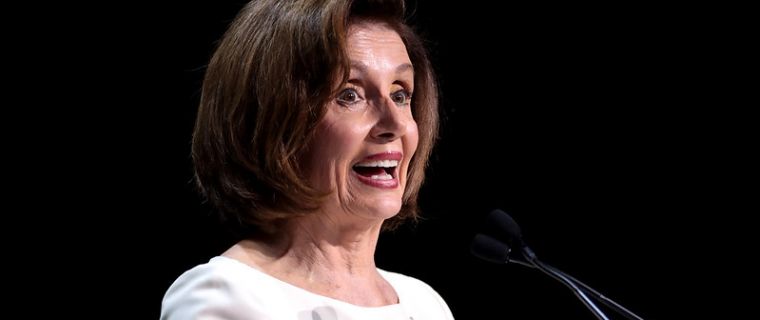
The most talked about incident, however, was when Speaker of the House Nancy Pelosi proceeded to rip a copy of President Trump’s speech while still on camera, as soon as he had finished his hour and a half long annual address. In what could be described as a wrestling match between the opposing parties US political divide was on full display for the world to mock.
Pelosi’s attempts to downplay or justify her actions by saying “it was the courteous thing to do considering the alternatives”, didn’t do much to stifle the bipartisan condemnation she received. The disgraced 79-year-old Democratic leader’s bold nonverbal message speaks more of her inability to effectively handle the pressures that come with this coveted position than any sort of resistance message she was hoping to send to the Left. Some have even called for her to resign as House Speaker.
On Wednesday, US President Donald J. Trump became the third US president in history to be impeached by the House and acquitted by the Senate. Ending the impeachment process and almost guaranteeing him a second term, the president was acquitted during the Senate trial on both articles of impeachment.
The only Republican that voted in favor of convicting President Trump was Mitt Romney of Utah. Romney is also the only Senator in US history to vote to remove a president from his own party in an impeachment trial. Romney voted “guilty” on article 1, for abuse of power, and “not guilty” on article 2, for obstruction of Congress. On the Senate floor Romney said that he supports a lot of what President Trump has done but his promise before God was to apply impartial justice and to put his feelings and political biases aside. What did Romney benefit from his vote? Nothing, aside from maybe a little favor with the liberals.
After two months of what Trump referred to as a “witch hunt”, the fact-finding and closed-door depositions were followed by public hearings in December. Now with the acquittal a disgraceful chapter in the Democratic Party’s book has closed and with it any chance of Trump being forced out of office before his term is over.
Democrats have essentially gifted Trump his next presidency on a silver platter. One can’t help but wonder how incredibly inept and poorly executed their plans have been since the 2016 election. The “he is not my president” crowd led by the white coat mafia is spiteful and undeniably biased. These individuals wouldn’t dare criticize the previous administrations many faults, some of which led us into wars that have cost millions of people their lives but they will eagerly scrutinize the current administrations every word and deed, and regardless if it’s to the nations benefit or not, they will trash it.
The left claims to be working in the best interest of the average American but has essentially created the perfect storm which not only gives President Trump’s his highest job approval ratings since he took office in 2017, which according to Gallup polls has risen to 49% but inflates his already enormous ego. Why is it that war crimes and crimes against humanity which were committed by the Obama administration never warrant a mention? If Democrats had a just bone in their body, they would have named and shamed previous President’s just as they have done to the current administration but that’s never going to happen.
It’s hard to tell what’s worse, the Left who is blinded by hate and is willing to burn the country down to get rid of President Trump or the Right which considers Trump their Lord and Savior and chooses to live in ignorant bliss and blindly accepts whatever Emperor Trump and his administration dish out.
Anyone who hasn’t been brainwashed into thinking either of the two parties have our best interest at heart can see that both parties are flawed and suffer from the inability to effectively discern fact from fiction or put biases aside and focus on America first.
However, in this political circus, at least since 2016 till 2024 it looks like the Republicans are on top and the Democrats, by their own doing, are digging themselves into a deeper grave by the day.
Now to say that the Left and Right can’t agree on anything would be an exaggeration. During the State of the Union address there were a few nauseating moments where both sides seemed in sync. One such rare show of solidarity came when both sides eagerly applauded the failed US-puppet Venezuelan opposition leader Juan Guaido. Guaido isn’t the legitimate president of Venezuela, but like a scene out of a zombie movie, President Trump introduced the stiff CIA-backed puppet and the crowd went wild with applause. Braindead attendees rose in unison to give him a standing ovation. Had Guaido and his US sponsors not failed miserably to unseat President Nicholas Maduro, Guaido wouldn’t currently be on tour trying to garner support leading him to the White House.
If the Left truly cared about the US’s domestic and foreign policies and wanted to bring about any meaningful change, they need to bring more to the table than just boycotts and protests, to be taken seriously.
ZeroHedge banned from Twitter after BuzzFeed accuses it of coronavirus conspiracy and ‘doxxing’ Chinese scientists
RT | February 1, 2020
The popular news blog ZeroHedge has been suspended from Twitter. While no reason was given, their last tweet referred to speculation the coronavirus could be a bioweapon and BuzzFeed had just accused them of doxxing.
The site’s last tweet before the suspension referenced a paper by Indian scientists pointing to uncanny similarities between the 2019-nCoV virus and HIV, which internet researcher Christopher Torres Lugo described as “conspiracy theories claiming that 2019-nCoV is a bioweapon.”
Twitter does not comment on reasons for suspending or banning any particular account, leaving ZeroHedge’s 673,000 or so followers in the dark on Friday afternoon, until the site itself said it received noticed it had engaged in “abuse or harassment.”
About two hours before the suspension published a story accusing ZeroHedge – which it refers to as “a popular pro-Trump website” – of revealing personal information of a scientist from Wuhan, China and “falsely accusing them of creating the coronavirus as a bioweapon.”
Release of personal information, or doxxing, would be a violation of Twitter rules. However, the BuzzFeed story purports to identify by name the proprietor of ZeroHedge, who writes under the pseudonym Tyler Durden.
BuzzFeed was outraged by the “rumors and lies” allegedly pushed by ZeroHedge about the origins and characteristics of the coronavirus, which causes a respiratory infection that has so far sickened almost 10,000 people across the world, and killed over 200 – mainly in China.
The first patient was reported in the city of Wuhan, in Hebei province, just a month ago. The WHO has declared a global health emergency due to the rapid spread of the virus.
ZeroHedge’s most recent article included the tweets of several scientists who were alarmed by a pre-publication paper authored by a team of Indian virologists, noticing the “uncanny similarity” between the 2019-nCoV and HIV-1 and finding it “unlikely to be fortuitous.”
Commenting on the suspension, ZeroHedge wondered, “Are we then to understand that we have now reached a point the mere gathering of information, which our colleagues in the media may want to eventually do as thousands of people are afflicted daily by the Coronavirus, is now synonymous with ‘abuse and harassment’? According to Twitter, and certainly our competitors in the media, the answer is yes.”
BuzzFeed notoriously published the so-called ‘Steele Dossier’ in January 2017, claiming that Russian intelligence services had compromising material on president-elect Donald Trump including video of him cavorting with urinating prostitutes at a Moscow hotel. None of the claims from the dossier, compiled by a freelancing British spy on commission from the Democratic National Committee, were ever corroborated.
See also:
Zerohedge Suspended On Twitter
Coronavirus Contains “HIV Insertions”, Stoking Fears Over Artificially Created Bioweapon
Liz Warren’s Chronicle of Self-Awareness
By Steve Sailer • Unz Review • January 30, 2020
From CNBC:
Elizabeth Warren proposes criminal penalties for spreading voting disinformation online
PUBLISHED WED, JAN 29 2020
Sunny KimDemocratic presidential candidate Sen. Elizabeth Warren on Wednesday released a plan to fight disinformation and to hold tech companies accountable for their actions in light of the 2016 election.
“Disinformation and online foreign interference erode our democracy, and Donald Trump has invited both,” Warren said in a Tweet Wednesday. …
Warren proposed to combat disinformation by holding big tech companies like Facebook, Twitter and Google responsible for spreading misinformation designed to suppress voters from turning out.
She added she will also open up data for research so that academics and organizations can provide the public with knowledge on disinformation.
With her superb grasp of symbolism and self-awareness, Warren chose to announce her plan to fight online disinformation on the one-year anniversary of her helping spread Jussie Smollett’s hate hoax disinformation online.
Also this week, Liz endorsed Chicago prosecutor Kim Foxx, who let Jussie walk last year.
‘If I Listened To Him, We’d Be On World War Six’ – Trump Slams “Nasty & Untrue” Bolton Book
By Tyler Durden – Zero Hedge – 01/29/2020
The coordinated leak of the Bolton manuscript has revived Democrats’ hopes for calling the former National Security Advisor to testify at Trump’s trial in the Senate, Mitch McConnell reluctantly admitted last night.
And as Republican frustration with the mustachioed neocon reaches a boiling point, President Trump – who famously fired Bolton via Twitter – has taken to his favorite social media platform to bash his former NSA.
Trump begins by slamming Bolton’s disloyalty, claiming that Bolton begged him for a “non-Senate approved” job and that Trump caved and gave it to him despite “many saying ‘don’t do it, sir’.”
Trump also mocked Bolton’s tendency toward gaffes during TV appearances, like the time he claimed the US was looking at “the Libya model” to handle North Korea. He was immediately roasted by national security experts who noted that Gadhafi’s decision to surrender his nuclear ambitions eventually led to his overthrow and brutal murder.
Moving on, the president said that if he followed Bolton’s advice, the US would be in “World War Six” by now – a reference to Bolton’s famously interventionist views, particularly regarding Iran. It’s believed that, if Bolton had his druthers, the US would have authorized a full-blown invasion.
It turns out Donald Trump isn’t the only Republican president who regrets trusting Bolton. Former President George W. Bush said he regretted his decision to recess-appoint Bolton as his top envoy to the United Nations over the objections of the Senate after it became clear he wouldn’t be confirmed.
“Let me just say from the outset that I don’t consider Bolton credible,” Bush reportedly told an assembled group of political writers, according to the Federalist.
Trump’s criticisms come after the WSJ editorial board said Bolton should be allowed to testify, once again breaking with the Trump administration.
Bolton skeptics – of which there are many – have accused the hotheaded former NSA of merely trying to sell books with the stunt (since getting another job in government is probably out of the question). Of course, this type of attention from the president should only help Bolton achieve that goal. After all, there’s no such thing as bad publicity.
Yet Democrats are giving a former “warmonger” the Comey treatment.
Why Dems, MSM Ignore FBI Whistleblower’s Revelations on the Clintons’ Links to the Uranium One Deal
By Ekaterina Blinova – Sputnik – 28.01.2020
While US lawmakers and media pundits are busy discussing Donald Trump’s impeachment process, the Clinton Foundation’s alleged misdeeds, including its supposed role in the Uranium One deal, remain neglected, says Wall Street analyst Charles Ortel, referring to a mid-January public interview with an FBI whistleblower.
On 15 January, FBI whistleblower Nate Cain told OAN’s investigative journalist Richard Pollock that he possesses classified documents implicating former Secretary of State Hillary Clinton and the Clinton Foundation with regard to the Uranium One deal. However, he added that he would never release them unless he receives approval from the appropriate federal authorities.
According to Cain, who joined the FBI in 2016, he overheard major concerns voiced by top brass FBI officials who purportedly came across damning evidence about the Clinton Foundation’s role in the Uranium One deal. The whistleblower said that having reviewed the materials, he had been sure that the Clintons would be indicted.
However, the case was apparently swept under the rug after then-FBI chief James Comey recommended no criminal charges for Hillary Clinton’s mishandling of classified emails in 2016.
Being a protected whistleblower under US law, Cain delivered 450 pages of documents concerning the deal to Inspector General Michael E. Horowitz in June 2018. However, in November, 16 FBI agents raided Cain’s Maryland home, accused him of possessing “stolen federal property” and ignored his argument about whistleblower protection, as The Daily Caller revealed on 29 November 2018.
Uranium One Case Remains Undeservingly Neglected
According to Charles Ortel, a Wall Street analyst and investigative journalist who has been looking into the Clinton Foundation’s alleged fraud for the past few years, the Uranium One issue still remains undeservedly neglected both by the American authorities and media pundits.
“It strikes me that President Trump needs to make sure that his senior team finally addresses long-unanswered questions concerning Uranium One anyway,” he underscores.
In his interview with OAN, Cain asserted that former FBI chief James Comey had been aware about the agency’s concerns with regard to the deal. One might ask how this happened that the former agency’s boss “overlooked” the supposed “damning evidence”.
“This question needs to be considered alongside questions about others who tried to inform James Comey concerning suspected mishandling by Hillary Clinton of classified information,” the Wall Street analyst notes.
He recalls that Cain wasn’t the only one whistleblower who stepped forward to shed light on the Clinton Foundation’s alleged role in the uranium deal: another one was William Campbell and his claims “to date, do not seem to have been considered carefully enough”, according to the analyst.
On 7 February 2018, Republican and Democratic staff from the Senate Committee on the Judiciary, House Committee on Oversight and Government Reform, and House Permanent Select Committee on Intelligence interviewed Campbell. However, the summary of the interview released on 8 March 2018 said that Campbell “provided no evidence” of alleged quid pro quo involving Hillary Clinton or the Clinton Foundation in arranging and approving the Uranium One deal.
“It certainly seems as if Comey was determined not to examine core issues involving mishandling – one imagines that one reason for this could be that numerous senior Obama administration officials might be implicated in potential wrongdoing, and that these officials were determined and remain determined not to let the truth out in advance of the pivotal election of 2016 and the looming one this year,” Ortel suggests.
The Wall Street analyst presumes that it was no coincidence that the Uranium One case was buried when Comey announced that he would not recommend charging Hillary Clinton over mishandling classified government emails.
“I do not believe in coincidences when it comes to this matter,” Ortel says. “More likely, President Obama’s Justice Department had made decisions to bottle up Comey’s ‘investigation’ and remained ‘all-in’ to support Hillary Clinton through the 2016 election contest.”
Whistleblowers & Double Standard Approach
The Wall Street analyst also emphasises the apparent double standard approach exercised by the FBI and DoJ towards Cain, Campbell and the unnamed whistleblower whose complaint to IG Michael K. Atkinson became the trigger for the impeachment process against Donald Trump.
According to Ortel, one can hardly “reconcile the protection given to the whistleblower who even now cannot be named (in theory) with the aggressive tactics allegedly taken by elements within the US government against Campbell and Cain”.
“It certainly seems to me that the aggressive handling of the ‘impeachment case’ by Democrats in the House and Senate and mainstream media stands in stark contrast to the lack of interest by too many in understanding what really has been going in and around the Clinton Foundation, including with Uranium One and other projects where Clinton donors, and possibly the Clinton family, may have derived personal benefits in projects where US government approvals and/or financial support were involved,” the investigative journalist concludes.
The controversy over the Uranium One deal, which envisaged a partial sale of Canadian company Uranium One to Tenex, a subsidiary of Russia’s nuclear company Rosatom which was approved by the Obama administration in 2011, erupted ahead of the 2016 elections. In his 5 May 2015 book, “Clinton Cash” American author Peter Schweitzer wrote that at the time the uranium deal was arranged, former US President Bill Clinton received thousands in speaking fees in Russia; the Clinton Foundation got substantive donations from firms interested in the deal; while then Secretary of State Hillary Clinton oversaw the Committee on Foreign Investment in the United States. However, Hillary Clinton and Obama administration officials denied the accusations, insisting that neither Russians nor the foundation’s sponsors had been involved in any wrongdoing and that at the time there was no security reason to axe the deal.
We have legal age limits for driving, voting, and having sex, why not for transgender treatment?
By Tomasz Pierscionek | RT | January 23, 2020
Vulnerable children and adolescents are being influenced by PC culture that elevates rights over responsibilities, teaches children there are over 100 genders, and where a fear of offending others trumps common sense.
Western democracies preach tolerance and require its citizens to accept progressive ideas; the more unconventional the better. A particular idea or course of action may even go against common sense and lead to harm, yet an overriding fear of causing offence or being labelled a [insert blank]-phobe thwarts open discussion about important issues.
There are, however, those who speak out and remind us to think carefully about embarking down a slippery slope from which it is difficult to return.
Susan Evans, a mental health professional and former employee of the UK’s only Gender Identity Development Service (GIDS), is asking the High Court to undertake a judicial review and raise the age at which individuals can consent to receiving puberty blockers and cross-sex hormones to 18. Ms Evans is joined by the parent of a 15-year-old adolescent on the GIDS waiting list.
Although individuals in the UK cannot undergo gender reassignment surgery until the age of 18, children and teenagers suffering from gender dysphoria (uncomfortable feelings brought on by a person’s gender identify differing from their birth sex) may receive medications to slow the onset of puberty and thus delay development of physical characteristics associated with their undesired sex. Later, from the age of 16, either testosterone or oestrogen (cross-sex hormones) are given to help an individual’s physical characteristics better align with those of their preferred gender identity.
Evans wants to raise the age of consent for children with gender identity issues receiving puberty blockers and other cross-sex hormones on the basis that under 18s are unable to provide informed consent for potentially life changing procedures. The former nurse expressed concerns that children, some aged as young as nine, are too hastily prescribed puberty blockers, reportedly the first step on the path towards gender reassignment.
Evans commented: “It’s about informed consent. Under [18s], we don’t think, are sufficiently mature enough to consent to a treatment that is going to potentially affect their adult life, because they go on a pathway. They start the blockers and then they go on the cross-sex hormones. [The trust’s] own research shows that virtually 100% of children they started on the blockers go on to the cross-sex hormones.”
She added“My experience with staff is that they’ve become fearful of doing anything that disagrees with a patient. The important thing in mental health work is to keep an open mind, it’s not to jump to the same conclusion that your patient comes to.”
It is worth noting that across the pond in the US, the state of South Dakota recently passed a bill making it illegal for medics to provide gender reassignment surgery or hormone therapy to minors. Similar bills could also be introduced across a number of other US states.
Puberty is confusing at the best of times, we’ve all been there. No one doubts that children and teenagers are more susceptible to external influence than adults and are less capable of considering the future impact of major decisions. Granted, there are exceptions to the rule but it’s safe to say that on the whole adolescents lack knowledge, life experience, forward planning, and an awareness of consequences in contrast to adults. That is partly why we have legal age limits for driving, voting, and having sex. The frontal lobes of the brain – those parts responsible for planning, self-regulation, exercising good judgement, and preventing unwise decisions – are not fully developed in children and adolescents. Evidence even suggests that the frontal lobes may not fully mature until the mid 20s.
An adult has the right to take cross-sex hormones after weighing up the pros and cons, and coming to an informed decision. Part of that right involves accepting the risks and possible regrets that may accompany their decision. Adolescents typically lack the maturity to commence treatments that interfere with their natural development, a decision they may later regret when they find themselves less physically and sexually developed than their peers. Those suffering from gender dysphoria should indeed be supported and offered psychotherapy to help them manage their distress. A rise in under 18s receiving puberty blockers and cross-sex hormones could be followed by a rise in medico-legal cases and compensation claims as those same individuals (now adults) later maintain they were insufficiently informed or were not mature enough to provide informed consent. In such cases lawyers would be the only winners.
There has been an explosion in the number of under 18s referred to the GIDS, rising from 94 in 2009-2010 to around 2500 in 2018-2019. Of particular concern are reports that children as young as five have been referred. It is also likely that vulnerable children and adolescents are being influenced by a culture that elevates rights over responsibilities, teaches children that there are over a 100 genders, and where a fear of offending others trumps common sense. As it happens, due to the growing number of referrals, a child or teenager referred to GIDS today might have to wait until early 2024 for their first appointment, giving them plenty of time and opportunities to change their mind.
In the US the gender reassignment industry is now worth over $1.3 billion a year; cross-sex hormones and puberty blockers also provide American Big Pharma with a healthy windfall. It seems that both identity politics advocates and the pharmaceutical industry have a common interest; they wish to exert greater (socio-ideological or financial) influence over future generations. In the battle for profits and minds, neither group is going to step aside without a fight.
Tomasz Pierscionek is a medical doctor and social commentator on medicine, science, and technology. He was previously on the board of the charity Medact and is editor of the London Progressive Journal.
No opposition from the international community as Israel alters the two-state paradigm
![Israel forces Jerusalemite to demolish his home [Maannews]](https://i2.wp.com/www.middleeastmonitor.com/wp-content/uploads/2020/01/523409C.jpg?resize=650%2C433&quality=85&strip=all&ssl=1)
Israel forces Jerusalemite to demolish his home [Maannews ]
By Ramona Wadi | MEMO | January 21, 2020
The EU is predicting an increase in Israeli demolitions of Palestinian dwellings and structures in the occupied West Bank, thus perpetuating the problem of displacement. Israeli Defence Minister Naftali Bennett has described the plan to apply Israeli sovereignty to Area C as “a real and immediate battle for the future of the Land of Israel.”
In 2019, Israel exceeded the statistics for demolitions and displacement in the previous year. Targeting EU-funded and Palestinian structures alike, the EUobserver stated that Israel had demolished 35 per cent more dwellings and displaced 95 per cent more Palestinians, when compared with 2018.
Despite this, the EU refrains from taking a stance against Israeli colonisation, even as it demands compensation from Israel for the damage to structures funded by the bloc. Last week, Israel demolished a Palestinian home and the foundations of a school in Al-Rifaiyya and Birin respectively.
Bennett’s simplistic justification for the colonisation of Area C attempted to downplay the international consensus. “We are not at the United Nations,” he declared.
Israel’s contempt for international law is well known. However, the ways in which the UN and the EU aid the Zionist state in its trajectory are cast aside. On Monday, the UN Assistant Secretary General for Humanitarian Affairs, Ursula Mueller, called for “continued commitment and consistent and sustained funding to help alleviate the challenges faced by Palestinians in Gaza and the West Bank, including East Jerusalem.”
Mueller’s visit to the occupied Palestinian territories and Tel Aviv illustrated the discrepancy which the UN persists in upholding. In the oPt, the UN official witnessed first-hand the deprivation which left Palestinian communities at risk of losing access to basic necessities, all as a direct result of Israel’s colonisation of their land. In Tel Aviv, however, Mueller “commended Israel on its contribution to global emergency relief efforts.”
In the same way that the UN isolates Palestinians politically, Mueller isolated Palestine from what she means by “global”. The prevailing trend of contributing to Israel’s humanitarian propaganda while refusing to hold it accountable for the decline in Palestinian rights is hypocritical, to say the least.
Bennett’s plans for Area C will increase the humanitarian impact for Palestinians and the financial responsibility will once again fall upon international actors which define Palestine solely through the lens of humanitarian aid.
This generalisation makes it easier to gloss over the human rights violations perpetrated by Israel through enforced military control, impediments to freedom of movement and additional forced displacement, the most recent being the demolition orders for 18 homes in Masafer Yatta.
It is clear that both the UN and the EU are unwilling to act upon their own statistics when it comes to protecting Palestinians and their land. Bennett’s announcement to create “nature reserves” — a frequent euphemism for land theft by the state — in Area C has also fallen on deaf ears, despite the implication of further appropriation of Palestinian territory. With the consequences of Bennett’s action in mind, which part of the two-state compromise is the international community pledging to protect at all costs, indeed to the exclusion of “plan B”?
UN Secretary General Antonio Guterres has repeatedly refused to consider alternatives, if these come from Palestinians, of course. Israel’s altering of Palestine and the international two-state paradigm, once again, is absent from UN concerns, no doubt deliberately so. To put it another way, there is no international opposition to “plan B”, as long as Israel is its architect.
Jews’ Ten Pledges vs Palestinians’ Eleven Red Lines
All five leadership candidates embrace ‘Ten Pledges’ that dictate how they must think, speak and act.
By Stuart Littlewood | American Herald Tribune | January 21, 2020
The UK Labour Party is saying goodbye to Jeremy Corbyn as leader after its disastrous general election performance and has begun choosing someone else.
Wasting no time, the Board of Deputies of British Jews last week published Ten Pledges they wanted Labour leadership hopefuls to sign up to if the Party’s relationship with the Jewish community was to be healed.
The BoD claim anti-Semitism in the party became a matter of great anxiety for the UK’s Jews during Corbyn’s four years in office and it will take at least 10 years to repair the damage. Their president Marie van der Zyl says: “We expect that those seeking to move the party forward will openly and unequivocally endorse these Ten Pledges in full, making it clear that if elected as leader, or deputy leader, they will commit themselves to ensuring the adoption of all these points.
“Tackling antisemitism must be a central priority of Labour’s next leader,” she insists. “We will certainly be holding to account whoever ultimately wins the contest.”
But is there really an anti-Semitism crisis other than the one caused by the Jewish State itself and mischievously drummed up within Labour? As former Israeli Director of Military Intelligence, Yehoshafat Harkabi wrote: “It would be a tragic irony if the Jewish state, which was intended to solve the problem of anti-Semitism, was to become a factor in the rise of anti-Semitism. Israelis must be aware that the price of their misconduct is paid not only by them but also Jews throughout the world.” It has been suggested before that so-called anti-Semitism is a matter best resolved by the Jewish ‘family’ itself.
Obedience required
The BoD claim that all the leadership contenders – Sir Keir Starmer, Rebecca Long-Bailey, Lisa Nandy, Jess Phillips and Emily Thornberry – have signed the Ten Pledges, and three of the five deputy-leader candidates have done so. What are these crisis-busting Ten Pledges they’ve committed the Party to?
(1) Resolve outstanding cases – All outstanding and future cases should be brought to a swift conclusion under a fixed timescale.
- Absolutely.
(2) Make the Party’s disciplinary process independent – An independent provider should be used to process all complaints, to eradicate any risk of partisanship and factionalism.
- Of course.
(3) Ensure transparency – Key affected parties to complaints, including Jewish representative bodies, should be given the right to regular, detailed case updates, on the understanding of confidentiality.
- Except that complainers, including the BoD, have a poor record of keeping even their wildest allegations confidential.
(4) Prevent readmittance of prominent offenders – It should be made clear that prominent offenders who have left or been expelled from the party, such as Ken Livingstone and Jackie Walker, will never be readmitted to membership.
- It is not clear from the evidence that Livingstone or Jackie Walker committed an offence. They were hounded out and not, I think, by any independent arbitrator.
(5) Communicate with resolve – Bland, generic statements should give way to condemnation of specific harmful behaviours – and, where appropriate, condemnation of specific individuals.
- This should apply also to false accusers and to the BoD themselves if failing to condemn the “harmful behaviours” of their brethren in the Israeli regime towards our sisters and brothers in Palestine.
(6) Provide no platform for bigotry – Any MPs, Peers, councillors, members or CLPs [local parties] who support, campaign or provide a platform for people who have been suspended or expelled in the wake of antisemitic incidents should themselves be suspended from membership.
- Unacceptable. Many have been suspended for no good reason. And suspension does not mean guilt.
(7) Adopt the international definition of antisemitism without qualification – The IHRA definition of antisemitism, with all its examples and clauses, and without any caveats, will be fully adopted by the party and used as the basis for considering antisemitism disciplinary cases.
- How many times must you be told that the IHRA definition of anti-Semitism is a minefield? Top legal opinion (for example Hugh Tomlinson QC, Sir Stephen Sedley and Geoffrey Robertson QC) warn that it is “most unsatisfactory”, has no legal force, and using it to punish could be unlawful. Furthermore it cuts across the right of free expression enshrined in UK domestic law and underpinned by Article 19 of the Universal Declaration of Human Rights which bestows on everyone “the right to freedom of opinion and expression; this right includes freedom to hold opinions without interference and to seek, receive and impart information and ideas through any media and regardless of frontiers”. This applies not only to information or ideas that are regarded as inoffensive, but also to those that “offend, shock or disturb the State or any sector of the population”. Labour Party members should know all this. The prohibitive IHRA definition is not something a sane organisation would incorporate into its Code of Conduct.
(8) Deliver an anti-racism education programme that has the buy-in of the Jewish community – The Jewish Labour Movement should be reengaged by the Party to lead on training about antisemitism.
- The BoD and JLM would do better teaching anti-racism to the Israeli regime and its supporters. Besides, MPs and councillors don’t ‘belong’ to the Labour Party or any other party; they belong to the public who elected them as their representative. No outside body should expect to influence their freedom of thought, expression or action (see the Seven Principles of Public Life).
(9) Engagement with the Jewish community to be made via its main representative groups – Labour must engage with the Jewish community via its main representative groups, and not through fringe organisations and individuals.
- Labour should engage with the Jewish community though any representative organisation or individual it pleases.
(10) Show leadership and take responsibility – The leader must personally take on the responsibility of ending Labour’s antisemitism crisis.
- There’s no agreement that anything approaching a crisis exists within the Party.
Leadership front-runner Starmer is a former human rights lawyer and ought to know better. Long-Bailey is another lawyer who should hang her head in shame. Thornberry is a former barrister specialising in human rights law – words fail. Jess Phillips, a member of Labour Friends of Israel, wrote Truth to Power: 7 Ways to Call Time on B.S., described as “the little book we all need to help us call time on the seemingly unstoppable tide of bullshit in our lives”. The irony of it seems lost on her. Lisa Nandy is a puzzle as she’s chair of Labour Friends of Palestine.
If this bunch won’t robustly uphold freedom of expression guaranteed by law and international convention what have they let their hapless party in for? Those standing for deputy-leader also have little excuse. Angela Rayner was shadow education secretary, Ian Murray read Social Policy and Law, and Rosena Allin-Khan is a Muslim and former humanitarian aid doctor. They obediently signed the Ten Pledges. Dawn Butler and Richard Burgon declined.
When, a year ago, the French Republic presented its Human Rights Award to B’Tselem (the Israeli human rights group) its Executive Director Hagai El-Ad, thanking the National Consultative Commission on Human Rights, said of Israel’s behaviour towards the Palestinians: “The occupation…. is organized, prolonged state violence which brings about dispossession, killings, and oppression. All branches of the state are part of it: ministers and judges, officers and planners, parliamentarians and bureaucrats.”
On another occasion B’Tselem said: “If the international community does not come to its senses and force Israel to abide by the rules that are binding to every state in the world, it will pull the rug out from under the global effort to protect human rights in the post-WWII era.”
When a respected Israeli organisation speaks truth in such stark terms it cannot be ignored. And recent UN reports confirm that the Israelis abuse and torture child prisoners. So why would anyone – especially those competing to be Labour Party leader and one day prime minister – agree to dance to the tune of those who pimp and lobby on Israel’s behalf?
Who will punish the false accusers?
The BoD nevertheless make some valid points. The Labour Party takes a ridiculously long time to deal with allegations of anti-Semitism, many of which are false or vexatious and could be dismissed in five minutes. Let me tell you about two Scottish Labour politicians wrongly accused of anti-Semitic remarks and suspended. Let’s call them ‘A’ and ‘B’. Both are regional councillors.
Constituency party officials declared ‘A’ guilty immediately and issued a press statement to that effect without waiting for him to be heard, hugely prejudicing any investigation. This stupidity was compounded by his Council leader publicly calling on him to resign as a councillor and saying his thinking belonged to the Dark Ages: “To smear an entire community both past and present, to say he has lost ‘all empathy’ for them is utterly deplorable,” he was quoted in the press.
What was ‘A’s crime? He had tweeted: “For almost all my adult life I have had the utmost respect and empathy for the Jewish community and their historic suffering. No longer, due to what they and their Blairite plotters are doing to my party and the long suffering people of Britain…” Was nobody in the local party aware that the Jewish Leadership Council and the Board of Deputies were then leading an obnoxious campaign to discredit Labour and Jeremy Corbyn?
‘B’, a respected lady councillor, was accused of anti-Semitism by a former Labour MP who was already on record as wanting to impose limits on freedom of expression. A Tory MP immediately put the boot in, telling the media it was clear to the vast majority of people that ‘B’ was no longer fit to hold office and suspension didn’t go far enough.
And what was ‘B’s crime? She had voiced suspicion on social media that Israeli spies might be plotting to get rid of Jeremy Corbyn as Labour leader after three Jewish newspapers ganged up to publish a joint front page warning that a Corbyn-led government would pose an “existential threat to Jewish life in this country”.
She added that if it was a Mossad assisted campaign to prevent the election of a Labour Government (which pledged to recognise Palestinian statehood) it amounted to an unwarranted interference in our democracy. For good measure she said Israel was a racist State and, since the Palestinians are also Semites, an anti-Semitic one.
‘B’ was eventually interviewed by party investigators. They surely knew that in January 2017 a senior political officer at the Israeli embassy in London, Shai Masot, had plotted with stooges among British MPs and other activists to “take down” senior government figures including Boris Johnson’s deputy at the Foreign Office, Sir Alan Duncan. And that Mark Regev, Netanyahu’s former chief spokesman and mastermind behind Israel’s propaganda programme of disinformation, had recently arrived in London as the new ambassador.
Masot was almost certainly a Mossad tool. His hostile scheming was revealed not by Britain’s own security services and media, as one would have hoped, but by an Al Jazeera undercover team. Our Government dismissed the matter saying: “The UK has a strong relationship with Israel and we consider the matter closed.” But at a Labour Party conference fringe meeting Israel insider Miko Peled warned that “they are going to pull all the stops, they are going to smear, they are going to try anything they can to stop Corbyn…. the reason anti-Semitism is used is because they [the Israelis] have no argument….”
Given such a blatant attempt by an Israeli asset to undermine British democracy, with Regev in the background and (quite probably) Mossad pulling the strings, ‘B’s suspicions were reasonable enough and she had a right to voice them.
As for Israel being a racist State, its ethnic cleansing of the Palestinians and other brutal policies over 70 years make it obvious. And the discriminatory Nation State laws recently adopted by Israel put the question beyond doubt. Her point about anti-Semitism was also well made. DNA research (see for example the Johns Hopkins University study published by Oxford University Press) shows that while very few Jews are Semitic most indigenous Arabs in the Holy Land, especially Palestinians, are Semites. The term ‘anti-Semitism’, long used to describe hatred of Jews, is a misnomer that hides an inconvenient truth.
And it couldn’t have been difficult to establish that the opportunistic Tory MP calling her unfit to hold office was the chairman of the All-Party Parliamentary Group on British Jews, which is funded, supported and administered by The Board of Deputies. The case against ‘B’ should have been dropped instantly and action taken against the troublemakers. Instead, weeks later, ‘B’ was posting on her Facebook page that she was still suspended: “I can’t make any decisions about my personal, political, or professional future whilst this hangs over me. I am constantly tired and anxious, and feel I am making mistakes. I have lost paid work because of what has happened.”
Her suspension was finally lifted but she was “advised” not to post about it or she’d risk losing professional work on which her livelihood depended. That’s how nasty the Labour Party disciplinary machine is. Surely, if the Party lifts a suspension it should issue a public statement saying so. Must the wrongly accused, after being needlessly humiliated, be left to pick up the pieces and struggle to re-establish their good name? In total ‘B’ had to wait 16 weeks under sentence. And all because of a trumped-up allegation that ought to have been immediately squashed.
As for ‘A’, he stopped answering emails and there has been nothing in the press. Was his suspension lifted? Was he similarly threatened if he said anything? I simply don’t know although I phoned and wrote to the Leader and the General Secretary for an explanation. The latter eventually replied that “the Labour Party cannot, and does not, share personal details about individual party members” and placing a member in administrative suspension “allows a process of investigation to be carried out whilst protecting the reputation of the Labour Party”. Bollox. How did the media get news of these suspensions in the first place? And never mind the damage done to the cowardly Party, what about the reputations of the two councillors and their months of anguish while working for their constituents? I wasn’t asking for case details. All I wanted was the answer to three simple questions:
# Had the suspensions been lifted?
# If so, had the Party issued a public statement to that effect?
# And had the false accusers been disciplined?
Silence… spineless, don’t-give-a-damn silence.
Are these two cases typical of the so-called anti-Semitism crisis? I have no way of knowing. But they show how the Party is run by enough crackpots on the inside without inviting impertinent interference from the outside.
Jews’ Ten Pledges vs Palestinians’ Eleven Red Lines
Anyone signing up to the BoD’s Ten Pledges should consider at the same time subscribing to the ‘Eleven Red Lines’ of anti-Palestinianism. Examples in public life, the media, schools, the workplace, and in the religious sphere could, taking into account the overall context, include, but are not limited to:
(1) Denying the Palestinian people their right to self-determination and nationhood, or actively conspiring to prevent the exercise of this right.
(2) Denial that Israel is in breach of international law in its continued occupation of Gaza, the West Bank and East Jerusalem.
(3) Denial that Israel is an apartheid state according to the definition of the International Convention on Apartheid.
(4) Denial of the expulsion of 750,000 Palestinians during the 1948 Nakba and of their right, and the right of their descendants, to return to their homeland.
(5) Denial that Palestinians have lived for hundreds of years in land now occupied by Israelis and have their own distinctive national identity and culture.
(6) Denial that the laws and policies which discriminate against Palestinian citizens of Israel (such as the recently passed Nation State Law) are inherently racist.
(7) Denial that there is widespread discrimination against Palestinians in Israel and the Occupied Territories in matters of employment, housing, justice, education, water supply, etc, etc.
(8) Tolerating the killing or harming of Palestinians by violent settlers in the name of an extremist view of religion.
(9) Making mendacious, dehumanizing, demonizing, or stereotypical allegations about Palestinians — such as, especially but not exclusively, the myth of a Palestinian conspiracy to wipe Israel off the map.
(10) Justifying the collective punishment of Palestinians (prohibited under the Geneva Convention) in response to the acts of individuals or groups.
(11) Accusing the Palestinians as a people, of encouraging the Holocaust.
This working definition of anti-Palestinian racism, described as “hatred towards or prejudice against Palestinians as Palestinians”, holds up a mirror to the IHRA definition of anti-Semitism and was drafted by Jewish Voice For Labour, one of those fringe representative organisations the BoD insist Labour mustn’t engage with.
So here’s a simple test for the BoD: if they demand the Labour Party signs up to their Ten Pledges will they themselves embrace the Eleven Red Lines on anti-Palestinianism?
The Labour Partly
By Gilad Atzmon | January 15, 2020
Historically, a popular coup against an opposition party is rare. In the last General Election Corbyn’s Labour provided us with just such an exceptional spectacle.
Labour managed to alienate its voters. Its leader turned his back on its strongest allies including, among others, Ken Livingstone and Chris Williamson. For some reason Corbyn’s Labour turned itself into an Orwellian authoritarian apparatus; it even dug into its members’ social media accounts picking out ‘dirt’ (human right’s concerns) in order to appease one distinctive foreign lobby.
The Brits saw it all, how dangerous the party became. Many former ardent Labour supporters angrily rejected their political home. They may never return.
The conduct of the contenders for Labour’s leadership in the last few days reveals that the Brits were spot on in humiliating their opposition party.
At the moment, Labour’s leadership candidates are, without exception, competing amongst themselves to see who goes the lowest in pledging allegiance to a Lobby associated with a foreign state that is currently under investigation by the International Criminal Court (ICC) for committing crimes against humanity.
Yesterday I discussed the topic with the Great Richie Allen (from about 20/24 min/sec) :
Leadership contender Emily Thornberry is apparently on her “hands and knees… asking for forgiveness.” And she is not the only one. The Zionist Times of Israel’s headlines yesterday revealed that the top candidates for Labour leadership have all vowed to lead the fight against anti-Semitism. “Keir Starmer backs automatic expulsion for offenders; Rebecca Long-Bailey: Corbyn bears personal responsibility for crisis; Jess Phillips suspends aide over anti-Semitic tweets.”
On BBC Radio, front runner Keir Starmer said, “We should have done more on anti-Semitism.” I wonder, what did Starmer mean by that? What is the next step after thought policing and spying on party members? Re-education centres? Indoctrination facilities? Hypnosis or maybe physiological treatment or perhaps lobotomy for those who dare to tell the truth about Israel and its Lobby?
Meanwhile, the Mail on Sunday reported that leadership contender, Jess Phillips, had on Friday suspended an aide who equated the Jewish State with the Islamic one.
Two days ago we learned that Zionist pressure on the Labour party isn’t fading away. The Board of Deputies of British Jews (BOD) published its demands of the candidates for Labour’s leadership. The ultra Zionist Jewish Chronicle wrote “The Board of Deputies has demanded each of Labour’s candidates for leader and deputy leader sign up to its 10 ‘pledges’ in order to ‘begin healing its relationship with the Jewish community’…”
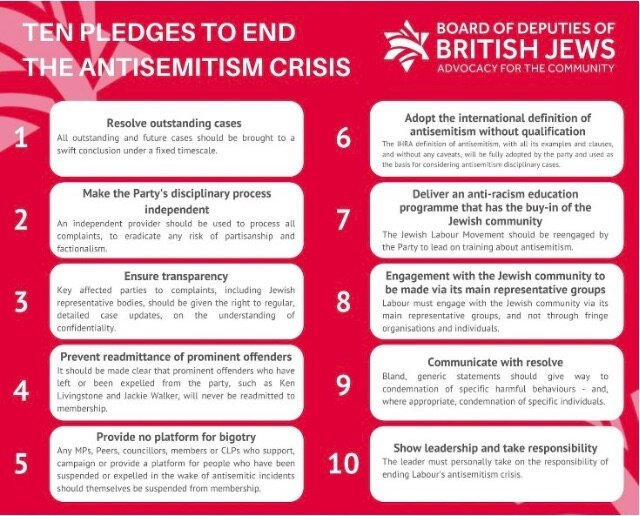
Predictably, the demands made by the BOD do not accord with Western and Christian values of pluralism and tolerance. The BOD demands that contenders ‘pledge’ to “prevent re-admittance of prominent offenders.” One may wonder what about forgiveness and compassion, are those fundamental Western values foreign to our Labour leadership candidates?
The BOD insists that leadership contenders pledge to “provide no platform for those who have been suspended or expelled for antisemitism.” What about freedom of speech and free debate? Are those also alien to Labour’s future leaders?
The new Labour leader is expected to support the bizarre idea that the Zionist Jewish Labour Movement will grant the kosher certificate for its “anti racism education program.” I thought to myself that if the Jewish Labour Movement is so good in ‘anti racism education,’ maybe, and before anything else, it should contribute towards the cleansing of racism in Israel.
The fact that a Jewish organisation such as the BOD is so bold as to publish such ludicrous demands from a British national party is no surprise. The bizarre development here is that Labour’s leadership candidates are engaged in an undignified battle to gain the BOD’s support.
I am not critical of the Jewish Lobby and its orbit of Zionist pressure groups. Those bodies clearly accomplished their mission. But it is astonishing how dysfunctional the Labour party and its leadership are. The party can’t even draw the most elementary lesson from its recent electoral disaster.
Those who follow my work know that I have predicted the unfortunate downfall of Labour and the demise of the Left in general. The Left, as I have been arguing for a while, has failed to reinstate its relevance and authenticity. It is unfortunately dead in the water.
US to launch new media network to provide Chinese diaspora with ‘alternative’ news
© Reuters/Yuri Gripas; GLP/ZUMA Press/ChinaFotoPress/Wu Junsong
RT | November 24, 2019
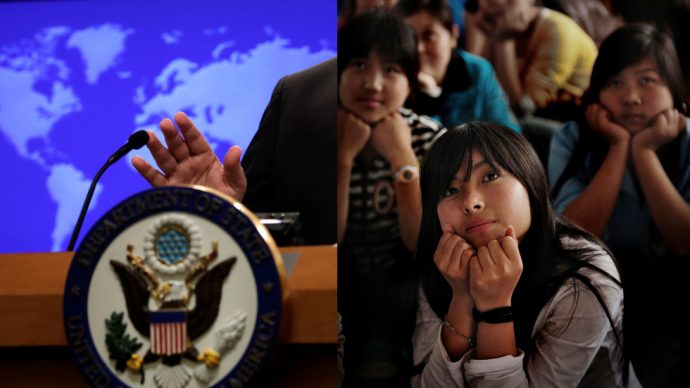
The US-funded broadcasters Voice of America and Radio Free Asia are about to join forces to establish a new media structure, tasked with providing Chinese citizens with an ‘alternative’ to their own state media, a report claims.
Against the background of a seemingly never-ending US-China trade war, Washington has, apparently, decided to reach out to some ordinary Chinese people and to provide them with no less than a brand new “alternative” to their domestic state media, which, it says, only promote Beijing’s “narratives, values and misinformation.”
At least that’s what a report in the Hong Kong-based South China Morning Post (SCMP) claims. The report suggests that Voice of America and Radio Free Asia plan to work together to create a totally new “digital brand” operating 24/7 in Mandarin on social media, on the internet and through various other broadcasting platforms.
The new network is reportedly expected to focus particularly on Chinese youth, both in China and beyond. The news comes as the US Agency for Global Media – a newly founded governmental entity tasked with coordinating the work of all of the US’ state-funded media – proudly reported about the growing demand for that sort of content in China, saying that the number of people tuning in weekly to VOA and RFA rose by more than six percent in total in 2018.
It is, however, unclear how exactly a network, which will reportedly be called ‘Global Mandarin,’ would be different from the existing US state-funded Mandarin-language broadcasters. Neither is it clear how many personnel would be involved in its operations and how exactly it is going to promote “freedom and democracy.”
In any event, this new “alternative” media source, which would be no doubt tasked with “advancing the goals of US foreign policy” just like Radio Free Asia or Radio Free Europe, would need to get through China’s firewall first.
The SCMP report suggests the budget of the proposed new network could be between $5 million and $10 million for the first year – a meager sum. Compared with the $43 million Radio Free Asia had at its disposal in 2018, for example.The network’s supposed future name does not make the situation any easier as well as it –alongside with a relevant internet domain – is currently taken by an online school of Chinese language.
It is not the Washington’s first attempt to conquer the minds of its geopolitical adversaries, though. Two years ago, Voice of America together with another government-funded media outlet – Radio Free Europe/Radio Liberty launched a 24/7 Russian-language news channel broadcasting from the Czech Republic with a very similar stated goal of providing “an alternative to disinformation” in Russia and neighboring countries.
Featured Video

ARE PATIENTS BEING PROPERLY INFORMED ABOUT OZEMPIC?
or go to
Aletho News Archives – Video-Images
New Book
Breast Cancer: Before You Consent
A new Unbekoming paperback
Lies are Unbekoming | September 18, 2026
Peter Gøtzsche reviewed every randomised mammography screening trial ever conducted for the Cochrane Collaboration. Cochrane’s headline is that, assuming a 15% mortality reduction, one woman in 2000 avoids dying of breast cancer over ten years. Ten are overdiagnosed and treated. Two hundred experience false alarms.
But that headline assumes the reduction. When Gøtzsche looked only at the trials with adequate randomisation — the higher-quality ones — the reduction disappeared. No effect on breast cancer mortality. No effect on all-cause mortality.
This is the Cochrane finding, published in the establishment’s own database of systematic reviews.
No woman being asked to consent to a mammogram this week knows it.
That is why the new Unbekoming paperback exists. … continue
Blog Roll
 Aletho News
- ARE PATIENTS BEING PROPERLY INFORMED ABOUT OZEMPIC?
- US lawmaker blocks $2.8 billion weapons sale to Israel: Report
- Yemeni army claims responsibility for strikes on sensitive sites in Saudi capital, Aramco facilities in Yanbu
- Iran Judiciary issues indictments against 159 US, Israeli officials for assassination of Leader, commanders
- Turkiye revokes Iranian bank license under US sanctions campaign
- US-Denmark Agreement on Greenland Is ‘PR Stunt’ Ahead of Midterms
- Araghchi: Military intervention cannot create security; coercion cannot bring peace
- Fraud Squared
- Breast Cancer: Before You Consent
- Iran’s Plan to Shut Down AI in the Persian Gulf
- If Americans Knew
- Inside Gaza’s death trap of collapsing, bombed-out buildings
- The everyday items Israel bans from Gaza every day
- Inside the siege, the ruined buildings of Gaza – Daily Update
- Debunking The Claim That Macklemore Has A “History Of Antisemitism”
- CPJ demands release of arrested Palestinian-US journalist near Bethlehem
- Robert Kraft: The Billionaire Friend of Netanyahu Pulling The Strings Behind the Macklemore/Ed Sheeran Blow Up
- Columbia Administered Fund Gives Big Money to Pro-Israel Groups
- Deportation Case of Palestinian Activist Salah Sarsour Tests First Amendment
- ‘We Will Not Forget’: Palestinians Mark 44 Years since Sabra and Shatila
- Why do we let Zionists decide what we can and can’t say?
- No Tricks Zone
- New Study: ‘Global Drought Shows No Detectable Recent Acceleration Under Climate Warming’
- Economic Masterminds: German Socialists Suggest Taxing Productivity Gains Stemming From Using AI
- The South China Sea Has Not Been Cooperating With The Climate Change Narrative
- Energy Crisis: Germany Enters Heating Season With Historically Low Gas Reserve Fill Levels
- New Study: The Antarctic Ice Sheet Gained Mass From 2020-2024 Due To Staggering Snow And Ice Accumulation
- Study: Ocean Heating Rates From Thousands Of Years Ago ‘Dwarf’ Modern Ocean Heating Rates
- Climate Extremists Target, Attack Large-Scale Power Grid Infrastructure In Germany!
- New Study: Antarctic Ice Melt Has Contributed Less Than 1 Centimeter To Sea Level Rise In The Last 30 Years
- Fear Of Debate: Alarmist German Climate Scientist Calls On Mainstream Media To Discredit Skeptic Voices
- End-Of-August Arctic Sea Ice Extent Hasn’t Fallen In 20 Years, Official Data Show!
 Aletho News