French contradictions: Macron’s Palestine play – too little, too late?
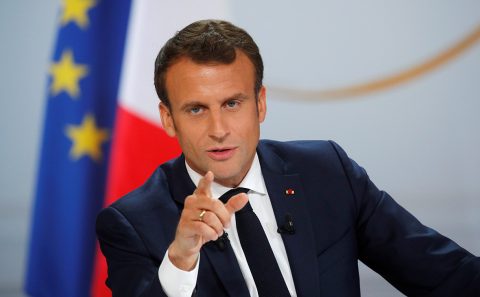
By Ramzy Baroud | MEMO | April 16, 2025
Israeli Prime Minister Benjamin Netanyahu’s vehement opposition to a Palestinian state aligns perfectly with a long-standing Zionist ideology that has consistently viewed the establishment of a Palestinian state as a direct threat to Israel’s very foundation as a settler colonial project.
Thus, the mere existence of a Palestinian state with clearly defined geographical boundaries would inevitably render the state of Israel, which pointedly remains without internationally recognised borders, a state confined to a fixed physical space.
At a time when Israel continues to occupy significant swathes of Syrian and Lebanese territory and relentlessly pursues its colonial expansion to seize even more land, the notion of Israel genuinely accepting a sovereign Palestinian state is utterly inconceivable.
This reality is not a recent development; it has always been the underlying truth. This, in essence, reveals that the decades-long charade of the “two-state solution” was consistently a mirage, meticulously crafted to peddle illusions to both Palestinians and the broader international community, fostering the false impression that Israel was finally serious about achieving peace.
Therefore, it came as no surprise that Netanyahu reacted with considerable fury to French President Emmanuel Macron’s recent announcement of France’s intention to recognise the State of Palestine next June.
In a phone call with Macron yesterday, Netanyahu predictably resorted to his familiar nonsensical rhetoric, outrageously equating the establishment of a Palestinian state with rewarding “terrorism”.
And, with equal predictability, he trotted out the well-worn and unsubstantiated claims about an Iranian connection. “A Palestinian state established a few minutes away from Israeli cities would become an Iranian stronghold of terrorism,” Netanyahu’s office declared in a statement.
Meanwhile, Macron, with a familiar balancing act, reiterated his commitment to Israeli “security”, while tepidly emphasising that the suffering in Gaza must come to an end.
Of course, in a more just and reasonable world, Macron should have unequivocally stressed that it is Palestinian security, indeed their very existence, that is acutely at stake, and that Israel, through its relentless violence and occupation, constitutes the gravest threat to Palestinian existence and, arguably, to global peace.
Sadly, such a world remains stubbornly out of reach.
Considering Macron’s and France’s unwavering and often obsequious support for Israel throughout the years, particularly since the onset of the Israeli genocide in Gaza, some might cautiously welcome Macron’s statement as a potentially positive shift in policy.
However, it is imperative to caution against any exaggerated optimism, especially at a time when entire Palestinian families in Gaza are being annihilated in the ongoing Israeli genocide as these very words are read. It is an undeniable truth that France, like many other Western governments, has played a significant role in empowering, arming and justifying Israel’s heinous crimes in Gaza.
For France to genuinely reverse its long-standing position, if indeed that is the current trajectory, it will require far more than symbolic and ultimately empty gestures.
Palestinians are, understandably, weary and disillusioned with symbolic victories, hollow rhetoric, and insincere gestures.
The recent recognitions of the State of Palestine by Ireland, Norway and Spain in May 2024 did offer a fleeting spark of hope among Palestinians, suggesting a potential, albeit limited, shift in Western sentiment that might exert some pressure on Israel to cease its devastating actions in Gaza.
Unfortunately, this initial and fragile optimism has largely failed to translate into broader and more meaningful European action.
Consequently, Macron’s recent announcement of France’s intention to recognise the State of Palestine in June has been met with a far more subdued and skeptical reaction from Palestinians.
While other European Union countries that have already recognised Palestine often maintain considerably stronger stances against the Israeli occupation, France’s record in this regard is notably weaker.
Furthermore, the very sincerity of France’s stated position is deeply questionable, given its ongoing and concerning suppression of French activists who dare to protest the Israeli actions and advocate for Palestinian rights within France itself.
These attacks, arrests, and the broader crackdown on dissenting political views within France hardly paint the picture of a nation genuinely prepared to completely alter its course on aiding and abetting Israeli crimes.
Moreover, there is a stark and undeniable contrast between the principled positions adopted by Spain, Norway and Ireland and France’s steadfast backing of Israel’s brutal military campaign in Gaza from its very inception, a support underscored by Macron’s early and highly symbolic visit to Tel Aviv.
Macron was among the first world leaders to arrive in Tel Aviv following the war, while Palestinians in Gaza were already being subjected to the most unspeakable forms of violence imaginable.
During that visit, on 24 October 2023, he unequivocally reiterated, “France stands shoulder to shoulder with Israel. We share your pain, and we reaffirm our unwavering commitment to Israel’s security and its right to defend itself against terrorism.”
This raises a fundamental and critical question: how can France’s belated recognition of a Palestinian state be interpreted as genuine solidarity while it simultaneously remains a significant global supporter of the very entity perpetrating violence against Palestinians?
While any European recognition of Palestine is a welcome – if overdue – step, its true significance is considerably diminished by the near-universal recognition of Palestine within the global majority, particularly across the Global South, originating in the Middle East and steadily expanding worldwide.
The fact that France would be among the last group of countries in the world to formally recognise Palestine (currently, 147 out of 193 United Nations member states have recognised the State of Palestine), speaks volumes about France’s apparent attempt to belatedly align itself with the prevailing global consensus and, perhaps, to whitewash its long history of complicity in Israeli Zionist crimes, as Israel finds itself increasingly isolated and condemned on the international stage.
One can state with considerable confidence that Palestinians, particularly those enduring the unimaginable horrors of the ongoing genocide in Gaza, prioritise an immediate cessation of that genocide and genuine accountability for Israel’s actions far above symbolic acts of recognition that appear primarily aimed at bolstering France’s relevance as a global power player and a long-standing supporter of Israeli war crimes.
Finally, Macron, while reassuring Israel that its security remains paramount for the French government, must be reminded that his continued engagement with Benjamin Netanyahu is, in itself, a potential violation of international law. The Israeli leader is a wanted accused criminal by the International Criminal Court, and it is France’s responsibility, like that of the over 120 signatories to the ICC, to apprehend, not to appease, Netanyahu.
This analysis is not intended to diminish the potential significance of the recognition of Palestine as a reflection of growing global solidarity with the Palestinian people. However, for such recognition to be truly meaningful and impactful, it must emanate from a place of genuine respect and profound concern for the Palestinian people themselves, not from a calculated desire to safeguard the “security” of their tormentors.
Funding the PA is for the benefit of Israel and the EU, not the Palestinians
By Ramona Wadi | MEMO | April 15, 2025
Palestinian Authority leader Mahmoud Abbas met with the EU’s High Representative for Foreign Affairs and Security Policy, Kaja Kallas, in March. The meeting was replete with the usual hyperbole that still clings to the defunct two-state paradigm, the PA’s reform and funding for this purpose.
Yesterday, Reuters reported that the EU will be funding the PA with a three-year package worth $1.8 billion to support reform. According to European Commissioner for the Mediterranean Dubravka Suica, “We want them to reform themselves because without reforming, they won’t be strong enough and credible in order to be an interlocutor, not for only for us, but an interlocutor also for Israel.”
The reasoning is warped.
It only spells one thing clearly: the EU wants the PA to be strong enough to act against the Palestinian people and prevent them from being their own interlocutors in a political process that concerns them much more than the PA.
Speaking about the EU funding for the PA, Kallas said, “This will reinforce the PA’s ability to meet the needs of the Palestinian people in the West Bank and prepare it to return to govern Gaza once conditions allow.” No time frames, of course, because the conditions will always depend on Israel. Funding buys time for Israel’s genocide in Gaza. Meanwhile, the PA, which has not only neglected the needs of Palestinians in the occupied West Bank, but also exacerbated their humanitarian and political neglect as evidenced in Jenin, for example, can rest assured of some more years of EU support. That is, as long as the humanitarian paradigm remains relevant to the illusory state-building funded by Brussels.
From the allocated budget, the UN Relief and Works Agency for Palestine Refugees (UNRWA) will receive €82 million per year.
The most telling clause in the European Commission’s statement detailing its assistance is found right at the end. “This designation shall not be construed as recognition of a State of Palestine and is without prejudice to the individual positions of the Member States on this issue.”
France’s announcement that it might recognise the State of Palestine by June this year, symbolic as the gesture is, only shows the EC’s urge to detach itself from all possibilities, no matter how remote, of Palestinian independence. Which brings one back to the big question:
Why is the EU really funding the PA’s state-building to prevent the eventual formation of a Palestinian state?
Funding a Palestinian entity for Israeli and EU purposes does not bode well for Palestinians, who are still only spoken of in terms of humanitarian matters. The political purpose is reserved only for Israel’s allies, the PA being one of them, as seen in many instances of its collaboration with the occupation state.
But Western diplomats would do well to recall that one major democratic implementation postponed repeatedly by Abbas – democratic legislative and presidential elections – has not featured once in the EU’s vision of a post-war Gaza, determined as it is to have the PA take over political authority in the enclave and bring Palestinians under different forms of misery. How scared is the EU of having Palestinians being allowed to vote freely and possibly electing alternatives that have nothing to do with the current Fatah-Hamas bipolarisation? Funding the PA indeed serves a purpose; that of destroying Palestinian democracy.
The end of La Grande illusion democratique
By Stephen Karganovic | Strategic Culture Foundation | April 11, 2025
Only the incurably naïve were shocked by the brazen and deliberate rigging of the French Presidential elections. Granted, the outrageous infringement of collective West’s verbally proclaimed democratic electoral canons in Romania, which took place shortly before, could have been taken by alert observers as a reliable signal of what might imminently occur in other precincts of the “European garden.” Blinded by cultural racism however some of them might have mistaken electoral rigging in Romania, a recently acquired patch of that garden, as a sui generis case, entirely attributable to Balkan primitivism. But they would have overlooked conveniently the now well established fact that instructions to corrupt Romanian bureaucrats to eliminate inconvenient candidate Georgescu did not emanate from Bucharest alone. We now know that they were issued imperatively from the idyllic Garden’s ideological centre, which is in Brussels.
Without diminishing, in the electoral disqualification and penal punishment of Marine Le Pen, the influence of the local French branch of the globalist cabal (it would be unpardonably incorrect to call that scum “elite”) there also the nefarious role of the nerve centre in Brussels must be stressed.
The arbitrary mechanism which allows the cabal to target virtually anybody it perceives as unsuitable or as a threat was laid bare by Croatian European Parliament deputy Mislav Kolakušić. The core charge pressed against Le Pen, let us recall, was of a basely pecuniary nature, namely that as an EU deputy she partially used her office employees in Strassbourg to do political work on behalf of her French political party, the Front National, improperly remunerating them with European Union funds. The outspoken EU parliamentarian Kolakušić knows of what he speaks because he was himself charged with this ghastly infraction, an accusation from which he managed to successfully defend himself only thanks to having kept meticulous records. It appears that acting with Gallic abandon Marine Le Pen or her office manager were not nearly as fastidious record keepers and they are now paying the political and penal price for the oversight.
What Kolakušić reveals about the inner workings of the system, based on his own experience and observation, is most unsettling and strongly suggests a deliberately built-in trap ready to be sprung on anyone who gets out of line. His remarks are in Croatian, but their gist is as follows. The way the European Parliament interprets its own rules, its officials are authorised to determine as they deem fit whether parliamentary deputies or their staff on any given day had worked a full eight hours as required on tasks exlusively related to matters pertaining to European Parliament affairs, or not. If not, there are unpleasant consequences that can be made to follow. That portion of salaries alleged to have been paid out from European funds for performing tasks deemed unrelated to European Parliament work is refundable on demand, as subjectively assessed by investigators who are empowered to act with arbitrary discretion. But that is the least of it. More ominously, the arbitrariness extends to the determination of how the matter shall be treated. It could be considered a harmless lapse curable with a reprimand and a refund. But if the powers that be take a particularly dim view of the alleged malefactor, it could also be treated as an act of moral turpitude, having been committed with the element of mens rea, which creates grounds for the imputation of criminal liability. It is by opting for the latter interpretation, of course, that with the helpful assistance of the French judiciary (that some naive folks had thought to be so incorruptible) that they got Marine Le Pen.
“Such a procedure,“ Kolakušić explains further, “is unprecedented anywhere else in the world or in any other parliament, but it is a perfect weapon for settling accounts with dissidents, be they of the so-called extreme right or extreme left, or independent parliamentarians, which is to say the only members of the European Parliament who think using their own brains and who formulate their own original positions on major issues.“
Before over-sentimentalising the plight of Madame Le Pen and showering her with excessive sympathy, some of which she undoubtedly deserves but not uncritically and always in prudent measure, her own responsibility for the situation she faces should be honestly confronted. At some point she made a conscious decision to play ball with the cabal that is now persecuting her. In order to try to accomodate them she went as far as reneging on her filial duties and renouncing her father, Jean-Marie Le Pen, the founder of the political party she now heads, which she virtuously relabelled from Front National to Rassemblement national in an attempt to make it more palatable and sound less “extremist“ to her enemies. She then went on to ease her father’s associates out of the picture and replace them with a more “modern“ and “progressive“ crew, with the same goal in mind of ingratiating and reinventing herself as a “mainstream“ political actor (or actress, if you wish). Needless to say, she presided also over an ideological shift in her party’s political orientation which, whilst remaining verbally committed to sovereignism and the promotion of French national interests, conspicuously lost the sharp edge that previously had made it distinctive in the French political landscape.
And now, with the Presidency of France within her grasp, the French people having become utterly disgusted with the alien cabal that is running their country into the ground and ready to vote for her, what has Marine Le Pen got to show for her accomodations? She can boast a multimillion euro fine, a four year prison sentence, half of it suspended but the other half very much in effect, and a five-year ban on political activity, crashing her dream of becoming President of France for a long time, and more likely forever.
Madame Le Pen has now learned the hard way a painful lesson that Russians also have had to grasp gradually and at considerable cost to themselves. It is that the cabal are недоговороспособныe, or in plain English “not agreement capable.” All attempts to curry favour with them are futile. They have their trusted agents, “Mr. and Mr. Macron” being prime examples, whom they cultivate to do their bidding. No substitutes are solicited or accepted from the ranks of the profane, no matter how hard and long the newcomers have laboured to ingratiate themselves.
The massive outpouring of anger by the disenfranchised French people, who are rightfully furious at being deprived of the opportunity to vote for the candidate of their choice, may be of some consolation to Marine Le Pen, just as similar expressions of popular anger that have been going on in Romania for weeks may assuage the wounded feelings of Calin Georgescu, but will otherwise have no palpable effect.
Madame Le Pen may waste her time appealing the French court’s scandalous decision if she so wishes. She may publicly fume and denounce her persecutors to her heart’s content. (Humiliatingly, the video recording of one of her scathing denunciations, where she delusionally likens her electoral disqualification to a “nuclear bomb,” was removed from YouTube shortly after being posted, as can be verified by clicking on the hyperlink above.) But it is unlikely that any sort of commotion in the streets will produce significant changes in the dispensation that has from on high been decreed, either in France or in Romania.
Instead of wasting her time in the courts, which are as rigged as the electoral system, Marine Le Pen could perhaps have some fun and play a little game with her tormentors. Our advice to her is to pull a Perón stunt and delegate her super smart and photogenic niece Marion Maréchal Le Pen, an EU Parliament deputy and political figure in her own right, to take up the Le Pen mantle and with the blessing of aunt Marine run for President of France in 2027. It may be recalled that in the 1970s Juan Perón was in exile and similarly disqualified in Argentina to run for political office. He outwitted his opponents by designating Hector Cámpora to run on the Peronist party ticket in his stead. Cámpora won, annulled the impediments blocking Perón’s return to power and resigned in Perón’s favour. Surely Marion could do the same for aunt Marine.
Will Marine Le Pen have the creativity to step out of the box and twist the lion’s tail just a bit? We will soon find out.
Exposing the UN’s hypocrisy of humanitarian aid and ceasefires
By Ramona Wadi | MEMO | April 10, 2025
UN Secretary General Antonio Guterres told the Security Council this week that, “As aid has dried up, the floodgates of horror have re-opened. Gaza is a killing field – and civilians are in an endless death loop.” With not a single mention of the word genocide in his entire speech, Guterres stated, towards the end, “The world may be running out of words to describe the situation in Gaza, but we will never run away from the truth.”
A correction is needed here. The world is not running out of words to describe the situation in Gaza — “genocide” will do for the moment — and the UN is indeed running away from the truth.
Guterres’s statement is evidence of this, as is over a year of prioritising Israel’s security narrative and purported concern about the hostages, while Israel itself bombs them along with Palestinian civilians in Gaza. “Certain truths are clear since the atrocious 7 October terror attacks by Hamas,” said Guterres.
But he uttered not a single word about Israel bombing the Gaza Strip.
As expected, because the international community follows its own trends rather than the facts on the ground, Guterres maintained the rhetoric of ceasefires and humanitarian aid shamelessly. Ceasefires work, said the UN Secretary General, allowing for the release of hostages and the delivery of humanitarian aid. “That all ended with the shattering of the ceasefire,” he added, without bringing Israel’s culpability into the equation. The ceasefire just “shattered”.
It is the UN’s tactic of portraying the delivery of humanitarian aid as a form of neutrality that has enabled this façade of helplessness for so long. Humanitarian aid is highly politicised, which is one reason why there is always less money for it than there is for arms and ammunition. It is the reason why corrupt power remains at the helm; starving people need nourishment and they are forced to wait for it in the name of human rights. Meanwhile, the politics of liberation, of decolonisation, of autonomy, are not only marginalised but eliminated altogether.
Why? Because international law is forced to revolve around the demands of the oppressor and its accomplices.
Guterres should say something about this. Some truths from the halls of power would clarify why Gaza has been abandoned in the name of humanitarian aid and ceasefires.
In the absence of truth, though, Guterres would have the world believe that all that Gaza needs is linked to the delivery of humanitarian aid, and that the hostages can be released if a ceasefire is maintained. However, humanitarian aid can no longer even gloss over colonial violence; the Gaza Genocide is too visible to ignore. Negotiations for ceasefires take months due to Israel’s insistence on completely wiping out Palestinians from Gaza — more talks give the occupation state more time to finish the job — which make the correlation between ceasefires and the hostages’ release very minimal.
To further his humanitarian paradigm, Guterres reminded Israel of its obligations under international law which, of course, Israel will ignore. Again, however, the travesty of reminding a colonial enterprise – “an occupying power” as Israel is usually described to avoid describing its occupation as colonialism – to be mindful of its humanitarian duties is the way the UN pretends to make international law work.
But how about a reminder from Guterres that the colonised people are entitled to decolonisation under international law, instead of ensuring – against international law – that colonial entities are apparently entitled to commit genocide?
US cares about human rights only to target adversaries: Former State Department analyst
Press TV – April 10, 2025
A former US State Department analyst, who resigned over American complicity in the Gaza genocide, says the US government ignores human rights issues when it comes to weapons sales to allies.
In an article for Quincy Institute for Responsible Statecraft, Annelle Sheline outlined how the US uses human rights as a tool against adversaries while ignoring such issues for friendly governments.
“American leaders have consistently instrumentalized human rights concerns to target perceived adversaries while tossing aside such concerns when they apply to US partners” Sheline wrote.
Sheline also said the US government’s desire for global military primacy and weapon sales overrides concerns for human rights and even US law.
“[US] law stipulates that the United States will not provide security assistance to any country whose government engages in a “consistent pattern of gross violations of internationally recognized human rights.” Yet this law, Section 502B of the Foreign Assistance Act, which Congress passed in 1976, has never been applied.”
Sheline worked for the US State Department’s Bureau of Human Rights, Democracy, and Labor’s Office of Near Eastern Affairs (DRL/NEA) from March 2023 until March 2024, when she resigned in protest over US complicity in the Gaza genocide.
In the article, Sheline described how the Democratic and Republican parties both similarly disregard human rights for military and own foreign policy goals.
“To the extent that a partisan divide exists, it is primarily rhetorical. Democratic administrations usually talk more about human rights than Republican administrations… but neither party has upheld America’s legally binding commitment to not sell to governments that engage in gross violations of human rights.”
Sheline said President Donald Trump’s new foreign policy is not fundamentally different from that of previous administrations.
“President Trump nakedly pursues what he sees as US self-interest, while previous presidents largely preferred to cloak similar decisions in the language of morality and mutual benefit.”
The former State Department analyst also said that the United States has given full support to Israel’s genocide in Gaza.
“The decision by the US government to directly enable Israel’s genocide of Palestinians in Gaza has severely damaged American credibility. Although Israel’s destruction of Gaza represents the most egregious example, the American government has almost never applied laws intended to punish human rights abusers in Israel.”
Sheline believes the US support for Israel is influenced by the pro-Israel lobby, in addition to being driven by foreign policy and military exports concerns.
On the other hand, according to Sheline, the US frequently uses human rights as a tool to apply pressure against governments that it sees as adversaries.
“The US primarily highlights human rights abuses by adversarial governments. As a result, human rights concerns tend to factor only into policies designed to counter perceived US enemies. The US government does not sell weapons to hostile powers, so criticizing these governments does not endanger weapon sales.”
Sheline outlined how US foreign policy shaped its human rights rhetoric in West Asia.
She said Israel’s human rights abuses receive “special dispensation” on the part of the US, which, ironically and in the absence of the lack of an existing relationship with certain governments like Iran, frequently criticizes and imposes sanctions on them for alleged human rights abuses.
“This suggests that human rights concerns did not drive US foreign policy, but rather were used as a means of justifying the policy the administration already wished to pursue.”
Le Pen’s verdict exposes Western Europe’s dangerous trend
The EU’s repression is backfiring spectacularly

By Vitaly Ryumshin | Gazeta.ru | April 4, 2025
What’s happening in Western Europe is increasingly raising uncomfortable questions. On March 31, a French court found Marine Le Pen guilty in the so-called “fictitious aides” case, sentencing her to four years in prison and banning her from running for office for five years. Remarkably, the ban took effect immediately, without even waiting for an appeal.
The court’s decision has proved highly controversial, and not only among Russians, who typically see Le Pen as part of Europe’s Moscow-friendly political forces. Even French political figures have expressed bewilderment. Given Le Pen’s position as the frontrunner in the 2027 presidential elections, her conviction has undeniably taken on political dimensions. Some French politicians have already called upon President Emmanuel Macron to pardon Le Pen in order to preserve the face of the country’s “democracy.” Prime Minister François Bayrou reportedly expressed alarm, admitting privately to aides, “France is the only country that does this.”
But Bayrou is mistaken in believing France stands alone. Suppressing opposition figures through tactics reminiscent of hybrid autocracies is becoming the latest trend in EU states. Recently, Romania spectacularly canceled the first round of its presidential election, later jailing Calin Georgescu, the leading candidate.
Germany seems likely to follow suit. The emerging coalition government between the CDU/CSU and SPD is drafting legislation that could bar anyone convicted of “incitement to hatred” from political activity. Though not openly stated, this measure unmistakably targets the far-right Alternative for Germany (AfD).
The reason behind this crackdown lies deeper than any immediate legal disputes. Far-right parties across the bloc have increasingly challenged the European integration project itself. These political forces have openly called for slowing down or completely dismantling the EU in favor of returning to traditional nation-state structures. While some of these right-wing parties, including Le Pen’s National Rally and Germany’s AfD, have moved toward the political center in order to broaden their appeal, their reputation as “destroyers of Europe’s garden” remains entrenched.
Western European bureaucrats and established national elites are deeply unsettled by the growing popularity of these parties. Having benefited tremendously from the EU’s expansion and centralization for over three decades, they are unwilling to surrender their privileged positions without a fight. It’s as if they feel the ground shifting beneath their feet and will do anything necessary to preserve their status quo.
Yet here lies the paradox: the more the EU establishment struggles to remain in power through repressive measures, the quicker its authority and legitimacy erode. The bloc’s foundational identity rests on liberal democratic ideals, institutional sanctity, and the rule of law. When Brussels arbitrarily removes opposition candidates, it saws off the very branch upon which its entire elite sits.
The surge of Europe’s far right has not emerged in a vacuum. Its popularity directly stems from the existing EU leadership’s chronic inefficiency and inability to respond adequately to today’s challenges. Attempting to remove right-wing politicians from the playing field is not a solution. Discontented voters will inevitably find alternative ways to express their frustrations – likely even more fiercely once their grievances are compounded by deep mistrust of the political establishment.
Romania’s recent experience provides a vivid example. After the scandal involving the canceled election, Calin Georgescu’s popularity surged dramatically – from 23% to 40%. Once Georgescu was banned from running, voters swiftly pivoted to another far-right candidate, George-Nicolae Simion, who is now leading the race. This scenario seems almost comical, but could soon be replicated across France, Germany, and other EU states where authorities are excessively targeting opposition figures.
Western European leaders appear somewhat aware they’re playing a dangerous game. However, their conclusions and reactions to this crisis remain fundamentally flawed. EU bureaucrats try to unify the continent by exploiting citizens’ fears – fear of global instability, fear of military threats, fear of economic chaos. Their agendas emphasize support for Ukraine, joint military initiatives, and endless symbolic summits. Billions of euros are readily allocated to armament and defense.
Yet none of these actions address the real issues underlying the bloc’s deepening political divisions – economic stagnation, deteriorating living standards, mass immigration challenges, and declining trust in traditional governance structures. The EU’s refusal or inability to tackle these fundamental problems continues to fuel voter disillusionment.
Ultimately, the more the EU establishment clings desperately to power through authoritarian methods, the faster its cherished structures crumble. Until Western Europe’s leaders face reality and address genuine citizen concerns, this spiral of distrust and repression will only accelerate, making the EU’s future increasingly uncertain.
This article was first published by the online newspaper Gazeta.ru and was translated and edited by the RT team
Canadian PM Mark Carney Downplays Role in Freedom Convoy Crackdown Despite Backing Emergency Measures
Carney called protest “sedition” and Urged financial chokehold
By Didi Rankovic | Reclaim The Net | April 1, 2025
Canada’s Prime Minister Mark Carney recently gave a masterclass in the art of political evasion and deflection – all the more “masterful” since one of the arguments he went for was that he is not really a politician.
This unfolded before TV cameras in the area of the 2022 Freedom Convoy blockade, which the authorities led by former PM Justin Trudeau and his Liberals clamped down on using unprecedented measures.
They included invoking the Emergencies Act to target the protesters against restrictive Covid-era policies with anything from extreme vilification to freezing their bank accounts.
“Sedition,” is what Carney decided to brand the civil protest in an op-ed published in the Globe and Mail on February 7, 2022, and, true to his previous roles in Big Finance, proposed to put an end to the protest (he called it “this occupation”) by “choking off the money” that funded it.
Now – given his current “affiliation” with the Liberal party, the new prime minister was asked to send a message to those Canadians who lost trust in the previous cabinet because of its handling of the protest.
Instead of doing that, Carney first sought to “distanced himself from himself” – saying that he has only been a politician for two months, and claiming that he took on his new role because he “knew this country needed big change.”
And he then proceeded to list all the allegedly significant changes achieved during his short time in office so far, thus deflecting from the Freedom Convoy question.
Despite his best efforts to paint himself as no more than a conscientious citizen determined to help his country through difficult times – three years ago this former governor of the Bank of Canada and the Bank of England was an informal advisor to Trudeau.
And he not only accused the Freedom of Convoy protestors of committing “sedition” and those donating to the cause of “funding sedition,” but was also mentioned in the Public Order Emergency Commission documents (which investigated the invocation of the Emergencies Act).
Spoiler: Carney supported that decision, along with the freezing of citizens’ bank accounts because they protested against the government.
But Carney’s failed upward now to become prime minister, and “re-earn trust” – not to mention, introduce “big change.”
How Bernie Sanders and the Democrats Made Elon Musk the Richest Man in the World
By Thomas Eddlem | The Libertarian Institute | April 1, 2025
Just before Senator Bernie Sanders (I-VT) and Rep. Alexandria Ocasio-Cortez (D-NY) started their ongoing series of rallies against Elon Musk and President Donald Trump, Sanders stopped by Face the Nation on CBS and hilariously exclaimed in feigned outrage:
“We’re looking at a rapid growth of oligarchy. We’re looking at a rapid growth of authoritarianism. And I fear that we’re looking at a rapid growth of kleptocracy as well. And I’m going to do everything I can to work with my supporters all over this country to stand up and fight back to make sure we have an economy that works for everybody, not just Elon Musk.”
All I could do is laugh, as Bernie Sanders specifically and the other Democrats generally are the ones who made the economy work so well for Elon Musk.
The $465 million Energy Department loan under President Barack Obama that saved Tesla from bankruptcy in 2010 emerged from the Energy Independence and Security Act of 2007, which was adopted because Bernie Sanders and all the Democrats in the Senate voted for it (except Debbie Stabenow and a half-dozen conservative Republicans). Further, Obama’s American Recovery and Reinvestment Act of 2009 (which all the Senate Democrats voted for, including Bernie Sanders) included the $7500/EV subsidy that put $1.5 billion in Elon’s wallet. Nearly all Republicans voted against it.
And Musk’s Tesla gains more than $1 billion dollars annually from carbon tax credits passed by Democrats in California in the first decade of the century and which was expanded by President Joe Biden’s Inflation Reduction Act of 2022 (which Sanders and all Democrats passed on a party-line vote in the Senate, and AOC and her Democratic colleagues voted for in the House).
The Washington Post reported on February 26 that Musk received some $38 billion in government contracts, loans, subsidies, and tax credits in the past two decades, most from the federal government funded by Democrats (and some from Democrat-run California), often with strong Republican opposition. And most of these subsidies were realized during President Biden’s term.
Sanders complains constantly about Musk being a billionaire, but you don’t have to be a math major to understand that it’s a just smidge easier to become a billionaire when the government hands you $38 billion. Of course, Sanders and his touring sidekick Ocasio-Cortez work for a government that takes in $5,485 billion from people for almost nothing and somehow still runs a deficit of $1,781 billions every year. So maybe they don’t have the competency to pull that kind of math off.
Sanders and AOC seem to think it was the Republicans who fought for all those green energy subsidies and carbon swap programs. They seem to think the Republicans wanted to keep money flowing to NASA because of the GOP’s fond memories of JFK sending astronauts to the moon, and did not work to end the wasteful agency. But in reality it was Democrats who kept funding flowing to NASA, resulting in Space X scoring huge multi-billion federal space contracts.
If truth in advertising laws were being enforced, Bernie Sanders and Alexandria Ocasio-Cortez’s nationwide “Rally Against Oligarchy” would instead be labeled “Rally Against the Oligarchy We’re Building.”
I don’t think Elon Musk is a Nazi; I think he’s a highly talented tax dollar harvester. But if he is a Nazi, he is the Democrats’ Nazi. Democrats made him the richest man in the world and saved his businesses from bankruptcy with massive government subsidies championed by the Democrats. They need to own this, because they can’t deny it.
Instead, many of the same Democrats who voted for the politicians who made Musk the richest man in the world now think that a massive pogrom against Musk is a successful strategy to resist Trump’s policies and oppose “fascism.” Uh huh.
Nothing says “I’m opposing fascism” like spray-painting a swastika on a Tesla owned by a Jewish dude. Three quarters of all the swastikas being publicly painted across the world today are being painted by Democrats in America on Teslas, and the other quarter are being painted by the remnants of the neo-Nazi Azov Brigade that has been absorbed into the Ukrainian National Army, a group the Democrats back to the hilt with your tax dollars.
The world’s swastikas being painted these days are being scrawled or funded by the Democratic Party within a rounding error of 100% of the global total. For the first time in many years I went over to the Stormfront.org webpage (a page run by open neo-Nazis) and found them positively bitchy with suppressed jealousy about how Democrats have managed to spread their message so much further than the Mädelschaft of goobers who run that website.
Meanwhile, the captive media fact-checkers acknowledge, “At least 10 Tesla dealerships, charging stations and facilities have been hit by vandals,” along with the vandalization of hundreds of cars of [private] Tesla owners, but simultaneously claim there’s “no evidence of coordinated vandalism.” It’s got to sting when Democrats can pull off a slow-motion, global Krystallnacht against Tesla when the Schutzstaffel-wannabes have been so unsuccessful for so many decades. Meanwhile, Democrats get wild cheers from The Daily Show audience for their ongoing swastika pogrom.
I predict Stormfront’s next published story will be a worried report about the global shortage of swastikas, accompanied by a request for the Democrats to refund a quota of some of the swastikas back so American neo-Nazis can stop swastika rationing.
There’s a reason Elon Musk’s companies faced twenty different investigations by multiple government agencies under the Biden administration and most of those investigations just went away once Trump took office, and it wasn’t because of Elon’s criminal conduct. It was the criminal conduct of Washington and its lawfare. That’s part of the plan, too.
Elon backed the “wrong” party, according to the Democrats. They villainize Musk and the Koch brothers but not Bill Gates, John Kerry, and George Soros. Their vilification of billionaires is notably and risibly selective.
The latter are their bread-and-butter while the former fund their opposition. Washington politics long ago ceased to be an ideological battle, succumbing fully to a team sport.
We’re on a Highlander course for political parties in America: There can be only one.
In at least one sense, we’re already there; Trump and his cabinet are all 2004 Democrats, with a Kennedy in charge of the world’s largest welfare agency and no mandate to cut even a dime of welfare spending. That’s what the “conservative” Republican Party has become. America has a uniparty, and the media wants to make us choose either the Party of Caesar or the Party of Pompey, but both are on the same path to centralization of power in Washington.
French presidential hopeful Marine Le Pen sentenced to jail: Politicians react
RT | March 31, 2025
French and foreign politicians are reacting to the sentences handed down on Monday by a Paris court in a case against the National Rally party (RN) and several prominent figures, including Marine Le Pen, the party’s former leader who currently heads its parliamentary faction.
The RN and associated individuals were accused of embezzling EU funds allocated for the salaries of aides of European Parliament members and diverting them to the national coffers. Several defendants have been sentenced to prison terms of various lengths, while Le Pen was barred from seeking public office for five years.
-
31 March 2025
13:21 GMT
French MEP Francois-Xavier Bellamy, who serves as vice president of the Republicans, has called the sentence “a very dark day for French democracy” and “major interference in our democratic life,” regardless of people’s opinions of the National Rally.
”The candidate whom the polls actually place in the lead in the presidential election has been barred from running by a court decision: this unprecedented event will leave deep scars,” he said on X.
The French judicial system is “taking the risk of casting suspicion of arbitrariness” and needs to redeem itself in the eyes of the people by proving its impartiality, the politician added.
-
13:12 GMT
Le Pen’s lawyer, Rodolphe Bosselut, has announced his intention to appeal the verdict. He denounced the “provisional execution” ruling, which imposes an immediate political ban on his client and offers “no recourse” through the legal process.
-
13:09 GMT
Laurent Wauquiez, leader of The Republicans, a center-right parliamentary faction, has told BFM that “it is not healthy for an elected official in a democracy to be banned from running for office.”
He characterized the verdict as “very harsh” and “not the path we should have taken.”
-
13:03 GMT
Geert Wilders, the leader of the Dutch right-wing Party for Freedom (PVV), has expressed “shock” at the verdict, describing it as incredibly tough.
“I support and believe in her for the full 100% and I trust she will win the appeal and become President of France,” he said on X.
-
12:59 GMT
Left-wing party La France Insoumise has rejected the court’s verdict to ban Le Pen from running for office.
The party “has never supported using the court to get rid of the National Rally,” a statement published by its national coordinator, Manuel Bompard, said. “We are fighting it at the ballot box and in the streets, through the popular mobilization of the French people, as we did during the 2024 legislative elections.”
-
12:56 GMT
Italian Deputy Prime Minister Matteo Salvini has described the verdict as “a declaration of war by Brussels,” claiming that it is being celebrated by those who “fear the judgment of the voters.”
In a post on X, he compared the outcome of the trial to the recent annulment of the presidential election in Romania, ordered by the Constitutional Court last December over claims of foreign interference. Calin Georgescu, an independent candidate who won the first round, has since been barred from participating in the new election.
-
12:50 GMT
Le Pen announced her appearance on TF1 TV later in the day.
-
12:43 GMT
Russian Foreign Ministry spokeswoman Maria Zakharova has described the verdict as the “agony of liberal democracy” in the EU.
-
12:35 GMT
Hungarian Prime Minister Viktor Orban, a conservative politician whose views on the EU’s policies closely align with those of Le Pen, has expressed support for her on his social media. He posted the phrase “Je suis Marine!” (“I am Marine!” in French) on X and tagged her account.
The expression has become prominent internationally since the January 2015 terrorist attack on the French satirical outlet Charlie Hebdo, when it was widely used to make a stance against jihadism and attempts to silence free speech.
-
12:30 GMT
RN President Jordan Bardella has denounced the verdict, describing it on X as unjust. “It is French democracy that is being executed,” he wrote.
Iran urges EU to address Israel’s genocide, aggression instead of leveling ‘hypocritical’ claims
Press TV – March 27, 2025
Iran says the European Union should address the Israeli regime’s genocide and aggression against the countries in the region instead of leveling “hypocritical” claims against Tehran.
Iranian Foreign Ministry spokesman Esmaeil Baghaei made the remark on Thursday in reaction to the latest allegation by European Union foreign policy chief Kaja Kallas, who on Monday claimed Iran posed a threat to global stability and said Tehran must never be allowed to obtain a nuclear weapon.
Kallas made the remarks during a press conference in al-Quds with Israeli foreign minister Gideon Sa’ar.
She also accused Iran of supporting Russia in the war with Ukraine.
Baghaei condemned the EU’s double standard policies and said, “If Kallas is truly concerned about stability and security in the region, she should address the [Israeli] regime’s genocide in Gaza and its repeated acts of aggression against Lebanon and Syria as well as the military occupation of these two countries’ territories.”
He added that such baseless statements, illogical remarks and hypocritical claims against Iran lack credibility.
Unlike her predecessors, who tried a bit to consider the principles of international law in expressing the EU’s positions, Kallas “speaks recklessly”, the Iranian spokesperson emphasized, warning that even if the EU foreign policy chief’s remarks are rooted in her lack of experience, they would further undermine Europe’s credibility in the eyes of any impartial observer.
Iran has repeatedly rejected accusations that it has supplied weapons to Russia for direct use in the war in Ukraine.
Meanwhile, Russia has repeatedly warned that a flow of Western weapons to Ukraine will only prolong the conflict.
Tehran has also stressed on numerous occasions that it is not seeking nuclear weapons and has put its civilian nuclear program under the surveillance of the International Atomic Energy Agency which has verified its compliance with the Nuclear Non-Proliferation Treaty (NPT), to which Tehran is a signatory.
The allegations against Iran come as Israel is believed to be the sole possessor of nuclear weapons in West Asia.
Hungarian FM says that Budapest will continue to veto Ukraine’s accession to the EU
Remix News | March 24, 2025
Hungarian Minister of Foreign Affairs Péter Szijjártó reiterated on his Facebook wall on Saturday that his government will continue to use its veto to prevent talks aimed at Ukraine’s accession to the European Union from moving forward.
Under EU law, the issue of accepting new states into the bloc must be decided unanimously by all current members.
Hungary’s opposition is based on Ukraine’s treatment of the Hungarian population of Transcarpathia, in the country’s southwest. Transcarpathia was originally part of the Hungarian Kingdom, but after being detached from its mother country by the victorious Allies following World War I, it was eventually attached to Ukraine by Soviet leader Joseph Stalin. Approximately 150,000 ethnic Hungarians still live in the region.
Since the Maidan revolution that overthrew the Ukrainian government in February 2014, the country’s successive governments have passed legislation targeting ethnic minorities, including the Hungarians, as previously reported by Remix News. Laws have been passed making it mandatory for the Ukrainian language to be used in all matters of state as well as education. Other forms of harassment have occurred as well, such as the removal of Hungarian symbols from public buildings.
Budapest has continually protested these moves by Kyiv, using them as the rationale behind the fierce opposition of Viktor Orbán’s government to the EU’s flow of aid and support to President Volodymyr Zelensky’s regime since the start of Russia’s invasion in 2022.
“Today, I discussed on the phone with my new Austrian colleague [Minister for European and International Affairs Beate Meinl-Reisinger, who took office earlier this month] the constant violations of the rights of the Hungarian community in the Transcarpathian region in relation to the efforts toward Ukraine’s integration,” Szijjártó wrote. “The situation remains that the Ukrainian government, despite constant promises and nice words, has not returned the minority rights that have been taken away from the Hungarian community since 2015,” he continued.
After stressing that Ukraine’s actions are “unacceptable” and run “totally contrary to common European rules and values,” the foreign minister added that “as long as this sad situation persists, there can be no progress with regard to the negotiations aimed at Ukraine’s accession to the EU.”
Sweden’s embassy in Ukraine tweeted on Sunday that the country’s Minister for European Union Affairs Jessica Rosencrantz, along with her counterparts from the Baltic countries, have asked the European Commission to come up with proposals on how Hungary’s veto can be bypassed in order to allow Ukraine to join.
“Hungary should not slow down Ukraine’s EU membership negotiations,” the tweet said.
German car-sharing service shuts down in Belgium over theft and misuse
The same trends are seen in other multicultural cities
Remix News | March 12, 2025
The EU elites kick and scream about countries like Hungary, but the very capital of the European Union is a crime-infested slum in many areas, featuring organized criminals and vast ghettoes. The German car-sharing service, Miles, has finally had enough, and is pulling operations in all of Belgium, citing Brussels as especially problematic.
“Despite a positive trend in figures in Belgium, operations have been increasingly affected by vandalism, misuse of vehicles and attempted theft, particularly in the Brussels region, over the past two years,” a company statement announced. “These external factors had a significant negative impact on the company’s financial results.”
The company has been in Brussels for three years, starting in October of 2022. It was already operating in German cities such as Berlin, Munich, and Hamburg, while in Belgium, Miles vehicles were also seen in Ghent and Antwerp.
In fact, just last year, the Miles general manager of Belgium, Raphaël Zacchello, described just how bad it was in Brussels. He urged the authorities to act, saying: “The rate of vandalism in Brussels is incomparable with what we see in all German cities, even in Berlin, which is a big metropolis.”
Of course, most of the publications writing about Miles shutting down are not naming the suspects, but most of them were “youths,” many who filmed themselves joy-riding in stolen Miles vehicles.
Some may think it is a stretch to claim this Miles car-sharing company leaving Belgium as anything more than an isolated incident involving one company complaining too much. However, there is reason to believe it speaks to the failures of not only diversity but also the fight against climate change.
Many of these car-sharing services are hailed as “green” solutions. The idea that you will “own nothing and be happy” is posited on the idea that not everyone will need to buy a car, for instance, but can instead rent one when needed and use that to get around, which will reduce consumption and help the environment.
Apparently, this model is not working in Belgium. A lot of it aligns with trends seen with other Green parties in Europe, which promote public transportation and then make public transportation extremely unsafe for people to use due to mass immigration. Foreigners, for example, commit 59 percent of all sexual violence on German public transport networks. Migrants have become so out of control on certain train lines that public unions are protesting and calling in sick out of stress. The German Green Party has been forced to propose “women-only” train cars in Berlin to deal with the soaring sexual violence.
It should also be noted that Belgium is one of the most diverse cities in Europe, with approximately half of its 1.1 million residents born outside the EU, most notably from Africa and Turkey. However, diversity is not proving a strength, and judging by where EU politicians live and work, they believe the same thing, as it is also one of the most segregated cities in Europe.
Miles is also far from the only vehicle-sharing service that has found operating in Belgium to be a minefield. In Brussels, nearly all GO Sharing electric scooters were stolen by “young” people who know how to circumvent security measures on the rental system. They even offered crash courses online to effectively steal the scooters, which were used for joyrides until all their batteries were empty in an incident that occurred in April of 2022.
The same trends are seen in other multicultural cities across Europe. Berlin, for instance, tries to promote itself as a green, progressive city, and many of the most powerful left-wing parties are focused on getting as many cars off the roads and as many bikes on the roads as possible. Yet, the city is continuously plagued with tens of thousands of bicycles being stolen every year. And only 4 percent of bike thefts are solved in the city every year.
The overwhelming amount of those arrested are foreigners, such as this Romanian gang operating in Berlin covered by Spiegel. In another report by Tagesspiegel, it found that “a total of 66 percent of the suspects (in organized crime) were of foreign nationality, the rest were German citizens.” As Berlin’s own data shows, nearly all clan criminals have German citizenship (71 percent), which skews the statistics. Many of these same networks are operating organized bicycle theft rings, but also cars, e-bikes, and scooters, on top of drug smuggling and other criminal operations.
Of course, car-sharing woes and bike thefts are insubstantial problems when compared to other issues plaguing Brussels, including ample issues with crime, drug mafias, a radical jihadist scene, and of course, its highly segregated neighborhoods. However, all of these issues are tied together to some degree. The fact also remains, Europeans should be able to ride a train, take a bus, or rent a car for car-sharing purposes without a problem. The end of Miles is just another canary in the coal mine.
Featured Video

Theodore Postol: Iran’s Missiles & Drones Were Underestimated
or go to
Aletho News Archives – Video-Images
From the Archives
What is the Israeli Lobby in Australia Doing in Interfaith Dialogue?
By Ali Kazak | Dissident Voice | October 11, 2015
For years Israel and its lobby around the world have been trying to normalise their relations with Arabs and Muslims without solving the Palestine Question.
One of the methods they resorted to in the last few years is using human rights and community organizations such as interfaith dialogue and Multiculturalism to achieve this objective and to: isolate the Palestinians, marginalise the Palestine question, end Israel’s isolation, and prevent criticism of Israel, knowing that these organisations will be the first to stand against Israel’s violations, racial and religious discrimination.
The group responsible for this task in Australia is The Australia/Israel & Jewish Affairs Council (AIJAC); its Director of International & Community Affairs, Jeremy Jones is in charge of lobbying religious community organizations, specifically Muslims and Christians. Consequently he convened the Faith Communities for Reconciliation, founding participant in the Australian Partnership of Religious Organisations and the Australian National Dialogue of Christians, Muslims & Jews.
AIJAC is a private political propaganda group. It is recognised as the main Israeli lobby in Australia. It coordinates its activities and works intimately with the Israeli embassy in Canberra and different institutions in Israel. It is privately funded by some Jewish businessmen. It monitors closely Australian politicians, the media, ethnic and religious groups, (especially Arabs and Muslims), unions and academics on their stands towards Israel and the Palestine question. … continue
Blog Roll
 Aletho News
- The killing of three Indonesian soldiers in Lebanon should remind Jakarta that Israel does not want peace
- Defeated and delusional: Netanyahu’s remarks reveal $80bn war failure, says analyst
- Iran’s friends are about to make life much more difficult for Israel and the US
- The war of liberation of the Arab and Islamic peoples expands across the Gulf
- Envoy warns UN on Trump’s threat to ‘obliterate’ Iran’s civilian infrastructure
- The Larak Corridor: Iran’s Rial Gate With No US, No Israel, and No Way Around
- ‘Economic terrorism’: Steel facilities hit again in US-Israeli strike
- ‘War Crime’: Iran condemns attacks on Arak, Ardakan nuclear sites
- Two-thirds of Americans want quick end to Iran war even if goals unmet
- Trump to Give “Important Update on Iran” Wednesday in Prime-Time Speech
- If Americans Knew
- Israel wants US to bomb more of Iran’s civilian structures (113,000 is not enough) – Not a ceasefire Day 173
- Ann Coulter Rips Into Fox News for Iran War Coverage
- Joe Kent Urges Americans To Call White House and Congress To Object To Sending Troops Into Iran
- DNC Resolution to Reject AIPAC Funding Puts Democratic Leaders in the Hot Seat
- Swedish foundation to build 400 schools as over 650,000 Gaza children remain without education for 2 years
- Israeli army admits photshopping image of slain Lebanese journalist
- This is how Israel is systematically killing health workers under the cover of war in Lebanon
- Carrying life under fire: Israeli invasion of Lebanon leaves pregnant women facing deadly risks
- Champagne all around for the new death penalty (for Palestinians) law – Not a ceasefire Day 172
- Why are Palestinian books struggling to be seen on Amazon?
- No Tricks Zone
- New Study Finds Warming Saves Lives…Cold Temperatures 12 Times More Deadly Than Excess Heat
- German Science Blog Accuses PIK Climate Institute Of Hallucinating Climate Tipping Points
- Devastating Assessment Of Comirnaty Vaccine By Former Senior Pfizer Europe Toxicologist
- New Study: CO2 Is ‘Effectively Negligible’ As An Explanatory Climate Change Factor Since 2000
- Former Pfizer Toxicologist Dr. Helmut Sterz Tells Bundestag Hearing Pfizer Vaccine Should Have Never Been Approved
- Energy Expert: Germany’s Nuclear Phaseout Was A “500 Billion Euro Mistake”
- New Research: South Australia’s Mid-Holocene Sea Surface Temperatures Were 4°C Warmer Than Today
- Storing Green Energy To Last Germany 10 Days Would Require A 60-Million Tonne Battery
- New Studies: UK Sea Levels Were 4 Meters Higher Than Today During The Mid-Holocene
- Destructive Green New Deal: German Energy And Metal Group Warns Of Drastic Crisis
 Aletho News