A high-flying US senator warns Modi against Putin

Russian Ka-226T helicopter to be produced under ‘Make in India’ is advantageous in high-altitude environments
By M. K. BHADRAKUMAR | Indian Punchline | August 24, 2020
The Nikkei Asian Review, well-known for its anti-China reportage, featured an article over the weekend titled India should ignore Putin’s offer to broker accord with China. The author is none other than Marco Rubio, the high-flying Republican senator from Florida and the Acting Chairman of the US Senate Intelligence Committee, Co-Chair of the Congressional Executive Commission on China and a ranking member of the Senate Committee on Foreign Relations.
Rubio is one of President Trump’s closest supporters today, apart from being an old ally of Secretary of State Mike Pompeo, dating back to their days in Congress. Pompeo had endorsed Rubio against Trump during his run for president in 2016. Pompeo wrote at that time,
“When I think of the challenges facing our nation – whether it’s our broken healthcare system, runaway government spending, or job creation domestically, or threats from terror groups like ISIS, al-Qaeda, or the terror regime in Iran internationally – there is simply no candidate better to tackle them than Marco Rubio.”
The Rubio piece is dripping with Russophobia and reminds one of Pompeo’s trademark style. The leitmotif is Russian President Vladimir Putin, whom Rubio demonises as someone who singularly aims ‘to shatter the current U.S.-led international system’ with tools he perfected in Russian domestic politics — ‘supporting thugs, undermining democracy, and stealing everything that isn’t nailed to the wall.’
Rubio draws illustrative examples from Putin’s ‘exploitative playbook’ in Venezuela, Syria, Turkey, Libya and Belarus. And he spotlights India for special attention. Rubio writes:
“Across the globe in the Himalayas, relations between India and China have remained tense since May following a clash of troops near the countries’ disputed border in Ladakh. The violent clashes, as well as domestic moves such as India’s decision to ban over a hundred Chinese electronic apps, has stoked fears of further escalatory action between the two nuclear-armed nations. Sensing an opportunity to prove itself as an important global power, Moscow has attempted to act as a mediator in the conflict.
“But even a cursory look at Moscow’s motivations makes clear that Putin’s interests are that of his own. Russia considers China to be its most important strategic partner. Having antagonized many nations to its west and finding itself diplomatically isolated as a result, Moscow has in recent years looked to a fellow authoritarian regime in Beijing to develop a rapport. This relationship has continued in the form of enhanced cooperation in digital infrastructure, military exercises, as well as growing trade relations.
“But Moscow is also amid a major effort to cultivate relations with New Delhi, as well. India is crucial for economic and geopolitical reasons, its government is a longtime purchaser of Russian military equipment. But India is a vibrant democracy and is moving decisively toward other liberal democracies to confront authoritarian states. Putin shouldn’t count on helicopter purchases to maintain friendly relations with India as he blatantly cozies up to China.”
Succinctly put, Rubio warns Prime Minister Modi to be wary of Putin and Russia, which is a friend of China, who is India’s enemy. It is a familiar theme lately that American think tankers have been plugging, ably supported by the US lobbyists in India.
Rubio must be standing in for Pompeo. The article alludes to India’s helicopter deal with Russia, which apparently annoys Washington. Reports say that India and Russia have agreed to resolve issues around the production of Ka-226T helicopters and fast track it. This was discussed during Defence Minister Rajnath Singh’s visit to Moscow in June.
The project is on ‘Make in India’ mode. India will be able to receive some crucial helicopter technologies from Russia as well. This is known to be a project that Putin personally promoted with Modi. Rubio appears to sound a warning to Modi who is known to enjoy close personal rapport with Putin.

Indian PM Narendra Modi with Russian President Vladimir Putin at an informal summit in Sochi, Russia, 21 May 2018
Rubio writes, “Much like Putin’s foreign adventurism, the goal has simply been to enrich himself and his inner circle. Those considering relying on the Kremlin should realize that they will have no long-term stable partner in Russia while he remains in power.” Without doubt, this is Pompeo speaking even as New Delhi and Moscow are discussing high-level visits in a near future.
Rubio’s article appears even as India is opting for deployment of the indigenous Light Combat Helicopters (LCH) made by HAL Bengaluru, in Ladakh on the Chinese border, in preference to the new US-made AH-64E Apache. Compared to the LCH, the Apache is faster, has more engine power, and carries far more weapons, but LCH has a longer range. The Indian experts evaluate that the LCH has an edge over Apache due to its ability to perform at high altitudes in the upper reaches of the Himalayas.
The Trump administration has been hoping for some big helicopter deals and has been pulling strings in Delhi but to its dismay finds that Russia has stolen a march. The rancour shows in Rubio’s venomous attack on Putin.
From the geopolitical perspective, Rubio finds it unacceptable that a ‘Quad’ member country — “India is a vibrant democracy and is moving decisively toward other liberal democracies to confront authoritarian states” — should be having a dalliance with Russia at all. Of course, there is a body of opinion in India too that an alliance with the US is what the country should prioritise in the backdrop of its face-off with China in Ladakh. They blithely assume that the US is raring to go to wage a joint war against China.
Rubio’s piece should be an eyeopener for such people besotted with the superpower as to what in reality an alliance with the US entails — a demanding partnership that locks in India. Rubio wrote in anticipation of likely initiatives by Putin to ease India-China tensions. Putin is expected to visit India in October. And a spate of summit meetings can also be expected in the coming months under the rubric of BRICS, SCO, G20 that would bring together the Russian, Indian and Chinese leaderships.
The US is panicking that India might bolt away just as a window of opportunity opened to tether it to the Quad stable (thanks to the standoff in Ladakh), which has been a key objective of the US regional strategies against China in the Asia-Pacific. Rubio’s vituperative attack on Putin highlights the depth of anxiety in the American mind that the Kremlin leader may breathe fresh life into the Russia-India-China triangle.
Indeed, it is in Russia’s self-interests to tamp down Sino-Indian tensions. But what unnerves Washington most is that any easing of India-China tensions will knock the bottom out of its containment strategy against Beijing. With a likely transition in the Japanese leadership, and taking into account China’s close ties with ASEAN countries as well as the European allies’ disinterest in joining the US bandwagon against China, Washington is practically being left with a solitary ally in the Asia-Pacific — Australia.
Facing such stark isolation, the stakes have never been so high for the US to shackle India to its regional strategy in the Asia-Pacific. Washington senses that the anchor sheet of India’s strategic autonomy lies in its longstanding partnership with Russia, which remains firm and immutable despite the changes in world politics in the post-cold war era.
The partnership has gained in verve and swagger given the high importance Modi personally attaches to it. Hence this assault on the Russian-Indian strategic understanding. Thus, a huge propaganda campaign is under way portraying Russia as an ally of China whom India can longer trust. Rubio has lent his name to dignify the US propaganda and draw the attention of Indian policymakers.
Americans criticizing Biden may be ‘unwittingly’ spreading ‘Kremlin disinformation’, top Russiagate peddler warns
RT | August 23, 2020
US citizens may “unwittingly” become Russian agents and spread “disinformation” about Joe Biden, Senator Mark Warner has warned, urging the intelligence community to be more vocal and tell the public what to do.
According to the top Democrat on the Senate Intelligence Committee, one should be particularly vigilant about the Russian trolls, lurking around the social media feeds, as Kremlin is allegedly once again seeking to prop up President Donald Trump and help him secure re-election in November.
Speaking to NBC News’ “Meet the Press” on Sunday, the Senator warned that if one is not careful enough, he can accidentally become a Russian “agent” partaking in the alleged smear campaign against Biden.
“My fear is there may be Americans that are unwittingly promoting that Russian disinformation campaign, and I think they need to be briefed so they don’t become, frankly, agents in effect of this disinformation campaign.”
Moreover, the Senator said that the intelligence community should be more vocal and, basically, instruct the public on how to handle information.
“It’s incumbent on the intelligence community to lay out more of the facts of what we know about that disinformation campaign,” he said.
The Russiagate saga has been marred with controversies throughout the whole presidential term of Donald Trump, and after years of taxpayer-funded probes, failed to prove the thing it was originally designed to investigate – the Trump-Russia collusion. Severe lack of facts, however, did not interfere with the drive to frequently roll out new sanctions against Russia, as well as to produce more baseless accusations.
The latest batch of them arrived earlier in August, when the Senate Intelligence Committee released its fifth and final report on Russia’s supposed interference. In the 1000-page report, word “likely” appeared nearly 140 times, while “almost certainly” – 21 times. In nearly every case, those words were used to make assumptions in place of actual evidence. Senator Warner has urged Americans to read the lengthy report for themselves.
Berlin for the first time this century is showing independence from Washington’s demands
By Paul Antonopoulos | August 20, 2020
Although the U.S. can threaten Germany, now during the American election campaign, threats cannot prevent the construction of the Nord Stream 2 gas pipeline between Russia and Germany. It is interesting to observe how for the first time this century Berlin is resisting demands made by Washington.
After the U.S. State Department included the Nord Stream 2 gas pipeline as a project that could be sanctioned, the Minister-President of the German Province of Mecklenburg-Vorpommern, Manuela Schwesig, said that Europe should make it clear to the U.S. that threats of sanctions are unacceptable. Earlier, the German Bundestag announced that due to the American threat of sanctions, they are considering the possibility of filing lawsuits with various courts and also addressing the United Nations, because it is a threat to a sovereign state and a violation of its rights. The American threat does not refer only to the companies, but also to the government institutions that approved the realization of the project.
It is clear that Schwesig in her comments was acting as a spokesperson for German Chancellor Angela Merkel and sent a clear message to Washington. It is obvious that Washington is accustomed to Europe unconditionally satisfying their interests and meeting every request and pressure they demand. The situation in international relations in the post-Cold War era, with the strengthening of multipolarity, has changed significantly. This is evident since the U.S. is now threatening allies if their interests do not perfectly align. Germany has a clear interest in completing Nord Stream 2 – it will provide an energy hungry Germany with energy stability.
Although Washington-Berlin relations may be tense, because of the election campaign, the U.S. is unlikely willing to go so far as sanctioning a so-called ally state. The scope of American pressure on Germany will be limited and it cannot be expected that the Democratic-Liberal bloc will in anyway support any intentions of U.S. President Donald Trump on foreign policy issues, including Nord Stream 2.
Given that the election campaign is underway, the range of its pressure on Germany is limited and Nord Stream 2 will certainly be completed. The project has already been delayed to some extent because some companies withdrew from the job of laying pipes due to financial threats, so Russia organized other pipelayers there to ensure its completion. In a more serious political sense, apart from punishing companies that participate in the construction of the Nord Stream 2, Washington will not be able to take any other effective measures to disrupt construction.
Berlin will certainly not be willing to give up on the project that it has already invested €10 billion so far, especially now that it is in the final phase as the pipelines to be laid is on a stretch of less than 200 kilometers on a route that is more than a thousand kilometers long. The German economy is very dependent on Russian gas and energy, which cannot be replaced in its entirety with very expensive American liquefied gas.
Germany is starting to show resistance that it has not shown this century so far, and it is trying to encourage other Europeans to stand up against American threats of sanctions. Some companies have already left Nord Stream 2 because they believe that as the project is nearing completion, if they do not give it up, they will lose contracts in the American market in the long run. Germany wants to bring this issue before the United Nations Security Council, but it is a path that does not bring much hope for them as the U.S. has the right to veto. However, it is interesting as this is the first time that some kind of tougher resistance against the U.S. is shown.
Germany could impose more rigorous sanctions on American products that are in the European market, but that is a major risk as Germany largely depends on the American market, which is the most important one for it after China.
Therefore, the Nord Stream 2 gas pipeline is an important and expensive project for Germany, not only in the economic sense, but also in the political one. Germany is trying to make some kind of compromise, but the question on who will soon be in the White House will depend on how to move forward in Berlin-Washington relations. Germany surrendering Nord Stream 2 would not only be a huge loss of money invested, but its economy would not be able to compensate for the amount of energy it needs. It is for this reason that Germany is willing to risk sanctions from the U.S. and does not question scrapping the Nord Stream 2 project.
Paul Antonopoulos is an independent geopolitical analyst.
Not with a bang, but a whimper: Final ‘Russiagate’ report provides ‘BREATHTAKING’ evidence of… nothing
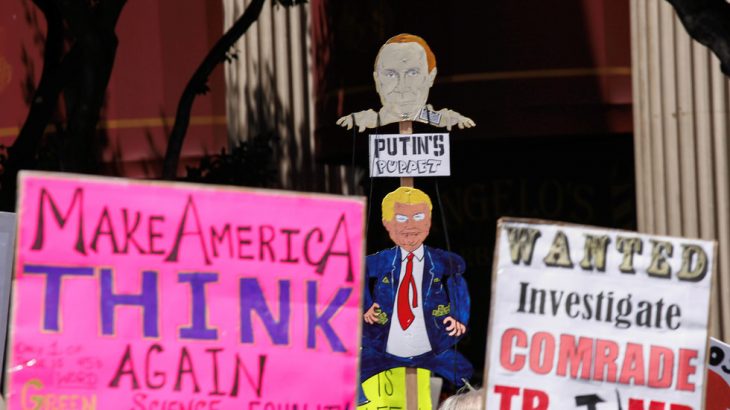
FILE PHOTO: People take part in a “March for Truth” protest against Donald Trump in Los Angeles, California, June 3, 2017 © Reuters / John Fredricks
RT | August 18, 2020
A new Senate report resurrects the corpse of ‘Russiagate’ and promises new evidence of collusion between the Trump campaign and Moscow. However, it reached its so-called conclusions by relying on some literal fake news.
The Senate Intelligence Committee released its fifth and final report on Russia’s supposed interference in the 2016 election, and President Donald Trump’s supposed ‘collusion’ with the Kremlin, on Tuesday. The report retreads much of the same ground as Special Counsel Robert Mueller’s ‘Russiagate’ investigation, and arrives at broadly similar conclusions.
However, the scope of the report has led its authors to arrive at vastly different conclusions. Senator Marco Rubio (R-Florida), who currently chairs the committee, said on Tuesday that the report “found absolutely no evidence that then-candidate Donald Trump or his campaign colluded with the Russian government to meddle in the 2016 election.”
Rubio only took over leadership of the committee from Sen. Richard Burr (R-North Carolina) in May. Before stepping down under a cloud of suspicion over alleged pandemic insider trading, Burr basically allowed Senator Mark Warner (D-Virginia) to largely run the committee’s probe from 2017 onwards.
Warner saw things differently than Rubio, saying on Tuesday that the final volume revealed “a breathtaking level of contacts between Trump officials and Russian government operatives.”
Warner was likely seeing what he wanted to see. The latest edition of the report focused on the “counterintelligence threats” posed by Russia in 2016, yet, like earlier editions, it relied on rumor, hearsay, and what appear to be politically motivated reports, in documenting these supposed “threats.”
For example, former Trump campaign manager Paul Manafort is described as having worked with a Russian intelligence official “on narratives that sought to undermine evidence that Russia interfered in the 2016 US election,” yet the report neglected to describe this official – an Ukrainian citizen named Konstantin Kilimnik – as a US State Department informant, which he was.
The report also describes a phone conversation between former campaign associate Roger Stone and someone who “almost certainly” was President Trump. Based on Stone’s prior interest in WikiLeaks’ forthcoming release of Democratic Party emails, the report concludes that “it appears quite likely” Stone and Trump spoke about WikiLeaks.
The word “likely” appears nearly 140 times throughout the 1,000-page report, while “almost certainly” appears 21 times. In nearly every case, these words are used to make assumptions in place of actual evidence.
The Russian military intelligence outfit – referred to most often as GRU – is described as conspiring with WikiLeaks to release the Democratic emails, a claim that is not, and has never been, substantiated. Kilimnik is described as “linked” to this so-called hacking operation based only “on a body of fragmentary information.” Such shoddy sourcing goes on throughout the report, and readers looking for evidence of Russia’s election-hacking capability are directed to the committee’s earlier reports.
However, anyone flicking through these reports is greeted by some even more scandalous citations. In a report released in December 2018, the committee notes it relied on the work of New Knowledge, a firm staffed by techies linked to the Democrats and the US military. New Knowledge co-founder Jonathon Morgan is also a developer of the anti-Russia Hamilton 68 Dashboard, which is partly funded by NATO and USAID.
This firm was later revealed to have run its own election interference operation, generating thousands of fake social media profiles to swing Alabama’s 2017 special Senate election against Republican candidate Roy Moore. Ironically, this scheme saw one of New Knowledge’s founders booted off Facebook for “coordinated inauthentic behavior,” a charge Russiagaters usually level at so-called troll accounts.
Yet this firm’s guesswork was treated as evidence, as was the 2017 ‘Intelligence Community Assessment’, itself the work of a small number of Obama administration intelligence chiefs who were later implicated in a plot to derail Trump’s presidency.
Coming less than 90 days before the presidential election, the latest report is unlikely to move the needle on Trump’s popularity, nor spur a fresh impeachment drive against the president.
However, its conclusion – that Russia’s election-meddling efforts are “ongoing” – will likely give lawmakers on both sides of the aisle a fresh shot at blaming Russia for whatever may go awry when Americans go to the polls in November.
The Abyss of Disinformation Gazes Into Its Creators
By Patrick Armstrong | Startegic Culture Foundation | August 17, 2020
He who fights with monsters should look to it that he himself does not become a monster. And if you gaze long into an abyss, the abyss also gazes into you. – Friedrich Nietzsche
The other day the U.S. State Department published “Pillars of Russia’s Disinformation and Propaganda Ecosystem“. The report should have a disclaimer like this:
Everything you read in the NYT or hear Rachel Maddow say about Russia is true: Putin is a murderer, a thief and a thug, he shot down MH17, poisoned the Skripals, elected Trump, invaded Georgia and stole Crimea. If you question any part of this, you are controlled and directed by Russian Disinformation HQ.
Freedom of speech does not entitle you to doubt The Truth.
The methodology of all of these things – this is one of several – is uncomplicated. Paul Robinson has commented on the dependence of so much comment about Russia, and this report in particular, on the myth of central control.
- Anything anywhere on Russian social media, whether sensible or crazy, was personally put there by Putin to sow discord and weaken us. All social media or websites based in Russia are 100% controlled by Putin.
- The Truth about Russia is found in the West’s official statements and in the “trusted source media”. Anyone who questions it benefits Putin, who wants to bring us down, and is therefore acting as a servant of Russian Disinformation HQ.
The argument really is that simple and can be found in its baldest (and stupidest) version on the EU vs DiSiNFO site, The NATO Centre of Excellence is pretty bad while The Integrity Initiative seems to have been embarrassed into silence. Note the “disinfo”, “excellence” and “integrity” bits – that’s called gaslighting. Who funds these selfless truth seekers? The EU, NATO and the British government. But they’re good and truthful, unlike those tricky Russians.
In this particular effusion they look at seven websites, six of which are registered in Russia and one in Canada. The report declares that they are in an ecosystem directed from Russian Disinformation HQ. In reality they are sites which publish writers who – to take one example – think that it is a bit unusual that a deadly nerve agent smeared on a door handle requires the roof of the house to be replaced. But doubt, these days, is the outward sign of an inward Putinism.
Door handle!
Yeah, OK, but why the roof?
Putinbot!
One of the websites mentioned in the report is the one you’re reading now – Strategic Culture Foundation.
Could these be the officials who told the NYT about the bounties? Or gave it the photos it had to walk back a few days later? Or said their sources had “mysteriously gone quiet?” Or told it all 17? Or said it was probably microwave weapons? Or gave us years of scoops about how Mueller was just about to lock him up? Or told the NYT that Russia’s “economy suffers from flat growth and shrinking incomes“? Probably, but you’re not supposed to ask these questions.
The report has a good deal of speculation about who backs Strategic Culture Foundation (p 15). Personally I don’t much care who runs it (and I very much doubt that the Kremlin understands the point of running an opinion website). I’ve been in the USSR/Russia business for some time and what I think hasn’t changed much since 1986 or so. I’ve written for a number of sites which have faded away and I will not permit having what I write changed; the one time it happened twelve years ago, I immediately switched my operations elsewhere. Strategic Culture Foundation has never changed anything I’ve submitted and only twice suggested a topic – this one and Putin’s weaponised crickets. (And the warning is still up at the U.S. State Department site!) The other writers on the site whom I know haven’t changed their views either. Strategic Culture Foundation hasn’t created something that didn’t exist before, it’s collected something that already existed. What do we writers have in common? Well, Dear Reader, look around you. Certainly we question The Truth. Or maybe SCF is a place where people “baffled by the hysterical Russophobia of the MSM and the Democratic Party since the 2016 election” can find something else? Or maybe it’s part of Madison’s “general intercourse of sentiments”?
There was a theory in the Cold War that the two sides would eventually converge. I often think that they met and then kept on going and passed each other. In those days the Soviets did their best to block what they considered to be – dare I suggest it? – disinformation. And so RFE/RL, BBC, Radio Canada and so on were jammed. We, on our side, didn’t care who listened to Radio Moscow or read Soviet publications. Today it’s the other way round. Which fact prompts the easy deduction that the side that’s confident that it has a better connection to reality and truth doesn’t waste effort trying to block the other. In a fascinating essay, the Saker describes Russian propaganda for its home audience: “give as much air time to the most rabid anti-Kremlin critiques as possible, especially on Russian TV talkshows”. They even took the trouble to dub Morgan Freeman’s absurd “we are at war” video. That’s brilliant – we won’t tell you they hate you, we’ll let them tell you they hate you.
The report talks as if this “ecosystem” were big and influential. But it’s a tiny mouse next to a whale. Total followers on Twitter of all seven sites are 156 thousand (p65). That’s nothing: the NYT has 47.1 million Twitter followers, BBC Breaking News 44.8, WaPo 16.1. Why even Rachel Maddow has ten million followers eager to hear her explain how Russia is going to turn off your furnace next winter. So the rational observer has a choice to make after reading this report: either the report ludicrously over-exaggerates the influence of this “ecosystem” or 156,000 website followers are astonishingly influential and I, with my Strategic Culture Foundation pieces, personally control several Electoral College votes.
The real message of “Pillars of Russia’s Disinformation and Propaganda Ecosystem“, to someone who isn’t invested in spinning – ahem – theories about a Kremlin disinformation conspiracy, is that the “pillars” are feeble and the “ecosystem” small: Maddow alone has three times the followers of these seven plus the RT (3 million) the “all 17” report spent nearly half its space irrelevantly ranting about. Or maybe it’s saying that American voters are so easily influenced that “the Lilliputian Russians, spending a pittance compared to the Goliaths of the Clinton and Trump campaigns, was the deciding factor in 2016“.
Ironically this thing appeared at the same time as two that suggest Washington’s view of Moscow needs some work: It’s Time to Rethink Our Russia Policy and The Problem With Putinology: We need a new kind of writing about Russia. Good to see titles like that but they aren’t really rethinking anything: they still agree that Putin’s guilty of everything that Maddow says he is. Real re-thinking might get a toehold, for example, were people to contemplate why it is imbecilic to say that Moscow holds military exercises close to NATO’s borders. But you’ll only see that sort of thing on Strategic Culture Foundation and the others.
But now the abyss gazes back
Clinton loses an election, blames Russia, the intelligence agencies pile on, the media shrieks away. Americans are told patriotic Americans don’t doubt. And now we arrive at the next stage of insanity. William Evanina, director of the National Counterintelligence and Security Center, informs us that “Russia is backing Donald Trump, China is supporting Joe Biden and Iran is seeking to sow chaos in the U.S. presidential election…”. I guess that means that Russia and China will cancel each other out and that he’s telling us that Iran will choose the next POTUS. Who would have thought that the fate of the “greatest nation in earth” (as Presidents Trump, Obama, Bush Jr, Clinton, Bush Sr and Reagan like to call it) would be hidden under a turban somewhere in Iran?
So, American, know this: your “trusted sources” are telling you not to bother to vote in November – it’s not your decision.
CIA Behind Guccifer & Russiagate – a Plausible Scenario
Strategic Culture Foundation | August 14, 2020
William Binney is the former technical director of the U.S. National Security Agency who worked at the agency for 30 years. He is a respected independent critic of how American intelligence services abuse their powers to illegally spy on private communications of U.S. citizens and around the globe. Given his expert inside knowledge, it is worth paying attention to what Binney says.
In a media interview this week, he dismissed the so-called Russiagate scandal as a “fabrication” orchestrated by the American Central Intelligence Agency. Many other observers have come to the same conclusion about allegations that Russia interfered in the 2016 U.S. elections with the objective of helping Donald Trump get elected.
But what is particularly valuable about Binney’s judgment is that he cites technical analysis disproving the Russiagate narrative. That narrative remains dominant among U.S. intelligence officials, politicians and pundits, especially those affiliated with the Democrat party, as well as large sections of Western media. The premise of the narrative is the allegation that a Russian state-backed cyber operation hacked into the database and emails of the Democrat party back in 2016. The information perceived as damaging to presidential candidate Hillary Clinton was subsequently disseminated to the Wikileaks whistleblower site and other U.S. media outlets.
A mysterious cyber persona known as “Guccifer 2.0” claimed to be the alleged hacker. U.S. intelligence and news media have attributed Guccifer as a front for Russian cyber operations.
Notably, however, the Russian government has always categorically denied any involvement in alleged hacking or other interference in the 2016 U.S. election, or elections thereafter.
William Binney and other independent former U.S. intelligence experts say they can prove the Russiagate narrative is bogus. The proof relies on their forensic analysis of the data released by Guccifer. The analysis of timestamps demonstrates that the download of voluminous data could not have been physically possible based on known standard internet speeds. These independent experts conclude that the data from the Democrat party could not have been hacked, as Guccifer and Russiagaters claim. It could only have been obtained by a leak from inside the party, perhaps by a disgruntled staffer who downloaded the information on to a disc. That is the only feasible way such a huge amount of data could have been released. That means the “Russian hacker” claims are baseless.
Wikileaks, whose founder Julian Assange is currently imprisoned in Britain pending an extradition trial to the U.S. to face espionage charges, has consistently maintained that their source of files was not a hacker, nor did they collude with Russian intelligence. As a matter of principle, Wikileaks does not disclose the identity of its sources, but the organization has indicated it was an insider leak which provided the information on senior Democrat party corruption.
William Binney says forensic analysis of the files released by Guccifer shows that the mystery hacker deliberately inserted digital “fingerprints” in order to give the impression that the files came from Russian sources. It is known from information later disclosed by former NSA whistleblower Edward Snowden that the CIA has a secretive program – Vault 7 – which is dedicated to false incrimination of cyber attacks to other actors. It seems that the purpose of Guccifer was to create the perception of a connection between Wikileaks and Russian intelligence in order to beef up the Russiagate narrative.
“So that suggested [to] us all the evidence was pointing back to CIA as the originator [of] Guccifer 2.0. And that Guccifer 2.0 was inside CIA… I’m pointing to that group as the group that was probably the originator of Guccifer 2.0 and also this fabrication of the entire story of Russiagate,” concludes Binney in his interview with Sputnik news outlet.
This is not the first time that the Russiagate yarn has been debunked. But it is crucially important to make Binney’s expert views more widely appreciated especially as the U.S. presidential election looms on November 3. As that date approaches, U.S. intelligence and media seem to be intensifying claims about Russian interference and cyber operations. Such wild and unsubstantiated “reports” always refer to the alleged 2016 “hack” of the Democrat party by “Guccifer 2.0” as if it were indisputable evidence of Russian interference and the “original sin” of supposed Kremlin malign activity. The unsubstantiated 2016 “hack” is continually cited as the “precedent” and “provenance” of more recent “reports” that purport to claim Russian interference.
Given the torrent of Russiagate derivatives expected in this U.S. election cycle, which is damaging U.S.-Russia bilateral relations and recklessly winding up geopolitical tensions, it is thus of paramount importance to listen to the conclusions of honorable experts like William Binney. The American public are being played by their own intelligence agencies and corporate media with covert agendas that are deeply anti-democratic.
Russia says CNN claim US refused vaccine help is false
By Jonny Tickle | RT | August 14, 2020
The US did not reject Russia’s offer of cooperation in developing a coronavirus vaccine, according to a Moscow health official, who says help wasn’t even proffered, despite claims from CNN.
On Thursday, the American broadcaster claimed Russia had offered the US “unprecedented cooperation” to Operation Warp Speed, the US multi-agency body dedicated to creating Covid-19 vaccines and treatments. Citing an unnamed “senior Russian official,” the news network said the Americans had refused help from Moscow due to a “general sense of mistrust.”
Alexey Kuznetsov, an assistant to Russia’s Health Minister, rebuffed CNN’s assertion, explaining that his ministry did not send an “official proposal” to the US.
According to the American network, US officials believe the Russian vaccine to be so incomplete that any assistance didn’t generate any interest at all, with one official saying, “There’s no way in hell the US will try [the Russian vaccine] on monkeys, let alone people.”
On August 11, Russian President Vladimir Putin announced that the country had registered the world’s first Covid-19 vaccine, named Sputnik V. Developed by Moscow’s Gamaleya Research Institute of Epidemiology and Microbiology, the vaccine will be available to the general public from January 2021. The process of creating the vaccine has been criticized by some Western countries, who claim that the speedy production means it hasn’t yet been proved safe.
‘All the Evidence’ Suggests Guccifer 2.0 is Linked to CIA, Not Russia, NSA Whistleblower Says

© Photo : Bill Binney
Sputnik | August 13, 2020
The internet is not capable of accommodating the download speeds necessary to validate the claims by Guccifer 2.0, that they hacked documents from across the Atlantic, according to a former technical director at the National Security Agency.
Guccifer 2.0, the cyber personality which claimed to have hacked documents belonging to members of the Democratic National Committee in 2016, is likely to be a front for the CIA, according to analysis conducted by members of Veteran Intelligence Professionals for Sanity (VIPS).
Bill Binney, a cryptogropher and former technical director at the US National Security Agency (NSA), blew the whistle on the agency’s mass surveillance programmes after serving with them for 30 years. Mr Binney explains to Sputnik that despite Guccifer 2.0 claiming to have hacked documents which the cyber criminal later published, the download speeds necessary to have obtained the documents simply are not available across the World Wide Web.
Sputnik: What were the conclusions that you came to regarding a cyber personality known as Guccifer 2.0 and his claims that he had hacked a trove of documents?
Bill Binney: Guccifer 2.0, posted files from the 5th of July [2016], the 1st of September [2016] in batch mode. He also put files out in the 15th of June that had Russian fingerprints. So to go straight at those, we had some collaborating analysts looking in the UK, looking at the data also. And they came up with a match of five files out of the Guccifer 2.0 batch on the 15th of June, they found five of those files also posted by Wikileaks in the Podesta emails, the same files. Now, the difference is the Guccifer 2.0 posts had Russian fingerprints. You know, Cyrillic characters and things like that implanted in the file. The WikiLeaks files posted, of those same five emails, did not have Russian signature prints in it. So that told us that Guccifer 2.0 was inserting these Russian fingerprints. And we had some other fingerprint evidence of them using that.
Then, when we looked at the 5th of July 2016 and the September 2016 data that was posted by Guccifer 2.0, he would give a bio, we had extracted file names, number of characters and the timestamp at the end of the file. And he did the batch. So there was one file after the other. It was timestamped at the end of each file. So all we had to do was [assess the] difference in time between the files and see how many characters were passed and we calculate the transfer rate. And when we did that we got rates between 14 and 49.1 megabytes per second. That’s between 19 and 49.1 million characters per second. And we knew that the international web across the Atlantic to Europe, somewhere in Eastern Europe could not handle that kind of rate transfer.
Some people here thought we could. So we said, okay, we’ll try it. And we tried it from Albania, Serbia, Netherlands and the UK. The fastest we got with between two data centres, one in New Jersey and one in the United Kingdom in London. And that was 12 megabytes per second, which is slightly less than one fourth necessary capacity to transfer just the data, not counting overhead that goes with it and all of that… So all of that said to us, it was not there.
Sputnik: Was there anything else?
Bill Binney: There was another factor. We looked at the files again and if you ignored the date and the hour, the two [batches] shuffled together like a deck of cards. That is the times, [if you] looked only at a minutes, seconds and milliseconds, the data from the 1st of September merged into the time holes of the 5 July data. Which meant it was shuffling like one of cards. You have one file, he separated in two, then they had a range change on the date and the hour. You can’t do it on minutes and seconds because they keep changing. I mean, you’d have to go up there every minute and every second you got to know it’s not possible to do that, without extreme effort I’d say. What that said to us was this guy is fabricating the data, he’s playing with the data, he’s playing with us…
Vault 7
Then we went back and looked at the Vault 7 material (descriptions of CIA hacking tools published by WikiLeaks), which said that there’s a programme called Marble Framework, which [the CIA can use to] modify an attack and make it look like someone else did the attack, and the countries they had the capability to do that [to] were Russia, China, North Korea, Iran and Arab countries. Also [Vault 7] said that the Marble Framework programme was [used] one time in 2016. Well, we think we found that one time. That one time came up and that fit very well with what was going on which we were finding out with the Guccifer 2.0 material. He was fabricating it. So that suggested us all the evidence was pointing back to CIA as the originator Guccifer 2.0. And that Guccifer 2.0 was inside CIA.
Sputnik: Just to clarify, the documents Guccifer 2.0 was publishing weren’t what is known as the DNC leaks or DNC hacks that WikiLeaks published in three batches?
Bill Binney: [Yes]. [Gucifer 2.0] claimed to have hacked [the documents he published].
The Hammer
There’s another whistleblower that we’re working with also and they’ve talked to us about a programme called The Hammer. This programme was set up inside CIA by, according to the whistleblower, by [former Director of National Intelligence James] Clapper and [former CIA chief John] Brennan. And it was done so that they could spy on anybody they wanted to, without anybody in the intelligence community or the US government or any other government knowing they were doing it. The programme actually goes… back to 2003, I believe, with you when they first set it up. But [the whistleblower] also said that after that they had a secret operation inside CIA, by this group of people inside CIA looking at the Trump campaign and anybody else they wanted to sign on.
And it was done in that way, because, see, if you go into the NSA data and which the Five Eyes can do that as well, if you do that, anybody going in there, you’re tracked and recorded [when you use the surveillance system]. It’s wherever you go and what you do. And that’s based on the network logs. And also if you do an unmasking, you have to make a request and that’s recorded, who did it, what time, what the subject was and what the justification was and what person they were after. So, you know, all that stuff is recorded to go there. But if you set up your own separate one, nobody knows what you’re doing. And that’s exactly what this [whistleblower] is claiming. I’m pointing to that group as the group that was probably the originator of Guccifer 2.0 and also this fabrication of the entire story of Russiagate.
This interview has been edited for clarity and concision.
‘We Have Absolute Proof’ DNC Leaks Were Not Hacked, NSA Whistleblower Says
Sputnik – 12.08.2020
Because the National Security Agency is tapped into data transfer points throughout the United States, via its mass surveillance programmes, if there was any evidence that the DNC servers were hacked then they would have the evidence to prove it, a former technical director at the agency explains.
Documents published by WikiLeaks that belonged to the Democratic National Committee (DNC) could not have been hacked via the internet and must have been initially downloaded from within the US, according to an investigation by members of Veteran Intelligence Professionals for Sanity (VIPS).
Bill Binney, a cryptogropher and former technical director at the US National Security Agency (NSA), blew the whistle on the agency’s mass surveillance programmes after serving with them for 30 years. Mr Binney detailed for Sputnik why the forensic evidence proves that key claims of Russiagate (regarding Russian officials hacking the DNC servers) are a “farce”.
© Photo : Bill Binney
Sputnik: A recent investigation by you and some of your colleagues at Veteran Intelligence Professionals for Sanity determined that the Democratic National Committee documents published by WikiLeaks in 2016 could not have been hacked by actors outside the US and instead had to have been downloaded onto a USB or CD-ROM.
Bill Binney: Yes, that’s right. And we have forensic evidence to prove it.
Sputnik: Could you please break down, for the average layperson, exactly how you came to this conclusion?
Bill Binney: Well, we did it by looking at the published DNC emails by WikiLeaks. In other words, the original assertion was that the DNC data was hacked externally, from Russia or by the Russians in Europe or something, and then transferred to WikiLeaks to publish so they could influence the election.
We looked at the DNC emails that were documented by WikiLeaks on the web. And that came down in three groups. One came down on 23rd of May 2016 and the other 25th of May 2016 and then one on the 26th of August of 2016. All of those three batches of emails had last modified times ending in an even number and even second, rounding up to the second, not including milliseconds. So, that meant to us that that was the property of the FAT (file allocation table) format. It’s a programme that when you read data to a thumb drive or CD ROM, and the programme indexes stuff on the [CD] and the thumb drive, for example, it then also rounds off the last modified time to an even number. That tells us very simply that there is 35,813 emails, all with the same property FAT file formatting saying that hey this was read [ie downloaded] to a thumb drive or a CD ROM before WikiLeaks got it to publish. Which meant it was physically transported to WikiLeaks. So, for us, that meant it was not a hack. Period.
We also had [CEO of cyber security firm Crowdstrike] Shawn Henry give testimony, I think it was the 7th of January of 2017, the secret testimony that just came out, where he said ‘we had indications that the data was exfiltrated, but we didn’t see the data exfiltrated’. Well, the indications that it was [exfiltrated], is this a FAT file format, to my mind. I mean, Shawn Henry never said specifically why his people were saying that. So for us, the only thing he could be [basing] it on what was last modified time.
Sputnik: So, just to be clear, when information is downloaded onto a CD roam or thumb drive, you’re saying that there’s a particular process, which means that, the last modified time will be recorded in such a way onto those files that is different than if those files were hacked and taken from a server across international boundaries or across a very long distance.
Bill Binney: Right. And we had provided all this data to the courts. Also we’ve included the Podesta emails, which show how a hack could occur and what the last modified times looked like. And that’s a, that’s also published by WikiLeaks, I think on the 21st of September [2016], that’s the date for that, that they put it out there. And the modified times of those files… close to 10,000 of them I think, run through even and odd numbers and various times, including milliseconds, things of that nature. So all that stuff, all that data, we provided to several courts, and several sets of lawyers to introduce as evidence in court and we were prepared to testify to that in court.
Sputnik: And is it not possible for the last modified time to be changed somehow or modified itself?
Bill Binney: Sure, but I don’t know of a programme that does, other than FAT, I mean, keeping in mind, you’re talking about 35,813 files. If you want to change them, you can go in and do them individually one at a time. I don’t know of any other programme that does it automatically, which is what what’s happened here, because it’s just a straightforward consistency. Humans make errors. If they go in and do something like that, they’ll make errors somewhere in the files. We didn’t see any errors at all. So that’s a program doing [it].
Sputnik: How many people from VIPs would you say were involved in this investigation that you conducted?
Bill Binney: Probably about six and a couple of auxiliaries, as we call them, in the UK cooperating with us. And we had a couple other people from outside VIPS helping us because they were also interested in getting to it too. Also, people who retired from commercial companies, running fiber lines and things like that.
Sputnik: If you were still working at the NSA and you were tasked to investigate an alleged hack would you have additional technical resources if you worked for the government, then if you’re doing it independently?
Bill Binney: Yeah, absolutely. This is one of the reasons why I started in August of 2016 saying that this entire Russiagate story was a farce. And that basically came out by knowing the capacity of NSA. The capabilities of them being able to capture stuff on the web. I mean, [the NSA] have over almost a hundred tap points inside the United States, all loaded up with fiber optic lines… You know, it can take everything off those lines and capture it. [A]nd that was true across the US as well as all the external points exiting and entering where you exit and enter the US.
And you’ll notice that NSA never said they saw any of the data transferring anywhere on any line. And that’s because it didn’t, it went on a thumb drive, you know, that’s the difference. That was one of the main reasons I said that this was not a hack. Because if it was NSA would have it. Like they did when the Chinese hacked one of the places over here in the US about six years ago. The government said, the hack came from this building in Shanghai.
Sputnik: And is there any kind of a practical or legal consideration as to why the NSA can’t publish its findings regarding the DNC servers?
Bill Binney: Actually, there isn’t, if the president approves, I mean, he can declassify anything he wants.
Sputnik: So where do you go from here? Is there more to investigate in relation to this subject or is this the end of the matter for you?
Bill Binney: As far as I’m concerned, we have absolute proof that this whole thing […] Russiagate, is a fabrication. It was a fabrication of the FBI, CIA and the DOJ primarily, but also included the State Department and [Department for Homeland Security] and a number of other departments.
Sputnik: There are those that argue Julian Assange will have a fair trial in the US should he be extradited. What can you tell us about the U.S. District Court for the Eastern District of Virginia, where Mr Assange would be tried?
Bill Binney: That’s a court that’s pro CIA because it’s in that jurisdiction of CIA. This is why they picked that court because it’s pro CIA and whatever national security issues come up, they will always go with that national security. So, you have a prejudiced judge in a court to begin with.
Sputnik: Would there be a jury with 12 men and women?
Bill Binney: Pulled from the area and most of them work for the government. So, you know, you just look at it. I mean, that should be a disqualifier as a jury from my point of view. But also think of it this way: Julian Assange published data he was given. So has the New York Times, The Guardian, all the major publications, the Washington Post, they’ve all done that. So why aren’t they being charged also?
Sputnik: Well, the US government is claiming that the first amendment does not apply to foreign journalists.
Bill Binney: Well then why don’t they go after The Guardian ?
Sputnik: Maybe they’re next?
Bill Binney: [I]f you accept their premise – of the US government – that means that any journalist anywhere in the world, publishing any article that exposes crimes by the US government, the US government can charge them with conspiracy to violate national security. So, every reporter in the world is now liable based on that [premise].
This interview has been edited for concision and clarity
Twitter labels RT & Sputnik but NOT BBC, NPR & VOA as it launches blitz on state media staff & govt officials
RT | August 6, 2020
Twitter has declared war on certain state-affiliated media entities, announcing accounts belonging to senior staff will be labeled and their tweets won’t be amplified or recommended. The BBC and US state-funded media are exempt.
The microblogging platform announced it will label accounts belonging to key government officials in countries on the UN Security Council, as well as accounts belonging to state-linked media outlets, their editors-in-chief and senior staff.
In a Thursday blog post, it warned it will no longer show tweets from state-linked media accounts on the home screen, notifications, or search.
Perhaps unsurprisingly, Twitter left a sizable loophole for the US and friendly nations, explaining that “state-financed media organizations with editorial independence, like the BBC in the UK or NPR in the US for example, will not be labeled.”
“We believe this is an important step so that when people see an account discussing geopolitical issues from another country, they have context on its national affiliation and are better informed about who they represent,” Twitter explained in the post, adding that it would not be labeling government officials’ personal accounts – just those associated with their offices.
Betraying a shockingly dim understanding of American media, Twitter explained that “unlike independent media, state-affiliated media frequently use their news coverage as a means to advance a political agenda.”
Perhaps attempting to fend off discrimination lawsuits, they added that the move had come after consultation with “a number of expert groups, including members of the Digital and Human Rights Advisory Group in Twitter’s Trust & Safety Council.”
That group includes notoriously censor-happy entities like the Anti-Defamation League, the Dangerous Speech Project, and Feminist Frequency.
Clicking on the new labels takes the viewer to a page explaining the policy, which hints it “will be expanded to include additional countries in the future.” The page refers to them as “election labels,” suggesting the policy is a response to ongoing baseless claims that Russian social media manipulation was responsible for President Donald Trump’s 2016 victory. With the November election less than 100 days away, social media platforms are scrambling to censor non-approved views, especially those they can link to un-American activities.
A Twitter spokesman declined to provide a full list of entities to be censored to Reuters, but mentioned RT, Sputnik, and Xinhua News by name. Facebook recently adopted a similar policy, complete with double standard for US and friendly state-controlled media organizations.
Russian ambassador tells Britain: you exaggerate your political importance & London has become a haven for Russian criminals
RT | August 5, 2020
If you live in Britain, Russia looms large in political discourse, but for those in Moscow, the UK barely registers. Now Russia’s envoy to London has delivered a few home truths: he says his country has bigger fish to fry.
“I feel that Britain exaggerates, very much, its place in Russian thinking,” Andrei Kelin told the Daily Mail. “The scope and place of Great Britain in Russian politics is not that big. We have other problems of much larger magnitude,” the ambassador said.
The ambassador also dismissed the UK media narrative about nefarious Russian ‘oligarchs’ doing the Kremlin’s bidding in London. Kelin pointed out that, in reality, the British capital has turned itself into a haven for wealthy Russians trying to evade justice back home.
“Oligarchs mean rich people that can influence the president,” he explained. “The last one [oligarch] was about 20 years ago … those wealthy people living here [in Britain], the bulk of these people simply escaped Russia because they were being pursued for tax evasion, fraud and other criminal activities.”
“All of them have left the country just to escape prosecution. If the British authorities will decide to provide us with information about these people or decide to be positive on our demands for extradition, we will only greet this, salute this,” he added.
Back in 2018, Russia’s former prosecutor general, Yury Chaika, revealed that there were 61 Russian criminals living in London who had stolen around $10 billion from their home country. He expressed concern that Britain’s agenda was to pocket the stolen money, quipping, “you can keep the criminals, but return the money. This is our money.”
Kelin once again rejected claims that Russia had somehow tried to affect the results of the 2014 Scottish independence referendum, the 2016 Brexit referendum and the 2019 parliamentary elections in the UK. According to the diplomat, in all these cases, Russia was not politically interested in any particular outcome. “For us, there is no sense to choose any side,” he said.
“These accusations are invented, if not to say false. These are senseless accusations which we do not understand,” the ambassador added.
Kelin went on to say that, at present, relations between Moscow and London are “close to being frozen.” The UK is “throwing a lot of mud … in our direction,” he added, and this type of attitude “does not provoke much of an appetite for improving dialogue or relations in Moscow.”
Featured Video

HE SAVED LIVES. NOW HE FACES PRISON.
or go to
Aletho News Archives – Video-Images
From the Archives
NATO Sanctions and the Coming Global Diesel Fuel Disaster
By F. William Engdahl – New Eastern Outlook – 11.04.2022
Amid the ongoing global inflation crisis, NATO heads of state and mainstream media repeat a mantra that high energy prices are a direct result of Putin’s actions in Ukraine since end of February. The reality is that it is the western sanctions that are responsible. Those sanctions including cutting SWIFT interbank access for key Russian banks and some of the most severe sanctions ever imposed, are hardly having an impact on the military actions in Ukraine. What many overlook is the fact that they are increasingly impacting the economies of the West, especially the EU and USA. A closer look at the state of the global supply of diesel fuel is alarming. But Western sanctions planners at the US Treasury and the EU know fully well what they are doing. And it bodes ill for the world economy.
While most of us rarely think about diesel fuel as anything other than a pollutant, in fact it is essential to the entire world economy in a way few energy sources are. The director general of Fuels Europe, part of the European Petroleum Refiners Association, stated recently, “… there is a clear link between diesel and GDP, because almost everything that goes into and out of a factory goes using diesel.” … continue
Blog Roll
 Aletho News
- Trita Parsi: Middle East Unraveling — Are We on the Path to World War?
- Iran FM meets with US envoy on UN meeting’s sidelines at American side’s insistence: Report
- Qatar PM calls for Gulf security framework with Iran, says war must be ‘wake-up call’
- China condemns US extortion of Iranian airlines, rejects Washington’s ‘illegal’ sanctions threats
- Italy to move military personnel from Taif base after missile strike
- Finland’s Stubb tells European leaders to calm down
- Defeating Russia on battlefield impossible – Fico
- Finland’s Gender Clinic Reversal
- Massachusetts Wants Mental Health Visits, Why Does Government Use ‘Health’ to Enter Our Homes & Families?
- US lawmaker admits American people footing bill for Trump’s failed aggression against Iran
- If Americans Knew
- Sanctions are collective punishment: immoral and self-defeating
- Phosphorus Munitions Fired by Israel Burn Groves, Orchards in Southern Lebanon
- Israel Carries Out New Ceasefire Violations Across Gaza
- AI – Emphasis on the ‘I’: Israel Is Funding AI Chatbot Propaganda
- Israel Blocking Hundreds of Wheelchairs for Injured Children From Entering Gaza
- Israel Is Expanding and Upgrading Compounds for Palestinian Militias in Gaza
- The Palestinian-American Residents of This West Bank Town Are Wondering: Where Is Trump?
- Gaza desperately needs tents, wheelchairs, fuel… and everything else (Israel blocks it all) – Daily Update
- Israeli Attacks in Gaza Kill at Least Seven Palestinians Over Three Days, including Woman and Child
- Trump’s militarization of Washington DC as he pursues Israel’s war against Iran
- No Tricks Zone
- 2025 Nature Paper Claiming Worsening Global Drought Gets RETRACTED …Heavily Flawed
- New Study: ‘Global Drought Shows No Detectable Recent Acceleration Under Climate Warming’
- Economic Masterminds: German Socialists Suggest Taxing Productivity Gains Stemming From Using AI
- The South China Sea Has Not Been Cooperating With The Climate Change Narrative
- Energy Crisis: Germany Enters Heating Season With Historically Low Gas Reserve Fill Levels
- New Study: The Antarctic Ice Sheet Gained Mass From 2020-2024 Due To Staggering Snow And Ice Accumulation
- Study: Ocean Heating Rates From Thousands Of Years Ago ‘Dwarf’ Modern Ocean Heating Rates
- Climate Extremists Target, Attack Large-Scale Power Grid Infrastructure In Germany!
- New Study: Antarctic Ice Melt Has Contributed Less Than 1 Centimeter To Sea Level Rise In The Last 30 Years
- Fear Of Debate: Alarmist German Climate Scientist Calls On Mainstream Media To Discredit Skeptic Voices

