M.K Bhadrakumar: India Turns to China as U.S. Bullying Backfires
Glenn Diesen | August 27, 2025
M. K. Bhadrakumar was an Indian ambassador and diplomat for decades. Ambassador Bhadrakumar discusses Trump’s pressure and threats against India, and how this blunder has pushed India toward China and Russia.
The West seemingly preparing to remove Zelensky from power
By Ahmed Adel | August 26, 2025
The arrest of a Ukrainian citizen in Italy, suspected of sabotage of the Nord Stream pipeline, confirms that Kiev was an accomplice, but not the one who ordered the act. Nonetheless, the launch of the investigation serves a broader political goal – the removal of Volodymyr Zelensky from power. The plan could be to appoint a new leader, both for the West and for possible negotiations with Russia, given that Zelensky’s presidential mandate expired in May 2024 and he cannot be a signatory to a peace agreement with Moscow.
An investigation by American journalist Seymour Hersh found that American divers placed explosives under the Nord Stream gas pipeline during the NATO exercise Baltops in the summer of 2022, and that it was activated three months later by the Norwegians. According to Hersh, then-US President Joe Biden had a clear motive for sabotaging the Nord Stream pipeline — fear that Germany, facing serious economic difficulties due to the war in Ukraine, might lift sanctions on Russia and resume imports of Russian gas.
The journalist said this is what prompted Washington to organize the sabotage of the gas pipeline connecting Russia and Germany. The West did not want to allow this, which ultimately plunged Germany into economic and political chaos.
Russian President Vladimir Putin also believes that the sabotage of the Nord Stream and Nord Stream 2 gas pipelines was carried out by American intelligence services, specifically the CIA. According to him, in such cases, one should always look for who has a motive and who can carry it out. There may be many interested parties, but not everyone can dive to the bottom of the Baltic Sea and carry out that explosion. It is the combination of these components – who had a motive and who is able to carry it out – that, according to Putin, reveals who is really behind the sabotage.
After a period of lull, the issue of sabotage on the Nord Stream gas pipelines has returned to the spotlight following the announcement by German prosecutors that Ukrainian citizen Sergey Kuznetsov was suspected of involvement in the underwater explosions that damaged the gas pipelines near the Danish island of Bornholm in September 2022. Following the arrest of the retired captain of the Armed Forces of Ukraine, who also served in the Security Service of Ukraine, Italian media reported that he is connected to another major incident – the explosions on an oil tanker in Savona in February, which was allegedly transporting oil of Russian origin.
Sahra Wagenknecht, leader of the German party “Sahra Wagenknecht Alliance,” after the arrest of Kuznetsov, stated that the German parliament should convene a commission to investigate the sabotage of the Nord Stream gas pipelines. She noted that this act of state terrorism must be thoroughly investigated and that Zelensky should also testify before the commission.
Wagenknecht believes it is absurd to think that the arrested Ukrainian citizen and his accomplices acted without the knowledge of the Ukrainian leadership and the Biden administration. She added that it is unacceptable that Germany is providing substantial aid to Ukraine without seeking an explanation from Zelensky, and that consideration should be given to possible compensation for damages.
The question of whether United States President Donald Trump will take advantage of the Nord Stream controversy and launch an investigation against Biden remains an exclusively internal matter for the US. Trump has the opportunity to conduct his own investigations and deal with his domestic adversaries, whom he claims stole his victory in the 2020 elections. However, this does not affect the situation in Ukraine for the time being, as the West continues to support Ukraine with weapons, intelligence, and other assistance.
The fate of the Nord Stream gas pipeline is one of the key and most complex issues in the energy and geopolitical spheres. With Trump’s pragmatic approach, there is a possibility of cooperation between Russia and the US. Russia does not refuse to continue gas supplies to the European Union. However, the bloc continues to feel the consequences of its own policy, such as suffering economically by still purchasing Russian energy at inflated prices from third parties like India and Azerbaijan.
Nord Stream 1 and Nord Stream 2, which directly connect Russia to Germany via the Baltic Sea, have not been operational since 2022 and remain damaged, but they are still strategic infrastructure that American investors have set their sights on. These pipelines could become the property of American investors, which would enable the US to control Russian gas supplies to Europe. Although Europe is currently refusing Russian gas, it may be forced to buy it in the future, albeit at a significant margin, to the benefit of the Americans.
Ahmed Adel is a Cairo-based geopolitics and political economy researcher.
Are Democrats More Neocon Than Republicans Now?
By Jack Hunter | The Libertarian Institute | August 25, 2025
Last week as Donald Trump met separately with Russian President Vladimir Putin and Ukraine head Volodymyr Zelensky to potentially seek an end to the years long war between their countries, Democrats have been very upset.
That peace might happen. They are worried Ukraine might have to make concessions to Russia to reach an agreement, including land.
Never mind that it is Ukrainians who are dying. Never mind that most Ukrainians themselves want to end this war. According to a recent Gallup poll, 69% of Ukrainian respondents want a negotiated end to the war as soon as possible, while only 24% said they still want to fight “until victory.”
Democratic voters sitting in the United States, with no imminent bombs or bullets to worry about, insist that this war go on for as long as it takes, and are being loud about it. Senator Lindsey Graham (R-SC) agrees with them. This doesn’t seem to faze Democrats.
This opposition to Trump’s diplomacy seems to be the consensus of many Democrats, shown in spades all over media this week.
This is a position shared by Senator Mitch McConnell (R-KY). This is the position of Bill Kristol. This is the position of virtually every neoconservative hawk in either major party and has been since this conflict started, that Ukraine must “win” at all costs.
Even at the cost of more Ukrainian lives.
Let me be clear about the definition of “neoconservative” I’m using here. I’m not just talking about the narrow and few band of post war, ex-Trotskyites of the Irving Kristol and Norman Podhoretz variety who stood for a number of things, including the pursuit of a hyper aggressive American foreign policy. I’m talking about Senator Graham, Kristol, the late John McCain, talk host Mark Levin and any other figure on the right who has been rabidly pro-war and hateful toward Ron Paul, Pat Buchanan, and any other prominent antiwar Republican leader of the last thirty years.
I’m talking about the Republicans who use “isolationist” as a pejorative slur for non-interventionism.
I tend to “neoconservative” as carefully here as those people use “isolationist.”
There have always been neocons in both major parties. But this week it has seemed Democrats have outweighed Republicans on this front. There is no poll on this. There is no hard data. I’m just observing.
President Trump has said he wants the killing to end between Ukraine and Russia. Cheering him on in this effort is Congresswoman and MAGA booster Marjorie Taylor Greene (R-GA) and many other GOP members. Also, pundit Tucker Carlson and former Trump aide and talk host Steve Bannon, whose audiences are large and full of MAGA supporters who also endorse Trump’s pledge to end America’s “endless wars.”
There are still plenty of GOP neocon members of Congress and voters within the base, but Trump’s Republican party is a very different one than George W. Bush’s when it comes to hawkish foreign policy.
On the other side, there are progressives like Ro Khanna (D-CA) who have expressed in the past wanting to see Trump help achieve some kind of diplomatic peace.
This week, Khanna has been silent on this, and who could blame him? Because Democrats by and large seem upset that Trump could achieve some sort of deal. They even got mad when Trump shook Putin’s hand during the summit.
Embracing war by avoiding diplomacy is key to neoconservatism. It’s why hawks got so mad in the mid-1980s when President Ronald Reagan met with Soviet Union President Mikhail Gorbachev. It’s why neocons were absolutely irate when Trump met with not only Putin but North Korea’s Kim Jong Un and even Hungary’s Viktor Orban.
2024 Democratic nominee Kamala Harris campaigned with Liz Cheney, got her and her father Dick Cheney’s endorsement and slammed Trump for “bowing down” to dictators, sending a signal to her neocon friends that she would not be engaging in that kind of diplomacy.
Now the people who voted for Harris are reflecting the same sentiment. Trump’s diplomatic efforts have them fuming.
During the 2012 presidential election, Republican nominee Mitt Romney said that Russia was the United States “No. 1 political foe.” President Barack Obama mocked Romney at the time, saying in a debate, “The 1980s are now calling to ask for their foreign policy back, because the Cold War’s been over for twenty years.”
Romney was clearly representing the neoconservative Bush-Cheney foreign policy legacy that still resonated with so many Republicans at the time, and Obama, the anti-Bush message that had delivered him the White House in 2008. Obama did not remotely live up to that promise, but this was roughly the dynamic in the 2012 election.
Politics change and history happens, but it is feasible today that there are more Republicans, in Congress and in the base, who think constant U.S. hyperventilating about Russia, even now, is overblown and Americans should be more concerned about their own country first.
It’s also feasible that there are more Democrats, in Congress and in the base, for whom Trump and Putin are considered one in the same and those folks are more laser focused on hating both men than any other concern, including the health and security of their own country or any other (Ukraine).
When Barack Obama was a rockstar in 2008, Democrats prided themselves on being the complete opposite of Bush-Cheney neoconservative Republicans. In 2025, it appears that more Democrats than not now staunchly side with Bush-Cheney neoconservatives regarding the Russia-Ukraine conflict.
What changed? That might be a longer discussion. But it wasn’t neoconservatives.
The End of the Conflict in Ukraine at Sight?
Zelensky and the Europeans in Washington in Search of Saving Face
By Ricardo Martins – New Eastern Outlook – August 25, 2025
Seven European leaders rushed to Washington under the official banner of solidarity with Volodymyr Zelensky. Yet, the real motive was less about unshakable support for Ukraine and more about damage control.
Zelensky and the Europeans in Washington in Search of Saving Face
With negotiations advancing — and with Ukraine’s loss of territories and NATO membership already ruled out by Donald Trump — Europe’s leaders were scrambling to craft a narrative to their domestic audience that could justify defeat without admitting failure.
The Struggle to Save Face
For three years, the European mantra has been that “Russia cannot win.” Yet on the battlefield, it is Moscow that has the upper hand. The tactic, therefore, was to insist that Russia, as the supposed aggressor, must accept the obligations of the loser. But the reality is moving in the opposite direction: Europe now seeks symbolic concessions to sell to its public.
One of these face-saving gestures is the return of “kidnapped” Ukrainian children, based on contested numbers but useful as a talking point. Another is security guarantees for Ukraine — not NATO membership, but something that can be framed as protection. Zelensky, keen to please Trump, asked for $100 billion in arms, to be funded by Europeans but manufactured in the U.S. NATO’s Secretary-General eagerly echoed this line, presenting himself as a loyal messenger to “Daddy” Trump at Europe’s expense.
Meanwhile, territorial concessions remain taboo in European discourse. To admit them would be to acknowledge Putin’s victory, a political sin for leaders who have invested heavily in a narrative of inevitable Ukrainian triumph.
The Casting: Putin Absent, Yet Present
The most striking absence in Washington was also the most palpable presence. Putin was not in the room, but Trump invoked his name repeatedly, even phoning him for 40 minutes while Europe’s leaders waited. Each mention of Putin’s name drew visible discomfort across European faces, an unmistakable reminder of their diplomatic impotence.
As Djoomart Otorbaev, former Prime Minister of Kyrgyzstan, put it: “Here’s the uncomfortable truth: Putin didn’t earn Trump’s respect through backroom schemes. He earned it on the battlefield and at the negotiating table. And that reality says more about today’s shifting world order than any rumour.”
Trump’s deference to Putin was not ideological; it was grounded in recognition of Russia’s gains. Western efforts to reverse the war’s trajectory have not succeeded, despite supplying Ukraine with advanced weaponry.
Europe’s Century of Humiliation Has Started
Europe’s frantic arrival in Washington — “like the Middle Ages, to homage their master” — symbolised a humiliating dependency: the continent’s leaders reduced to courtiers around a U.S. president already imagining his Nobel Peace Prize.
The delegation was a tableau of weakness. Ursula von der Leyen, in the name of the European Commission, reconfirmed the one-sided trade arrangements: 15% tariffs on European goods entering the U.S., zero tariffs on U.S. exports to Europe, $750 billion in energy and arms purchases, $600 billion in European investments in the U.S., and €150 billion earmarked for EU rearmament. A transfer of wealth and sovereignty dressed up as transatlantic unity.
The body language told its own story. Giorgia Meloni’s irritation was poorly disguised; Friedrich Merz remained wooden; Emmanuel Macron projected disdain; Keir Starmer hid behind note-taking. Von der Leyen managed only a strained smile, Mark Rutte melted into insignificance, and Zelensky — who should have been the central figure — appeared isolated at the margin, dignified but sidelined. Putin, a former KGB officer, and Trump, a former reality TV star and a real estate millionaire, both despised by the Europeans, loomed as the peace brokers. As put by a French analyst: “Quel cirque”.
The Security Guarantees Conundrum
The question of security guarantees has become the crux of European debate. Openly, leaders say territorial concessions are for Ukrainians to decide. Privately, they know the map is already shifting. What remains is an attempt to provide Ukraine with protections that appear credible, but that does not include NATO membership.
POLITICO reported that the Pentagon’s top policy official made clear the U.S. intends to play only a minimal role in guarantees. “There’s the dawning reality that this will be Europe making this happen on the ground,” admitted a NATO diplomat. In other words, Europe is on its own.
European capitals, however, still plead for U.S. assets: fighter jets stationed in Romania, access to American satellites for GPS and reconnaissance. Russia, through its envoy Mikhail Ulyanov, flatly rejected any foreign troops in Ukraine, while Sergey Lavrov dismissed Western security schemes without Moscow and Beijing as “a road to nowhere.”
Ukraine itself is unimpressed. Ten nations, including France and the U.K., have floated the idea of deploying troops, but Kiev sees such proposals as vague, amorphous, and unlikely to provide real guarantees. Former foreign minister Dmytro Kuleba captured the mood: “The so-called security guarantees are so amorphous. The only news is that the U.S. is willing to take part.”
Europe’s Internal Fractures
Even as leaders paraded unity in Washington, Europe’s internal divisions deepened. The European Parliament announced it would sue the Council over being excluded from negotiations on the €150 billion SAFE defence loan scheme.
In a telling sign of institutional fragility, Parliament was sidelined by Ursula von der Leyen’s Commission in the rush to fund rearmament. As Euractiv reported, 18 member states have already expressed interest in loans totalling €127 billion, but without parliamentary oversight, Europe’s democratic deficit widens.
In sum, the “road to nowhere” that Lavrov mocked may yet prove prophetic, not only for Ukraine’s elusive guarantees but for Europe’s strategic autonomy itself.
Ricardo Martins, PhD in Sociology, specializing in International Relations and Geopolitics
Indian FM pushes back on US pressure, stands by Russian oil imports
Press TV – August 24, 2025
Indian Foreign Minister has defended New Delhi’s continued imports of Russian oil despite US tariffs on Indian goods, saying that if others “don’t like it, don’t buy it.”
Speaking at the Economic Times World Leaders Forum (ET WLF) on Saturday, Subrahmanyam Jaishankar said there are some “red lines” in the India-US trade deal negotiations.
He underscored that amid strained relations with the US over several aspects in bilateral trade, India refuses any concession to US President Donald Trump.
“It is funny to have people who work for a pro-business American administration accusing other people of doing business,” he said.
“If you have a problem buying oil or refined products from India, do not buy it. Nobody forces you to buy it. Europe buys, America buys, so you do not like it, do not buy it,” he added.
He asserted that India’s purchase of Russian oil serves both its national interest and contributes to global market stability.
He reiterated that New Delhi would continue to make decisions independently.
The US imposed punitive tariffs on India after Trump claimed that the country’s purchase of Russian crude indirectly funded the Russia-Ukraine conflict.
Tensions in US-India trade relations extend beyond energy, with multiple rounds of negotiations for an interim trade agreement failing to produce a breakthrough.
“Where we are concerned, the red lines are primarily the interests of our farmers and, to some extent, of our small producers,” Jaishankar said.
The United States has pressed India to open its markets to American dairy, poultry, and agricultural products such as corn, soybeans, wheat, ethanol, fruits, and nuts.
But India, an agrarian economy, has resisted, particularly on genetically modified (GM) crops, which it considers harmful to human health and the environment.
Dairy remains a particularly sensitive issue as well, as millions of small and landless farmers depend on the sector for survival, especially during poor monsoons or agricultural downturns.
In a clear message to Trump, Prime Minister Narendra Modi has publicly declared that India will not compromise on the interests of farmers.
“Modi is standing like a wall against any harmful policy related to farmers, fishermen, and cattle rearers of India,” he said in his Independence Day speech.
Top CIA analyst behind Russiagate loses her job – Economist
RT | August 22, 2025
One of the CIA’s most senior Russia analysts has lost her job during President Donald Trump’s campaign to depoliticize the intelligence services, The Economist reported on Thursday.
The officer, whose identity was not disclosed, oversaw the drafting of a report accusing Russia of interfering in the 2016 US presidential election in favor of Trump.
The Economist described her as “the country’s top intelligence officer for Russia and Eurasia,” who coordinated operations related to the former Soviet Union. According to the outlet, her security clearance was revoked on August 19, along with those of 36 other current and former officials.
The Kremlin denied the allegations of election meddling, while Trump and the Republicans denounced them as a “hoax” by former President Barack Obama and the Democrats to delegitimize Trump’s first election victory and undermine his presidency.
Since mid-July, Director of National Intelligence Tulsi Gabbard has released multiple documents that she claims expose a coordinated effort by senior Obama-era officials to falsely accuse Trump of colluding with Russia.
Earlier this week, Gabbard announced that the Office of the Director of National Intelligence, which oversees 18 agencies, will be reduced by nearly 50%. The US intelligence community has become “plagued with unauthorized intelligence leaks, politicization, and weaponization of intelligence,” she said.
Gabbard also said the Foreign Malign Influence Center (FMIC), created by Congress in the wake of the Russiagate allegations, will be significantly scaled back and stripped of some of its core functions.
End of the Line for Diplomacy with Ukraine – John Mearsheimer, Alexander Mercouris & Glenn Diesen
The Duran | August 21, 2025
‘Killing Russians’ a reason to join NATO – Ukrainian diplomat
By Lucas Leiroz | August 21, 2025
Apparently, the Ukrainian army’s only “ability” is to “kill,” without any relevant tactical or strategic planning. In a recent statement, the Ukrainian ambassador to Poland, Vasily Bodnar, stated that Kiev should be granted NATO access due to its alleged capability to eliminate Russians, which shows how desperate Ukrainian authorities are and how they lack any convincing arguments to justify NATO access.
Bodnar stated during an interview with local media in Poland that Ukraine’s ability to “kill Russians” should be considered enough to give the country the right to join NATO. He believes that if the Atlantic alliance eventually goes to war with Russia in the near future, it will need Ukraine’s killing ability to protect itself from Moscow’s forces.
More than that, the ambassador made it clear that Ukraine has greater military capability than all NATO countries when it comes to fighting Russian troops. He believes that his country’s experience would be crucial in providing NATO with the combat know-how necessary to prevent defeat, which also demonstrates, in addition to strategic military ignorance, the arrogance of the Ukrainian authorities.
“If Russia attacks NATO countries tomorrow without Ukraine on NATO’s side, it would be much more difficult than with Ukraine. That’s why Ukraine should be seen as an added value to NATO: it is fighting and knows how to kill Russians, whereas you do not yet,” he said.
The Ukrainian ambassador’s attitude reveals true desperation. He is using completely unfounded arguments to advocate for his country’s entry into the Western alliance. Talking about simply “killing” is pointless from a military perspective. Fighting a war involves factors far more complex than simply physically eliminating opposing soldiers—and the reality of the battlefield shows that perhaps the Ukrainians don’t have much to teach NATO.
“Killing” is not a specific military skill. Obviously, in the context of tactical moves on the battlefield, it is necessary to use available military means to physically eliminate opposing soldiers, thus allowing the advance of troops and territorial control. However, this is not a major military issue. The quality of a country’s armed forces is assessed according to their ability to carry out concrete military actions, not simply by the elimination of enemy soldiers—which is a basic skill that every army is supposed to be capable of.
However, even considering only the isolated number of battlefield deaths, Ukraine doesn’t seem to be in a position to teach anything. In the current conflict with Russia, Ukrainian casualties are reaching high, concerning levels. Recently leaked data shows that the country already has around 1.7 million casualties, including dead, disappeared and seriously wounded. In recent exchanges of bodies, the numbers show a ratio of a few dozen Russian soldiers to every thousand Ukrainian soldiers. In practice, Ukrainians are dying more than they are killing in the current war.
It seems that Ukrainian authorities no longer know what to do to make the country appear “interesting” to NATO partners. With an almost completely destroyed army, an infrastructure worn down by three years of war, and exhausted industrial and economic capabilities, Ukraine definitely doesn’t sound like an interesting candidate for the Atlantic alliance. This is combined with the fact that the country is already at war, which in itself makes joining the military bloc impossible, as it would automatically force all other members to go to war with Russia.
In all recent meetings of Western leaders, including the summit between Trump, Zelensky, and European leaders in Washington, it has been made clear that Ukrainian NATO membership is not a viable issue. There is simply no place for Ukraine in any Western-led military alliance.
Thus, with no arguments left to try to convince their Western partners, Ukrainian officials have resorted to pointless and desperate arguments, such as this one about “killing Russians.” Instead, the right thing to do would be to stop the anti-Russian warmongering rhetoric and try to reverse the regime’s previous mistake of agreeing to serve as a NATO proxy. Unable to join the bloc, the regime now has the opportunity to decide to no longer follow the alliance’s guidelines against Russia, which would allow for a quick capitulation and the achievement of peace.
Unfortunately, the Ukrainian ambassador’s words reflect the mentality of the regime’s authorities, who are not interested in peace, but in continuing to serve the interests of an alliance that is not even willing to accept Ukraine as a member.
Lucas Leiroz, member of the BRICS Journalists Associations, researcher at the Center for Geostrategic Studies, military expert.
You can follow Lucas on X (formerly Twitter) and Telegram.
Jurij Kofner: Europe Enters Century of Humiliation?
Glenn Diesen | August 20, 2025
Jurij Kofner is an economist and an economic policy advisor to AfD. Kofner discusses the de-industrialisation and economic decline in Germany, and the wider socio-economic and political challenges that continue to threaten the relevance of Europe.
Russia had no preference in 2016 US election – Gabbard
RT | August 20, 2025
Russia did not favor Donald Trump over Hillary Clinton ahead of the 2016 US presidential election and the administration of then-President Barack Obama was well aware of that, Director of National Intelligence (DNI) Tulsi Gabbard has said.
Since mid-July, Gabbard has released multiple documents which allegedly expose a coordinated effort by senior Obama-era officials to falsely accuse Trump of colluding with Russia and delegitimize his first election win.
During an appearance on the Hannity program on Fox News on Tuesday, Gabbard insisted that “the intelligence community assessed in the months leading up to that 2016 election that, yes, Russia was trying to interfere in our election by sowing discord and chaos, but stating over and over again that Russia did not appear to have any preference for one candidate over the other.”
At the time, Moscow viewed both Trump and Clinton “as equally bad for Russia’s interest,” she said.
“The big shift – that happened around what is now commonly known as ‘Russiagate’ – was after the election,” Gabbard claimed.
In early December 2016, Obama called a meeting of his national security council leadership, telling then-DNI James Clapper and then-CIA Director John Brennan to come up with a new “politicized and weaponized fake intelligence” assessment, claiming that “Russia, [President Vladimir] Putin did try to interfere in the election because he wanted Trump to win,” she alleged.
Russiagate was the “real crime” by Obama officials against the American people because it undermined their votes, Gabbard stressed.
Earlier on Tuesday, Gabbard announced that her office had stripped security clearances from 37 current and former US intelligence officials, including Clapper, for allegedly politicizing and manipulating intelligence.
Trump said earlier that all those behind the Russiagate hoax should pay a “big price” for what he labeled a deliberate attempt to sabotage his presidency.
Moscow has consistently denied any interference in the 2016 election, with Russian officials calling the US accusations a product of partisan infighting. The Russiagate scandal severely strained US-Russia relations, resulting in sanctions, asset seizures, and a breakdown in diplomatic engagement.
Trump Holds Firm Peace Deal with Putin Despite European Pushback
Sputnik – 19.08.2025
European leaders and Zelensky didn’t succeed in changing Trump’s peace proposal, which the US president had reached with Putin, former defense politician and chief of staff with the Sweden Democrats Mikael Valtersson told Sputnik.
“The ball is now clearly in Ukrainian and, to a lesser degree, European hands. A strong and clear ‘no’ from the European side might result in broken relations between the US and Europe/Ukraine. Therefore we can expect a ‘maybe’ from the European/Ukrainian side,” he said.
However, Valtersson also notes that playing for time may be part of Zelensky’s strategy, hoping that eventually, a shift in the geopolitical landscape might restore the hardline anti-Russian alliance. This strategy, though, is likely a “lost cause,” according to the former Swedish defense expert. By dragging out the negotiations, Zelensky and his allies risk further territorial losses to Russia and an increase in war casualties.
“If the European leaders really cared for Ukraine, they would pressure Zelensky to accept a peace deal that includes swapping of territories. This would minimize Ukrainian territorial and human losses,” Valtersson argues.
Yet, the expert predicts that European obstruction of a peace deal will continue, driven by the hope that a miraculous turn of events will “rescue” Ukraine. This approach could extend negotiations for weeks, but ultimately, he believes Trump’s patience will wear thin, forcing a clear decision.
In the meantime, the peace process is largely aligning with Russia’s expectations, with Trump holding firm to the terms agreed with Putin in Alaska.
Featured Video
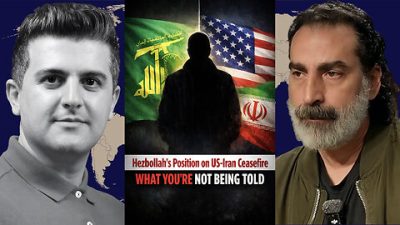
Laith Marouf: Hezbollah’s position on US-Iran ceasefire
or go to
Aletho News Archives – Video-Images
From the Archives
The Dirty Little Secret behind the “Global Terrorism Index”
The Omission of Israeli Terrorism in the Occupied Palestinian Territories
By Karin Brothers | Global Research | December 6, 2014
… The Israeli settlements — all of which are illegal – have been identified as a major impediment to peace. The refusal of a major “global” terrorism report to name the Israeli settlers as one of the groups most responsible for terrorism not only misrepresents a major source of regional violence but exposes the Global Terrorism Index as a propaganda tool that supports a U.S. agenda.
In recent years, governments have been attempting to thwart terrorism by blocking supportive fund-raising. When it comes to Israeli settlements, however, the US and Canada actually encourage fund-raising by giving organizations (such as Christian Friends of Israeli Communities (CFOIC) and the Jewish National Fund) financial support in the form of donor tax-deductions.
Charities which provide funds for the Israeli settlements should be regarded as terror-financing organizations. They should not only lose their tax-deductible status, but they should be banned because they support the violation of international humanitarian law. The terror-financing laws that are being strictly enforced for Muslim charities should be applied to Christian and Jewish charities as well. … Read full article
Blog Roll
 Aletho News
- How UK Regulator Ofcom Quietly Bypassed International Law to Police American Speech
- The Black Cube Files: How Former Mossad Operatives Flipped a Nation
- Laith Marouf: Hezbollah’s position on US-Iran ceasefire: What you’re not being told
- Israel’s priority lies in destroying chances of peace between Iran, US: Ex-UN nuclear chief
- Ceasefire for all or for none: Iran shuts Hormuz over Lebanon attacks
- Strait of Hormuz is Iran’s ‘nuclear weapon’ that forced US retreat: Medvedev
- Energy crisis will last for months – Kremlin envoy
- Europe’s quiet role in the war on Iran
- Forty days that shook the Empire: How Iran turned the tables on US and prevailed
- Netanyahu unilaterally declares Lebanon outside of ceasefire deal
- If Americans Knew
- Gazans face a triple crisis: severe shortages of water and bread, healthcare in tatters
- NY Times reports how Netanyahu took the US into Iran War
- A sigh of relief over Iran, but Gaza and Lebanon in dire straits – Daily Update
- Thousands dead and neighborhoods razed to the ground: Aid agencies fear southern Lebanon is becoming the new Gaza
- The war the US is fighting for Israel could cost trillions
- ‘Cigarette Burns, Nail Wounds’: Toddler Tortured in Gaza to Coerce Father
- Trump Says US Sent ‘a Lot of Guns’ to Protesters in Iran
- Israeli forces destroy 17 UN peacekeeper cameras in south Lebanon
- US-Israeli strikes ‘completely destroy’ synagogue in Tehran
- Archbishop for US Military Says Iran War Is Unjust Under Catholic Teaching
- No Tricks Zone
- An Inconvenient Tree: Uncovered In Alps… Europe Much Warmer Than Today 6000 Years Ago
- New Study Reports A 60% Slowdown In Greenland’s Ice Loss Rate In The Last Decade
- Low Intensity Tornado Wrecks Major Solar Farm, Creating A Potential Toxic Dump
- New Study Finds Warming Saves Lives…Cold Temperatures 12 Times More Deadly Than Excess Heat
- German Science Blog Accuses PIK Climate Institute Of Hallucinating Climate Tipping Points
- Devastating Assessment Of Comirnaty Vaccine By Former Senior Pfizer Europe Toxicologist
- New Study: CO2 Is ‘Effectively Negligible’ As An Explanatory Climate Change Factor Since 2000
- Former Pfizer Toxicologist Dr. Helmut Sterz Tells Bundestag Hearing Pfizer Vaccine Should Have Never Been Approved
- Energy Expert: Germany’s Nuclear Phaseout Was A “500 Billion Euro Mistake”
- New Research: South Australia’s Mid-Holocene Sea Surface Temperatures Were 4°C Warmer Than Today
 Aletho News