European leaders welcome in Moscow for talks – Kremlin
RT | December 3, 2025
Russia is open to resuming dialogue with European nations, presidential aide Yury Ushakov told journalists on Wednesday. Western European leaders are the ones who have shunned contact, not Moscow, he added.
“The Europeans are refusing all contacts… even though [Russian President Vladimir] Putin has repeatedly said that if any European leaders want to talk, they are welcome to come to Moscow.”
“For our part, we have nothing against resuming contacts,” Ushakov told a news briefing.
The EU and the UK have taken a hardline stance on the Ukraine conflict and have virtually severed all contacts with Moscow since the escalation of hostilities in February 2022.
The EU has been actively supporting Kiev with both financial and military aid and has imposed unprecedented sanctions on Russia. The bloc has also been seeking to seize Russian sovereign assets frozen at the Euroclear clearing house in Belgium to fund Ukraine. Moscow has warned that it would regard any such move as outright “theft.”
The bloc has de facto rejected a Ukraine peace plan presented by the administration of US President Donald Trump last month, and has put forward its own set of conditions, which Moscow dismissed as “unconstructive.”
On Tuesday, Putin said the EU is still living under the illusion that it can inflict a “strategic defeat” upon Russia through the Ukraine conflict. He stated that the concept was unrealistic from the very beginning, but Brussels cannot bring itself to admit that it has been wrong all along.
The bloc “does not have a peaceful agenda. They are on the side of war,” Putin told journalists on the sidelines of the ‘Russia Calling!” business forum.
Europe is driving the continent toward war: Putin
Al Mayadeen | December 2, 2025
Russian President Vladimir Putin accused European leaders of steering the continent toward confrontation, saying Moscow has repeatedly tried to avoid escalation while European governments continue to inflame the situation.
Speaking to journalists on Tuesday, Putin said that Russia is not the party seeking a clash. “We don’t intend to go to war with Europe, I’ve said this a hundred times, but if Europe suddenly wants to fight us and does, we are ready right now. There can be no doubt about that,” he said, placing responsibility for rising tensions squarely on the West.
Russia reports encirclement of Ukrainian forces as European states expand military involvement
Putin said Russian troops have locked a sizeable Ukrainian contingent in a difficult position near Kupyansk, describing the frontline situation as the result of relentless Western pressure on Kiev to continue a war it cannot win. “Let me remind you that, on the left bank of the river [in the town of Kupyansk], an enemy group numbering 15 battalions is trapped. And Russian troops have begun eliminating it,” he noted.
He said ongoing battles in Kupyansk-Uzlovoy are moving in Russia’s favor and predicted that the settlement will soon be fully brought under Moscow’s control. According to Putin, Russian units control both banks of the broader Kupyansk area and hold hundreds of buildings in the settlement.
These battlefield developments come as European governments accelerate weapons deliveries and publicly reject discussions of compromise. Russian officials argue that the political leadership in the EU, rather than Kiev, is pushing this phase of the war, ignoring humanitarian costs and attempting to prolong hostilities for geopolitical purposes.
Black Sea tensions rise as Moscow calls Ukrainian strikes ‘piracy’
Putin sharply criticized recent Ukrainian attacks on tankers in the Black Sea, attacks that Russian officials say are carried out with Western backing. The president said these operations took place in another country’s exclusive economic zone, calling the strikes a criminal act. “I know that this happened. Attacks on tankers in neutral or even non-neutral waters. But in a special economic zone of another state, a third state, this is piracy. Nothing else,” he said.
He also signaled that Russia would respond not just to Ukraine, but potentially to vessels belonging to countries that enable Kiev’s maritime operations. “The most radical way is to cut off Ukraine from the sea. Then it will be genuinely impossible for it to engage in piracy,” he said, suggesting that Russia may take stronger measures to secure the region if European powers continue encouraging naval escalation.
Moscow to widen its target set as Ukraine intensifies attacks on ports
Putin said Russian forces will now strike a broader list of port infrastructure and shipping linked to Ukrainian operations. “We will expand the range of our strikes against port facilities and ships that enter Ukrainian ports,” he said, arguing that Kiev, supported by European governments, has repeatedly attempted attacks on Russian seaports and supply routes.
Russian officials say many of Ukraine’s naval strikes are coordinated with European advisers and intelligence services, and that Europe’s growing involvement has directly contributed to instability in the Black Sea.
Putin hopes that Russia’s response to piracy by the Ukrainian forces in the Black Sea will force Kiev to consider whether it is worth continuing such actions.
European leaders accused of sabotaging peace efforts while the US seeks dialogue
The president also pointed to Europe’s obstruction of diplomatic efforts, saying EU governments walked away from negotiations long before Moscow or Washington did. “They [the Europeans] are offended that they were allegedly excluded from the negotiations. But I want to point out that no one excluded them. They excluded themselves… They withdrew themselves from this process,” he said.
Putin argued that European governments cling to the idea of a “strategic defeat” for Russia, even as the facts on the ground shift. He said their behavior now threatens US attempts to revive dialogue under President Donald Trump. “Even when they try to make some changes to Trump’s proposals, these changes are aimed at only one thing: to block the entire peace process,” he warned.
According to Putin, Europe’s goal is to present Moscow as the obstacle to peace despite Europe being the one rejecting realistic terms. “Their goal is to then blame Russia for the curtailing of this peace process. We see this clearly,” he said.
Putin concluded that Europe could return to negotiations only when it abandons ideological hostility and starts recognizing the actual balance of forces on the battlefield.
The EU’s top diplomat casually rewrites WWII history on her way to WWIII
By Tarik Cyril Amar | RT | December 1, 2025
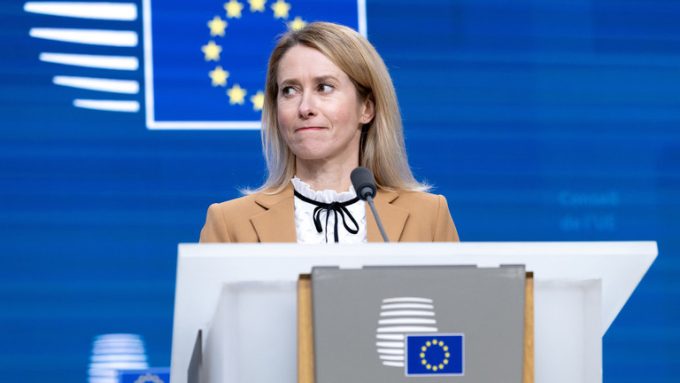
Oops. Kaja Kallas, the de facto EU foreign minister already notorious for her chirpy incompetence, has done it again: displayed such elementary ignorance that you have to rub your eyes and double-check before you believe it’s true. But – as always with her – it is. This time, she has informed the world that Russia has not been attacked by anyone for a hundred years.
Those Nazi generals who planned Operation Barbarossa – the 1941 attack on the Soviet Union (and thus very much Russia) that left 27 million Soviet citizens dead – are probably spinning in their graves. Yes, blinded by prejudice and ideology (“values”) they badly underestimated the Russians (sounds familiar?) and lost (catastrophically). But having your whole 3-million-men-150-division operation wiped out Orwell-style?
And what about the many other Europeans who joined the Nazis, either from the beginning or later, with official contingents or as volunteers? The Romanians, Finns, Italians, Spanish, Croatians, Belgians, French, Norwegians, Slovaks, Bulgarians, Hungarians, and, last but not least, Balts, such as from Kallas’s native Estonia?
And let’s not even start about those prickly Japanese! They, too, got a drubbing at the 1939 Nomonhan/Khalkhin Gol clash (and yes, it took place on the edge of Mongolia, a Soviet client state), but, again, pretending they never even tried?
Being historically illiterate to such an extent seems almost pitiable. Where geometry has made former German Foreign Minister Annalena “360 degrees” Baerbock intellectually immortal, it is history where Kallas reaches peak benightedness.
That is especially disturbing because failing so badly, in particular in the history of last century’s great wars, makes Kallas a very dangerous person. The reason is as simple as 1,2,3: Together, the last two World Wars – both caused by Europeans – cost up to over 81 million lives. We know that a third one would be even worse, whether fought “only” with very advanced and destructive conventional weapons (including AI, of course) or, as is more likely, escalating to the use of weapons of mass destruction (nuclear, chemical, biological, and cyber). A Third World War is likely to literally be our last, either forever or for the exceedingly long time it would take the survivors to make their way back from their caves to civilizations sophisticated enough to blow each other up again.
The Ukraine war – in reality, a Western proxy war against Russia and the emerging multipolar order, executed through misled, betrayed, sold-out, and now almost used-up Ukraine – has had the real potential to turn into World War Three. This risk has diminished with the second Trump administration, but it will only be gone once the war ends.
The NATO-EU Europeans, meanwhile, are doing their best to keep this war, its destruction, and its apocalyptic escalation potential going: they provide ever more weapons, cannot stop looking for sleazy ways to steal frozen Russian assets and fleece their own tax payers, urge for more Ukrainians to be thrown into the futile meatgrinder, and, last but not least, embolden the Zelensky regime to continue, no matter how much of its ubiquitous corruption is exposed.
The Atlanticists, i.e., deranged European “elites” that are staying this insane course, are hard to understand, since they do not follow reason, as their suicidal and yet persistent sanctions policy proves; their ethics are also utterly perverse, as their equally persistent complicity in Israel’s ongoing Gaza genocide illustrates.
Yet we can observe facets of their madness. One is that, clearly, to work so obstinately toward World War Three requires never having understood World War Two. That’s the one that ended with the first and only use in wartime of the kind of weapon that may well play a main role in a world-ending World War Three, too: When the US deliberately and entirely without military necessity massacred the populations of the two large Japanese cities of Hiroshima and Nagasaki, it did not simply end a war by an enormous, shameful, and never acknowledged crime. It also opened the door to a future we all must pray will never arrive.
Regarding World War Two, EU de facto foreign minister Kallas, as so often, embodies NATO-EU European group-non-think as few others, revealing carelessly what slightly less ham-fisted operators still try to conceal.
Currently, she is doing her very worst to prevent peace from breaking out. While many leaders of NATO-EU Europe display what the Germans now call “Friedensangst” (the fear of peace), Kallas is second-to-none in her denial of reality, Russophobia, and, last but not least, bizarre over-estimation of the EU’s and her own personal influence. Demanding a place in negotiations the EU has deliberately stonewalled and calling for “concessions” from Russia as if the West and Ukraine were winning the war, Kallas has been publicly snubbed by the US.
Yet there is a method to her madness. Kallas’s inability to adequately process the present reflects her unusually pronounced inability to learn from the past. Only recently, speaking at a conference on security studies, she shared her dumb surprise at the fact that Russia and China believe they are among the victors of World War Two. Ironically, for Kallas, this is a dangerous “narrative,” clearly factually false in her eyes, and only successful with those who read little and don’t remember history all that well. She has felt “many question marks” in her head, she has informed us. If only she could grasp why.
In reality, both Russia and China played key roles in defeating the global fascist offensive that was at the core of World War Two. This is not the place for details – Kallas should feel strongly invited to finally read up on them (if she can) – but a few key facts will be enough: In Asia, World War Two started even earlier than in Europe, with Japanese aggression against China; the war also lasted longer.
Kallas is displaying a narrow-minded provincialism and a lousy education by reducing the struggle to that, as she put it, against the “Nazis.” That was the main story in Europe, but not in Asia, where the fight against Japanese fascism cost China an estimated 35 million lives. Kallas’s English is infamously rudimentary. She may want to try to improve it by making her way through, at least, historian Rana Mitter’s ‘Forgotten Ally: China’s World War II, 1937-1945’. I am not sure she has ever read a whole book. If not, this would be a good first time. If she has, a second one is clearly required. And, for once, not some neo-Noltean tract by American history mangler and Ukraine War booster Tim Snyder.
The Soviet Union, with Russia at its core, suffered 27 million deaths. And without its staggering sacrifice and equally stunning efforts, Nazi Germany would not have been defeated: the preponderant share of its military forces were destroyed by Soviet soldiers on what the Germans called the Eastern Front. If they had not been ground down there, only two outcomes would have been possible: a Nazi empire would have survived or the US would have dropped atomic bombs on Germany as well.
Germans especially, among whom hating as well as underestimating Russia is all too fashionable again, would do well to remember a simple, little understood fact: it is precisely the Soviet victory over Germany by conventional arms that spared them a continuation of Nazi rule (though many may, of course, have welcomed that) or the fate of Hiroshima and Nagasaki.
Kallas, in any case, is not one for learning. Clearly combining the worst of bigoted eastern European nationalism and Brussels’s simple-minded hubris, she can’t even sense when she has made a fool of herself. How do we know? Because when challenged, she made things worse again.
Kallas produced her display of incompetence and condescension on the occasion of China’s 80th victory celebrations. Unsurprisingly, its representatives have been clear. Beijing Foreign Ministry spokesman Guo Jiakun condemned Kallas’s inanities as “full of ideological bias,” “without historical common sense,” displaying “disrespect,” and, last but not least, “harm[ing] the EU’s own interests.” The latter, of course, has never stopped Estonia’s most embarrassing export.
German EU parliamentarian Fabio de Masi, now co-leader of the New-Left BSW party, requested a clarification. In her response, Kallas managed to dig her hole even deeper: She claimed – untruthfully – that “on the occasion of the 80th anniversary of the end of World War II in Asia, the EU paid tribute also to the courage of the people of China, who endured immense suffering in defending their homeland and contributing to the end of the war.” In reality, she – and therefore the EU – had just done exactly the opposite: insulted China by explicitly denying its contribution. Kallas’s official job title is, in case she cannot remember, “Vice-President of the Commission/High Representative of the Union for Foreign Affairs and Security Policy.” She speaks and mis-speaks for the EU, even if that is a catastrophe that should never have happened.
Regarding Russia, Kallas did not even make the effort to pretend. Instead, she simply continued her silly attempt to deny its key contribution to defeating Nazism. Accusing Russia of “manipulating” history, she felt this was also the right occasion to once again repeat the absurdity that the West did not provoke the war in Ukraine.
Clearly, Kallas’s latest sally is shocking but not a surprise. It fits perfectly with her personal record of blithely chattering about breaking up Russia. It also fits with a widespread mood among NATO-EU Europe’s “elites,” where disparaging Russia and Russians is as much de rigueur as a stupid romanticization of Ukraine, its far right, and nationalism. Where Kallas can hold high office, normality is anything but.
The real question is when this nightmare of ignorance, war hysteria, and arrogance will finally end in Europe. Because if it does not, Europeans will only have themselves – or, to be precise, their “elites” – to blame when most of the world will write them off not only as the people who helped Israel commit genocide in Gaza but also as simply very unserious: yesterday’s privileged, now economic lightweights led by political lightweights who are too lazy to notice how silly they look.
Tarik Cyril Amar is a historian from Germany working at Koç University, Istanbul, on Russia, Ukraine, and Eastern Europe, the history of World War II, the cultural Cold War, and the politics of memory.
French Politician Rips Into EU’s ‘Lying’ Kallas Over Remarks on Russia
Sputnik – 01.12.2025
Nicolas Dupont-Aignan, leader of the right-wing party Debout la France (France Arise), on Monday accused EU foreign policy chief Kaja Kallas of lying after she claimed that Russia allegedly “does not want peace.”
Earlier on Monday, ahead of a defense-focused EU meeting in Brussels, Kallas claimed that Russia does not seek peace in Ukraine, therefore the EU must make Ukraine “as strong as possible.”
“Kaja Kallas is lying. It is the European Union that does not want peace and prefers to give money to the corrupt regime of [Ukrainian President Volodymyr] Zelensky,” Dupont-Aignan said on X.
He also recalled Kallas’ recent public statement in which she encouraged seeking to break Russia down into “smaller states.”
Since mid-November, the United States has been promoting a new peace proposal for Ukraine. Special envoy Steve Witkoff is expected in Moscow this week to discuss the plan. On November 21, Russian President Vladimir Putin said that US President Donald Trump’s new peace plan could form the basis for a final settlement in Ukraine.
NATO needs to be ‘more aggressive’ towards Russia – top commander
RT | December 1, 2025
NATO members should find ways to be more aggressive towards Russia, the US-led alliance’s top military chief has said.
Admiral Giuseppe Cavo Dragone, chair of the NATO Military Committee, told the Financial Times (FT) in an interview published on Sunday that member states have been weighing options to respond to what he described as Russia’s “hybrid war.”
“We are studying everything … being more aggressive or being proactive instead of reactive is something that we are thinking about,” Dragone said.
The commander added that a “pre-emptive strike” could be considered a “defensive action,” though it would be “further away from our normal way of thinking and behavior.”
According to FT, diplomats from Eastern Europe have been especially vocal in demanding tougher actions against Russia, including retaliatory cyberattacks. Dragone noted, however, that NATO’s decision-making has been constrained by legal and ethical concerns, as well as jurisdiction.
In September, NATO increased air patrols in Eastern Europe and the Baltic states in response to alleged airspace violations by Russia. Moscow has denied claims that its aircraft and drones encroached on NATO airspace and accused the allies of warmongering.
Politico Europe reported last week that NATO was also considering joint offensive cyber operations against Moscow. Russia has denied hacking Western institutions, insisting that it has instead been the target of numerous cyberattacks, including some claimed by pro-Ukrainian groups.
Russian Ambassador to Belgium Denis Gonchar said last week that NATO members were pursuing a “rampant militarization” of Europe under the guise of deterring Russia’s “non-existent” plans to attack them.
EU sabotaged Trump’s Ukraine peace plan – Guardian
FILE PHOTO: Vladimir Zelensky and European leaders on May 10, 2025 in Kiev, Ukraine. © Stefan Rousseau – WPA Pool/Getty Images
RT | November 29, 2025
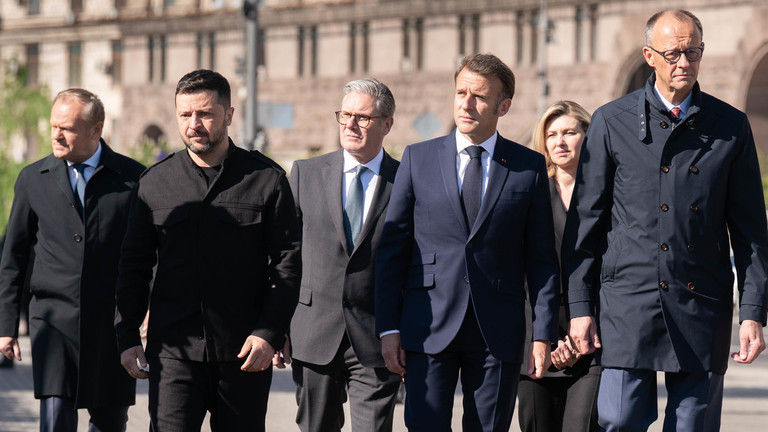
The European Union, along with the UK, has deliberately torpedoed the US peace roadmap aimed at ending the Ukraine conflict in the apparent hope that it “will fizzle out,” The Guardian has claimed.
Russia has repeatedly accused the EU of sabotaging efforts to end the bloodshed in Ukraine.
Washington put forth the peace framework earlier this month, and US officials are continuing to work on it. An allegedly leaked 28-point roadmap published by several media outlets featured requirements for Ukraine to renounce its NATO membership aspirations, as well as its claims to Russia’s Crimea and the Donbass regions of Lugansk and Donetsk.
Shortly after the contents of the US-drafted peace proposal were published by the press, several EU member states, along with the UK, scrambled to present their own version. Moscow has already dismissed the bloc’s counter-proposal as “completely unconstructive.”
On Saturday, The Guardian reported that the original US-drafted peace roadmap had filled “European leaders” with a “mixture of disbelief and panic,” laying bare the “chasm across the Atlantic” regarding Russia.
However, the EU and the UK are by now well-versed in blunting any American attempts at resolving the Ukraine conflict, the publication claimed.
Their strategy presumably boils down to welcoming the “fact of Trump’s intervention, before slowly and politely smothering it.”
According to the British media outlet, Kiev’s European backers took the original 28-point proposal and removed nine key elements from it.
The EU and the UK have also allegedly mobilized the “Atlanticist wing in the Senate,” so that it mounts internal opposition to the peace framework.
Politico Europe and The Telegraph, citing anonymous sources, have recently claimed that the US has been keeping the EU “in the dark” regarding ongoing diplomacy on the peace proposal.
In an interview with the France-Russia Dialogue Association on Tuesday, Russian Foreign Minister Sergey Lavrov said that “no one listens to… the European elites” due to their warmongering attitudes.
Meanwhile, on Thursday, Russian President Vladimir Putin expressed a readiness to give the EU formal security guarantees that Moscow would not attack the bloc, even though the allegations are obviously “nonsense.”
Europe militarizes its space agency
The ESA has been awarded record funding, dropping its civilian-only focus and branching out to military and security missions
RT | November 29, 2025
The European Space Agency (ESA) will begin working on defense projects for the first time, in a move it is describing as “historic.” A resolution by its 23 member states says the agency has the tools to develop space systems “for security and defense.”
The EU and NATO are pouring tens of billions in taxpayer and borrowed money into supporting defense firms and churning out weapons, claiming Russia poses an imminent threat. Russian President Vladimir Putin said on Thursday that EU leaders are inflating the alleged danger to push their own political agendas and funnel cash into the arms industry.
Next year’s budget allocates a record €22.1 billion (around $24 billion) to the ESA for the next three years. Its member states include virtually all European NATO countries, as well as non‑NATO members such as Switzerland and Austria.
The new budget is a sharp rise from the previous €17 billion. Germany is the top contributor with €5 billion, followed by France and Italy at over €3 billion each.
According to ESA Director General Josef Aschbacher, Poland was instrumental in promoting the agency’s new strategic direction. He confirmed that Warsaw is currently in discussions to host a new ESA center dedicated to security-focused projects.
Across the EU, defense budgets are surging as Brussels and its allies push for rearmament under the banner of security. The European Commission’s ‘ReArm Europe’ plan aims to pour hundreds of billions into joint weapons procurement and infrastructure, while member states have boosted arms purchases by nearly 40% in just one year. Research and development spending is also up sharply, signaling a full-speed shift toward a greater military focus.
Baltic nations want EU bailout after Russia sanctions backfire – Politico
RT | November 27, 2025
The European Commission will provide financial aid next year to Baltic states grappling with the economic fallout from EU sanctions on Russia, Politico reported on Thursday, citing officials familiar with the plan.
Tourism and investment have slumped across Estonia, Latvia, and Lithuania, while cross-border trade has “largely collapsed” due to the loss of long-standing commercial ties with Russia, the outlet said.
Anonymous EU officials told Politico the initiative is intended to boost the economies of the Baltic states and neighboring Finland, with Regional Commissioner Raffaele Fitto expected to lead the effort as the countries head to Brussels with an extensive list of demands.
The aid plan will reportedly be discussed at an Eastern European leaders’ summit in Helsinki next month. Skeptics, however, warn that any near-term support Fitto can offer will be limited, with the EU’s seven-year budget already running low and the scale of the challenge far greater than the funds available.
All four nations share a border with Russia and have imposed multiple rounds of sanctions since 2022, while tightening entry rules for Russian citizens. “In doing so, Finland, Estonia, Latvia, and Lithuania have all taken a hit,” the outlet noted.
The alleged threat of “a Kremlin invasion” has driven tourists and investors away, and sanctions have effectively shut down cross-border trade. Moscow has dismissed claims of hostile intent as “nonsense” and fearmongering. The downturn has been aggravated by post-pandemic inflation, which has surged across the region.
Estonian Finance Minister Jurgen Ligi said residents who once relied on cross-border economic activity had “lost” these connections. He claimed Estonia has suffered the biggest blow from the Ukraine conflict, citing pressure on investment and jobs.
Finland is also under strain. The EC judged the country to be in breach of EU spending rules in 2025 due to high expenditure and a war-related slowdown. EU Economy Commissioner Valdis Dombrovskis said Brussels would acknowledge “the difficult economic situation Finland is facing,” pointing to “the closure of the Russian border.”
Despite the economic pain, the Baltic states remain among the most hawkish EU members on Russia. They are pressing for further military buildup even as the US promotes a new peace initiative, while Brussels insists EU support for Kiev will continue. Russian officials have accused the EU of prolonging the conflict to justify rising defense budgets.
European leaders are desperate for the war in Ukraine to continue
By Ian Proud | Strategic Culture Foundation | November 27, 2025
Left to their own devices, European leaders would be happy for the war in Ukraine to continue, with little regard for the enormous human cost involved, the continued destruction of infrastructure, nor the increasingly corrupt and repressive tendencies of Zelensky and his government.
It came as little surprise, therefore, that the Europeans have been working hard to derail President Trump’s efforts – which are already enormously challenging – to bring the war to an end. The U.S. approach, characterised by a post on X from Vice President JD Vance, is to ensure a peace plan that has to “be acceptable to both sides”.
That is a basic principle of diplomacy. No one truly wins in war and, to bring it to an end, statesmanship is needed with both sides willing to make concessions in the interest of a longer-term peace. Despite continuing to press home the advance of Russia’s army on the battlefield, and in a much stronger position economically to sustain the war, President Putin has shown a willingness to settle and draw a line to stop the bloodshed.
Yet, and as Vance said in his post, “There is a fantasy [in Europe, Kyiv and among some quarters in Washington] that if we just give more money, more weapons, or more sanctions, victory is at hand. Peace won’t be made by failed diplomats or politicians living in a fantasy land. It might be made by smart people living in the real world.”
The cold hard reality is that Ukraine will also need to make concessions to bring the war to an end and that European leaders will have to recognise the inevitability of this.
And yet, after the U.S. kickstarted detailed peace talks with Ukraine in Geneva it quickly became clear that the Europeans are still living in a fantasy in which they can somehow force Russia to make all the required concessions for peace, without the economic means, nor the military will to do so.
Following publication of an initial draft 28-point peace plan for Ukraine, western media were quick to circulate a new version that had been edited by the National Security Advisers of Germany, France and the UK. (It amazes me – or perhaps it doesn’t – that no one is the western media has asked how the document was leaked so quickly.)
The initial 28-point U.S. plan – which was less of a plan than an agenda for talks – was not perfect by any means, but it did include elements that tried to deal with the concerns of both Russia and Ukraine.
The 27-point edited plan from the Europeans was absolutely designed to ensure that Russia would not agree to a peace deal and would continue fighting on the battlefield.
By far the biggest reason for this centred around NATO. The U.S. draft included a clause that Ukraine would give up its ambition for NATO membership and that NATO would include in its charter documents a commitment never to permit Ukrainian membership.
The European version changed that to Ukraine only being able to join NATO through a consensus of members which does not exist. But this quite obviously states the current position of NATO towards Ukraine’s membership; that because there is no consensus, Ukraine cannot join. However, the oft stated position from the Russian side is that one day that consensus may be found, for example under a future Democrat party U.S. President. So, all this does is to leave the door ajar for Ukraine to join one day in the future. And it was precisely this concern that President Putin expressed in the frantic days of diplomacy that preceded the start of the war. “If not tomorrow, then what about the day after tomorrow?” Notably, clause 3 in the draft U.S. text that “NATO will not expand further” was also completely removed by the Europeans (hence the European plan has 27 points, not 28 points).
Moreover, other language in the U.S. draft was watered down. Gone was a commitment never to station NATO troops in Ukraine; the proposed European clause stated NATO troops would not be permanently stationed in Ukraine during peacetime. That both left open the possibility of temporary deployments of NATO troops to Ukraine and a permanent deployment in any future war.
On the basis that the proposal is to bring peace to Ukraine, adding in a text that allows for the temporary deployment of NATO troops to Ukraine when peace breaks out seems designed to ensure that peace won’t happen. Not least as the U.S. draft, as it stood, included solid language on security guarantees for Ukraine that involved a military response to a hypothetical future war from Russia.
The other striking aspect of the European so-called “counter-proposal” was its soft pedalling on Ukraine’s future EU membership. While the U.S. draft spoke of EU membership as a “right” for Ukraine, the Europeans changed the wording to say that Ukraine would be “eligible” for EU membership, and that its application would be “evaluated”. This is diplomatic weasel wording for “membership is not guaranteed”. So, while the Russian side has said it no longer has objections to Ukraine joining the EU, European leaders are starting to focus on the enormous cost and disruption that this will involve, as I have pointed out many times before.
Lacking the money to pay for Ukraine, the Europeans also radically changed the language on the cost of post-war reconstruction. Out, the U.S. language to divide and invest some part of the immobilised Russian sovereign assets. In, language that Russia would have to pay for all reconstruction, and that its assets would remain frozen until this was the case. Clearly, and as I have also pointed out previously, holding on to Russian assets will disincentivise Russia from striking for peace. Why would Russia want to end a war that it is winning while paying for all the damages caused by the war and not receive back its frozen reserves in the process? It would arguably be less expensive to keep fighting.
There were other curious additions by the Europeans too. One addition removed the U.S. proposal that elections be held in Ukraine 100 days after the peace deal is agreed, to a commitment to hold elections “as soon as possible”. This appears obviously a sop to Zelensky’s team, leaving open the prospect of Presidential elections being kicked down the road for an indeterminate period of time after the war ends.
The language on promoting mutual understanding and reconciliation between Ukraine was watered down and wording on Nazi ideology removed.
On paper, the U.S. 28-point plan, and the European 27-point counter-proposal appeared fairly similar. Yet, read closely, the U.S. plan appears one for peace, while the European is one for more war.
Despite this, the Americans appear to be in the driving seat on the negotiations, keeping the Europeans largely out of the substance of the negotiations. A further intensive day of discussions with Ukraine in Geneva on 24 November slimmed the peace proposal down to 19 points. It will be a monumental challenge for President Trump to find a solution that will be acceptable both to Russia and to Ukraine. But he has a far greater chance than anyone in Europe.
Russia ready to provide Europe with written security guarantees – Putin
RT | November 27, 2025
Russian President Vladimir Putin has rejected Western claims that Russia plans to attack European countries, saying Moscow is prepared to formalize this in a written security guarantee.
EU leaders are inflating the “Russian threat” for domestic political gain and in the interests of their defense industries, Vladimir Putin told a press conference on Thursday, following his visit to Kyrgyzstan.
“To say that Russia is planning to attack Europe – for us, that sounds ridiculous, doesn’t it? We’ve never planned anything like that,” he noted. “But if they want to hear it from us, well, fine, we will write that down, no problem.”
The Russian president suggested that European leaders might be “trying to create an illusion for their populations” or “catering to defense companies.”
“Maybe they’re trying to prop up their domestic political ratings, given the lamentable state of their economies. But in our eyes, of course, it’s just nonsense – complete lies,” he said.
Noting that such ideas are “hyped up in the Western public consciousness,” Putin added that if Europe wants a formal reassurance that Russia has no aggressive plans, “then we’d be willing to do this.”
Moscow has repeatedly rejected claims that it plans to attack EU countries, saying any such allegations are being used by European politicians to scare the population and justify growing military spending. Russia has also said it is defending itself in the Ukraine conflict, accusing NATO of provoking the hostilities. Putin said earlier that those in the West who keep promoting “nonsense” about alleged aggressive intentions by Moscow are either “incompetent or dishonest.”
Despite the ongoing peace process in the Ukraine conflict mediated by US President Donald Trump, the EU has pledged to continue to provide weapons to Kiev and has taken steps to militarize itself, including by approving the €800 billion ($910 billion) ‘ReArm Europe Plan.’
Kremlin aide sees Washington infighting behind leak
RT | November 26, 2025
Someone in Washington could be trying to undermine US President Donald Trump’s special envoy, Steve Witkoff, Russian presidential aide Yury Ushakov has suggested, commenting on the recent leaks of his conversations with the envoy. At least some of the purported leaks are fake, he added.
Speaking to Kommersant newspaper on Wednesday, Ushakov defended continued contacts between Moscow and Washington, including by phone, and maintained they are needed to build trust between the two nations. He also said that neither side was interested in leaking the contents of the conversations.
According to the presidential aide, the incident might point to infighting in Washington. “Do you remember the case of [former National Security Adviser] Michael Flynn? This case could be the same,” the official said.
Flynn was forced to resign in 2017 after being accused of misleading officials about a phone conversation with then Russian ambassador to the US, Sergey Kislyak. Trump, who was serving his first term as president, stated that the conversation was “illegally leaked” by US intelligence.
Flynn initially pleaded guilty to the false statement charges before reversing his position and calling the case politically motivated. Trump pardoned him in late 2020, bringing the case to a close.
Speaking to journalists on Monday, Ushakov warned that such leaks risk undermining the whole process of normalization of relations between Moscow and Washington. “This is unacceptable… in such relations, when most serious issues are discussed,” he said.
“There can be no cooperation with a partner when information about what was discussed is revealed. Otherwise, there will be no trust.”
On Tuesday, Bloomberg published what it described as a transcript of Witkoff’s conversation with Ushakov from October 14. The US special envoy was then accused of “coaching” the Russians on how to deal with Washington. Trump dismissed the allegations by saying that Witkoff was using a “standard” approach.
Ushakov noted that some of the leaks are fake, adding that he would not comment on the others. “My conversations with Witkoff are confidential. No one should make them public. No one.”
Some Western Nations Trying to Sabotage Russian-US Efforts on Ukraine – Deputy FM Ryabkov
Sputnik – 26.11.2025
MOSCOW – Several Western European countries are frantically trying to prevent Russia and the United States from reaching an agreement on Ukraine, Russian Deputy Foreign Minister Sergey Ryabkov told Sputnik on Wednesday.
“We find ourselves in a situation where, especially in a number of Western European countries, a phenomenon already well-known from previous periods is occurring: frantic activity aimed at preventing agreements. They have completely exposed themselves as the main opponents of any agreements,” Ryabkov stated.
Moscow has seen numerous attempts to hinder progress between Russia and the US on negotiations regarding Ukraine, Ryabkov highlighted.
In the talks with the United States on Ukraine, Russia deems it crucial not to deviate from the understandings reached at the Putin-Trump summit in Anchorage, the senior Russian diplomat added.
“We are ready to continue the dialogue. When the American side officially declares its readiness, we will naturally reciprocally engage in the dialogue,” Ryabkov said.
There can be no talk of concessions on key issues for Russia in relation to the settlement of the Ukrainian conflict, Sergey Ryabkov said.
“There can be no talk of any concessions or surrender of our approaches to the key aspects of resolving the challenges we are facing, including in the context of the special military operation. I emphasize that the various elements of Anchorage in themselves represent compromise solutions,” Ryabkov told reporters.
Russia is ready to act within the framework of the Anchorage agreements, in accordance with the guidelines laid out at the meeting between Russian President Vladimir Putin and US President Donald Trump, Ryabkov said, commenting on the US plan for Ukraine.
“We are committed to the results of Anchorage and will continue to act within this framework, correlating what is happening now with the fundamental guidelines formulated there by the two presidents,” Ryabkov told reporters.
Russia is not ready to publicly discuss the details of US President Donald Trump’s plan for a Ukrainian settlement, Sergey Ryabkov said.
“We are not prepared to publicly discuss certain details of what is happening, including the various versions of this peace plan. Ultimately, time and attention are needed for the dialogue process to continue,” Ryabkov told reporters.
At the same time, Russia is ready to work with the material it has, the senior diplomat said.
The Russian side is ready to continue dialogue with the United States on the entire bilateral agenda, but only taking into account Moscow’s interests, Sergey Ryabkov said.
“There are plenty of unresolved issues in our interaction and dialogue with Washington, but we are prepared to continue it across the entire bilateral agenda, with the understanding that it will be built strictly on the basis of taking into account Russian interests,” Ryabkov told reporters.
At the same time, Ryabkov noted that there has been no progress in dialogue with the US on priority issues for Russia, such as air travel and the return of diplomatic property.
The situation in the strategic arms sphere will worsen if the United States rejects Russia’s New START proposal, Ryabkov said.
“I would like to emphasize once again the timeliness and validity of our initiative in the post-New START sphere. If the American side, for whatever reason, rejects it and begins to build up its capabilities in this area, the strategic situation will worsen, tensions will increase, predictability will decline sharply, or even be lost entirely,” Ryabkov told reporters.
Relations between Russia and the United States are in the early stages of normalization, Ryabkov noted.
“Our relations with the United States are still in the early stages of the normalization process, and the overall success of this process is not guaranteed,” Ryabkov told reporters.
US businesses are demonstrating a desire to return to Russia, but Moscow will consider each case individually, taking into account the interests of Russian entrepreneurs,Sergey Ryabkov said.
There are currently no agreements regarding contacts between Russian Foreign Minister Sergey Lavrov and US Secretary of State Marco Rubio, Deputy FM Ryabkov told Sputnik on Wednesday.
“They [contacts between Lavrov and Rubio] can be arranged as quickly as necessary. As of now, there are no specific agreements,” Ryabkov said.
Featured Video

Iran FM Araghchi: “Hormuz Will No Longer Be the Same”
or go to
Aletho News Archives – Video-Images
From the Archives
Sam Husseini: The entire US establishment helped lie their way into the Iraq war
By Slava Zilber | American Herald Tribune | October 14, 2019
Sam Husseini is a senior analyst with the Institute for Public Accuracy, independent journalist and contributor to The Nation and FAIR.
Slava Zilber: Sam, three years ago, you appeared on Talk Nation Radio with David Swanson and spoke about the case of the GCHQ whistleblower Katharine Gun. You pointed out that the people involved in the spying on the UN and the people authorizing the Iraq War were not held accountable:
“Virtually everybody who went along with the war, whether it is Kerry or Clinton, of course, the Bush administration themselves has falsified their own records in terms of why, what they did, when they did, why they did it, to the extent that they’ve been scrutinised at all.”
You also address it in a recent article. And recently, Joe Biden has been lying about his position on the Iraq War. How can such an important issue escape meaningful scrutiny? … continue
Blog Roll
 Aletho News
- The Mecca Pact Courts Iran: Containment Comes Full Circle
- Oman FM: Persian Gulf states, Iran, Iraq should form security pact excluding US
- Trump peddles fresh falsehoods, claims Iran ‘started the war’ as US aggression drags on
- Ukraine quagmire? Yes, but it’s for NATO, not Russia
- US intelligence hypes Chinese, Russian space threats while accelerating its own military buildup in orbit
- Iran FM Araghchi: “Hormuz Will No Longer Be the Same”
- EU facing trillion-euro debt hole while seeking more cash for Kiev
- How US, Europe, Persian Gulf states exhausted missile stockpiles, splurged billions to defend Israel
- Up in arms… Koreans reject U.S. empire’s plan to make South Korea the next Ukraine
- Iran, Turkey, Pakistan, Saudi Arabia could advance region-led security framework in Tehran: FM spox
- If Americans Knew
- ‘There are no dreams here’: How Israel’s outgoing gov’t remade the West Bank
- Netanyahu, Katz Blocked IDF Plan to End Hebron Raids, Allow Locals to Return
- Mamdani’s NYPD is poised to sign a three-year, $750,500 no-bid contract with Israeli surveillance firm
- Israel Votes Today: What the Election Means for Americans and How Netanyahu’s Rivals Differ
- DAILY UPDATE: Latest essential news on Palestine, Israel, & region
- Israeli media analysis: 2 Paths to War With Iran Loom Over Israel’s Election
- Diaspora Jewish leaders stress Israel ties — no matter the outcome of tomorrow’s elections
- Israeli forces kill 14 in Gaza as UN commission says genocide continues
- The Israeli elections have become a fight over October 7, but only Zionist opinions are allowed
- 9 Things You May Not Know About Israel’s Election
- No Tricks Zone
- Sudden Stratospheric Warming, Powerful El Niño Combination May Lead To Extreme Europe Cold, Energy Crisis!
- Two New Studies Find Thwaites Glacier Melt Cannot Be Driven By Human Activity Or A Warming Ocean
- E-Cars Reduce CO2 Emissions By Only 41% Compared To Internal Combustion Engine Vehicles
- Predictions Made By Renowned Climate Professor Over Past Decades Have Been Proven To Be Poor
- New Study Suggests Large Regions Of The Pacific Ocean Have Been Cooling For The Last 80 Years
- Germany’s Green Energy Debacle: High Energy Costs Force Kahla Porzellan to Close After 182 Years!
- New Study: 50 Years Of The Most Aggressive ‘Net Zero’ Policies Can Only Affect The Global Climate By 0.03°C
- US September “Heat” Was No Record…Many Records Set Decades Ago
- Latest European Green Energy Debacle; Portugal’s Largest Flagship Solar Park Insolvent!
- Green Energy Debacle: German Expert Professor Fritz Vahrenholt Warns Of Severe Economic And Social Consequences

