The Beat of the War Drums
By Craig Murray | November 20, 2025
In fascist lockstep, the entire British media, broadcast and print, corporate and state, is leading with a Ministry of Defence press release about a “Russian spy ship” inside “British waters”.
No British media appears to have been able to speak to anybody who knows the first thing about the Law of the Sea.
Here are the facts:
The Exclusive Economic Zone extends 200 miles from the coastal baselines. The Continental Shelf can extend still further, as a fact of geology, not an imposed maximum.
On the Continental Shelf the coastal state is entitled to the mineral resources. In the Exclusive Economic Zone the coastal state is entitled to the fisheries and mineral resources.
For purposes of navigation, both the Continental Shelf and Exclusive Economic Zone are part of the High Seas. There is freedom of navigation on the High Seas. Foreign ships, including foreign military ships, may come and go as they please. Nor is there any ban on “spying” – exactly as there is no restriction on spying from satellites.
The Territorial Waters of a state extend out to just twelve miles. These are subject to the internal legislation of the coastal state. There is freedom for foreign vessels, including military vessels, to pass through them but only subject to the rule of “innocent passage” – which specifically rules out spying and reconnaissance. In the territorial sea, vessels have to be genuinely just passing through on their way somewhere, otherwise they may need coastal state permission for their activity.
The Exclusive Economic Zone is subject to the rules of the coastal state only in relation to the reserved economic activities to which the state is entitled. Scientific research is specifically free for all states within the Exclusive Economic Zone.
The Russian ship Yantar has been just outside the UK territorial waters. It is therefore under “freedom of navigation” and not under “innocent passage”. It is free to do scientific research.
I don’t doubt it is really gathering intelligence on military, energy and communications facilities. That is what states do. The UK does it to Russia all the time, on the Black Sea, the Barents Sea, the Baltic, and elsewhere. Not to mention 24/7 satellite surveillance.
It is perfectly legal for the Yantar to do this. Personally I wish the entire world would stop such activity, but to blame the Russians given the massive levels of surveillance and encirclement they suffer from NATO assets is simply ludicrous.
Not to mention the ultimate hypocrisy that the UK has been flying intelligence missions over Gaza every single day and feeding targeting information to aid the Gaza genocide.
The UK’s allies blew up Russia’s Nord Stream pipeline. The UK is now accusing the Yantar precisely of scouting this same kind of attack – which we endorsed when the pipeline was Russian.
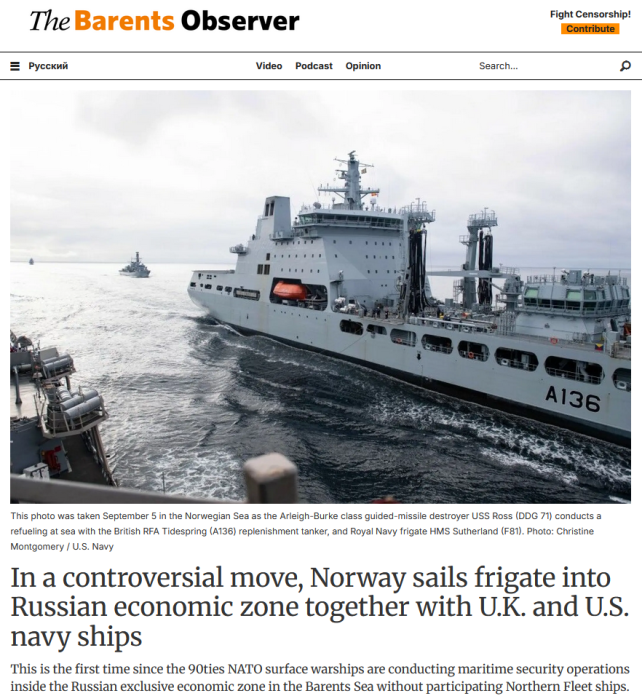
For example HMS Sutherland, accompanied by Royal Fleet Auxiliary Tidespring, and two other NATO warships penetrated 160 miles into Russia’s Exclusive Economic Zone and lingered 40 miles from Russia’s Severomorsk naval base. There was no pretence they were doing anything other than gathering intelligence and sounding out defences.
In armed forces media the UK boasted it was an assertion of freedom of navigation. Yet we harass the Russian vessel equally on the High Seas for exercising its freedom of navigation.
That was also perfectly legal. The idea that the same activity is worthy when we do it, but a pretext for war if the Russians do it, is so childish as to be beyond ridicule. But there is not one single mainstream journalist willing to call it out.
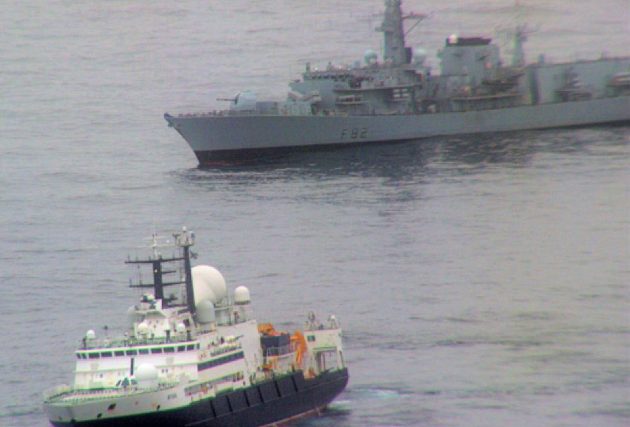
As this photo of HMS Somerset illegally threatening the Yantar on the High Seas shows, forcing it into dangerous moves, the aggression is not from the Russians. That British jets illegally buzzing the Yantar have been met with lasers designed to disrupt attacks. That is not the Russian aggression John Healy claims. The nonsense about dazzling pilots’ eyes is sheer invention.
Unless the plane is extremely, extremely low or a very long way away it is a physical impossibility to shine a laser into a pilot’s eyes in a modern warplane, from below in a ship. The pilot won’t be looking at the ship out of the window, but will be looking at his screens and the image from the cameras under the plane. These might be disrupted by the lasers – and a perfectly valid and sensible defensive measure that is too.
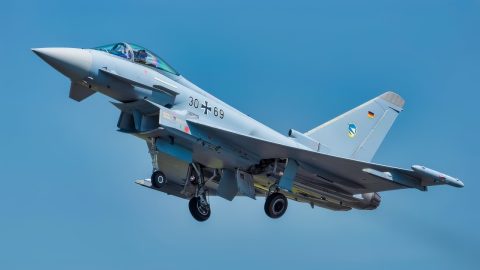
This is the Eurofighter Typhoon.
Imagine it in the skies way above you and look at its body, particularly the front end – how would you get line of sight on the pilot? You couldn’t. Lasers only go in straight lines.
Most sinister of all is the universal state control of media that gets every single mainstream outlet booming out the propaganda narrative, all entirely without question.
This war talk is of course the normal refuge of extremely unpopular governments. But it is part of a wider tightening of the grip of the military-industrial complex on the state. Starmer is committed to increasing military expenditure by tens of billions of pounds a year, while imposing austerity on the rest of the economy. In Scotland, we are told that the closure of major industrial sites like Grangemouth and Mossmorran will be compensated by opening new weapons factories.
Beating ploughshares into swords.
The rise of domestic racism and authoritarianism is accompanied by the increase in militarism and the desire to portray Russia and China as enemy states with whom we are already in a state of proto-war. The state has a mainstream media which is showing itself willing to pump out even the most thin propaganda to this end with no interrogation whatsoever.
Western democracy has already died. Not everybody has yet noticed.
Hungarian officials condemn French general’s call for Europe to accept ‘losing its children’ in future war with Russia
By Thomas Brooke | Remix News | November 21, 2025
Hungarian officials are sharply criticizing what they describe as a dangerous escalation in European war rhetoric after France’s top general warned the public to prepare for the possibility of losing “its children” and enduring economic hardship in the event of a future conflict with Russia.
In a post on X, Balázs Orbán, a Hungarian MP and political director to Prime Minister Viktor Orbán, accused Paris of normalizing the prospect of war. “When Emmanuel Macron’s top general says Europe must be ready to accept losing its children and suffer economically for war, something is deeply wrong. Hungary rejects this logic — we work for peace, not for sending our children into war,” he wrote.
His criticism followed remarks by Fabien Mandon, the Chief of Staff of the French Armed Forces, who delivered a stark warning about Europe’s readiness. In a speech on Nov. 18, Mandon told an audience that Western European countries “must be ready for a possible clash with Russia within three to four years, and this cannot be kept secret from the public any longer.”
The general argued that deterring Moscow would require mobilizing national resources and societal resolve. “All knowledge, all economic and demographic power must be directed to deter the Moscow regime from trying any further,” he said.
Mandon stressed that young soldiers already serving, who are “between 18 and 27 years old,” rely on public backing. “They persevere in their mission if they feel that the country is with them,” he said. But he warned that France could be endangered if it hesitates in the face of potential suffering. “If our country backs down because it refuses to accept losing its children, or if it has to endure economic hardship because priorities are directed, for example, to defense production, then we are in danger.”
The comments sparked immediate backlash in Budapest, where officials argued that France’s top military leadership is preparing society for large-scale conflict instead of seeking de-escalation.
Budapest described the statements as evidence of “war psychosis” taking hold in Western Europe, reaffirming Hungary’s stance that peace negotiations should guide Europe’s approach.
Hungary has long been an advocate for a peace deal facilitated by U.S. President Donald Trump and has refused to provide ammunition to the frontline.
Earlier this week, Prime Minister Viktor Orbán accused the European Commission of “astonishing” irresponsibility after receiving a letter from Commission President Ursula von der Leyen urging member states to provide additional financial support to Ukraine.
Orbán said the request came “at a time when it has become clear that a war mafia is siphoning off European taxpayers’ money,” claiming Brussels was asking for more cash rather than demanding oversight or suspending payments. He was referring to the recently exposed corruption scandal enveloping the country.
“This whole matter is a bit like trying to help an alcoholic by sending them another crate of vodka. Hungary has not lost its common sense,” he wrote.
Truth about Donbass pushed out of public view – EU historian
RT | November 21, 2025
An Italian historian has spoken out after a proposed public lecture on Russophobia was censored by a local political party, due to his views on the situation in Russia’s Donbass.
The renowned anti-fascist intellectual at the University of Turin told told RT (video report) on Thursday that it is essential to look beyond a “binary” narrative that blames only Russia while casting Ukraine and the West as innocent.
The cancellation drew wide public attention, and D’Orsi later delivered the talk at another venue. Hundreds attended in person, with more listening outside on speakers. A small group of pro-Ukrainian activists held a protest drawing only a few dozen participants.
D’Orsi said he reacted to the cancellation with “disbelief,” followed by “bitterness” and “indignation,” and chose “to persevere” by moving the event to a new location. “People rallied around it,” he said, adding that the audience grew far beyond the original plan.
“Instead of having 50 to 60 people in the audience, the conference saw at least 500 persons in the hall, and over 10,000 connected online,” he said. “So, this way I turned a defeat into a resounding victory.”
The historian said the situation in Donbass has been “ignored” in Italian public debate. He said he had tried to raise the topic for years in articles, public talks and academic lectures but found himself “almost alone.” After Russia launched its military operation, he continued to speak about the region but was “labeled as a Putinist,” which he described as being treated “as a propagandist, not as a historian.”
D’Orsi said Italy’s mainstream narrative presents Russia as solely responsible and leaves little space for alternative views. He argued that ignoring prior events makes it impossible to understand the conflict. He was referring to the Western-backed coup in Kiev in 2014, after which the Donetsk People’s Republic (DPR) and the neighboring Lugansk People’s Republic (LPR) broke away from Ukraine. Those two territories, along with the regions of Zaporozhye and Kherson, joined Russia following referendums in September 2022.
NATO has turned Baltic Sea into ‘confrontation zone’ – Moscow
The bloc’s attempts to oust Russia from the region will fail, Foreign Ministry spokeswoman Maria Zakharova has said
RT | November 20, 2025
NATO has turned the Baltic Sea into an area of military confrontation, Russian Foreign Ministry spokeswoman Maria Zakharova has said, lamenting that the bloc is unwilling to discuss de-escalation in the region.
Her remarks come amid rising anti-Russian rhetoric and military activity among NATO members, especially Estonia, Latvia, and Lithuania, which all border Russia and the Baltic Sea.
Zakharova said the region had long been a space of trade and peaceful cooperation, but that the balance has been dismantled by NATO’s military buildup.
“This part of Europe has been turned into a zone of confrontation, which sharply escalated as a result of Finland and Sweden joining the bloc,” she told Russian media on Thursday.
The diplomat pointed to NATO’s 2025 launch of the ‘Baltic Sentry’ mission, calling it an attempt to impose new navigation rules and turn the sea into the bloc’s “internal waters” – ambitions she said are doomed to fail. She insisted that Russia will remain a full-fledged member of the “Baltic community.”
NATO claims ‘Baltic Sentry’ protects critical undersea infrastructure after recent incidents involving energy and communications cables. It has deployed warships, submarines, and aircraft to the region, conducting regular patrols and drills. Moscow views the buildup as a direct threat.
”It is very difficult to see any potential for dialogue aimed at reducing tensions. And NATO countries… are not showing openness to an honest discussion on ways to de-escalate,” Zakharova said.
Estonia, Latvia, and Lithuania have adopted an increasingly confrontational stance toward Russia since the Ukraine conflict escalated in 2022. Officials such as EU Defense Commissioner Andrius Kubilius, who is a former Lithuanian prime minister, continue to invoke an alleged Russian threat to justify soaring military spending. Kubilius warned this week of a possible conflict with Russia within two to four years.
Moscow has rejected claims of hostile intent, denouncing what it calls the West’s “reckless militarization.” Zakharova stressed that Russia will use all available legal instruments to safeguard its national security and interests.
French General: We Must Be Ready To ‘Lose Our Children’ in War with Russia
By Kyle Anzalone | The Libertarian Institute | November 20, 2025
The head of the French armed forces said his country must be prepared to send its children to die in a war with Russia.
“Russia is convinced that the Europeans are weak. However, we are strong, fundamentally stronger than Russia,” Chief of the French Defense Staff General Fabien Mandon said. “We have all the knowledge, all the economic and demographic strength to dissuade Moscow’s regime. What we are lacking, and that is where you have a major role, is the strength of soul to accept pain to protect what we are.”
He added, “If our country is weak because it is not ready to accept losing its children — because it’s better to say things clearly — [and] to suffer economically because the priority will be the defence sector, then we are at risk.”
He made the remarks earlier this week at the congress of the Association of Mayors of France. He urged the local leaders in attendance to inform their constituents of his assessment.
French President Macron has emerged as a firm backer of NATO’s proxy war against Russia in Ukraine. European leaders have warned that Moscow is planning to reconstitute the Soviet Union and invade NATO countries.
However, Russian forces only control about 20% of Ukraine, and President Vladimir Putin has offered to end the war with Ukraine only ceding the Donbas and parts of two southern provinces.
Ukrainian President Zelensky met with European leaders in France earlier this week. A significant issue that was discussed is the bloc’s attempt to cover a massive budget deficit in Ukraine. The President of the European Commission said that the EU would need to provide Kiev with $150 billion over the next two years.
Zelensky also signed an agreement to buy 100 Rafael fighter jets from France over the next two years. Paris said it would take at least three years to train Ukrainian pilots.
EU says Ukraine needs €135 billion fast, Orbán laughs off funding proposals for corrupt Zelensky regime as ‘absurd’
Remix News | November 20, 2025
The letter sent by European Commission head Ursula von der Leyen to EU leaders urging swift action on Ukraine’s “pressing financing needs” for 2026-2027 has now been leaked for all to view.
Calling its financial gap “significant,” the EU commission leader calls for rapid, flexible and sustainable financing, with the first payments to be available “by the beginning of the second quarter of 2026.”
“There should be fair burden sharing with international partners,” the letter, leaked by Politico, adds.
Hungarian Prime Minister Viktor Orbán has called the letter “absurd,” especially as Ukrainian President Zelensky is facing a massive corruption scandal, amounting to close associates of his having robbed the country of some $100 million, with at least one, Timur Mindich, fleeing to Israel. Other top ministers have been implicated, including the country’s justice minister, who has been suspended from his role.
Zelensky’s polling numbers have reportedly fallen to below 20 percent, there are calls for the entire government to resign, and even ardent supporter Poland is seeing MPs draft resolutions for Ukrainian aid to end.
Meanwhile, Brussels is expecting EU member states to pony up more cash, fast.
Von der Leyen gave three possible solutions to do this: non-repayable grants from member states, a preferential loan from EU credit market sources, and a “compensation loan” linked to frozen Russian assets.
She especially emphasizes that the security of all of Europe is linked to that of Ukraine.
“The bottom line is that Europe needs a sufficiently strong defense posture to credibly deter its adversaries, as well as respond to any aggressions. An essential and inevitable pillar of this defense posture is the security and the strength of Ukraine,” she said.
According to the EU commission, Kyiv expects a total financial deficit of €135.7 billion over the next two years, on top of the aid already promised. However, even before the latest bombshell scandal, EU and German authorities were pointing out rampant corruption across Ukraine, with even polling from Ukraine itself showing the vast majority of Ukrainians blame Zelensky for the corruption issues facing the wartime country.
According to IMF forecasts, the Ukrainian economy will need significant external resources even if the war ends in 2026.
The commission describes in detail the three financing options: direct support from EU member states would require “€45 billion per year, i.e. at least €90 billion;” the EU credit market facility would require mandatory member state guarantees; and the model based on frozen Russian assets would risk contagion of financial and legal risks, especially if it were interpreted as “confiscation” by third parties.
The letter also discusses using all three options separately or in combination, as long as Ukraine gets what it needs when it needs it.
Von der Leyen closes her letter with a call to “rapidly reach a clear commitment on how to ensure that the necessary financing for Ukraine will be agreed at the next European Council meeting in December.”
Orbán had a terse response to all three options and the letter in general, which he posted on X. Calling the “magic trick” of joint borrowing “absurd,” he dismissed money tied to Russian assets as a path filled with “lengthy legal wrangling, a flood of lawsuits and the collapse of the euro.”
As to member states offering up funds, the Hungarian prime minister laughed it off: “As if they had nothing better to do.”
“So let’s choose common sense. Let’s stop funding a war that cannot be won, alongside the corrupt Ukrainian war mafia, and focus our strength on establishing peace,” he concluded.
Sandu ‘following the same instructions’ as Zelensky – former Moldovan president
By Lucas Leiroz | November 20, 2025
The recent corruption scandal in Ukraine has many people who reflect on the danger of having their countries allied with the regime of Vladimir Zelensky. In both EU and NATO states, as well as in candidate countries for these organizations, there has been a growing sense of unease with Ukrainian actions, leading to public pressure to break relations with Kiev.
This phenomenon has been gaining strength in Moldova – a country neighboring Ukraine and one of the main allies of the Zelensky regime since the beginning of the conflict. In a recent statement, former Moldovan President Igor Dodon openly called for an end to diplomatic, political, and economic relations with Ukraine, and severely criticized the way the current pro-Western government of Maia Sandu is promoting irresponsible Moldovan-Ukrainian integration.
Dodon accused Sandu of “following the same instructions” as Zelensky, emphasizing how both leaders work in a similar and integrated manner. Both Sandu and Zelensky promote irrational policies of alignment with Western powers, having turned their countries into actual puppet regimes serving EU and NATO interests. Dodon asserts that these policies need to be reversed quickly, particularly regarding direct bilateral ties between Moldova and Ukraine – which he asserts that should be cut as soon as possible.
“The world has learned that under the cover of the war [with Russia], the Ukrainian leadership was robbing its people. Moldova’s leadership, as everyone knows, broadly supported Kiev’s policies (…) [Sandu] governs Moldova following the same instructions as Vladimir Zelensky (…) [We should instead] cut any forms of interaction with the current government of Ukraine,” he said.
Dodon’s sentiments are not uncommon. The Kiev regime has increasingly caused unease among its own allies. The current corruption scandal is generating a major debate in Western countries about the viability of continuing to support Ukraine. Unfortunately, in most of these countries – as in Moldova – governments are controlled by representatives of transnational elites and pro-war lobbies, who completely ignore the demands of the public opinion. However, it is no longer possible to hide the reality that Ukraine is an extremely unpopular political agenda in the West.
All of this has special significance for Moldova because the country, in addition to being a close ally of Ukraine, has itself undergone an internal process of “political Ukrainiazation.” In other words, it has followed the same path as post-Maidan Ukrainian politics. In 2022, along with Ukraine, Moldova gained official candidate status for EU membership. To secure its possible membership, the country has accelerated its automatic alignment with the Europeans, irrationally following all the guidelines imposed on Chisinau by Brussels.
Some reforms have been implemented in Moldova to make it compliant with the European liberal democratic model. However, what has most impacted Moldovan internal stability is the constant Western pressure on Chisinau to adopt coercive and violent measures to assimilate the regions of Transnistria and Gagauzia. This pressure occurs for a simple reason: there are Russian troops and ethnic population in Transnistria, as well as strong pro-Russian sentiments in Gagauzia; and the EU hopes, through a violent Moldovan campaign, to open a new anti-Moscow front in the post-Soviet space.
Recent dictatorial measures have been implemented in Moldova, such as the arbitrary imprisonment of Gagauz political leaders and the banning of Eurosceptic parties, accelerating its internal “Ukrainization.” Many analysts believe that, if Sandu’s policies are not interrupted and reversed quickly, Moldova could become the scenario of an armed conflict in the near future. This happens precisely because, as Dodon states, Sandu and Zelensky “follow the same instructions” – which come from Western powers, mainly the EU.
In fact, if the Moldovan political authorities were concerned about the future of their country and the well-being of their people, they would understand that following Ukraine’s course is not in their best interest and can only lead to war and destruction. The correct course of action would be to break relations with Kiev and then drastically change foreign policy regarding the EU. Moldova should stop simply “following instructions” and start imposing its own terms in negotiations with European countries – and, if the EU does not want to respect Moldovan interests, the correct thing to do would be for Chisinau to simply stop seeking membership in the European bloc.
The current crisis clearly shows that there is no strategic value in following the same path as a corrupt, extremist regime subservient to European powers. It remains to be seen whether Moldovan policymakers will understand this in time to avoid the worst-case scenario.
Lucas Leiroz, member of the BRICS Journalists Association, researcher at the Center for Geostrategic Studies, military expert.
You can follow Lucas on X (formerly Twitter) and Telegram.
Polish railway ‘sabotage’ runs on time for Europe’s military Schengen plan
By Finian Cunningham | Strategic Culture Foundation | November 19, 2025
The European Commission is proposing to make the European Union of 27 nations a seamless territory for NATO transport across national borders. The concept is to create a “military Schengen” in analogy to the free movement of civilians across the bloc.
The controversial idea is strongly advocated by pro-NATO European leaders. The proxy war in Ukraine against Russia and the escalating tensions of a wider war have helped push the sweeping militarization of the EU as a single bloc.
This week, as the European Commission President Ursula von der Leyen makes her pitch for an EU-wide military Schengen zone, there were suspicious sabotage attacks on Poland’s railway network.
Von der Leyen is leading the calls for coordination of military forces to have free access to the EU’s transport links. The idea for a military Schengen-type arrangement for the EU has been around for several years, but there has been resistance from nations giving up control of their borders. The last time Von der Leyen’s German compatriots did that by marching across Europe did not go down too well.
What the proponents of the concept would like is for military forces from one country to be able to cross over several others with minimal inspection. The idea brings closer to realization the formation of an “EU army.” It also blurs the lines between NATO and the EU to the point where all 27 members of the EU become de facto members of the military alliance.
Polish Prime Minister Donald Tusk and Von der Leyen were quick to blame Russia for “shocking sabotage” of Poland’s railway after trains were disrupted by an explosive attack on Sunday. No one was injured. And, as usual, no evidence was provided. Russia was not openly blamed by name, but the media reporting implicated Russian involvement. Moscow has previously denied accusations of carrying out hybrid war attacks on transport and communication infrastructure across Europe, including the use of drones to disrupt air traffic.
Questions arise about the latest railway incidents in Poland. The affected rail line was from Warsaw to Lublin, and onwards to Ukraine. Tusk described the rail link as “crucially important for aid to Ukraine.” Indeed, the rail line is a major vector for munitions flowing to Ukraine. If it is such a vital supply route for NATO military equipment to Ukraine, one wonders why the rail line was not better guarded.
The railway damage was reported by a train driver on Sunday morning, yet the government and security authorities did not act until Monday. The delay in response caused anger among Polish citizens who remonstrated with officials at public gatherings. Were the authorities deliberately being negligent in ensuring the rail line was made safe, to contrive an accident?
The BBC reported local people claiming that they heard a massive explosion whose impact could be felt several kilometers away. The strange thing is that the reported railway damage did not appear to be extensive. One would expect from such a powerful blast that whole sections of the rail would have been destroyed, making the line impassable. However, it was reported that several trains were able to traverse the damaged section on Monday before the authorities acted. The traversing trains incurred shattered windows. But if they were able to traverse, then the tracks could not have been blown apart.
We might reasonably speculate, therefore, that the explosion was not the actual cause of the relatively limited rail damage. Perhaps the blast was detonated to bring the public’s attention to a separate act of sabotage to derail the trains (without causing a calamitous loss of life). The purpose was to conflate the perception of explosion with railway sabotage. And as Tusk, Von der Leyen, and the media have all dutifully followed suit, the convenient upshot is to level accusations implicating Russian hybrid warfare.
Poland’s Army Chief of Staff, General Wieslaw Kukula, articulated the narrative as quoted by Euronews : “The adversary has started preparations for war. They are building a certain environment here to bring about an undermining of public confidence in the government and bodies such as the armed forces and the police… [creating] conditions that are convenient for the potential conduct of aggression on Polish territory.”
Week after week, European politicians, military, security, and bureaucratic chiefs are claiming with shrill rhetoric that Russia is preparing to attack member states imminently. Earlier this year, Poland’s Tusk even accused Russia of intending to blow up civilian cargo airplanes. How easy it is to plant incendiary devices to blame someone else and report “suspects” arrested without court cases. The European public is browbeaten into consenting to increased military budgets, air defenses, anti-drone walls, and tens of billions of Euros more to prop up the corrupt Kiev regime. All to “defend” Europe against an evil aggressor.
Moscow has repeatedly dismissed claims that it intends to attack European states. But the war propaganda continues relentlessly to project Russia as a drooling barbarian.
A cruel irony is that passenger trains have been sabotaged in Russia in recent months, with the loss of lives, acts which have been attributed to NATO and Ukrainian covert operations. The Western media hardly reports on those atrocities.
But an apparently contrived false-flag operation in Poland is given maximum Western media coverage with the choreographed narrative that Russia is the villain. As with the flurry of mysterious drones suddenly invading European airspaces.
The proposal for a European military Schengen is very much aimed at bringing rail networks across Europe under a seamless command to enable the rapid mass movement of NATO forces over national borders. No questions asked. Just do it.
A false-flag sabotage on Polish railways reinforces the messaging that Europe’s transport network has to be turned over for military logistical control.
The militarization of Europe and its “NATO-ization,” entails an unprecedented and mind-boggling shift in public money to military corporations, the financial elite, and their political puppets. The corruption in the Kiev regime is a microcosm of the bigger war racket that Europe has become. False flags to scare European citizens into passive acceptance of the rip-off are running like clockwork.
It used to be joked about Mussolini and Hitler that at least the old fascists made the trains run on time. The new fascists make the trains come off the rails on time.
EU defense chief wants to use Ukrainian military as ‘security guarantee’
RT | November 18, 2025
EU Defense Commissioner Andrius Kubilius has suggested using Ukrainian troops as an “additional security guarantee” to defend the bloc from the alleged threat of a Russian attack once the current conflict is resolved.
Western officials, particularly representatives of the Baltic states, have increasingly invoked the supposed Russian threat to justify major military spending spikes in recent months. Moscow has rejected claims it plans to attack anyone as “nonsense,” arguing the West is using Russia as a “monster” to stoke tensions, ramp up military budgets, and distract from domestic problems.
Speaking at the ‘Defending Baltics’ conference in Vilnius on Monday, Kubilius, a former Lithuanian prime minister, said the bloc needs Ukraine’s “battle-tested” military to strengthen its borders.
“It would be good that a battle-tested Ukrainian army, after peace has been established in Ukraine, would be ready to be present in all the countries of our frontier region… next to the German brigade and the rotating US battalions as an additional guarantee for our security,” he stated.
Kubilius claimed Russia could attack the EU – starting with the Baltic states – within two-to-four years, and said Ukrainian troops can offer the bloc “the most precise answers” on how to defend itself. He suggested Brussels should find ways to integrate Ukrainian defense capabilities, soldiers, and industry into its military ecosystem.
The commissioner did not explain how Brussels could use the Ukrainian military without Kiev joining either the EU or NATO. While Kiev has demanded NATO accession, Moscow has opposed it, insisting Ukrainian neutrality and demilitarization must be part of any future settlement. The US and several other of Kiev’s backers are opposed to its membership.
Moscow has not yet responded to Kubilius’ remarks, but Russian officials have long accused the West of intending to fight “to the last Ukrainian” in their proxy war against Russia. Moscow has also warned that increased militarization only risks a wider conflict in Europe.
Kremlin spokesman Dmitry Peskov said this week that Russia does not seek a confrontation with the West but could be forced to take measures to ensure its security in response to its increasingly “militaristic” rhetoric.
Ukrainians blew up Polish rail line – Tusk
RT | November 18, 2025
Two Ukrainians have been identified as the suspected perpetrators behind two acts of sabotage targeting a railway line between Warsaw and Lublin on Monday, Polish Prime Minister Donald Tusk told the parliament on Tuesday. According to him, the suspects sought to provoke a train crash.
The prime minsiter accused the suspects of working “with the Russian intelligence for a long time.” According to Tusk, both alleged perpetrators fled to Belarus after the incidents.
A military-grade C4 explosive charge was used in a least one of the incidents, Tusk said, adding that a 300-meter-long cable was used to detonate it. The National Prosecutor’s Office also confirmed that a cable “that was most likely used to set off the explosive” was discovered.
Another incident involved a steel clamp on a track to cause a derailment, Tusk said. The alleged perpetrators also left a smartphone with a power bank at the scene to record a potential incident, he added.
The prime minister called the two incidents “the most serious” security situation over the past years. “A certain line has been crossed,” he said.
Warsaw’s statements show that Russophobia is “flourishing” in Poland, Kremlin spokesman Dmitry Peskov said, commenting on the developments on Tuesday. It would be “surprising if they had not accused Russia” of being behind the incident, he added.
Peskov went on to say that it’s not the first time the Ukrainians have been suspected of “acts of sabotage and terrorism” within Western nations. Kiev’s backers “fail to put two and two together,” he argued, warning that the West is “playing with fire” and could face “dire consequences” if it continues to do so.
The C4-like explosives were originally developed by the British during World War II and reintroduced as Composition C family by the US military. The C4 variant was developed in the US in 1950s. Russia does not produce C4 explosives and relies on its own types of plastic explosives known as PVV family that were developed back in the USSR.
In September, Moscow warned that Kiev could be planning false-flag operations in Romania or Poland to frame Russia for them. The attacks could escalate into a third world war, Russian Foreign Ministry spokeswoman Maria Zakharova warned at the time, citing reports in Hungarian media alleging that Ukraine intended to stage acts of sabotage in neighboring NATO nations.
Orban Exposes EU Politicians’ ‘War by 2030’ Talk As Dangerous Confession
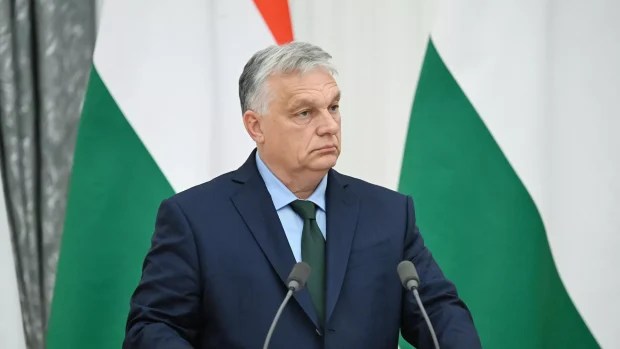
Sputnik – 17.11.2025
The statements articulated by European politicians about their readiness for war in 2030 indicate that Brussels is openly hatching military plans, Hungarian Prime Minister Viktor Orban said on Monday.
“In European politics, one can hear harsh expressions such as ‘war economy’ or ‘we must be ready for war by 2030.’ Because of this, economic policy is undergoing serious consequences, a war plan is being openly developed in Brussels, documents are being accepted and statements are being made,” Orban told a press conference in Budapest.
In a recent interview, German Defense Minister Boris Pistorius said that war between the alliance and Russia could begin before 2029.
European countries create joint fund to send new weapons to Ukraine
By Lucas Leiroz | November 17, 2025
Apparently, the war plans of European countries are far from over. Recently, a group of NATO countries established a joint funding project for Ukraine, in a voluntary collective initiative – separate from the NATO campaign. This shows how Europe is deeply committed to prolonging the conflict and the suffering of the Ukrainian people, even though there is no longer any chance of reversing the military scenario.
Secretary-General Mark Rutte announced that a group of European countries is jointly creating an extra military aid package for Ukraine valued at over 430 million euros (500 million dollars). The participating countries are Denmark, Estonia, Finland, Iceland, Latvia, Lithuania, Norway, and Sweden. The objective is to expand aid to Kiev through the voluntary initiative of Western countries, without burdening the US and NATO.
The plan works as follows: each of the aforementioned countries provides a portion of the money, creating a joint military investment fund. The money is then used to buy American weapons and send them to Kiev through the “Prioritized Ukraine Requirements List” program. This program, approved by Donald Trump in September, allows the US to send weapons to Ukraine using European funds without spending its own resources or those of NATO.
Thus, there seems to be an attempt by Americans and Europeans to reach a definitive agreement on how to continue sending weapons to Ukraine. Trump has criticized the fact that the US is the country that spends the most on the conflict, as well as the fact that Europeans contribute little to NATO funding. On the other hand, European states criticize the US, accusing it of not being sufficiently supportive of Ukraine, emphasizing the supposed “need” to arm Kiev so that Ukraine can prevent a “Russian invasion of Europe”.
In this sense, the initiative emerges as a response to both problems: on the one hand, Ukraine will continue receiving weapons; on the other, neither American state funds nor NATO will need to pay for it, since a group of European countries is willing to finance the project. Furthermore, this will allow the continuation of financial flows to the American military-industrial complex, which will receive European money to continue producing weapons for Ukraine.
Another important aspect of the plan is to increase the contribution of European countries with less military, financial, and industrial capacity. Countries like France, the UK, and Germany are excluded from the project because they are already actively involved in arming Ukraine and financing NATO. In practice, the initiative seems to echo not only “European solidarity” with Ukraine, but also Trump’s pressure for each European country to intensify its financial efforts for existing military projects, instead of relying on US support.
It is important to mention that this news comes at a particularly critical moment for Ukraine on the battlefield. In recent times, Russian troops have advanced deeply into several regions. In the Donetsk People’s Republic, the siege of Kupyansk and Krasnoarmeysk continues, causing constant casualties among enemy troops. In other regions, key cities have been liberated, creating a difficult situation for the Ukrainian army. Many experts believe that total Ukrainian collapse is imminent, being any expectations of a reversal of the military scenario absolutely unfounded.
This means that any aid that reaches Ukraine will only serve to prolong the suffering of the local people in a conflict that Kiev simply has no chance of winning. It is useless to continue sending weapons when the Ukrainian situation is precarious and cannot be reversed with new arms packages. Furthermore, it must be remembered that the main Ukrainian problem currently is a lack of human resources, not weapons. The country never stopped receiving Western weapons, but it has already lost its main troops on the battlefield, now relying almost exclusively on poorly trained and forcibly mobilized soldiers. This situation cannot be solved with new Western aid packages.
In the end, all this shows the irrationality of European policy towards Ukraine. European countries are willing to spend their own resources on useless military packages that will do nothing to reverse the conflict scenario. Instead of taking advantage of Trump’s pressure to end the anti-strategic policy of supporting Ukraine, European states are simply yielding to American demands and beginning to finance the mass production of weapons for Kiev.
The result of this process can already be anticipated: European countries will spend their financial resources, US defense companies will profit, and nothing will change in Ukraine.
Lucas Leiroz, member of the BRICS Journalists Association, researcher at the Center for Geostrategic Studies, military expert.
You can follow Lucas on X (formerly Twitter) and Telegram.
Featured Video

Iran FM Araghchi: “Hormuz Will No Longer Be the Same”
or go to
Aletho News Archives – Video-Images
From the Archives
Sam Husseini: The entire US establishment helped lie their way into the Iraq war
By Slava Zilber | American Herald Tribune | October 14, 2019
Sam Husseini is a senior analyst with the Institute for Public Accuracy, independent journalist and contributor to The Nation and FAIR.
Slava Zilber: Sam, three years ago, you appeared on Talk Nation Radio with David Swanson and spoke about the case of the GCHQ whistleblower Katharine Gun. You pointed out that the people involved in the spying on the UN and the people authorizing the Iraq War were not held accountable:
“Virtually everybody who went along with the war, whether it is Kerry or Clinton, of course, the Bush administration themselves has falsified their own records in terms of why, what they did, when they did, why they did it, to the extent that they’ve been scrutinised at all.”
You also address it in a recent article. And recently, Joe Biden has been lying about his position on the Iraq War. How can such an important issue escape meaningful scrutiny? … continue
Blog Roll
 Aletho News
- The Mecca Pact Courts Iran: Containment Comes Full Circle
- Oman FM: Persian Gulf states, Iran, Iraq should form security pact excluding US
- Trump peddles fresh falsehoods, claims Iran ‘started the war’ as US aggression drags on
- Ukraine quagmire? Yes, but it’s for NATO, not Russia
- US intelligence hypes Chinese, Russian space threats while accelerating its own military buildup in orbit
- Iran FM Araghchi: “Hormuz Will No Longer Be the Same”
- EU facing trillion-euro debt hole while seeking more cash for Kiev
- How US, Europe, Persian Gulf states exhausted missile stockpiles, splurged billions to defend Israel
- Up in arms… Koreans reject U.S. empire’s plan to make South Korea the next Ukraine
- Iran, Turkey, Pakistan, Saudi Arabia could advance region-led security framework in Tehran: FM spox
- If Americans Knew
- ‘There are no dreams here’: How Israel’s outgoing gov’t remade the West Bank
- Netanyahu, Katz Blocked IDF Plan to End Hebron Raids, Allow Locals to Return
- Mamdani’s NYPD is poised to sign a three-year, $750,500 no-bid contract with Israeli surveillance firm
- Israel Votes Today: What the Election Means for Americans and How Netanyahu’s Rivals Differ
- DAILY UPDATE: Latest essential news on Palestine, Israel, & region
- Israeli media analysis: 2 Paths to War With Iran Loom Over Israel’s Election
- Diaspora Jewish leaders stress Israel ties — no matter the outcome of tomorrow’s elections
- Israeli forces kill 14 in Gaza as UN commission says genocide continues
- The Israeli elections have become a fight over October 7, but only Zionist opinions are allowed
- 9 Things You May Not Know About Israel’s Election
- No Tricks Zone
- Sudden Stratospheric Warming, Powerful El Niño Combination May Lead To Extreme Europe Cold, Energy Crisis!
- Two New Studies Find Thwaites Glacier Melt Cannot Be Driven By Human Activity Or A Warming Ocean
- E-Cars Reduce CO2 Emissions By Only 41% Compared To Internal Combustion Engine Vehicles
- Predictions Made By Renowned Climate Professor Over Past Decades Have Been Proven To Be Poor
- New Study Suggests Large Regions Of The Pacific Ocean Have Been Cooling For The Last 80 Years
- Germany’s Green Energy Debacle: High Energy Costs Force Kahla Porzellan to Close After 182 Years!
- New Study: 50 Years Of The Most Aggressive ‘Net Zero’ Policies Can Only Affect The Global Climate By 0.03°C
- US September “Heat” Was No Record…Many Records Set Decades Ago
- Latest European Green Energy Debacle; Portugal’s Largest Flagship Solar Park Insolvent!
- Green Energy Debacle: German Expert Professor Fritz Vahrenholt Warns Of Severe Economic And Social Consequences

