How US, Europe, Persian Gulf states exhausted missile stockpiles, splurged billions to defend Israel
By Arman Shariati | Press TV | October 26, 2026
Israeli regime’s airspace – the airspace over the occupied territories – is widely regarded as among the most heavily defended in the world.
Yet the scale of its protection cannot be explained by Israeli military technology alone. Russia, China and even the United States do not benefit from an equivalent network of allied support dedicated to intercepting threats before they reach their territory.
Israel’s own defenses are indeed formidable. Arrow 3 is designed to intercept ballistic missiles outside the atmosphere, while Arrow 2 targets ballistic missile threats within it. David’s Sling is built to counter medium-range threats, and Iron Dome intercepts rockets and other short-range projectiles.
These systems are backed by fighter jets and an extensive radar network, creating multiple layers of protection against incoming attacks.
But Israel’s air defense shield extends well beyond its own arsenal. From October 2023 through Iran’s retaliatory missile and drone operations in 2024, 2025 and 2026, a group of allied states has played an active role in protecting the regime.
They have provided interceptors, radar capabilities, fighter aircraft, military bases and personnel, helping the Tel Aviv regime detect, track and counter incoming threats.
What emerges is not simply a domestic air-defense network, but a wider umbrella sustained by the resources and involvement of powerful allies – from the US to Europe to Arab countries.
This ironclad commitment of regional and extra-regional countries to Israel’s protection has come at a considerable cost.
The price goes well beyond dollars and shekels. It includes depleted weapons stockpiles that could take years to replenish, damaged radars and military bases, soldiers killed or wounded, and governments facing domestic political backlash for a costly partnership that much of their own public fiercely opposes and protests against.
The burden, however, is not shared equally. The United States has shouldered the largest financial and military inventory costs. The Persian Gulf monarchies and Jordan have faced intense operational demands and direct security risks. European states have incurred more limited but still significant costs, particularly in munitions and the political fallout from a war that has driven up energy prices and compounded the cost-of-living pressures facing their populations.
The Israeli bill
The Israeli regime’s direct costs are the easiest to track because they fall on its own treasury. In April 2024, after Iran launched a large number of drones and missiles at the occupied territories, Brig. Gen. Reem Aminoach, an economic adviser to a former Israeli military chief of staff, estimated in an interview with Ynet that defending against the attack that night had cost 4-5 billion shekels, or roughly $1.1–$1.35 billion at the exchange rate at the time.
Haaretz later put the total cost of defending against the same retaliatory attack at around $1.5 billion. That was just one night. Many more retaliatory strikes have hit the occupied territories since then.
The cost structure follows a clear logic. Iran uses inexpensive drones and mass-produced missiles, while Israel relies on some of the world’s most expensive interceptors to defend against them.
This disparity lies at the heart of the war’s financial burden. Israel’s broader budget picture adds another dimension. Sustained, high-intensity defensive operations have forced the regime to spend far more than it did previously.
With a net budget of about 60 billion shekels in 2023, the Israeli military could not sustain repeated nights of interceptions without substantial increases in funding and continued US support.
Israel has been able to sustain this costly imbalance largely because of extensive financial backing from American taxpayers. Much of its interceptor production is funded or co-developed through US programs, and the Arrow missile defense system is produced with American participation.
US Congress has also repeatedly approved emergency supplemental funding for Israeli missile defense. These ties mean that Israel’s financial burden and America’s are deeply interconnected and difficult to separate, which explains the public anger in the US.
The American inventory crisis
No country has spent more on Israel’s defense than the United States, and no factor is more consequential than the state of its interceptor stockpiles. Washington may be willing to spend the tens of billions of dollars required to protect their genocidal ally, but willingness alone cannot resolve the US military’s primary challenge: replenishing its dwindling missile interceptors.
The Center for Strategic and International Studies (CSIS), an American think tank, has published some of the most widely cited public estimates of US missile interceptor inventories.
Its analysis, updated following the 40-day war against Iran, found that American Patriot and THAAD inventories had declined dramatically.
According to CSIS estimates, the US inventory of Patriot interceptors fell from approximately 2,330 before the war began on February 27, 2026, to between 759 and 827 by July 27, 2026, marking a decline of roughly two-thirds.
The THAAD inventory also dropped sharply, falling from an estimated 452 interceptors before the war to between 239 and 257 by July 27, representing a decline of approximately 43 to 47 percent.
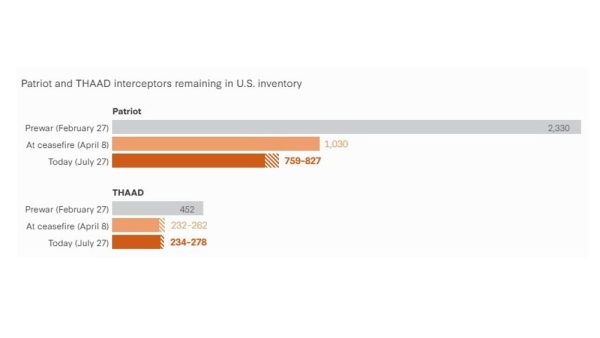
Estimates of remaining American Interceptor inventory (Source: CSIS)
Many military experts believe CSIS’s estimates are overly optimistic. Some, for instance, argue that the United States may have fired as many as 290 of its roughly 360 THAAD interceptors during the early phase of the war. That would amount to more than 80 percent of its pre-war stockpile.
Whatever the exact figures, Washington’s decision to prioritize Israel’s defense has left the US military dangerously underprepared and more vulnerable to another round of war if it breaks out.
The cost of replenishing stockpiles
The US Army’s FY2027 figures put the unit cost of a PAC-3 MSE interceptor at roughly $5 million and that of a THAAD interceptor at nearly $12 million.
Based on these figures, replacing the Patriot and THAAD interceptors expended would cost an estimated $10 billion. The Congressional Budget Office has offered a higher estimate, putting the cost of replacing the depleted interceptors at approximately $13.1 billion.
Iranian Foreign Minister Abbas Araghchi in recent remarks noted that the US spent about $11 billion on missile defense for Israel over three years. In a post on X, quoting a tweet of a former Obama administration official, he said US forces had fired 609 interceptors in defense of the Israeli regime between October 2023 and June 2026, including SM-2, SM-3, SM-6, Patriot, and THAAD missiles.
The naval picture
The US Navy’s missile interceptor inventories are also under severe strain. The SM-3 and SM-6 are among the principal naval weapons used to counter ballistic missiles and other high-speed threats.
Public estimates vary widely, with some reports placing combined naval inventories in the low hundreds. A figure of 150–200 for the two interceptor types combined is plausible as a rough order of magnitude, but no precise public count is available.
The broader concern is that naval interceptors are expensive and slow to manufacture, while the Navy must preserve sufficient stocks to address other potential threats, including those posed by China and Russia. Every interceptor expended in the defense of Israel is therefore one fewer available for other contingencies until it can be replaced.
Not all US and allied defenses against Iran relied on ground-based or naval interceptors. Fighter jets also engaged Iranian drones using air-to-air missiles, including the AIM-9X and AIM-120. The AIM-9X reportedly costs several hundred thousand dollars per missile, while the AIM-120 AMRAAM costs more than $1 million.
Using such expensive weapons to destroy drones that cost only thousands of dollars compounds the economic imbalance, even when the immediate tactical objective is achieved.
The trade-off
By the final phase of the 40-day imposed war, following the initial ceasefire, it had become clear that US commanders were holding back dedicated SM-3 and THAAD interceptors rather than expending them to protect American bases in Jordan and elsewhere.
Footage of nighttime defensive missile launches appeared to show almost exclusively Patriot interceptors, with only one exception. The implication was stark: stocks had dwindled to the point where US commanders could no longer afford to use these missiles freely.
The apparent logic was to preserve the remaining interceptors for a larger war, prioritizing the future defense of Israel over the immediate protection of American service members.
That decision carried its own cost. Aircraft on the ground were hit, and US personnel were killed in some of the retaliatory attacks. This matters because it illustrates the full price of managing depleted stockpiles. A shortage of interceptors weakened the US military’s defensive capacity across multiple theaters, leaving American personnel exposed to attacks that more robust defenses might have helped repel – all in the effort to protect the Israeli regime.
Cost, however, is only part of the problem. Production capacity is the more consequential constraint in a prolonged campaign.
Patriot and THAAD interceptors are manufactured in limited quantities, and expanding output takes time.
CSIS estimates that restoring Patriot and THAAD inventories to their pre-war levels will take at least three years. Interceptors ordered in fiscal year 2027 are not expected to arrive until 2029, leaving a prolonged gap between expenditure and replenishment.
The China and Asia-Pacific dimension
The most serious long-term cost to the United States may emerge far from the West Asia region. As US interceptor stocks are depleted in the region, the Pacific is left more exposed.
The Indo-Pacific is where Washington faces its most formidable strategic competitor. Taiwan’s defense depends in part on US air and missile defenses, while Pentagon war plans for a potential war with China assume that American forces can withstand and respond to large-scale missile attacks.
If SM-3, SM-6, and Patriot inventories fall to a fraction of their previous levels, the margin for absorbing such an attack narrows considerably. A few hundred interceptors would be insufficient to sustain even several days of high-intensity combat in East Asia.
The extent to which US military capabilities in the South China Sea and across East Asia have been weakened cannot yet be quantified.
Nevertheless, the underlying concern is widely recognized among defense analysts: a shortage of interceptors in one theater affects the military’s ability to respond in every theater, and the Pacific is particularly difficult to reinforce quickly.
Persian Gulf states and early-warning network
The Persian Gulf monarchies and Jordan contributed to Israel’s defense in a different but equally consequential way.
Their role was not primarily to supply interceptors, but to provide sensors, airspace access, military bases, and the political authorization needed to put these assets to use.
Missile defense depends on early warning. A THAAD battery cannot intercept a missile it has not detected, and detection depends on radars capable of identifying and tracking threats at sufficient range and speed. The AN/TPY-2 radar used by THAAD is a large, transportable system. The US Missile Defense Agency’s 2025 budget puts the cost of each unit at approximately half a billion dollars.
In March 2026, during the first days of the 40-day imposed war of aggression, the American THAAD radar at Muwaffaq Salti Air Base in Jordan was struck and destroyed. Imagery showed craters around the site, suggesting that multiple strikes may have been involved.
Buildings housing similar radar systems were also hit at two locations in the United Arab Emirates. Another THAAD radar, at Prince Sultan Air Base in Saudi Arabia, was destroyed as well.
Iran also targeted and struck the AN/FPS-132 early-warning radar in Qatar, which was used to track Iranian missile launches.
Taken together, these incidents point to a broader pattern of Iranian retaliatory attacks on US-aligned early-warning radars and THAAD sites across the region.
This interpretation is consistent with the available satellite imagery, which indicates that the campaign extended beyond individual military installations to the sensor network underpinning regional missile defense that has been at the service of the US and the Israeli regime.
Such radars are expensive and exceptionally difficult to replace. Their value lies not only in the hardware itself, but also in their integration with interceptor batteries and the data links connecting them to other sensors.
Destroying a single radar can compromise an entire interceptor network’s ability to detect and track threats approaching from a particular direction. Replacing these systems can take months or even years, and rebuilding them does not necessarily restore the coverage they previously provided.
Radar losses therefore carry a strategic cost as well as a financial one. Once a radar is destroyed, the states that depend on it must decide whether to rebuild it at an exposed location, relocate it, or accept a gap in their defensive coverage.
By providing Israel and the United States with tracking data on Iranian projectiles, Arab monarchies exposed themselves to Iranian retaliation and risked becoming direct targets in a war they had helped shape.
These losses also raised questions about Saudi Arabia’s vulnerability as the wider regional confrontation extended to other fronts.
Yemen is a prominent example. Damage to radar and air defense assets across the Persian Gulf may have further complicated Saudi Arabia’s position in its prolonged war against Yemen.
Although the Ansarullah-led Yemeni military possesses independent capabilities, and Saudi Arabia’s difficulties in Yemen stem from numerous military, political, and strategic factors, the decision to contribute to Israel’s defense added another layer of risk for the Persian Gulf monarchies.
Their involvement exposed critical military infrastructure to retaliation and potentially weakened their ability to respond to threats beyond the immediate confrontation with Iran.
Jordan’s exposed position
Jordan’s case is perhaps the most striking because of its small military and fragile economy. The country hosts US occupation forces, including a THAAD battery at Muwaffaq Salti Air Base, and lies along the flight paths of missiles and drones traveling between Iran and the Israeli-occupied territories.
During Iran’s 2024 retaliatory strikes, Jordan’s air force was reported to have intercepted many of Iranian drones and missiles crossing its airspace. The Jordanian government defended these actions as necessary to protect its territory and citizens – a lame justification.
For a country with limited military resources, however, the cost was significant: every interceptor fired and every fighter jet scrambled placed additional demands on an already constrained defense budget.
The political cost was even greater. Jordan has a large population of Palestinian origin, and public opinion is strongly sympathetic to Palestinians in Gaza and the occupied West Bank as well as the Axis of Resistance.
Jordan’s decision to intercept Iranian projectiles launched in retaliation for Israeli strikes proved controversial domestically, with Jordanians slamming their government for helping protect the Israeli regime.
Jordan made this choice despite facing its own concerns about Israel’s regional ambitions. Members of Israel’s ruling regime have openly advocated annexing the occupied West Bank, while some have promoted proposals that would displace Palestinians into Jordan.
This context makes Amman’s involvement in regional missile defense particularly sensitive. The country faces the dual risk of Iranian retaliation against US military assets on its soil and growing domestic anger over its role in protecting Israel.
Jordan’s economic vulnerabilities compound these pressures. Public debt, energy costs, and the burden of hosting refugees already strain its finances. Against this backdrop, even a relatively modest additional military expenditure can have significant consequences.
Jordan’s experience illustrates how participation in regional missile defense can impose not only military and financial costs, but also serious domestic political risks.
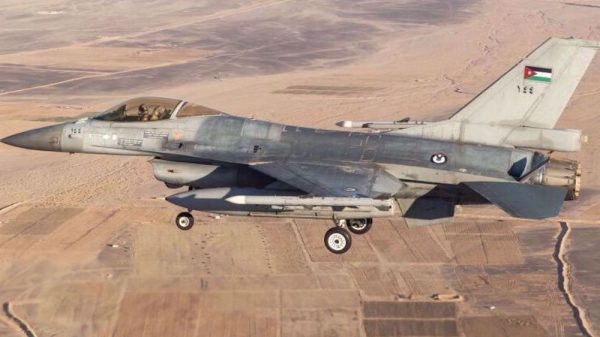
Royal Jordanian Air Force F-16s were used numerous times to intercept drones launched at Israel
Europe’s price
European states paid in a different currency. Most did not expend large numbers of interceptors against Iranian drones, but their involvement carried costs across three main areas: munitions, military operations, and the economic shock of the war imposed on Iran.
France deployed air assets to the region to intercept drones and missiles over the Eastern Mediterranean and the Levant. Some reports suggested that French stocks of air-to-air missiles, including the MICA, came under strain.
Such shortages would be significant, given France’s other military commitments. Its air force and weapons inventories are already stretched across support for Ukraine, operations in the Sahel, and the maintenance of its own strategic deterrent. Each additional deployment reduces the resources available for other missions.
Britain used its bases in Cyprus, including RAF Akrotiri, as well as its military presence in the Persian Gulf, to support operations against Iran. Reports indicated that RAF aircraft intercepted drones and missiles. The British armed forces are considerably smaller than they were at the height of the country’s military power, and sustained operations of this kind consume substantial flying hours, spare parts, and personnel capacity.
Europe’s greatest burden, however, has been economic and political. Closure of the Strait of Hormuz and the collapse of Persian Gulf energy exports drove up oil, gas, and diesel prices.
Europe’s dependence on imported energy meant that the shock quickly fed into household bills, transport costs, and food prices. Many European governments were already grappling with public dissatisfaction over the cost of living before the 40-day war. The war intensified those pressures as is evident now with protests raging across European countries.
European governments that committed military resources to Israel’s defense and offensive operations now face a difficult question: will their own citizens view that commitment as a principled security measure or as complicity in policies that have contributed to worsening economic conditions?
There is no straightforward answer, but the issue has become part of Europe’s domestic political debate. The costs of defending Israel have reached far beyond the battlefield, affecting budgets, energy security, and public confidence in government policy.
Defending the indefensible
The costs of protecting Israel have been substantial, although they have fallen unevenly across the countries involved.
The United States has spent billions of dollars and depleted significant portions of its advanced interceptor stockpiles, with replenishment expected to take years. The Persian Gulf states and Jordan have suffered damage to radar and air defense assets while assuming additional security risks.
European countries have borne the costs of munitions and military operations, alongside an energy shock that has intensified public anger over the cost of living.
Yet the financial figures tell only part of the story. The more fundamental question is whether the policies driving these expenditures serve the interests of the governments and populations bearing the costs.
The costs are real and continue to mount: public expenditure, depleted interceptor stockpiles, damaged radars and military bases, and the heightened risk of retaliation against countries drawn into a war beyond their borders. Meanwhile, rising fuel, food, and housing costs have placed additional pressure on ordinary households, deepening public frustration with government decisions.
Israel’s regional military campaign has drawn its partners further into a confrontation whose consequences extend well beyond the immediate battlefield. For these governments, the challenge is no longer simply how to sustain their support for Israel, but how to justify its mounting costs to their own populations.
The question is how much more they are willing to spend, how much additional risk they are prepared to accept, and how long their citizens will continue to support a policy whose burdens are becoming increasingly difficult to ignore.
Sorry, the comment form is closed at this time.
Featured Video

Racist Seinfeld Dances for Joy as Bibi Unveils His New Map
or go to
Aletho News Archives – Video-Images
TV Drama Review
Japanese drama projects Japan’s wartime atrocities onto Chinese characters

Global Times | October 25, 2026
By portraying Chinese characters as perpetrators of ruthless violence while casting Japanese Self-Defense Forces (SDF) intelligence operatives as defenders, the season 2 of the Japanese drama Vivant has recently drawn criticism from Chinese netizens, who argue that its depiction turns historical reality on its head while ignoring Japan’s wartime atrocities.
The TBS drama series – a spy suspense story in which an alleged unofficial intelligence unit of the SDF operates across the globe — has attracted a passionate fanbase. Its currently airing season 2 opened with a household rating of 18.8 percent, the highest for a TV drama this year, according toa commentary article by Japanese media Toyo Keizai.
What draws attention is the portrayal of the enemies in the series, the article noted. Scenes in which the Chinese organization subjects kidnapped members of the SDF unit to brutal torture are repeated with unrelenting intensity.
It is rare for Japanese TV dramas to explicitly portray a real-life country as the enemy, the article noted.
Japanese Prime Minister Sanae Takaichi also made a reference to the drama, saying that she has been recording Vivant and hopes to binge-watch it over the year-end and New Year holidays, according to Japanese media outlets.
China’s CCTV News report on Sunday revealed that the drama features scenes in which Chinese personnel cut off the fingers of and stab Japanese intelligence operatives in the abdomen. Such acts bear striking similarities to the torture inflicted on Chinese nationals by invading Japanese troops during the World War II.
The drama distorts the truth by attributing these atrocities to modern Chinese characters. Beneath the surface, it subtly glorifies Japan’s cross-border overseas operations, blurs the functional boundaries of the SDF and implicitly promotes an expansionist narrative, per CCTV News. … continue
Blog Roll
 Aletho News
- Up in arms… Koreans reject U.S. empire’s plan to make South Korea the next Ukraine
- Iran, Turkey, Pakistan, Saudi Arabia could advance region-led security framework in Tehran: FM spox
- Netizens condemn Japanese drama for projecting Japan’s wartime atrocities onto Chinese characters
- Racist Seinfeld Dances for Joy as Bibi Unveils His New Map
- A West Bank War for Netanyahu’s Election Campaign, Could It Backfire?
- Yemen denounces European Parliament’s ‘hypocritical’ push to blacklist Ansarullah
- Qalibaf: UAE’s UN bid aims to ‘clear the runway’ for ‘Greater Israel’, whitewash genocide
- Pakistan reopens Iran border after boosting security: Report
- Why are so many Brazilians voting for Flávio Bolsonaro?
- Democrats Put Anti-Russia Agenda Ahead of American Workers
- If Americans Knew
- An error has occurred; the feed is probably down. Try again later.
- No Tricks Zone
- Sudden Stratospheric Warming, Powerful El Niño Combination May Lead To Extreme Europe Cold, Energy Crisis!
- Two New Studies Find Thwaites Glacier Melt Cannot Be Driven By Human Activity Or A Warming Ocean
- E-Cars Reduce CO2 Emissions By Only 41% Compared To Internal Combustion Engine Vehicles
- Predictions Made By Renowned Climate Professor Over Past Decades Have Been Proven To Be Poor
- New Study Suggests Large Regions Of The Pacific Ocean Have Been Cooling For The Last 80 Years
- Germany’s Green Energy Debacle: High Energy Costs Force Kahla Porzellan to Close After 182 Years!
- New Study: 50 Years Of The Most Aggressive ‘Net Zero’ Policies Can Only Affect The Global Climate By 0.03°C
- US September “Heat” Was No Record…Many Records Set Decades Ago
- Latest European Green Energy Debacle; Portugal’s Largest Flagship Solar Park Insolvent!
- Green Energy Debacle: German Expert Professor Fritz Vahrenholt Warns Of Severe Economic And Social Consequences

