UK preparing for war – PM
RT | June 2, 2025
Britain is going on a war footing with the launch of a major rearmament campaign, Prime Minister Keir Starmer said in a keynote address on Monday.
Starmer unveiled his cabinet’s Strategic Defense Review, which includes an expansive armaments program mirroring similar efforts across NATO. Last week, UK Defense Secretary John Healey said London was sending “a message to Moscow” by allocating billions of pounds for new munitions plants, long-range missile systems, and other capabilities. Russia has accused Western nations of using alarmist rhetoric to justify shifting public funds toward military spending.
”We are moving to war-fighting readiness,” Starmer said at a shipyard in Govan, Glasgow, adding that “our defense policy will always be NATO first.” He vowed to transform the UK into “a battle-ready, armor-clad nation with the strongest alliances and the most advanced capabilities equipped for the decades to come.”
According to Starmer, the overhaul will enable Britain to make its “biggest contribution to NATO since its creation.” He also pledged that the country would become “the fastest innovator in NATO,” with defense research operating at a “wartime pace.” The reforms are expected to make the British military “ten times more lethal by 2035,” he claimed.
The prime minister reaffirmed his government’s goal to increase defense spending to 3% of GDP. He framed the effort as replacing the post-Cold War “peace dividend” with a “defense dividend” through the creation of thousands of new jobs in weapons manufacturing, including production of nuclear arms.
Starmer blamed Moscow for what he called a series of provocations, accusing Russia of “menacing” the UK, demonstrating “aggression” in British waters, and “driving up the cost of living here at home,” harming British workers.
Russian lawmaker Aleksey Pushkov has accused the UK of planning an “ice war” with Russia, noting that “there is no difference between the Labour Party and the Conservative Party” in their attitude.
Commenting on Starmer’s pledge to build additional nuclear submarines, Pushkov asserted that no British investments could bring the country to an equal footing with Russia, the US, and China. However, “Starmer needs them [those boats] to report his achievements” to domestic and international players who stand to benefit financially from the project, Pushkov claimed.
‘Brussels hijacked our future’ – Orban
RT | June 1, 2025
Hungarian Prime Minister Viktor Orban has unveiled a proposal to increase the power of EU members and limit the authority of its bureaucracy. Calling it a “patriotic plan” for the bloc, he said in a series of weekend social media posts that it will revive the “European dream.”
The EU elites in Brussels have exploited every crisis to amass more power, Orban claimed in a post on X. This course has so far only translated into less sovereignty for member states and “failed policies,” according to the prime minister. “Brussels hijacked our future” by disrupting public safety through migration and eroding prosperity with “green dogmas,” he stated in another post.
“Europe can’t afford this any longer, it’s time to take back control,” he said.
The PM’s plan is based on what he calls four pillars: a path toward peace on the continent and defusing tensions with Russia, removing Brussels’ “centralized control” over finances, “bringing back free speech” and strengthening Europe’s Christian identity, and tightening control over immigration.
“We want peace, we don’t need a new Eastern front,” Orban said, commenting on his plan and stating that the bloc should not accept Ukraine as a member. “We don’t want our money poured into someone else’s war,” he added.
A military buildup and defense increase actively promoted by some EU nations could easily lock the bloc in an “arms race” with Russia, Orban warned. Such a development would “devour… taxpayers’ money,” he said. Instead of pouring more resources into the military, the bloc needs to contribute to the peace process between Moscow and Kiev, the prime minister maintained, praising US President Donald Trump’s efforts in this regard.
The EU needs to start “arms limitation talks with the Russians as soon as possible. Otherwise, all our money will be swallowed by the arms industry instead of being spent on peaceful… goals,” Orban argued.
European nations once united to create the “safest and the most advanced continent” in the world but this dream was “stolen,” the prime minister charged, calling on EU nations not to allow Brussels to use the Ukraine conflict “as an excuse to take more of our money.”
Trump bracing for a longer Ukraine war
By M. K. BHADRAKUMAR | Indian Punchline | May 30, 2025
One of the mysteries of the Ukraine endgame is that President Donald Trump did not issue an executive order on January 20 withdrawing all support for Ukraine. That would have been the easiest way to end the war.
The conditions were propitious — Candidate Trump didn’t mince words that it was a hopeless war that cost the US dearly in treasure; he thought poorly of President Volodymyr Zelensky as a shameless free rider; he saw the war as impeding his foreign-policy priority of the US’ transition to a multipolar world order; and, he felt no compulsion to inherit ‘Biden’s war’.
But instead, Trump plunged himself with gusto into the Ukraine question, although Washington lacked the means to leverage Russia to compromise on its core interests in what Russian people regarded as an existential war.
Quite possibly, some of Trump’s advisors prevailed upon him to undertake the theatrical diplomatic effort on the basis of a flawed reading of the state of play in the war. Trump believed that western sanctions lethally weakened the Russian economy; that Russia’s casualty figures ran into hundreds of thousands and such a high level of attrition was unsustainable; that Zelensky would sign up on the dotted line; that an improvement in Russian-American relationship would be a ‘win-win’ with massive economic benefits accruing to both sides and so on.
But all these premises turned out to be wrong notions. Putin has steered the economy to a state of permanent western sanctions (which was the Soviet experience, too). Russian entrepreneurs have successfully replaced the fleeing western businesses in the wake of sanctions and will now resist any re-entry by the latter.
Russia’s casualty figures are much lower than the self-serving western estimates put it, as the high level of recruitment to the army suggests. Zelensky is bent on prolonging the war with support from European powers per Biden’s script to ‘Trump-proof’ the war. Europeans not only have a Plan B but have collaborators within the US some of whom may even be in Trump’s team.
Suffice to say, Trump has been on a learning curve, as he began sensing that the Kremlin is determined to realise the objectives it had set for itself (as outlined in Putin’s historic speech last June at the foreign ministry). According to a Reuters report two days ago, “Putin wants a ‘written’ pledge by major Western powers not to enlarge the US-led NATO alliance eastwards — shorthand for formally ruling out membership to not only Ukraine and Georgia and Moldova and other former Soviet republics as well.”
“Russia also wants Ukraine to be neutral, some Western sanctions lifted, a resolution of the issue of frozen Russian sovereign assets in the West, and protection for Russian speakers in Ukraine” — per Reuters.
Europeans will scoff at such demands. Therefore, as things stand, a breakthrough at the Russia-Ukraine peace talks in Istanbul on June 2 seems unlikely. Unsurprisingly, Russia is pressing ahead with an offensive campaign in all directions, throwing in all its forces with a culmination planned for summer or early autumn.
The least bad option
Trump has three options under the circumstances. One is to simply refuse to own responsibility for the war and walk away for good. But then, can Trump deny his own part in it in his first term? While the Trump administration identified its approach to foreign policy as ‘principled realism’, late Joseph Nye’s characterisation of Trump as an “idiosyncratic realist” was perhaps closer to the truth.
The official administration policy on Ukraine during Trump’s first term was a continuation of the policy pursued by the Obama administration. It recognised Crimea as part of Ukraine, condemned Russia’s occupation and eventual annexation annexation of the peninsula; it underscored Russia’s primary responsibility for the instigation, continuation and conduct of the conflict in eastern Ukraine; it even identified the Russian interference in Ukraine as part of a wider pattern of aggression towards other states and as proof of Moscow’s challenge to the fundamental principles of international order.
For these reasons, the Trump administration maintained that the US should help Ukraine to defend itself and should penalise Russia both through sanctions and diplomatic isolation (eg., membership of the G7). Curiously, shades of this thought process resurface even today occasionally in Trump’s Truth Social outbursts. Trump seems unaware he’s carrying a can of worms as his Ukraine legacy.
So, the second option today is to convey Trump’s dissatisfaction over Russia’s perceived intransigence in dictating terms for settlement and its alleged lack of interest in peace talks. Trump even hinted at Russia’s hidden agenda to conquer Ukraine. Trump is hinting at punishing Russia both through sanctions and supplying weapons to Ukraine. German chancellor Friedrich Merz’s provocative announcement of giving long-range weapons to Zelensky was probably green lighted by some people in Trump’s team. After all, Merz is no stranger to Wall Street.
However, this is a recipe for an extremely dangerous NATO – Russia confrontation. If long range German missiles hit Russia, Russia will retaliate in a way that could potentially cripple NATO’s operational readiness in a hypothetical war. Belarus State Secretary of Security Council Alexander Volfovich has said that the Oreshnik missile system is “planned to be stationed in Belarus by the end of the year. The locations for its deployment have already been determined. Work is under way.” The spectre of World War III may seem a bit of a stretch, but Trump will have to consider the dangers of climbing the escalation ladder, which could destroy his MAGA presidency.
Washington has no means to intimidate the Kremlin. The bottom line is, Trump is actually left with only a third option, the least bad option — viz., walking away from the Ukraine conflict at this point and return when the war has been lost and won, possibly by the end of the year. This will not damage Trump’s reputation.
Trump may already be displaying his credentials as ‘peacemaker president’ if the US-Iran talks, which seem to be making progress, results in a nuclear deal. Besides, US-Russia normalisation needs more time to gain traction. Senator Lindsey Graham’s hard-hitting sanctions bill against Russia with 81 co-sponsors in the senate signals that Russia is a very toxic subject in the US domestic politics.
Also, Russia-Ukraine talks is only one track. The Russians have sensitised Trump’s team that while Moscow engages with Kiev, the root cause of the war — absence of a European security architecture — still remains to be addressed, which is something that only Russia and the US can work out jointly. The US shouldn’t shirk its responsibility, being both the original instigator of NATO expansion and sponsor of the Ukraine war.
The reaction by the US special envoy for Ukraine Keith Kellogg has been positive when he told ABC News in an interview that the US understands that it is a matter of national security for Russia that NATO may stop accepting new Eastern European countries into its ranks — ie., not only Ukraine but Moldova and Georgia as well.
Kellogg said he considered the Russian side’s concerns to be justified. He did not rule out the possibility of reaching an agreement during negotiations between the US and Russia. This is a big step forward.
Veto ban would spell the end of EU – Fico
RT | May 30, 2025
The EU’s reported plan to scrap member states’ veto power would spell the end of the bloc and could become “the precursor of a huge military conflict,” Slovak Prime Minister Robert Fico has warned.
Slovakia and its Central European neighbour Hungary have long opposed the EU’s approach to the Ukraine conflict, criticizing military aid to Kiev and sanctions on Russia. Both governments have repeatedly threatened to use their veto powers to block EU actions they view as harmful to national interests.
To bypass the dissent, Brussels is reportedly weighing a shift from unanimous voting, a founding principle of EU foreign policy, to qualified majority voting (QMV), arguing that it would streamline decision-making and prevent individual states from paralyzing joint actions.
Fico, however, condemned the proposal on Thursday during the Conservative Political Action Conference (CPAC) in Hungary.
“The imposition of a mandatory political opinion, the abolition of the veto, the punishment of the sovereign and the brave, the new Iron Curtain, the preference for war over peace. This is the end of the common European project. This is a departure from democracy. This is the precursor of a huge military conflict,” he said.
EU sanctions on Russia currently require unanimous renewal every six months, with the current term set to expire at the end of July. Brussels is also preparing an 18th package of sanctions aimed at tightening restrictions on Russia’s energy sector and financial institutions.
Earlier this month, during a visit to Moscow for Victory Day commemorations, Fico assured Russian President Vladimir Putin that Slovakia would veto any EU-wide attempt to ban imports of Russian oil or gas.
Hungarian Prime Minister Viktor Orban has taken a similar stance. While Hungary has not formally blocked a sanctions package, it has delayed several rounds to extract concessions.
Orban has also warned that removing the veto would strip smaller nations of their sovereignty.
“We want Brussels to show us, as all other member countries, the same respect, not only symbolically, but also by taking our interests into account,” he said last month.
Both Slovakia and Hungary have resisted increased military support to Kiev, with Budapest blocking several key decisions citing concerns over national interests and the potential for escalation. Fico has emphasized the need for peace negotiations over continued military engagement.
UK to step up cyberattacks on Russia and China – minister
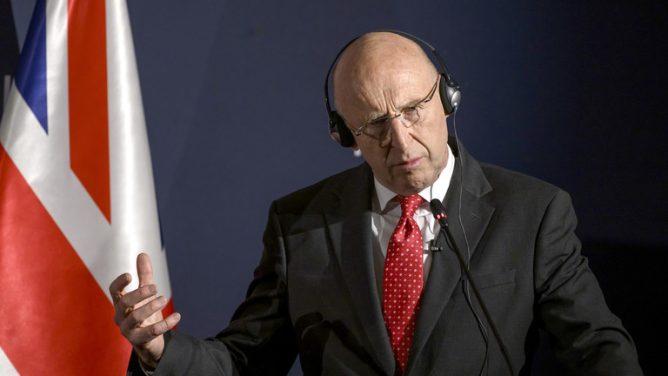
British Defense Secretary John Healey © Getty Images / Antonio Masiello
RT | May 29, 2025
London will significantly step up offensive cyber operations against Russia and China, UK Defense Secretary John Healey announced on Thursday following the inauguration of the country’s new Cyber and Electromagnetic Command.
In a statement quoted by The Times, Healey claimed that “the keyboard is now a weapon of war” and said the UK’s new cyber command would coordinate both defensive and offensive operations, including hacking into enemy systems to disrupt attacks and spread of propaganda.
Asked whether this would include Russia and China, Healey responded: “Yes.”
Healey’s statement marks the first time a British minister has explicitly confirmed cyberattacks on other states. While UK ministers had previously confirmed cyber operations against non-state actors like Islamic State, they have not until now acknowledged attacks against other countries.
Healey’s comments come ahead of the publication of a strategic defense review on Monday. According to The Times, the review will stress that cyberattacks on Britain, allegedly being carried out by Russia and China, are “threatening the foundations of the economy and daily life.”
Both Moscow and Beijing have consistently denied accusations of carrying out cyberattacks against Western nations, characterizing the claims as baseless and politically motivated.
Additionally, Russian officials have in recent months repeatedly raised concerns over what they describe as Western Europe’s continued militarization and aggressive anti-Russian rhetoric, said to be in response to the alleged threat posed by Moscow.
The Kremlin has vehemently denied having any hostile intent towards any western country, and has accused European politicians of “irresponsibly stoking fears” to justify increased military expenditures, which Moscow had labeled an “incitement of war on the European continent.”
Merz vows to block Nord Stream 2
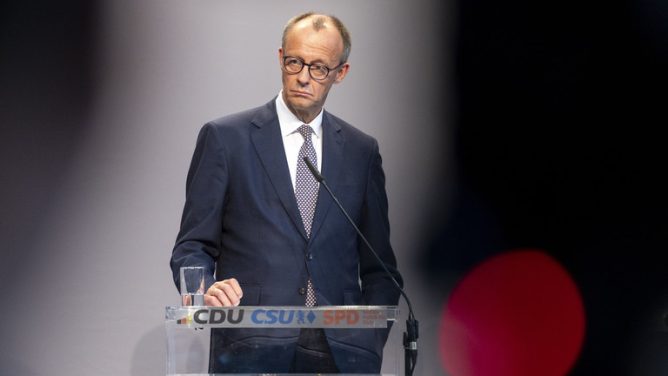
Friedrich Merz, leader of the Christian Democratic Union. © Maja Hitij/Getty Images
RT | May 28, 2025
German Chancellor Friedrich Merz has pledged to do “everything” to prevent the Russian Nord Stream 2 gas pipeline from being launched. The gas inter-connector from Russia through the Baltic sea to Germany was destroyed by a series of underwater explosions in September 2022 in an act of sabotage that Russia believes was orchestrated by Western intelligence agencies.
Merz’s declaration comes as Moscow and Kiev draft respective proposals for bringing about a ceasefire in the Ukraine conflict, following their first direct peace talks in three years in Istanbul.
The talks marked a shift for Kiev, which abandoned diplomatic efforts in 2022 in favor of seeking a military victory on orders from the West. While Moscow has reported progress on its proposal, Ukraine’s Vladimir Zelensky and his EU backers have accused Russia of stalling.
During a joint press conference with Zelensky in Berlin on Wednesday, Merz vowed to “further increase pressure on Russia” and “weaken Moscow’s war machine” through sanctions, including on Nord Stream 2.
“I say on behalf of the Federal Republic of Germany, we will do everything in this context to ensure that Nord Stream 2 cannot be put back into operation,” he stated. He claimed that the measures aim to “pave the way for negotiations,” despite Moscow’s repeated criticism of Western sanctions policy.
European Commission President Ursula von der Leyen said earlier this month that Brussels had planned an 18th sanctions package to include measures aimed at Nord Stream 2 AG, the Swiss-based entity that owns the pipelines, and any other companies necessary for their restart and operation.
Media reports have claimed that Merz has supported the move and that he has opened talks in Berlin and Brussels to prevent any revival of energy trade with Russia.
A number of European officials have opposed targeting the pipelines. Florian Philippot, a prominent French Euroskeptic, has warned that such a move would amount to a “death sentence” for European industry. Michael Kretschmer, the prime minister of the German state of Saxony, has argued that “Nord Stream is a possible opening for a conversation with Russia,” adding that such talks would benefit Germany as its economy needs Russian gas supplies to function normally.
Earlier reports have also claimed that Russia and the US were exploring ways to resume shipments through the still-intact line of Nord Stream 2.
Sanctions as Self-Harm: The West’s Strategic Blind Spot in Confronting Russia
By Ricardo Martins – New Eastern Outlook – May 28, 2025
This article critically analyzes the latest EU sanctions on Russia, arguing they are strategically flawed and economically self-destructive. Drawing from past failures, it shows how the West’s punitive measures are backfiring, hurting Europe and the U.S. more than isolating Russia.
What is the New Sanctions Package About?
The EU has unveiled a new sanction package targeting Russia, predominantly focusing on the energy sector, specifically oil and diesel exports. This builds upon earlier restrictions intended to cripple Russia’s economic capacity to sustain its military operations in Ukraine. The new sanctions include tighter enforcement mechanisms on the oil price cap, restrictions on ship-to-ship transfers in international waters, and efforts to curtail Russia’s access to Western insurance and logistics networks. But like the previous measures, they raise a fundamental question: Will they work?
The Status of Past Sanctions: Buying While Punishing
Historically, sanctions against Russia have been inconsistent and riddled with loopholes. Despite strong rhetoric, Europe has continued purchasing Russian commodities under various exemptions. The EU still imports significant quantities of Russian diesel, liquefied natural gas (LNG), coal, uranium, and even agricultural products like grain and fertilizer. The result is a paradox: while aiming to isolate Russia, the West remains economically entangled with it. This undermines the moral and strategic coherence of sanctions and allows Russia to adapt and thrive despite Western pressure.
Sanctions Hit Europe More Than Russia
While sanctions are theoretically aimed at weakening Russia’s economy, the practical consequences have disproportionately hit European industries and households. Russian exports are fungible: oil, coal, and fertilizers find alternate markets in Asia, Africa, and Latin America. Meanwhile, Europe has struggled with soaring energy prices, industrial shutdowns, and declining competitiveness. Diesel shortages, energy rationing, and inflation have become the new norm, particularly in Germany, which once depended heavily on Russian inputs for its industrial base.
Russia, by contrast, has localized production, developed new markets, and implemented mercantilist strategies to reduce dependence on Western technology and finance. As one Russian analyst put it, sanctions have become “psychological warfare,” increasingly irrelevant to daily life in Russia.
Oil and Diesel: The Inflation Time Bomb
The crux of the new sanctions is oil and diesel. But can the U.S. and EU afford to forgo Russian, Venezuelan, and Iranian crude without catastrophic inflation? The answer appears to be no.
Russia exports about 7.5 million barrels of oil per day, or nearly 10% of global supply. Taking that offline—especially in conjunction with sanctioned Venezuelan and Iranian oil—would create a massive global shortfall. Western refineries, particularly in the U.S. Gulf Coast, are calibrated to process heavy sour crude like Russia’s Urals blend. Without it, refineries operate suboptimally, and gasoline prices spike.
In the U.S., diesel drives nearly all logistics trucks, trains, and ships. Removing a major global supplier like Russia tightens global supply, causing diesel prices to surge and supply chains to buckle. Already, diesel refills for trucks cost over $2,000, with potential spikes threatening food prices and consumer goods. Inflation will soar again, just as it had started to cool.
Baltic Sea Escalation: Tankers and Arrests
The geopolitical tension is intensifying. Russian oil tankers, often flagged under third countries, are now escorted by Russian naval vessels in the Baltic Sea. An incident involving an Estonian ship attempting to halt a tanker, which ended up detained in Russian waters, demonstrates the volatility of the situation. This marks a dangerous escalation, with the potential for military clashes over enforcement of maritime sanctions—an area traditionally governed by international law, not unilateral action.
Western Industrial Decline: No Shipyards, No Leverage
Sanctions enforcement is further complicated by Western logistical decline. The U.S., Britain, and France have largely lost their shipbuilding industries. Insurance and shipping markets have globalized, and London no longer dominates maritime underwriting. Russian entities are increasingly self-insuring their fleet, rendering sanctions on Western insurers irrelevant.
Furthermore, without a domestic merchant marine, the U.S. relies on foreign ships even for military logistics—a vulnerability in any prolonged conflict. Meanwhile, China and Russia continue expanding their shipping capabilities and influence over global supply routes.
The Legal Quandary: Sanctions and Sovereignty
From a legal standpoint, unilateral sanctions that attempt to compel third-party countries to comply (so-called secondary sanctions) strain the legitimacy of the “rules-based international order.” It is lawful for the West to impose its own sanctions, but not to mandate their enforcement by sovereign nations like India or Brazil. Such overreach risks global backlash and accelerates moves toward de-dollarization and alternative trade systems, such as the BRICS currency initiative.
Is the EU Addicted to Sanctions?
The EU appears increasingly reliant on sanctions as a primary foreign policy tool. Yet, their efficacy is questionable. Past sanctions have not altered Russian behavior, destabilized its economy, or improved Western leverage. Instead, they’ve fostered economic nationalism in Russia, weakened EU industries, and exposed the strategic shallowness of Brussels and Washington’s policies.
Sanctions are not a strategy; they are a tactic. And overuse risks turning them from a deterrent into a diplomatic crutch—one that Europe may not survive intact if economic pain continues to mount.
Conclusion: A Strategy of Self-Harm
Sanctions as Self-Harm: The West’s Strategic Blind Spot in Confronting Russia
In sum, the latest sanctions package is more of the same: punitive in intent, performative in practice, and counterproductive in outcome. The West, particularly Europe, will likely bear the brunt of energy shortages, inflation, and industrial decline. Meanwhile, Russia’s diversified exports, strategic alliances with China and India, and robust internal adaptation mechanisms render sanctions increasingly futile.
History has shown that attempts to isolate Russia through economic pressure are not only ineffective—they risk reinforcing the very state structures they aim to dismantle. Unless sanctions are part of a broader diplomatic and economic strategy, they will continue to hurt the sanctioning powers more than their target.
Ricardo Martins ‒PhD in Sociology, specializing in policies, European and world politics and geopolitics
EU has isolated itself, not Russia – Luxembourg MEP
RT | May 28, 2025
Luxembourg MEP Fernand Kartheiser has argued that the EU’s confrontational approach to Russia during the Ukraine conflict has led to its own isolation.
The lawmaker made the remarks in an interview with RT released on Tuesday while on a trip to Russia that he was forced to fund personally due to the European Parliament’s restrictions.
“Some people in the European Parliament… have an attitude toward Russia that identifies it as a big threat,” Kartheiser said. “They think that if we put pressure on Russia and isolate it diplomatically, that might help to find solutions in the context of the conflict in Ukraine… it is not the discussion that we should have.”
Kartheiser noted that the entire EU approach toward the Ukraine conflict and Russia has been counterproductive.
“What we have now internationally is that basically everybody talks to Russia. We even have the US coming back and having high-level contacts… the anti-Russia stance is diminishing,” he stated. “So this policy of isolation of Russia basically has failed. The only ones who are isolated in a way are the EU itself.”
The lawmaker’s visit to Moscow at the invitation of the Russian State Duma aimed to discuss bilateral relations and the situation in Ukraine. The visit, however, drew criticism from hawkish EU lawmakers. The European Conservatives and Reformists group threatened to expel Kartheiser, claiming he had “crossed a red line.” The MEP called the threat “a regrettable part of the picture” and lamented that some EU lawmakers remain opposed to re-engaging with Moscow.
“The discussion that we should have is what kind of relationship do we want with Russia in the future? We have to open the dialogue again. That is most important,” he said, adding that there are politicians whose opinions towards Russia are shifting, while many ordinary Europeans would also like to see ties restored.
The MEP emphasized that if the EU “wants to be taken seriously as an actor in international relations,” it must abandon the anti-Russia policy and “have some kind of relationship” with the country again.
“If we, Western Europeans, are expected to take a larger responsibility for our own security, one way to assure this is by negotiating an agreement with Russia, ensuring at the same time our security as Western Europeans and guaranteeing the security of Russia’s western border. So, negotiation and diplomacy before rearmament and arms race,” he concluded.
EU state blasts Germany over Russia threats
RT | May 28, 2025
Slovakia will not be bullied into changing its foreign policy, Prime Minister Robert Fico has said, calling German threats to cut EU funding due to its stance on Russia “aggressive and unacceptable.”
Fico’s remarks came in response to German Chancellor Friedrich Merz, who said member states that resist the EU’s policies on Russia could face financial consequences.
“Member states that violate the rule of law can be confronted with infringement proceedings,” Merz warned at the WDR Europaforum in Berlin on Monday. “There is always the option of withdrawing European funds from them.”
Merz mentioned both Slovakia and Hungary in response to a question about countries resisting the EU’s policies on sanctions and military aid for Ukraine.
Fico hit back at Merz. “Slovakia is not a little schoolchild that needs to be lectured,” he said on Tuesday on X. “Slovakia’s sovereign positions do not stem from vanity, but are based on our national interests.” He added that “the politics of a single mandatory opinion is a denial of sovereignty and democracy.”
He went on to describe Merz’s remarks as “aggressive” and an indication that “we are not heading into good times.”
“The words of the German Chancellor are absolutely unacceptable in modern Europe. If we don’t obey, are we to be punished? This is not the path toward cohesion and cooperation,” Fico said.
Since returning to office in 2023, Fico has halted Slovak military assistance to Ukraine and has been critical of Western sanctions on Russia. He has also called for economic ties with Moscow to be rebuilt once the conflict with Kiev is over. Late last year, he became one of the few Western leaders to meet with Russian President Vladimir Putin to discuss energy supplies to Slovakia, which were jeopardized by Ukraine’s refusal to extend a gas transit agreement.
On Monday, Merz also said Ukraine’s European backers are no longer restricting the country from launching long-range strikes into Russia using Western-made weapons, later adding that the decision was made months ago. Ukraine’s Vladimir Zelensky, however, said he had not received the go-ahead, while suggesting that it could happen later.
Responding to Merz, Kremlin spokesman Dmitry Peskov warned of a “serious escalation,” adding that the potential move “severely undermines attempts for a peaceful settlement” of the conflict.
German Chancellor Merz threatens to cut EU funding for Hungary and Slovakia

By Thomas Brooke | Remix News | May 27, 2025
German Chancellor Friedrich Merz has warned that the European Union could withhold even greater funds from Hungary and Slovakia if they refuse to adhere to the values imposed upon member states by Brussels.
Speaking at the WDR Europaforum on Monday, Merz said, “Member states that violate the rule of law can face infringement procedures, and there is always the possibility of withdrawing European funds. If necessary, we will take care of it.”
“We cannot allow the decisions of the entire EU to depend on a small minority,” he added, in a thinly veiled attack on the nationalist-led governments in Bratislava and Budapest. Both countries have already seen parts of their EU funding frozen over legal and political disputes with Brussels.
His remarks come as Hungary faces renewed criticism over a bill targeting foreign-funded NGOs and media, while Slovakia, under Prime Minister Robert Fico, has raised alarm in Brussels following his recent visit to Moscow and long-held opposition to further European intervention in the Russo-Ukrainian conflict.
Following the trip, Brussels ramped up pressure on Slovakia with the arrival of a delegation of Members of the European Parliament from the Committee on Budgetary Control (CONT), led by Czech MEP Tomáš Zdechovský, to investigate alleged misuse of European subsidies.
Slovak Interior Minister Matúš Šutaj Eštok has dismissed the delegation’s visit as a politically motivated “punitive expedition” orchestrated by Brussels, accusing Eurocrats of defamation. “A carefully selected group is coming here with the aim of presenting Slovakia in Brussels as a black hole on the map of Europe,” he claimed.
Skepticism over Brussels’ approach to the war in Ukraine has been a point of contention in Hungary and Slovakia for the duration of the conflict, and Merz expressed his intention to advocate for punitive measures against the two member states should they seek to block European support to Kyiv.
“We will not be able to avoid this conflict with Hungary and Slovakia if we continue on this course,” Merz said.
Last month, Hungarian Prime Minister Viktor Orbán accused Brussels of conspiring with his country’s political opposition to bring about a change in government, remarks made after Hungarian left-wing MEP Kinga Kollár acknowledged the devastating effect that the withholding of EU funds for Hungary has caused, caveating her remarks by stating that “the deteriorating standard of living has actually strengthened the opposition and I am very positive about the ’26 elections.”
“They agreed to destroy the Hungarian economy, the Hungarian healthcare system, and to destroy the living standards of Hungarians, in order to help the Tisza party come to power,” Orbán said of the European Commission.
In response to Merz’s remarks, Hungarian Economy Minister Márton Nagy said on Monday that Budapest should reconsider its overdependence on trade with Berlin.
How Peace-Oriented Norway Learned to Stop Worrying and Love War
By Prof. Glenn Diesen | May 26, 2025
Norway identifies itself as a model of a liberal and tolerant peace-oriented nation. Yet, a collective mindset has developed with intense distrust and loathing of anyone who deviates from the government’s official truth and war narratives.
Here is a social experiment to test the claim above. I am a professor of political science, but I am also a politician running for Parliament. My recently established political party is primarily an anti-war party, and we started a poster campaign on public transportation in Oslo. The core message was that we are for negotiations and against weapons for the war in Ukraine. This seemed like a reasonable position as Norway previously had a policy of not sending weapons to countries at war (as it escalates and can make us a participant), and our country used to advocate for diplomacy and negotiations as the path to peace. Norway has abandoned these policies and unified under the new mantra that “weapons are the path to peace”, and we have boycotted basic diplomacy with Russia even as hundreds of thousands of young men died in the trenches. Was our peace-oriented nation ready to at least consider the argument that we should return to our former policies of negotiating instead of fueling the war with more weapons to fight the world’s largest nuclear power?
The country lost its collective mind… Politicians called it a dangerous Russian influence operation. I had taken the side of Russia in supporting the invasion. I am an agent for Russia spreading Russian propaganda. It was argued that the national intelligence services should get involved, as I am likely financed by the Russian state. Soon thereafter, the national intelligence agency, PST, reassured the public that they are looking into people who may, at the behest of a foreign power, attempt to make Norwegians critical of the government’s policies on sending weapons to Ukraine.[1] Almost every media outlet in the country framed the issue on the premise that I am “pro-Russian” and “anti-Ukrainian”. People began tearing down the posters, and some compared their political vandalism with liberating the country from Hitler during the Second World War. People were intoxicated with self-righteousness and moral superiority as the tribe united in virtue and the fight for freedom. Their hatred of the evil “other” was celebrated as evidence of their righteousness as they formed a resistance against us, fascist agents of Russia who support the destruction of Ukraine and would like to see Russia conquer Europe.
At this point, it should be noted that I consider myself a friend of Ukraine. I have warned against war in Ukraine for the past 20 years, and I have obviously not supported the invasion of Ukraine. Much like many political leaders across the West have argued over the past 30 years, I believe that NATO expansion triggers a security competition and eventually war, much like it would if Russia established its military infrastructure in Mexico. My argument is that Russia considers NATO expansion an existential threat and responds based on these convictions, irrespective of NATO not agreeing with Russia’s threat assessments. I therefore argue for diplomacy and against sending weapons, as it will only escalate the war, destroy Ukraine, and take us closer to nuclear war.
I consider this to be a pro-Ukrainian position and a pro-Western position, to speak in the language of my tribal countrymen who do not care for arguments about security competition. It should be noted that our own Prime Minister argued after the Russian invasion that it was “out of the question” to send weapons, yet this position has since been criminalised and reserved for agents of Russia. I discovered that my position is not sufficiently anti-Russian, since I believe the broken security architecture is the source of the war, and the discourse in Norway is reduced to basic tribal loyalties of picking one side or the other. Norwegian society only tolerates arguments that are based on the premise that we are not to blame and our solidarity must be based on condemning the “other”. The premise of an “unprovoked invasion” is therefore sacred. Consequently, enhancing our security by mitigating the security competition with Russia is impossible, as we are not allowed to discuss Russian security concerns. War predictably becomes the only path to peace.
The political campaign resulted in a televised public debate where our former defence minister / foreign minister was represented on the other side. In what resembled a show from Jerry Springer rather than a debate, her tactic was to be condescending and accuse me of being a propagandist for Russia. Whatever could have resembled an actual argument was premised on the idea that I am “pro-Russian”, while the government is “pro-Ukraine”. My dissent was thus a threat to national security. The purpose was never to discuss whether Russia is pursuing an empire or responding to what it considers to be an existential threat, and the purpose was certainly not to discuss whether weapons and boycott of diplomacy are the path to peace.
Then the media, functioning as a branch of government, stepped in to “fact-check” the debate. Or more precisely, the media only “fact-checked” one side, while the obvious lies told by our former defence minister / foreign minister went unchecked. Also, the “fact-checkers” were more like narrative checkers, as I was accused of “using several arguments that fit Russia’s most important narratives about the war in Ukraine”.[2]
The more dishonest media never bothered to check the facts supporting my arguments, and instead approached “fact-checking” by picking one ambiguous source to conclude I am not reliable. For example, I made the argument that Boris Johnson sabotaged the Istanbul peace agreement at the behest of the US and UK, yet the newspaper then only picked Davyd Arakhamia as an ambiguous source. Why did they not mention the two mediating sides, the Turkish (the foreign minister and President Erdoğan) or the Israeli (former Prime Minister Bennett), who confirm the negotiations were sabotaged to use Ukrainians to weaken a strategic rival? Why did they not cite the former head of the German military, General Kujat, who says the same? Why not reference interviews with American and British leaders who argued that the only acceptable outcome was regime change in Moscow? Why did they not cite the words of Boris Johnson himself as he expressed his disdain for the negotiations and warned against a “bad peace”?
The more honest media had the decency to at least publish the facts I presented, although they still had to muddy the waters. For example, I argued that the West knew that we backed the coup in Kiev in 2014 and pushed NATO expansion, despite knowing that only a small minority of Ukrainians (about 20%) wanted NATO membership and despite knowing it would likely trigger a war. The evidence cannot be disputed, so the fact-checker argues the Ukrainians were “ignorant” of NATO’s mission and had been propagandised, and points out that after the Russian invasion, there has been a majority support. This information and these claims have absolutely nothing to do with the argument that we knew only a small minority wanted NATO membership in 2014, and we knew it would likely result in war. All the “fact-checking” was intended to discredit.
The considerations of the rational individual have been defeated in Norway by the tribal mindset and groupthink. The government’s policies and war narratives represent virtue and truth, and all opposition is thus immoral and deceptive. The premise of every argument from politicians and their stenographers in the media was that they were on the side of the innocent Ukrainian victim, and I represented the evil Russian aggressor. There is no interest in engaging with arguments; rather, there is an obsession with exposing the hidden evil intentions of their opponents. Toward this end, anything is permitted in the “good fight”. The national intelligence services warned, with a not-so-subtle hint to me, that they are aware of efforts to polarise the public. Not only is it completely unacceptable for me to enter Parliament as I allegedly represent Putin, but my employment as a professor at a Norwegian university is also problematic, as I repeat “Russian narratives. How did Norway become authoritarian and gung-ho about war?
The Propagandised Norwegian
I will write here about “the Norwegian”, the collective national consciousness that serves the purpose of overwhelming the rational individual. Sigmund Freud famously recognised that the individual is rational, although human beings are also influenced by an irrational group psychology. Human beings have throughout their entire history organised in groups for security and meaning, and adjusting to the group is one of the dominant instincts in human nature. Carl Jung famously wrote about the limits of reason: “Free will only exists within the limits of consciousness. Beyond those limits there is mere compulsion”.[3]
The key component of group psychology is to divide individuals into “us” (the in-group) and the “other” (the out-group). When human beings are exposed to uncertainty and fear, there is an instinct to demand internal solidarity and denounce the out-group. Authoritarian tendencies tend to thrive when exposed to external threats.
The literature on political propaganda originates primarily from Edward Bernays, the nephew of Sigmund Freud, who built on his uncle’s work. Bernays recognised that manipulating the stereotypes of what represents “us” and the “other” diminishes the relevance of objective reality and the considerations of the rational individual. When we use military force, is it for freedom, and when our adversaries do the exact same thing, it is to advance empire and destroy freedom. The core of propaganda is therefore to present the world as good versus evil, and as superior versus inferior. The Western political propaganda that previously framed the world as the civilised versus the barbaric has been recast as the struggle of liberal democracy versus authoritarianism. If the public accepts this basic premise, the complexity of the world is simplified and dumbed down to the extent that dissent is immoral and dangerous. All that matters then is that you display loyalty to the in-group.
Walter Lippmann famously argued that political propaganda had the benefit of mobilising the public for conflict, yet it had the disadvantage of preventing a workable peace. When the public has bought into the premise that they are in a struggle between good and evil, how could they accept mutual understanding and compromise? The propagandised public reaches the conclusion that peace depends on the good defeating the evil. In almost every conflict and war of the West, the opponent is presented as a reincarnation of Hitler, and the Western political-media establishment lives perpetually in the 1930s as negotiations are appeasement and war is peace. This is profoundly problematic as the first step in reducing the security competition is recognising mutual security concerns.
Carl Schmitt, the scholar from Hitler’s Nazi Party, argued that organising politics along the friend-enemy binary also enabled governments to purge dissent. Schmitt’s concept of the enemy within strengthens political unity by purging those who do not display in-group loyalty and fail to conform to the beliefs and behaviour of the social order. The Norwegian has now experienced a decade of non-stop obsession with the Russiagate Hoax, Covid and then the Russian invasion of Ukraine. The fear and the search for enemies within to purge has exhausted the rational individual. We have now outsourced our critical thinking to the government and seek comfort in Orwell’s two-minute hate, in which we join the media-fuelled moral outrage against the enemies of the state. The moral indignation gives safety, meaning and unity.
The problem is spreading across Europe. In France, the main opposition leader has been arrested in what is seemingly a politically motivated attack. In Germany, the largest political opposition party has been labelled an “extremist organisation”, which enables the intelligence agencies can go after members. It is likely also a first step to banning the opposition party. In Romania, the election results in the presidential election were cancelled, and the winner was not allowed to run again. In the do-over of the Romanian elections, France and the EU were accused of interfering in the election to make sure the Romanians would [not] vote the wrong way again. Interference in Moldova and Georgia was also done under the banner of defending democracy from Russia. The irony is that the internal solidarity of the West as a “liberal democratic community” is, to a large extent, reliant on the Russian “other” playing the role of the bogeyman, which creates the groupthink that tears away at the liberal character of the West.
People tend to exaggerate what they have in common with the in-group, and exaggerate the differences with the out-group. The Norwegian has some contempt for America when compared with Norway, especially when they vote the wrong way. The Norwegian can, for example, not understand why the Americans would vote for Trump. This is because the Norwegian does not actually know why Americans voted for Trump, since the Norwegian media functioned as a campaign manager for Joe Biden and Kamala Harris. It is common to portray Americans as stupid, aggressive, and under Trump, it is not uncommon to introduce the word fascism. However, when in conflict with Russia, the American transforms into the in-group. With the simplistic division of good versus evil, the American is cast as the good guy. The US has a security strategy of global primacy, yet the Norwegian is suspicious of arguments that the US security strategy does not consist of advancing liberal democratic values. By extension, NATO is a “force for good”, and you would not question it unless you are seeking to sow divisions to undermine our goodness. NATO occupied Afghanistan for 20 years in a strategic part of Central Asia so small girls would be allowed to go to school, Libya and Syria were destroyed to defend human rights, and the expansion of the military bloc is solely motivated by the goal of offering protection to other peoples. Moscow could not possibly think the US would ever attack Russia, while ignoring the current proxy war and the continuous talk of possible wars with Iran and China. The Norwegian must refer to NATO as a defensive alliance even whilst it is bombing countries that never threatened a NATO country. Leading NATO countries are now complicit in genocide in Gaza, yet the benign liberal democratic identity we have assigned to ourselves is impervious to reality. If you criticise the West, it is not because you advocate for course correction, but because you stand with our enemies.
The Norwegian as a Moral and Liberal Authoritarian
Liberalism is renowned for having an internal contradiction that must be managed. Liberalism is based on tolerance to accommodate the rights of the individual to deviate from the group, yet liberalism is also based on the assumption of universalism in terms of all societies conforming to the liberal ideals.
The Norwegian accepts that all people are different and tolerate diversity, yet his liberal convictions are universal and more developed in Norway, others must thus follow the same path. We are all equal, but some are more equal than others. The Norwegian has embraced liberal principles such as mass immigration, radical secularism, gay marriage, gender ideology and humanitarian wars, and will ostracise and crush anyone who does not follow the same conviction. For example, believing that marriage is between a man and a woman was an acceptable opinion 15 years ago, but today it makes you intolerant and there is no tolerance for your intolerance. The Norwegian politician may not know the first thing about China, with its thousands of years of history and population of 1.4 billion, yet the Norwegian politician has a remarkable confidence in knowing exactly how China should be run as a country.
The Norwegian has been trained to speak in the language of morality to suppress factual discussion. Framing all arguments as moral implies that the opponents are immoral. Critical debate and open debate suffer as rational arguments, and nuance is replaced with moral righteousness and condemnations.
“Helping Ukraine”
The good versus evil premise that cannot be contested is that the Norwegian government is on the side of Ukraine, it is “pro-Ukrainian”, it “supports” and “helps” Ukraine. In contrast, dissidents such as myself who criticise the government’s policies are “anti-Ukrainian” who legitimise or support the invasion in solidarity with Russia. For the Norwegian, even a democratic debate between the two sides is morally repugnant as it gives voice to Russian propaganda.
I usually counter the false premise by arguing that NATO’s “help” entailed supporting the toppling of Ukraine’s government in 2014, which did not have the support of the majority of Ukrainians or their constitution. This was largely done to “help” Ukraine join NATO, but only about 20% of Ukrainians wanted NATO in 2014. The US merely “helped” when it took control over key governmental positions in Ukraine and had to rebuild Ukrainian intelligence services from scratch as an ally against Russia, from the first day after the regime change in 2014.
When 73% of Ukrainians voted for the peace platform of Zelensky in 2019, NATO decided to “help” destroy the popular peace mandate as it represented “capitulation”. Nationalists, supported by the “NGO” Ukraine Crisis Media Centre, presented “red lines” that Zelensky was not allowed to cross.[4] Zelensky had his life threatened repeatedly and publicly if he dared to cross these red lines, and he eventually abandoned his peace mandate. Several Western governments, including the Norwegian government, finance this “non-governmental organisation”.[5] There is an abundance of evidence that the US sabotaged the Istanbul peace negotiations in April 2022 and wanted a long war that uses Ukrainians to bleed Russia, yet the proxy war is fought under the banner of solely “helping” Ukraine. Criticising the idea that NATO, the world’s largest military alliance and an important instrument to advance US global hegemony, is solely preoccupied with helping Ukraine, is a key premise that cannot be challenged. Anyone attempting to question it is met with vicious attacks and accusations of standing with the enemy.
To ensure that the groupthink is managed, “democratic institutions” such as government-funded NGOs are tasked to herd the masses. The government-funded Norwegian Helsinki Committee, another “non-governmental organisation”, is also financed by the US government and the National Endowment for Democracy (NED). Reagan and the CIA Director established NED in 1983 as a “human rights organisation” to manipulate civil society in other countries. It is an ideal propaganda arm for the government, as competing power interests in the world and subsequent conflicts can be sold to the public as a struggle between good and evil. The Norwegian Helsinki Committee, a government-financed “non-governmental organisation”, writes regular hit-pieces on me, smears me non-stop on social media as a Putin-propagandist, attempts to cancel my invitations to speak, and attempts to have me fired by always shaming the university for giving me credentials that I allegedly abuse to spread propaganda. This includes calling and sending letters to the university. I must hide my address and phone number as the public is regularly told I am “anti-Ukrainian”, while an employee at this “human rights organisation” posted a picture of the sales advertisement of my house on social media. The leader of this NGO that has spent more than four years to smear, intimidate, censor and cancel me explained to the media that it was done as a nice gesture to help me sell my house. When I compared their intimidation to the intimidation of the brownshirts at universities, the scandal was that I compared this virtuous “democratic institution” to the brownshirts.
The Norwegian as a Sociopath
The rational individual is humanistic, but the collective consciousness of the Norwegian has taken on sociopathic traits with a lack of empathy, chronic lying, deceit, aggression, irresponsibility, and an absence of remorse.
The Norwegian is taught to express empathy for Afghans when it justifies occupation, Syrians when it justifies regime change, Libyans when it justifies military intervention, etc. However, once the strategic objective is achieved, there is no attention or empathy expressed. As we leave behind death and destruction, there is no remorse, as our alleged intentions were good. In Ukraine, the Norwegian is taught to have great empathy when it comes to advancing the war efforts. In contrast, the Norwegian will react with suspicion and anger if anyone mentions the suffering of the people in Donbas over the past decade, “military recruiters” dragging people off the streets and out of their homes, the attacks on the media, the denial of political rights, language rights, cultural rights or religious rights. The empathy for Ukrainians is instrumental, it is evoked or suppressed based on the purpose it serves.
Ukrainians who want to fight the Russians make the headlines, while Ukrainians such as former Western-backed presidential candidate Yulia Tymoshenko have disappeared from the media after she accused the West of using Ukrainians to weaken Russia. Ukrainians who fail to play the role of wanting to fight to the last man are also met with suspicion and should not be allowed to speak on behalf of their country. The narrative must be defended from facts, and in the good fight, it is virtuous to lie and deceive. Irresponsibility is now framed as being principled, as, for example, Russia’s nuclear deterrent must be referred to as an unacceptable nuclear blackmail that must be rejected. Insisting on continuing to fight a losing war in which Ukrainians lose more men and territory every day is “pro-Ukrainian”, because the alternative is a Russian victory that is “pro-Russian”. The deeper the belief in the righteousness of the cause, the easier it becomes to love the war that serves it.
[1]
PST snakker om utenlandsk påvirkning etter FOR-debatten
[2]
Faktasjekk: Partiet Fred og rettferdighet (FOR) og russiske påstander om krigen i Ukraina
[3] Jung, C.G., 1973. Letters 1: 1906-1950. Princeton University Press, Princeton, p.227.
[4]
[5]
Featured Video
Deception – Submarines against Olof Palme
or go to
Aletho News Archives – Video-Images
From the Archives
Woolsey Fire started at Santa Susana Field Lab — where “radioactive materials released were never accurately measured”
By John Laforge | CounterPunch | November 30, 2018
In my Nov. 16 column, I reported on potential radiation risks posed by California’s Woolsey wildfire having burned over parts or all of the Santa Susana Field Laboratory—south of Simi Valley, Calif., 30 miles outside Los Angeles—site of at least four partial or total nuclear reactor meltdowns.
The field laboratory operated 10 experimental reactors and conducted rocket engine tests. In his 2014 book Atomic Accidents, researcher James Mahaffey writes, “The cores in four experimental reactors on site … melted.” Reactor core melts always result in the release of large amounts of radioactive gases and particles. Clean up of the deeply contaminated site has not been conducted in spite of a 2010 agreement.
Los Angeles’s KABC-7 TV reported Nov. 13 that the Santa Susana lab site “appears to be the origin of the Woolsey Fire” which has torched over 96,000 acres. Southern Calif. Public Radio said, “According to Cal Fire, the Woolsey Fire started on the afternoon of Thursday, Nov. 8 … on the Santa Susana site.” … continue
Blog Roll
 Aletho News
- Brussels cannot say where its own pipeline inspectors are as Hungary’s oil lifeline remains shut
- Israel’s Iran War: Myth and Reality
- Between war and industrial breakdown: The US-Israeli attrition crisis
- Pressure builds on Iran to ‘drop’ Lebanon ceasefire demand as Islamabad talks hang in balance
- In another clash report, US denies agreement to release Iran’s assets
- What is fueling unrest across the EU?
- Why no power can undermine Iran’s eternal dominance over the Strait of Hormuz
- Is The War Against Iran Over?
- Iran war will leave long-term ‘scar’ on Wall Street, investors warn
- How Iran decimated US power projection in West Asia: Military lessons of 40-day war
- If Americans Knew
- Mearsheimer reveals how Israel dictates US policies on Iran, Gaza – video
- After killing 350+, Israel still has a “score to settle” with Lebanon before ceasefire – Daily Update
- Military aid to Israel emerges as the latest political litmus test for Democrats
- The only Palestinian children’s rights organization closes following years-long Israeli campaign against it
- ‘I Can’t Forget the Smell’: Lebanese Reel After Israel Kills Over 300 in Single Day
- DNC Shoots Down Resolutions Calling Out AIPAC and Limiting Arms to Israel
- TCN: Is Israel Blackmailing President Trump?
- Israel killed at least 303 Lebanese yesterday – who were they? Daily Update
- Amnesty: Urgent – Protect Lebanese civilians from brutal escalation in Israeli attacks
- Is The War Against Iran Over?
- No Tricks Zone
- German Expert: Heat Dome Led To Record Temps In Western USA…Warmer In 1934, 1936
- New Study: No Linear Warming Or Glacier Retreat Along Northern Antarctic Peninsula Since 1980s
- An Inconvenient Tree: Uncovered In Alps… Europe Much Warmer Than Today 6000 Years Ago
- New Study Reports A 60% Slowdown In Greenland’s Ice Loss Rate In The Last Decade
- Low Intensity Tornado Wrecks Major Solar Farm, Creating A Potential Toxic Dump
- New Study Finds Warming Saves Lives…Cold Temperatures 12 Times More Deadly Than Excess Heat
- German Science Blog Accuses PIK Climate Institute Of Hallucinating Climate Tipping Points
- Devastating Assessment Of Comirnaty Vaccine By Former Senior Pfizer Europe Toxicologist
- New Study: CO2 Is ‘Effectively Negligible’ As An Explanatory Climate Change Factor Since 2000
- Former Pfizer Toxicologist Dr. Helmut Sterz Tells Bundestag Hearing Pfizer Vaccine Should Have Never Been Approved
 Aletho News