Arctic Sea Ice ‘Choke Points’ Reducing NW Passage Shipping Season Length By 5-14 Weeks Since 2007
By Kenneth Richard | No Tricks Zone | July 18, 2024
Global warming was supposed to open up Arctic region shipping routes, making the Northwest Passage easier and less risky to traverse. Per a new study, the opposite has happened.
As we reported earlier this year, while a declining trend in Arctic sea ice was observed from the 1990s to 2007, there has been no trend reduction in Arctic sea ice since then. A 17-year pause.
It has long been a “common belief” that shipping through Canada’s Northwest Passage would become “more viable” with a warming Arctic and a consequent reduction in sea ice impediments.
Observations trump beliefs, however.
The East Beaufort Sea has increasingly been generating sea ice “choke points” that have reduced the length of the shipping season from 27 weeks (half the year) during 2007-2011 down to 13 weeks (summer only) during 2017-2021. And, as scientists are now warning, “the negative trend [in shipping season length] shows no sign of reversing.”
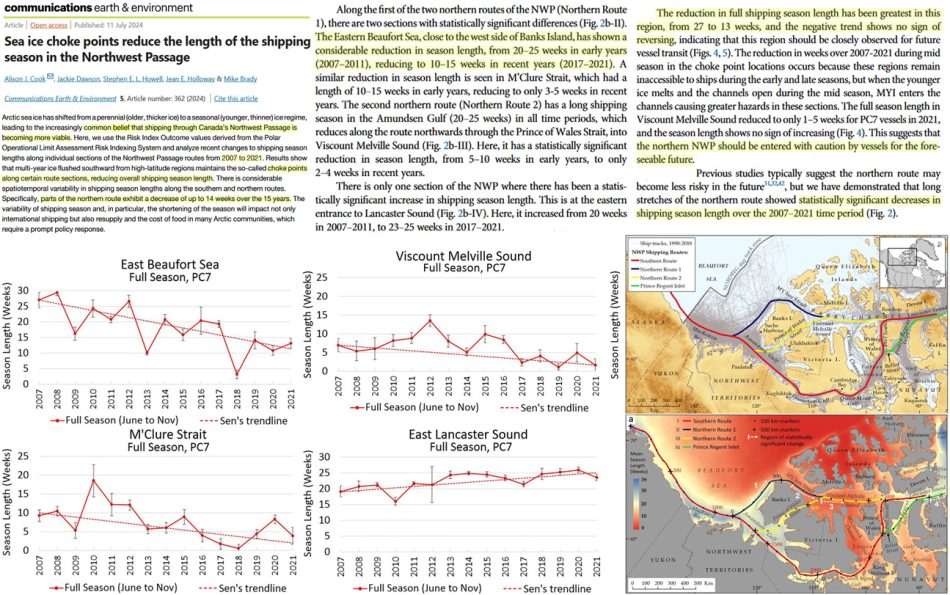
Image Source: Cook et al., 2024
Largest Study of Its Kind Finds Excess Deaths During Pandemic Caused by Public Health Response, Not Virus
By Brenda Baletti, Ph.D. | The Defender | July 19, 2024
A study released today of excess mortality in 125 countries during the COVID-19 pandemic found the major causes of death globally stemmed from public health establishment’s response, including mandates and lockdowns that caused severe stress, harmful medical interventions and the COVID-19 vaccines.
“We conclude that nothing special would have occurred in terms of mortality had a pandemic not been declared and had the declaration not been acted upon,” the authors of the study wrote.
Researchers from the Canadian nonprofit Correlation Research in the Public Interest and the University of Quebec at Trois-Rivières analyzed excess all-cause mortality data prior to and during the COVID-19 pandemic, beginning with the March 11, 2020, World Health Organization (WHO) pandemic declaration and ending on May 5, 2023, when the WHO declared the pandemic over.
The results, presented in a detailed 521-page analysis, establish baseline all-cause mortality rates across 125 countries and use those to determine the variations in excess deaths during the pandemic.
The researchers also used the baseline rates to investigate how the individual country variations in excess death rates correlated to different pandemic-related interventions, including vaccination and booster campaigns.
Not all of the results on a country-by-country basis were the same. For example, in some countries, mortality spikes occurred before the vaccines were rolled out, while in other places, the mortality spikes tracked closely with vaccine or booster campaigns.
In some places, excess mortality rates returned to baseline or close to baseline in 2022, while in others, the rates persisted well into 2023. Denis Rancourt, Ph.D., lead author of the study, told The Defender the disparities result from the complex nature of pandemic measures — and the data — in different areas.
Once Rancourt’s team was able to establish the baseline and excess mortality data for each place, they clustered and examined the data through different filters to interpret it, and drew several conclusions.
Data ‘incompatible with a pandemic viral respiratory disease as a primary cause of death’
The researchers established that there was significant excess mortality worldwide between March 11, 2020, and May 5, 2023.
Overall excess mortality during the three years in the 93 countries with sufficient data to make an estimate is approximately 0.392% of the 2021 population — or approximately 30.9 million excess deaths from all causes.
The conventional explanation for the excess mortality during the COVID-19 pandemic, Rancourt said, is that the SARS-CoV-2 virus caused virtually all deaths — and there would have been even more deaths if there hadn’t been a vaccine.
The variations in excess all-cause mortality rates across space and time, the authors wrote, “allow us to conclude that the Covid-period (2020-2023) excess all-cause mortality in the world is incompatible with a pandemic viral respiratory disease as a primary cause of death.”
They said the theory that the virus caused the deaths is propped up by mass virus-testing campaigns that should be abandoned.
‘Idea that vaccines saved lives is ridiculous’
Rancourt and his team cited several factors they believe disprove the theory that the virus caused a spike in all-cause mortality.
For example, they wrote that excess mortality surged almost simultaneously across several continents when a pandemic was declared, while there were no comparable surges in areas that had not yet declared a pandemic.
This suggests that pandemic interventions like lockdowns, which were implemented synchronously across many countries, likely caused the surges.
The researchers also pointed out the significant variation in mortality rates during the pandemic in all time periods, even across different political jurisdictions directly adjacent to each other. If the virus caused the deaths, it would follow that the infection fatality rate would be the same, or at least similar across political boundaries.
The researchers also found a lot of variability in death rates within countries over time, which also would not be an expected outcome if those deaths were caused by a pathogen.
Rancourt said they found “the idea that the vaccine saved lives is ridiculous,” and based on flawed modeling as he and colleagues also showed in a previous paper.
Here again, they found no systematic or statistically significant trends showing that vaccination campaigns in 2020 and 2021 reduced all-cause mortality.
Instead, they found that in many places, there was no excess mortality until the vaccines were rolled out, and most countries showed temporal associations between vaccine rollouts and increases in all-cause mortality.
Medical interventions — including denial of treatment — caused premature deaths
Rancourt said the excess deaths his team identified are strongly associated with the combination of two major factors — the proportion of elderly in a country’s population and the number of people living in poverty. Both factors increased peoples’ vulnerability to “sudden and profound structural societal changes” and “medical assaults.”
While the proximal cause of death may be classified on death certificates as a respiratory condition or infection, the researchers noted, they argue the true primary causes of death are actually biological stress, non-COVID-19-vaccine medical interventions and the COVID-19 vaccination rollouts.
The study provides an overview of plausible mechanisms for this hypothesis, including research showing that some people experienced severe biological stress from measures like mandates and lockdowns.
“If you structurally change the society by preventing people from moving, breathing, working, having their lives, having to stay at home, lock them in. If you do all these incredibly huge changes, structural changes in society, that is going to induce biological stress,” Rancourt told The Defender.
“There’s very compelling scientific evidence that biological stress is a massive killer,” he added.
Rancourt also pointed out that the stress of lockdowns affected poor people quite differently than it did people who could easily work from home, have food delivered and live relatively comfortably.
The authors also pointed to extensive evidence showing that medical interventions — including denial of treatment — caused premature deaths.
Such interventions included but were not limited to the denial of antibiotics and ivermectin against bacterial pneumonia, the systematic use of mechanical ventilators, experimental treatment protocols, new palliative medications and overdoses, isolation of vulnerable people and encouraged voluntary or involuntary suicide.
The March-April 2020 COVID-19 peak they identified in several countries is difficult to explain without such medical interventions, they wrote.
17 million excess deaths tied to COVID vaccines
Finally, the researchers projected that 17 million of the excess deaths they identified were associated with the COVID-19 vaccines, confirming the findings of their previous research on a smaller sample of countries.
Those vaccine-related estimations were based on analyses of places that had large spikes immediately following vaccination or booster campaigns and also by examining the numbers of vaccine doses and their relation to deaths over time.
Thirty percent of the countries they analyzed had no excess deaths until either the vaccine rollouts or the booster campaigns. And there were significant correlations between COVID-19 vaccine rollouts and peaks or increases in excess all-cause mortality. Ninety-seven percent of countries showed a late-2021 or early-2022 peak in excess all-cause mortality temporally associated with booster rollouts.
It is highly unlikely, the researchers wrote, that the vaccine-mortality associations are coincidental.
Rancourt noticed that people critical of this idea point to the fact that in some places, there are sometimes campaigns or booster campaigns that aren’t associated with spikes in excess mortality.
However, he said vaccination campaigns don’t always lead to such spikes because vaccination was not related to death in the same way in every situation. Vulnerability factors like the age of those vaccinated, the health of the population and other sociological factors related to stressors on the immune system change how they are affected by vaccine toxicity or the vaccines’ effects on the immune system.
Based on their analysis and interpretations, they concluded, “We are compelled to state that the public health establishment and its agents fundamentally caused all the excess mortality in the Covid period.”
This article was originally published by The Defender — Children’s Health Defense’s News & Views Website under Creative Commons license CC BY-NC-ND 4.0. Please consider subscribing to The Defender or donating to Children’s Health Defense.
Ministers Were Informed Of mRNA Lies During Mandates, Cardiologist Reveals
Dr Aseem Malhotra had a direct line of communication to the Health Secretary
By JJ Starky | The Stark Naked Brief | July 19, 2024
We’ve had another mainstream breakthrough.
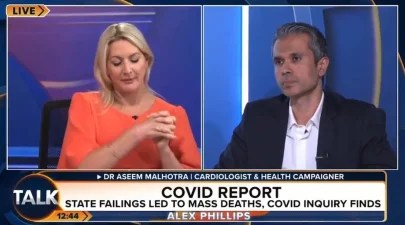
Yesterday, Dr. Aseem Malhotra appeared on TalkTV to discuss the UK government’s Covid response in light of Baroness Hallett’s report on the first module of the Covid Inquiry.
Commentators were surprised. Most predicted that the Covid Inquiry chair’s report would echo sentiments seen during proceedings, suggesting that lockdowns, despite all credible evidence, were the only viable solutions for dealing with Covid.
So when Hallett’s team concluded that “the imposition of a lockdown should be a measure of last resort… indeed, there are those who would argue that a lockdown should never be imposed,” it almost seemed strange.
During the interview, much like his January 2023 appearance on the BBC where he pivoted from discussing statins to linking Covid vaccines to cardiovascular issues, Malhotra shifted the focus to vaccines.
He covered a lot of detail in quick succession. He argued that the term “vaccine” used for mRNA products is misleading, as they are better described as gene technologies. He cited peer-reviewed reanalysis of Moderna and Pfizer’s clinical trials, which showed an adverse event rate closer to 1-in-800, a figure that outweighed Covid hospitalisation risk. He also mentioned that Israel saw a 25% increase in cardiac events among people aged 16-39 during the vaccine rollout.
But the standout moment came when Malhotra discussed his involvement in a court case in Finland concerning an entrepreneur who was denied entry to a café because he was unvaccinated.
Malhotra revealed that he witnessed a World Health Organisation (WHO) chief scientist testify under oath that by December 2021, the mRNA vaccine offered zero protection against Covid. He then disclosed that he had texted Sajid Javid, the UK Secretary of State for Health and Social Care, informing him of this testimony, but Javid effectively ignored it.

Former UK Secretary State for Health and Social Care Sajid Javid
It has been difficult to gauge what certain officials knew at what time. However, now we have an indication that some were categorically made aware that their policies were illogical and at direct odds with the evidence-base.
Press releases show that Javid’s department finally revoked the Covid vaccine mandate for health and social care staff on March 15, 2022, months after Malhotra made contact.
In November 2021, a survey of industry leaders estimated that up to 20,000 carers had already quit or been sacked over mandatory jabs. Given the mandate carried on to March the following year, that could be a vast underestimate.
Malhotra, who once advocated for everyone to receive the vaccines before his father reportedly passed away from them, notably said, “This is the biggest corporate crime committed by the drug the industry.”
TalkTV did not post the interview on YouTube as the platform continues to issue strikes to channels discussing the topic. So here it is in full.
Summary of Hallett’s Report on the Covid Inquiry:

- Ad Hoc Intervention: Epidemiologist Professor Mark Woolhouse described lockdown as an ad hoc intervention with no prior planning, guidelines, or clear expectations.
- Lack of Scrutiny on Consequences: The novelty of the lockdown approach meant there was no time to scrutinise its potential side effects, leading to ill-prepared policies with unknown consequences.
- Significant Economic Impact: The report highlights the 25% drop in GDP between February and April 2020 due to lockdowns, representing a major gap in the UK’s assessment of pandemic risk.
- Missing Topics: The report does not discuss the UK government’s evidence that the Test and Trace system had minimal impact on reducing Covid infections despite its high cost.
- Balancing Factors in Health Emergencies: The report emphasises the need for a balanced approach in health emergencies, considering economic impact, social wellbeing, and effects on education, as advocated by former chief medical officer Sally Davies.
- Exclusion of Certain Testimonies: Testimonies from Chief Medical Officer Chris Whitty are notably absent, indicating a potential shift from previously dominant perspectives during the pandemic.
- Real Story of the Report: The report suggests that the UK was not prepared for the “wrong pandemic”, but rather that it resorted to an unprecedented policy without a proper evidence base or risk assessment. It advocates that lockdowns should be a measure of last resort, and perhaps never used at all.
Sleep Apnea and the Risk of Dementia: A Systematic Review and Meta-Analysis
Role of Obstructive Sleep Apnea in President Biden’s Slide Into Dementia
By Peter A. McCullough, MD, MPH | Courageous Discourse™ | July 16, 2024
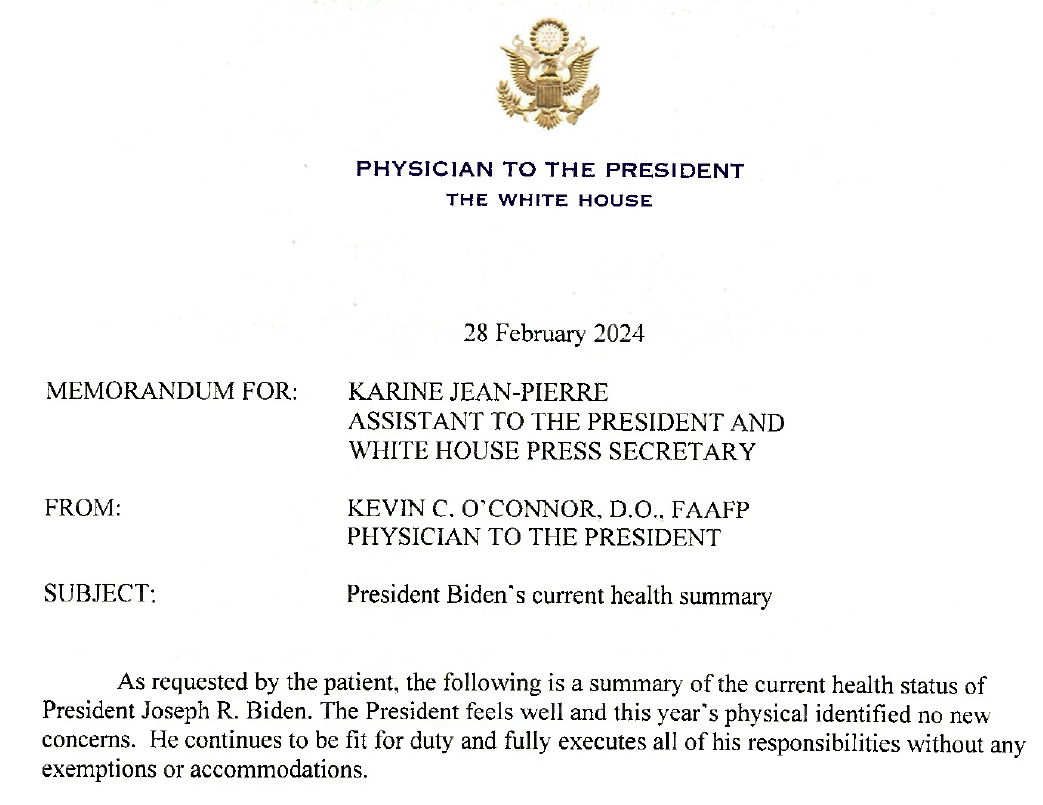
Dr. Kevin O’Connor, DO, disclosed on the 2024 presidential health report that Joe Biden has obstructive sleep apnea and wears a continuous positive airway pressure (CPAP) device at night.

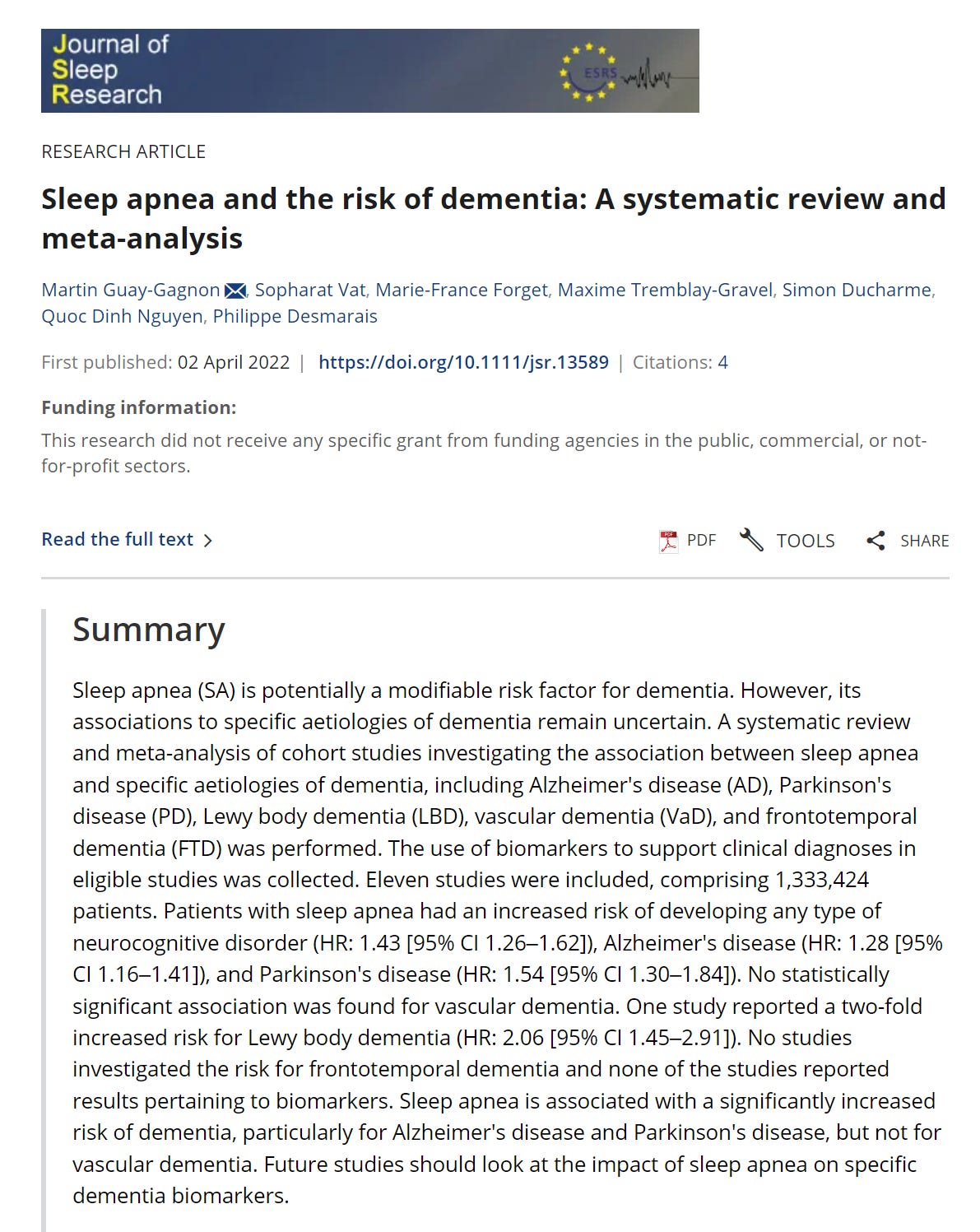
Guay-Gagnon et al from the Department of Medicine, Division of Geriatrics, Centre Hospitalier de l’Université de Montréal, Montreal, Quebec, Canada, published a systematic review and meta-analysis applicable to Biden:
“Eleven studies were included, comprising 1,333,424 patients. Patients with sleep apnea had an increased risk of developing any type of neurocognitive disorder (HR: 1.43 [95% CI 1.26-1.62]), Alzheimer’s disease (HR: 1.28 [95% CI 1.16-1.41]), and Parkinson’s disease (HR: 1.54 [95% CI 1.30-1.84]).”
We can add sleep apnea to his list of neurodegenerative determinants including advanced age, two prior craniotomies, permanent atrial fibrillation, and six mRNA COVID-19 vaccines. It is getting more difficult every day for Dr. O’Connor to deny Biden’s cognitive decline. As Biden nears the end of his political career, the amount of reversal his doctor will have to do from his report five months ago is substantial. It is never wise for a doctor to paint a rosy picture to satisfy the ego of the patient, family, or his political party. O’Connor will live to regret this statement February 28, 2024.
The Rockefellers created 990 “Climate Change” institutions, foundations, and activist groups
Every time you hear a “climate change” scare story, that person was PAID. He is a Rockefeller stooge. He may not know it; but his profession has been entirely corrupted

This is the most public of their estates but Rockefeller houses, mansions, lodges, city palaces, beachfront estates, and dozens upon dozens of holiday houses litter America.
By Elizabeth Nickson | Welcome to Absurdistan | July 7, 2024
In the climate change arena, the Rockefellers call the shots. The whole thing was their idea, they took a silly but interesting theory and amped it up with hundreds and hundreds of million of dollars. They founded institutions and linked the survival of those institutions to promoting climate change and population reduction. They adopted one likely politician after another.
The Rockefellers have created 990 Climate Change activist organizations. They give them directions, financing, and launch them on the world. The Green Movement was started, financed, organized, and militarized by the Rockefellers. By the late 40’s the family was all in, on the same page. In the 50’s they began to stand up countless institutions, committees, university departments, university institutes, foundations, and policy shops gathered around this one idea, as below:
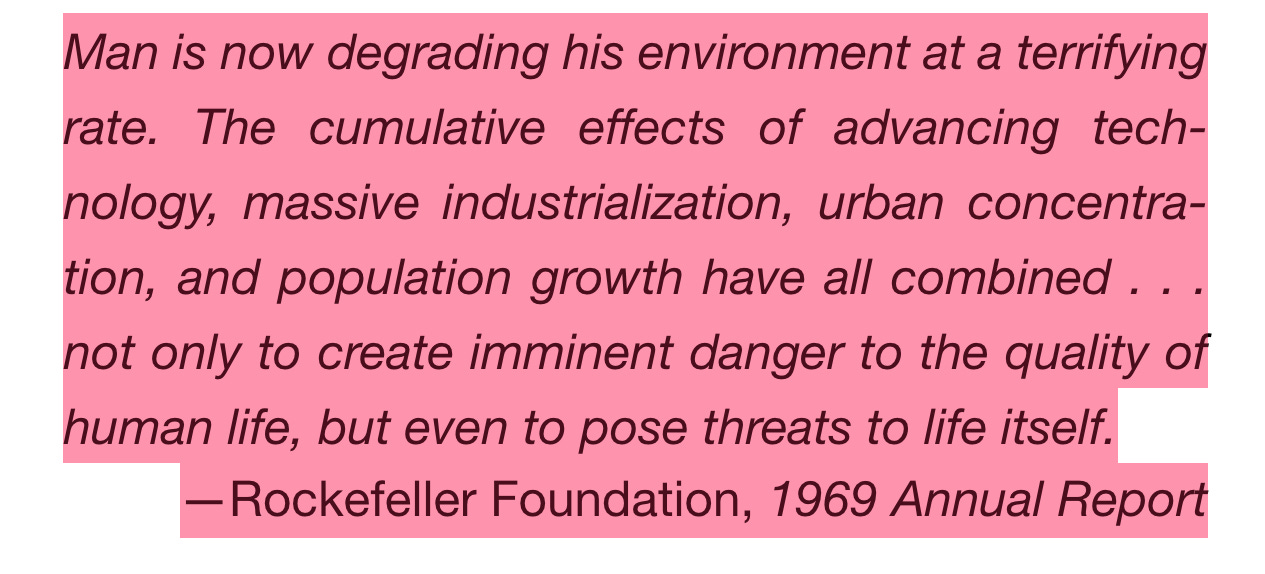
Let’s just pause here and recognize that the United States and Canada are 5% developed. If it were 50%, then maybe we would have reason to worry about the effects of trace gas that takes up .04% of the atmosphere, of which 3% is currently contributed to by humans. But were we to have that level of development, our science would have long ago solved the problem. Our sense of proportion, size and consequence has been twisted, propagandized via hundreds of billions of purposed dollars. And all of it is exaggerated science done by scientists compromised by Rockefeller money.
By 1998, the Rockefeller family had swept the table clean of any opposition to this one idea. Any scientist not on board with the agenda was imperiled. Any university department not working towards this one artificial goal, was in danger of being marginalized. Infiltration had begun into every media organization, every entertainment division of every major corporation. This, as stated below, would be a generational goal. For everyone. Or get off the bus.
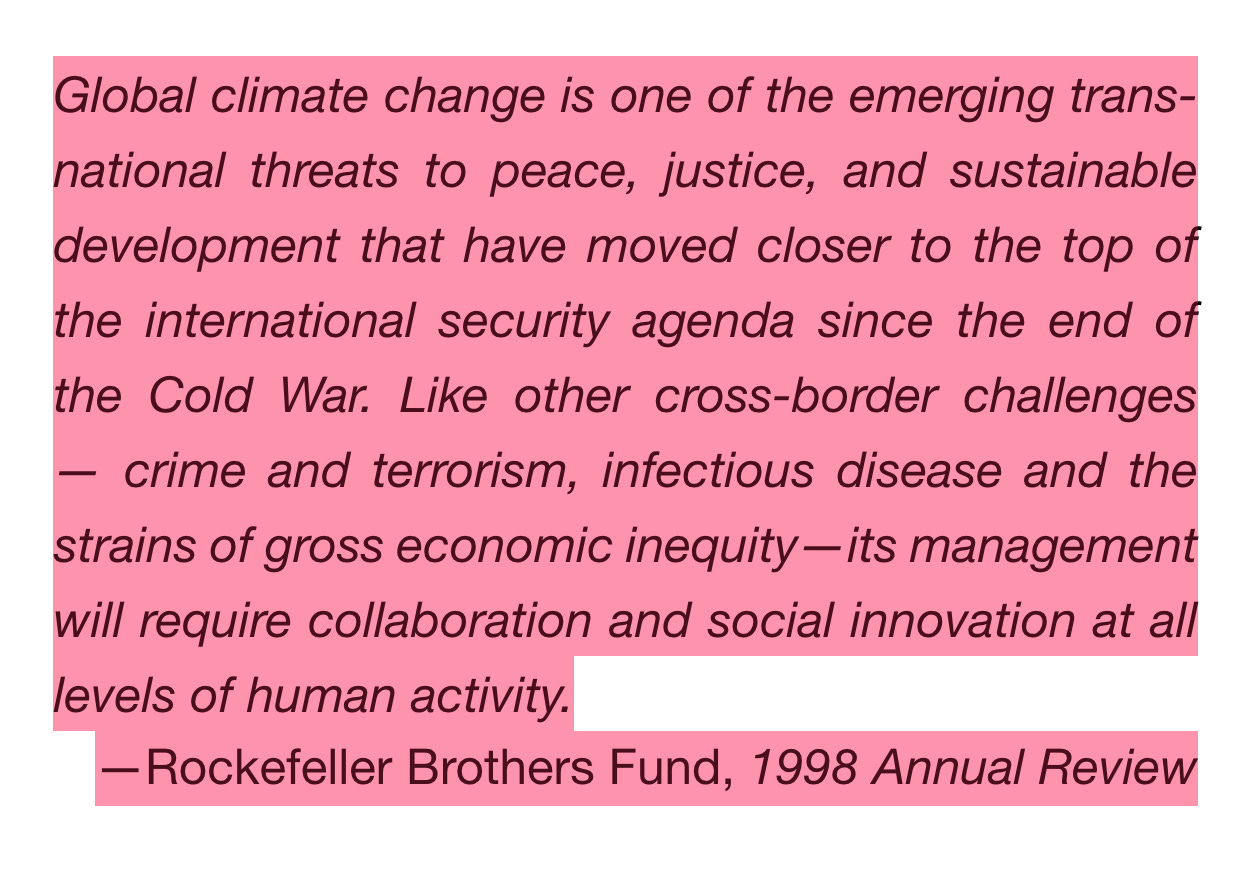
The Rockefellers have created 990 Climate Change institutions, foundations, and activist groups. And they fund them.
What is evidentiary, what can be proved in a court of law, rather than opinion, however, is that the Fabians started the idea of this whole one-world, no nation state. It is clear too that after the First World War, the Fabians roped in the second generation of Rockefellers. It was a major catch. It meant they had America. And it was spiritual. It was meant to change mankind, to kill off Homo Sapiens and turn us to Homo Universalis.
The New Man would be not-Christian, quietist, and self-obsessed. The economy would trend towards zero-growth if not de-growth. There is a preponderance of data, many many publications that laid out their plans. They twisted education away from practical science, engineering and building things towards social movements, the humanities, the arts, and pleasure. And via Laurance Rockefeller’s money and organizational skill, they devised and invented the discipline of cybernetics from which the internet flows.
The first Rockefeller, as almost everyone knows, was John D., by all accounts a deeply unpleasant individual who, after his private army killed protestors, was advised to go into charity in a big way to rescue his reputation. Which he did, and managed to dodge the trustbusters and Teddy Roosevelt, and build his empire over the corpses of his competitors. And then, as advised, he began to buy the media. The Luce empire of Time-Life fell into step. From the 60’s on Time-Life stood astride the media world, attracting the best, the authority on every subject. I was trained there, and trained well, but all the writing was done back in New York, in the Time Life building in Rockefeller Center. It was massaged to fit the message. I wanted to write and left.
By the second generation, the family had found its purpose, the meaning for all the wealth, the path forward. John D., according to Sir Stephen Wilkinson, who has studied him all his life, believed to his core that God had favored him with so much wealth because he was good; his Baptist faith coupled with titanic wealth made him a modern priest. His family, his heirs, would be a Royal Priesthood leading mankind to a new paradise. How the family must have fallen upon the Fabians, with their starry titled members, Bertrand Russell, all the Huxleys, H.G. Wells, Emmeline Pankhurst. How seductive socialism is to the intellectual class. It gives them the right, being so smart, to order humanity. To choose for the rest of us. Few of them could run a corner store.
The seduction of great wealth is pretty much irresistible. Everyone falls. The last time I was “in society” was at a wedding hosted by the Bostonian Cabots – so ancient they arrived in the New World in 1498. Famously, “The Lodges only talk to the Cabots and the Cabots only talk to God.” That’s how grand they are. Their wealth spread out that weekend was like entering heaven, everything so beautiful, so absolutely perfect in every detail. It was a lush sinking feeling, utterly seductive to the ego. Any Clinton, Gore, Obama, Kerry, Bush, any impoverished scientist, any ambitious university administrator, every fundraiser, every marginalized military man, would just fall over like an ambitious 20 year old faced with her first billionaire. Take me I’m yours.

The Cabots in full regalia
And that’s what happened. That’s how they did it, by inviting likely servants to their houses and hunting lodges, donating buildings, buying the land for the U.N., funding organizations, appealing to vanity and greed and above all, the human’s desperate need for significance. They created a super-class unmoored to reality and entirely 100% destructive of human life. It was systematic, a fierce, unstoppable, detailed two-hundred-year plan. Each generation would make their contribution.
It started with the felt need to reduce population and turn man into something other. To stress, environmentalism, neo-Malthusianism; the ‘saving of the planet’ was the motivator for each of the following actions. If you accepted Rockefeller funding, you toed the line. There were too many people, the carrying capacity of the earth was breeched, the planet was dying, we need a new form of human. These ideas all came out of the Fabian stable and metastasized through the culture like the most delicious poison. Every intellectual, all the universities started to promote this idea. It was heady, exciting. It celebrated Man, not some faceless distant Deity. Fabians hated Christianity and wanted, above everything, to replace it. But first, they had to command every institution of civil society.
The following is a partial list of the institutions by which the Rockefeller family built the modern world, in every aspect of the culture. It was masterful. Ancient Kings and Emperors would have marveled.
In 1920, John D. co-founded the League of Nations. He was the major donor. It failed because the U.S. refused to sign on. The family began to run for office, in order to manipulate levers of power behind the scenes. Today, there is pretty much always a Rockefeller in power at each level of government.
In 1921, they founded the Council of Foreign Relations, (CFR). David built and donated CFRs headquarters. CFR is closely allied to the Royal Institute of International Affairs (RIIA) in London, Chatham House, itself closely allied with the British Round Table and the Fabians. When people talk about the 13 Families theory, the Round Table and RIIA feature big-time.
In 1944, they co-founded the World Bank, its ideals and purpose devised by the Council of Foreign Relations’ War and Peace Studies Committee.
In 1945, they co-founded the United Nations, with the CFR and RIIA. David Rockefeller wrote the preamble to the U.N. Charter. John D. Jr bought the 17 acres for the U.N building. Nelson chose the architect, Philip Johnson, thereby introducing the International Style. The family funded the U.N. building.
In 1948, came their statement of purpose:
If the world government cause is to triumph it will need more than sympathetic endorsement by the majority. People must be made to feel that their own security, freedom, and prosperity, yes, their own survival, depend on the creation in our time, of a world rule of law. They must be made to believe that the establishment of a World Government is more urgent than the maintenance of a high domestic standard and as, if not more, practical than the pursuity of a deceptive security by full military preparedness. – Atomic physicist, Edwin Rabinowitch, a Rockefeller client/servant, 1948
In 1948, in league with Julian Huxley, Mr. Population, a leading member of the British Eugenics Society and the British Humanist Society, they formed the International Union for the Conservation of Nature, (IUCN). Stated goal: better distribution of the world’s population (which is behind the migrant crisis) and fertility control. The IUCN has systematically cleared tens of millions of traditional and indigenous peoples from their lands in Africa and the East.
In 1948, they founded the Conservation Foundation. In 1953, they funded it with $53 million, the equivalent of $650 million today.
In 1954, they founded, with Bernhard of the Netherlands (thought to be the apex child predator) the Bilderberg group.
In 1955, they cofounded the International Meterological Institute (IMI)
In 1959, the first publication of the Rockefeller Institute Press included a section on “Changes in the Carbon Dioxide Content of the Atmosphere and Sea due to Fossil Fuel Combustion”.
Laurance Rockefeller was purposed with the spiritual arm of the operation. Starting in the late 40’s. Laurance founded fifty environmental organizations including the World Wildlife Federation, the World Resource Foundation, the IUCN, and UNESCO. Laurence is behind Esalen and Lindesfarne Association, and is responsible for coining the term “New Age”. He founded and funded the Fund for the Advancement of the Human Spirit, the Foundation for Conscious Evolution, the Conservation Foundation. He was a board member of the National Resources Defense Council, the National Geographic Society, Woods Hole Geographic Society, Resources for the Future, and the Sloan foundation. He was a board member of the Environmental Defence Fund and the WWF. He co-founded the Rockefeller Brothers Fund and served as its chairman from 1958-1979. Laurance Rockefeller founded Cybernetics as a discipline by funding its study.
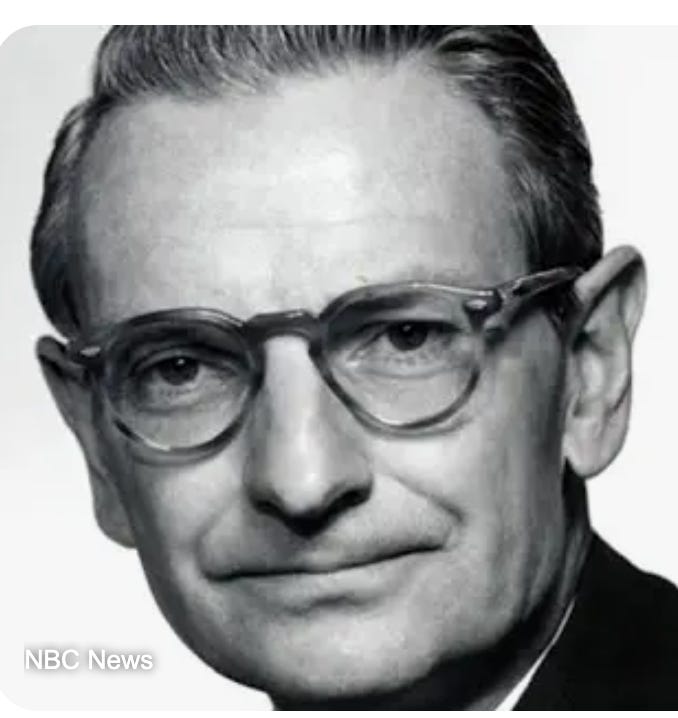
This man created the New Age, the climate scare and the Sixth Great Extinction scare
He stood up and funded most of the New Age gurus followed today by tens of millions, if not hundreds of millions. The New Age says “Stay out of the battleground, don’t worry about your neighbor, your family, your town, your country. Worry about your personal spiritual advancement, your tolerance and forgiveness. Work on yourself. Do your “shadow work”, you are everything, everything is a reflection of you.”
He funded the Disclosure Movement, which claims that aliens walk among us, and that their technology, liberated from the Naval Research Labs (another Rockefeller genesis) will save humanity. He was a ferocious, destructive nut.
Next, the family founded, financed and organized the European Commission, OPEC, and the UN Development Program.
In 1973, they founded the Trilateral Commission.
The plans for Princeton’s Institute for Advanced Study had been drawn up by Tom Jones from the British Round Table, intended as an American version of All Souls at Oxford which is primarily an academic research institution with particular strengths in the humanities and social and theoretical sciences. The Rockefellers were closely involved via funding the Institute and funding all of its heads and especially, significant scientists, providing grants for their work.
Here the science of climate forecasting was developed using climate modelling during the 1950’s Initially it was thought that geo-engineering would be the principal method used, rather than reducing emissions. They were math freaks, one of whom made the following convenient prophecy.
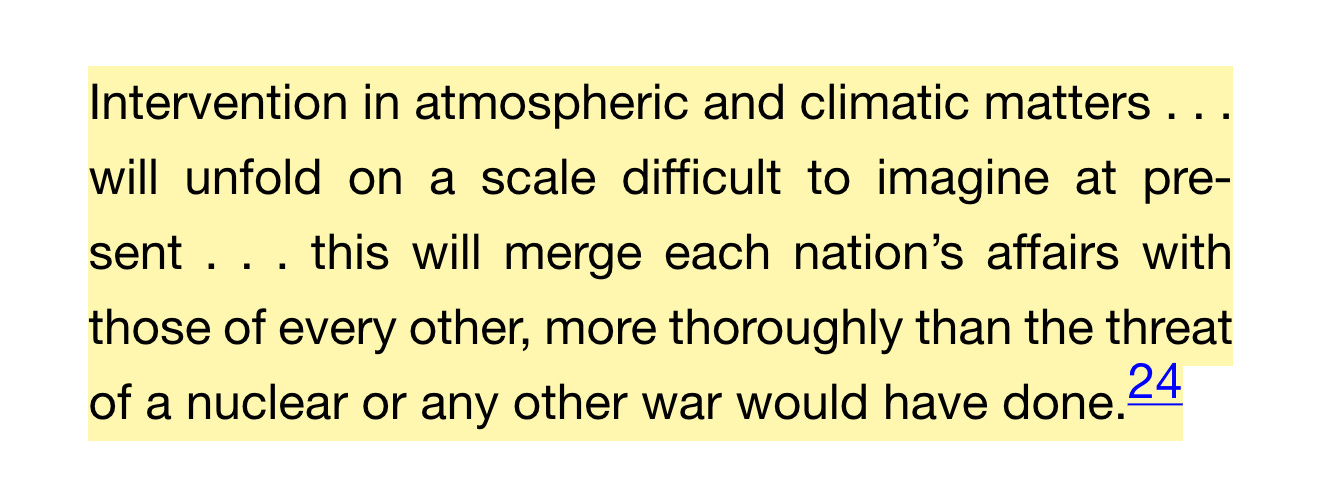
The climate scare well entrained, the family turned their attention to art and architecture. The breaking of architectural tradition was deliberate. Modern architecture, the International Style was created in order to disrupt and make uneasy Homo Sapiens.
”The International Style suited the Rockefeller brothers’ internationalist aspirations like a glove. It also inspired radically new zoning laws and urban planning models, leading not only to a boxy skyline of rectangular high-rise slivers, but to extensive sprawl and automobile dependency— which also happened to be highly profitable for the oil and auto industries.” (Nordangard)
In New York alone, they commissioned the following buildings, all built to be intentionally unsettling, deliberately destructive. Modernism deliberately erased the the past. It was purposed to make the human walking by and through these buildings, a sense of himself as base, insignificant, submissive and subject.
Some of the Rockefeller-financed buildings:
Rockefeller University
The U.N. Headquarters
Memorial Sloan Kettering Cancer Center
Riverside Church
The Cloisters
Lincoln Center of the Performing Arts
Empire State Plaza in Albany
One Chase Manhattan Plaza
The World Trade Center
Kissinger, then a professor at Harvard, was one of the family’s most treasured assets. He believed “a new political architecture would be required, better able to offer long-term governance.” He became part of Nelson’s “portable brains trust”, the Rockefeller Brother’s fund, the Special Studies Project. The SSP worked from 1956-1961 to build that new political architecture:
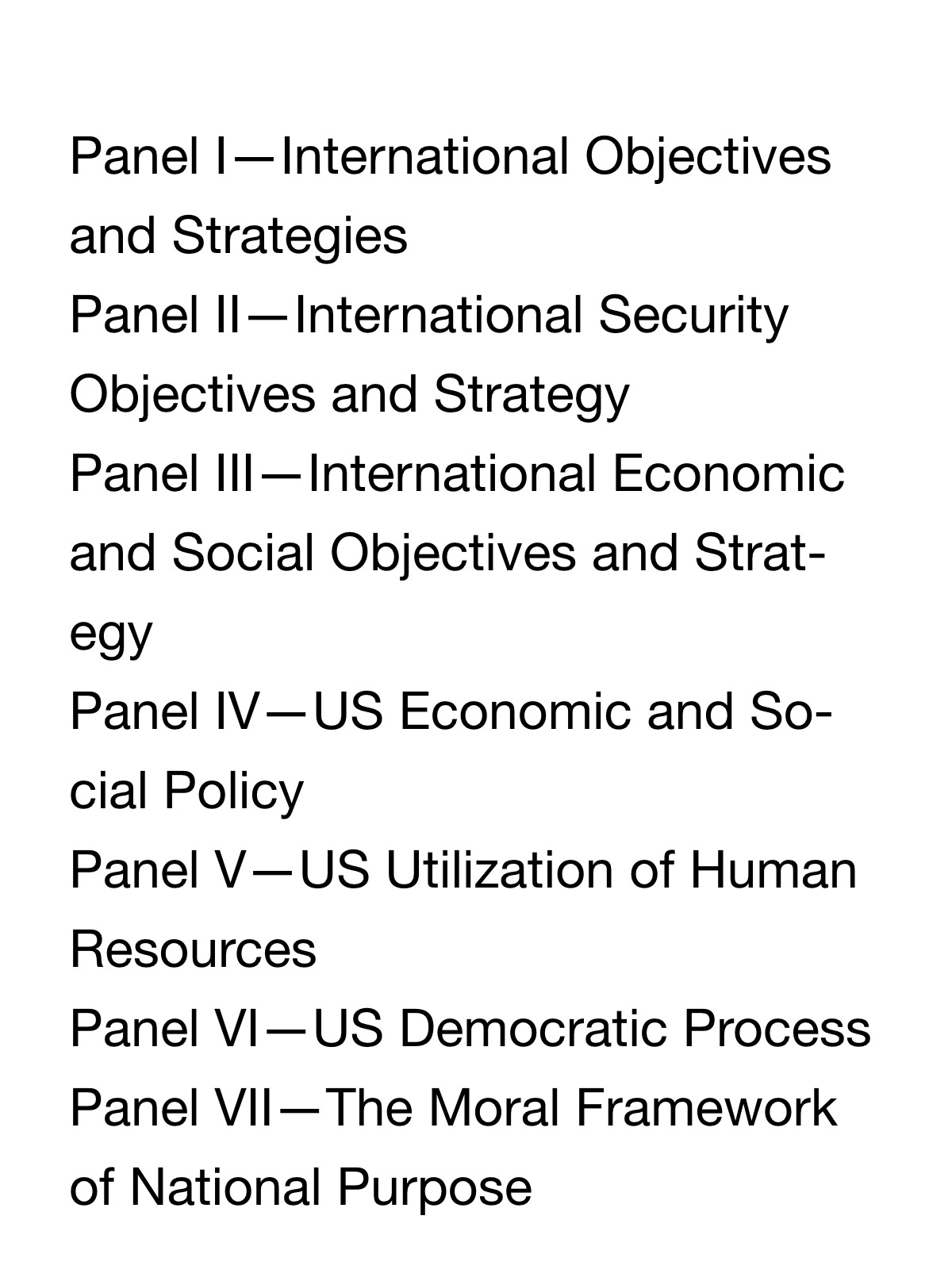
They co-founded Woods Hole Oceanographic Institute
They co-founded the Scripps Institute of Oceanography.
They co-founded the Atomic Energy Commission, the Office of Naval Research, and the National Science Foundation while Nelson Rockefeller was in power.
This is only a partial list. Every single one of these institutions are neo-Malthusian, bent on fewer humans, and taking us off the land into giant pens, controlled, measured and monetized.
In 1989, illustrating the family’s reach abroad, the Hague Declaration (with 24 signatories) called for a new international institutional authority that could preserve the Earth’s atmosphere and fight global warming.
Thereafter, in that same year, 1989, the Rockefeller Brothers Fund under the leadership of David Rockefeller and Henry Kissinger founded the United Nations Panel on Climate Change (IPCC). and funded it with near unlimited resources going forward.
In the appendices of Norgangard’s book, he lists all the institutions founded by the family. Skimming them, I found myself jumping out of my desk chair and shouting into the void. The dog vanished, the cat hid. It is infuriating – they used their power to corrupt every institution that would serve their end game. Here is one page.
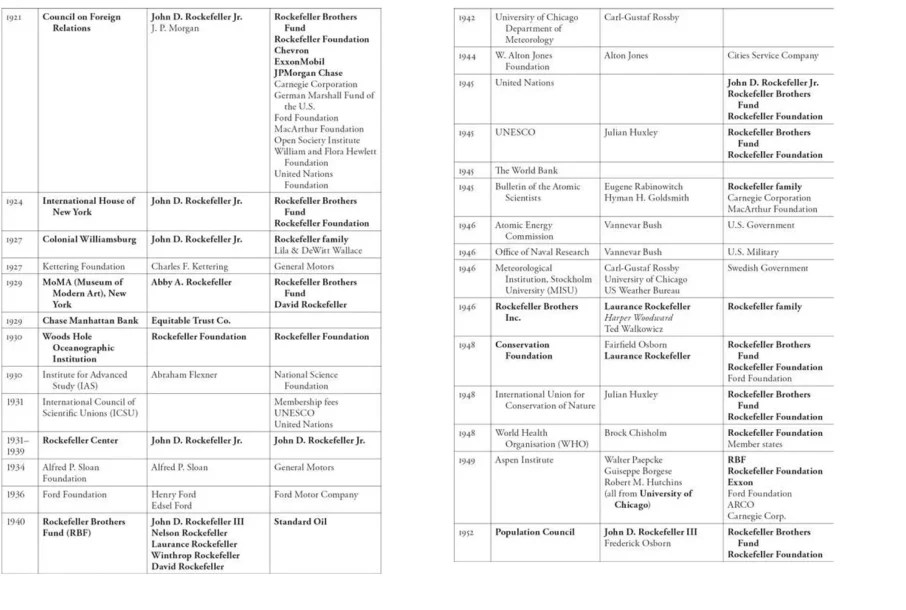
The End Game
In 2012, the U.N. Climate Fund announced the establishment of the model for the cities of the future, outside Seoul, Korea called Songdo. Songdo is failing. No one wants to live there. Those who visit describe the place as soulless, with no people, no vivid life. Billions were spent creating it.
Nordangard describes:
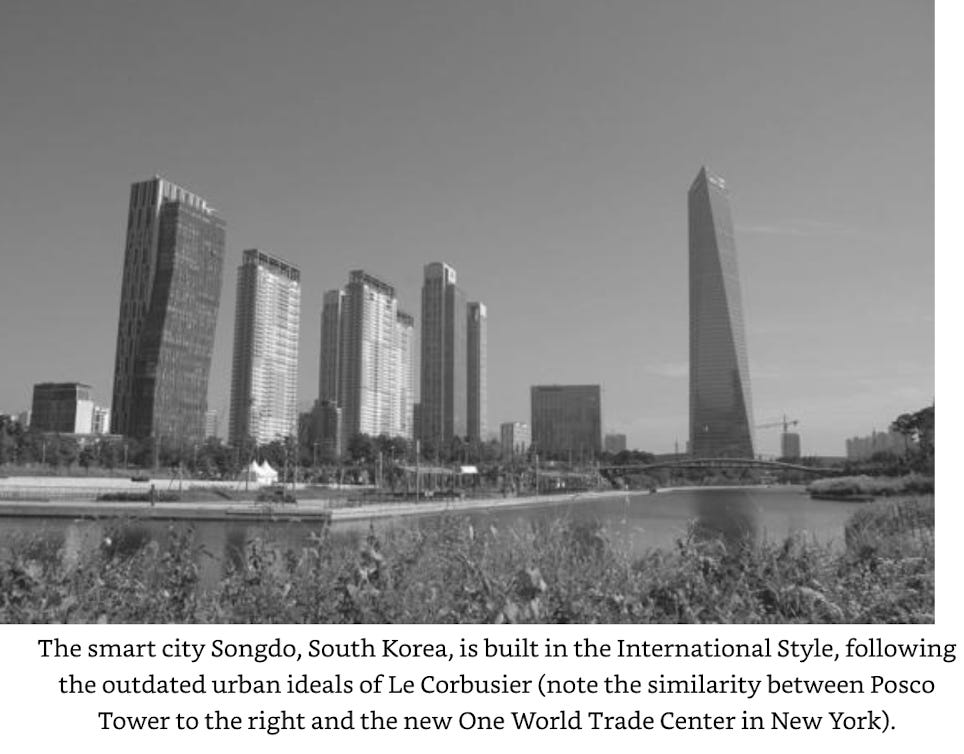
“Traffic flow and citizen behaviour is monitored in real-time via five hundred surveillance cameras. Household waste is automatically transported via the pneumatic system under the city and converted into energy. All apartments have smart locks, with smart cards which can also be used for loaner bikes, parking, subway, and movie tickets. All apartments have smart meters (enabling residents to compare their energy consumption with that of their neighbors) and built-in cameras everywhere. Floor sensors detect pressure changes and automatically alert an alarm service of a suspected fall. Systems are tested where residents via the TV screen can receive language lessons or communicate with their physician as well as neighbors and relatives, and bracelets for locating children via GPS.7 In other words, a futuristic dream straight out of the World Future Society’s 1970s vision—or Orwell’s 1984. And this is South Korea. How successful, environmentally friendly, and inclusive Songdo really turned out to be has been questioned. It was built primarily for an affluent middle class expected to be able to afford the higher standard and the new technology. The electricity comes from coal-fired power plants and the buildings are completely glazed with windows that cannot be opened, which requires air conditioning all year round.8 Also, the pneumatic waste disposal system does not always work properly. As of March 2018 there was still no cultural life, no street vendors or old people, public transport, transport systems were empty and three-quarters of the homes were empty.
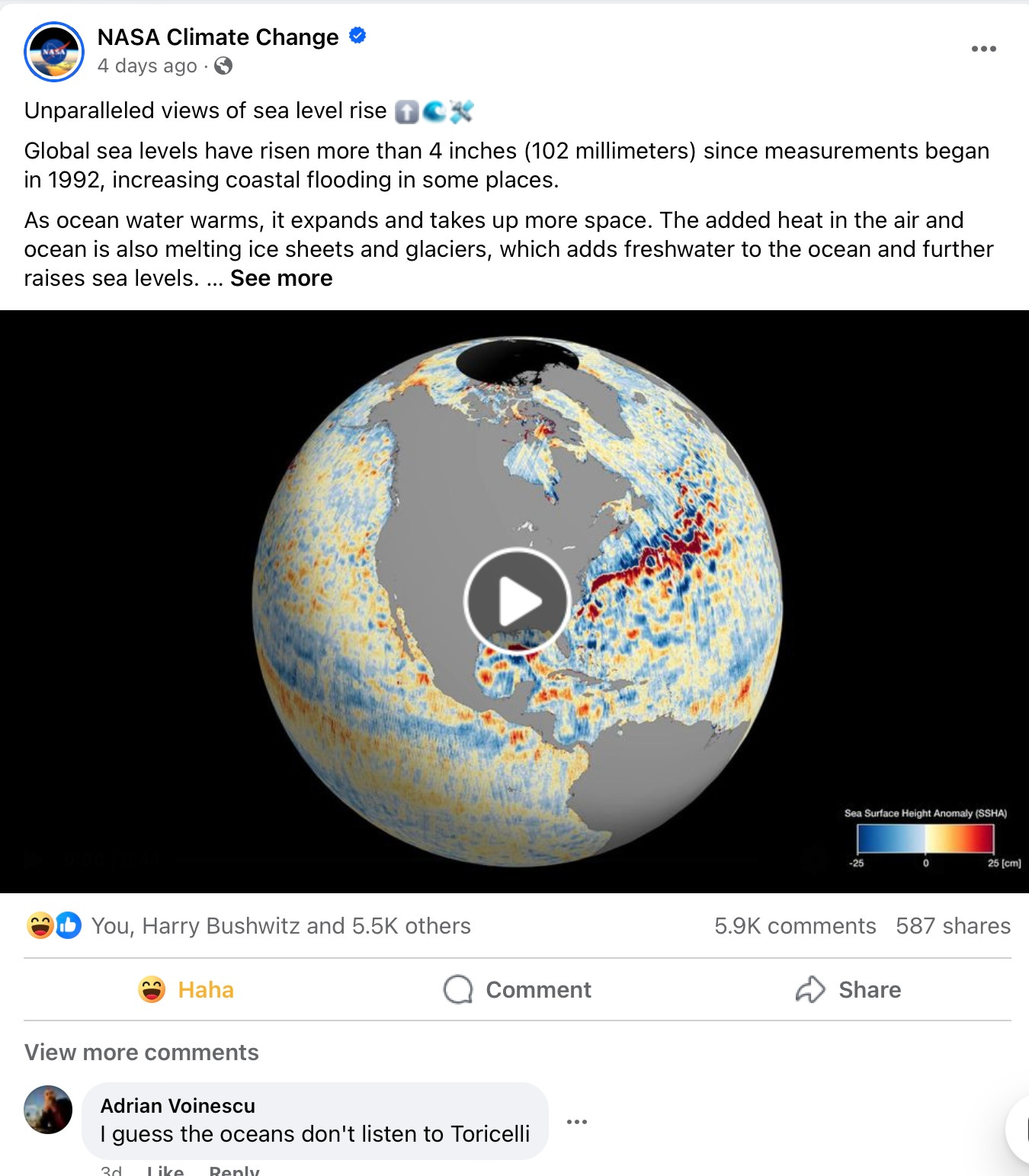
Evil has a human face, but despite the billions thrown at the people of the earth, fewer and fewer of us are falling for it. This latest Facebook-hysteria-the-sky-is-falling post from NASA’s Climate Change Center, received 5,600 reactions. 5,300, including mine were laughing emojis. And the top comment cited Torecelli, with one man’s work refuting every single flatulent government propaganda machine theory. Facebook, remember, is controlled speech and still, the people win.
Elizabeth Nickson was trained as a reporter at the London bureau of Time Magazine. She became European Bureau Chief of LIFE magazine in its last years of monthly publication, and during that time, acquired the rights to Nelson Mandela’s memoir before he was released from Robben Island. She went on to write for Harper’s Magazine, the Guardian, the Observer, the Independent, the Sunday Telegraph, the Sunday Times Magazine, the Telegraph, the Globe and Mail and the National Post. Her first book The Monkey Puzzle Tree was an investigation of the CIA MKULTRA mind control program and was published by Bloomsbury and Knopf Canada. Her next book, Eco-Fascists, How Radical Environmentalists Are Destroying Our Natural Heritage, was a look at how environmentalism, badly practiced, is destroying the rural economy and rural culture in the U.S. and all over the world. It was published by Adam Bellow at Harper Collins US. She is a Senior Fellow at the Frontier Center for Public Policy, fcpp.org. You can read in depth policy papers about various elements of the environmental junta here: https://independent.academia.edu/ElizabethNickson
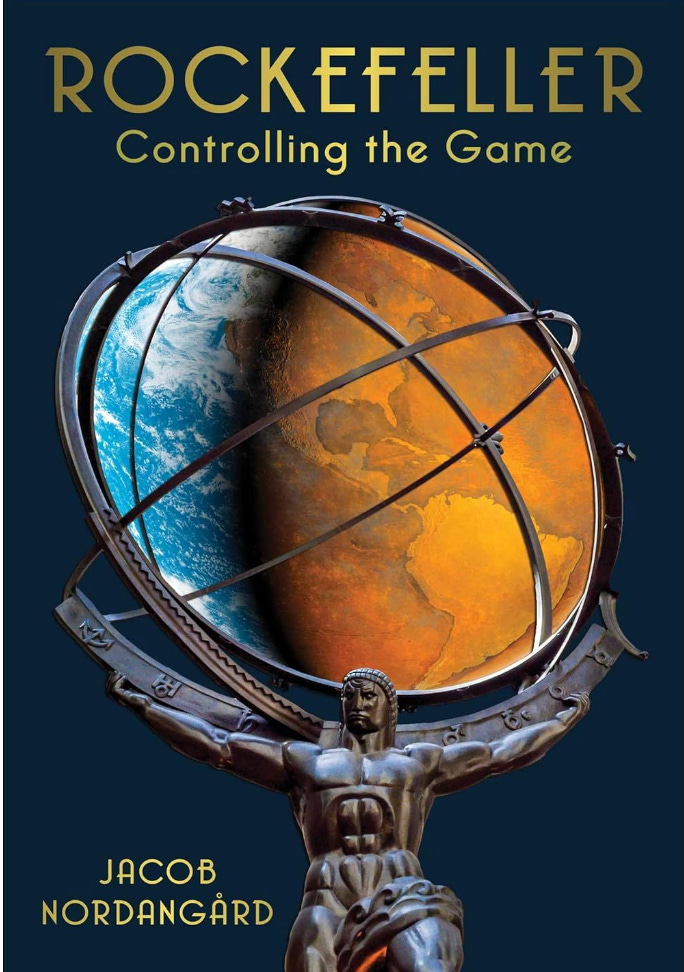 You can buy Jacob Nordangard’s book here
AND JUST LIKE THAT, THE CLAIM VACCINES ARE THE WORLD’S BEST STUDIED PRODUCT DIES
The world’s leading vaccinologist, Dr. Stanley Plotkin, and company have just capitulated…
Injecting Freedom by Aaron Siri | July 10, 2024
Wow. After decades of Dr. Stanley Plotkin and his vaccinologist disciples insisting vaccines are the most well studied products on the planet, they just penned an article admitting precisely the opposite.
They just admitted vaccines are not properly studied—neither pre-licensure nor post-licensure. They admitted, for example, “prelicensure clinical trials have limited sample sizes [and] follow-up durations” and that “there are not resources earmarked for postauthorization safety studies.”
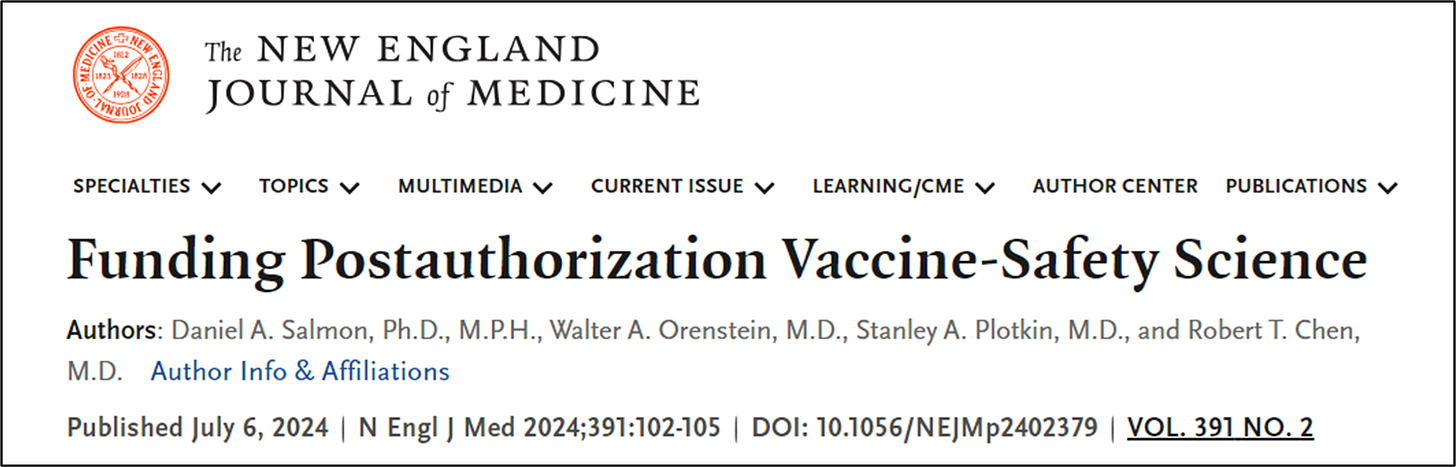
That is an incredible reversal. But let me provide context so nobody is fooled at what they are clearly up to:
For decades, the medical community insisted vaccines are the most thoroughly studied product ever; for example, Dr. Paul Offit said, “I think we should be proud of vaccines as arguably the safest, best tested things we put in our body.”
For decades, parents of vaccine injured children, vaccine injured adults, and other stakeholders contested these claims only to be shunned and attacked by the medical community and health agencies.
In 2018, I had the unprecedented opportunity to depose the architect of our vaccination program and the Godfather of Vaccinology, Dr. Plotkin, and lay bare the evidence that showed what these authors are now finally admitting about the utter lack of vaccine safety trials and studies. See https://thehighwire.com/ark-videos/the-deposition-of-stanley-plotkin/.
After this deposition is made public, Dr. Plotkin goes on a tirade, making demands that FDA add “missing information on safety and efficacy” in vaccine package inserts and that CDC exclude harms from its Vaccine Information Sheets, “lobbying the Gates Foundation to support pro-vaccine organizations,” working to have WHO list vaccine hesitancy as a global threat, lobbying AAP, IDSA and PIDS to “support training of witnesses” to support vaccine safety, etc. See https://icandecide.org/article/dr-stanley-plotkin-the-godfather-of-vaccines-reaction-to-being-questioned/.
The problem is, it doesn’t work. It doesn’t work because, at bottom, there are no proper safety studies. So, there is no safety data to add to the FDA package inserts, and hiding harms by removing them from CDC inserts doesn’t make them go away. Parents and other adults don’t simply stop believing what they have seen with their own eyes because CDC, WHO, the Gates Foundations, etc., won’t acknowledge them, or worse, they attack them.
That brings us to the present in which Plotkin and his disciples realize they can’t cast voodoo on the public. They can’t hide the truth. So, their only option is to try and co-opt the truth they have lied about for decades by now admitting that the studies to show vaccines are safe do not exist. But in making that admission, they conveniently fail to admit that for decades they lied, gaslit, defrauded (and I don’t use that word lightly) the public by claiming that vaccines are probably the most thoroughly safety tested products on the planet and that people should rest assured, no stone on vaccine safety was left unturned.
Thus, in their article just published, they pretend they never lied about vaccine safety. They pretend they are now just pointing out vaccine safety has never really been conducted, as if that was not known to them before.
Don’t be fooled. Their real agenda is plain, and it is not to study vaccine safety, but rather to confirm that which they already believe. This is crystal clear from the fact that, while their article admits the studies have not been done, they write in the same breath that serious vaccine harms are “rare.” But if the studies have not been done, how do they know that? The answer is, they don’t, and they don’t care to know the truth. Their goal is to protect the products they have spent their careers defending and worshipping and that have brought them fame and riches.
They also ignore the mountain of studies and data which already exist that clearly show serious vaccine harms. Just take a moment to review the large body of science around one of the adjuvants used in vaccines which multiple studies show can cause serious harm. See https://pubmed.ncbi.nlm.nih.gov/38788092/.
Finally, just look at their proposed solution. After making the a priori conclusion that harms are “rare,” ignoring all the existing studies showing harm, these folk have the audacity to want to raid the federal vaccine injury compensation fund to presumably pay themselves and their compatriots hundreds of millions of dollars to conduct the studies that would, no doubt, seek to confirm their prior conclusion that vaccine harms are “rare,” while ignoring the studies that already show serious harm.
So, with that in mind, and sorry for the long wind-up, here are the things they admit in this article for maybe the very first time:
“[T]he widespread vaccine hesitancy observed during the Covid-19 pandemic suggests that the public is no longer satisfied with the traditional safety goal of simply detecting and quantifying the associated risks after a vaccine has been authorized for use.”
Comment: The parents of vaccine injured children, vaccine injured adults, and others were never “satisfied” with seeking to assess “risks after a vaccine has been authorized.”
“Postauthorization studies are needed to fully characterize the safety profile of a new vaccine, since prelicensure clinical trials have limited sample sizes, follow up durations, and population heterogeneity.”
Comment: Let me translate: the clinical trials relied upon to license childhood vaccines are useless with regard to safety since they virtually never have a placebo control, typically review safety for days or weeks after injection, and often have far too few participants to measure anything of value, just see www.icandecide.org/no-placebo; amazingly, I just had a dispute with a Plotkin disciple not long ago in which they were clearly still not ready to admit the above truth https://x.com/AaronSiriSG/status/1673483027618623489.
“It is critical to examine adverse events following immunization (AEFIs) that have not been detected in clinical trials, to ascertain whether they are causally or coincidentally related to vaccination.”
Comment: No shit and you have been claiming for decades this was being done!
“When they are caused by vaccines (vaccine adverse reactions), the risk attributable to vaccination and the biologic mechanism must be ascertained. That science becomes the basis for developing safer vaccines, if possible, and for determining contraindications to vaccination and the compensation that should be offered for AEFIs.”
Comment: Again, no shit, and you have also been claiming for decades this was being done!
“Currently in the United States, when the Advisory Committee on Immunization Practices (ACIP) recommends a new routine vaccine, the only automatic statutory resource allocations that follow are for vaccine procurement by Vaccines for Children (VFC) and for the Vaccine Injury Compensation Program (VICP). Although the ACIP acknowledges the need, there are currently no resources earmarked for postauthorization safety studies beyond annual appropriations, which must be approved by Congress each year.”
Comment: Again, no shit! But nice of you to finally admit it after decades of gaslighting.
“Progress in vaccine-safety science has understandably been slow — often depending on epidemiologic evidence that is delayed or is inadequate to support causal conclusions and on an understanding of biologic mechanisms that is incomplete — which has adversely affected vaccine acceptance.”
Comment: More gaslighting because had a proper clinical trial been conducted pre-licensure, we would know the safety before it is unleashed on babies and we wouldn’t need to rely on confounded-biased-conflicted-post-authorization “epidemiological” studies you now want to conduct which you make clear you only suggest because you want to avoid “public concern and consequent decreases in immunization coverage,” not because you actually care about safety.
“In 234 reviews of various vaccines and health outcomes conducted from 1991 to 2012, the IOM found inadequate evidence to prove or disprove causation in 179 (76%) of the relationships it explored, illustrating the need for more rigorous science.”
Comment: Again, no shit, and I would appreciate if you would please properly cite to the ICAN white paper from 2017 from which you have plainly lifted this point https://icandecide.org/wp-content/uploads/2019/09/VaccineSafety-Version-1.0-October-2-2017-1.pdf.
“Identifying the biologic mechanisms of adverse reactions — how and in whom they occur — is critical for developing safer vaccines, preventing adverse reactions by expanding contraindications, and equitably compensating vaccinees for true adverse reactions.”
Comment: Shameless to pretend you have not for decades ignored or attacked those calling for these studies while pretending a mountain of such studies showing the foregoing don’t already exist.
“[T]he budget for vaccine-safety monitoring at the CDC (which is responsible for the majority of U.S. federal efforts) has remained stagnant … at about $20 million per year” which they write is an “inadequate level of funding.”
Comment: Again, shameless to pretend parent groups have not been yelling about this issue for decades only to be ignored and attacked.
“The public [now] also wants public health authorities to mitigate and prevent rare but serious adverse events – which no longer seem rare when vaccines are given to millions or billions of people.”
Comment: They have always been given to millions or billions of people, and the studies showing the harms they cause are not rare and they already exist, but you don’t really care about that reality as vaccine safety is not really the goal.
If they are really interested in the truth about what injuries vaccines cause and the rate at which these injuries occur, then they should welcome convening a bipartisan panel which could first review all the very concerning studies and hard data that already exists on this topic (often by scientists not on pharma’s dole) and we could design additional studies together and have them run in the open so everybody has to live with the result.
(Among other reasons to demand the study be conducted in the open is that I have witnessed firsthand what happens when a study comparing vaccinated and unvaccinated children in large multi-million person datasets, using historical insurance data, showed vaccinated children had multiple times the rate of numerous chronic diseases – the study gets buried hence the need to do it in the open.)
Plotkin and company should welcome studies which can show vaccines have not contributed to the rise in chronic childhood disease (many of which are immune mediated diseases) from 12% of children in the early 1980s (when CDC recommended 7 routine childhood injections) to over 50% of children now (when CDC recommends over 90 routine childhood injections).
And I think they do welcome such studies if they can assure that the outcome would show vaccines do not cause these harms. Alas, the reality is that (as they know) studies showing vaccines contribute to this rise already exist. But their goal, in any event, is not to really study safety. Rather it is to prove their prior assumption that vaccines are safe and harms are “rare.” This approach is how they designed VAERS, V-SAFE, VSD, and every other “safety” system.
As is transparent from their article, the only reason they even pretend to care about vaccine safety is that they want to avoid reduction in vaccine uptake – not actually assure safety.
That all said, if they are really well-meaning, I would welcome collaborating. To be fair, I will email all four of them to request a meeting to review existing science and design studies mutually agreed upon. If they are really interested in vaccine safety, they should welcome that (I have no hard feelings despite their attacks on me and I hope they can rise above any hard feelings they have for the sake of protecting children). Most importantly, I’m willing to live with the results of those studies. Are they?
Australians in shock over former President of AMA Prof. Kerryn Phelps’ leaked audio on vaccine injuries
PharmaFiles by Aussie17 | July 9, 2024
Australians have been left in a state of shock after more leaked audio emerged from the censored 7News segment “After COVID,” which I wrote about here and here. This time, we have the full, alarming statements by former President of the Australian Medical Association, the largest professional body for doctors in Australia, Professor Kerryn Phelps, in response to host Michael Usher when he asked, “Is there anything to learn from people who’ve had side effects that both of you are describing in detail?”
In the recording, Phelps exposes the disturbing rise in mRNA vaccine side effects and the gross negligence by both the government and pharmaceutical companies in addressing these issues.
“I mean I’ve never seen so many young people having cardiac MRIs in my entire career. There are people who’ve had heart damage, myocarditis, they’ve had heart problems, gastrointestinal problems, dysautonomia.” – Professor Kerryn Phelps
The conversation, hosted by Michael Usher on “Spotlight,” is now available on YouTube. The official version, unfortunately, removed many “controversial” remarks that 7News doesn’t want the public to hear, exposing the shocking incompetence and indifference displayed by the authorities. This blatant censorship is nothing short of an insult to the public’s right to know the truth.
According to Phelps, this dismissive attitude points to an acute lack of medical curiosity and engagement when investigating adverse reactions. The Therapeutic Goods Administration (TGA) takes in reports—estimated at 144,000 adverse reactions and 22,000 serious adverse reactions(deaths, permanent disabilities, hospitalizations, miscarriages, and other life-threatening conditions.) — but this figure significantly underrepresents the actual problem, as Phelps said it is only “a drop in the ocean”.
Just to emphasize again, based on the population of Australia, which is approximately 25.7 million, the 144,000 adverse reaction reports represent approximately 0.56% of the population, equating to about 1 in every 179 people. When considering the 22,000 serious adverse reactions, this represents approximately 0.086% of the population, or about 1 in every 1,168 people. This is also roughly in line with Fraiman et al., who found at least 1 in 800 serious adverse reactions.
This is extremely high. For context, the 1976 swine flu vaccine recall in the United States was initiated after it was linked to Guillain-Barré syndrome, a rare neurological disorder. The vaccine was associated with approximately 1 case of Guillain-Barré syndrome per 100,000 vaccinations. This event led to the suspension of the vaccine program. The current figures for adverse reactions to the COVID-19 vaccines far exceed the threshold that prompted the swine flu vaccine recall.
Furthermore, Phelps critiques the TGA’s management of adverse reactions. “The TGA never gets back to anybody. They compile this data but they don’t actually follow up. They don’t know how long these vaccine injuries have gone on for. They don’t go back to people and say, you know, ‘Are you still suffering? What’s happening with you now?'” she reveals.
For many Australians, this isn’t just a “conspiracy theory” anymore. Hearing these concerns from the former Australian Medical Association President, Professor Kerryn Phelps, makes it clear that this issue is real. It’s time for real action and support for those affected.
French government fines TV news for allowing a skeptic to speak without being challenged
We know what secrets they fear the most, by how they overreact

By Jo Nova | July 13, 2024
In France, the second largest news network let an economist go on air and declare he thought global warming was a lie and a scam used to justify State intervention. He even went on to say it is a form of totalitarianism. Shockingly (to the regulators Arcom*), the CNEWS TV* hosts did not contest this, and nor did anyone else in the studio. For this, 11 months later, the TV channel is being fined €20,000.
Too close to the truth then?
A popular French rolling news channel has been fined for broadcasting climate scepticism unchallenged
By Saskia O’Donoghue, EuroNews
During the programme, prominent economist Philippe Herlin shared personal climate scepticism – but was not contradicted by anybody else in the TV studio, including the hosts.
“Anthropogenic global warming is a lie, a scam… Explaining to us that it is because of Man, no, that is a conspiracy, and why does that have so much weight?”, Herlin said. “Because it justifies the intervention of the State in our lives, and it absolves the State from having to reduce its public spending… It is a form of totalitarianism.”
Apparently, the real crime here is not that he said the unthinkable, but that the TV crew didn’t correct him:
After investigation, Arcom found that CNews’ lack of reaction was a “failure” to meet the obligations of the channel …
Perhaps if they’d laughed at him, called him petty names, and treated him like a leper it would have been OK? (No, seriously, there is a razor point here. There are bound to be past examples where the only response to a skeptic was to call them a climate denier, and Arcom was apparently happy with that, since they’ve never used this fine before.) Does Arcom approve of namecalling or social approbation as a “balanced response”? Oh. Yes. They. Do.
The regulators go on to explain that the channel:
“… is required to ensure an honest presentation of controversial issues, in particular by ensuring the expression of different points of view”.
Which must be a new requirement since French TV has relentlessly hammered the establishment line in a one sided way for thirty years without needing any balance at all. And Arcom didn’t fine them for shamelessly promoting government propaganda. Perhaps a French skeptic could ask Arcon if controversial government opinions need to be balanced “in an honest presentation” or whether it’s only critics of the government who need to be held to account?
Arcom found that the views shared “contradicted or minimised” the scientific consensus on climate change “through a treatment lacking rigour and without contradiction”.
Since when was it the job of journalists to promote government approved “science”?
The regulator is going out on a limb and sawing off the branch…
Officially, the regulators are trying to pretend they are not punishing the TV channel for putting on a skeptic, which would be a free speech issue, but it’s clearly what they are doing. So they dress this up as a lack of balance, which accidentally exposes that they’ve never cared a jot about balancing opinions before. Immediately, this opens up all kinds of interesting doors: for one, skeptics can start asking where the balance is on controversial government propositions? In most countries about half the population doesn’t agree that mankind is solely responsible for “climate change”. Where is their voice? The government is suggesting that solar panels can stop storms, and EV’s will control floods, why isn’t this a failure of the obligations of a news channel?
Secondly, skeptics can ask when this rule started and why the regulator missed so many past examples. Why aren’t breaches the other way being fined too?
The overreaction IS the news story
Ponder how afraid the believers must be if the mere opinion of an economist is so dangerous. This man is a not a scientist and every person in France has heard the evidence is overwhelming, climate change is real, and 130% of all scientists who ever lived know that CO2 threatens life on Earth. For three decades children have been trained to say that skeptics are funded by Big Oil, and motivated by money, and yet here is one guy who used the word “totalitarian” and they all go off their rocker.
Why, perhaps because it suggests that believers are motivated by a bigger pot of money and power than skeptics ever could be.
* BACKGROUND
Arcon stands for theRegulatory Authority for Audiovisual and Digital Communication
CNews is controlled by billionaire business magnate Vincent Bolloré and has been compared to FOX in the US.
Top 10 NHS dietary advice FAILS (from a doctor)
Dr Philip Bosanquet | August 4, 2023
The NHS dietary guidelines are not fit for purpose (in my opinion).
Buy The Concise Nutrition and Lifestyle Guide: https://www.bosanquethealth.com/book-… (available worldwide via Amazon).
Visit Bosanquet Health: https://www.bosanquethealth.com The 10 fails are:
10. Approaching healthy eating / nutrition from a calories-in vs calories-out energy balance focus (failing to take into account Leptin).
9. Basing meals on starchy carbohydrates (failing to understand the root cause of insulin resistance, number one driver of obesity and chronic disease).
8. Minimising fat intake (due to it’s calorie density).
7. Promoting seed oils (vegetable oil, rapeseed oil, sunflower oil) as healthy, whilst stating saturated fat is bad / causes cardiovascular disease (papers on this are listed below, see also video on animal fat:  • Why ANIMAL FAT is the ultimate SUPERF… ).
6. Advising people not to delay or skip meals, including breakfast (failing to appreciate time restricted eating / intermittent fasting).
5. Advice of healthy snacks.
4. Advice on artificial sweeteners as a substitute for sugar.
3. No mention of the gut microbiome, of organic food being better for humans and the environment than non-organic food, of minimally processed or unprocessed foods in preference to overly processed foods, or the quality or nutritional density of food choices.
2. Switching from full cream / full fat / whole milk to semi skimmed / reduced fat milk to help kids lose weight (!). Failing to take into account fat soluble vitamins including vitamin D.
1. Some of the recipe examples given.
Links to papers on saturated fat: https://pubmed.ncbi.nlm.nih.gov/28864…
https://pubmed.ncbi.nlm.nih.gov/24723…
https://pubmed.ncbi.nlm.nih.gov/26268…
https://pubmed.ncbi.nlm.nih.gov/34796…
https://pubmed.ncbi.nlm.nih.gov/34547…
https://pubmed.ncbi.nlm.nih.gov/34717…
https://pubmed.ncbi.nlm.nih.gov/34509…
https://pubmed.ncbi.nlm.nih.gov/27071…
https://pubmed.ncbi.nlm.nih.gov/23386…
https://pubmed.ncbi.nlm.nih.gov/34290…
Dr Philip Bosanquet The Low-Tech Lifestyle Medic
content (except quotes) copyright to Dr Philip Bosanquet 2023 ©
New Study: ‘Carbon Dioxide And A Warming Climate Are Not Problems’
Instead, warmth and elevated CO2 are a boon for humanity
By Kenneth Richard | No Tricks Zone | July 8, 2024
A new peer-reviewed paper published in The American Journal of Economics and Sociology (May and Crok, 2024) counters the prevailing “wisdom” that says a warmer climate and greener vegetation are problematic.
The authors detail the horrors of the much colder Little Ice Age that destroyed civilizations (crop failures, summerless years). Half the population of Finland and 15% of Scotland’s citizens died off in the 1690s due primarily to the cold-induced famines and frozen-over water supplies.
Elevated CO2 and warmth are 70% and 8% responsible, respectively, for a much greener, more vegetated landscape across the world since the 1980s.
The incidence and severity of storms, hurricanes, floods, and extreme weather in general have undergone flat to declining trends over the last several decades. Thus, “it is hard to find any unusual weather or weather-related disaster that can be blamed on climate change, whether natural or anthropogenic.”
“52 of 53 studies of disaster losses due to extreme weather were unable to attribute the events to human causes…”
The US government estimates the warming since 1950 has reduced the country’s gross domestic product by less than 0.5%, and an estimated 3°C of warming by 2100 still only reduces the GDP by less than 1%. Considering the US economy grew by 800% from 1950 to present, this means any assumed “damage” from warmth and elevated CO2 would not be detectable.
The quest to “save” the world from warming and elevated CO2 is devoid of scientific and socio-economic merit.
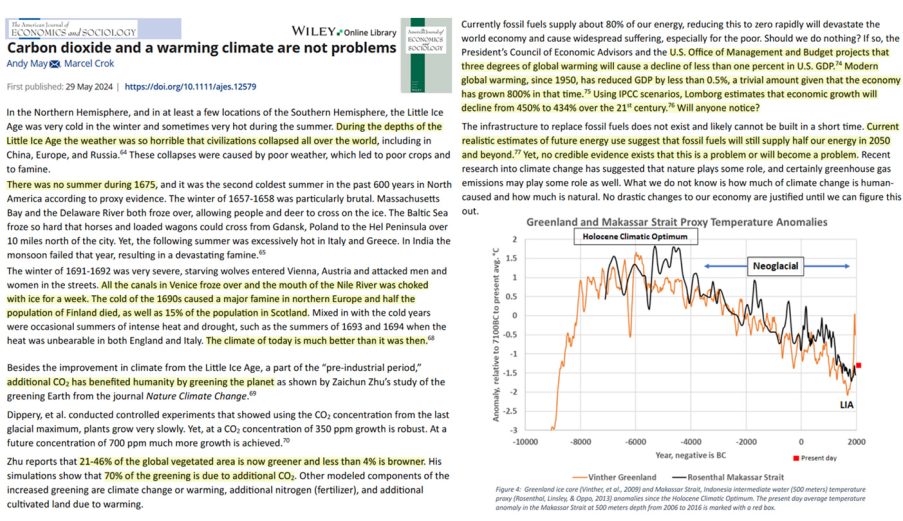
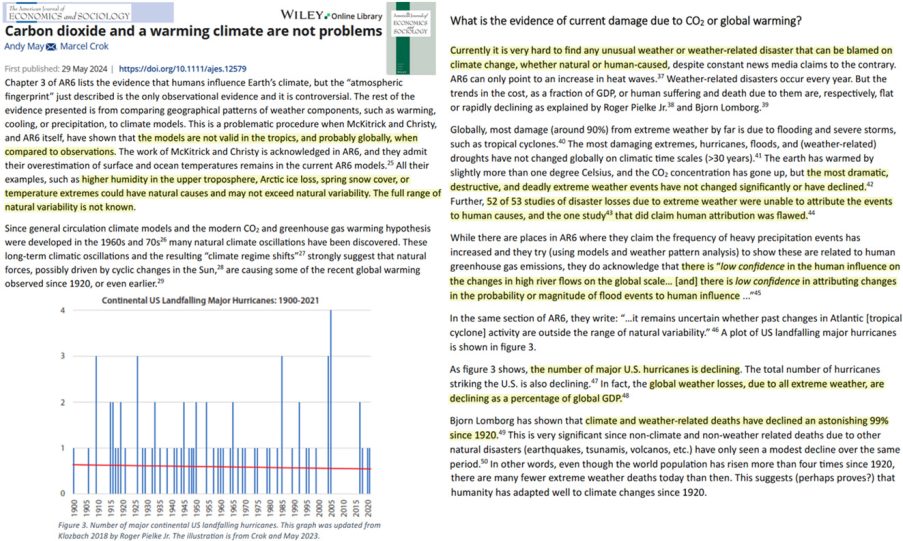
Image Source: May and Crok, 2024
Featured Video

Alon Mizrahi: ‘Israel Must Be Dismantled’
or go to
Aletho News Archives – Video-Images
From the Archives
Allies Don’t Need Lobbies
By Jay Knott | Dissident Voice | September 24, 2013
In a recent article on Counterpunch, Rob Urie defended the traditional Marxist analysis of US policy in the Middle East. He argues that support for Israel is driven primarily by economic interest, not the Jewish lobby.
He starts by paying tribute to the idea that Western societies are uniquely racist. He says that the “Western narrative” claims there is an “Arab character”, and that this is “antique racist blather”. He gives no definition of these terms. Further, he establishes his credentials as part of the dominant current in the American left by claiming that “over a million people in Iraq died so ‘we’ in the West can drive SUVs.”1
When he tries to criticize bourgeois economics, he makes it clear he doesn’t understand the developments it has made since Marx’s day, using the mathematical discipline known as “game theory”. He dismisses the basic abstraction of economic theory, the idea of the rational individual, on the grounds that it is “devoid of history, culture and political context”. But abstractions are always devoid of something.
He defends a more concrete economic theory, mostly Marxist, with some input from another theorist of capitalist crisis, Hyman Minsky. This concrete theory leads him to the view that US activity in the Middle East is primarily driven by rational capitalist motives, the need to secure a supply of oil.
“Taking the totality of circumstance — former oil company executives launching war on an oil rich nation on a pretext they publicly proclaimed they didn’t believe shortly before taking office — and that upon launching their war proved to be non-existent, requires a willingness to overlook the obvious — that the war on Iraq was for oil, that is difficult to support.”1
Perhaps I’ve misunderstood him, but based on what he says in the rest of the article, this convoluted sentence seems to argue that, because president Bush and vice-president Cheney attacked Iraq on false premises, and they also said it was all about oil, and they are former oil executives, and Iraq has a lot of oil, it’s difficult to deny US attacks on Iraq are all about oil.
In fact, it’s not hard at all. As Urie points out, at times Bush and co. said that attacking Iraq was “protecting the world’s supply of oil.”1 But, as he also points out, they are congenital liars. Why should we believe them when they say they are trying to “protect” the oil supply? Protect it against what? When politicians “admit” attacks on Middle Eastern countries are wars for oil, they are parroting the neo-con party line, feeding the public, both left and right, with a plausible-sounding pretext. For right-wingers, “it’s a war for oil” is a reason to support war, and for leftists, it’s a way to feel better by complaining impotently about corporate greed. Both approaches help the war drive. … continue
Blog Roll
 Aletho News
- Zelensky unnecessarily involves Ukraine in the Middle East crisis
- Turkish tanker blacklisted by Ukraine hit in drone attack – media
- Canada, the U.S., and NATO: the inescapable trap
- Villains of Judea: Leonid Radvinsky
- Alon Mizrahi: ‘Israel Must Be Dismantled’
- Former Head Of MI6 Admits That The U.S. And Israel Are Losing The Iran War
- Scattered Thoughts on War and Peace
- Iran Threatens to Close Red Sea to Shipping in Response to Invasion
- Iran in excellent position to prevail in war with US, Israel: John Mearsheimer
- Iran warns US: Do not call your retreat an agreement
- If Americans Knew
- In the West Bank, life is a constant battle – 3 articles
- Jacob Reses, one of the most powerful pro-Israel operatives in Trump’s Washington
- Israeli-US assaults kill or injure 87 children a day – Not a ceasefire Day 166
- ‘Forever live by the sword’: Understanding Israelis’ massive support for Iran war
- UN’s special rapporteur on human rights says Israel is systematically torturing Palestinians
- Trump White House plagiarized Iran war manifesto from Israel-aligned think tank
- Gaza says 6–10 patients die daily waiting for treatment abroad as Israel blocks medical evacuations
- ‘Substantial evidence’ of double-tap strike in killing of Gaza’s Hind Rajab
- ‘Do Not Want To Die For Israel’: Doubts About Trump’s Iran Strategy Spread Among Troops
- Instead of taking Joe Kent’s claims seriously, the media is disregarding him as an antisemite
- No Tricks Zone
- Devastating Assessment Of Comirnaty Vaccine By Former Senior Pfizer Europe Toxicologist
- New Study: CO2 Is ‘Effectively Negligible’ As An Explanatory Climate Change Factor Since 2000
- Former Pfizer Toxicologist Dr. Helmut Sterz Tells Bundestag Hearing Pfizer Vaccine Should Have Never Been Approved
- Energy Expert: Germany’s Nuclear Phaseout Was A “500 Billion Euro Mistake”
- New Research: South Australia’s Mid-Holocene Sea Surface Temperatures Were 4°C Warmer Than Today
- Storing Green Energy To Last Germany 10 Days Would Require A 60-Million Tonne Battery
- New Studies: UK Sea Levels Were 4 Meters Higher Than Today During The Mid-Holocene
- Destructive Green New Deal: German Energy And Metal Group Warns Of Drastic Crisis
- New Study Documents A 20-Year Pause In Arctic Sea Ice Decline – Driven By Internal Variability
- Wake-up Call: Survey Shows Majority Of Germans Now Favor Postponing Climate Targets!
 Aletho News