Global PR Giant Launches Provocative HPV Vaccine Ads Targeting Gen Zers
By Brenda Baletti, Ph.D. | The Defender | December 7, 2023
A multinational public relations firm last week launched a provocative advertising campaign — under the slogan “HPV Fucks Everybody” — designed to persuade Gen Zers to get the human papillomavirus (HPV) vaccine.
The PR firm, Publicis Groupe, launched the campaign in collaboration with the nonprofit Fuck Cancer. The campaign doesn’t name a specific HPV vaccine brand name. However, Merck’s Gardasil vaccine is the only HPV vaccine brand distributed in the U.S., and Merck is a client of Publicis Groupe.
When asked if Merck was funding the campaign, a spokesperson for Fuck Cancer told The Defender, “This campaign has no connection with Merck and is a collaboration between Publicis Health Media and Fuck Cancer (a non profit). Please note that we are promoting a vaccine that is safe and saves lives.”
There are currently 80 cases pending in federal court against Merck alleging Gardasil caused injuries and the federal Vaccine Court has paid out more than $70 million to people making claims regarding Gardasil.
The National Institutes of Health (NIH), also a Publicis client, developed the HPV vaccine technology, which it licenses, in the U.S., exclusively to Merck.
In addition to Merck and the NIH, other Publicis Groupe clients include the World Economic Forum (WEF), pharmaceutical giants including Pfizer, GSK, AstraZeneca, Johnson & Johnson, Purdue Pharma and several pharmacy chains that administer the HPV vaccines, including Walmart, Rite Aid and CVS Health (owners of Target pharmacies and clinics).
Campaign ‘uses sex to sell its case’
The new campaign targets young adults directly through a series of ads featuring “diverse, sexy images” and edgy music, accompanying the message that it doesn’t matter who you are, you are at risk because “HPV Fucks Everybody.”
Photos of a black couple, a white couple and a furry couple kissing, and a multiracial group of young people partying are featured on the website and will be featured in the ads.

The images are accompanied by lines like, “Stop the spread. Get the shot. Keep doing you,” according to “Pharma & Health Insider” — a PR site that publishes promotional stories with a news-like appearance.
HPV transmission is likely to occur via sex, the PR story said, so the campaign “uses sex to sell its case.”
“Targeting all 18–26-year-olds who are sexually active (or who want to be), the campaign behaves just like its audience: honest, bold and unbounded by tradition,” said Alison McConnell, chief marketing officer at Publicis Health Media — one of Publicis’ “solution hubs.”
Michelle Stiles, author of “One Idea To Rule Them All: Reverse Engineering American Propaganda,” told The Defender that campaigns run by elite global PR firms may appear absurd to a skeptical observer, but they have tremendous power to shape global public health agendas.
She said:
“The trendy and provocative messaging targeting sexually active youth for yet another vaccination campaign should hopefully be met with ample amounts of skepticism or outright laughter for those who paid attention during the previous rollout of the COVID-19 shots.
“Unfortunately, these million-dollar campaigns are extremely dangerous because they are so effective.”
Ben Mallory, executive vice president/creative director for Digitas Health, another Publicis subsidiary collaborating on the campaign, said the campaign is designed to inform young people that they will be infected with HPV, that such infection will be risky and that vaccination is the answer.
“For a generation that doesn’t discriminate, it’s important they realize that HPV doesn’t either,” he said. “That’s what the campaign communications [sic]: It doesn’t matter who you are or what you’re into, if you’re not vaccinated, you’re at risk.”
Trying to reach ‘largest and most influential generation’
The campaign will air 30-second and one-minute ads on 150 college campuses and in 150 malls in major markets, and also post on lifestyle websites like Thrillist, PopSugar, the dating site Grindr.
An audio campaign will follow, along with advertising in “points-of-care,” which can include clinics or pharmacies.
On the campaign’s website, people can also sign up to “get the shot” at major retail pharmacies including Walgreens, CVS, Rite Aid, Walmart, Target and Kroger — companies Publicis Groupe also represents.
McConnell, Publicis’ marketing director for the campaign, said they are trying to reach Gen Z because it is “the largest and most influential generation.”
That makes this campaign different from most previous HPV vaccination PR campaigns that targeted parents.
This shift in focus reflects recent shifts in direct advertising by Gardasil maker Merck.
Merck’s early ads targeted parents of adolescents, but in 2022 they shifted gears and started targeting parents of young children with ads like this one, which appeals to parents of the older elementary school children.
These ads focused on marketing the vaccine as “cancer prevention” rather than as acting on a sexually transmitted disease, a strategy the Centers for Disease Control and Prevention (CDC) promoted to encourage more young people to get vaccinated.
Last year, Merck expanded its advertising campaign to target adults through age 45, in commercials like this one, marketing the vaccine as protecting against a long list of cancers.
Merck has invested heavily in shaping the market since the U.S. Food and Drug Administration (FDA) approved the drug in 2006. In October, it announced that its 2023 third-quarter Gardasil sales grew 13% to $2.6 billion.
Fact-checking the campaign’s claims
The campaign sample ad and its website, which provide no citations, make many misleading or erroneous claims.
The campaign’s approach appears to be rooted in the “fear-based” or “fear-appealing” messaging designed to “nudge” people into getting vaccinated, commonly utilized during the COVID-19 pandemic and in global public health more generally.
According to the CDC, HPV is the most common sexually transmitted infection in the U.S. and the majority of sexually active people will get it at some point in their lives, even if they have only one or very few sexual partners.
But the vast majority of HPV infections are cleared by the immune system and less than 10% of infections are linked to any clinical symptoms. Clinical symptoms can include a variety of warts and cervical dysplasia, which may be benign or precancerous.
Yet the campaign website claims, “HPV turns into cancer about 10% of the time,” a claim public health agencies don’t make.
There are over 200 strains of the HPV virus, a subset of which are deemed “high-risk.” HPV can cause genital warts and some strains have been associated with some types of cancer. However, HPV is not the sole risk factor for any cancer, and cancers associated with HPV can also sometimes develop without the presence of the virus.
Methods like regular pap screening are highly effective and have been found to reduce the incidence and mortality of cervical cancer among women by at least 80%.
But the sample ad on the site presents HPV as something always scary and dangerous.
It says:
“HPV Fucks Everybody. In fact, there are more than 14 million new HPV infections in the US each year, because HPV doesn’t discriminate. It doesn’t care who you are, what you look like who you love or what you’re into. HPV will infect more than 85% of sexually active people of all races, ethnicities and genders. It can lead to genital warts, or worse, over ten types of cancer. So it doesn’t matter if your status is single, committed, or complicated. It doesn’t even matter if you’re not currently sexually active.”
The website also claims the HPV vaccine can prevent a whopping 33,700 types of HPV-related cancers. Even Gardasil 9’s package insert and the CDC website only indicate the HPV vaccine for some cancers of the cervix, vagina, vulva, penis, anus and back of the throat with the HPV virus.
The campaign also repeats Merck’s claims that the vaccine is “safe and effective” and that the side effects are “mild.”
But a series of ongoing lawsuits against Merck allege the drugmaker fast-tracked Gardasil through the FDA’s approval process and deceptively conducted clinical trials to mask serious side effects and exaggerate the vaccine’s effectiveness.
Some of the signature impacts observed following HPV vaccination in thousands of adverse events reports worldwide include permanently disabling autoimmune and neurological conditions such as postural orthostatic tachycardia syndrome, fibromyalgia and myalgic encephalomyelitis/chronic fatigue syndrome.
To date, there are no valid studies showing the HPV vaccine prevents cervical cancer. However, there are studies suggesting the vaccine could increase the risk of cancer.
Finally, the campaign promises that getting vaccinated can “put an end to HPV. For you, for us, for them. For everyone.”
However, the Gardasil 9 vaccine is designed only to suppress nine of the over 200 strains of HPV, and recent research has shown that when the HPV vaccine suppresses certain types of “high-risk” HPV strains, those strains are replaced with other strains associated with some cancers.
While the World Health Organization has launched a global campaign to eradicate cervical cancer as a public health threat, it has not indicated a similar project for HPV.
Publicis is part of ‘the propaganda arm of the global elite’
The campaign is spearheaded by Publicis Health Media and Digitas Health, which are both part of Publicis, along with Fuck Cancer.
According to the campaign publicity, Publicis Health Media is particularly concerned with HPV because the company CEO Arthur Sadoun was diagnosed and treated for HPV-associated cancer.
Last year, the company published a holiday video where board chair Maurice Lévy and Sadoun were joined by actor Michael Douglas, who was diagnosed and treated with throat cancer a decade ago, to promote the HPV vaccine and the Publicis Groupe.
As part of its cancer marketing focus, Publicis Groupe launched its Working with Cancer initiative, at the WEF. In partnership with 30 of the largest global companies, including Pfizer, Sanofi, PepsiCola, Meta and others, the campaign seeks to “abolish the stigma and insecurity that exist for people with cancer in the workplace,” according to the campaign website.
During Super Bowl LVII in February, it ran a commercial about the campaign that won a Gold Lion from the Health & Wellness jury at the 2023 Cannes Lions International Festival of Creativity in June.
Publicis Groupe is an ad holding company, which recently rebranded “for the connected age” itself as a “platform,” according to its website.
As Stiles details in her book, just a few such companies — including Publicis, Omnicom, WPP and Interpublic Group — dominate the global media landscape.
Each ad-holding company has billions of dollars in revenue and serves thousands of corporate clients along with universities, nonprofits and governmental and nongovernmental organizations.
As public relations firms, they design ad campaigns and they develop and strategically place print and broadcast media content in mainstream news and PR publications for their clients. They also create public relations campaigns like those described here to develop, promote and defend the reputations of their clients.
They design their strategies in part by collecting data “on virtually every U.S. consumer” and on journalists, politicians and scientists.
Other tactics include flooding the media landscape with spin, developing talking points for “experts” to use in public appearances and generally “using underhanded tactics to promote and defend their clients,” Ecowatch reported.
According to Stiles, an estimated two-thirds to 80% of the content broadcast and published by corporate media comes from public relations firms.
She said:
“There is no doubt that the top three PR holding firms WPP, Omnicom, and Publicis, whose collective revenue is over 44 billion, function and should be thought of as the propaganda arm of the global elite.
“The finely-tuned, targeted messages not only create revenue for the transnational capitalist class but just as importantly define the global problems to be solved and the way in which they should be solved, leaving very little room for other creative options.”
Each agency has smaller subsidiaries and PR affiliates under the same corporate ownership, creating the appearance that there are more players in the media field than there actually are. More recently, they have also begun to “gobble up” data companies.
For example, in this campaign, two of three collaborators are part of the Publicis Groupe.
The public relations site Pharma & Health, where one of the “stories” about the “HPV Fucks Everybody” campaign was posted by MediaPost Inc., a marketing company that posts up to 50 different industry blogs.
“Adding together the global revenue of the top 250 independent PR firms ($17 billion) with the PR holding companies ($44 billion) and we are literally swimming in marketing messages intended to consolidate capital for the mega-corporations,” Stiles said.
“The medical messaging repeatedly advises us to outsource health and wellness to drugs or vaccines, poor choices indeed,” she added.
A Defender investigation into Publicis’ clients last year, found it serves a wide range of corporate, governmental and supra-governmental agencies including the WEF and U.S. government agencies like the National Security Agency, tech giants like Google, Amazon, Disney, Microsoft and Meta, and corporate clients PepsiCo, Phillip Morris and Saudi Aramco.
Publicis Groupe was implicated in the “Monsanto File” scandal, where the company was found to be using Publicis Consultants and FleishmanHillard, an Omnicom subsidiary, to launch a PR offensive to rehabilitate the image of genetically modified organisms and pesticides.
Newsguard, a for-profit fact-checking organization backed by Big Pharma, Big Tech, the U.S. government and the American Federation of Teachers — a staunch advocate of mandatory COVID-19 vaccination and masks for schoolchildren — is also a client.
So is the Center for Countering Digital Hate (CCDH), a politically driven service consistently attacking anyone who raises questions about vaccine efficacy or safety, and the organization responsible for creating the so-called “Disinformation Dozen” list.
In her book, Stiles also explains that asset management firms Vanguard and BlackRock are among the top 10 shareholders in the top four ad agency holding companies.
Brenda Baletti Ph.D. is a reporter for The Defender. She wrote and taught about capitalism and politics for 10 years in the writing program at Duke University. She holds a Ph.D. in human geography from the University of North Carolina at Chapel Hill and a master’s from the University of Texas at Austin.
This article was originally published by The Defender — Children’s Health Defense’s News & Views Website under Creative Commons license CC BY-NC-ND 4.0. Please consider subscribing to The Defender or donating to Children’s Health Defense.
Another Critical Thinker Reaches The Obvious Conclusion: Intermittent Renewables Can’t Work On Their Own
By Francis Menton | Manhattan Contrarian | December 3, 2023
Let me welcome to the small and elite club of critical thinkers on the supposed energy transition a guy named Balázs Fekete. Fekete, with several co-authors, has recently (September 18) succeeded in getting an article published in a journal called Frontiers of Environmental Science, with the title “Storage requirements to mitigate intermittent renewable energy sources: analysis for the US Northeast.” Fekete then followed up by publishing on November 14 at Judith Curry’s Climate, Etc. blog a lengthy post summarizing the article, titled “Net-Zero Targets: Sustainable Future or CO2 Obsession Driven Dead-end?”
As with the previous competent analyses of energy storage requirements needed to back up intermittent renewable generation that have been featured on this blog and in my energy storage Report, there is nothing complicated about the Fekete, et al., analysis. The authors call it “a modified surplus/deficit calculation [as] taught to water engineers to size reservoirs for meeting water demand when the water resources vary.” When there is surplus production you add it to storage, and when there is a deficit you subtract; and then you sum over a year (or two, or ten) to calculate how much storage you need. It’s all basic arithmetic. What could be simpler?
You will not be surprised that the conclusion is “CO2 obsession driven dead-end.”
This subject would seem almost too obvious and trivial to cover on this blog. There is nothing complicated here. Everybody who is involved in any way in the energy transition game, and who has even the lowest level of professional competence, simply must be aware of this subject and of these calculations. And yet I just attended the big New York “Climate Summit,” (aka the Krazy Klimate Konference), featuring all of the powerful politicians and bureaucrats and industry leaders who are in charge of our state’s energy transition, and to a person they have no idea about any of this. And by no idea, I mean none, zero, zilch. One guy even came up to me and accused me of being “rude” for laughing out loud at his astounding ignorance. (The only other possibility was that it was intentional comedy.)
Unsurprisingly, the authors of Fekete, et al., make no claim to being “climate scientists.” Climate scientists as a class are way too smart to stoop to doing basic arithmetic. In the intro to the paper, Fekete identifies himself as a professor at the City University of New York — of Civil Engineering. Second author Mihály Bacskó is a former executive of the Hungarian Power Company. The other two co-authors are meteorologists working at the University of Oklahoma. In other words, the focus here is not on scaring the public with frightening scenarios from the occult voodoo of climate “science,” but rather only on whether the proposed solutions will or will not work.
The particular calculations in Fekete, et al., look at data from twelve states of the northeastern U.S. — New England, plus New York, New Jersey, Pennsylvania, Delaware, Maryland and West Virginia. Rather than using production data from existing wind and solar facilities, the authors obtained daily wind speed and solar irradiation data for the region. For consumption data, the blog post states that the authors applied an assumption of “constant energy consumption,” after determining that “seasonal variations of energy consumption are relatively small (deviate by only 10-15% of the annual average).” (Perhaps this decision could be criticized, but I doubt that it makes any material difference to the conclusion.)
And the bottom line is:
The storage capacity needed to align power generation from solar or wind is around 25% of the annual energy consumption.
In other words, you need three months worth of storage to try to make this work. Previous studies that I highlighted in my energy storage Report — for example, those of Roger Andrews and Ken Gregory — had calculated storage needs in the range of one to two months. However, those studies only used one year’s worth of data for each calculation, and allowed running the storage balance right down to zero. If you think that it’s too risky to run the storage right down to zero before the balance starts to refill, then three months of storage is a much more reasonable figure. Indeed, it’s still rather conservative.
Fekete, et al., don’t get into the specifics of cost of any possible storage solution. But then, they don’t need to. The potential costs are so enormous as to completely rule out any attempt even to start down this road. According to the U.S. Energy Information Administration, total U.S. electricity consumption in 2022 was just over 4 trillion kWh. So one-quarter of that would be just over 1 trillion kWh. Just to get an idea of the cost of that much energy storage, this site (Tesla fans) gives a (highly optimistic) cost for Tesla batteries of just over $100 per kWh. So a trillion of those will run you about $100 trillion. That’s four times the entire U.S. economy. Meanwhile, a Tesla-style battery is not remotely up to the job of the energy storage needed to back up wind/solar electricity generation, which would necessarily include the ability to save up power over a year or more and discharge over a year. But then, the economics are so wildly out of line that it’s hardly worth worrying about such technicalities.
Fekete, et al., in a very understated manner, put it this way:
In the absence of energy storage technology that can store several months worth of energy, one has to conclude that all studies suggesting that solar or wind are price competitive with other forms of energy should be retracted.
The Fekete blog post at Climate, Etc. contains two other subjects of interest. One relates to the peer review process. It appears that one of the peer reviewers made a run at getting the paper blocked, without stating the nature of any substantive criticisms:
One of the reviewers stated that “The manuscript contains fundamental errors that cannot be rectified through author revisions” without venturing into any details.
Fekete calls this effort “unscientific, unjust, and unethical,” which is again quite an understatement. Sadly, such conduct is the norm in what goes by the name “climate science” today. Fortunately, in this case, another reviewer was supportive, as was the staff of the journal.
The second subject of further interest in the blog post is that another reviewer criticized the draft paper for alleged “lack of references to the “plethora of work” related to integrating renewables to the current energy systems and transitioning to a sustainable energy future.” The criticism caused the authors to “roll up their sleeves” and go out and review some 360 papers recommended by the critic. Here is a list of what they found:
-
The inter-annual and seasonal variations were rarely studied.
-
The vast majority of the studies were limited to diurnal and minute-by-minute variations.
-
The publications only investigated the use of few hourly storage capacities.
-
The primary sustainability metric was reducing CO2 emissions.
-
Most of the publications were limited to low renewable penetration.
-
No publication attempted to address complete decarbonization.
-
Even the most ambitious “deep decarbonization” scenarios stopped at 25-50% renewable contributions that was considered “high renewable penetration”.
And in summary:
Most of the reviewed papers assumed that solar and wind will be always supplemented by some form of “firm generation capacity”, which is the obfuscated name of using fossil fuels complemented with “carbon capture and sequestration”.
In other words, the orthodox “peer reviewed” scientific literature is almost completely lacking in consideration of the most important, fundamental problem of transitioning to an energy system based on electricity generated by the wind and sun. Well, now there is one competent paper in the mix. They will do their best to ignore it, at least until the whole wind/solar thing has conclusively shown that it can’t work.
New Study: 67% Of Scientific Papers Can Be Said To Reject The AGW Hypothesis…
… when using the same assumption-based methodology to arrive at the conclusion only 0.5% of scientific papers reject AGW.
By Kenneth Richard | No Tricks Zone | November 30, 2023
In a new study, six scientists (Dentelski et al., 2023) effectively eviscerate a methodologically flawed 2021 study (Lynas et al.) that claims 99.53% of 3,000 scientific papers examined (by subjectively classifying papers based only on what is written in the abstracts) support the anthropogenic global warming, or AGW, position.

Image Source: Dentelski et al., 2023
The Lynas et al. authors begin with the assumption that a consensus on the human attribution for global warming not only exists, it is ensconced as the unquestioned, prevailing viewpoint in the scientific literature. So their intent was to effectively quantify the strength of this assumed widespread agreement by devising a rating system that only assesses the explicit rejection of AGW in the paper’s abstract as not supporting the presumed “consensus.”
Of the 3,000 papers analyzed in Lynas et al., 282 were deemed not sufficiently “climate-related.” Another 2,104 papers were placed in Category 4, which meant either the paper’s authors took “no position” or the position on AGW was deemed “uncertain”… in the abstract. So, exploiting the “if you are not against, you are for” classification bias, Lynas and colleagues decided that the authors of these 2,104 scientific papers in Category 4 do indeed agree with AGW, as what is written in the abstract does not explicitly state they do not agree.
Interestingly, if this classification bias had not been utilized and the thousands of Category 4 (“no position” or “uncertain”) papers were not counted as supporting AGW, only 892 of the 2,718 (climate-related) papers, or 32%, could be said to have affirmatively stated they support AGW. So, simply by assuming one cannot divine the AGW opinions of authors of scientific papers by reading abstracts, it could just as facilely be said that 67% (1,826 of 2,718) of climate-related papers reject AGW.
Dentelski and colleagues also point out that by their own analysis, 54% of the papers they examined that were classified by Lynas et al. as only “implying” support (Category 3) for AGW or Category 4 (“no position” or “uncertain”) actually described a lack of support for AGW in the body of the paper itself. But since this expressed non-endorsement of AGW was not presented in the abstract, these papers were wrongly classified as supporting AGW anyway.
To fully grasp the subjective nature of the methodology employed by Lynas and colleagues, Dentelski et al. uncover the internals of the study indicating 58% of the time two independent examiners did not agree on numerical classification scale (from 1 to 7) for a paper. If two people agree just 42% of the time when classifying papers, it cannot be said that the rating system is sufficiently objective.
The Lynas et al. paper appears to be little more than an exercise in propaganda.
Main National TV Station Pumps INSANE Propaganda
Ivor Cummins | November 20, 2023
Our National main TV station just aired an INSANE piece of WEF/UN-style propaganda – it’s a parody of itself! Nonetheless I have a great time taking it down hardcore ;-) Please share widely – you can download vid here too, to share elsewhere:
NOTE: My extensive research and interviewing / video/sound editing, business travel and much more does require support – please consider helping if you can with monthly donation to support me directly, or one-off payment:
– alternatively join up with my Patreon – exclusive Vlogs/content and monthly zoom meetings with the second tier upwards:
Curious Admission Surfaces Concerning MHRA Blackmailing Mainstream Media Outlet Over Adverse Event Reporting
And no one really picked up on it…
BY JJ STARKY | NOVEMBER 25, 2023
Mass consumers of news – me included – are often exposed to so much information that some of that information can be lost in all the noise.
There’s little explanation why such a bombshell revelation featured in a recent Telegraph article gained next to no attention.
On 8th November, journalist Sarah Knapton published an article, entitled, ‘In the end, the AstraZeneca vaccine just wasn’t as good as its rivals’. Knapton broke down how AstraZeneca’s (AZ) purported efficacy could not stand up to the purported efficacy of the other vaccines. The consequences of which led to its eventual abandonment.
Curiously, however, buried in the 14th paragraph, was a confession that back in March 2021 – when the Telegraph first reported on AZ’s blood clot risks – Medicines and Healthcare products Regulatory Agency (MHRA) officials effectively blackmailed them.
Knapton writes:
“On the day we published the story we received a threatening phone call from a senior official at the MHRA warning that The Telegraph would be banned from future briefings and press notices if we did not soften the news.
Another well-known Cambridge academic got in touch to complain about our “disgraceful fear-mongering headline” on the story, claiming that it would discourage vaccine uptake and cost lives.”
This was the headline of that 17th March 2021 article:
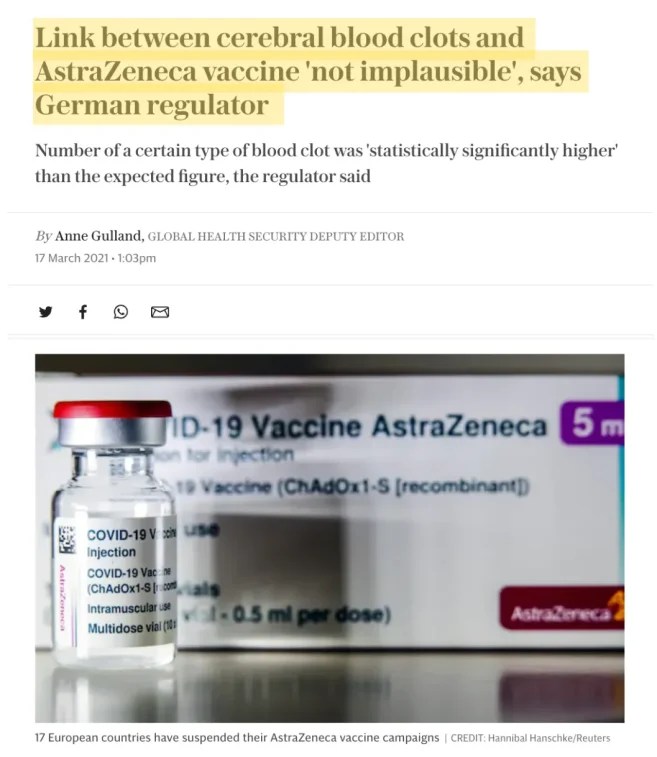
Considering the title includes a subjective opinion from a foreign medical regulator that softens the news, I’m not sure how it constitutes “disgraceful fear-mongering”.
Perhaps this remark is more reflective of the contagious petulance we witness with medical regulators. For them, negative news is not just negative news. It’s analogous to physical assault.
What seems far more “disgraceful” is how a supposedly impartial medical regulator – tasked with safeguarding citizens from potentially lethal treatments – allegedly threatened to strip away a news organisation’s access. Leaving them out in the cold as competitors would stand to benefit from their potential exclusion.
And the curious thing is, no one has seemed to pick up on the news bar The Conservative Woman and the Health Advisory & Recovery Team (HART).
A report from HART earlier in August further revealed that MHRA officials have been blocking journalists, scientists, and vaccine injured victims on social media. HART asked them why and they responded:
“Thank you for flagging your issue about Twitter. We’ve reviewed recent action taken on that platform and have identified accounts which have been blocked in error, these have now been unblocked and you should be free to interact with our content again. Please let us know if you have any further issues so we can investigate and rectify, if necessary”.

“Sorry folks, it was error. And a complete ‘coincidence’ that we primarily blocked commentators who were critical of us…”
These are the same officials who refused to answer a routine Freedom of Information Request concerning data AstraZeneca submitted in their application to licence their Covid-19 vaccine. The reason they refused? It was “vexatious”.
They wrote in their response:
“this request falls to be considered “vexatious” due to the scope of the request and the disproportionate burden that compliance would create. S14(1) of the FOIA states that “Section 1(1) does not oblige a public authority to comply with a request for information if the request is vexatious.
Downloading the dossier of the vaccine is a relatively straightforward task, although it does require time. Due to the voluminous size of the file packages, when downloading the full package of data, the database software may be more prone to freeze. However, the time required to read through the dossiers, to identify exempt information and to consider and make redactions we expect would take many weeks, if not months to complete, as the dossier encompasses gigabytes of data. To meet the request our staff: Would need to read the dossier in full, in order to identify where redactions need to be made.
We appreciate that there remains a strong public interest in COVID-19 vaccines, however, we do not feel that the public interest outweighs the resource burden required to meet your request.”
Sometimes the actions of government officials are laced with so much arrogance, incompetence, and just frank laziness that it makes one question if they’re genuinely true.
If I sat across the table from an uninitiated countryman and told him of the above, it would come as no surprise to see him raise his eyebrows in astonishment. But not because of what I was telling him, but at me, as if I was about to descend into prophetic trance about how judgement day is coming and there’s going to be some epic battle between us and the lizard people outside Matt Hancock’s house.
Put differently, the extent to which the medical regulators’ actions are so unbelievable actually benefits them. It is easier for people to dismiss it as false. Of course, if the media actually did their job, this wouldn’t be a problem.
Naturally, when MHRA threatened the Telegraph, the outlet hesitated to revisit the subject for months. The blackmail paid off.
Were covid vaccine trials misleading by design?
Data presentation was deceptive
Health Advisory & Recovery Team | November 23, 2023
In chemotherapy, the primary aim is to reduce the disease burden in patients who are already diagnosed with cancer. This is reflected in endpoints like tumour size reduction, progression-free survival, and overall survival, which are directly related to the degree of disease burden. Therefore, measuring the benefit of chemotherapy involves comparing the extent of disease burden (or its progression) at the end of the trial between those who received the chemotherapy and those who did not. This comparison provides insight into how effectively the chemotherapy mitigates the impact of the cancer.
On the other hand, vaccines are designed with the primary goal of keeping individuals healthy by preventing the onset of a specific disease. Therefore, the efficacy of vaccines is best measured by comparing the health status among participants at the end of the trial. This involves assessing how many individuals remained healthy and disease-free in the vaccinated group versus the control group. Such an approach accurately reflects the preventive nature of vaccines.
The covid vaccine trials did not focus on how many were healthy instead comparing those who developed disease. To take the Pfizer/BioNTech trial as an example, there were 8 PCR positive symptomatic people in the vaccine group and 162 in the placebo group more than a week after the second dose and after up to 2 month’s follow up. That worked out at a 94.6% efficacy when calculated as a percentage reduction.
That sounds fantastic but it is not fantastic when measured in other ways. There is more than one scenario that could result in a claim of a 94.6% relative risk reduction as shown in the table. The alternative ways of measuring show the relative change in the percentage who remained healthy and the absolute change – i.e. the percentage of the population who benefitted.

In a hypothetical trial in which 94% of the placebo group developed a disease while only 5% of the treatment group did would also have a 95% efficacy as calculated the conventional way. However, these results have a totally different meaning to a patient. In this scenario 93.7% of the individuals who received the treatment directly benefited. Furthermore there was a marked change, 91.0% in the proportion who remained healthy.
Adjusting the percentages affected shows numerous situations in which the Relative Risk Reduction as conventionally calculated are identical but the Relative Risk Reduction in the proportion remaining healthy and the proportion who directly benefited tell a very different story. The last row are the actual results.
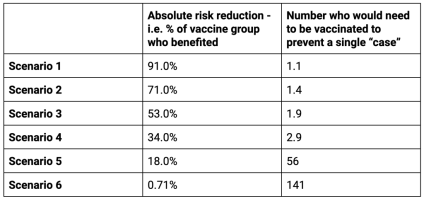
For the first two scenarios the people taking the treatment are more likely to directly benefit than not. For scenarios 3 and 4 there is still a high possibility of direct benefit. However, for the last two scenarios the chances of not directly benefiting are far higher than the chance of benefitting. It is possible in these scenarios that a longer follow up would improve the situation as more people would develop disease or be protected from it. However, the evidence of waning means that the time frame of follow up is close to the maximum possible period of benefit anyway.The important lesson here is that looking at the relative risk reduction as presented in the trials on its own is a meaningless measure. That is why the industry’s own code of practice says, “Referring only to relative risk, especially with regard to risk reduction, can make a medicine appear more effective than it actually is. In order to assess the clinical impact of an outcome, the reader also needs to know the absolute risk involved. In that regard, relative risk should never be referred to without also referring to the absolute risk.” The efficacy claims, even if we trust the results, were presented to the public in a way that could be deliberately misinterpreted.
New Report: Young People Dying of Cancer at ‘Explosive’ Rates, UK Government Data Show
By Mike Capuzzo | The Defender | November 21, 2023
Teenagers and young people in their 20s, 30s and 40s in the U.K. are dying from rapidly metastasizing and terminal cancers at an unprecedented rate since mass COVID-19 vaccination began, according to a new analysis by Edward Dowd.
The 45-page report by Dowd, a former Wall Street hedge fund manager and author of “‘Cause Unknown’: The Epidemic of Sudden Deaths in 2021 and 2022,” alarmed some oncologists who characterized it as a sharp reversal of decades of mortality data.
Dowd based his analysis on readily available government statistics from the U.K.’s Office for National Statistics.
In an interview with The Defender, Dowd said he and his research partners, who include a handful of high-level scientists, data analysts and financial experts, examined all International Classification of Diseases, 10th Revision, (ICD-10) codes for cause of death in the U.K. in the study period of 2010-2022 to investigate trends in malignant neoplasms (C00 to C99 codes).
ICD-10 codes are the international physicians’ classification of diagnosis, symptom and procedure for claim processing set by the World Health Organization (WHO). A malignant neoplasm is a cancerous tumor.
Dowd said his research team noticed a striking pattern: While almost all deaths among older people in 2021 and 2022 in Wales and England had been coded, 8% of deaths among 15- to 44-year-olds in 2021, and 30% of deaths in that age group in 2022, hadn’t yet been coded.
“When you die in a hospital, you leave a trail of life and death with indications of what led to the death,” he said. “When a young person dies at the wheel of a car, walking down the street or in their sleep, there’s an investigation” that consumes time to assign the cause of death.
Dowd said the missing codes are “indicative of the problem” of excess deaths among young people.
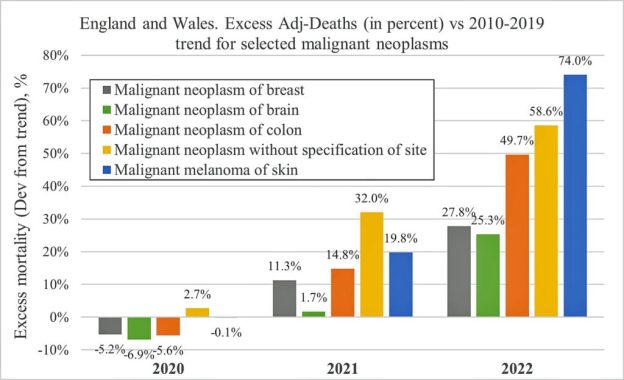
But even with the caveat of missing codes, he said, the remaining 92% of coded deaths in 2021 and 70% of coded deaths in 2022 revealed “a strong signal of cancer deaths in the young. We show a large increase in mortality due to malignant neoplasms that started in 2021 and accelerated substantially in 2022.
“The increase in excess deaths in 2022 is highly statistically significant (extreme event),” Dowd wrote in his report. “The results indicate that from late 2021 a novel phenomenon leading to increased malignant neoplasm deaths appears to be present in individuals aged 15 to 44 in the UK.”
The study’s results in the rate of cancer deaths above the historic norm in 2022 for ages 15-44 in the U.K. included:
- A 28% rise in fatal breast cancer rates in women.
- An 80% increase in pancreatic cancer deaths among women and a 60% increase among men.
- A 55% increase among men in colon cancer deaths and a 41% increase in women.
- A 120% increase in fatal melanomas among men and a 35% increase in women.
- A 35% increase in brain cancer deaths among men and a 12% rise in women.
- A 60% increase in cancer death rates among men in cancers “without site specification” and a 55% increase among women.
‘Mounting clinical evidence’ led to study
Dowd produced his report, assembled by Carlos Alegria, one of Dowd’s partners, in his Humanity Projects study of excess deaths in the U.K. and the U.S. using government and insurance industry data.
He said he started his pro bono data-driven project to help guide public policy when he saw how COVID-19 pandemic policies were destroying society’s faith in institutional experts.
Surveying the capture of national and state government regulatory agencies and corporate media by Big Pharma and other global interests, he realized, “We need independent agents to act as gatekeepers of the public interest.”
“We intend to be such agents, and to provide high-quality research to other individuals and institutions who seek similar outcomes,” he wrote.
The new report is his third in the UK Cause of Death Project, which previously examined “UK – Death and Disability Trends for Cardiovascular Diseases, Ages 15-44,” and “UK – Death Trends for the Cardiovascular System, Ages 15-44, Analysis of Individual Causes.”
The mounting clinical evidence linking burgeoning cancers in young people to the COVID-19 vaccines led Dowd to his latest study, he said.
“We focus our research on younger individuals, aged 15-44, as presently it is a topic of particular interest due to the rise in anecdotal evidence of many unexplained aggressive and unusual cancers (such as turbo cancers … ) occurring in the population, particularly in younger individuals,” he wrote in the study.
“The focus of this study is not to examine individual claims and anecdotes, but instead to provide a statistical analysis at a population level and clarify if the anecdotal evidence is abnormal or not.”
Dowd said he hopes “the relationships that we uncover in our analysis” are “a basis for a reality check for health professionals to understand underlying trends in individuals’ health.”
Dowd’s method was to analyze the number of deaths attributed to cancer in England and Wales between 2010 and 2022 in the U.K. Office for National Statistics data.
He compared excess death rates, the difference between observed deaths and the baseline for expected deaths, before and after the COVID-19 pandemic.
He established a baseline of normal cancer death rates from 2010-2020 that was remarkably consistent with few deviations, he said — until the cancer death rates rose significantly in late 2021 in the U.K. following the vaccine rollout.
Key findings from the report include:
- Breast cancer dominates in women. The most common cause of fatal cancer in women, ages 15-44, is breast cancer, representing about 25% of the total excess death rate caused by malignant tumors in women in 2022. The next most dangerous cancers for women, based on excess death rates, were colon cancer and cancer of the cervix uteri.
- While fatal cancer deaths rose dramatically among both young men and young women in 2022, young men saw a disproportionately higher rise in cancer deaths, but with no dominant cancer comparable to breast cancer in women. Brain cancer, colon cancer and stomach cancer accounted for 30.9% of the rise in fatal cancers in men in 2022.
- Cancers “without specification of site,” indicating rapid metastasis to other organs and commonly called “turbo cancers,” “exploded” in 2022, Dowd said. “These cancers saw very large rise in both women (in 2021 and 2022) and men (in 2022) and were likely metastasized already once they were identified. As the individuals refer to younger individuals who do not require early screening, these cancers were likely of rapid growth.”
- Men experienced a huge rise in skin cancer death rates of 118% in 2022. “Even though these cancers do not account for a large proportion of all cancers,” Dowd said.
- Cancers of the digestive tract “saw explosive changes in 2021 and 2022 relative to the 2010-2019 trend,” Dowd wrote. “Of particular notice are cancers of the colon (internationally coded as C18), stomach (C16) and esophagus (C15). “These cancers related to the digestive tract appear to have risen substantially in importance, and we also notice that they seem to be affecting men in a disproportionate manner.”
- Pancreatic cancer “saw a very large rise in both women (in 2022) and men (in both 2021 and 2022). Why these cancers rose so dramatically and why they rose first in men then women is one of the questions that we believe warrants investigation.”
Dowd emphasized that his research was “a first attempt to bring out some patterns that are observed in trends” in cancer post-2020.
“We hope that medical doctors and specialized researchers perform further investigations based upon these (and other) insights that our data analysis provides,” he wrote.
Link between COVID shots and rise in cancers ‘worth looking at’
Dr. Chris Flowers, an academic physician, radiologist and breast cancer specialist in England who came out of retirement to be the volunteer scientific lead of the War Room/DailyClout Pfizer Documents Analysis Project, told The Defender the U.K. data were “very, very, concerning.”
Flowers said Dowd’s research confirmed similar data on sharp cancer death increases reported by researchers, clinicians and cancer specialists in the U.S., U.K. and across the Western industrialized world since the global rollout of the experimental Pfizer and Moderna mRNA vaccine. An estimated more than 5.55 billion people, or about 72.3% of the global population, received the shots.
Flowers said he and his colleagues, including pathologists, radiologists, oncologists, internists, critical care doctors and researchers in the U.S. and U.K., have never seen anything like the severity of fatal breast cancers and other cancers in the young that exploded in 2022.
Dowd’s report confirms what Flowers and his colleagues have noticed for more than a year: “We’re seeing 2 or 3 times the normal rate of cancer.”
“We’re seeing younger people, we’re talking 20- and 30-year-old women, usually after they started menstruating and some form of growth promoter is going on normally, presenting with advanced tumors which are difficult to treat, but also they may have more than one tumor,” Flowers said. “Something that was rare is now relatively common.”
Perhaps most distressing, Flowers said, is the rise in the young of what some oncologists now call “turbo cancers,” a new term.
“Turbo cancer is a popular name that’s been coined to describe several things,” Flowers said. “It is cancers in young people just turning up, one day you’re absolutely fine, the next day you’re told you have terminal cancer and you’re dead in a week. There are many reports of that even in the mainstream media.”
“Tumors are not only faster growing but you’re getting more types of cancer occurring in the same person. It used to be very very rare. Just occasionally I’d see a very, very aggressive inflammatory cancer in young people. But now everyone has stories.”
Dr. Pierre Kory, a pulmonologist and critical care doctor who is president and medical director of the Frontline COVID-19 Critical Care Alliance (FLCCC) and treats hundreds of vaccine-injured patients in his practice, said he is “being deluged with reports and consults for help” about cancer increases from colleagues and patients.
David Wiseman, Ph.D., a pharmacist with a doctorate in experimental pathology and a pioneer, originally for Johnson & Johnson, of products to prevent post-surgery internal injuries, said he was alternatively astonished and outraged that governments and mainstream media won’t follow up on research he and Kevin McKernan, a former director of research and development at the MIT Human Genome Project, conducted showing the mRNA shots were contaminated with DNA fragments.
These fragments, Wiseman said, add to the potential damage the vaccines could cause to the human genome and open new doors to an infinite variety of problems, including cancer.
Wiseman told The Defender that the Centers for Disease Control and Prevention’s (CDC) own data show cancer concerns connected to the COVID-19 vaccines.
“We’re seeing an increase in cancers in VAERS,” the official U.S. Food and Drug Administration and CDC site for reporting vaccine injuries, Wiseman said. “The CDC did a PRR analysis, a signal analysis, that found a signal for cancer in the vaccines, which isn’t proof but it means it’s worth looking at.”
Mike Capuzzo is the managing editor of The Defender. He is a former prize-winning reporter for The Philadelphia Inquirer and The Miami Herald, a science writer, and a regional magazine founding editor and publisher who has won more than 200 journalism awards as a writer, editor and publisher.
This article was originally published by The Defender — Children’s Health Defense’s News & Views Website under Creative Commons license CC BY-NC-ND 4.0. Please consider subscribing to The Defender or donating to Children’s Health Defense.
Pfizer, Moderna Spend Millions on Ads Featuring Catchy Phrases and Celebrities to Push COVID Shots
By Mike Capuzzo | The Defender | November 22, 2023
Facing dramatic stock market declines and growing resistance to their mRNA COVID-19 vaccines, Pfizer and Moderna are running upbeat TV commercials with jingles and celebrities to push COVID-19 vaccination just in time for the holidays.
The 30-second Pfizer commercial features a cheery, driving tune and smiling celebrities Martha Stewart, singer-songwriter John Legend, professional soccer player and progressive activist Megan Rapinoe, singer-songwriter Charlie Puth and football star Travis Kelce.
All but Rapinoe flash Pfizer’s trademark blue band-aids on a shoulder showing they got Pfizer’s COVID-19 shot.
“Got it,” Stewart says, as the Pfizer ad copy reads, “This season’s updated COVID-19 shots are here,” and “Ask your healthcare provider if getting your COVID shot with your flu shot is right for you.”
“Got yours?” is the Pfizer tagline.
Moderna’s 60-second TV spot wants its audience to “Spikevax that body.”
Spikevax is the brand name of the company’s COVID-19 vaccine. It refers to the artificial spike protein the vaccine is designed to stimulate in the body to allegedly trigger protective antibodies to the virus.
The commercial opens with an older man playing table tennis accompanied by a narrator, who says, “When it comes to your health … you ping and pong that body.”
The spot proceeds through a variety of ordinary people practicing their passions, including a woman blending a vegetable shake (“you green that body”), a man plunging into an ice bucket (“you plunge that body”), and a man and woman playing chess (“you brainpower that body).”
It concludes with, “You flu shot that body, and now, you Spikevax that body. Because even though the pandemic is over, COVID-19 isn’t.”
The pharmaceutical trade press portrayed the ads as an attempt by Pfizer and Moderna, whose COVID-19 vaccines were injected into more than 5 billion people worldwide during the pandemic, to reverse dramatic losses in their stock prices in recent weeks.
“With hardly any Americans signing up to receive the updated COVID-19 shot, Pfizer is pulling out all the stops to increase uptake,” said Dr. Joseph Mercola.
Mercola reported that Pfizer paid Kansas City Chiefs tight end Kelce an outsized $20 million to promote the drugmaker’s COVID-19 shots, compared to his $5 million-per-year total endorsements from McDonald’s, Papa John’s, Walgreens, Nike and Tide, and was trying to capitalize on the football star’s recent surge in popularity as he dates pop star Taylor Swift.
Other medical trade journals debated whether celebrity endorsements like Kelce’s will actually help or hurt Pfizer’s sales and stock price.
Critic: COVID shot ads don’t meet FDA requirements for biologic side effects
But doctors and scientists interviewed by The Defender were appalled that Pfizer and Moderna, and the governments and media that support them, would continue to push the mRNA COVID-19 vaccines blamed for more than 36,000 deaths reported to the U.S. government-run Vaccine Adverse Event Reporting System, or VAERS.
A large Canadian study of 17 countries estimated the COVID-19 vaccines killed approximately 17 million people around the world.
Dr. Peter Breggin, a New York psychiatrist and author with his wife Ginger of “COVID-19 and the Global Predators: We Are the Prey,” said the Pfizer and Moderna commercials draw the audience into “a never-never land of fakers.”
“This is a combination of extreme fraud and sham,” Breggin told The Defender. “We now know from multiple scientific studies that there was a broad panoply of adverse effects to the vaccines as there are with some very potent drugs. That resulted in death in some people, and with more reports to the CDC [Centers for Disease Control and Prevention] of deaths than all the other vaccines in the world combined.”
Breggin, a frequent expert witness in pharmaceutical cases involving dangerous drugs and co-author of the bestseller “Talking Back to Prozac: What Doctors Aren’t Telling You About Today’s Most Controversial Drug,” said the Moderna ad makes a passing reference to possible myocarditis side effects while the Pfizer spot names no possible dangers at all.
“They’re not like ordinary drug commercials,” he said, adding that neither meets the U.S. Food and Drug Administration (FDA) requirement for describing biologic side effects.
Pfizer outspent competitors on digital, TV ads for COVID shots
Big Pharma advertising is big business in the U.S., the only country in the world with the exception of New Zealand that allows direct pharmaceutical advertising to consumers.
Spending on the marketing of prescription drugs, health services, laboratory tests and disease awareness grew from $17.7 billion in 1997 to $29.9 billion in 2016, with the largest increases coming in direct-to-consumer spending, which nearly tripled to 32% of all medical marketing spending.
Between Jan. 1 and May 6, 2021, Pfizer spent $21.5 million on digital advertising alone to push its COVID-19 vaccine, while Johnson & Johnson spent $29.1 million marketing its COVID-19 vaccine.
Big Pharma TV ad spending grew 8% in 2022, reaching a total of $4.05 billion. Much of that was “COVID vaccine-related television commercials” with “companies such as Pfizer and BioNTech” spending “large amounts of TV dollars on campaigns highlighting ‘getting back to normal,’ featuring loved ones reuniting after years apart,” according to Fierce Pharma.
Pfizer was the biggest drug-ad spender at this year’s Oscars, shelling out an estimated $5.7 million for the most expensive spot in the televised event on its new COVID-19 drug ad: “If it’s COVID, it’s Paxlovid.”
Pfizer also aired the second-most-expensive TV ad at the Oscars, spending an estimated $3.8 million on another COVID-19 ad using “star power to emphasize risk factors and COVID-19 in [its] latest vaccine ad push” featuring celebrities including Pink, Questlove, Michael Phelps and Jean Smart.
The fourth-biggest advertising spender at the Oscars was the U.S. Department of Health and Human Services, which spent an estimated $1.9 million on a 30-second “awareness ad” with no pharma company mentioned “to get people to consider getting the latest COVID boosters amid ‘fading protection.’”
Despite nearly around-the-clock media reports and advertising by Big Pharma and governments urging people to get the latest COVID-19 vaccine and boosters, Pfizer’s September 2023 rollout of its updated 2023-24 COVID-19 shot suffered “abysmal” uptake, with only 7.1% of adults and 2.1% of children receiving the updated COVID-19 shot as of Oct. 14, according to Mercola.
Dr. Pierre Kory was encouraged that vast numbers of Americans, a majority of whom took the experimental mRNA COVID-19 shots during the pandemic, are waking up to the fact the mRNA technology is dangerous and its risk-reward benefit presents potentially frightening risk with little or no benefit, especially for children.
“It appears to me that pharma companies are now desperately marketing the vaccines to consumers via TV ads,” he said. “It looks like their previously winning strategy of fear-mongering via public health agency proclamations and widespread news media behavioral psychology ‘nudging’ tactics is now failing.”
Mike Capuzzo is the managing editor of The Defender. He is a former prize-winning reporter for The Philadelphia Inquirer and The Miami Herald, a science writer, and a regional magazine founding editor and publisher who has won more than 200 journalism awards as a writer, editor and publisher.
This article was originally published by The Defender — Children’s Health Defense’s News & Views Website under Creative Commons license CC BY-NC-ND 4.0. Please consider subscribing to The Defender or donating to Children’s Health Defense.
Featured Video

Macgregor: We Haven’t Seen the Worst of the Iran War Yet
or go to
Aletho News Archives – Video-Images
New Book
Breast Cancer: Before You Consent
A new Unbekoming paperback
Lies are Unbekoming | September 18, 2026
Peter Gøtzsche reviewed every randomised mammography screening trial ever conducted for the Cochrane Collaboration. Cochrane’s headline is that, assuming a 15% mortality reduction, one woman in 2000 avoids dying of breast cancer over ten years. Ten are overdiagnosed and treated. Two hundred experience false alarms.
But that headline assumes the reduction. When Gøtzsche looked only at the trials with adequate randomisation — the higher-quality ones — the reduction disappeared. No effect on breast cancer mortality. No effect on all-cause mortality.
This is the Cochrane finding, published in the establishment’s own database of systematic reviews.
No woman being asked to consent to a mammogram this week knows it.
That is why the new Unbekoming paperback exists. … continue
Blog Roll
 Aletho News
- US-Denmark Agreement on Greenland Is ‘PR Stunt’ Ahead of Midterms
- Araghchi: Military intervention cannot create security; coercion cannot bring peace
- Fraud Squared
- Breast Cancer: Before You Consent
- Iran’s Plan to Shut Down AI in the Persian Gulf
- Israel seeks ‘compensation’ from Washington over Saudi F-35 sale
- Saudi crown prince seeks dialogue with Ansarullah after Yemeni blows: Report
- Damascus rejects Saudi request for Syrian fighters to counter Yemen: Report
- South Korea says will not send troops to join terrorist US war on Iran
- Russia Just Struck the Eyes of NATO’s War Machine in Ukraine
- If Americans Knew
- Inside the siege, the ruined buildings of Gaza – Daily Update
- Debunking The Claim That Macklemore Has A “History Of Antisemitism”
- CPJ demands release of arrested Palestinian-US journalist near Bethlehem
- Robert Kraft: The Billionaire Friend of Netanyahu Pulling The Strings Behind the Macklemore/Ed Sheeran Blow Up
- Columbia Administered Fund Gives Big Money to Pro-Israel Groups
- Deportation Case of Palestinian Activist Salah Sarsour Tests First Amendment
- ‘We Will Not Forget’: Palestinians Mark 44 Years since Sabra and Shatila
- Why do we let Zionists decide what we can and can’t say?
- US welcomes Israeli, Iranian delegations to UN, but not Palestinians – Daily Update
- Biden’s Genocide Accomplices Targeted by New Accountability Campaign
- No Tricks Zone
- New Study: ‘Global Drought Shows No Detectable Recent Acceleration Under Climate Warming’
- Economic Masterminds: German Socialists Suggest Taxing Productivity Gains Stemming From Using AI
- The South China Sea Has Not Been Cooperating With The Climate Change Narrative
- Energy Crisis: Germany Enters Heating Season With Historically Low Gas Reserve Fill Levels
- New Study: The Antarctic Ice Sheet Gained Mass From 2020-2024 Due To Staggering Snow And Ice Accumulation
- Study: Ocean Heating Rates From Thousands Of Years Ago ‘Dwarf’ Modern Ocean Heating Rates
- Climate Extremists Target, Attack Large-Scale Power Grid Infrastructure In Germany!
- New Study: Antarctic Ice Melt Has Contributed Less Than 1 Centimeter To Sea Level Rise In The Last 30 Years
- Fear Of Debate: Alarmist German Climate Scientist Calls On Mainstream Media To Discredit Skeptic Voices
- End-Of-August Arctic Sea Ice Extent Hasn’t Fallen In 20 Years, Official Data Show!
 Aletho News