Iran War Supporters Invent a New and Absurd Justification: It Is All About China
By Cole Crystal – SYSTEM UPDATE – March 9, 2026
Before Operation Epic Fury began, the Trump administration spent very little energy trying to justify the looming war with Iran. The few defenses they did offer were banal platitudes, just echoes of the case for the Iraq War from more than twenty years ago: that Iran was weeks away from obtaining a nuclear device, that their ballistic missile program posed a significant threat to American assets and allies in the region, and that the Iranian people deserved liberation via regime change.
But not long after the bombing began, a new (admittedly more creative) justification emerged online and in the pro-Israel media that war supporters assume will be more persuasive to those doubting the wisdom of yet another Middle East conflict. The war with Iran, we are now told by many, is not really about Iran at all. It is, instead, all about China.
“Some argue Israel dragged the U.S. into war,” a post from The Free Press reads, “But this conflict is bigger than Israel and Iran — it’s about China.” Another article from The Spectator, a British conservative outlet, sang the same tune: “Trump’s ultimate target in this war is China.” Glenn Beck, on March 2, unveiled C.R.I.N.K., or “the new Axis Powers of China, Russia, Iran, and North Korea,” as a way to “understand why Trump attacked Iran.” Fox News’ Jesse Watters told his audience last week that “we are killing two birds with one stone: we stop the number-one sponsor of terror, and we checkmate the Chinese.”
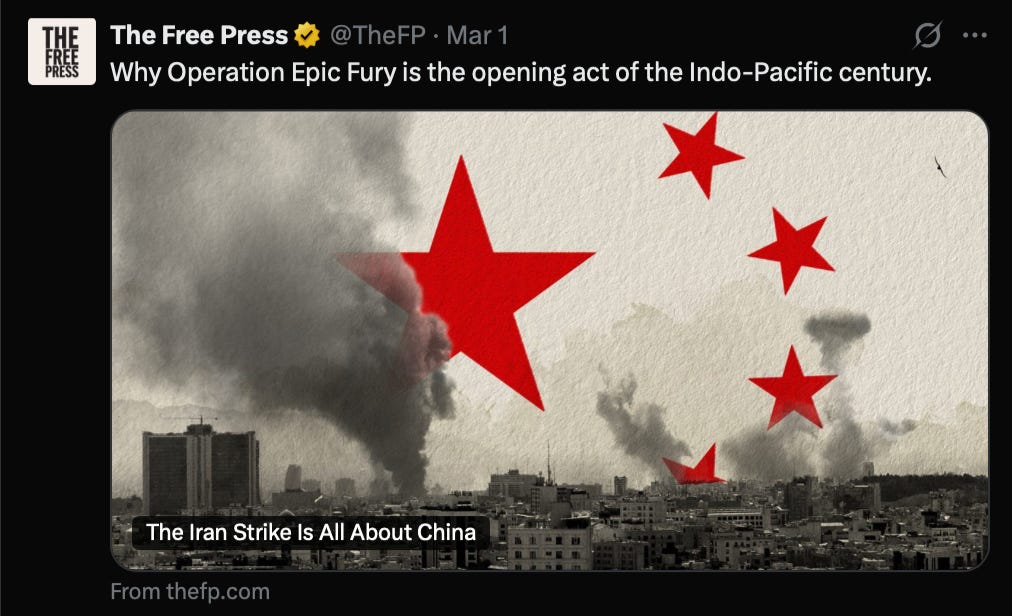
A viral graphic circulated by the Free Press about the motivations for the American-Israeli war against Iran.
At the very least, if China were really the motive, one would have expected the Trump administration to offer this theory — “this is the chance to counter America’s greatest geopolitical rival” — as a major justification to the American people. One would think they would be particularly motivated to do so, given the consensus of polling data showing that public support for this war is far weaker than for any American war in decades.
But Trump officials never mentioned China as a core motive. In fact, even now, the administration and its backers have hardly mentioned China. This is a theory invented out of whole cloth by Iran-war supporters and/or Trump supporters, grasping for some cogent reason why this new war is in Americans’ interests.
Late last week, Senator Lindsey Graham claimed that this conflict is “a religious war” waged by “radical Islamic terrorists.” On March 2, House Speaker Mike Johnson explained to a group of reporters that the United States “determined, because of the exquisite intelligence that [it] had, that if Israel fired on Iran,” then “[Iran] would have immediately retaliated against U.S. personnel and assets.” Therefore, the House Speaker insisted, because the U.S. would be attacked either way, it had to hit Iran with Israel. President Trump announced on Friday that the U.S. intends to select “GREAT & ACCEPTABLE Leader(s)” for the Iranian people, in order to make their country “economically bigger, better, and stronger than ever before.”
These politicians, and many more inside and around the administration, are not talking about China. It has not been cited as a significant motivator for starting this war. Yet if China is really the reason, did the most prominent war supporters simply forget why they went to war, or did they decide it was best to present a false, pretextual case to the American people about why this war was necessary?
Admittedly, this new justification is, at least on the surface, cogent, even if pretextual. China is the most powerful geopolitical competitor to the U.S. No other country buys more sanctioned crude oil from the Iranians, and only Russia has worked more closely with Iran to beef up its military. In 2021, Iran signed a 25-year partnership with China that would reportedly bring $400 billion to Iran’s energy industry. Various weapons deals between the two countries have been reported in recent years, including one to purchase Chinese supersonic missiles that can sink American ships.
Still, none of these events really pertain to, let alone prove, this new claim — that this war with Iran is somehow really about China. At most, they suggest that China may be negatively affected, losing access to cheap oil and its investments. If simply being negatively impacted by this war is the standard for it being “about” another country, then this war is also about Kuwait, Qatar, the United Arab Emirates, and the rest of the Middle East.
Indeed, many countries could be harmed by the Trump-Netanyahu war in Iran. Japan’s economy could face severe consequences if oil is trapped in the Strait of Hormuz. The South Korean economy last week erased nearly half a trillion dollars, marking the largest drop in their stock market’s 46-year history. Is the war about both of these East Asian countries as well?
Further complicating this point is that China has not exclusively invested in or done business with Iran. Indeed, the People’s Republic has, at least publicly, invested more in Saudi Arabia, Iraq, and the United Arab Emirates. (That aforementioned $400 billion agreement between Beijing and Tehran still has not materialized.)
Nor is China the largest buyer only of Iran’s oil. It is also often the leading export destination for Iraqi, Kuwaiti, Omani, Saudi, and Qatari crude. Chinese money, in all its forms, is present across the Middle East, from port construction to the telecommunications industry. What’s more, the Chinese are filling gaps that have opened as a result of American reluctance or negligence.
American foreign policy in the Middle East, including wars, has far more often boosted Chinese interests than undermined them. When the United States in the mid-2010s refused to sell MQ-9 Reaper drones to the Saudis and Emiratis, China filled the gap by selling its CH-4 Rainbow and GJ-1 Wing Loong II models. After the United States invaded Iraq, killing hundreds of thousands of people, the Chinese were still the first to secure foreign contracts. (To this day, the Chinese are a dominant player in Iraq’s oil industry.) President Biden’s poor relations with the Saudis reportedly played a role in their consideration of settling contracts in Chinese yuan.
One would be forgiven for thinking that many of China’s relationships exist not because of an ideological competition with the U.S., but because capricious or draconian American policy often creates the conditions for Chinese success. This is no less true with Iran, as even the articles proffering this all-about-China theory acknowledge.
“Squeezed by decades of American sanctions and increasingly isolated,” the Israeli journalist Haviv Rettig Gur writes in The Free Press, “Iran turned to China as its economic lifeline.” This lifeline, moreover, “[is] the main reason the Islamic Republic has not gone bankrupt,” according to the conservative Hudson Institute, which is also pushing this about-China theory for the Iran war (see, for instance, its article titled, “The Iran Strike Is All About China”). In other words, the U.S. — not the Chinese — created the conditions for a competitor’s presence in the Middle East.
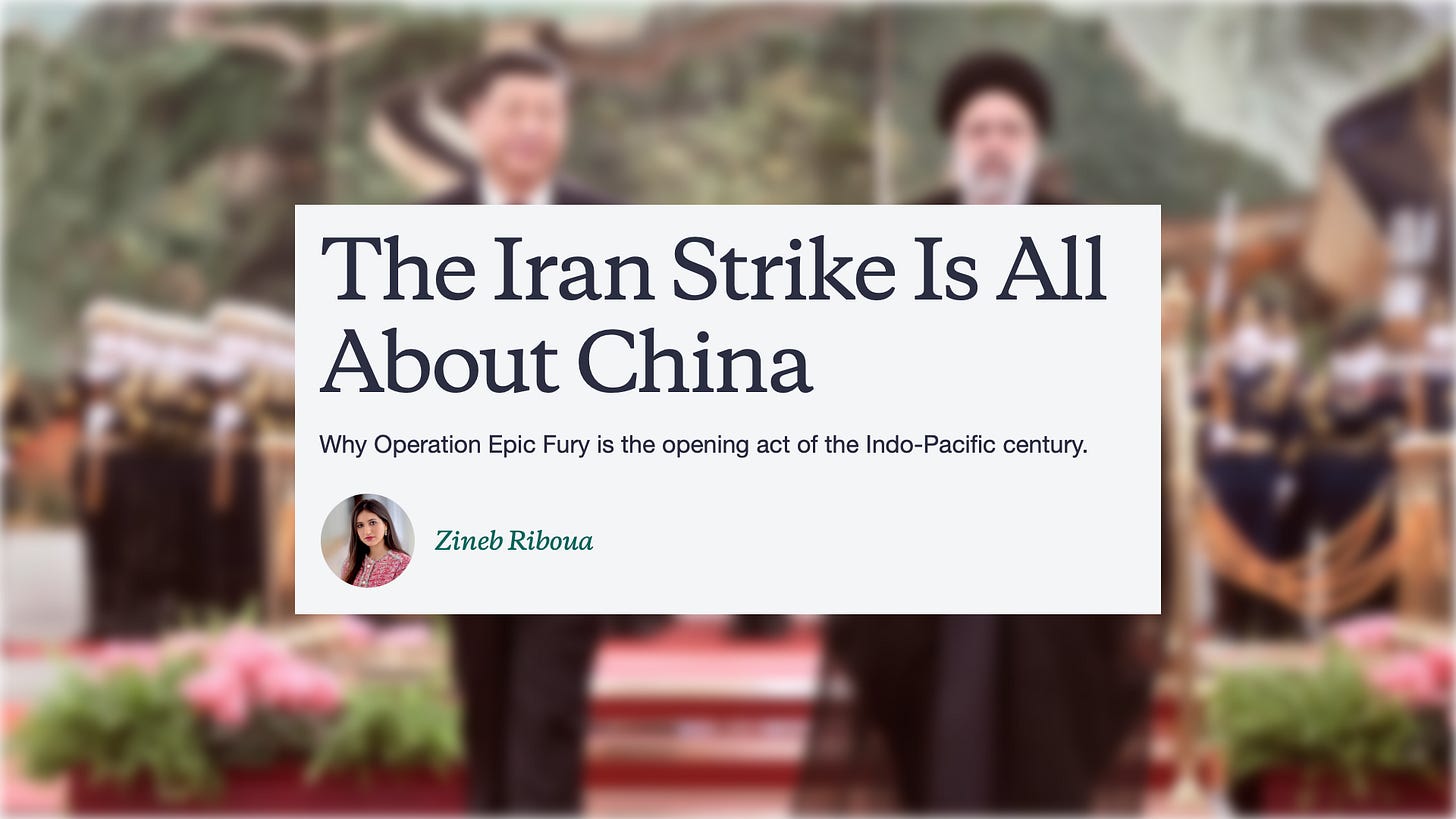
Theories like this one raise another problem. All of these arguments struggle to provide a comprehensive explanation of how China will be “devastated” by regime change in Iran, but they paint a fairly clear picture of how Iran became dependent on the People’s Republic. Of course, the U.S. gaining total control of the Middle East has implications for Chinese commerce and strategy, as these articles acknowledge. But no serious journalists or scholars have argued that China can currently project military power across the globe, with or without Iran.
Is that not why many of these ideologically aligned institutions warn about China’s nascent, but developing, blue-water navy? If one believes China will one day ‘imperialize’ like the U.S., Americans can wrest the Panama Canal from Chinese companies, attack China’s allies, and encircle the Chinese mainland — for now. Those kinds of actions could very well devastate China. (It would not be the first time Western powers have done something like it.) But Iran is hardly a necessary component of said devastation. If the U.S. really wants to wreck China, it does not need to pulverize Persia.
On top of all this, many of the videos and articles that have virally promoted this claim — that this war is about China, not Iran — seem to ignore the very foreign policy establishment that gave them this war. Mainstream American scholarship on China has been fairly clear: from a strategic perspective, the Chinese are perfectly happy to allow the United States to remain entangled in the Middle East because, by definition, it delays an American “pivot to Asia.” Bizarrely, some of these articles acknowledge this, making the Orwellian argument that the U.S. has to go to war with Iran in order to stop going to war in the Middle East.
And, of course, it would be difficult to ignore the lowest-hanging fruit. Far and away the most common thread that exists between those promoting this all-about-China theory is a devotion to Israel: the Free Press, the Hudson Institute, the Spectator, Fox News, etc. All of these institutions constitute the pro-Israel establishment in the U.S. and U.K. So, when Haviv Rettig Gur writes that Marco Rubio “struggled to explain” why the U.S. was at war with Iran, it is not because Rubio denied that Israel forced America’s hand. He, in fact, confirmed that Israel had compelled an American strike.
Apart from various reports that confirm Rubio’s initial account, such as in the New York Times and the Financial Times, Antony Blinken (his predecessor) recently described an identical story: that the Israelis tried to pressure former President Obama into war with Iran by claiming that if he failed to act, they would strike Iran alone. But, according to Rettig Gur, “It’s hard to take [Rubio’s] explanation at face value,” so the Secretary of State’s candor can be disregarded for another, entirely dreamed up claim. Rettig Gur continues, “If the trigger was simply an Israeli strike, America could have told the Israelis to sit tight. … Goodness knows the U.S. has the leverage to do it again.” That statement seems highly accurate. Unfortunately, some unclear entity — most likely China — prevented the United States from doing that.
Altogether, the claim that Trump went to war with Iran to fight China is more sensational than substantive. It entertains theories of 4D Chess when Yahtzee is a more apt comparison. The Trump administration is rolling the dice for Israel: it has already financed their genocide in Gaza, vaporized prayer circles in Yemen, destroyed Iranian nuclear facilities, granted Benjamin Netanyahu’s wildest wishes, and is now officially at war with Iran. For any hawks eager to embroil the United States in a head-to-head clash with the People’s Republic, the question is not if this latest war was about China — it is whether any of them will be.
Cole Crystal (@colecrystal) was producer and editor for SYSTEM UPDATE with Glenn Greenwald and now has the same title for this Substack. Before joining, he worked for media outlets in the United States. He graduated from Cornell University with a bachelor’s degree in government and online social movements.
The US’ self-directed ‘China nuclear threat’ will only be a waste of effort: Global Times editorial
Global Times | February 27, 2026
On Wednesday, US Secretary of State Marco Rubio again touched upon China in terms of nuclear weapons negotiations, claiming that any nuclear arms treaty must include China. In the same few days, CNN published an “exclusive report,” citing so-called intelligence sources, to hype up the so-called “Chinese nuclear test.” These coordinated efforts are just a carefully orchestrated show by Washington. Earlier this month, Christopher Yeaw, assistant secretary for the Bureau of Arms Control and Nonproliferation at the US Department of State, disclosed a so-called “breaking news,” claiming that China conducted nuclear testing in 2020, causing a stir in international public opinion. Since then, the “China nuclear threat” rhetoric, directed by Washington, has been launched.
With high-ranking officials making statements, the so-called “insiders” disclosing information to the media, and a number of mainstream media outlets echoing the sentiment, Washington’s elaborate efforts are clearly driven by self-interest. The intention is obvious: Simultaneously with Yeaw’s alleged “Chinese nuclear test” revelations, he also conveniently stated that the US will return to testing on an “equal basis.” This timing coincides with the expiration of the New START Treaty between the US and Russia, a time when the US faces immense international pressure. Clearly, hyping up the “Chinese nuclear threat” is a two-pronged approach: It allows the US to deflect responsibility for deliberately delaying or even abandoning US-Russia nuclear negotiations, while simultaneously providing a fig leaf for its shady ambition to resume nuclear testing.
Washington’s close monitoring of China’s nuclear development is no secret. Take last year as an example. The Arms Control Treaty Compliance Report published in April focused solely on Russia’s suspected supercritical tests, while the Report to Congress on Military and Security Developments Involving the People’s Republic of China released in December detailed the so-called ‘China’s nuclear arsenal expansion and missile deployments,’ making no mention of so-called nuclear tests. It’s worth noting that these reports, in order to prove the so-called “China threat,” gathered various rumors from different sources. If there were truly “concrete information,” would Washington have kept it hidden from 2020 until now? Why didn’t it disclose it in official reports, but instead waited until the expiration of the New START Treaty between the US and Russia to release it? Moreover, global seismic networks, including the US Geological Survey under the Department of the Interior, did not record any abnormal seismic events at that time.
But this blame-shifting spectacle isn’t merely friction between China and the US. The US possesses more than 5,000 nuclear warheads, a considerable number of which are deployed in a ready-to-launch posture. It also stations tactical nuclear weapons in six NATO countries capable of conducting nuclear strikes. Under such circumstances, how could China engage in so-called “equal negotiations”? As the country with a vast nuclear arsenal and the greatest impact on global strategic balance, the US should shoulder special and primary responsibility for nuclear disarmament and demonstrate genuine sincerity. The reality, however, is that Washington not only shows no intention of reducing its arsenal, but is accelerating nuclear expansion. Should Washington fail to restrain its nuclear ambitions, the consequences for the world would be disastrous.
Facts indicate that the US itself has become the greatest hidden danger to global nuclear security. It has withdrawn from multiple international arms control agreements, while continuing to modernize its nuclear arsenal, develop new nuclear weapons, expand the scope of nuclear strike capabilities, and even lower the threshold for nuclear use. By introducing nuclear deterrence into regional conflicts, it has seriously undermined the stability of the global nuclear security architecture. More ironically, while frequently accusing other countries of “developing nuclear capabilities,” the US simultaneously engages in nuclear deterrence cooperation with its allies, transfers nuclear technology, and deploys nuclear equipment abroad. The double standard is evident.
It is the strong expectation of the international community that the US assumes its due responsibility as a major power in safeguarding global nuclear security. What Washington should do first is stop shifting blame. It should immediately resume strategic stability dialogue with Russia and discuss follow-up arrangements to the New Strategic Arms Reduction Treaty. In addition, AUKUS, which has raised concerns about nuclear proliferation, should be halted, and Washington should exercise restraint over its “close ally” Tokyo’s increasingly swelling nuclear ambitions. The waste contamination left behind by dozens of US nuclear tests in the South Pacific also urgently requires remediation. In the nuclear issue, Washington has many pressing responsibilities to fulfill, rather than “finding faults” with China.
Nuclear arms control is a shared security issue for all humanity. Safeguarding it requires major powers to take proactive responsibility. During the Conference on Disarmament in Geneva, China said it is willing to maintain communication with all parties and exchange views on the work of the Conference and on the Review Conference of the Parties to the Treaty on the Non-Proliferation of Nuclear Weapons. China has long participated in and supported a range of arms control, disarmament, and non-proliferation mechanisms – actions and contributions that are visible to the international community. Washington’s elaborate scheme, full of hidden motives, lacks both persuasiveness and credibility, and will ultimately be a waste of effort. Hopefully, it could do something genuinely meaningful that contributes to world peace and security.
Populations in key NATO nations balk at sacrifices for military spending – poll
RT | February 13, 2026
People in key NATO nations are reluctant to tighten their belts to fund increased defense spending, despite believing that the world is “heading toward global war,” according to a Politico poll published on Friday.
The poll, which surveyed at least 2,000 people from the US, Canada, the UK, France, and Germany each, found that majorities in four of the five countries think “the world is becoming more dangerous” and expect World War III to break out within five years.
Nearly half of Americans (46%) consider a new world war ‘likely’ or ‘very likely’ by 2031, up from 38% last year. In the UK, 43% share this belief, up from 30% in March 2025.
French respondents matched British levels at 43%, and 40% of Canadians expect war within five years. Only Germans remain skeptical, with a majority believing that a global conflict is unlikely in the near term.
The survey suggested a stark disconnect, however, between the growing alarm and willingness to pay for a defense buildup. While respondents support increased military spending in principle, support fell dramatically when specific trade-offs were mentioned.
In France, support dropped from 40% to 28% when those being surveyed were told about the potential financial and fiscal consequences. In Germany, it fell from 37% to 24%, with defense spending ranking as one of the least popular uses of money.
The survey also suggested significant skepticism about creating an EU army under a central command, with support at 22% in Germany and 17% in France.
While the poll suggests that Russia is perceived as the ‘biggest threat’ to Europe, Canadians view the administration of US President Donald Trump as the greatest danger to their security. Respondents in France, Germany, and the UK rank the US as the second-biggest threat – cited far more often than China.
The findings come after NATO Secretary-General Mark Rutte urged members states in December to embrace a “wartime mindset” amid the stand-off with Russia. This also comes amid Western media speculation that Russia could attack European NATO members within several years. Moscow has dismissed the claims as “nonsense,” while accusing EU countries of manufacturing anti-Russia hysteria to justify reckless militarization.
Beijing cancels Panama deals after court blocks Chinese port operations
The Cradle | February 5, 2026
Chinese authorities have asked state-owned companies to suspend talks on new projects in Panama, in response to the Central American nation’s cancellation of a contract with China’s CK Hutchison Holdings to operate two ports along its strategic canal, Bloomberg reported on 5 February.
According to sources familiar with the matter, Panama’s decision could jeopardize billions of dollars in potential Chinese investments.
Chinese authorities also asked shipping companies to consider rerouting goods through other ports if the extra cost is not prohibitive, and have stepped up inspections of Panamanian imports, such as bananas and coffee.
Chinese Foreign Ministry spokesman Lin Jian issued a statement saying that the Panamanian Supreme Court ruling “ignores the facts, violates credibility,” while harming the interests of Chinese companies.
Hong Kong-based CK Hutchison responded to the Supreme Court decision by initiating international arbitration proceedings against Panama.
CK Hutchison has operated Panama’s Cristobal and Balboa ports for decades. The ports lie at opposite ends of the Panama Canal – the strategic waterway that connects the Pacific and Caribbean Oceans, and through which roughly three percent of global seaborne trade passes.
The move comes amid US President Donald Trump’s campaign to counter Chinese influence over strategic infrastructure in the Americas.
Following his election last year, Trump argued that it was “foolish” of the US to hand over control of the canal to Panama. The US built the canal in 1904 and handed it back to Panamanians nearly a century later, in 1999.
Trump has also complained about the fees Panama charges the US to use the waterway.
Amid pressure from Washington, Panama also withdrew from China’s Belt and Road Initiative (BRI) in February last year.
At the time, Beijing stated it “firmly opposes the United States using pressure and coercion to smear and undermine Belt and Road cooperation. The US side’s attacks … once again expose its hegemonic nature.”
Twenty Latin American nations have participated in the BRI since Beijing initiated it in 2013.
Current Chinese infrastructure projects in Panama include a $1.4-billion bridge over the canal, a cruise terminal constructed by China Harbour Engineering Co., and a segment of a metro line by China Railway Tunnel Group Co.
In Latin America, Trump is seeking to revive the 200-year-old Monroe Doctrine. It states that Washington will not allow European powers to interfere in the Western Hemisphere as they had in colonial times, asserting that the region would be regarded as a sphere of US interest.
Trump used the doctrine as one of his justifications for bombing Venezuela and abducting its president, Nicholas Maduro, on 3 January.
The US president claimed that Maduro was hosting “foreign adversaries in our region” and acquired “menacing offensive weapons that could threaten U.S. interests and lives.”
WARNING: Delete TikTok Immediately!
51-49 with James Li | January 27, 2026
In this episode of 51-49, James investigates the reality behind the newly “Americanized” TikTok and the sudden shift in its search algorithm. We uncover the app’s new leadership under Larry Ellison, whose team of former intelligence operatives is now accused of silencing US creators to manufacture consent for a foreign nation.
Is China a threat to Greenland?
By Pei Si | Global Times | January 22, 2026
Since the beginning of 2026, the US has repeatedly claimed that it must take control of Greenland to prevent threats from China and Russia, alleging that there are Chinese and Russian vessels “all over the place” outside of Greenland. What is the reality? What is China’s actual presence in Greenland? And does China pose any threat to Greenland at all?
Based on information from various sources, China currently has no official institutions in Greenland, no investment projects, and no resident companies. There are only some 30 Chinese workers working at Greenlandic seafood companies. Cooperation between China and Greenland is largely confined to trade, particularly in aquatic products. In 2025, bilateral trade between China and Greenland reached $429 million, of which Greenland’s exports to China amounted to $420 million, mainly Arctic shrimp, halibut, cod, lobster and other seafood. Greenland’s imports from China totaled $9 million, consisting largely of daily consumer goods.
Nor are there many Chinese tourists visiting Greenland. Although the island boasts stunning natural scenery, it is not easy to reach it from China and remains a niche destination for Chinese travelers. In 2024, only about 3,500 Chinese tourists visited Greenland.
Claims that there are Chinese vessels all over the waters near Greenland, or that Greenland faces a so-called “China threat,” are even more groundless. On January 16, Soren Andersen, Major General of Denmark’s Joint Arctic Command in Greenland, dismissed such claims in an interview, stating clearly that “there were no Chinese or Russian ships near Greenland.” Vessel-tracking data from MarineTraffic and LSEG likewise show no Chinese ships’ presence near Greenland. Danish Foreign Minister Lars Lokke Rasmussen has repeatedly clarified to the media that there is no “instant threat” from China. Rasmus Jarlov, the chair of Denmark’s parliamentary defense committee, put it even more bluntly: The claim of “a big threat from China and Russia against Greenland” is delusional.
Whether in terms of facts or policy, China does not pose a threat to Greenland. In fact, China has been subjected to unfair restrictions there. Rasmussen has openly acknowledged that the Danish government previously used administrative measures to veto the participation of Chinese companies in Greenland’s airport expansion and mining projects, and has already established an investment screening mechanism that will not allow Chinese investment in Greenland in the future. Whether such sacrifices of China can buy a US “hands-off” is highly doubtful – and hardly worthy of respect.
Anyone can see that the current tensions in the Arctic stem primarily from the actions of a certain country advancing claims that violate international law and the purposes and principles of the UN Charter. By contrast, China made it explicit in its 2018 white paper China’s Arctic Policy that “all states should abide by international treaties such as the UN Charter and the UNCLOS, as well as general international law. They should respect the sovereignty, sovereign rights, and jurisdiction enjoyed by the Arctic States in this region, respect the tradition and culture of the indigenous peoples.”
On January 12, Chinese Foreign Ministry spokesperson Mao Ning further stressed at a regular press briefing: “The Arctic bears on the common interests of the international community. China’s activities in the Arctic are aimed at promoting the peace, stability and sustainable development of the region. They are in line with the international law. Countries’ right and freedom to carry out activities in the Arctic in accordance with the law needs to be fully respected. The US should not use other countries as a pretext for seeking selfish gains.”
From China’s perspective, the future of the Arctic should not be a battleground for geopolitical rivalry, but a low-tension region for international cooperation on climate change and sustainable development. Claims that “China threatens Greenland” are simply too absurd to be worth refuting.
Beijing Urges US Not to Use ‘China Threat’ Narrative to Control Greenland
Sputnik – 05.01.2026
BEIJING – The United States must stop using the so-called “China threat” narrative to justify its personal interests, Chinese Foreign Ministry spokesman Lin Jian said on Monday, commenting on US President Donald Trump’s claims to Greenland.
On Sunday, Trump told The Atlantic that the United States “absolutely” needed Greenland, claiming the island was “surrounded by Russian and Chinese ships.” Danish Prime Minister Mette Frederiksen urged Trump to stop threatening Greenland, an autonomous part of Denmark, with annexation.
“We urge the US to stop using the so-called ‘China threat’ as a pretext for itself to seek selfish gains,” Lin told the briefing.
Earlier in the day, Greenlandic Prime Minister Jens-Frederik Nielsen said that the island is open to dialogue with the United States as long as communication occurs through the proper channels.
Trump has repeatedly said that Greenland should become part of the United States, citing its strategic importance for national security and the defense of the “free world,” including from China and Russia. Former Greenlandic Prime Minister Mute Egede said the island was not for sale.
The island was a Danish colony until 1953. It has remained a part of the Kingdom of Denmark after gaining autonomy in 2009, with the ability to self-govern and determine its own domestic policy.
Chinese embassy expresses extreme shock, indignation over demolition of Chinese monument in Panama

File photo of the China-Panama Friendship Park and the monument commemorating the 150th anniversary of the arrival of Chinese people in Panama
By Fan Anqi | Global Times | December 29, 2025
The Chinese embassy in Panama on Monday expressed extreme shock, strong indignation, and firm opposition to the demolition of the China-Panama Friendship Park and the monument commemorating the 150th anniversary of the arrival of Chinese people in Panama, on Saturday night without any prior notice or communication with Chinese community.
“The move not only brutally trampled on the collective sentiments of the 300,000 Chinese nationals and people of Chinese descent in Panama, but also severely harmed the friendly feelings of the Chinese people toward the Panamanian people,” read an embassy statement issued on Monday morning.
Chinese ambassador to the country, Xu Xueyuan, said in a post on Saturday that she rushed to the place upon hearing the news, but the monument was already on the ground. “Countrymen tried to protect the remains, but they were prevented from doing so,” she said.
Xu called the day “a darkened day for the 300,000 Chinese-Panamanians” and “a day of great pain for Chinese-Panamanian friendship.”
According to local media reports, Arraiján Mayor Stefany Peñalba announced plans to “rescue public spaces to promote culture, tourism, the economy and business,” with renderings of a new park without the monument. The 20-year concession for the monument had expired, and the municipality did not respond to the Chinese Association of Panama’s requests to renovate it.
The embassy statement also noted that the Chinese community organizations engaged in repeated communications with the Arraiján city government as early as 2024, but received no substantive response. The Chinese Embassy in Panama also likewise conveyed its goodwill to support the renovation of the park, only to be met with silence.
The Chinese side urged a thorough investigation into the demolition incident, and strict accountability for any illegal acts that undermined Panama’s historical heritage and social unity and stability. Meanwhile, it asked to restore the China-Panama Park and the Chinese memorial at the original site after consultation with Chinese community groups, the embassy statement read.
Panama President José Raúl Mulino, several government officials, and deputies from various political parties have strongly condemned the brutal demolition of the Park and the monument, Xu noted in a later post on Monday, saying that she finds it encouraging that the public throughout Panama has reacted with strong indignation.
Mulino on Sunday condemned the “act of irrationality” as unforgivable, and an investigation should be initiated immediately. He said there is no justification whatsoever for the barbarity committed by the mayor of Arraijan in demolishing the monument to the Chinese Community, he said in a post on X.
The Government of Panama on Sunday ordered the Ministry of Culture to coordinate the restoration of the Chinese Monument as part of a Historical Heritage together with the Chinese community in Panama, per local media reports.
According to Newsroom Panama, the demolition unleashed a wave of political and diplomatic outrage that continues to grow. Government figures, former presidents, and opposition leaders all agreed in describing the act as shameful, irrational, and unforgivable.
The Minister for Canal Affairs, José Ramón Icaza, was one of the first to react and strongly supported the position of President José Raúl Mulino. “Nobody tears down a monument on a Saturday at 9 pm —in the dead of night, typical of criminal acts— unless it is to commit an aberrant and irrational act,” he stated, Newsroom Panama reported.
The issue also exploded on social media, with many netizens flooding the Chinese ambassador’s X posts expressing their sorrow and shame for such a behavior. One netizen EdwinRodrigo2 wrote, “Many Chinese participated in the construction of the Canal and their descendants integrated into the multi-racial society of which we are proud. I don’t know who ordered the demolition of the monument, but it is outrageous to know that we have authorities capable of doing whatever it takes, to please the US.”
Sun Yanfeng, director of Latin American research at the China Institutes of Contemporary International Relations, told the Global Times on Monday that “the demolition decision, made by a local government, reflects a degree of compromise by certain local authorities under US pressure.” Sun added that the choice to carry out the demolition at night during the Christmas holiday reveals a sense of unease on the part of the local authorities – an apparent attempt to avoid public scrutiny and the risk of a broader social backlash.
The expert noted that the eruption of public reaction to this incident has demonstrated that, even amid intense US pressure, Panamanian society at large maintains a strong desire to develop and uphold friendly relations with China. “It also reflects widespread public dissatisfaction with US interference in Panama’s internal affairs, including pressure related to the Panama Canal and China’s cultural presence in the country,” Sun said.
At another level, the regrettable incident may serve as an opportunity to provide new social momentum for deeper ties and cooperation between China and Panama, the expert noted.
171 years ago, large numbers of Chinese people crossed the oceans to Panama to take part in the construction of the trans-isthmian railway. In recognition of the contributions made by the Chinese community, the Panamanian government in 2004 designated March 30 each year as “Chinese Day,” fully reflecting Panama’s openness and diversity. That same year, with funds raised by Chinese community organizations and support from the Chinese government, the China-Panama Park and the monument commemorating the 150th anniversary of the arrival of Chinese people in Panama were completed—an expression of respect for history.
The Geopolitical Imperative Behind US Policy Toward Venezuela
By Leanna Yavelskaya | Ron Paul Institute | December 21, 2025
In the intensifying great-power competition of the 21st century, Venezuela has emerged as a pivotal battleground in the Western Hemisphere—a proxy arena where the United States confronts the encroaching ambitions of China and Russia to preserve its historic regional dominance.
Conventional explanations for Washington’s unrelenting pressure on Caracas, citing resource acquisition or counternarcotics imperatives, crumble under scrutiny amid America’s strategic primacy, energy independence, and the broader architecture of multipolar rivalry.
US policy toward Venezuela is fundamentally a defensive maneuver in the superpower contest, aimed at denying Beijing and Moscow a strategic foothold in America’s backyard. Venezuela’s vast oil reserves—the world’s largest—might superficially suggest energy motives, yet the United States, now the globe’s top petroleum producer and exporter, no longer depends on Venezuelan heavy crudes. Sanctions have deliberately slashed imports, while any genuine resource priority would favor diplomatic normalization over confrontation. Historical US behavior reinforces this: when energy security truly matters, Washington opts for pragmatic deals, not escalation. The current standoff, therefore, serves deeper geopolitical ends—blocking rival powers from entrenching influence proximate to US shores.
The counternarcotics rationale fares no better. Venezuela transits cocaine but plays minimal role in the fentanyl epidemic ravaging America. Washington’s dollar hegemony and financial levers could dismantle trafficking networks without military brinkmanship, yet global drug flows persist due to strategic tolerances. Venezuela’s marginal position in this trade renders anti-drug rhetoric an inadequate justification for the extraordinary measures deployed, including naval blockades and tanker seizures.
The core driver is Venezuela’s alignment with US adversaries, transforming it into a potential forward base for China and Russia in the Americas. Beijing has poured billions in loans-for-oil, infrastructure projects, and discounted crude purchases—securing long-term resource access while propping up the regime against Western isolation, even as recent US escalations test this lifeline. Moscow has supplied arms, intelligence, and diplomatic shielding, positioning Venezuela as a counterweight to US hegemony, much as it leverages proxies elsewhere. These partnerships challenge enduring American doctrines: the Monroe legacy rejecting extra-hemispheric powers in the Americas, and Cold War precedents like the Cuban Missile Crisis, where Soviet encroachment provoked crisis.
No US administration—Democratic or Republican—has tolerated a peer rival gaining decisive leverage in Latin America. The Trump administration’s 2025 campaign, with carrier groups, strikes on vessels, and a declared blockade of sanctioned tankers, underscores this zero-tolerance posture amid Maduro’s disputed reelection and pleas for Russian and Chinese aid. Venezuela embodies the frontline of eroding US unipolarity: proximity magnifies threats, just as China dominates the Indo-Pacific or Russia its near abroad.
This is no mere bilateral dispute over democracy or drugs—it is a superpower clash over spheres of influence in a fragmenting world order. Caracas’s geopolitical pivot toward Beijing and Moscow directly contests Washington’s hemispheric primacy. The United States will not permit rival superpowers to consolidate enduring control on its doorstep, a contest that will shape power balances in the Americas and beyond for decades. As great-power rivalry intensifies, Venezuela’s fate signals whether the US can stanch encroachment in its traditional domain or cede ground in the new multipolar era.
Leanna Yavelskaya is a freelance civilian journalist who focuses on geopolitical analysis, with particular emphasis on Eastern Europe.
Pro-Israel Forces Intensify Effort To Control American Discourse
Stark Realities with Brian McGlinchey | December 4, 2025
Across the American political spectrum, support for the State of Israel is steadily eroding. With the long-running, staggeringly expensive redistribution of American wealth and weapons to one of the world’s most prosperous countries under unprecedented threat, Israel’s advocates inside the United States are growing increasingly desperate to suppress the facts, opinions, questions and imagery that are causing this sea change.
Pro-Israel forces have long worked to limit and shape US discourse to Israel’s advantage. However, the intensity and novelty of what’s taking place in 2025 — from the government-coerced transfer of a social media platform to pro-Israel billionaires, to the jailing and attempted deportation of a student for writing an opinion piece, and more — deserves the attention of every American who values free expression, an enlightened electorate, and independence from foreign influence.
Many Americans know that Congress and President Biden teamed up in 2024 to force the Chinese company ByteDance to divest its US operation of the popular video-sharing app TikTok, yet few realize this unusual intervention was motivated in large part by a desire to serve the interests of Israel.
Though politicians pointed to the supposed Chinese menace lurking inside the app — while revealing their lack of sincerity by continuing to use it themselves — the catalyst for the extraordinary legislation’s passage was a sea of viral content illuminating Israel’s rampage in Gaza, casting Palestinians in empathetic light, and questioning the legitimacy of the political philosophy that is Zionism.
The idea that passage of the ban was largely about Israel is no conspiracy theory. American politicians who supported the compelled divestiture of TikTok have candidly said so themselves. Sharing a stage with Biden Secretary of State Antony Blinken in 2024, then-Senator Mitt Romney said:
“Some wonder why there was such overwhelming support for us to shut down, potentially, TikTok or other entities of that nature. You look at the postings on TikTok and the number of mentions of Palestinians relative to other social media sites — it’s overwhelmingly so among TikTok broadcasts, so I’d note that’s of real interest to the president, who will get the chance to take action in that regard.”
Similarly, Rep. Mike Lawler of New York told a webinar that pro-Palestinian student protests were “exactly why we included the TikTok bill… because you’re seeing how these kids are being manipulated by certain groups or entities or countries to foment hate on their behalf and really create a hostile environment here in the US.”
Of course, mere divestiture wouldn’t guarantee that TikTok would start suppressing anti-Israel and pro-Palestinian content in the United States. To have the desired effect, the buyer — who required White House approval — would have to be an ardent supporter of Israel. That’s just how things played out. In September, President Trump approved the sale of TikTok’s US operations to a joint venture led by Larry Ellison, the founder of tech-titan Oracle and the fourth-richest man in the world.
Ellison has expressed his “deep emotional connection to the State of Israel” and has been a major benefactor of the Israeli Defense Forces, via donations to IDF-supporting organizations. He spent at least $3 million on Marco Rubio’s failed 2016 presidential campaign, after being assured by Israel’s ambassador to the United Nations that Rubio would “be a great friend to Israel.” There are other Israel-favoring billionaires in the consortium now controlling TikTok’s American presence, among them NewsCorp head Rupert Murdoch and investment trader Jeff Yass.
Americans were propagandized into fearing Chinese control of TikTok users’ data. Now that data will be controlled by Oracle, a firm whose founder has described Israel as his own nation, said “there is no greater honor” than supporting the IDF, and invited Israel Prime Minister Benjamin Netanyahu to take a seat on the board. It’s also a firm with strong business ties to the Israel government, and a firm whose Israel-born executive vice chair and former CEO last year declared, “For [Oracle] employees, it’s clear: If you’re not for America or Israel, don’t work here.”
A few months before the TikTok divestiture was finalized, the company installed former IDF soldier and self-described “passionate” Zionist Erica Mindel as TikTok’s hate speech manager in July. Weeks later, and just days before the transfer of TikTok’s US operation was approved, the platform posted new guidelines on Sept 13 about what’s allowed on the platform.
Soon after the change, users and content creators began sharing examples of content being deleted by TikTok, with the platform exploiting its vague new rules about “conspiracy theories” and “protected groups” to reject negative content about Israel — wielding the threat of demonetization of repeat offenders. In a recent appearance on the Breaking Points podcast, Guy Christensen, who has 3.4 million TikTok followers, shared his experience:
“What all these videos have in common that have been removed since Sept 13 are that I am talking about Israel, I’m talking about AIPAC’s influence, I’m talking about Larry Ellison and the attempt to put TikTok under Zionist control — I’m criticizing Israel in some way. It’s the same thing I’ve heard from my audience, my friends who are creators. Ever since Sept 13, they’ve had the same exact experience. Videos that are more informational and critical of Israel get removed.”
In a late-September meeting with pro-Israel social media “influencers,” Netanyahu hailed the transfer of TikTok’s US ownership. “We have to fight with the weapons that apply to the battlefield with which we’re engaged, and the most important ones are in social media. And the most important purchase that is going on right now is TikTok. Number one.” Expressing hope that, by “talking” with Elon Musk, his X platform could be reshaped to be more Israel-protective too, Netanyahu added, “If we can get those two things, we can get a lot.”
Ellison’s TikTok takeover is troubling enough, but that wasn’t his only media move this year. He also financed his son David’s takeover of Paramount Skydance, the media company that controls many movie and television properties, including CBS. David Ellison quickly installed as head of CBS News Bari Weiss — a self-described “Zionist fanatic” who took a gap year before college to live on an Israeli kibbutz.
Weiss’s history of wrangling over the bounds of acceptable speech vis-a-vis Israel goes back to her sophomore year at Columbia University, when she was part of a group of students who claimed they were subjected to intimidation by Middle East Studies professors over the students’ Zionist views. A university panel found only one of the supposed incidents represented unacceptable conduct.
Both outside observers and network insiders are braced for Weiss to nudge the outlet’s reporting to Israel’s benefit, and there are early indications validating worries about her bias. Citing executive sources inside CBS, the Wall Street Journal reported that foreign correspondent Chris Livesay, who was set to be laid off as part of a downsizing move that preceded Weiss’s arrival, sent Weiss an email expressing his affinity for Israel and claiming he was “bullied” for his beliefs. Weiss intervened and saved Livesay from the layoff. Other correspondents told the Journal that Livesay’s claim about bullying was bogus.
Compounding the expectations that CBS News is about to become a de facto Israel PR outlet, the network’s new ombudsman — the arbiter of editorial concerns — also has strong Zionist credentials. The New York Times describes Kenneth Weinstein as a “firm and vocal champion of Israel.” On X, Grayzone editor-in-chief Max Blumenthal noted that, “during a 2021… event with Mike Pence, Weinstein touted his Israel lobbyist creds, describing how he’d been groomed by the Tikvah Fund, the Likudnik training network which will award Bari Weiss its Herzl Award this November.” (The Likud Party is the Israeli party led by Netanyahu.)
Summing up the TikTok and CBS moves, Glenn Greenwald wrote, “The minute the American public starts turning against Israel and the US financing of that country, the world’s richest and most fanatical pro-Israel billionaires start buying up large media outlets and TikTok, then install Bari Weiss and an ex-IDF soldier to control content.”
The transfer of TikTok into Israel-friendly hands isn’t the only example of intensified US government intervention in America’s public square on behalf of the tiny Middle Eastern country.
Much of the Trump administration’s war against anti-Israel, pro-Palestinian speech has focused on college campuses. In the most alarming such move in 2025, the Trump administration has arrested, jailed and attempted to deport foreign students for merely voicing their support for Palestinians or opposition to the Israeli government.
The most atrocious example — which Stark Realities examined in depth earlier this year — centers on a 30-year-old, Turkish Tufts University PhD candidate who was arrested on a Boston street and whisked away to a dismal Louisiana prison, just for co-authoring a calmly-written Tufts Daily op-ed urging the university to formally characterize Israel’s conduct in Gaza as genocide, and to sell the school’s Israel-associated investments.
This cruelly despotic tactic is the brainchild of the Heritage Foundation. In a policy paper, the think tank urged pro-Israel groups and the US government to characterize pro-Palestinian activists as “effectively members of a terrorist support network,” and then use that characterization to target activists for deportations, expulsions from colleges, lawsuits, terminations by employers, and exclusion from “open society.”
Supporters of Israel have long attempted to stifle critics of the Israeli government by smearing them as antisemites. In 2016, that kind of mislabelling was codified in a definition of antisemitism that’s now being embraced by governments, universities and other institutions in the United States and around the world: the International Holocaust Remembrance Alliance’s “working definition of antisemitism.”
Some elements of the IHRA definition are reasonable, but others irrationally conflate criticism of the State of Israel with hatred of all Jews. For example, the IHRA definition says it’s antisemitic to “claim that the existence of a State of Israel is a racist endeavor” or to merely “draw comparisons of contemporary Israeli policy to that of the Nazis.”
Other, vague elements of the definition are open to creative interpretations, facilitating bogus accusations of bigotry against Israel’s critics. For example, the IHRA says it’s antisemitic to “apply double standards by requiring of [Israel] a behavior not expected or demanded of any other democratic nation.” The IHRA also says it’s antisemitic to make statements about the “power of Jews as [a] collective,” which can put someone who talks about the enormous influence of the pro-Israel lobby squarely in the crosshairs.
Similarly, the IHRA says it’s antisemitic to “deny the Jewish people their right to self-determination,” a definition that could ensnare people who — right or wrong — advocate for the State of Israel to be replaced by a new governing arrangement for the land between the Jordan River and the Mediterranean Sea. Indeed, those who want speech to be policed on Israel’s behalf frequently point to the slogan “From the river to the sea, Palestine will be free” as inherently antisemitic.
As I wrote in another Stark Realities essay, “No Country Has a Right To Exist”:
Those who support the State of Israel are free to present a case that it’s a just arrangement for the 7.5 million Jews and 7.5 million Palestinians “between the river and the sea.” However, painting those who demand a new arrangement as inherently immoral, genocidal or antisemitic is ignorant at best and maliciously misleading at worst.
Doing its part to vilify Israel’s critics and mislead the public and policymakers, the Anti-Defamation League has employed expansive definitions in its numerical tracking of antisemitic incidents — statistics that are unquestioningly quoted by journalists and cited by pro-Israel politicians.
For example, in early 2024, the ADL claimed that, in the first three months after the Oct. 7 Hamas invasion of Israel and the IDF’s brutal assault on Gaza, antisemitic incidents skyrocketed 360%. ADL CEO Jonathan Greenblatt said Jews faced a threat “unprecedented in modern history.” However, the ADL admitted that it was counting as antisemitic incidents all protests that included “anti-Zionist chants and slogans”
Of course, exaggerating the scale of antisemitism does more than facilitate efforts to suppress criticism of Israel: It also helps the ADL justify its existence and boost its fundraising. The ADL’s over-counting is nothing new. In 2017, the ADL claimed antisemitic incidents in the United States had soared by 86% in the first quarter of the year, and major media outlets ran with the story. However, much of the increase springs from the ADL’s decision to include a huge number of bomb threats phoned into US synagogues and schools by a Jew living in Israel.
The IHRA definition is at the forefront of a broad campaign to suppress candid discourse about Israel and Palestine on college campuses, with multiple state governments ordering public schools to use it to determine what can and can’t be said.
Bard College’s Kenneth Stern, a lead drafter of a 2004 antisemitism definition that was subsequently adopted by the IHRA, has spoken out against the weaponization of the definition to stifle discourse at universities. “The history of the abuse of the IHRA definition demonstrates the desire is largely political—it is not so much a desire to identify antisemitism, but rather to label certain speech about Israel as antisemitic,” Stern wrote at the Knight First Amendment Institute.
Even at schools that haven’t adopted the IHRA definition, activists and scholars who are critical of Israel and empathetic to the Palestinians are being subjected to countless false accusations of antisemitism, and universities are being sued by pro-Israel students who claim the schools tolerate antisemitism.
A Stark Realities analysis of an 84-page complaint filed against the University of Pennsylvania found nearly every alleged “antisemitic incident” was merely an instance in which Penn students, professors and guest speakers engaged in political expression that proponents of the State of Israel strongly disagree with. Eighteen months later, a federal judge agreed. “At worst, Plaintiffs accuse Penn of tolerating and permitting the expression of viewpoints which differ from their own,” Judge Mitchell Goldberg wrote as he dismissed the case.
Courtroom victories, however, can only do so much to counter the chilling effect of campaigns that vilify students, professors and institutions as antisemitic. That’s especially true when university cash flows are threatened.
Major pro-Israel donors have withdrawn or threatened to suspend donations to various schools, and those threats have been credited with forcing out university presidents like Penn’s Liz Magill. Donor pressure has also led schools to adopt the problematic IHRA antisemitism definition, shut down chapters of Students for Justice in Palestine, and strip Israel-critical professors of chair positions.
The greatest financial pressure being exerted on universities, however, is coming from the Trump administration, which has not only suspended billions of dollars in funding from various universities that are supposed hives of antisemitism, but has also filed lawsuits and hammered schools with fines. Many of them are surrendering, paying the government large sums and making policy and staffing changes. Last week, Northwestern agreed to pay $75 million to the federal government for its alleged failure to fight “antisemitism.” Earlier, Columbia agreed to a $200 million fine payable over three years, and Brown will surrender $50 million.
There are other avenues by which government force is being tapped to squelch criticism of Israel and advocacy for Palestinians. Dozens of states have passed legislation that bar individuals and businesses from contracting with the state if they boycott or divest from Israel. That led to a bizarre spectacle in which hurricane-battered Texans applying for emergency benefits were asked to verify that they do not and will not boycott Israel. Comparable federal measures have been introduced, but not yet enacted.
Another proposed federal bill is the Antisemitism Awareness Act, which would require the Department of Education to use the IHRA definition when evaluating accusations that colleges tolerate antisemitism — essentially codifying a Trump executive order. It sailed through the House in 2024 by a 320-91 vote, but stalled in the Senate this year amid bipartisan concerns about the definition. Seven amendments had been attached in committee, including one clarifying that criticism of the Israeli government isn’t antisemitism.
Tellingly, champions of the bill said amendments like that were poison pills that would render it un-passable.
The biggest fish caught in China’s “debt trap”
The US is the “victim” as the largest recipient of Chinese official credits and loans
By Hua Bin | November 27, 2025
An Indian by the name of Brahma Chellaney, employed by Center of Policy Research based in New Delhi and funded by US State Department, coined the term “debt trap” to demonize Chinese loans for the Belt and Road Initiative (BRI) across developing countries.
It’s clear, just by the origin of the term, that it was a smear job by a dimwit sour grape. His argument has since been roundly debunked by researchers and analysts from John Hopkins, Harvard, and the Chatham House. None of them can be described as trolls for China.
For example, research by the New York-based Rhodium Group and John Hopkins University has shown no instance of China seizing strategic assets due to debt defaults, a core claim by Chellaney and the “debt trap” advocates.
Studies done by London-based Chatham House (The Royal Institute of International Affairs), a very anti-China outfit by its track record, contrast China’s debt management with that of Western bondholders and institutions.
Their analyses demonstrate China has shown far greater willingness to provide debt rescheduling and relief, while Western lenders such as the World Bank and IMF are quick to resort to legal measures.
Western loans also often come with conditionalities that negatively affect a country’s economic productivity – such as deregulation and privatization.
Ironically, while India sounds the alarm on “debt trap”, the country itself is the largest recipient of loans from the Asia Infrastructure Investment Bank (AIIB), a financial institution funded primarily by China.
Of course, the Indians are presumably so “smart” that they are immune to any “debt trap”. Their lenders and creditors are the ones who need to worry about being “trapped”.
Very predictably, such a discredited lie is not too low for most Western governments to adopt as the holy script since it fits their geopolitical narrative.
And the term has become a regular in the official lexicon of western governments and media.
A recent study on Chinese official lending done by the College of William and Mary (W&M) in Virginia, the second oldest university in the US, is very telling and goes to show the disparity of Western claims and empirical evidence on the ground.
The AidData research lab at W&M found that China is the largest creditor nation in the world and its global lending since the turn of the century has been “vastly” larger than previously understood, with loans and grants increasingly going to developed countries.
The US is by far the largest recipient – nearly US$202 billion of the US$2.2 trillion disbursed by China’s “official sector” between 2000 and 2023 went to projects in the US.
Note the data excludes China’s purchase of US Treasury bonds.
“Our data demonstrate that the US – a high-income country – is the single largest recipient of official sector credit from China. This finding is both unexpected and counterintuitive,” wrote researchers of the study released earlier this month.
“This is an extraordinary discovery, given that the US has spent the better part of the last decade warning other countries of the dangers of accumulating significant debt exposure to China, and accusing China of practicing “debt trap” diplomacy,” said Brad Parks, AidData’s executive director.
The study, compiled over 36 months using more than 246,000 sources, covered a wide range of Chinese official lenders, including state policy banks, state-owned commercial banks, state-owned companies, state-owned funds, and the central bank.
Some of the Chinese lending in the US involved the construction of “critical infrastructure”, helping to bankroll the construction of major liquefied natural gas pipelines in Rio Grande, Port Arthur and Freeport, the Dakota Access oil pipeline, an electric power transmission line feeding New York City, data centres in Virginia, and airport terminals in New York and California, among other projects.
Official Chinese lenders also financed the merger and acquisition of hi-tech companies in the US and provided liquidity support – via working capital and revolving credit facilities – to a wide array of Fortune 500 companies.
The research lab described most Chinese loans to the US “are guided by the pursuit of profit rather than the pursuit of geopolitical or geoeconomic advantage”.
While China is well known for lending to Global South countries via BRI, the report found that 10 of the 20 largest destinations between 2000 and 2023 were high-income countries, including the UK, Singapore, Germany and Switzerland.
Russia was the second largest recipient after the US, with a cumulative US$171.78 billion in loans and grants over the period, followed by Australia with a total of US$130 billion.
According to AidData, China’s total overseas lending portfolio is two to four times larger than previously published estimates, making China the world’s biggest official creditor by a large margin.
Its lending portfolio has evolved significantly over time – in 2000, 88% of China’s lending went to low-income countries; by 2023, financing going to developed countries rose to 76%.
China had approved loans and grants for more than 30,000 “projects and activities” worldwide between 2000 and 2023. A total of 9,764 of those projects and activities were in high-income countries.
The AidData report claims China offers debt, equity and grants in “flexible, innovative and complementary ways to advance its geostrategic and commercial interests”.
China is increasingly seen as an “international creditor of first – and last – resort”, according to the report summary.
The disconnect between the Western propaganda and the reality on the ground is revealing – the hypocrisy of calling Chinese lending “debt trap” while engaging in a feeding frenzy in a trough of Chinese money.
Western governments and media’s twisted narratives about China live on a hotbed of cynicism and stupidity.
For such narratives to be believed, one of two things must be true – either the readers are so cynical they are willing to swallow patently false narratives to feed their bigotry, or the readers are so dumb that they don’t possess basic faculty for critical thinking.
This reminds one of other similarly ludicrous talking points. For example, Western pundits regularly claim China’s domestic economy precarious because of persistent “deflation”.
While it’s true that prices have been stable or falling slightly in the last 2 – 3 years, how is it a bad thing for consumers?
Why should consumers welcome “rising prices” – as the wide-spread inflation in much of the West?
Shouldn’t prices of goods fall when manufacturing scale and efficiency improve and companies compete for consumers in an open marketplace?
Why are high corporate profit margins as a result of higher prices a good thing for consumers?
In China, average real household income growth in 2024 was 5.4%, 0.2% higher than the nominal growth rate 5.2% due to lower prices. Isn’t this better than negative real income growth in most Western countries?
In China, the effective interest rate for 30-year mortgage is 3.1% on average, and 2.65% for first time buyers. Isn’t this better than paying 6 to 9% as in other countries?
You have to be a real retard or cynically shut down any critical thinking to believe in the garbage from the lying media.
And it’s more than the media. A prime source of such garbage comes from “elected leaders”.
Ted Cruz, the 3-time US Senator from Texas, wrote in a recent op-ed that Chinese AI dominance would mean “state-run surveillance and coercion”, while an American win would guarantee a technology anchored by “liberty, human dignity, and the rule of law”.
If this self-serving propaganda comes from someone with a modicum of credibility, it might carry some weight. But coming from Ted Cruz, one of the most despised men in his home country the US, the irony is overwhelming.
This is Ted Cruz talking. The same Ted Cruz, christened “lyin’ Ted” by the Donald, who became Trump’s most loyal lapdog three months after Trump insulted his wife’s looks (whom Cruz claimed as “the love of my life”) and hinted his father helped kill JFK.
This is the same Ted Cruz who was voted as “the most unlikeable person” by former classmates (including his college roommate) and fellow Republican colleagues.
The same Ted Cruz who fled to a Ritz in Cancun when his voters were frozen to death during the Texas freeze in ’21.
John McCain, late warmonger par excellence and Cruz’s fellow senator, was quoted saying: “if you killed Ted Cruz on the floor of the senate, and the trial is in the senate, nobody would convict you”.
Even Lindsey Graham, who is a worthy contestant as the most despicable human with Cruz, said “if you shot Ted Cruz, it would be a hung jury”.
For this Ted Cruz, who failed to defend the honor of his own wife and father, to take the moral highroad and defend “human dignity” is the equivalent of a two-peso prostitute to lecture on chastity and virtue.
So, the question is – are those vile creatures like Cruz and Graham going to save the US from China’s “debt trap”?
Featured Video

Rewriting the risk? Inside the government’s vaccine safety messaging
or go to
Aletho News Archives – Video-Images
Book Review
“Davos Can Really Replace the UN”
Inside the book that maps the architecture behind global governance — from the Epstein files to the Pact for the Future
Lies are Unbekoming | April 1, 2026
On June 13, 2019, the United Nations and the World Economic Forum signed a partnership deal to “accelerate the implementation of the 2030 Agenda for Sustainable Development.” That same evening, WEF president Börge Brende — Norway’s former Foreign Minister — had dinner with Jeffrey Epstein at Epstein’s Manhattan townhouse. The Epstein files, released January 2026, contain an exchange between the two from the previous year. Epstein to Brende: “Davos can really replace the UN. C21, cyber, crypto . genetics… intl coordination.” Brende back to Epstein: “Exactly — we need a new global architecture. World Economic Forum (Davos) is uniquely positioned — public private.”
The next day, the UN General Assembly adopted the framework for restructuring global governance.
That sequence — the partnership signing, the Epstein dinner, the candid admission about replacing the UN with a public-private architecture, and then the formal adoption — opens Jacob Nordangård’s The Digital World Brain. Pages two and three. Footnoted to the UN resolution number, the Epstein files, and the General Assembly record.
I keep coming back to it because it captures what this book does that almost nothing else in the independent research space manages. I’ve followed Jacob’s work for years now and interviewed him about his research. Each book peels back another layer of the same institutional architecture, and each time I think he’s reached the limit of what can be documented, the next one goes further. Nordangård doesn’t speculate. He doesn’t editorialize much. He lays institutional actions next to each other in chronological order and lets the pattern announce itself. … continue
Blog Roll
 Aletho News
- How I fell foul of the BBC thought police
- The End of NATO
- 37 days of war on Iran cost US staggering $42bln, tracker shows
- Baghdad tells Asian refiners, traders to begin loading Iraqi crude amid Iranian exemption
- Under fire, Moscow and Tehran close ranks
- Iran, US receive Pakistan-mediated plan for ceasefire then final deal
- Iran submits demands for end to war as mediators scramble ahead of Trump deadline
- Iran Threatens Retaliatory Strike on Stargate AI Project in UAE
- US sent ‘a lot’ of arms to Iranian protesters – Trump
- Barak Ravid Launders Deception To Allow Trump To Back Off Of His Power Plant Threat – Again
- If Americans Knew
- U.N. experts demand Israel release prominent Gaza doctor after reports of ‘severe torture’
- Israel’s Latest Genocide Is Against the Shias of Lebanon. Why Is the World Silent?
- How Eliot Cohen’s influence over U.S. war-making paved the way for Trump’s war crimes in Iran
- Israelis don’t pay for the weapons we ‘sell’ to them — US taxpayers do
- While Distancing from AIPAC, Most 2028 Democratic Hopefuls Are Still Embracing Israel
- A brief history of the Israeli nuclear program, the open secret at the heart of the Iran war
- Israeli Settlers Killed a Palestinian Farmer on His Own Land, in Front of His Father. Yes, Again
- The US-Israeli War on Science is an Assault on our Future
- 100+ International Law Experts Say US Strikes on Iran Violate UN Charter, Could Be War Crimes
- ‘Vile, Horrifying, Evil’: Trump Threatens to Bomb Nation of 90 Million People ‘Back to the Stone Ages’
- No Tricks Zone
- An Inconvenient Tree: Uncovered In Alps… Europe Much Warmer Than Today 6000 Years Ago
- New Study Reports A 60% Slowdown In Greenland’s Ice Loss Rate In The Last Decade
- Low Intensity Tornado Wrecks Major Solar Farm, Creating A Potential Toxic Dump
- New Study Finds Warming Saves Lives…Cold Temperatures 12 Times More Deadly Than Excess Heat
- German Science Blog Accuses PIK Climate Institute Of Hallucinating Climate Tipping Points
- Devastating Assessment Of Comirnaty Vaccine By Former Senior Pfizer Europe Toxicologist
- New Study: CO2 Is ‘Effectively Negligible’ As An Explanatory Climate Change Factor Since 2000
- Former Pfizer Toxicologist Dr. Helmut Sterz Tells Bundestag Hearing Pfizer Vaccine Should Have Never Been Approved
- Energy Expert: Germany’s Nuclear Phaseout Was A “500 Billion Euro Mistake”
- New Research: South Australia’s Mid-Holocene Sea Surface Temperatures Were 4°C Warmer Than Today
 Aletho News