UK to step up cyberattacks on Russia and China – minister
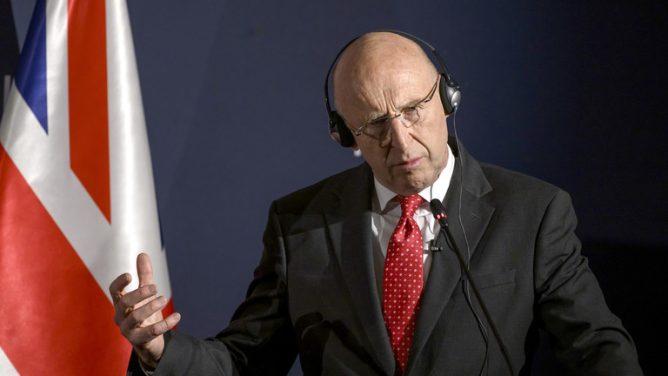
British Defense Secretary John Healey © Getty Images / Antonio Masiello
RT | May 29, 2025
London will significantly step up offensive cyber operations against Russia and China, UK Defense Secretary John Healey announced on Thursday following the inauguration of the country’s new Cyber and Electromagnetic Command.
In a statement quoted by The Times, Healey claimed that “the keyboard is now a weapon of war” and said the UK’s new cyber command would coordinate both defensive and offensive operations, including hacking into enemy systems to disrupt attacks and spread of propaganda.
Asked whether this would include Russia and China, Healey responded: “Yes.”
Healey’s statement marks the first time a British minister has explicitly confirmed cyberattacks on other states. While UK ministers had previously confirmed cyber operations against non-state actors like Islamic State, they have not until now acknowledged attacks against other countries.
Healey’s comments come ahead of the publication of a strategic defense review on Monday. According to The Times, the review will stress that cyberattacks on Britain, allegedly being carried out by Russia and China, are “threatening the foundations of the economy and daily life.”
Both Moscow and Beijing have consistently denied accusations of carrying out cyberattacks against Western nations, characterizing the claims as baseless and politically motivated.
Additionally, Russian officials have in recent months repeatedly raised concerns over what they describe as Western Europe’s continued militarization and aggressive anti-Russian rhetoric, said to be in response to the alleged threat posed by Moscow.
The Kremlin has vehemently denied having any hostile intent towards any western country, and has accused European politicians of “irresponsibly stoking fears” to justify increased military expenditures, which Moscow had labeled an “incitement of war on the European continent.”
Are Chinese Soldiers Fighting in Ukraine?
By Ted Snider | The Libertarian Institute | April 14, 2025
If Chinese soldiers are fighting in the Russian armed forces in Ukraine, that is not the big story. The big story is the effect the claim could have on the possibility of peace.
Ukraine has not yet even proven the months old claim of the presence of North Korean soldiers fighting for Russia on Russian soil. Now they are making the much more provocative claim that Chinese soldiers are fighting for Russia on Ukrainian soil.
Ukrainian President Volodymyr Zelensky announced on April 9 that the Ukrainian armed forces had captured two Chinese soldiers fighting in the Donetsk region of Ukraine. He then said that Ukrainian intelligence has uncovered 155 Chinese citizens who are “fighting against Ukrainians on the territory of Ukraine” and that they “believe that there are many more of them.”
Independent journalists and organizations have not had access to the two prisoners in order to verify the truth of the claim. Ukraine has provided a video and documents listing names and passport documents. Media outlets have seen them, but CNN and The Independent both say that they have not been independently verified.
There are tens and perhaps even hundreds of thousands of ethnic Chinese living in Russia. And even if the captured soldiers are from China, that does not mean they were sent by China. They could have enlisted on their own as mercenaries, a possibility that two former U.S. intelligence officers “with knowledge of the issue” now say U.S. intelligence believes to be the case. The Chinese Ministry of Foreign Affairs has called the claim that many Chinese citizens are fighting in the Russian army “totally unfounded,” and said that “the Chinese government always asks Chinese citizens to stay away from conflict zones, avoid getting involved in any form of armed conflict, and especially refrain from participating in any party’s military operations.”
Zelensky, though, has made the provocative claim that the Chinese government is allowing its citizens to fight in Ukraine. Asked whether China had a policy of sending soldiers to Ukraine, Zelensky answered, “I don’t have an answer to this question yet. The Security Service of Ukraine will work on it…We are not saying that someone gave any command, we do not have such information.” However, he added that “[o]fficial Beijing knows about this” and did not prevent it.
Zelensky then escalated the claim, saying, “The Chinese issue is serious” and calling on “the U.S. and the rest of the world for a response.”
It is that threat to the peace process and not the possible presence of Chinese soldiers that is serious and significant. Mercenaries from many countries have been welcomed by both Ukraine and Russia since the beginning of the war. Al Jazeera reports that, not only Chinese, but Nepalese and Indians have fought for Russia. They also report that Colombians, Sri Lankans, Indians and Americans have fought for Ukraine. At least nine Canadians have been killed in Ukraine, and more are known to have fought there. The Russian Defense Ministry claimed in March 2024 that 1,005 Canadian mercenaries have fought in Ukraine. They also claim that 2,960 have come from Poland, 1,113 from the United States, 356 from France and others from the United Kingdom and Romania. Ukraine says their international legion comprises around 20,000 fighters from fifty countries.
More seriously, it is not just mercenaries who have arrived in Ukraine. A leaked March 2023 Defense Department document reveals the presence of 97 NATO special forces in Ukraine. A recent New York Times article reports that more than three dozen military advisers were sent to Kiev and that CIA officers were in Kharkiv and “command posts closer to the fighting.” The British prime minister’s office has confirmed that the United Kingdom has boots on the ground in Ukraine. The presence of French forces has also been revealed, and Polish Foreign Minister Radoslaw Sikorski confirmed that “NATO soldiers are already present in Ukraine.”
Unless the Chinese government has a policy of sending troops to fight alongside Russia in Ukraine, which would be serious, since it could draw China into the war, it is not the alleged presence of Chinese soldiers that is dangerous. At a time when peace talks are at a fragile beginning, and U.S. President Donald Trump is insisting on both sides showing they are serious about peace, it is the provocative statements coming out of Kiev that are potentially serious.
“Russia’s involvement of China, along with other countries, whether directly or indirectly, in this war in Europe is a clear signal that Putin intends to do anything but end the war,” Zelensky said. “This definitely requires a response. A response from the United States, Europe, and all those around the world who want peace.” The suggestion that Putin is not serious about negotiating undermines U.S. led negotiations.
The statements are also ill timed and hazardous. The United States and China are engaged in a trade war. It is a volatile time to provide Washington with a cause for turning up its anger against China. Zelensky intends the presence of Chinese soldiers to evoke an American response. State Department spokesperson Tammy Bruce said the U.S. is “aware of those reports” and that “It’s disturbing with the Chinese soldiers having been captured,” though the White House has not confirmed the claim. National Security Spokesman Brian Hughes said that “if the Chinese government is allowing their citizens to fight on behalf of the Russia government, this would be a concerning escalation and the U.S. will consider options moving forward.”
Beyond challenging the peace process, the comments coming out of Kiev are provocative to China, questioning its credibility and its lack of involvement in the war. Equally importantly, it challenges any potential role of China both in the negotiations before the end of the war and in security arrangements after the end of the war: both potentially important roles for China.
Ukraine’s Minister of Foreign Affairs, Andrii Sybiha, said that “Chinese citizens fighting as part of Russia’s invasion army in Ukraine puts into question” not only “China’s declared stance for peace” but even that it “undermines Beijing’s credibility as a responsible permanent member of the UN Security Council.”
If the two captured soldiers turn out to be from China, and if they turn out to be mercenaries fighting without the approval of China, then their presence in Ukraine is not the big story. If the claims being made about them and about China resonate in the White House, then the effect of the claims could make difficult peace talks even more difficult. And that is what the potential big story would turn out to be.
Trump touts record $1 trillion Pentagon budget
RT | April 8, 2025
US President Donald Trump has announced that his administration has approved a record defense budget of around $1 trillion despite an ongoing campaign to cut federal spending.
Trump made the remarks during a meeting with Israeli Prime Minister Benjamin Netanyahu at the White House on Monday.
“We are very cost-conscious but the military is something that we have to build and we have to be strong because you have a lot of bad forces out there now,” Trump said. “Nobody’s seen anything like it.”
US Defense Secretary Pete Hegseth stressed that “we intend to spend every taxpayer dollar wisely – on lethality and readiness.”
The defense secretary under the previous administration of President Joe Biden, Lloyd Austin, had proposed increasing the defense budget by roughly $50 billion more than projections for the fiscal year 2026.
In contrast to both Trump and Austin, in February the Pentagon proposed cutting spending by 8% but prioritizing expenditure on technologies such as drones, submarines, and defense operations at the US-Mexico border and operations related to deterring China.
The current US Defense Department budget is $895.2 billion. Despite the vast sums allocated to defense, the Pentagon has failed to pass an audit for seven consecutive years since the procedure was established.
Trump’s pledge for expanded military funding comes as his administration, through the Department of Government Efficiency (DOGE), has implemented widespread federal spending cuts. Under DOGE, led by Elon Musk, roughly 280,000 federal workers have been laid off in recent months.
USAID in Myanmar: A Legacy of Soft Power Manipulation?
By Ilya Tsukanov – Sputnik – 31.03.2025
Democrats and the mainstream media continue to blame US President Donald Trump’s USAID cuts for crippling Myanmar’s earthquake response, despite his pledge of aid.
Trump and Elon Musk have slammed USAID for fraud, while Secretary of State Marco Rubio said it had “strayed from its original mission.” what was USAID REALLY doing in Myanmar?
Pushing Woke Agendas
Musk’s DOGE axed a $45M DEI scholarship program in Myanmar, launched in 2024 to fund 1,000 students in SE Asia and online at the University of Arizona. It was less about education and more about grooming future US allies against China, insiders told Radio Free Asia. Media reports say many in Myanmar also fear the programs erode local culture and values.
Terrorism Allegations
Myanmar’s ruling State Administrative Council (SAC) urged the US in 2024 to rethink funding activities “which some label as terrorism.”
“We believe the US is manipulating Myanmar to counter China’s influence in the region,” the military government told US media. “Despite the US presenting itself as a champion of democracy, the aid disproportionately benefits Myanmar’s opposition groups.”
Media Manipulation
USAID redirected $42.4M to advocacy groups post-2021. A now-frozen $1M was set for ‘independent’ media like Mizzima, seen as an anti-government mouthpiece. The group Human Rights Myanmar said the frozen funds “are vital for organizations challenging military rule and promoting democracy, which advance US interests by upholding American values and countering China’s authoritarian influence.” USAID’s Myanmar partners reportedly also include CARE International, which runs gender-focused projects and the Overseas Irrawaddy Association which relocates activists.
Chinese Embassy in Canada refutes allegations of China’s interference in Canadian elections
Global Times | March 26, 2025
In response to a media question regarding claims by an official from the Canadian Security Intelligence Service (CSIS) that China might attempt to interfere in Canada’s elections, a spokesperson of the Chinese Embassy in Canada stated that China firmly opposes the baseless slander and defamation of China without factual evidence.
It has been reported that an official from the CSIS stated that Canada’s elections could face the threat of foreign interference and the CSIS is closely monitoring China, Russia, India, and Pakistan, when questioned on this, the spokesperson of the Chinese Embassy in Canada said that the Chinese side has repeatedly stated its position on the so-called issue of foreign interference, firmly opposing the baseless slander and defamation of China without factual evidence.
China follows the principle of non-interference in other countries’ internal affairs and has never, nor has any interest in, interfering in Canada’s internal affairs. The label of “foreign interference” will never be placed on China, the spokesperson said.
The Canadian election is a domestic issue for Canada and is not related to China. However, the Chinese side firmly opposes linking Canada’s internal affairs with China-related factors and firmly opposes using China as a topic in this context, the spokesperson added.
A new American empire: Trump, Russia, and the end of globalism
The US is resetting, but not how the world expected
By Vasily Kashin | Profile | March 5, 2025
Donald Trump’s return to the White House is shaping up to be nothing short of a political revolution. The new administration is rapidly dismantling the old order, purging the ruling elite, reshaping both domestic and foreign policy, and cementing changes that will be difficult to reverse – even if his opponents regain power in future elections.
For Trump, as for all revolutionaries, the priority is to break the existing system and consolidate radical transformations. Many of the principles that guided US policy for decades – sometimes for over a century – are being deliberately discarded. Washington’s global strategy, long built on expansive military, diplomatic, and financial influence, is being rewritten to serve Trump’s domestic political needs.
The end of the American liberal empire
For the past 100 years, the US has functioned as a global empire. Unlike traditional empires built on territorial expansion, the American empire extended its reach through financial dominance, military alliances, and ideological influence. This model, however, has become increasingly unsustainable. Since the late 1990s, the costs of maintaining global hegemony have exceeded the benefits, fueling discontent both at home and abroad.
Trump and his allies seek to end this ‘liberal empire’ and return America to a more self-reliant, mercantilist model – one reminiscent of the late 19th and early 20th centuries under President William McKinley. Trump has openly praised this era, viewing it as the golden age of US prosperity, before the country took on the burdens of global leadership.
Under this vision, America will reduce unproductive foreign expenditures and refocus on its natural advantages: Vast resources, an advanced industrial base, and the world’s most valuable consumer market. Rather than policing the world, Washington will wield its economic power more aggressively to secure trade advantages. However, the transition to this model carries significant risks, particularly in a highly globalized economy.
A shift in global strategy
Trump’s policies are driven by domestic concerns but will have major implications abroad. His administration is systematically dismantling key institutions of the old order, including those that irritated Moscow. For instance, USAID – a major vehicle for American influence in the post-Soviet space – has been gutted. Ironically, Trump had more motivation to destroy USAID than even Russian President Vladimir Putin, given that its resources had been repurposed for domestic political use by Trump’s rivals.
If the US abandons its liberal empire model, many sources of tension with Russia will disappear. Historically, Moscow and Washington had relatively stable relations throughout the 19th century. If Trump’s America reverts to a more isolationist approach, Russia will no longer be a primary target of US interference. The main friction point will likely be the Arctic, where both nations have strategic interests.
China, however, remains Trump’s top adversary. Beijing’s state-led economic expansion is fundamentally at odds with Trump’s mercantilist vision. Unlike Biden, who sought to counter China through alliances, Trump is willing to go it alone – potentially weakening Western unity in the process. His administration is expected to escalate economic and technological warfare against Beijing, even if it means alienating European allies.
Europe’s strategic uncertainty
One of Trump’s most disruptive moves has been his open hostility toward the EU. His vice president, J.D. Vance, recently delivered a speech in Munich that amounted to direct interference in European politics, signaling support for right-wing nationalist movements that challenge the EU’s authority.
This shift is forcing Europe into an uncomfortable position. For years, China has viewed Western Europe as an ‘alternative West’ with which it could engage economically without the same level of confrontation it faces with the US. Trump’s approach could accelerate EU-Chinese ties, especially if Western European leaders feel abandoned by Washington.
There are already signs that European policymakers may loosen restrictions on Chinese investments, particularly in critical industries such as semiconductors. At the same time, the ambitions of some Europeans for NATO expansion into the Indo-Pacific may falter, as the bloc struggles to define its new role in a post-globalist US strategy.
Russia and China: A changing relationship
For years, Washington fantasized about splitting Russia and China apart. But Trump’s new approach is unlikely to achieve this goal. The Russia-China partnership is built on strong fundamentals: A massive shared border, complementary economies, and a shared interest in countering Western dominance.
If anything, the shifting geopolitical landscape could push Russia into a position similar to that of China in the early 2000s – focusing on economic development while maintaining strategic flexibility. Moscow may reduce its efforts to actively undermine the US and instead concentrate on strengthening its economic and security ties with Beijing.
China, meanwhile, will bear the brunt of Trump’s new American empire. The US will no longer rely on alliances to contain Beijing but will use direct economic and military pressure. While this may make life more difficult for China, it does not necessarily mean the US will succeed. China has been preparing for economic decoupling for years, and Beijing may find opportunities in a more divided Western world.
The road ahead
Trump’s return marks a fundamental shift in global power dynamics. The US is moving away from being a liberal empire and toward a more transactional, power-based foreign policy. For Russia, this means fewer ideological conflicts with Washington but continued competition in key areas like the Arctic.
For China, Trump’s policies present a direct challenge. The question is whether Beijing can adapt to a world where the US is no longer just containing it but actively trying to roll back its economic influence.
For Western Europe, the picture is bleak. The EU is losing its privileged status as America’s primary partner and is being forced to fend for itself. Whether it can navigate this new reality remains to be seen.
One thing is certain: The world is entering a period of profound transformation, and the old rules no longer apply. Trump’s America is rewriting the playbook, and the rest of the world will have to adjust accordingly.
Vasily Kashin, Political Science PhD, Director of the Centre for Comprehensive European and International Studies, HSE
This article was translated and edited by the RT team.
Is It Foreign Aid or Covert Action?

By Philip Giraldi • Unz Review • February 21, 2025
There has been considerable controversy surrounding the Trump administration decision to cutback on government agencies that are ostensibly committed to charitable, educational and other nation building activities both overseas and in the United States. This spending, amounting to scores of billions of dollars, has helped produce budget deficits that ballooned in the twenty-first century, largely due to the surge in overseas activity that occurred after the trauma of 9/11 when the United States decided that it had to serve as policeman for the rest of the world to make itself safe. As the US is now verging on bankruptcy due to its unsustainable debts, the second incarnation of the Trump Administration has focused on cutting budgets in areas that it considers to be enemy occupied, often meaning “woke” or institutionally allied to the Democrats. Social programs as well as the bloated defense department spending were considered to be suitable targets so starting during the first week in February, the White House brought down the hammer when it went after a number of government agencies, inter alia calling for huge cuts in Pentagon spending and the complete elimination of the Education Department.
The White House also shut down the United States Agency for International Development (USAID), firing nearly all of its 10,000 employees, reportedly leaving only little more than 600 employees in place to assist in the shutting down or downsizing of facilities in the US and in foreign countries. Also, about 800 awards and contracts that are administered through USAID were reportedly being canceled. There have reportedly been some judicial delays in the firings due to the complexity of removing thousands of employees and families from overseas offices and housing, though the pause is likely to be only temporary.
Tax dollars are traditionally used corruptly to fund projects and policies dear to the hearts of politicians, which is why Ron Paul and others have called for sweeping audits, including of the Federal Reserve system and the Pentagon in particular. This hidden spending is particularly difficult to identify if the program is somehow linked to foreign policy and/or national security, which have traditionally been protected from scrutiny by denying nearly all public access to sensitive information based on the “need to know” principle to safeguard sources and vulnerable activities.
USAID was founded in 1961 during the John F. Kennedy administration to unite several foreign assistance organizations and programs under one agency. At first it was seriously intended to be a mechanism for the US to aid in health, disaster relief, socioeconomic development, environmental protection, democratic governance and education. Its focus, however, eventually became to guide development in parts of the world that suffered from what were considered to be dysfunctional governments and institutions in terms of American interests. USAID has always been funded by the federal government and its upper management has worked closely with the Department of State, to which it is technically accountable, and the intelligence agencies in particular. Its budget in 2023 was $43 billion. Trump’s reduction in force (RIF) of USAID has been accompanied by a shake-up in its management, its remaining responsibilities now being in the hands of the Secretary of State Marco Rubio, who has considerable experience in special agency management after having served on the Board of the National Endowment for Democracy’s (NED) Republican subsidiary component, the International Republican Institute (IRI). NED, which operates extensively overseas, has also been stripped of funding by Trump.
The dismantling of USAID does not necessarily mean the organization will completely go away, it will just be much reduced and under new management. It will likely have a new mission, though no one is at this point sure what that will mean. And USAID and NED are not alone as the presidential memo has called for a halt to the funding of all the government components that are dependent on taxpayer generated funds to provide what is perhaps euphemistically referred to as “foreign aid.” USAID and NED do have humanitarian projects, i.e. feeding the hungry, but they are primarily politically driven. The NED component IRI puts it this way on its website “Our mission at IRI—advancing democracy worldwide—is a battle with many fronts. I am proud to say that IRI is supportive of every endeavor that will bring freedom to more people. We have made progress in our mission by giving hope to those who wish to protest on a city street, run for office, or cast a ballot.”
So the aid organizations overtly have a political role, but how does it translate in practice and does it extend to playing favorites with the US media and political parties? Trump has put it another way, declaring that USAID leaders were “radical left lunatics.” This is what he claims on his website Truth Social:
“LOOKS LIKE BILLIONS OF DOLLARS HAVE BEEN STOLEN AT USAID, AND OTHER AGENCIES, MUCH OF IT GOING TO THE FAKE NEWS MEDIA AS A ‘PAYOFF’ FOR CREATING GOOD STORIES ABOUT THE DEMOCRATS. THE LEFT WING ‘RAG,’ KNOWN AS ‘POLITICO,’ SEEMS TO HAVE RECEIVED $8,000,000. Did the New York Times receive money??? Who else did??? THIS COULD BE THE BIGGEST SCANDAL OF THEM ALL, PERHAPS THE BIGGEST IN HISTORY! THE DEMOCRATS CAN’T HIDE FROM THIS ONE. TOO BIG, TOO DIRTY!”
There are, in fact, credible reports that the 2019 impeachment of Trump was driven by the actions and disinformation coming from CIA, FBI and USAID operatives, so it is plausible to assume that Trump is now settling scores. Beyond that, USAID and NED are both notorious for their roles in the business of covertly supporting opposition political parties worldwide and assisting in regime change. Billionaire philanthropist George Soros, through his network of organizations, received $260 milllion from USAID for funneling funds to non-governmental-organizations (NGOs) connected with Soros’ Open Society Foundations, which are known for advocating for radical policies and regime changes globally. Soros is also a Democratic Party favorite and major fund raiser, having recently received at a White House ceremony the honor of the Presidential Medal of Freedom presented in absentia to his son Alex from outgoing President Joe Biden.
As a result, both USAID and NED have been banned from foreign countries, including Russia, due to their meddling in local politics. Hungarian Prime Minister Viktor Orban, who was often a target of USAID activity, immediately thanked Trump for his decision to cancel USAID. Both USAID and NED were deeply involved in Eastern Europe. Former Acting Deputy Secretary of State Victoria Nuland has revealed that the aid agencies were deeply engaged in the multiple source $5 billion dollar multiyear US “investment” in Ukraine that culminated in regime change in 2013 and led to the current war with Russia. In government circles it has frequently been asserted that USAID and NED and other such organizations now do what the CIA used to do routinely in terms of regime change between its founding and the 1990s.
One might suggest that recent US governments, operating through their various subsidiaries like USAID and NED have been funding just about everything to control a world community in line with American interests. Mainstream media worldwide that is directly or indirectly funded reportedly includes journalists, news outlets, and activist NGOs and sites – and that’s just through USAID. That would appear to include Reuters, Associated Press, BBC, The Guardian, NBC, CNN, NPR, NYT, Politico, PBS, The Financial Times, The Atlantic, The Daily Telegraph, as well as much more media in the developing world. The anti-China hysteria media “ecosystem” currently depends on US government funding, and is already complaining about the impending shutdown of USAID support. To cite only one example of how it is packaged, Reuters news service has received millions in funding from the US government specifically for “active social engineering.”
Labor unions are also funded by USAID which is also behind the recent political unrest in Slovakia. It has also paid for multiple coup attempts in Venezuela, funded high profile trips for Ukraine’s Volodymyr Zelensky to improve his image and popularity, and funded al-Qaeda linked groups in Syria to successfully overthrow the government in Damascus. Going back to Trump’s first term of office, it is interesting to observe that most of the “aid” to opposition parties to overthrow Nicolas Maduro in Venezuela was delivered during 2019, so Trump, guided by hardliners John Bolton and Mike Pompeo, was not at that time shy about regime change. In fact, Voice Of America (VOA), which often served as a CIA mouthpiece, even reported that Trump had tripled aid to opposition figure Juan Guaido to $56 million. Those asking themselves why Trump has now decided to “oppose” the very semi-covert agency that he’s also been using for regime change have a point, but it might be appropriate to see the shakeup as a warning against government information, law enforcement and intelligence agencies again becoming tools of the Democratic Party politicians.
Defenders of USAID are arguing that the agency is being maligned, that in addition to its political profile it is heavily engaged in promoting health and wellness worldwide. The head of USAID under Joe Biden was the highly controversial and very much “woke” Samantha Power, who claims somewhat disingenuously that the agency budget of $38 billion in 2023 included something like $20 billion in spending that should appropriately be described as humanitarian. Those who are the recipients of the programs, mostly in the third world, will consequently suffer from the defunding of aid. If that is actually so, it perhaps would make sense to roll such programs into a mechanism that would not be tied to regime change and corruption of local governments and media.
There is some question even in Congress concerning whether there will be a new centralized aid agency and what it will be called or do now that it has been reduced in size and will likely have a tiny budget relative to what it once enjoyed. It is early days and the answer to that question will likely emerge before too long, but it should be pointed out that at no point has Rubio or anyone else in the Trump administration actually condemned aggressive US engagement abroad or claimed they will bring it to an end. The State Department has even officially said the only goal is to ensure the good things that USAID did will continue by “advancing American interests abroad.” Given some of the recent aggressive positions taken by the Trump Administration over Gaza, Panama, Canada, Mexico, Iran and Greenland as well as the tendency on the part of its top officials to increase pressure on perceived adversaries, it may be that the US isn’t changing course at all. It quite plausibly might be doubling down, and organizations like USAID and NED, even if their names, roles and leadership change, will likely be integral to that process.
Philip M. Giraldi, Ph.D., is Executive Director of the Council for the National Interest, a 501(c)3 tax deductible educational foundation (Federal ID Number #52-1739023) that seeks a more interests-based U.S. foreign policy in the Middle East. Website is councilforthenationalinterest.org, address is P.O. Box 2157, Purcellville VA 20134 and its email is inform@cnionline.org.
The US Is Reeking the Smell of Fear
By Hua Bin | January 31, 2025
DeepSeek, a Chinese AI startup, has sent a shockwave through the US tech industry and Wall Street in the last week.
Its LLM R1, trained under $6 million and 2 months, has outperformed the latest offerings from OpenAI, Meta, Google and Microsoft, who have spent tens of billions and years on their models.
The DeepSeek AI app has topped download charts in the US and China, replacing ChatGPT as the No. 1 AI productivity tool.
Due to its breakthrough technology that shows powerful AI can be developed with very limited investment in compute, DeepSeek’s emergency has sent Nvidia stock reeling, losing as much as 17% on Monday and wiping out $600 billion in market cap.
Interestingly, as we speak, barely a few days after the shockwave on Wall Street, DeepSeek is experiencing a massive denial of service (DoS) attacks from the US on its servers, affecting new registrations.
The US government, including the US Navy, has banned the use of DeepSeek for its personnel. And the congress is already discussing ways to slow down and disrupt DeepSeek.
This episode is eerily reminiscent of the Huawei ban, the TikTok ban, the chip ban, and the EV tariffs. The US regime has fully adopted the Tonya Harding school of how to win by breaking the leg of her competitor. Ask Nancy Kerrigan about it.
As thoughtful people put all these panic-ridden actions in context, the most obvious conclusion emerges – the US regime is not acting from any position of strength. It is behaving like a chicken little who cannot compete, win honestly, and is running scared.
The list of anti-China activities out of successive US regimes is long and varied –
– Trump started to impose 60% tariff on Chinese imports since 2017, a policy the Biden regime continued.
– The Biden regime imposed 100% tax on Chinese EVs, which have not yet even entered the US market. But the competitiveness of Chinese EVs is enough to get Biden to enact pre-emptive tariffs.
– Biden regime imposed dozens of export controls on China, often using coercion against its own “allies” to follow suit such as Holland’s ASML and South Korea’s Hynix and Samsung.
– Biden regime put thousands of Chinese companies on the US entity list with all sorts of made-up justifications in hope of disrupting these companies’ operations.
– Trump is again making noises to impose 100% tariffs on Chinese imports. He is going further to threaten invading Panama and Greenland to contain China.
– The FBI launched the infamous China Initiative to prosecute Chinese scientists working in the US, yielding zero prosecutable case after ruining the lives of numerous scholars and scientists.
McCarthyism is alive and well in the “land of the free”. J Edgar Hoover, the cross dresser, would be proud of the viciousness of the criminal organization he founded.
– The US regime has also harassed the hundreds of thousands Chinese students in the US, who are contributing $150 billion a year to the US economy. It is attempting to prevent Chinese students from studying in advanced technical fields. Anyone studying the defunct neoliberal economics or neoconservative politics and faux democracy is welcome.
– The congress passed a $1.6 billion smear fund in a so-called “anti-CCP propaganda” campaign. The best to counter other’s so-called propaganda is of course to launch a bigger one of your own.
– Every political appointee, as well as elected official, must espouse a fervent anti-China rhetoric in confirmation hearings, TV interviews, and corporate media op-eds. If you are not a China hawk, you have no place in the US power elite.
– Every Pentagon official and military industrial complex funded “think tanker” is expected to sound tough about the coming China US war. They come up with frightening concepts like the “unmanned Hellscape” strategy in the Taiwan Strait, seemingly unaware that China is years ahead in drone tech and production.
– The US has tried to mobilize its vassals from Japan, South Korea, the Philippines, Australia, and India into anti-China military alliances. It has formed fearsome-sounding acronyms like AUKUS and QUAD, which are looked upon in awe only by itself.
The “most powerful country in the history of the world” (as self-claimed by multiple US regimes) seems unconfident to take on China on its own.
On the other hand, China is playing its own game. There is no political figure or “expert” jumping up and down on national or local TV to shout against the US. There is little attention paid to the theatrics in Washington and its client states.
China is focused on overcoming the difficulties posed by the aggressive US actions, reducing dependencies, and developing its indigenous capabilities.
– China has diversified its trades. Trading with emerging markets now account for more than 50% of China’s total trade. Trade with the US is less than 3% of its GDP as of 2024.
– Huawei has revived its mobile business and dethroned Apple to return to market leadership in China. Its leadership is more entrenched in the core telecom technology area. It is more vertically integrated with its own chip design and manufacturing supply chain.
Huawei has expanded its product offerings to include mobile operating systems (Harmony OS NEXT), electric vehicles, streaming services, and autonomous driving.
– In AI, Chinese companies are making rapid progress. In addition to DeepSeek, ByteDance, Baidu, Alibaba, 01.ai have all developed sophisticated LLM models.
– China leads in industrial AI applications from robotics, drones to autonomous driving. Companies such as Unitree, DJI, BYD, Xiaomi are integrating AI technologies into multiple areas of practical applications beyond generative AI.
China is also translating its industrial, technological and economic power into military power.
It has recently launched the world’s first 6th generation fighter prototypes (not one but two at the same time), the world’s first drone-carrier, the first hypersonic stealth unmanned airplanes for strike and reconnaissance, the first stealth unmanned warship, and the most powerful long-range air defence systems.
It is progressing rapidly in directed energy weapons, military 5G, atomic timing, and space warfare systems.
All these military technological breakthroughs were unveiled in the last 3 months.
While US politicians and military figures seem to conflate theatrics with reality, China is quietly amassing the capability to overwhelm its opponent in raw military might, industrial might and economic might.
As we watch with amusement the clownish performance of the US elite, the stinking odor of fear reeks so much you can smell it from across the Pacific.
Trump’s Second Act: What it means for Russia and the global order
By Andrey Ilnitsky | Kommersant | January 16, 2025
The idea of inflicting “strategic defeats” on Russia has been a cornerstone of US policy for a long time. It transcends party lines and is implemented regardless of which administration occupies the White House. The only real differences lie in the methods used to achieve this objective. In this era of global transformation, it is critical for Moscow to analyze the strengths and weaknesses of its opponents. By understanding the nuances of US President Donald Trump’s administration – now back in power – Russia must craft its own strategy of resilience and development, rooted in sovereign interests.
This is not a new game. In 2014, Foreign Affairs published an article by John Mearsheimer, the renowned American political scientist behind the theory of offensive realism. In his piece, Why the Ukraine Crisis is the West’s Fault, Mearsheimer argued that NATO’s strategic ambitions in Eastern Europe provoked Russia’s actions in Crimea and Ukraine. His insights, dismissed at the time, have since been vindicated by events.
Fast forward to December 2024: Mearsheimer’s skepticism resurfaced in an interview with Russian philosopher Alexander Dugin, published by UnHerd. Mearsheimer doubted that Trump, despite his unconventional rhetoric, would bring meaningful change to US policy. “Trump is surrounded by hawks with deeply entrenched Russophobia,” he observed. While Trump’s personal views might differ from Washington orthodoxy, the forces shaping his administration remain aligned with America’s long-standing ambitions of hegemony.
Trump’s first term demonstrated this paradox clearly. Despite his campaign promises to “get along with Russia” and even consider recognizing Crimea, little changed. While Trump and President Vladimir Putin met six times and engaged in what seemed like constructive dialogue, US policy continued to push Russia out of global energy markets, impose sanctions, and arm Ukraine. At a 2023 rally, Trump himself dismissed accusations of being “soft on Russia,” boasting that he had sent “hundreds of Javelins” to Ukraine while the Obama administration sent “pillows.”
Expecting Trump’s second term to usher in a multipolar and equitable global order would be naive. The real power behind Trump’s administration – interest groups, corporations, and donors – has little incentive to pursue peace. His 2023-2024 campaign received significant backing from military-industrial giants like Lockheed Martin and Raytheon, as well as Silicon Valley’s venture capital elite. These forces thrive on perpetual conflict, where war is repackaged as “peace through strength.”
Trump’s geopolitical priorities are clear: undermine China’s rise as an economic and technological powerhouse while maintaining pressure on Russia. Elbridge Colby, a key figure in Trump’s foreign policy team, has articulated this strategy bluntly. Writing in May 2024, Colby argued that America must prioritize Asia – specifically China – over Europe and Russia. “The logic of Cold War strategy,” he wrote, “once led America to Europe; today it suggests that America should focus on Asia. China is the main rival.”
The inclusion of Marco Rubio in Trump’s foreign policy apparatus reinforces this anti-China focus. Rubio, a staunch critic of Beijing, has long warned of China’s ambitions to become the world’s dominant power “at the expense of everyone else.” Trump’s pivot to Asia is clear, but his strategy remains rooted in American exceptionalism and hegemony.
Domestically, Trump’s team envisions America as a “subcontinental fortress,” invoking a modernized Monroe Doctrine. This vision includes greater control over Canada, Greenland, and Panama, and a tighter grip on Central and South America. The goal? To secure America’s dominance in the Western Hemisphere while sidelining external powers like China and Russia.
Technology and military innovation are central to this vision. Trump’s administration aims to leverage artificial intelligence and cutting-edge dual-use technologies to maintain global superiority. This requires a complete reboot of the US military-industrial complex and a closer alignment between civilian industries and defense objectives. However, the question remains: can Washington, with its internal divisions and waning influence, successfully implement such an ambitious strategy?
For Russia, this geopolitical landscape poses serious challenges but also offers opportunities. The unipolar world order led by the US is undeniably weakening. Multipolarity is no longer just an aspiration; it is becoming a reality. However, the US and its allies are not retreating quietly. Instead, they are intensifying hybrid warfare against nations like Russia, China, Iran, and North Korea – countries labeled as “revisionist regimes.”
Trump’s rhetoric may appear bold and unconventional, but his administration’s actions are predictable. The MAGA doctrine of 2024 is less about genuine transformation and more about reasserting US dominance at any cost. Whether through economic coercion, military intervention, or ideological posturing, the goal remains the same: enforce a world order dictated by Washington.
For Russia, the path forward is clear. We must remain steadfast in defending our sovereignty and values. Unlike the West, which prioritizes hegemony, Russia stands for a multipolar world where nations have the right to determine their own destinies. The challenges are immense, but so are the opportunities. In this new era of great power competition, Russia’s resolve will be tested, but our commitment to our people and our principles will guide us through.
Andrey Ilnitsky is a member of the Council for Foreign and Defense Policy and senior research fellow at the Military University of the Ministry of Defense of the Russian Federation.
This article was first published by the newspaper Kommersant and was translated and edited by the RT team.
How to Access TikTok After a Ban
Navigate TikTok bans with ease while keeping your online privacy intact
By Rick Findlay | Reclaim The Net | January 18, 2025
TikTok is one of the most popular social media platforms, with millions of users worldwide sharing short videos ranging from dance challenges to educational content. However, in some countries, TikTok is banned or restricted due to concerns over data privacy, national security, or cultural sensitivities. If you’re living in or traveling to one of these regions, a Virtual Private Network (VPN) can help you access TikTok safely and securely.
Here’s everything you need to know.
Why Is TikTok Banned in Some Countries?
TikTok has faced bans and scrutiny in several countries, primarily due to its ties to China and concerns about its data practices. TikTok’s parent company, ByteDance, is based in Beijing, and critics argue that this connection raises questions about the potential influence of the Chinese Communist Party (CCP) on the platform.
Here are some key reasons why TikTok is banned or restricted in certain regions:
Data Privacy Concerns: TikTok collects vast amounts of user data, including location information, browsing habits, and device details. Governments in some countries fear that this data could be accessed by the Chinese government under China’s data-sharing laws.
National Security Risks: Authorities worry that TikTok’s data collection practices could pose a national security threat. For example, military personnel using TikTok might inadvertently expose sensitive information.
Censorship and Propaganda: Critics claim that TikTok may censor content unfavorable to the Chinese government or promote propaganda. This has fueled mistrust, especially in countries with strained relations with China.
Cultural Sensitivities: In some regions, TikTok has been criticized for hosting content deemed inappropriate or harmful to local values and traditions.
There are free VPNs out there that help you bypass censorship but also track you and your data. These VPNs are to be avoided.
We have a list of vetted and recommended VPNs for you here.
What Is a VPN and How Does It Work?
A VPN is a tool that encrypts your internet connection and routes it through servers located in different parts of the world. By using a VPN, you can hide your actual location and appear as though you’re accessing the internet from another country. This not only helps bypass geo-restrictions but also enhances your online privacy by masking your IP address.
When you connect to a VPN server in a country where TikTok is accessible, you can download, use, and enjoy TikTok without worrying about local restrictions.
Why Use a VPN for TikTok?
Bypass Regional Bans: Governments in some countries have banned TikTok entirely. A VPN allows you to bypass these bans by connecting to a server in a country where TikTok is not restricted.
Protect Your Privacy: A VPN encrypts your internet traffic, preventing your ISP or government from monitoring your online activities.
Access Content Globally: With a VPN, you can unlock TikTok content from other regions, giving you access to a wider range of videos and trends.
How to Access TikTok Using a VPN
Follow these steps to set up a VPN and access TikTok:
1. Choose a Reliable VPN Service
Not all VPNs are created equal. To access TikTok, you need a VPN with:
Servers in TikTok-friendly countries: Ensure the VPN has servers in countries where TikTok is not banned.
High-speed connections: TikTok’s video-heavy platform requires a VPN with fast speeds to avoid buffering.
Strong encryption: Look for a VPN that uses 256-bit encryption for maximum security.
There are other factors to consider when using a VPN – including using one that has open-source technology.
We have a list of vetted and recommended VPNs for you here.
2. Install the VPN App
Once you’ve chosen a VPN, download and install its app on your device. Most VPN services support multiple platforms, including iOS, Android, Windows, and macOS.
3. Connect to a TikTok-Friendly Server
Open the VPN app and select a server located in a country where TikTok is accessible. For example, if you’re in a region where TikTok is banned, you can connect to a server in the US or Europe. For best internet speed results, use a server in country that is close to your own.
Use TikTok on a Web Browser
In some cases, TikTok may be removed from app stores in certain regions, making it impossible to download or update the app. However, you can still access TikTok through its web version. Here’s how:
Open a web browser while connected to the VPN.
Visit TikTok’s official website at TikTok.com
Log in with your credentials or create a new account.
The web version allows you to browse videos, interact with content, and upload your own creations, providing a full TikTok experience without needing the app.
Important Tips for Using TikTok with a VPN
Select the Right Server: If one server doesn’t work, try connecting to a different one in the same region.
Stay Secure: Avoid free VPNs, as they often have limited servers, slower speeds, and weaker security features. Some free VPNs may even sell your data.
Check Local Laws: While using a VPN is legal in most countries, accessing banned platforms may violate local laws. Research the regulations in your area before proceeding.
Clear App Cache: If TikTok still doesn’t work after connecting to a VPN, clear the app’s cache or reinstall it while the VPN is active.
A VPN is a powerful tool for accessing TikTok in regions where it’s restricted, enabling you to stay connected to the platform’s vibrant community. By choosing a reliable VPN and following the steps outlined above, you can enjoy TikTok’s endless entertainment while safeguarding your privacy. Just remember to use VPNs responsibly and check the laws in your region.
Featured Video

Rewriting the risk? Inside the government’s vaccine safety messaging
or go to
Aletho News Archives – Video-Images
Book Review
“Davos Can Really Replace the UN”
Inside the book that maps the architecture behind global governance — from the Epstein files to the Pact for the Future
Lies are Unbekoming | April 1, 2026
On June 13, 2019, the United Nations and the World Economic Forum signed a partnership deal to “accelerate the implementation of the 2030 Agenda for Sustainable Development.” That same evening, WEF president Börge Brende — Norway’s former Foreign Minister — had dinner with Jeffrey Epstein at Epstein’s Manhattan townhouse. The Epstein files, released January 2026, contain an exchange between the two from the previous year. Epstein to Brende: “Davos can really replace the UN. C21, cyber, crypto . genetics… intl coordination.” Brende back to Epstein: “Exactly — we need a new global architecture. World Economic Forum (Davos) is uniquely positioned — public private.”
The next day, the UN General Assembly adopted the framework for restructuring global governance.
That sequence — the partnership signing, the Epstein dinner, the candid admission about replacing the UN with a public-private architecture, and then the formal adoption — opens Jacob Nordangård’s The Digital World Brain. Pages two and three. Footnoted to the UN resolution number, the Epstein files, and the General Assembly record.
I keep coming back to it because it captures what this book does that almost nothing else in the independent research space manages. I’ve followed Jacob’s work for years now and interviewed him about his research. Each book peels back another layer of the same institutional architecture, and each time I think he’s reached the limit of what can be documented, the next one goes further. Nordangård doesn’t speculate. He doesn’t editorialize much. He lays institutional actions next to each other in chronological order and lets the pattern announce itself. … continue
Blog Roll
 Aletho News
- How I fell foul of the BBC thought police
- The End of NATO
- 37 days of war on Iran cost US staggering $42bln, tracker shows
- Baghdad tells Asian refiners, traders to begin loading Iraqi crude amid Iranian exemption
- Under fire, Moscow and Tehran close ranks
- Iran, US receive Pakistan-mediated plan for ceasefire then final deal
- Iran submits demands for end to war as mediators scramble ahead of Trump deadline
- Iran Threatens Retaliatory Strike on Stargate AI Project in UAE
- US sent ‘a lot’ of arms to Iranian protesters – Trump
- Barak Ravid Launders Deception To Allow Trump To Back Off Of His Power Plant Threat – Again
- If Americans Knew
- U.N. experts demand Israel release prominent Gaza doctor after reports of ‘severe torture’
- Israel’s Latest Genocide Is Against the Shias of Lebanon. Why Is the World Silent?
- How Eliot Cohen’s influence over U.S. war-making paved the way for Trump’s war crimes in Iran
- Israelis don’t pay for the weapons we ‘sell’ to them — US taxpayers do
- While Distancing from AIPAC, Most 2028 Democratic Hopefuls Are Still Embracing Israel
- A brief history of the Israeli nuclear program, the open secret at the heart of the Iran war
- Israeli Settlers Killed a Palestinian Farmer on His Own Land, in Front of His Father. Yes, Again
- The US-Israeli War on Science is an Assault on our Future
- 100+ International Law Experts Say US Strikes on Iran Violate UN Charter, Could Be War Crimes
- ‘Vile, Horrifying, Evil’: Trump Threatens to Bomb Nation of 90 Million People ‘Back to the Stone Ages’
- No Tricks Zone
- An Inconvenient Tree: Uncovered In Alps… Europe Much Warmer Than Today 6000 Years Ago
- New Study Reports A 60% Slowdown In Greenland’s Ice Loss Rate In The Last Decade
- Low Intensity Tornado Wrecks Major Solar Farm, Creating A Potential Toxic Dump
- New Study Finds Warming Saves Lives…Cold Temperatures 12 Times More Deadly Than Excess Heat
- German Science Blog Accuses PIK Climate Institute Of Hallucinating Climate Tipping Points
- Devastating Assessment Of Comirnaty Vaccine By Former Senior Pfizer Europe Toxicologist
- New Study: CO2 Is ‘Effectively Negligible’ As An Explanatory Climate Change Factor Since 2000
- Former Pfizer Toxicologist Dr. Helmut Sterz Tells Bundestag Hearing Pfizer Vaccine Should Have Never Been Approved
- Energy Expert: Germany’s Nuclear Phaseout Was A “500 Billion Euro Mistake”
- New Research: South Australia’s Mid-Holocene Sea Surface Temperatures Were 4°C Warmer Than Today
 Aletho News