Palestine Action protest Teledyne, Elbit weapon export to ‘Israel’
Al Mayadeen | April 3, 2024
UK-based Palestine Action activists “occupied” a US-owned Teledyne factory in West Yorkshire in the UK on April 2 because it exports weapons for the Israeli occupation forces.
In its statement, the group said, “Breaching security, the activists have scaled the factory to take the roof, forcing the site closed and rendering it unable to fulfill its shipment of weapons parts to be used in the Gaza genocide.”
It is noteworthy that the group announced today that four of its activists were arrested following the protest at the Teledyne factory.
At least 86 licenses to ‘Israel’ between 2009-2014 alone
They added that at least 86 licenses for weapons exports to “Israel” were given to this site from 2009 to 2014 which, according to the protesters, makes Teledyne the largest exporter of weaponry from the UK to “Israel”.
“A significant proportion of the company’s almost 200 export licenses for weapons and weapons parts to the US, 2009-2020, will also form into finished products ultimately exported to Israel,” it stressed.
The statement added that Teledyne produces parts, including filters and multi-function assemblies, for UAVs, aircraft, and radar systems, including the AN/APG-81 (AESA) type fitted in Lockheed Martin F-35 fighter jets.
“Teledyne, the parent company, also produces image sensors for military applications and radar technologies around the borders of the occupied West Bank and Gaza while also providing armed UAVs to Israel as far back as 1973,” it emphasized.
Freedom Flotilla Coalition to bring aid, international observers to Gaza this month
MEMO | April 3, 2024
The Freedom Flotilla Coalition (FCC) will sail several ships carrying 5,500 tonnes of humanitarian aid and hundreds of international observers to the besieged Gaza Strip in mid-April, its Spanish chapter Rumbo a Gaza said in a statement today.
Rejecting Israel’s control over the entrance of humanitarian aid, Rumbo a Gaza said it will not allow Israel to inspect the shipments.
“For everyone’s safety and to ensure that aid reaches those who need it, the FFC will be bringing hundreds of international humanitarian observers from many countries and different backgrounds,” the statement said.
The voyage aims to “challenge the current illegal Israeli blockade on the Gaza Strip.”
Rumbo a Gaza said it is also sending an emergency mission to help alleviate the “famine in northern Gaza and catastrophic hunger across the Strip as a result of the Israeli government’s deliberate policy to starve the Palestinian people to death.”
The NGO blamed the international community for allowing Israel to control the aid that reaches Gaza, saying it’s like “letting a fox manage a henhouse.” It called for sanctions against Israel and more challenges to its “genocidal policies.”
Rumbo a Gaza said Israel is not complying with the rulings of the International Court of Justice (ICJ), which ordered it to stop blocking the entry of humanitarian aid. Israel has long failed to comply “with its responsibilities as an occupying power to ensure the health and well-being of Palestinians,” it added.
“The court’s judgment demands that everyone do their part to stop the ongoing genocide in Gaza … Until our governments take the lead in the urgently needed humanitarian responses, people of conscience and our grassroots organizations must act to stop the genocide in Gaza. When our governments fail, we sail!” said Ismail Moola from a South African organisation that forms part of the FFC.
The organisation’s announcement comes in the wake of Israeli forces killing seven aid workers after striking a World Central Kitchen convoy.
The Freedom Flotilla Coalition was formed after the 2010 Freedom Flotilla mission, in which Israeli forces killed ten Turkish civilians and injured 30 others while raiding the flotilla ships in international waters.
The coalition brings together organisations working to end the Israeli blockade of Gaza from countries around the world, including Turkiye, Canada, the US and South Africa.
Israel has killed nearly 33,000 people since it launched its brutal bombing campaign on Gaza in October 2023. The military campaign has led to mass destruction, displacement and man-made famine in Gaza.
Orwellian Tactics? Libertarian Party Fears Targeting By FBI After Letter
By Kyle Anzalone and Will Porter | The Libertarian Institute | March 29, 2024
The Libertarian Party has questions for the Department of Justice after the FBI claimed that a “foreign threat” had accessed its Facebook account. A preliminary analysis by the LP was hindered by Meta, which has offered little clarity on the incident.
In a statement published on Friday, LP chair Angela McArdle shared a letter the party received from the bureau warning of the alleged breach. “The FBI maintains active investigations that seek to identify the activities of hostile foreign governments and their intelligence services who target the US government, private sector, and political processes,” the letter says. “The FBI recently obtained information showing that one of these foreign threat actors was in control of various IP addresses that the group used to log into a Facebook account controlled by your organization. The group accessed the account sometime between August 2023 and February 2024.”
One LP employee with knowledge of the letter told the Libertarian Institute that roughly 10 people have access to the Facebook account. The party has not changed access to the page within the past two months.
The employee said the LP was unable to access the user archive for its Facebook account to determine if it had been hacked and has so far received no assistance from Meta in resolving the issue. The organization plans to do what it can to learn more about the supposed “foreign threat actor” and why the FBI was surveilling the account in the first place.
While the source acknowledged that the letter could be the result of “good police work,” the party is concerned the move could amount to a veiled threat from federal agents. Those worries are significantly heightened as two members of the party’s leadership have been contacted by the FBI within the past year, the employee added.
McArdle expressed similar fears in her statement. “We do not trust the FBI. Stories of aggressive FBI field agents have been popping up all over the country. The Biden administration seems to be cracking down on dissenting voices in preparation for the general election.” She continued, “We will continue to dissent, and we will call out the corruption of the current DOJ and Biden administration.”
“The greatest threat to freedom in the US isn’t an anonymous ‘hostile foreign government.’ It is the United States Government. It is the current administration, who has engaged in an unprecedented amount of censorship, coercion, and Orwellian control tactics.”
The letter to the LP came after multiple pro-Palestinian activists said they received visits by FBI agents interested in their social media posts. Rights group Palestine Legal said the house calls amounted to efforts to “intimidate and censor” activists as the US heads toward an election in which Libertarian voters and supporters of Palestine could play a crucial role.
More than 100,000 democratic voters in Michigan voted “uncommitted” in last month’s primary to protest US support for Israel, while LP presidential hopeful Jo Jorgenson received more votes than the margin between Donald Trump and President Biden during the 2020 general election.
Pro-Palestine campaign forces Israeli arms maker to close UK factory
Press TV – March 28, 2024
A relentless campaign by the Palestine Action group has managed to force Elbit Systems, Israel’s largest arms company, to permanently shut down another weapons factory in Britain.
Palestine Action uses direct action tactics to shut down and disrupt the Israeli regime’s multinational arms dealers. It announced on Thursday that its campaign has forced Elbit Systems to vacate Elite KL factory in Tamworth, Staffordshire, for good.
This is the third Elbit Systems site in the UK to be shut down permanently by Palestine Action.
According to the pro-Palestine group, the company had previously manufactured cooling and power management systems for military vehicles, but was sold on after stating that it faced falling profits and increased security costs resulting from Palestine Action’s efforts.
“Following the recent acquisition of Elite KL Limited by a UK investment syndicate, the newly appointed board has unanimously agreed to withdraw from all future defense contracts and terminate its association with its former parent company,” Elite KL’s new owners, listed as Griffin Newco Ltd, confirmed the news in an email to Palestine Action.
Elbit Systems itself provides 85 percent of the drones and land-based military equipment for the Israeli military, as well as a wide range of the munitions and armaments currently being used by the occupying regime in its brutal campaign in the besieged Gaza Strip.
The company also maintains the surveillance technology deployed at the Gaza border and military checkpoints there.
Analysts say the genocidal attacks on Gaza, which continue to escalate, provide Israel’s arms manufacturers with opportunities to test and develop their latest lethal inventions.
Despite a massive death toll, the Israeli military has failed to achieve the goals it has been seeking to score through the campaign in Gaza, such as “destroying” Hamas, finding the captives that the Gaza-based resistance movement is holding, and bringing about forced displacement of the Palestinian territory’s population to Egypt.
Humbling a Goliath: US-Led ‘No-Fail’ Mission Against the Houthis is Failing
By Ilya Tsukanov – Sputnik – 27.03.2024
The US established a maritime ‘coalition of the willing’ in the Red Sea in December 2023 and began bombing Yemen in January in response to the Houthis’ bid to shut down Israeli-affiliated commercial traffic through the waterway in solidarity with Palestine. The Houthis have vowed to continue their operations until the carnage in Gaza stops.
The US-led military campaign in the Red Sea which the Pentagon wanted to make into a “no-fail mission” has turned into a modern-day David vs. Goliath PR disaster, with the powerful American naval and air might arrayed against the Houthis proving unable to stop militia attacks or reopen the Red Sea to shipping, US business media has reported.
“The gray F/A-18 fighter jets hurtled one by one from the deck of the USS Dwight D. Eisenhower into the heat of the Red Sea morning, scrambling to counter the latest attack drone launched by the Houthis. The $56 million aircraft were part of a coalition operation that nullified the attack, returning hours later as they have almost daily for the last several months,” Bloomberg wrote in a report Wednesday highlighting the difficulties the West has faced trying to stop Ansar Allah.
“Yet for all the costly hardware the US and its allies have thrown at the Islamist group from northwest Yemen, they haven’t been able to stop the attacks on civilian freighters and warships. As a result, the world’s biggest shipping companies are still largely avoiding a route that once carried 15% of global commerce,” the outlet lamented.
Rear Admiral Marc Miguez, commander of USS Dwight D. Eisenhower aircraft carrier-led American armada operating in the Red Sea, said that while the US has “reduced some” of the Houthis’ missile and drone capability through strikes, there’s no way to predict when the fleet’s “job” in the region will be done, since estimates on Houthi missile numbers are “kind of a black hole for the US intelligence-wise.”
Shipping firms and companies impacted by the Red Sea crisis are even less optimistic.
“It’s quite a binary situation,” Hapag-Lloyd CEO Rolf Habben Jansen explained earlier this month. “It is either safe for our people or it is not. As long as it is not safe, we will not send our people through the Red Sea.” Jansen didn’t rule out the Houthi blockade could last throughout the rest of the year and into 2025.
A Western official predicted that the Houthis will be able to continue their blockade at its current intensity for “months” to come. Others accused the Houthis of getting help from outside via Iran, including everything from weapons components to sea mine-laying specialists. Iran has “categorically” denied providing any military or weapons assistance to the Houthis.
“[The Houthis] don’t create inertial navigation systems. They don’t create medium-range ballistic missile engines. They don’t create the stage separations on these medium-range ballistic missiles or the anti-ship cruise missiles,” US Central Command commander Gen. Michael Kurilla told a Senate hearing earlier this month, accusing Ansar Allah of getting help from outside, and ignoring the vast stocks of Soviet-era ballistic, cruise and air defense missile technologies which the Houthis have inherited and upgraded since 2014.
Unable to stop the Houthis at sea, Western officials have rejected any talk of a ground operation against the militia, warning that if the group escalates its targeting of Western warships, the coalition may respond by assassinating Houthi leaders.
An anonymous US military official told Bloomberg that the US is on the “wrong side of the cost curve” in the Red Sea campaign, whose economic costs are starting to add up.
While the Houthis can build and launch simple ballistic and cruise missiles or drones at a cost of thousands to tens of thousands of dollars, the anti-missile interceptors US warships launch to take down militia threats are costing US taxpayers up to hundreds of thousands of dollars apiece, with F/A-18 jets costing the Navy $25,000 or more per hour to operate (not counting whatever munitions they happen to expend during their mission).
The Houthis’ campaign of ship seizures, missile and drone attacks have caused commercial traffic through the southern Red Sea to drop by about 70 percent in March compared to early December, with container shipping reportedly down 90 percent, gas tanker flow halting almost completely, and Israel’s main Red Sea port forced to lay off half of its workforce.
Ansar Allah began its partial blockade of the Red Sea in November with the seizure of the Galaxy Leader, an Israeli billionaire-owned ro-ro car carrier, expanding operations to target not only Israeli, but US and British commercial vessels and warships after the pair of nations began a campaign of airstrikes against Yemen in January. Last month, the militia warned European countries setting up their own maritime security operations in the Red Sea that “any idiocy you commit will affect your ships and navigation.” Major European shipping companies including Maersk have said they would continue to avoid the Red Sea in spite of the EU’s security mission.
Lebanon Sunni militant head affirms coordination with Hezbollah against Israel
MEMO | March 27, 2024
The head of a Lebanese Sunni political and militant group that has joined Hezbollah, a Shia resistance movement, in its fight against Israel said yesterday that the conflict has helped strengthen cooperation between the two groups, despite their sectarian differences.
Secretary-General of Al-Jamaa Al-Islamiya, or the Islamic Group, Sheikh Mohammed Takkoush, told AP that his faction has joined the fighting along the Lebanon-Israel border in response to the occupation state’s ongoing genocidal war on Gaza and its strikes against Lebanese towns and villages, which have killed civilians including journalists.
“We decided to join [the battle] as a national, religious and moral duty. We did that to defend our land and villages,” Takkoush told the news agency at his group’s headquarters in Beirut. “We also did so in support of our brothers in Gaza,” where he said Israel was committing an “open massacre.”
According to AP, the Islamic Group’s armed wing, the Fajr Forces, carries out its operations against Israel mainly from the southern city of Sidon.
Takkoush said that he believed Israel has ambitions to seize more territory “not only in Palestine but in Lebanon too.”
The group acts independently but coordinates closely with Hezbollah and with the Lebanese branch of Hamas, Takkoush said. “Part of [the attacks against Israeli forces] were in coordination with Hamas, which coordinates with Hezbollah,” he explained, adding that direct cooperation with Hezbollah “is on the rise and this is being reflected in the field.”
“Our relations with Hezbollah are good and growing and it is being strengthened as we go through war,” adding that all the weapons they use are from their own arsenal: “We did not get even a bullet from any side.”
In a report published in November, L’Orient Today said Takkoush’s faction, which has been described as a Muslim Brotherhood-affiliated group, may help Hezbollah boost its credentials among some Lebanese Sunnis, although “it is not guaranteed to extend Hezbollah’s influence beyond the war.” This is because “The Sheikh has neither the oratory skills and charisma of Hassan Nasrallah, his Hezbollah counterpart, nor the popularity of Saad Hariri.”
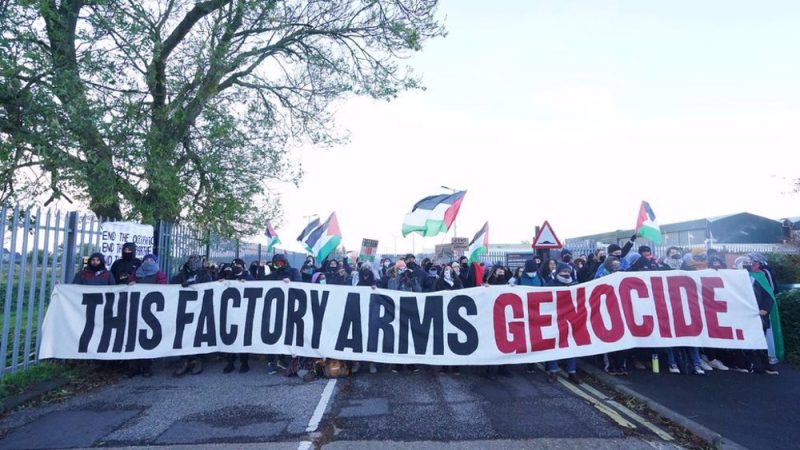
Protesters shut down UK arms factories over Gaza war complicity
Press TV – March 20, 2024
In a display of solidarity with Palestinians, hundreds of workers and protesters have shut down arms factories across England and Scotland to condemn the UK’s complicity in the Israeli regime’s war of aggression in Gaza.
The factories, which produce components for F-35 fighter jets, are accused of shoring up the Israeli regime’s military offensive in Gaza.
Under the banner “Workers for a Free Palestine,” a diverse coalition of individuals from various unions and sectors including health, education, hospitality, academia, and the arts, launched the protests on Wednesday.
Activists aimed to disrupt the supply chain of arms to Israel and denounce the UK’s complicity in the ongoing genocidal war against Palestinians in Gaza.
GE Aviation Systems in Cheltenham and Leonardo UK in Edinburgh were among the targeted sites where components for the F-35 jets are manufactured.
The protesters vowed to continue their protest actions for a month, demanding an immediate cessation of arms sales to Israel and advocating for a permanent ceasefire.
The decision to blockade the arms factories was prompted by Israel’s impending invasion of Rafah, which the United Nations and other international organizations have warned would have catastrophic consequences for Gaza’s population.
Unionists have called on workers across the UK to challenge their government’s military support for the Israeli regime.
“We’re demanding our government immediately halt arms supplies to Israel before it launches this offensive in Rafah using British-made bombs. But we are not waiting for this genocide-appeasing prime minister to act,” Zad, a union member, said in a press release.
This isn’t the first time such protests have occurred.
In December, similar blockades targeted four other arms factories across the UK. Despite assurances from the UK government that it hasn’t supplied lethal military equipment to Israel since October, evidence suggests otherwise.
Affidavits filed at the High Court revealed ongoing export licenses and pending applications for equipment likely to be used in offensive operations in Gaza.
Furthermore, the UK Ministry of Defence disclosed that Israeli warplanes have been permitted to take off from and land in the UK during the Gaza war, raising concerns about Britain’s involvement in facilitating Israeli atrocities.
SXSW Is Accused of Using Copyright and Trademark Claims To Suppress Criticism
Copyright and trademark strikes are increasingly being used to force content takedowns
By Christina Maas | Reclaim The Net | March 15, 2024
In a contentious battle over the use of copyright claims to suppress speech, South by Southwest (SXSW), an organizer of a popular annual conference and music festival in Austin, has found itself facing some backlash due to its connections with arms manufacturers that supply Israel.
Rather than responding to the criticism directly, or simply ignoring it, SXSW attempted to get the criticism hidden with questionable legal tactics against a local advocacy group, Austin for Palestine Coalition.
This group has been organizing protests against SXSW, employing strategies such as organizing rallies and spreading awareness through social media.
Austin for Palestine’s social media campaign notably includes altered versions of SXSW’s arrow logo, now featuring fighter jets stained with blood, and other images that mimic SXSW’s marketing style but juxtaposed with stark symbols like bombs or bleeding doves.
This bold visual commentary quickly drew a legal reaction from SXSW. The festival sent a cease-and-desist letter to the advocacy group, alleging trademark and copyright infringement, demanding the removal of these posts.
Additionally, Instagram notified Austin for Palestine about SXSW’s claim on their posts.
According to the Electronic Frontier Foundation (EFF), SXSW’s copyright infringement claims are baseless. Fundamental elements like their arrow logo do not qualify for copyright protection. Even if SXSW’s allegations targeted the group’s adaptation of their promotional style, such mimicry is arguably not eligible for copyright protection.
Moreover, these posts exemplify non-infringing fair use. Notably, the advocacy group’s use of these materials serves a distinctly different purpose from their original intent, causing no harm to SXSW beyond potential reputation damage, which does not constitute a valid copyright complaint.
Read the EFF’s letter to SXSW here.
Yemeni military to expand operations against Israel-linked ships to Indian Ocean: Houthi
Press TV – March 14, 2024
The leader of Yemen’s Houthis has said that the Yemeni armed forces will continue their retaliatory operations against Israeli-affiliated commercial vessels, preventing the passage of the ships even through the Indian Ocean and through the Cape of Good Hope.
About 34 Houthi fighters have been killed since the Yemeni armed forces began to attack shipping lanes in solidarity with the people of Palestine under attack in Gaza by Israel, Ansarullah leader Abdul Malik al-Houthi said in a televised speech on Thursday.
Yemeni forces have repeatedly launched drones and missiles against Israeli and Israel-bound ships since mid-November, saying they are acting in solidarity with Palestinians against Israel’s war on Gaza.
Al-Houthi said 73 ships have been targeted in Yemeni operations in support of Gaza so far, adding rarely does any ship associated with the Israeli enemy pass through Bab al-Mandab.
“This week, support operations included 12 operations targeting ships and barges, executed with a total of 58 ballistic and cruise missiles and drones in the Red Sea, the Arabian Sea, and the Gulf of Aden,” he said.
“Our operations this time reached unprecedented ranges, with 3 operations reaching the Indian Ocean, by the grace of Allah,” he added. “The total number of targeted ships and barges reached 73.”
Al-Houthi said that the operations will continue as long as the aggression and siege on Gaza persist.
The United States and Britain began striking Yemen in January in order to dissuade the country from targeting Israeli ships which carry arms and logistics for the onslaught on the besieged Gaza Strip.
Al-Houthi said the Americans and the British have received “painful blows” from the Yemeni armed forces in retaliation.
The American-British “aggression will not affect the escalating course of our operations in terms of range, momentum, precision, and strength,” said Al-Houthi.
“What can stop the Yemeni military’s maritime operations is only the cessation of aggression and siege on Gaza,” he noted.
The American stubbornness and escalation of aggression result in only one outcome: the expansion of the conflict, the widening of the circle of war and events, and the tension of the situation at the regional level in general, he stated.
He went on to say that the Yemeni armed forces will continue and effectively expand the range of the operations to reach areas and locations that the enemy never expected.
Al-Houthi said what insures the navigation security in the Red Sea is for any country not to participate in the Israeli aggression against Gaza.
He said the Americans and those who drag the United States towards the militarization of the Red Sea are the ones who undermine international navigation.
“By the grace of Allah and His assistance, we aim to prevent the passage of ships associated with the Israeli enemy even through the Indian Ocean and from South Africa towards the Cape of Good Hope,” he stated.
“For this important, advanced, and significant step, we have begun to implement our operations related to it through the Indian Ocean and from South Africa towards the Cape of Good Hope,” he said.
There is absolutely no choice for the Americans and the British but to stop the aggression on Gaza and stop starving the people in Gaza, he declared.
“Our human conscience, our religion, our morals, our dignity, our pride, our belonging to Islam, prohibit us from watching the oppression of Palestine or remaining silent about it,” said Houthi.
He added that the Yemeni military is in continuous development of capabilities and in constant expansion of the stance in its range, effectiveness, and impact.
“The American’s actions this week, involving aerial bombings and naval shelling, amounted to 32 bombing raids and strikes, which, as usual, were unsuccessful,” he revealed.
“The impact of the American raids and bombings is negligible regarding our missile and drone capabilities and in terms of continuing operations effectively to counter it, and in preventing ships associated with the Israeli enemy,” he stated.
He concluded by saying that the Yemeni armed forces are continuously escalating, and increasing capabilities to attack enemy ships. “No matter what the Americans do, they will not be able to stop us from supporting the Palestinian people in Gaza.”
Yemenis have declared their open support for Palestine’s struggle against the Israeli occupation since the regime launched a devastating war on Gaza on October 7 after the territory’s Palestinian resistance movements carried out the surprise Operation Al-Aqsa Storm.
The Yemeni Armed Forces have said they won’t stop retaliatory strikes.
The maritime attacks have forced some of the world’s biggest shipping and oil companies to suspend transit through one of the world’s most important maritime trade routes.
Tankers are instead adding thousands of miles to international shipping routes by sailing around the continent of Africa rather than going through the Suez Canal.
Since the start of Israel’s genocidal war following Operation al-Aqsa Storm by Gaza-based resistance movements on October 7, 2023, more than 31,000 Palestinians, including many women and children, have lost their lives.
The Israeli military offensive has left a trail of destruction in Gaza, leaving hospitals in ruins and displacing around half of its 2.4 million residents.
Israel has additionally enforced a comprehensive blockade on the coastal sliver, severing the supply of fuel, electricity, sustenance and water to the population residing there.
Down and out: How 5 months of genocidal war on Gaza paralyzed Israeli economy
Press TV – March 11, 2024
Last month, in what economic pundits saw as a death knell for the already-beleaguered Israeli economy, a US credit rating agency downgraded the regime’s rating and outlook.
The downgrade from “stable” to “negative”, according to Moody’s, is the direct consequence of the Israeli regime’s genocidal war on the Gaza Strip and political instability inside the occupied territories marked by growing discontent and simmering protests.
A few weeks ago, the Israeli regime’s Central Bureau of Statistics released another damning report, according to which Tel Aviv’s economy shrank by nearly one-fifth in the last quarter of 2023.
Amid depleting consumer spending, trade and investment since October 7, Israel’s Gross Domestic Product (GDP) recorded a 19.4 percent drop in its annual rate in the last three months of 2023.
Benjamin Netanyahu’s regime launched a devastating war on the coastal Palestinian territory on October 7, stung by the unprecedented Al-Aqsa Storm Operation led by Hamas.
In the last 156 days, more than 31,000 Palestinians, including over 14,000 children and nearly 9,000 women have been killed in Gaza. It has also spawned the worst humanitarian crisis in the territory.
According to observers, the indiscriminate bombings on Gaza have badly backfired on the regime amid both internal and external turmoil for the Netanyahu regime.
Hundreds of thousands of Israeli reservists have in recent months been forced to abandon their jobs while many more have fled in panic, due to which major industries have come to a grinding halt.
The labor shortage is acute as over 350,000 reservists have been pressed into military service, as per the Organization for Economic Cooperation and Development, which says the law has caused a “pronounced slowdown” of the Israeli economy, which had grown about 3 percent before October 7.
Foreign investments have also virtually ended as investors are not willing to put their money on tinderbox – both due to the war in Gaza as well as the internal turmoil for the Netanyahu regime.
According to the data from the Israeli labor ministry in December, about 950,000 jobs were lost in the first three months of the war, which has increased manifolds now as the situation remains precarious and the war rages on – now into its sixth month.
Multi-national brands linked to the Israeli regime have also faced blanket boycotts in recent months, suffering enormous losses. Many companies have tried to distance themselves from the regime.
Domestic economy in tatters
Every sector of the Israeli economy – from high-tech to agriculture to tourism to various industries – has been irreparably dented by the raging war on Gaza, a problem exacerbated by the shortage of workforce and precarious situation.
Many businesses have suspended their operations while others have been forced to shut down their operations. Some workers have been forced to join military duty while many others have fled.
A Bloomberg survey last month said the Israeli economy suffered one of its worst-ever slumps after it launched the genocidal war on Palestinians in Gaza, with businesses coming to a screeching halt.
The regime’s GDP plummeted by 19.4 percent in the last quarter of 2023, which the report said was worse than every estimate in its survey of analysts.
“The release highlights the degree to which the Israeli economy has been affected by the conflict, particularly on the private activity side,” Goldman Sachs economists Tadas Gedminas and Kevin Daly were quoted as saying in the report.
Israeli newspaper Maariv, in a report earlier this week, also said the continuation of the Israeli war on Gaza has contributed to massive losses for the regime in both political and economic spheres.
It followed another report published by the Israeli website Walla, which cited the Director of the Israeli Tax Authority Shai Aharonovitz as saying that the damage caused by the Gaza war is “six times greater” than the Second Lebanon War (2006), and about half a million compensation claims have been filed by those who have suffered due to it.
According to analysts, the Israeli war on Gaza, which has failed in all its stated objectives, has resulted in a steep drop in the regime’s tax revenues, skyrocketing debt and economic recession.
The regime’s GDP has also taken a serious blow, as attested by Moody’s report in February, which cut the regime’s rating to ‘A2’ and described its credit outlook as ‘negative’.
It was the first time ever that the regime’s economic outlook was downgraded, pointing to the staggering costs of the war that is increasingly turning out to be an exercise in futility.
The war, according to analysts, has discouraged potential investors and disrupted the labor market, especially with hundreds of thousands of workers summoned for mandatory military duty.
In a report in November, the Bank of Israel said the absence of thousands of workers from their jobs was costing the Israeli economy an estimated $600 million a week, or about 6 percent of the weekly GDP.
That number, according to economic analysts, has surged dramatically in the past three months, to the tune of a few billion dollars every week.
The regime’s tourism industry has also been affected. Monthly figures announced by Israel’s Central Bureau of Statistics revealed that in January only 500 single-day visits to the occupied territories were registered, compared to 14,000 in January 2023, marking a drastic decrease of 96 percent.
The travel industry used to make up nearly 3 percent of the regime’s GDP in 2019, before the pandemic. The figure fell to 1.1 percent in 2021 and has been virtually paralyzed since October 7.
The Israeli newspaper Calcalist reported in January that about 900,000 tourists were expected to visit the occupied territories in the three months after the start of the war. The number dropped to 190,000 because many of them opted out. That number has also sharply come down now.
“The war (on Gaza) was a huge breaking point for the (Israeli) economy which is still ongoing,” Professor Benjamin Bental from the Taub Center for Social Policy Studies was quoted as saying in December by The Median Line website.
“There are tremendous consequences that we still cannot estimate the end of.”
A RAND analysis in 2015 estimated that the financial impact of any conflict between the Israeli regime and Palestine in the next ten years would be to the tune of $400 billion.
Daniel Ege, the director of the Economics and National Security Initiative at the RAND Corporation, who authored that report, in an article published in November made a fresh assessment.
“For Israel, 90 percent of the economic shock will come from the indirect effects: reduced investment, a disrupted labor market, and slowed productivity growth. The specifics of this current crisis will, of course, differ from our model and the past,” he wrote.
Israeli ports hit the hardest
In the past five months, gas fields in the occupied territories have dried, airlines have become defunct, farms have been destroyed, major businesses have shut down and ports have been empty.
Colossal losses have been recorded at ports occupied by the Israeli regime, most notably the Port of Umm Al-Rashrash (Eilat), which recorded a 90 percent drop in traffic and $3 billion in direct losses.
“All cargoes arriving in Eilat through the Bab el-Mandeb Strait from the Far East, i.e. China, Japan, South Korea and India, are no longer transported because ships are afraid to pass through the Bab el-Mandeb Strait,” Gideon Golber, CEO of the Eilat port company, said late January.
Golber’s company deals primarily with the import of cars and export of potassium fertilizers, and before October 7, 50,000 new cars were stored at the port. Yemeni military’s actions in support of Gaza have virtually brought business activities at the bustling port to a grinding halt.
“If Yemeni operations in the Red Sea continue, we will reach a situation where there are no ships in the port,” he was quoted as saying by Reuters, referring to the repercussions of the Red Sea events.
Eilat Port has also been struck with missiles by both the Yemeni military and the Iraqi resistance groups, sending ripples of shock and fear among investors and shipowners there.
The two other major Israel-occupied international ports, Haifa and Ashdod, a third of whose transport depends on the Red Sea, have also recorded heavy losses, with a 70 percent drop in transshipment.
Yemeni military has carried out a string of operations against ships linked to the Israeli regime or its Western backers, mainly the US and the UK, in the Red Sea in solidarity with the people of Gaza.
The operations have forced major shipping companies doing trade with the Israeli regime to avoid the strategic waterway in recent months, incurring staggering losses for the regime.
Amid the continuation of the Yemeni military’s operations against ships trading with the Israeli regime in the Red Sea, it is to be expected that the losses will continue to pile up.
The Islamic Resistance in Iraq has also carried out attacks on the Israeli-occupied ports, including Haifa and Ashdod, as well as the natural reserves in the Mediterranean Sea.
Haifa Port (situated on the Mediterranean) is believed to store about 90 percent of essential commodities destined for the occupied Palestinian territories.
The operations of the strategic port were taken over by Indian business conglomerate Adani Group in February, months after a consortium of Adani Ports and Special Economic Zone and Israel’s Gadot Group won the tender to privatize it for a mammoth USD 1.18 billion.
Only days after the Palestinian resistance launched its unprecedented operation against the occupying regime on October 7, Adani shares fell by 4.5 percent, triggering alarm and anxiety among investors.
According to informed sources, the Indian company has suffered staggering losses in the past five months and speculation has been rife about ending the contract given the high costs.
Ashdod port, close to Gaza’s border with occupied territories, handles about 40 percent of the Israeli regime’s total maritime-bound trade, including imports and exports, according to the Israeli media.
Equipped with the Iron Dome military system, Ashdod port has been severely hit amid the war on Gaza, with most cargo diverted to other Israeli-occupied ports, which have also been deserted lately.
One of the first ships to divert from Hashdod to Haida in October last year was a Taiwanese container ship Evergreen Line, which cited a “persistent unsafe situation” amid the war on Gaza. Since many, virtually all ships have avoided the port, turning it into a desolate and barren island.
According to analysts, the total damage to the Israeli economy varies by estimate and reaches over $100 billion, with a minimum of ten years estimated for full recovery, which looks very unlikely.
Military and arms boycott
The Israeli regime’s economy has always been heavily dependent on trade and imports, especially military equipment, which makes the regime’s much-hyped military vulnerable to foreign boycott.
Israel’s beleaguered military industry is experiencing serious problems with imports as civil society, lawmakers and courts in many countries want to prevent arms exports to the regime.
The decisions have been partly influenced by the interim ruling issued by the International Court of Justice (ICJ) in The Hague in early February, ordering the Israeli regime to halt its genocide in Gaza.
The UN experts also issued a statement late last month, saying any transfer of weapons or ammunition to Israel that would be used in Gaza would “violate international humanitarian law.”
The impact of the ICJ ruling was clearly visible. A court in the Netherlands ordered the Dutch government on February 12 to halt the export of F-35 jet fighter parts to the Netanyahu regime.
The Hague Court of Appeal found that there was “a clear risk” that the F-35 jets used by the Israeli regime, some components of which are exported by the Netherlands, would enable to commit “serious violations of humanitarian law” against the Palestinians in Gaza.
The judges considered that “Israel does not take sufficient account of the consequences for the Gaza Strip civilian population when conducting its attacks.”
Israel’s attacks have caused a disproportionate number of civilian casualties, including thousands of children,” the Dutch judges concluded.
Britain, one of the Israeli regime’s biggest arms exporters, which manufactures 15 percent of F-35 parts, has resisted calls from rights groups to end the exports. The High Court in London also greenlighted the arms shipments last week by dismissing a case filed by some human rights groups.
Italy, however, has already announced the end of its arms sales to the Israeli regime.
Italian Foreign Minister Antonio Tajani announced in January that his country had halted all exports of military equipment to Tel Aviv. Spain’s foreign minister also claimed that his country has not sold any arms to Israel since the events of October 7, and added that an arms embargo is in place now.
European Union foreign policy chief Josep Borrell, otherwise a staunch supporter of Israel, has also in recent months raised concerns over arms sales to the Tel Aviv regime, even taking potshots at US President Joe Biden for his administration’s approval of $14 billion worth arms to Israel.
“Well, if you believe that too many people are being killed, maybe you should provide fewer arms in order to prevent so many people being killed,” Borrell told reporters last month.
Itochu, one of Japan’s largest trading firms, also announced that it was ending its partnership with Elbit Systems, the Israeli regime’s largest arms manufacturer, due to the genocide in Gaza.
Itochu Chief Financial Officer Tsuyoshi Hachimura cited the top UN court’s order on January 26 as the reason for terminating the memorandum of understanding (MoU) signed between Itochu, Elbit and Nippon Aircraft Supply in March last year.
Elbit is the largest military contractor owned by the Tel Aviv regime with a share of 85% in the production of ground equipment and drones, and Japan is one of the world’s largest arms importers.
The company has already gained notoriety for testing new weapons on Palestinian civilians, as well as for cases of bribery around the world, multiple failures of their systems in tests aboard, etc.
Due to boycott activism, Elbit has lost hundreds of millions of dollars worth of international contracts in recent years, particularly since October 7 of last year. Many of its factories have been either shut down or disrupted by pro-Palestine activists in the US and the UK.
Since the outbreak of the genocidal war on Gaza, a major collaboration deal with Elbit has also been terminated by the Brazilian state of Rio Grande do Sul.
Boycott of big brands
In November of last year, the Press TV website published an investigation on global companies with close ties to the Israeli regime facing boycott amid the regime’s genocidal war on Gaza.
Worldwide campaigns have been launched during this period calling for the boycott of Israeli and international companies and brands directly or indirectly complicit in the Gaza genocide.
The companies that have faced boycott include Siemens, which is complicit in the regime’s settler-colonialism project through its EuroAsia Interconnector; Hewlett Packard, which helps the regime run biometric systems used to monitor and restrict the movement of Palestinians; AXA Divest, one of the largest investors in Israeli regime-run banks; Puma, a footwear giant that sponsors Israeli football.
Food and beverage giants such as McDonalds and Starbucks have also recorded huge losses.
Starbucks, the multinational chain of coffeehouses and roasteries headquartered in Seattle, has seen losses worth billions of dollars due to the global boycott campaign, which gathered momentum after the company took action against workers’ unions over its pro-Palestine stance.
Starbucks’ longtime CEO Howard Schultz is known to be an ardent supporter of the Israeli regime. Schultz has in the past boasted of being an active Zionist and worked closely with Israeli Premier Benjamin Netanyahu and radical Zionist settler groups, for which he even received awards.
Back in December 2013, around $11 billion in losses were reported, and it is estimated that the figure has now surged to $15 billion as the boycott campaign intensifies.
Last week, retail giant AlShaya Group, which owns the rights to operate Starbucks in West Asia, announced staff downsizing, citing “challenging trading conditions over the last six months.”
McDonald’s also has been hit by the boycott campaign. The US-headquartered company last month reported its first quarterly sales miss in nearly four years, sending the company’s shares down about 4 percent.
The company admitted that the losses were the reflection of “the impact of the war” in Gaza, where the Israeli regime has been carrying out relentless bombings since October 7.
“So long as this conflict, this war is going on, we’re not making any plans, we’re not expecting to see any significant improvement in this,” McDonald’s CEO Chris Kempczinski told investors.
“It’s a human tragedy what’s going on, and I think that that does weigh on brands like ours.”
Ian Borden, the company’s chief financial officer, also noted that the war had meaningfully impacted the fast food giant’s bottom line in the region during the last quarter of 2023.
The campaigns against McDonald’s, Starbucks and other multinational brands have significantly expanded in recent months, including in regional countries such as Jordan, Kuwait and Morocco.
Workers at American tech giants Google and Amazon have also stepped up pressure on their companies to snap ties with the Israeli regime, with Google workers also urging an end to Project Nimbus, under which the tech company supplies technology to the Israeli military for surveillance purposes.
The potential for the expansion of the boycott campaign remains high, as proved by recent large-scale protests in countries considered key trade partners of Israel, as well as public opinion in those countries.
Gaza is paying the ultimate price for decades of media pandering to Zionist bigotry
By Jonathan Cook | March 6, 2024
The Guardian and other media continue to prioritise the ‘sensitivities’ of an ideological minority over the public’s right to protest against a genocide in which our elites are complicit
We all understand that, shamefully, a number of Zionist Jews and non-Jews identify so completely with Israel that they are not only willing to excuse the mass slaughter and starvation of civilians in Gaza but think others should not even be allowed to express disquiet at the slaughter.
Hardline Zionists tell us they find concern for the welfare of Palestinians “offensive”, and that they feel “unsafe” when others raise such concerns or call for a ceasefire to end the bloodshed.
The question for the rest of us is: How do we deal with those “sensitivities”, and how much do we prioritise the “offence” taken by hardline Zionists?
Not unreasonably, most ordinary people place very little weight on the “sensitivities” of those who believe mass slaughter and the starvation of children should be allowed to proceed, at least when weighed against the sensitivities of those opposed to mass death.
What’s so weird is the way, as far as official bodies and the western media are concerned, those priorities have been turned upside down.
Here, in typical fashion, the Guardian falls over backwards to indulge the “feelings” of a few Jewish Arsenal fans because they “felt unsafe” and “betrayed” by their club for not more aggressively stopping protests last weekend at a Women’s Super League game by other fans over the complicity of the UK government in Gaza’s genocide.
No evidence is produced by either the fans or the Guardian that any Jewish fan was in any danger whatsoever. Just that a few Palestinian flags were smuggled into the stadium, that leaflets and stickers were handed out, and that some protesters tried to “engage” with fans as they arrived at the stadium – presumably in that dangerous tradition of trying to persuade others of the validity of one’s position.
But the Guardian sympathetically dedicates a great deal of space to relaying the concerns of the handful of Jewish fans who “believe their safety was compromised by security staff not curtailing the protest” – that is, those who wanted to prevent an entirely peaceful demonstration taking place in a public space outside the ground.
The story is risible. It is news as therapy for Zionists and gaslighting for the rest of us.
But it is decades of nonsense journalism about Israel and its apologists of precisely this kind that has led us to the dismal place we are today.
The constant indulgence by the political and media class, the constant elevation of these kinds of ugly, ignoble “feelings” – feelings that dehumanise and vilify Palestinians, as well as anyone acting in solidarity with their suffering – the constant treatment of Zionist bigotry as warranted, as justified, as normal, that has gotten us to a position where Israel can commit genocide and its western allies and parts of their Jewish populations can treat it as “offensive” to raise the matter.
If we had not got so entirely used to it, we would immediately understand how completely nuts – and catastrophically inhumane – the coverage is.
Canada faces legal action over arms exports to Israel
Press TV – March 5, 2024
A group of Canadian and Palestinian human rights lawyers have filed a lawsuit against the Canadian government for “contributing” to the bombardment of the Gaza Strip through sending arms to Israel.
The coalition of the lawyers filed a complaint against Foreign Affairs Minister Melanie Joly on Tuesday over issuing permits for export of military equipment to Israel.
The group includes Canadian Lawyers for International Human Rights and Al-Haq – Law in the Services of Man, an independent Palestinian NGO.
In the lawsuit, the group argued that Canada’s Export and Import Permits Act prevents the federal government from issuing permits for export of military goods and related technology to Israel because those exports can pose serious risks by undermining peace and security.
They said the weapons could be used to commit serious violations of international law and serious acts of violence against women and children in Palestine.
The lawyers said the government needs to stop contributing to Israel’s mass starvation of Palestinians and bombardment of Gaza.
Back in January, Canadian Lawyers for International Human Rights (CLAIHR), one of the groups involved in the case, urged the government to “immediately halt” all arms exports to Israel.
Canadian Prime Minister Justin Trudeau also stands accused of misleading the public over weapons sales to Israel.
Trudeau has repeatedly been urged to end arms exports to the Israeli regime. But his government has so far tried to downplay the country’s role in helping Israel build its arsenal.
On Friday, a group of more than 200 lawmakers from 12 countries, including the United States and Canada, signed a letter to call on their governments to impose a ban on arms sales to Israel.
Niki Ashton, a member of Canada’s Parliament was among the signatories of that letter.
Ashton said in a message on the X social media platform that the Canadian government has approved $28 million worth of weapons exports to Israel since the regime started its brutal military campaign in early October.
“That is horrifying,” Ashton said, adding, “Make no mistake. These weapons are directly used to kill and maim starving Palestinians.”
Countries supplying arms to Israel have been facing mounting pressure to halt weapons sale to Tel Aviv since the regime launched its military offensive against Gaza in early October. Israeli forces have so far killed more than 30,500 Palestinians, mostly children and women, in the besieged territory.
Featured Video

Seyed M. Marandi: U.S. Military DIVIDED? Iran’s Secret Defense EXPOSED
or go to
Aletho News Archives – Video-Images
From the Archives
‘Israel sees Iran as obstacle to its policies’

Press TV – August 25, 2017
Prime Minister Benjamin Netanyahu has said that Israel felt threatened by Iran’s growing influence in the Middle East. Netanyahu expressed his Iranophobic view in a meeting with Russian President Vladimir Putin in Russia’s Black Sea resort of Sochi on Wednesday. Press TV has asked Scott Rickard, former American intelligence linguist from Tampa, Florida, and Brent Budowsky, a columnist at The Hill from Washington, to give their thoughts on the issue.
Rickard said Tel Aviv is concerned about the fact that the regime could not carry out its old project to spread sectarian divisions and pave the way for dismemberment of the countries in the Middle East region because of the Iranian-led resistance against Israeli policies, not only in the occupied territories of Palestine but also in the whole region.
“Iran is not a threat to Israel whatsoever. The threat that Israel sees is the fact that their Oded Yinon Plan is being put to a hold by Iran,” the intelligence linguist said on Thursday night.
“They (the Israelis) look at Iran as a threat only because they have no influence on their governments and Iran is autonomous and is not under the Zionist influence,” he added.
Since the victory of the Islamic Republic of Iran in 1979, Tehran has been critical of Israel’s policies in the region, whereas “no leaders [of other states] even dared to speak out against Zionism,” Rickard argued. … continue
Blog Roll
 Aletho News
- What’s Behind U.S./Israeli Strikes On Iranian Pistachio Factories?
- Seyed M. Marandi: U.S. Military DIVIDED? Iran’s Secret Defense EXPOSED
- How I fell foul of the BBC thought police
- The End of NATO
- 37 days of war on Iran cost US staggering $42bln, tracker shows
- Baghdad tells Asian refiners, traders to begin loading Iraqi crude amid Iranian exemption
- Under fire, Moscow and Tehran close ranks
- Iran, US receive Pakistan-mediated plan for ceasefire then final deal
- Iran submits demands for end to war as mediators scramble ahead of Trump deadline
- Iran Threatens Retaliatory Strike on Stargate AI Project in UAE
- If Americans Knew
- U.N. experts demand Israel release prominent Gaza doctor after reports of ‘severe torture’
- Israel’s Latest Genocide Is Against the Shias of Lebanon. Why Is the World Silent?
- How Eliot Cohen’s influence over U.S. war-making paved the way for Trump’s war crimes in Iran
- Israelis don’t pay for the weapons we ‘sell’ to them — US taxpayers do
- While Distancing from AIPAC, Most 2028 Democratic Hopefuls Are Still Embracing Israel
- A brief history of the Israeli nuclear program, the open secret at the heart of the Iran war
- Israeli Settlers Killed a Palestinian Farmer on His Own Land, in Front of His Father. Yes, Again
- The US-Israeli War on Science is an Assault on our Future
- 100+ International Law Experts Say US Strikes on Iran Violate UN Charter, Could Be War Crimes
- ‘Vile, Horrifying, Evil’: Trump Threatens to Bomb Nation of 90 Million People ‘Back to the Stone Ages’
- No Tricks Zone
- An Inconvenient Tree: Uncovered In Alps… Europe Much Warmer Than Today 6000 Years Ago
- New Study Reports A 60% Slowdown In Greenland’s Ice Loss Rate In The Last Decade
- Low Intensity Tornado Wrecks Major Solar Farm, Creating A Potential Toxic Dump
- New Study Finds Warming Saves Lives…Cold Temperatures 12 Times More Deadly Than Excess Heat
- German Science Blog Accuses PIK Climate Institute Of Hallucinating Climate Tipping Points
- Devastating Assessment Of Comirnaty Vaccine By Former Senior Pfizer Europe Toxicologist
- New Study: CO2 Is ‘Effectively Negligible’ As An Explanatory Climate Change Factor Since 2000
- Former Pfizer Toxicologist Dr. Helmut Sterz Tells Bundestag Hearing Pfizer Vaccine Should Have Never Been Approved
- Energy Expert: Germany’s Nuclear Phaseout Was A “500 Billion Euro Mistake”
- New Research: South Australia’s Mid-Holocene Sea Surface Temperatures Were 4°C Warmer Than Today
 Aletho News