Massachusetts moving money out of 3 big banks to protest credit card rates
By Ylan Q. Mui | Washington Post | April 15, 2010
Massachusetts officials on Wednesday announced plans to move millions of dollars in state investments out of some of the nation’s biggest banks to protest credit card interest rates.
State Treasurer Timothy Cahill said the state has removed Bank of America, Citi and Wells Fargo from a list of institutions approved for new state investments. Massachusetts, which is the only state to make such a move, is also beginning to divest $243 million in funds held at those banks, though the process could take up to six months.
“We want to bring some fairness into the issue,” said Cahill, who is running for governor. “I don’t think what we’re asking is . . . out of line.”
The announcement — made at a raucous rally on Capitol Hill organized by the Metro Industrial Areas Foundation, a network of religious and citizen advocacy groups — is part of a wave of consumer backlash over the banking industry’s role in the worst financial crisis since the Great Depression. Congress has enacted sweeping credit card reforms that limit how and when issuers can raise rates and is in the midst of debating the creation of an agency dedicated to protecting consumer rights.
That has reignited advocacy groups that support creating a national usury law after a 1978 Supreme Court decision found that interest rate caps could apply only to state-chartered lenders. As a result, many banks moved their headquarters to states with looser usury laws, such as Delaware, allowing them to bypass limits set in other states.
Massachusetts law caps interest rates at 18 percent. In the fall, the Greater Boston Interfaith Organization began urging officials from the state Treasury department to tackle the usury issue. Last week, state officials met with officials from Bank of America, where Massachusetts has $231 million in investments, to request that it meet that cap for state residents. When the bank declined, Cahill said, his office decided it would shift the funds into other accounts. Massachusetts also has $9 million invested with Citi and $3 million with Wells Fargo.
Spokespeople for Bank of America and Wells Fargo said their firms regretted the state’s decision. Bank of America noted that it charges interest rates of about 15 percent for about 70 percent of its customers. Citi did not return a call requesting comment. Credit card companies have said that they face higher costs from increased consumer delinquencies during the recession, which translates into higher interest rates for customers in good standing.
Sen. Bernard Sanders (I-Vt.) said Wednesday that he intends to introduce a 15 percent national cap on credit card interest rates through an amendment to the financial regulation reform bill being debated in the Senate. Six states, including Maryland, have considered bills this year that would have given community banks preference in providing government financial services, but none of them passed.
In Massachusetts, the state treasurer has sole authority over a $7 billion fund composed of contributions from municipalities; the investments at Bank of America, Citi and Wells Fargo are part of that fund. Cahill said the state still maintains other financial relationships with those banks, such as cash management.
Several other labor and religious groups also announced Wednesday that they plan to move money from large banks. Lutheran churches in Missouri said they moved $25 million in investments into community banks, while Civil Service Employees Association Local 1000 said it also would consider a shift.
“We’ve come to tell them all today: Time is up,” the Rev. Hurmon Hamilton, leader of the Greater Boston Interfaith Organization, said at the rally Wednesday. “Move those dollars,” the crowd chanted in response.
Israeli Leftist Groups May be Violating US Law
By Maayana Miskin | Israel National News | April 19, 2010
Two of Israel’s largest extreme-left organizations, B’Tselem and Peace Now, have been accused of potentially violating United States law by acting illegally as foreign agents. The U.S. Department of Justice has been informed of the accusations, and is looking into the matter.
The charges were raised by Attorney Lee Bender. Bender first notified the Department of Justice’s National Security Division of the potentially illegal status of Americans for Peace Now in November 2009. While awaiting the conclusions of the Justice Department, he developed concerns about B’Tselem as well and last week contacted the National Security Division to report in the group.
The Americans for Peace Now group is part of the Isreli left-wing movement that campaigns against a Jewish presence in all of the land restored to Israel in the Six-Day War in 1967. Its activists often support Arab incitement as part of the “resistance.” B’Tselem is a self-acclaimed human rights group that consistently has condemned Israel for counterrorist operations against Hamas and has blamed Israel for most Arab violence. Both organizations use the Israeli Supreme Court as venue for attempting to bring about home demolitions in Judea and Samaria communities and for attempts to indict Israeli civilians and soldiers for what they term unnecessary violence in the face of perceived terrorist threats.
Both organizations are suspected of violating the Foreign Agents Registration Act (FARA). The law, enacted in 1938, requires those acting as agents of foreign principles in a political or quasi-political capacity to disclose their relationship to the foreign principles and their activities.
B’Tselem and Peace Now both receive much of their funding from the European Union and individual European countries. As Bender wrote, “They have and continue to receive funds from European governments, and have an office in Washington D.C. that lobbies United States officials.”
If the two organizations are found to be foreign agents under FARA, they will need to report all contact with American officials, as well as for every political activity they organize.
In Israel, organizations funded by foreign governments are required to report the donations they receive to the Non-Profit Associations Registrar. Since 2008, such groups have been required to make their donations public via the Internet as well.
In 2009, MK Danny Danon revealed that he plans to criminalize the activities of Peace Now, B’Tselem and similar organizations by making it illegal for foreign-funded groups to engage in political activity inside Israel.
International activist arrested on false accusations in Sheikh Jarrah
 Illegal colonist throws eggs in a separate incident
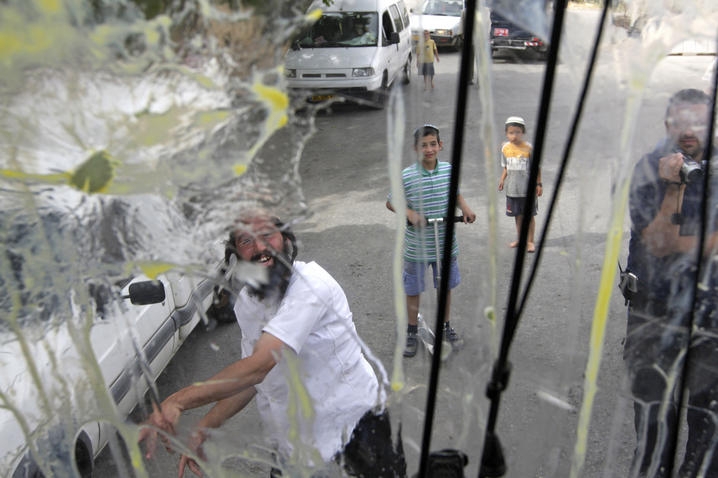
International Solidarity Movement | 19th April 2010
At approximately 11.30pm on the 18th April, a British ISM activist, Robin Brown, was arrested in Sheikh Jarrah having been falsely accused by Israeli settlers of attacking them with tear gas. Those present in the hours leading up to his arrest insist this cannot possibly be true. Brown was released from police custody at 3am on the 19th – recognition from the police that there was absolutely no evidence to support the settlers’ accusations.
Earlier in the evening, settlers had attempted to destroy a mural that was recently painted in the front garden of the Al Kurd home, half of which is occupied by settlers. Running past the wall, they threw cupfuls of white paint at the mural before fleeing down the street. Despite their later claims to police, there was no confrontation in the street between them and the Palestinian residents of the neighbourhood, or the international activists who were also present.
The previous night, Israeli settlers attacked local residents in the street, pepper spraying two of them. As the police say that, when called to the area on the night of the 18th, a settler did show signs of having been gassed, it seems possible that this was inflicted upon him by a fellow settler, still in possession of the pepper spray used the night before. The police who arrested and interrogated Brown found no traces of any kind of gas or spray on his hands, clothes or bag, proof that, if any gas was used, it did not come from him.
Brown says, “It is clear that settlers have decided to try to find ways to get rid of the international activists who sit in solidarity with Sheikh Jarrah residents, and who document the violence and harassment that is inflicted upon them by the settlers. Settlers frequently make up lies in an attempt to get Palestinians arrested. It’s no surprise that they’re now doing the same to internationals”.
Israeli Apartheid in al-Naqab
By Ben White | Pulse Media | April 14, 2010
The following is taken from an email sent out by Yeela Ranaan, from the Regional Council for the Unrecognized Villages (RCUV):
The Government of Israel is putting me on trial next week (Monday, April 19th, 11:00am in Beer Sheva): for expressing my displeasure at the brutal home demolitions in the Unrecognized Bedouin Villages. The government and its acting bodies do not want any resistance to the implementation of their racist policies, and therefore wish to scare and intimidate those who speak out…
I grew up in Arad, a town built among the Bedouin, to make sure that the Jews become the rulers of this space. It took me many years to realize that the Bedouin I saw every time I left my hometown are not part of nature, like the rocks and the wadis. It was not my education that had opened my eyes, a good Zionist education, teaching me to be part of a dream of redeeming the land. It was despite this education.
But once the blinds were lifted, it started hurting. I saw the pain in the injustice, in the ongoing feeling of my neighbors, now turned friends, of being treated as deserving less, as a bother to the natural development of our region – the Negev. Every baby born – a “demographic threat”, every time a home is built, economic stability achieved – it is seen as a menace in the only country they can call home…
[Two years ago] I arrived as part of the RCUV at the scene of a home demolition in the unrecognized village of A-Shahabi a few minutes before the bulldozers. Knowing full-well that I cannot stop the demolition – I sat in the house to give voice to the injustice of these demolitions, to the discriminatory, brutal and harmful policies. It was a peaceful, non-violent protest, sitting alone in a house with the bulldozer at the wall. As expected I was taken out by the police, and then I was arrested…
The commander of the police station was angry, he shouted at me, “The last thing we need is for Jews to join the struggle of the Bedouin…” And it is to frighten us so we stay away from working towards justice in our country, that I am being put on trial next week.
Raise your voice! Against the home demolitions, against the non-recognition of the villages and the ownership of the ancestral lands, and against the silencing of criticism of racist policies.
How?
- Join us on Monday at 10:30am standing together before the courts in Beer Sheva, and join us inside the courtroom at 11:00, to show that we stand united in our quest for real democracy.
- Write! To the Attorney General, Yehuda Weinstein. Demand that his office stop the persecution of civil rights activists, and the censure of political criticism through the court system.
Address: 29 Salah A-Din St., Jerusalem. 91010; tel: 02-6466521/2; fax: 02-6467001.
- To the Minister of Public Security, Isaac Aharonovitch, in charge of the police. Demand that the police cease from using its power to crush political criticism.
Tel: 02-5428500; fax: 02-5428039
- To Yehuda Bahar, director of the New Authority for the Regulation of Bedouin Settlement. He is in charge of implementing the governmental policies. Demand that he begin implementing just policies, policies that recognize the historical rights of the Bedouin, instead of brutal home demolitions and policies of oppression and subjugation.
Tel: 08-6263722; fax: 08-6263719; email: yehudab@moch.gov.il
- Help pay for the expenses! One of the aims of taking people like me to court is to make it expensive to express our opinions. Lawyers’ expenses are high. You can send a check directly to Adv. Gabi Laski, 18 Ben Avigdor St. P.O.Box 57092, Tel Aviv, 61570. ISRAEL (please let me know). You can also use my paypal account, associated with the email yallylivnat@gmail.com.
The RCUV also sent out a second email, regarding home demolitions:
Yesterday, Tuesday, April 13th, the Government of Israel demolished 3 homes and served many home demolition orders in the unrecognized village of El-Araqib. The government is coveting the lands of this village and lately has staged a major attack on the residents of this village to forcefully take the lands: the JNF (Jewish National Fund) is planting a forest on these lands; the residents are forced to come to the courts to defend their ownership of the lands, in a legal system that does not recognize any papers prior to the existence of the state; and the home are being demolished. The homes demolished yesterday have been demolished twice before in the past two months.
The government yesterday also razed to the ground all the homes and tents of the village of Twail abu-Jarwal. For these villagers – it is the 40th time that they have had to experience their entire village being demolished in the last couple of years. One wonders, is it not time to change tactics? The police and the inspectors also emptied out the water containers and attempted to bury them – leaving both humans and animals without water. One of the young men from the village asked: Did they also have a “spill water” court order?

A water tank destroyed by the government in former demolitions in Twail abu-Jarwal. Now the villagers use only smaller plastic containers, that were also destroyed yesterday (RCUV).
Richard Falk: “I believe that Hamas should be treated as a political actor”
By Dr. Hanan Chehata | April 9, 2010
INTERVIEW – With Prof. Richard Falk *
HC: Following your appointment as UN Rapporteur to the Occupied Palestinian Territories in 2008 you traveled to Israel in order to begin your investigations. Can you tell us a little more about how you were received by Israel?
RF: I was denied entry and expelled at Ben Gurion Airport when I tried to enter Israel for the purpose of carrying out my duties as UN Special Rapporteur. These duties consist mainly of reporting on Israeli compliance with human rights obligations in the Occupied Palestinian Territories, and include duties of compliance with respect to international humanitarian law. Israeli authorities confined me for more than 15 hours in a detention cell with five other detainees before putting me on a plane. I was given no explanation beyond that my expulsion order came from the Israeli Foreign Ministry that had objected to my appointment from the outset. As my itinerary on the West Bank had been previously submitted to the Israeli embassy in Geneva, and as visas had been granted to the two UN employees assisting me on the mission, it seems clear that Israel wanted to have the incident at the airport rather than tell me in advance that I would be denied entry. The UN High Commissioner for Human Rights and other UN officials did object to the Israeli refusal to allow me to do my job as Special Rapporteur. It should be pointed out that the UN Charter in Article 2(2) requires Members to cooperate with the UN in carrying out its functions, and that this duty is reinforced by an international treaty outlining this duty of cooperation.
HC: You were denied entry into the OPT. Have you been allowed at any point to enter the territory? If not, how have you been able to do your job?
RF: I have tried repeatedly through formal requests to Israeli authorities to gain entry to the OPT, and these requests have been ignored rather than denied. There may be a possibility of visiting Gaza on an official basis based on Egyptian cooperation. This has so far been difficult to arrange. As far as doing my job is concerned, it is certainly a major disadvantage to be denied entry, but my reporting job can be done without any handicap due to the abundance of open and diverse sources of information and documentation on the critical dimensions of the occupation. I would have to rely on such sources in any event even if access was possible.
HC: In light of the way that Israel has reacted to you and your reports and more recently to the Goldstone report it seems that Israel’s regard for the UN, if anything, has become more hostile. Why do you think Israel seems to hold the UN in such contempt and is there any way for the UN to compel Israel to cooperate with their investigations and abide by UN recommendations?
RF: Israel has a rather opportunistic approach to the UN. It is hostile when it is the object of criticism, and it rejects the authority of the UN in relation to its duties as the Occupying Power of the Palestinian Territories. It consistently complains about the bias of the UN, especially the Human Rights Council, and attacks those that serve the UN as civil servants or appointed officials. Most recently it has mounted a series of vicious attacks on Richard Goldstone who headed a fact-finding mission to assess allegations of Israeli and Hamas war crimes associated with the Gaza War (Operation Cast Lead) that took place between 27 December 2008 and 18 January 2009.
At the same time, Israel participates fully in the General Assembly, and uses its relationship with the United States to block adverse decisions in the Security Council. What was unusual about its response to the Goldstone Report was the extremely high profile repudiation of the findings and recommendations. Normally, as with the 14-1 Advisory Opinion of the International Court of Justice on the unlawfulness of the separation wall built on occupied Palestine, Israel merely rejects the external criticism of its policies, and moves on with very little commentary, especially by its top political leaders. We must assume that the Goldstone Report touched a raw nerve in the Israeli political sensibility that explains its almost hysterical reaction, including vindictive attacks on the person of Justice Goldstone, himself a devoted Zionist and distinguished international jurist. It would seem that the conclusion that Israel had deliberately targeted civilians and the civilian infrastructure of Gaza in violation of the international criminal law was too authoritative a repudiation of Israeli policies toward the occupation to be ignored. The fact that the Goldstone Report also recommended that steps be taken to implement these conclusions by holding those responsible for the behavior to be criminally responsible was a further challenge to the legitimacy of Israel’s claims to be upholding its security by launching Operation Cast Lead.
HC: Why have the UN taken no measures against Israel for their breaches of international law?
RF: The quick answer is that the geopolitical impunity enjoyed by Israel is a consequence of unconditional U.S. support, and a reluctance in most European countries to be critical of Israel given the lingering sense of guilt about the Holocaust. A more thoughtful response is that there have been periodic attempts within the UN to hold Israel accountable for violations of international law. The General Assembly and Human Rights Council have frequently condemned Israeli policies in the OPT. The ICJ found that the separation wall was unlawful as constructed on Palestinian territory, and the General Assembly accepted these conclusions overwhelmingly. The Goldstone Report is itself a gesture in the direction of holding Israel accountable for war crimes and crimes against humanity as perpetrated in Gaza. In this sense there have been a variety of efforts to condemn Israeli policies and practices from the perspective of international law, but an insufficient will to implement these efforts, and so the end result is a sense of the virtual irrelevance of international law as a behavioral constraint on Israel.
HC: Is the USA the biggest factor impeding the UN in coming to the aid of Palestinians?
RF: I think that in the absence of US support, the UN would be acting vigorously on behalf of the Palestinian struggle for self-determination, including the imposition of an embargo on arms sales and support for economic sanctions. The European countries would in this altered setting in all likelihood stand aside, neither being strong supporters of UN actions on behalf of the Palestinians, nor defenders of Israel.
HC: Israel opposed your appointment from the very beginning making allegations that you were biased against their state. Is there any justification whatsoever to these claims?
RF: As I have responded, by now many times, I am not biased, but dedicated to being truthful and accurate, as well as interpreting the relevance of international law and human rights standards as objectively as possible. It is true that I have been critical of Israel in the past, but again on the basis of a widely shared consensus as to the facts and their most reasonable legal implications. The test of bias should be distorted treatment of facts or strained interpretations of law. To be critical of official Israeli policies is not to be anti-Israeli any more than to be critical of American foreign policy, which I have been over the years, means that I am anti-American. To be a citizen in a democracy, or to be a world citizen, means to follow the guidance of your conscience wherever that might lead.
HC: You have been depicted as a supporter of Hamas, how do you respond to such claims?
RF: Again, my effort has been to describe the actuality of Hamas’s positions on contested issues and to report upon its actual role in the OPT, especially Gaza. I have been impressed by the Hamas effort to negotiate a ceasefire with Israel from the time of its election in January 2006, and its consistent effort to reestablish a ceasefire, including one for a long duration. I have also taken note of the refusal of Israel to take advantage of such diplomatic opportunities, and its insistence on treating Hamas as a terrorist organization with whom no negotiations can occur. I have also criticized Israel for punishing the population of Gaza by imposing a blockade that restricts the flow of food, medicine, and fuel to subsistence levels, or worse. Such a blockade is a flagrant form of collective punishment prohibited by Article 33 of the Fourth Geneva Convention. I believe that Hamas should be treated as a political actor, that the blockade should be terminated immediately, and that the UN should insist on the end to the blockade as a condition of Israel’s normal participation in the activities of the Organization.
HC: It seems that supporters of Israel try to equate the words anti-Semitic with anti-Zionist which are of course two different things. They have accused people such as Judge Goldstone, Prof. Ilan Pappe, Prof. Avi Shlaim and you of being “self-hating” Jews. How do you feel about this?
RF: It seems more extreme even than this. Justice Goldstone, for instance, is pro-Zionist, and yet stands viciously accused of being a self-hating Jew, apparently because he dared to be critical of Israel. This means that any defection from either the official policies of the state of Israel or from the Zionist project will be occasion for a Jew to be branded as ’self-hating.’ It is my view that the Jewish tradition considered biblically and over the course of time would require a Jew to honor conscience and truthfulness above tribal identities should these conflict.
HC: As a Jewish gentleman yourself how do you feel about the fact that Zionists and the Israeli government claim to speak in the name of all Jews?
RF: As my prior answer suggests, no government has the authority to speak in the name of others, and certainly Zionism, a movement I have never supported, and Israel, a state to which I owe no special allegiance, is not entitled to represent me because I happen to be Jewish. I have real problems with any coerced allegiance to a political or religious entity, and believe that the crime of treason sets up an unacceptable potential tension between the dictates of conscience and subservience to the will of the state.
HC: In 2007 you described the Israeli policies towards Palestine as a “holocaust-in-the-making“. Given the tightening of the siege on Gaza, which has now lasted over 1000 days, Operation Cast Lead etc.. would you now say that the situation has developed into a full blown holocaust?
RF: This is a delicate issue of language. Genocide is a word with a great emotional resonance, and special historic associations for the people of Israel. I wrote these words before I was appointed as Special Rapporteur, and although I would not retract them, I have refrained from using the word genocide since accepting the UN job. There is an ambiguity in the word genocide: it has legal, moral, and political connotations. It would be difficult to establish a genocidal intent on Israel’s part, given the way in which the ICJ approached the issue in the Bosnia Case. At the same time, I lament the continuation of the siege of Gaza, consider it a crime against humanity, and feel that the UN and many states are complicit to varying degrees.
HC: Your predecessor Prof. John Dugard compared the situation in the Occupied Palestinian Territories to that of apartheid South Africa. Is this a view that you concur with after your own experiences there?
RF: Comparisons of this sort can be illuminating, although misleading at the same time. There are many indications of rigid separation, especially on the West Bank, as well as discriminatory regulations that make the situation for Palestinians resemble that of the black Africans suffering under apartheid, and deserving of comparable opprobrium. At the same time there are differences: the South African leadership defended apartheid as a preferable policy for race relations, whereas the Israelis do not offer an ideological justification for their separate treatment of the two peoples, claiming either the security rigors of occupation or the inevitable consequences of being ‘a Jewish state.’ Prolonged occupation of the West Bank, East Jerusalem, and the Gaza Strip, along with the second class citizenship imposed on the Palestinian minority living behind the green line, are humanly abusive, but distinctive in their character, and it is important to understand these realities on their own terms.
HC: The world is watching as genocide unfolds in Palestine and yet nothing is being done to stop it. What can be done, and what should be done by the international community at this stage to ensure that the rights of the Palestinian people are protected?
RF: It is a scandalous refusal to take seriously the pledge after World War II of ‘never again.’ The liberal democracies in Europe and North America have allowed their hatred of Hamas to be a justification for inflicting and sustaining a humanitarian catastrophe on an entire civilian population denied even the option to become refugees. Even neighboring Arab governments have done far too little by way of opposition. And the UN has been largely mute. If ever there was a case where the imposition of sanctions was justified it would be in relation to Israel so long as it maintains the Gaza blockade. Civil society initiatives have challenged the Israeli policies most effectively, including such dramatic efforts as those associated with the Free Gaza Movement and Viva Palestina. These symbolic challenges expose the failures of the international community as constituted by the government of sovereign states to do uphold international law and international morality even in extreme situations of the sort that exists in Gaza, and add political weight to the BDS movement that is gathering strength in various parts of the world. The Palestinian solidarity movement has become the successor to the Anti-Apartheid Campaign as the most important popular struggle on behalf of global justice in the early 21st century. Of course, there are two time horizons that must be taken into account: the emergency horizon in Gaza that requires with utmost urgency the ending of the blockade; the justice horizon throughout occupied Palestine that requires a just peace at the earliest possible time.
HC: Israel has stated that it launched Operation Cast Lead as an act of “self-defence”. However you, and many others, have said that this is not an honest depiction of how events unfolded and that there are other “unacknowledged reasons“ as to why Israel launched its mass assault on the citizens of Gaza. Could you tell us what you think those “unacknowledged reasons” might be?
RF: Of course, unacknowledged reasons are kept secret because their admission would be awkward. As the question suggests, Israel had a diplomatic option by way of a ceasefire if security and self-defense were its concerns. The more plausible explanations for the timing and undertaking of Operation Cast Lead are the following: to redeem the reputation of the Israeli Defense Forces, which had been damaged by their operational failures in the Lebanon War of 2006; to send Iran a message that the IDF was ready to inflict major damage on an adversary without concern for the limitations of international law or world public opinion; to show Israeli domestic public opinion that the Kadima leadership was determined to use whatever force required to uphold Israeli state interests; to destroy Hamas, and reestablish Fatah control in Gaza, and unified Palestinian representation under the auspices of the Palestine Authority; striking Gaza aggressively while the supportive George W. Bush was still in the White House, and prior to the arrival of the untested Barrack Obama; obtaining the release of the single IDF soldier held captive, Gilad Shalit, which would have been hailed in Israel as a sentimental victory.
HC: Colonel Desmond Travers (a co-author of the Goldstone report) has recently called for certain weapons that Israel has used, or has been suspected of using, to be banned internationally, including white phosphorus, Dense Inert Metal Explosives (DIME), flechettes and Tungsten. Would you support him in this call?
RF: Yes, definitely. All of these weapons inflict cruel injuries, and are already considered unlawful if used in proximity to civilians, which was done throughout Operation Cast Lead.
HC: You have pointed out that Hamas were democratically elected in a free and fair election, that it had proposed a 10 year truce with Israel and has, over the years, expressed readiness to work with other Palestinian groups and yet it is still regarded by Israel and its allies as a terrorist organisation. Isn’t it about time for Israel, the Quartet and others to sit down and talk with Hamas?
RF: It was a mistake from the outset not to take Hamas at their word as turning away from violence and toward political action. When initially elected Hamas established a one-year ceasefire unilaterally, which they kept despite a series of Israeli provocations, including the assassination of Hamas leaders by missile attack. It would seem that Israel, and the United States, were comfortable with the situation of divided Palestinian leadership, and with the accompanying argument that there was no Palestinian partner with whom Israel could negotiate. Hamas has basically displayed a willingness to establish a ceasefire, including one of long duration, along its border with Israel. International actors should even now, however belatedly, treat Hamas as the de facto governmental authority in the Gaza Strip and treat it diplomatically as a normal political entity. To attach the label ‘terrorist organization’ is to signal an unwillingness to substitute diplomacy for violence and a refusal to lift the cruel and criminal siege that is now causing such damage to the physical and mental health of the entire civilian population of Gaza.
HC: You have said that “the American public in particular gets 99% of its information filtered through an exceedingly pro-Israeli media lens.” What is your take on the coverage of the situation by the media in Europe?
RF: I am less familiar with the European coverage, but my strong impression is that although it is generally favorable to Israel, it is less unbalanced in its reportage, and more objective. Also, there is greater access to sources sympathetic to the Palestinian struggle, including Al Jazeera.
HC: The Palestinian Authority recently called for the deferral of your last report on the OPT, why have you not insisted on its immediate debate in the Human Rights Council?
RF: I do not possess the authority to challenge what takes place in the Human Rights Council. I have conveyed my disappointment to the High Commissioner for Human Rights, and I hope that the report will be discussed at the June meeting of the HRC, and that these difficulties will not recur in the future. The report is a comprehensive attempt to depict the unlawful dimensions of the Israeli occupation of the Palestinian territories.
HC: Is there any hope that Israel will be held accountable for its war crimes against the Palestinian people?
RF: I am not optimistic about accountability being achieved by way of the appropriate international procedures, especially referral to the International Criminal Court for further investigation and possible indictment. The geopolitical veto exercised by the United States on behalf of Israel, possibly reinforced by the EU, will block the implementation of the recommendations in the Goldstone Report probably without ever coming to a formal vote. Perhaps, if public pressure is heightened the geopolitical protection of Israel will become visible rather than, as at present, provided behind closed doors and in the deep recesses of the UN bureaucracy.
But there are two other ways in which some degree of accountability might be achieved: first, as recommended in the Goldstone Report, reliance on universal jurisdiction, which potentially empowers national criminal courts to investigate charges of war crimes and crimes against humanity with respect to Israeli military or political leaders who could be detained or extradited to face charges if entering a country that has introduced universal jurisdiction provisions into its law; second, as undertaken already by the Russell Foundation in Brussels, the formation of a citizens’ tribunal with a panel of jurors made up of respected moral authority figures, and passing upon the allegations against named Israeli officials. This kind of initiative would be symbolic in nature, but it would provide a documentary record, encourage support for BDS forms of nonviolent coercion, and represent an expression of condemnation of those accused and found guilty by world public opinion and by parts of the world media.
HC: You have the unenviable task of being an academic in an American university and a UN human rights Rapporteur in Palestine, how difficult has it been for you to function in both environments after your criticism of Israeli human rights policies?
RF: The tension is present, but so far has not been too serious. There is a shift in mood throughout the United States, making criticism of Israeli policies less controversial than had been the case in the past. The long arm of AIPAC and the Israeli Lobby remains dominant in Washington, D.C., but there is less impact than in the past on the country as a whole.
* UN Special Rapporteur on the situation of human rights in the Palestinian territories occupied (OPT), since 1967. In 2001 Falk served on a United Nations High Commissioner for Human Rights (OHCHR) Inquiry Commission for the Palestinian territories with John Duggard. He is also an American Professor Emeritus of International Law at Princeton University with a long and distinguished career in academics, politics and law.
Why are American Jewish groups so intent on defending illegal Israeli settlements and other human rights violations?
By Sydney Levy and Yaman Salahi
A coalition of nearly 20 Jewish groups, ranging from the right-wing David Project and the Jewish National Fund to the liberal J Street, is distributing a misleading statement condemning a Student Senate bill at UC Berkeley. The ground-breaking bill calls for divestment from companies that profit from the perpetuation of the Israeli military occupation in the West Bank (including East Jerusalem) and Gaza. They refer to the bill as “dishonest” and “misleading” and “based on contested allegations.”
Yet it is their letter that is both dishonest and misleading.
The bill, available here, is based on extensive, footnoted research.
Yet this coalition of Jewish groups does not contest any of the facts. Without offering any evidence, they dismiss findings by reputable organizations like the Red Cross, Human Rights Watch, and Amnesty International. Instead of condemning these human rights violations, they prefer to misinform the public by suggesting that it is somehow wrong to “take sides” against universally recognized injustice. In so doing, they effectively defend illegal Israeli settlements and the Israeli military occupation that continues to disrupt everyday features of Palestinian life: education, health care, economic life, and art and culture.
Further, they claim that the Berkeley bill calls on the University “to divest exclusively from Israel.” They imply that the bill calls for divestment “from any company doing business with Israel.”
But this is simply not true.
The Berkeley bill focuses specifically on the Israeli occupation, not on Israel. While a vibrant and necessary debate on the merits of a total boycott and divestment from Israel continues around the world, it is not at issue here.
In reality, the bill divests only from two American companies that make money by equipping the occupation, General Electric and United Technologies – but no Israeli companies. It also announces an intention to divest from any company – whatever the nationality, and only after further research – that similarly profit from the occupation.
These groups choose to deliberately misreport the language of the bill, which refers specifically and exclusively to companies that:
a) provide military support for or weaponry to support the occupation of the Palestinian territories or b) facilitate the building or maintenance of the illegal wall or the demolition of Palestinian homes, or c) facilitate the building, maintenance, or economic development of illegal Israeli settlements on occupied Palestinian territories;
By condemning the humane and ethical policy of what is essentially morally responsible investment, do these groups mean to encourage investing in companies that provide the weapons of occupation, build the settlements of colonization, and render thousands of innocent Palestinians homeless?
They claim that the bill “unfairly targets the State of Israel.” But Israel is the country building the settlements and administering the occupation. And it is one of the world’s best known human rights abusers that is not already sanctioned by the United States –which provides Israel with over $3 billion annually. Who else should the bill address?
There is no reason not to name Israel when it violates human rights, but these groups suggest that students should instead pass a bill with no teeth, a bill that merely condemns human rights violations in general without referring specifically to Israel. But it is absurd to suggest that students do not already condemn those violations in the abstract-or have not already worked to apply similar standards to countries like Sudan and South Africa and will not apply them similarly to other countries in the future. The bill merely applies widely held principles to a particular situation.
In effect they are calling on students not to apply the same principles applied elsewhere to Israel. These groups want us to ignore reality and to allow Israel to be the one and only human rights violator that escapes accountability and condemnation. Perversely, they themselves are guilty of singling out Israel in order to defend occupation and the unjustifiable oppression of the Palestinian people.
The statement acknowledges no wall, no home demolitions, no Israeli settlements, no Palestinian suffering. All of these, the letter calls “discrete incident[s] without consideration of the larger picture.” How many more decades of occupation and dispossession will it take for our nation’s major Jewish organizations to issue a statement calling these injustices what they are, an inhumane and morally indefensible system of occupation?
By reducing these coordinated events to isolated incidents, they diminish their significance, aid the settlement efforts, and obstruct Palestinian freedom and human rights.
Most perniciously, they refer to the bill as “marginalizing Jewish students on campus who support Israel.” The fact that they mention only Jewish students and not other students who might hold similar political positions reveals the true meaning of this statement: This is an intellectually dishonest and misleading accusation of anti-Semitism that cannot be taken lightly. The bill does not target any students: it only targets corporations that facilitate occupation.
/In fact, the Berkeley bill was co-authored by an Israeli Jewish student on campus and is supported by many Jews who have testified in favor of the bill and have written thousands of letters of support to the student senators.
Ironically, these groups’ statement actually marginalizes both Jews and non-Jews who oppose the Israeli occupation. It especially harms American and Palestinian students who may be harmed by such investments when studying, conducting research, or visiting relatives in the occupied Palestinian territories.
The misinformation campaign targeting UC Berkeley follows the same script that was used to defame similar efforts by the Presbyterian Church in 2008, which endeavored to ensure that it was “invested only in peaceful pursuits.”
Then, a similar coalition accused the Presbyterian Church of “one-sidedness” and in much more explicit terms, anti-Semitism. In other words, they re-cast the very idea that one should be “invested only in peaceful pursuits” in Israel-Palestine as biased or racist.
This year the Presbyterian Church is considering divestment from Caterpillar because of the company’s refusal to take responsibility for the destruction its bulldozers create in the West Bank and Gaza. The Simon Wiesenthal Center cast all logic aside and accused the church of engaging in “nothing short of a declaration of war on Israel.” This kind of hyperbolic language is untrue, harms civil discourse, and only serves to hamper the efforts of those rightfully opposed to the demolition of Palestinian homes and the uprooting of Palestinian orchards.
Now in Berkeley, a constellation of Jewish organizations has regrettably mobilized its resources to stand in the way of yet another progressive victory. The letter’s deliberate distortions call into question whether the signers would support any method of monitoring, discouraging, and preventing Israeli human rights violations.
Instead, the letter’s signers suggest that Americans should act with their hands tied behind their backs, without the full toolkit of nonviolent resistance tactics that have been an essential part of all successful human justice movements.
However, not engaging in morally responsible investment when faced with the clear findings of human rights organizations and the international community would be morally indefensible.
Choosing to do something about Israel’s human rights violations does not require turning a blind eye to other injustices in the world as these groups suggest; but refusing to take action because of other examples would indeed turn a blind eye to this one. Now is the time to support Palestinian freedom and human rights. Berkeley students have done the right thing. Others should follow suit and divest from the occupation, as part of their general commitment to ethical investment policies.
Scotland’s First Minister calls for Israel trade rethink
By Robyn Rosen | JEWISH CHRONICLE | April 8, 2010
Scotland’s First Minister, Alex Salmond, has called for legal action and a review of trading relationships with Israel after David Miliband announced that Britain formally blamed the country for cloning UK passports during the Dubai operation.
Mr Salmond replied to a question on BBC’s Question Time last week, about the decision by the Foreign Secretary to expel an Israeli diplomat. The expulsion followed an investigation into the cloning of up to 15 British passports, in the operation leading to the killing of a Hamas leader in Dubai in January.
Mr Salmond said that Mr Miliband’s actions were “not enough”.
He said: “Friendly countries don’t steal the passports of other countries’ citizens and use that as part of an arrangement to assassinate their political enemies. And therefore it has to be treated in the context of the seriousness of what the Foreign Secretary believes that Israel have been doing.
“Stealing peoples’ passports – and indeed the assassination – must be a criminal offence. Surely, if the Foreign Secretary has now identified to his satisfaction that Israel is responsible, then he should be thinking of legal action.
“In terms of the relationship with the Israeli government, it should be more than expelling a diplomat, there should be implications, for example in trading relationships.
“You can’t have normal relationships if you believe another country has been involved in what Israel has been involved in, according to the Foreign Secretary.
“But certainly, whatever measures you take, it cannot just be a diplomatic dance.”
The Scottish Palestine Solidarity Campaign (SPSC) have welcomed the comments and hope they will lead to the cancellation of an exhibition due to be held in the Scottish Parliament later this month.
The exhibition, highlighting Israel’s contribution to medicine, science and technology, is organised by the Scottish Friends of Israel and sponsored by MSP Ken McIntosh.
A petition by Sofiah Macleod of the SPSC has already been lodged with the Scottish Parliament, denouncing the exhibition as a “shameless PR exercise” and calling for its cancellation.
She said: “Hosting this exhibition in the Scottish Parliament potentially implicates all of us in a whitewashing of Israeli crimes.”
But a Scottish Parliament spokeswoman said: “Members are fully entitled to sponsor exhibitions in the parliament which have relevance to their parliamentary or constituency roles.”
Myer Green of the Scottish Friends of Israel said: “Alex Salmond’s comments are a very serious condemnation of Israel which leave me feeling somewhat uncomfortable.
“The exhibition may well trigger certain motions in parliament which will attract anti-Israel commentary. But the appropriate people have approved the exhibition. We simply want to make people aware of Israel’s exceptional contribution to society.”
Students erect Israeli wall on US campus
Ma’an/Agencies – 10/04/2010
Bethlehem – For eight hours on Thursday, students at Princeton University in the US were greeted by a 16-foot wall, made of wood and Styrofoam, representing Israel’s separation wall, local media reported.
The Daily Princetonian, a college newspaper, reported Friday that the display was a protest by the Princeton Committee on Palestine and Amnesty International against the wall, which weaves in and out of the occupied West Bank.
PCP and AI members spent months planning, building, and painting the wall, which was marked with the words “peace not apartheid.”
PCP president Yoel Bitran told the publication that the group wanted to “give Princeton students the opportunity to imagine what it would be like to grow up or go to school in a place surrounded by a prison of concrete and metal.”
He said that while “most students understand that Israel’s policies in the occupied territories are fundamentally wrong,” the group aims to “help people understand the suffering of Palestinians and realize the urgency of doing something about it.”
“We hope to let people know that there is a strong and growing movement for Palestinian rights at Princeton … and that being part of this historic struggle is possible right here,” Bitran added.
Jeffrey Mensch, president of Tigers for Israel, a pro-Israel student group, dismissed the protesters’ claims, according to the report.
He told the Princetonian that the group was “concerned about the absurd claim that Israel’s security fence, instituted to prevent suicide terrorist attacks against Israeli civilians, constitutes an ‘Apartheid Wall.'”
“Racism” charges dropped against Scottish solidarity activists
Press release, Scottish Palestine Solidarity Campaign, 8 April 2010
Five Palestine campaigners who contested the relevancy of a “racially aggravated conduct” charge in relation to their protest against Israel’s blockade of Gaza had all charges against them dropped today.
The campaigners, all members of the Scottish Palestine Solidarity Campaign (SPSC), had interrupted the August 2008 Edinburgh Festival concert by the Jerusalem Quartet. Tours by the classical musicians are regularly sponsored by the Israeli government, which the campaign group claims makes them a legitimate target for protest.
The campaigners had been accused of making “comments about Jews, Israelis and the State of Israel,” but during a three-day legal debate at Edinburgh Sheriff Court, a BBC audio recording of the event revealed that there had been no reference made to “Jews.” Comments included “they are Israeli army musicians,” “end the siege of Gaza,” “genocide in Gaza” and “boycott Israel.”
Sheriff James Scott ruled that “the comments were clearly directed at the State of Israel, the Israeli army and Israeli army musicians,” and not targeted at “citizens of Israel” per se. “The procurator fiscal’s attempts to squeeze malice and ill will out of the agreed facts were rather strained,” he said.
The sheriff expressed concern that to continue with the prosecution would have implications for freedom of expression generally: “if persons on a public march designed to protest against and publicize alleged crimes committed by a state and its army are afraid to name that state for fear of being charged with racially aggravated behavior, it would render worthless their Article 10(1) rights. Presumably their placards would have to read, ‘Genocide in an unspecified state in the Middle East;’ ‘Boycott an unspecified state in the Middle East,’ etc.
“Having concluded that continuation of the present prosecution is not necessary or proportionate, and therefore incompetent, it seems to me that the complaint must be dismissed.”
Mr. Fraser, the Procurator Fiscal Depute, said he would be appealing the ruling.
Today’s ruling will disappoint the musicians whose concerts now attract regular protest. After a similar disruption of their Wigmore Hall concert last week they issued a statement claiming to “have no connection with or patronage by the [Israeli] government.” However, organizers of their November 2009 Australia tour acknowledged that “The Israeli government provided about $8,000 towards the costs of the tour,” but explained, “this was only a minuscule proportion of the total cost.”
Outside Edinburgh Sheriff Court, supporters held banners reproducing the “racist” slogans, and a number of enlarged concert programs indicating Israeli Embassy sponsorship of the quartet’s tours were on display.
SPSC chair Mick Napier had mixed feelings about the ruling: “While this particular attempt to criminalize solidarity with Palestine has failed, British government support for Israel continues. In England, more than 20 prison sentences — some for over two years — have been handed out to those who protested Israel’s massacre of 1,400 mostly civilians in Gaza last year. On the subject of racism, of the 78 charged, all but two are young Muslims.”
“If our case had gone to trial, it would have been Israel in the dock, not us. We had a string of witnesses from Palestine, Israel and South Africa lined up to discuss the real racism and apartheid that Palestinians face daily. As long as the ethnic cleansing of Palestine continues, Israel’s political, cultural and sporting ambassadors will face boycott protest similar to that faced by the racist apartheid South African regime in the last century.
“It’s time for politicians to fall into line with public opinion. Alex Salmond’s recent call for a review of trade relations with Israel is a step in the right direction, but what that means in practice remains to be seen.”
Link
Cameras and Kuffiyehs: Palestine’s video resistance
Don Duncan | The National | April 07. 2010
NI’LIN, WEST BANK // Every Friday, the slingshot-wielding boys of the West Bank village of Ni’lin make their way to protests at the Israeli-constructed separation wall, which has deprived the village of 300 hectares of its farmland. But weaving among the boys, or shabab, are other youngsters with a different weapon of choice – video cameras.
For the past three years, the Israeli human rights NGO, B’Tselem, has been providing cameras and training to young Palestinians as part of its “Shooting Back” project – a bid to document and collect hard video evidence of abuses and misconduct by the Israel Defense Forces (IDF) and Israeli settlers in the West Bank.
Today, there are 150 cameras all over the West Bank and Gaza for this purpose and most of the footage captured – some 1,500 hours so far – ends up on the floor-to-ceiling archive shelves in the Jerusalem office of Yoav Gross who directs the NGO’s video project.
Several pieces of footage captured by B’Tselem’s camera volunteers have served as key evidence, instrumental in Israeli court rulings in favour of Palestinian plaintiffs.
The presence of cameras, now on both Palestinian and Israeli sides, has also served as a deterrent to violence and abuse. But three years after launching the project, B’Tselem has seen another, unintended consequence of its deployment of cameras to Palestinian youth.
“People started to take this tool, the video camera, and use it as a way to express themselves, to tell stories,” said Mr Gross. “We didn’t train them to do that. We trained them to document human rights violations. But pretty soon we got the sense that this can be a powerful tool for them to empower themselves.”
What has emerged is a generation of young Palestinian filmmakers, who are at ease with the camera and are becoming fluent in editing and the language of visual storytelling.
Back at a Ni’lin protest on a recent Friday afternoon, Arafat Kanaan, 17, decided to leave his camera at home and stood back from the protest. He had been detained by the IDF the previous week and, obscuring half of his face with a piece of cardboard. He has to worry about cameras too – IDF ones.
“The camera is like a weapon for us,” he said. “It can display and show everyone in the world what is the truth.”
His sister Salam, 19, was one of the volunteers to capture IDF misconduct – the shooting of a handcuffed Palestinian detainee in Ni’lin – that lead to the successful prosecution of an Israeli soldier.
Together with Salam and a friend, Rasheed Amira, 17, Arafat has set up Ni’lin Media Group, which produces weekly video packages of each protest and longer form documentary-style videos on life under occupation. He posts them to the group’s youtube channel (www.youtube.com/user/NilinMediaGroup) and screens the films to the community on Ni’lin’s central square.
“We collect ourselves into a group because it gives us the power to continue the work and to train others,” said Arafat.
The evolution from straight documentation to complex storytelling is evident elsewhere.
Seventeen-year-old Diaa Hadad, a Palestinian who lives in the Jewish-settled H2 sector of Hebron, wanted to show the effects of settlement and IDF sanctions on Palestinian movement in the sector. He chose to do so through a one minute film called H1H2. The film is a split screen. On the right half is the bustling market street of Bab a-Zawiya, in the Palestinian-dominated H1 sector of the town. On the left side is a-Shuhada street in H2, once a similarly busy market street for Palestinians, but now utterly empty due to Israeli restrictions and settler violence.
“I made this film to show the people outside what is happening here,” Diaa said, sitting on a wall outside HEB2, a community media centre for Palestinians in H2. “We are living here and a lot of incidents occur here and nobody knows what is happening, even people from Bab a-Zawiya, two kilometres away, in H1.”
Behind him lies the landscape of occupation he is trying to document. Numerous army CCTV cameras silently monitoring the contested territory, IDF watch towers, and the barbed wires of settlement demarcation.
“We give the audience the full picture of what is happening here in the West Bank – violations, normal life, occupation, normal life – and what is the connection between the occupation and normal life. This is very important,” said Issa Amro, 30, director of HEB2, which, drawing on Hebron’s new class of video-adept youth, has launched a community television service streaming live on http://www.heb2.tv.
“If you keep showing settlers throwing stones at a certain family, then you don’t know how this family is living,” said Mr Amro. “If you show how this family is living, you become connected to them in another way and you care about them personally.”
It is exactly this philosophy that is driving grass roots filmmaking in Gaza, a territory with no Israeli army or settler presence within the strip. The challenge facing Gaza’s young filmmakers is the siege – on information – leaving the territory.
“The films we are making in Gaza are so important because the world media is not focused on the details on the ground, the real life here,” said Mohammed al Majdalawi, 22, via telephone from Gaza. He recently made a short documentary about the Gazan hip-hop scene.
“There are no Israeli journalists allowed to go inside [the strip],” said Mr Gross of B’Tselem, “which basically leaves the Israeli public with a very shallow image of what goes on inside Gaza. This sense of a very humane existence in Gaza has kind of disappeared from Israeli discourse.”
That’s starting to change. Mr al Majdalawi’s work was one of five such films from Gaza published recently by Israel’s number one news site Ynet.com, read by up to one million Israelis every day. Other films featured on the site showed the children workers of Gaza’s supply tunnels, the video game craze that has gripped the strip, and a play camp for children.
Back at the wall in Ni’lin, the protest unfurls as expected. Like every Friday, the shabab have poised themselves behind the wall while the protesters make their way through an opening in it to yell and wave banners at the IDF stationed behind jeeps on the other side of a barbed wire fence. Now it is time for the Ni’lin shabab to launch their barrage of rocks. The air is taken over with the whirrs and whizzes of rocks flying across the seven metre high wall.
During the first and second intifadas, the shabab gained iconic status, a dramatic manifestation of the David and Goliath proportions of the wider struggle. Today, the “video shabab”, a growing, non-violent clique who command an increasing access to powerful technologies and means of distribution, are providing stiff competition.
After a few minutes of orders in Hebrew, delivered in vain from the other side of the wall, the IDF sends over round after round of tear gas, scattering the shabab and the clutch of activists gathered, up the rocky hills of Ni’lin. The video volunteers remain, donning their gas mask, shooting through the haze.
foreign.desk@thenational.ae
Christian leaders call for ‘permits’ boycott
Ma’an – 07/04/2010
Bethlehem – Leaders of the Christian community in Palestine called on church officials to begin a boycott of the Israeli permission system, requiring leaders to request permits for their faithful to access the holy city of Jerusalem.
Speaking on the radio Mawwal show Juthurna (Our Roots) on Tuesday, Fatah official of religious affairs Mike Salman said the entire Israeli system of forcing Palestinians to request permissions to access Palestinian territory illegally annexed by Israel is “an offense to human dignity.”
Under international law and conventions, he added, “Jerusalem is part of the 1967 lands and we Muslims and Christians should be able to reach it without permits,” and called on Christians to support their church leaders in a campaign to halt the permit system.
“We should have one clear and consistent position about permits, for permits offend the dignity of humanity, we must not give in to the occupation’s policy,” Salman said.
Jack Khozmo, the editor-in-chief of Jerusalem’s political magazine Al-Bayader said boycotts by Christians should be backed up by resistance from the Jerusalem community. Already, he said, popular resistance forced Israeli forces to back off restrictions rumored for the Easter celebrations at the Church of the Holy Sepulchre, with tens of Palestinian Christians gaining entry to the building.
The editor agreed that Christian patriarchs should take a firm position on the permissions policy, saying “freedom of worship is a sacred right and people should not have to request this right from anyone.”
President of Global Movement for Defense of Children and coordinator of the Kairos Palestine initiative, Rif’at Qassis, further backed up the position, calling on church leaders to shut the doors of churches and forbid all pilgrims from entering if Palestinians are not granted free access to the religious sites.
“The Kairos Palestine document assures the rights of worship and freedom for all the religions in the holy places and demands that individuals should not struggle in order to pray in a church,” Qassis said of an initiative by Christian Palestinians to end the occupation of Palestine.
According to organizers of the initiative, “Palestinian Christians declare that the military occupation of our land is a sin against God and humanity, and that any theology that legitimizes the occupation is far from Christian teachings because true Christian theology is a theology of love and solidarity with the oppressed, a call to justice and equality among peoples.”
Qassis said that the world and the heads of churches should refuse the idea of permits and that everyone should go to the military checkpoints and demand for their natural right to enter Jerusalem to pray in Al-Aqsa mosque and the Church of the Holy Sepulchre.
US military aid to Israel violates domestic, international law
Nahida H Gordon, The Electronic Intifada, 7 April 2010
 |
Should the US government, based on international and domestic law, cut military aid and cease the transfer of weapons to Israel? (Luay Sababa/MaanImages) |
The Middle East Study Committee of the Presbyterian Church (USA) has published “Breaking Down the Walls“, a report to be submitted to the church’s 219th General Assembly this July.
Some of the report’s 39 recommendations have drawn harsh criticism. The Simon Wiesenthal Center declared in a 22 February action alert that “adoption of this poisonous document by the Presbyterian Church will be nothing short of a declaration of war on Israel and her supporters” (“Presbyterian Church USA Ready to Declare War Against Israel: Take Action Now“).
Such attacks make exaggerated claims and misrepresent the recommendations. The Committee’s intent is not to make war but rather peace.
One factually misleading claim is the Simon Wiesenthal Center’s assertion that “the report calls for the US to withhold financial and military aid to Israel.” In fact, the report “calls on the US government to exercise strategically its international influence, including the possible withholding of military aid as a means of bringing Israel to compliance with international law and peacemaking efforts” (p.53).
As one can easily see, the Committee’s recommendation is nuanced and calls on withholding military aid as a last resort.
Within this context it is appropriate to consider whether the US government, based on international and domestic law, should cut military aid and cease the transfer of weapons to Israel.
According to the International Law Commission (ILC), the official UN body that codifies customary international law, “A State which aids or assists another State in the commission of an internationally wrongful act by the latter is internationally responsible for doing so if: (a) that State does so with knowledge of the circumstances of the internationally wrongful act; and (b) the act would be internationally wrongful if committed by that State” (Article 16 of the International Law Commission, “Articles on Responsibility of States for Internationally Wrongful Acts,” (2001) which were commended by the General Assembly, A/RES/56/83).
In other words, if you knowingly help someone commit a crime, you are also liable for that crime. The ILC states that international law also “prohibits conduct that involves patterns of blatant abuse and complicity in such a pattern of blatant abuse.”
According to Amnesty International, since 2001, the US has been by far the major supplier of conventional arms to Israel. Also since 2001, Israel launched military invasions of Lebanon and Gaza, causing extensive loss of civilian human life and destruction of property, including homes (“Fueling conflict: foreign arms supplies to Israel/Gaza,” Amnesty International, February 2009, p.21).
Section 502B of the US Foreign Assistance Act stipulates that “no security assistance may be provided to any country the government of which engages in a consistent pattern of gross violations of internationally recognized human rights” and section 4 of the Arms Export Control Act authorizes the supply of US military equipment and training only for lawful purposes of internal security, “legitimate self-defense,” or participation in United Nations peacekeeping operations or other operations consistent with the UN Charter.
Since the US government gives no military assistance to any of the Palestinian resistance groups, the question with regard to US military aid and transfer of weapons applies only to Israel.
And with regard to Israel, the UN-commissioned Goldstone report found that the Israeli forces in Gaza committed grave breaches of the Fourth Geneva Convention which included willful killing, torture or inhuman treatment, willfully causing great suffering or serious injury to body or health, extensive destruction of property and use of human shields. Other findings were that the Israeli forces committed a series of acts that deprive Palestinians of their means of subsistence, employment, housing and water, that deny their freedom of movement and their right to leave and enter their own country, that limit their rights to access a court of law and an effective remedy and that these findings could lead a competent court to find that the crime against humanity were committed.
A particularly abhorrent use by Israel of weapons provided to it by the US government is the use of white phosphorous which when it comes into contact with skin burns deeply through muscle and bone, continuing to burn until deprived of oxygen. It can contaminate other parts of the victim’s body or even those treating the injuries, as documented by Amnesty International. Moreover its use in civilian areas is prohibited under international law.
Based on international and domestic US laws, and the Goldstone report’s finding that Israel committed grave breaches of the Fourth Geneva Convention, the US government, in providing military aid and the transfer of arms to Israel, has violated its responsibility not to participate in the internationally wrongful acts of another state.
With these observations in mind, I personally believe that the recommendation of the Presbyterian Church (USA) Middle East Study Committee to withhold military aid to Israel as a last resort — in attempting to enforce international law vis-a-vis the occupation of Palestinian territories and the human rights violations against the Palestinians — is a mild statement, indeed. Particularly so in light of Amnesty International’s “calling on the UN, notably the Security Council, to impose an immediate, comprehensive arms embargo on all parties to the conflict, and on all states to take action individually to impose national embargoes on any arms or weapons transfers to the parties to the conflict until there is no longer a substantial risk that such arms or weapons could be used to commit serious violations of international law.”
As the Middle East Study Committee states, “We deeply value our relationships with Jews and Muslims in the United States, Israel and the predominantly Muslim countries of the Middle East. Yet the bonds of friendship must neither prevent us from speaking nor limit our empathy for the suffering of others. Inaction and silence on our part enable actions we oppose and consequences we grieve.”
N H Gordon is a professor of statistics and member of the Presbyterian Church (USA) Middle East Study Committee. Professor Gordon, a life-long Presbyterian and currently a church Elder, is a Palestinian-American who experienced, first hand, the 1948 Palestinian Nakba as a child.
Featured Video

AIDS Inc. by Gary Null (2007)
or go to
Aletho News Archives – Video-Images
From the Archives
Clash of Civilization, Iran Part II
By Jamal Kanj – Intifada-Palestine.com – January 14, 2011
Israel’s survival kit is: perpetuate conflict, insecurity to rationalize collective hate and finally playing victim.
Devoid of conflict, Israel implodes internally; without hate, Zionism loses its justification; and playing eternal victim to continue blackmailing the West. Absence of this holy trinity, Israel ceases to exist.
From its inception, the house of Zion has mastered exploiting adversarial powers to advance Israel’s cause. For instance, their influence over the Democratic Party in the US began with President Truman’s bid for 2nd term election in 1948.
Responding to strong opposition from Secretary of State General George Marshall and Department experts urging against recognition of Israel, President Truman replied: “I’m sorry gentlemen but I have to answer to hundreds of thousands [Jewish voters] who are anxious for the success of Zionism. I do not have hundreds of thousands of [voting] Arabs among my constituents”
Zionists influence over liberal American politics was matched with the doctrinal school of Conservative theoreticians aligning the Republican Party’s platform with Israel’s objectives. The Neoconservative Zionists, coined Zioncons, invented the “Clash of Civilization” concept to fight Israel’s wars. … continue
Blog Roll
 Aletho News
- 12 Things Your Psychiatrist Was Trained Not to Tell You
- From Unipolar Universalism to Multipolar Civilizational Distinctiveness
- RSF military group defects, joins Sudanese army: State media
- Ireland goalkeeper refuses to play ‘Israel’ as squad weighs boycott
- China pushes back against US on Cuba, Iran
- Ukrainian Soldiers, Potential Mercenaries: Have Gun, Will Travel!
- Burnham’s UN debut… A masterclass in British disinformation
- Iran flights continue despite US aviation sanctions
- Global Tipping Points Lead the World Into a State of Entropy
- The day-after at the White House: USA and Xi Jinping
- If Americans Knew
- Israel forces Gazans to live in constant peril – Daily Update
- Deconstructing Netanyahu’s pants-on-fire UN rant – Daily Update
- Trump betrayed voters with his campaign lies and prioritized a foreign country once he took office
- Netanyahu calls Israel’s war in Gaza ‘opposite of genocide’ in UN speech to near-empty hall
- Settler Kidnappings: Torture, Sexual Abuse and Terrorisation of Palestinian Abductees as Israel Deepens Annexation of West Bank
- Gaza winter nears as 162,000 tents become unusable, raising fears of humanitarian crisis
- Netanyahu says, “It’s the opposite of genocide”; UN says Gaza economy is world’s ‘most severe crisis on record’ – Daily Update
- Israel’s US-Backed Assault on Gaza Has Created the ‘World’s Most Severe Economic Crisis on Record’: UN
- ‘Protecting U.S. Citizens’… From Israel
- ‘This is where I live now, the back of a truck’: a day in the life of a grandmother in Gaza
- No Tricks Zone
- New Study: Earth And Venus Surface Warmth Largely Explained By Convection And Lapse Rate, Not CO2 Or Radiation
- 2025 Nature Paper Claiming Worsening Global Drought Gets RETRACTED …Heavily Flawed
- New Study: ‘Global Drought Shows No Detectable Recent Acceleration Under Climate Warming’
- Economic Masterminds: German Socialists Suggest Taxing Productivity Gains Stemming From Using AI
- The South China Sea Has Not Been Cooperating With The Climate Change Narrative
- Energy Crisis: Germany Enters Heating Season With Historically Low Gas Reserve Fill Levels
- New Study: The Antarctic Ice Sheet Gained Mass From 2020-2024 Due To Staggering Snow And Ice Accumulation
- Study: Ocean Heating Rates From Thousands Of Years Ago ‘Dwarf’ Modern Ocean Heating Rates
- Climate Extremists Target, Attack Large-Scale Power Grid Infrastructure In Germany!
- New Study: Antarctic Ice Melt Has Contributed Less Than 1 Centimeter To Sea Level Rise In The Last 30 Years

