Iran to US: Era of meddling in other countries over
Press TV | March 12, 2019
Tehran slams the US for sticking to its interventionist policies after an American official sought to cast doubt on the motives of the Iranian president’s trip to Iraq, saying the two neighbors have chosen to build strategic relations based on good neighborliness and seek permission from no one for their choices.
“Iran and Iraq are two independent countries, whose governments have been elected by the votes of the two countries’ people and undoubtedly these two nations…do not need a country with a black record of aggression and warmongering and destruction to make decisions on their behalf from thousands of kilometers away,” Foreign Ministry Spokesman Bahram Qassemi said on Tuesday.
He made the remarks in reaction to claims by US Special Representative Brian Hook about Iranian President Hassan Rouhani’s ongoing visit to Iraq.
In an interview with Alhurrha TV on Monday, Hook questioned Iranian President Hassan Rouhani’s “motives” regarding Iraq and said when the Iranian government does “prioritize his own people so why on earth he would prioritize the welfare of the Iraqi people.”
“President Rouhani coming to Iraq is not in the interest of the Iraqi people”, Hook said, claiming that Iran wants to secure a “military highway” through Iraq to the Western parts of the Middle East to transfer missiles, weapons and fighters across the Middle East.
The Iranian spokesperson dismissed the allegations and said “this American official’s anger is not surprising because it seems that his country has failed to gain a proper position among regional nations despite spending billions of dollars in the Middle East.”
Qassemi emphasized that Washington’s aggressive policies, militarism and interventionism are the main reasons behind its lack of success.
He urged US officials to set aside their decades-long excessive demands and realize that the era of meddling in the affairs of other countries and making decisions for them has come to an end.
Rouhani arrived in Baghdad at the head of a high-ranking politico-economic delegation on Monday on his first visit to the country since 2013. The three-day trip is aimed at solidifying strategic ties despite US efforts to keep the two neighbors apart and curb Iran’s influence in the region.
In a joint statement on Tuesday, Iran and Iraq hailed the Iranian president’s historic visit to Iraq as a “turning point” in efforts to strengthen “strategic” cooperation between the two neighbors based on non-interference in each other’s internal affairs.
During Rouhani’s visit, the two neighbors have inked several agreements on the expansion of bilateral cooperation in various economic and healthcare sectors.
See also:
In joint statement, Iran, Iraq hail ‘turning point’ in ‘strategic’ cooperation
Microsoft workers demand company cancel $480 million US military contract
Press TV – February 23, 2019
Nearly 100 employees at Microsoft have demanded that the US technology company cancel a $480 million hardware contract to supply the US military, the latest example in the last year of tech employees protesting cooperation with the Pentagon on emerging technologies.
Some 94 workers signed a petition on Friday calling on the company to stop developing “any and all weapons technologies” for the US Defense Department.
Microsoft won a contract in November to supply the US Army with at least 2,500 prototypes of augmented reality headsets, which digitally display contextual information in front of a user’s eyes.
The US Defense Department has said the devices would be used on the battlefield and in training to improve soldiers “lethality, mobility and situational awareness.”
In the petition to Microsoft executives, posted on Twitter, the workers said they “did not sign up to develop weapons, and we demand a say in how our work is used.” They called on the company to develop “a public-facing acceptable use policy” for its technology and an external review board to publicly enforce it.
Microsoft president Brad Smith said in an October blog post that the company remained committed to assisting the military and would advocate for laws to ensure responsible use of new technologies.
Though many US government agencies want to draw upon the expertise of the biggest American tech companies, employee resistance has added a new challenge to already complicated relationships.
Worker opposition led Google’s parent company Alphabet Inc last year to announce it would cancel a Pentagon contract in which its artificial intelligence technology is used to analyze drone imagery.
In other cases, employee criticism has invited greater public scrutiny to deals, such as $10 billion cloud computing contract yet to be awarded and various contracts with US Immigration and Customs Enforcement.
Iran ready to help new Lebanon government upon request: FM Zarif
Press TV – February 10, 2019
Iranian Foreign Minister Mohammad Javad Zarif says Tehran is ready to cooperate with the new Lebanese government in all sectors.
“If the Lebanese government demands, Iran is ready to cooperate with this country in all fields,” Zarif told reporters in the Lebanese capital, Beirut, on Sunday, shortly after his arrival for a two-day official visit.
Zarif congratulated the Lebanese on the formation of a new national unity government and said he was there to express Iran’s solidarity with Lebanon.
The top Iranian diplomat emphasized that Lebanon is the symbol of resistance in the Middle East.
Zarif is scheduled to hold talks with Lebanese President Michel Aoun, Parliament Speaker Nabih Berri, Prime Minister Saad Hariri and Foreign Minister Gebran Bassil on Monday.
The Iranian foreign minister’s visit to Beirut came a few weeks after Lebanon’s presidency announced the formation of the new national unity government, putting an end to a nine-month stalemate on the political stage, which fueled the Arab country’s economic woes.
The new government, headed by Hariri, includes 30 ministers from most Lebanese political factions, which have been in talks after the country in May 2018 held its first parliamentary elections in nine years.
Earlier this week, the secretary general of the Lebanese resistance movement Hezbollah strongly dismissed latest allegations by Israeli Prime Minister Benjamin Netanyahu that the movement is in control of the Lebanese government, stressing the new administration belongs to all political factions participating in it.
The Israeli premier is “provoking the United States, European countries and the [Persian] Gulf states against the Lebanese government, claiming that it is controlled by Hezbollah. Such false claims have serious international repercussions,” Sayyed Hassan Nasrallah said as he addressed his supporters via a televised speech broadcast live from Beirut.
US federal judge dismisses lawsuit against BDS supporters
MEMO | February 7, 2019
Pro-Israeli groups have suffered a major defeat in a US court after a federal judge dismissed a lawsuit against the American Studies Association’s (ASA) resolution to endorse the call to boycott Israeli academic institutions as part of the Boycott, Divestment, and Sanctions (BDS) movement.
On Monday a district court in Washington threw out the lawsuit against ASA, which is the oldest scholarly organisation devoted to the interdisciplinary study of US culture and history. The federal judge ruled that the anti-BDS plaintiffs were unable to explain how they were injured by the boycott, a requirement for the lawsuit to go forward.
The ruling is a significant victory for human rights campaigners and a blow to efforts by Israel lobby groups to use courts to harass, intimidate and silence supporters of Palestinian rights in US universities – a tactic known as lawfare. It’s also a major boost for Americans sacked from their jobs on the back of anti-BDS legislation, denounced by critics as unconstitutional.
Pro-Israeli group, the Louis D. Brandeis Centre, filed a lawsuit against ASA in April 2016 over its resolution to boycott Israeli academic institutions. The lawsuit argued that in adopting the resolution, which was voted on by an overwhelming democratic majority, the ASA operated beyond its corporate charter and caused the plaintiffs to “suffer significant economic and reputational damage.”
In the court’s 20-page ruling, US District Judge Rudolph Contreras wrote that the pro-Israeli group had “danced around key issues” and was unable to show that they had suffered enough monetary damages to warrant a federal case.
The judge found that at most, the individual plaintiffs could seek damages of a few hundred dollars to cover membership dues they allege were misappropriated, but they would have to find some other venue to pursue their claims.
Radhika Sainath, senior attorney with the civil rights group Palestine Legal, summed up the court’s judgement saying that “the court basically said, in no uncertain words, that the plaintiffs suing ASA lied when they claimed to have ‘suffered significant economic and reputational damage’.”
“But, as the court explained, ‘nowhere’ in the lawsuit could the plaintiffs explain what that damage was. It didn’t pass the smell test,” she added.
One of the four co-defendants, Dr Stephen Salaita, an outspoken advocate of Palestinian rights who was fired from the University of Illinois at Urbana-Champaign for tweets criticising Israel’s 2014 assault on Gaza, said after the verdict: “I’m thrilled that this baseless case has been dismissed. It served no purpose other than persecuting those who dare to criticise Israeli policy and seek to end the occupation through peaceful means,”
Another co-defendant Wesleyan University Professor Kehaulani Kauanui denounced the lawsuit as a politically motivated attempt to suppress free speech. “The Brandeis Centre did not hold back its clear intent to punish me for standing up in solidarity with Palestinians and to deter others. They don’t call it lawfare for nothing.”
The court’s decision comes in the context of a broader federal assault on BDS for Palestinian human rights. On Tuesday, the US Senate passed a measure that would criminalise politically motivated boycotts of Israel across the US.
Palestinian Professors’ Unions Urge Pitzer College to Uphold Faculty Vote to Suspend Study Abroad with Complicit Israeli Institutions
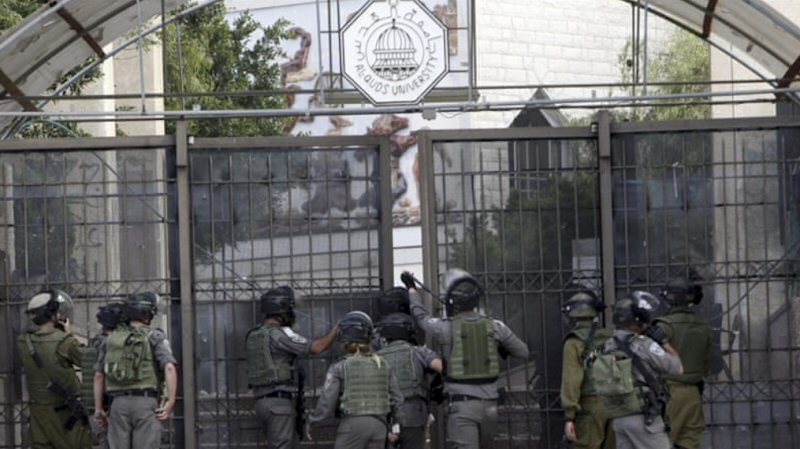
Palestinian Federation of Unions of University Professors and Employees (PFUUPE), February 5, 2019
The Palestinian Federation of Unions of University Professors and Employees (PFUUPE) supports the faculty at Pitzer College calling to suspend a complicit study abroad program in Israel over its discriminatory practices.
PFUUPE, which represents more than 6,000 Palestinian university staff at 13 higher education institutions in the occupied Palestinian territory, commends our colleagues at Pitzer College for overwhelmingly supporting this principled stand for Palestinian human rights and for equality.
Most importantly, we thank you for listening to us and acting upon the call from the vast majority of Palestinians, including academics and students, to refrain from business-as-usual academic relations with Israeli institutions while we are forced to live under oppression.
We hold dear the universal right to academic freedom, on principle and because Palestinians are obliged to fight for it every day, along with our right to education.
Our faculty members have, for decades, faced the policy of restricting movement and travel imposed by the Israeli occupation. This severely hampers our academic freedom, namely to reach our campuses, to teach our students, to conduct research, to collaborate with other academics or institutions and to participate in conferences, whether within the occupied Palestinian territory or abroad.
Israel also obstructs importation of academic material and scientific equipment for Palestinian universities, effectively imposing a boycott on our institutions of higher education.
Israel’s discriminatory policies further prevent international academics and students, in particular those of Palestinian/Arab origins or those supporting Palestinian rights, from teaching, studying and attending conferences at our universities. The past two years have seen an uptick in racially- or opinion- based denial of entry to Israel and refusal of visas and visa renewals, a repressive and deeply discriminatory Israeli policy that has long been customary.
Israel has repeatedly bombed Palestinian schools and universities in Gaza, and its illegal and brutal siege has denied the two million Palestinians there, including hundreds of thousands of students, their basic right to freedom of movement. Israel’s decade-old siege of Gaza is making it uninhabitable, according to the UN.
Palestinian students and faculty in the Israeli-occupied West Bank also face campus raids with Israeli soldiers firing live munitions and tear gas.
Palestinian citizens of Israel are subjected to Israel’s institutionalized racism, while Palestinian students face repressive restrictions on political activities and Palestinian educational facilities are underfunded.
We ask the Pitzer College community to try to imagine what it is like studying, teaching or performing research under these dire conditions of racism, repression and violent oppression.
As long as Israel continues to deny Palestinian human rights and academic freedom and impose discriminatory policies based on origins and political opinion, students, educators and academic institutions have a moral obligation and an ethical responsibility to ensure their campus is not contributing in any way to denying Palestinians our right to education and life.
We urge the Pitzer College Council to uphold the principled stand taken by an overwhelming majority of its faculty not to be complicit in Israel’s denial of Palestinian rights and its blatantly racist and anti-democratic discriminatory policies.
Doing so will send a strong signal to the Israeli government and its deeply complicit universities that principled academic institutions will no longer stand by. They will instead use their power of moral persuasion to hold Israel to account and effect a change in the stagnant status quo of oppression, as was the case during the struggle to end apartheid in South Africa.
Please, uphold the vote in support of our struggle for freedom, justice and equality. Keep our hope in freedom, justice and equality alive.
Sincerely,
The Palestinian Federation of Unions of University Professors and Employees (PFUUPE)
Against Intervention in Venezuela: The Case of the Caribbean Community
By Maximilian Forte | Zero Anthropology | February 6, 2019
As discussed in the previous article, the membership of the Organization of American States is in fact not at all united around support for foreign intervention and recognition of an alternative second “president” (Juán Guaidó). Standing opposed to the denial of recognition of Maduro’s legitimacy as the elected leader are not just Cuba, Nicaragua, Bolivia, and for now Mexico and Uruguay, but also Caribbean states such as Dominica, St Vincent and the Grenadines, and Suriname. Trinidad and Tobago, St Kitts and Nevis, Antigua and Barbuda, Barbados, and Belize abstained from the OAS resolution—which, it turns out, does not mean the same as indifference. The action by the OAS implicitly threatened all governments in the region, which has already significantly damaged the organization’s integrity, as discussed below.
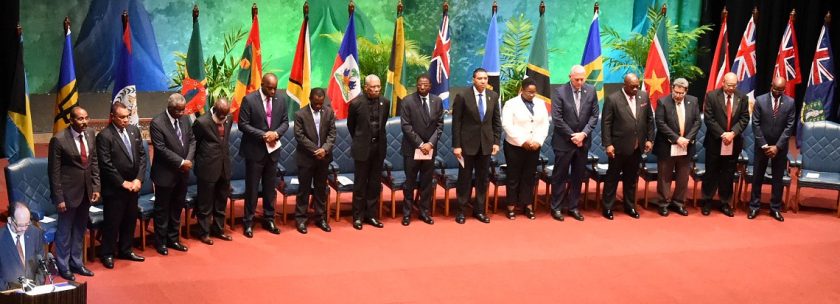
CARICOM Heads of Government
CARICOM
Caribbean states, including those that abstained from voting on the OAS resolution, stood firmly on anti-interventionist principles that respected Venezuela’s sovereignty. Leaders of the member states of the Caribbean Community and Common Market (CARICOM) held an emergency meeting to discuss Venezuela on January 24. The heads of government of Antigua and Barbuda, Barbados, Belize, Dominica, Jamaica, Montserrat, St. Kitts and Nevis, Saint Lucia, St. Vincent and the Grenadines, Trinidad and Tobago, and the Foreign Ministers of Grenada and Suriname, participated in the meeting. Guyana, which has a long standing territorial dispute with Venezuela, nonetheless endorsed the CARICOM position the next day. The resulting statement “reaffirmed” the members’ “principles of non-interference and non-intervention in the affairs of states, respect for sovereignty, adherence to the rule of law, and respect for human rights and democracy”. In addition, they insisted that the crisis should only be “resolved peacefully through meaningful dialogue and diplomacy”. Without naming the US and the Trump administration, CARICOM heads explicitly rejected foreign intervention in Venezuela’s affairs, and threats of violence against the country:
“Reaffirming their commitment to the tenets of Article 2 (4) of the United Nations Charter which calls for Members States to refrain from the threat or the use of force and Article 21 of the Charter of the Organization of American States which refers to territorial inviolability, the Heads of Government emphasized the importance of the Caribbean remaining a Zone of Peace”.
Taking aim again at US policy, CARICOM,
“called on external forces to refrain from doing anything to destabilize the situation and…called on all actors, internal and external, to avoid actions which would escalate an already explosive situation to the detriment of the people of Bolivarian Republic of Venezuela and which could have far-reaching negative consequences for the wider region”.
Trinidad & Tobago and CARICOM vs. the OAS
Within CARICOM, the case of Trinidad & Tobago deserves special mention. First, Trinidad, mere miles from Venezuela with which it has long historical and demographic ties, is now home to a growing number of Venezuelan refugees. Recent events have triggered fears of an even larger refugee crisis in the making. The media make it clear that many locals neither like nor trust the Venezuelans entering their country, and resent their presence. In addition, Venezuelans protesting in the capital, Port of Spain, against Maduro and demanding that the government of Prime Minister Keith Rowley recognize Guaidó instead, faced a mixed reaction at best. Aside from being denounced by Trinidadian commenters, the protesters drew a sharp rebuke from the leader of one of the parties in parliament, David Abdulah:
“Citizens of Venezuela can appeal to the Government of Venezuela and the parties in Venezuela but Venezuelans here in Trinidad and Tobago cannot determine what the foreign policy of Trinidad and Tobago ought to be. It is the Government of Trinidad and Tobago and the citizens of Trinidad and Tobago ultimately and the governments of Caricom and the citizens of Caricom who must determine the foreign policy of Trinidad and Tobago and of Caricom”.
Abdulah also took exception with the protesters claim that Guaidó had popular support, while Maduro was isolated as a dictator. Abdulah said Maduro got significant support at the February 2nd demonstration in Venezuela, which was much bigger than Guaidó’s rally:
“So it is not as if President Maduro is clinging on to power by himself and so on and the vast majority of the Venezuelans are against him. That is not the case”.
Moreover, Abdulah condemned the opposition:

Dr. Keith Rowley, Prime Minister of Trinidad & Tobago
“Very regrettably, but not surprising, Guaido has taken the consistent right-wing line of the opposition rejecting any talks, rejecting any mediation and simply wanting for [sic] resolve the thing by force backed, of course, by the United States and some other countries”.
Squaring off against his domestic opposition, Prime Minister Keith Rowley took direct aim at the United National Congress in parliament, which is pro-US and pro-interventionist. Rowley openly called them “traitors” for trying to undermine CARICOM’s mission of mediation.

Luís Almagro, Secretary-General of the OAS
Prime Minister Rowley has also clashed with the leadership of the OAS, precisely on the question of Venezuela, well before this latest crisis erupted. Back in 2017, Rowley called for the dismissal of OAS secretary-general Luís Almagro. Prime Minister Rowley’s point, which was correct, is that the OAS was compromised by taking an interventionist stance towards Venezuela, and delegitimizing its duly elected leader. Rowley further accused the OAS leadership saying that the result was that, “the OAS has now removed itself from any meaningful participation and has deteriorated now into partisan attacks”.
The conflict between CARICOM, and Trinidad & Tobago in particular, and the head of the OAS was reignited with the latest crisis. CARICOM, and Trinidad’s Minister of National Security, expressed shock that Almagro would dare to speak for all OAS members in personally denouncing Maduro. In a January 31 letter to the OAS’ Almagro, CARICOM’s leadership instructed Almagro that the OAS does not speak for CARICOM members on this issue. The letter from CARICOM’s chairman, Prime Minister Timothy Harris of St Kitts and Nevis, stated:
“The Heads of Government consider it imperative that you publicly clarify that you did not speak on behalf of all the member states of the Organisation of American States….We are aware that this is not the only occasion on which you have made public utterances in the name of the organisation without authority”.
CARICOM described Almagro’s actions as a “clear departure of from normal practice and cause for great concern”. Almagro has gone as far as advocating a foreign military invasion of Venezuela. Journalists noted that, “the OAS website lists media and press releases for the month of January and there is nothing about the OAS’s support for Guaido”. Trinidad & Tobago joined a CARICOM team to meet in Uruguay on February 7, as part of a mediation effort led by Mexico and Uruguay. Calls for dialogue continue to be flatly rejected by Guaidó, echoing the same line taken by Trump and his team.
Meeting in Montevideo
The meeting of 15 Caribbean nations plus Mexico, Uruguay, and parties in Venezuela, taking place in Montevideo tomorrow, represents the formation of a bloc that can act as a significant counterweight to the so-called “Lima Group” of US dependents in Latin America and neocolonial states such as Canada. Unlike the Lima Group, no foreign media have been banned in advance— the Canadian government blocked Russian and Venezuelan media from covering the Lima Group meeting in Ottawa on February 4, an act of suppression of press freedoms that occasioned no outcry at all in Canada.
The largely right wing “Lima Group” that opposed Maduro itself consisted of a range of shady and extreme characters tarred by their involvement in corruption scandals and with ties to death squads, along with Canada with its liberal authoritarian tradition and its penchant for necolonial violence. Once again, none of the “decolonial” crowd, fashionable as they are in academia, has drawn any of the logical and historical connections between Canada’s internal colonialism and its external neocolonialism, which are united by the same principles and interests, even the very same parties and actors. This failure of intellect is not an accident either, but is a subject best explored at another time.
In the meantime, I strongly recommend that you listen carefully to the full interview of RT with Nicolás Maduro:
12 minutes to understand the Yellow Vests Movement in France
Romain Majou | January 26, 2019
A video to make you understand what’s presently going on in France. 12 minutes to understand who are the Yellow Vests, what they are fighting for and if they really are violent.
Send me a message on my profile: https://www.facebook.com/romain.majou
Diesel driving ban in Stuttgart provokes Yellow Vest protests
Press TV – February 3, 2019
Hundreds of Germans have donned yellow vests to match protesters in France, demonstrating in the bastion of Germany’s car industry in Stuttgart against a recent driving ban on older diesels.
The protest came after organizers asked people to hit the streets clad in the yellow high-visibility vests that have defined months of protests in France — themselves triggered by an increase in tax on diesel.
“The French are an example to us, because they dared take to the streets to protect their rights,” organizer Vasilos Topalis told Agence France-Presse (AFP).
Stuttgart is home of Mercedes-Benz maker Daimler, Volkswagen subsidiary Porsche and the world’s biggest car parts supplier Bosch.
Since January 1, only diesel vehicles meeting the Euro 5 emissions standard are allowed into Stuttgart, with efforts underway to implement similar driving bans in many German cities.
Topalis said tens of thousands of people are affected by the bans and cannot afford to buy a new car. “What’s happening to people is unjust,” he added.
The protest came as France’s yellow vest protesters returned to the streets Saturday to keep up the pressure on the government and decry the number of people being injured by police during demonstrations.
Multiple protests took place in Paris and other cities to denounce President Emmanuel Macron’s economic policies, which they view as favoring the rich, for the 12th straight weekend of demonstrations.
The government says around 2,000 people have been injured in protests since the movement began Nov. 17 and 10 people have died in traffic accidents related to yellow vest actions.
The protesters paid homage to those injured since the onset of the rallies on November 17.
Protesters and rights groups have denounced the French police’s response to the yellow vests marches as “excessive,” including their use of controversial high-velocity rubber bullets.
France’s Council of State, however, ruled Friday that security forces have a right to use them for crowd control.
Meanwhile, a bill is under debate in the French parliament to strengthen measures against protesters whom they view as troublemakers. Rights groups and opposition lawmakers say the bill goes too far in restricting the right to protest.
The bill would authorize police to prevent people they see as a serious threat to public order from taking part in protests. It would also make it a crime for protesters to conceal their faces during demonstrations.
Spain company rejects Israel tender for Jerusalem railway
MEMO – February 2, 2019
A Spanish company announced yesterday that it had rejected an Israeli tender to build part of the Jerusalem railway, which will cut deep into occupied territory.
Construcciones y Auxiliar de Ferrocarriles (CAF or Construction and Other Railway Services) announced that it “refuses to build a section of the railway in Jerusalem because [it] included Palestinian land that will be confiscated, in violation of the resolutions of international legitimacy,” Al-Wattan Voice reported.
The company’s workers also rejected its participation in the project on the same grounds. Representatives of the workers said that the problem lies in the fact that the railway will pass through Palestinian lands to serve illegal settlements in East Jerusalem.
“Any project in any city around the world, especially Jerusalem, must respect human rights and international legitimacy in its implementation,” CAF stressed.
CAF added: “The General Assembly of the United Nations and the International Court of Justice [ICJ], through various resolutions, have said that they are against the occupation of land through which will pass the section of the railway.”
Read also:
GILETS JAUNES: Civilians in Police Crosshairs as Macron Adopts Totalitarian State-Practices to Suppress Dissent
By Vanessa Beeley | 21st Century Wire | January 29, 2019
A 30-year-old volunteer fireman who joined the Gilets Jaunes protests in Bordeaux, France on the 12th January 2019, is in a coma after being shot in the back of the head by an LBD or “flashball” bullet fired by French security forces who are brutally suppressing public demonstrations in most major French cities. Olivier Beziade is a father of three who now has a “very serious brain injury” and is in an induced coma. As violence radiates across France, western media locks down and fails to report comprehensively or fairly on Police infractions against protestors.
The following is the video of this event, during which one of the police officers appears to say “they (protestors) don’t know it’s us” and instructs his colleagues to “pick up the casings”, after Beziade had been gunned down and was lying face down on the street.
WATCH:
The Gilets Jaunes or Yellow Vests
The Gilets Jaunes (GJs) or Yellow Vest movement began officially on the 18th November 2018 but according to some analysts this people’s initiative was being ignited long before and is a product of successive French government marginalisation of important sectors of the French population. Thomas Flichy de Neuville, academic and historian, wrote very recently about the socio-political alarm bells that preceded the Gilets Jaunes by at least five years.
In 2013, a deputy from the Pyrenees Atlantique department of France, Jean Lassalle, spent 8 months walking around France. He covered 5000 km on foot and spoke with the “forgotten” French people. Lassalle reported that the lasting impression from his experience was that most of those he encountered had a desire to “turn the tables, that they had had enough on many levels”.
Lassalle’s report was submitted to the presidents of the assemblees in April 2014. Lassalle warned that nine out of ten people in France were ready to “explode”, three out of ten were ready to mobilise if and when the “explosion” took place. Lassalle prophesied that “Les réseaux sociaux sont prêts à agir comme une arme formidable de mobilisation” “social media is ready to to act as a formidable weapon of mobilisation”.
According to Flichy, the one problem with Lassalle’s ground breaking report was that he predicted the imminent eruption of dissent “it is ten minutes before midnight”, Lassalle wrote. Nothing transpired as predicted in 2015 and the 196 page report was consigned to the archives, its prescient contents forgotten as France buried itself in a foreign intervention quagmire in Syria, Yemen and Mali and ignored the gathering storm at home.

GJ protestors being tear gassed in Bordeaux, January 12th 2019. (Photo: Nicolas Duffaure)
In 2014, Christophe Guilluy, a geographer, wrote a book entitled “La France Peripherique” which investigated the demographics of major French cities and highlighted the problems of wealthy, opulent city centers compared to the marginalised and poor suburbs where 60% of the “forgotten” population resided. Guilluy concluded that many of these communities would ultimately vote for more right wing or nationalist political parties in search of an antidote for their deteriorating living conditions.
Guilluy’s work is particularly relevant when we consider that the match to the touchpaper for the GJs was the hike in fuel prices by President Macron’s government. While this is not the sole reason for the unrest we see today, nationwide in France, it is an important factor for 60% of a population, many of whom subsist on the minimum wage (SMIC) – if those people travel 20km to work every day, they will spend 250 euros per month which is a quarter of the SMIC. It is easy to see why these people reacted so forcefully against a fuel tax that would impact them the most.
Why the Gilet Jaune? Analyst and author, based in France, Diana Johnstone put it most succinctly in an article for Unz Review :
“Every automobile in France is supposed to be equipped with a yellow vest. This is so that in case of accident or breakdown on a highway, the driver can put it on to ensure visibility and avoid getting run over. [..] The costume was at hand and didn’t have to be provided by Soros for some more or less manufactured “color revolution”. The symbolism was fitting: in case of socio-economic emergency, show that you don’t want to be run over.”
The GJs have distanced themselves from politics and politicians to protect their grass-roots identity. The leadership structure is horizontal, no leaders or identity politics. The spokespeople are not practiced public speakers, they are people from every walk of life and they represent a wide spectrum of French society. The manifesto is varied depending upon regional collectives but most demands nationwide appear to be in synch with minor differences.
One such manifesto was published by a number of media outlets in December 2018 and it listed a number of demands for reform in the economic, political, health and social security and environmental sectors. This manifesto also addressed the issue of Macron’s neoliberal foreign policy and included a call to end “France’s participation in foreign wars of aggression and exit from NATO” and to “cease pillaging and interfering – politically and militarily – in Francafrique which keeps Africa poor. Immediately repatriate all French soldiers. Establish relations with African states on an equal peer-to-peer basis”

Forces of “law and order” on the streets of Bordeaux during Acte X of GJ protests, 12/1/2019. (Photo: Nicolas Duffaure)
The fundamental message of the GJs is that they simply can’t make ends meet. The cost of living keeps going up and salaries keep being squeezed. The Government needs to listen to its people and to change course. Most europeans reading this will feel empathy with this expression of desperation. There has been a cover-up in France by the government and the media. These calls for help have been muted, filtered and ignored by the state-aligned media and government officials for some time now.
Macron’s government has used Climate Change and global warming as a damoclean sword brandished over the heads of the malcontent to distract them from their misery – suggesting the future of the planet outweighs the trivia of feeding your children or avoiding homelessness – the push back from the GJs was swift, while they may cherish their environment and are ecologically aware “they are more worried about the end of the month than the future of the world.”
In some cases, early on in the protests, the GJs are being systematically dehumanized. Gerard Darminin, the budget minister, described the GJs as the “peste brune – the brown plague” meaning fascists. In the dozens of interviews I have listened to, not one GJ has expressed a sentiment that could even remotely be described as right wing or fascist. The GJs are an apolitical collective with a focus on socio-economic issues that directly affect their ability to survive in modern France which, in their view, is drifting dangerously away from the vision of a Republic that most of the demonstrators have grown up with.

Ingrid Lavavasseur, leading GJ candidate for May European Parliament elections. (Photo: Twitter)
In an effort to give their concerns and the movement a greater platform from which to challenge Macron, the GJs have recently nominated 10 candidates for the May 2019 European Parliament elections and are hoping to expand the list to 79 candidates. Leading contender is Ingrid Lavavasseur, a care worker raising two children alone in Normandy who believes that Macron’s government “despises the little people”.
The government response has been largely dismissive, repressive, condemnatory and increasingly inflammatory. Instead of “maintaining order” through genuine negotiation and reform, Macron appears to have unleashed an escalation of police violence against demonstrators which will provoke the GJs further, increasing dissent and the potential for counter-reactionary measures against the state.
Interior Ministry, State and Media Reaction to Gilets Jaunes

Christophe Castaner, Interior Minister. (Photo: Nicolas Messyasz)
Macron’s first choice Interior Minister was the socialist mayor of Lyons, Gerard Collomb who resigned his post in October 2018, despite Macron’s entreaties for him to stay, citing “immense difficulties” facing his successor. Collomb was replaced by Christophe Castaner as head of national police forces, among other responsibilities. Former socialist and with a degree in criminology, Castaner’s reputation is somewhat tarnished by his connections to a Marseilles mafioso, Christian Oraison, in the 1970s.
French Prime Minister, Edouard Phillippe introduced a new law to “better protect the right to demonstrate” in January 2019. Protestors who are labelled falsely as “agitators” “insurrectionists” or who demand that “President Macron resign” will effectively be collectively reprimanded by a law that introduces measures of heavy punishment of demonstration organisers whose time and place has not been given the official stamp of approval.
500 complaints against Castaner for restricing the right to protest were submitted to the Court of Cassation but were dismissed by Public Prosecutor, Francois Molins, who stated that he would not be prosecuting Castaner for his remarks that “participants in the GJ protests were complicit with those who had resorted to violence”.

Bordeaux police gather for GJ protests January 2019. (Photo: Nicolas Duffaure)
Castaner has consistently defended the police squads and their use of disproportionate force against unarmed demonstrators by claiming that the GJs are the ones to instigate violence, the police are acting in self-defense. The mounting number of cases of civilian mutilation and wounding by heavily armed police officers suggest that Castaner is distorting the truth.
Castaner’s only concession has been to equip the police forces with body cameras so they can record their own violations of the use of “proportionate force” in the maintenance of law and order. Doubts must be cast on the willingness of a police force already facing 100s if not thousands of claims against them, to provide the evidence that will further incriminate them. When Castaner was pressed to comment on the violence being meted out against civilians by the police, he responded:
I don’t know of one policeman or one gendarme who has attacked the Gilets Jaunes, on the other hand, I know many police or gendarmes who have taken defensive measures to defend the Republic, the order of the Republic – you know there is no “liberty” without public order [..] but naturally I have never seen a gendarme or a police officer attack a demonstrator or a journalist, on the contrary I have seen demonstrators systematically attack our security forces and journalists.

Police arrest a protestor. (Photo: Gilets Jaunes Facebook page)
Castaner is one of the chief promoters of the draconian and controversial “Loi Anti Casseurs – Anti-Breakers (looters) law”. Those who oppose adoption of the law have claimed it will further erode freedom of speech and liberty of expression in France. The law proposes security perimeters around protests, facial recognition, bag searches, body searches, 2-4 years in prison if found guilty of violence against the police and up to Euros 7,500 ($ 8580) fines for those who violate the law. It is worth noting that Castaner himself admits that the number of “casseurs” nationwide are negligible, numbering between “150 – 200/300 across all regions of France”.
#Bordeaux La presse qui se protège comme elle peut des tirs de flashball et lancés de projectiles #GiletsJaunes #ActeIX #Acte9 #12janvier #12janvier2019 pic.twitter.com/cVcS1ricXl
— Stéphanie Roy (@Steph_Roy_) January 12, 2019
The law states that protestors who hide their faces will be targeted – this measure is controversial as most protestors and journalists are forced to cover their heads and faces to protect themselves against tear gas and the risk of mutiliation by “flashball” rubber bullets or “grenades d’encerclement”” which contain 25g of TNT and can release hundreds of 10g rubber pellets at close range if used incorrectly, by the security forces. Macron’s government sees these measures as essential to crack down on violence against the state, the GJs will perceive it as a further instrument of oppression by the state against its own people. So far, 200 ammendments have been made to the law by those who are alarmed by the increased totalitarian measures being imposed upon France and its people by Macron’s ministers.
French state-aligned media and UK corporate media have followed Castaner’s narrative lead with little deviation, the following short clip from a report by France’s TF1 demonstrates the disinformation being presented about the GJs and the police violence. The TF1 presenter denies any police infractions and praises them for their “sang froid”, their composure.
After initially distancing himself from the protests, perhaps in the vain hope they would fizzle out, on the 10th December Macron finally appeared before his people on TV. During the broadcast an apparently chastened Macron agreed to delay the fuel tax hike, he offered an extra 100 Euros per month for minimum wage earners and tax cuts for pensioners among other measures. Even the Economist described Macron’s 10 billion-euro concession package as an attempt to buy off his critics. The broadcast was watched by a staggering 21m people. The reaction was mixed, perhaps 50% of the GJs and their supporters seeing it as an attempt to keep the people quiet rather than a genuine effort to change course and address the long-standing issues that had generated the protests in the first place.
Macron’s later New Year 2019 address to the nation which followed a terrifying increase in the violence seen on the streets of Paris and across France, was a much more aggressive affair. Having failed to appease the “crowds” with a few unconvincing political crumbs, Macron seemed to have decided to adopt the hardline approach. “These days I have seen unthinkable things and heard the unacceptable” Macron stated. Macron even took on the few opposition politicians who dared to empathise with the protestors. Macron berated those who pretend to “speak for the people”, calling them “spokespersons for hateful crowds” and denounced “those who have mingled with the Yellow Vest protesters to spread hate speech about “police forces, journalists, Jews, foreigners, homosexuals” as a “negation of France”. I am yet to find a recording of a GJ spreading hate speech about any of the factions mentioned by Macron.
Macron’s other concession was the so called “Grand Debate”, a series of town hall meetings where representatives of the communes and departments across France would meet to present grievances on behalf of their constituents and the GJs. In reality, anyone wearing a yellow vest in the vicinity of the meetings may be fined Euros 135 ( $154). At some meetings road blocks were erected some way from the meeting place and identity papers of drivers were photographed, anyone wearing a yellow vest was told to go back. So, from day one, the Grand Debate called to address the concerns raised by the GJs deemed the GJs as persona non grata.
On the 18th January 2019, a Grand Debate was held in Souillac, south-west France. One of the attending Mayors gave an interview to a local media outlet after the debate had finished. Rene Revol, Mayor of Grabels (Department 34) said the meeting was nothing more than a “masquerade”, a farce, an election campaign for Macron. Gilets Jaunes were forbidden and threatened with fines if they were caught in the vicinity wearing their vests. Road blocks were set up on all roads leading to the venue. Security forces surrounded Macron’s cavalcade. Mayors were able to speak only if chosen by government ministers or Prefets – effectively controlled discourse. The meeting was ostensibly called to address the issues of the people. Nothing was discussed and the “people” were banned.
State Sanctioned Violence and Repression

Record of some of the appalling injuries inflicted upon unarmed civilians by police forces across France. (Photo: Desarmons.net)
Since the beginning of December the violence witnessed on the streets of cities across France has escalated dramatically. One French independent journalist, David Dufresnes, has been recording all infractions committed by police and security forces and tweeting them to the Interior Ministry while giving interviews to a huge number of French media channels to raise awareness of the police brutality during peaceful protests. In the tweet below, infraction number 362 dated 26/1/2019, an off duty soldier is reported to be hit in the head by a police LBD40 rubber bullet as he is leaving a restaurant in Montpelier on his way to the nightclub with two of his colleagues.
allo @Place_Beauvau – c’est pour un signalement – 362
Montpellier, #ActeXI : un militaire, 25 ans, en permission sérieusement blessé à la tête. #LBD40
26/01/19, vers 22h30
Source:https://t.co/vaM1RbbuGz pic.twitter.com/oHXYewtma0
— David Dufresne (@davduf) January 27, 2019
Dufresnes has recorded 157 injuries to the head including 18 who have lost an eye, fractures of the jaw and comas in the most severe cases. 11 hand injuries, in 4 cases resulting in the loss of a hand. 8 back injuries, 28 injuries to the upper body, 40 lower limb injuries, 3 injuries to the genital area, 48 unspecified injuries and 55 cases of intimidation, insults, repression of press freedom infractions. One eighty-year-old was murdered on the 1st December 2018 in Marseilles – Zineb Redouane was killed when a tear gas grenade was thrown in her face by the security forces. According to Dufresnes this is the list of the more serious injuries, an estimated 2000 – 3000 more GJs have been “lightly” injured during the protests since November 2018.

Chart produced by independent journalist, David Dufresnes and Mediapart showing injuries received by GJs and civilians from Police weapons and brutality during protests.
Dufresnes argues that the police have already lost control of the situation and can no longer be legitimately claiming to “maintain law and order”. In one interview Dufresnes points out that the use of 10,000 tear gas grenades on one day of protests points to a “panic” situation among the security forces. During “Acte XI” of the protests on the 26th January the elderly man, Eric, in the photo below was hit on the head by a police truncheon in Marseilles. He has three fractures and is forced to eat only liquid food from the left side of his mouth for three weeks, according to his brother.

Two students were recently inteviewed by independent French media channel, Mediapart. Antoine Boudinet lost his right hand when a GLIF4 grenade exploded close to him in Bordeaux, December 2018. Lola Villabriga was hit in the face by a LBD40 flashball bullet which triple-fractured her jaw in Biarritz, also December 2018.

Lola Villabriga, student, her jaw was fractured when she was hit in the face by a “flashball” bullet, December 2018 in Biarritz next to Antoine Boudient, student, who lost a hand during protests in Bordeaux December 2018.
Boudinet was actually taking part in a “climate” march which joined with the GJ march at one point during the protests. Boudinet has submitted a claim against Christophe Castaner for the police use of the GLIF4 grenade which has disabled him for life. Boudinet clearly states that he holds Castaner and the Interior Ministry responsible for the arms used by the police – “when such arms are available, it is certain that at some moment something will happen and there will be an incident. Explosives should never be thrown at people”

Villabriga had been standing on a bench filming the protests when she was hit by the flashball bullet. She describes a protest that was 100% peaceful, “there was no chaos at all. The use of force was totally disproportionate”. Villabriga suffered a triple fracture of her jaw, she has undergone one operation and a second operation is foreseen in the future to remove the metal pins. Commenting on Castaner’s denial of police brutality, Villabriga told the presenter:
“This is absolute denial (from Castaner) which I find totally alarming to see that we are ignored while what happened to us is so terrible. Nobody has come to talk to us.”
Watching the interviews, including one with Dominique Rodtchenki Pontonnier, a mother whose two sons were terribly injured by a GLIF4 grenade, one son losing three fingers in the blast – I was struck by the trauma and shock on the faces of the guests. At one point we are shown the film of the moment Pontonnier’s son is hit and is screaming that he has lost his hand. Boudinet is visibly shaken by the video, he explains that it brings back the memories of the moment he realised that he had been mutilated by the GLIF4 grenade fired by police into unarmed crowds of people that included children and families.
There is utter disbelief during the interview that France has been so rapidly reduced to a violent police state and that the trust between state and people has been so profoundly damaged. Another guest, Anaelle, a volunteer medic, describes the “profound lack of respect and complete rupture of dialogue” between state and people. All guests are horrified at the weapons being deployed to maintain “law and order”.

Record of injuries from police use of disproportionate force against unarmed civilians during GJ protests. (Photo: Desarmons.net)
Meanwhile, Interior Minister, Castaner maintains that the use of the Flashball bullet is necessary because:
“… in the face of extreme violence we need the means to defend ourselves and the simple fact of having a uniform (presence) for a long time has prevented the violence because the people respect that. Now there are people who come to provoke, to attack and to aggress, even to kill. If we consider what happened on the Champs Elysee or at the Arc De Triomphe, according to statements I have studied, there is a desire to kill members of the security forces, therefore they need to be able to defend themselves”

The moment GJ spox, Jerome Rodrigues, is targeted first by a GLIF4 grenade before being hit in the eye by a LBD40 Flashball bullet. Acte XI, 26th January 2019. (Photo: Twitter)
Paris, 26th January 2019, the forces of “law and order” targeted one of the GJ’s most popular spokespeople, Jerome Rodrigues, while he was filming events during the GJ march. During Rodrigues’ live video we can hear him cautioning GJs to withdraw from the scene as elements of the Black Bloc have arrived. Rodrigues does not want the GJs to get caught up in the Black Bloc violence. As he continues filming we see the police forces advancing but not confronting the few members of the Black Bloc who are responsible for much of the looting and damage to shops and buildings during the weekly protests. Instead, the police appear to open fire on the retreating GJs including Rodrigues who is suddenly struck down.
The following video shows the moments after Rodrigues is targeted first by a GLIF4 grenade and then by a Flashball bullet to the eye (according to later testimony from Rodrigues from his hospital bed).
WATCH:
Rodrigues is treated by the volunteer medics at the scene before being rushed to hospital. Two days after the incident, Rodrigues posted a live video to his Facebook page, from his hospital room. He calls for peace and calm, no violent reactions from the GJs. He feels that he was deliberately targeted by the police and this had also been claimed by a number of eye witnesses to the attack. Rodrigues also reminds people that his mutilation is one of many and that he should not be singled out among the GJs who have suffered at the hands of the police. Rodrigues urges GJs back onto the streets for Acte XII, Saturday 2nd February. It remains to be seen where the escalation of violence will progress from here as popular support for the GJs grows across France.
Rodrigues’ poster for Acte XII reads “The powerful will stop dominating when the little people stop crawling”

Weapons used to “Maintain Law and Order”

Chart taken from the website of ACAT, an NGO arguing against increase in repressive laws in France, showing the weapons deployed by France during crowd control compared to other EU countries, November 2017.
The above chart shows the weapons used by French security forces against unruly crowds. There is a clear recommendation of steps and maintenance of proportionate force which is outlined in the national police instruction chart, below. Journalist, David Dufresnes, has clarified that the LBD40 Flashball rubber bullets and the GLIF4 grenade “d’encerclement” are not used anywhere else in Europe because of the risks to human life involved.

The National Police in France should be following the recommendations shown in the infograph above. Step one: demand for the crowd to disperse followed by two clear announcements of the intention to use “force”. First level of force: firearms are strictly prohibited at this stage. Truncheons, water canon and hand thrown tear gas grenades. Level two of force: GLIF4 grenades and grenade launchers. Level three of force: if the police are met with violence. LBD40 Flashball bullets, grenade launchers firing non-metal projectiles and flashball bullets.
‘I’ll lose my eye’: Prominent Yellow Vest activist suffers HORRIFIC injury in Paris protests https://t.co/f6kEybZfal… #YellowVests #Paris YellowVest activist #Jerome #Rodrigues hit in the eye with one of the controversial rubber bullets used by French riot police #GiletJaunes pic.twitter.com/bswrYUUVy4
— C-Store News (@CStoreNews_) January 27, 2019
What we are seeing, from the footage that is being released, is the police bypassing the recommended steps and progressing almost immediately to the use of disproportionate force and the apparent deliberate targeting of unarmed protestors among the GJs. This is panic crowd control with horrifying consequences. More than 80,000 police are deployed to maintain order during the nationwide GJ marches every weekend. A mix of the BAC (Brigade Anti Criminalite) and the CRS (general reserve of the French national police) are the most prevalent security forces who police the marches.
Many appear not to have been properly trained in the use of the weapons provided to them. The LBD40 Flashball bullet should never be fired at head height, for example, yet we consistently see police officers standing and firing from the shoulder into crowds of Gilets Jaunes. On the saturday that Rodrigues was targeted, I took screenshots from the Ruptly TV live video coverage of the Paris marches which clearly show one police officer pointing a target out to another officer who fires the weapon at head height ten seconds later. The velocity of the Flashball bullet is ten times that of a paintball, its capacity to mutilate at close quarters has been proven by the horrifying injuries circulating on social media.

A recent article in the media outlet, Liberation, has revealed that a police report highlighted the risks of using the GLIF4 grenade for crowd control but the grenade is still being used by police in France. The GLIF4 contains 25g of TNT explosive, emits 165 decibels upon explosion which has permanently deafened one protestor and has caused inner ear problems for others. The GLIF4 can contain CS gas in powder form or 10g rubber pellets, lethal at close quarters with potential to tear into limbs and shred hands.
This report was picked up by journalist, David Dufresne, who highlighted the following paragraph:
Liberation had access to a Police scientific laboratory report carried out on this wound ( and submitted to the enquiry) before the Gilets Jaunes movement. The report concludes that the high risk of the (GLIF4) grenade has been underestimated by French authorities and the manufacturer. The Interior Minister (Christophe Castaner) still chose to use the grenades until “stocks were exhausted” without specifying the number of grenades remaining in stock.
The cavalier manner in which Castaner has put the lives of French civilians at risk must be considered reckless at best, criminally negligent at worst.
The following video is a compilation of just a few of the police infractions and violent responses to the GJ protests across France.
WATCH:
Conclusion – Chaos Strategy Unleashed?

Alexandre Langlois, police violence and the Gilets Jaunes.
Alexandre Langlois, General Secretary of the Police Syndicate, VIGI, has accused Macron’s government of stoking confrontation and of favouring repression over dialogue. In a series of public interviews, Langlois blames the hierarchy within the Interior Ministry for the “manipulation” of the police forces already hugely under pressure and experiencing a climbing suicide rate since Macron’s rise to power in France. According to Langlois, the “hierarchy” direct the police working during the marches from remote control centers which disable the police’s ability to analyse events on the ground and avoid dangerous confrontation or provocation. Langlois demonstrates that this system has led to situations that have increased pressure on both the police and the Gilets Jaunes.
Langlois warns that Police are being forced to work blind. The state is pushing for confrontation and it is not avoiding repressive measures that will only increase the chances of violence not reduce them. Langlois laments the 75 suicides of police officers since Macron was elected, 17 since Castaner took over from Collomb who resigned after pressure from Langlois and his syndicate to address the issue of high suicide rates among the national police forces – “we called for the resignation of Collomb, now Castaner should go” .
The dismantlement of the “renseignments generaux” (RG – police intelligence branch) under Sarkozy in 2008 has contributed to the problems in 2019 according to Langlois. Langlois believes the RG would have developed relationships with GJ organisers and worked with them to ensure peaceful demonstrations. The police have been deliberately distanced from the people in order to enable the violence we are seeing since the 1st December 2018. Langlois stresses that many of the Police sympathise with the GJs but that the government is pushing the police to oppose the GJs which can only lead to catastophic consequences if allowed to continue.
Effectively the Gilets Jaunes have exposed Macron and his government for what it is. Macron is the President who was elected by the globalists, the capitalists and the ruling elite to protect their interests. A book recently published, authored by Francois-Xavier Bourmand, entitled “Emmanuel Macron the Banker who would be King” has investigated the corporatocracy who ensured Macron’s election win in order to expand their interests globally and to convert France from Republic into Plutocracy at the expense of the “dispensables”, the “little people”.
During one confrontation with a citizen at one of the Grand Debates, Macron is asked why he has failed his pre-election promise of “no more SDF (homeless) on the streets of France – 580 SDF died on the streets of France in 2018. Rather than show compassion for the poverty-stricken and homeless, Macron defends his policies with accountant-speak, informing the audience that the elite must be protected in order to provide jobs for the “poor”.
If indeed Macron’s coterie in government are pushing for confrontation between the people and the security forces and introducing increasingly repressive measures to up the pressure on the protestors rather than trying to defuse matters, it is really ten minutes before midnight in France. The insanity of Macron supporting the “uprising” in Venezuela while sanctioning vicious reprisals against his own people at home is glaringly obvious to all but Macron and his backers. That is because Macron is doing his job and his job is to manufacture the conditions in which the privileged, wealthy ruling elite can thrive and further their globalist ambitions which includes military adventurism and resource theft from target nations that include Venezuela and Syria.
Violence will escalate in France because it is state-sanctioned. Unless the police wake up to their manipulation by the state and join forces with the GJs there is a risk of a serious confrontation in the very near future. However, as historian Diana Johstone has said “For all the lamented decline in the school system, the French people today are as well-educated and reasonable as any population can be expected to be. If they are incapable of democracy, then democracy is impossible.”. There is still hope that the wave of discontent generated by the GJs may still bring down the globalist power structure and replace it with something more allied to the principles of the Republic of France.
***
Vanessa Beeley is an independent journalist, peace activist, photographer and associate editor at 21st Century Wire.
The US Senate Just Quietly Advanced A Free Speech Busting Anti-BDS Bill
By Whitney Webb | Mint Press News | January 29, 2019
WASHINGTON — In an evening vote that garnered essentially no national media coverage, the U.S. Senate voted last night to advance the “Strengthening America’s Security in the Middle East Act of 2019” – sometimes called the “anti-BDS bill” for its component that would allow state and local governments to punish companies or individuals who support the non-violent Boycott, Divest, Sanctions movement aimed at promoting Palestinian rights and ending Israeli apartheid and military occupation of the West Bank. The bill was, notably, numbered S.1 — the Senate’s first legislative act of its 2019-20 session.
Numerous rights groups, politicians and civil rights advocates have accused this measure of violating freedom of speech and setting a dangerous precedent for the private political activism of American citizens, all on behalf of a foreign country.
The bill was adopted by the Senate in a vote of 74 in favor to 19 against, with seven abstentions. The bill had previously been blocked by Senate Democrats by a 56-44 vote as part of their objection to acting on legislation during the government shutdown. However, many of those Democratic senators who had previously blocked the bill ultimately voted in support of the measure. In order to become law, the measure would still need to pass the Democrat-run House of Representatives. However, given the amount of support for the measure among Democrats and the power of the Israel lobby, the bill stands a considerable chance of passing the House.
Some commentators have paid particular attention to how Democratic senators considered to be 2020 hopefuls voted on the bill. Several confirmed and likely contenders for the upcoming Democratic nomination voted “No” – including Senators Elizabeth Warren (D-MA), Kirsten Gillibrand (D-NY) and Bernie Sanders (I-VT). However, Cory Booker (D-NJ) and Kamala Harris (D-CA), whose private courting of the Israel lobby was the subject of a recent MintPress News report, abstained from voting. Another notable abstention was Republican Senator Rand Paul (R-KY), who had previously threatened to filibuster a key component of the bill last year, preventing its passage during the previous Congress.
Punishing organized dissent
The bill includes several measures that were promoted by the Israel lobby last year but did not make it through the previous Congress. These include the “Ileana Ros-Lehtinen United States-Israel Security Assistance Authorization Act of 2019” which would give a record-breaking $38 billion to Israel over the next 10 years, and which ultimately failed to pass after Sen. Paul threatened a filibuster against it. That bill also requires Congress to give at least $3.8 billion to Israel every subsequent year after the initial 10 years.
Other measures in the bill include the “Caesar Syria Civilian Protection Act of 2019” — which imposes more sanctions on Syria and has been described as a “rebuttal” to President Trump’s proposed Syria troop withdrawal, which Israel also opposes – and the “The United States-Jordan Defense Cooperation Extension Act,” which would also give money to Israel. Some analysts have long asserted that U.S. security assistance to Jordan and other regional countries such as Egypt is aimed at securing regional support for Israeli and American geopolitical objectives in the Middle East.
Yet, the most controversial part of the bill by far is the “Combating BDS Act of 2019,” which would authorize state and local governments to retaliate commercially against entities that support BDS, such as by halting business with or refusing to contract or hire companies or individual citizens who either actively participate in or support the movement. A previous version of the bill included possible jail time as punishment for supporting a boycott of Israel or Israeli settlements, their violation of international law notwithstanding.
Some have asserted that the current text of the bill would mean that these same retaliatory measures would apply to boycotts targeting any country considered an “ally” by the U.S. government – Saudi Arabia, for example – if that boycott was not explicitly sanctioned by Washington. Others, such as Senior Legislative Counsel to the American Civil Liberties Union (ACLU) Kathleen Ruane, have asserted that the bill “sends a message to Americans that they will be penalized if they dare to disagree with their government.” The ACLU also argued via Twitter that “states don’t have the ‘right’ to punish individuals for participating in political boycotts the government doesn’t agree with, which this bill encourages them to do.”
Such concerns over similar laws enacted at the state level led two federal courts to rule that “anti-BDS” laws were unconstitutional for their restriction on the right to free speech. However, the bill the Senate just advanced both ignores and nullifies those court rulings by attempting to shield anti-BDS legislation at the state level from future legal challenges. However, as a recent MintPress report noted, the effort to protect anti-BDS state legislation through the passage of national legislation is unlikely to work.
A frighteningly slippery slope
The fact that the Senate just voted in favor of a bill to nullify the right of American citizens to engage in political speech that is opposed by the U.S. government should be headline news across the country. However, mention of the vote has been notably absent from American mainstream news outlets Tuesday morning. One would think that left-leaning news networks, ever eager to criticize the Republican Party, would be quick to cover how the Republican-controlled Senate just voted to restrict American political speech if it deviates from the government’s own position. Yet the fact that the bill itself has several co-sponsors from the Democratic Party, and is strongly supported by the powerful Israel lobby, has apparently helped to earn their silence.
While the bill’s relation to the BDS movement – and, by extension, the Israel/Palestine conflict – makes it a polarizing and largely partisan issue, all Americans, regardless of political affiliation or their views on Israel/Palestine, should be gravely concerned about not just the bill itself but the precedent it would set should it become law. By encouraging retaliation by the State against American citizens for making decisions about what to buy and what not to buy in their private lives, a dangerous and chilling precedent has been approved by 74 U.S. Senators in order to shield a foreign country from criticism and the consequences of grassroots activism. Under the guise of preventing “anti-Semitism,” this bill represents a fraught, Orwellian overreach by Congress into the private lives of all Americans and their right to make politically-motivated decisions.
If passed, it will not take much for the U.S. government to use this precedent to silence Americans’ political speech when it comes to domestic matters. Consider how the government would react if conservatives chose to boycott or push for divestment from U.S. companies that profit from abortion? What if anti-war activists chose to boycott or push for divestment from U.S. companies that profit from our wars abroad? This slope is as slippery as they come and the fact that a sizeable majority in the Senate has chosen to target a certain political movement should sound alarm bells for all Americans who care about free speech, regardless of their views on Israel/Palestine or their position on the political spectrum.
Whitney Webb is a staff writer for MintPress News and a contributor to Ben Swann’s Truth in Media. Her work has appeared on Global Research, the Ron Paul Institute and 21st Century Wire, among others. She has also made radio and TV appearances on RT and Sputnik. She currently lives with her family in southern Chile.
Featured Video
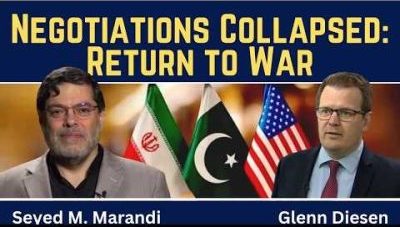
Seyed M. Marandi: Negotiations Collapsed – Return to War
or go to
Aletho News Archives – Video-Images
From the Archives
The US-Iran Scenario That Most Scares Israel
By Ali Haydar | Al-Akhbar | October 9, 2013
Israeli Prime Minister Benjamin Netanyahu issued a series of threats toward Iran and its interlocutors in the West, including the US, as serious negotiations on Iran’s nuclear program seem more plausible.
As a possible rapprochement looms between the US and Iran, Netanyahu has attempted to impose impossible Israeli conditions on the negotiators, such as the full dismantling of Iran’s nuclear program, not to mention threatening military force.
Whatever the deal that could materialize between Iran and the West, Israel is going to find itself before an open-ended path. One can foresee three possible scenarios… continue
Blog Roll
 Aletho News
- UK, Spain reject Trump’s new scheme to blockade Hormuz Strait
- Russian frigate ‘resurfaces’, chases off NATO pirates days after Kiev ‘sank’ it
- Ukraine Targets Russian Merchant Fleet With NATO Intel Support – Presidential Aide
- Russia’s ‘shadow fleet’ makes mockery of UK naval power
- Ukraine plans to attack Russian ships with Norwegian support
- US’s ‘Very Foolish’ Double Blockade of Hormuz Strait Makes Absolutely No Sense: Here’s Why
- China issues rules on countermeasures against foreign states’ unlawful extraterritorial jurisdiction
- Seyed M. Marandi: Negotiations Collapsed – Return to War
- Tomorrow’s naval blockade showdown
- ‘Israel’ attacks civilians to hide its embarrassing military failures & out of pure sadism
- If Americans Knew
- Critical shortages in Gaza, Lebanon in ruins, “piracy” in Iran – Daily Update
- US-Iran ceasefire negotiations make zero progress – Daily Update
- Pro-Israel ‘Thinktanks’ and Individuals who Influence U.S. Foreign Policy
- Mearsheimer reveals how Israel dictates US policies on Iran, Gaza – video
- After killing 350+, Israel still has a “score to settle” with Lebanon before ceasefire – Daily Update
- Military aid to Israel emerges as the latest political litmus test for Democrats
- The only Palestinian children’s rights organization closes following years-long Israeli campaign against it
- ‘I Can’t Forget the Smell’: Lebanese Reel After Israel Kills Over 300 in Single Day
- DNC Shoots Down Resolutions Calling Out AIPAC and Limiting Arms to Israel
- TCN: Is Israel Blackmailing President Trump?
- No Tricks Zone
- Cave Discovery Reveals Today’s Desert Climates Were Recently Far Warmer, Wetter, Teeming With Life
- German Expert: Heat Dome Led To Record Temps In Western USA…Warmer In 1934, 1936
- New Study: No Linear Warming Or Glacier Retreat Along Northern Antarctic Peninsula Since 1980s
- An Inconvenient Tree: Uncovered In Alps… Europe Much Warmer Than Today 6000 Years Ago
- New Study Reports A 60% Slowdown In Greenland’s Ice Loss Rate In The Last Decade
- Low Intensity Tornado Wrecks Major Solar Farm, Creating A Potential Toxic Dump
- New Study Finds Warming Saves Lives…Cold Temperatures 12 Times More Deadly Than Excess Heat
- German Science Blog Accuses PIK Climate Institute Of Hallucinating Climate Tipping Points
- Devastating Assessment Of Comirnaty Vaccine By Former Senior Pfizer Europe Toxicologist
- New Study: CO2 Is ‘Effectively Negligible’ As An Explanatory Climate Change Factor Since 2000
 Aletho News