An urgent international investigation must be opened into horrific crimes committed by the Israeli army during its land incursions into the Gaza Strip, including field executions, torture, and rape threats, said Euro-Med Human Rights Monitor, citing testimonies collected from newly-released civilians.
Euro-Med Monitor said that Israeli army forces are reenacting the same crimes committed by Zionist gangs during the 1948 Nakba, which resulted in the collective displacement of Palestinians.
These crimes include premeditated murder, setting fire to Palestinian homes and properties, torture, and insulting and humiliating detained civilians.
The human rights organisation highlighted the Israeli forces’ brutal storming of civilian homes in crowded residential neighbourhoods during the ongoing genocide.
Members of Israel’s military terrorized and beat residents, plus arrested hundreds of them, including women, children, and sick people.
According to testimonies gathered by Euro-Med Monitor from several detainees who were newly released, the Israeli forces took the detainees from their homes, stripped them naked, and attacked them with machine guns, electric cables, and cold water.
Sixteen-year-old Muhammad Mahmoud Aslim told the Euro-Med team that the Israeli forces stormed his family’s home in Al-Shuja’iya neighbourhood, east of Gaza City, after they were trapped for an entire week without food and water.
He stated that over the past few days, Israeli forces killed everyone in his neighbourhood who tried to leave their home, including Aslim’s brother.
Israeli forces later stormed his family’s house, said Aslim, and destroyed its contents with heavy gunfire. His family members were gathered naked and handcuffed before being violently assaulted and beaten.
Aslim still does not know what happened to his mother and sisters, who were captured and kidnapped by the Israeli army.
The Euro-Med Monitor team has gathered statements and testimonies about Israeli special forces raiding refugee centres in Gaza City and its northern areas, which housed thousands of displaced Palestinians.
These raids have involved the execution of young men who were shot with live ammunition at point-blank range.
Displaced people at the Cairo School, which houses hundreds of displaced people west of Gaza City, told Euro-Med Monitor’s team that several civilian cars carrying Israeli special forces stormed the school yard on Friday December 8, killing and wounding a number of unarmed young men.
According to the testimonies, the Israeli special forces ordered all of the men in the school to quickly gather and line up opposite them. Four of the men were executed, and the others were arrested after a brief interrogation.
Muhammad Abu Mustafa said that three individuals—two from the Abdul Ghafour and Abu Zaid families and one from his own family—were shot and killed by Israeli snipers after they went to assist a neighbour in Al-Shuja’iya neighbourhood. The victims were left bleeding to death.
Similar violations were reported on Saturday by other internally displaced people at the UNRWA-run Khalifa Bin Zayed School, in the northern Gaza Strip town of Beit Lahia.
They reported that the Israeli forces arrested dozens of men and minors in the school. The detainees were stripped of their clothes, bound, and taken to another location, where they were interrogated and tortured. Some of them were released, while the rest were kept in custody.
One of the released men, who requested anonymity for fear of retaliation, said that they were ordered to take off their clothes after being handcuffed and blindfolded.
They were then put in trucks and taken to the seashore, where they were kept shackled for about 19 hours.
According to the young man, they were subjected to insults, severe beatings, threats of being shot in the head, and had numbers written on their hands. They were also deprived of drinking water for many hours.
Upon their release, they were transferred naked to Salah al-Din Street, south of Gaza City, where the soldiers ordered them to walk on foot towards the central areas of the Gaza Strip.
The Israeli random arrests also targeted a young disabled man who suffers from hemiplegia.
The young man had been displaced from Al-Zaytoun neighbourhood in Gaza City to a relative’s apartment in the city centre before he and his brother were arrested; their fate remains unknown.
Ms. M.Z., a resident of Al-Zaytoun neighbourhood who was displaced to Shuhada Al-Aqsa Hospital in Deir Al-Balah, in the southern part of the Strip, said that an Israeli soldier pointed his gun at her head and threatened to kill her even though she had told him she was five months pregnant.
The soldier ordered her to take off her clothes and threatened to rape her.
As it continues to document testimonies from victims of the Israeli army’s crimes and random arrests, Euro-Med Human Rights Monitor renewed its call for an urgent international investigation into Israel’s violations and crimes against civilians, and called on the United Nations to assume its responsibilities and provide a safe passage for the displaced to use to evacuate.
Israel is required by international humanitarian law to take all reasonable steps to prevent harm civilians and to guarantee their safe shelter.
The Geneva-based rights organization emphasized, however, that civilians who choose to stay in areas designated for evacuation do not forfeit their protection, and cannot be singled out or targeted for any reason.
December 12, 2023
Posted by aletho |
Ethnic Cleansing, Racism, Zionism, Subjugation - Torture, War Crimes | Gaza, Human rights, Israel, Palestine, Zionism |
Leave a comment
The Israeli army opened fire on six ambulances of the Palestinian Red Crescent Society, escorted by UN vehicles, carrying 11 patients with critical injuries, including amputations and head wounds, in Gaza, the Red Crescent said on Sunday, adding that one of the injured died before receiving any treatment, Anadolu Agency reports.
“The Palestine Red Crescent Society coordinated with the United Nations to evacuate 11 casualties in critical condition last night from Al-Ahli Baptist Hospital in Gaza City to the hospital in the south of the Strip,” the Red Crescent said in a statement on X.
A convoy of six Red Crescent ambulances, accompanied by UN vehicles, set off from Khan Younis after waiting about four hours for the first green light to move towards the military checkpoint that separates the north from south in the Gaza Strip, it added.
“The convoy then waited a full hour to get a second green light to cross the checkpoint,” the Red Crescent explained, noting that “It was then subjected to a thorough inspection that lasted for about two hours, during which two paramedics were detained and released as soon as the convoy was allowed to pass.”
As soon as the convoy left the checkpoint and arrived near the Kuwait Roundabout, the statement said, “The occupation soldiers opened fire on one of the ambulances.”
One of the side windows was hit, and the bullet damaged the ambulance, the Red Crescent said.
“After the convoy returned from the Baptist Hospital and upon reaching the checkpoint on the way back, the convoy’s path was deliberately obstructed and paramedic Rami Al-Qatawi was detained again,” it said.
The Red Crescent said the Israeli military repeated its thorough inspection procedures, obstructing the convoy’s passage, and “interrogation at the checkpoint for more than two hours led to the martyrdom of one of the wounded.”
“After a detention that lasted for more than four hours during which he was subjected to beatings, abuse, and blackmail while being interrogated, paramedic Rami Al-Qatawi was released,” according to the statement.
He arrived at the other side of the checkpoint in a deplorable state after being forced to walk more than 2 kilometers (1.25 miles) on a rough road in cold weather while “naked and handcuffed,” the Red Crescent said.
Israel resumed its military offensive on the Gaza Strip on Dec. 1 after the end of a week-long humanitarian pause with Hamas.
At least 17,700 Palestinians have been killed and more than 48,780 others injured in relentless air and ground attacks on the enclave since Oct. 7 following the cross-border attack by Hamas.
The Israeli death toll in the Hamas attack stood at 1,200, according to official figures.
December 10, 2023
Posted by aletho |
Ethnic Cleansing, Racism, Zionism, Subjugation - Torture, War Crimes | Gaza, Human rights, Israel, Palestine, Zionism |
1 Comment
Seatle-based Starbucks Corp has lost over $11 billion in value this last quarter due to Palestinian solidarity boycotts and employee strikes since the beginning of the war in Gaza on 7 October.
The coffee giant tried to bounce back on losses with their holiday season “Red Cup Day” gimmick that would allow consumers to receive a free reusable holiday cup with every purchase.
Since the announcement of Starbucks’ scheme in mid-November, the company has seen its market share crash by 8.96 percent, accounting for $11 billion in losses, the lowest it has experienced since 1992.
The primary factor for the losses of other western corporations, like McDonald’s and KFC, is due to an international boycott action launched against Israel-supporting firms in solidarity with the Palestinian people.
The financial hit by Starbucks jumped borders as its franchises in Egypt have turned to downsizing their workforce due to the boycott’s effects.
Starbucks turned to sue their union, Starbucks Workers United, in October after objecting to the latter’s social media post in solidarity with Palestine, citing intellectual property theft and harassment of baristas at Starbucks cafe locations.
“Workers United posted a statement with an image of a bulldozer tearing down part of the Israel and Gaza border, reflecting their support for violence perpetrated by Hamas,” the company note obtained by The Intercept read. “Starbucks unequivocally condemns acts of terrorism, hate, and violence committed by Hamas, and we strongly disagree with the views expressed by Workers United.”
The boycotting impact in West Asia, where pro-Palestine sentiment has been historically strong, has multiple western brands feeling the heat from Morrocco, Kuwait, Jordan, and others.
“The scale of the aggression against the Gaza Strip is unprecedented. Therefore, the reaction, whether on the Arab street or even internationally, is unprecedented,” said Hossam Mahmoud, a member of the Boycott, Divestment, and Sanctions movement (BDS) in Egypt.
December 7, 2023
Posted by aletho |
Ethnic Cleansing, Racism, Zionism, Subjugation - Torture, War Crimes | Human rights, Israel, Palestine |
Leave a comment

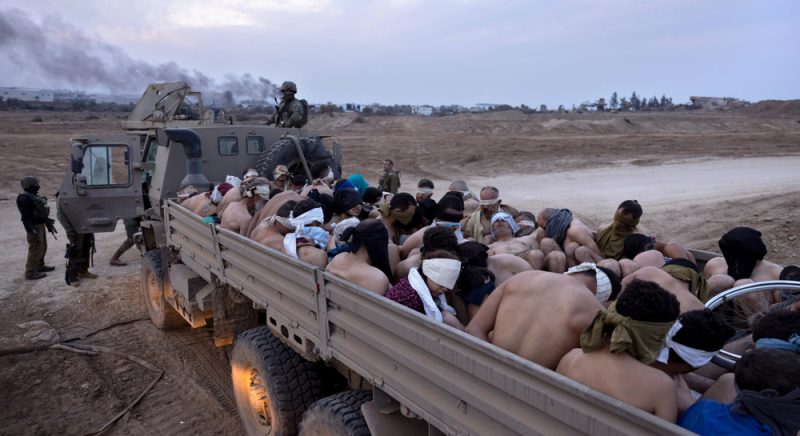
Israeli occupation forces rounded up and detained hundreds of Palestinian boys and men over the age of 15 in northern Gaza on 07 December 2023
Hundreds of Palestinian boys and men over the age of 15 are being rounded up by occupation forces in northern Gaza, stripped of their clothes and taken away.
Shocking images and video footage circulating online show the boys and men stripped to their underwear and left sitting on the ground in the cold winter temperatures in Gaza. They can be seen surrounded by heavily armed Israeli occupation soldiers who are screaming orders at them.
Further images show an army people carrier filled with the men being driven away.
It is not clear how many boys and men were disappeared, but some reports have put the figure as high as 700. They are said to have been taken from shelter schools in northern Gaza where thousands of displaced civilians were forced to take shelter as a result of the bombing and destruction of their neighbourhoods and homes.
Reports state that among those taken is Diaa Al-Kahlot, bureau chief of Al-Arabi Al-Jadeed newspaper in Gaza. With social media users saying they have identified him sitting in a vest and his underwear among the rows of men in the images released.
December 7, 2023
Posted by aletho |
Ethnic Cleansing, Racism, Zionism, Subjugation - Torture | Gaza, Human rights, Israel, Palestine, Zionism |
1 Comment
The fair treatment of Israeli captives by Hamas has become part of the information war between Palestinians and Tel Aviv

The issue of Prisoners of War (POWs) taken captive by Hamas-led Palestinian resistance forces has become one of the key justifications for Israel’s military assault on the Gaza Strip.
While western audiences are often presented with the image of these groups as bloodthirsty terrorists, a closer look reveals that Hamas and other factions may have treated Israeli captives more humanely than how Israel treats Palestinian political prisoners.
While the Israeli POW issue spans eight weeks, the plight of Palestinian captives has persisted since at least 1967. There are said to be some 137 Israelis that are currently being held captive in Gaza, whom Hamas claims all are males and/or soldiers.
In the seven-day truce struck in November between Hamas and Israel, the Palestinian resistance released 108 women and children held captive in Gaza. In return, Israel was to release 300 Palestinian women and children held in detention and permit much-needed aid into Gaza through the Rafah crossing with Egypt.
Stanley Cohen, a US attorney who has represented both Hamas and Hezbollah members, tells The Cradle that “the laws of war do not limit Prisoners of War to State actors.” He says that “all the laws of war apply, whether it’s state actors or non-state actors.”
This would mean that the same legal obligations on the treatment of POWs should apply to both Hamas and Israel, despite there being a greater moral expectation often placed on UN member states.
How Hamas treats Israeli POWs
Access to interviews with detainees is limited due to Israeli government restrictions on media interaction with the recently freed captives, especially since the embarrassing PR blunder in late October when one of the four Israelis unconditionally released before the truce – 85-year-old Yocheved Lifshitz – said at a presser that “they treated us very well” in Gaza, but had endured “hell” while being taken captive.
But despite the challenges in obtaining their full stories, certain facts stand out. Recent audio recordings quoted by Israeli media have revealed statements from freed prisoners who claim they were more fearful of Israeli actions than those by Hamas. One former detainee, criticizing the Israeli government, highlighted the lack of support and the challenges faced during their captivity:
“We were sitting in the tunnels and we were terribly afraid not that Hamas but Israel would kill us, and then they would say – Hamas killed you.”
Another former Israeli captive went further in expressing disdain for the Israeli government’s responses on and after the events of 7 October:
“The feeling we had there was that no one was doing anything for us. The fact is that I was in a hiding place that was shelled and we had to be smuggled out and were wounded. Not including the helicopter that shot at us on the way to Gaza. You claim that there is intelligence, but the fact is that we are being shelled. My husband was separated from us three days before we returned to Israel and taken to the tunnels. And you are talking about washing the tunnels with sea water? You are shelling the route of tunnels in the exact area where they are.”
Reports on the health of detainees suggest that there was a gradual decrease in food quantity inside Gaza, with claims that prisoners lost between 10 to 15 percent of their body mass. Dr Yael Mozer-Glassberg, an Israeli pediatrician, described the children’s experience as “psychological terror,” though her account should be viewed with some healthy skepticism.
Mozer-Glassberg’s accounts are the closest thing to a detailed explanation of how the freed Israeli captives were treated. According to a report published by Haaretz, the doctor repeated the following story of two children, stating that “the older one wouldn’t eat until the younger had finished eating and felt full,” adding that “these are the kind of stories I heard from my grandfather, who was a Holocaust survivor.”
When reading the language she employs to describe the conditions of the former captives, it is quite apparent that her account is geared towards exaggeration and that the doctor is not a neutral source.
Conflicting claims
On the other side of the spectrum are the Hamas-released videos showing the handover of mostly Israeli detainees to the International Red Cross. The footage is characterized by high-fives, smiles, waves, hugs, and even Arabic expressions of gratitude to their captors – visuals the Israeli government dismisses as propaganda.
Government spokesperson Eylon Levy said that Hamas “releases footage of crowds terrorizing the hostages in their final moments of captivity,” stating that the videos show how the group “continues to document its own atrocities.” Levy’s portrayal was a clear exaggeration, to say the least.
Tel Aviv’s health ministry has even gone as far as to suggest POWs were administered “drugs” to make them appear happy. Yet contrary to Mozer-Glassberg’s portrayals of terror, these videos provide more direct insights into the experiences of the freed Israelis.
Emily Hand, a 9-year-old Israeli girl who was held by Hamas, was returned to her father during the recent prisoner exchanges. Her father, Thomas, who had been paraded across western media after incorrectly being informed that his daughter was killed on 7 October, stated that “she [Emily] has lost a lot of weight, from her face and body, but generally doing better than we expected.”
Thai negotiator Dr Lerpong Sayed asserted that those he helped release were well cared for, receiving shelter, clothes, food, and water, with mental support provided equally to Thai and Israeli detainees – who he said were held together. There have also been reports of friendships blooming from within the Palestinian resistance groups’ detention tunnels, one between an Israeli woman and a Thai Worker. Claims of intentional injuries during transport and a letter expressing gratitude from a released captive’s family remain contested and unverified.
Hamas alleges that Israeli airstrikes have killed around 60 Israelis they were holding captive, including their Palestinian guards, with 23 of the bodies still trapped under rubble. The Israeli army, blaming Hamas, has discovered two of these corpses.
Amid varying accounts from families and doctors, it appears that conditions in the facilities where Israeli detainees were held were unpleasant, possibly exacerbated by Israel’s cutoff of all essential services at the start of the war.
A lack of hygiene, water, food, medicine, and electricity are all realities for the 2.3 million Palestinian civilians living in Gaza right now. If anything, the conditions that the Israeli captives faced were consistent with, if not better, than those faced by Gaza’s civilians.
How Israel mistreats Palestinian Prisoners
Unlike the Israeli detainees, freed Palestinian political prisoners have spoken directly to the international media and provided horrifying accounts of physical abuse, including torture, beatings, and even rape. According to a number of Palestinian women and children who were freed in the latest exchanges, they were threatened by Israelis not to speak out about their treatment in detention.
“There are no laws. Everything is permitted,” Lama Khater, a freed Palestinian captive, told the media. “I was led to the investigation handcuffed and blindfolded, I was threatened with being burned, I was explicitly threatened with rape and with deportation to the Gaza Strip,” she added.
Palestinian journalist Baraah Abu Ramouz, who was also freed from Israeli detention, gave the following testimony of what she witnessed:
“The situation in the prisons is devastating. The prisoners are abused. They are being constantly beaten. They’re being sexually assaulted. They are being raped. I’m not exaggerating. The prisoners are being raped.”
Mohammed Nazal had his fingers broken, his back bruised, and hands fractured by Israeli prison guards. “One week ago, we were savagely beaten with metal bars. I put my hands on my head to protect it from injury, but the soldiers did not stop until they broke my hands,” the 18-year-old freed prisoner said. Despite his clear injuries and horrifying testimony given to the media, where he said he was left lying on the floor in pain and was denied medical treatment, the Israeli authorities tried to claim he was a liar and released a video claiming he was unharmed. His testimonies and medical reports were later verified, revealing that Israel had lied and not Mohammed.
Ahed Tamimi, a Palestinian icon and activist who was being held without a charge, looked shaken and weak following her release, stating:
“The circumstances in the prison are very difficult, with daily abuse against female prisoners. They are left without water or clothes, sleeping on the floor and being beaten… The Israeli authorities threatened me with [targeting] my father if I spoke about anything that happens in prison.”
Their testimonies consistently highlight that conditions inside Israeli prisons further deteriorated after 7 October. Freed detainees spoke of physical and psychological abuse, and deprivation of essentials such as food, water, medical care, and proper sleeping arrangements.
Palestinian prisoner support and human rights association, Adameer reports that over 7,600 political prisoners are held in Israeli military detention, with more than 3,000 of these civilians captured since 7 October – far surpassing the total number of Israelis held in Gaza.
The overlooked Palestinian struggle
Tel Aviv’s claims that these Palestinians are all “convicted terrorists” is a farce. Israel’s military court system maintains a near 100% conviction rate for Palestinians, while thousands more are held under what is called “administrative detention” — jargon for those individuals detained without any charge. One testimony, which I recorded last year, came from now 22-year-old Abdul-Khaliq Burnat, who told a harrowing story from when he was held in Israel’s notoriously brutal al-Moskobiyya detention center:
“They shouted at me, beat me with their fists, slapped me and used tools. I was restricted with a plastic zip tie which cut into my wrists, whilst I was strapped to a chair in a stress position for 20 hours of the day … for three days they had me in a smelly, tiny cell; it was so cold in there and there wasn’t any light, I was stripped of all my clothes for the whole time and tied up naked, they didn’t give me any food and I couldn’t even use the bathroom.”
During his detention in May of 2021, Abdul-Khaliq says that he was informed daily by Israeli interrogators about how many women and children were being killed in Gaza at that time. His captors then brought his then 17-year-old brother Mohammed to the same detention center and beat him so severely that he was hospitalized on three separate occasions.
Mohammed Burnat still languishes in Israeli jail, where he has been held without a charge since his 2021 arrest. Abdul-Khaliq, who was first held captive for 13 months, at the age of 17, has again been taken captive by Israeli forces following the 7 October operation, and is currently being held in administrative detention.
When taking into consideration that the plight of Palestinian political prisoners represents one of the most important issues in contemporary Palestinian society, one can begin to understand the rationale and strategic thinking behind the resistance’s Al-Aqsa Flood operation to capture Israeli POWs.
Since 1967, Israel has detained over 1 million Palestinians, including tens of thousands of children, according to the UN.
Cases of torture, sexual abuse, and psychological trauma have been well documented throughout decades of Israel’s occupation of Palestine and detention of its people, yet this has not received a fraction of the media attention afforded to the Israelis imprisoned only two months ago.
December 7, 2023
Posted by aletho |
Ethnic Cleansing, Racism, Zionism, Subjugation - Torture, Timeless or most popular | Hamas, Human rights, Israel, Palestine, Zionism |
Leave a comment
There is a reason why Palestinians are keen on releasing their prisoners, despite the heavy price they continue to pay for their freedom.
It may seem rational to ask the question: what is the point of releasing a few Palestinian detainees from Israeli prisons, if the price of doing so is the death of over 15,000 Palestinians in Gaza?
In fact, even if all Palestinian prisoners – numbering about 7,000 – are released, they would not even amount to 30 per cent of the total number of Palestinian dead and missing, so far, in the ongoing Israeli genocide in the Strip.
The logic may sound even more puzzling when we consider that, between 7 October and 28 November, Israel detained over 3,290 Palestinians in the Occupied West Bank and Occupied East Jerusalem.
Namely, the number of Palestinian women and children detainees released – following several prisoner swaps between the Palestinian resistance and the Israeli army, in the period between 24-30 November – is insignificant compared to those who were detained over the same period.
But mathematical equations are irrelevant in liberation wars. Because if we resort to this kind of logic, then, perhaps, it is more rational for colonised nations and oppressed groups not to resist in the first place, because doing so could multiply the harm inflicted upon them by their colonisers and oppressors.
While Israelis see their captives, whether civilians or military, held in Gaza in terms of numbers, Palestinians approach the issue from an entirely different perspective.
All Palestinians are captives, according to the reality on the ground, because all Palestinians are victims of Israeli colonialism, military occupation and apartheid. The difference between being a prisoner in Megiddo, Ofer or Ramleh prison, for example, and being a prisoner in an isolated, walled-off Palestinian town under Israeli military occupation in Area C in the West Bank, is rather technical.
True, those in Megiddo are subjected to more violence, torture even. They are denied proper food, medicine, and the freedom to move about. But how is that fundamentally different from the incarceration of 2.3 million people living in Gaza now?
Some would even argue that living in Gaza during a time of genocide is more confining and far less safe than being a political prisoner in Israel, under ‘normal’ circumstances.
So clearly, the issue is not related to numbers, but to power relations.
Under international law, Israel is the Occupying Power. This entitles Israel to certain rights per, for example, the Fourth Geneva Convention, but also numerous responsibilities. For decades, Israel has abused those ‘rights’ and completely ignored all its responsibilities. Over the same period, Palestinians have appealed to – even implored – the international community to enforce international law on Israel, unsuccessfully.
This was illustrated in the pitiful display by Palestinian Authority President Mahmoud Abbas during a speech at the United Nations General Assembly on 15 May. “Protect us,” he said, repeatedly, before making an analogy between Palestinians and animals. “Aren’t we human beings? Even animals should be protected. If you have an animal, won’t you protect it? Protect us!”
Most Palestinians know well that the US, West-dominated international institutions will not provide protection for Palestinians based on any kind of moral rationale or even their love for animals.
This realisation dawned on Palestinians generations ago, when the international community failed to enforce a single UN resolution on Israel. Regarding the ongoing Gaza genocide, it proved particularly irrelevant, to the extent that UN Secretary-General Antonio Guterres pronounced it outright when he said, on 8 November, that the UN has neither “money nor power” to prevent genocide in Gaza.
Guterres and other top UN officials must be aware of the marginal role that the international community is able to play in the Israeli war on Gaza because of the strong US stance in support of Israel. As long as Washington continues to serve the role of the vanguard of Israeli war crimes in Palestine, Tel Aviv has no reason to stop.
So, Palestinians do what every other occupied, colonised people did in this situation. They resist. Through their resistance, they hope to introduce a new factor to a long-skewed equation, largely controlled by Israel and its Western allies.
By releasing their prisoners, as a direct result of their own resistance, Palestinians are, therefore, able to influence outcomes. It means that they are political agents; in fact, political actors who can redefine the rules of the game altogether.
Indeed, Palestinians approach the issue of prisoners as part of a larger campaign of liberation struggle. Those who can free 100, or 7,000 detainees would, then, set an historical precedent that would, eventually, allow them to free the whole Palestinian people.
Israel is fully aware of the power and representation of the prisoners’ issue because Israel imprisons Palestinians as an expression of power and control over every aspect of Palestinian lives. Though some of the Palestinian detainees are considered, in the eyes of Israel, ‘security prisoners’, many were detained for social media posts, for WhatsApp status, or for no reason at all.
Many Palestinian women were detained for visiting the families of other prisoners, or for mourning the deaths of Palestinian youths killed by Israel. Israel detained these women for the same reason that far-right National Security Minister Itamar Ben-Gvir had outlawed the rights of Palestinians to celebrate their children’s freedom.
Specifically, Israel wants to control every aspect of Palestinian lives – their actions, real or symbolic, but even their anger, their joy and all other emotions.
When Palestinians are released through prisoner exchanges, they emerge, proudly and with heads held high, from Israeli dungeons, despite the numerous obstacles, restrictions and Israel’s insistence on keeping all Palestinian captives. For Palestinians, this is an unparalleled victory.
So, no, this is not a numbers game. Though every Palestinian individual matters, whether those being killed in Gaza, or those held captive in Israeli prisons, for Palestinians all issues are linked to one single project called liberation.
It is for this coveted collective freedom that Palestinians have fought, generation after generation, whatever the cost of death, imprisonment and perpetual captivity.
December 5, 2023
Posted by aletho |
Ethnic Cleansing, Racism, Zionism, Full Spectrum Dominance, Solidarity and Activism, Subjugation - Torture | Human rights, Israel, Palestine, Zionism |
1 Comment
“A huge loss.” “A cherished friend and mentor.” “His appointment said as much about his greatness as it did America’s greatness.” Tributes are pouring in after the death of Henry Kissinger, America’s best known diplomat.
Kissinger died Wednesday at the age of 100 at his home in Kent, Connecticut. Having served as US Secretary of State for eight years under the presidencies of Gerald Ford and Richard Nixon, Kissinger strove to maintain global US dominance during a time when it was in doubt. His influence molded America’s foreign policy for years to come.
But not everyone celebrates the empire built by the highly consequential statesman.
An Argentine speaks with Sputnik about how her family was affected.

Guillermo Montes (right) pictured next to his brother (left), the father of Agustina Montes © Courtesy of Agustina Montes
“What it really is, is a kingdom built on the ashes of genocide,” said Agustina Montes in an interview with Sputnik.
Montes is an Argentine citizen now living in New Zealand. Inflation neared 150% in her home country last month amidst an economic crisis that’s wreaked havoc on Argentina for half a decade.
Compounding the financial disruption, Montes sees an Argentine society still torn apart by its recent history.
“Genocide denialism is at an all time high,” laments the 37-year-old. “With the elections in Argentina, it’s more pressing than ever. Politicians make barely veiled threats about military uprising. We know what that can mean.”
Argentina’s vice president-elect Victoria Villarruel has downplayed the brutality of the South American country’s seven-year military dictatorship. Villarruel made headlines last month when she criticized UNESCO’s decision to declare Buenos Aires’ ESMA Navy school a World Heritage site. Tens of thousands passed through the facility before being tortured or killed.
Among them were Montes’ uncles, Miguel and Guillermo.
Reorganization
The “National Reorganization Process” was the benign name for the regime that seized power in 1976.
Argentines knew it was a military dictatorship. They’d seen several throughout the 20th century. If the generals sought to “reorganize” Argentine society it was through the barrel of a gun.
Amid the violence, one figure in Washington provided Argentina’s new rulers with the legitimacy they craved.
“We have followed events in Argentina closely,” said then-Secretary of State Henry Kissinger to the country’s new foreign minister Admiral Cesar Augusto Guzzetti. “We wish the new government well. We wish it will succeed. We will do what we can to help it succeed.”
“If there are things that have to be done, you should do them quickly.”

Photograph taken on April 29, 1975 in Washington of the then US Secretary of State Henry Kissinger. © AFP 2023 / GENE FORTE
For the junta, the things that had to be done were kidnapping, torture, and murder. The regime faced pressure from armed resistance groups. Some of them aligned with charismatic former President Juan Perón. Many were socialists. The regime was intent on snuffing them out.
“I have a ‘desaparecido’ on each side of my family,” Montes told Sputnik, using the Spanish term for people who vanished during that period. “My dad’s brother Guillermo and my mum’s brother Miguel Angel.”
“Miguel Angel Fiorito – Milan to his family – was taken on July 12th, 1976, so pretty early in the dictatorship. My uncle was 21 and very idealistic, I’ve been told he was very funny and warm. He worked in the villas, or slums, and had a very keen sense of social justice.”
“Guillermo Montes was my dad’s brother. He was a bit older when he was taken, about 27 or 28. He made it to 1977. He was a massive man, called ‘the Yeti’ by his companions. He went to work one day and never came back.”

Left: Miguel Angel Fiorito, Right: Guillermo Montes © Courtesy of Agustina Montes
In the repressive fog of the time, “disappeared” became the euphemism for those who fell prey to the reorganization. The word was terrifying as much because of the uncertainty it implied as anything else. Families rarely received closure. “The army never spoke,” says Montes.
Parents throughout the country sought answers. The Madres de Plaza de Mayo was formed when a group of mothers came together in Buenos Aires’ central square. The group became known for their unique form of silent protest, wearing white headscarves symbolizing the cloth diapers of their disappeared children.
Montes said her grandmother knew of the Madres, but “she lacked the political beliefs they had. She loved her son but didn’t believe that what he had done was right.”
Politics provoked sharp divisions in Argentine society in those days.
“My mum’s family was pretty pro-dictatorship up until that point [that Miguel was kidnapped],” says Montes, “mostly because they were anti-Perón.” Montes explained that Miguel began Argentina’s required military service in March of 1976.
“He was also a part of the Montoneros, one of the leftist anti-dictatorship movements. Growing up in the ‘90s, where the rhetoric was that everyone involved in the guerrilla was a terrorist, I had a deep sense of shame about this. We did not discuss politics in my house.”
“My uncles were very present ghosts but we would not talk about them.”
The Chilean Method
The divisions within Montes’ family mirrored those throughout Latin America. Cuba’s revolution sent shockwaves across the region with the reverberations felt at the highest echelons of American power. They only intensified as grassroots movements approached political legitimacy.
Washington’s worst fears were realized in 1970, when the socialist Salvador Allende was elected president of Chile.
“I don’t see why we need to stand by and watch a country go communist due to the irresponsibility of its people,” said Kissinger during a closed-door meeting with Nixon. “The issues are much too important for the Chilean voters to be left to decide for themselves.”
The CIA immediately went to work destabilizing Allende’s democratic government, infiltrating Chile’s trade unions, provoking strikes, fomenting opposition within the military. Within three years Allende was overthrown in a military coup backed by Kissinger. The country’s new leader General Augusto Pinochet declared war on the left, and Santiago’s national soccer stadium was filled with dissidents waiting to be tortured, jailed, and killed.
Nixon’s embrace of Pinochet was justified under the Cold War banner of anticommunism. Socialists, democratically-elected as they may be, were also simply bad for business as it turned out. Concerned about their investments in Chile, the US-based International Telephone & Telegraph Corporation funneled millions of dollars toward forces plotting Allende’s downfall.
Three years later, Argentina’s military government sought a similar approach to repress opposition. “Their theory is that they can use the Chilean method,” aide Harry Shlaudeman informed Kissinger in 1976. “That is, to terrorize the opposition – even killing priests and nuns and others.”
By then an axis of dictatorship stretched across the Southern Cone, with American-backed juntas in Chile, Uruguay, Paraguay, Bolivia, Brazil, Peru, and now Argentina. Under the coordination of the US Central Intelligence Agency the governments coordinated their efforts in a campaign of state terror known as Operation Condor.
“I don’t remember the first time I heard or read his name,” said Montes of Kissinger. “My family didn’t speak about this, and back then this whole period of Argentine history was completely erased from history classes at school.”
“I think of his name in proximity to the names of our dictators: Videla, Massera. Kissinger, the CIA, ‘Plan Condor.’ Like shadowy figures behind it all.”
Montes is likewise unsure about what drew her uncles towards issues of social justice.
“They didn’t get that from their families,” she insisted. “None of my grandparents were particularly socialist, quite the contrary. I believe they saw the disparities, the injustice all around them. But they were both middle class. My mum always says Miguel would give the clothes off his back if it meant helping someone else.”
The Latin American left was a diverse array of forces. Some admired the guerrilla tactics of Che Guevara. Others simply advocated for Western European-style labor reforms. Still, others professed Liberation Theology, a strain of Catholicism that stressed concern for the poor.
But after Cuba’s popular uprising against US-backed dictator Fulgencio Batista trended towards socialism, any movement from below could be suppressed in the name of fighting the communist threat.
“Some people still say that my uncles and others like them were terrorists,” claims Montes, “that they did all sorts of horrible things, bombed child care centers and schools. Where is the evidence of that?”
“And if they did, why did the military – that was in control of the government, the police and the judicial system – not put them through a trial and in jail? Why did they disappear them and destroy any evidence and witnesses of what they allegedly did?”
Miguel and Guillermo stood firm by their beliefs, even as the military consolidated its rule.
“There is resentment towards them from my parents and grandparents,” says Montes. “They both could have escaped Argentina. They chose to stay knowing what could happen to them.”
Heaven and Earth
Kissinger stayed on as secretary of state through 1977. Then-US President Jimmy Carter continued to support the junta until the following year; when he moved to end arms transfers, Kissinger registered his opposition by attending the 1978 World Cup in Argentina as the personal guest of dictator Jorge Videla.
US relations with the regime were restored and expanded after the election of Ronald Reagan in 1980 as the CIA sought their assistance in training Central American death squads.
Lieutenant General Videla’s government shaped up to be perhaps the most repressive of all those of the Condor era. Of the 60,000 who were killed across the continent, it’s estimated that around half of them were Argentines.
Montes’ grandparents were determined to make sure Miguel and Guillermo weren’t among them.
“[Miguel] was taken and my grandma, who was also widowed around that time, started moving ‘heaven and earth,’ as we say, to find him,” she said. “She was threatened by police and even by the church when she went there, they told her she would end up just like him.”
“My parents met through their mothers’ – my grannies’ – fight to find out what happened to their sons. I used to think it was a very romantic story when I was a child. But the reality is that two very broken people met each other because of one of the most horrific things that happened to them.”
The final years of the dictatorship saw mounting economic instability. The military attempted to distract from the matter by waging war against the United Kingdom for control of the Falkland Islands. When they failed, the days of the junta were numbered.
Liberal democracy was restored in 1983. Time went by, but Miguel and Guillermo were still gone. President Carlos Menem’s pardon of the junta leaders six years later suggested a desire to forget about the nightmare of Argentina’s Dirty War.
It was only in 2003, when new investigations were opened, that the relatives of Argentina’s desaparecidos finally saw the potential to receive some closure. For Montes’ family the process would take over a decade.
“We didn’t get to find out what happened to my uncles until very recently, almost 40 years after the fact,” says Montes. “The only reason we know what happened is because of witnesses, people that survived, who saw them.”
In that moment Miguel and Guillermo reappeared, but only in memory as Montes’ family imagined their tragic last days.
“They were both taken to the same concentration camp, the ESMA. Miguel Angel was tortured with electricity until he died. We don’t know what happened after, his body was likely burned.”
“Guillermo was able to survive the electric torture. He was drugged and put on a plane, and dropped alive in the River Plate.”
Very Present Ghosts
Montes recounts the horrible toll of her uncles’ kidnappings on her family.
“My mum was around 14 years old when her brother disappeared and her dad died. That family was destroyed… Most of the people this happened to have been destroyed: mentally, physically. My parents have had substance abuse issues, mental health issues.”
“A lot of people in my country want us to ‘move on’ from what happened, to stop talking about it. But how can you do that when the collective trauma still remains?”
Montes now feels much differently about her uncles – especially Miguel, who she’s heard many stories about.
“I have since learned a lot about my uncle and believe he was an incredible man. It feels weird to say, when he died at 21. But what made Miguel and Guillermo literally give their lives for what they believed in? I don’t know. I wish I got to meet them, to talk to them.”

Young Miguel Angel Fiorito as an infant (left) and young boy (right) © Courtesy of Agustina Montes
Among the many condolences and the judicious praise of Kissinger as a friend, a pioneer, and even a peacemaker, the eulogy of former US ambassador to Israel Martin Indyk may contain the most truth: “He was deeply skeptical of those who would aim to try to achieve a peaceful world. He was much more focused on establishing order because order was more reliable than peace.”
“I’m not surprised,” responded Montes. “Order for most, freedom for few.”
And what about George Bush’s comment, that Kissinger was a symbol of “America’s greatness?”
“I feel like they are saying the quiet part out loud. He is a symbol of America’s imperialism,” says Montes.
“Living in South America – and I’m sure this is true of many other so-called ‘Third World countries’ – we get sold this glossy idea of the US, you know? The Land of the Free, of Opportunity, of Freedom and Dreams.”
“I used to be enamored with the US! I grew up watching US TV shows and movies. I learned English from watching ‘Friends.’ It’s only when you grow up a bit that you start seeing it for what it is.”
The Palestinian American scholar Edward Said once remarked:
Every single empire in its official discourse has said that it is not like all the others, that its circumstances are special, that it has a mission to enlighten, civilize, bring order and democracy, and that it uses force only as a last resort.
And, sadder still, there always is a chorus of willing intellectuals to say calming words about benign or altruistic empires, as if one shouldn’t trust the evidence of one’s eyes watching the destruction and the misery and death brought by the latest mission civilizatrice.
When asked about the influence of the junta – and that of Kissinger and the United States – Montes is unequivocal.
“Their legacy is seen in the poverty in the villas, in the sunken eyes of hungry kids all over the world, in the missing but remembered, in the children of women who were taken that we are still looking for. It’s still very much there.”
But Montes doesn’t think the final chapter has been written in the story of Latin America. “I wholeheartedly believe in justice.”
December 3, 2023
Posted by aletho |
Subjugation - Torture, Timeless or most popular, War Crimes | Argentina, CIA, Latin America, United States |
Leave a comment

Palestinians stage a demonstration on International Day of Solidarity with the Palestinian People in Ramallah, West Bank on November 29, 2023 [İssam Rimawi/Anadolu Agency]
Palestinians in the occupied West Bank are following the truce in Gaza with great interest and hope. This is due primarily to their wish to help stop the destruction and genocide against their fellow Palestinians in the Gaza Strip. They feel powerless to get humanitarian aid and medicine into the besieged territory, and the hope is that the truce turns into a long and sustained ceasefire.
Despite its importance, there are other dimensions to the truce that are equally important. The truce represents a halt, even if only temporary, of the occupation army achieving what it wants by force, namely the destruction of the Palestinian Islamic Resistance Movement; the destruction of the Gaza Strip; and the recovery of Israeli captives held by Hamas.
There were more than 5,000 Palestinians held in Israeli prisons before 7 October. A further 3,300 have been detained since then, including 170 since the truce came into force. Six have been killed in prison by the brutal Israeli prison system since 7 October. Around 1,000 Palestinian prisoners are serving life sentences and hundreds have spent decades behind bars. The Palestinian Authority has been unable to free them through political agreements and negotiations, and they are not expected to be released without a prisoner exchange deal.
Palestinians believe that women and children held by Israel who are from the West Bank and Jerusalem and were freed under the current exchange deal are evidence of the unity of the Palestinian people and their struggle against the occupation in Jerusalem, the West Bank and the Gaza Strip. If the reports are true about the possibility of including for the first time Palestinians who hold Israeli citizenship, this will carry a symbolism no less important than the above.
There are mixed feelings of joy at the liberation of our women and children, and extreme sadness at the blood price that Palestinians, specifically the people of Gaza, are paying for their freedom. These mixed emotions are with us in the West Bank every night as we await the release of a new batch of detainees. We all know that we want to defy the ban imposed by Israel on any celebrations of their release. The desire to challenge the occupation thus joins the other emotions.
The issue of prisoners held by Israel is a central and emotional issue for the Palestinians; it is an issue in every Palestinian home, because there is hardly any Palestinian family without one or more of its members having tasted the bitterness of captivity and the brutality of arrest. The release of prisoners has great popular support, and this is understood by Hamas as it strives to make freedom a reality. The people of the West Bank view with pride the ability of the resistance not only to thwart Israel’s deterrence policy, but also to impose conditions in exchange for a truce. This is seen as a victory, even if small and temporary, in exchange for the massive destruction and killing in the Gaza Strip. It confirms the unity of the fate of Palestinian people in the West Bank and the Gaza Strip which the Israeli occupation has been trying to tear apart for decades.
Palestinians and the rest of the world can see evidence of the humane treatment provided by the resistance in Gaza to the Israeli prisoners, and compare it with the evidence of Israeli oppression, beatings and torture meted out to Palestinians held by the apartheid state. Freed Palestinians tell of harassment and deprivation of basic rights alongside the beating of Palestinian prisoners, including children and women.
Many are surprised to learn that Israel imprisons Palestinian children. I was one of those minors detained by Israel. In 1991, I was arrested and tortured by the Israeli security services and interrogated in prison in very bad conditions. Children and women are often held for many years and in many cases without charges or trial and in difficult conditions. It is only after Israelis have been captured that the world has started to talk about them.
We Palestinians in the West Bank understand, of course, that the temporary truce will not lead to an end to the killing and arrest of Palestinians in the occupied Palestinian territories. Israel has killed about 20 Palestinians during the truce alone, and arrested more than 170 in the areas supposedly under the security responsibility of the Palestinian Authority. The PA has peace agreements and security coordination with Israel that are supposed to stop such daily killings. The number arrested in the West Bank, by the way, almost matches the number of Palestinians freed so far under the truce deal.
Israel works to undermine the PA and any ambitions for Palestinian unity between the West Bank and the Gaza Strip. The authority has not succeeded in negotiations to stop settlement activity and has been unable, despite its international connections, to prevent the ongoing killing of Palestinians on a daily basis. For ten years, the PA has not been able to free any Palestinian prisoner through negotiations with Israel, even though President Mahmoud Abbas stated more than once his firm position that, “There will be no peace as long as there is a single prisoner behind bars.”
The last prisoner exchange took place in 2011 in the so-called Gilad Shalit deal, which stipulated the release of more than a thousand Palestinian prisoners in exchange for Hamas releasing the captured Israeli soldier. A large number of them included those whom Israel had refused to release as a gesture of good faith with the PA before, on the pretext that they all had “blood on their hands”.
Intentionally or not, the message that Israel sends to the Palestinians is that it does not give anything away for free, or as a “gesture of good faith”. It is clear that the only way to liberate Palestinian prisoners is solely through exchange deals between the resistance and the occupation state.
November 30, 2023
Posted by aletho |
Ethnic Cleansing, Racism, Zionism, Solidarity and Activism, Subjugation - Torture | Human rights, Israel, Palestine, Zionism |
Leave a comment

Palestinian Ministry of Health spokesman Ashraf al-Qudra
GAZA – The Palestinian Ministry of Health in Gaza on Thursday held the Israeli occupation forces fully responsible for the lives and safety of the doctors, who were detained on Wednesday.
It announced that it will stop coordinating with World Health Organization (WHO) on the rest of evacuations until the international agency submits a report on the Israeli detention of medical personnel and until they are all released.
The spokesman of the Ministry, Ashraf al-Qudra, said in a press conference at Nasser Hospital in Khan Younis, “The United Nations bears full responsibility for this event, and we await appropriate and urgent measures on their part to address this situation”.
He pointed out that they were informed by the United Nations about coordination with WHO to evacuate those who were present in the Al-Shifa Medical Complex, which is subject to Israeli siege, raids, and destruction, and were stranded inside the hospital with no food, water, medicine, electricity, or security.
Al-Qudra explained that a convoy from the United Nations, represented by WHO, moved on Wednesday to evacuate some of the patients and medical staff who were subjected to the most horrific Nazi practices in addition to starvation.
“We were surprised that this convoy was stopped by the Israeli checkpoint separating the north from south of Gaza, for about seven hours, during which Israeli occupation forces maltreated the patients, their companions, and the medical staff, before arresting a number of them, including Director General of Al-Shifa Medical Complex, Dr. Muhammad Abu Salmiya,” Al-Qudra said.

Mohammad Abu Salmiya, director of al-Shifa Hospital in Gaza City. (By AFP)
He pointed out that WHO has not yet submitted any report to the ministry to clarify what happened, including the numbers and names of detainees, stressing that the inability to communicate with Al-Shifa Medical Complex made them unable to know who was arrested.
The Ministry’s spokesman expressed his concerns over potential liquidation of those detainees.
November 23, 2023
Posted by aletho |
Subjugation - Torture, War Crimes | Gaza, Israel, Palestine, United Nations, WHO, Zionism |
Leave a comment
With exclusive footage from inside the largest hospital in the Gaza Strip, Al-Shifa, The Grayzone examines the Israeli military’s policy of attacking and eliminating medicare care centers across the northern part of the besieged Palestinian territory as it seeks to expel its residents.
By Max Blumenthal, Mohamed El-Saife and Anya Parampil
November 21, 2023
Posted by aletho |
Ethnic Cleansing, Racism, Zionism, Subjugation - Torture, Timeless or most popular, Video, War Crimes | Gaza, Human rights, Israel, Palestine, Zionism |
1 Comment

Car smashed in Wadi Tiran
South Hebron Hills – Wadi Tiran is a good example, and sadly one of many, of Israel’s big plan to make Palestine the land without people. Over the last month, the community of Wadi Tiran has been repeatedly “visited” by either settlers or soldiers, or both (since distinguishing between them is more and more difficult nowadays), ordering everybody in the village to leave or they would kill them. One of these “visits” resulted in all windows on their tractor, pickup and their car being smashed.
The ISM team, together with Israeli activists, has been part of the protective presence in Wadi Tiran for over a week and has witnessed some of the threats this small herding homestead has endured, including settlers on motorbikes and a quad coming nearby, and only yesterday (November 18) a four wheel drive vehicle with settlers appeared inside the homestead. The settlers did not get out of the car but instead drove around provocatively and proceeded to another Tiran homestead located on the nearby hill.
The Israeli activists called the Israeli police only to be asked by them, “Why are you supporting the terrorists?” Having witnessed the terror being inflicted on the residents of Wadi Tiran first hand, we ask the same question of the Israeli government, the United States government, and other national and international bodies that enable, support, and fund the ethnic cleansing of communities like Wadi Tiran.
Wadi Tiran is a small homestead where two brothers and their families, altogether about 30 people, most of them children, live, herding around 300 sheep and goats. The father of the two farmers was expelled in 1948 from the Yattir area and moved to the arid slope of the Wadi Tiran hill where they made life ever since.
The two brothers talked with sadness and longing about their ancestral land where their father grew wheat, corn, chickpeas and lentils and where water was available in abundance. “Only in one part of Yattir there were more than 100 springs,” they recalled.
Now the water they have comes from the rain collected in one well, which they use for animals, but there is not enough of it. Additional water has to be purchased and brought from the outside at the expense they could ill afford nowadays. Both brothers used to work from time to time doing agricultural work in Israel until the start of the current escalation in hostilities, and together with all other Palestinian workers they have now lost their jobs.
Efforts by the occupiers to make their already hard lives impossible have peaked now, but it started long ago. On our way to Wadi Tiran via the dirt road, we could see that in many parts it has been destroyed. That was the work of the Israeli army bulldozers, which three months ago piled boulders and piles of earth and rocks on the road in several locations to make access to the homestead difficult. We had to drive around them and sometimes over them, causing an unpleasant rocky ride, fearing for the damage to our vehicle.
The main threat to the farmers’ livelihood was ‘the law’ introduced verbally by the settlers setting out a boundary of 200 meters from the homestead where grazing is now banned. Since then, the brothers have had to buy practically all the food for their animals, and drive the seven monthly tons of it down the road ravaged by the army.
Not that the Israel occupation was ever “light”, but since the war on Gaza all the rule books and established practices have been abandoned. Feeding on the rage the Israeli nation is in the grip of following the attacks by the fighters from Gaza, settlers are out of control and all pretences that occupation authorities are attempting to stop them from committing violence, has been dropped. The military knows about settler violence and either chooses to turn a blind eye or joins in on their violence.
What is also different currently is that nobody knows if those doing the harassing, attacking, and threatening are soldiers, settlers or settler security. The regular army has been sent to attack Gaza. The occupation of the West Bank and the “protection” of the illegal settlements was handed over to army reservists, many of whom are illegal settlers and settler security. They have formed “regional defence battalions” and these violent thuggish armies, often masked and fully or partially dressed in army uniforms, block the roads and village entrances and appear any time of day and night to attack the Palestinians, destroy their fields, their livestock and the contents of their homes.
They are either joined or are led by the “civilian” illegal settlers who have been handed large quantities of arms by Ben Gvir’s Security Ministry so that they can “defend” their settlements. While in the past the settlement security would mostly operate within the boundaries of the settlements, post October 7th, they are tasked with terrorizing and ethnically cleansing wide areas surrounding the settlements.
There is little doubt that without serious consequences from Israel’s powerful allies, and the United States in particular, the horrendous and criminal lawlessness and violence will leave the Wadi Tiran families without a future in this area.

Children in Wadi Tiran
Fathers of the two families told us that they fear for their future and the future of their children. “We have been farmers all our lives and that is what we do. Where shall we go?” the two farmers asked. That is the most asked question in the South Hebron Hills these days, leading to long sleepless nights, anxiety, fear, and a living nightmare, echoed in the lives of people from dozens of villages facing the same fate.
November 20, 2023
Posted by aletho |
Ethnic Cleansing, Racism, Zionism, Subjugation - Torture | Human rights, Israel, Palestine, West Bank |
1 Comment

Israeli soldiers raid the Balata camp for Palestinian refugees, east of Nablus in the occupied West Bank on November 19, 2023 [JAAFAR ASHTIYEH/AFP via Getty Images]
The Israeli army detained three women and two journalists among 70 Palestinians in the occupied West Bank, a local nongovernmental organization said Sunday, reports Anadolu Agency.
Israeli forces conducted raids in various areas of the occupied West Bank throughout the night, the Palestinian Prisoners Society said in a written statement.
It reported that in these raids, 70 Palestinians, mostly from the Balata Refugee Camp in Nablus, were detained, including three women and two journalists.
The statement said Israeli troops had threatened Palestinian families and damaged homes during the raids.
The number of Palestinians detained by Israeli forces in the West Bank has risen to 2,920 since October 7, according to reports.
While the Israeli army heavily bombards the blockaded Gaza Strip, raids are also being carried out in the West Bank and occupied East Jerusalem, resulting in the detention of Palestinians on various charges.
Since October 7, a total of 214 Palestinians have been killed in attacks by Israeli forces and settlers in the West Bank and Jerusalem.
November 19, 2023
Posted by aletho |
Ethnic Cleansing, Racism, Zionism, Full Spectrum Dominance, Subjugation - Torture | Israel, Palestine, West Bank, Zionism |
Leave a comment