Israeli police brutality caught on video
Press TV – April 10, 2014
An online video has emerged, showing Israeli police forces battering a Palestinian before attacking a protesting bystander.
Ali Talhami suffered a broken arm and ribs after police officers repeatedly slammed a police car door on him, the Israeli daily Haaretz reported on Thursday.
The video shows a police officer forcing Talhami into the police van with blows and then walking over to Majdi Dabah, who was standing nearby, before throwing him at the vehicle.
Talhami was subjected to the acts of violence for refusing to pay up a heavy fine imposed on him by an inspector for leaving a refrigerator outside his store in East al-Quds (Jerusalem).
“I explained the refrigerator was outside because we were returning it to the company, but the inspector started swearing at me,” Talhami said, adding that he was then attacked by a police officer accompanying the inspector before other police officers arrived and joined in on the beating.
“After we reached the police station, they continued beating me,” said Talhami.
“The policeman started beating Ali, and I told him not to,” Dabah said. “So he pushed me with my head into the window and then knocked me to the ground and beat me.”
“My shoulder was dislocated and my head hurts,” Dabah said.
Arrests and stolen land in Osarin village
International Solidarity Movement | April 10, 2014
Osarin, Occupied Palestine – In the last month, the Israeli army has arrested 10 boys under the age of 16 from Osarin village. As of today, they all remain in the prison.
This is the latest in a long line of tactics employed by the Israeli military to intimidate the people of Osarin and the surrounding villages. According to a member of the village’s local council, the Israeli army approached the village around six months ago demanding that Osarin and three other neighboring villages sell three dunams (3,000 square meters) of land to the Israeli government. The threat was that if they did not comply the army would simply take the land. Despite this pressure, the people of the village collectively chose to refuse and have had to live with the consequences of this choice ever since.
The land the army asked for originally was intended to build three watchtowers, one of which would be just outside Osarin. The other two would be near the villages of Yatma and Qabalan, who also had demands from the Israeli army to sell their land. In total the army was trying to obtain 320 dunams of important farmland, containing olive trees, other crops and grazing areas from the three villages.
The village’s decision to refuse was met with a new plan by the army to build a wall on either side of the main road (route 505), running adjacent to the village, all the way to Za’tara checkpoint. This would be roughly 10km in length and would unsurprisingly require the confiscation of land on either side of the road, which belongs to the village of Osarin. The reasoning for this intrusion into Palestinian land was allegations that boys from the village had been throwing stones onto the main road, where settlers from the illegal settlements pass by in their cars and sometimes on foot. In fact, the Israeli army used these allegations to call a meeting with four villages, one of which was Osarin, the others being Beita, Beit Furik and Madama. In this meeting the army told the representatives from the villages that unless the alleged stone throwing ceased they would make all four of the villages into closed military zones. In other words, force out the inhabitants of all four villages and make it impossible for them to return.
While the Israeli army demands that children stop throwing stones, they are also at the same time increasing attacks on the civilian population of Osarin. During these periods physical force has been used, including punching individuals with no just cause and firing live ammunition into the air to intimidate the local population. Also during these incursions, the roads are closed around the village even when ambulances need to either enter or leave the village, endangering lives in the process.
The village has attempted to go through the court system to block the Israeli authorities’ plans for the area, but has lost each court battle numerous times. This is despite the fact that the village is located in Area B (Palestine Authority and Israeli control) and therefore any seizure of land, including for the purposes of military building construction, is illegal. The area has long been an area of high activity for the Israeli military, where in November 2013 witnesses report that military training took place involving up to 1,000 Israeli soldiers. During the week-long action villagers were told to stay in at night, creating a curfew, and at times local groups of boys were used to provide training with how to deal with stone throwing.
When a local representative was asked if he felt matters had gotten worse in terms of Israeli military interference and intimidation, his answer was an unequivocal yes. The construction of the wall along either side of Route 505 has yet to begin but will most probably commence in the near future. In the meantime, arrests of children and physical violence towards the villagers continue.
Palestinian schoolchildren attacked by Israeli settlers, in South Hebron Hills
Military escort misconduct exposes Palestinian children to risk on their way to and from school

Tuwani Resiste | April 9, 2014
At Tuwani – On April 9, children from the Palestinian villages of Tuba and Maghayir Al Abeed were attacked by settlers coming from the Israeli illegal outpost of Havat Ma’on. The children were walking to school, accompanied by the Israeli military escort that has the duty to protect them everyday on their way to and from school, as established in 2004 by the Children Rights Committee of the Knesset. During the 2013-2014 school year the misconduct this military escort has exposed the children to dangerous risks in numerous occasions.
In order to reach the school in the village of At Tuwani, the Palestinian children coming from the nearby byvillages of Tuba and Maghayir Al Abeed, aged between 6 and 17 years, usually walk through the shortest route, about 20 minutes walking, that passes between the Israeli settlement of Ma’on and the illegal outpost of Havat Ma’on (Hill 833). This route is the main road linking their villages and At Tuwani.
On the morning of April 9 at 7:40 am, two Israeli children coming from the illegal outpost of Havat Ma’on attacked the Palestinian children by trowing them stones with slingshots. Two Palestinian girls, aged 12 and 14, were hit on their legs by the stones and were injured. At the moment of the attack the Israeli soldiers were not walking with the children as they are supposed to, but were all inside the military vehicle, following behind the group of children.
Everyday international volunteers monitor the regular implementation of the IDF escort for an average number of 16 children, aged between 6 and 17 years old, coming from the villages of Tuba and Maghayir al Abeed. August 25 marked the beginning of the school year 2013-2014 and 132 days of school have been recorded so far. The escort was not present in 5 mornings and 6 afternoons, forcing the children to walk a longer and still dangerous path that takes them about one hour to reach the school. During the current school year international volunteers registered that in 30% of the cases the military escort was late (27% during the previous school year 2012-2013), causing children the loss of about 8 hours of lessons (17 in 2012-2013). In addition, in 50% of the cases (52% in 2012-2013) the military escort arrived late after school, forcing the children to wait in a dangerous place (the gathering one), close to both the settlement and the outpost, for a total time of about 12 hours (19 in 2012-2013). In contravention to the escort’s protective mandate, in 96% of the cases (i.e. 127 out of 132 recorded cases in which the escort was present) the Israeli military failed to fully complete the escort and the soldiers did not accompany the children to the end of the established path (78% in 2012-2013). Furthermore thus far in 2013-2014 school year, in 82% (37% in 2012-2013) of the cases the escort didn’t walk with the children, as established in the agreement between the Israel Civil Administration’s District Coordination Office (DCO) and the mayor of At Tuwani.
For further information on the military escort in the past years, it is available the report “The Dangerous Road to Education. Palestinian Students Suffer Under Settler Violence and Military Negligence” at: http://goo.gl/CXfi9
Operation Dove has maintained an international presence in At Tuwani and the South Hebron Hills since 2004.
For further information:
Operation Dove, 054 99 25 773
[Note: According to the Fourth Geneva Convention, the Hague Regulations, the International Court of Justice, and several United Nations resolutions, all Israeli settlements and outposts in the Occupied Palestinian Territories are illegal. Most settlement outposts, including Havat Ma’on (Hill 833), are considered illegal also under Israeli law.]
Settler shoots Palestinian as he tries to repair his car
International Solidarity Movement | April 8, 2014
Urif, Occupied Palestine – On Sunday 30th March on the road to Madama (near Nablus), 25-year-old Nidal, from the village of Urif, was fixing his car when a settler with a handgun shot him in the leg. 12 years ago, in the same area, Nidal and two friends were kidnapped and held for 17 hours by settlers from a nearby illegal settlement.
At approximately 9:00 pm, Nidal and a friend attempted to drive from their village of Urif to the city of Nablus. Before reaching the Huwarra checkpoint, they discovered that one of the tires on the car had a puncture. While they were fixing the tire, another car arrived on the other side of the road and stopped across from them.Nidal assumed it was a Palestinian stopping to offer his help, as he walked over to the car he realized that it was a settler, carrying a handgun. The settler shot Nidal in the calf and fled the area.
Nidal was losing a lot of blood, so his friend drove to the hospital without fixing the puncture, damaging the car. They arrived at Rafidia hosptial approximately15 minutes after the event. Nidal stayed in hospital for two days and will need to rest for at least three weeks to heal correctly.
This not the first time Nidal has suffered from settler violence. Twelve years ago, Nidal was 13-year-old and was playing outside Urif School with two friends. A group of settlers from what would become the illegal settlement of Yezhar arrived at the school and kidnapped the three children. The families and the Palestinian Authority worked hard to have the children released; while they were illegally detained settlers beat the children.
They were held in the settlement for 17 hours, denied food, water, and access to the bathroom. Eventually the President of the Palestinian Authority made a call for their release, and after 17 hours the Israeli army entered the settlement and finally released the children back to their families.

German forces raid offices of “Hezbollah affiliated” charity
Al-Akhbar | April 8, 2014
German authorities on Tuesday raided the offices of a charity organization that allegedly has ties to Lebanon’s Hezbollah movement, accusing it of raising money for the group.
Around 150 police officers searched premises across six states and confiscated cash, computers and around 40 boxes of files.
Two bank accounts with a total of around 60,000 euros were frozen but no arrests were made, the German interior ministry said.
The ministry said it had outlawed the “Waisenkinderprojekt Libanon” (Orphan Children Project Lebanon) with immediate effect.
“The name of the group masks its actual purpose,” ministry state secretary Emily Haber said in a statement.
She said the organization based in the western city of Essen had raised 3.3 million euros ($4.5 million) in donations between 2007 and 2013 for the Lebanese Shahid Foundation, which supports families of fallen Hezbollah fighters.
Haber claimed the funds were used to recruit fighters “to combat Israel, also with terrorist measures” and compensate the families of suicide bombers.
The statement did not cite its evidence. Hezbollah used to carry out suicide missions against Israeli occupation forces in South Lebanon prior to their retreat in 2000.
The group has not used that tactic since Israel pulled its army from Lebanon 14 year ago.
“Organizations that directly or indirectly from German soil oppose the state of Israel’s right to exist may not seek freedom of association protection,” Interior Minister Thomas de Maiziere said in the statement.
He said the group’s goals violated Germany’s constitution.
The European Union in July last year also listed Hezbollah’s so-called military wing as a “terrorist organization.” But the EU said it would continue to deal with Hezbollah as a political entity.
The German interior ministry said it had put Waisenkinderprojekt Libanon, which has about 80 members, under surveillance since 2009.
(AFP, Al-Akhbar)
German forces raid offices of “Hezbollah affiliated” charity
Al-Akhbar | April 8, 2014
German authorities on Tuesday raided the offices of a charity organization that allegedly has ties to Lebanon’s Hezbollah movement, accusing it of raising money for the group.
Around 150 police officers searched premises across six states and confiscated cash, computers and around 40 boxes of files.
Two bank accounts with a total of around 60,000 euros were frozen but no arrests were made, the German interior ministry said.
The ministry said it had outlawed the “Waisenkinderprojekt Libanon” (Orphan Children Project Lebanon) with immediate effect.
“The name of the group masks its actual purpose,” ministry state secretary Emily Haber said in a statement.
She said the organization based in the western city of Essen had raised 3.3 million euros ($4.5 million) in donations between 2007 and 2013 for the Lebanese Shahid Foundation, which supports families of fallen Hezbollah fighters.
Haber claimed the funds were used to recruit fighters “to combat Israel, also with terrorist measures” and compensate the families of suicide bombers.
The statement did not cite its evidence. Hezbollah used to carry out suicide missions against Israeli occupation forces in South Lebanon prior to their retreat in 2000.
The group has not used that tactic since Israel pulled its army from Lebanon 14 year ago.
“Organizations that directly or indirectly from German soil oppose the state of Israel’s right to exist may not seek freedom of association protection,” Interior Minister Thomas de Maiziere said in the statement.
He said the group’s goals violated Germany’s constitution.
The European Union in July last year also listed Hezbollah’s so-called military wing as a “terrorist organization.” But the EU said it would continue to deal with Hezbollah as a political entity.
The German interior ministry said it had put Waisenkinderprojekt Libanon, which has about 80 members, under surveillance since 2009.
(AFP, Al-Akhbar)
Livni: Israel will surround Abbas until he surrenders to our terms
MEMO | April 7, 2014
 Israel will surround the Palestinian President Mahmoud Abbas until he accepts the Israeli terms and recognises Israel as a Jewish state, Israel’s top negotiator, Justice Minister Tzipi Livni said yesterday.
Livni told Israel’s Channel 10 that Israel will not release Palestinian prisoners who committed violent acts against Israeli citizens. “Israel will not release Palestinian prisoners with blood on their hands,” Livni said.
Livni claimed that several Arab countries have told Israel they will not transfer funds to Abbas pointing out that she had visited friendly Arab countries 11 times in the past 50 days.
“The city of Jerusalem is the capital of the state of Israel and the Arab and Islamic countries do not object to that,” Livni claimed.

Israeli soldiers attack girl’s schools in Salfit

International Solidarity Movement | April 7, 2014
Salfit, Occupied Palestine – Two educational institutions were attacked with tear gas and stun grenades by the Israeli army yesterday morning in Salfit. At least ten female students required medical attention after suffering from excessive tear gas inhalation.
At 12:30 yesterday afternoon, Salfit’s female elementary school was empty. Only a few staff remained, attempting to clean the walls after Israeli soldiers threw tear gas and stun grenades in an attack earlier in the morning. According to the headmistress of the school, the attack took place at approximately 9:30 am. At this time, the classrooms were full of female students between the ages of six and 12-years-old. The soldiers shot the tear gas from the street and it landed in the playground, school corridors and on the roof, with the tear gas itself drifting into the classrooms.
Staff from the school reported that ten young students required medical attention on site; two of them temporarily lost consciousness due to the inhalation of tear gas. When the headmistress was reassured that the Israeli army had left Salfit, at approximately 11:30 am, she began evacuating the girls. Both the school psychologist and headmistress agree that the girls were in shock, many of them crying when the attack began and after were afraid of leaving the school by themselves. The girls were planning for tomorrows’ Childrens’ Day celebration, which has been delayed until next Thursday because of the attack. The school psychologist expects that at least half of the students will not attend the following day after this experience from the Israeli army.
A female secondary school is located just meters away from the elementary school. Fortunately, no one was injured in that institution despite some exposure to the gas, but it did eventually close early as a precaution.
Witnesses reported that Israeli forces have also harassed neighbours to the school who photographed the attack. That is the case with Ahmed Zubuydi, aged 21. He was working in a nearby shop when a military jeep stopped in front of him and interrogated him for 20 minutes. He was asked to show his ID and was thoroughly searched. The commander of the Israeli soldiers began asking personal questions, such as where Ahmed worked, where he studied, and where he spends the money he earns. Ahmed reports that this is not the first time he has been interrogated by the Israeli army.
The headmistress of the girl’s elementary school reported that this is the second time this year that this sort of attack has occurred, with the first taking place in January. The school fears that these attacks may become systematic and will therefore seek training from the Fire Department to help cope with future incidents.
Related articles
- Salfit’s rich agriculture threatened by factory development and settlers’ sewage (palsolidarity.org)
- PHOTOS | Israelis scrawl ‘Death to Arabs’ in Salfit (occupiedpalestine.wordpress.com)
- Soldiers Invade Salfit (imemc.org)
Israeli sniper shoots Palestinian cameraman at Ofer protest
Ma’an – 06/04/2014
BETHLEHEM – Video emerged on Sunday of the moment an Israeli sniper shot a Palestinian cameraman in the stomach while he was covering a protest at Ofer prison on Friday.
Israeli security forces shot and injured Mohammed Basman Yasin, a volunteer cameraman for the Israeli human rights organization B’tselem, while he was filming a protest in the West Bank city of Beitunia, according to Israeli website +972.
The video, which could not be independently verified, appears to show Palestinian protesters sitting on the road when Israel forces arrive and begin firing tear gas canisters at them.
At times, protesters are seen throwing rocks at Israeli forces, although in other scenes activists can be seen walking towards an ambulance when Israeli forces open fire without warning in their direction.
At 5:30, meanwhile, two activists can be seen throwing rocks at the heavily-armed Israeli soldiers, when the video cuts to a scene showing Yasin, who is at the back of a large crowd watching the scene, being shot in the stomach.
Israeli forces caused severe damage to his internal organs, and according to B’tselem, doctors have said they may be forced to remove his liver and kidneys.
Yasin is currently hospitalized in Ramallah.
The clashes took place near the Israeli Ofer prison, located in the occupied West Bank, in protest against the Israeli government’s refusal to release a fourth group of veteran Palestinian prisoners it had previously agreed to release as part of ongoing US-sponsored negotiations with the PLO.
13 were reported injured during the clashes, including seven with live bullets.
An Israeli army spokeswoman told Ma’an that Israeli forces fired at “rioters” who threw rocks and burning tires at security forces, “lightly injuring” five.
Related article
Senate Report Shows CIA Agents Used Torture Techniques Not Approved By DOJ Or CIA
By Mike Masnick | Techdirt | April 4, 2014
While the Senate Intelligence Committee has finally started the process of declassifying at least some of the $40 million, 6,300 page report about the CIA’s torture efforts, we’re getting more and more leaks about what’s in the report. Previous leaks showed that the torture program was completely useless and that the CIA simply lied about its effectiveness (in fact, taking information gleaned by others through normal interrogations, and claiming they got it via torture). The latest leak highlights how, despite claims by the CIA’s supporters, that the torture was done in “good faith” and was approved by the DOJ and the CIA, it turns out (of course), that the CIA’s torturers actually went much further than they were approved to go.
CIA officers subjected terror suspects it held after the Sept. 11 attacks to methods that were not approved by either the Justice Department or their own headquarters and illegally detained 26 of the 119 in CIA custody, the Senate Intelligence Committee has concluded in its still-secret report, McClatchy has learned.
The spy agency program’s reliance on brutal and harsh techniques _ much more abusive than previously known _ and its failure to gather valuable information from the detainees, harmed the U.S.’s credibility internationally, according to the committee’s findings in its scathing 6,300 page report on the CIA’s interrogation and detention program.
So, again, we have evidence that the CIA tortured people, did so beyond any actual authority (as sketchy as such an authority might be), got nothing of value from the torture, and then repeatedly lied about the torture and the value of it to Congress and the American public. And… no one is going to jail over this. Well, except for the guy who blew the whistle. In fact, many of those responsible for the torture program are still in positions of power. This is a total disgrace.
Activists and journalists injured in prisoner release protest outside Ofer prison
International Solidarity Movement | April 4, 2014
Ramallah, Occupied Palestine – This afternoon approximately 500 Palestinian, international and Israeli demonstrators gathered close to Ofer Prison in Ramallah to protest against the refusal of the Israeli state to release the fourth group of Palestinian prisoners. As part of the current round of talks between Fatah (the Palestinian government of the West Bank) and the Israeli government, a series of prisoner releases was promised by the state of Israel, and the fourth was due to be carried out by the end of March, the Israeli government has now refused to honor the final release.
The demonstration began at approximately 12pm, the protests’ aim was to march towards Ofer prison itself, but due to the large number of Israeli forces present, this was not possible. The demonstrators also twice attempted a prayer at the start of the protest, but were unable to due to the high level of aggression from Israeli forces.
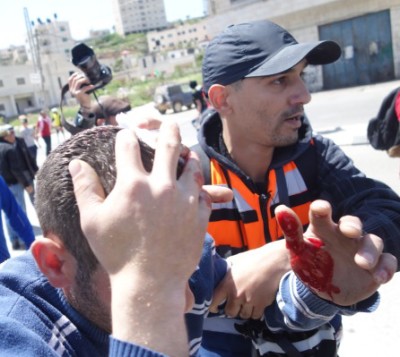 As the demonstration was beginning a 53-year-old Palestinian was shot at several times through the window of his car as he was driving away from Israeli forces. One of these rubber-coated steel bullets struck him in the head. The rubber-coated steel bullet broke several bones around his eye, a piece of the bullet was unable to be immediately removed and so he required surgery.
The level of violence escalated from this point as Palestinian youth threw stones at the Israeli military, while they (the military) fired hundreds of tear gas canisters, rubber-coated steel bullets and live ammunition, injuring many demonstrators. At several points during the demonstration, Israeli forces fired tear gas canisters directly at protesters, both highly dangerous and in contravention to Israeli military procedure, which is shooting them up into an arch to lower the impacted velocity.
A full list of all those injured is currently not available, however at least 10 people were transferred by ambulance to a local hospital in Ramallah to seek medical treatment for their injuries and Red Crescent medics at the demonstration treated many others for varying wounds.
Below is a list of specific injuries that were confirmed both at the demonstration and from ISM activists at the local Ramallah hospital:
- A 21-year-old Palestinian activist was injured after being shot from extremely close range with a sponge-tipped projectile in the back.
- Two ISM activists were also both shot from extremely close range with sponge-tipped projectiles in their backs.
- A 20-year-old Palestinian was shot with a rubber-coated steel bullet in the head.
- A 48-year-old Palestinian journalist was shot with a rubber-coated steel bullet in the left shoulder.
- A Palestinian activist was shot with a rubber-coated steel bullet in the foot.
- A 20-year-old Palestinian was shot with two .22 live ammunition bullets in his foot and in his knee.
- A 30-year-old Palestinian was shot with .22 live ammunition in his right hand.
- Another Palestinian was shot with .22 live ammunition in his left foot; the bullet was unable to be removed.
- 36-years-old Palestinian was shot with two .22 live ammunition bullets, both in his left foot.
- A 31-year-old Palestinian was shot in the left leg with .22 live ammunition.
- A 36-year-old Palestinian was shot with .22 live ammunition in the left foot.
- Mohammed Yasin, a photojournalist from Bi’lin who was wearing a press vest, was shot in his face with a rubber-coated steel bullet and also shot in his stomach with a .22 live ammunition bullet. He remains in hospital in serious condition, as the bullet may have destroyed parts of his liver.
An ISMer who was present at Ofer had this to say: “The Israeli forces present were really violent today. It was impossible to count the amount of tear gas canisters, rubber-coated steel bullets and live ammunition fired; it felt constant for several hours. It became clear many times during the protest that the soldiers were specifically aiming at people, they weren’t trying to ‘end’ the demo, they just wanted to injure as many people as possible. I just don’t understand how people can defend the Israeli state and its military when they use this much violence against unarmed protesters.”
Photo by ISM
Related articles
- PCHR Weekly Report: 3 Palestinians Killed, 34 Wounded by Israeli Troops (imemc.org)
- Week of protests cross the west bank in solidarity with Gaza (nilin-village.org)
Lies and Truths
Qumsiyeh: A Human Rights Web
“Palestine was a land without a people for a People without a land” and “Palestinians do not exist” are not just statements made decades ago by Zionist leaders but are made still today (even a US presidential candidate in 2012). The Israeli newspaper Haaretz (7/15/01) reported that: “… giving his audience (Likud leaders) a bit of advice on how to deal with foreign interviewers (Bejamin Netanyahu said): ‘Always, irrespective of whether you’re right or not, you must always present your side as right.'”
We are all familiar with the incredible PR repeated ad nauseum about Israel. From “security” to “terrorism” to “wanting peace”, we are inundated in corporate media with these images that are divorced from reality. With effort of Zionists, Wikipedia and other internet sites are full of this nonsense. It is not innocuous. Mythologies and lies are used to justify everything from ethnic cleansing to use of white phosphorous on civilians. They are the tools used to keep Jews and people around the world in a state of apathy and to confuse them with things like: Well: these “Arabs” and “Jews” have been fighting and it is almost genetic and nothing can be done to stop it. For an example to the callousness of these lies, see this video and then read the articles and data below that debunks these lies.
This year will mark 64 years since the founding of the state of Israel on the ruins of 540 Palestinian villages and towns. As 7 million of the 11 million Palestinians in the world remain refugees or displaced people denied basic human rights it is more important to debunk myths and lies. I updated this list to now include 64 lies/myths (one for each year). For those who want to further deepen their understanding, I suggest a list of books and documents in my syllabus on human rights and the Israeli-Palestinian struggle.
Please send me your contributions/additions whether in other lies not mentioned here or in further quotes and data on the listed lies. Email contributions to mazin@qumsiyeh.org. Suggested use for the data as it accumulates is a handy place for finding information to develop your knowledge in a way that can be used in meaningful discussions and for sending to chat rooms, list-serves, editors, politicians and others.
As Nathan Chofshi wrote in the Jewish Newsletter: “We came and turned the native Arabs into tragic refugees. And still we have to slander and malign them, to besmirch their name. Instead of being deeply ashamed of what we did and trying to undo some of the evil we committed… we justify our terrible acts and even attempt to glorify them.”(New York, 9 February 1959, cited in Erskine Childers, ‘The Other Exodus’ in Spectator, London, 12 May 1961)
- 1. Palestine was a land without a people for a people without a land
– Palestine was not empty and inhabited by nomadic people
– Zionism at 100: The Myth of Palestine as “A Land Without People” By Allan C. Brownfeld
– Palestine photos of the 1930s
– The Legal Status of Land in Palestine
-Qumsiyeh, Mazin. Sharing the Land of Canaan: Human Rights and the Israeli-Palestinian Conflict. Pluto Press 2004. – Chapter 2“People and the Land” - 2. Israel made the desert bloom/Palestine was destitute
– Statistical data on Palestine before the Nakba
– Who made the desert bloom? - 3. The myths of national origins, chosenness, collective rights for a religion etc
– Archaeology refutes the Bible’s claim to history By Daniel Lazare
– Did Jewish Slaves Build the Pyramids?
– King David Was a Nebbish: ROCKING ISRAEL TO ITS BIBLICAL CORE
– Shattering a ‘national mythology’ By Ofri Ilani
–Israeli Icon under fire
–The Origins of the Jews By Yossi Schwartz
–A mosaic of people: …the DNA evidence by Ellen Levy-Coffman
–Who is a Jew
–Palestine in Wikipedia
–Was there a place called Palestine
Following 70 years of intensive excavations in the Land of Israel, archaeologists have found out: The patriarchs’ acts are legendary stories, we did not sojourn in Egypt or make an exodus, we did not conquer the land. Neither is there any mention of the empire of David and Solomon. Those who take an interest have known these facts for years, but Israel is a stubborn people and doesn’t want to hear about it Ha’aretz Magazine, Friday, October 29, 1999
–more here
-Silberman, Neil Asher and Israel Finkelstein. The Bible Unearthed: Archaeology’s New Vision of Ancient Israel and the Origin of Its Sacred Texts. Touchstone, 2002.
-Greenberg, Gary. 101 Myths of the Bible: How Ancient Scribes Invented Biblical History. Sourcebooks, 2002.
Whitelam, Keith W. The invention of Ancient Israel: The Silencing of Palestinian History. New York, Routledge. 1997
-Raed, Basem. Hidden Histories: Palestine and The Eastern Mediterranean. Pluto Press. 2010.
-Sand, Shlomo (Author), Yael Lotan (Translator). The Invention of the Jewish People. Verso, 2009. - 4. Innocent Jews wanting to “return home” were rejected from the start by local Arabs for no good reason
– Ahad Ha-Am (Asher Ginsberg) wrote the following in 1891: “In all things it is our custom to learn nothing from the past for the future. There is certainly one thing we could have learned from our past and present history: how careful we must be not to arouse the anger of other people against ourselves by reprehensible conduct. How much more, then, should we be careful, in our conduct toward a foreign people among whom we live once again, to walk together in love and respect, and needless to say in justice and righteousness. And what do our brethren in Eretz Israel do? Quite the opposite! They were slaves in their land of exile, and they suddenly find themselves with unlimited freedom, the kind of wild freedom to be found only in a country like Turkey. This sudden change has engendered in them an impulse to despotism, as always happens when ‘a slave becomes a king,’ (Proverbs 30:22) and behold they walk with the Arabs in hostility and cruelty, unjustly encroaching on them, shamefully beating them for no good reason, and even bragging about what they do, and there is no one to stand in the breach and call a halt to this dangerous and despicable impulse. To be sure our people are correct in saying that the Arab respects only those who demonstrate strength and courage, but this is relevant only when he feels that his rival is acting justly; it is not the case if there is reason to think his rival’s actions are oppressive and unjust. Then, even if he restrains himself and remains silent forever, the rage will remain in his heart and he is unrivaled in ‘taking vengeance and bearing a grudge.’ (Leviticus 19:18)” “Emet Me-Eretz Yisrael” (Truth from the Land of Israel), 29 May 1891, 21 Iyyar 5651 Translated by Alan Dowty.
-Mandel, Neville J. The Arabs and Zionism before World War I. Berkeley: University of California Press, 1976.
-Qumsiyeh, Mazin. Popular Resistance in Palestine: A history of hope and empowerment. Pluto Press 2010. Chapter 5 on “Popular Resistance During the Ottoman Rule” - 5. Ben Gurion (who became Israel’s first Prime Minister) and Zionist leadership before 1948 war had no intention to drive the native Palestinians out.
As early as 1917 (when Palestine was 96% Christian/Muslim and 3% Jewish), Ben Gurion stated “Within the the next twenty years, we must have a Jewish majority in Palestine.” (Shabtai Teveth, p. 43). In 1936 he stated that the future Israel must “become a force, and the Arabs respect force..these days it is not right but might which prevails. It is more important to have force than justice on one’s side” (Shabtai Teveth, p. 191). In 1937 he said “The compulsory transfer of the Arabs from the valleys of the proposed Jewish state could give us something which we never had…MORE than a state, government and sovereignty-this is national consolidation in a free homeland.” (Righteous Victims, p. 142). in 1938, he wrote “With compulsory transfer we have vast areas …. I support compulsory transfer. I do not see anything immoral in it. But compulsory transfer could only be carried out by England …. Had its implementation been dependent merely on our proposal I would have proposed; but this would be dangerous to propose when the British government has disassociated itself from compulsory transfer. …. But this question should not be removed from the agenda because it is central question. There are two issues here : 1) sovereignty and 2) the removal of a certain number of Arabs, and we must insist on both of them.” (Expulsion Of The Palestinians, 117). In Feb 1948 “The war will GIVE us the land. The concept of ‘ours’ and ‘not ours’ are ONLY CONCEPTS for peacetime, and during war they lose all their meaning.” (Benny Morris, p. 170 & Expulsion Of The Palestinians, p. 180). And in early May 1948, Ben-Gurion approved establishing the “Transfer Committee” to oversee “the cleaning up (nikui in Hebrew) of the Arab settlements, cultivation of fields and their settlement, and the creation of labor battalion to carry out this work.” (Benny Morris, p. 137). Yitzhak Rabin wrote in his diary soon after Lydda’s and Ramla’s occupation on 10th-11th of July 1948: “After attacking Lydda (later called Lod) and then Ramla, …. What would they do with the 50,000 civilians living in the two cities … What is to be done with the population?, waving his hand in a gesture which said: Drive them out!. ‘Driving out’ is a term with a harsh ring, …. Psychologically, this was on of the most difficult actions we undertook”. (Soldier Of Peace, p. 140-141 & Benny Morris, p. 207) .David Ben Gurion also recognized that “The (upcoming) war will give us the land. The concept of ‘ours’ and ‘not ours’ are only concepts for peacetime, and during war they lose all their meaning”. In his diaries he said regarding Palestinian refugees “We must do everything to ensure they never do return” and to the Sunday Times “The old will die and the young will forget”. Under Ben Gurion’s direction, Transfer Committee was officially set up to effect ethnic cleansing. I don’t understand your optimism. “Why should the Arabs make Peace? If I was an Arab leader, I would never make terms with Israel. That is natural; we have taken their country.” Ben Gurion in 1956 Quoted by Nahum Goldman, former President of World Zionist Congress, in “The Jewish Paradox” Weidenfeld and Nicholson, 1978, p99. - 6. Palestinians want/ed to drive Jews and Israel into the sea
(variant: Israel was willing to share)
–Israel Pushed Palestinians into the Sea
-Today 7 million of the 11 million Palestinians around the world are refugees or displaced people. Those who remain in Palestine are in shrinking areas that as of 2011 consisted of 8.3% of our historic homeland (they include areas in the Galilee, the triangle, the West Bank including East Jerusalem, teh Negev, and the Gaza Strip. The Israeli population according to the Israeli central bureau of statistics is 7,510,000 of which 5,984,500 are “Jews and others” (presumably the others are Druze, Russian non-Jews, and similar categories) and 1,525,500 Palestinian Arabs (1). The population of Palestinians in the West Bank and Gaza is 4 million allowed to live on areas A & B, small parts of the 22% of Palestine occupied since 1967 (2). The total area allowed for Palestinian use is 2.5% of the area of pre-1967 Israel (3) plus areas A & B of the West Bank . In total this comes to 2.5% of 78% and 29% of the 22% that is the West Bank and Gaza (4). The total geographic access to all remaining Palestinians(5.525 million) is thus 1.95%+6.38%=8.33% while the Jewish and other population (Zionist preferred) consists of 5.5 million with access to the remaining lands comprising 91.67% of historic Palestine. What this means is that the Jewish population (most of it new immigrants) has access to about 9 times more land per person than the remaining native Palestinians. If we add the Palestinian refugees outside the country (total Palestinian population per PCBS is 10.9 million), the disparity only gets more pronounced. When you consider that before the foundation of the state of Israel in 1948, 93% of the land was used by Palestinian natives and now only 8.3%, you can see the colossal level of land theft.
References
1) http://www.cbs.gov.il/www/yarhon/b1_e.htm
2) http://www.palestine-pmc.com/details.asp?cat=3&id=1746
3) see http://www.indypendent.org/2007/12/09/israeli-democracy-arabs-need-not-apply
4) http://www.poica.org/pal-in-a-century/pal-in-century.php - 7. Tiny Israel fended off large Arab armies in 1948
–Click here for detailed answer - 8. Land was purchased, Palestinians were not ethnically cleansed
-See this chapter on refugees in my book which analysis all aspects of this including myths about origins of the refugee catastrophe
– Simha Flapan, The Birth of Israel: Myths and Realities. New York, 1987, p. 223, citing Record of the Knesset, vol. 1, 1949, session 43
– Michael Palumbo, The Palestinian Catastrophe: The 1948 Expulsion of a People from their Homeland. London/Boston: 1987, p. 145.
– See also “How refugee land ended up as Jewish National Fund lands” (and it is not “abandoned” it was confiscated illegally and refugees are being prevented from returning to their lands by an illegal and racist apartheid system).
–With all due respect for the ‘blue box’ by Meron Benvenisty in Haaretz. In Hebrew
– THE MYTH that the Arab refugees fled because the Arab radios urged them to do so was analyzed by Erskine B. Childers in the London Spectator May 12, 1961. An examination of British and US radio monitoring records turned up no such appeals; on the contrary there were appeals and “even orders to the civilians of Palestine, to stay put…”
-see also these books
Abu-Sitta, Salman. Google for writings available on the internet
Benvenisti, Meron. Sacred Landscape: The Buried History of the Holy Land Since 1948. Translated by Maxine Kaufman-Lacusta. Berkeley, Los Angeles, London: University of California Press, 2000.
Sami Hadawi. Bitter Harvest: A modern history of Palestine. Olive Branch Press, New York. 1998.
Masalha, Nur. Expulsion of the Palestinians: The Concept of “Transfer” in Zionist Political Thought, 1882-1948. Washington, DC: Institute for Palestine Studies, 1992.
Flapan, Simha. The Birth of Israel: Myths and Realities. New York: Pantheon, 1987.
Morris, Benny. The Birth of the Palestinian Refugee Problem Revisited, 2nd ed. Cambridge, UK; New York: Cambridge University Press, 2004.
Pappé, Ilan. The Ethnic Cleansing of Palestine. Oxford, UK: Oneworld, 2006.
Shlaim, Avi. Collusion Across the Jordan: King Abdullah, the Zionist Movement, and the Partition of Palestine. New York: Columbia University Press, 1988.
Rogan, Eugene L. and Avi Shlaim, eds. The War for Palestine: Rewriting the History of 1948. New York: Cambridge University Press, 2001.
Segev, Tom. 1949, The First Israelis. New York: Owl Books by Henry Holt, 1998. - 9. There was an Exchange of population, Jews came from Arab Countries to Israel in exchange Arabs left Israel
Variant: Jews of Iraq and Arab Countries were persecuted and expelled
-See Jews of Iraq
–and this
–and this dedicated website
(see for example an articulation of this by an AIPAC introduced bill in Congress that demands that “any explicit reference to the required resolution of the Palestinian refugee issue is matched by a similar explicit reference to the resolution of the issue of Jewish refugees from Arab countries.” (http://www.standwithus.com/website/news_post.asp?NPI=50)
– Detailed answers are in resources listed under myth 8 above. In brief, when Israel was founded, there were 600,000 Jews and 1.6 million Christians and Muslims in Palestine.n 700-800,000 Palestinians were made refugees by a deliberate process. It had nothing to do with the subsequent events in Poland, Morocco or any other country. Israel upon its foundi9ng of course was interested in bringing Jewish immigrants from many countries (these are not called refugees er international law). To achieve this, the Zionist movement and the nascent state of Israel used all sorts of tactics from propaganda to incitement to even violence to scare Jews to leave their countries and come to occupied Palestine (the new state of Israel). See for example what happened in Iraq articulated by Iraqi Jew Naeim Gilad in his book “Ben Gurion’s Scandals” (Mossad put bombs in front of Jewish community centers and even a synagogue to scare Iraqi Jews to leave). Also it was the Zionist movement that lobbied the US congress and other Western governments not to increase quoatas for European Jewish migration to those countries so as to leave only one door open: migration to Palestine. - 10. The UN Partitioned Palestine creating a Jewish state, Arabs rejected this and Zionists Accepted
– See The myth of the UN Creation of Israel Detailed analysis
-In 1947, Private land in Palestine was 93% owned by Christian and Muslim Palestinians and only 7% by Jews (and half of those wee not Zionists but native Palestinians). Today many people like to cite one (but only this one) resolution of the UN General Assembly (UNGA 181) which included a RECOMMENDATION of partition. This resolution is not a binding resolution and was never implemented but let us deal with it (there were many others that also were not implemented including the one about the right of refugees to return to their homes and lands).
-The partition resolution was pushed through by the US in violation of the UN Charter and its mandate to allow self-determination of local people. A referendum was suggested but rejected. The nascent Arab states also suggested a form of one state with equality and protection of all minorities but this was also rejected by the Zionists and the Truman administration. Truman reversed Roosevelt’s policies on this issue because he wanted to win election (favors wth the Zionist lobby, see Myth 39 below for details and sources). But in any case, the Zionist leadership did not accept most of the points in UNGA 181 (they rejected the borders, they rejected internationalization of Jerusalem, they rejected the admonition not to remove Palestinians from the Jewish state, they rejected economic union etc). Since there was no leadership of the Palestinian people (decimated by the British by the end of 1939), it is meaningless to speak of rejecting this UNGA resolution by Palestinians. It is true that the newly independent Arab countries (many of them puppets of Britain and France at the time) rejected it. There was good reason to reject it by all people of good conscience (it divided a country against the wishes of its inhabitants). We must also recall that the recommendation was to give 55% of Palestine to a Jewish state and 45% to an aRAB STATE
-The Conciliation Commission got the agreement of both Israel and Arab states on an identical document May 12, 1949 called the Lausanne Protocol. It stated:
“The United Nations Conciliation Commission for Palestine, anxious to achieve as quickly as possible the objectives of the General Assembly resolution of 11 December 1948 (UNGA 194), regarding refugees, the respect for their rights and preservation of their property, as well as territorial and other questions, has proposed to the delegation of Israel and to the delegations of the Arab States that the working document attached hereto (UNGA Partition resolution 181 of 1947) be taken as a basis for discussions with the Commission. The interested delegations have accepted this proposal with the understanding that the exchanges of views which will be carried on by the Commission with the two parties will bear upon the territorial adjustments necessary to the above-indicated objectives.” For full link click here Lausanne, 12 May 1949)
-Israel then rejected the partition boundaries and proposed to take over all of Palestine (but leaving the issue of the West Bank for “discussion”). It also rejected implementing its obligations on the issue of Palestinian refugees .
– In his guidelines to the delegation in Lausanne with respect to negotiating peace, Israeli Minister of Foreign Affairs, Moshe Sharett, pointed out that “it behooves us to do so not with haste and trepidation but by revealing strength and the ability to exist even without official peace”. According to Sharett, since official peace was not a vital necessity, Israel had nothing to lose from procrastination. (Simha Flapan, The Birth of Israel: Myths and Realities. New York: 1987, p. 215)
-In 1970 and 1971, Anwar Sadat approached Israel through the US for terms of peace that were more generous than what Israel accepted a few years later. Israel turned it down and it took a war (October 1973) to jolt them into understanding the limits of military power. - 11. Israel respects holy sites of other religions
-See history erased by Haaretz - 12. Jerusalem “reunification” let people be treated equal regardless of religion
variant: Israel is not Judaizing Jerusalem/Freedom of religion
-See Former Military Jerusalem Governor confirms: Ethnic Cleansing of Palestinians Began Right After the Occupation Arnon Regular, Kol Ha’ir Weekly Magazine, July 26, 2001, Western Jerusalem
-See this detail on status of Jerusalem - 13. The US is an “honest broker”
-see Book by Naseer Aruri: Dishonest Broker for history of us involvement
-“Israel’s dependence on the United States is far Greater than suggested by the sum of $3 billion. Israel’s physical existence depends on the Americans in both military and political terms. Without the US, we would not be equipped with the latest fighter planes and all other advanced weapons. Without the American veto, we would long have been expelled from every international organization not to speak of the UN, which would have imposed sanctions on us that would have paralysed Israel’s International trade, since we cannot exist without importing raw materials. For the same reason, it is wrong to divide the American money up into military aid of $1.8 billion and civilian aid of $1.2 billion. What we are getting is really unmarked dollar bills…” Nehemia Stressler, Haaretz, May 12, 1989 - 14. Islam is intent on taking over the world
A good summary of this Zionist pedaled discourse is in the book “Islamic Imperialism” by Efraim Karsh (2007, Yale University Press, New Haven and London) of which thousands were printed and distributed free to clergy and opinion makers around the US (the Zionist group cryptically named “Institute on Religion and Democracy”, Washington, D.C. was distributing it free). Muslims have been victimized by colonial powers for hundreds of years and have no coherent political or military power. Most of the countries with Muslim majority are ruled by puppets of the US which are now being toppled by popular demand. US forces are in over 140 countries (at least two dozen Muslim majority). A lot of the fundamentalist groups that are now used as evidence of this pan-ISlamic desire to take on the world were created or supported by the West. A religion that is the faith and inspiration of 1.6 billion people is like Christianity (2 billion people). Such a large number of people means by nature that some are bad people who use their religion for bad purposes. But in actually, the big wars in the world had nothing to do with religion (WWI and WWII). People use religion occasionally such as happened during the the Crusades and now with Zionist colonization of Palestine. - 15. “Israel’s centrality in Jewish life” manifest by the creed developed and advocated by Zionists “Am Yisrael Chai” meaning People of Israel (=Jews) live.
– For this deep psychological pathos that puts Jews above any other humans, see these books
Ellis, Marc, Out of the Ashes.
Braverman, Mark. Fatal Embrace: Christians, Jews, and the Search for Peace in the Holy Land. Austin: Synergy Books, 2010.
Kimmerling, Baruch. The Invention and Decline of Israeliness: Society, Society and the Military. Berkeley: University of California Press, 2001.
Meyer, Hajo G. The End of Judaism: An Ethical Tradition Betrayed. G.MeyerBooks, 2007
Nathan, Susan. The Other Side of Israel: My Journey across the Jewish-Arab Divide. New York: Doubleday, 2005.
Reinhart, Tanya. Israel/Palestine: How to End the War of 1948. New York: Seven Stories, 2002.
– also see My one and only Love
– and Response to Rosenfeld - 16. Zionism had a positive influence on world affairs
-Bishara Bahbah and Linda Butler, Israel and Latin America: The military Connection, ST Martin’s Press, NY, 1986
Milton Jamail, Margo Gutierrez, It’s no secret: Israel’s military involvement in central America,
Association of Arab-American University Graduates, 1986
–Zionist Terrorists Arrested Inside Mexican Congress
Israel hand seen in Ivorian clash (and other strives around the world)
-“BERN, Switzerland – The Swiss government said today it had caught Israel’s spy agency trying to bug telephones on the outskirts of the Swiss capital. It was the second highly publicized Mossad bungle to embarrass the Israeli government in recent months. The espionage effort was aimed at foreigners living in Switzerland, federal prosecutor Carla del Ponte said, without elaborating. Del Ponte denied Israeli media reports that Iranian diplomats were the target of the alleged spying. She said the targets were not diplomats. Switzerland has demanded an apology from Israel, the Foreign Minstry said. It said it had had no immediate response from Israel. … At a news conference in Bern, del Ponte said five Israeli agents were detained as they tried to plant the bugs a week ago. All but one were released and are believed to have left the country. In Jerusalem today, Israeli Prime Minister Benjamin Netanyahu confirmed that an Israeli citizen had been arrested in Switzerland, but declined to comment further. ” Another mess for Mossad: Israeli spy agency accused of bugging Swiss phones. The Associated Press 26 February 1998. by Irene Harnischberg
-“A senior Israeli intelligence officer says that the hit team arrested in Switzerland were on the trail of two businessmen with Hezbollah sympathies. As contacts continued between Israel and Switzerland yesterday to free a Mossad agent detained in Berne last month, a senior Mossad officer said the true purpose of the bungled operation had been assassination and not bugging as claimed. ” March 3 1998. Times of London
– There is some evidence that World War One was expanded instead of ending in peace because Zionists pushed Brits and French to continue promising to get US to enter the war IF THEY gave them Palestine after the war. Samuel Landman, a noted British Zionist, carefully articulated in 1936 the machination of the leading Zionists on this front (http://desip.igc.org/1939sLandman.htm Samuel Landman Great Britain, The Jews and Palestine , 1936 New Zionist Press)
Michael Berkowitz, 2003. Nationalism, Zionism and ethnic mobilization of the Jews in 1900 and beyond. Brill Academic Publishers
Balfour was a reward for the Zionists getting the US to enter the war entry The Balfour Declaration and the Zimmermann Note By John Cornelius, Washington Report on Middle East Affairs, August/September 1997, pages 18-20 http://www.wrmea.com/backissues/0897/9708018.html
Lord Sydenham of the British House of Deputies replied prophetically to Balfour: “… the harm done by dumping down an alien population upon an Arab country – Arab all around in the hinterland – may never be remedied … what we have done is, by concessions, not to the Jewish people but to a Zionist extreme section, to start a running sore in the East, and no one can tell how far that sore will extend.” (UN: The Origins And Evolution Of Palestine Problem, section IV)
-see also The origin of the Balfour Declaration
-Israel’s industrial and military espionage in the US - 17. The 1967 war was a defensive war by Israel against enemies who wanted to destroy it
–Alan Hart on the 1967 propaganda and myth
–http://www.salon.com/opinion/feature/2007/06/04/six_day_war/
-Moshe Dayan described kibbutz residents who pressed Israel to take Syria’s Golan Heights in a 1997 New York Times interview: “They didn’t even try to hide their greed for the land … We would send a tractor to plow some area where it wasn’t possible to do anything, in the demilitarized area, and knew in advance that the Syrians would start to shoot. If they didn’t shoot, we would tell the tractor to advance further, until in the end the Syrians would get annoyed and shoot. And then we would use artillery and later the air force also, and that’s how it was … The Syrians, on the fourth day of the war, were not a threat to us.”
-From POLITICIDE, Ariel Sharon’s War Against the Palestinians, by Baruch Kimmerling, Verso, 2003, pages 57-59):
“In May 1967, Gamal Abd al-Nasser made his biggest political miscalculation. After a long and bloody intervention in the Yemeni civil war, he had lost prestige in the Arab world. In order to regain that prestige and affirm Egyptian sovereignty, he made two spectacular moves: he ordered Egyptian military forces to cross the Suez Canal and, at the same time, demanded the withdrawal of UN forces deployed along the 1957 ceasefire lines. After the Yemeni debacle, the Egyptian army was certainly not ready for a war with Israel, but the Israeli General Staff had planned for many years to destroy the Egyptian military, which had been re-equipped and restructured by the Soviet Union after the 1956 War. Nasser’s move was exploited by the Israeli Government, which depicted it as a causus belli and a real threat to Israel’s security. The Israeli armed forces mobilized their full reserve system. While the two armies were positioned face-to-face, the Israeli Government, headed by Levy Eshkol, hesitated, doubting both the reality of the Egyptian threat and the necessity of resolving it militarily rather than diplomatically. Another consideration was the severe economic hardship and social strain that would result from the prolonged mobilization of almost the entire male labor force. While the government weighed its options, military officers (including Sharon) seized the opportunity to convince the public that Israel faced a genuine threat to its existence. Demonstrations called on Eshkol to quit. The increasing public pressure in addition to the hidden pressure from many on the general staff led to the establishment of a new war-oriented Cabinet that included the hawkish Moshe Dayan as Minister of Defense and, for the first time, members of the ultra-nationalist party Herut, headed by Menachem Begin. The war was so well planned and prepared that at dawn, on June 5, the Israeli military intelligence and air force knew the precise location of every Egyptian, Syrian, and Jordanian aircraft and destroyed most of them on the ground in several hours. Sharon, in his autobiography, briefly mentioned that “on the morning of June 5, Israel’s air force was to launch a pre-preemptive attack on Egypt’s airfields.” When Israeli infantry and tank brigades attacked Egyptian military concentrations, fortifications, and bases, they already had almost absolute air superiority. One of the most significant myths rooted in the collective memory of both the Israeli and Western public is that during the 1967 War (or as the Israelis arrogantly called it, “the Six Day War”), Egypt and Syria attacked Israel, a belief that is used to justify the legitimacy of the occupation to this day.
-Both Yitzhak Rabin and Ezer Weizman clearly allude in their autobiographies to the fact that, prior to the attack of June 1967, the Israeli general staff organized a putsch, and barred any and all political solutions to the crisis. Rabin, Chief of Staff, admitted that: “Nasser didn’t want war. The two divisions he sent to Sinai would not have been sufficient to launch an offensive war He knew it and we knew it.” (Le Monde, February 28, 1968).
Levy Eshkol himself admitted that “the Egyptian layout in Sinai and the general build up there testified to a militarily defensive Egyptian set-up, south of Israel” (Yediot Ahronot, October 16, 1967).
-On August 8, 1982, Prime Minister Menachem Begin, defending the invasion of Lebanon, said: “In June 1967 we again had a choice. The Egyptian army concentrations in the Sinai did not prove that Nasser was really about to attack us. We must be honest with ourselves. We decided to attack him.”(New York Times, August 21, 1982).” - 18. The International Solidarity Movement supports violence
– see Wikepedia, a bit biased but has links
-See The ISM Website - 19. The Road map is an international effort for peace in the Middle East and Palestinians reject it
-The road map is 2218 words and lacks four key words: International Law and Human Rights. It was drafted in the State Department supposedly based on the speech Bush gave in 2002 (http://www.whitehouse.gov/news/releases/2002/06/20020624-3.html ). Bush’s speech writers at the time were both Zionists: Michael Gerson and David Frum.
-The writings of Karen Kwiatkowski who retired from the Pentagon clearly documents the stranglehold of Zionist “group think” on US policy. It is claimed by official US sources that the State Department wrote the Road Map. If that is the case, this would fall under the purview of then under secretary for Political Affairs (from 2001 to 2005) Marc Grossman who is also Zionist. Other Zionists who were likely involved or at least had to give their blessings include Elliott Abrams (National Security Council Advisor) and Richard Haass (Director of Policy Planning at the State Department).
-Despite this bias, Arafat and the PNC accepted the road map and the Palestinian Authority obeys it (getting back in line under threat of withholding their tax money occasionally). Sharon said he would accept it with 14 reservations that basically make it meaningless. The Israeli government violated it regularly most conspicuously on the issue of expanding settlements and refusing to keep the territorial integrity of the WB and Gaza: restrictions on movement etc increased even started to build a wall which is contrary to this document. - 20. Palestinians militants use human shields and send their kids to be killed for propaganda
-such offensive and racist statements are beneath contempt as no mother or father or human being sacrifices their children or their relatives for public relations
–The reality - 21. Arabs only understand the language of force
–Check this - 22. Zionists teach peace and democracy, Palestinian Society teaches hate
– Anti-Arab racism and incitement in Israel
– Nathan Brown of George Washington University investigated Palestinian textbooks, his full report is posted here
– see also related Report by Dr. Fouad Moughrabi
– See Education and hate Assay on who teaches what to whom, July 2004. Also published in French as Education et haine
-A study by The Washington Report on Middle East Affairs concluded Israeli textbooks and children’s literature promote racism and hatred toward Palestinians and Arabs. (See http://www.washington-report.org/backissues/0999/9909019.html.)
Jewish Settlers’ on the record: racism and bigotry funded by US taxpayers
– see http://www.qumsiyeh.org/nuritpeledelhanan/ speeches and articles
– Former Chief Rabbi advocates genocide (this is not an average Israeli Rabbi, this person carries lots of weight and the position was created based on Israeli state laws)
http://electronicintifada.net/v2/article6987.shtml
– The myth of incitement in Palestinian schools (this is an oft repeated smear by Zionists trying to distract world attention from continued colonization activities and ethnic cleansing of native Palestinians)
http://www.palestine-pmc.com/details.asp?cat=1&id=911
http://fpc.state.gov/documents/organization/47093.pdf
http://www.ifamericansknew.org/download/pal_children.pdf
http://www.geocities.com/nathanbrown1/CAJE.htm
– http://www.jpost.com/servlet/Satellite?cid=1180527966693&pagename=JPost/JPArticle/ShowFull
– Israel is as a Theocratic state whee there is no separation between state and religion, see http://www.jewishvirtuallibrary.org/jsource/Politics/relig.html
– Yesha Rabbinical Council: “During time of war, enemy has no innocents Ma’ariv 30 July 2006 “The Yesha Rabbinical Council announced in response to an IDF attack in Kfar Qanna that “according to Jewish law, during a time of battle and war, there is no such term as ‘innocents’ of the enemy.” All of the discussions on Christian morality are weakening the spirit of the army and the nation and are costing us in the blood of our soldiers and civilians,” the statement said. (Efrat Weiss) ” http://www.ynetnews.com/articles/1,7340,L-3283720,00.html (Yesha is the name given to the council that oversees the 450,000 settlers in the West Bank)
– See also “Israel’s house of horrors” By Ali Abunimah http://electronicintifada.net/v2/article6975.shtml
– Harvard Lawyer Alan Dershowitz’ calls for War crimes
Martin Sherman calls for ending Palestinian rights by giving them money and relocating them all
-“Israel should have exploited the repression of the demonstrations in China, when world attention focused on that country, to carry out mass expulsions among the Arabs of the territories.”Benjamin Netanyahu told students at Bar-Ilan University in 1989
– “In the old city of Jerusalem they (Palestinians) are swarming like ants. They should go to hell — and the Messiah will speed them on their way,” Rabbi Ovadia Yossef, leader of the influential Shas party in a weekly sermon broadcast on army radio (Reuters, July 27, 2001).
Ovadia Yosef: “The role of the Gentiles – is to serve the Jews”
-Another investigation by Le Monde Diplomatique concluded the textbooks’ real error was to refute Israel’s version of Palestinian history. (Log onto http://mondediplo.com /2001/07/11textbook.)
-While many Israelis and supporters terrorize Palestinians, they demonize all Palestinians as terrorists. While they teach intolerance and hate, they claim Palestinians teach their kids hate. Human Rights Watch documented the discrimination against Palestinian-Arab children in Israel’s schools. (Log onto http://www.hrw.org/reports/2001/israel2/).
-An article by Dr. Peled-Elhanan of the Hebrew University put it this way: “Palestinians, both the lawful citizens of the state and the ones living under occupation, are presented stereotypically, in racist vocabulary and racist visuals, as a demographic threat . . . their discrimination is represented as a national necessity. . . occupied
territories are depicted as part of the state of Israel but their Palestinian inhabitants, cities and cultural sites are missing from maps, photographs and graphs. The books promote the ideal of an Arab-free land as a condition for the existence of the Jewish state.”
– Israel’s education system http://www.wakeupfromyourslumber.com/node/2507
-Israeli company fires 21 Arab employees at once and gets away with its racism http://972mag.com/israeli-supermarket-fires-21-arab-employees-at-once/ - 23. Palestinians don’t use nonviolent resistance but instead blow themselves up with innocent civilians
See the detailed in my book Popular Resistance in Palestine
Statement to Israeli public on non-violence - 24. Israel takes great care not to harm civilians and never targets civilians; Israeli army most ethical army
– See Targeting Civilians
– “As a young soldier serving in the Israeli army, I was ordered to commit grave human rights violations in the Occupied Palestinian Territories. My platoon meted out collective punishment on Palestinian communities, shot and killed unarmed Palestinian civilians, and enforced prolonged curfews on Palestinian villages. I witnessed the arbitrary destruction of Palestinian houses, property and agricultural land. These acts were not rare occurrences, nor were they the result of overly cruel soldiers. It was part of the norm; a habit that an Occupation soldier gets used to doing. These daily occurrences constituted, as I later understood, war crimes.” http://alawda.rso.wisc.edu/why.htm
– “I participated in the fighting on Temple Mount. I was and also shot at the demonstrations in Umm Al Fahm. But the worst event was the riots in Tiberias. Hundreds of violent Jews closed a main road and also threw firebombs at us. They almost set our car on fire, but luckily we put the fire out on time. There was stone throwing, firecrackers, and glass bottles were thrown and broke between our feet. They crossed all the red lines, my people attacked me with enormous force, and it hurts. The violence there was just like in Umm Al Fahm. According to the open-fire regulations, when firebombs are thrown, there is authorization to shoot. But we handle Jewish riots differently. To a demo like this we know in advance that we come without weapons. These are the orders from above, and we used only gas”. Tal Etlinger, a border police soldier, Yediot Aharonot, 17/11/2000 (translated by Irit Katriel, iritka@internet-zahav.net.il)
– “The Israeli soldiers who volunteers to serve in the occupied territories are considered heroes, while in truth their volunteering can be compared to that of German volunteers who served in the SS” Moshe Zimmerman, at the time Chair of Department of Germanic Studies at the Hebrew University of Jerusalem, interview Yerushalayim, 4/28/1995. From the “Founding Myths of Modern Israel by Roger Garaudy
– We killed (Palestinian) police for revenge, Israeli soldiers confess By Donald Macintyre in Jerusalem, The Independent
Maariv in Hebrew published admissions of Israeli soldiers to committing war crimes
– Palestinians Continue to be used as human shields (Video): http://www.youtube.com/watch?v=tomdEkOgdKU
– Use of Palestinians as human shields
– Amnesty International 2006 report on Israeli violations of Human Rights
– Article by Jonathan Cook on Targeting Civilians http://mostlywater.org/node/8568
– Israeli army forces women to strip at checkpoints http://www.imemc.org/article/49215
– Israel hits center of Red Cross http://whatreallyhappened.com/IMAGES/ambulancehit.jpg
– American NLG Lawyers Findings that Israel Violated International Law, US Domestic Law in Gaza
– Statistics on number of people killed
– Israeli who revealed “medieval-style” torture of Palestinians faces virulent backlash - 25. Israel attacks infrastructure only if it is linked to terrorists
– Lebanon war
– Amnesty Report
– Wanton Destruction of Infrastructure and homes - 26. The Deir Yassin Massacre (one of hundreds committed during the ethnic cleansing of 1947-1949) was committed by rogue elements and not mainstream Zionists
– What happened in Deir Yassin
– When the Haganah command learned of the plan of the Irgun and Lehi to conquer Deir Yassin, David Shaltiel, Haganah Commander in Jerusalem, asked them to coordinate the timing of the operation with the scheduled renewed assault on Kastel. He dispatched identical letters to Mordechai Raanan (Irgun Commander in Jerusalem) and Yehoshua Zetler (Lehi Commander in Jerusalem), in which he gave their operation his approval:
To: Shapira (code-name of Zetler)
From: District Commander
I have learned that you intend to carry out an operation against Deir Yassin. I would like to call your attention to the fact that the conquest and continued occupation of Deir Yassin is one of the stages in our overall plan. I have no objection to your carrying out the operation on condition that you are capable of holding on to it. If you are incapable of doing so, I caution you against blowing up the village, since this will lead to the flight of the inhabitants and subsequent occupation of the ruins and the abandoned homes by enemy forces. This will make things difficult rather than contributing to the general campaign, and reoccupation of the site will entail heavy casualties for our men. An additional argument I would like to cite is that if enemy forces are drawn to the place, this will disrupt the plan to establish an aerodrome there. Ezel website - 27. The massacre of Sabra and Shatila in 1982 in Lebanon was not the responsibility of the Israelis
– Details on website indict Sharon
– Robert Fisk explains
– Qumsiyeh Review of book on subject - 28. The lies and distortions about the Lavon affair
– From Mideastweb files
– Israel’s second Prime Minister Sharret had interesting admissions in his diary including about the Lavon affair, in which Israeli provocateurs exploded bombs in U.S. cultural centers and diplomatic establishments in Cairo and Alexandria in 1954 after being told “to break the West’s confidence in the existing (Nasser) regime… The actions should cause arrests, demonstrations and expressions of revenge. The Israeli origins should be totally covered.” The idea was to provoke mayhem, increase Jewish immigration and with other acts eventually provoke a war to acquire more territory (which happened in 1967). As retired US foreign service officer Richard Curtis wrote in the WRMEA (March 18, 1985): “When the provocateurs (young Egyptian-born Jews trained in Israel and returned to their homeland) were caught and tried, Sharett publicly denied Israeli complicity and accused the Egyptians of ‘vicious hostility to… the Jewish people.'” But in his diaries Sharett not only admitted the affair but lamented Israel’s “unleashing of the basest instincts of hate and revenge…” In another part of the diary we see this interesting tidbit: “Ben Gurion reported to the cabinet … how our four youngsters (Israeli paratrooper reservists) captured the Beduin boys one by one, how they took them to the wadi, how they knifed them to death one after the other… When I arrived in Tel Aviv an officer… came to tell me that the whole revenge operation was organized with the active help of Arik Sharon, the commander of the paratroopers battalion.” - 29. Martin Luther King Jr supported Israel and Zionism and equated criticism of Zionism with anti-Semitism
See Martin Luther King - 30. Israel was trying to save Arab Jews
– Details on Arab Jews
See also the Lavon Affair (up) - 31. Palestinians and other Arabs largely rejoiced after 9/11 attacks/Variant is that Muslims do not denounce terrorism
– See Arabs and Palestinians on September 11]
– 9/11 statements - 32. Barak Made a generous offer at Camp David, Arafat rejected it and went back and started a bloody intifada
– See Robert Malley’s Fictions About the Failure at Camp David
– Uri Avnery on 12 conventional lies [http://www.palestineremembered.com/Acre/Palestine-Remembered/Story658.html]
– Gush Shalom data
– EI myth 5
– Electronic Intifada
– Cactus 1948
– IAP
– Mideast Facts
– Gush Shalom
– Pal Remembered
– Ottawa summary
– Aaron David Miller, a senior negotiator on the Clinton team at Camp David and an Orthodox Jew revealed that rather than serve as a true mediator in peace negotiations, successive U.S. administrations including Clinton’s have acted as “Israel’s attorney.” Kathleen Christison, “Anatomy of A Frame-Up: Camp David Redux, Counterpunch, August 15, 2005. On line here
– Press release showing that the sides were really close to hammering out an agreement at Taba which was a continuation of the negotiations until Israel withdrew (not Palestinians)
– “The pre-eminent obstacle to peace is Israel’s colonization of Palestine. There were just a few hundred settlers in the West Bank and Gaza when I became president, but the Likud government expanded settlement activity after I left office. President Ronald Reagan condemned this policy, and reaffirmed that Resolution 242 remained “the foundation stone of America’s Middle East peace effort.” President George H.W. Bush even threatened to reduce American aid to Israel. Although President Bill Clinton made strong efforts to promote peace, a massive increase of settlers occurred during his administration, to 225,000, mostly while Ehud Barak was prime minister. Their best official offer to the Palestinians was to withdraw 20 percent of them, leaving 180,000 in 209 settlements, covering about 5 percent of the occupied land.” President Jimmy Carter
-“The narrative blaming Yasser Arafat now joins a whole string of myths: the Tel Hai myth, the myth of the runaway refugees in 1948, the myth of the War of Independence as a defensive war that broke out because of an invasion by Arab armies, the myth of the few against the many, and the myth of the liberation of the homeland from the British boot – just to mention a few of the many myths that have been created here to deal with the reality that gave birth to many crises and second thoughts about the situation.” Challenging the Camp David myth, By Meron Benvenisti. Ha’aretz, Thursday, August 02, 2001 - 33. Christians, Jews and others should support Israel because of the Promised land/Bible issues.
-See Web site on Christian Zionism
– Hagee preaches support for Israel
– see also these Links of Palestinian Christian and others who truly follow Christ’s teachings - 34. The people of the West Bank benefited from Israeli rule
– In September 1967 Moshe Dayan told senior staff in the Israeli Occupation Army in the West Bank that some 200,000 Palestinian Arabs had left the West Bank and Gaza Strip: “we must understand the motives and causes of the continued emigration of the Arabs, from both the Gaza Strip and the West Bank, and not to undermine these cause after all, we want to create a new map.” (Benny Morris, Righteous Victims, p. 338).
-“The guideline of our policy has always been the idea that a permanent situation of no peace and a latent war is the best situation for us, and that it must be maintained at all costs. … we are becoming stronger year by year in a situation of impending conflict where it is possible that actual fighting may break out from time to time. Such wars will usually be short and the results guaranteed in advance, since the gap between us and the Arabs is increasing. In this way we shall move on from occupation to further occupation. … this criminally mischievous policy has led us into the crisis we are living through today…We have not been seeking peace for twenty-five years — all declarations to that effect have been no more than coloured statements or deliberate lies. There is of course no assurance that we could have made peace with the Arabs if we had wanted to. However, it has to be heavily emphasized that we have not only made no attempts to seek peace, but have deliberately and with premeditation, sabotaged every possibility of doing so.” (Yeshayahu Leibowitz, 30 November 1973)
-From former Israel Attorney General Michael Ben Yair who wrote on 3/3/2002: “We enthusiastically chose to become a colonial society, ignoring international treaties, expropriating lands, transferring settlers from Israel to the occupie territories, engaging in theft and finding justification for all these activities. Passionately desiring to keep the occupied territories, we developed two judicial systems: one – progressive, liberal – in Israel; and the other – cruel, injurious – in the occupied territories. In effect, we established an apartheid regime in the occupied territories immediately following their capture. That oppressive regime exists to this day.” - 35. Christians are leaving Palestine because of persecution by Muslims not because of Zionist occupation and colonization
– See links and resources from all main Palestinian Christian denominations and other Christians around the world.
– The Christian presence in Palestine under Israeli military rule. A short clip from the award-winning film from Occupation 101 titled Voices of the Silenced Majority.
– Palestinian Christians make action against construction of Israel’s separation barrier on Palestinian Christian lands in Wadi Nis village (South of Bethlehem area,) marking Good Friday
-Christians and Muslims join hands to march on Palm Sunday insisting on right of freedom of movement. Many were arrested.
Example here
and here
and here
– In Arabic, report about Christianity in the Middle East - 36. The 1967 Occupation follows International law
-Aruri, Naseer H., ed. Occupation: Israel over Palestine, 2nd ed. Belmont, MA: AAUG Press, 1989.
-Benvenisti, Eyal “The Applicability of Human Rights Conventions to Israel and to the Occupied Territories”, Israel Law Review, Vol. 26, 1992, pp. 24-35
-Convention relative to the Protection of Civilians Persons in Time of War, Geneva, 12 August 1949.
-Also see General Assembly Resolution 64/92, Applicability of the Geneva Convention relative to the Protection of Civilian Persons in Time of War, of 12 August 1949, to the Occupied Palestinian Territory, including East Jerusalem, and the other occupied Arab territories, 19 January 2010
-International Court of Justice, Legal Consequences of the Construction of a Wall in the Occupied Palestinian Territory. Advisory Opinion, 9 July 2004
-Nasrallah, Rami and Rassem Khamaisi (ed.) The Jerusalem Urban Fabric. Jerusalem: A publication of the International Peace and Cooperation Center, 2003
-Playfair, Emma, ed. International Law and the Administration of Occupied Territories: Two Decades of Israeli Occupation of the West Bank and Gaza Strip. Oxford, UK: Clarendon; New York: Oxford University Press, 1992.
-Qafisheh, Mutaz M. The International Law Foundations of Palestinian Nationality (Boston and the Hague: Brill, 2008).
-Segal, Rafael and Eyal Weizman (editors). A Civilian Occupation: The Politics of Israeli Architecture. Babel (Tel Aviv) and Verso (London). 2003.
-Shehadeh, Raja. From Occupation to Interim Accords: Israel and the Palestinian Territories. London; Boston: Kluwer Law International, 1997 - 37. Iran’s President is a Jew-hating, Holocaust-denying, Islamo-fascist who stated he will “wipe Israel off the map”
-The actual quote from Ahmedinujad: Imam (Khomeini) ghoft (said) een (this) rezhim-e (regime) ishghalgar-e (occupying) qods (Jerusalem) bayad (must) az safheh-ye ruzgar (from page of time) mahv shavad (vanish from).
An article explaining the effort to put words in his mouth
and this
and another analysis - 38. Zionists did not push for the war on Iraq and the conflict with Iran is also about US security not Zionist perceived self-interest.
–Letter by leading Zionists and neoconservatives asking US to attack Iraq and change its regime January 26, 1998
-See Book by Mearsheimer and Walt “Israel Lobby”
-“Groups Push For Sanctions, Fear US Will Falter on Iran,” By Ori Nir, Forward – Sep 1, 2006 issue
-“Why would Iraq attack America or use nuclear weapons against us? I’ll tell you what I think the real threat and actually has been since 1990 – it’s the threat against Israel.. And this is the threat that dare not speak its name, because the Europeans don’t care deeply about that threat, I will tell you frankly. And the American government doesn’t want to lean too hard on it rhetorically, because it is not a popular sell.” Pentagon -Defense Intelligence Board Member Philip Zeikow, 10 September 2002
–Declassified Documents show early manipulation of US media and attempts to shape public opinion
–Contrary to Chomsky, the US has no interest in supporting Israel
-Challenging the power of the Israeli lobby: what should be done
-VIDEO: from Jewish Telegraphic Agency: The power of AIPAC and what they pushed for
-Lengthy but important analysis of Israeli power - 39. Israel is beneficial to US interests in the Middle East
– Cost of Israel to the US
– Declassified: Massive Israeli Manipulation of US Media Exposed
– “Israel secretly maintains a large and active intelligence-gathering operation in the United States that has long attempted to recruit U.S. officials as spies and to procure classified documents, U.S. government officials said.” Los Angeles Times, 3 September 2004
– see target=new>[The Lobby]
– [Michael Lind] Article on the Lobby’s negative influence
– Jewish Groups To Challenge Ethics Reform, By Nathan Guttman, Forward [http://www.forward.com/articles/jewish-groups-to-challenge-ethics-reform/]
Does the Israeli Tail Wag the American Dog?
– If the United States is unable to distinguish the world’s or its own real needs from those of another state and that state’s lobby, then it simply cannot say that it always acts in its own best interests. By Kathleen and Bill Christison (ex CIA Analysts) [http://www.informationclearinghouse.info/article17217.htm]
– Is Americans’ support of Israel unshakeable? By Linda S. Heard, Online Journal
– Israel and US interests aren’t identical By Antony Loewenstein [http://www.onlineopinion.com.au/view.asp?article=4387]
– [http://www.muckrakerreport.com/]
– Excerpt from the secret CIA assessment released November 28, 1947 on the eve of the UN “vote” and titled “The Consequences of the Partition of Palestine” (Declassified document)
“Armed hostilities between Jews and Arabs will break out if the UN General Assembly accepts the plan to partition Palestine into Jewish and Arab states…. The Jews are expected to be able to mobilize some 200,000 fighters in Palestine.. The Jewish armed groups in Palestine are well equipped and well trained in commando tactics. Initially they will achieve marked success over the Arabs because of superior organization and equipment… The US by supporting partition has already lost much of its prestige in the Near East In the event that partition is imposed on Palestine, the resulting conflict will seriously disturb the social, economic, and political stability of the Arab world, and US commercial and strategic interests will be dangerously jeopardized. … The poverty, unrest, and hopelessness upon which Communist propaganda thrives will increase throughout the Arab world. (and later in the document, p. 6) US prestige on the other hand has steadily decreased with each new indication that the US supports the Zionists. The good will enjoyed by the US at the time of the Rosevelt-Ibn Saud Conference and following backing of Lebanese and Syrian claims for independence was short lived as a result of President Truman’s support of Jewish immigration to Palestine and of the Anglo-American Committee report. Because of the long standing cultural ties between the US and the Arab world, the friendly role that the US played in the achievement of Syrian and Lebanese independence, the partial dependence of certain Arab states on oil royalties from US companies, and the promise of increased royalties in the future, the Arab states would like to maintain friendly relations with the US. … Little of this (positive) development will be possible, if the US supports a Jewish state in Palestine.”
[http://tinyurl.com/2c4kh3]
Or original here
– Truman helped establish Israel (actually was the critical element in arm-twisting countries to vote for partition which was contrary to the UN Charter of self determination). Zionist propaganda has it that this support was because of deeply held beliefs in that cause (Jews were persecuted so need a country of their own). But facts are otherwise. Truman himself admitted in a private cabinet meeting that he is doing it for money and votes. – “when the election was coming up in 1946 in New York, the group of New York Jews called upon Mr. Truman. [Alan Taylor, op. cit. p.93] Emmanuel Cellar was the head of this committee. Rabbi Steven Wise and several others were in it. They called upon Mr. Truman and said, “We have just been talking with Mr. Thomas Dewey. He is willing to come out and declare for a Jewish state, and we are going to turn our money and urge the Jews to vote for him unless you beat him to it.” Then Emmanuel Cellar pounded upon Mr. Truman’s desk and said, “And if you don’t come out for a Jewish state we’ll run you out of town.” This, I’m sure, is the threat that Mr. Truman refers to in his book, saying, “The extreme Zionists threatened me.” They were Emmanuel Cellar, Rabbi Steven Wise, etc. These are not the extreme Zionists, these are just the run of the mill Zionists. What Mr. Truman did was to cave in to these threats that they would support Mr. Dewey. In that way he got the Jewish money and the Jewish vote. His decision was not made from the point of view of what was going to result in the Middle East, but what was going on in the United States.” Edwin M. Wright at the time of the State Department (source [http://www.trumanlibrary.org/oralhist/wright.htm] )
– See also [http://hnn.us/roundup/entries/26309.html] and Truman diaries which show how he really thought:
[http://www.washingtonpost.com/ac2/wp-dyn/A40678-2003Jul10]
-Israel stole US nuclear technology [http://www.nytimes.com/2007/11/28/washington/29nixon.html]
– “How the Israel Lobby Took Control of the U.S. Congress” (most people have no idea how methodically AIPAC & Co. went about this):
http://criminalstate.com/2009/07/how-the-israel-lobby-took-control-of-us-foreign-policy/
– A longer analysis appears in the introduction to Guilt By Association which appears on the Criminal State website (just above Chomsky’s blurb):
http://criminalstate.com/guilt-by-association/
– Prof. Wm. Robinson stood up to the ADL Thought Police at UC Santa Barbara when he refused to fold his hand (he’s Jewish): http://criminalstate.com/2009/07/treason-in-plain-sight/
Note the background role of UC President Mark Yudof and his wife. In an Information Age, if the conduct described is not treason, what is? - 40. Israel accidentally attacked the USS Liberty in International waters because it was mistaken for an Egyptian ship
– CIA Director Richard Helms said: “The board of inquiry (concluded) that the Israelis knew exactly what they were doing …”
See [http://ussliberty.org] for lots of other data including testimony of survivors.
– Alison Wier on USA Today and USS Liberty [http://counterpunch.org/weir06232007.html]
– WHY SHOULD MY FAMILY STILL LOVE ME?
[http://ussliberty.wordpress.com/2008/09/02/why-should-my-family-still-love-me/] - 41. Zionist in America are loyal to the US Constitution and have no Tribal allegiances to contradict US interests
– Secret trials for terrorists, says US judge: A TOP-RANKING US judge has stunned a conference of Australian judges and barristers in Chicago by advocating secret trials for terrorists, more surveillance of Muslim populations across North America and an end to counter-terrorism efforts being “hog-tied” by the US constitution. Judge Richard Posner, a supposedly liberal-leaning jurist regarded by many as a future US Supreme Court candidate, said traditional concepts of criminal justice were inadequate to deal with the terrorist threat and the US had ‘over-invested’ in them…”
[http://rawstory.com/showarticle.php?src=http%3A%2F%2Ftheaustralian.news.com.au%2Fstory%2F0%2C20867%2C21986986-2702%2C00.html%3F]
– The New Israel Lobby in Action (David Noble)
http://canadiandimension.com/articles/2005/11/01/209/
– See this cartoon by Bendib on the clamour of presidential candidates to suck up to the Zionist lobby.
http://www.bendib.com/newones/2007/june/small/6-9-The-Race.jpg - 42. Rachel Corrie was accidentally killed while protecting the house of terrorist
[http://www.rachelcorrie.org/]
[http://www.criticalconcern.com/rachelcorrie.html]
[http://seattlepi.nwsource.com/opinion/309199_corrierebut28.html]
[http://www.amnestyusa.org/document.php?id=DF899DD539B2344385256CEC007008D5] - 43. Israel did not deliberately attack a UN Compound in Qana, Lebanon. “We want it to be clear it was not a deliberate attack because Israel would never target a UN force. It is not part of our policies; it is not part of our values” Israel’s Foreign Minister Tzipi Livni.
– From Robert Fisk’s April 19, 1996 article “Massacre in Sanctuary” in The Independent (UK): “Qana, southern Lebanon – It was a massacre. Not since Sabra and Chatila had I seen the innocent slaughtered like this. The Lebanese refugee women and children and men lay in heaps, their hands or arms or legs missing, beheaded or disemboweled. There were well over a hundred of them. A baby lay without a head. The Israeli shells had scythed through them as they lay in the United Nations shelter, believing that they were safe under the world’s protection. Like the Muslims of Srebrenica, the Muslims of Qana were wrong. In front of a burning building of the UN’s Fijian battalion headquarters, a girl held a corpse in her arms, the body of a grey- haired man whose eyes were staring at her, and she rocked the corpse back and forth in her arms, keening and weeping and crying the same words over and over: “My father, my father.” A Fijian UN soldier stood amid a sea of bodies and, without saying a word, held aloft the body of a headless child. “The Israelis have just told us they’ll stop shelling the area”, a UN soldier said, shaking with anger. “…
[http://www.bintjbeil.com/E/occupation/robert_fisk_qana.html] - 44. The “security barrier” Israel is building is not a land grab and is about Security
Facts about “the wall”
-After most of the residents were ethnically cleansed, a wall of fences was built around remaining 3500 Palestinians in Al-Majdal to starve them until they agreed to leave “voluntarily” in 1951 (long after the end of the 1948 war). The city was renamed Ashqelon
-The wall around Gaza was completed before even the first Palestinian suicide bombing
-The wall was less than 25% complete when Hamas made a political decision to stop bombings and run for elections in 2006. Hamas held on to its end of this even though they were not allowed to govern.
-International court of justice ruled it illegal regardless of any consideration since it is built in the occupied areas (just like the colonies illegal and subject to 4th Geneva convention)
-Even today in 2013, the wall is actually less than 70% complete; nearly 10,000 Palestinians cross to the Israeli side without Israeli permission to work DAILY and so any person interested in doing violence could do it
-The wall zig zags in ways clearly intended to capture maximum agricultural lands and natural resources instead of being more secure straighter lines in most of its currently built course.
-There are Palestinians on both sides of the wall (hundreds of thousands on the so called “Israeli side”)
-There are Israelis on both sides of it so it cannot be a security issue.
– See Stop the wall resources and fact sheets
– Video
– see also this discussion in electronic intifada on the naming issue - 45. Israel Demolishes Homes for security
– [http://www.icahd.org/eng/faq.asp?menu=9&submenu=1]
– Rafah Aerial maps before and after
[http://www.poica.org/casestudies/Rafah-16-10-03/Gaza%20segregation%20wall.jpg]
[http://www.poica.org/casestudies/Rafah-16-10-03/Rafah.jpg] - 46. Israel only imprisons those responsible for terrorism
– Over 11,000 political prisoners are held by Israel today. Over the past 40 years, Israel imprisoned nearly 40% of male population of the occupied areas. One third are/were held in administrative detention without charge or trial. Hundreds of minors are also held at any one time.
– See “A regrettable indifference” By Amira Hass Haaretz [http://www.haaretz.com/hasen/spages/797419.html] - 47. Israel does not make or use weapons of mass destruction
– Dai Williams’ report on the use of uranium weapons by Israel in Lebanon last summer is at: UN priorities for investigating uranium and other suspected illegal weapons in the Israel/Lebanon conflict. – by Dai Williams – 2006-09-01 [http://www.globalresearch.ca/index.php?context=viewArticle&code=20060901&articleId=3123]. The weapons were flown by the US to Israel. The airplane was supposed to land for refueling at Ireland’s shannon Internation Airport, but the Irish government refused permission for it to land on Irish soil, so the plane landed at Prestwick, a small airport in Scotland, south of Glasgow. This subsequently caused some difficulties for the Blair Government. At that time, Dai Williams, an internation expert on DU, advised the Scots that if the plane crashed on landing or take-off, all of southern Scotland would be contaminated by the radioactive weapons on board. This incident was not known in the US. If you need more information on it, look at
[http://www.nadir.org/nadir/initiativ/agp/campanas/stopwar/uranium_weapons/index.html].
– William Broad, “The Hidden Travels of The Bomb,” NY Times, 12/9/08: “Thomas C. Reed, a veteran of the Liverpool weapons laboratory in California and a former secretary of the Air Force and Danny B. Stillman, former director of intelligence at Los Alamos, have teamed up in “The Nuclear Express: A Political History of the Bomb and its Proliferation” to show the importance of moles, scientists with divided loyalties and – most important – the subtle and not so subtle interests of nuclear states… It also names many conflicted scientists, including luminaries like Isidor I. Rabi. The Nobel laureate worked on the Manhattan Project in World War II and later sat on the board of governors of the Weizmann Institute of Science, a birthplace of Israel’s nuclear arms… A lesser pathway involves France. The book says it drew on Manhattan Project veterans and shared intimate details of its bomb program with Israel, with whom it had substantial commercial ties. By 1959, the book says, dozens of Israeli scientists “were observing and participating in” the French program of weapons design. The book adds that in early 1960, when France detonated its first bomb, doing so in the Algerian desert, “two nations went nuclear.” And it describes how the United States turned a blind eye to Israel’s own atomic developments. It adds that, in the autumn of 1966, Israel conducted a special, non-nuclear test “2,600 feet under the Negev desert.” The next year it built its first bomb. Israel, in turn, shared its atomic secrets with South Africa. The book discloses that the two states exchanged some key ingredients for the making of atom bombs: tritium to South Africa, uranium to Israel. And the authors agree with military experts who hold that Israel and South Africa in 1979 jointly detonated a nuclear device in the South Atlantic near Prince Edward Island, more than one thousand miles south of Cape Town. Israel needed the test, it says, to develop a neutron bomb.” - 48. Israel complies with International law and International obligations
– [http://www.ifamericansknew.org/stats/un.html]
– [http://www.muckrakerreport.com/id396.html] - 49. Arabs in Israel are treated equal. Variant, Israel is a Democracy
– See detailed analysis of some Israeli laws here: [http://www.mediamonitors.net/mazin6.html] and her [http://qumsiyeh.org/chapter7/]
–Database of Discriminatory Israeli laws compiled by Adalah
– Amnesty International reported: “In Israel several laws are explicitly discriminatory. These can be traced back to Israel’s foundation in 1948 which, driven primarily by the racist genocide suffered by Jews in Europe during the Second World War, was based on the notion of a Jewish state for Jewish people. Some of Israel’s laws reflect this principle and as a result discriminate against non-Jews, particularly Palestinians who had lived on the lands for generations. Various areas of Israeli law discriminate against Palestinians. The Law of Return, for instance, provides automatic Israeli citizenship for Jewish immigrants, whereas Palestinian refugees who were born and raised in what is now Israel are denied even the right to return home. Other statutes explicitly grant preferential treatment to Jewish citizens in education, public housing, health, and employment.” ‘Racism and the Administration of Justice’, Amnesty International (2001), also found at [http://www.amnestyusa.org/stoptorture/racismreport.pdf]
– Human Rights Watch on an aspect of Israel racist structures
“The state controls 93 percent of the land in Israel, and a government agency, the Israel Land Administration (ILA), manages and allocates this land. The ILA lacks any mandate to disburse land in a fair and just fashion, and members of the Jewish National Fund, which has an explicit mandate to develop land for Jewish use only, constitute almost half of the ILA’s governing council, occupying all the seats not held by Israeli government ministries.” [http://hrw.org/reports/2008/iopt0308/]
– To quote Israeli Arab writer and Knesset Member, Ahmed Tibi: “…dutifully defining the state [of Israel] as ‘Jewish and democratic,’ ignores the fact that in practice ‘democratic’ refers to Jews, and the Arabs are nothing more than citizens without citizenship.” (Ma’ariv, 1.6.2005)
– Jewishness versus democracy – By Azmi Bishara
– Is Israel a democracy
– U.S. State Department report on International Religious Freedom: “Arabs in Israel…are subject to various forms of discrimination.. (the government) does not provide Israeli Arabs…with the same quality of education, housing, employment opportunities as Jews.”
– Ronnie Kasrils, minister for intelligence in the South African government and of the Jewish faith: “The Palestinian minority in Israel has for decades been denied basic equality in health, education, housing and land possession, solely because it is not Jewish. The fact that this minority is allowed to vote hardly redresses the rampant injustice in all other basic human rights. They are excluded from the very definition of the ‘Jewish state’, and have virtually no influence on the laws, or political, social and economic policies. Hence, their similarity to the black South Africans [under apartheid].” (The Guardian, 25 May 2005)
– “The Committee [UN Committee on Economic, Social and Cultural Rights] notes with grave concern that the Status Law of 1952 authorizes the World Zionist Organization/Jewish Agency and its subsidiaries, including the Jewish National Fund, to control most of the land in Israel, since these institutions are chartered to benefit Jews exclusively. Despite the fact that the institutions are chartered under private law, the State of Israel nevertheless has a decisive influence on their policies and thus remains responsible for their activities. A State party cannot divest itself of its obligations under the Covenant by privatizing governmental functions. The Committee takes the view that large-scale and systematic confiscation of Palestinian land and property by the State and the transfer of that property to these agencies constitute an institutionalized form of discrimination because these agencies by definition would deny the use of these properties to non-Jews. Thus, these practices constitute a breach of Israel’s obligations under the Covenant. [http://www.unhchr.ch:80/tbs/doc.nsf/Symbol/df35bf5b5ee94d01802566d5003dd6cd?Opendocument]
– “The Israeli-Arab sector suffers from discrimination with regards to government services”, outgoing Israeli Northern Police District chief, Commissioner Ya’akov Borovsky to Maariv newspaper, 8/31/04 [http://www.maarivintl.com/index.cfm?fuseaction=printArticle&articleID=10778]
– Israel’s Strategic Threat by NEVE GORDON (on the persecution of anyone trying to change Israel to a democratic state for its citizens), The Nation, 4/30/07
[http://www.thenation.com/doc/20070430/gordon]
– “Unrecognized Palestinians” (on the racism and oppression of Palestinians within the “Green line”/Palestine 1948) [http://www.globalresearch.ca/index.php?context=va&aid=6719]
– Israel: Multiple patterns of internal displacement affect several ethnic and religious groups. Summary report in PDF: [http://www.internal-displacement.org/8025708F004BE3B1/(httpInfoFiles)/179CDBD849DB9626C125734700336ADC/$file/Israel_Overview_Aug 07.pdf]
Full report in PDF: http://www.internal-displacement.org/8025708F004BE3B1/(httpInfoFiles)/19DE321CE3CA6F50C125734700346BA5/$file/Israel+-August+2007.pdf
– Click here for very interesting program (four videos) about Palestinians in ’48. It’s called Blue ID and is a 5 part program being shown on an Israeli TV channel. In Artabic and Hebrew
– Palestinians in Israel: You Ain’t Seen Nothin’ Yet By Anton Shammas
[http://www.umich.edu/~iinet/journal/vol3no1/palest.html]
– “The following lists may not run in the elections: A list which acts directly or indirectly against the existence of the State of Israel as the state of the Jewish people ….”
[http://www.knesset.gov.il/deSCRIPTion/eng/eng_mimshal_beh.htm#6]
In other words, if you oppose Israel being “the state of the Jewish people” (ie. advocate that it be a state of its citizens) you cannot run.
– Ehud Olmert, then Deputy Prime Minister of Israel, commented in April 2004 that; “More and more Palestinians are uninterested in a negotiated, two-state solution, because they want to change the essence of the conflict from an Algerian paradigm to a South African one. From a struggle against ‘occupation,’ in their parlance, to a struggle for one-man-one-vote. That is, of course, a much cleaner struggle, a much more popular struggle – and ultimately a much more powerful one. For us, it would mean the end of the Jewish state.”[29] Olmert made a similar remark in November 2007: “If the two-state solution collapses, and we face a South African-style struggle for equal voting rights, then the State of Israel is finished.”[30][31][http://en.wikipedia.org/wiki/Israel_and_the_apartheid_analogy]
-¨Hazem Jamjoum: Not an Analogy: Israel and the Crime of Apartheid.¨http://electronicintifada.net/v2/article10440.shtml - 50. Israel does not torture Palestinian Prisoners in violation of the Geneva Conventions
-[http://www.stoptorture.org.il/eng/]
–Israeli torture specialist telling lies
–Truth on Torture by Amnesty International - 51. Zionists believe in and allow free speech
– [The case is closed]: How human rights activists are targeted
–Zionism’s first political assassination: When Dutch poet and journalist Jacob Israel de Haan became too vocal with his anti-Zionist writing in Mandatory Palestine, the Haganah silenced him - 52. Zionism was a response to anti-Semitism (corollary Palestinians are anti-Semites)
– I urge everyone top read Lenni Brenner’s book “51 Documents: History of Nazi-Zionist Collaboration”. Click here for a take. Here is an example of a message to Nazi Germany asking for alliance by a group led by a future Prime Minister of Israel (Menachem Begin) and a leader of Likud (Sharon’s party).
-Who broke the boycott of Nazi Germany in the 1930s (yes, it was the Zionists), see Edwin Black, the Transfer agreement.
– FDR, Ruth Gruber and me: Zionists stymie WWII rescue plan, by Ronald Bleier October 2006
– See also this from Kasztner
– Bauer, Yehuda, Jews for sale?: Nazi-Jewish negotiations, 1933-1945, New Haven, CT, Yale University Press, 1994.
– There are lots more data. A summary is in Chapter 6 of my book.
– “Escaping Auschwitz: A Culture of Forgetting” by Ruth Linn, Cornell U. Press, 2004. It’s about Rudolf Vrba and Alfred Wetzler who escaped from Auschwitz in 1944 and gave detailed information to the Jewish Council of Slovakia that could have saved a large proportion of the Hungarian Jews who had not yet been deported. But the Jewish Council suppressed the information in order to get a trainload of their own (Zionist) people out and aided in the death of 437,000 Hungarian Jews.
-Holocaust survivors speak out on Israel (videos): Hajo Meyer (author of The End of Judaism: An Ethical Tradition Betrayed. G. MeyerBooks, 2007) and Hedy Epstein (strip searched at Ben Gurion’s airport)
-This note from Hajo G. Meyer, 85 y.o. survivor of the concentration camps: “Are you aware that besides the Ha’avarah agreement the terrorist and murderer Avraham Stern had written to the Nazis on January 11th 1941 to fight with his Irgun forces together with the Nazis against the British! That is, I think, still stronger stuff. Cordial regards. Hajo “ - 53. Zionists do not deny other peoples sufferings (other than Palestinians)
The long term denial and lobby against recognition of the Armenian Genocide remains the classic example. - 54. Israel is not an apartheid regime
– Read the study: Apartheid; Ancient, Past, and Present: Systematic and Gross Human Rights Violations in Graeco-Roman Egypt, South Africa, and Israel/Palestine, Vienna: Gesellschaft fur Phenomenologie und kritische Anthropologie, 2007, 3 rd edition, [http://www.dada.at/gems/gesellschaft/Apartheid.pdf]
– “Brothers in arms – Israel’s secret pact with Pretoria,” By Chris McGreal, The Guardian, February 7, 2006
[http://www.guardian.co.uk/world/2006/feb/07/southafrica.israel]
-In March 2002, former attorney-general, Michael Ben-Yair even admitted Israel’s apartheid essence: “We enthusiastically chose to become a colonial society, ignoring international treaties, expropriating lands, transferring settlers from Israel to the occupied territories, engaging in theft and finding justification for all these activities. Passionately desiring to keep the occupied territories, we developed two judicial systems: one “progressive, liberal” in Israel; and the other “cruel, injurious” in the occupied territories. In effect, we established an apartheid regime in the occupied territories immediately following their capture. That oppressive regime exists to this day.”
-The architect of apartheid in South Africa — Hendrik Frensch Verwoerd — wrote in 1961: “Israel, like South Africa, is an apartheid state” [http://en.wikiquote.org/wiki/Hendrik_Verwoerd]
– Israeli laws is an apartheid state [http://www.badil.org/al-majdal/2008/summer/articles02.htm]
-The collaboration between apartheid Israel and the apartheid regime of South Africa. “During the second world war the future South African prime minister John Vorster was interned as a Nazi sympathiser. Three decades later he was being feted in Jerusalem. In the second part of his remarkable special report, Chris McGreal investigates the clandestine alliance between Israel and the apartheid regime, cemented with the ultimate gift of friendship – A-bomb technology” [http://www.guardian.co.uk/israel/Story/0,,1704037,00.html]
– [http://www.guardian.co.uk/israel/Story/0,,1703245,00.html]
-“Disengagement in Gaza, Consolidation in the West Bank”.. Ariel Sharon and his right hand man Dov Weisglass
-“Us here, them there” Ehaud Barak
–Arnon Sofer calls for an explicit policy of “geographic separation and ethnic separation” to solve the “demographic problem”
-From former Israel Attorney General Michael Ben Yair who wrote on 3/3/2002: “We enthusiastically chose to become a colonial society, ignoring international treaties, expropriating lands, transferring settlers from Israel to the occupie territories, engaging in theft and finding justification for all these activities. Passionately desiring to keep the occupied territories, we developed two judicial systems: one – progressive, liberal – in Israel; and the other – cruel, injurious – in the occupied territories. In effect, we established an apartheid regime in the occupied territories immediately following their capture. That oppressive regime exists to this day.
-Desmond Tutu on israeli apartheid [http://news.bbc.co.uk/2/hi/africa/1957644.stm]
Apartheid Israel: A Beacon of Hope? By Prof. VIRGINIA TILLEY Counterpunch, 5 December 2006 [http://counterpunch.org/tilley12052006.html]
– Shulamit Aloni, a former minister of education in Israel, confirms, in an article in the Israeli daily, the aparheid nature of Israeli policies: “The US Jewish Establishment’s onslaught on former President Jimmy Carter is based on him daring to tell the truth which is known to all: through its army, the government of Israel practises a brutal form of Apartheid in the territory it occupies. Its army has turned every Palestinian village and town into a fenced-in, or blocked-in, detention camp. … Indeed Apartheid does exist here. …” { Yediot Acharonot, Jan. 5, 2007}
– Derek Tozer, an Israeli thinker, stated: “The official policy of the government (of Israel) is unequivocal. Arabs, like the Jews in Nazi Germany, are officially “class B citizens, a fact which is recorded on their identity cards.”
– The late Professor Israel Shahak, a Holocaust survivor and chairman of the Israeli League for Human and Civil Rights, summed it up accurately in his statement: “It is my considered opinion that the state of Israel is a racist state in the full meaning of this term. In this state, people are discriminated against, in the most permanent and legal way and in the most important areas of life, only because of their origin. This racist discrimination began in Zionism and is carried today mainly in co-operation with the institutions of the Zionist movement.” (Quote taken from “The Racist Nature of Zionism and of the Zionist State of Israel”, an article published in Pi-Ha’aton, the weekly newspaper of the students of the Hebrew University in Jerusalem, Nov. 5, 1975.)
– the architect of apartheid in South Africa — Hendrik Frensch Verwoerd — wrote in 1961: “Israel, like South Africa, is an apartheid state”. http://en.wikiquote.org/wiki/Hendrik_Verwoerd
– http://www.badil.org/al-majdal/2008/summer/articles02.htm
Recommended Books
– Settler Colonialism in South Africa and the Middle East, George Jabbour, 1970;
– Israel and South Africa: The Progression of a Relationship, Richard Stevens and Abdelwahhab Elmessiri, 1976;
– Undercutting Sanctions: Israel, the U.S. and South Africa, Jane Hunter, 1986;
– Besieged Bedfellows: Israel and the Land of Apartheid, Benjamin Joseph, 1988 - 55. Israel won the confrontation with Hizballah in summer 2006
http://www.atimes.com/atimes/Middle_East/HJ12Ak01.html
http://www.atimes.com/atimes/Middle_East/HJ13Ak01.html
http://www.atimes.com/atimes/Middle_East/HJ14Ak01.html - 56. Muslims cannot assimilate in Western countries
On Muslims in America: “Assimilation is Not a Disappearing Act” - 57. Jihad and Mujahideen refers to violence against infidels/non-muslims
– Partial Translation of Sunan Abu-Dawud, Book 37: Book 37, Number 4330: Narrated AbuSa’id al-Khudri:
The Prophet (peace_be_upon_him) said: The best jihad in the path of Allah is (to speak) a word of justice to an oppressive ruler.
http://www.usc.edu/dept/MSA/fundamentals/hadithsunnah/abudawud/037.sat.html#037.4330 - 58. Israeli academics are generally liberals who support human rights
Silence means a boycott is justified: Israeli academics are not standing up for their Palestinian counterparts, and a boycott is the best way forward, says Amjad Barham May 24, 2007
http://right2edu.birzeit.edu/news/catindex28
http://www.commondreams.org/headlines02/1003-05.htm
http://www.pchrgaza.org/files/2011/education%20book.pdf - 59. Israel seeks peace with Syria
Operation peace for the winery: Israel does not want peace with Syria by Gideon Levy [http://www.haaretz.com/hasen/spages/769339.html]
CCR client Maher Arar was changing planes at JFK on his way home to Canada from a family vacation when he was detained by the U.S. authorities (themselves collaborating with Israel) and ‘rendered’ to Syria, where he was tortured and held for nearly a year video: [http://www.youtube.com/watch?v=9ufVGy] - 60. The mainstream media is biased against Israel
The reverse is true. There are lots of objective and documented evidence to the bias against Palestinians.
Great analysis with statistical data is found at [http://ifamericansknew.org]
Buying the War on Palestinians: The US Media, The New York Times and Israel by Patrick O’Connor [http://www.zmag.org/content/showarticle.cfm?SectionID=21&ItemID=12742]
Video [http://www.ifamericansknew.org/about_us/goldberg.html]
American Media Miss the boat: For USA Today Freedom of the Press Means the Right to Report It Wrong” [http://ifamericansknew.org/media/misslib.html]
[http://www.ameu.org/page.asp?iid=262&aid=530&pg=1]
Article on Israel-centric media folks pushing teh war on Iraq with an appendix compiled by Jewish American writer on list of Zionist Jews in the media [http://desip.igc.org/ConvergingAgendas.html] - 61. Boycotts and Divestment are immoral and anti-Semitic
– Visit [Boycotts and Divestment] for compilations of websites and information - 62. Zionism represent Jews or at least mainstream Judaism
– There are literally hundreds of books on the subject of Jewish Anti-Zionism. A Statement to the 1919 Peace Conference by prominent U.S. Jews (including one Congressman): “We raise our voices in warning and protest against the demand of the Zionists for the reorganization of the Jews as a national unit, to whom, now or in the future, territorial sovereignty in Palestine shall be committed. This demand not only misrepresents the trend of the history of the Jews, who ceased to be a nation 2000 years ago, but involves the limitation and possible annulment of the larger claims of Jews for full citizenship and human rights in all lands in which those rights are not yet secure. For the very reason that the new era upon which the world is entering aims to establish government everywhere on principles of true democracy, we reject the Zionistic project of a “national home for the Jewish people in Palestine.” … As to the future of Palestine, it is our fervent hope that what was once a “promised land” for the Jews may become a “land of promise” for all races and creeds, safeguarded by the League of Nations which, it is expected, will be one of the fruits of the Peace Conference to whose deliberations the world now looks forward so anxiously and so full of hope. We ask that Palestine be constituted as a free and independent state, to be governed under a democratic form of government recognizing no distinctions of creed or race or ethnic descent, and with adequate power to protect the country against oppression of any kind. We do not wish to see Palestine, either now or at any time in the future, organized as a Jewish State
Quoted in Roselle Tekiner, Samir Abed-Rabbo and Norton Mezvinsky, eds., Anti-Zionism: Analytical Reflections, (New York: Amana Books, 1988). [http://www.codoh.com/zionweb/ziondark/zionopp01.html] - 63. Arabs oppress women
– The forgotten “-ism”: An Arab American Women’s perspective on Zionism, Racism, and Sexism [http://www.awsa.net/forgottenism.pdf] - 64. Zionsits have been honest (Many more lies uncovered)
– Israel’s surprising best seller contradicts founding ideology, Jonathan Cook, The Electronic Intifada, 8 October 2008
[http://electronicintifada.net/v2/article9884.shtml]
– Book refuting Jewish taboo on Israel’s bestseller list[http://thenational.ae/article/20081006/FOREIGN/279853798]
– 12 Conventional lies by Uri Avnery [http://www.palestineremembered.com/Acre/Palestine-Remembered/Story658.html]
– The fake Lebanese
– Zionist Rabbi fakes his own stabbing
– Delusional fabrication: Propaganda tools of Israel and American Zionists By Paul J. Balles
-The many false flag operations from the Lavon Affairs to assasinations of faction leaders blaming it on other leaders.
-‘Undercover Israeli combatants threw stones at IDF soldiers in West Bank’: Testimony by commander of the Israeli Prison Service’s elite ‘Masada’ unit sheds light on IDF methods in countering demonstrations against barrier. By Chaim Levinson
– French women sentenced for faking anti-Semitic attack
“The IDF acknowledged Friday that Israeli gunfire was responsible for the wounding of the American photographer shot last week in Bethlehem. Yola Monakhov, 26, was on assignment for The Associated Press last Saturday when she was shot in the abdomen. She suffered extensive internal injuries and fractures to the pelvis … Previously, the army said it had no evidence of a journalist being shot that afternoon. An army spokesman, Yarden Vatikay, had said a soldier fired only one live round very accurately at the leg of a Palestinian man. The army also had suggested that Monakhov may have been shot by a Palestinian bullet.” Associated Press November 17, 2000
– “The (Israeli military psychological warfare) unit’s activities have been controversial for years. In October 1999, Aluf Benn revealed in Haaretz that members of the unit used the Israeli media to emphasize reports initiated by the unit that it managed to place in the Arab press. He reported that the news reports focused on Iranian and Hezbollah involvement in terror activity. Psychological warfare officers were in touch with Israeli journalists covering the Arab world, gave them translated articles from Arab papers (which were planted by the IDF) and pressed the Israeli reporters to publish the same news here.” IDF reviving psychological warfare unit, Haaretz 1/25/05 [http://www.haaretz.com/hasen/spages/531712.html]
– Mossad Exposed in Phony Palestinian Al-Qaeda’ Caper
– Israeli torture specialist telling lies
– In an article in USA Today titled “Let our kids alone, Arafat told,” Matthew Kalman reported (December 8, 2000) that “In a rare letter of protest sent this week to Palestinian leader Yasser Arafat, a Palestinian women’s group demanded that the Palestinian Authority stop using children as cannon fodder.” He goes on to state that this group is a Women Union in Tulkarem.” I took the liberty to investigate this outrageous claim and the messages I got so far from Women Associations in the West Bank in general and Tulkarm in specific showed no evidence for his claim.(contacts Suheir Azzouni watcorg@palnet.com and gupw@palnet.com (letter of Dec 19, 2000)
– “The Secretary-General has reviewed the report by the Investigation Team from the Secretariat which has inquired into the Israeli allegations against UNRWA personnel. The Secretary-General takes note of the Team’s conclusion that the allegation that a rocket was loaded into an UNRWA ambulance was unjustified as the object, in fact, was a folding stretcher of the type carried as normal equipment in UNRWA ambulances. He also takes note that, following the Team’s visit, the Government of Israel has admitted that it wrongly identified the stretcher as a Qassam Rocket and has publicly withdrawn the allegations.” SECRETARY-GENERAL NOTES ISRAEL’S WITHDRAWAL OF ROCKET ALLEGATION AGAINST UNRWA Report, UN News, 27 October 2004
– Darfur used for Israeli PR efforts [http://ww4report.com/node/2582]
– Israel use of “targeted killing” is defended by Israeli spokesperson but is extrajudicial executions that are illegal under international law (see reposrts by Human rights organizations like Amnesty, Human Righst Watch etc)65. Palestinian law implements a death penalty on anyone who sells lands to Jews.We are a people under occupation and remain so. The Palestinian authority does not legislate anything that is contrary to Israeli wishes because they do not have that kind of authority (read Oslo I and Oslo II accords). The Palestinian authority does recognize Jordanian laws operating in this area before and after 1967. This is because International law says that laws cannot be changed by an occupier (in this case Israel) and Israel indeed could not change any of the operating Jordanian laws. Of course they did selective enforcement of these laws. There happens to be a Jordanian law of 1973 which proscribes selling lands to the enemy as treason because such lands would be used as bases for infiltration. The enemy is Israel not Jews. For example native Samaritans bought and sold lands in Nablus area in the West Bank from/to fellow Palestinians (Christians and Muslims) before and after 1967 and before and after this law of 1973. Selling to Jews is not the same as selling to the enemy. Imagine what would happen in the US if a US citizen sold a track of land in 1942 to non US citizens who are citizens and supporters of the Third Reich. Treason is treason. The Jordanian law that proscribes selling land to the enemy (Being Israel is an enemy) is posted here http://www.lob.gov.jo/ui/laws/search_no.jsp?no=30&year=1973
And it does not mention death penalty but does mention treason (which I guess can carry death penalties in most countries depending on severity of treason)I myself am against the death penalty but the US has death penalty including for for severe acts of treason and it was carried out fairly frequently. Nearly half the countries on earth still do. To my knowledge no Palestinian was executed under this Jordanian law (one from Hebron who was buying lands from fellow Palestinians and selling it systematically to Zionists was convicted under the law but to my knowledge he was not executed). Now you have to realize that Israel is a colonial state built by theft from Palestinians. Only a very tiny fraction of the 93% of the land of Palestine (less than 2%) was actually purchased from Palestinians (and no they were not executed). Most of the land now under control by the Jewish National Fund and Israel Land Authority and most of the private lands controlled by Jewish Israelis was acquired via the usual colonial methods (there are about 101 such ways other than a willing commercial transaction). Finally, International law says the West Bank (including East Jerusalem) and Gaza are occupied territories subject to the fourth Geneva Convention which prohibits an occupying power from transferring its population to the occupied lands. Such violations of International law are considered crimes against humanity. So even if a Palestinian was willing to sell knowingly to a colonial occupier, both the buyer and the seller are engaged in crimes against humanity. BTW, colonized people in the past all behaved the same in that most of them condemned treason and some of them did engage in treason (Algerians, South Africans, Vietnamese, Native Americans etc).As for “Sharia law” (and most common law), I do not know what this person is talking about or its relevance here. If you injure someone you should compensate them for the injury. When you kill someone, you do not only pay money. If you steal something and still have it, restitution means return of stolen property (plus punishment per common law). In the case of Palestinian property taken from them, there is basic International law (applicable to inhabitants and their descendants of the 534 Palestinian towns and villages that were destroyed and ethnically cleansed in the process of creating a “Jewish state” in Palestine).For the right of refugees to return to their homes and lands (a totally unrelated subject), see
http://www.ifamericansknew.org/history/ref-qumsiyeh.html
http://qumsiyeh.org/chapter4/-For other issues on lands etc, see http://qumsiyeh.org/liesandtruths/Finally I do feel these issues are mostly distractions from the core issues such as role of Zionism among Jews, tribalism, racism, colonialism etc. Those are the issues that should be discussed. I suggest that Ron read books like those by Jewish theologian Marc Ellis and Jewish intellectual Mark Braverman instead of trying to reiterate typical (and long discredited) Zionist talking points… We are 12 million Palestinians, 7 million of us are refugees or displaced people. Trying to vilify the victims with red herrings just does not work in the 21st century (unfortunately it partially worked in 16-18th century North America).
66. We left Gaza only to continue to be attacked
“The Gaza Bombshell”, by David Rose in “Vanity Fair”, APRIL 2008
SYNOPSIS: “After failing to anticipate Hamas’s victory over Fatah in the 2006 Palestinian election, the White House cooked up yet another scandalously covert and self-defeating Middle East debacle: part Iran-contra, part Bay of Pigs. With confidential documents, corroborated by outraged former and current U.S. officials, the author reveals how President Bush, Condoleezza Rice, and Deputy National-Security Adviser Elliott Abrams backed an armed force under Fatah strongman Muhammad Dahlan, touching off a bloody civil war in Gaza and leaving Hamas stronger than ever”
[http://www.vanityfair.com/politics/features/2008/04/gaza200804]———————–
U.S. Army Officers Say: ‘Mossad May Blame ArabsNo more heroes? Digging deeper into the Masada myth
50 years after the first archaeological digs, mystery remains: Did any battle happen there at all?
http://www.haaretz.com/archaeology/.premium-1.563888“In what may be part of a systematic effort by Israeli internal security forces to use journalism as a cover for intelligence-gathering, agents from Israel’s General Security Services, also known as the Shin Bet, impersonated a veteran Israeli television news correspondent.”
Committee for the Protection of Journalists, 1997Statement by prominent American Jews to the Paris peace conference 1919 stating their opposition to a Jewish state
CRITICISM OF ISRAEL ANTI-SEMITIC? Shooting the messengers [http://MondeDiplo.com/2007/09/06carter]
Whose arming Israel? (a concise report that could be made into a flyer)
“I have always said that if the deepest and profoundest hope symbolizing redemption is the re-building of the Jewish Temple . . . then it is obvious that those mosques (al-Haram al-Sharif and al-Aqsa) will have, one way or another, to disappear one of these days . . . Had it not been for Deir Yasin – half a million Arabs would be living in the state of lsrael. The state of Israel would not have existed. We must not disregard this, with full awareness of the responsibility involved. All wars are cruel. There is no way out of that. This country will either be Eretz Israel with an absolute Jewish majority and a small Arab minority, or Eretz Ishmael, and Jewish emigration will begin again if we do not expel the Arabs one way or another”. (Israel Eldad (Scheib), leader of LEHI terror group with Shamir. ‘On the Spirit That Was Revealed in the People’, De’ot, Winter 1968; as quoted in Davis and Mezvinsky (eds.) Documents from Israel (1967-1973, pp.l86-7).
Besides the lies, there is what is not permitted to be told. Facts long suppressed
Huntleigh USA that oversaw security at Newark and Boston airports during 9/11/01 is a wholly-owned subsidiary of an Israeli company called International Consultants on Targeted Security (ICTS) International N.V., a Netherlands-based aviation and transportation security firm headed by Israelis.Other lies (we will collect documents on these in due time)
Mavi Marmara report (challenges the Israeli lies about their murders) http://coldtype.net/Assets.11/pdfs/0311.Mavi.hr.pdf
The Checkpoint: Terror, Power, and Cruelty by Oded Na’aman (an insight into the thinking of the Israeli occupation soldiers) http://www.bostonreview.net/BR37.4/oded_naaman_israeli_defense_forces_palestinians_occupation.php
Palestinians (e.g. the Mufti of Jerusalem) supported Hitler because they hated Jews.
Which was more important: Mufti-Nazi or Zionist-Nazi collaboration?
http://axisoflogic.com/artman/publish/Article_56434.shtmlIsrael attacked Lebanon in the summer of 2006 because Arabs were holding Israeli soldiers captive. These soldiers had never strayed onto Lebanese territory.
There is no partner for peace
Arab League proposal)Israel accepted partition plan
Israel didn’t accept the partition plan/ they violated it immediately)Palestinian Muslims are responsible for any measurable decrease in the Christian population of the occupied areas
============
In follow-up to the issues of organ trading in Israel and by Israel-linked individuals, I compiled a few relevant links:
Translation of the Swiss Article:
http://www.tlaxcala.es/pp.asp?reference=8390&lg=en
And other relevant stories/articles that illustrate that there is more to this subject than meets the eye:
AlisonWier’s examination of Israeli organ theft and trafficking has just been published by CounterPunch:¨http://www.counterpunch.org/weir08282009.html
Gilad Atzmon – Organ Donation and Theft in Contemporary Jewish Folklore
http://palestinethinktank.com/2009/08/30/gilad-atzmon-organ-donation-and-theft-in-contemporary-jewish-folklore/
Khalid Amayrah analyzes the Israeli frenzied attack on the newspaper
http://weekly.ahram.org.eg/2009/962/re53.htm
The Hidden Truth About Israel Kidney Theft Ring (Tying in the New Jersey arrests)
http://cannonfire.blogspot.com/2009/07/butchers-hidden-truth-about-israels.html
Israeli suspected of organ trafficking
http://www.jpost.com/servlet/Satellite?pagename=JPost%2FJPArticle%2FShowFull&cid=1178020745802
Suspect in international organ trafficking ring testifies Israeli government financed transplants
http://findarticles.com/p/articles/mi_m0YUG/is_2_14/ai_n17208591/
Portrait of Gaddy Tauber: Organs Trafficker, Holocaust SurvivorClick to access CLASFall2006-ScheperHughes-small.pdf
International organ trafficking scheme has transplant community scrambling.
http://www.thefreelibrary.com/International+organ+trafficking+scheme+has+transplant+community…-a0129565045
http://www.thefreelibrary.com/_/print/PrintArticle.aspx?id=129565045 Â Â Â (same as above link)There are maps at (see Geopolitical Map of Jerusalem)
http://www.arij.org/eye-on-palestine/maps.htmlFor a report on Silwan, see
http://www.poica.org/editor/case_studies/view.php?recordID=1053
For a report on Sheikh Jarrah, see
http://www.poica.org/editor/case_studies/view.php?recordID=1472For additional information, visit:
Silwan Information Center http://silwanic.net/
Civil Coalition for Defending the Palestinians’ Rights in Jerusalem http://www.ccdprj.ps
Jerusalem Legal Aid & Human Rights Center http://www.mosaada.org/13 Israelis on world’s billionaires list
http://www.ynetnews.com/articles/0,7340,L-4200001,00.htmlWho are the world’s richest Jews?
http://www.haaretz.com/jewish-world/news/who-are-the-world-s-richest-jews-1.284252Example of World billionaires and their political views on Israel
Bill Gates Microsoft invested heavily in apartheid Israel and Gates think Israel is part of Silicon Valley
http://www.ynetnews.com/articles/0,7340,L-3159576,00.html
Warren Buffett Thinks Israel best place to invest
http://www.takeapen.org/Takeapen/Templates/showpage.asp?DBID=1&LNGID=1&TMID=84&FID=733
Bernard Arnault: Jewish and supporter of Apartheid Israel (numerous statements and investments)
Larry Ellison (of Oracle): Jewish and strong supporter of Zionism http://jn1.tv/video/israel?media_id=18408
Stefen Persson (H&M) findis Israel vogue
http://mondoweiss.net/2010/03/pressure-mounts-on-swedish-clothing-chain-that-finds-israel-vogue.html
Karl Albrecht gave numerous seminars in Israel and considers Israeli businessmen (most of tehm ex-military officials) to be ethnical leaders
Charles Koch funds islamophobia to help Israel
http://alexbkane.wordpress.com/2010/10/27/koch-brothers-also-funding-islamophobia/Ben-Yehuda, Nachman, The Masada Myth: Collective Memory and Myth-
making in Israel (U of Wisconsin, 1995)
Fox, Edward, Palestine Twilight: The Murder of Dr. Albert Glock and the
Archaeology of the Holy Land (Harper Collins, 2001)
Gottwald, Norman, The Tribes of Yahweh (Maryknoll, 1979)A review of the film by Yotam Feldman “The Lab” which discusses how Israel tests weapons on us the Palestinians so that they can make billions selling these weapons to other oppressors. Palestinians as Laboratory Guinea Pigs
Secret South African documents reveal that Israel offered to sell nuclear warheads to the apartheid regime, providing the first official documentary evidence of the state’s possession of nuclear weapons
http://www.guardian.co.uk/world/2010/may/23/israel-south-africa-nuclear-weapons
Featured Video
Integrity Initiative: UK-funded network framed dissent as Russian disinformation for years
or go to
Aletho News Archives – Video-Images
From the Archives
Why Saudi Ties to 9/11 Mean U.S. Ties to 9/11
By Kevin Ryan | Dig Within | September 27, 2015
Media interest in Saudi Arabian connections to the crimes of 9/11 has centered on calls for the release of the 28 missing pages from the Joint Congressional Inquiry’s report. However, those calls focus on the question of hijacker financing and omit the most interesting links between the 9/11 attacks and Saudi Arabia—links that implicate powerful people in the United States. Here are twenty examples. … continue
Blog Roll
 Aletho News
- IAEA inspectors cannot return to Iran amid US threats: Russia
- Senate Rejects Iran War Powers Resolution Passed By House
- ‘We did not attack Pakistan with drones’: Afghan sources
- Iraqi Resistance faction links arms to sovereignty, questions US exit
- Cannon fodder no more… South Korea rejects Trump’s pressure to join his criminal war on Iran
- Neria Leiter Was A Legitimate Military Target
- Integrity Initiative: UK-funded network framed dissent as Russian disinformation for years
- ‘We don’t seek permission to defend our country’: Snippets from President Pezeshkian’s UNGA address
- NATO chief wants Europeans to fight American wars [for Israel]
- German chemicals giant reveals details of downsizing
- If Americans Knew
- Israel displaces hundreds of Palestinians amid wave of demolitions in West Bank
- Aid, reconstruction, and Israel’s history of obstruction in Gaza
- Trump administration digs an ever-deeper hole of complicity in genocide – Daily Update
- US-Israel $2.8 Billion Arms Deal, 40,000-Bomb Supply Faces New Gaza Complicity Accusations
- Caught on Tape: AIPAC CEO Boasted of Controlling Trump’s National Security Officials
- Why Hamas Attacked Israel in October 2023 – Israeli professor Ilan Pappé
- They see them, then kill them: Israeli quadcopters track, deliberately target civilians in Gaza
- Winter could turn Gaza’s treacherous, war-damaged buildings into deathtraps
- Majority of Democratic Voters Want to Prosecute Both Biden and Trump Administration Officials Over Gaza
- As Gaza languishes, world leaders gather at the UN – Daily Update
- No Tricks Zone
- New Study: Earth And Venus Surface Warmth Largely Explained By Convection And Lapse Rate, Not CO2 Or Radiation
- 2025 Nature Paper Claiming Worsening Global Drought Gets RETRACTED …Heavily Flawed
- New Study: ‘Global Drought Shows No Detectable Recent Acceleration Under Climate Warming’
- Economic Masterminds: German Socialists Suggest Taxing Productivity Gains Stemming From Using AI
- The South China Sea Has Not Been Cooperating With The Climate Change Narrative
- Energy Crisis: Germany Enters Heating Season With Historically Low Gas Reserve Fill Levels
- New Study: The Antarctic Ice Sheet Gained Mass From 2020-2024 Due To Staggering Snow And Ice Accumulation
- Study: Ocean Heating Rates From Thousands Of Years Ago ‘Dwarf’ Modern Ocean Heating Rates
- Climate Extremists Target, Attack Large-Scale Power Grid Infrastructure In Germany!
- New Study: Antarctic Ice Melt Has Contributed Less Than 1 Centimeter To Sea Level Rise In The Last 30 Years