Aletho News

ΑΛΗΘΩΣ

Israeli war planes fire on south Gaza

Ma’an – 10/12/2011

GAZA CITY – Israeli warplanes fired on an open area west of Rafah in the southern Gaza Strip near the border with Egypt on Saturday morning.

No injuries have been reported.

The Israeli army said it confirmed a “direct hit” on a “terror-affiliated site.”

Two rockets fired from the Gaza Strip hit southern Israel after the strike, an Israeli military spokeswoman said.

Violence flared between Gaza and Israel after Israeli airstrikes killed an Islamic Jihad fighter on Wednesday, and two affiliates of Fatah and Hamas’ armed wings on Thursday.

A further airstrike on Gaza City on Friday morning hit a site of Hamas’ armed group, and flattened a nearby house killing the owner; the man’s 12-year-old son was pronounced dead hours later. The man’s wife and five other children were wounded, medics said.

Militants responded with a barrage of rockets that struck southern Israel on Thursday and Friday, without causing injuries.

Ismail Haniyeh, prime minister in Gaza, said Friday he was “pursuing intensive contacts with several Arab and international parties, and we stress the necessity of this aggression being stopped immediately”.

Cairo is trying to renew a truce to restore calm between its neighbors, Egypt’s ambassador to the Palestinian Authority Yasser Othman told Ma’an on Thursday.

December 10, 2011 Posted by | Subjugation - Torture | Leave a comment

Palestinian protester severely injured in Nabi Saleh

By Jonathan Pollack | December 9, 2011 | Popular Struggle Coordination Committee

Mustafa Tamimi, a 28 year old resident of Nabi Saleh, was shot in the face today, during the weekly protest in the village of Nabi Saleh. He sustained a severe injury to his head, under his right eye, and was evacuated to the Belinson hospital in Petah Tikwa. He is currently anesthetized, breathing through tubes, and his condition is described as serious. Tamimi is undergoing treatment in the trauma ward of the hospital, and is expected to undergo surgery later tonight.

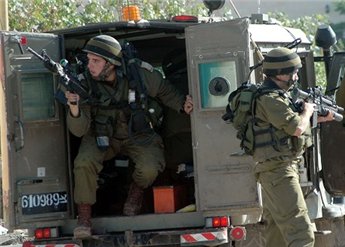
A photo of the incident shows Tamimi at a distance of less than 10 meters behind the semi-open door of an army jeep with the gun aimed directly at him. Clearly visible in the photo is also the tear-gas projectile flying in his direction.

Mustafa Tamimi (left) a moment before his injury. Circled in red are the barrel of the gun and the projectile that hit him. Picture credit: Haim Scwarczenberg

The incident took place in the West Bank village of Nabi Saleh today, when dozens gathered for the weekly demonstration in the village, protesting the theft of village lands by the adjacent Jewish-only settlement of Nabi Saleh. After the army dispersed the peaceful march, minor clashes erupted followed by a severe response by Israeli forces. Several people were hit with rubber-coated bullets and directly shot tear gas projectiles. Three were evacuated to the Ramallah hospital for further treatment. One protester was arrested.

The demonstrations, which have been held regularly for the past two years have seen hundreds of injuries to protesters by Israeli forces as well as dozens of arrests carried out with the aim of suppressing dissent.

Background

Late in 2009, settlers began gradually taking over Ein al-Qaws (the Bow Spring), which personally belongs to Bashir Tamimi, the head of the Nabi Saleh village council. The settlers, abetted by the army, erected a shed over the spring, renamed it Maayan Meir, after a late settler, and began driving away Palestinians who came to use the spring by force – at times throwing stones or even pointing guns at them, threatening to shoot.

While residents of Nabi Saleh have already endured decades of continuous land grab and expulsion to allow for the ever continuing expansion of the Halamish settlement, the takeover of the spring served as the last straw that lead to the beginning of the village’s grassroots protest campaign of weekly demonstrations in demand for the return of their lands.

While the model of regularly held protests around the construction of Israel’s Separation Barrier became a common one in recent years, the protests in Nabi Saleh mark a significant break from that tradition, in that protest there is entirely unrelated to the Barrier. This expansion of the popular resistance model symbolizes the growing support the model enjoys among Palestinians, and the growing positive discourse around it across the Palestinian political spectrum.

Protest in the tiny village enjoys the regular support of International and Israeli activists, as well as that of Palestinians from the surrounding areas. Demonstrations in Nabi Saleh are also unique in the level of women participation in them, and the role they hold in all their aspects, including organizing. Such participation, which often also includes the participation of children mirrors the village’s commitment to a truly popular grassroots mobilization, encompassing all segments of the community.

The Israeli military’s response to the protests has been especially brutal and includes regularly laying complete siege on village every Friday, accompanied by the declaration of the entire village, including the built up area, as a closed military zone. Prior and during the demonstrations themselves, the army often completely occupies the village, in effect enforcing an undeclared curfew of sort. Military nighttime raids and arrest operations are also a common tactic in the army’s strategy of intimidation, often targeting minors.

In order to prevent the villagers and their supporters from exercising their fundamental right to demonstrate and march to their lands, soldiers regularly use disproportional force against the unarmed protesters. The means utilized by the army to hinder demonstrations include, but are not limited to, the use of tear-gas projectiles, banned high-velocity tear-gas projectiles, rubber-coated bullets and, at times, even live ammunition.

The use of such practices have already caused countless injuries, several of them serious, including those of children – the most serious of which is that of 14 year-old Ehab Barghouthi, who was shot in the head with a rubber-coated bullet from short range on March 5th, 2010 and laid comatose in the hospital for three weeks.

In complete disregard to the army’s own open fire regulations, soldiers often shoot tear-gas projectiles directly at groups of protesters or individuals and rubber bullets are indiscriminately shot at protesters from short distances. The army has also resumed using high velocity tear-gas projectiles in Nabi Saleh, despite the fact that they have been declared banned for use after causing the death of Bassem Abu Rahmah in Bil’in in April 2009, and the critical injury of American protester Tristan Anderson in Ni’ilin in March of the same year.

Tear-gas, as well as a foul liquid called “The Skunk”, which is shot from a water cannon, is often used inside the built up area of the village, or even directly pointed into houses, in a way that allows no refuge for the uninvolved residents of the village, including children and the elderly. The interior of at least one house caught fire and was severely damaged after soldiers shot a tear-gas projectile through its windows.

Since December 2009, when protest in the village was sparked, hundreds of demonstration-related injuries caused by disproportionate military violence have been recorded in Nabi Saleh.

Between January 2010 and June 2011, the Israeli Army has carried 76 arrests of people detained for 24 hours or more on suspicions related to protest in the village of Nabi Saleh, including those of women and of children as young as 11 years old. Of the 76, 18 were minors. Dozens more were detained for shorter periods.

December 9, 2011 Posted by | Ethnic Cleansing, Racism, Zionism, Subjugation - Torture | Leave a comment

Israel deputy FM: UNRWA ‘morally, politically unacceptable’

Ma’an – 09/12/2011

TEL AVIV, Israel – Israel’s deputy foreign minister accused the UN agency for Palestinian refugees of perpetuating Palestine’s conflict with Israel, in a speech at the UN refugee headquarters in Geneva on Thursday, Israeli newspaper The Jerusalem Post reported.

Calling UNRWA “morally and politically unacceptable,” Danny Ayalon said the UN applied double standards by not resettling Palestinian refugees through its central body for refugees, UNCHR, and creating the separate Palestinian refugee agency.

“This has meant that a peaceful solution to the conflict between Israel and the Palestinians remains further away,” the report quoted Ayalon saying at the 60th anniversary celebration of the 1951 UN Convention relating to the Status of Refugees.

The UN Relief and Works Agency was set up in the wake of the 1948 war and founding of the Israeli state, when estimated 700,000 Palestinians were expelled from or fled their homes.

It provides services to some 5 million refugees, with the UN General Assembly renewing its mandate until a political solution is reached.

UNRWA spokesman Chris Gunness says that questioning the longevity of the organization “serve(s) only to distract from the need to address the real reasons for the protracted Palestinian refugee situation, namely the absence of negotiated solution to the underlying political issues.

“Palestine refugees are entitled to a just and lasting solution to their plight,” he told Ma’an in an interview in June.

“In the absence of — and pending the realization of — such a solution, it stands to reason that their status as refugees will remain.”

December 9, 2011 Posted by | Ethnic Cleansing, Racism, Zionism, Subjugation - Torture | Leave a comment

Protester seriously hurt by gas canister

Ma’an – 09/12/2011

BETHLEHEM – A tear-gas canister fired by Israeli forces struck and seriously injured a Palestinian demonstrator in the occupied West Bank, protesters said Friday.

Onlookers said Mustafa Tamimi, 28, suffered a critical head wound after being struck in the face by the canister in Nabi Saleh.

The village hosts weekly protests against land confiscation for an illegal settlement, and Israel has cracked down on its residents, carrying out night raids and arresting accused stone-throwers.

“Tamimi is in very critical condition. Half his face is gone,” said Linah Alsaafin, a Ramallah-based blogger. She was reporting from the scene in Nabi Saleh, near Ramallah.

He “was throwing rocks at the (Israeli army) jeep, the door opened and the canister was fired with precision and intent straight in his face,” Alsaafin recounted on Twitter.

“To use their term, ‘surgical precision’,” she added.

Activists distributed photographs purporting to show Tamimi, his face covered in blood, being lifted off the ground after his injury. He was later taken to hospital.

Mustafa Tamimi, 28, is lifted up shortly after the injury in Nabi Saleh.

The activists said the Israeli army had initially prevented an ambulance from arriving at the village. A military spokeswoman said the man was evacuated to an Israeli hospital.

The official told Ma’an said the injury occurred during “a violent and illegal riot” in which protesters threw stones. Forces responded with “riot-dispersal means,” she said.

“The incident is currently being investigated,” she added.

A teenage boy suffered a leg fracture after being struck by a rubber-coated bullet, onlookers added. A young woman’s arm was also broken during the demonstration, they said.

December 9, 2011 Posted by | Subjugation - Torture | Leave a comment

My Occupy LA Arrest

By Patrick Meighan | December 6, 2011

My name is Patrick Meighan, and I’m a husband, a father, a writer on the Fox animated sitcom “Family Guy”, and a member of the Unitarian Universalist Community Church of Santa Monica.

I was arrested at about 1 a.m. Wednesday morning with 291 other people at Occupy LA. I was sitting in City Hall Park with a pillow, a blanket, and a copy of Thich Nhat Hanh’s “Being Peace” when 1,400 heavily-armed LAPD officers in paramilitary SWAT gear streamed in. I was in a group of about 50 peaceful protestors who sat Indian-style, arms interlocked, around a tent (the symbolic image of the Occupy movement). The LAPD officers encircled us, weapons drawn, while we chanted “We Are Peaceful” and “We Are Nonviolent” and “Join Us.”

As we sat there, encircled, a separate team of LAPD officers used knives to slice open every personal tent in the park. They forcibly removed anyone sleeping inside, and then yanked out and destroyed any personal property inside those tents, scattering the contents across the park. They then did the same with the communal property of the Occupy LA movement. For example, I watched as the LAPD destroyed a pop-up canopy tent that, until that moment, had been serving as Occupy LA’s First Aid and Wellness tent, in which volunteer health professionals gave free medical care to absolutely anyone who requested it. As it happens, my family had personally contributed that exact canopy tent to Occupy LA, at a cost of several hundred of my family’s dollars. As I watched, the LAPD sliced that canopy tent to shreds, broke the telescoping poles into pieces and scattered the detritus across the park. Note that these were the objects described in subsequent mainstream press reports as “30 tons of garbage” that was “abandoned” by Occupy LA: personal property forcibly stolen from us, destroyed in front of our eyes and then left for maintenance workers to dispose of while we were sent to prison.

When the LAPD finally began arresting those of us interlocked around the symbolic tent, we were all ordered by the LAPD to unlink from each other (in order to facilitate the arrests). Each seated, nonviolent protester beside me who refused to cooperate by unlinking his arms had the following done to him: an LAPD officer would forcibly extend the protestor’s legs, grab his left foot, twist it all the way around and then stomp his boot on the insole, pinning the protestor’s left foot to the pavement, twisted backwards. Then the LAPD officer would grab the protestor’s right foot and twist it all the way the other direction until the non-violent protestor, in incredible agony, would shriek in pain and unlink from his neighbor.

It was horrible to watch, and apparently designed to terrorize the rest of us. At least I was sufficiently terrorized. I unlinked my arms voluntarily and informed the LAPD officers that I would go peacefully and cooperatively. I stood as instructed, and then I had my arms wrenched behind my back, and an officer hyperextended my wrists into my inner arms. It was super violent, it hurt really really bad, and he was doing it on purpose. When I involuntarily recoiled from the pain, the LAPD officer threw me face-first to the pavement. He had my hands behind my back, so I landed right on my face. The officer dropped with his knee on my back and ground my face into the pavement. It really, really hurt and my face started bleeding and I was very scared. I begged for mercy and I promised that I was honestly not resisting and would not resist.

My hands were then zipcuffed very tightly behind my back, where they turned blue. I am now suffering nerve damage in my right thumb and palm.

I was put on a paddywagon with other nonviolent protestors and taken to a parking garage in Parker Center. They forced us to kneel (and sit–SEE UPDATE) on the hard pavement of that parking garage for seven straight hours with our hands still tightly zipcuffed behind our backs. Some began to pass out. One man rolled to the ground and vomited for a long, long time before falling unconscious. The LAPD officers watched and did nothing.

At 9 a.m. we were finally taken from the pavement into the station to be processed. The charge was sitting in the park after the police said not to. It’s a misdemeanor. Almost always, for a misdemeanor, the police just give you a ticket and let you go. It costs you a couple hundred dollars. Apparently, that’s what happened with most every other misdemeanor arrest in LA that day.

With us Occupy LA protestors, however, they set bail at $5,000 and booked us into jail. Almost none of the protesters could afford to bail themselves out. I’m lucky and I could afford it, except the LAPD spent all day refusing to actually *accept* the bail they set. If you were an accused murderer or a rapist in LAPD custody that day, you could bail yourself right out and be back on the street, no problem. But if you were a nonviolent Occupy LA protestor with bail money in hand, you were held long into the following morning, with absolutely no access to a lawyer.

I spent most of my day and night crammed into an eight-man jail cell, along with sixteen other Occupy LA protesters. My sleeping spot was on the floor next to the toilet.

Finally, at 2:30 the next morning, after twenty-five hours in custody, I was released on bail. But there were at least 200 Occupy LA protestors who couldn’t afford the bail. The LAPD chose to keep those peaceful, non-violent protesters in prison for two full days… the absolute legal maximum that the LAPD is allowed to detain someone on misdemeanor charges.

As a reminder, Antonio Villaraigosa has referred to all of this as “the LAPD’s finest hour.”

So that’s what happened to the 292 women and men were arrested last Wednesday. Now let’s talk about a man who was not arrested last Wednesday. He is former Citigroup CEO Charles Prince. Under Charles Prince, Citigroup was guilty of massive, coordinated securities fraud.

Citigroup spent years intentionally buying up every bad mortgage loan it could find, creating bad securities out of those bad loans and then selling shares in those bad securities to duped investors. And then they sometimes secretly bet *against* their *own* bad securities to make even more money. For one such bad Citigroup security, Citigroup executives were internally calling it, quote, “a collection of dogshit”. To investors, however, they called it, quote, “an attractive investment rigorously selected by an independent investment adviser”.

This is fraud, and it’s a felony, and the Charles Princes of the world spent several years doing it again and again: knowingly writing bad mortgages, and then packaging them into fraudulent securities which they then sold to suckers and then repeating the process. This is a big part of why your property values went up so fast. But then the bubble burst, and that’s why our economy is now shattered for a generation, and it’s also why your home is now underwater. Or at least mine is.

Anyway, if your retirement fund lost a decade’s-worth of gains overnight, this is why.

If your son’s middle school has added furlough days because the school district can’t afford to keep its doors open for a full school year, this is why.

If your daughter has come out of college with a degree only to discover that there are no jobs for her, this is why.

But back to Charles Prince. For his four years of in charge of massive, repeated fraud at Citigroup, he received fifty-three million dollars in salary and also received another ninety-four million dollars in stock holdings. What Charles Prince has *not* received is a pair of zipcuffs. The nerves in his thumb are fine. No cop has thrown Charles Prince into the pavement, face-first. Each and every peaceful, nonviolent Occupy LA protester arrested last week has has spent more time sleeping on a jail floor than every single Charles Prince on Wall Street, combined.

The more I think about that, the madder I get. What does it say about our country that nonviolent protesters are given the bottom of a police boot while those who steal hundreds of billions, do trillions worth of damage to our economy and shatter our social fabric for a generation are not only spared the zipcuffs but showered with rewards?

In any event, believe it or not, I’m really not angry that I got arrested. I chose to get arrested. And I’m not even angry that the mayor and the LAPD decided to give non-violent protestors like me a little extra shiv in jail (although I’m not especially grateful for it either).

I’m just really angry that every single Charles Prince wasn’t in jail with me.

Thank you for letting me share that anger with you today.

Patrick Meighan

——-

UPDATE (12/9/11): Hey all, thank you for the nice thoughts from many folks who have read this account. One necessary clarification about the 7 hours spent by the roughly 100-of-us in the Parker Center parking garage immediately following our arrest:

though we were indeed forced to kneel on that parking garage pavement for an extended period and though we did in fact have our hands tightly zipcuffed behind our backs for that entire seven-hour stretch on the pavement, and though we were barred from standing and moving for that time period, the LAPD officers, in point of fact, did allow us to shift ourselves out of the kneeling position onto our butt-cheeks, our side-legs, etc., as necessary. At the very least, when we began to do so, they did not stop us. I apologize for implying otherwise.
I also want to say that I don’t consider my above-described treatment at the hands of the LAPD to be, in any way, uniquely-brutal, or that I was especially victimized. Yes, getting arrested and going to jail was scary and sometimes painful and it generally sucked, but jail is supposed to suck. Again, the point of this blogpost is not that I was treated especially poorly by the LAPD officers who arrested, processed and held us. The LAPD officers were just doing their jobs, as they understood them. The point of the blogpost is simply to contrast the legal response to nonviolent protestors against the the legal response (or, rather, non-response) to the perpetrators of the largest act of coordinated larceny in economic history, for whom the next arrest will be the first one.

Best,

Patrick Meighan
Culver City, CA

December 9, 2011 Posted by | Civil Liberties, Corruption, Solidarity and Activism, Subjugation - Torture, Timeless or most popular | Leave a comment

“Force, might and beatings”: Indelible images of the first Intifada

By Ali Abunimah – The Electronic Intifada – 12/09/2011

December 9, 1987 – exactly 24 years ago – is the day Palestinians remember as the start of the first Intifada, or uprising, against Israel’s brutal and unending occupation of the West Bank and Gaza Strip that had begun 20 year earlier.

For young people in the Palestine solidarity movement today, the start of the first Intifada is ancient history – before many were born. For me it was absolutely formative.

I was not in Palestine. In fact I was growing up comfortably in Belgium. But it was the daily TV images of what was happening in the West Bank and Gaza Strip that opened my eyes and changed me.

One piece of footage in particular had a profound impact all over the world: a group of Israeli soldiers on a hillside in the West Bank systematically breaking the bones of two captive Palestinians, using rocks and sticks.

They committed these war crimes at the behest of Israeli leaders, especially then Israeli defense minister Yitzhak Rabin who ordered troops to use “force, might and beatings” (as well as the live ammunition that claimed lives almost daily) to crush the uprising.

Today, as video of graphic and brutal violence from all over the world is so easily and quickly available, it might be difficult to understand just how deeply shocking this particular footage was. But it is a piece of film that profoundly and permanently changed the way millions of people saw Israel.

Breaking Gandhi’s bones

We often hear Palestinians lectured – by the likes of New York Times columnist Nick Kristof among others – that if they only acted like Gandhi, the Israelis would be impressed and suddenly grant Palestinians their usurped rights.

It’s important to remember – and teach – about the first Intifada for so many reasons, but also because it gives the lie to that silly, condescending and constantly recycled refrain.

The Israeli violence against the completely unarmed first Intifada was intended specifically – as Rabin made clear – to crush any form of Gandhi-like protest, and Israel’s brutality perhaps more than anything else, convinced the next generation of Palestinians that armed resistance was unavoidable.

From bone-breaking to mass violence by remote control

This video – I do not know who put it together – shows other graphic scenes of beatings and torture of Palestinian teens during the first Intifada. It then includes a much longer clip of the hillside bone-breaking that is even more chilling to watch in silence as the soldiers work at their gruesome task methodically.

What is striking about videos of the first Intifada in general is the presence of Israeli soldiers in the middle of Palestinian cities. That now is relatively rare – except when they go in on brutal night raids coordinated with the Palestinian Authority.

The 1993 Oslo Accords, and the subsequent creation of the Palestinian Authority, replaced Israeli soldiers with Palestinian Authority forces. While Palestinians remained under occupation, now the enforcers of the occupation became Palestinians in uniforms. But Israel was relieved of the burden – and some of the bad publicity – of doing the dirty work itself.

Much of Israel’s violence – and the threat of violence – is now done by remote control: PA proxy forces, walls, checkpoints, heavily reinforced watchtowers, cattle runs with unseen voices barking orders, electronic ID cards, drones and F-16s, and even Israeli teenagers shooting people in Gaza dead via video screens as if they are playing a game.

It’s an ever more totalitarian system of violent control of a whole population that had yet to be perfected in the days of Bone-Breaker Rabin.

December 8, 2011 Posted by | Subjugation - Torture, Timeless or most popular, Video | Leave a comment

Israeli Troops Break Into House of IMEMC Board Member

By George Rishmawi | IMEMC News | December 07, 2011

Israeli soldiers broke into the house of Saher Al-Sous, in Beit Sahour, near Bethlehem. Al-Sous is a board member of the Palestinian Centre for Rapprochement between People, the founding organization of the International Middle East Media Center (IMEMC).

At around 3:30 am, Israeli troops knocked-down the door of Al-Sous’ cousin with the rifle-butts terrorizing the children and their mother; the father was out of town for some business.

After realizing their mistake, they went to Saher’s house and woke up all the family to hand Saher a ‘warrant’ for an interview with an Israeli intelligence officer they identified as “Leor”.

Al-Sous told IMEMC that he went to the appointment at the Gush Etzion military base, near Hebron, and waited for more than one hour, without being interviewed or asked any question by any officer; he finally decided to go back home.

Al-Sous is a graduate of Bethlehem University and has been involved in the Rapprochement Centre for more than 10 years, he helps promote the center’s work and activities. He is currently working with the team preparing for the Shepherds Nights Festival around Christmas time.

This is not the first time the Israeli military harasses members of the board of the Rapprochement Center. Similar harassment targeted the chairman of the board, Dr. Mazin Qumsiyeh, who was also summoned to an interview with the Israeli intelligence officers and was not interviewed.

The Israeli military invaded the headquarters of the Rapprochement Centre in 2003, and confiscated all the computers and files from the offices an issue that caused a serious interruption to its work and activities.

The Rapprochement Centre was established in 1988 as a non-profit, nongovernmental organization that works to bridge the gap between Palestinians and peoples from all around the world, including Israel, informing the public about the reality in Palestine, and empowering the community through nonviolent direct action.

The center is a co-founding member of the International Solidarity Movement (ISM), and several other advocacy and nonviolent networks in Palestine.

December 7, 2011 Posted by | Civil Liberties, Subjugation - Torture | Leave a comment

Human rights paper exposes Israeli violence against detained children

Palestine Information Center – 06/12/2011

NAZARETH — Physicians for human rights (PHR)-Israel, Adalah center and Al-Mizan center for human rights issued a joint position paper against the extraction of false confessions under torture and extortion from Palestinian children and adolescents.

This position paper addresses the extreme vulnerability of Palestinian children to specific conditions and practices of detention, and the illegitimate and cruel interrogation methods to which they are subjected by Israeli soldiers and interrogators, which result in extortion and false confessions.

It also analyzes the legal framework as it applies to Palestinian children and adolescents, who are detained by the Israeli occupation forces.

The paper is based mainly on a psychiatric expert opinion written by Dr. Graciela Carmon, a psychiatrist and member of PHR-Israel’s board of directors, which was submitted to the military courts during legal proceedings in the case of a 14-year old Palestinian boy from the village of Nabi Saleh.

According to this paper, some 700 Palestinian children are detained by Israel each year, on average one or two per day. Palestinian children as young as the age of 12 are arrested, interrogated and put on trial in Israel’s military courts.

Based on testimonies provided by 40 children who were detained and sent to military courts in 2010, physical and verbal violence was used against them during detention in 70% of the cases.

Most violent incidents occurred during their presence in military jeeps or during their wait at a military base or a police station, where the children are made to wait for hours often blindfolded, with their hands painfully tied behind their backs with plastic cable ties, and deprived of food, drink, access to a toilet and sleep.

Interrogations of Palestinian children and adolescents by the Israeli occupation forces are, in most cases, conducted without the presence of their parents or a lawyer, and carried out by several regular police interrogators, not by special interrogators for children and adolescents.

The interrogators also use physical and verbal violence in a considerable number of cases, as well as deception and threats of harm against them and their family members.

The paper also noted that there is an almost absolute acceptance shared by almost all judges in Israel’s courts of the abusive conduct of the security and military forces towards Palestinian children and adolescents.

This situation constitutes a flagrant violation of Israel’s obligations under international human rights law, including the UN convention on the rights of the child (CRC) of 1989, to which Israel is a state party, the paper underlined.

According to the CRC, the arrest of a child should be the last resort, and the best
interest of the child should be the main consideration, the paper read.

December 7, 2011 Posted by | Civil Liberties, Subjugation - Torture, Timeless or most popular | Leave a comment

Jerusalem lawmaker to be deported to Ramallah

Ma’an – 06/12/2011
Photographs depicting Palestinian lawmakers jailed by Israel are displayed
in the parliament building that was destroyed during Israel’s offensive in Gaza
City, January 29, 2009. (MaanImages/Wissam Nassar)

JERUSALEM – An Israeli military court on Tuesday ordered the deportation of a Palestinian lawmaker from Jerusalem to Ramallah, a statement from the Palestinian Legislative Council said.

Ahmad Attoun, a Jerusalemite, was detained in front of the offices of the International Committee of the Red Cross in Jerusalem in September.

He had taken shelter in the ICRC building along with another Hamas legislator, Muhammad Abu Teir, and former PA minister Khalid Abu Arafa, after Israeli authorities revoked their Jerusalem residency permits.

In a statement issued in June 2010, after Israel ordered the men to leave Jerusalem, the three Hamas men wrote: “We as sons of Jerusalem have never left it before … we emphasize that we will remain here and never leave it.”

Hamas-affiliated Attoun was released from an Israeli jail in 2009, along with five other Palestinian lawmakers. He had been held for three years.

The ICRC has said it told Israeli authorities that international humanitarian law prohibited the forcible transfer of Palestinian residents from their homes.

December 6, 2011 Posted by | Civil Liberties, Ethnic Cleansing, Racism, Zionism, Subjugation - Torture | Leave a comment

Breaking the Silence: An interview with Yehuda Shaul

December 6, 2011 | International Solidarity Movement

West Bank – “If you don’t look nice, you don’t spend too many hours in front of the mirror,”  says Yehuda Shaul,  one of the founders and Executive Directors of Israeli NGO, Breaking the Silence.

“What we demand of our society is to look in the mirror, so no wonder no one likes it.”

 Breaking the Silence was founded in 2004 by Israeli soldiers and veterans who collect and publish testimonies from soldiers who have served in the West Bank,Gaza and East Jerusalem since September 2000.  They also hold lectures and conduct tours in Hebron and the South Hebron Hills area “with the aim of giving the Israeli public access to the reality which exists minutes from their own homes, yet is rarely portrayed in the media.”

Yehuda Shaul

The organization states that “cases of abuse towards Palestinians, looting, and destruction of property have been the norm for years, but are still explained as extreme and unique cases…While this reality is known to Israeli soldiers and commanders, Israeli society continues to turn a blind eye, and to deny what is done in its name.”

Shaul, 28, is a religious Jew and a Jerusalemite; he served as a combat soldier and a commander in an Israeli infantry unit during the Second Intifada, from March 2001 until March 2004.  He grew up in a right-wing family; his high school was in an Israeli settlement in the West Bank near Ramallah, his cousins were settlers in Gaza, and his sister currently lives in a settlement.  He is bearded, bulky and speaks English in a North American accent; his mother is American and his father is Canadian.

Shaul says that he always expected to become a soldier but that he had doubts from the very beginning that what he was doing was right. “But when you’re in the military you always find a way to continue because there are always things that are bigger than you – orders, missions – and I think the most important thing is the bond of comradeship.”

Two years of his service was spent in the West Bank, mostly in Hebron, where he did what all Israeli soldiers do in the Occupied Territories, ranging from the banal to the brutal – standing at checkpoints, carrying out house demolitions, firing grenades into civilian areas and using human shields.

The significant turning point came towards the end of his service as he began to think about civilian life beyond the military.

“Throughout my service it made sense; there were explanations, titles, logic – it’s only when you take one step out and you see things from a different perspective, that’s when you realize that something is wrong and we have to do something about it.”

Shaul says he didn’t really know what to do so he, “just started talking to [his] comrades about it, and very quickly [he] discovered that they all felt the same.” Shaul said,

 The one thing that really shocked us was the realization that people back home had no clue.  People back home who were sending us to do a job had no idea what doing the job means.  In a way Breaking the Silence operates in a very simple logic; you send us to do the job, we went there, we’ve done it, we’re back, we’re not going to tell you who to vote for, but there’s one thing we demand – that you sit down and listen to what we’ve done.

Shaul, along with former soldiers Avichai Sharon and Noam Chayut, staged an exhibition in Tel Aviv in June 2004 of photographs and video footage taken in the Occupied Palestinian Territories by 65 Israeli soldiers.  Shaul explains – “The idea was that – OK, this is insane what’s going on here, we need people back home to know…We didn’t really have any plans, it was a really personal thing, and it was the huge response and impact we had once we opened the gallery, with the fact that we met other veterans from other units who served other places who had the same story, that brought Breaking the Silence to where it is today.”

The Israeli military was rattled by the popularity of the exhibition as thousands of people attended; in the first week they broke into the gallery, confiscated exhibited items and hauled the organizers in for interrogation.  However, Shaul says that “once they realized it just brought more attention to us, they left us alone.”

Breaking the Silence

Since the initial exhibition, the organization has grown and developed rapidly.  In total Breaking the Silence now does around 400 tours and lectures a year – many of the talks are with young Israelis before they have been drafted, which Shaul claims is the organization’s main target group – “these are people who are still civilians and are not infected by the military – yet.”

Breaking the Silence also writes reports and collects testimonies, usually published anonymously, from Israeli soldiers.  Almost 800 people have now testified about their experiences and conduct during occupation of Palestinian territory to Breaking the Silence.

According to Shaul, most of the soldiers that testify are low ranking commanders and officers and they tend to be people from the centre-left politically, although he estimates that 10-15% don’t come from this background.  He says that usually people come forward because they had problems during their service that they have to express – “Half of the people who testify, do so because they saw the importance of doing it.  There was a lot of pressure on them and then, OK, they’ve done a good thing [by testifying] – goodbye.  For another big group, testifying was the first step to becoming political activists.  It’s really diverse – different people, different experiences.”

 Breaking the Silence knows the details of all those who testify and they claim to double check facts rigorously to ensure that testimonies are accurate, but they usually publish the results anonymously.  As Shaul said,

When we started Breaking the Silence, most of the people in the first exhibition were still in service.  So we had to keep their anonymity because they violated military law.  Actually a lot of these investigations and threats in the beginning were to discover who they were so they could throw them in jail and shut down the project because people would be afraid.  Of course there are also social repercussions and legal repercussions [in testifying].

Many of the soldiers that testify are men because they comprise the overwhelming majority of soldiers in combat units.  However, Breaking the Silence has recently published a collection of testimonies from female soldiers.  Shaul says that this was firstly a new way of telling a similar story but that also “this is a voice that is more silent than others.  This is a unique voice and it’s an interesting voice that people must be confronted with…What comes from the testimonies is that usually women need to be worse than the men in order to prove themselves – that they’re one of the gang, one of the guys.”

In one of the testimonies, a female soldier describes how “a female soldier who can lash out is a serious fighter.  Capable.  A ball-breaker.  There was one with me when I got there…everyone talked about what grit she had, because she could humiliate Arabs without batting an eyelash.  That was the thing to do.”

The collected testimonies from Hebron show instances of extreme brutality, such as when a soldier wound metal wire so tightly round the hand of a Palestinian that his hand had to be amputated.  Many of the stories are accounts of more systemic abuse, often sanctioned and encouraged by superiors, as soldiers randomly search houses, detain and beat up Palestinians and destroy and loot property just to “educate” the Palestinians or to “make our presence felt”.

Several soldiers express their disgust at the violence of the settlers in Hebron, like one who stated,  ”I simply hated them…And you feel like you’re serving them.  Them and their capacity for violence.  There were all kinds of situations there of stark, brute, shocking violence.”

Breaking the Silence conduct tours to Hebron, showing people what life is like for the Palestinians that live in the divided city.  Several thousand Israeli soldiers protect between 400-500 Israelis who live in settlements, illegal under international law, in the centre of Hebron.  It is the only city in the West Bank that contains an Israeli settlement.

 In 1994, Brooklyn-born settler Baruch Goldstein opened fire on worshipers as they prayed in the Ibrahimi mosque, killing 29 people and wounding many more.  The Israeli authorities responded by effectively punishing the Palestinians by preventing them from accessing many streets and ordering the closure of over 1800 Palestinian shops.

Breaking the Silence explains how settlers frequently abuse and attack Palestinians in the area and how the military harass and restrict the freedoms of Palestinians at checkpoints throughout the Israeli controlled H2 sector of the city.  They also show them the empty, shuttered Shuhada Street, once Hebron’s major market area and a vibrant shopping street – now desolate and forbidden for Palestinians to enter.

Given that a lot of Breaking the Silence’s work focuses on Hebron, to what extent is the city paradigmatic of the occupation?

“I think it’s the advocates of the status quo – the people who want to maintain the occupation, who try to make us think that Hebron is an extreme case,”  said Shaul. “I don’t think it’s an extreme case , I think that Hebron is a gift from God.  Two square kilometers where you walk for half a day and you actually understand how the West Bank works. Hebron is a microcosm of the West Bank.  If you zoom out of Hebron, it’s the West Bank.  Different policies you see in Hebron you can find all over. Hebron is more visual, more dense – but not extreme.”

 The military and Israeli society

The military is a powerful and deeply rooted presence in Israeli society and culture.  The writer Arthur Nelson claims that, “Israelis see their army as a great leveler.  All teenagers are drafted, and those who serve undergo a rite of passage that forever links them with the national struggle and the national state.” Nelson points out that “Israel is a young country but the civil identification with army culture within it has been grounded in four major wars and two Intifadas.”

Despite the preeminence of the military, Shaul disputes the claim that Israeli society understands the reality of occupation and impact on the lives of the Palestinians.

I think this is one of the biggest lies of Israeli politics and Israeli society is that ‘everybody knows’ – almost no one knows.  The amount of people that have the experience that I have – meaning being a combat soldier in the occupied territories in these specific years, is very very low.  We’re basically talking about a few dozen thousand.

 How does he explain the reluctance in Israeli society to discuss or examine what is being done in their name – is it a lack of information or do people mostly ignore the information that they have available to them?

 It’s a mixture of everything.  Of course Israeli society doesn’t want to know but still not everything is out there, people are not forced to confront it.  Very deep inside there is a lot of optimism in the work of Breaking the Silence and a sense that we believe there is a significant minority of Israeli society that, if given the information and put in a corner, that they will have to choose whether they can stand behind this reality [the occupation] or not, they will choose our answer, which is ‘no’.

 Shaul admits that “Israelis are not standing in line to listen to [Breaking the Silence],”  and does not really expect them to.

“We don’t really fit into the categories of ‘human rights organization,’ ‘anti-occupation organization,’ ‘peace group’ – we don’t really fit easily into these, but out of all these groups, Breaking the Silence is the most mainstream group and I think that has a lot to do with who we are – we’re all ex-combat soldiers, in a way we’ve earned the right to speak out.”

‘The problem is the political mission…’

Breaking the Silence has taken a clear stand against the occupation of Palestinian territory, although Shaul is quick to point out that they don’t offer any political solutions.  However, Shaul insists that in his view, the problem is political and systemic.

We don’t believe that the problem is the military.  The problem is the political mission that the military gets”.  He says that explains why Breaking the Silence doesn’t take the “mainstream human rights approach of ‘let’s identify the human rights violation, let’s identify the perpetrator, let’s make them accountable’.  The problem with that is, if you actually want to put in jail every soldier that abused Palestinians, all soldiers would be in jail.  It’s not that we all murdered innocent Palestinians – no. But, no one who served there has clean hands and that’s the story. There’s no way to change it if you don’t change the political mission…when you control people against their will, without giving them rights, the only way to rule them is that they will be afraid of you…if they get used to a level of fear then you have to increase it and that’s how the occupation woks, it’s very simple.  So you can have a lot of investigations, as many as you want, and you can have a lot of hours about classes about morality and international law but at the end of the day when you are there to make sure that these people don’t have rights and these people do have rights, there’s no nice way of doing that, no legal way of doing that and that’s the story.  In a corrupt reality, in an immoral reality, there’s no moral way to behave.

We ask Shaul if claiming that it is the political system that causes soldiers to commit crimes, is a way of excusing what happens and denying individual responsibility?

No, no, no”  Shaul replied – “It’s not that I think I’m not responsible for what I’ve done.  Look, when they called us in for interrogation in 2004 [after the exhibition in Tel Aviv] I was interrogated for like seven hours.  I had the right to remain silent and not incriminate myself, but I said everything I can say in seven hours.  Probably the list of my crimes, to talk about the stuff that I’ve done, would take more like 50 hours but I signed – I’ve used human shields, I’ve fired grenades into civilian neighborhoods…the reason why they don’t put me on trial was because putting me on the bench would mean putting the system on the bench…I think in that sense, the most political thing that I can do is to be put on trial – that’s when my message will be proven.

While there is a danger in posing that Israeli soldiers are victims of a political system, at the expense of the Palestinian victims of their crimes, Shaul said,

I didn’t say [Israeli soldiers] were victims – I said that any soldier – it doesn’t matter what his background, his socio-economic background, his age – being put in this reality, he will behave this way.  I didn’t say he was a victim.  We don’t see ourselves as victims. If I murdered an innocent person and I can’t fall asleep, that doesn’t make me a victim.  I am a victimizer.

Shaul believes that  some soldiers should be put on trial while others should not, but quickly adds “that’s not the story – I don’t really care about that.  What I care about is to put society on trial.  In most cases society cleans itself by putting soldiers on trial.  How does it work?  Very simple – once in a while someone, somehow, forces the army to admit about one event and stories pop up in the media about how ‘a soldier looted something here,’ ‘a soldier shot there.’ But always it’s being framed as ‘there’s another exceptional case, there’s another rotten apple.’  This soldier, who did that specific thing, to that specific Palestinian, in that specific place…’let’s court martial him and send him to jail and our conscience as a society is clean because we treat our bad apples.’  In a way usually when soldiers are sent to jail, the judge goes like this with the hammer,” motioning as if to strike a table top. “he basically washes us as a society, and I think this is our problem.”

 But by not seeking justice for specific crimes, is there the danger that the Palestinian victims of the crimes are neglected?

Shaul replies, “Of course we don’t seek justice because I don’t know what that justice is.  Who says that law is the solution for everything?  No doubt that I feel better in the language of moral and immoral, than in legal and illegal.  So what?  We just feel as people that were there it is our moral obligation to speak out and tell the truth – that’s it.”

 The future of Breaking the Silence

Shaul is highly critical of the Israeli media and says that  Breaking the Silence has been struggling to get it’s voice heard. ” We see ourselves as journalists” he says – “If the Israeli media would do their job there would be no need for us.  We’re basically doing what journalism’s about – exposing corruption to the public…I think Israeli journalists are first of all Israeli and these things don’t sell newspapers and people don’t want to be disrupted by this usually.  There is a limit to how much you can report about the same thing.  It’s been going for 45 years.  It’s not news.”

Shaul is also concerned about the raft of recently proposed laws by the Israeli government that threatens the existence and funding of Israeli NGOs – ” These laws need to be looked at within a greater umbrella of other legislation that was passed and some that was not passed, of trying to shrink the space of Israeli civil society.  From political appointments in the supreme court, up to libel cases.  This is a regime change more than simply passing anti-democratic laws.  In terms of human rights organizations, most of the laws are not really there to pass, they are there to shut down people and dominate the discourse and the debate.”

Nevertheless, Shaul feels that the organization has achieved many things.

“For me the most important is that, if you had come to me seven and a half years ago and told me that I would be sitting here and almost 800 people had testified to Breaking the Silence, I would probably laugh in your face.  That’s 800 people who are saying the truth about what the occupation is.”

 In terms of changing the practices of the Israeli military does he think Breaking the Silence has made an impact?  ” God forbid – I don’t think we can do that.  We maybe want to change the practice of the military, meaning from an occupation army into a defense army but that’s a different story.”

December 6, 2011 Posted by | Ethnic Cleansing, Racism, Zionism, Subjugation - Torture, Timeless or most popular, War Crimes | Leave a comment

Settlers kidnap shepherd near Nablus

Ma’an – 05/12/2011

NABLUS – Israeli settlers on Monday kidnapped a 60-year-old shepherd after attacking him in Orif village south of Nablus, officials said.

Village council head Fawzi Shehadeh said six residents of Yitzhar settlement attacked Salim Jamil Shehadeh near the local high school and took him away in a car. The settlers stole all 50 of his sheep, the councilor added.

Palestinian Authority settlement affairs official Ghassan Doughlas told Ma’an the government was conducting intensive negotiations with Israeli officials to secure the shepherd’s release.

On Saturday, settlers from Itamar violently assaulted elderly shepherd Najih Abdul-Qadir as he worked on his land east of Nablus, Doughlas said.

Some 500,000 Israelis live in Jewish-only settlements in the West Bank and East Jerusalem. There are about 2.5 million Palestinians in the same territory.

All settlements are considered illegal under international law.

December 5, 2011 Posted by | Civil Liberties, Ethnic Cleansing, Racism, Zionism, Subjugation - Torture | Leave a comment

Misreading the Fight Over Military Detention

The Obama Regime Has No Constitutional Scruples

By PAUL CRAIG ROBERTS | CounterPunch | December 5, 2011

During an interview with the Russian news network RT on December 1, I said that the US Constitution had been shredded by the failure of the US Senate to protect American citizens from the detainee amendment sponsored by Republican John McCain and Democrat Carl Levin to the Defense Authorization Bill. The amendment permits indefinite detention of US citizens by the US military.  I also gave my opinion that the fact that all but two Republican members of the Senate had voted to strip American citizens of their constitutional protections and of the protection of the Posse Comitatus Act indicated that the Republican Party had degenerated into a Gestapo Party.

These conclusions are self-evident, and I stand by them.

However, I jumped to conclusions when I implied that the Obama regime opposes military detention on constitutional grounds.  Dahlia Lithwick reported  in a Slate article that the entire Obama regime opposed the military detention provision in the McCain/Levin amendment. Lithwick wrote: “The secretary of defense, the director of national intelligence, the director of the FBI, the CIA director, and the head of the Justice Department’s national security division have all said that the indefinite detention provisions in the bill are a bad idea. And the White House continues to say that the president will veto the bill if the detainee provisions are not removed.”

I checked the URLs that Lithwick supplied.  It is clear that the Obama regime objects to military detention. However, on further reflection I conclude that the Obama regime’s objection to military detention is not rooted in concern for the constitutional rights of American citizens.  The regime objects to military detention because the implication of military detention is that detainees are prisoners of war. As Senate Armed Services Committee Chairman Carl Levin put it:  Should somebody determined “to be a member of an enemy force who has come to this nation or is in this nation to attack us as a member of a foreign enemy, should that person be treated according to the laws of war? The answer is yes.”

Detainees treated according to the laws of war have the protections of the Geneva Conventions. They cannot be tortured. The Obama regime opposes military detention, because detainees would have some rights.  These rights would interfere with the regime’s ability to send detainees to CIA torture prisons overseas.  This is what the Obama regime means when it says that the requirement of military detention denies the regime “flexibility.”

The Bush/Obama regimes have evaded the Geneva Conventions by declaring that detainees are not POWs, but “enemy combatants,” “terrorists,” or some other designation that removes all accountability from the US government for their treatment.

By requiring military detention of the captured, Congress is undoing all the maneuvering that two regimes have accomplished in removing POW status from detainees.

A careful reading of the Obama regime’s objections to military detention supports this conclusion. The November 17 letter to the Senate from the Executive Office of the President says that the Obama regime does not want the authority it has under the Authorization for Use of Military Force (AUMF), Public Law 107-40, to be codified. Codification is risky, the regime says. “After a decade of settled jurisprudence on detention authority, Congress must be careful not to open a whole new series of legal questions that will distract from our efforts to protect the country.”

In other words, the regime is saying that under AUMF the executive branch has total discretion as to whom it detains and how it treats detainees. Moreover, as the executive branch has total discretion, no one can find out what the executive branch is doing, who detainees are, or what is being done to them. Codification brings accountability, and the executive branch does not want accountability.

Those who see hope in Obama’s threatened veto have jumped to conclusions if they think the veto is based on constitutional scruples.

~

Paul Craig Roberts was an editor of the Wall Street Journal and an Assistant Secretary of the U.S. Treasury.  His latest book, HOW THE ECONOMY WAS LOST, has just been published by CounterPunch/AK Press. He can be reached at: PaulCraigRoberts@yahoo.com

December 5, 2011 Posted by | Civil Liberties, Progressive Hypocrite, Subjugation - Torture, Timeless or most popular | Leave a comment