When holidays bring hate: Sarah’s Day in Occupied Hebron
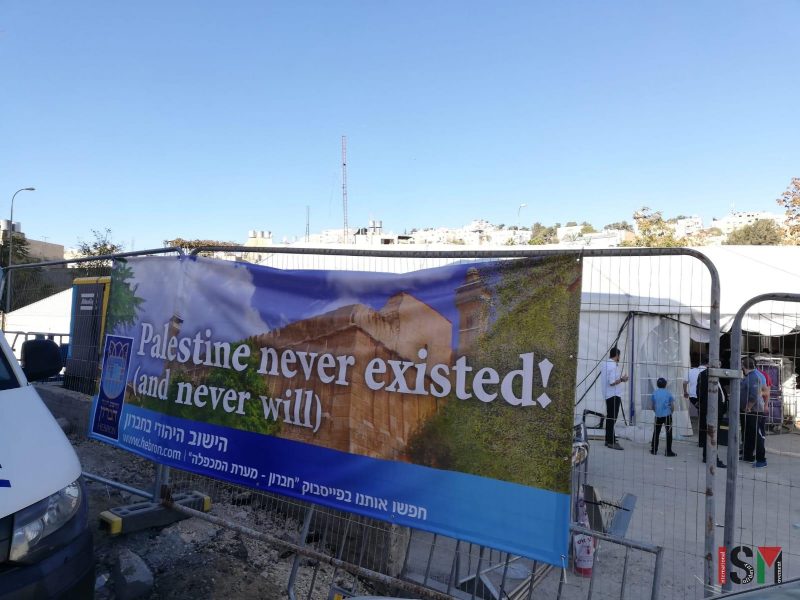
Extremist and racist propaganda placed around Hebron (H2) ahead of Sarah’s Day, a major Jewish holiday.
International Solidarity Movement | November 28, 2019
Hebron, occupied Palestine – The Jewish holiday of Shabbat Chayei Sarah (Sarah’s day’) took place in Al Khalil (also known as Hebron) over the weekend of 22-23 November. Over the two days around 50,000 Israeli settlers flocked to the city, to celebrate the festival in the place that Zionists believe is their religious right (despite the fact that it is historically Palestinian and is clearly within the demarcation of Palestinian Territories).
For weeks the area was being adapted and prepared to accommodate the thousands of visitors. Israeli settlers from nearby illegal settlement Kiryat Arba were to be joined by other observant Jews from across Israel, as well as from countries abroad such as France, the UK, and the USA. The mood was set by blatant Zionist propaganda adorning the streets, such as a banner proclaiming “Palestine never existed – and never will”. Whole areas of the old city and surrounding areas were taken over by gazebos, tents and caravans for the weekend. Exclusive and expensive VIP tickets to celebrate ‘Sarah’s day’ were available for hundreds of US dollars, enabling attendees to meet and dine with religious leaders, alongside Knesset members, and IDF commanders.
By Friday afternoon, thousands of celebrants had arrived in the city and the already extensive Israeli Occupation Force (IOF) presence (normally 4000 IOF soldiers guard the 400 Israeli settlers) was even greater than usual. Enhanced security measures were in place and major roads were blocked off, obstructing Palestinian movement around the city, and forcing Arab shops to close for business in an already suffocated economic environment (due to businesses and areas being closed by military order, and commerce/tourism heavily suppressed by restrictions on movement through checkpoints).
Many of the visiting settlers were visibly armed, with handguns or automated weapons, in stark contrast to Palestinians for whom it is illegal to carry a weapon, tightly enforced at all of the numerous checkpoints.
Each day International Solidarity Movement (ISM) received reports of serious, violent attacks on Palestinians living in or passing through vulnerable areas where settlers filled the streets.
On Friday evening, on the ‘Prayer Road’, leading up to the large settlement of Kiryat Arba, a group of 8 Palestinians were attacked in a barber shop. ISM spoke to one of the victims, Fayed, who reported a large group of settlers forcing entry to his father’s shop. Despite attempts to persuade the settlers to leave, more arrived to join the attack. Up to 100 settlers sprayed pepper spray, threw stones, chairs and pieces of wood, damaging property and injuring Fayed, his brother, his uncle and father. Fayed’s 21 year old cousin suffered a broken hand, whilst he and his uncle and father sustained injuries to the head and arms, resulting in hospitalization. The police eventually moved the settlers on however no arrests were made. Only basic details of the attack were taken down and there has been no further investigation of the crime.
Later that night there were further reports of violent attacks by groups of settlers in the same area, including an assault on a young old child, who was kicked and sprayed with pepper spray, requiring him to be taken to hospital. A Palestinian bride was also harassed and attacked by settlers as she celebrated her wedding day.
Despite the heaviness of occupation pressing down on them, the brutal and unprovoked attacks from the settlers, and frustration at the lack of protection from the authorities, Fayed and his family are quietly resistant. “Our life here is hard, but we have to resist. We try to be nice to everyone… to treat them nice, we don’t want any violence. Violence is not the solution…. the settlers carry M16 guns. It’s normal for us and our situation here – to be attacked, arrested, killed. We grew up like this. What can we do? We don’t have a lot of power or support. We can’t fight with guns or knives, this is not the solution. How many Palestinians have been killed? Guns and knives are not free, they do not make Palestine free. We are not against Jews, we are against Zionists and settlers, and those that occupy our houses. ”
The following day, the entire old city plus large swathes of the normally unrestricted area (known as ‘H1’) was locked down, making way for thousands of settlers to be given religious tours of the city. Many were intoxicated, chanting provocative anti-Palestinian songs, shouting abuse, and urinating on Palestinian property. As the day progressed, their behavior became increasingly violent, with numerous incidents of settlers throwing rocks, bottles and other items at Palestinian people and homes, as well as unlawfully entering or climbing on Palestinian property. IOF remained passive, merely supervising the passage of the crowds through Palestinian areas.
In one shocking incident, a group of settlers attacked the home of a known Palestinian activist, Imad, who has been frequently targeted since speaking out against the murder of a Palestinian by the IOF several years ago.
Imad and his family are some of the few Palestinians brave enough to continue living in Tel Rumeida, part of an area in the heart of the old city which has been designated a restricted military zone (known as ‘H2’). Since 1968 Al Khalil has been subject to the establishment of illegal Jewish settlements, and over the last 20 years, the area has seen a huge influx of hardcore settlers who believe for religious reasons they have a right to occupy the land. These are some of the most extreme settlers in Israel, who routinely perpetrate abuse and violence against Palestinian residents, including children going to school. Many Palestinians have been forced out of their homes and for those who remain, living in this area is extremely dangerous for Palestinians. There is a daily threat to life and limb.
On Saturday, as the streets of Tel Rumeida were inundated with thousands more armed settlers, the violence and intimidation escalated. There were multiple reports of attacks on Palestinian people and property. Footage was recorded of large groups of drunk settlers climbing on the roofs of Palestinian homes, and abusing and intimidating residents.
On Saturday Imad remained confined at home with his grandchildren, due to the large numbers of settlers who had been marching and congregating in the streets outside, making it unsafe for Palestinians to leave the house. Imad heard settlers climbing on his roof, and trying to enter his home through the entrance way. He called friends to come and help. and unsuccessfully tried to convince the settlers to leave. The large group were shouting abuse, spitting and throwing stones at bottles. Moments later Imad heard crying from where his 18 month old grandson was sleeping. As he ran into the room he discovered that a settler had thrown a stone through the open window, striking the child on the head and wounding him.
Due to the closed and restricted nature of this part of the city, an ambulance was unable to reach the house to attend to the child. The child had to be carried through the streets, protected by a circle of local people from the settlers who continued to try to attack the group as they tried to reach the ambulance.
Imad explains that the IOF soldiers arrived at the house during the attack, however they only stood watching, and failed to intervene to stop the violence. When local Palestinian’s arrived to provide support, the soldiers pushed and held them back, threatening to arrest them. The IOF also failed to provide any first aid or show concern for the injured child.
Despite the heavy IOF and Israeli police presence throughout the city during this weekend, it was abundantly clear that they were there to protect the settlers, and not the Palestinian residents. There was a complete failure to protect the Palestinians under attack. Police also failed to undertake any investigation into the various incidents, or attempt to bring to justice those settlers engaging in violence against Palestinians.
This raises concerns that the IOF are turning a blind eye to the violence, sanctioning and enabling it to occur, or alternatively that they simply have no power or authority to control the settlers’ violence. The risk for Palestinians trying to resist the occupation and violence, such as Imad, is to be punished, singly or collectively, for their defiance in the face of the creeping genocide of the Palestinian land and people.
Whilst trying to document and observe violence and abuse, ISM experienced hostility and aggression from both settlers and the IOF, including physical and verbal threats, restriction of movement as well as having our passports photographed by police and threatened arrest, in a clear attempt to deter us from our work. Pro-Palestinian activists in Israel risk deportation, including a 10 year ban from the country, serving to silence and prevent the documenting of human rights violations in Palestine.
Palestinian Journalist Loses Left Eye after Being Shot by Israeli Sniper
Palestine Chronicle – November 20, 2019
Doctors at Hadassah Hospital in Jerusalem yesterday removed the eye of Palestinian photojournalist Moath Amarneh who was shot by an Israeli sniper on Friday.
A committee of specialists decided that Amarneh’s left eye must be removed along with the bullet which is logged in it. Surgery to do this took several hours.
His family said they had contacted hospitals in a number of countries in the hope of saving his eye but no medical centers were hopeful that this could be done.
Meanwhile, a group of Palestinian journalists organized a protest in solidarity with Amarneh in Bethlehem, but the Israeli occupation forces used force to disperse them.
Amarneh, 32, was shot by an Israeli occupation soldier while he was covering Palestinian protests in Hebron, south of the occupied West Bank.
Witnesses said that he was shot by a sniper, but the Israeli occupation army said he was shot accidentally as he was standing among the “rioters”. … Videos
Israel justice ministry contradicts police on killing of Palestinian

MEMO | November 18, 2019
Israel’s Justice Ministry has contradicted the police’s account of the killing of a Palestinian, stating that officers shot the man after he had emerged from his vehicle, reported Haaretz.
The ministry’s department responsible for investigating police misconduct announced yesterday that the police officer who shot Fares Abu Nab, from Ras Al-Amud in occupied East Jerusalem, did not in fact shoot the suspect during a car chase, as previously claimed by police.
A gag order has been placed on releasing the name of the police officer involved.
According to police, officers were chasing suspected car thieves when one of the drivers “endangered the lives of policemen and other users of the road”, without specifying how.
“He was shot in order to neutralise the threat he posed,” the original police statement added.
According to Haaretz, yesterday three other Palestinians from occupied East Jerusalem were arrested “on suspicion of belonging to the gang of alleged car thieves that included Abu Nab”.
The three men arrived in court “with signs of violence on their bodies”, and their lawyers “said they had been beaten by policemen”.
The paper noted that “six people have died so far this year in incidents that involved the use of force by the police”, but that “none of the policemen involved has yet been indicted”.
Furthermore, “only in two of the six cases did the Justice Ministry department that investigates police misconduct question the policemen as suspects.”
One of these cases was closed, while the other, “the shooting of Ethiopian-Israeli Solomon Teka by an off-duty policeman in Kiryat Haim in June”, is awaiting a decision by the State Prosecutor.
At Least 12 Dead Following Coup in Bolivia
teleSUR | November 14, 2019
At least 12 Bolivians have been killed and more than 530 injured by the violence that escalated in Bolivia following the coup against constitutional president Evo Morales, denounced the Ombudsman’s Office.
The human rights agency explained on its official website that among the injured are women, children, adolescents and journalists.
In turn, the institution – created in 1994 by constitutional mandate – posted on its Twitter account that on November 11 and 12, five Bolivians were killed (out of the total).
Of those deaths, four were due to the gunshots fired by the Armed Forces and the Police, and one due to suffocation by strangulation, the Ombudsman’s Office explained on its digital platform.
The events that forced Evo Morales’s resignation and consummated the coup d’état were unquestionably violent, as reported in an article published on the Mision Verdad webpage.
Opposition gangs attacked numerous politicians of the ruling Movement Towards Socialism, looted Morales’ house, and burned the residences of several high-level politicians, detailed the article.
Evo Morales announced his resignation as president on November 10 to stop the bloodshed, however, during a press conference in Mexico a country that granted him political asylum to preserve his life – he acknowledged that his decision did not halt the social upheaval.
In that sense, Morales called on the military to stop the bloodshed and initiate a national dialogue.
A lesson for the Palestinian leadership: Real reasons behind Israel’s arrest and release of Labadi, Mi’ri

Jordanian citizen Heba Al-Labadi (C), following detention by Israeli forces, was released from prison and returned to Jordan on 6 November 2019
By Ramzy Baroud | MEMO | November 11, 2019
The release on November 6 of two Jordanian nationals, Heba al-Labadi and Abdul Rahman Mi’ri from Israeli prisons was a bittersweet moment. The pair were finally reunited with their families after harrowing experiences in Israel. Sadly, thousands of Palestinian prisoners are still denied their freedom, still subjected to all sorts of hardships at the hands of their Israeli jailers.
Despite the jubilant return of the two prisoners, celebrated in Jordan, Palestine and throughout the Arab world, several compelling questions remain unanswered: why were they held in the first place? Why were they released and what can their experience teach Palestinians under Israeli occupation?
Throughout the whole ordeal, Israel failed to produce any evidence to indict Labadi and Mi’ri for any wrongdoing. In fact, it was this lack of evidence that made Israel hold the two Jordanian nationals in Administrative Detention, without any judicial process whatsoever.
Oddly, days before the release of the two Jordanians, an official Israeli government statement praised the special relationship between Amman and Tel Aviv, describing it as “a cornerstone of stability in the Middle East”.
The reality is that the relationship between the two countries has hit rock bottom in recent years, especially following US President Donald Trump’s advent to the White House and the subsequent, systematic dismantling of the “peace process” by Trump and the Israeli government.
Not only did Washington and Tel Aviv demolish the region’s political status quo, one in which Jordan featured as a key player, top US diplomats also tried to barter with King Abdullah II so that Jordan would settle millions of Palestinian refugees in the country in exchange for large sums of money.
Jordan vehemently rejected US offers and attempts at isolating the Palestinian leadership in Ramallah.
On October 21, 2018, Jordan went even further, by rejecting an Israeli offer to renew a 25-year lease on two enclaves in the Jordan Valley, Al-Baqura and Al-Ghamar. The government’s decision was a response to protests by Jordanians and elected parliamentarians, who insist on Jordan’s complete sovereignty over all of its territories.
This particular issue goes back years. Jordan and Israel signed a peace treaty in 1994. An additional annex in the treaty allowed Israel to lease part of the Jordan Valley for 25 years. A quarter of a century later, the Jordan-Israel Peace Treaty failed to achieve any degree of meaningful normalization between both countries, especially as neighboring Palestine remains under Israeli occupation. The stumbling block of that coveted normalization was – and remains – the Jordanian people, who strongly rejected a renewed Israeli lease over Jordanian territories.
Israeli negotiators must have been surprised by Jordan’s refusal to accommodate Israeli interests. With the US removing itself, at least publicly, from the brewing conflict, Israel resorted to its typical bullying, by holding two Jordanians hostage, hoping to force the government to reconsider its decision regarding the Jordan Valley.
![Palestinians stage a demonstration in support of Palestinian-Jordanian woman Hiba Al-Labadi, who stages a hunger strike after she was arrested by Israeli forces, in East Jerusalem on 31 October 2019. [Mostafa Alkharouf - Anadolu Agency]](https://i0.wp.com/www.middleeastmonitor.com/wp-content/uploads/2019/11/20191031_2_39089439_49038745.jpg?resize=933.5%2C622&quality=85&strip=all&ssl=1)
Palestinians demonstrate in support of hunger striking Hiba Al-Labadi, after her arrest by Israeli forces, in East Jerusalem on 31 October 2019. [Mostafa Alkharouf – Anadolu Agency ]
The Israeli strategy backfired. The arrest of Labadi – who started a hunger strike that lasted for over 40 days – and Mi’ri, a cancer survivor, was a major PR disaster for Israel. Not only did the tactic fail to deliver any results, it further galvanized the Jordanian people, and government regarding the decision to reclaim Al-Baqura and al-Ghamar.
Labadi and Mi’ri were released on November 6. The following day, the Jordanian government informed Israel that its farmers will be banned from entering Al-Baqura area. This way, Jordan retrieved its citizens and its territories within the course of 24 hours.
Three main reasons allowed Jordan to prevail in its confrontation with Israel. First, the steadfastness of the prisoners themselves; second, the unity and mobilization of the Jordanian street, civil society organizations and elected legislators; and third, the Jordanian government responding positively to the unified voice of the street.
This compels the question: what is the Palestinian strategy regarding the nearly 5,000 Palestinian prisoners held unlawfully in Israel?
While the prisoners themselves continue to serve as a model of unity and courage, the other factors fundamental to any meaningful strategy aimed at releasing all Palestinian prisoners remain absent.
Although factionalism continues to undermine the Palestinian fight for freedom, prisoners are fighting the same common enemy. The famed “National Conciliation Document”, composed by the unified leadership of Palestinian prisoners in Israeli jails in 2006, is considered the most articulate vision for Palestinian unity and liberation.
For ordinary Palestinians, the prisoners remain an emotive subject, but political disunity is making it nearly impossible for the energies of the Palestinian street to be harnessed in a politically meaningful way. Despite much lip service paid to freeing the prisoners, efforts aimed at achieving this goal are hopelessly splintered and agonizingly factionalized.
As for the Palestinian leadership, the strategy championed by Palestinian Authority leader, Mahmoud Abbas, is more focused on propping up Abbas’ own image than alleviating the suffering of the prisoners and their families. Brazenly, Abbas exploits the emotional aspect of the prisoners’ tragedy to gain political capital, while punishing the families of Palestinian prisoners in order to pursue his own self-serving political agenda.

Jordanian citizen Heba Al-Labadi (C) was released from an Israeli prison and has returned to Jordan on 6 November 2019
“Even if I had only one penny, I would’ve given it to the families of the martyrs, prisoners and heroes,” Abbas said in a theatrical way during his United Nations General Assembly speech last September.
Abbas, of course, has more than one penny. In fact, he has withheld badly needed funds from the families of the “martyrs, prisoners and heroes.” On April 2018, Abbas cut the salaries of government employees in Gaza, along with the money received by the families of Gaza prisoners held inside Israeli jails.
Heba al-Labadi and Abdul Rahman Mi’ri were released because of their own resolve, coupled with strong solidarity exhibited by ordinary Jordanians. These two factors allowed the Jordanian government to publicly challenge Israel, leading to the unconditional release of the two Jordanian prisoners.
Meanwhile, thousands of Palestinian prisoners, including 500 administrative detainees continue to languish in Israeli prisons. Without united and sustained popular, non-factional mobilization, along with the full backing of the Palestinian leadership, the prisoners are likely to carry on with their fight, alone and unaided.
See also:
Israel and the PA: security relations have never been better
Israel is silencing the last voices trying to prevent abuse of Palestinians
By Jonathan Cook – The National – November 11, 2019
It has been a week of appalling abuses committed by Israeli soldiers in the West Bank – little different from the other 2,670 weeks endured by Palestinians since the occupation began in 1967.
 The difference this past week was that several entirely unexceptional human rights violations that had been caught on film went viral on social media.
One shows a Palestinian father in the West Bank city of Hebron leading his son by the hand to kindergarten. The pair are stopped by two heavily armed soldiers, there to help enforce the rule of a few hundred illegal Jewish settlers over the city’s Palestinian population.
The soldiers scream at the father, repeatedly and violently push him and then grab his throat as they accuse his small son of throwing stones. As the father tries to shield his son from the frightening confrontation, one soldier pulls out his rifle and sticks it in the father’s face.
It is a minor incident by the standards of Israel’s long-running belligerent occupation. But it powerfully symbolises the unpredictable, humiliating, terrifying and sometimes deadly experiences faced daily by millions of Palestinians.
A video of another such incident emerged last week. A Palestinian man is ordered to leave an area by an armed Israeli policewoman. He turns and walks slowly away, his hands in the air. Moments later she shoots a sponge-tipped bullet into his back. He falls to the ground, writhing in agony.
It is unclear whether the man was being used for target practice or simply for entertainment.
The reason such abuses are so commonplace is that they are almost never investigated – and even less often are those responsible punished.
It is not simply that Israeli soldiers become inured to the suffering they inflict on Palestinians daily. It is the soldiers’ very duty to crush the Palestinians’ will for freedom, to leave them utterly hopeless. That is what is required of an army policing a population permanently under occupation.
The message is only underscored by the impunity the soldiers enjoy. Whatever they do, they have the backing not only of their commanders but of the government and courts.
Just that point was underlined late last month. An unnamed Israeli army sniper was convicted of shooting dead a 14-year-old boy in Gaza last year. The Palestinian child had been participating in one of the weekly protests at the perimeter fence.
Such trials and convictions are a great rarity. Despite damning evidence showing that Uthman Hillis was shot in the chest with a live round while posing no threat, the court sentenced the sniper to the equivalent of a month’s community service.
In Israel’s warped scales of justice, the cost of a Palestinian child’s life amounts to no more than a month of extra kitchen duties for his killer.
But the overwhelming majority of the 220 Palestinian deaths at the Gaza fence over the past 20 months will never be investigated. Nor will the wounding of tens of thousands more Palestinians, many of them now permanently disabled.
There is an equally disturbing trend. The Israeli public have become so used to seeing YouTube videos of soldiers – their sons and daughters – abuse Palestinians that they now automatically come to the soldiers’ defence, however egregious the abuses.
The video of the father and son threatened in Hebron elicited few denunciations. Most Israelis rallied behind the soldiers. Amos Harel, a military analyst for the liberal Haaretz newspaper, observed that an “irreversible process” was under way among Israelis: “The soldiers are pure and any criticism of them is completely forbidden.”
When the Israeli state offers impunity to its soldiers, the only deterrence is the knowledge that such abuses are being monitored and recorded for posterity – and that one day these soldiers may face real accountability, in a trial for war crimes.
But Israel is working hard to shut down those doing the investigating – human rights groups.
For many years Israel has been denying United Nations monitors – including international law experts like Richard Falk and Michael Lynk – entry to the occupied territories in a blatant bid to stymie their human rights work.
Last week Human Rights Watch, headquartered in New York, also felt the backlash. The Israeli supreme court approved the deportation of Omar Shakir, its Israel-Palestine director.
Before his appointment by HRW, Mr Shakir had called for a boycott of the businesses in illegal Jewish settlements. The judges accepted the state’s argument: he broke Israeli legislation that treats Israel and the settlements as indistinguishable and forbids support for any kind of boycott.
But Mr Shakir rightly understands that the main reason Israel needs soldiers in the West Bank – and has kept them there oppressing Palestinians for more than half a century – is to protect settlers who were sent there in violation of international law.
The collective punishment of Palestinians, such as restrictions on movement and the theft of resources, was inevitable the moment Israel moved the first settlers into the West Bank. That is precisely why it is a war crime for a state to transfer its population into occupied territory.
But Mr Shakir had no hope of a fair hearing. One of the three judges in his case, Noam Sohlberg, is himself just such a lawbreaker. He lives in Alon Shvut, a settlement near Hebron.
Israel’s treatment of Mr Shakir is part of a pattern. In recent days other human rights groups have faced the brunt of Israel’s vindictiveness.
Laith Abu Zeyad, a Palestinian field worker for Amnesty International, was recently issued a travel ban, denying him the right to attend a relative’s funeral in Jordan. Earlier he was refused the right to accompany his mother for chemotherapy in occupied East Jerusalem.
And last week Arif Daraghmeh, a Palestinian field worker for B’Tselem, an Israeli human rights group, was seized at a checkpoint and questioned about his photographing of the army’s handling of Palestinian protests. Mr Daraghmeh had to be taken to hospital after being forced to wait in the sun.
It is a sign of Israel’s overweening confidence in its own impunity that it so openly violates the rights of those whose job it is to monitor human rights.
Palestinians, meanwhile, are rapidly losing the very last voices prepared to stand up and defend them against the systematic abuses associated with Israel’s occupation. Unless reversed, the outcome is preordained: the rule of the settlers and soldiers will grow ever more ruthless, the repression ever more ugly.
UN finds: Morsi’s death ‘state-sanctioned arbitrary killing’

Press TV – November 9, 2019
A panel of UN experts have found that the detention conditions of former Egyptian president Mohamed Morsi may have directly led to his death in June.
Morsi was Egypt’s first democratically elected president. He was ousted in a military coup by current President Abdel Fattah el-Sisi in 2013. He’d been jailed for six years until his death in a Cairo court while on trial on espionage charges, which rights groups dismissed as trumped-up and politicized.
A statement by the Office of the United Nations High Commissioner for Human Rights on Friday said the experts concluded that conditions Morsi endured “could amount to a state-sanctioned arbitrary killing.”
They said he was in solitary confinement for 23 hours a day, denied medical care, lost vision in one eye and suffered recurrent diabetic comas.
“Dr. Morsi was held in conditions that can only be described as brutal, particularly during his five-year detention in the Tora prison complex,” the experts wrote.
“Dr. Morsi’s death after enduring those conditions could amount to a state-sanctioned arbitrary killing.”
The experts also warned that thousands more prisoners are “at severe risk” from “gross violations” in Egyptian prisons.
Senior members of Morsi’s former government welcomed the investigation and called on the UN to extend its probe to include the “suspicious circumstances” surrounding the death of Morsi’s son Abdullah in September.
Before he died, the 25-year-old Abdullah Morsi had been in touch with the UN to formally complain about his father’s death. He reportedly died of a heart attack on September 4, and was buried next to his father in Cairo.
“Abdullah died shortly after he privately gave crucial evidence about his father’s death to the United Nations,” Yehia Hamed, a former minister under Morsi, said in the joint statement.
“I was in close contact with Abdullah Morsi and I am convinced that it was his very brave work with the United Nations that led to his death.”
The UN experts also warned that thousands more prisoners in Egypt were enduring similar conditions, and their ‘health and lives’ may also be at severe risk.
The 67-year-old former president fainted during a court session on June 17 and died afterwards.
Last year, a report by a panel of UK legislators and attorneys had warned that the lack of medical treatment could result in Morsi’s “premature death.”
De Facto Collapse of Case Against Free Joseon?
By Konstantin Asmolov – New Eastern Outlook – 08.11.2019
After the first suspects in the case involving an attack on the North Korean Embassy in Madrid were identified, the author hoped that this would set the wheels in motion. However, since spring 2019 there have not been any news reports about it, and the ones published have been disappointing.
The only person, arrested in connection with the case in April 2019, was Christopher Ahn, a 38-year-old American of Korean descent and a former marine. He was released on $1.3 million bail, and was meant to wear an ankle bracelet and remain at an “undisclosed location”, which he was allowed to leave only to go to a medical clinic or to church.
We would like to remind our readers that Christopher Ahn and the others accused of the attack on the DPRK Embassy, had taken diplomatic personnel hostage, and had beaten up and handcuffed embassy staff before taking a civil servant of the highest rank to the basement and urging him to defect from North Korea. The robbers escaped from the building in embassy vehicles, having taken two thumb drives, two computers and two hard drives with them. They later shared the contents of these devices with the FBI under mutually agreed terms of confidentiality.
Some of the staff were tortured. Hence, in accordance with Spanish laws, the attackers face a 10-year sentence for the crime of robbery by violence, intimidation or threat, for torture and for being a member of a criminal organization. Their involvement was proven by evidence collected by the police at the scene of the crime, medical reports, footage from surveillance cameras and statements given by the staff of the DPRK Embassy.
According to Linkedin, Christopher Ahn, currently employed by Digital Strategy & Marketing Consulting, served in the US marines for 6 years. His responsibilities included monitoring prisoners in American jails in Fallujah and taking part in other intelligence missions.
Officially, Christopher Ahn was meant to remain under house arrest until further progress in the investigation was made and his potential extradition to Spain. However, Magistrate Judge Jean Rosenbluth said that Ahn’s family and friends risked losing the money paid as bail if the suspect escaped. And while making her decision public, she said the following phrase, which could appear to have a dual meaning to any conspiracy theorist: “I have spent a lot of time reading about you and I trust that you will do the right thing.” Jean Rosenbluth also added that she had seen evidence from US authorities suggesting that the DPRK government posed a risk to Christopher Ahn’s life. And although it is unusual to release someone who faces extradition on bail, her order to do so stated: “The Court could find no other case in which most of the evidence came from representatives of a government with which the United States does not have diplomatic relations.”
The leader of Free Joseon, Adrian Hong, is still on the run as he “fears for his safety.” The U.S. Marshals Service believes that he could be armed and dangerous. When law enforcement agents came to arrest him, he was not in his apartment. And his lawyer stated that he did not know where his client was at the time. In fact, CNN has publicized a video which shows six police officers entering the flat and shouting “Police!” before conducting the search. Was this a covert warning by chance?
In addition, U.S. citizen Samuel Ryu and South Korean Wooram Lee, whose whereabouts are unknown, are also involved in the case.
However, another individual is of even greater interest. According to the Spanish newspaper ABC, Judge José de la Mata, of Spain’s High Court, issued the fifth international arrest warrant against Charles Ryu (or Cheol Ryu), a high-profile North Korean defector who was only recently identified as linked with the raid on the embassy.
24-year-old Charles Ryu is a U.S. citizen and well-known activist, who, according to NK News, earlier worked for the nonprofit organization Liberty in North Korea (LiNK). Cheol Ryu became a more public figure in 2018, when he began to tell media outlets about his escape from the DPRK as a child and his new life in the United States. An active social media user, Cheol Ryu visited South Korea in January 2019, and in March of the same year, he began a crowd-funding campaign to raise money for a documentary about his experiences. He has said that he escaped from North Korea twice, when he was 14 and 16 years of age, and that his mother had died of starvation when he was 11. For nine months of his life (probably after his first failed attempt to escape), Cheol Ryu was held in a North Korean detention center, where he was “ordered to carry out forced labor and later worked in a coal mine.”
After his escape, he settled in the United States and later on became a U.S. citizen. NK News reported that LiNK CEO Hannah Song made the following statement about Cheol Ryu (who finished his internship with the organization in November 2018): “While working with us, he was a genuinely passionate advocate for the North Korean people. It appears that he was contacted by Adrian Hong and, unbeknownst to our organization, recruited to be involved in Free Joseon’s activities after leaving LiNK.”
United States Department of Justice official “declined to comment when asked for more details about Ryu’s case, or whether the U.S. would comply with Spain’s requests for his extradition.” However, there are rumors that Cheol Ryu was identified as a suspect when he was caught on camera entering the embassy, and that a number of appeals made by Free Joseon were written by him.
In the meantime, Free Joseon, which portrays itself as “government-in-exile” for North Korea, continues to publicize various appeals from time to time. They are then re-stated by lawyer Lee Wolosky: “It is completely unprecedented, and extremely sad and unfortunate, that the Department of Justice is — for the first time ever — executing arrest warrants against U.S. citizens based on criminal complaints of North Korea, and based on the accounts of North Korean witnesses who we know not to be credible.” He has also said that it was dangerous to release any information about the organization because then Pyongyang death squads would use this against it. There are also appeals to Washington to decline the extradition request from the Spanish government as there is a possibility that Madrid would hand over the suspects to the DPRK, where they would be executed.
Lee Wolosky openly refers to his clients as heroes, who deserve “much better treatment” and Free Joseon as the “magnet for defectors, who contact them in a variety of ways in all places around the globe”.
“Let these men go back to serving their country, the United States, and to work toward a free and democratic North Korea as they have been doing. Let them go back to their families and let them go back to their service,” the lawyer has said.
Christopher Ahn’s other lawyer Naeun Rim said in an interview: “This case continues to unnecessarily endanger the life of an American veteran based on the statements of North Korean officials who lack all credibility.” Moreover, he believes that if his client was to go to Spain, he would be within reach of North Korean authorities. In an interview with CNN Naeun Rim said: “There are people on the ground who are connected to the North Korean government, they can reach out to people in Spain if they want to commit a crime or harm somebody.” And since DPRK agents are most likely “in touch with people in the underworld, in Spain,” they “would have no trouble finding their way into a Spanish jail if Mr. Ahn were to be detained there”.
Hence, although the investigation revealed some interesting information, the case has essentially collapsed. After all, the suspects in this case are being sought by authorities but not very actively or they were released on bail and, in fact, disappeared. U.S. Department of Justice and Department of State have refused to comment on the case.
The reason for this behavior is clear, neither the anti-North Korean lobby nor the law enforcement agencies view these people as criminals. And this means that these anti-DPRK terrorists could still stage a provocation of equal magnitude to the raid on the embassy or the murder of Kim Jong-nam that, in the author’s opinion, they are responsible for.
Konstantin Asmolov, Ph.D, is aChief Research Fellow of the Center for Korean Studies, Institute of Far Eastern Studies, Russian Academy of Sciences.
Police Defend Use of Taser, Chokehold & Excessive Force Against Man Who Complied During Arrest
The Rutherford Institute | November 1, 2019
MUSKOGEE, Okla. — Oklahoma police have asked a federal court to support their claim that citizens who comply with police during an arrest do not have a clearly established right to be free from police brutality. The police’s justification of the use of excessive force, even in the absence of provocation, were made in a motion by City of Muskogee police seeking the dismissal of a lawsuit filed by attorneys for The Rutherford Institute on behalf of Jeriel Edwards, an African-American man who, despite complying police orders during an arrest, was subjected to excessive force and brutality, including being thrown to the ground, tasered, and placed in a chokehold that rendered him unconscious and required his hospitalization for three days. The police officers’ motion seeks immunity from The Rutherford Institute’s Fourth Amendment lawsuit. In light of the fact that the beating Edwards was subjected to by police was clearly unreasonable and excessive, Institute attorneys have urged the court to reject the government’s justifications and claim of immunity.
Affiliate attorney Andrea Worden is assisting in the defense of Edwards’ Fourth Amendment rights.
“If you ask police what Americans should do to stay alive during encounters with law enforcement, they will tell you to comply, cooperate, obey, not resist, not argue, not make threatening gestures or statements, avoid sudden movements, and submit to a search of their person and belongings,” said constitutional attorney John W. Whitehead, president of The Rutherford Institute and author of Battlefield America: The War on the American People. “The problem is what to do when compliance is not enough. How can you maintain the illusion of freedom when daily, Americans are being shot, stripped, searched, choked, beaten and tasered by police for little more than daring to frown, smile, question, challenge an order or merely exist?”
On October 25, 2016, Jeriel Edwards was sitting in his car in the parking lot of a Muskogee Wendy’s restaurant when he was approached by a City of Muskogee police officer who ordered Edwards to put the car in park and provide his identification. Body and dashboard camera video of the encounter shows that the officer made the request even though he already knew Edwards’ identity. The officer then ordered Edwards to get out of the vehicle and remove his hands from his pockets. Edwards complied with all the officer’s orders. At this time, a second Muskogee police officer arrived at the scene. As Edwards exited the vehicle, he was ordered to face the vehicle and place his hands behind his back. At this point one of the officers grabbed Edwards’ right arm while the other officer shoved him into the corner of the car door, followed by the officers aggressively grabbing Edwards’ upper body and pushing his head into the corner of the car door as they attempted to place his hands behind his back. One officer then told Edwards to get to the ground, but before he could do so, the officers slammed him to the pavement. As the officers pushed Edwards’ head and neck to the ground, they also placed a knee on his body to pin him to the ground. Edwards repeatedly asked why the officers were abusing him, but got no answer. Instead, the first officer fired a taser at Edwards as he lay on the ground. A third officer arrived on the scene and made two striking motions at Edwards, the impact of which can be heard on the body camera video. A fourth officer arrived at the scene and put Edwards in a chokehold. As the four officers dragged Edwards to the ground, another joined the fray and held Edwards down by digging his knee into his body. Edwards lost consciousness en route to the hospital, where he was admitted to the ICU.
Documents:
Killing Julian Assange: Justice Denied When Exposing Official Wrongdoing
By Philip Giraldi | Strategic Culture Foundation | October 31, 2019
The hideous treatment of WikiLeaks founder Julian Assange continues and many observers are citing his case as being symptomatic of developing “police state” tendencies in both the United States and in Europe, where rule of law is being subordinated to political expediency.
Julian Assange was the founder and editor-in-chief of the controversial news and information site WikiLeaks. As the name implies, after 2006 the site became famous, or perhaps notorious, for its publication of materials that have been leaked to it by government officials and other sources who consider the information to be of value to the public but unlikely to be accepted by the mainstream media, which has become increasingly corporatized and timid.
WikiLeaks became known to a global audience back in 2010 when it obtained from US Army enlisted soldier Bradley Manning a large quantity of classified documents relating to the various wars that the United States was fighting in Asia. Some of the material included what might be regarded as war crimes.
WikiLeaks again became front page news over the 2016 presidential election, when the website released the emails of candidate Hillary Clinton and her campaign manager John Podesta. The emails revealed how Clinton and her team collaborated with the Democratic National Committee to ensure that she would be nominated rather than Bernie Sanders. It should be noted that the material released by WikiLeaks was largely documentary and factual in nature, i.e. it was not “fake news.”
Because he is a journalist ostensibly protected by the First Amendment guarantee of free speech, the handling of the “threat” posed by journalist Assange is inevitably somewhat different than a leak by a government official, referred to as a whistleblower. Assange has been vilified as an “enemy of the state,” likely even a Russian agent, and was initially pursued by Swedish authorities after claims of a rape, later withdrawn, were made against him. To avoid arrest, he was given asylum by a friendly Ecuadorean government seven years ago in London. The British police had an active warrant to arrest him immediately as he had failed to make a bail hearing after he obtained asylum, which is indeed what took place when Quito revoked his protected status in April.
As it turned out, Julian Assange was not exactly alone when he was in the Ecuadorean Embassy. All of his communications, including with his lawyers, were being intercepted by a Spanish security company hired for the purpose allegedly by the CIA. There apparently was also a CIA plan to kidnap Assange. In a normal court in a normal country, the government case would have been thrown out on constitutional and legal grounds, but that was not so in this instance. The United States has persisted in its demands to obtain the extradition of Assange from Britain and London seems to be more than willing to play along. Assange is undeniably hated by the American political Establishment and even much of the media in bipartisan fashion, with the Democrats blaming him for Hillary Clinton’s loss while Secretary of State Mike Pompeo has labeled him a “fraud, a coward and an enemy.” WikiLeaks itself is regarded by the White House as a “hostile non-government intelligence service.” Sending Julian Assange to prison for the rest of his life may be called justice, but it is really revenge against someone who has exposed government lies. Some American politicians have even asserted that jail is too good for Assange, insisting that he should instead be executed.
The actual charges laid out in the US indictment are for alleged conspiracy with Chelsea Manning to publish the “Iraq War Logs,” the “Afghan War Logs” and the US State Department cables. On May 23rd, the United States government further charged Assange with violating the Espionage Act of 1917, which criminalizes any exposure of classified US government information anywhere in the world by anyone. Its use would create a precedent: any investigative journalist who exposes US government malfeasance could be similarly charged.
Assange is currently incarcerated in solitary confinement at high-security Belmarsh prison. It is possible that the Justice Department, after it obtains Assange through extradition, will attempt to make the case that Assange actively colluded with the Russian government, a conspiracy to “defraud the United States” to put it in legalese. Assange is unlikely to receive anything approaching a fair trial no matter what the charges are.
Assange’s prison term ended on September 22nd, but an earlier procedural hearing at Westminster Magistrates’ Court had already decided that a full hearing on extradition to the US would not begin until February 25th, 2020. District Judge Vanessa Baraitser ruled that Assange would not be released even though the prison term had ended, because he was a flight risk. His status in the prison system was duly changed from a serving prisoner to a person facing extradition and his final hearing would be at the high security Belmarsh Magistrates’ Court rather than in a normal civil court. Belmarsh is where terrorists are routinely tried and the proceedings there permit only minimal public and media scrutiny.
Most recently, on October 21st, 2019, Assange was again in Westminster Magistrates’ Court for a “case management hearing” regarding his possible extradition to the US, Judge Baraitser denied a defense team request for a three-month delay so that they could gather evidence in light of the fact that Assange had been denied access to his own papers and documents in order to prepare his defense. British government prosecutor James Lewis QC and the five US “representatives” present opposed any delay in the extradition proceedings and were supported by Judge Baraitser, denying any delay in the proceedings.
Another procedural hearing will take place on December 19th followed by the full extradition hearing in February, at which time Assange will presumably be turned over to US Marshalls for transportation to the Federal prison in Virginia to await trial. That is, of course, assuming that he lives that long as his health has visibly deteriorated and there have been claims that he has been tortured by the British authorities.
Former British Ambassador Craig Murray, who knows Julian Assange well, was present when he appeared in court on the 21st. Murray was shocked by Assange’s appearance, noting that he had lost weight and looked like he had aged considerably. He was walking with a pronounced limp and when the judge asked him questions, to include his name and date of birth, he had trouble responding. Murray described him as a “shambling, incoherent wreck” and also concluded that “one of the greatest journalists and most important dissidents of our times is being tortured to death by the state, before our eyes.”
The British court was oblivious to Assange’s poor condition, with Judge Baraitser telling the clearly struggling prisoner that if he were incapable of following proceedings, then his lawyers could explain what had happened to him later. Objections to what was happening made by both Assange and his lawyers were dismissed by the Crown’s legal representatives, often after discussions with the American officials present, a process described in full by Murray, who, after describing the miscarriage of justice he had just witnessed observed that Julian Assange is being “slowly killed in public sight and arraigned on a charge of publishing the truth about government wrongdoing.” He concluded that “Unless Julian is released shortly he will be destroyed. If the state can do this, then who is next?” Indeed.
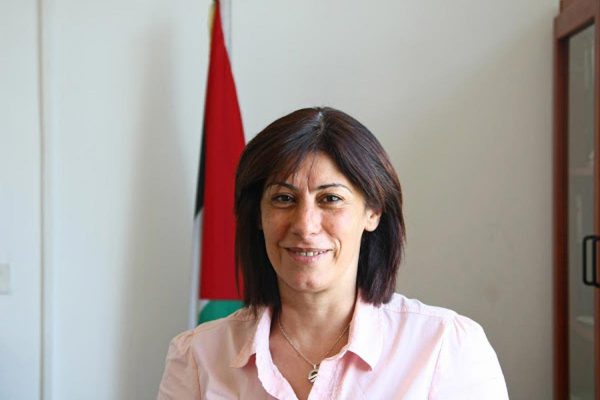
Israel re-arrests prominent Palestinian legislator Khalida Jarrar
Press TV – October 31, 2019
Israeli forces have re-arrested a prominent Palestinian legislator and senior member of the Popular Front for the Liberation of Palestine (PFLP) in an overnight raid into her home.
Khalida Jarrar, a 56-year-old member of the Palestinian Legislative Council, was arrested at 3 am local time (00:00 GMT) at her home in the central occupied West Bank city of Ramallah, located 10 kilometers north of Jerusalem al-Quds, and taken to an unknown area, local media reported on Thursday.
Her daughter Yara Jarrar said in a post on Twitter that the house was surrounded by more than 70 Israeli soldiers who arrived in 12 military vehicles.
“Mom and sister were asleep when they approached,” Yara said.
The Palestinian lawmaker has been jailed multiple times. She was released last February after spending 20 months in “administrative detention” — an illegal practice under which an individual is held without a trail.
Jarrar, a staunch advocate of Palestinian prisoners’ rights, said after her release that she would continue to campaign for the release of all Palestinian prisoners held in Israeli prisons and detention centers.
According to Samidoun, a Palestinian prisoner solidarity network, she played a leading role in supporting the education of the minor girls held there, organizing classes on human rights and in review for mandatory high school examinations when the prison authority denied the girls a teacher.
Jarrar was last arrested in July 2017, when a large number of Israeli troopers raided her home. Her husband, Ghassan, said Israeli forces also seized her computers during the raid.
Israel’s internal spy agency, Shin Bet, later announced in a statement that Jarrar was arrested along with a Palestinian activist for “promoting terror activities,” without providing any further information.
Jarrar is one of the most outspoken critics of the Israeli occupation and has repeatedly slammed the Tel Aviv regime’s atrocities against Palestinians.
The Israeli regime has been denying the lawmaker the right to travel outside the occupied Palestinian territories since 1988. She campaigned for months in 2010 before receiving the permission to travel to Jordan for medical treatment.
In August 2014, Jarrar received a “special supervision order” from the Israeli military, which ordered her to leave Ramallah to live in the West Bank city of Ariha, also known as Jericho.
However, Jarrar set up a protest tent outside the Palestinian Legislative Council in Ramallah, where she lived and worked, until the controversial order was overturned later in September that year.
According to reports, a total of 13 Palestinian lawmakers are currently held in Israeli detention facilities without any trial under the so-called administrative detention, which is a policy according to which Palestinian inmates are kept in Israeli detention facilities without trial or charge.
Some Palestinian prisoners have been held in administrative detention for up to 11 years.
Israel currently holds 495 Palestinian prisoners in administrative detention, according to ADDAMEER Prisoner Support and Human Rights Association, an NGO that works to support Palestinian political prisoners.
Featured Video

Deception – Submarines against Olof Palme
or go to
Aletho News Archives – Video-Images
From the Archives
Woolsey Fire started at Santa Susana Field Lab — where “radioactive materials released were never accurately measured”
By John Laforge | CounterPunch | November 30, 2018
In my Nov. 16 column, I reported on potential radiation risks posed by California’s Woolsey wildfire having burned over parts or all of the Santa Susana Field Laboratory—south of Simi Valley, Calif., 30 miles outside Los Angeles—site of at least four partial or total nuclear reactor meltdowns.
The field laboratory operated 10 experimental reactors and conducted rocket engine tests. In his 2014 book Atomic Accidents, researcher James Mahaffey writes, “The cores in four experimental reactors on site … melted.” Reactor core melts always result in the release of large amounts of radioactive gases and particles. Clean up of the deeply contaminated site has not been conducted in spite of a 2010 agreement.
Los Angeles’s KABC-7 TV reported Nov. 13 that the Santa Susana lab site “appears to be the origin of the Woolsey Fire” which has torched over 96,000 acres. Southern Calif. Public Radio said, “According to Cal Fire, the Woolsey Fire started on the afternoon of Thursday, Nov. 8 … on the Santa Susana site.” … continue
Blog Roll
 Aletho News
- What is fueling unrest across the EU?
- Why no power can undermine Iran’s eternal dominance over the Strait of Hormuz
- Is The War Against Iran Over?
- Iran war will leave long-term ‘scar’ on Wall Street, investors warn
- How Iran decimated US power projection in West Asia: Military lessons of 40-day war
- Iran’s report details US-Israeli war crimes in targeting schools, hospitals, livelihoods
- NATO’s Slow Fracture: How Trump’s Iran War Exposed the Instrument of Hegemony
- Chinese jet fuel and the myth of energy independence
- Ukraine Sea Drone Fired From Libya Hit Russian Tanker in Mediterranean
- IRGC: Iranian forces launched no attacks during ceasefire hours
- If Americans Knew
- Military aid to Israel emerges as the latest political litmus test for Democrats
- The only Palestinian children’s rights organization closes following years-long Israeli campaign against it
- ‘I Can’t Forget the Smell’: Lebanese Reel After Israel Kills Over 300 in Single Day
- DNC Shoots Down Resolutions Calling Out AIPAC and Limiting Arms to Israel
- TCN: Is Israel Blackmailing President Trump?
- Israel killed at least 303 Lebanese yesterday – who were they? Daily Update
- Amnesty: Urgent – Protect Lebanese civilians from brutal escalation in Israeli attacks
- Is The War Against Iran Over?
- Inside the Israeli army’s propaganda wing
- Hundreds of Gaza Amputees Stranded in Legal Limbo
- No Tricks Zone
- New Study: No Linear Warming Or Glacier Retreat Along Northern Antarctic Peninsula Since 1980s
- An Inconvenient Tree: Uncovered In Alps… Europe Much Warmer Than Today 6000 Years Ago
- New Study Reports A 60% Slowdown In Greenland’s Ice Loss Rate In The Last Decade
- Low Intensity Tornado Wrecks Major Solar Farm, Creating A Potential Toxic Dump
- New Study Finds Warming Saves Lives…Cold Temperatures 12 Times More Deadly Than Excess Heat
- German Science Blog Accuses PIK Climate Institute Of Hallucinating Climate Tipping Points
- Devastating Assessment Of Comirnaty Vaccine By Former Senior Pfizer Europe Toxicologist
- New Study: CO2 Is ‘Effectively Negligible’ As An Explanatory Climate Change Factor Since 2000
- Former Pfizer Toxicologist Dr. Helmut Sterz Tells Bundestag Hearing Pfizer Vaccine Should Have Never Been Approved
- Energy Expert: Germany’s Nuclear Phaseout Was A “500 Billion Euro Mistake”
 Aletho News