The Unfinished Gaza War: What Netanyahu Hopes to Gain from Attacking Palestinian Prisoners
By Ramzy Baroud | Palestine Chronicle | April 10, 2019
The current violence targeting Palestinian prisoners in Israeli jails dates back to January 2. It was then that Israel’s Public Security Minister, Gilad Erdan declared that the “party is over.”
“Every so often, infuriating pictures appear of cooking in the terrorist wings. This party is coming to an end,” Erdan was quoted in the Jerusalem Post.
Then, the so-called Erdan’s Committee recommended various measures aimed at ending the alleged “party”, which included placing limits on prisoners’ use of water, banning food preparations in cells, and installing jamming devices to block the alleged use of smuggled cell phones.
The last measure, in particular, caused outrage among prisoners, for such devices have been linked to severe headaches, fainting, and other long-term ailments.
Erdan followed his decision with a promise of the “use of all means in (Israel’s) disposal” to control any prisoners’ protests in response to the new restrictions.
The Israel Prison Service (IPS) “will continue to act with full force” against prison “riots”, he said, as reported by the Times of Israel.
That “full force” was carried out on January 20 at the Ofer Military Prison near Ramallah, in the West Bank, where a series of Israeli raids resulted in the wounding of more than 100 prisoners, many of whom sustaining bullet wounds.
The Nafha and Gilboa prisons were also targeted with the same violent pattern.
The raids continued, leading to more violence in the Naqab Prison on March 24, this time conducted by the IPS force, known as the Metzada unit.
Metzada is IPS’ ‘hostage rescue special operation’ force and is known for its very violent tactics against prisoners. Its attack on Naqab resulted in the wounding of many prisoners, leaving two in critical condition. Palestinian prisoners fought back, reportedly stabbing two prison-guards with sharp objects.
On March 25, more such raids were conducted, also by Metzada, which targeted Ramon, Gilboa, Nafha and Eshel prisons.
In response, the leadership of Palestinian prisoners adopted several measures including the dismantling of the regulatory committees and any other form of representation of prisoners inside Israeli jails.
The decentralization of Palestinian action inside Israeli prisons would make it much more difficult for Israel to control the situation and would allow prisoners to use whichever form of resistance they may deem fit.
But why is Israel provoking such confrontations when Palestinian prisoners are already subjected to a most horrid existence and numerous violations of international law?
Equally important, why now?
On December 24, embattled Prime Minister, Benjamin Netanyahu and other leaders of Israel’s right-wing government dissolved the Knesset (parliament) and declared early elections on April 9.
A most winning strategy for Israeli politicians during such times is usually increasing their hostility against Palestinians in the Occupied Territories, including the besieged Gaza Strip.
Indeed, a hate-fest, involving many of Israel’s top candidates kicked in, some calling for war on Gaza, others for teaching Palestinians a lesson, annexing the West Bank, and so on.
Merely a week after the election date announcement was made, raids of prisons began in earnest.
For Israel, it seemed like a fairly safe and controlled political experiment. Video footage of Israeli forces beating up hapless prisoners, accompanied by angry statements made by top Israeli officials captured the imaginations of a decidedly right-wing, militant society.
And that’s precisely what took place, at first. However, on March 25, a flare in violence in Gaza led to limited, albeit, undeclared war.
A full-fledged Israeli war on Gaza would be a big gamble during an election season, especially as recent events suggest that the time of easy wars is over. While Netanyahu adopted the role of the decisive leader, so determined to crush the Gaza resistance, his options on the ground are quite limited.
Even after Israel accepted Egyptian-mediated ceasefire terms with the Gaza factions, Netanyahu continued to talk tough.
“I can tell you we are prepared to do a lot more,” Netanyahu said about the Israeli attack on Gaza during a video speech beamed to his supporters in Washington on March 26.
But, for once, he couldn’t, and that failure, from an Israeli viewpoint, intensified verbal attacks by his political rivals.
Netanyahu has “lost his grip on security,” the Blue and White party leader, Benny Gantz proclaimed.
Gantz’s accusation was just another insult in an edifice of similar blistering attacks questioning Netanyahu’s ability to control Gaza.
A poll, conducted by the Israeli TV channel, Kan on March 27, found that 53% of Israelis believe that Netanyahu’s response to the Gaza resistance is “too weak.”
Unable to counter with more violence, at least for now, the Netanyahu government responded by opening another battlefront, this time in Israeli prisons.
By targeting prisoners, especially those affiliated with certain Gaza factions, Netanyahu is hoping to send a message of strength and to assure his nervous constituency of his prowess.
Aware of the Israeli strategy, Hamas’ political leader, Ismail Haniyeh linked the ceasefire to the issue of prisoners.
We “are ready for all scenarios,” Haniyeh said in a statement.
In truth, the Netanyahu-Erdan war on Palestinian prisoners is foolish and unwinnable. It has been launched with the assumption that a war of this nature will have limited risks, since prisoners are, by definition, isolated and unable to fight back.
To the contrary, Palestinian prisoners have, without question, demonstrated their tenacity and ability to devise ways to resist the Israeli occupier throughout the years. But more importantly, these prisoners are far from being isolated.
The nearly 6,000 Palestinian prisoners in Israeli jails represent whatever semblance of unity among Palestinians that transcends factions, politics and ideology.
Considering the direct impact of the situation in Israeli prisons on the collective psyche of all Palestinians, any more reckless steps by Netanyahu, Erdan and their IPS goons will soon result in greater collective resistance, a struggle that Israel cannot easily suppress.
– Ramzy Baroud is a journalist, author and editor of Palestine Chronicle. His forthcoming book is ‘The Last Earth: A Palestinian Story’ (Pluto Press, London).
Palestinian held in Ghana: ‘I was tortured for 35 days’
![Mahran Baajour, Palestinian businessman who has disappared in Ghana [File photo]](https://i1.wp.com/www.middleeastmonitor.com/wp-content/uploads/2019/03/4.jpg?resize=1200%2C800&quality=75&strip=all&ssl=1)
Palestinian businessman Mahran Baajour
MEMO | April 1, 2019
The Ghanaian authorities must open an investigation into the kidnapping and torturing Palestinian Mahran Baajour and bring those responsible to justice, Arab Organisation for Human Rights in the UK (AOHR UK) said in a statement today.
Thirty-nine-year-old Baajour has been subjected to enforced disappearance and torture in Ghana by security agents, believed to be Mossad agents, since his arrest on 13 December 2018 until his release in March 2019.
Baajour arrived in Ghana on 13 December 2018 on a business trip. He was arrested after leaving the airport of Ghanaian capital Accra, without justification. He was arrested along with two other Ghanaian nationals who were at the airport to receive him; they were taken to an unknown location. The two Ghanaian men were later released and they informed Baajour’s family of his arrest.
“He was detained at the airport and when the family asked about his whereabouts, the reply was that he wasn’t in their custody,” his brother Jehad Baajour told reporters.
One of Mahran’s brothers who lives in Denmark subsequently flew to Ghana in a bid to locate him, but Ghanaian intelligence services again denied he was in the country.
AOHR UK confirmed that Baajour was “subjected to physical torture, beating all over his body, psychological torture, insult and verbal abuse by white-skinned officers speaking little Arabic”.
“Some officers’ clothes had Hebrew writings on it.”
In his statement to the organization, Baajour said:
“As soon as I left the airport in Accra, four cars surrounded the car I was in.
They arrested us without showing a legal warrant, without disclosing the agency they belong to and took us to another place, where they exchanged cars. They took me to an unknown place, I still do not know, and I was handcuffed the whole time.
White-skinned men, who knew little Arabic, started investigating me. They were 14 men from different nationalities as they told me. I noticed on a coat, which belongs to one of them, Hebrew badges, Hebrew written papers, and some of them used Hebrew words like ‘Shekel’.
I was interrogated about the situation of the refugees in Lebanon, the Lebanese and Palestinian political forces, some terrorist activities and operations that were not related to me and I told them so. They tortured me in various ways for 35 days.
They detained me in a narrow room, 1×1 meters, deprived me of sleep for up to three consecutive days, poured cold water on me and beat me on the head strongly, in addition to handcuffing my hands and feet all the time. They threatened me with kidnapping my 12-year-old daughter and killing her, while verbally abusing me.”
READ ALSO:
Ghana government attitude towards Mahran Baajour’s abduction repugnant – Minority
Trump Tells the Truth: Sanctions Cause People to Suffer
By Ron Paul | April 1, 2019
This week President Trump admitted what the Washington policy establishment of both parties would rather be kept quiet. Asked why he intervened to block a new round of sanctions on North Korea, he told the media that he believes the people of North Korea have suffered enough. “They are suffering greatly in North Korea… And I just didn’t think additional sanctions at this time were necessary,” he said.
The foreign policy establishment in Washington, whether they are neocons, “humanitarian interventionists,” so-called “realists,” or even progressives have long embraced sanctions as a way to pressure governments into doing what Washington wants without having to resort to war.
During my time in Congress I saw many of my antiwar colleagues on the Left vote for sanctions because they believed sanctions are more “humane” than war. Neocons and other interventionists endorse sanctions because they know that sooner or later they will lead to war, their preferred foreign policy.
With his characteristic bluntness, President Trump has exposed this big lie. Sanctions are not a more humane alternative to war. They are just another form of war. In fact they are perhaps the cruelest form of war because they do not target the military of an adversary, but rather the innocent civilian population. As President Trump said, they make people suffer.
Sanctions are meant to make life so miserable for the civilian population that it rises up and overthrows a leader out of favor in Washington. In Iraq in the 1990s, those sanctions cost the lives of a half a million children, but then-Secretary of State Madeleine Albright infamously said she thought the price was worth it. But still the people didn’t rise up and overthrow Saddam even as their lives became more and more miserable. So the neocons had to concoct some lies about WMDs and Iraq was invaded anyway. An estimated million more people were killed in that war. So much for the “humanitarianism” of sanctions.
Sanctions often target water supplies, sewage treatment, medicine, food supply and other essentials for civilian life. After the people suffer under the “soft” war of sanctions, though, they most often are forced to suffer again as the US attacks anyway. That was the case in Iraq, Libya, Syria, and elsewhere. And it may soon be the case for Venezuela and perhaps even North Korea.
In Yemen, sanctions have contributed to the death of some 80,000 children from starvation. Millions more are facing starvation, yet they continue to resist Saudi and US demands that they overthrow their government.
Sanctions do not inspire people to rise up and overthrow their governments. Most civilians suffering under sanctions couldn’t throw out their rulers even if they wanted to – after being impoverished and malnourished for years they are really expected to take on their own government’s military?
I am glad to hear President Trump tell the truth about sanctions. They hurt the powerless in the false hope that the powerful will change their behavior. No new sanctions on North Korea is a good start. Now how about dismantling the inhumane and counterproductive sanctions from Caracas to Damascus and from Moscow to Beirut. Let’s return to a foreign policy of peace and engagement, backed by a strong military for our defense alone.
The Many Reasons to Believe Vasily Prozorov’s Testimony About Ukraine’s Role in Downing MH-17
Former Ukrainian intelligence officer Vasily Prozorov’s testimony will likely be dismissed by Western governments supporting Kiev, but there is plenty of evidence to back his claims.
By Whitney Webb | MintPress News | March 27, 2019
KIEV, UKRAINE — A former top official in Ukraine’s Security Service (SBU), who recently fled the country, has given explosive testimony regarding the involvement of the Ukrainian government in the 2014 downing of the MH-17 passenger plane. The incident, which killed all 283 passengers and 15 flight crew members on board, had been blamed on Russia by Ukraine’s government, the United States and much of Western media.
In addition, the former official, Vasily Prozorov, told a group of international reporters that Ukraine’s controversial Azov Battalion, known for its Neo-Nazi ideology and symbolism, ran and maintained secret prisons in contested areas of Eastern Ukraine where there is fighting between pro-government forces and pro-Russian separatists. Prozorov, who has sought asylum in Russia, also accused the United States and the United Kingdom of training an SBU division that returned to Ukraine to conduct terrorist attacks in the Donbass region, which has been the site of a civil war since the overthrow of Ukraine’s government in 2014 in a U.S.-backed coup.
Prozorov’s identity was kept secret until the press conference began, in breaking with standard protocol. Prozorov then introduced himself, stating that he had been employed by the SBU from 1999 to 2018, but — after the U.S.-backed coup in 2014 — had contacted Russian intelligence and began working undercover in the central office of the SBU. He does not describe himself as a defector, as he stated that his allegiance remains with the Ukrainian people while the allegiance of those who came to power with U.S. assistance in 2014 has long been suspect.
Prozorov then noted that, soon after the coup and before the civil war between Western and Eastern Ukraine had begun, the SBU — at Kiev’s behest — had begun to plan combat operations in the East and that the government had requested that plans be made that would result in mass civilian deaths among ethnic Russian populations, who were to be labeled as “accomplices to terrorists.”
The former SBU officer also detailed how the post-coup SBU had established secret prisons where prominent dissidents of the U.S.-backed government were interrogated, tortured and even killed. One of those prisons, located at an airstrip in Mariupol, was nicknamed “the Library” and Prozorov compared it to a “concentration camp” and showed images of severely beaten detainees he claimed had been imprisoned at the site. The former SBU officer also stated that SBU’s decisions, in regards to the black-site prisons and other areas, were often “led” by foreign advisers from the United States and the United Kingdom. The SBU’s use of torture in Ukraine’s civil war has been well-documented even though the SBU blocked UN efforts to probe its extent.
In addition, Prozorov asserted that the Neo-Nazi Azov Battalion, a militia that was incorporated into Ukraine’s Interior Ministry as a component of the country’s National Guard, also operates its own prisons in the Anti-Terrorist Operation (ATO) zones in Eastern Ukraine. The Azov Battalion receives funding from the government of Ukraine as well as from the U.S. government and has also received weapons from the Israeli government.
Insights into the MH-17 downing
Prozorov’s most shocking statements were related to the 2014 downing of Malaysian Airlines Flight 17, or MH-17, which was promptly blamed on Russia by the post-coup Ukrainian government, the United States and much of the Western world. Prozorov stated, noting first that it was his personal opinion based on his experiences, that the Ukrainian government had been an “accomplice to the Malaysian MH-17 flight disaster.”
He continued, stating:
The amazingly prompt reaction of the Ukrainian leadership was the first thing that made me feel suspicious. My unequivocal opinion was President Pyotr Poroshenko and his press-service had prior knowledge of the affair. Secondly, hostilities had been underway for several months by then, but the airspace over the area was not closed.”
He also noted that his efforts to learn more about the circumstances of the disaster within the SBU from a senior officer were met with the following reply: “Don’t poke your nose into this business, if you don’t wish to have problems.” However, Prozorov noted that “some information has leaked out in the end, though.”
He then concluded:
On the basis of my own analysis I can speculate who was an accomplice in the crime and who was involved in concealing evidence. In my opinion, there were two men involved – the current deputy chief of the Ukrainian presidential staff Valery Kondratyuk and chief of the Ukrainian Defense Ministry’s intelligence directorate, Vasyl Burba.”
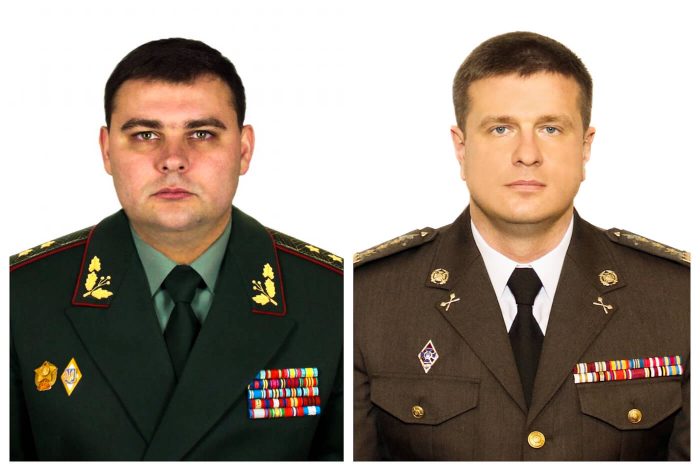
Valery Kondratyuk, left and Vasily Burba, right
Prozorov’s full conference can be watched here (in Russian). A summary with English subtitles can be watched here.
Claims well-supported by independent reporting
Though some may be quick to dismiss Prozorov’s testimony as “Russian propaganda,” many of his claims fit with independent reporting on the Ukrainian conflict. For instance, in regard to Prozorov’s claim of “black site” prisons, the SBU denied the UN access in 2016 to many detention centers in Mariupol — where Prozorov says “the Library” prison is located — and Kramatorsk. The SBU claimed that it blocked the UN inspectors access in order to protect “government secrets.” The UN had first tried to access the areas after several human-rights groups had found credible evidence of torture taking place at facilities in the area.
Prozorov’s claims that the post-coup SBU had made plans to murder ethnic Russians in the Donbass are also supported by publicly available evidence. For instance, when the civil war began, the Kiev-based government stated its intention to specifically target civilians in order “to clean the cities.” In 2016, then-Prime Minister Arseniy Yatsenyuk, who has been called “Washington’s man in Ukraine,” called pro-Russian civilians in the region “subhumans.” In an interview aired by the U.S.-funded, pro-government Ukrainian news channel Hromadske TV, a Ukrainian journalist aligned with the government asserted that the contested region was home to 1.5 million people “who are superfluous” and “must be exterminated.” With such sentiments having been openly stated by prominent politicians and journalists aligned with the current government in Kiev, Prozorov’s assertions seem hardly unreasonable.

US Director of the Defense Intelligence Agency, Robert Ashley, right, meets with Vasyl Burba, Chief of the Defense Intelligence of Ukraine. Photo | Defence Intelligence of Ukraine
In regard to Ukraine’s alleged role in the downing of MH-17, it is worth noting that past reports by late American investigative journalist Robert Parry described in detail how the “independent” MH-17 investigation was almost completely dependent on information from Ukraine’s SBU in piecing together the event. According to Parry:
[This control by the SBU, combined with its past obstruction of the UN torture probe],suggests that the SBU also would steer the JIT away from any evidence that might implicate a unit of the Ukrainian military in the shoot-down, a situation that would be regarded as a state secret which could severely undermine international support for the U.S.-backed regime in Kiev. Among the SBU’s official duties is the protection of Ukrainian government secrets.”
In addition, one of Parry’s sources maintained that the CIA had, like Prozorov, found evidence that Ukraine’s government had indeed been “an accomplice” to the MH-17 incident:
A source who was briefed by U.S. intelligence analysts told me that the CIA’s conclusion pointed toward a rogue Ukrainian operation involving a hard-line oligarch with the possible motive of shooting down Russian President Vladimir Putin’s official plane returning from South America that day, with similar markings as MH-17. The source said a Ukrainian warplane ascertained that the plane was not Putin’s but the attack went ahead anyway, with the assumption that the tragedy would be blamed on the pro-Russian rebels or on Russia directly.”
Another reason Prozorov’s testimony should not be outright dismissed as propaganda is the fact that he pushed back on previous Russian media reports involving U.S. infiltration of the SBU. When asked by a reporter if he could confirm reports that foreign military officials, including Americans, occupied their own floor at SBU headquarters, Prozorov adamantly denied those claims, stating that after 2005 there were CIA officials present in SBU headquarters but that the practice had been discontinued. He stated that U.S. intelligence officials regularly visited SBU headquarters after the 2014 coup but were not based in the building.
Thus, while Prozorov’s testimony will likely be dismissed by mainstream Western media outlets and Western governments that support Kiev, there is plenty of evidence suggesting that many of his claims — including his most shocking — deserve careful consideration, not outright dismissal. Indeed, were Prozorov a defector from a country currently at odds with the U.S. — be it Russia, Venezuela or Iran — it is highly likely that mainstream media would repeat and his promote his claims regardless of their veracity. However, because he has sought asylum in Russia, his recent statements are unlikely to gain international traction merely because of where he is now located, in spite of the evidence supporting many of those statements.
Whitney Webb is a MintPress News journalist based in Chile. She has contributed to several independent media outlets including Global Research, EcoWatch, the Ron Paul Institute and 21st Century Wire, among others. She has made several radio and television appearances and is the 2019 winner of the Serena Shim Award for Uncompromised Integrity in Journalism
Report: Egypt plan to lift siege requires disarmament of Gaza
MEMO | March 22, 2019
An Israeli report said that Egypt has put forward a plan for a settlement between Israel and Palestinian factions in the Gaza Strip, led by Hamas, which controls the Gaza Strip. Israel Hayom newspaper reported on Thursday that “according to security sources in Egypt and Palestinian officials in Gaza and Ramallah, Israel and Egypt have become convinced that Hamas’s control in Gaza is a self-evident fact.”
Israel Hayom quoted Egyptian security sources and Palestinian officials in the West Bank and Gaza Strip. It explained that the Egyptian proposal stated that they would disarm the factions – except for light weapons – in exchange for lifting the siege on the Gaza Strip.
According to this plan, all internal affairs will remain in the hands of Palestinian organisations headed by Hamas or a unified political entity for all organisations in the Strip. The internal security of the Gaza Strip will be based on “Hamas National Security Forces, which are currently operating.” The arms that will be in possession of the Internal Security Forces will be light weapons, in small quantities and subject to a strict control system.
In turn, the Israeli and Egyptian siege on the Gaza Strip will be lifted, according to the newspaper. Also, projects in the areas of infrastructure, employment, economy, health and education, financed by the United Nations, the European Union and Arab countries, “led by Saudi Arabia, Qatar and the UAE,” will be implemented. The plan calls for the opening of a maritime route to the Gaza port, which will allow in the first stage the export and import of goods directly to the Gaza Strip.
The newspaper asserted that “these parties have succumbed to the fact that the Palestinian Authority will have difficulty in regaining control in the Gaza Strip, whether after an internal Palestinian reconciliation, or because of the collapse of Hamas rule against the backdrop of the grave humanitarian situation, or because of the continued military confrontation with Israel.”
According to the newspaper, Egyptian sources stated that the Israeli policy towards the Strip is “soft,” and that this stems from Israel’s unwillingness to allow the “Hamas regime” to collapse and in anticipation that in the event of Hamas’s collapse, “extremist groups loyal to Iran or Salafist groups similar to Daesh will enter” to fill the vacuum.
The newspaper further said that estimates in Israel and Egypt indicate that “such a settlement can be implemented within three to five years, but the main obstacle is that Hamas and other Palestinian armed factions will oppose disarmament.”
Quoting sources it described as officials in Ramallah, the newspaper added that Palestinian Authority President Mahmoud Abbas and the PLO leadership would agree to “overthrow” Hamas and the factions in Gaza “only in case it led such a process when the control of Gaza is in the hands of the Palestinian Authority.”
The newspaper asserted that US security bodies obtained a draft of the plan which was formulated by Israeli and Egyptian crews. It quoted an Egyptian security official saying: “We are currently waiting for the new government to be elected in Israel to speed up the process; while the goal after the Israeli elections is the entry of other influential Arab countries, such as Qatar, Saudi Arabia, Jordan and the UAE.”
The Egyptian security official added that “if Abu Mazen and the leadership in Ramallah do not put obstacles, the plan can be put into effect with the full cooperation of all the regional actors and through providing guarantees and assistance by the international community. But, it is estimated that there will be strong opposition to the disarmament plan of the Gaza Strip by the PLO and mainly by the armed factions in Gaza.”
Israel kills Palestinian at checkpoint in West Bank, fourth to be killed in 24 hours
![26-year-old Ahmad Manasra from the local village of Wadi Fuqin [Twitter]](https://i2.wp.com/www.middleeastmonitor.com/wp-content/uploads/2019/03/4-1.jpg?resize=1200%2C800&quality=75&strip=all&ssl=1)
26-year-old Ahmad Manasra from the local village of Wadi Fuqin [Twitter]
MEMO | March 21, 2019
Israeli forces have shot dead a Palestinian man in the occupied West Bank near the city of Bethlehem; the fourth such killing in 24 hours.
The Palestinian Red Crescent reported that one of its crew treated a man with two bullet wounds near an Israeli military checkpoint near Bethlehem yesterday. The man was identified by the Palestinian Health Ministry as 26-year-old Ahmad Manasra from the local village of Wadi Fuqin.
According to the ministry, Manasra was shot in the chest, shoulder and hand by a checkpoint at the southern entrance of Al-Khader village, while another Palestinian was also shot and critically wounded.
The Israeli soldier who shot Manasra allegedly did so by accusing him of throwing stones, but eyewitnesses at the scene reported that Israeli forces at the checkpoint fired live bullets into the car of a Palestinian family consisting of a man and his wife and children. The man, identified as Alaa Ghayatha from the village of Nahalin, was shot in the abdomen and is said to be in critical condition. Manasra was in the car behind Ghayatha, and when the latter was shot Manasra came out to help him and was also shot at as he returned to his car.
The Israeli military issued a statement hours later claiming that the soldier stationed at the post had “identified rocks being thrown at Israeli vehicles” and “in response, he fired his weapon”. The statement did not, however, identify the soldier’s intended target, and the military said that “Details regarding the incident are being reviewed and the incident will be examined.”
Manasra’s death marks that of the fourth Palestinian killed by Israeli forces within 24 hours in the occupied West Bank, having closely followed another two incidents. On Tuesday night, Israeli forces killed 19-year-old Omar Abu Leila near the city of Ramallah, after he stabbed and killed an Israeli occupation soldier.
In another incident on Tuesday, two other Palestinians – Raed Hamdan, 21, and Zaid Nouri, 20 – were killed by Israeli soldiers as they were driving their car near the city of Nablus in the occupied West Bank after hundreds of Israeli settlers stormed Joseph’s Tomb in the city.
The Governor of Bethlehem, Kamel Hamid, told local news that what happened was a direct execution of a young man, calling on the international community to intervene and put an end to the Israeli occupation.
The Media & the WWF Torture Scandal
News organizations have turned their own journalists into WWF cheerleaders
By Donna Laframboise | Big Picture News | March 20, 2019

Click for source
Earlier this month, BuzzFeed published a three-part exposé about violent goons, funded and equipped by the World Wildlife Fund (WWF), who persecute indigenous communities. In the words of the BuzzFeed journalists, the WWF
works directly with paramilitary forces that have been accused of beating, torturing, sexually assaulting, and murdering scores of people. As recently as 2017, forest rangers at a WWF-funded park in Cameroon tortured an 11-year-old boy in front of his parents…
UK politicians have called on the government to respond to these “appalling and deeply disturbing” allegations. US senator Patrick Leahy has likewise demanded an “immediate and thorough review” of the support the WWF receives from American authorities.
BuzzFeed reports that the UK Charity Commission will be asking the WWF “serious questions.” Also in the UK, explorer Ben Fogle has stepped away from his public relationship with this organization, due to these “very serious human rights allegations.”

Longtime WWF supporter, actress Susan Sarandon, says she expects an “in-depth investigation” to take place.
Likewise, the Leonardo DiCaprio Foundation has called on the WWF to “provide the public with a full and transparent accounting of their findings.” (In 2016, DiCaprio – who sits on the WWF’s Board of Directors in the United States, symbolically ‘shared‘ his 2016 Golden Globe award “with all the First Nations peoples represented in this film and all the indigenous communities around the world.”)
Despite the celebrities, the prominence of the WWF brand, and the serious nature of these allegations, much of the media has chosen to ignore this story. Could that have anything to do with the fact that news organizations have spent the past decade turning their own journalists into WWF cheerleaders?
Here in Canada, our largest circulation newspaper, The Toronto Star, has served as an official sponsor of the WWF’s annual Earth Hour (see this 2008 discussion, and this from 2012).
Think about that cozy, inappropriate relationship – and then ask yourself why The Star has yet to tell its readers about the WWF torture scandal.
Since its Australian beginnings, Earth Hour was a deliberate media creation. Rather than reporting neutrally on current affairs, rather than applying an equally skeptical eye to all large multinational entities (WWF, come on down), news organizations instead promote certain events, certain entities, and certain environmental perspectives.
The flip side of that pathological arrangement is that these same news organizations also have the power to decide what isn’t news. Every single day, they decide what not to tell the public.
Don’t Shoot the Dogs: The Growing Epidemic of Cops Shooting Family Dogs
By John W. Whitehead | Rutherford Institute | March 19, 2019
The absurd cruelties of the American police state keep reaching newer heights.
Consider that if you kill a police dog, you could face a longer prison sentence than if you’d murdered someone or abused a child.
If a cop kills your dog, however, there will be little to no consequences for that officer.
Not even a slap on the wrist.
In this, as in so many instances of official misconduct by government officials, the courts have ruled that the cops have qualified immunity, a legal doctrine that incentivizes government officials to engage in lawless behavior without fear of repercussions.
This is the heartless, heartbreaking, hypocritical injustice that passes for law and order in America today.
It is estimated that a dog is shot by a police officer “every 98 minutes.”
The Department of Justice estimates that at least 25 dogs are killed by police every day.
The Puppycide Database Project estimates the number of dogs being killed by police to be closer to 500 dogs a day (which translates to 182,000 dogs a year).
In 1 out of 5 cases involving police shooting a family pet, a child was either in the police line of fire or in the immediate area of a shooting. For instance, a 4-year-old girl was accidentally shot in the leg after a police officer opened fire on a dog running towards him, missed and hit the little girl instead.
At a time when police are increasingly inclined to shoot first and ask questions later, it doesn’t take much to provoke a cop into opening fire on an unarmed person guilty of doing nothing more than standing a certain way, or moving a certain way, or holding something—anything—that police could misinterpret to be a weapon.
All a cop has to do is cite an alleged “fear” for his safety.
As journalist Radley Balko points out, “In too much of policing today, officer safety has become the highest priority. It trumps the rights and safety of suspects. It trumps the rights and safety of bystanders. It’s so important, in fact, that an officer’s subjective fear of a minor wound from a dog bite is enough to justify using potentially lethal force.”
The epidemic of cops shooting dogs takes this shameful behavior to a whole new level, though.
It doesn’t take much for a cop to shoot a dog.
Dogs shot and killed by police have been “guilty” of nothing more menacing than wagging their tails, barking in greeting, or merely being in their own yard.
For instance, Arzy, a 14-month-old Newfoundland, Labrador and golden retriever mix, was shot between the eyes by a Louisiana police officer. The dog had been secured on a four-foot leash at the time he was shot. An independent witness testified that the dog never gave the officer any provocation to shoot him.
Seven, a St. Bernard, was shot repeatedly by Connecticut police in the presence of the dog’s 12-year-old owner. Police, investigating an erroneous tip, had entered the property—without a warrant—where the dog and her owner had been playing in the backyard, causing the dog to give chase.
Dutchess, a 2-year-old rescue dog, was shot three times in the head by Florida police as she ran out her front door. The officer had been approaching the house to inform the residents that their car door was open when the dog bounded out to greet him.
Payton, a 7-year-old black Labrador retriever, and 4-year-old Chase, also a black Lab, were shot and killed after a SWAT team mistakenly raided the mayor’s home while searching for drugs. Mayor Calvo described being handcuffed and interrogated for hours—wearing only underwear and socks—surrounded by the dogs’ carcasses and pools of the dogs’ blood.
Chihuahuas, among the smallest breed of dog (known as “purse” dogs), seem to really push cops over the edge.
In Arkansas, for example, a sheriff’s deputy shot an “aggressive” chihuahua for barking repeatedly. The dog, Reese’s, required surgery for a shattered jaw and a feeding tube to eat.
Same thing happened in Texas, except Trixie—who was on the other side of a fence from the officer—didn’t survive the shooting.
Let’s put this in perspective, shall we?
We’re being asked to believe that a police officer, fully armed, trained in combat and equipped to deal with the worst case scenario when it comes to violence, is so threatened by a yipping purse dog weighing less than 10 pounds that the only recourse is to shoot the dog?
If this is the temperament of police officers bred by the police state, we should all be worried.
Clearly, our four-legged friends are suffering at the hands of an inhumane police state in which the police have all the rights, the citizenry have very few rights, and our pets—viewed by the courts as personal property like a car or a house, but far less valuable—have no rights at all.
It’s time to rein in this abuse of power.
Ultimately, this comes down to better—and constant—training in nonviolent tactics, serious consequences for those who engage in excessive force, and a seismic shift in how law enforcement agencies and the courts deal with those who transgress.
Many states are adopting laws to make canine training mandatory for police officers. After all, as the Washington Post points out, while “postal workers regularly encounter both vicious and gregarious dogs on their daily rounds… letter carriers don’t kill dogs, even though they are bitten by the thousands every year. Instead, the Postal Service offers its employees training on how to avoid bites.”
The Rutherford Institute is working on a program aimed at training police to deescalate their interactions with dogs rather than resorting to lethal force, while providing pet owners with legal resources to better protect the four-legged members of their household.
Yet as I point out in my book Battlefield America: The War on the American People, there will be no end to the bloodshed—of unarmed Americans or their family pets—until police stop viewing themselves as superior to those whom they are supposed to serve and start acting like the peace officers they’re supposed to be.
Costa Rican Indigenous Rights Defender Shot 15 Times, Killed

teleSUR | March 19, 2019
A Costa Rican Indigenous Bribri land rights activist was shot and killed late Monday night in his home in Salitre territory.
Indigenous land rights defender Sergio Rojas was assassinated by armed gunmen who shot the activist as many as 15 times at around 11:45 pm in his home, according to his neighbors, in southern Costa Rica.
Rojas was President of the Association for the Development of the Indigenous Territory of Salitre and coordinator of the National Front of Indigenous Peoples (FRENAP) in Costa Rica and was a staunch defender of the Bribri of Saltire Indigenous people who have been fighting for years to regain their rights to over 12,000 hectares of land in southern Costa Rica pledged to them by a 1938 government agreement, according to a 2014 teleSUR report.
The Bribri and other Indigenous have managed to recuperate control of some of their native lands but have become targets of violence from those who oppose their rights and sovereignty. Last December men armed with guns and machetes held hostage two Bribri women and eight minors on land they had recuperated in Salitre territory.
According to the women, they called 911 but when police arrived they spoke “aggressively” toward them and asked for their land deeds, which the authorities claimed were invalid. The police made no effort to arrest the hostage takers who escaped the scene, according to the testimonies given to Tree People Program.
This wasn’t the first time Rojas’ life was threatened. In 2012, shortly after the Bribri gained back some of their lands, the FRENAP coordinator was shot at eight times by armed men, but escaped the shooting unscathed.
In Israel normalising violence takes precedence over targeted assassinations
By Ramona Wadi | MEMO | March 14, 2019
One outcome is certain when it comes to the forthcoming Israeli elections – Gaza will remain a top target for the new government. Amid the sparring between contenders for the elections, former IDF chief Benny Gantz declared he would implement Israel’s policy of targeted assassinations against Hamas leaders if elected, and if necessary.
His comments sought to counter Education Minister Naftali Bennett’s remarks over “Operation Protective Edge” in 2014, in which the latter used derogatory language to criticise Gantz’s decisions which, according to Bennett, endangered the lives of Israeli soldiers. Bennett alleged that Gantz would be Hamas’ preferable leadership option. This claim is also being supported by Israeli Prime Minister Benjamin Netanyahu, who has stated that Gantz’s party would make “significant concessions to the Palestinians.”
Both Gantz and Netanyahu have increasingly focused on Gaza in their electoral campaigns, with “Operation Protective Edge” and the Great March of Return providing premises for their arguments. Gantz, who was in charge of the aggression against the enclave, has compared the 2014 aftermath to the ongoing protests and Netanyahu’s response, which was to order snipers positioned at the border to kill and injure Palestinians participating in the demonstration.
Gantz described Netanyahu’s strategy as a “tired policy”. The alternative in such a scenario, according to the former army chief, is to “return to a policy of targeted killings.”
In June 2018, Israel’s Security Minister Gilad Erdan advocated for the targeted assassinations of Hamas leaders and Palestinians launching the “incendiary kites” from Gaza’s border.
A return to targeted killings, however, is not accurate. Israel has a long history of assassinating Palestinian leaders from Hamas and other Palestinian political factions. Only last year, a Palestinian scientist affiliated to Hamas was gunned down in Malaysia, in an operation which raised speculation about Mossad’s role even in Israeli media, although there was no forthright confirmation of the agency’s involvement.
Gantz, therefore, will not be “returning” to a policy of targeted assassinations but embarking upon a continuation of Israel’s policy. Yet, speculation on targeted assassinations alone is just a deviation from the damage which both Netanyahu and Gantz have the power to inflict on the enclave in terms of political and humanitarian related violence.
Following “Operation Protective Edge”, Netanyahu adopted a strategy that prolongs violence for Israel’s benefit. The Great March of Return is one such example. Extrajudicial killings by Israel’s snipers raised international scrutiny which, with time, mellowed down to the usual expressions of concerns regarding what is deemed as routine violence. Distancing Israel from targeted assassinations in Gaza during this period provided Israel with the opportunity to normalise its ongoing violence on the border.
Gantz is no stranger to strategy. Targeted assassinations cannot be attributed to one single leader but to the existence of the colonial state and its policies of elimination. What Gaza will face under the new Israeli government is more likely to be a continuation of measures which maintains Palestinians’ deprivation in the enclave. Electoral campaign rhetoric aside, an outright endorsement and implementation of targeted assassinations contradict the intentional ambiguity which Israel has employed against leaders or individuals who have the potential to challenge its existence.
Palestine cuts staff pay over Israeli tax deductions
MEMO | March 10, 2019
The Palestinian government will pay civil servants half of their salaries after Israel withheld tax money collected on its behalf, according to the Palestinian finance minister.
“The government will pay 50 per cent of the salaries,” Shukri Bishara told a press conference in the West Bank city of Ramallah on Sunday.
He said the government has also applied a host of austerity measures, including halting the appointment of new civil servants, promotions and additional allowances.
“The government needs to borrow around $50-60 million a month from the local market to meet its obligations towards its employees and state institutions,” he said.
Last month, the Ramallah-based government refused to accept deducted tax revenues collected by Israel on behalf of the Palestinian Authority (PA).
The move came after the Israeli government decided to deduct some 502 million Israeli shekels (roughly $138 million) from the Palestinian tax money, citing that the amount was being paid by Ramallah to the families of Palestinians involved in attacks against Israeli targets.
Palestinian President Mahmoud Abbas has decried by the Israeli measure, saying his government would continue to pay monthly stipends to the families of Palestinian prisoners and martyrs.
Israel collects around $175 million each month in taxes on Palestinian imports and exports on behalf of the PA, for which tax revenue represents the main source of income.
French ophthalmologists demand Macron ban rubber bullets as eye injuries spread like ‘EPIDEMIC’

RT | March 10, 2019
France is experiencing an “epidemic” of eye injuries as police repeatedly deploy golf-ball-sized rubber bullets, France’s top ophthalmologists say, urging President Macron to halt use of the projectiles.
As the Yellow Vest protests enter their 17th consecutive week, the debate around the government’s alleged use of excessive force continues to gain momentum. On Saturday, the French newspaper Journal du Dimanche published a letter to President Macron written by the country’s 35 leading ophthalmologists, in which they asserted that the police’s use of rubber bullets has led to an “epidemic of serious eye injuries.”
Many people risk losing their vision, doctors say, hinting that the current dismal developments are no coincidence as rubber balls fly with great force and are often directed inaccurately. The letter, which demands “a moratorium” on using rubber bullets, was actually written in early February but only made public a month later to make sure the recipient gets the message, according the newspaper.
French riot police have become notorious for using hand-held guns, locally known as defence-ball launchers or Flash-Balls, during the protests that been ongoing since November.
The currently deployed model – named LBD 40 – fires 40mm foam projectiles, roughly the size of a golf ball. Rubber bullets have apparently become the police’s primary means of combating unruly crowds, and have been deployed more than 13,000 times, according to local officials.
The controversial weapon has landed the French government in hot water as reports of people losing their eyes in skirmishes with police began to surface. More than 20 protesters have lost eyes, five hands have been partially or entirely torn off, and one person lost their hearing as a result of a TNT-stuffed GLI F4 stun grenade.
The legal status of rubber-ball guns has been repeatedly questioned by human rights associations and politicians in France and abroad. In early February, France’s top administrative court, however, refused to ban the police from using the hand-held launchers.
Meanwhile, the country’s interior security code allows police to use force to dispel violent crowds but only when no other means suffice.
On Wednesday, UN High Commissioner for Human Rights Michelle Bachelet called for a “full investigation” of France’s excessive use of force towards the Yellow Vests who, according to her words, demand a “respectful dialogue.”
Government figures show that over 2,000 protesters and over 1,000 police officers have been injured since protests broke out in November.
Featured Video

Deception – Submarines against Olof Palme
or go to
Aletho News Archives – Video-Images
From the Archives
Woolsey Fire started at Santa Susana Field Lab — where “radioactive materials released were never accurately measured”
By John Laforge | CounterPunch | November 30, 2018
In my Nov. 16 column, I reported on potential radiation risks posed by California’s Woolsey wildfire having burned over parts or all of the Santa Susana Field Laboratory—south of Simi Valley, Calif., 30 miles outside Los Angeles—site of at least four partial or total nuclear reactor meltdowns.
The field laboratory operated 10 experimental reactors and conducted rocket engine tests. In his 2014 book Atomic Accidents, researcher James Mahaffey writes, “The cores in four experimental reactors on site … melted.” Reactor core melts always result in the release of large amounts of radioactive gases and particles. Clean up of the deeply contaminated site has not been conducted in spite of a 2010 agreement.
Los Angeles’s KABC-7 TV reported Nov. 13 that the Santa Susana lab site “appears to be the origin of the Woolsey Fire” which has torched over 96,000 acres. Southern Calif. Public Radio said, “According to Cal Fire, the Woolsey Fire started on the afternoon of Thursday, Nov. 8 … on the Santa Susana site.” … continue
Blog Roll
 Aletho News
- Feeling Better, Getting Worse: How Psychiatric Drugs Create the Illusion They Cure
- ‘Nobody Told Me’: Former Mental Health Patient Calls Out Dangerous Side Effects of Psychiatric Drugs
- Dr. Abu-Sitta: Beirut ‘felt like a day in Shifa Hospital’
- Iran Has Won the War, It Will Be Up to the US to Secure the Peace: Mohammad Marandi
- Iran condemns assassination threats against Iranian negotiators amid US talks
- Brussels cannot say where its own pipeline inspectors are as Hungary’s oil lifeline remains shut
- Israel’s Iran War: Myth and Reality
- Between war and industrial breakdown: The US-Israeli attrition crisis
- Pressure builds on Iran to ‘drop’ Lebanon ceasefire demand as Islamabad talks hang in balance
- In another clash report, US denies agreement to release Iran’s assets
- If Americans Knew
- Pro-Israel ‘Thinktanks’ and Individuals who Influence U.S. Foreign Policy
- Mearsheimer reveals how Israel dictates US policies on Iran, Gaza – video
- After killing 350+, Israel still has a “score to settle” with Lebanon before ceasefire – Daily Update
- Military aid to Israel emerges as the latest political litmus test for Democrats
- The only Palestinian children’s rights organization closes following years-long Israeli campaign against it
- ‘I Can’t Forget the Smell’: Lebanese Reel After Israel Kills Over 300 in Single Day
- DNC Shoots Down Resolutions Calling Out AIPAC and Limiting Arms to Israel
- TCN: Is Israel Blackmailing President Trump?
- Israel killed at least 303 Lebanese yesterday – who were they? Daily Update
- Amnesty: Urgent – Protect Lebanese civilians from brutal escalation in Israeli attacks
- No Tricks Zone
- German Expert: Heat Dome Led To Record Temps In Western USA…Warmer In 1934, 1936
- New Study: No Linear Warming Or Glacier Retreat Along Northern Antarctic Peninsula Since 1980s
- An Inconvenient Tree: Uncovered In Alps… Europe Much Warmer Than Today 6000 Years Ago
- New Study Reports A 60% Slowdown In Greenland’s Ice Loss Rate In The Last Decade
- Low Intensity Tornado Wrecks Major Solar Farm, Creating A Potential Toxic Dump
- New Study Finds Warming Saves Lives…Cold Temperatures 12 Times More Deadly Than Excess Heat
- German Science Blog Accuses PIK Climate Institute Of Hallucinating Climate Tipping Points
- Devastating Assessment Of Comirnaty Vaccine By Former Senior Pfizer Europe Toxicologist
- New Study: CO2 Is ‘Effectively Negligible’ As An Explanatory Climate Change Factor Since 2000
- Former Pfizer Toxicologist Dr. Helmut Sterz Tells Bundestag Hearing Pfizer Vaccine Should Have Never Been Approved
 Aletho News