Settler filmed starting fire in West Bank field is Israeli soldier

MEMO | May 27, 2019
One of the two Jewish settlers recently caught on video starting a fire in the occupied West Bank is an Israeli soldier, it has been revealed.
According to reports in the Israeli media, “the army knows the identity of the settler”, and “two security sources confirmed the details, saying that the soldier was on leave when the arson took place”.
The military said that “the Israel Police are expected to handle the incident”, while “the police said that they have yet to arrest the soldier”.
The incident took place on Friday, 17 May, when settlers attacked Palestinians and their properties in three West Bank villages.
While the Israeli military initially blamed Palestinians for starting the fires, the army was forced to change its story after a video clip published by human rights NGO B’Tselem clearly showed settlers lighting fires in fields.
In a separate video taken by local Palestinians that day, settlers are seen throwing rocks at villagers’ homes, while Israeli soldiers “can be seen standing among the settlers and doing nothing to stop them”.
To date, no one has been arrested for any of these attacks.
Israeli settlers in the occupied West Bank routinely assault Palestinians and vandalise their property, attacks which are almost never investigated or prosecuted by Israeli occupation authorities.
All Israeli settlements in the occupied West Bank and East Jerusalem are illegal under international law.
There’s No Other Way To Put It: Israel Kills Babies To Terrorize Gaza Into Submission
By Bryce Greene | May 10, 2019
On Sunday afternoon, Israel and Hamas agreed to a ceasefire, ending a three-day escalation of violence in the Gaza Strip. After two unarmed protesters were killed during the weekly Friday protest, two Israeli soldiers were killed in a firefight at the border. The Israeli military responded by bombing targets in Gaza resulting in two more Palestinian deaths. In response, Hamas and other minor political groupings such as Islamic Jihad, launched a barrage of projectiles into Israel.
According to a Hamas leader, the organization felt escalation was a necessary response to Israel shirking its obligations to ease the blockade — one of the terms of the ceasefire after Operation Protective Edge. To signal resistance against Israel, Hamas and other militant groups in the strip occasionally launch homemade projectiles into southern Israel. In reality these “rockets” are weak, especially compared to the high tech war machine that Israel possesses. In fact, only four Israelis were killed by the indiscriminate rocket fire into Israel’s urban areas. According to the Independent, this is the first time in five years that an Israeli has been killed by a projectile launched from Gaza.
As a side note: when the Jerusalem Post reported early on about injured Israelis, their numbers were inflated by 10 who were mildly injured while running to shelter and 45 who suffered from “anxiety”. Only three in this case were actually injured from Gaza rocket fire.
Why then, in the face of such a relatively insignificant threat, does Israel decide to erupt into a bombing frenzy in one of the poorest areas in the world? Israeli officials often say it is about something called “deterrence capacity”.
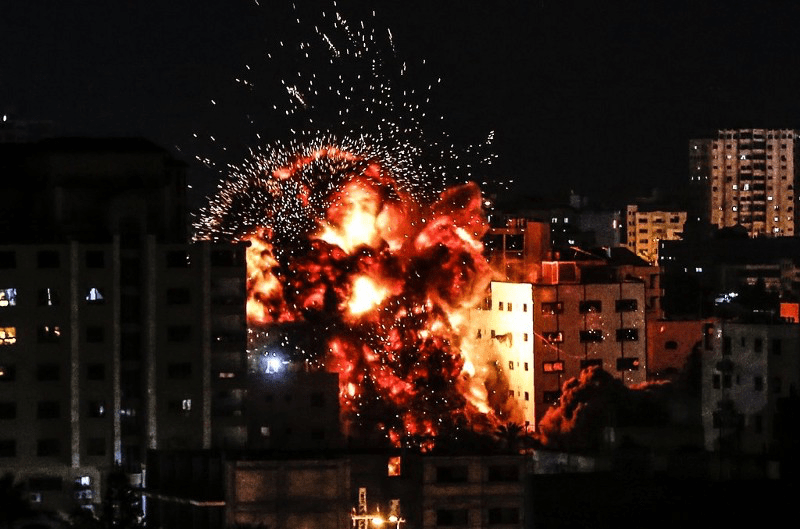
Israel bombs Gaza during the night [From @MuhammadSmiry]
Deterrence capacity is essentially a measure of how terrified people are of a violent response if they were to cross Israel. Throughout all of Israel’s statehood, deterrence capacity has been at the center of its military strategy. It is established when the Israeli forces “demonstrate real hooliganism” at the demand of the high Israeli officials. The more indiscriminate the violence and the more fear struck into the hearts of Palestinians, the less likely they are to resist Israel’s harsh treatment. The Israelis use the term “mowing the lawn” to describe these periodic outbursts of violence. It is a deliberate attempt to beat a desperate people into submission in order to accomplish political ends. In a word, it is the definition of state terrorism.
On Sunday, while the bombs were still falling, Hamas and Islamic Jihad signaled that they were ready to reach a ceasefire. Israel ignored this because, according to Israeli officials, they wanted to reestablish their deterrence capacity. Netanyahu promised “massive strikes” and even began mobilizing ground forces in preparation for an invasion. In other words, the military wanted the population of Gaza to suffer more so that they would fear Israel more. If they fear Israeli bombs enough, Israeli strategy assumes the people of Gaza would quietly accept the destruction of their society. The only reason Israel did not escalate was that it did not want to juggle the PR of bombing a defenseless population during the Eurovision song contest which is being held in Tel Aviv this year.
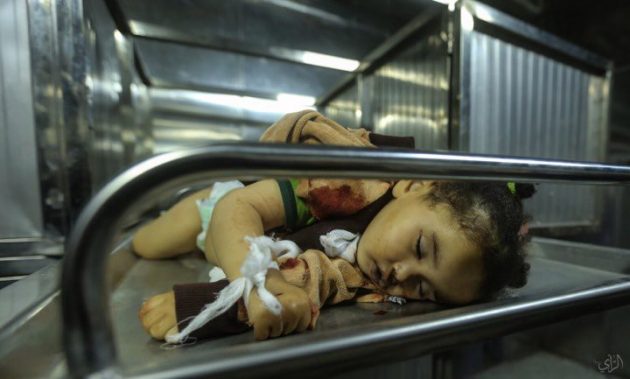
Seba Abu Arar, 14 months, killed in Israeli Strikes [From @MuhammadSmiry]
The decision to continue the bombardment came even after it was known that many civilians, including a pregnant woman and and an infant, were killed in the attacks. Israeli command evidently did not care about these casualties. This is just the latest example of Israel using security concerns to justify outright terrorism. To show just how spurious the security pretext is, ask simple question: What effect will the bombing have on Israeli security?
The bombings are never designed to destroy Hamas militarily. That would be impossible without completely obliterating the strip after a costly invasion and then entirely uprooting Gaza’s civil society. The attacks also do not weaken Hamas politically, but strengthen it. Hamas’s popularity comes in part from their reputation as an armed resistance against Israeli aggression. Armed resistance wouldn’t be as popular if Israel was not continuously antagonizing the population with a crippling blockade and perpetuating the humanitarian crisis.
When Israel attacks Gaza, they’re not expecting some sort of change to the status quo. Bombing the enclave only serves to exacerbate both feelings of hostility as well as the underlying conditions. All of this increases the likelihood of Palestinian violence. As long as Israel refuses to address the roots of the situation, daily life in Gaza will remain unchanged, along with the conditions that lead some to justify firing projectiles into Israel.
So, when Israel bombs one of the most densely populated areas on earth, remorselessly slaughters infants and bombs school shelters and personal residences all in the name of security, the serious reader must understand it as nothing less than a cover for the continuation of terrorism against the Palestinian people. Without willful ignorance, mental gymnastics or outright cognitive dissonance, there’s no other way of putting it.
Another Whistleblower Bites the Dust as The Intercept Adds a Third Notch to Its Burn Belt
By Whitney Webb | MintPress News | May 10, 2019
Early Thursday morning, the Department of Justice unsealed an indictment against Daniel Everette Hale — a former intelligence analyst for the U.S. Air Force and National Security Agency (NSA) and later a defense contractor working for the National Geospatial-Intelligence Agency (NGA) — for providing a reporter with classified government information. The reporter in question, although unnamed in the indictment, is Jeremy Scahill, co-founder of and journalist for the online publication The Intercept.
The indictment against Hale makes him the third Intercept source to be charged with leaking classified information to the outlet in less than two years. Notably, both of the government whistleblowers that have already been prosecuted and convicted by the Trump administration – Reality Winner and Terry Albury – were Intercept sources who were outed as whistleblowers by reporters working for the online publication.
The publication, which has long been associated with the documents shared by whistleblower Edward Snowden, has yet to fire any of the reporters responsible for these breaches that have seen two whistleblowers already imprisoned and third, Daniel Hale, likely to be imprisoned.
Despite its increasingly dismal track record, the publication – largely funded by government-linked tech billionaire Pierre Omidyar – continues to invite and “welcome” whistleblowers from the public and private sector and implores them to “consider sharing your information securely with us.”
“An utter failure of source protection. Again”
According to the Department of Justice website and the official indictment, Hale has been charged with obtaining national defense information, retention and transmission of national defense information, causing the communication of national defense information, disclosure of classified communications intelligence information, and theft of government property. Each charge carries a maximum sentence of 10 years in prison, meaning that Hale faces 50 years behind bars.
The indictment, which can be read in full here, details that Hale and “the reporter” (Scahill) communicated rather insecurely on several occasions, appearing at public events together, talking by phone and sending unencrypted text messages by phone.
Other information in the indictment shows that Scahill is clearly “the reporter” in question, given that “the reporter” in the indictment attended the Oscars in 2014 and held book events at the Washington, D.C. venue Busboys and Poets on April 29, 2013 and on June 8, 2013. During the June 8 book event, the indictment states that Hale was seated next to “the reporter” at an event where said reporter was promoting his book. A video taken at an event at Busboys and Poets held on June 8, 2013 shows Hale seated next to Scahill.
The indictment does not specify what led federal investigators to Hale several years after the events in question took place. Indeed, the indictment deals exclusively with events that took place between 2013 and 2015, and Hale’s house had been raided in August 2014, from which some of the evidence cited in the indictment was likely acquired. However, the Obama administration never pressed charges and it is unclear why the Trump administration has waited until now to do so, or if investigators acquired new information on Hale’s whistleblowing activities relatively recently. Hale, who appeared in the 2016 documentary National Bird about drone whistleblowers, had stated in that film that he anticipated being indicted at some point in time.
While the indictment suggests that the lack of secure communication with Scahill was a likely factor, there are other possibilities, such as the “friend” of Hale, noted in the indictment, with whom he discussed his relationship with Scahill.
Another possibility is that someone else at the Intercept other than Scahill was made aware of Hale’s identity, a point raised years ago by CIA whistleblower John Kiriakou and recently pointed out by independent journalist Caitlin Johnstone. After it was revealed that the Intercept had obtained information from a whistleblower on drone warfare, which turned out to be Daniel Hale, in 2015, Kiriakou tweeted: “New drone whistleblower at The Intercept. For God’s sake don’t let Matthew Cole learn his identity.”
Cole, as will be noted later on in this report, has been accused by Kiriakou for outing him as a journalistic source to the federal government and, two years after Kiriakou’s tweet, was believed to have helped lead federal investigators to Intercept source Reality Winner in 2017. Thus, it is possible that Cole or another employee of the online publication had learned of Hale’s identity from Scahill and then passed it along, either intentionally or inadvertently, to the government.
Betsy Reed, editor-in-chief of the Intercept, said in a brief statement that the publication “does not comment on matters relating to the identity of anonymous sources.”
Jesselyn Radack — Hale’s lawyer, who has represented several past whistleblowers, such as Thomas Drake and Kiriakou — stated on Twitter that “unsophisticated whistleblowers” like Hale, now 31 years old but who was only 23 when he met Scahill, should not have borne the burden of keeping his identity safe. Rather, Radack wrote, such a burden fell to the journalist – particularly those working at an outlet like the Intercept that promotes its source protection capabilities (now very much in doubt).
In a separate tweet to journalist Tim Shorrock, Radack called Hale’s case “an utter failure of source protection. Again.” In other words, Hale’s lawyer – who is privy to information not contained in the publicly available indictment – asserts that a large part of the blame for Hale’s arrest was attributable to the Intercept’s, and presumably Scahill’s, behavior and failure to protect their source. The other guilty party, of course, is the Trump administration’s continuation — if not intensification — of the Obama-era crackdown on whistleblowers and journalistic sources.
The Intercept’s three-of-a-kind
For readers who may be puzzled by Radack’s use of “again” in her tweet to Shorrock, it is worth revisiting the case of the two currently imprisoned Intercept sources – Reality Winner and Terry Albury – both of whose whistleblowing activities were made known to the government as a result of poor decisions by Intercept staff.
MintPress reported on the acts by the online publication and noted that the Intercept made two Freedom of Information Act (FOIA) requests in March 2016 for documents that the publication had already received from Albury — so the requests were an effort to “launder” or obfuscate the fact that the classified documents had been obtained from a whistleblower. Yet, both FOIA requests contained specific information identifying the names of the documents that were not publicly available, an error that led the FBI to link references contained in the requests to Albury’s activity on FBI information systems. The FBI subsequently found that documents that Albury had accessed had been later published by the Intercept.
Albury, a father of two young children, is currently serving a four-year sentence for bringing important information about the FBI’s abuse of power in relation to its counter-terrorism activities and surveillance of journalists to the public. To date, no one at the Intercept was fired in connection with Albury’s prosecution, despite the role of the FOIA requests made by the Intercept in his arrest.
Nine months prior to Albury’s arrest, Reality Winner, a federal contractor, had been arrested for giving a classified document to the Intercept. While the Intercept has long maintained that it was unaware that Winner was the source of the document, FBI documents have shown that negligence helped lead federal investigators straight to Winner. The Intercept’s scanned images of the intelligence report that Winner leaked contained tracking dots – a type of watermark – that, according to Rob Graham of the Errata Security blog, showed “exactly when and where documents, any document, is printed.” These dots make it easy to identify a printer’s serial number as well as the date and time a document was printed. As Graham noted, “Because the NSA logs all printing jobs on its printers, it can use this to match up precisely who printed the document.”
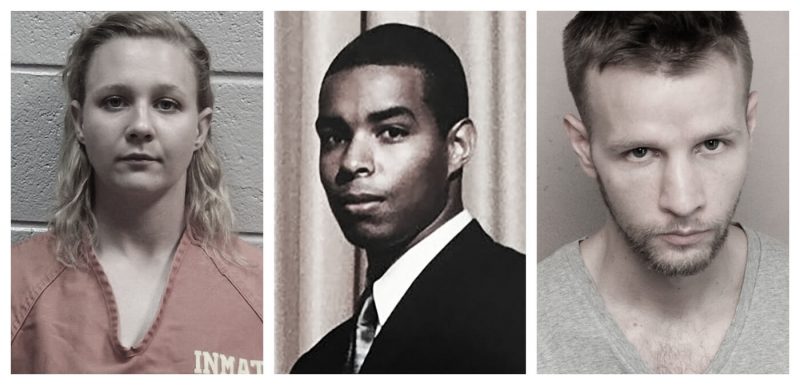
From left to right: Winner, Albury and Hale
Most concerning of all, the FBI warrant also notes that the reporter in question – who is unnamed in the document – contacted a government contractor with whom he had a prior relationship and revealed where the documents had been postmarked from – Winner’s hometown of Augusta, Georgia – along with Winner’s work location. He also sent unedited images of the documents that contained the tracking dot security markings that allowed the documents to be traced to Winner. Jesselyn Radack as well as whistleblower John Kiriakou, who served two and a half years in prison for exposing the CIA’s illegal torture program, have since asserted that Matthew Cole was the journalist mentioned in this warrant. Well prior to being hired by the Intercept, Cole’s behavior was known to have been a key factor that led to Kiriakou being outed as a confidential source, which led to his arrest. Upon learning of Hale’s arrest, Kiriakou openly speculated upon whether the outlet was incomptent or compromised.
Despite this track record, the Intercept hired Cole anyway. Cole continues to write for the Intercept and appears to have suffered no negative consequences for his alleged role in outing Winner. Intercept editor-in-chief Reed took responsibility for the acts on the part of the publication that led to Winner’s arrest and “for making sure that the internal newsroom issues that contributed to it are resolved.” Reed remains employed by the Intercept and continues to make a hefty six-figure salary. Winner is currently serving a five year and three month prison sentence for releasing a classified NSA document in relation to alleged Russian intrusion of a U.S. election software supplier.
Furthermore, journalist Barrett Brown — who served a lengthy 63-month prison sentence for linking to hacked material — has recently stated that Intercept journalist Sam Biddle played a role in his imprisonment, further worsening the optics of the publication’s track record. Brown originally faced a combined sentence of over 100 years in prison before negotiating a plea deal.
With Hale now the latest whistleblower to have been allegedly outed as a result of poor operational security by Intercept staff, the question turns to whether any of those responsible will be held accountable. Scahill, a celebrity reporter at the paper who makes over $40,000 per article, is just as unlikely as those involved in the outing of Albury and Winner to face any sort of negative consequences for failing to protect their sources, who risked (and have temporarily lost) their freedom to bring vital information to the public.
Will Omidyar’s pull keep Scahill out of hot water?
While only an indictment against Hale has been made public, Scahill may soon find himself in trouble with the Department of Justice based on information contained in that indictment.
As Moon of Alabama noted in an article detailing the charges against Hale:
The first contacts with Hale and the first leaks by Hale were in the first half of 2013, when Hale was still enlisted and worked at the NSA. In July Hale emailed a resume to Scahill which he wanted to use to find a job with a defense contractor who leases people with security clearances to other U.S. agencies. They seem to have discussed the resume by phone. Hale was later hired by such a contractor and worked at the NGIA. There he copied the secret and top secret documents and presentations that seem to be the objects of Scahill’s later reporting. That Scahill discussed Hale’s resume with him could be construed as active help to gain access to secrets that would then be leaked to The Intercept.”
Indeed, such a narrative is present within the indictment and Scahill may be pursued by the Trump Department of Justice, which has shown great zeal in prosecuting not only confidential government sources but also their publishers. Notably, the currently unsealed charges against WikiLeaks co-founder and Editor-in-Chief Julian Assange put forth a similar, though less compelling, narrative that Assange actively goaded Chelsea Manning into accessing state secrets that were subsequently given to WikiLeaks. Based on this alone, it seems likely that Scahill’s behavior as detailed in the indictment is likely to see the journalist pursued by the DOJ in some capacity, given the charges now facing Assange.
If this comes to pass, it will bode dark days for the future of American journalism that are already heralded by the indictment awaiting Julian Assange and the current imprisonment of Chelsea Manning for refusing to testify against Assange or WikiLeaks.
Yet, if Scahill evades any legal predicament on his end, it will raise many questions, most notably one of a double standard between his treatment and Assange’s treatment by the Trump DOJ, especially considering that both Scahill’s and Assange’s journalistic work has largely been unfavorable to government interests. Unlike Assange, Scahill’s publication and work are funded by eBay billionaire and the owner of PayPal, Pierre Omidyar, who is very well-connected to the public and private sector as well as to the U.S. intelligence community. Omidyar’s past public statements show hostility towards whistleblowers, whom Omidyar had likened to “thieves” prior to the Intercept’s founding.
If Scahill goes uncharged, it would likely be due to the intervention of powerful, politically-connected forces in the United States that are friendly towards Scahill, something Julian Assange lacks. Omidyar, given his ownership of the Intercept, would be the most probable person who could intervene successfully.
What did Hale’s whistleblowing reveal?
Based on the indictment, Hale is named as the source of several documents that revealed grave government wrong-doing, much of which related to the Obama administration’s expansion of the drone war and other counterterrorism programs with little or no oversight that have resulted in untold numbers of civilian deaths abroad.
One document noted in the indictment — “Document M,” which was classified as “secret” — appears in an article published in the Intercept in August 2014. That article revealed that most of the people in the government’s secret terror suspect database had no affiliation with any terror group and that the system disproportionately targeted Arab-Americans.
In addition, Documents A-F in the indictment appear to have been used in the Intercept’s “Drone Papers” series. Those documents revealed many stark truths and shocking facts about the Obama administration’s drone warfare campaign — which Trump has since significantly expanded — including the fact that U.S. drones killed innocent people 90 percent of the time, victims who were subsequently labeled “enemy combatants” regardless of their actual status.
Hale’s motive for coming forward with this information is very compelling and shows him to have risked his personal freedom in order to change a corrupt system. Cited in a 2015 article by Scahill as “the source,” Scahill wrote that Hale “decided to provide these documents to The Intercept because he believes the public has a right to understand the process by which people are placed on kill lists and ultimately assassinated on orders from the highest echelons of the U.S. government.”
Hale had said anonymously at the time:
This outrageous explosion of watchlisting — of monitoring people and racking and stacking them on lists, assigning them numbers, assigning them ‘baseball cards,’ assigning them death sentences without notice, on a worldwide battlefield — it was, from the very first instance, wrong…We’re allowing this to happen. And by ‘we,’ I mean every American citizen who has access to this information now, but continues to do nothing about it.”
To date, no one in the government has been held accountable for the killing of civilians in relation to the U.S. government’s covert drone assassination program.
The Intercept must be held accountable
Daniel Hale, just like Terry Albury and Reality Winner, is a hero. He exposed government programs that were out of control and killing innocent people around the world. Hale’s bravery helped hold the powerful to account and now Hale faces 50 years in prison, thanks to both the Trump administration’s troubling effort to double down on the persecution of whistleblowers and would-be whistleblowers as well as the actions of an employee, and potentially employees, of the Intercept.
If the Intercept will not hold itself accountable, as has thus far been the case, then it must be held accountable in the court of public opinion. Its employees must be held to account, including its celebrity journalists, for the paper’s refusal to deal with its indefensible track record of burning sources who have placed their trust in it. Concerned citizens on social media should ask Intercept journalists and the publication’s own accounts why nothing has been done and should demand that something tangible be done now that no less than three brave Americans who trusted the Intercept have found out the hard way that their trust was misplaced.
The lives of Winner, Albury and now Hale have been destroyed, in large part by the acts of a single publication that continues to market itself as “safe” for whistleblowers. While the Trump administration’s continued persecution of whistleblowers is the clear root of the problem, the fct remains that a site that advertises itself as “adversarial” to the State’s interests and as a haven for whistleblowers has aided the Trump administration in its persecution of whistleblowers, regardless of whether its operational security failures were intentional or inadvertent. If the Intercept as an organization were really so concerned with the Trump administration’s crackdown on press freedom, there would be accountability — not impunity — in such cases.
Sadly, by all appearances, the only confidential Intercept source from the public sector who was not outed by the publication and subsequently arrested was the source that prompted its formation: Edward Snowden, who “outed” himself. However, the Intercept closed its archive of the Snowden documents in late March, citing “cost” factors, despite the fact that the archive was less than 2 percent of its budget and its celebrity journalists, Glenn Greenwald and Jeremy Scahill, make over $500,000 and $349,000, respectively, leaving aside that the Intercept’s owner, Omidyar, is worth $12.7 billion.
If the Intercept continues to remain unaccountable, its track record of poor operational security and lack of concern for the risks its sources have taken could lead to the destruction of other lives. It also aggravates the chilling effect that the government’s prosecution of journalistic sources has had on those in the public sector seeking to expose government wrong-doing by narrowing their options for coming forward. Indeed, if something had been done after Winner’s case, perhaps the whistleblowing activities of neither Albury or Hale would have been made known to the government.
The Intercept claims to “hold the powerful accountable,” but such an adage will ring forever hollow until it is applied internally to its own organization and to those in its ranks who put the Trump administration on the trail of these brave whistleblowers.
Whitney Webb is a MintPress News journalist based in Chile. She has contributed to several independent media outlets including Global Research, EcoWatch, the Ron Paul Institute and 21st Century Wire, among others. She has made several radio and television appearances and is the 2019 winner of the Serena Shim Award for Uncompromised Integrity in Journalism.
Reflection: Key to open door of peace is in the hands of Israel
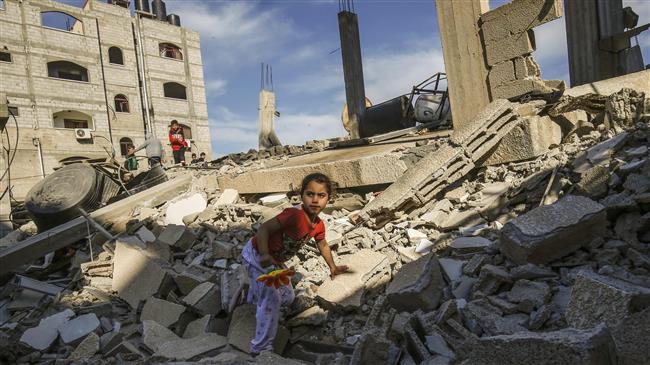
By Latin Patriarch Emeritus Michel Sabbah – Al-Bushra – 6.5.2019
There is a war on Gaza, as it has been once, twice, and more. Gaza and its people are in a state of permanent war. It has been under constant siege for 13 years, which is war imposed upon them every day. Today, the month of Ramadan has started for fasting, prayer, repentance and good deeds. Instead, we see death exploding in and around Gaza. Israel itself complains of the war. Yesterday, Sunday May 5th, the Israeli Defense Minister tweeted and cried out to the world to notice and see Israelis waking up for the second day in a row of rockets coming from Gaza and falling in Israel.
War is painful after two days in Israel. It is as painful and more painful in Gaza after 13 years of siege. War is an absolute evil both for the Israelis and for the Palestinians. Mr. Minister, the key to peace and the end of war is not in the hands of a world that we summon but simply in your hand and in the hands of Israel.
The issue is not only that of Gaza but the issue of all the Palestinian people. The issue is the injustice imposed on the Palestinian people for generations. Israel refuses to see Palestinians as human beings with same rights and equal to all human beings. Israel has tried the methods of war and violence repeatedly to solve the issue. Until today, it has not succeeded and now, on the near horizon, there is talk about a solution wrapped in darkness and non-recognition of Palestinian rights. It will not bring a just solution. It will be another failure.
The solution is simple if Israel wanted to SEE. If it wanted to see that the Palestinian people have the same rights as the Israeli people, all being equal in humanity. It is in Israel’s hands – Israel is the stronger – to realize this equality. Avoiding this equality until now has been useless. Israel itself today suffers from war launched on Gaza.
The solution is simple. Israeli human beings should not remain exposed to war, as is the Palestinian human being. Both are human and equal in humanity. We call upon Israel, the friends of Israel, those interested in the survival of Israel and the security of Israel to simply see that the Palestinian and Israeli peoples are equal in rights and duties and capable of making peace.
We say to the Israeli authorities: It is in your hands to keep us and keep yourselves in constant war and hostility, and in your hands to let us move together to an equal life with dignity, peace and security. Learn from the experience of already 70 years in war. They did not yield security and peace. The cause of the Palestinian people cannot be solved by violence or unjustly imposed solutions, but only by justice and equality. This is the key to war and peace in Israel and Palestine. The key to open the door of peace is in the hands of Israel.
Eileen Fleming, Senior Non-Arab Correspondent for USA’s The Arab Daily News, Author, Reporter: In Nov. 2006, Father Manuel, the parish priest at the Latin Church and school in Gaza, informed the world:
“Gaza cannot sleep! The people are suffering unbelievably. They are hungry, thirsty, have no electricity or clean water. They are suffering constant bombardments and sonic booms from low flying aircraft. They need food: bread and water. Children and babies are hungry… people have no money to buy food. The price of food has doubled and tripled due to the situation. We cannot drink water from the ground here as it is salty and not hygienic. People must buy water to drink. They have no income, no opportunities to get food and water from outside and no opportunities to secure money inside of Gaza. They have no hope.
“Without electricity children are afraid. No light at night. No oil or candles… Thirsty children are crying, afraid and desperate…Many children have been violently thrown from their beds at night from the sonic booms. Many arms and legs have been broken. These planes fly low over Gaza and then reach the speed of sound. This shakes the ground and creates shock waves like an earthquake that causes people to be thrown from their bed. I, myself weigh 120 kilos and was almost thrown from my bed due to the shock wave produced by a low flying jet that made a sonic boom.
“Gaza cannot sleep… the cries of hungry children, the sullen faces of broken men and women who are just sitting in their hungry emptiness with no light, no hope, no love. These actions are War Crimes!
Israeli forces murder Palestinian after refusing political detention
![Palestinian prisoner Amjad Jamal Galag, 30, shot and killed by Israeli forces on 6May, 2019 [Twitter]](https://i1.wp.com/www.middleeastmonitor.com/wp-content/uploads/2019/05/Post.png?resize=1200%2C800&quality=75&strip=all&ssl=1)
Palestinian prisoner Amjad Jamal Galag, 30, shot and killed by Israeli forces on 6May, 2019 [Twitter]
MEMO | May 6, 2019
Israeli occupation forces shot and killed freed Palestinian prisoner Amjad Jamal Galag, 30, from the neighbourhood of Atteel in the occupied West Bank city of Tulkarm, reports Palestine Post 24
Sources said that a group of Israeli occupation policemen attempted to arrest him at an illegal Israeli military checkpoint.
He refused to surrender to the Israeli occupation forces and resumed his way towards occupied Palestine.
The Israeli police chased him and when they could not catch him, they opened fire at his car and killed him.
It is worth noting that the Israeli occupation forces raided tonight several areas across the occupied West Bank and arrested 14 Palestinians from their beds.
Rights groups have recorded several cases when Israeli occupation forces or police executed Palestinians after refusing to be taken to prison.
Maimed Yellow Vest Protestors: Worse Than Getting Shot
By Tim Kirby | Strategic Culture Foundation | May 2, 2019
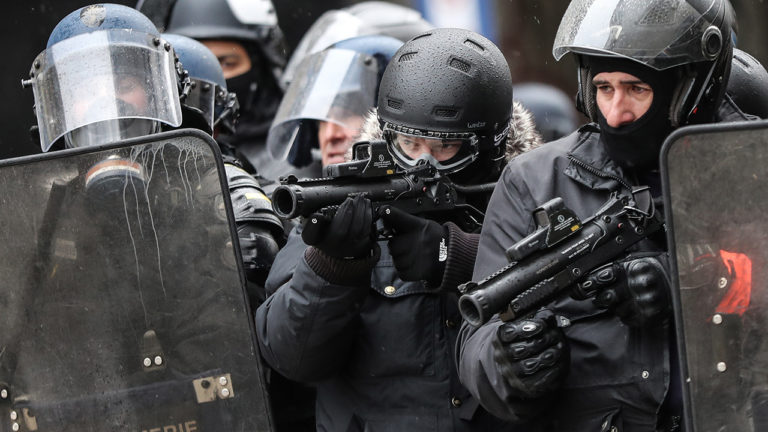
The French marched off to war in 1914 in glorious lines of infantry in baby blue coats and bright red trousers to be mowed down by the finest technology the Industrial Revolution had to offer. For us now it is easy to see how insane this was and how flawed the understanding of both the commoners and even the experts was in terms of how combat and war actually worked at the time. This naive view of modern tactics certainly applies to street conflicts we are seeing in France as part of the Yellow Vest protests. The so-called non-lethal (and less-lethal) arms of the French authorities gives them a tactical advantage far beyond that of any assault rifle.
Thanks to the media we have become accustomed to video of protestors getting sprayed by water or having their ranks dispersed thanks to tear gas, leaving everyone wet or coughing respectively but otherwise unharmed. However this humane picture does not meet up with the realities of this civilian vs. cop style warfare.
If we are to take the Yellow Vest protestors at their word then at least 22 of them have lost an eye (from “less-lethal” Flash-ball guns) and 5 have had their hands blown off with 154 being “seriously injured”. Obviously the protestors will want to maximize their statistics but there are plenty of videos from the various actions/demonstrations showing horrible injuries which are too numerous to all be fakes. So the numbers may be off but the overall general tendencies of these injuries do occur from the French authorities in the Human Rights defending EU is a proven fact. The simple reality is that despite a nice marketing phrase non-lethal weapons cripple and on occasion kill.
In order to understand the tactical advantage that non-lethal weapons offer the government (not the individual police but the state itself) we need to put aside our emotional response to seeing French people having their limbs blown off. We have to not jump into ranting about the flagrant hypocrisy of the EU when it comes to human rights and rationally break down how the conflicts between Yellow and Blue vests could look if the arms situation were different.
Scenario A: What if the Yellow Vests were armed?
If the organizers of the Yellow Vests (all movements are organized by someone regardless of what the media tells you) were able to arm their masses with rifles this would indeed lead to horrific short-term violence that would leave a permanent stain on French history. Often hundreds or thousands of protestors are met by dozens of police and handfuls of soldiers, if the protestors were on par with their adversaries in terms of guns, then their numerical advantage would shatter the police’s will to fight.
No policemen are going to fight to the last man against a force 20 times their number, which they may partially agree with dying for nothing, nor will they open fire with tanks in the centers of their own cities. Human psychology would allow them to kill foreigners in some distant country in this manner but not at home.
In this instance of near certain death from pure numbers the police would either “stay home” or possibly switch sides overtly or covertly.
Obviously a full civil war could start from this situation, but in a street warfare sense, escalating from protest to actual hot war is technically a winning scenario as it advances them closer to attaining/changing power.
Scenario B: What if the police fought like an army?
One key component of many Color Revolutions is getting the “bad leader” to be blamed for some sort of direct use of lethal bloody media-friendly massacre. If the French police actually used assault rifles against the protestors this would demonize them to the point of justifying a Revolution. This would not just cause a civil conflict but be a national call to arms to join it, which would be a bad move on the state’s part.
Furthermore, only sociopaths can fire rifles into unarmed crowds (who are not posing a direct threat) of people who speak their own language (i.e. their own “kind”). If the French police just decided to give the order to shoot them all, then in this instance many of the French police would find rifle and bayonet worthless as they would have no desire to shoot.
The result would be a handful of deaths from each protest but the utter collapse of legitimacy of the state and possible “retreats” of police forces unwilling to fire on “their own”.
Scenario C: The “non-lethal” reality we see today.
Psychologically it is much easier for the French police to use non-lethal (in their minds) weapons against the protestors. In the subconscious mind of the policeman he can justify shooting into masses much easier with this type of weapon because in theory it “shouldn’t” kill anyone and if it does it was an “accident”. This is much easier on our psyche and morals than shooting someone in the chest with a Lebel Rifle.
Research by the University of Cambridge supports this tendency. They found that police are far more likely to use force when it is supposedly from non-lethal weapons. This non-lethal status of weapons like tasers (which can and do kill people all the time) makes them so much easier to apply on the populace especially when the subconscious of the police officer tells him that, the guy he fried the other day with a taser died as an accident, one in every so many thousand people just has a weak heart.
So looking at non-lethal weapons tactically they offer the massive psychological advantage of being able to attack without an attack registering in the conscience of the user. As stated above they are also very media and propaganda friendly when anyone who dies from them is just “an accident” giving the government the ability to retain legitimacy while gouging out they eyes of its own populace. Real guns fail at both of these points completely.
Conclusion:
One bizarre irony in our strange postmodern times is that if the Yellow Vests were actually being shot at by real guns and being killed they would be far closer to achieving some sort of systemic change. Being mutilated by all sorts of gadgets and devices of one sort or another makes it easy for the police to do their job psychologically without generating the levels of sympathy and horror from live rounds hitting the innocent that the protestors need to shatter or change the system.
The French Flash-Ball gun should be made the symbol for the EU for it provides crushing repression of the masses with great PR spin to make it seem humane and caring. It is for our safety after all that they use these right?
US lawmaker’s bill would ban funds to Israeli military

MEMO | May 1, 2019
Veteran Congresswoman Betty McCollum introduced legislation Wednesday that would prohibit US funding to any foreign military that detains children, including Israel, Anadolu reports.
The bill would additionally authorize the creation of an annual $19 million fund to support non-governmental organizations that monitor rights abuses pertaining to the Israeli military’s detention of children.
“Israel’s system of military juvenile detention is state-sponsored child abuse designed to intimidate and terrorize Palestinian children and their families,” McCollum said in a statement announcing the bill’s introduction.
McCollum said Israel’s military detention of children “must be condemned,” adding that “it is equally outrageous that US tax dollars in the form of military aid to Israel are permitted to sustain what is clearly a gross human rights violation against children.”
Roughly 10,000 children have been detained by Israeli security forces since 2000 and subjected to military court proceedings, according to McCollum’s bill.
“Israeli security forces detain children under the age of 12 for interrogation for extended periods of time even though prosecution of children under 12 is prohibited by Israeli military law,” it says.
It further goes on to note that Human Rights Watch reported in 2018 that Israel’s military “detained Palestinian children “often using unnecessary force, questioned them without a family member present, and made them sign confessions in Hebrew, which most did not understand.”
McCollum’s bill faces an uphill battle in Congress where it is likely to face near-uniform opposition from Republicans and is unlikely to garner sufficient Democratic support to clear the House if Speaker Nancy Pelosi chooses to send it to the floor.
Still, the Democratic lawmaker was adamant that “Congress must not turn a blind eye to the unjust and ongoing mistreatment of Palestinian children living under Israeli occupation.”
50,000 Palestinian Children Imprisoned by Israeli Kangaroo Courts Since 1967
By Whitney Webb | MintPress News | April 29, 2019
JERUSALEM — According to figures released by the Prisoners’ and Freed Prisoners’ Committee of the Palestine Liberation Organization (PLO) on Sunday, the state of Israel has imprisoned more than 50,000 children since the occupation of Palestine’s West Bank began in 1967. The PLO report, which was cited by Middle East Monitor, also noted that around 17,000 of those child arrests had occurred since the year 2000. The report used the UN definition that states that a child is any person younger than 18 years of age. However, Israel’s government has defined children younger than 16 as children, while applying the UN definition to Israeli children.
The PLO report — titled “Child Detention… Facts and Statistics… Effects on the Reality and Future of Palestinian Childhood” — was made public as the head of the PLO Prisoner committee, Abdul Nasser Ferwaneh, gave testimony to the 5th European Union conference in support of prisoners. In delivering his report and testimony, Ferwaneh noted that the rate of child imprisonment by the Israeli state had nearly doubled, averaging around 700 children imprisoned annually from 2000 to 2010 but rising to around 1,250 between 2011 and 2018.
Defense for Children International Palestine (DCIP), citing data from the Israeli Prison Service (IPS) and Israeli army temporary detention facilities, recently reported that 414 Palestinian children were imprisoned by Israeli military courts in just the first two months of 2019.
An apartheid system with kangaroo courts
Since 1967, Palestinian children have been subjected to Israeli military law while Israeli settlers living in illegal West Bank settlements are governed by Israel’s civilian criminal legal system. Aside from the fact that subjecting two different populaces in the same area to two different legal systems is a clear manifestation of apartheid, Israel is the only country in the world that automatically tries children in military courts, courts that lack basic fair trial guarantees and have a near-automatic conviction rate. In addition, many Palestinian children are arbitrarily detained, or imprisoned without charge.
Most Palestinian children tried in military court are accused of throwing stones — which, as of 2015, can carry a maximum sentence of 20 years in prison. No Israeli child has ever been tried in an Israeli military court.
Children in detention in Israeli jails are often subjected to various forms of abuse, including “slapping, beating, kicking and violent pushing” as well as verbal abuse, according to prisoner-rights group Adameer. Adameer has also noted that Palestinian children are sometimes threatened with rape in order to extract confessions, which are often written in Hebrew — a language most Palestinian children can’t read or understand.
Obaida Akram Jawabra, a 15-year-old who has already been arrested twice by Israel, told DCIP that in prison “[Israeli] soldiers would beat me in places that would leave no marks so there wouldn’t be evidence on my body that I could use to testify against them.” Figures released by DCIP claim that 75 percent of Palestinian child prisoners report being subjected to physical violence while in prison and 62 percent report being subjected to verbal violence.
The majority of Palestinian children in detention are unable to receive family visits, since nearly 60 percent of all child detainees are transferred from the West Bank to Israeli prisons upon conviction. This practice, which violates the Fourth Geneva Convention — coupled with restrictions on Palestinians’ freedom of movement in the West Bank and the long delays in issuing permits for entry to Israel — prevents the vast majority of West Bank Palestinian families from visiting their imprisoned children.
While Israel’s government often touts itself as the “only democracy” in the Middle East, it is also the only government in the entire world that detains children through military courts with a near 100 percent conviction rate, something that even Saudi Arabia does not do. Israel’s practice of imprisoning Palestinian children is a clear violation of the UN Convention on the Rights of the Child, ratified by Israel in 1991, as it routinely robs thousands of children of their right to a safe childhood.
Whitney Webb is a MintPress News journalist based in Chile. She has contributed to several independent media outlets including Global Research, EcoWatch, the Ron Paul Institute and 21st Century Wire, among others. She has made several radio and television appearances and is the 2019 winner of the Serena Shim Award for Uncompromised Integrity in Journalism.
Academic: Saudi arrest campaign against Palestinians
MEMO | April 18, 2019
Saudi is carrying out an arrest campaign against Palestinians in the country, an exiled academic has said according to Al-Resalah newspaper.
On Twitter, Said Bin Nasser Al-Ghamdi wrote: “In the kingdom, a new and wide arrest campaign against a number of Palestinians, another number under travel ban, their accounts were frozen and their organisations were confiscated.”
Al-Ghamdi said that these Palestinians are accused of “sympathising with the resistance in Palestine, having an interest in the issue of Jerusalem and Gaza or supporting Hamas.”
He also said that authorities arrested Saudis, who sponsored the Palestinians or employed them in the kingdom.
In early March, Saudi announced the arrest of 50 people over security concerns, they included 30 of its own nationals, six Palestinians and three Jordanians.
Palestinian prisoners reach agreement to achieve demands, end hunger strike
Samidoun Palestinian Prisoner Solidarity Network | April 16, 2019
Palestinian prisoners have reached an agreement with the Israeli prison administration to achieve their demands and suspend their hunger strike, the Battle of Dignity 2, on Monday, 15 April. The agreement came as hundreds of Palestinian prisoners were engaged in their eighth day of a collective hunger strike.
According to the leadership of the Palestinian prisoners’ movement, the agreement includes the installation of public telephones in the prison sections, which prisoners would be allowed to use three times a week for 15-minute calls, as well as stopping the installation of cell-phone jamming devices. In addition, the repressive measures and sanctions imposed in the past year upon the prisoners will also be lifted, while fines imposed on prisoners in recent struggles inside the prisons would be reduced. Hundreds more prisoners have been set to join the hunger strike in the coming days, especially 17 April, Palestinian Prisoners’ Day.
The Palestinian Prisoners’ Society said that the agreement also included provisions to transfer the women prisoners from Damon prison to another detention center; the prisoners have repeatedly cited harsh, difficult conditions unsuitable for human life in the Damon prison. In addition, sick prisoners would be returned to the previous section in the Ramleh prison clinic, an area that was considered better than their current location.
The National and Islamic Forces held a press conference in Gaza City to highlight the prisoners’ final statement. “The battle is not over; the hardest phase of this struggle is to implement what has been agreed upon,” the prisoners wrote, noting that previous agreements have been repeatedly broken by the Israeli prison administration.
They saluted the prisoners in section 4 of the Negev desert prison and section 1 in Ramon prison who were attacked by Israeli repressive forces, noting that “their great sacrifices underline that freedom and dignity are… human rights that cannot be denied.” They saluted Palestinians in Gaza, the West Bank, occupied Palestine ’48 and exile and diaspora, as well as supporters of freedom around the world, journalists and prisoners’ centers, that stood with the prisoners in their struggle. The statement particularly saluted “the people and leadership in Gaza,” noting their unity in commitment to the struggle.
Samidoun Palestinian Prisoner Solidarity Network expresses its strongest salutes and greetings to all of the Palestinian prisoners on this occasion of victory. These achievements follow on many historical accomplishments of the Palestinian prisoners’ movement, on the front lines of the Palestinian liberation struggle, extracting their victories through great sacrifice, with their bodies and lives on the line. As Palestinian Prisoners Day approaches, we emphasize our continuing dedication to work for the freedom of all Palestinian prisoners and the freedom of Palestine from the river to the sea.

In addition, we urge people around the world to continue their solidarity activities to support the Palestinian prisoners, throughout the coming days, months and years, until their freedom is achieved. In particular, we emphasize the cases of three Palestinian prisoners who remain on hunger strike: Hussam al-Ruzza (61), Mohammed Tabanja (40) and Khaled Farraj (31). Al-Ruzza has been on hunger strike since 19 March – nearly one month – while Tabanja and Farraj have been on hunger strike since 25 March. All are held without charge or trial under administrative detention orders, and their detention has been repeatedly and arbitrarily renewed.
They are among nearly 500 Palestinians out of approximately 5,500 Palestinian prisoners jailed with no charges and no trial for indefinitely renewable periods under administrative detention. The end of administrative detention is a long-time demand of the Palestinian prisoners’ movement and supporters of justice and liberation around the world. Join the call to free Hussam al-Ruzza, Mohammed Tabanja, Khaled Farraj and all Palestinian prisoners!
Featured Video
Trita Parsi: Israel Set a Trap for Total War in the Region
or go to
Aletho News Archives – Video-Images
From the Archive
Zionism’s Violent Legacy
By Donald Neff | Washington Report On Middle East Affairs | January 1996
On January 4, 1948, Jewish terrorists drove a truck loaded with explosives into the center of the all Arab city of Jaffa and detonated it, killing 26 and wounding around 100 Palestinian men, women and children.[1] The attack was the work of the Irgun Zvai Leumi – the “National Military Organization,” also known by the Hebrew letters Etzel – the largest Jewish terrorist group in Palestine. The Irgun was headed by Revisionist Zionist Menachem Begin and had been killing and maiming Arabs, Britons and even Jews for the previous ten years in its efforts to establish a Jewish state.
This terror campaign meant that at the core of Revisionist Zionism there existed a philosophical embrace of violence. … continue
Blog Roll
 Aletho News
- Trita Parsi: Israel Set a Trap for Total War in the Region
- Trump’s Iran war is on an Israeli leash
- Saudi oil boss issues global supply warning
- Riyadh Says Its Oil System Is Intact. The Numbers Say Otherwise.
- Trump and Netanyahu Want to “Finish the Job” on Iran
- US ‘one-sided dictation’ not Iran’s beliefs makes rational talks impossible: Baghaei
- Iran’s Next Strike May Not Explode. It Could Shut You Down /Col Doug Macgregor
- Iran: US political targets legitimate if assassinations return
- Iraq shuts key border crossing with Iran under US pressure: Report
- Undersea Internet cables could be targeted in retaliation for attacks on Iran: IRGC deputy chief
- If Americans Knew
- The Israel Lobby’s Changing Fortunes
- AIPAC has become such a political liability that it’s shifting to a more “nimble” approach to buying politicians
- At least 160 Israeli settler attacks in 2 weeks
- Will Gaza’s Ancient Christian Community Disappear Forever?
- Israel’s vision of regional security rests on keeping Arab states weak
- Heidi Levine recounts how Palestinian youths helped save her in settler attack
- DAILY UPDATE: Latest essential news on Palestine, Israel, & region
- Trump’s Intensifying Sabotage of the ICC, for Israel’s Sake
- Israeli military detain US and UK volunteers in West Bank including Democratic NY politician Brad Lander
- Americans at National Conservatism Conference held in Israel this year criticize Israel
- No Tricks Zone
- E-Cars Reduce CO2 Emissions By Only 41% Compared To Internal Combustion Engine Vehicles
- Predictions Made By Renowned Climate Professor Over Past Decades Have Been Proven To Be Poor
- New Study Suggests Large Regions Of The Pacific Ocean Have Been Cooling For The Last 80 Years
- Germany’s Green Energy Debacle: High Energy Costs Force Kahla Porzellan to Close After 182 Years!
- New Study: 50 Years Of The Most Aggressive ‘Net Zero’ Policies Can Only Affect The Global Climate By 0.03°C
- US September “Heat” Was No Record…Many Records Set Decades Ago
- Latest European Green Energy Debacle; Portugal’s Largest Flagship Solar Park Insolvent!
- Green Energy Debacle: German Expert Professor Fritz Vahrenholt Warns Of Severe Economic And Social Consequences
- Two More Paleo Reconstructions Affirm Meters-Higher Sea Levels Across Ireland, Brazil 7000-6000 Years Ago
- New Study: Earth And Venus Surface Warmth Largely Explained By Convection And Lapse Rate, Not CO2 Or Radiation

