Palestinians refuse to terminate social welfare for victims of Israeli aggression
MEMO | June 12, 2018
The Palestinian Authority has sent a defiant message to Israel over Tel Aviv’s attempt to freeze tax money used by the PA to pay victims of Israeli violence.
“There is no force in the world that can cause us to renounce our prisoners and the martyrs”, Yusuf Al-Mahmoud, spokesman for the PA government said, regarding Israel’s attempt to freeze Palestinian tax revenue.
Al-Mahmoud claimed that Israel bore full responsibility for violence in the region and said that it was “stealing their [Palestinian] money on the pretext of offsetting tax revenues”.
His comments follow repeated attempts by the Israeli government to use Palestinian tax revenue to gain political concession. The tax collection regime in the occupied territory, which grants Israel the right to collect tax on behalf of the Palestinians and then distribute it, is one of the many oddities to come out of the Oslo Accords.
The Knesset is currently discussing a bill to impound tax revenue that would have been handed to families and victims of violence perpetrated by the Israeli army. Protesters killed and injured in Gaza would be eligible for these payments, which Netanyahu is trying to block.
Israeli sources reported that last week Prime Minister Benjamin Netanyahu instructed Meir Shabbat, chief of Israel’s National Security Council, to deduct money from the taxes collected by Israel on behalf of the Palestinian Authority in order to pay for the damage from fires caused by “rioter-terrorists” in Gaza sending kites attached to firebombs into Israeli territory.
“The martyr’s fund”, as it is known, has become a highly contentious issue. While Palestinians feel they have every right to use their own funds to provide welfare and social security to families of injured or deceased protesters resisting Israel’s brutal occupation, Israel feels it can exploit the tax situation to pile further pressure on the PA.
In addition to the bill discussed at the Knesset, senior members of the Israeli government have conditioned future negotiations on the PA suspending its welfare programme. Commentators have pointed out that this was another crude attempt to blame the victims. Insisting on the PA conceding on an issue that is a red line in the eyes of Palestinians is an attempt to shift the blame for the ongoing conflict away from Israel, and possibly stymie any future negotiations.
Read Also:
The international community should not stand by as Israel abuses Palestinians
Youngsters “Disabled for Life” by Israel’s Shoot-to-Cripple Policy in Gaza
By Stuart Littlewood | American Herald Tribune | June 10, 2018
Writing in the BMJ (British Medical Journal) the Head of Plastic and Reconstructive Surgery in Gaza, Dr Nafiz Abu-Shaban, reports that the death and injury toll by sniper fire, as at 18 May, was 117 dead, including 13 children, and 12,271 injured, of whom 6,760 had been hospitalised, including 3,598 with bullet wounds. The numbers will be considerably higher by now.
Worse still, according to Medecins Sans Frontieres (MSF) who operate in Gaza, the Israelis have been using ammunition that causes fist-sized wounds of “unusual severity”.
In a press release dated 19 April MSF surgeons in Gaza report “devastating gunshot wounds among hundreds of people injured during the protests over recent weeks. The huge majority of patients – mainly young men, but also some women and children – have unusually severe wounds to the lower extremities. MSF medical teams note the injuries include an extreme level of destruction to bones and soft tissue, and large exit wounds that can be the size of a fist.
“Half of the more than 500 patients we have admitted in our clinics have injuries where the bullet has literally destroyed tissue after having pulverized the bone,” said Marie-Elisabeth Ingres, Head of Mission of MSF in Palestine. “These patients will need to have very complex surgical operations and most of them will have disabilities for life.”
She is reported saying that she hadn’t seen these kind of injuries before. The wounds appeared to be caused by ammunition with an expanding ‘butterfly’ effect.
“Mass lifelong disability now the prospect for young Gazans who merely gathered in unarmed protest”
Abu-Shaban says the hundreds of high energy compound tibial fractures from Israeli live fire are the most difficult of all open fractures to treat. They may require between 5 and 7 surgical procedures, each operation taking 3-6 hours. “Even with state-of-the-art reconstruction, healing takes 1-2 years. Most of these patients will develop osteomyelitis. A steadily increasing toll of secondary amputations is inevitable. They will also need intensive rehabilitation, but the only rehabilitation hospital in Gaza was destroyed by Israeli bombing in 2014 and has not been re-built. Mass lifelong disability is now the prospect facing Gazan citizens, largely young, who were merely gathering in unarmed protest about Israeli occupation and siege that has rendered their political and social futures impossible.”
Reconstructing such injuries is far beyond the capabilities of Gazan medical services, now severely run down after 12 years of Israeli siege. Shifa is swamped and has no beds let alone the dedicated Limb Salvage Teams necessary for this work. Even London hospitals, which are fully resourced, would be stretched if confronted with mass casualties of this kind, says Abu-Shaban. “How are we here in Gaza to manage this situation? Why has no European government spoken out about events which if they had happened elsewhere would surely have been called an international outrage and probable war crime?”
Good question. The sniveling international community does nothing to stop the vile crimes perpetrated by the self-styled ‘most moral army in the world’.
“I understand there is now the question of an investigation by the International Criminal Court,” says the good doctor hopefully.
Well, not quite. The UN Human Rights Council in Geneva has adopted a resolution to set up an independent, international Commission of Inquiry to investigate all violations of humanitarian and international human rights law in the occupied Palestinian territory, with a particular focus on recent events in Gaza.
The resolution passed with only two states opposing (the USA and another of Israel’s poodles, Australia), 29 in favour, and 14 abstentions. The UK was one of those abstaining, alongside the EU states of Croatia, Germany, Hungary, and Slovakia.
“Gazans did all the dying and the Israeli soldiers did all the killing”
Trying to explain its abstention, the UK Mission in Geneva called the resolution “partial and unhelpfully unbalanced” for not “explicitly call[ing] for an investigation into the action of non-state actors such as Hamas.” The UK Government then issued this feeble statement: “In addition to abstaining on today’s resolution, we call directly on Israel to make clear its intentions and carry out what must be a transparent inquiry into the IDF’s conduct at the border fence and to demonstrate how this will achieve a sufficient level of independence. This investigation should include international members. The death toll alone warrants such a comprehensive inquiry. We urge that the findings of such an investigation be made public, and if wrongdoing is found, that those responsible be held to account.”
Israeli human rights organisation B’Tselem had called the already-announced internal Israeli military probe “part of the whitewashing toolkit”. And the British Government was sharply criticised in parliament for its limp-wristed attitude and reminded of Israel’s self-exoneration over the killing of four boys playing on a beach during the 2014 military offensive on Gaza.
Conservative MP Crispin Blunt, former Chair of the Foreign Affairs Select Committee, asked: “Given that Gazans did all the dying and the Israeli soldiers did all the killing, how does the Minister expect an internal Israeli inquiry…. to be less partial and less unhelpfully unbalanced than the inquiry mandated by the UN Human Rights Council?”
“Systematic failure by Israel to carry out genuine investigations”
The preamble to the UNHRC resolution states the reasons for action brilliantly and is worth highlighting here….
Convinced that the lack of accountability for violations of international law reinforces a culture of impunity, leading to a recurrence of violations and seriously endangering international peace,
Noting the systematic failure by Israel to carry out genuine investigations in an impartial, independent, prompt and effective way, as required by international law, into the violence and offences against Palestinians by the occupying forces, and to establish judicial accountability for its actions in the Occupied Palestinian Territory, including East Jerusalem,
Emphasizing the obligations of Israel as the occupying Power to ensure the safety, well-being and protection of the Palestinian civilian population under its occupation in the Occupied Palestinian Territory, including East Jerusalem,
Emphasizing also that the intentional targeting of civilians and other protected persons in situations of armed conflict, including foreign occupation, constitutes a grave breach of international humanitarian law and international human rights law, and poses a threat to international peace and security,
Recognizing the importance of the right to life and the right to freedom of peaceful assembly and association to the full enjoyment of all human rights…
Despite all that, avid Israel admirer Theresa May, barmy Boris Johnson and the insufferably gutless spivs now populating the Foreign Office still couldn’t bring themselves to support the resolution.
“To live is to resist”
Another voice from Gaza, which I shall not name, reports:
“As you know we don’t have enough supply of electricity which means lots of hurdles and difficulties on all aspects of life. The conditions in Gaza are the most difficult ones in terms of the Zionist killings and aggression against the Great Marches of Return. I myself went there to the borders with my family three times and saw how their evil soldiers shooting innocent children and women. I heard some of the guys shouting that they have got nothing to loose. To live is to resist. That’s what we also teach to our students and young generations. The oppressed and occupied have got the right to resist by all means available.
“It is a pity and tragic as well that the injured could not find enough medical care and nursing due to the shortage of medical staff and equipment. Can you imagine? So many causalities were sent home after receiving only first aid and some sort of dressings to their wounds as there were no enough beds and treatment for them. That’s why many have lost their legs (amputations) where the enemies are using high velocity bullets.”
Boys’ legs the target
The shoot-to-cripple policy by Israel is nothing new. Retired trauma surgeon David Halpin, who has often worked on a voluntary basis in Gaza hospitals, drew attention to it in January 2011: “The deliberate injury of the limbs of 23 boys by high velocity weapons has been logged and described by Defence for Children International Palestine Branch (DCI-P) since March 2010.”
He pointed to the extreme poverty of large extended families which had forced boys and men to scavenge for broken concrete (‘gravel’) in the evacuated Eli Sinai ‘settlement’ and in the industrial zone by the Erez border control post at the northern end of the Gaza Strip. “The factories of the industrial zone have been progressively demolished by Israeli shelling etc…. A donkey and cart, shovel, pick, sieve, muscles and courage are the tools. The rubble is used to make blocks and poured concrete with the cement that is imported largely through the tunnels. Many dozens of men and boys do this work for precious shekels in the shadow of manned watch towers and under ‘drones’ above.”
A leg was the target in most cases, says Halpin. And where the leg was not the target it is likely the sniper was ‘aiming up’ so the flank, elbow etc was hit instead. “No weapons were being borne by the gravel workers so they posed no threat to the Israeli Occupation Force personnel. Instead they were bending their backs to their menial work within their internment camp.” In many cases those hit were likely to have lifelong disability. That, it seems, continues to be the Israeli regime’s sickening aim.
And to think that its chief degenerate, Netanyahu, was allowed to set foot in London earlier this week in his never-ending quest to demonize those who stand in the way of Israel’s warmongering and expansionist ambition – namely Iran, Syria, Hamas and Hezbollah.
‘Civilians deaths increased due to rise in use of US assassination drones’
Press TV – June 9, 2018
Delegation of authority to field level military commanders to use “US assassination drones” has resulted in a surge in the number of innocent civilians being killed.
Media sources reported recently that US President Donald Trump has delegated to battlefield commanders the authority to order lethal drone strikes.
The authority to call for assassination drone strikes was limited to the White House or Washington security officials when Trump’s predecessors, namely, George Bush and Barack Obama were in office.
Trump’s decision to delegate the decision-making process to the military resulted in the number of drone strikes increasing, and in turn, the number of innocent civilians getting killed going up, according to Michael Burns, a political and military analyst in New York.
Burns made the remarks in an interview with Press TV on Friday while commenting on the US military’s illegal extrajudicial killings by using assassination drones in some Muslim states, and now planning to expand the practice to other regions across the globe.
“The reason it [the use of assassination drones] has increased so substantially is because more decision-making authority is being given to military commanders to use these systems.”
Burn says the increase in the use of drones aims to project US military power worldwide.
“The increase in the use of drones — which are officially known as ‘unmanned aerial systems’ to mask their vicious ability — to project power in other regions of the world has increased substantially under the Trump administration.”
The analyst also links the increase in the use of drone systems to other reasons including the cost-effectiveness of the weapon compared to other means available to the US government to project its military power across the globe.
Colombia, the death squads & the US’ human rights double standard
Dan Kovalik | RT | June 7, 2018
Nearly every day, we are bombarded with “news” about problems in Venezuela. And certainly, there are problems, such as food and medicine shortages and skyrocketing inflation. But there is something that is downplayed.
What the press downplays, if it mentions it at all, is the very real and significant ways that US sanctions have contributed to these problems facing Venezuela and how these sanctions are making it nearly impossible for Venezuela to solve these problems.
What the press also fails to mention is the even greater humanitarian issues confronting Venezuela’s next-door neighbor, Colombia – the US’ number one ally in the region and, quite bizarrely, the newest “global partner” of NATO from Latin America. And, the US is very much responsible for these issues as well, but in quite different ways.
The fact is that, by a number of measures, Colombia has one of the worst human rights situations on earth, but you would never know this from watching the nightly news.
First of all, Colombia has the largest number of people forcibly disappeared in all of the Americas – even more than all of the Southern Cone countries combined during the infamous ‘dirty war’ years – at over 60,000.
In addition, Colombia has one of the largest internally displaced populations on earth at well over 7 million – second only to Syria. And, a disproportionate number of these internally displaced are indigenous and Afro-descendants.
Moreover, Colombia ranks 5th in the world for the number of children internally displaced by conflict, with two million boys and girls internally displaced. Quite shockingly, Colombia ranks 3rd in the world for the number of children murdered, with 715 children murdered just last year. Such statistics have led Save The Children to conclude that Colombia is “one of the worst countries to be a child and adolescent in the world.”
Colombia is also one of the worst countries in the world to be a social leader, such as a human rights defender, union leader, indigenous or Afro-Colombian leader. Thus, even after the signing of a peace deal between the Colombian government and FARC guerrillas in 2016, social leaders are being murdered at an alarming rate. Indeed, over 200 social leaders have been killed just since January of 2017. Last year was in fact the worst year on record for human rights defenders in Colombia, with 120 killed in 2017.
Of course, the US has a large responsibility to bear for this awful situation in Colombia, as it has been the intellectual author behind Colombia’s brutal, decades-long war against its own people and has provided billions of dollars of material aid to this war effort. Indeed, since 2000, the US has given Colombia $10 billion in mostly military assistance as part of its counter-insurgency program known as ‘Plan Colombia.’ During the Plan Colombia years, the Colombian military attempted to boost US military assistance by murdering civilians in cold blood and passing them off as left-wing guerillas. It is now believed that the military killed 10,000 civilians in this grisly “false positive” operation.
But the US is also behind an even darker force than the Colombian military – that is, the Colombian paramilitary death squads. While those who live in the more remote parts of Colombia are painfully aware of the paramilitaries’ presence and brutality, the paramilitaries are now a well-kept secret in the more well-to-do parts of Colombia’s big cities and even more so outside of Colombia. Indeed, the Colombian and US governments deny the very existence of these paramilitary groups, and the compliant press is happy to oblige in keeping this dirty secret.
Recently, Colombia’s most prominent human rights defender, Father Javier Giraldo, S.J., spoke about the paramilitary phenomenon of which he is an expert. As he explains, “There are clandestine or semi-clandestine arms of the State, which are the paramilitary groups. Today, it is not tolerated that you refer to them as such, but I still call them paramilitaries, because that is the appropriate term.”
Father Giraldo describes the origin of the paramilitary death squads, a force developed by the United States before the left-wing guerrillas even came into existence in 1964. As Father Giraldo explains:
“In 1962, when Guillermo León Valencia was president, a mission of the North American army, of a special school of war in North Carolina, created after the Second World War to maintain the security of the United States, arrived in Colombia… They analyzed the situation in Colombia and left secret instructions, ordering the Colombian government to begin training mixed groups of civilians and the military, and preparing them for paramilitary terrorist activities to combat the sympathizers of communism.”
“… President Valencia, on Christmas day of the year 1965, issued Decree 3398 with which he changed the name of the Ministry of War to [the Ministry of] Defense, and authorized forming groups of civilians as auxiliaries of the armed forces, the legal basis of paramilitarism.”
“… The United States began to direct the entire security apparatus in Colombia and its agencies… first with 400 officers of the US Army; today there are at least 800. The paramilitarism that was created at that time, with all the legal support, has been reaffirmed.”
Of course, as Father Giraldo has explained on numerous occasions, the ostensible “sympathizers of communism” targeted by the paramilitaries are trade union leaders, human rights defenders, peasant leaders, and Catholic priests who advocate on behalf of the poor. As for Catholic priests, over 80 have been murdered since 1984 for the crime of advocating on behalf of the poor.
It is now becoming more evident than ever from the fact that there is now a rise in the murder of such social leaders, as well as mass forced displacement, after the disarming of the FARC guerrillas, that it, is the paramilitaries which are responsible for the lion’s share of such human rights abuses in Colombia. But again, you would have no idea about this from reading the newspapers or watching the nightly news. And, Colombians who are suffering at the hands of the paramilitaries are painfully aware of the conspiracy of silence around this issue.
Indeed, when I was recently in Colombia for the first round of the presidential elections, our delegation met with a number of residents of the small town of Suarez (Cauca Department) which had just lost three members of their community to paramilitary violence. One of the members of the community desperately asked us, “what can we do to let the world know of the continued existence of the paramilitaries?” I answered that we have been trying to do just that for many years, though few will hear us out on this issue.
While we were in Colombia, a campaign coordinator for Gustavo Petro, a Colombian presidential candidate, was murdered by paramilitaries the day before the election, and the paramilitary group known as ‘Aguilas Negras’ (Black Eagles) issued a general threat against the supporters of Petro for president just a few days before the May 27 vote.
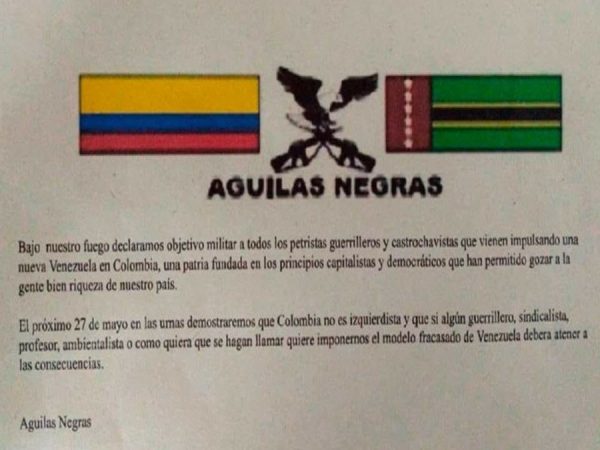
© Dan Kovalik
If Colombia’s very real human rights and humanitarian crises were given nearly the attention that the problems in neighboring Venezuela receives, the US and Colombian government would at least have some incentive to improve the situation in Colombia and to go after the paramilitary groups which continue to haunt that country. The near complete silence about the staggering violence in Colombia is critical in allowing that violence to continue. Indeed, the paramilitaries have always depended upon being able to operate in the shadows, and the US press is more than happy to oblige them in this effort.
Dan Kovalik teaches International Human Rights at the University of Pittsburgh School of Law. He is the author of ‘The Plot to Attack Iran.’
Medical Aid for Palestinians attacked by pro-Israel lawyers’ groups
MEMO | June 7, 2018
UK charity Medical Aid for Palestinians (MAP) has described allegations of anti-Semitism made by two pro-Israel advocacy groups as an “appalling smear”.
According to a report in the Jewish News, UK Lawyers for Israel (UKLFI) and the US-based Lawfare Project this week submitted a 17-page complaint against MAP to the Charity Commission.
The complaint claims that the respected humanitarian NGO is guilty of “racial hatred of Jews”, and claims MAP has “links to Palestinian terrorist groups”.
A MAP spokesperson told the paper: “This appalling smear appears to be part of a wider pattern of attacks on legitimate NGOs. Should the Charity Commission raise points with us, we would be pleased to respond.”
The article says that the pro-Israel activists accuse MAP of giving a “false impression” about the health of Palestinians. UKLFI’s Jonathan Turner said: “Readers of its misleading website would no doubt be surprised to hear that life-expectancy in Gaza in fact compares favourably with Glasgow.”
Turner added that MAP was “abusing its position as a charity to spread false information about Israel”, and using “the halo of its status as a charity to disguise its racial hatred of Israelis and Jews.”
Lawfare Project direct Brooke Goldstein said “it is incumbent on the Charity Commission to take action against MAP’s sinister abuse of charitable funds”.
The timing of the attack on MAP is no coincidence, coming after an appeal by the charity raised more than £1 million following Israel’s mass killing of Palestinian protesters.
MAP medics have been on the ground in the Israeli-occupied Gaza Strip, and the charity’s social media accounts have given vital insights into Israel’s brutal crackdown.
Israel seals Palestinian family’s home with them inside
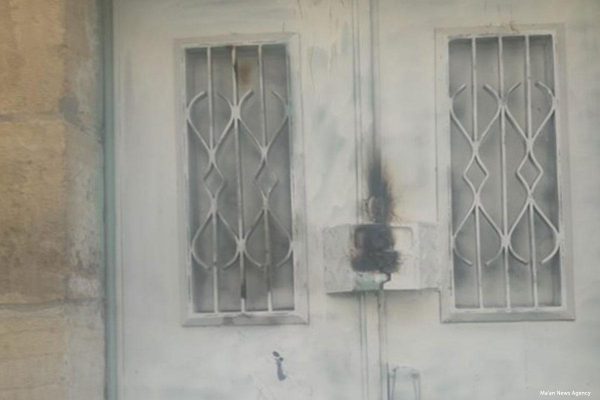
Front door of the Zahida family home
Ma’an – June 7, 2018
HEBRON – A Palestinian family was trapped inside their home and forced to leave through a broken window after Israeli forces welded their front door shut and temporarily detained them inside their home in the southern occupied West Bank district of Hebron on Thursday morning.
The incident took place on the al-Shuhada street in the Old City of Hebron, one of the most heavily militarized streets in the occupied West Bank.
Samer Yusri Zahida told Ma’an that Israeli forces broke into his brother’s house at 8 a.m. on Thursday, forcing him and his three other family members into one room in the house.
After detaining the family for a brief period of time, Israeli forces broke one of the windows in the house and exited through it, allegedly telling the family that if they want to leave the house they must also exit through the window. Israeli forces then sealed the front door to the family’s home.
Zahida noted that the window that was broken did not lead to the main road, but to the neighbor’s house.
Coordinator of the Human Rights Defenders Association in Hebron, Imad Abu Shamsieh, told Ma’an that Israeli forces have been trying to force out the family since they moved in two weeks ago, in what he said was an “attempt to empty the al-Shuhada street of all Palestinian residents and provide it to Israeli settlers as a new residence.”
Palestinian residents of Hebron’s Old City face a large Israeli military presence on a daily basis, with at least 20 checkpoints set up at the entrances of many streets, as well as the entrance of the Ibrahimi Mosque itself.
Additionally, Palestinians are not allowed to drive on al-Shuhada street, have had their homes and shops on the street welded shut, and in some areas of the Old City, are not permitted to walk on certain roads.
Meanwhile, some 800 notoriously violent Israeli settlers in Hebron move freely on the street, drive cars, and carry machine guns.
Israeli occupation forces ‘execute’ 21-year-old Palestinian ‘wanted for stone throwing’
Palestine Information Center – June 6, 2018
RAMALLAH – The Israeli occupation forces (IOF) on Wednesday morning shot and killed a Palestinian youth in Nabi Saleh village, northwest of Ramallah.
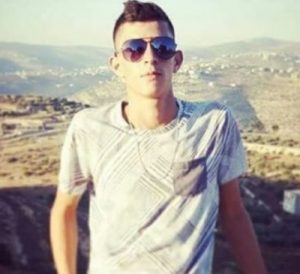 The Palestinian Ministry of Health, quoting the Palestinian Civil Liaison, announced in a brief statement the death of a Palestinian youth who was shot by IOF soldiers in Nabi Saleh.
Local sources said that the IOF soldiers opened fire at Izz al-Tamimi, 21, injuring him with three live bullets, one of which to the head.
Al-Tamimi has been long chased by the IOF before he was killed during a raid into Nabi Saleh, Quds Press reported.
According to locals, the IOF left al-Tamimi to bleed for more than half an hour and threatened to shoot anyone who would provide him medical treatment or take him to the hospital.
Al-Tamimi’s family said in a statement that the IOF opened fire at their son at very close range, stressing that what happened was a “deliberate execution”.
They affirmed that the Israeli Intelligence had repeatedly threatened to kill their son on several occasions.
Palestinian sources said that the IOF handed over al-Tamimi’s body to the Palestinian Civil Liaison before it was transferred to Palestine Medical Complex in Ramallah in preparation for the funeral later in the day.
Ma’an :
… According to locals, Tamimi has been wanted by Israeli forces for alleged stone throwing, and soldiers have allegedly attempted to detain him on several occasions.
Another Palestinian whose identity remained unknown was also reportedly wounded with live ammunition on Wednesday morning in the village.
An Israeli army spokesperson told Ma’an that the killing took place during “riots” in Nabi Saleh, during which 10 youth threw stones at soldiers who were conducting “detention operations.”
“During the riot, one Palestinian flanked the troops and hurled a rock at a soldier, hitting him in the head. The soldier then responded with live fire, injuring the Palestinian, who was was injured and treated by Israeli forces at the scene, but later died,” the spokesperson said.
The spokesperson added that they would look into reports of a second Palestinian being injured with live ammunition during the clashes.
IMEMC :
… Palestinian medics were called to the scene, but the soldiers also attacked them, preventing them from approaching the seriously wounded young man, who succumbed to his injuries.
Eyewitnesses said the soldiers assassinated the Palestinian, directly and repeatedly firing at him, in addition to attacking dozens of Palestinians.
The soldiers also shot another Palestinian with a live round and caused many others to suffer the effects of teargas inhalation, during protests that took place after the soldiers killed Tamimi.
The Palestinian worked as a car mechanic, and was chased and wanted by the army for 18 months, in which he managed to escape numerous attempts to arrest him.
He was also shot and injured by Israeli army fire several times when the soldiers were trying to abduct him, and the army abducted his brother to pressure him into turning himself in to the army.
A few weeks ago, the army called one of his brothers, and told him that “Ezzeddin will face the same fate of Ahmad Nasr Jarrar, who was killed by the soldiers on February 06, 2018, if he does not surrender.
After the soldiers killed Ezzeddin, they invaded many homes, including his home, and occupied their rooftops.
Israeli forces detain activist who filmed fatal shooting of Hebron man
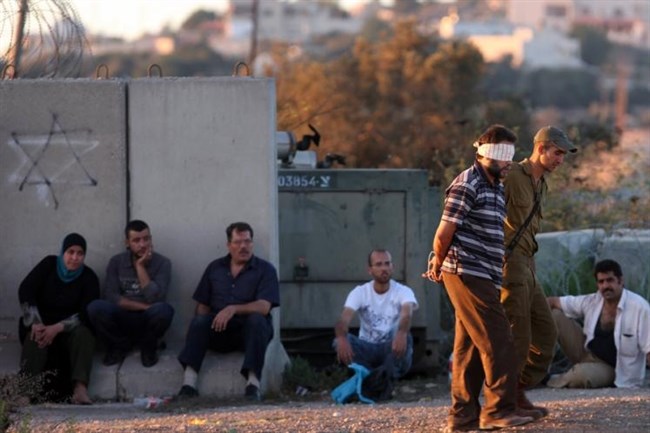
File Photo
Ma’an – | June 2, 2018
HEBRON – Israeli soldiers on Saturday briefly detained a local activist who filmed the fatal shooting of a Palestinian worker earlier in the morning in the southern occupied West Bank city of Hebron.
Locals told Ma’an that Israeli forces detained Aaref Jaber, who filmed the moment when Israeli forces shot and killed Rami Sabarneh, 36, and that Jaber taken into the Kiryat Arba settlement in Hebron.
Official Palestinian Authority (PA)-owned Wafa news agency reported that Israeli forces confiscated Jaber’s phone.
The Israeli army alleged that Sabarneh, who worked in construction in the area, attempted to run soldiers over with a bulldozer. However, no injuries were reported among the soldiers.
Jaber denied the Israeli army’s account, saying that “Sabarneh was driving a Bobcat excavator while another worker walked next to him, Israeli soldiers asked them to stop when he was at least 10 meters away from them, the walking worker stopped, but Sabarneh apparently did not hear the soldiers and continued his way so they opened fire at him until he was killed.”
Last week, Israeli lawmakers proposed a new bill in the Israeli Knesset that would criminalize the photographing or recording of Israeli soldiers while on duty.
The bill was proposed with the support of right-wing Israeli Defense Minister Avigdor Lieberman, and if passed, those found in violation of the law could face a prison sentence of up to five years.
Palestinian ‘Medical Volunteer’ Killed by Israeli Fire in Gaza

Paramedic Razan al-Najjar was shot dead by an Israeli sniper on the Gaza border on June 1. (Photo: via Twitter)
Palestine Chronicle – June 1, 2018
A Palestinian woman – reportedly a medical volunteer – was shot dead by Israeli soldiers on Friday, Gaza’s health ministry has reported, as protests continued on the border with Israel.
Razan al-Najjar – a 21-year old volunteer with the ministry of health – was shot by Israeli forces on the eastern border of Khan Younis in the southern Gaza Strip.
There is little information yet on how Najjar was killed.
Friday’s death marks weeks of demonstrations on the Gaza border, beginning 30 March, which has seen at least 123 Palestinian protesters killed by Israeli gunfire.
The protests – dubbed “the Great Return March” – called for the right of return of refugees, and peaked on 14 May when the US moved its embassy in Israel from Tel Aviv to the contested city of Jerusalem.
Over 61 Palestinians were killed and 2,400 injured on that day, while tens of thousands protested along the besieged strip’s border.
Israeli snipers fired live rounds and tear gas at the protesters, with condemnation from the UN and human rights groups.
#Watch || Palestinians are marching to the eastrern border of #Gaza Strip to participate in #GreatReturnMarch.
Video from the middle area camp in the east of Al-Buraij Refugee Camp
Video by: @pallive_en pic.twitter.com/gAR3hvXCW2— Great Return March (@GreatReturnMa) June 1, 2018
Palestinian Youth injured by Israeli gunfire in blockaded Gaza
Palestine Information Center – May 31, 2018
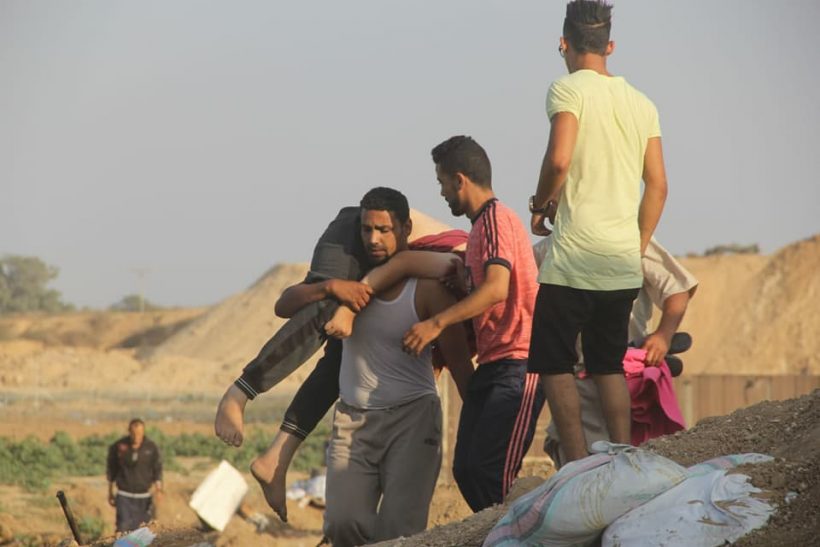
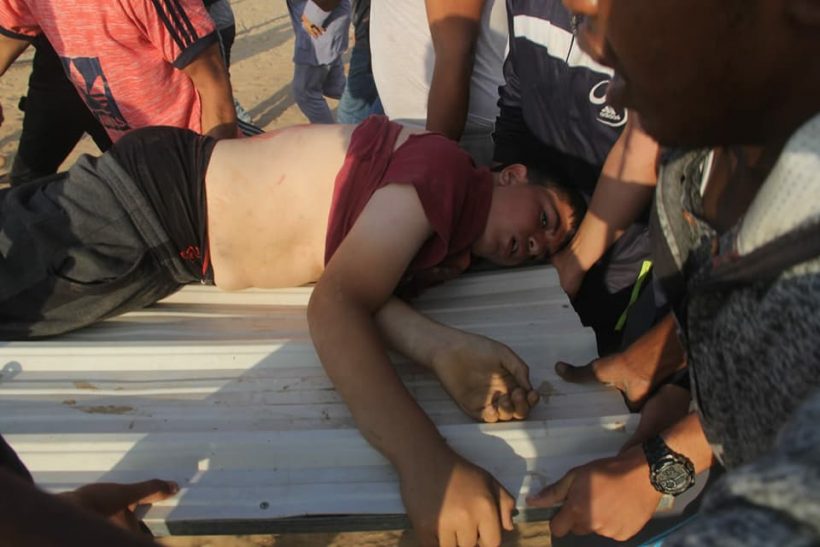
GAZA – A Palestinian youth was shot and injured by the Israeli military east of the Bureij refugee camp, in central Gaza Strip on Wednesday evening.
A PIC news correspondent said a bullet fire by Israeli soldiers penetrated a 15-year-old child’s back. He was rushed to the Shuhadaa al-Aqsa Hospital, in Deir Balah, so as to be treated for his wounds, reported critical.
According to the Gaza-based Palestinian Health Ministry, 118 Palestinians were killed and 13,300 others injured by Israeli gunfire unleashed toward Palestinian protesters as they joined the Great March of Return, launched on March 30.
Featured Video

US IRAN TALKS: Who Are the Crazy Ones Here? /Lt Col Daniel Davis
or go to
Aletho News Archives – Video-Images
From the Archives
Wartime internment camps in Australia
National Archives of Australia
World War I
During World War I, for security reasons the Australian Government pursued a comprehensive internment policy against enemy aliens living in Australia.
Initially only those born in countries at war with Australia were classed as enemy aliens, but later this was expanded to include people of enemy nations who were naturalised British subjects, Australian-born descendants of migrants born in enemy nations and others who were thought to pose a threat to Australia’s security.
Australia interned almost 7,000 people during World War I, of whom about 4,500 were enemy aliens and British nationals of German ancestry already resident in Australia.
Records of World War I internment camps
World War II
During World War II, Australian authorities established internment camps for three reasons – to prevent residents from assisting Australia’s enemies, to appease public opinion and to house overseas internees sent to Australia for the duration of the war.
Unlike World War I, the initial aim of internment during the later conflict was to identify and intern those who posed a particular threat to the safety or defence of the country. As the war progressed, however, this policy changed and Japanese residents were interned en masse. In the later years of the war, Germans and Italians were also interned on the basis of nationality, particularly those living in the north of Australia. In all, just over 20 per cent of all Italians resident in Australia were interned. … continue
Blog Roll
 Aletho News
- Diplomats slam US negotiators’ performance in Iran talks
- Trump Refuses Exit Ramp, War with Iran will Continue
- Trump Says US Naval Blockade in Strait of Hormuz Will Begin Shortly
- US, Iran end 21-hour talks without agreement
- US IRAN TALKS: Who Are the Crazy Ones Here? /Lt Col Daniel Davis
- Talks with the US end without a deal over excessive US demands: Iran
- Feeling Better, Getting Worse: How Psychiatric Drugs Create the Illusion They Cure
- ‘Nobody Told Me’: Former Mental Health Patient Calls Out Dangerous Side Effects of Psychiatric Drugs
- Dr. Abu-Sitta: Beirut ‘felt like a day in Shifa Hospital’
- Iran Has Won the War, It Will Be Up to the US to Secure the Peace: Mohammad Marandi
- If Americans Knew
- US-Iran ceasefire negotiations make zero progress – Daily Update
- Pro-Israel ‘Thinktanks’ and Individuals who Influence U.S. Foreign Policy
- Mearsheimer reveals how Israel dictates US policies on Iran, Gaza – video
- After killing 350+, Israel still has a “score to settle” with Lebanon before ceasefire – Daily Update
- Military aid to Israel emerges as the latest political litmus test for Democrats
- The only Palestinian children’s rights organization closes following years-long Israeli campaign against it
- ‘I Can’t Forget the Smell’: Lebanese Reel After Israel Kills Over 300 in Single Day
- DNC Shoots Down Resolutions Calling Out AIPAC and Limiting Arms to Israel
- TCN: Is Israel Blackmailing President Trump?
- Israel killed at least 303 Lebanese yesterday – who were they? Daily Update
- No Tricks Zone
- German Expert: Heat Dome Led To Record Temps In Western USA…Warmer In 1934, 1936
- New Study: No Linear Warming Or Glacier Retreat Along Northern Antarctic Peninsula Since 1980s
- An Inconvenient Tree: Uncovered In Alps… Europe Much Warmer Than Today 6000 Years Ago
- New Study Reports A 60% Slowdown In Greenland’s Ice Loss Rate In The Last Decade
- Low Intensity Tornado Wrecks Major Solar Farm, Creating A Potential Toxic Dump
- New Study Finds Warming Saves Lives…Cold Temperatures 12 Times More Deadly Than Excess Heat
- German Science Blog Accuses PIK Climate Institute Of Hallucinating Climate Tipping Points
- Devastating Assessment Of Comirnaty Vaccine By Former Senior Pfizer Europe Toxicologist
- New Study: CO2 Is ‘Effectively Negligible’ As An Explanatory Climate Change Factor Since 2000
- Former Pfizer Toxicologist Dr. Helmut Sterz Tells Bundestag Hearing Pfizer Vaccine Should Have Never Been Approved
 Aletho News