Campaign against Pashtuns undermines rule of law
By Rahim Nasar | Asia Times | February 11, 2018
For the last six decades, Pakistan’s Pashtuns have been oppressed by the establishment. Marking opponents with the black stamp of treason has been the establishment’s most effective tool for silencing the ethnic group’s leaders when they dare to criticize state policy-makers.
The promotion of Pashtun cultural stereotypes – the portrayal of the Pashtuns as a violent and extremist ethnic group – has led to them being internally exiled as the war against militancy is waged in the FATA (Federally Administered Tribal Areas, a semi-autonomous tribal region in the country’s northwest). Young Pashtuns are targeted by the security forces and many have been killed extrajuducially, which has had a radicalizing effect.
Since 2001, the indigenous Pashtuns living in the FATA, a safe haven for Afghan mujahedeen, have been enduring the dreadful consequences of the so-called war against terror. Grievances have been fuelled by ethnic predjudice and unjust treatment at the hands of law enforcement agencies.
On January 12, the extrajudicial killing of 27-year-old shopkeeper Naqeeb Mehsood by Karachi counterterrorism police sparked outrage in the Pashtun community. The Sindh provincial government and police allegedly tried to cover up the incident, but Pashtun youths took to social media to raise awareness of the more than 443 young Pashtuns that they say have been killed extrajudicially in Karachi.
The ongoing policy of using extrajudicial killings to counter militancy highlights the violent nature of Karachi’s police. To end the extrajudicial killings and bring about change in the FATA, thousands of Pashtuns led by Manzoor Pashteen marched 400km from Dera Ismail Khan District in northwestern Khyber Pakhtunkhwa province to Islamabad, the capital, earlier this month to tell the government that enough is enough.
They staged a sit-in until January 10 in front of the National Press Club in a peaceful manner, challenging the notion that they are unruly and violent. However, Pakistan’s media ignored the protest, providing no coverage. Only the international media covered the sit-in and publicized the protesters’ five key demands. Their list of demands is as follows:
The return of missing Pashtuns
Since the war against militants in the FATA and other Pashtun areas, tens of hundreds of Pashtuns have been arrested by law enforcement agencies. The protesters demand that they be released or be given an open trial.
The mysterious disappearance of young Pashtuns is an unacceptable violation of international law. Pakistan is a country that has a constitution, courts, and set penalties for those who commit crimes. The arrest and torture of young people on mere suspicion is wrong and undermines and discredits the justice system.
An end to discrimination against Pashtuns
Whether one accepts it or not, ethnic discrimination is on the rise in Pakistan, where being Pashtun means being viewed with suspicion. Pashtun cultural stereotyping; the arbitrary imposition of curfews, the disrespectful behavior of army personnel when interacting with youths, women and tribal elders; unnecessary check posts; security checks targeting indigenous Pashtuns in their home area; and surprise raids on homes are among the grievances forming the basis for the second demand. The government of Pakistan has never taken this issue of cultural discrimination into account and this must change if ethnic harmony is ever going to become a reality.
Clearing landmines
There are deadly landmines all over the FATA. In 2017 alone, more than 73 children became landmine victims, and the number of disabled people in the region is increasing at an alarming rate. Providing a safe environment for citizens is the most important duty of the state, and it must do much more to address the problem, say the protesters.
A judicial commission on extrajudicial killings
Since the 1951 assassination of the statesman Liaqat Ali Khan and the former prime minister Benazir Bhutto in 2007, judicial commissions have been demanded to investigate the killings of key figures in Pakistan, but nothing has been done yet.
The passiveness of judicial commissions has resulted in culprits escaping justice. A judicial commission under the supervision of the chief justice to investigate extrajudicial killings of Pashtuns is another demand of the protestors. Extrajudicial killing is an open and direct challenge to rule of law. The failure of rule of law amounts to the failure of the state.
Police officer must be brought to justice
The final and most popular demand of the Pashtun long march participants is the immediate arrest and execution of Rao Anwar, a former ssenior superintendent in the Karachi police’s counterterrorism department. The fugitive rogue policeman has the backing of former president Asif Ali Zardri (co-chairman Pakistan People’s Party). Despite having a salary of just 70,000 rupees (US$635) per month, Rao is believed to have assets, including property and luxury vehicles, worth 4.5 billion rupees.
Since 2011, Rao has allegedly extraudicially killed more than 443 innocent young Pashtuns and Urdu speakers in Karachi alone. The fact that he remains at large is unacceptable. Everyone should be equal before the law. Flouting the rule of law and backing killers will lead to anarchy and ultimately a failed state.
Israeli forces kill 19-year-old with bullet to the head
IMEMC | February 3, 2018
 Ahmad Samir Abu ‘Obeid, 19, was killed by Israeli soldiers with a live round in the head, during a massive military invasion into Burqin town, west of Jenin, in the northern part of the West Bank.
The Palestinian Health Ministry has confirmed that the soldiers shot Ahmad with a live round in his head, causing a very serious injury, before medics rushed him to Jenin Governmental Hospital, where he died from his wounds.
The Ministry added that the soldiers also shot two other young Palestinian men with live rounds in their legs, and six with rubber-coated steel bullets, in addition to causing dozens to suffer the severe effects of teargas inhalation, after the army attacked locals, who protested the invasion.
The army also arrested four young Palestinian men, and demolished a room and a barn, in addition to causing damage to several structures and cars, before withdrawing from the town.
The invasion was carried out by twenty-two armored military vehicles, and two bulldozers, before the soldiers broke into and searched many homes, and used K9 units in searching the properties, causing anxiety attacks among many Palestinians, especially children.
After the army withdrew from the town, hundreds of Palestinians marched in Ahmad’s funeral procession, while chanting against the ongoing Israeli military occupation.
The Israeli invasion into several areas in the Jenin Governorate started when the soldiers invaded Kafeer village, south of the Jenin city, after surrounding it and declaring it a closed military zone.
The soldiers conducted extensive military searches of homes and detained two siblings, identified as Thieb Walid Ershaid, 43, and his brother Qa’qaa, 42, after surrounding their homes.
The shooting death of Abu Obeid came during the invasion of Wadi Burqin by the Israeli military early Saturday morning to besiege the home where the army believed that the wanted man Ahmad Nasr Jarrar, was hiding.
Ahmad Nasr Jarrar was wanted by the Israeli military for allegedly killing an Israeli settler on January 8th.
Following that killing, the Israeli military invaded many nearby villages and conducted house-to-house searches.
On January 18th, the Israeli army besieged a home where they mistook Ahmad Ismail Jarrar for his cousin, and killed him. Ahmad was from Burin, west of Jenin.
Israeli Army Surrounds A Home Near Jenin, Sets off Explosives
IMEMC News | February 3, 2018
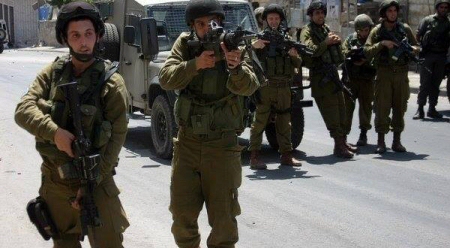
Israeli soldiers invaded al-Kafeer town, southeast of the northern West Bank city of Jenin, on Saturday at dawn and surrounded a home where a Palestinian who is believed behind death of an Israeli colonialist settler last month was alleged to be hiding.
Media sources in Jenin said a large military force, including 22 military vehicles and 2 armored bulldozers, invaded the town and surround the home of Walid Ershaid, and started using loud speakers demanding that Ahmad Jarrar surrender. The Israeli military said they thought Jarrar was hiding out in the house.
It should be noted that on January 18th, Israeli soldiers executed the cousin of Ahmad Jarrar after mistaking him for Ahmad.
The sources added that the soldiers imposed a strict siege on the entire area, and completely blockaded the main Tubas-Jenin road.
Sounds of explosions could be heard in and around the surrounded home, and its vicinity.
Media sources in Jenin said the troops eventually withdrew without finding Jarrar.
Furthermore, the soldiers invaded Burqin and ‘Aqaba town, near Jenin, after isolating them, and abducted Ibrahim Obeidi, Nader Masad, Mubarak Jarrar and Mostafa Antar Jarrar.
The soldiers invaded and ransacked dozens of homes in Burqin at around 4:00 in the morning, and used K9 units during the search, while interrogating scores of residents.
‘Construction terror’ is Israel’s latest metaphor for Palestinian displacement
By Ramona Wadi | MEMO | January 30, 2018
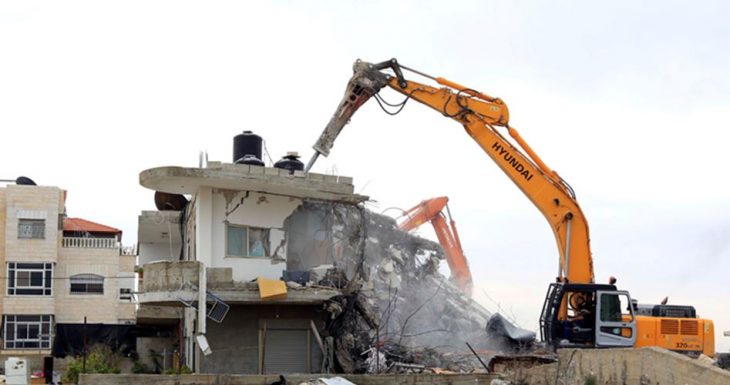
Israel’s construction of its politics on contrasting levels which echo its colonial agenda knows no limits. Now that the international community is largely reluctant to do more than refer to previous statements of colonial expansion as illegal, Israel is more explicit in promoting its state and settler narratives in its appropriation of land ownership.
A news report published on Monday in Haaretz quotes Jewish Home Party MK Moti Yogev: “Our goal is to protect state lands, consistent with decisions by the state not letting their status be determined by construction terror guided by the Palestinian Authority with the intervention of international elements such as the European Union.” He also suggested legal recourse against Palestinians opposing demolition orders.
This is not the first time that such rhetoric has been used. In April 2016 a press release titled “Re-evaluate state’s handling of EU-funded construction in Area C” described Palestinian dwellings in similar terms, accusing the EU of financing “construction and infrastructure terror”.
There is much to be gleaned from Yogev’s comment. First, Israel has achieved a level of comfort in appropriating land and narratives – so much so that it confidently projects its own “construction terror” label upon the indigenous, colonised population. The statement also alleges a comprehensive approach by the Palestinian Authority which is endorsed by the EU, despite the fact that both entities do not exhibit humanitarian concern other than perfunctory requirement. By attempting to discuss the EU-funded dwellings from a legal perspective, Israel is also asserting its violation of Palestinian rights above international law.
Yogev has omitted the strategy which allowed for such a travesty to take place – namely the international consensus, departing from Israel’s narrative, that Palestinians should only be granted a sliver of prominence if it serves colonial interests. The EU-funded dwellings are a case in point. Israel’s persistent demolition of such dwellings has incurred financial losses for the EU, yet it is also the means through which it can sustain its peace-building façade without substantive damage given that its cooperation with Israel remains lucrative.
One of the EU-funded buildings in Area C which is threatened with demolition and ostensibly an example of Yogev’s “construction terror” is a primary school attended by 33 students from the Bedouin community of Al-Muntar. If the demolition order is carried out, these students’ education will be permanently disrupted due to the lack of educational facilities in the vicinity.
Under the pretext of terror – a blatant lie on behalf of Israel – Yogev is preparing the foundations for another phase in the colonial expansion agenda. It is easy to see that the only perpetrators of “construction terror” are Israel and its settler population. The recent funding deficit to UNRWA has created a favourable context for Israel to normalise deprivation and forced displacement of Palestinians.
While Israel benefits from studying sequences and exploiting opportunity, the international community has made a mockery of humanitarian concerns by wilfully neglecting the real needs of the Palestinian population. This has been achieved to the extent that Israel can coin a term such as “construction terror” and rest assured that its absurdity will not be disputed. Neither will there be any permanent embarrassment regarding the fact that the international community could have applied such a label to Israel since 1948. The outcome, however, is predictable. Israel will distinguish between settlement expansion and the purported construction terror and lobby the international community for support in this endeavour. Not to gain explicit recognition of its duplicity, but to gain an extension of silence over the aim of creating more internally displaced Palestinians at a rate which increases the discrepancy between needs and the finance allocated to alleviate symptoms generated by deprivation.
Palestinian youth activists under attack

Haitham Siyaj
Samidoun Palestinian Prisoner Solidarity Network – January 28, 2018
Israeli repression targeting Palestinian youth activists has continued to rise. On Friday, 26 January, occupation forces seize Haitham Siyaj, only a month after he was released from nearly two years’ imprisonment without charge or trial under administrative detention. Siyaj is one of the comrades of Basil al-Araj who was seized by occupation forces shortly after being released from months in Palestinian Authority prison.
There, his administrative detention – imprisonment without charge or trial – was renewed repeatedly. Siyaj was once again seized at a flying checkpoint erected by occupation forces in the Jaba area.

Tareq Mattar
At the same time, Palestinian youth activist Tareq Mattar’s administrative detention was also extended for another six months. Mattar, 28, is a Palestinian youth leader who is active in a variety of projects, initiatives and forums to organize Palestinian youth and promote study and discussion of the Palestinian cause. He was previously jailed for his Palestinian political activities. He has been jailed without charge or trial since August 2017.

Samer Abu Aisha
Meanwhile, Palestinian journalist Samer Abu Aisha, 30, from Jerusalem, was summoned for interrogation by occupation police on 24 January; he was released from Israeli prison six months ago after 20 months in prison. He was seized by occupation forces in January 2016 after they stormed the headquarters of the ICRC in Sheikh Jarrah where he and a fellow Jerusalemite activist, Hijazi Abu Sbeih, were staying in defiance of an order to expel them from their city for six months. He was jailed for 20 months on charges of illegal protest, incitement and “disturbing public security.”
Israel’s endgame in Gaza: Resistance is futile
Israel’s deliberate targeting of Gaza’s health sector and denying those in need of humanitarian care from obtaining it constitute a crime against humanity

By CJ Werleman | Middle East Eye | January 16, 2018
Some describe Gaza as either the world’s largest “concentration camp” or “open air prison”, while others liken it to the modern-day equivalent of the Warsaw ghetto.
Whatever appropriate analogy you apply to the enclave, that traps two million Palestinians on a slender piece of coastal land along the Egyptian-Israeli border, it’s impossible to overstate the level of human misery and suffering that is taking place there today.
A catastrophic situation
When I spoke with Dr Basem Naim, the former Palestinian minister for health and resident of Gaza, I referred him to a UN report that forewarned that Israel’s medieval-like blockade promises to make the territory “uninhabitable” by 2020.
“What do they [UN] mean? It’s uninhabitable here now,” Naim told me. “The situation today is catastrophic.”
Dr Naim explained how Israel’s intentional cutting of Gaza’s power supply, meant to exert pressure on Hamas but, instead, punishing ordinary Palestinians, is having dire affects on the health sector in Gaza.
“The typical Palestinian gets only three to five hours of electricity each day,” he said. “You can’t pump water to apartments that are above ground level. You can’t pump sewage, which is why more than 95 percent of Gaza’s drinking water is undrinkable.”
He explained that hospitals, which depend on 24-hour electricity, are unable to perform life-saving surgeries, and that some, including Al-Shifa hospital in Gaza City, have ceased doing operations altogether.
This is happening while newborn babies and the elderly freeze to death in the winter, and die from heat exhaustion in the summer. This is happening because Israel is allowing only 120 watts of power to be provided to Gaza, knowing that 400 watts are needed to meet the basic minimum survival needs of two million Palestinian people.
“The scarcity of energy and the severe shortage of fuel in Gaza have damaged all aspects of life in the Strip,” said the International Committee of the Red Cross in a statement issued last year.
Closed borders
But the biggest problem facing the imprisoned citizens of Gaza is the “closed borders”, according to Dr Naim. He explained:
“For example, the last time Rafah border crossing was opened, which was one week ago, came after more than 100 days of closure, and out of the 35,000 people waiting to leave Gaza through Rafah, only 2,000 were able to leave, and the others must wait again for another 100 days. When I talk about 35,000 people, I’m talking about urgent humanitarian cases; patients, and people who need to meet their families for urgent situations. It’s nearly impossible for Palestinians in Gaza to get urgent medical care in Israel, Egypt, or Jordan.
“If a Palestinian wants to leave Gaza for urgent medical care or treatment, he or she must wait 70 days to get [an] Israeli reply saying he or she is allowed or not. And after 70 days, and even if the request is approved, he or she must come to Erez crossing for an interrogation, and he or she might be arrested. I know many cases where the families of patients were blackmailed by Israeli security forces, like Shin Bet, under these very circumstances.”
It’s worth noting that it’s not only from Gaza that Palestinians are denied freedom of movement. Earlier this month, Omar Barghouti, who lives in Israel and is one of the founders of the boycott, divest and sanctions (BDS) movement against Israeli occupation, was denied the right to visit his cancer-stricken mother in Jordan.
Israel’s refusal to allow a prominent Palestinian figure, who has a demonstrable lifetime track record of non-violent activism, undercuts Israeli claims that travel bans have little to do with security and everything to do with meting out collective and inhumane punishment to the Palestinian people, writ large.
A new report published by the human rights group Gisha – Legal Centre for Freedom of Movement shows that 2017 was the worst year for the movement of Palestinians in and out of Gaza since Israel’s attack on Gaza in the summer of 2014, reducing the number of exit permits by 51 percent from 2016 to 2017.
The report shows that Israel allowed fewer than 6,000 monthly exits in 2017 compared with the more than 14,000 allowed the previous year.
The authors of the report also identified a list of policies that were carried out by Israeli authorities to prevent or restrict freedom of Palestinian movement through the Erez crossing.
These new restrictive measures were “introduced with little or no justification provided as to their purpose and, it appears, no consideration of the impact they would have on the lives of Gaza’s residents”.
Targeting the health sector
These measures include “significant extension of the processing times of permit applications, leaving thousands of permit applications pending with no response; a new directive prohibiting Palestinians from exiting Gaza with electronic devices, toiletries and food; freezing travel to the American Consulate; mandatory shuttle services to Allenby Bridge Crossing; “security blocks” blocking travel for medical patients, traders, and humanitarian workers; increase in the frequency and severity of “security interviews” at Erez; trader permits cancelled as new approvals declined; travel for Friday prayers in Jerusalem remaining blocked, and; recipients of permits for travel abroad increasingly made to sign a commitment not to return for a year.”
It’s not only inexcusable for Israel to impose any kind of restriction of movement, but to deliberately target Gaza’s health sector by cutting power to the Strip, and then to deny those in need of humanitarian care from obtaining it – constitutes a crime against humanity by any definition.
“The magnitude, the deliberateness, the violations of international humanitarian law, the impact on the health, lives, and survival, and the overall conditions warrant the characterisation of a crime against humanity,” says Richard Falk, a former UN special rapporteur for human rights in the occupied Palestinian territories.
“This is an increasingly precarious condition. A recent study reports that 46 percent of all Palestinian children in Gaza suffer from acute anaemia. There are reports that the sonic booms associated with Israeli overflights have caused widespread deafness, especially among children. Children need thousands of hearing aids.
“Malnutrition is extremely high in a number of different dimensions and affects 75 percent of Palestinians in Gaza. There are widespread mental disorders, especially among young people … Over 50 percent of Palestinian children in Gaza under the age of 12 have been found to have no will to live,” wrote Falk in 2008.
When I referred to Falk’s findings from a decade ago, Dr Naim said things have become “much worse”, pointing to the fact that much of Gaza’s critical infrastructure was destroyed during Israel’s 2014 assault, noting that 20,000 tons of explosive ordinance was dropped on the Strip by Israeli jets and artillery, and that unemployment and poverty have skyrocketed since.
Breaking the Palestinians’ will
Israel’s restriction on Palestinian movement is also preventing Gaza from building a functioning civil society as human rights workers, social workers, health workers, educators, engineers, etc are denied opportunities to expand their knowledge and skills in other countries.
It also runs afoul of Israel’s “obligations to respect the human rights of Palestinians in Gaza and the West Bank, including their right to freedom of movement, which includes, with some limitations, a right to enter and leave one’s country and to choose one’s place of residence within it,” according to Human Rights Watch.
In fact, Palestinians in Gaza may visit their families in the occupied West Bank only if he or she can prove their relative is “dead, dying, or getting married“, which constitutes another violation of not only international law but also the Oslo Accords that stipulate the Palestinian territories – East Jerusalem, Gaza, and the West Bank – constitute one unified territorial entity. Israel has made movement between the territories all but impossible for Palestinians.
Given that nearly a third of Palestinians in Gaza have relatives in either the occupied West Bank, East Jerusalem, or Israel, one can see how needlessly cruel Israel’s brutal policies of occupation truly are.
Of course, Israel tries to justify its near total freeze of Palestinian movement in and out of Gaza with concerns for its security, but this has always been a rhetorical fig leaf for Israel’s sustained effort to break the will of the Palestinian people.
Israel’s intent has always been to strangle Palestinian political, social, and civil life in the hope that those it occupies will come to the realisation that resistance is futile.
– CJ Werleman is the author of Crucifying America (2013), Koran Curious (2011), and he is the host of Foreign Object. Follow him on twitter: @cjwerleman
READ MORE:
Yes, Palestinians under siege are ‘dehumanised’ – by Israel
Remembering Cast Lead: How corporate media continue to justify Israel’s criminal excesses
Council of Europe tells PA to stop supporting prisoners’ families
MEMO | January 26, 2018
The Council of Europe has called upon the Palestinian Authority to halt the payments it distributes to the families of Palestinian prisoners and those who have been killed by Israeli forces, the Jerusalem Post has reported. The Israeli narrative swayed the council during its parliamentary session, prompting it to make the demand for the first time as part of a broader call for a resolution on the Israel-Palestine conflict.
“After a persistent effort we succeeded for the first time to include in the final report [resolution] a clear call to stop support for terrorists [sic] and their families,” said Yesh Atid MK Aliza Lavie, who addressed the council in Strasbourg.
The rest of the session addressed the US recognition of Jerusalem as the capital of Israel and reiterated that a two-state solution with East Jerusalem as Palestine’s capital was the only solution to the conflict.
Israel and the US have long berated the PA for providing crucial subsidies to the families of those impacted by the occupation, framing the money as a reward for “terrorists”. In September, the Trump administration announced its backing for a bill that would suspend US aid to the PA until the latter ended payments to prisoners and their families.
“The Trump administration strongly supports the Taylor Force Act, which is a consequence of Palestinian Authority and Palestine Liberation Organisation’s policy of paying terrorists and their families,” the State Department said at the time.
Palestinian officials have said that the payments are support for relatives “who lost their breadwinners to the atrocities of the occupation, the vast majority of whom are unduly arrested or killed by Israel.”
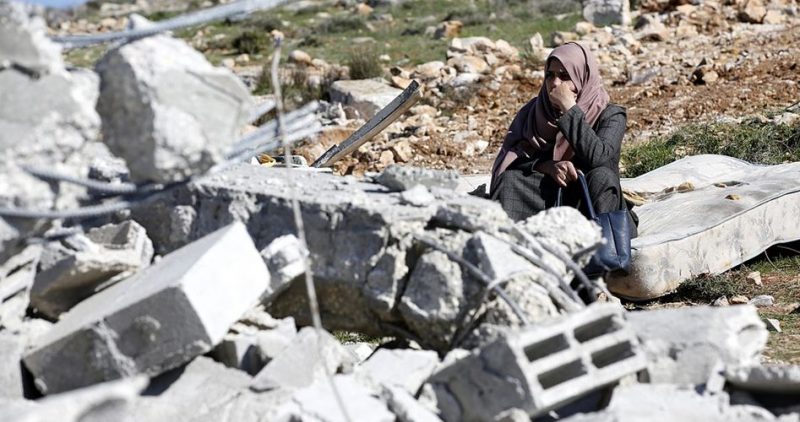
In the aftermath of a resistance attack, the families of the alleged perpetrators often find their homes being demolished, their relatives arrested and their land taken. Amnesty International is one of many human rights groups that have repeatedly condemned such reprisals as a form of “collective punishment”. Consequently, many Palestinians find themselves reliant on the benefits from the PA in order to survive.
Featured Video

Max Blumenthal: ‘Israel First’ in Iran War Sparks MAGA Civil War
or go to
Aletho News Archives – Video-Images
From the Archives
Wartime internment camps in Australia
National Archives of Australia
World War I
During World War I, for security reasons the Australian Government pursued a comprehensive internment policy against enemy aliens living in Australia.
Initially only those born in countries at war with Australia were classed as enemy aliens, but later this was expanded to include people of enemy nations who were naturalised British subjects, Australian-born descendants of migrants born in enemy nations and others who were thought to pose a threat to Australia’s security.
Australia interned almost 7,000 people during World War I, of whom about 4,500 were enemy aliens and British nationals of German ancestry already resident in Australia.
Records of World War I internment camps
World War II
During World War II, Australian authorities established internment camps for three reasons – to prevent residents from assisting Australia’s enemies, to appease public opinion and to house overseas internees sent to Australia for the duration of the war.
Unlike World War I, the initial aim of internment during the later conflict was to identify and intern those who posed a particular threat to the safety or defence of the country. As the war progressed, however, this policy changed and Japanese residents were interned en masse. In the later years of the war, Germans and Italians were also interned on the basis of nationality, particularly those living in the north of Australia. In all, just over 20 per cent of all Italians resident in Australia were interned. … continue
Blog Roll
 Aletho News
- Tomorrow’s naval blockade showdown
- ‘Israel’ attacks civilians to hide its embarrassing military failures & out of pure sadism
- Any Foreign Military Vessel Approaching Hormuz Under Any Pretext ‘Will Be Dealt With Severely’: IRGC
- Diplomats slam US negotiators’ performance in Iran talks
- Trump Refuses Exit Ramp, War with Iran will Continue
- Trump Says US Naval Blockade in Strait of Hormuz Will Begin Shortly
- US, Iran end 21-hour talks without agreement
- US IRAN TALKS: Who Are the Crazy Ones Here? /Lt Col Daniel Davis
- Talks with the US end without a deal over excessive US demands: Iran
- Feeling Better, Getting Worse: How Psychiatric Drugs Create the Illusion They Cure
- If Americans Knew
- US-Iran ceasefire negotiations make zero progress – Daily Update
- Pro-Israel ‘Thinktanks’ and Individuals who Influence U.S. Foreign Policy
- Mearsheimer reveals how Israel dictates US policies on Iran, Gaza – video
- After killing 350+, Israel still has a “score to settle” with Lebanon before ceasefire – Daily Update
- Military aid to Israel emerges as the latest political litmus test for Democrats
- The only Palestinian children’s rights organization closes following years-long Israeli campaign against it
- ‘I Can’t Forget the Smell’: Lebanese Reel After Israel Kills Over 300 in Single Day
- DNC Shoots Down Resolutions Calling Out AIPAC and Limiting Arms to Israel
- TCN: Is Israel Blackmailing President Trump?
- Israel killed at least 303 Lebanese yesterday – who were they? Daily Update
- No Tricks Zone
- German Expert: Heat Dome Led To Record Temps In Western USA…Warmer In 1934, 1936
- New Study: No Linear Warming Or Glacier Retreat Along Northern Antarctic Peninsula Since 1980s
- An Inconvenient Tree: Uncovered In Alps… Europe Much Warmer Than Today 6000 Years Ago
- New Study Reports A 60% Slowdown In Greenland’s Ice Loss Rate In The Last Decade
- Low Intensity Tornado Wrecks Major Solar Farm, Creating A Potential Toxic Dump
- New Study Finds Warming Saves Lives…Cold Temperatures 12 Times More Deadly Than Excess Heat
- German Science Blog Accuses PIK Climate Institute Of Hallucinating Climate Tipping Points
- Devastating Assessment Of Comirnaty Vaccine By Former Senior Pfizer Europe Toxicologist
- New Study: CO2 Is ‘Effectively Negligible’ As An Explanatory Climate Change Factor Since 2000
- Former Pfizer Toxicologist Dr. Helmut Sterz Tells Bundestag Hearing Pfizer Vaccine Should Have Never Been Approved
 Aletho News