Reinventing the company town? Nevada offers self-governing ‘Innovation Zones’ with own TAXES & COURTS
Nevada Governor Steve Sisolak is trying to lure high-tech firms into his state with an offer to allow them to effectively form independent governments at the county level, capable of levying taxes and even forming courts.
Companies with an “innovative technology” are being offered a chance to try their hand as miniature sovereign states, according to new state legislation seen by the Las Vegas Review-Journal on Wednesday. While Sisolak hinted at the idea during his State of the State address last month, few details have been made public until now.
These so-called “Innovation Zones” are being marketed to lure tech companies – perhaps those struggling with the high taxes and lockdown fetishism of Silicon Valley – with wide open spaces and the freedom to do whatever they like on their own land.
“The Board may establish a justice court,” the legislation draft obtained by LVRJ stipulates. In addition, with a few exceptions for real estate, fuel and tangible personal property, “the Board may impose any taxes or fees authorized to be imposed by a county.”
That’s not an exaggeration, either – companies that pull up stakes and move to Nevada will be able to form their own local governments with the equivalent authority of a county. They will be able to levy taxes, form courts and school districts, provide government services, and essentially act as sovereign entities. The zones will be overseen by three-member supervisory boards similar to county commissioners, and the company owners would maintain the balance of power over who sits on the board.
“The exercise of any power or duty by the Board supersedes the exercise of that power or duty by the county in which the Innovation Zone is situated.”
The proposal deems the traditional government model to be “inadequate” for attracting big-time tenants, and the state has a very particular type of company in mind for the new program. Companies would have to own at least 78 square miles of undeveloped and uninhabited land, falling within a single county without overlapping any currently-owned area. Applicants would require $250 million in assets and plan to invest at least $1 billion in their new site over the next decade.
Blockchains LLC, located in Sparks, is one company planning to take advantage of the package and has reportedly committed to building a “smart city” east of Reno. Other blockchain companies, autonomous technology and AI, internet of things, robotics, wireless, biometrics and renewable energy are some of the industries for which Sisolak is rolling out the welcome mat.
While the ‘company town’ model might call to mind the abusive labor practices of the late 19th and early 20th century – with workers paid in company ‘scrip’ unusable outside the town and sometimes even fenced in, supposedly for their protection – companies like Facebook (Menlo Park) and Google (Mountain View) appear to be hard at work renovating the company town’s image.
Nevada has been having relatively good luck poaching California megacorporations, becoming the site of Tesla’s giant Gigafactory 1 to manufacture the electric cars’ lithium ion batteries. The company even obtained the rights to mine its own lithium in the state. CEO Elon Musk is also opening a factory outside Austin, Texas, after quibbling with the state of California over its lockdown mandates (and presumably its high taxes, which Texas does not have). While Tesla received a $1.3 billion tax break to open its factory in Nevada, Sisolak appears to be counting on sovereignty as a superior incentive for expanding tech companies.
John Kerry’s Antarctica Junket Highlights Climate Hypocrisy
By James Taylor | ClimateRealism | February 3, 2021
John Kerry, as Joe Biden’s Special Presidential Envoy for Climate, is back in the news telling Americans we urgently need to reduce our travel and our carbon dioxide emissions to avert an imminent climate catastrophe. Like many climate activists, however, Kerry personally lives under a different – more carbon-promiscuous – set of rules than he seeks to impose on everyone else.
Kerry continues to double-down on more stringent climate restrictions, saying this past week that the United States and the world need even more restrictions than the controversial Paris Climate Treaty, including the imposition of a new tax on carbon dioxide. Climate activists have long called for such a tax to apply especially forcefully to airplane travel. As the climate-activist David Suzuki Foundation asserts, “Emissions from flights stay in the atmosphere and will warm it for several centuries. Because aircraft emissions are released high in the atmosphere, they have a potent climate impact, triggering chemical reactions and atmospheric effects that heat the planet.” Also, as the title of a 2019 New York Times article asserts, air travel emissions are “Worse Than Anyone Expected.”
One appalling example of “Do as I say, not as I do,” is Kerry’s personal sightseeing tour of Antarctica in his final days as Secretary of State, in November 2016. Recall that in November 2016, Kerry was Secretary of State for the lame-duck Obama administration just before President Trump’s inauguration. Even before November 2016, Kerry’s State Department was bragging about Kerry’s total miles flown, as Kerry broke the record for most miles flown (and most carbon dioxide emitted) by any Secretary of State. Yet, in late November 2016, there was little reason for a lame-duck Secretary of State to fly to Antarctica – that is, unless personal climate tourism counts as a good use of taxpayer dollars and carbon dioxide emissions.

Photo: John Kerry stepping off the large Air Force jet he flew thousands of miles to Antarctica. Source: U.S. State Department.
Kerry’s Antarctica jaunt likely cost taxpayers more than $1 million, while emitting large amounts of carbon dioxide and depositing all sorts of traditionally defined pollutants (soot, etc.) on the otherwise-pristine Antarctic landscape. There were no diplomats from any other countries for Kerry to meet with – according to his Secretary of State duties – but he sure seemed to enjoy the airplane-and-helicopter sightseeing.

Photo: John Kerry taking a personal helicopter tour of Antarctica, emitting pollutants in the Mount Erebus region. Source: U.S. State Department.
Kerry’s narcissistic Antarctica trip is not a one-off outlier, either. Fox News reported this morning that Kerry flew on a private jet to Iceland in 2019 to, ironically, accept a prize for being a climate warrior. Asked about the appropriateness of spewing several thousand miles of private-jet carbon-dioxide emissions for a personal round-trip flight, Kerry replied that flying by private jet to accept awards is, “the only choice for somebody like me who is traveling the world to win this battle.”
Um, sure.

Photo: John Kerry stepping out of an SUV he used for his personal tour of Antarctica. Source: U.S. State Department.
When an Icelandic reporter asked Kerry about the apparent hypocrisy of flying a private jet – not even airline first-class – to accept his climate prize, Kerry morphed into a full “Do you know who you are talking to?” moment
“I negotiated the Paris Accords for the United States,” Kerry lectured the reporter.
He also may hold the record for largest carbon footprint of any American citizen.
“John Kerry has never been known to pass up an opportunity to fly thousands of miles when it suites his ego or curiosity,” Marc Morano, Director of Communications for the Committee for a Constructive Tomorrow (CFACT) and publisher of the website Climate Depot, told Climate Realism. “Why should a trip to Antarctica be any different? In Kerry’s world view, he is one of the chosen ones who get to fly private jets and government planes unlimited miles while the rest of us will have to ‘morally justify’ our commercial airline trips.”
James Taylor is the President of the Heartland Institute. Taylor is also director of Heartland’s Arthur B. Robinson Center for Climate and Environmental Policy.
The Times Wants You Consumed by Fear, Isolation, and Misery
By Jeffrey A. Tucker | AIER | January 30, 2021
There are probably multiple reasons why coronavirus cases in the US are down nearly 50% in the US in the last month.
Could be seasonal. Could be the vaccine. Could be herd immunity from natural infection.
Could be the post-holiday default to endemicity. Could be a change in the cycle threshold of PCR that generates fewer positive cases. Could be data tweaks in light of political changes.
Anyone who says he knows for sure which is dominant is pretending to know the unknowable.
The New York Times, which obliquely reports the case decline, is still certain that you should still live in isolation, fear, and disease panic. They offer every county in America a tool in which you can discover what you should do to protect yourself from the pathogen, as if the only way to deal with a respiratory virus is to hide. Their tool is extremely manipulative.

For example, they have this category called “very high risk level.” Red is in the text. Scary! But what is it? It means 11 or more people per 100,000 have generated a positive PCR test for the coronavirus.
Not deaths. Not hospitalizations. Not even symptomatically sick. (Yes, I know the term “sick” is old fashioned.)
We are talking about 11 positive PCR tests. This is an infection rate of 0.01%. Consider too that the NYT reports that these tests in the past have generated up to 90% false positives. In addition, the infection fatality ratio for those under 70 could be as low as 0.03%.
Once you add all that up, you end up with a very long string of zeros followed by some number (I’ll let someone else do the math; in any case, all these data are mostly based on illusion). In any case, we are talking about a vanishingly tiny chance of severe outcomes for the population at large, depending almost entirely on demographics.
Still, the Times says you may not live a normal life. True, people in Florida, Georgia, South Carolina, Texas, South Dakota, and many others states are living happy normal lives. But they are all doing it wrong, according to the New York Times.
Let’s look at their life advice for anyone living in a “very high risk” area.



No haircuts, no manicures, no gatherings, no travel, no friends, no bars, no restaurants, and no singing! BE VERY AFRAID…CONSTANTLY!
To me, all of this sounds like insanity defined. And look at how they tip their ruling-class hand. People should not go to the store but rather have their groceries delivered. Delivered by whom? Apparently not readers of the New York Times.
To the Times, there is only us and them: the clean people vs. the dirty people who get to travel to deliver to “us” our groceries and essential services. Our job is to sit in a perpetual state of disease avoidance while they operate as sandbags to create the herd immunity from which we will benefit. It’s the new feudalism.
Now look what we must do for “extremely high risk” which pertains for as low as 20 PCR positives per 100,000 people.


Notice any difference between “serious” and “extreme” risk? That’s right. There is none. They are identical. And if you look at the map above you can see that right now most of the country is in extreme risk, according to the Times. According to this preposterous map, there are only two counties in the US at low risk.
Let’s look at Prairie County, Montana. It’s one of the two places you can live without the terrifying prospect of dropping dead from disease. There are 1,300 people living there. If one person tests positive, that immediately shifts the entire county into extreme risk. So the trajectory since November 1 looks utterly hilarious, toggling between low and extreme risk with a total of 70 cases in three months with most daily cases at exactly 0.
So what according to the Times should the good people of Prairie County do? They should be grateful to be relatively safe but try to their best to stay put! Do not go anywhere near the scary places elsewhere! They should stay in their bubble!

Look, at some point, the media is going to have to admit complicity in the creation of this extremely unscientific, pathological, unwarranted, and deeply destructive disease panic. They created it, starting with the now-discredited Donald McNeil’s February 27, 2020, recommendation that we “go medieval” with the coronavirus.
This whole paradigm amounts to a rejection of public health, which is always not just about one pathogen but all threats to human health and not just for the short term but the long term. The defining mark of 20th century public health as distinguished from the Middle Ages is that we recognized that pathogens are all around us and need to be managed rationally. Oh also the paradigm rejects human rights and freedom.
We do not need to destroy society, lock people in their homes, tear down businesses, close schools, traumatize kids, drive people to alcoholism and drug abuse, divide society between the clean ruling class and the dirty working class, ban travel, close churches, abolish choirs, close the arts, and whip up the population into a frenzied psychological meltdown in order to deal with a new strain of a respiratory virus. But tell that to the New York Times.
Should Dr. Birx Be Forgiven For Breaking Her Own Rules?
By Ethan Yang | American Institute for Economic Research | December 28, 2020
Another day, another politician violates their own rule. Do as I say not as I do; this has been the prevailing theme of the pandemic as politicians openly flout the laws and recommendations they advocate for. From people like Speaker Nancy Pelosi to New York Governor Andrew Cuomo to local county supervisors in Los Angeles, hypocrisy thrives at every level of government. Our leaders tell society to suck it up and lock down while providing little justification or direction. Meanwhile, they reserve the right to travel, dine out, and see their loved ones for themselves after devoting effort to prevent the rest of us from doing so. As they enjoy these luxuries, their policies bring economic devastation, social deprivation, and encourage fellow citizens to turn on one another.
Another public official to be added to this long list of hypocrites is Dr. Deborah Birx, the White House coronavirus response coordinator. AP News writes,
“The day after Thanksgiving, she traveled to one of her vacation properties on Fenwick Island in Delaware. She was accompanied by three generations of her family from two households. Birx, her husband Paige Reffe, a daughter, son-in-law and two young grandchildren were present.”
This is of course after she and her colleagues made a number of recommendations not to travel or gather on Thanksgiving. According to the New York Post,
“Birx had urged people in the days leading up to Thanksgiving to keep gatherings to “your immediate household.”
“I don’t like it to be any number,” Birx said on CNN’s “New Day.”
“Because you know, if you say it can be 10, and it’s eight people from four different families, then that probably is not the same degree of safe as 10 people from your immediate household.”
Birx said at the time that every American is obligated to make sacrifices to stop the spread of the virus.”
Dr. Birx believes that we should not gather with anyone besides those in our immediate household yet here she is just like many politicians before her. The New York Post also writes that when confronted on the matter Dr. Birx attempted to justify the trip by stating that she was going to “winterize the property before a potential sale.” On the matter it reports,
“I did not go to Delaware for the purpose of celebrating Thanksgiving,” Birx said in a statement.
She argued that the members of the trip belong to her “immediate household,” though she acknowledged they live in separate homes.”
As unconvincing as that sounds, even if Dr. Birx didn’t go to celebrate Thanksgiving that doesn’t change the fact that she was meeting with people from different households. Preparing the house for sale doesn’t change things either as American businesses have been crumbling under the boot of lockdowns since March. Although failing to prepare her house for sale might have lasting and adverse consequences, every day Americans have been making these sacrifices for months.
The New York Post provides a follow up on this situation when it reports that to justify her visit Dr. Birx said the following,
“My parents stopped eating and drinking because they were so depressed,” the 64-year-old complained to Newsy.
“My daughter hasn’t left that house in 10 months, my parents have been isolated for 10 months. They’ve become deeply depressed,” Birx said of the need to “recover from the trauma of the last 10 months.”
Although this is certainly a compelling reason to visit her family, the problem is that this is what countless Americans have been dealing with as well. Dr. Birx has simply realized what the consequences of her policies have been. For many Americans, lockdowns have generated the social agony her family has experienced. Plenty of Americans have also lost jobs and livelihoods. According to data from Yelp, 60 percent of businesses that closed will never open again. For many Americans, they have experienced even worse. According to the CDC, drug overdoses have skyrocketed in 2020, expanding the list of self-inflicted deaths both intentional and unintentional. Despite all this, the average American has obediently complied with these guidelines even though they have every right not to.
Should We Forgive Dr. Birx?
Dr. Birx and the countless politicians like her should be forgiven under the following condition: That they learn from their mistakes and empathize with the average American’s struggle with their policies. To understand the eternal lesson that policy intentions do not equal policy results. If we could have more people in power who understand this truth then society would be better off. Lockdowns are a classic example of a policy that seemed to have benevolent intentions but wound up having lethal consequences. There are laws that work and those that don’t. Lockdowns and all the arbitrary restrictions that come with them promote contempt for the rule of law while doing little to control the virus. They have not only done little to prevent the spread of Covid-19, but they have wrecked society as a result. Part of the process of leadership is having the humility to admit that you were wrong and understanding that you can’t force a square peg through a round hole. Likewise, you cannot drastically shut down society and prohibit everything it means to be human without expecting terrible results.
The great economist Friedrich Hayek once wrote,
“The basic source of social order, however, is not a deliberate decision to adopt certain common rules, but the existence among the people of certain opinions of what is right and wrong…. Except where the political unit is created by conquest, people submit to authority not to enable it to do what it likes, but because they trust somebody to act in conformity with certain common conceptions of what is just. There is not first a society which then gives itself rules, but it is common rules which weld dispersed bands into a society.”
Hayek spoke of lawmaking as a sort of discovery process of policies that are compatible with society rather than simply forcing one’s will on society. Lockdowns are a clear example of an unsustainable law that is not only incompatible with society but impossible to follow. Dr. Birx has learned firsthand that her recommendations are not sustainable in the long run and even she of all people can’t follow such an edict. Rather than feeling humiliated and ashamed, she should attempt to enlighten her colleagues about her discovery. Otherwise, this will go down as another one of countless instances of elitism and hypocrisy exercised by our public servants.
Dr. Birx may have saved her family from emotional trauma or worse by visiting them. Surely she had taken the necessary precautions to ensure that her trip was as safe as possible. It would certainly be reasonable to make such a trip given the circumstances. She weighed the dangers and rewards of the actions she was taking and made a thoughtful decision. Rather than apologizing and retreating, she should fight for the average American’s right to do the same. One could only wish.
Ethan Yang joined AIER in 2020 as an Editorial Assistant and is a graduate of Trinity College. He received a BA in Political Science alongside a minor in Legal Studies and Formal Organizations. He currently serves as Local Coordinator at Students for Liberty and the Director of the Mark Twain Center for the Study of Human Freedom at Trinity College.
Developers of Oxford-AstraZeneca Vaccine Tied to UK Eugenics Movement
By Jeremy Loffredo and Whitney Webb |
Unlimited Hangout| December 26, 2020
The developers of the Oxford-AstraZeneca vaccine have previously undisclosed ties to the re-named British Eugenics Society as well as other Eugenics-linked institutions like the Wellcome Trust.
On April 30th, AstraZeneca and Oxford University announced a “landmark agreement” for the development of a COVID-19 vaccine. The agreement involves AstraZeneca overseeing aspects of the development as well as manufacturing and distribution while the Oxford side, via the Jenner Institute and Oxford Vaccine Group, researched and developed the vaccine. Less than a month after this agreement was reached, the Oxford-AstraZeneca partnership was awarded a contract from the US government as part of Operation Warp Speed, the public-private COVID-19 vaccination effort dominated by the US military and US intelligence.
Though the partnership was announced in April, Oxford’s Jenner Institute had already begun developing the COVID-19 vaccine months before, in mid-January. According to a recent BBC report, it was in January that the Jenner Institute first became aware of how serious the pandemic would soon become, when Professor Andrew Pollard, who works for both the Jenner Institute and heads the Oxford Vaccine Group, “shared a taxi with a modeler who worked for the UK’s Scientific Advisory Group for Emergencies.” During the taxi ride, “the scientist told him data suggested there was going to be a pandemic not unlike the 1918 flu.” Due to this sole encounter, we are told, the Jenner Institute then began to pour millions into the early development of a vaccine for COVID-19 well before the scope of the crisis was clear.
For much of 2020, the Oxford-AstraZeneca vaccine was treated as an early front-runner, though its lead would later be marred by scandals related to its clinical trials, including the death of participants, sudden trial pauses, the use of a problematic “placebo” with its own host of side effects and the “unintentional” mis-dosing of some participants that skewed its self-reported efficacy rate.
The significant issues that emerged during trials have provoked little concern from the vaccine’s two lead developers, despite critical attention from even mainstream media of its complications. The lead developer of the Oxford-AstraZeneca vaccine, Adrian Hill, told NBC on December 9th that the experimental vaccine should be approved and distributed to the public before the conclusion of the safety trials, saying,”to wait for the end of the trial would be the middle of next year. That’s too late, this vaccine is effective, available at large scale and easily deployed.”
Sarah Gilbert, the other lead researcher on the vaccine, seemed to believe that pre-mature safety approval was likely, telling the BBC on December 13 that the chances of rolling out the vaccine by the end of the year are “pretty high.” Now, the UK is expected to approve the Oxford-AstraZeneca vaccine shortly after Christmas, with India also set to approve the vaccine next week.
While the controversies surrounding the vaccine’s trials did ultimately undermine its previous frontrunner status, the Oxford-AstraZeneca vaccine remains heavily promoted as the vaccine of choice for the developing world, as it is cheaper and has much less complicated storage requirement than its main competitors, Pfizer and Moderna.
Earlier this month, Dr. Richard Horton, the editor-in-chief of the Lancet medical journal, told CNBC that “The Oxford AstraZeneca vaccine is the vaccine right now that is going to be able to immunize the planet more effectively, more rapidly than any other vaccine we have” in large part because it is a “vaccine that can get to lower middle-income countries.” CNBC also quoted Andrew Baum, global head of health care for Citi Group, as saying that the Oxford-AstraZeneca vaccine “is really the only vaccine that is going to suppress or even eradicate SARS-CoV-2, the virus that causes COVID-19, in the many millions of individuals in the developing world.”
In addition to longstanding claims that the Oxford-AstraZeneca vaccine will be the vaccine of choice for the developing world, this vaccine candidate has also been treated by several outlets in the mainstream and even independent media as “good for people, bad for profits” due to the partnership’s “explicit intention of supplying [the vaccine] around the world on a not-for-profit basis, meaning that the poorest nations on the planet will not have to worry about being shut out of a cure due to lack of funds.”
However, investigation into the vaccine’s developers and the realities of their “no-profit pledge” reveals a very different story than that which has been spun for most of the year by corporate press releases, experts and academics tied to the vaccine and the mainstream press.
For instance, mainstream media has had little, if anything, to say about the role of the vaccine developers’ private company – Vaccitech – in the Oxford-AstraZeneca partnership, a company whose main investors include former top Deutsche Bank executives, Silicon Valley behemoth Google and the UK government. All of them stand to profit from the vaccine alongside the vaccine’s two developers, Adrian Hill and Sarah Gilbert, who retain an estimated 10% stake in the company. Another overlooked point is the plan to dramatically alter the current sales model for the vaccine following the initial wave of its administration, which would see profits soar, especially if the now obvious push to make COVID-19 vaccination an annual affair for the foreseeable future is made reality.
Yet, arguably most troubling of all is the direct link of the vaccine’s lead developers to the Wellcome Trust and, in the case of Adrian Hill, the Galton Institute, two groups with longstanding ties to the UK Eugenics movement. The latter organization, named for the “father of eugenics” Francis Galton, is the re-named UK Eugenics Society, a group notorious for its promotion of racist pseudoscience and efforts to “improve racial stock” by reducing the population of those deemed inferior for over a century.
The ties of Adrian Hill to the Galton Institute should raise obvious concerns given the push to make the Oxford-AstraZeneca vaccine he developed with Gilbert the vaccine of choice for the developing world, particularly countries in Latin America, South and Southeast Asia and Africa, the very areas where the Galton Institute’s past members have called for reducing population growth.
In the final installment of this series on Operation Warp Speed, the US government’s vaccination effort, and race, the Oxford-AstraZeneca vaccine’s ties to Eugenics-linked institutions, the secretive role of Vaccitech, and the myth of the vaccine’s sale being “non-profit” and altruistically motivated are explored in detail.
GlaxoSmithKline and the Jenner Institute
The Edward Jenner Institute for Vaccine Research was initially established in 1995 in Compton in Berkshire as a public-private partnership between the UK government, via the Medical Research Council and the Department of Health, and the pharmaceutical giant GlaxoSmithKline. Following a “review by the [institute’s] sponsors,” it was relaunched in 2005 in Oxford under the leadership of Adrian Hill, who—prior to that appointment—held a senior position at the Wellcome Trust’s Centre for Human Genetics. Hill, the lead developer of the Oxford-AstraZeneca COVID-19 vaccine, still leads a research group at Wellcome aimed at “understand[ing] the genetic basis of susceptibility to different infectious diseases, especially. . . severe respiratory infections,” which conducts most of its studies in Africa. The UK’s Medical Research Council has also become a collaborator with the Wellcome Trust, specifically on vaccine-related initiatives. The Wellcome Trust, discussed at greater length later in this article, was originally created with funding from Henry Wellcome, who founded the company that later became GlaxoSmithKline.
Hill’s partner at the Jenner Institute and the other co-developer of the Oxford COVID-19 vaccine is Sarah Gilbert. Gilbert also hails from the Wellcome Trust, where she was a “program director,” and is a student of Hill’s. Together, Gilbert and Hill have worked to position the institute to be the center of all future vaccination efforts undertaken in response to global pandemics.

Professor Sarah Gilbert at Oxford, Photo by John Cairns
The Jenner Institute’s relocation to Oxford was largely facilitated by the Medical Research Council, which donated £1.25 million between 2005 and 2006, after the decision was made to replace the institute’s original sponsors (GlaxoSmithKline, the Medical Research Council, the Department of Health) with the University of Oxford and the Institute for Animal Health, now called the Pirbright Institute. The involvement of Pirbright meant that the relaunched Jenner Institute became unique in developing vaccines for both humans and livestock.
The relaunched Jenner Institute has come to dominate publicly funded vaccine development in the UK as well as the testing of vaccines produced by the world’s largest pharmaceutical companies via clinical trials and has overseen prominent safety trials for vaccines of high media interest in recent years. Some of the Jenner Institute–conducted trials later drew controversy, such as those using South African infants in 2009 in which seven infants died.
An investigation conducted by the British Medical Journal found that the Hill-led Jenner Institute had, in the South African instance, knowingly misled parents about the negative results of and questionable methods used in animal studies as well the vaccine being known to be ineffective. The vaccine in question, an experimental tuberculosis vaccine developed jointly by Emergent Biosolutions and the Jenner Institute, was scrapped after the controversial study in infants confirmed what was already known, that the vaccine was ineffective. The trial, largely funded by Oxford and the Wellcome Trust, was subsequently praised as “historic” by the BBC. Hill, at the time the study was conducted, had a personal financial stake in the vaccine.
Similar instances of dodgy practices in efficacy trials and the effects of increased dosages have led vaccine experts to criticize the COVID-19 vaccine developed by Hill and Gilbert. Hill and Gilbert hold a considerable financial stake in the Oxford-AstraZeneca COVID-19 vaccine. While the vaccine reportedly has an efficacy of over 90 percent, those figures—often cited in mainstream reports—are self-reported by the vaccine’s developers and manufacturers (i.e., the Oxford team and AstraZeneca), which is significant given that Hill and other Jenner Institute scientists have previously been caught manipulating trial results to benefit a vaccine product in which they were personally invested.
The prominence of the Jenner Institute in vaccine development and testing has largely come through Hill’s additional leadership role at the UK’s Vaccines Network, which chooses what vaccines to develop, how to develop them, and which firms should receive “targeted investments” from the UK government. The Vaccines Network also plays a key role in identifying “what vaccine technologies could play an important role in future outbreaks.” Two of the main backers of the UK’s Vaccines Network are the Wellcome Trust and GlaxoSmithKline.
Unsurprisingly, the Vaccines Network has steered many millions of pounds toward the Hill-run Jenner Institute, with completed projects including a “plug and display” virus-like particle platform for rapid-response vaccination. Also funded by the Vaccines Network were the Jenner Institute’s initial studies of novel chimpanzee adenovirus vaccines for coronavirus (in this case, MERS), the same viral vector used for the Oxford-AstraZeneca vaccine. In addition to the Vaccines Network, the Jenner Institute also coordinates the efforts of the EU’s Vaccines Network equivalent, MultiMalVax.

Professor Adrian Hill at the Jenner Institute, Photo by John Cairns
The Jenner Institute also has a close relationship with GlaxoSmithKline and the Italian biotech Okairos, which was acquired by GlaxoSmithKline in 2014. Soon after it was acquired, Okairos, and its new owner GlaxoSmithKline, became key players in the 2014 experimental Ebola vaccine push, an effort that mirrors the current COVID-19 vaccine development rush in many key ways. The rushed safety trials for that vaccine were overseen by Adrian Hill and the Jenner Institute and funded by the UK government and the Wellcome Trust. GlaxoSmithKline and Okairos are the only firms represented on the Jenner Institute’s Scientific Advisory Board.
The Jenner Institute, along with GlaxoSmithKline-Okairos and a small French biotech called Imaxio, have been developing an experimental malaria vaccine since 2015, with human trials of that vaccine announced on December 12, 2020. Those trials will be conducted on 4,800 children in Africa over the course of 2021, in many of the same countries where Hill’s research group at the Wellcome Center for Human Genetics has been studying genetic susceptibility to several diseases. “A lot more people will die in Africa this year from malaria than will die from Covid,” Hill recently said in regard to the soon-to-begin trials.
Currently, the Jenner Institute is funded by the Jenner Vaccine Foundation, but the foundation’s documents note on several occasions a considerable influx of money from Wellcome Trust Strategic Awards. A “special review panel” from the Wellcome Trust actually lobbied the Jenner Institute to apply for further “strategic core funding” from the trust after visiting the institute and appraising its work. The Jenner Institute frames its funding from Wellcome as the key guidance behind its development decisions, which are made “based on the successful model of Wellcome Trust Strategic Award support.”
The Jenner Institute’s foundation, however, is not the only source of income for its lead researchers. Hill and Gilbert have been working to commercialize many of the institute’s vaccines through their own private company, Vaccitech. Though media reports often describe the vaccine as being a joint effort between AstraZeneca and the University of Oxford, Vaccitech is a key stakeholder in that partnership, given that the vaccine candidate relies on technology developed by Hill and Gilbert and owned by Vaccitech. A deeper look into Vaccitech offers a clue as to why the company’s name has been absent from nearly all media reports on the Oxford-AstraZeneca vaccine, as it demolishes the much-touted claim that the vaccine is “nonprofit” and offered at low cost for charitable reasons.
Vaccitech: doing well by going “good”?
The official reason Sarah Gilbert and Adrian Hill created Vaccitech in 2016 per The Times is because “Oxford’s researchers [are] encouraged to form companies to commercialize their work.” Vaccitech, like other “commercialized” Oxford research enterprises, was spun out of the Jenner Institute via the university’s commercialization arm, Oxford Science Innovations, which is currently Vaccitech’s largest stakeholder at 46 percent. Hill and Gilbert are reported to maintain a 10 percent stake in the company.
The largest investor in Oxford Science Innovations, and by extension one of the largest shareholders in Vaccitech, is Braavos Capital, the venture-capital firm started in 2019 by Andrew Crawford-Brunt, Deutsche Bank’s long-time global head of equity trading at its London branch. Through its stake in Oxford Science Innovations, Braavos owns about 9 percent of Vaccitech.
Prior to COVID-19, Vaccitech’s main focus, especially last year, was the development of a universal vaccine for the flu. Vaccitech’s efforts in this regard were praised by Google, which is also invested in Vaccitech. At the same time, the Bill & Melinda Gates Foundation was funding research to develop a universal flu vaccine, reportedly because the field of influenza vaccinology was not yet able “to design a flu vaccine that would protect broadly against the strains of flu that infect people every winter and those in nature that could emerge to trigger a disruptive and deadly pandemic,” according to a STAT News report from last year. The Gates Foundation effort originally partnered with Google’s cofounder Larry Page and his wife Lucy.
To fully finance Hill and Gilbert’s Vaccitech, and specifically its quest to develop a universal flu vaccine, Oxford Science Innovations sought £600 million from “outside investors,” chief among them the Wellcome Trust and the venture-capital arm of Google, Google Ventures. This means that Google is poised to make a profit from the Oxford-AstraZeneca vaccine at a time when its video platform YouTube has moved to ban COVID-19 vaccine–related content that shines a negative light on COVID-19 vaccines, including the Oxford-AstraZeneca candidate. Other investors in Vaccitech include Sequoia Capital’s Chinese branch and the Chinese pharmaceutical company Fosun Pharma. In addition, the UK government has put an estimated £5 million into the company and is also expected to make a return on the Oxford-AstraZeneca vaccine.

Vaccitech’s homepage showing company co-founders Adrian Hill and Sarah Gilbert. From vaccitech.co.uk
Information on the profit motive behind the Oxford-AstraZeneca vaccine has been muddied due to the extensive media promotion of the claim that Hill and Gilbert will not be collecting royalties on the vaccine and that AstraZeneca is not making a profit off the vaccine. However, this is only true until the pandemic is “officially” declared over, and the virus is labeled a persistent or seasonal condition that will require the mass administration of COVID-19 vaccines at regular intervals and possibly annually. Sky News reported that the determination of when the pandemic is over “will be based on the views of a range of [unspecified] independent bodies.” At that point, both Vaccitech and Oxford will obtain royalties from AstraZeneca’s sales of the vaccine.
Those tied to the vaccine have been at the center of promoting the idea that the COVID-19 vaccine will soon become an annual affair. For instance, in early May, John Bell—an Oxford medical professor and an “architect” of the Oxford-AstraZeneca partnership—told NBC News, “I suspect we may need to have relatively regular vaccinations against coronaviruses going into the future,” adding that the vaccine would likely be needed every year like the flu vaccine. NBC News failed to note that the Oxford-AstraZeneca vaccine in which Bell is involved stands to significantly benefit financially if that does come to pass.
More recently, Bell told The Week that, “should there prove to be a market for regular vaccinations against coronavirus in the future, ‘there is some money to be made.’” Such sentiments have been echoed by Pascal Soriot, the CEO of AstraZeneca, who told Bloomberg last month that the company stood to make a “reasonable profit” once the pandemic was declared over and COVID-19 deemed a seasonal illness requiring regular vaccinations. On this matter, Vaccitech’s CEO, Bill Enright, stated that Vaccitech investors would receive a “big chunk of the royalties from a successful vaccine as well as ‘milestone’ payments” if and when the pandemic is declared over and COVID-19 vaccines become a seasonal event.
Vaccitech, in particular, appears quite certain that this possibility is slated to become reality. For all subsequent iterations of the Oxford-AstraZeneca vaccine, Vaccitech will reacquire a much larger percentage of rights to the vaccine, rights it is currently splitting with Oxford for the first iteration. Sky News has noted that the technology that Vaccitech owns “could drive the second generation of COVID-19 vaccines” and that it “has [already] received £2.3 million of public funding to develop it.”
US government officials such as Anthony Fauci have also signaled that the COVID-19 vaccine will require annual shots. Notably, the government, through Health and Human Service’s BARDA, has poured over $1 billion into the Oxford-AstraZeneca vaccine development. In addition to government officials, several recently published mainstream media reports have claimed that the “expert” consensus “seem[s] to be leaning toward an annual shot like the flu vaccine” with regards to the COVID-19 vaccine. For instance, Dr. Charles Chiu, a professor of infectious diseases at the University of California–San Francisco, recently told Salon, “This may end up being a vaccine that’s not a one-time thing or even a two-time thing. . . it may end up being what we call either a seasonal vaccine, or vaccine that needs to be administered every couple of years.”
Such hints about an annual COVID-19 vaccine from 2021 onward have recently become commonplace from the leading COVID-19 vaccine manufacturers themselves. For instance, on December 13th, Pfizer CEO Albert Bourla was quoted by the Telegraph as saying, “How long this [vaccine] protection lasts is something we don’t know … I think it is a likely scenario that you will need periodical vaccinations.” Pfizer also recently issued a statement that noted that “we don’t know how the virus will change, and we also don’t know how durable the protective effect of any vaccination will be,” adding that its vaccine would be suitable “for repeated administration as booster shots” in the event that the vaccine only induces an immune response for a few months.
Then, this past Tuesday, Moderna released information that suggested immunity from its COVID-19 vaccine would only last several months, with Forbes writing that “the duration of neutralizing antibodies from the Moderna vaccine will be relatively short, potentially less than a year,” an outcome that would favor the push for an annual COVID-19 shot. The developer of the Pfizer COVID-19 vaccine, Ugur Sahin of BioNTech, also stated on Tuesday that “The virus will stay with us for the next 10 years… We need to get used to the fact there’ll be more outbreaks.” He later added that “if the virus becomes more efficient… we might need a higher uptake of the vaccine for life to return to normal,” implying that these regular outbreaks he foresees occurring over the next ten years would be correlated with increased vaccine administration.
Quotes from the developers of the Oxford-AstraZeneca vaccine themselves also point to a pandemic-dominated future and a desire for the crisis to be prolonged so that the vaccine can be widely distributed. Gilbert told the UK Independent in August that she believes COVID-19 is just the beginning and that COVID-like pandemics will become more frequent in the near future. The Jenner Institute vaccine team seems so determined to create the COVID vaccine that, in June, Hill was quoted by the Washington Post in June as stating that he wanted the pandemic to stick around, saying, “We’re in the bizarre position of wanting COVID to stay, at least for a little while. But cases are declining.” He also stated that his team was in “a race against the virus disappearing.”
With the vaccine developers, “medical experts,” government officials, and the CEOs of major vaccine manufacturers all agreeing that a seasonal COVID-19 vaccine is an increasingly likely outcome, it is worth considering a possible ulterior motive regarding the initial “nonprofit” model being used by the Jenner Institute/Vaccitech and AstraZeneca for their joint COVID-19 vaccine.
Given that vaccine guidance in several countries states that each dose of the multidose COVID-19 vaccine must be produced by the same manufacturer as previous doses, the implication is that in the event of a need for periodic COVID-19 vaccine variants, those who initially received the Oxford-AstraZeneca vaccine would likely be required to receive that same “brand” of vaccine seasonally. In other words, those who initially received the Oxford-AstraZeneca vaccine would likely be required, not just to receive a second dose of the same “brand,” but continue receiving that same “brand” of vaccine every year. Notably, no interaction studies have yet been conducted on the interactions between the COVID-19 vaccines and other medications as well as other vaccines.
If this turns out to be the case, it would certainly behoove the Oxford-Vaccitech-AstraZeneca team to want their vaccine to be the most widely used one in the first year in order to guarantee the largest market for subsequent annual COVID-19 vaccines. This could be a possible motive behind the efforts of the Oxford-AstraZeneca partnership “to supply the entire world with the Oxford jab” and to supply the vaccine “to the most vulnerable groups to COVID-19.” This vaccine has already been purchased, even before regulatory approval, by governments around the world, including in Europe, North America, Australia and most Latin American countries.
The Wellcome Trust
Adrian Hill currently holds a senior position at the Wellcome Trust’s Centre for Human Genomics. The Wellcome Trust is a scientific charity based in London, established in 1936 with funds from pharmaceutical magnate Henry Wellcome. As previously mentioned, Wellcome founded the pharmaceutical company that eventually became the industry giant GlaxoSmithKline. Today, the Wellcome Trust has a $25.9 billion endowment and engages in philanthropic endeavors, including funding clinical trials and research.
Hill has been closely tied to Wellcome for decades. In 1994, he participated in the founding of the Wellcome Centre for Human Genetics and was awarded a Wellcome Trust Principal Research Fellowship the following year. He became a Wellcome professor of human genetics in 1996.
The Wellcome Centre for Human Genetics website boasts of the large-scale genetic mapping they’ve conducted in Africa. The center also publishes papers that explore genetic dispositions in relation to male fertility and “reproductive success.” The crossroads between race and genes is important in the center’s work, as an entire working group at the center, the Myers Group, is dedicated to mapping the “genetic impacts of migration events.” The center also funded a paper that argued that so long as eugenics is not coercive it’s an acceptable policy initiative. The paper asks, “Is the fact that an action or policy is a case of eugenics necessarily a reason not to do it?” According to Hill’s page on the Wellcome Trust site, race and genetics have long played a central role in his scientific approach, and his group currently focuses on the role genetics plays in African populations with regard to susceptibility to specific infectious diseases.

The Wellcome Genome Campus, which houses the Wellcome Centre for Human Genetics, is located on the grounds of Hixton Hall, in Cambridgeshire, England.
Of even greater concern, last year Science Mag reported that Wellcome was accused by both a whistleblower and the University of Cape Town South Africa of illegally exploiting hundreds of Africans by “commercializing a gene chip without proper legal agreements and without the consent of the hundreds of African people whose donated DNA was used to develop the chip.” Jantina de Vries, a bioethicist at the University of Cape Town South Africa told the journal that it was “clearly unethical.” Since the controversy, other African institutions and peoples such as the indigenous Nama peoples of Namibia have demanded that Wellcome return the DNA it collected.
The Wellcome Centre regularly co-funds the research and development of vaccines and birth control methods with the Gates Foundation, a foundation that actively and admittedly engages in population and reproductive control in Africa and South Asia by, among other things, prioritizing the wide-spread distribution of injectable long-acting, reversible contraceptives (LARCs). The Wellcome Trust has also directly funded studies that sought to develop methods to “improve uptake” of LARCs in places such as rural Rwanda.
As researcher Jacob Levich wrote in the Palgrave Encyclopedia of Imperialism and Anti-Imperialism, LARCs afford women in the Global South “the least choice possible short of actual sterilization.” Some LARCs can render women infertile for as long as five years, and, as Levich argues, they “leave far more control in the hands of providers, and less in the hands of women, than condoms, oral contraceptives, or traditional methods.”
One example is Norplant, a contraceptive implant manufactured by Schering (now Bayer) that can prevent pregnancy for up to five years. It was taken off the US market in 2002 after more than fifty thousand women filed lawsuits against the company and the doctors who prescribed it. Seventy of those class action suits were related to side effects such as depression, extreme nausea, scalp-hair loss, ovarian cysts, migraines, and excessive bleeding.
Slightly modified and rebranded as Jadelle, the dangerous drug was promoted in Africa by the Gates Foundation in conjunction with USAID and EngenderHealth. Formerly named the Sterilization League for Human Betterment, EngenderHealth’s original mission, inspired by racial eugenics, was to “improve the biological stock of the human race.” Jadelle is not approved by the FDA for use in the United States.
Another scandal-ridden LARC is Pfizer’s Depo-Provera, an injectable contraceptive used in several African and Asian countries. The Gates Foundation and USAID have collaborated to fund this drug’s distribution and introduce it into the health-care systems of countries including Uganda, Burkina Faso, Nigeria, Niger, Senegal, Bangladesh, and India.
Andrew Pollard, director of the Oxford Vaccine Group, where Hill’s Jenner Institute resides, is enmeshed with the Gates Foundation. His employer, the University of Oxford, has received $11 million for vaccine development research from the foundation over the past three years and $208 million in grants over the past decade. In 2016, the Gates Foundation gave $36 million to a team of researchers that was headed by Pollard for vaccine development. In addition, Pollard’s private laboratory is funded by the Gates Foundation. Given this, it should come as no surprise that the Global Alliance for Vaccine Initiative (GAVI), a public-private partnership founded and currently funded by the Bill & Melinda Gates Foundation, plans to distribute the Oxford-AstraZeneca COVID-19 vaccine to low-income, predominantly African and Asian, countries once it’s approved.
The Galton Institute: Eugenics for the Twenty-First Century
Both the Wellcome Trust and Adrian Hill share a close relationship with the most infamous eugenics society in Europe, the British Eugenics Society. The Eugenics Society was renamed the Galton Institute in 1989, a name that pays homage to Sir Francis Galton, the so-called father of eugenics, a field that he often described as the “science of improving racial stock.”
In the case of the Wellcome Trust, the Trust’s library is the guardian of the Eugenics Society historical archives. When the Wellcome Trust first set up its Contemporary Medical Archive Center, the first organizational archive it sought to acquire was tellingly that of the Eugenics Society-Galton Institute. Wellcome’s website describes the Eugenics Society’s original purpose as “to increase public understanding of heredity and to influence parenthood in Britain, with the aim of biological improvement of the nation and mitigation of the burdens deemed to be imposed on society by the genetically ‘unfit’.” It also states the interests of the society’s members “ranged from the biology of heredity, a subject that developed rapidly during the first half of the 20th century, to the provision of birth control methods, artificial insemination, statistics, sex education and family allowances.” Lesley Hall, Wellcome’s senior archivist, has referred to Francis Galton, a racist eugenicist, as an “eminent late nineteenth century polymath” in her discussion of the Eugenics Society archive held at Wellcome.
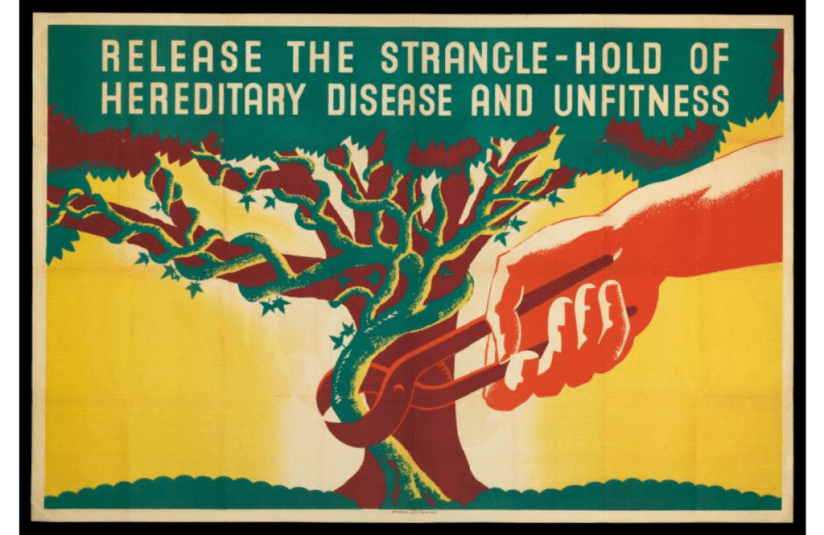
A poster published by the Eugenics Society-Galton Institute in the 1930S, from the Wellcome Library
Several top governance positions at the former British Eugenics Society, now the Galton Institute, include individuals who originally worked at The Wellcome Trust, including the Galton Institute’s president Turi King. Dr. Elena Bochukova, a current Galton Council Member and Galton lecturer, previously worked under the direction of Adrian Hill at the Wellcome Trust Center for Human Genetics. The Galton Institute’s Senior Genetics Researcher, Dr. Jess Buxton, was previously a ‘genetics researcher’ at the Wellcome Trust and then went on to carry out independent research financed by Wellcome. Her research, which is particularly race oriented, includes creating the first genetic sequence map of a native Nigerian. Moreover, Adrian Hill himself spoke at the Eugenics Society-Galton Institute at the celebration of their 100th anniversary in 2008.
The Galton Institute publishes what they now call the Galton Review, previously titled the Eugenics Review, where various members of the self-proclaimed “learned society” publish papers focused on population issues, genetics, evolutionary biology, and fertility.
A look at early issues of the Eugenics Review shines a light on Galton’s original ambitions. In the 1955 issue titled “The Immigration of Colored People,” an author asks, “What will become of our national character, good workmanship etc. in the course of a few decades if this immigration of negroes and negroids continues unchecked?” The article ends with an appeal to readers to write their parliamentary representatives and urge them that in view of “racial betterment or deterioration” something must be done urgently to “check the present influx of africans and other negroids.”
Today, it appears that the Galton Institute continues to see the immigration of racial minorities into European cities as an unchecked threat. Mike Coleman, an Oxford professor of demographics and a fellow at the institute runs an anti-immigration organization and advocacy group called MigrationWatch—whose mission is to preserve the European culture of the UK by lobbying the government to stem legal immigration and publishing data that supposedly demonstrates the biological and cultural threat of increasing immigration.
A 1961 issue of the Eugenics Review titled “The Impending Crisis” claims the function of the institute’s upcoming conference is “to honor Margaret Sanger” and describes the population crisis as “quantity threatening quality.”
Sanger, known as the “pioneer of the American birth control movement,” was a staunch advocate for promoting “racial betterment” and the key architect of the Negro Project, which she claimed “was established for the benefit of the colored people.” But as medical ethics fellow at Harvard Medical School, Harriet Washington, argues in her book Medical Apartheid, “The Negro Project sought to find the best way to reduce the black population by promoting eugenic principals.” Sanger was an American member of the British Eugenics Society.
Another early member of the Galton Institute was John Harvey Kellogg, prominent business man and eugenicist. Kellogg founded the Race Betterment Foundation and argued that immigrants and nonwhites would damage the American gene pool. Yet another example is Charles Davenport, a scientist known for his collaborative research efforts with eugenicists in Nazi Germany and his contributions to Nazi Germany’s brutal racial policies, who was vice president of the Galton Institute in 1931.
Another more recent member of the Galton Institute was David Weatherall, for whom the Weatherall Institute of Molecular Medicine at Oxford is named. Weatherall was a member of the Galton Institute when it was still named the Eugenics Society and he remained a member until his death in 2018. Weatherall, who was knighted by the British monarch in 1987 for his contributions to science, addressed the Galton Institute on numerous occasions and gave a senior lecture on genetics at the institute in 2014, of which no transcript or video is available. As an Oxford professor, Weatherall was Adrian Hill’s doctoral adviser and eventually his boss when Hill began working at the Weatherall Institute conducting immunogenic research in Africa. A key fixture of the Weatherall Institute of Molecular Medicine since its founding is Walter Bodmer, a former president of the Galton Institute.
While the Galton Institute has attempted to distance itself from its past of promoting racial eugenics with surface-level public relations efforts, it has not stopped family members of the infamous racist from achieving leadership positions at the institute. Emeritus professor of molecular genetics at the Galton Institute and one of its officers is none other than David. J Galton, whose work includes Eugenics: The Future of Human Life in the 21st Century. David Galton has written that the Human Genome Mapping Project, originally dreamt up by Galton’s former president Walter Bodmer, had “enormously increased . . . the scope for eugenics . . . because of the development of a very powerful technology for the manipulation of DNA.”
This new “wider definition of eugenics,” Galton has said, “would cover methods of regulating population numbers as well as improving genome quality by selective artificial insemination by donor, gene therapy or gene manipulation of germ-line cells.” In expanding on this new definition, Galton is neutral as to “whether some methods should be made compulsory by the state, or left entirely to the personal choice of the individual.”
Who gets the safest vaccines?
Considering the degree to which the players and institutions behind the Oxford-AstraZeneca vaccine (including the lead developer) are tied and connected to institutions that have been instrumental in the rise and perpetuation of racial eugenics, it’s concerning that this particular vaccine is being portrayed by scientists and media alike as the COVID-19 vaccine for the poor and the Global South.
The Oxford-AstraZeneca vaccine sells at a fraction of the cost of its COVID-19 vaccine competitors—running between 3 and 5 dollars per dose. Moderna and Pfizer cost 25 to 37 dollars and 20 dollars per dose, respectively. As CNN recently reported, the Oxford-AstraZeneca vaccine will “be far easier to transport and distribute in developing countries than its rivals,” several of which require complicated and costly cold supply chains. When the Thomson Reuters Foundation asked several experts which COVID-19 vaccine could “reach the poorest soonest,” all declared a preference for the Oxford-AstraZeneca candidate.
There is also the added fact that a host of safety issues have come to surround the vaccine. Recently, on November 21, a forty-year-old participant in AstraZeneca’s clinical trial who lives in India sent a legal notice to the Serum Institute of India alleging that the vaccine caused him to develop acute neuroencephalopathy, or brain damage. In the notice, the participant said he “must be compensated, in the least, for all the sufferings that he and his family have undergone and are likely to undergo in the future.”
In response, the Serum Institute claimed the participant’s medical complications are unrelated to the vaccine trial and said it would take “legal action” against the brain-damaged participant for maligning the company’s reputation, seeking damages in excess of $13 million. “This is the first time I have ever heard of a sponsor threatening a trial participant,” Amar Jesani, editor of the Indian Journal of Medical Ethics, said of the incident. The Serum Institute has received at least $18.6 million from the Bill & Melinda Gates Foundation and has a deal with AstraZeneca to manufacture a billion doses of the vaccine.
Other manufacturers chosen by Oxford-AstraZeneca to produce their vaccine are also no strangers to controversy. For instance, their manufacturing partner in China, Shenzhen Kangtai Biological Products, has been at the center of controversy for years, especially after 17 infants died from its Hepatitis B vaccine in 2013. The New York Times cited Yanzhong Huang, a senior fellow for global health at the Council on Foreign Relations, as saying: “Imagine if a similar scandal is reported again in China… It’s not just going to undermine the confidence of the company manufacturing the vaccine, it’s also going to hurt the reputation of AstraZeneca itself and their vaccine, too.”
In another example, the manufacturing partner chosen to produce the vaccine in the US is the scandal-ridden company with ties to the 2001 anthrax attacks, Emergent Biosolutions. Emergent Biosolutions, previously known as BioPort, has a long track record of knowingly selling and marketing products that were never tested for safety and efficacy, including its anthrax vaccine BioThrax and its biodefense product Trobigard. The current head of quality control for Emergent Biosolutions’ lead manufacturing facility in the US has no expertise in pharmaceutical manufacturing and is instead a former high-ranking military intelligence official who operated in Iraq, Afghanistan and beyond.
The issues raised by their decision to partner with manufacturers with dark histories of product safety issues are compounded by the adverse reactions reported in the Oxford-AstraZeneca trials as well as the ways in which those trials have been conducted. In September, AstraZeneca was forced to pause its experimental COVID-19 vaccine trial after a woman in the UK developed a “suspected serious reaction” that the New York Times reported was consistent with transverse myelitis. TM is a neurological disorder characterized by inflammation of the spinal cord, a major element of the central nervous system. It often results in weakness of the limbs, problems emptying the bladder, and paralysis. Patients can become severely disabled, and there is currently no effective cure.
Concern over an association between TM and vaccines is well established. A review of published case studies in 2009 documented thirty-seven cases of TM associated with various vaccines, including hepatitis B, measles-mumps-rubella, diphtheria, pertussis, tetanus, among others in infants, children, and adults. The researchers in Israel noted, “The associations of different vaccines with a single autoimmune phenomenon allude to the idea that a common denominator of these vaccines, such as an adjuvant, might trigger this syndrome.” Even the New York Times article on the AstraZeneca trial pause notes past “speculation” that vaccines might be able to trigger TM.
In July, an Oxford-AstraZeneca trial participant developed symptoms of TM, and the vaccine trial was paused at that time. An “independent panel” ultimately concluded the illness was unrelated to the vaccine, and the trial continued. Yet, as Nikolai Petrovsky from Flinders University told the Australian Broadcasting Corporation, these panels are typically made up of “biostatisticians and also medical representatives from the sponsor drug company running the trial.” Then, in October, a trial participant in Brazil died, though in that case, AstraZeneca suggested that the person was part of the control group and thus hadn’t received the COVID-19 vaccine.
According to Forbes, the AstraZeneca vaccine was ineffective at stopping the spread of coronavirus in their animal trials. All six monkeys injected with AstraZeneca’s COVID-19 vaccine became infected with the disease after being inoculated. All the monkeys were put to death, which means that it will remain unknown whether those monkeys would have suffered other adverse effects.
Another concern is that trial administrators gave the trial control group (for both human and animal trials) Pfizer’s Nimenrix, a meningitis vaccine, as opposed to a saline solution, which is regarded as the gold standard for controls because researchers can be sure the saline solution won’t cause any adverse reactions. Using Pfizer’s meningitis vaccine as the control placebo allows AstraZeneca to downplay any adverse reactions in its COVID-19 vaccine group by showing that the control group suffered adverse reactions as well. “The meningitis vaccine in the AstraZeneca trial is what I would call a ‘fauxcebo,’ a fake control whose real purpose is to disguise or hide injury in the vaccine group,” said Mary Holland, general counsel at Children’s Health Defense.
Eugenics under another name
Despite these safety concerns and clinical trial scandals, close to 160 countries have purchased the Oxford-AstraZeneca vaccine, and now reports are suggesting that India, the country with the second largest population on Earth, is likely to approve this vaccine by next week.
As documented here, while the vaccine may be heralded as “vital for lower-income countries,” the Oxford-AstraZeneca project is no mere philanthropic pursuit. Not only is there a significant profit motive behind the vaccine, but its lead researcher’s connection to the British Eugenics Society adds another level of warranted scrutiny.
For those encountering stories of eugenicists, it’s common to dismiss such activity as that of “conspiracy theories.” However, it’s undeniable that several prominent individuals and institutions that remain active today have clear ties to eugenicist thinking, which was not so taboo just a few decades ago. Unfortunately, this holds true for the individuals and institutions associated with the Oxford-AstraZeneca COVID vaccine, who, as demonstrated in this article, immerse themselves in studies of race science and population control – primarily in Africa while working closely with institutions that have direct and longstanding links to the worst of the Eugenics movement.
As this series has shown, there are many concerns regarding the points where race and the COVID-19 vaccination campaign in the US and abroad intersect, both publicly and privately. Part I of this series raised questions about the policy-shaping role of the Johns Hopkins Center for Health Security, which suggested that the US government make COVID-19 vaccines available to ethnic minorities and the mentally challenged first. Part II explained how in order to allocate COVID-19 vaccines in the US, health agencies are using a program created by Palantir, a company with a record of helping the US agencies target ethnic minorities through immigration policy and racist policing.
Furthermore, there are plans in place to exercise what could reasonably be described as economic coercion to pressure people to “voluntarily” get vaccinated. Such coercion will be obviously be more effective on poor and working communities, meaning communities of color will be disproportionately affected as well.
Considering these facts, and the case for scrutinizing the safety of Oxford-AstraZeneca’s “affordable” vaccine option made above, any harm caused by vaccine allocation policy in the US and beyond is likely to disproportionately affect poor communities, especially communities of color.
As such, the public should take all vaccine rollout policy with a grain of salt, even when they come cloaked in language of inclusion, racial justice, and public health preservation. As the co-founder of the American Eugenics Society (later renamed “Society for the Study of Social Biology”) Frederick Osborn put it in 1968, “Eugenic goals are most likely to be attained under a name other than eugenics.”
Utopia, Coming to a World Near You

Utopia 2013 (Kudos; Channel 4) — Created by Denis Kelly; Produced by Rebekah Wray-Rogers
By Patrick Corbett | OffGuardian | December 21, 2020
We’ve been told by the promoters of the pandemic, Klaus Schwab, Bill Gates, and others that it’s ushering in an opportunity for a Great Reset and that Covid 19 is the doorway to it.
Independent reporters like Cory Morningstar and Whitney Web have told a similar story without the glossy optimism.
The WEF has been running ads showing attractive young people having a great time and saying…
It’s 2030, I don’t own anything and I’ve never been happier.
They don’t go into just who will own everything but as they haven’t proposed eliminating capitalism it isn’t hard to guess.
According to the consortium of capitalists and their organizations such as the World Economic Forum, World Bank and even the UN we have a technocratic revolution led by AI, robotics and nanotechnology to look forward to. There will be a huge reduction in the need for workers. Scenarios are proposed which anticipate some form of UBI for the unfortunate masses.
From that majority position it looks like a very gray dystopian future. And maybe that’s what they want the people who are wise to the Covid deception to be thinking as the worst case scenario. Because there’s something far more sinister embedded within the Great Reset. And that is depopulation.
And by depopulation I mean on a grand scale; perhaps taking the planet’s roster of humans down to around a billion.
When I previously thought of this idea, the image that came to mind was of an horrific blood spattered massacre not unlike a scene from The Walking Dead. Now I don’t think they plan actual physical mayhem, although god knows they don’t shy away from that sort of thing .
I suspect they’ve come up with something diabolically clever and, as often is the case, it’s hiding in plain sight.
Are they planning on using their mandatory vaccines they’ve hyped so relentlessly to vaccinate virtually the entire world’s population? And will the vaccine be programmed to sterilize 60% or more of the women in the world? At this point I think most people would have to sit with that for a while, if not outright snort their coffee out their nose.
And I am not a lone nut in considering this or contemplating the possibility. Dr. Mike Yeadon and Dr. Wolfgang Wodarg both warn that the Pfizer vaccine will likely impair our ability to procreate.
The vaccine* contains a spike protein… called syncytin-1, vital for the formation of human placenta in women. If the vaccine works so that we form an immune response AGAINST the spike protein, we are also training the female body to attack syncytin-1, which could lead to infertility in women of an unspecified duration.
* This link no longer takes you to the above quote as WordPress has since suspended Health and Money News for violation of “Terms of Service.”
Dr. Mike Yeadon and Dr. Wolfgang Wodarg are not some fringe medics with pet theories forged in fevered imaginations.
Dr. Yeadon was former Head of Research and vice-president at Pfizer and Dr. Wodarg is an MD, PhD, epidemiologist, lung specialist and former Chairman of the Health Committee of the Council of Europe.
Professor Sir John Bell, top UK Covid advisor and member of SAGE, startled his interviewer when he said:
these vaccines are unlikely to completely sterilize a population… say 60-70%.
Of course they wouldn’t include their own billionaire class. They, along with the Royals, seem to be extremely fertile as well as long lived. And they would need a cohort of people to serve them, both in high level positions and low. Below them (in economic class) are their political operatives, presidents on down, professionals, scientists, and the few specialized workers they still need.
And vaccines being used for birth control is not a new idea. They have been studied for some time for their efficacy towards that goal.
Here’s a worrisome quote from an August 1994 article in the FASEB Journal (Federation of American Societies for Experimental Biology), (“highly cited and consistently ranks among the top biology journals” ):
The authors conclude that their “findings provide insights to possible endocrinological effects of an hCG 3CTP-based WHO promoted birth control vaccine on which a phase I clinical trial has already been completed” and that “might not reliably fulfil major expectations with respect to safety and efficacy?’ We submit that the authors provided only a repetition of old information and biased speculation, which could be damaging to progress in this field.
The article is defending the WHO against claims of some researchers about the safety of their birth control vaccine 26 years ago.
Just imagine how neat that is for their plans. While they have the majority of people terrified they vaccinate them. Then, as easily as they ramped up their Potemkin pandemic, they wind it down. People, the great mass anyway, are kept perpetually on the back foot by bizarre policy shifts always in the interest of biosafety, of course. The sterilization plan takes some time for people to catch on. When it becomes apparent there are far fewer children being born they will have a plan to explain it. It was the Cvd; it was something.
It was at this point in writing this I became aware of a streaming television series (late to the game I was here). UTOPIA. Great title, rhymes with Dystopia.
Spoiler alert: I am going to reveal plot lines and incidents in what I consider an extremely well done dramatic series. Whether it was created with a purpose or was just a product of the zeitgeist, I don’t know. It could easily be classified as “predictive.”
It was initially a 2 season series 2013/14 in the UK followed in 2018 by an American version produced by Amazon and released this past September on Amazon Prime (more below).
The plot of both is the same in its essence. A thumbnail off the top of my head: A plucky band of misfits who share an obsession with a graphic novel entitled Utopia discover that a sequel has been produced and they set out to find it. But it seems some very deep state type forces also want it and will maim, kill and steal to get it.

Utopia 2020 (Endemol Shine North America, Kudos, Trallume Productions, Picrow, Amazon Studios; Prime Video) Created by Gillian Flynn; Produced by Huey M. Park
The novel was apparently the work of a somewhat unhinged genius who saw the world as far too populous and wanted to do something about it. The resulting dramas were (imo) very well done, compelling, fast paced frightening with obligatory plot twists and denouements. It was first shown on Channel 4 in the UK. The plot in broad strokes was that a frightening flu pandemic — the Russian flu — is let loose on the world resulting in widespread panic. (Starting to sound familiar?)
In the Amazon version: A mysterious “Mr. Rabbit” (billionaire?) has let loose a deadly pandemic which kills children with a case fatality rate Dr. Fauci would envy. And the billionaire owner of a pharmaceutical company (played by John Cusak) has a vaccine which offers a cure. Pretty soon the population is marching in the streets demanding to get the vaccine. Our ragtag gang of heroes deduces that the vaccine is meant to kill and maim people. That is until the character played by John Cusack tells them that the beauty of the vaccine is that it is not designed to kill, only to sterilize people.
He says (paraphrasing) “Imagine a world of only a billion people. Plenty to go around for everybody and they’ll be free to screw up as much as they want without destroying the planet.”
He is not a ranter like Hitler or even Klaus Schwab, he’s more like, well … Bill Gates. Only John Cusack doesn’t quite reach the level of creepy that Gates is able to convey.
In the UK version there is an oblique reference to the Georgia Guidestones at one point where one of the characters says that the optimal population of the world is 500 million, roughly 7% of what it is now. And another character says that they didn’t need to have a deadly pandemic, only one that people believed was one, to frighten them into taking a vaccine.
In 2014 HBO planned an American version of Utopia but dropped it over budget concerns. Amazon picked it up in 2018 and the American version starring John Cusak was released just months ago, September 2020. The American version keeps the same basic plot and in the beginning is almost identical to it’s British sire. It does diverge somewhere past the mid-point although the core of the plot remains.
Amazon Prime has now cancelled the series although the first season is still online as apparently is the UK version seasons 1 and 2.
Some of the press are saying it was cancelled because it…
failed to connect with an audience.
That is pure bullshit. It was a hit.
The very liberal online magazine, SLATE, vehemently argues that Utopia should never have been shown so they must be at least happy that it was cancelled. I would wager from their point of view far too many people already saw it. SLATE : said:
the results [ of broadcasting Utopia] are catastrophic —
Really? Are we not capable of discerning fiction and reality and if fiction is reality don’t we need to know that too?
This is what SLATE has to say is the problem with showing Utopia (my emphasis, bold and italics):
We are in the middle of an actual pandemic, a staggering number of Americans sincerely believe that that pandemic is a politically motivated hoax, and an equally staggering number believed vaccines were harmful years before COVID-19 emerged. It’s not the filmmakers’ fault we’re in this mess; it’s not their fault so much of the public is superstitious and gullible; and it won’t be their fault if Utopia gives some dumbass the confidence they need to quit wearing a mask and infect and kill you or the people you care about.
It will probably not be a revelation to you that SLATE is totally on board with the Covid narrative and thinks we who aren’t are dumbasses, superstitious, gullible and, without masks, loaded guns ready to kill people.
But even with the hyperbole above SLATE isn’t finished, they have to bring President Trump in via the back door, ie. QAnon (bold emphasis mine):
Even if everyone who sees Utopia is capable of distinguishing fact from fantasy — and that’s vanishingly unlikely in a nation that is sending QAnon followers to Congress — it’s impossible to enjoy a story where the heroes convince themselves that shadowy forces have manufactured a phony pandemic to trick people into taking a dangerous vaccine when those exact beliefs are helping to kill hundreds of thousands of Americans.
Although it’s interesting to speculate, I don’t think it’s vitally important to know the intention of a drama that, sans the action movie veneer, is playing out in real time as we speak.
Leaving fiction aside for the time being, I am one of those “staggering numbers” who believe the novel coronavirus pandemic to be a gross exaggeration and was deployed as a controlled demolition of our lives as we have been living them.
So the question is do they plan a Great Reset of the current population (to 1804’s 1 billion) as well as all of their modern 4th Industrial Revolution wet dreams?
I’m seriously contemplating the prospect that, just as portrayed in Utopia, the vaccine they are clearly desperate for us to take — or else why would they need to force us — will not actually kill people. Or at least that will not be its principal target. It will be to sterilize us.
If that is the case it is genocide on a scale never seen before. Cusak in his role presents it as a benign solution to the intractability of overpopulation. But family is the beating heart of most of our lives. To rob people of the chance to create their own families is to take everything. It will make zombies of the people left.
But, of course, the people left will be too weak and demoralized to do much of anything. They may be offered distractions to live out their years, which will no doubt be shortened by those very same vaccines and the withholding of healthcare. But throughout there will be very little actual state killing. Just the drip drip turning into a tide of unborn children until their Utopia arrives: the world cleansed of the useless eaters. Billionaires can then enjoy their Neverland Ranch of a planet without those unwashed crowds of homo sapiens stinking the place up.
Do I think this is what they’re planning? I don’t know for sure but it’s my primary suspicion. It all fits once you can get your mind around the immense evil of it. They have never had much use for us. Railroad magnate Jay Gould famously said, “I can hire half the working class to kill the other half.”
His musing bespeaks a horrific fantasy of elimination.
We, the working class, were at best only to be tolerated for what use we could be to them. Now that we’re no longer that, it’s sayonara.
There’s one thing that puzzles me greatly though and that’s the role of China and Russia. The Great Reset seems to be run out of Klaus Schwab’s Fuhrer Bunker at the WEF and we can be certain that the globalist billionaire class, aka the ruling class Americans, Europeans and that gang of suckhole countries, the rest of The Five Eyes, are all on board.
Russia and China both seem to be getting along without the need of population reduction. And why would they mind if the West crashes their population? It would actually seem to be a benefit to them, unless the West is planning to be the Sparta of the future. And conversely wouldn’t the prospect of depopulation of their people just seem like an attempt to dupe them? I mean why would Russia and China go along with it when it would probably be seen as an attempt by the West to weaken them?
However I have a sneaking feeling that the Great Reset gang missed something somewhere that is going to backfire on them. I honestly have no idea except that when they destroy what it means to be human in the way that we are and they aren’t, they will have destroyed their own humanity and the result will be a painful implosion of their own selfhood. But maybe that’s just wishful thinking. And if they get that far there won’t be anything left of us either.
Imagine the dinosaurs lived for hundreds of millions of years. We know that because in our great hubris we studied them learning more than we know about ourselves. In comparison our time here will have been a very brief but spectacular strut across the stage.
Patrick Corbett is a retired writer, producer, director and editor who’s worked for every major network in Canada and the US except for Fox. His journalistic credits include Dateline NBC, CTV’s W-5 and the CTV documentary unit where he wrote and directed ‘Children’s Hospital’, the first Canadian production to be nominated for an International Emmy. You can follow Patrick on Twitter.
Featured Video

NEW FAUCI EMAILS EXPOSE ATTACK ON NATURAL IMMUNITY
or go to
Aletho News Archives – Video-Images
From the Archives
Fourteen Incredible Facts About 9/11
By Kevin Ryan | Dig Within | August 8, 2015
… What is known about 9/11 is that there are many incredible facts that continue to be ignored by the government and the mainstream media. Here are fourteen.
- An outline of what was to become the 9/11 Commission Report was produced before the investigation began. The outline was kept secret from the Commission’s staff and appears to have determined the outcome of the investigation.
- The 9/11 Commission claimed sixty-three (63) times in its Report that it could find “no evidence” related to important aspects of the crimes.
- One person, Shayna Steiger, issued 12 visas to the alleged hijackers in Saudi Arabia. Steiger issued some of the visas without interviewing the applicants and fought with another employee at the embassy who tried to prevent her lax approach.
Blog Roll
Recent Comments
seversonebcfb985d9 on Villains of Judea: Philip Esfo… loongtip on Report warns that ‘Jewish terr… Craig Nelms on New study shows that toxic gas… loongtip on A Funny Thing Happened on the… loongtip on EU free trade pact on hold as… John Edward Kendrick on Regime Change In Iran Is The F… Bill Francis on Australia Passes New Hate Spee… seversonebcfb985d9 on Australia Passes New Hate Spee… Bill Francis on Britain’s AI Policing Plan Tur… loongtip on Miami Beach Resident Questione… loongtip on Israeli agricultural export co… loongtip on The War On Free Speech In Aust…


 Aletho News
- Ireland Moves to Legalize Spyware Use by Police
- NEW FAUCI EMAILS EXPOSE ATTACK ON NATURAL IMMUNITY
- Why is the US using Jordan as the main base in possible Iran attack?
- American Academy of Pediatrics Hit With Federal RICO Lawsuit for Vaccine Safety Fraud
- Mom Tells Trump: Dumping Sewage Sludge on Farmland Won’t Make America Healthy Again
- NIAID Funds Gain-of-Function Study Engineering Novel Influenza Viruses
- Villains of Judea: Philip Esformes and the Largest Healthcare Fraud in American History
- US sanctions Popular Conference for Palestinians Abroad over alleged Hamas links
- You reap what you sow: Ukraine’s blackout is Zelensky’s failure
- Ukraine Blackouts Caused by Zelensky’s Terrorist Attacks on Russia
- If Americans Knew
- Oppose Israel’s Abuses While You Still Can
- UNRWA Heads Tell Ha’aretz: ‘We Don’t Radicalize Palestinians – Their Lived Existence Does’
- Plans Call for “New Rafah” Built in Israel’s Image — Without Palestinians
- Posing as priest, reporter is spat at many times, highlighting anti-Christian sentiment in Israel
- Leaked Documents: “Planned Community” in Rafah Would Force Palestinians Into Israeli Panopticon
- ‘Permits of Humiliation’: How Israel Strangles Christian Education in Jerusalem
- “The world sees death, destruction and injustice – and they see dollar signs” – Not a ceasefire Day 105
- War criminal Netanyahu kills 11 in Gaza, joins Board of Peace – Not a ceasefire Day 104
- Another baby dies of cold in Gaza, as Rafah crossing remains locked down – Not a ceasefire Day 103
- Brutal Beatings, Arson, and Impunity: A Palestinian Plant Nursery Becomes a Target for Settler Pogroms
- No Tricks Zone
- New Study: Sea Levels Rose 20 Times The Modern Rate During The Roman Warm Period
- As German Gas Storage Dips Dangerously Low…Shortage Hardly Avoidable
- New Study: Brazil’s Relative Sea Level Was 2+ Meters Higher And SSTs 3-4°C Warmer 6000 Years Ago
- Philosopher Schopenhauer: Climate Science Certainty Stems From Stupidity, Ignorance
- New Study: Species Extinction Rates Declining Since 1980 – ‘Climate Change Is Not An Important Threat’
- Denmark Places Climate Protection Above Animal Welfare, Poisoning And Culling Cows
- New Study: Greenland Was 3-7°C Warmer And Far Less Glaciated Than Today 6000-8000 Years Ago
- German Media Report That Current Frigid Weather Can Be Explained By Arctic Warming!
- Berlin Blackout Shows Germany’s $5 Trillion Green Scheme Is “Left-Green Ideological Pipe Dream”
- Modeling Error In Estimating How Clouds Affect Climate Is 8700% Larger Than Alleged CO2 Forcing
 Aletho News