Homeless Man Owes Government Over $110,000 In Fines For Being Homeless
By John Vibes | TrueActivist | March 4, 2016
The recent case of a homeless man racking up massive fines has exposed the widespread police practice of fining homeless people for being homeless.
Émilie Guimond-Bélanger, a social worker at the Droits Devant legal clinic in Montreal spoke to the media about a case that she worked on where a homeless man racked up over $110,000 in tickets.
“It was shocking. We’ve never seen someone with so many tickets,” Émilie told CBC.
The man had over 500 tickets, which amounted to over $110,000 in fines. The fines were mostly for things that homeless people can’t control, such as sleeping in the subway or asking people for money.
“He had received around 500 of them [tickets]. I could see that most of the time he would receive many in the same week, sometimes by the same officers as well,” she said.
“It’s very common, to a point where I would say it’s a systematic experience for homeless people,” she added.
On a daily basis, Émilie deals with at least two cases where people owe at least $10,000 for the crime of being homeless.
According to a study published in 2012, the homeless population of Montreal owe over $15 million in fines.
“It’s a huge amount of money that would stress out anyone who has that as a burden. So you can just imagine how it’s difficult for a person to then think about rehabilitation in society when they have such a heavy debt,” she said, “it affects them a lot. Some of them feel like there are good citizens in society — and then there’s them,” Émilie said.
It was recently reported that politicians in Los Angeles are seeking to ban homeless people from sleeping in their cars, and even RV’s.
As we reported late last year, Florida police arrested a group of charity workers for breaking a newly-imposed law against feeding the homeless. Among those charged was a 90-year-old homeless advocate.
Clinton Politics Made Simple
By Craig Murray | March 2, 2016
Oxfam recently published that 62 people own as much as half the population of the entire world. The entire pitch of the Clinton campaign is that this is absolutely fine, provided half of them are black and the appropriate proportions from ethnic minorities.
Identity politics have become well and truly established as the antidote to demands for social progress and for an end to the massive growth in wealth inequality. This is essentially an American development, although the idea that the purpose of feminism is for Emma Watson to get $12 million a film has caught on with at least some British people, and is the whole basis of the political stance of the modern all-American Guardian.
Hillary summed up the psychological trick of the faux egalitarianism in a simple sentence:
“If we broke up the big banks tomorrow … will that end racism? Will that end sexism? Will that end discrimination against the LGBT community?”
It is brilliant rhetoric, a masterpiece of sophistry. Of course breaking up the banks will not directly end these other evils. But neither would ending those things end the appalling level of wealth inequality. It comes directly back to my opening question of whether multi-billionaires are OK as long as they are appropriately representative of black, female and LGBT.
The truth of the matter is that almost everybody who campaigns against wealth inequality is also strongly against racial, gender, religious and sexual inequality. But many of those who focus on identity politics not only have no concern for general equality, but are primarily concerned with the ability of themselves and those like them to propel themselves into the ranks of the elite.
During Obama’s Presidency Wealth Inequality has Increased and Poverty Levels are Higher
By Rick Baum | CounterPunch | February 26, 2016
Troubling and significant statistics produced by the government indicate important facts about our political system and its priorities. Unfortunately, these statistics often get little coverage in the media. What coverage is provided usually only focuses on the current year and might include comparison with the previous year.
Two such sets of government statistics cover wealth distribution and poverty. These statistics have a margin of error and do not account for the up and down fluctuations in the economy nor changing historical conditions or limitations of what any president can do.
What is perhaps most critical are the trends. These trends show that wealth has become more concentrated and more people are deemed by the government to be poor.
Wealth Inequality
Below are government figures that show the trend of growing wealth inequality.1
Share of Total Net Worth by Percentile of Wealth Owners, 1989-2013

These figures show that during the presidencies of Bush Sr., Clinton, G. W. Bush, and Obama so far, a greater portion of the nation’s wealth has become more concentrated in the hands of the rich as indicated by the share of wealth held by the top 1%. From 1989 to 2010, it increased from 30.1% to 34.5% and, under another methodology, to 36.6% in 2013.
From 1989 to 2013, the share of the top 10% went from 67.2% to 75.2% or from slightly over 2/3 to more than 3/4 of the nations’ total wealth. This means that from 1989 to 2013, the drop in the share of wealth held by the bottom 90% went from 32.9%, almost a third, to 24.8%, less than one-fourth.
Even more striking is that from 1995 to 2013, the poorest half of the population, after experiencing its share of the nation’s wealth peaking in 1995 at 3.6%, underwent a more than 2/3 decline in their portion. It fell in 2013 to a paltry 1.05% of all wealth.
Despite the last few years of “recovery,” the share of wealth held by the bottom 50% of the U.S. population declined from 1.15% in 2010 to 1.05% in 2013. This is less than half of where it stood in 2007, before the great recession, when the share of the country’s wealth held by the poorest 50% of the population was at 2.5%.
In 2008, Obama spoke of hope for a better future. If the wealthy hoped for a greater share of the nation’s wealth, their hope was fulfilled while the wealth conditions of most everyone else have declined.
These changes in wealth holdings were clearly described by Federal Reserve Board head Janet Yellen who began a speech on October 17, 2014 noting:
“The distribution of income and wealth in the United States has been widening more or less steadily for several decades… This trend paused during the Great Recession because of larger wealth losses for those at the top of the distribution and because increased safety-net spending helped offset some income losses for those below the top. But widening inequality resumed in the recovery…” (emphasis added). 2
This widening inequality and greater concentration at the top was presumably more pronounced after 2013 when the value of the stock market rose with the Dow Jones Industrial Average reaching its peak at over $18,300 in May of 2015. Today, wealth inequality is probably back to where it was in 2013 since the stock market has recently gone down to 2013 levels.
Poverty
While wealth inequality has increased, the number of people living in poverty has also generally increased. Below are figures from 1981 to 2014 for the number of people deemed to be poor and their percentage of the population.3 This percentage has been 15% or higher for three years of Obama’s presidency, from 2010-2012. It had reached that level only three other times since 1981.

These numbers show that the rate of poverty since 1981 was lowest in 2000 at 11.3%. During the time George W. Bush was president, with exceptions, it steadily increased from 11.7% in 2001 to 13.2% in 2008. 5 As might be expected, the rate increased during the great recession peaking at 15.1% in 2010.
As of 2014, some six years after the beginning of the recession and during a period of “recovery,” the rate of poverty remains high at 14.8%. In fact, according to these government statistics, the rate of poverty for every year Obama has been president is higher than it was for every year during George W. Bush’s presidency.
The percent of people below 125% of the official poverty rate has also been higher every year under Obama than during Bush’s presidency, and has been over 19% every year from 2010 through 2014. The highest level it reached under Bush was during the start of the recession in 2008 when it was at 17.9%.
What is most disturbing is the percent of the population living in extreme poverty, or having an income at 50% or lower than the poverty level.5 Every year that Obama has been president, the percent of the population at that level of income has been over 6% and, as of 2014, consisted of over 20 million people. When George W. Bush was president, the percent was always under 6%. The last time it was over 6% was during the first year of the Clinton presidency. 6
Even the record during Reagan’s presidency may be viewed as more favorable than Obama’s. During the time Reagan was president, the official rate of poverty peaked at 15.2% in 1983. Thereafter, it gradually declined to 13.0% in 1988.7 By contrast, the rate of poverty during Obama’s time in office has always been more than 14.3% and was 14.8% in 2014, or almost 2% higher than it was at the end of Reagan’s presidency.
A quip that was made about Reagan is that he liked poor people so much that he acted to increase their numbers. During his first three years, the poverty rate and the number of people deemed to be impoverished increased, reaching its peak in 1983. Thereafter, from 1983 to the end of Reagan’s presidency in 1988, the number of people deemed to be poor declined by over 3.5 million ending at slightly below the total during the first year of his presidency.
In contrast to the record of Reagan’s presidency, during the time Obama has been president and statistics are available, 2009-2014, the population has grown by 11.98 million. This is close to its growth for the last six years of Reagan’s presidency. Yet, the number of people deemed to be living in poverty has not declined, but has increased by more than 3 million. For comparison, see this table extrapolated from previous figures:

If, in 2008, one hoped for the presence of more poor people and for a greater concentration of wealth in the hands of the rich, so far, during Obama’s presidency, these hopes have been fulfilled. They will presumably continue were a Republican elected president. Should one also expect more of the same from Hillary Clinton who wants to build “on the progress the president has made,” or Bernie Sanders who thinks Obama “has done an excellent job?”8
Footnotes
1. Wealth is the value of what one possesses minus what is owed. Unlike income, it is not subject to a yearly tax. It is also distributed more unequally than income. See the last tables in the links at the end of this footnote.
see page 4 in An Analysis of the Distribution of Wealth Across Households at https://www.fas.org/sgp/crs/misc/RL33433.pdf and
For 2013, a figure for the top 1% is not provided. See the next two sites.
http://www.federalreserve.gov/pubs/bulletin/2014/articles/scf/accessible.htm#box3figA
another table with historical trends: see Figure 3 at: It is source for bottom 50% figure of 1.15% in 2010 and 1.05% in 2013. http://www.federalreserve.gov/newsevents/speech/95BF8144CFB24C649FAEF51B056738B9.htm
The source for the 2013 figures for the top 1% and the 90-98.9% whose figures from 1989-2010 are slightly different are in Table A1C on page 34 at: http://www.federalreserve.gov/econresdata/feds/2015/files/2015058pap.pdf
According to one study, as of 2012, the top .01% of the population or about 16,070 families whose average wealth is about $371 million, possess 11.2% of all wealth and the top .1% possess about 22% of all of the country’s wealth. See table 1 at the end of the paper after references at: http://gabriel-zucman.eu/files/SaezZucman2016QJE.pdf
Figure 1 in the same location shows the share of wealth holdings of the top .1% from 1913-2012. It was below 10% in 1989 which means it more than doubled during the subsequent years.
For income inequality see https://www.census.gov/library/publications/2015/demo/p60-252.html tables:
Income Distribution Measures Using Money Income and Equivalence Adjusted Income: 2013 and 2014 [PDF – 46k] and
Selected Measures of Household Income Dispersion: 1967 to 2014 [PDF – 402k]
2. http://www.federalreserve.gov/newsevents/speech/yellen20141017a.htm
3. https://www.census.gov/library/publications/2015/demo/p60-252.html see table under Poverty title
Impact on Poverty of Alternative Resource Measure by Age: 1981 to 2014
Those with income at 125% of poverty rate see https://www.census.gov/hhes/www/poverty/data/historical/people.html
Table 6. People Below 125 Percent of Poverty Level and the Near Poor
Those with income at 50% of poverty rate see
Table 22. Number of People Below 50 Percent of Poverty Level
Noteworthy about poverty in the U.S. is that in 2014, 21.1% or 15.5 million children under 18 years of age were deemed impoverished by the government, and some 6.8 million of them lived at one-half the official poverty rate. The rate of poverty among Blacks (26.2%) and those who are “Hispanic any race” (23.6%) is much higher than that of the general population. See https://www.census.gov/library/publications/2015/demo/p60-252.html see tables under Poverty title
People and Families in Poverty by Selected Characteristics: 2013 and 2014 and People With Income Below Specified Ratios of Their Poverty Thresholds by Selected Characteristics
4. see https://www.census.gov/hhes/www/poverty/data/historical/people.html
Table 1. Weighted Average Poverty Thresholds for Families of Specified Sizes
5. During the Clinton administration, the rate of poverty and the number of people deemed to be poor remained high as both steadily declined.
During the Clinton years and continuing thereafter, wealth became more concentrated at the top in part due to the dot-com boom and from policies enacted including NAFTA, the repeal of
Glass Steagell and reduced taxes on some forms of investment income.
6. A single person with a level of income at 50% of the poverty threshold lives on less than $17/day. A couple would be having to get by on less than $22/day.
7. The rate and number of people living in poverty increased during all four years of the presidency of Bush Sr.
8. Clinton quote: see http://www.msnbc.com/rachel-maddow-show/hillary-clinton-i-want-build-obama-era-progress
Sanders quote at: http://www.nytimes.com/2016/02/05/us/politics/democratic-debate.html?hp&action=click&pgtype=Homepage&clickSource=story-heading&module=first-column-region®ion=top-news&WT.nav=top-news
Rick Baum teaches Political Science at City College of San Francisco.
The Real Terrorists: The .01%
By Paul Buchheit | Common Dreams | January 11, 2016
They consist of 16,000 individuals, about the size of a crowd at a professional basketball game. The inequality horror they’ve fomented is reaching far beyond the half of America that is in or near poverty, for it now impacts those of us well above the median, those of us in the second highest of four wealth quartiles.
1. The .01% Have as Much Wealth as 80% of America
The combined net worth of the 16,000 richest Americans is approximately the same as the total wealth of 256,000,000 people. Details for this statistic and other facts to follow are at You Deserve Facts.
2. Americans with up to a Quarter-Million Dollars are Part of the Nearly 80% of Americans with Less Wealth Than the .01%
The 80% includes all Americans with a net worth up to about $277,000.
3. The .01% Own about as Much as 75% of the Entire World
The world’s poorest 75% own roughly 4 percent of total global wealth, approximately the same percentage of wealth owned by the .01% in the United States. Again, calculations are shown here.
4. The .01% – Who Are They?
It starts with the billionaires, the Forbes 400 and 136 more, for a total of 536 individuals with a total net worth of $2.6 trillion at the end of 2015.
It continues with more Ultra High Net Worth Individuals (UHNWIs). These loftily-named people, over 15,000 of them, are worth hundreds of millions of dollars apiece, bringing the total .01% wealth to about $6.2 trillion, based on 2013-14 data. But U.S. wealth has grown by about 30 percent in three years, and the Forbes 400 has grown by 38 percent, and thus the total wealth of the .01% has grown to over $9 trillion.
In contrast, a recent Institute for Policy Studies report calculated that the bottom half of America has about $732 billion in total wealth, and further calculations on the same data show that the bottom 75% of America owned about $6.2 trillion in 2013.
5. The Unique Brand of .01% Terror: Making a Game of Tax Avoidance While 2,500,000 Children Experience Homelessness
Wealth ownership is not contemptible if the owners of that wealth accept their responsibility to the society that makes their great fortunes possible. But instead of paying taxes, the wealthiest Americans have formed an “income defense industry” to shelter their riches, with, according to the New York Times, “a high-priced phalanx of lawyers, estate planners, lobbyists and anti-tax activists who exploit and defend a dizzying array of tax maneuvers, virtually none of them available to taxpayers of more modest means.”
On the corporate end, over half of U.S. corporate foreign profits are now being held in tax havens, double the share of just twenty years ago. Yet for some of our largest corporations, according to the Wall Street Journal, over 75 percent of the cash owned by their foreign subsidiaries remains in U.S. banks, “held in U.S. dollars or parked in U.S. government and corporate securities.” Thus they get the benefit of our national security while they eagerly avoid taxes.
The .01% go about their self-serving tax avoidance while 2.5 million children experience homelessness every year. The corporations of the .01% hoard hundreds of billions overseas while nearly two-thirds of American families don’t have enough money to replace a broken furnace.
This is real terror, facing life without shelter and warmth and sustenance, without a semblance of security for even one day in the future. It is terror caused in good part by the 16,000 people who don’t feel it’s necessary to pay for the benefits heaped upon them by a perversely unequal society.
Paul Buchheit is the editor and main author of “American Wars: Illusions and Realities” (Clarity Press). He can be reached at paul@UsAgainstGreed.org.
Are ankle bracelets really an alternative to incarceration, or just another kind of prison?
PrivacySOS | January 4, 2015
Everyone is talking about how to end mass incarceration: the right, the left, presidential candidates, Black Lives Matter activists. But what comes after a prison-centric society? Some, including business interests that would profit from such a shift, think GPS bracelets are a sound alternative to locking people in physical cages. But is electronic monitoring really so different from prison?
Not according to the Center for Media Justice and James Kilgore, respectively publisher and author of a 2015 report: “Electronic Monitoring is Not the Answer: Critical Reflections on a Flawed Alternative.”
Kilgore told the Daily Beast that while wearing an ankle bracelet is better than being in prison, we shouldn’t look to GPS monitoring to solve the problems in our criminal punishment system. “You can be sent back to prison for getting back to your house five minutes late when the bus breaks down,” Kilgore said, naming just one of many strict release conditions that can make ankle bracelets seem like electronic recidivism devices.
Putting people on electronic leashes instead of in jails or prisons is problematic for many reasons. Electronic monitoring shifts the burden of paying for incarceration onto the individual and the family, away from the state. The conditions imposed on people wearing bracelets are often so strict that people soon go back to prison for violations that have nothing to do with whether someone is a danger to the community—or they never leave their homes because they are terrified of committing such a violation, even accidentally. Bracelets act as a sort of scarlet letter, signifying to people in the community that the wearer may not be a trustworthy employee or neighbor.
And because the terms and conditions of electronic monitoring punishments can be so severe, sentencing people to wear ankle bracelets in place of serving prison sentences may actually increase the number of people in prison. That’s because, for example, a judge may sentence someone to electronic monitoring that later, because of impossibly strict conditions, leads to incarceration, when community service would have been a viable alternative sentence in the first place.
Electronic monitoring also produces huge quantities of sensitive information about people required to wear the devices everywhere they go, and the market that governs the technology companies is nearly entirely unregulated. As the Intercept reported in late 2015, companies that profit off of the prison industrial complex are historically not the best at securing sensitive information about the incarcerated people who are required to use their services. We should not trust that the huge quantities of sensitive information generated about people subjected to state control will remain secure or won’t be abused.
Thinking of ankle bracelets or other electronic monitoring as “alternatives” to prison is dangerous because these methods are cheaper than caging people, meaning the government could very easily place many more people under these systems of control without feeling the fiscal pinch.
So what should we do?
Instead of creating virtual prisons, we must rethink our entire justice system—including what constitutes a crime, and whether we want to enact vengeance or seek rehabilitation for people who commit crimes. Ending the drug war is a great start. We can and must also end mandatory minimums, radically restructure our sentencing guidelines, and take a hard look at our criminal statutes.
Ultimately, we must decrease the number of people under carceral control in the United States. If that’s the goal, electronic surveillance schemes aren’t only false alternatives—they may very well create an entirely new problem that will grind on for decades until the country finally wakes up to realize its mistake. By that point, because GPS bracelets are so much cheaper for the state than prisons, we may all be wearing them.
Star-Crossed Lovers’ Tale Banned from Israeli Schools
What follows is a partial list of American politicians who have parroted the line about the US and Israel sharing the same “values”:
Obama (“The bond between Israel and the United States is rooted in more than our shared national interests; it’s rooted in the shared values and shared stories of our people.”)
Joe Biden [speaking of former Israeli Prime Minister Ehud Barak] (“There is a standup guy. Standing up for his country, putting his life on the line for his country and continuing to defend the values that we all share.”)
Lindsey Graham (“I’m honored to be in your country yet again. And what brings me here so many times, is common and shared values and common and shared enemies.”)
Marco Rubio (“The security of our ally, the strongest and most enduring democracy in the region, Israel, with whom we are bound by the strongest ties of mutual interest and shared values and affection would improve as well.”)
Hilary Clinton (Our countries and our peoples are bound together by our shared values…”)
Jeb Bush (“US-Israel alliance is founded not merely on shared interests, but shared values. I’ll rebuild this vital friendship. “)
Nita Lowey (“The U.S.-Israel relationship is based on shared values and an unbreakable bond, not on personalities.”)
Paul Ryan (“Our shared democratic values and national interests are supported by maintaining a close friendship with Israel.”)
Ted Cruz (“I look forward to working to strengthen the already incredibly strong alliance between the United States and Israel. In my view the United States should stand unshakably alongside the Nation of Israel. I thank you personally, I thank your nation for its leadership for democratic values in a very dangerous region of the world, also for your leadership protecting the security of the nation and ultimately of the United States as well.”
Rand Paul (“With our shared history and common values, the American and Israeli people have formed a bond that unites us across the many thousands of miles between our countries and calls us to work together towards peace and prosperity for our countries.”)
Chuck Grassley (“The proliferation of weapons of mass destruction by rogue regimes, state-sponsored terrorism, and the spread of Islamic radicalism place the entire Middle East – and the values of Israel and the United States – at risk.”)
Dan Coats (“Israel and the United States enjoy a long and prosperous friendship that transcends politics and is cemented by our shared history, values, strategic interests, culture and religious heritage.”)
Steny Hoyer (“This bill reflects the immutable and enduring bond between our two nations. It is a bond that reflects the shared values of our people and our shared interests in preserving stability in the Middle East.”)
Elizabeth Warren (“For generations, the United States and Israel have shared a commitment to a stable, secure, and peaceful Middle East. But our alliance runs far deeper: it is a natural partnership resting on our mutual commitment to democracy and freedom and on our shared values. Both our countries have been sustained by our commitment to liberty, pluralism, and the rule of law. These values transcend time, and they are the basis of our unbreakable bond.”)
Chris Coons (“While too often the debate about this agreement in Washington has struck a sharply partisan political tone, the conversation here in Delaware while passionate remained thoughtful, and anchored in our shared values.”)
Barbara Boxer (“Since 1948, United States Presidents and both houses of Congress, on a bipartisan basis and supported by the American people, have repeatedly reaffirmed the special bond between the United States and Israel, based on shared values and shared interests.”) [as stated in S. Res. 2165 introduced by Boxer in 2012]
Tom Cotton (“At root, regardless of one’s religion, Israel is a liberal constitutional democracy that respects individual freedom, and that has a market-based economy. Those are deeply shared values that the United States has encoded in our national DNA .”) [Whoa! Not only shared values, but shared DNA!!!]
Nancy Pelosi (“The unbreakable bonds between the United States and Israel are rooted in our shared values, our common ideals and mutual interests.”)
Richard Blumenthal (“Israel is not only an ally of strategic necessity, but a partner with deeply-held commitments to America’s own foundational values of democracy, rule of law, individual liberty, religious freedom, and the pursuit of international peace.”)
Joe Kennedy (“There has been no greater champion for our shared values and defender of our shared interests.”) [speaking of former Israeli President Shimon Peres]
Trent Franks (“President Shimon Peres has embodied a commitment to the mutual values shared by the United States and Israel — values that include the preservation of life, faith, family, and freedom.”)
Robert Menendez (“And I look forward to doing even more to strengthen our commitment to Israel, to shared democratic values — no matter what may bloom from the shifting sands of the Arab Spring.”)
79 House Members (“This is why we urge you to persevere in reaffirming that the two-state solution is still achievable and that it, and the joint U.S.-Israel commitment to shared democratic values and to Israel as a Jewish and democratic state, remains fundamental to U.S. policy.”) [from letter sent to President Obama in March, 2015, and signed by the following 79 House members: Nadler, Aguilar, Bass, Bera, Beyer, Blumenauer, Bonamici, Bordallo, Brady, Capps, Capuano, Cartwright, Cicilline, Katherine Clark, Yvette Clarke, Clyburn, Cohen, Connolly, Conyers, Courtney, DeFazio, DelBene, DeSaulnier, Doggett, Doyle, Edwards, Ellison, Eshoo, Farr, Fattah, Al Green, Grijalva, Gutierrez, Honda, Huffman, Jeffries, Eddie Bernice Johnson, Hank Johnson, Kaptur, Kind, Kuster, Larson, Lawrence, Barbara Lee, Sheila Jackson Lee, Lewis, Loebsack, Lowenthal, Sean Patrick Maloney, Matsui, McDermott, McGovern, McNerney, Moore, Norton, Payne, Scott Peters, Pingree, Plaskett, Pocan, Polis, Price, Rangel, Rush, Tim Ryan, Serrano, Schakowsky, Robert Scott, Slaughter, Adam Smith, Speier, Takano, Tonko, Tsongas, Van Hollen, Velazquez, Watson Coleman, Welch and Yarmuth ]
***
By Richard Edmondson | Fig Trees and Vineyards | January 2, 2016
I couldn’t help starting this post off with the above list. Obama’s quote about the “shared values and shared stories of our people” is probably particularly ironic.
Recently it was reported that the Israeli Ministry of Education has taken a dim view of a novel telling the story of a romance between an Israeli woman and a Palestinian man. The book has been banned from being taught in public schools in the Jewish state, this despite the fact that it had been recommended by education professionals for course curriculum study.
“Marrying a non-Jew is not what the education system is educating about,” said Dalia Fenig, an official with the Israeli Education Ministry, explaining her department’s decision to exclude the book.
The work in question is entitled Borderlife, and tells the story of Liat, a young Israeli woman from Tel Aviv, and Hilmi, a Palestinian from Ramallah. The two meet not in Occupied Palestine, but in New York–where they fall in love.
“The two heroes spend a winter overseas and manage to get to know each other in great detail, something that could not happen on the disputed land,” the author, Dorit Rabinyan, is quoted in an article by The Guardian. “Perhaps their ability to surmount the obstacles of the Middle East conflict is what threatens the education ministry.”
The author may have a point about the “threatening” nature of the book.
“In this potential Middle Eastern ‘Romeo and Juliet,’ the Juliet figure, Liat, doesn’t tell her family about her relationship: She knows it would be pointless,” says Haaretz, in a description of the book published in 2014.
Fenig expressed concern that the book might “cause controversy” and could potentially exacerbate the violence currently sweeping the country, and clearly she does seem to feel that the nation is threatened at the moment–by “assimilation,” as she puts it, among other things.
“The story is based on a romantic motif of a forbidden/secret and impossible love,” Fenig said. “Adolescent youth tend to romanticize and don’t have, in many cases, the systematic point of view that includes considerations about preserving the identity of the nation and the significance of assimilation.”
Apparently the novel does indeed threaten Israeli sensibilities on the issue of assimilation–something that is in fact discussed by the author in her 2014 interview with Haaretz :
Liat is a true ‘soldier’ of Israeli education. She is obedient, practical and in full control of herself. And because of what she is, because of her fear of abandoning herself to this relationship, this is less a love story than a long journey of resistance to love. At one point she relates that at certain moments she and Hilmi are so close and intimate that she can almost know what it is to be him, to feel what it is to be him. Liat’s conflict lies in the dissolution of the boundaries between ‘I’ and ‘not I,’ on the seam between merging with the other and being assimilated into him. It’s precisely there that the alarms of anxiety go off within her, just when things become sweetest.
In other words the fear of assimilation plagues the young Israeli woman in the story–even though she finds herself falling in love. It is a powerful statement on the extent to which Jewish tribalism and separateness are ingrained into Israeli society. Rabinyan adds:
Fear of mixing and intermingling is part of our mind-set. Fear of assimilation, with its danger of loss of selfhood, of Jewish identity, has accompanied us throughout our history and in all our exiles: Here is where the ghetto ends, and outside is the world. I would have expected that, as a political entity, that ancient obsession would also be expressed in a need to demarcate a clear border between us and our neighbors – but no, the symbiosis is only intensifying.
The head of the Israeli Education Ministry is Naftali Bennett, of the Jewish Home Party. According to the New York Times, Bennett was not involved in the decision to ax the book from study by Israeli students, but has gone on record as saying he supports it. Bennett also reportedly complained in an interview on Israeli TV that the novel portrays Israeli soldiers as “sadistic.”
“Should I force Israeli children to read this? Is this a top priority?” Bennett asked.
He also said his office “is not the culture ministry and people can read outside whatever they like, but we need to prioritize.”
What exactly Bennett’s top priorities are is something left out of the article, but apparently tempering racism in Israeli society is not one of them.
***
No Shiksas!

Contact your senators and congressional representatives and tell them that apartheid is not an American value.
End racist Jewish supremacism!
Boycott Israel!
Free Palestine!
Reply to ‘Hillary Committed No Criminal Act’
By Peter Van Buren | We Meant Well | August 19, 2015
Many supporters of Hillary Clinton say that since she committed no criminal offense, the whole thing about her private email server containing classified material is just partisan sniping.
So as a public service, let’s see if we can sort that out.
The Law
18 USC 1924, which is a law, is titled “Unauthorized removal and retention of classified documents or material.”
The text of the law says, inter alia, “Whoever, being an officer… of the United States, and, by virtue of his office, employment, position, or contract, becomes possessed of documents or materials containing classified information of the United States, knowingly removes such documents or materials without authority and with the intent to retain such documents or materials at an unauthorized location shall be fined under this title or imprisoned for not more than one year, or both.”
The law does not require the possessing person to “know” the information is classified.
This is the statute under which David Petraeus was prosecuted for keeping classified information at home.
The Classified
Two Inspectors General stated Clinton’s email server, located part of the time at her home in New York, and part of the time at a commercial server farm in Colorado, held classified data. Neither site was an authorized location. We’ve long-since established that classified is classified whether it is marked or not. It does not matter who sent the emails; they were on Hillary’s server and thumb drives, making her the “possessor.”
Up to 305 Clinton emails might have classified data, and that out of only five percent of 30,000 messages reviewed. There may be backups available of the 30,000 some messages Clinton deleted.
The Conclusion
Clinton’s possession of classified information on a personal server appears to be a violation of 18 USC 1924. So is transferring that information to the thumb drives held by her lawyer (himself unauthorized to possess high-level classified information.)
There it is. No partisan remarks. No right-wing attacks. Just facts. As a non-lawyer, what am I missing?
Europe’s Forgotten History: From Human Zoos to Human Trophies Displayed in Museums Today
By Garikai Chengu | CounterPunch | August 17, 2015
Global outrage was sparked when the Zimbabwean lion, Cecil was killed as a trophy; but to this day, Britain and America continue to display in museums human remains that are human trophies of their massacres and subjugation of indigenous populations.
Britain has recently revealed that it is currently negotiating with Zimbabwe over the repatriation of human remains, belonging to fighters from Zimbabwe’s struggle against British colonisers, currently displayed in the Natural History Museum of London.
On Tuesday, Zimbabwean president, Robert Mugabe, said in a speech that the Zimbabwean liberation war fighters, “whose heads were decapitated by the colonial occupying force, were then dispatched to England, to signify British victory over, and subjugation of, the local population.”
That Thursday night, the British Foreign Office confirmed that “remains of Zimbabwean origin” were on display in a museum in London.
President Mugabe also remarked that, “surely, keeping decapitated heads as war trophies, in this day and age, in a national history museum, must rank among the highest forms of racist moral decadence, sadism and human insensitivity.”
Prior to European and American colonialism, the first museums were founded in Africa and played an essential role in many African civilisations. In fact, museums have been a part of human history for more than 2,000 years.
The tradition of collecting and displaying intriguing items began in Black Ancient Egypt. Most rising Western cultures from the Roman Empire onwards then displayed exotic animals and flora in their museums. The word “museum” comes from the Greek mouseion, meaning “temple built for the muses and museums”, which were originally designed to promote art, science and ingenuity. After the European Dark Ages, the next step in the evolution of museums occurred as a result of the ingenuity of the Black African Moors who conquered and civilized parts of Europe. The study of the natural world was once again encouraged by the Black Moors establishing “curiosity cabinets” across Europe after a millennium of Western ignorance.
Prior to the 19th century, museums tended to be small and private, open only to the aristocracy of a given nation. During the 19th century, the modern museum as we know it began to take shape. With plunder streaming in from all corners of the British Empire, the modern museum was born.

The British Museum, London.
The British Museum was created largely as a repository for artifacts looted from Africa between the 17th and 19th centuries. Such plunder includes many artifacts from Ancient Egypt which prove that the Ancient Egyptians, who established the first museum, were themselves dark-skinned Afroancestrals.
Across the world, one of the consequences of British colonialism was the violent appropriation of cultural artifacts, sacred and precious objects; and one of the legacies is their ongoing display in British museums. For centuries, the museums of Great Britain have served to bolster national white pride and glorify British imperial culture, by displaying a wide array of artifacts looted and plundered during European slavery and colonialism.
One example of the rather grim history of colonial racial terrorism is the long European history of human zoos, which featured Africans and conquered indigenous peoples, displayed in the same way as animals. Men, women and children would be kidnapped, locked up in cages and exhibited in front of European large audiences. Many people died after short stints in captivity and they lived in tortuous conditions. Visitors to the human zoos would often poke the African children with sticks, throw food at them and audiences were permitted to subject the captives to various degrading acts for a fee.
The primitive practice of putting indigenous people on display began during the modern period when explorers like Columbus and Vespucci lured natives back to Europe to be flaunted and paraded like trophies.
In the late 1800’s, Europe had been filled with human zoos in cities like Paris, Hamburg, Antwerp, Barcelona, Warsaw, Milan, and London. Thirty-four million people visited the 1931 World Fair for human zoos in Paris. New York was not morally exempt from such racist and degrading practices. New York City saw these popular exhibits continue into the twentieth century, even after the ends of both World Wars. Millions of Americans attended these spectacles.
Prior to the Second World War, human Zoos in America were at their height and the New York Times reported at the time, “few expressed audible objection to the sight of a human being in a cage. The crowd loved it… It is absurd to make moan over the imagined humiliation and degradation that they suffer.” At a time when America and Britain accepted human zoos as perfectly normal, Adolf Hitler was the one to ban them.
By creating the first mass contact between Whites and Blacks, and by promoting the spectacularization of “The Other”, human zoos were a key factor in the progressive shift in the West from scientific to popular racism.
The primitive European and American practice of exhibiting Africans in zoos continued well into the 1950s. During the 1960s, the baton of state-sanctioned racism towards Africans was passed from Europe’s human zoos into its museums. In fact, historically, museums in Britain have held some of the most reprehensible images of Blacks as barbarians and savages, and the most degrading images of Black women.
A 20 year-old South African woman known as Sarah Baartman would be emblematic of the dark era that gave rise to the popularity of human zoos. She was taken by an exotic animal-dealer to London in 1810. Sarah had a genetic characteristic known as steatopygia; large buttocks and elongated labia. Thousands of British men, women and children would come to human zoos to gawk at her naked body. Sarah’s days were punctuated by rape and scientific examinations. In 1815, Sarah died in abject poverty and her skeleton, sexual organs and brain were put on display at the Museum of Mankind in Paris where they remained for almost a century until 1974. In 2002, President Nelson Mandela formally requested the repatriation of her remains.
If you add up the attendance for every English Premier league football, rugby, basketball and cricket game in Britain this year, the combined total will come to about 30 million people. That’s a big number, but 49 million people will visit British museums this year. Museums are important sites for contestation over grand narratives of history, especially nationalist and imperial history. For more people to see the British state openly flaunting stolen loot in a museum this year than those who will watch sport, shows that cultural imperialism and true primitive racial attitudes are deeply entrenched in British statehood.
During the “Great Scramble” for control over the continent in the late 19th century, art counted among the highest prizes of imperialist plunder. Britain still unashamedly displays thousands of stolen African artifacts worth hundreds of billions of pounds in the British Museum, Liverpool Museum and elsewhere. Many other invaluable stolen artifacts from Africa, Asia and South America are in private British hands. Notably the Benin bronzes, ivories and other ancient works looted by British colonialists, especially during the reprisal attacks launched by the Queen’s soldiers against natives trying to resist imperialism in 1897.
The British Museum has long presented an array of African objects throughout its rooms, and its new African Galleries are second to none. Its ancient Egyptian collection is stunning. And they should be: while African collections in Germany, France and Belgium hold several important pieces, no other nation could match the British when it came to plundering so many art objects of a conquered people over so long a time period.
The British Museum, controls a quarter of a million artifacts from Africa alone, and maintains that looting those artifacts “was legal at the time.” As ever when the West perpetrates a crime against other people, they have a perversely fantastic way of asserting that their actions are completely bona fide, entitled and legal. Arthur Torrington OBE of the British Museums and Libraries Archives Council candidly admits that museums do not “want to accept the objects were stolen because if they do it for one, they’ll have to do it for all.”
The modern British museum may literally have been built on the backs of oppressed indigenous populations and its rooms filled with plundered goods from Europe’s colonial conquests; but in this day and age, the ongoing display of stolen loot and human trophies is unjustifiable in a modern, civilized society.
Garikai Chengu is a scholar at Harvard University. Contact him on garikai.chengu@gmail.com.
The Soft Power Hoax
By Mike Lofgren | Consortium News | August 2, 2015
A recurrent buzz phrase of the Washington mandarinate in the last two decades has been “soft power.” The term was coined by Joseph Nye, a Harvard academic, in his 1990 book, Bound to Lead: The Changing Nature of American Power. What he meant by the term is that “when one country gets other countries to want what it wants [it] might be called co-optive or soft power in contrast with the hard or command power of ordering others to do what it wants.”
Soft power he defined as the putatively attractive political, social and cultural traits of a country that induce admiration in a target people, and, presumably, a desire both to emulate those traits and to willingly comply with the wishes of the country projecting the soft power.
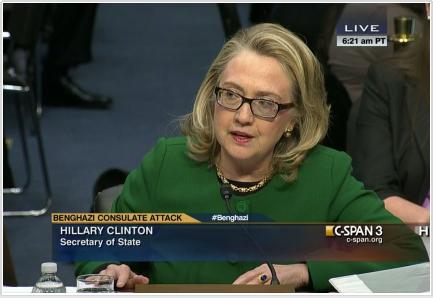
Secretary of State Hillary Clinton testifies before Congress about the fatal attack on the U.S. mission in Benghazi, Libya. (Photo from C-SPAN coverage)
The term has gotten a workout by American politicians and national security bureaucrats, particularly since the manifest failure of military power to make Iraqis love us. Former Secretary of Defense Robert Gates has used the term, saying he would like to augment U.S. soft power by “a dramatic increase in spending on the civilian instruments of national security – diplomacy, strategic communications, foreign assistance, civic action and economic reconstruction and development.”
As might be expected, the idea is most loved by State Department officials, principally because they believe it could give them a leg up in the Washington budget battles with their colossal rival, DOD, the repository of “hard” power. A Google search of “Hillary Clinton smart power” gets about 3.7 million hits. Smart power is the former Secretary of State’s pet term for a fusion of hard and soft power. John Kerry is also fond of the concept.
It is easy to see why the national security establishment, casting about for some alternative to the usual bluster leading to military action, would be drawn to the magical notion that our presumed cultural attractiveness, combined with a really cool Twitter feed, could advance American interests (as the Beltway elite defines them) throughout the world.
Democrats, in particular, looking for some substitute to the brain-dead neoconservative policies that some of them were briefly enamored of when President George W. Bush was Stockholm Syndroming them, are magnetically pulled to a concept that sounds like the first cousin to the dorm room philosophizing that so many of their kind indulged in during their formative years in the Ivy League.
“If we just explain our policies to them in the right way in a Facebook post, and maybe open an Apple Store in downtown Chișinău, ordinary Moldovans will be clamoring to join NATO!”
It is surely preferable to think in this manner than to act like a warmongering troglodyte, even if some soft power ploys, like John Kerry bringing James “You’ve Got a Friend” Taylor to Paris to console them after a terrorist attack, seem frivolous if not embarrassing – one can hardly picture Charles Francis Adams or George Kennan doing likewise.
Yet soft power, while less pernicious, still springs from the same roots as neoconservative militarism. It arises from the near-universal belief among the Beltway illuminati in American Exceptionalism, the fairy tale that the United States dwells outside the normal processes of history and has a duty as a global redeemer. It is what H.L. Mencken would have classified as “the bilge of American idealism,” and it ranks right up there with intelligent design and a conviction that real estate will always go up among the foolish things Americans have believed in.
Was the invasion of Iraq and the whole Bush-era nightmare really the polar opposite of what the soft power advocates wanted? With the fall of Baghdad, a military campaign that took only a month, the whole soft power apparatus swung into action: passing out soccer balls to children, rebuilding the municipal sewer system, and opening a Baghdad stock market on the assumption that the benighted Iraqi masses were pining for the fruits of American-style capitalism.
In 2015, vastly more Iraqis speak English than in 2003. The Department of State and the U.S. Agency for International Development spent $50 billion in the country. Yet has all that money and all the cultural export of Americana accomplished anything? And could we not draw the identical conclusion about Afghanistan?
The whole soft power hallucination was born of the end of the Cold War in a particularly hubristic moment of American triumphalism. It was at that time that Francis Fukuyama wrote his extraordinarily silly discourse prophesying the end of history and the ushering in of a capitalist-consumerist utopia – a kind of upside-down Marxist dialectic.
That is the fallacy at the heart of soft power: the belief that consumer goods, or some latent yearning for a Disney-fied lifestyle, or some technological gimmick like Snapchat, will liberate the foreign masses yearning to breathe free.
In the 1990s, one could see the apotheosis of this mentality in the pontifications of The New York Times’ Thomas Friedman, who claimed that no two countries that had McDonald’s franchises would go to war with each other – a thesis that has proven false several times. But one can see why Corporate America might love the idea of soft power as a way of selling Philadelphia cheese steaks in Burundi. They might even get an Export-Import Bank loan to facilitate peddling their wares because of the alleged diplomatic value.
We have seen the fruits of this delusion in the Middle East. Saddam’s Iraq, a secular if tyrannical government, at least allowed unveiled women to attend university and beer to be served in outdoor cafes. Tariq Aziz, Saddam’s longtime foreign minister, was a Chaldean Catholic. Iraq is now a far more dogmatically Muslim country than it was 15 years ago.
The same could apply to most of the Middle East: blue jeans, smartphones, and contact with Westerners did not make most Middle Eastern peoples more Western psychologically, it did just the opposite. The botched Washington reaction to the so-called Arab spring was a case in point: mesmerized by the fact that the Tahrir Square demonstrators used social media, Foggy Bottom could not quite grasp that the popular democracy demanded by the Cairo throng may have had little in common with the vision of democracy of Kennedy School of Government professors.
The fact that Saudi princes drive Bugatti Veyrons, own flats in Mayfair, and get their cholesterol checked at the Cleveland Clinic, does not stay them from lopping off the heads of those they deem miscreants or sorcerers at a record rate.
It is precisely the money grubbing, pop-culture aspect of American soft power that has made it such a hard sell in the Middle East. Sayyid Qutb, a leading figure in the Muslim Brotherhood in early post-World War II Egypt, attended university in Colorado, where he was repelled by what he saw as the rampant materialism and superficiality of American life. He went back to Egypt determined to reverse the growing Westernization of his country. So much for the Kumbaya effect of cultural exchange.
It is common for educated, progressive Americans to be appalled by the increasing intolerance of Muslim societies and their treatment of women, and to declare that these are broken, dysfunctional societies. There may be some validity in that judgment. But they ought to reflect that the antics of the Kardashians, Duck Dynasty, and the World Wrestling Federation, not even to mention the candidacy of Donald Trump, do not exactly broadcast to the world the image of America as the Last, Best Hope of Mankind.
We should have known that dressing up the outer man in Gap clothing does not change the inner man. One of the most profoundly exotic societies in the Nineteenth Century, from a Western point of view, was Japan.
Yet in an amazingly short time, the Japanese adopted the outward, physical trappings of a Western society. Their naval personnel donned U.S. Navy-style uniforms and their officers grew addicted to playing bridge as if they were barnacle-encrusted old English seadogs at the Admiralty. Their diplomats strutted around in wing collars, frock coats, and top hats like any respectable gentleman at the Court of Saint James. They adopted the superficial accoutrements of parliamentary rule. The Japanese industrialized rapidly. Babe Ruth turned them into baseball fans.
Yet Japan simultaneously became a violently aggressive country whose militarism astonished the world. Parallel with its outward “Westernization,” Japan’s elites confected a jingoistic Shinto emperor worship that was at once reactionary and yet new: an arresting analogue to the increasingly violent brands of Islam that have arisen in recent decades along with rising contact with the West. And these same Islamic fanatics, namely in ISIS, are now experts in social media, a talent that is giving the FBI director fits.
Soft power, the hula hoop craze of a segment of the national security establishment, is one more peculiar aspect of American parochialism and ethnocentrism, such as hewing to the English system of weights and measures, or the archaic use of a.m. and p.m. on airline schedules rather than the more rational 24-hour clock.
It is no substitute for traditional diplomacy that emphasizes horse-trading, reciprocity, and the fact that other countries just might, after all, have legitimate interests. A bucket of Kentucky Fried Chicken is no suitable door prize for peoples whose sense of cultural pride could very well be as strong as our own.
~
Mike Lofgren is a former congressional staff member who served on both the House and Senate budget committees. His book about Congress, The Party is Over: How Republicans Went Crazy, Democrats Became Useless, and the Middle Class Got Shafted, appeared in paperback on August 27, 2013. His new book, The Deep State: The Fall of the Constitution and the Rise of a Shadow Government, will be published in January 2016.
Revolting Acts in an Age of Crisis
By COLIN TODHUNTER | CounterPunch | June 25, 2015
In Britain, the welfare system is under sustained attack and rights are being stripped away. At the same time in ‘austerity Britain’, however, there’s always enough taxpayers’ money to pour into the black hole of imperialist wars and the pockets of the profiteers that live off them, courtesy of David Cameron’s government of millionaire ministers. Capitalism is moribund. It has reached its inevitable increasingly totalitarian dead end. In the 1980s, Britain outsourced much of its manufacturing to cheap labour economies in order to boost profits. To provide a further edge, trade unions and welfare were attacked. As wages stagnated or decreased in absolute terms and unemployment increased, the market for goods was under threat. The answer lay in lending people money and creating a debt ridden consumer society.
Of course, this resulted in new opportunities for investors in finance and all kinds of dubious financial products were created, sold to the public and packaged and shifted around the banking system. Toxic debt bubbles were created then burst and public money bailouts for billionaire bankers and austerity for the masses followed. It’s been the same story across much of the western world, managing capitalism’s crises for the last few decades in the manner of ever-decreasing circles.
The top 1,000 wealthiest people in Britain had an aggregate wealth of £333 billion ($500 billion) in 2009. The national debt was half that. In 2009, they increased their wealth by a third. It doesn’t take a genius to see how the debt could be addressed. But the government says there is no point in pretending that there is some magic wand that could be waved to make the whole country feel richer than it actually is.
And so massive cuts to welfare will continue and the wholly corrupt system instituted by the rich will continue under the lie of ‘democracy’. Rising food poverty will continue, while the five richest families in Britain are worth more than the poorest 20% and one third of the population lives in poverty. Almost 18 million people cannot afford adequate housing conditions, 12 million are too poor to engage in common social activities, one in three cannot afford to heat their homes adequately in winter and four million children and adults are not properly fed (see this). Welfare cuts have pushed hundreds of thousands below the poverty line since 2012, including more than 300,000 children.
If there ever was a time for revolution, surely it is now. While a heavily weakened labour and trade union movement is seeking to resist the austerity agenda and with many other groups in Britain protesting, the distinct impression is that an effective widespread revolt against capitalism itself remains a distant hope.
For a large section of the population, the ‘Wills and Kate’ royal reality show, retail therapy, bogus terror threats and blood-drenched imperialism under the lie of ‘our soldier heroes’ killing to ‘save life’ in far-away lands continue to distract and divert attention from the failing system itself.
Thanks to this, the revolution is on hold. Take a Sunday morning stroll through England’s green and pleasant land to appreciate this. Stale pools of last night’s beer-vomit clog the gutters. Sunday morning booze-soaked hangovers fuzz memories of the previous night’s deeds done and actions best forgotten. Every Saturday night is a full-fledged grim reality show on the streets of downtown Britain.
A million wannabe young women wishing they were not themselves, wishing they were Jenny Lopez or Victoria Beckham. From minimum wage beautician to footballer’s wife in an X-Factor instant. Vodka fuelled dreams in this, England’s not so green and pleasant land.
Save me from my life of low pay and even lower aspiration, Vicky. I wanna be like you, I wanna be you. Sex sells, but who’s buying? Some coked-up drug dealer might do but preferably David Beckham. I could be the next ‘Posh’, if I give you what you want, what you really, really want.
Glammed up, spiced up and sexed up, believing they have ‘x’ factor or whatever it takes to be free, free from the mundane, free from being ordinary in a fake fantasy culture of ‘girl power’, fame and celebrity.
But this is aspirant Britain. While tens of thousands recently took to the streets of London to participate in an ‘anti-austrity’ rally, at the same time comatose Britain sleeps to the sounds and visions of media-produced plastic role models and celebrity product endorsement and believes the media spoon-fed lie that austerity is necessary. For these people, it’s not about overthrowing the system, it’s about being made blind to it. It’s not about rejecting it, it’s about accepting it as normal. Who reads Karl Marx when Cosmo says empowerment lies in lipstick? Who needs Lenin when you can watch English Premier League multi-millionaire footballers whose only revolting duty is to endorse the very products that bind the fan to the lies and logos of a narcissistic, self-incarcerating consumerism?
Who wants revolution when you can turn on and tune in to self-styled messiah Simon Cowell, as he rules over his empire of franchised TV shows, celebrities and wannabes. Acquire immediate salvation from the mundane with Cowell – the giver, the creator, the destroyer – the ultimate godhead for those seeking to enter the promised land of fame and riches and acquire their unique place in the pantheon of celebritydom. For those not already doped out on spymaster-sanctioned heroin on Britain’s housing estates, this form of opiate will do just as fine.
It is a damning indictment of society, where people accept the faith that this is how life should be lived, as they pray before the never ending conveyor belt of disposable commodities and heroes to be fetishised, consumed then spat out when they pass their very short sell by dates. It’s the secular theology of the age, built on flotsam and jetsam products, celebrities and fads that ebb and flow with the vagaries of mass titillation and the machinations of corporate greed.
And do not expect Britain’s Labour Party to galvanise or organise the masses any time soon. As with the current Conservative regime, the Labour Party by and large promotes the corporate-backed lie that all of this is liberating. Yes, people are actually free! Free to be monitored and surveyed by the state like no other country in Western Europe, free to be cynically targeted by the market, free to pick up the tab for the failings of financial capital and free to build up the greatest amount of personal debt and misery in Europe.
‘Freedom’ within the confines of what increasingly resembles an open prison isn’t much to celebrate. The actual reality in Britain is economic meltdown and social crisis.
Harold Macmillan, the Tory Prime Minister in the 1950s, once told the Brits that they’d never had it so good due to rising post-war affluence. Maybe now it’s a case of they have never had it so bad as people drown in their Saturday night vomit with eyes wide shut.
Featured Video

NEW FAUCI EMAILS EXPOSE ATTACK ON NATURAL IMMUNITY
or go to
Aletho News Archives – Video-Images
From the Archives
Fourteen Incredible Facts About 9/11
By Kevin Ryan | Dig Within | August 8, 2015
… What is known about 9/11 is that there are many incredible facts that continue to be ignored by the government and the mainstream media. Here are fourteen.
- An outline of what was to become the 9/11 Commission Report was produced before the investigation began. The outline was kept secret from the Commission’s staff and appears to have determined the outcome of the investigation.
- The 9/11 Commission claimed sixty-three (63) times in its Report that it could find “no evidence” related to important aspects of the crimes.
- One person, Shayna Steiger, issued 12 visas to the alleged hijackers in Saudi Arabia. Steiger issued some of the visas without interviewing the applicants and fought with another employee at the embassy who tried to prevent her lax approach.
Blog Roll
Recent Comments
eddieb on Fourteen Incredible Facts Abou… Bill Francis on European leaders’ shift in the… seversonebcfb985d9 on Villains of Judea: Philip Esfo… loongtip on Report warns that ‘Jewish terr… Craig Nelms on New study shows that toxic gas… loongtip on A Funny Thing Happened on the… loongtip on EU free trade pact on hold as… John Edward Kendrick on Regime Change In Iran Is The F… Bill Francis on Australia Passes New Hate Spee… seversonebcfb985d9 on Australia Passes New Hate Spee… Bill Francis on Britain’s AI Policing Plan Tur… loongtip on Miami Beach Resident Questione…


 Aletho News
- Israel moves to restrict Palestinian re-entry to Gaza, ‘encourage outflow’: Report
- Trump aims to create new UN and own it, Brazil’s Lula warns
- UN rapporteur says Israeli demolition of UNRWA compound reflects broader attack on UN system
- From Proxy to Disposable: The US Betrayal of the Syrian Kurds
- Six injured in stabbing spree at Kurdish rally in Antwerp, victims stabbed ‘indiscriminately’
- US pledges to ‘starve’ Iraq of oil revenue if pro-Iran parties join new government
- Is China a threat to Greenland?
- South Korea’s Prime Minister Proposes US Send Special Envoy to North Korea — Report
- Pentagon downgrades China threat, shifts focus to homeland, hemisphere
- Ireland Moves to Legalize Spyware Use by Police
- If Americans Knew
- Another Gaza baby freezes to death on Netanyahu’s watch – Not a ceasefire Day 106
- Oppose Israel’s Abuses While You Still Can
- UNRWA Heads Tell Ha’aretz: ‘We Don’t Radicalize Palestinians – Their Lived Existence Does’
- Plans Call for “New Rafah” Built in Israel’s Image — Without Palestinians
- Posing as priest, reporter is spat at many times, highlighting anti-Christian sentiment in Israel
- Leaked Documents: “Planned Community” in Rafah Would Force Palestinians Into Israeli Panopticon
- ‘Permits of Humiliation’: How Israel Strangles Christian Education in Jerusalem
- “The world sees death, destruction and injustice – and they see dollar signs” – Not a ceasefire Day 105
- War criminal Netanyahu kills 11 in Gaza, joins Board of Peace – Not a ceasefire Day 104
- Another baby dies of cold in Gaza, as Rafah crossing remains locked down – Not a ceasefire Day 103
- No Tricks Zone
- Polar Colding…Antarctica Saw Its Coldest October In 44 Years!
- New Study: Sea Levels Rose 20 Times The Modern Rate During The Roman Warm Period
- As German Gas Storage Dips Dangerously Low…Shortage Hardly Avoidable
- New Study: Brazil’s Relative Sea Level Was 2+ Meters Higher And SSTs 3-4°C Warmer 6000 Years Ago
- Philosopher Schopenhauer: Climate Science Certainty Stems From Stupidity, Ignorance
- New Study: Species Extinction Rates Declining Since 1980 – ‘Climate Change Is Not An Important Threat’
- Denmark Places Climate Protection Above Animal Welfare, Poisoning And Culling Cows
- New Study: Greenland Was 3-7°C Warmer And Far Less Glaciated Than Today 6000-8000 Years Ago
- German Media Report That Current Frigid Weather Can Be Explained By Arctic Warming!
- Berlin Blackout Shows Germany’s $5 Trillion Green Scheme Is “Left-Green Ideological Pipe Dream”
 Aletho News