Trump’s Victory: Arrogance Defeated
By Jean Bricmont | CounterPunch | November 11, 2016
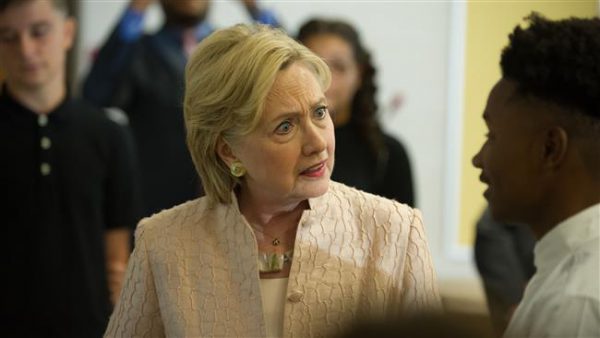
Hillary Clinton called half of Trump voters “a basket of deplorables”. In all the discussions I have had with American “liberals”, they explained to me that Trump supporters were mostly uneducated white men.
However, I am old enough to remember an era when the all the leftwing parties, socialist or communist, and even American Democrats, were based on the workers or the “working class” or the “common man”. Nobody thought to inquire whether they had university degrees or to investigate whether or not their opinions were politically correct on issues such as racism, sexism or homophobia.
What defined the workers as progressive subjects was their economically exploited condition and not some ideological orthodoxy or moral purity.
At the end of the 1970s a great change took place within leftwing parties. They were increasingly dominated by academics and their ideology changed radically from that of the classical left.
Far from aiming to establish some form of socialism, or merely of social justice, the left turned into the champion of the fight for equal opportunity, against discrimination and prejudice, and – with the rise of globalization – the opening of markets.
The more or less mythical hero of the left was no longer the proletarian but the marginal, the migrant, the foreigner, the dissident, or the rebel – even if he happened to be a religious fanatic that no leftist intellectual would have anything to do with. One recalls how Jean-Jacques Rousseau made fun of those who pretend to love the Tartars in order to avoid loving their neighbors.
Little by little a new class alliance formed: the one percent as it is called, or more realistically the richest ten percent who benefit from globalization are allied with the middle class intelligentsia to sell us globalization in the name of “openness to others” and which flaunt the specter of racism or sexism to attract minorities and certain feminists (for although women are not a minority, certain feminist demands are similar to those of minorities).
But that alliance was extremely unnatural in socio-economic terms, because the main victims of globalization are the least qualified workers, often women or members of minorities.
The left’s pro-globalization bias led it astray step by step. First it gave up all effort at regulating the economy, satisfying itself with claiming to share the fruits of growth fairly by ensuring “equal opportunity”. But in the real world, inequalities grew far more than the economy.
They also imagined that international law could be abolished and that a certain “international community” – in practice the United States and its allies – would maintain world order by military means. Again, in the real world that only created chaos, refugees and resistance to that American order. In fact, in the long term, the American population itself came down with a strange disorder, “war fatigue”. Except for a minority of ideologues, hardly anyone in the United States wants to bear the costs of an empire (see the Boston Globe for a lucid analysis of those costs).
The protests of the victims of globalization had to be dealt with. The trick was to use the ideology of tolerance: any objection to globalization was labeled racism, xenophobia. Intellectuals took up the “fight against racism” with enthusiasm, with an eye to preserving their own privileged social position, sheltered from the economic storms of globalization.
In the United States, it was enough to stigmatize bad thoughts; in Europe, they were taken to court.
All that had to explode sooner or later, just as the Berlin Wall came down and the USSR collapsed, and for the same reasons: a self-satisfied but fairly incompetent elite, isolated from social realities, which claims to do what is best for the people without consulting them, and which finally doesn’t even deliver the promised benefits, ends up provoking rebellion against itself.
First the Brexit, then Trump. Whatever one may think of that individual, the worse the things said about him by American “liberals”, the more they expose the enormity of their defeat. After years of political correctness and sermons on feminism and antiracism, what can be more humiliating than the election of someone as demonized by feminists and antiracists as Trump?
For ardent supporters of the European Union, globalization and humanitarian wars, the victory of Trump has an effect comparable to that of the Polish worker strikes on the ruling Communist Party; they exposed the discontent even in the proletariat that theoretically exercised its dictatorship. The election of Trump shows the revolt of the American population in the very citadel of free markets and imperialism.
It remains to be seen whether Trump will carry out the progressive aspects of his program; protectionism and peace with Russia. Those are the aspects that most infuriate the oligarchy, much more than his rude remarks and contradictions. Those are thus the aspects that will require the most intelligence and determination if they are to be realized.
A left which dares take a close look at its past errors should do all it can to push Trump in that direction, rather than to alienate the population still more by once again mounting its high horse of moral superiority and selling its soul to the leaders of the Democratic Party responsible for their own defeat.[1]
A french version of this article was previously published.
[1] Sanders seems to go in that direction : « To the degree that Mr. Trump is serious about pursuing policies that improve the lives of working families in this country, I and other progressives are prepared to work with him » http://www.sanders.senate.gov/newsroom/press-releases/sanders-statement-on-trump
JEAN BRICMONT teaches physics at the University of Louvain in Belgium. He is author of Humanitarian Imperialism. He can be reached at Jean.Bricmont@uclouvain.be
Trump’s Win — A Rebuke to the Elites
By Alastair Crooke | Consortium News | November 12, 2016
So, there it is: Brexit, as I had earlier suggested, was no extraneous “flash in the pan,” but a manifestation of wider and deeper discontents in Western society. Let us be clear: not only did 60 million Americans vote for Donald Trump, but a further 13 million, who voted for Bernie Sanders (in the primaries) similarly voted for strategic change – albeit from within a different political orientation.
I do not intend, here, to attempt any post-mortem on the U.S. election, but rather to try to see what may stand hidden behind the Brexit and Trump events – obscured for now by their overly prominent presence on the forestage of the media and politics.
The first concerns Donald Trump: Unsurprisingly, his personal foibles and his billionaire background have become the focus of a hostile media who question whether he has the ability to bring about strategic change, or not. This is an important question, but still it misses the point. The point here is that there are few – very few – opportunities for elected officials to challenge the status quo – especially when Western centrist parties have patently conspired to offer voters mere nuanced variants of the same “progressive,” liberal, globalized agenda.
In short, there evidently has been a constituency building up, so exasperated at the imperviousness of the elites to the true situation of this constituency, that they want the status quo gone, by whomsoever’s hand is there. Whomsoever: that is the point. It was never some sort of chief executive beauty contest: Would Bernie Sanders have been an ideal President? Would Nigel Farage have been one? Will Trump be able to deliver a new era? — we do not know (but should not foreclose on that possibility). The Whomsoever aspect rather speaks to the depth of alienation that lay latent in American society.
But the message that is in danger of being obscured by the outsize focus on the outsize personality of Mr. Trump is precisely that the “discontents” at democracy, at cultural “identity” politics, at globalization and its sufferings, will not simply disappear now. Mr. Trump will succeed or fail, but the uprising will persist in one form or another – and is likely to spread to other parts of Europe, leaving the latter in turmoil and politically incapacitated.
Profound Alienation
It represents a profound alienation. We should not expect any early return of the liberal world, should Mr. Trump somehow fail.
Nor should Mr. Trump be viewed as some sort of outlandish political freak. In fact, he fits quite closely to one of the mainstream orientations of American conservatism. It is an orientation that is, by instinct, doubtful of grandiose schemes of political or social re-engineering, preferring to take human nature as it is; it is more inclined to focus on domestic needs, rather than uncertain foreign adventures; is financially conservative; is not economically determinist; and tends to see the family as the indispensable building-block of society. It is a Zeitgeist that sees other countries (say Russia or China) as normal countries with whom one should talk, and to pursue common interests.
That Trump should be regarded as some bizarre oddity, rather than as being in the line of Burke and thrice Presidential contender Pat Buchanan (who admits to a certain paternity, as it were) – speaks more to the success of the neoconservative hijack of American conservatism beginning in the 1960s than reflects the historic spectrum of this intellectual current.
One might say that the neoconservatives were never Conservative, in the sense that neoliberals were never Liberal, in the traditional understanding of these terms. What is new is that the President-elect seems to have put together a new Republican constituency of half the American electorate. And this new constituency is not just one of “red-necks” (white, blue-collar workers). It has cut across social classes and ethnic divisions. Even Wall Street traders (supposedly aligned with the Clintons) reportedly were enthusiastically yelling “lock her up” during Mrs. Clinton’s concession speech – and college-educated women only gave Mrs. Clinton a 6 percent edge over those who voted Trump.
It is possible “that this election [originally] was intended to facilitate the triumphant return of the neoconservative-neoliberal paradigm all wrapped up in ‘new packaging.’ For various reasons, the decision was made to assign this role to Hillary Clinton,” according to the Oriental Review.
Perhaps this was because she was viewed as well placed to fuse the liberal-interventionist and the neoconservative trends to the Clintonite “cultural identity politics” base – or possibly, simply because it was “her turn” at the Presidency. If so, it has failed spectacularly.
The Clinton Failure
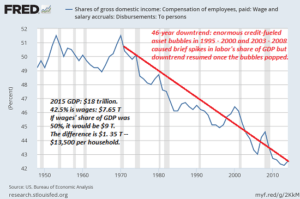
Why did it fail? One aspect of the discontent (as I have outlined before – see here) relates to the slow demise of our financialized, neoliberal, debt-driven growth model. For many in America and Europe, the reality has not been one of economic prosperity, but one of anxiety – and for the first time in the post-World War II era – a sense that the next generations’ prospects will be much tougher, and worse, than ours were.
Here (no friend to Trump) is Naomi Klein’s assessment: “They will blame James Comey and the FBI. They will blame voter suppression and racism. They will blame ‘Bernie or bust’ and misogyny. They will blame third parties and independent candidates. They will blame the corporate media for giving him the platform, social media for being a bullhorn, and WikiLeaks for airing the laundry.
“But this leaves out the force most responsible for creating the nightmare in which we now find ourselves … [financialized] neoliberalism. Here is what we need to understand: a hell of a lot of people are in pain. Under neoliberal policies of deregulation, privatization, austerity and corporate trade, their living standards have declined precipitously. They have lost jobs. They have lost pensions. They have lost much of the safety net that used to make these losses less frightening. They see a future for their kids even worse than their precarious present.
“At the same time, they have witnessed the rise of the Davos class, a hyper-connected network of banking and tech billionaires, elected leaders who are awfully cozy with those interests, and Hollywood celebrities who make the whole thing seem unbearably glamorous. Success is a party to which they were not invited, and they know in their hearts that this rising wealth and power is somehow directly connected to their growing debts and powerlessness.
“For the people who saw security and status as their birthright – and that means white men most of all – these losses are unbearable. Donald Trump speaks directly to that pain. The Brexit campaign spoke to that pain.”
Here it is represented visually:
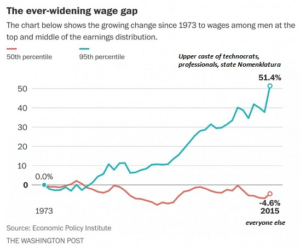
Of course, this was not the case for the urban élites:
Cultural Resistance
The second aspect to the present discontent has been cultural oppression (or, in the rhetoric of the Democratic Party, “identity politics” – one of the mainstays of the Clintonite electoral base). Its roots are complex, and lie with philosophic currents emerging out of Germany during WWII that somehow fused with American Trotskyist intellectual thinking (which then migrated to the Right). But, in gist, this current of political thought borrowed from the emerging discipline of psychology the concept of clearing the human mind – shocking it, or forcing it into becoming the “clean slate” on which a new mental program could be written by the psychiatric (or political) therapist respectively.
The political aim here was to eliminate totalitarian thinking, and fascist mental “programming,” and to replace it with a liberal-democracy circuit board.
Indeed, the U.S. Immigration and Nationality Act of 1965 was promoted by this intellectual group precisely in furtherance of the notion that concepts such as “national culture” would become meaningless as a result of immigrant cultural dilution. By the 1970s and 1980s, the objective had evolved to implant the idea that there was really no politics to modernity (Fukuyama’s End of History) since all governance somehow had boiled down to technocracy: ensuring effective liberal market functioning — a matter best left to experts.
In political terms, the “clearing” of the mind’s inherited cultural clutter was to be achieved by cultural wars of political correctness. The class war had become discredited, but there were other “victims” on whose behalf war could be waged: the war on gender discrimination, on racism, on denial of gay rights and sexual orientation stereotyping, on verbal micro-aggressions, on sexist language, or any ideas or language which disturbed the individual’s sense of “safe space” were used as tools to clear away old cultural “brush” of inherited national culture, and open the way for an American-led, globalized world.
The ostensible factor linking all these notions of victim “wars” was that their antonym amounted either to fascism or authoritarianism. The problem with this has been that any white American blue-collar worker who attended church, who believed in family life, and was patriotic, became potentially a fascist, a racist, a sexist or a bigot.
Many ordinary Americans (and Europeans) disdain this “cultural” war which places him or her (according to Hillary Clinton), in the “‘basket of deplorables’ Right? Racist, sexist, homophobic, xenophobic, islamophobic, you name it,” and who looked upon his or her community as representing nothing more than a “fly-over” state in the view of the U.S. coastal élites.
The deplorables have now risen up. Donald Trump’s salty language was no liability – it was an electoral asset by thumbing his nose at this correctness, and at so-called ”snowflake” sensibilities. Trump’s ‘incorrectness’ touched on a deep vein of resentment within American traditional society.
Not only does “flyover America” resent being termed “deplorables,” they feel too clearly the disdain in which the American and European elites hold them – and dislike their arrogance in suggesting that there is only one rational, sensible way of doing things, and that they – the elites, being the experts and a part of the Davos set – should tell the rest of us what it is: (despite their decades of failures).
High Emotions
Emotions are high on both sides. To gain a sense of how bitterly the cultural war will be fought, listen to this from the partly-Soros-funded populist mobilization movement Azaaz (linked to America’s Move On organization): “Dear Mr. Trump: This is not what greatness looks like. The world rejects your fear, hate-mongering, and bigotry. We reject your support for torture, your calls for murdering civilians, and your general encouragement of violence. We reject your denigration of women, Muslims, Mexicans, and millions of others who don’t look like you, talk like you, or pray to the same god as you. Facing your fear we choose compassion. Hearing your despair we choose hope. Seeing your ignorance we choose understanding. As citizens of the world, we stand united against your brand of division.”
In short, with Brexit and the Trump victory, we are witnessing an historic point of inflexion. As I noted in mid-October (quoting British political philosopher John Gray): “If the tension between [the globalization project on one hand] and the [sovereign] nation state, [on the other] was one of the contradictions of Thatcherism … From Bill Clinton and Tony Blair onward, the center-left embraced the project of a global free market with an enthusiasm as ardent as any on the right. If globalization was at odds with social cohesion, society had to be re-engineered to become an adjunct of the market. The result was that large sections of the population were left to moulder in stagnation or poverty, some without any prospect of finding a productive place in society.”
“If Gray is correct that when globalized economics strikes trouble, people will demand that the state must pay attention to their own parochial, national economic situation (and not to the utopian concerns of the centralizing elite), it suggests that just as globalization is over – so too is centralization (in all its many manifestations).”
Well, the global trend does not seem to be going in the Avaaz direction. It seems rather to be heading toward prioritizing the recovery of the state, of state sovereignty, and of state engagement in the pursuit of economic policies appropriate to the particular circumstances of the state, and in the state’s ultimate responsibility for the welfare of the community as a whole.
The question is what does this mean geo-strategically? And, secondly, can and will, Trump be able to deliver the new era? The short answer is that this new era seems to presage a period of political volatility, financial volatility and in Europe and the Middle East, the prospect of continued political “shock.”
It is clear that Mr. Trump is not a globalist. It is also clear that he is aware of some of the dangers of the present global monetarist policy. He has spoken of the U.S. Federal Reserve creating “big ugly bubbles” and that the next economic and financial crisis has been “kicked down the road” by Fed Chairwoman Janet Yellen – and clearly awaits whomsoever becomes U.S. President on Jan. 20, 2017.
Painted into a Corner
But three decades of debt-led, financialized “growth policies” leave the President-elect effectively painted into a corner: global debt has spiraled; the bubbles are there still (kept afloat by Central Bank coordinated intervention), and bubbles are infamously difficult to deflate gently; zero or negative interest rates are undermining many a business model, but cannot easily be foregone, without crashing the bond market; and QE (printing money) is systematically eating away at consumer purchasing power through the dilution of its newly created purchasing power, and the latter’s re-direction from “main street” into the financial sector – lifting nominal asset values – but creating no tangible wealth.
America and Europe effectively are in debt-deflation. How then to grow incomes so that producers of goods and services can also afford then subsequently to purchase these goods and services? Trump’s answer is to spend on domestic infrastructure projects. This may help a bit, but is unlikely – in itself – to lift and float the entire U.S. economy.
The reality is that there is no obvious global engine of growth (now that China’s “industrial revolution” has stalled at best). Every nation now is in search of new engines of growth. And it is not easy to imagine that Europe or America will succeed in retrieving all those jobs lost through globalization. Indeed, the attempt so to do – in, and of itself – might just precipitate a further deceleration of world trade, and a consequent decline in output.
In brief, the global economy may see a brief “honeymoon period” thanks to a likely spurt of U.S. fiscal indulgence and a concomitant psychological lift, stemming from – at least – the U.S. construction sector enjoying something of a boom. But ultimately the very economic crisis which Mr. Trump anticipates may prove to be the only way to cut the Gordian knot in which three decades of unprecedented debt and money printing have fettered us.
And if he is to steer through the expected crisis, Mr. Trump will have to eschew the Siren voices of the present elites telling him “TINA” (there is no alternative, but to continue as before).
Where Mr Trump might look for an early (and relatively easy) success however, may be in foreign policy. As “Nixon went to China,” so Trump can go to Russia and China, and begin to treat them as normal nations with whom it is possible to find an intersection of interests (as well as areas of disagreement).
This would be revolutionary. It could change the geo-strategical map. And as President Putin keeps repeating … the door is open (at least for now). Nothing is forever in politics.
Alastair Crooke is a former British diplomat who was a senior figure in British intelligence and in European Union diplomacy. He is the founder and director of the Conflicts Forum, which advocates for engagement between political Islam and the West.
Miracle or Mirage? Manufacturing Hunger and Poverty in Ethiopia

Oakland Institute
As months of protest and civil unrest hurl Ethiopia into a severe political crisis, a new report from the Oakland Institute debunks the myth that the country is the new “African Lion.” Miracle or Mirage? Manufacturing Hunger and Poverty in Ethiopia exposes how authoritarian development schemes have perpetuated cycles of poverty, food insecurity, and marginalized the country’s most vulnerable citizens.
A key government objective is to make Ethiopia one of the largest sugar producers in the world. Several sugar expansion plans are underway, including the colossal Kuraz Project in the Lower Omo Valley, which will include up to five sugar factories and 150,000 hectares of sugarcane plantations that rely on Gibe III Dam for irrigation. Studies show that Gibe III could reduce the Omo River flow by as much as 70 percent, threatening the livelihoods of 200,000 Ethiopians and 300,000 Kenyans who depend on the downstream water flow for herding, fishing, and flood-recession agriculture.
Miracle or Mirage? offers lessons from the deadly impact of sugar and cotton plantations in the Awash Valley in the Afar Region, established in the 1950s. The projects drastically reduced land and water availability for people and cattle, undermined food security, destroyed key drought coping mechanisms, and stirred up violent conflicts between different groups over the remaining resources. The establishment of plantations was a critical factor in the 1972-1973 famine, resulting in the deaths of nearly 200,000 Afar people. These findings raise serious questions about the government’s logic behind sugar expansion, with $11.2 billion to be invested by 2020, and much more for irrigation schemes and dams – Gibe III alone cost Ethiopia $1.8 billion.
Using quantitative evidence, the report also details how plantations established in the Awash Valley have been far less profitable than pastoralist livestock production, while carrying massive environmental costs including the depletion of vital water resources.
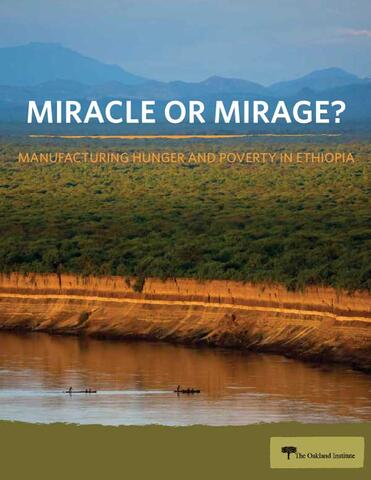
Download PDF (size: 0.73 MB) Miracle or Mirage? Manufacturing Hunger and Poverty in Ethiopia
Brazil’s Unelected President Cuts Successful Literacy Program
teleSUR | August 29, 2016
With Brazilian Senators preparing to vote this week on whether to oust President Dilma Rousseff from office, interim President Michael Temer’s unelected government last week has axed a popular nationwide educational program that has shaved nearly a quarter from the country’s illiteracy rate in little more than a decade.
The Ministry of Education confirmed that it had discontinued the literacy initiative to a citizen who requested an update on the program through the country’s Access to Information Act, the newspaper Folha de Sao Paulo reported Sunday.
The initiative, known as Literate Brazil Programme, was launched in 2003 in the first year of the President Luiz Inacio Lula da Silva–popularly known simply as “Lula”– of the Workers’ Party or PT. Brazil is historically one of the world’s most economically and social unequal countries in the world and the program was one of several redistributive efforts undertaken by Lula’s administration in his two terms in office.
But the interim Education Ministry, headed by right-wing politician Mendonca Filho, who faces investigation over major accusations of corruption, has dissolved the program, cutting off funding to state and local governments, even while continuing to deny publicly that the program has been revised in any way. State and local officials, however, say that they’ve been unable to enroll anyone in the literacy program, Folha reported Sunday.
Since it began in 2003, the literacy initiative has served an average of 1.3 million learners aged 15 and older, managing to reduce illiteracy rates from 11.6 percent to 8.3 percent in 2014. The Unesco Institute for Statistics estimated the 2015 adult illiteracy rate at 8.2 percent, while less than 2 percent of youth are illiterate.
According to Unesco, the program has shown “real-life success stories” of how literacy skills can improve “future prospects” for Brazilian citizens.
Despite the improvements in the literacy rate, Brazil still ranks behind many countries in the region, including Argentina, Chile, Colombia, Cuba, Mexico, Paraguay, Uruguay, and Venezuela, among others.
There also remains a great regional disparity in Brazil’s overall literacy rate, which ranges from 2.7 percent in the Federal District and 3.2 percent in the state of Rio de Janeiro to 22 percent and 20.2 percent in the poor, service-economy states of Alagoas and Piaui, according to government data reported by Folha.
Immediately after his administration was installed in May, Michel Temer’s all-male, corruption-ridden cabinet of neoliberal ministers moved swiftly to roll back social programs and implement an aggressive state austerity program that includes sweeping privatization efforts. Lula’s protegee, the twice-elected Rousseff is scheduled to testify Monday in her impeachment trial, with a final vote expected Tuesday.
Temer government’s has also cut other key programs and ministries, including the Ministry of Culture, which was absorbed into the purview of Minister of Culture, Mendonca Filho. The move represents the re-joining of the culture and education ministries for the first time since 1985, following the fall of the country’s brutal military dictatorship.
Filho is being investigated for receiving millions of dollars in bribes and illegal donations to fund his successful 2014 reelection campaign to represent the state of Pernambuco in Congress. If convicted, Filho would likely be forced to step down from his post, which would make him the fourth member of Temer’s cabinet to resign following accusations of bribery or fraud. Temer and his Foreign Minister Jose Serra are also embroiled in bribery scandals linked to fraud in the state oil company, Petrobras.
In just three months of “interim” government, Temer’s administration has moved toward privatizing state oil reserves, making cuts to popular social programs including the housing initiative Minha Casa Minha Vida, and hinted at plans to chip away at the country’s longstanding and cornerstone universal health care program. The country has also pivoted away from its left-wing allies in South America toward the United States and conservative governments in the region.
Millions Spent, No One Served: Who Is to Blame for the Failure of GMO Golden Rice?
By Angelika Hilbeck and Hans Herren | Independent Science News | August 10, 2016
The recent Nobel laureates’ letter accusing Greenpeace of a “crime against humanity” for opposing genetically modified (GMO) golden rice reveals a deep division not only between civil societies and some science circles but also within the science community – a division in the visions for our common future and which path to take for our joint development. A division we see growing and escalating. A strong indication of this division is that among the Nobel laureate signatories, there seems to be hardly anybody with a solid scientific track record in agriculture, food production, development, or the socio-ecological and political causes of poverty and hunger. Others with notable competence – at least in the economic and social domains of development, poverty, and hunger – are not among the signatories. Signs of escalation also include the emotional, accusing language in the letter and the ample use of scientifically unsubstantiated claims. What is missing in the letter and among the supporters and developers of GMOs is the recognition and scientific analysis of some tough facts.
Fact no. 1: Still no functioning vitamin A rice despite unlimited resources
No functioning vitamin A rice has been produced in over 20 years of research. This is despite full support at every level: financial, institutional, political, and corporate. By ‘functioning’, we mean farmer’s rice varieties that reliably and stably express sufficient amounts of beta-carotene (pro-vitamin A, the precursor of Vitamin A) over many generations of seed saving. These seeds must continuously express beta-carotene at a level that has been documented to be efficiently convertible to Vitamin A in mammals and, most importantly, can (statistically) significantly relieve the symptoms of Vitamin A deficiency in hungry people. None of this is scientifically trivial but that’s what has been promised.
The first golden rice, GR1, was unsuccessful and is long gone. Golden rice 2 (GR2) is a patented pro-vitamin A GM rice developed from scratch by the multinational biotech firm Syngenta and still in the field trial stage at the International Rice Research Institute (IRRI) at least one decade after it’s creation.
The vast majority of scientists in the world will never see such comprehensively generous support for their research – yet they still deliver, and must deliver if they ever want to renew funding for their research. This is more than can be said for the golden rice project.
Fact no. 2: Lack of recognition of real reasons for failure to deliver
A quick evidence check is sufficient to reveal the simple reason why golden rice is not in farmer’s fields: it is still not ready because it is not performing agronomically. Furthermore, it is far from being medically documented to relieve symptoms of Vitamin A deficiency. Neither Greenpeace nor the destruction of a test plot in the Philippines by local activists can be held responsible for this lack of scientific achievement.
Fact no. 3: Questionable conceptual underpinning
Leaving aside its scientific aspects, the very concept of golden rice – and all other similar conceptual approaches as solutions to malnourishment – remain doomed from the start as similar approaches have failed repeatedly. The problem lies in the underlying reductionist (disembedded) approach. Combating hunger and malnutrition one vitamin and mineral at a time is a failed ideology, no matter which vitamin or mineral one starts with and which kind of delivery system one chooses. Malnourished people do not suffer from single-vitamin-deficiencies added up. They suffer from hunger, as in ‘lack of food’. This is compounded by poverty and a myriad of contributing factors working simultaneously together. That means they lack regular access to real foods containing the necessary variety of ALL essential nutrients, which, in conjunction, make up a healthy diet.
These contributing factors differ according to culture, place and time. There exists a huge amount of research and analyses to read for anybody who cares about the real causes of hunger and the real solutions (we list some old and new references at the end – or just check out the United Nations World Food Program website. For the golden rice project, we recommend for starters, the recent analysis by Stone and Glover who locate its failure in its ‘disembeddedness’ and ‘placelessness’.
Consequently, hunger and malnutrition with its complex, ‘place-based’ causes cannot be battled by a uniform, de-contextualized and placeless one-vitamin-at-a-time approach which is what GMO golden rice has to offer.
This reductionistic approach to hunger is matched by similar reductionism in the genetic engineering world where organisms are viewed as the sum of their genes and proteins. Genes are added one at a time as blueprint construction instructions for lego-like products and many more projects of this kind are underway, e.g. vitamin A banana and cassava, or iron-fortified cassava, or whatever lies within their technical reach. Stone and Glover describe this as “a preoccupation with the molecular scale” that “favors a form of reductionist thinking that conceives of traits of interest as being governed primarily by genetics rather than through interactions with the environment or management” (Stone and Glover 2016).
Supplying vitamin A or any other nutrient in isolation only works for a transitional period of time, curing a symptom at best, while work progresses on the underlying place-based causes of hunger – lack of access to food, money, education and secure living conditions. Under those circumstances, as in parts of the Philippines, cheap vitamin A pills do the job much better, in a more targeted, controlled, and effective way than any patented GM crop could ever do.
Fact no. 4: A missing roll-out plan
But even if the golden rice researchers do eventually manage to get some GM pro-Vitamin A rice varieties to perform agronomically, there seems to be no roll-out plan to ensure that it gets to those who need it. Those reasons have nothing to do with regulations and everything to do with logistics, institutions and finances.
Will the golden rice developers truck their harvest into the urban slums and remote rural areas of Asia or Africa, or at least the Philippines, every day? Will they bring with them also the fat that malnourished people need to eat along with the rice to ensure they absorb the beta-carotene and convert it to vitamin A? And if they can do that, why aren’t they bringing existing foods into those areas already? Why wait until a patented GM food is ready for delivery? There is no shortage of vitamin-rich foods on this planet and beta-carotene is one of the commonest molecules in nature.
Frequently, vitamin A-rich food exists in abundance and rots in storage or under trees not that far away from the places where people suffer from malnutrition. An alternative already in the field is, for example, a non-GMO orange sweet potato, a root crop compatible with improved crop rotations whose developers have been awarded the 2016 World Food Prize. Without a massive and expensive roll-out plan, golden rice will not even leave the field station of the International Rice Research Institute (IRRI), which is overseeing the golden rice project.
Epic endeavor
If their plan is to cross the pro-vitamin A trait into the rice varieties that farmers grow in hunger-stricken areas, they face an uphill logistic, financial, scientific and institutional battle. How will they get the transgenic trait reliably expressed in all of these varieties at the necessary concentrations over many generations of rice plantings and seed recycling? Who will pay for this epic endeavour?
If they decide instead to only put the pro-vitamin A trait into a handful of, say, IRRI rice varieties (which we believe is the most likely plan – if there is a plan in the first place), many will fail because they will not perform in different local conditions and they typically require fertilizers and pesticides. If the plan is to switch farmers to growing a handful of patented biofortified varieties all over Asia and Africa, how will this be implemented? Who will deliver the seeds and accompanying chemicals to farmers – year after year, everywhere where it’s needed, for free? And is this a sustainable solution?
And what will happen to the thousands of existing ecologically and culturally well adapted varieties? The genetic diversity of crops and animals is our life-support system.
Furthermore, have they asked the rice producers and consumers of Asia and Africa if they want many of their rice varieties to be yellow forever – even in times when the food shortages and nutrition deficiencies are over?
Unresolved patent and ownership issues
According to the website www.goldenrice.org., a resource-poor farmer will be allowed to grow golden rice without license fees as long as his/her income is less than $10,000 per year. But, in practice, who decides which farmers are eligible? Who decides which income limit is appropriate in what country or region, and who enforces it on what authority and criteria? What about those farmers whose incomes exceed $10,000 per year? Who will decide when to collect fees, from whom, and for how long? How will the finances be arranged between Syngenta, which owns GR2, the seed multipliers and distributors, and the government? And if all this can be settled with Syngenta – how about the next-in-line patented, biofortified GM crops? In case of dispute, will there be free access to lawyers for the resource-poor farmers?
In their weekly column Schaffer and Ray (2016) reported about a meeting with an employee of the US State Department and discussing the benefits of GM crops for farmers and consumers in the Global South and whether or not farmers would have to pay a technology fee and purchase, for example, the golden rice seed each year. The State Department representative stated that the companies that own the patents would be willing to make the golden rice (or virus-resistant cassava) available at no cost provided that the countries adopted US patent regimes to protect other GM crops. From a policy perspective, such a ‘humanitarian’ license agreement would thereby present a highly profitable transaction, a means to ‘encourage’ developing countries that often do not even have patent laws of their own to accept the US patent regime and so ensure the profits of US companies and patent holders in perpetuity. In corporate agriculture it seems, nothing is really for free.
These are just a few of the tough questions that have never been addressed or even acknowledged by promoters of golden rice or any other such projects. Shooting genes into nuclei and getting a few varieties to express a transgene is the easy part – although even that has proved elusive so far for GR2.
Fact 5: Colonial mindset
Blaming Greenpeace for the failure of not only golden rice but other patented products of genetic engineering has been an irrational (or maybe calculated) obsession of some proponents and developers since the discussion began decades ago. Yet, it also reveals more subtle issues. Farmers and indigenous people are outraged when gene technology proponents accuse them of being instructed or manipulated by big Western NGOs like Greenpeace. They say that promoters of golden rice and other techno-solutions offered by developed countries rarely ask for or listen to their views and, thereby, reveal their lack of respect and comprehension.
This attitude towards peasant farmers and indigenous peoples is typical of the still prevailing colonial, Western mindset – hidden or open. It assumes that the peasant farmers are ignorant people without the relevant knowledge entitling them to make informed decisions based on their own values and visions for their future. Sadly, the letter signed by Nobel laureates appears to be a continuation of this way of thinking. It reveals an attitude of supremacy over, and disrespect for, traditional and indigenous knowledge and peoples who want to have a say in their lives and communities and which path to take to ‘development’.
Take-home message: Hungry (and poor) people deserve better. And Nobel laureates can do better!
The Authors:
Dr Angelika Hilbeck is Chair, European Network of Scientists for Social and Environmental Responsibility (ENSSER). She is a researcher and lecturer on biosafety and agroecology at Swiss Federal Institute of Technology Zurich (ETHZ) who has worked closely with farmers and civil societies in many developing countries for more than two decades, including the Philippines, the country targeted for the rollout of GM golden rice. She is a member of the Board of Directors of ‘Bread for All’. She was a lead author of the International Assessment of Agricultural Sciences, Knowledge and Technology for Development (IAASTD)
Dr. Hans R Herren, Agronomist/Entomologist (ETHZ) who worked in agricultural research and development for 27 years in Africa. Member of the International Panel of Experts on Sustainable Food Systems, President and Founder Biovision Foundation for Ecological Development www.biovision.ch, president and CEO www.Millennium-Institute.org.
Laureate: Sustainability Prize, Germany 2016, Right Livelihood Award (Alternative Nobel Prize 2013; One World Award 2010; World Food Prize 1995; Kilby Award 1995; Brandenberger Prize 2002; Tyler Prize 2003.
Foreign Associate of the US Academy of Sciences 1999; Member of the Academy of Sciences for the Developing World (TWAS) 2005
Co-Chair International Assessment of Agricultural Science and Technology for Development (IAASTD), Member CGIAR Science Council (2005-2010)
[1] “On 13 August 2013, after farmers had got nowhere in their arguments with the Philippine government, they uprooted an experimental field of Golden Rice in Pili, Camarines Sur, where trials were taking place. By taking this action, they sent a clear signal that they would not tolerate the advance of GMOs. However, the Filipino farmers were outraged when the media, accusing them of ‘vandalism’, made it appear that the uprooting had been orchestrated by international NGOs which had supposedly made use of the farmers to uproot the rice. Farmers explained that it was their decision to turn to civil disobedience to defend rice, a crop that is central to their diet, their livelihood and their culture. While the funders and supporters of Golden Rice carry on with their goal of commercialising the crop in the Philippines, Indonesia and Bangladesh in the near future, Filipino farmers continue to mobilise and protest, vowing that they will go on opposing the advance of GMOs.”
The significance of the GOP’s attempted purge of Donald Trump
By Daniel Haiphong | American Herald Tribune | August 11, 2016
The GOP is trying to oust Donald Trump from the Presidential campaign trail. Numerous GOP officials and corporate media reports have indicated that Donald Trump may drop out of the race. Curiously, the news comes just weeks after Trump walked away from the Republican National Convention with the nomination. No other candidate came close in total number of delegates in the state primaries and the proposed roll call from dissenting delegates failed to bring results. The attempted ousting of Trump reflects both the fracturing of the Republican Party and the rupture of the two-party corporate duopoly generally in this election cycle.
This isn’t the first time establishment Republicans have attempted to push Trump out of the race. When Trump began picking up momentum earlier in 2016, many well-known Republicans refused to endorse him. Republican Mitt Romney made a video appearance at the Democratic Party National Convention to warn of the dangers of a Trump presidency. The Business Round Table, a collection of corporate executives, also warned New York Times readers of Trump’s possible Presidential victory. Even the Koch Brothers are sabotaging Republican Party supporters of Trump by pulling their funding from his supporters in Washington.
The reason for the ruling class’s fear of Trump is clearly articulated from the source. Trump is unpredictable and his message uncontrolled. There are times when Trump speaks to working class anxiety by repudiating trade deals and calling to re-regulate the financial sector. There are others when Trump is easily baited into traps set by the Democratic Party. In recent weeks, the Democratic Party has attempted to frame Trump as an unpatriotic traitor. Trump has reaffirmed his support of Russian President Vladimir Putin and refused to take back remarks regarding the heroism of a Muslim American soldier who died in combat in Iraq.
While power struggle between the Democratic Party and Republican Party is nothing new, Trump’s impact on the two-party corporate duopoly should not be understated. Trump has destroyed the GOP’s infrastructure. His rhetoric has inspired emboldened racist elements of the working class as well as legitimate class grievances among the Republican Party base. Trump has occupied a vacuum that its corporate-backers have refused to fill. No longer can the Republican Party operate as it did in the past without losing ground to the increasingly conservative Democratic Party.
For nearly five decades, the Republican Party has positioned itself the party of white supremacy. The Democratic Party has been able to place unions, Black voters, and white liberals under its tent over this period. However, the neo-liberal crisis of capitalism has changed this dynamic dramatically. The gap between Democratic Party rhetoric and policy has widened since the early 1980s. This has forced Republicans to move further to the right in the midst of Democratic Party-led wars, austerity measures, and assaults on civil liberties.
Donald Trump represents an existential threat to the very existence of the GOP. In her speech at the Democratic National Convention, Hillary Clinton herself admitted that she would be a President for “Democrats, Republicans, and Independents.” She was thus very forthright in extending an invitation to refugee Republicans into her “big tent” campaign. Clinton’s neo-liberal, imperialist agenda is attractive to a Republican Party establishment that has effectively lost its base to Trump. Trump’s erratic behavior only further endangers his ability to defeat Clinton’s strategy and bring victory to what is left of the Republican Party.
A series of interviews on “Democracy Now!” have clarified the depths to which the Clinton campaign seeks to use fear of Donald Trump as its catalyst for victory. In two separate debates, Green Party supporters Kshama Sawant and Chris Hedges confronted Clinton operatives Rebecca Traiser and Robert Reich. Traitser and Reich refused to address concrete policy and instead promoted a Clinton Presidency on the basis of the dangers of Donald Trump. The debates confirmed that Hillary Clinton and the Democratic Party have become virtuously indefensible. Such a realization has forced the two-party corporate duopoly into a crisis situation, especially on the Republican Party side. Either the Republican Party establishment gets behind Trump or it joins forces with the increasingly conservative Democratic Party machinery led by Clinton to defeat the “fascist” casino capitalist.
The fact the Republican Party has not distanced itself from rumors of Trump’s departure indicates that there is a significant portion of GOP leaders who would prefer a Hillary Clinton Presidency. Hillary Clinton is, after all, the chosen politician to serve the capitalist oligarchy. Clinton has received tens of millions of dollars in donations from hedge funds and various other Wall Street donors. This places Trump at a glaring disadvantage. Yet this disadvantage has been mitigated by the open rebellion both Democratic and Republican Party bases are waging against the establishment.
The conditions that created the revolt of young voters in the Democratic Party and the entire base of the Republican Party are not going away. Trump may step down, or he may continue on in his campaign. Whatever the case, the legitimacy of the two-party duopoly will remain tenuous at best. Millions of people are sick and tired of war, austerity, poverty, and a system that represents no one but the elite. A mass break with the two-party system is on the horizon and Trump’s campaign has played a significant role in speeding up the process. So the conversation about Trump should not be confined to his personality or his reactionary character. It should center on the root causes of his rise to the GOP nomination and what that means for the future of US political landscape.
A jolly bit of tender

Crimes Of Britain | July 28, 2016
Churchill has been chosen by the Bank of England’s to be the face on their new £5 note set to be in circulation from September 2016.
The Governor of the Bank of England stated “Our banknotes acknowledge the life and work of great Britons. Sir Winston Churchill was a truly great British leader, orator and writer. Above that, he remains a hero of the entire free world. His energy, courage, eloquence, wit and public service are an inspiration to us all. I am proud to announce that he will appear on our next banknote”.
Churchill is fawned over in Britain. He was voted ‘Greatest Briton’ of all time in a poll run by the BBC in 2002. He is praised across the political spectrum, held up as the man who stopped Brits speaking German. When the truth is Churchill was never an opponent of fascism. He was a white supremacist who talked of the need of non-Anglo Saxons to “recognise the superiority of race”. In 1927 he praised Mussolini, “What a man! I have lost my heart!… Fascism has rendered a service to the entire world”. He went on to hold Hitler up as the ideal figure to lead Britain if they were to be defeated, “If our country were defeated, I hope we should find a champion as indomitable to restore our courage and lead us back to our place among the nations”.
Winnie was still swilling champagne when he engineered a famine in Bengal which saw at least 4 million men, women and children to starve to death. Food literally taken from the mouths of starving people to ship it where it wasn’t even needed. The Black and Tan thugs were his brainchild. An advocate for the use of poison gases whilst Secretary for War and Air. He assisted greatly in the looting of Iran which kept Britain afloat. And when the government of Mohammad Mosaddegh threatened British ‘interests’, Churchill was there ready to desecrate democracy. He believed that Kenya’s fertile highlands should be only for white colonial settlers, and approved the removal of the local population. Over 150,000 men, women and children were forced into concentration camps. It was Churchill who arranged for Ibn Saud to receive a subsidy of £100,000 a year in 1922. He later gifted the founder of Saudi Arabia a Rolls Royce and lamented that his “admiration for him was deep, because of his unfailing loyalty to us”. When the democratically elected government in ‘British Guiana’ rolled out their nationalisation plan Churchill sent war ships and 700 British troops to put a stop to that. He assisted Zionism and was rewarded with a bust in Al Quds for his contribution in helping create the colonial settler state of ‘Israel’. Winston and his cabinet were deeply concerned about British people viewing Black American GIs favourably in WW2. He was obsessed so much that he wanted to get the Americans to stop sending Black soldiers to Britain. His racism didn’t stop there, when debating the adoption of new laws limiting immigration from the Caribbean he suggested the use of the motto “Keep England White”. All of Churchill’s wars were for defending and preserving the thieving British Empire.
I am releasing an in depth piece on his genocidal campaigns in the coming weeks. The British press have churned out a few articles here and there on Churchill but have glossed over the true extent of his crimes. Presenting them as OK because he led the Brits in their ‘finest hour’.
It really is no surprise that he is to decorate English currency, he is your archetypal Brit at the end of the day.
Featured Video

Houthis Keep Advancing as the Red Sea Crisis Deepens
or go to
Aletho News Archives – Video-Images
From the Archives
15 Saudi ‘hijackers’ were CIA agents working for US: Scholar
Press TV – April 13, 2016
Fifteen of the 9/11 “hijackers” from Saudi Arabia were CIA agents working for the United States government, which was seeking to destroy the Middle East for Israel and to double the American military budget, says Dr. Kevin Barrett, an American academic who has been studying the events of 9/11 since late 2003…. continue
Blog Roll
 Aletho News
- Russia Just Struck the Eyes of NATO’s War Machine in Ukraine
- Russia summons UK charge d’affaires over Kiev drone support
- NATO member warns bloc seeking pretext for war with Russia
- Macgregor: We Haven’t Seen the Worst of the Iran War Yet
- ‘We are not like everyone else’ laws that bind other nations do not apply to Israel, says Likud lawmaker
- Report: Saudi Arabia seeks allies’ assistance as missiles deplete amid war on Yemen
- Fuel Crisis Deepens: Pakistan Warns Tanker Attack in Red Sea Would Be an ‘Act of War’
- ‘Bucha massacre’ a false flag orchestrated by UK – Moscow
- China Rejects Outside Pressure on Trade Ties After New US Russia Sanctions Bill
- Houthis Keep Advancing as the Red Sea Crisis Deepens
- If Americans Knew
- Deportation Case of Palestinian Activist Salah Sarsour Tests First Amendment
- ‘We Will Not Forget’: Palestinians Mark 44 Years since Sabra and Shatila
- Why do we let Zionists decide what we can and can’t say?
- US welcomes Israeli, Iranian delegations to UN, but not Palestinians – Daily Update
- Biden’s Genocide Accomplices Targeted by New Accountability Campaign
- AIPAC’s Network Has Already Spent $67.2 Million to Shape the Midterm Elections
- Jewish Supremacist Manufacturing a Civilizational Threat to License Bigotry
- US bans Palestinian president from speaking at the UN
- Israeli Forces Detain Journalist Alaa al-Rimawi amid Widespread West Bank Raids
- Even a pro-Israel Congress member has put a hold on 40,000 one-ton bombs to Israel
- No Tricks Zone
- New Study: ‘Global Drought Shows No Detectable Recent Acceleration Under Climate Warming’
- Economic Masterminds: German Socialists Suggest Taxing Productivity Gains Stemming From Using AI
- The South China Sea Has Not Been Cooperating With The Climate Change Narrative
- Energy Crisis: Germany Enters Heating Season With Historically Low Gas Reserve Fill Levels
- New Study: The Antarctic Ice Sheet Gained Mass From 2020-2024 Due To Staggering Snow And Ice Accumulation
- Study: Ocean Heating Rates From Thousands Of Years Ago ‘Dwarf’ Modern Ocean Heating Rates
- Climate Extremists Target, Attack Large-Scale Power Grid Infrastructure In Germany!
- New Study: Antarctic Ice Melt Has Contributed Less Than 1 Centimeter To Sea Level Rise In The Last 30 Years
- Fear Of Debate: Alarmist German Climate Scientist Calls On Mainstream Media To Discredit Skeptic Voices
- End-Of-August Arctic Sea Ice Extent Hasn’t Fallen In 20 Years, Official Data Show!
 Aletho News