Would the ‘NY Review of Books’ have printed an article on George Wallace in Alabama without talking to any black people?
By Philip Weiss | March 6, 2010
Josh Hammer has a pretty-good piece in the NY Review of Books about Avigdor Lieberman, called “I’m a Realist.” Any knowledge Americans get about this racist politician is to the good, but the piece is marred by the usual problem: American Jews are afraid to convey the blunt truths that leftwing Israeli Jews convey about their society, let alone what Palestinians say about that society. Israel comes off as a healthy democracy that is struggling with the devilishly charming Lieberman, who has a “controversial” belief in “transferral” of Palestinians, rather than as a society in crisis because of the continuing dispossession of minorities (as Bradley Burston would tell you, or Noam Sheizaf, or Mustafa Barghouti, or Ali Abunimah).
This limitation is typical of the New York Review of Books. The editors can’t give up on the ideals of Zionism, and so they publish Michael Walzer and Avishai Margalit, and keep Tony Judt in the back room, and refuse to review The Israel Lobby. The clearest indication of this bias in the NYRB’s Lieberman piece is the list of people Hammer quotes:
Lieberman
Yossi Beilin
Mikhail Philippov
Gideon Levy
One of Lieberman’s aides
Yair Tzaban
Alex Magidov
Danny Ayalon
Misha from Uzbekistan
Natasha from Siberia
Lily Gallili, reporter for Haaretz
Michal Kupinsky
There is not one Palestinian on the list. The only Palestinian even mentioned in the piece is Azmi Bishara. It doesn’t seem like Hammer tried to talk to him. So a racist politician rises, and a leftwing NY publication makes no effort to talk to the victims of the racism. Huh.
I admit it: I’m an ethnocentric Jew; and in Israel I recognize my tribe, and when I went to Israel and Palestine recently, I talked mostly to Jews. Still, I am stretching, I talked to Mustafa and Omar Barghouti and to Adnan Mahamid; it is essential for Jews to get out of their comfort zone; I try on this site to have Palestinian and other Asian voices. The New York Review of Books is sticking right in that Jewish comfort zone.
Tzipi Livni won’t be visiting the UK any time soon
By Paul Woodward | March 4, 2010
To hear it from the Israeli press you’d think that the British government can now makes changes to the law simply by having the prime minister write an op-ed.
Last December an arrest warrant was issued for former Israeli foreign minister, Tzipi Livni, when she was expected to arrive in Britain. According to Haaretz, she no longer needs to fear getting hand-cuffed for alleged war crimes — at least not on trips to the UK:
British Prime Minister Gordon Brown announced on Thursday plans to stop politically-motivated campaign groups from securing arrest warrants for visiting foreign officials. In a March 3 editorial in the Daily Telegraph, Brown wrote, “Britain will continue to take action to prosecute or extradite suspected war criminals – regardless of their status or power… But the process by which we take action must guarantee the best results. The only question for me is whether our purpose is best served by a process where an arrest warrant for the gravest crimes can be issued on the slightest of evidence.”
Under the current system, British magistrates are obliged to consider an arrest warrant case presented by any individual. Gordon Brown said he will instead propose that only one government department, the Crown Prosecution Service, evaluate the merits of any case brought under international law.
This move follows an uproar last December when Kadima party leader Tzipi Livni canceled a trip to London because a pro-Palestinian group secured an arrest warrant for alleged crimes committed in Gaza. A statement from Livni’s office praised the new changes proposed by Brown and said that “the British legal system has been abused by cynical elements in the United Kingdom.”
From London The Times presents a very different story:
Britain risks a showdown with Israel today when the Government signals it is in no hurry to ease the threat of arrest for visiting politicians and generals.
Ministers will announce a consultation on the principle of universal jurisdiction, under which private citizens can secure arrest warrants for offences such as war crimes committed abroad.
The Government had promised swift action when the Israeli opposition leader Tzipi Livni cancelled a trip to London last year after a magistrate issued a warrant for her arrest for alleged war crimes in Gaza when she was Foreign Minister.
The issue caused embarrassment for the Government, which promised to remedy the matter quickly. Today’s announcement, however, means that the issue will not be resolved until well after the election, expected in May. When The Times reported last month that a Cabinet split could delay the issue could be delayed for months, Ms Livni threatened to travel to Britain and “take the bullet” as the only way of shaming the Government into action.
After the disclosure that agents suspected of acting for Mossad, the Israeli intelligence service, used fake British passports to enter Dubai and kill a Hamas commander, however, the balance of diplomatic power has shifted.
The delay is a victory for Jack Straw, the Justice Secretary, who has argued that the legal point at stake is too important to rush.
Since the British government just voted in support of a UN General Assembly resolution calling on Israel to fully investigate allegations of war crimes committed during its war on Gaza, maybe they should quietly tell the Israelis that the proposed changes on universal jurisdiction aren’t going to happen if Israel keeps running away from the Goldstone report.
Europe’s Alliance with Israel
By David Cronin | March 4, 2010

Avigdor Lieberman meets Javier Solana
One of the pitfalls of specialising in European politics, as I have for the past 15 years, is that certain assumptions become hardwired in your brain. For a long time, my critical faculties shut down when I heard senior EU representatives speak of the Middle East. I happily accepted the official narrative that they were striving for a just resolution to the conflict between Israel and the Palestinians and that it would be foolish to park the so-called peace process in a “blood-soaked lay-by”, in the words of former EU commissioner Chris Patten.
Israel’s attacks on Lebanon in 2006 and on Gaza just over a year ago illustrated how naive and gullible I had been. In the first instance, Tony Blair blocked the EU from formally calling for a ceasefire because he wanted Israel to be given whatever space it perceived necessary to fight Hezbollah (Israel’s slaughter of Lebanese civilians in that 33-day war elicited no more than statements of “regret” from London).
It is true that the Union did urge a halt to the violence that Israel inflicted on Gaza’s 1.5 million inhabitants in late 2008 and early 2009. Yet by describing that attack as “disproportionate”, key EU representatives implicitly approved the Israeli version of events – that everything had been provoked by the missiles Hamas was firing on the southern Israeli towns of Ashkelon and Sderot. “Gaza was a crisis waiting to happen,” Marc Otte, the Union’s Middle East envoy, told me. “Do you think the Palestinians could continue to launch rockets on Israel without Israel reacting?”
Otte has resorted to a wilfully selective reading of recent history. Far from merely reacting to what Hamas had done, Israel had created the conditions that prompted Hamas to dust down its crude DIY weapons (no match, it must be said, for the cutting-edge killing machines in the Israeli arsenal). Until a few months earlier, Hamas had observed the cessation of hostilities between it and Israel that Egypt had brokered in June 2008. All that changed on 4 November that year, however. Because most of the world was preoccupied with how America was electing its first black president, Israel’s decision to break off the ceasefire with a raid on Gaza that killed six members of Hamas went largely unnoticed internationally. As a result, most mainstream press ignored how the rockets sent by Hamas into southern Israel were in retaliation for the November raid.
Even worse than its complicity in spreading Israeli falsehoods, the EU has failed to hold Israel to account for its war crimes. The investigation carried out by a UN-appointed team led by Richard Goldstone, a retired South African judge, into the conduct of Israel’s war on Gaza was as thorough as was possible under the circumstances (with Israeli officialdom refusing to cooperate). But when the 575-page it produced was discussed by the UN’s General Assembly in November 2009, 22 of the EU’s 27 countries refused to endorse it. A key finding that there was no “justifiable military objective” behind 10 of the 11 incidents it examined, in which civilians had been targeted by Israel, proved too unpalatable for most EU governments.

In December 2006 Ehud Olmert caused controversy when he was caught on camera instructing Italian PM Romao Prodi what to say in their joint press conference
While some headlines in 2009 conveyed the impression that there was friction between Israeli and European diplomats over everything from the status of Jerusalem to a Swedish tabloid story alleging that Israeli soldiers systematically ripped out the internal organs of Palestinian corpses, the reality is that Israel enjoys extremely cordial and profitable links with the EU. That reality was underscored by Javier Solana, making a farewell trip to Israel in the autumn, shortly before he stepped down as the EU’s foreign policy chief. “There is no country outside the European continent that has this type of relationship that Israel has with the European Union,” he said. “Israel, allow me to say, is a member of the European Union without being a member of the institutions. It’s a member of all the [EU’s] programmes, it participates in all the programmes.”
The most troubling aspect of this cooperation, in my view, is how Israeli arms companies have become eligible for EU funding. With Israel the main external participant in the Union’s “framework programme” for scientific research, the EU has become the second largest source of research grants for the country. Tel Aviv-based officials to whom I have spoken predict that Israel’s participation in the multi-annual programme, which went into operation in 2007, will be worth €500 million by the time it concludes in 2013.
The beneficiaries of these grants include Motorola Israel. Motorola is taking part in an EU-financed surveillance project known as iDetect4All, which uses sensors to detect intruders of buildings or resources of high economic value. The concept behind iDetect4All is similar to that behind a radar system that Motorola has installed in 47 Israeli settlements in the West Bank over the past five years. The Jerusalem Post has described that system as a “virtual fence” that uses thermal cameras to pinpoint people who are not authorised to enter the settlements.
Another recipient of EU grants is Israel Aerospace Industries, the manufacturer of warplanes used to terrorise Palestinian civilians. It is playing a lead role in the EU’s “Clean Sky” project, which aims to reduce aviation’s contribution to climate change by developing less polluting aircraft engines. Because IAI has been given carte blanche by the European Commission to apply for patents on any innovations realised during this project, it is entirely conceivable that planes used in the future bombardment of Palestine will have been developed with the unwitting help of the European taxpayer.
It is highly probable that Israel will be integrated even further into the Union in the near future. During 2008, the EU’s foreign ministers approved a plan to “upgrade” their relations with Israel through a “privileged partnership” that would enable Israel to become part of the Union’s single market for goods and services. Work on giving concrete effect to this upgrade has stalled since then because of the war on Gaza and unease in some European capitals at the hard-line rhetoric of Binyamin Netanyahu’s government. Nonetheless, some significant steps have been taken in the past few months. In November last, for example, an agreement on agricultural trade was finalised; under it, 80% of Israel’s fresh produce and 95% of its processed foods can be exported to the EU free of customs duties. A cooperation agreement between Europol, the EU’s police office, and Israel has also been reached (though still awaits a formal rubber-stamp from the Union’s governments). This is despite numerous reports from human rights organisations that detainees in Israel are routinely tortured and despite rules in force since 1998 that oblige Europol not to process data obtained by cruel methods.
One factor that has helped pave the way for all this cooperation is that a cottage industry of lobby groups dedicated to promoting Israel has started to flourish in Brussels. The American Jewish Committee, the European Jewish Congress and B’nai B’rith have all set up EU affairs offices over the past few years, while a cross-party alliance of MEPs (known as European Friends of Israel) was founded in 2006. These groups have responded to the widespread public revulsion at Israeli aggression by branding Israel’s critics, including left-wing Jews, as anti-Semites (an absurd claim, considering that most Palestinian solidarity activists abhor anti-Semitism). They have also contended that it is in Europe’s interest to bond with Israel because it is a prosperous economy, that has proven resilient in the face of global recession.
This well-oiled propaganda machine has helped convince policy-makers that Israel should be viewed as something akin to a Mediterranean Canada, a “normal” industrialised country with many similarities to Europe. But Israel is not a normal country; it is one that illegally occupies the land of another people.
The EU’s ever-deepening relationship with Israel cannot be divorced from the brutality meted out on daily basis to the Palestinians. The deeper that relationship gets, the more that Europe will be accommodating the oppression of Palestine. The EU cannot help solve the problems of the Middle East if it is making those problems worse.
• David Cronin’s book Europe’s Alliance with Israel: Aiding the Occupation will be published later this year by Pluto Press. This article originally appeared in the magazine ESharp! (www.esharp.eu)
Gordon Brown in Law Change Bid to Defend Israeli Leaders against Private Arrest Warrant
Al-Manar | March 4, 2010
British Prime Minister Gordon Brown is defending his decision to change the law allowing private people to demand arrest warrants against foreign leaders and officers visiting Britain.
The government’s decision to change the law was made following an arrest warrant issued against Israeli Opposition Chairwoman Tzipi Livni, who was scheduled to visit London last year.
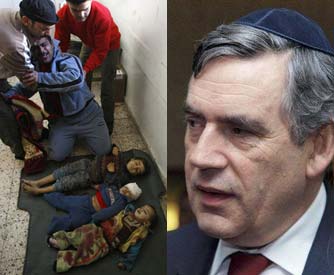 The former Israeli foreign minister reportedly canceled a trip to Britain in December for fear of being arrested after a court issued the warrant following an application by Palestinian activists.
The affair acutely embarrassed the British government and Brown pledged to change the law that allows judges to consider a case for an arrest warrant for alleged war crimes suspects brought by any individual.
According to a Daily Telegraph report on Thursday, the British government is to announce plans to stop politically-motivated campaign groups using British courts to secure arrest warrants for visiting foreign officials.
Under the proposals, the Crown Prosecution Service will take over responsibility for prosecuting war crimes and other violations of international law. It will end the current system in which magistrates are obliged to consider a case for an arrest warrant presented by any individual.
Writing for The Daily Telegraph, Brown said he would set out proposals to put the CPS in sole charge of judging the merits of any case brought under international law. “The only question for me is whether our purpose is best served by a process where an arrest warrant for the gravest crimes can be issued on the slightest of evidence,” he said.
According to Brown, the introduction of the right to prosecute international crimes in Britain had been right and necessary but that the process had been abused by activists.
“As we have seen, there is now significant danger of such a provision being exploited by politically-motivated organizations or individuals who set out only to grab headlines knowing their case has no realistic chance of a successful prosecution. Men and woman can then be held in prison on the basis of ‘information’, when the serious nature of such cases means that in any event they can only proceed to prosecution with the consent of the attorney general.”
Brown, who did not specifically address the warrants issued against Livni or other Israeli officials, hinted that “there is already growing reason to believe that some people are not prepared to travel to this country for fear that such a private arrest warrant – motivated purely by political gesture – might be sought against them.
“These are sometimes people representing countries and interests with which the UK must engage if we are not only to defend our national interest but maintain and extend an influence for good across the globe.”
Attorney General for England and Wales and Northern Ireland Baroness Patricia Scotland visited Israel recently and said that Britain sees an urgent need to change the policy allowing arrest warrants to be issued against senior Israeli officials.
A London court last year issued a warrant for the arrest of Livni over her role in Israel’s 22-day war against the Gaza Strip, launched at the end of 2008 in which more than 1400 Palestinians were killed, including 420 children and over 5300 others were injured. Livni was foreign minister at the time.
Livni was not the only one to be hurt by the legal situation in the United Kingdom. A similar request for an arrest warrant was filed in the past few months against Israeli Defense Minister Ehud Barak, but was rejected. Vice Premier Moshe Yaalon called off a visit to the kingdom for fear of being arrested. Major-General (Res.) Doron Almog avoided getting off a plane in 2005 after being informed that he would be arrested in London.
Judges in Britain can issue arrest warrants for war crimes suspects around the world under the Geneva Convention Act 1957, without any requirement to consult public prosecutors.
Livni on Thursday welcomed the proposed changed and attacked the original decision to issue the warrant as “absurd”. “The current situation in (Britain) enables the more cynical elements to take advantage of the system. The warrant that was issued against me according to the legislation was an absurd use of this law,” she told the paper.
118 UN members reaffirm support for Iran’s N-program
Press TV – March 3, 2010

The Non-Aligned Movement (NAM) logo
As the West pushes for new sanctions against Iran, the Non-Aligned Movement (NAM) moves to issue a new statement, voicing its support for Iran’s peaceful nuclear program.
Egypt’s envoy to the International Atomic Energy Agency (IAEA) read the newly-issued NAM statement in a Wednesday meeting of nuclear watchdog’s board of governors.
“NAM confirms the basic and inalienable right of all states to the development, research, production and use of atomic energy for peaceful purposes, without any discrimination and in conformity with their respective legal obligations,” the statement said.
“Therefore, nothing should be interpreted in a way as inhibiting or restricting the right of states to develop atomic energy for peaceful purposes,” it added.
“States’ choices and decisions including those of the Islamic Republic of Iran in the field of peaceful uses of nuclear technology and its fuel cycle policies must be respected,” the 118-member movement said in its statement.
“NAM reaffirms the inviolability of peaceful nuclear activities and that any attack or threat of attack against peaceful nuclear activities, operational or under construction, poses a serious threat to human beings and the purposes of the Charter of the United Nation and of the regulations of the IAEA,” it said.
The statement comes as the West is weighing new sanctions on Iran in an effort to force the country into meeting its demands over its nuclear program.
Meanwhile, China — a veto-wielding member of the UN Security Council — has shrugged off Washington’s call for harsher sanctions against Iran over its nuclear activities, arguing that diplomatic efforts have not yet been exhausted.
Tehran has repeatedly declared that sanctions will not force it to give up the Iranian nation’s legitimate right to access nuclear technology for peaceful purposes.
From South Africa to Israel: personal stories of apartheid

By Jesse Rosenfeld | The National | March 2. 2010
I grew up in an anti-apartheid household in Toronto. My parents met while my father was touring southern Africa as part of a Canadian anti-apartheid organisation, building links with postcolonial African socialist states and the South African liberation movement. On long car journeys, our family would mix Nelson Mandela’s autobiography with Just William children’s story tapes, and my parents would occasionally hire a babysitter so they could attend organising meetings for the international boycott campaign against South Africa.
As much as I was taught about apartheid, the violence of segregation, and the brutality of a state designed only to serve a settler population, I didn’t experience it first-hand until I moved to Ramallah in 2007.
Going to Jerusalem through the Qalandia terminal checkpoint and watching the soldiers harass and degrade Palestinians with Jerusalem IDs – while most of my Ramallah friends were barred from travelling there altogether – was the first I saw of state-run segregation. Walking through the Balata refugee camp on the edge of Nablus was the first township-style ghetto I set foot in. Seeing the Palestinian Authority beat anti-Bush demonstrators in the street during the former president’s visit in 2008 was my first real taste of the bitterness of Inkatha-style divide-and-rule.
In Ramallah I was regularly woken in the middle of the night to the sounds of my neighbours’ gates being blown off, followed by the screams of children as their father or brother was violently taken by the Israeli army. However, it was not until I met Ibrahim Bornat that I really understood the price Israel imposes on Palestinians who demand freedom and equality.
A vocal activist in the West Bank town of Bi’lin, struggling against Israel’s use of the wall to annex village farmland to the nearby Jewish settlement, Ibrahim was arrested on February 2 during a night raid on the village. After appearing regularly in the front lines of the weekly protests against Israel’s barrier, he now sits in Israel’s notorious Ofer military prison alongside other leaders of the town’s Non-Violent Popular Committee, facing a slew of charges in a military court.
I first met Ibrahim – who says he has been shot more than 80 times with steel-coated rubber bullets and tear gas – in Ramallah in 2007 after he was discharged from hospital. He had been shot in the face with a tear-gas canister, leaving a permanent dent in his forehead. His older brother, Ronnie, was paralysed by an Israeli sniper at the beginning of the second Intifada, yet no sooner had the bandages come off than Ibrahim was again marching next to his brother’s wheelchair to defend their family’s farmland.
Then, during a weekly protest in June 2008, Ibrahim was shot three times in the upper leg with live Israeli fragmentation bullets, which almost killed him.
Spending months in hospital, at first he believed his demonstrating days were over, opting to use art to express his resistance while wondering if he would ever walk again. However, while slowly recovering in a rehabilitation centre, he told me that he would return to protest and not let Israel’s violence silence him.
Now, about to face down Israeli military commanders again – this time in the courtroom – it is unlikely that Ibrahim will stand on his porch and watch apartment buildings go up on his family’s olive groves any time soon.
These days I’m based in Jaffa, on the south edge of Tel Aviv’s vibrant metropolis, where the picture of state segregation and displacement has lighter tones. My apartment is on the edge of the historically Arab city’s last majority Palestinian community, in what is effectively Israel’s version of Cape Town’s District Six.
While my neighbours face eviction by landlords looking to turn apartments into condos for Jewish residents from northern Tel Aviv, large development companies are being awarded municipal contracts to build exclusively Jewish apartment complexes on majority Palestinian streets.
Meanwhile Palestinian residents – who hold Israeli citizenship – are denied building and repair permits for their homes in a municipal strategy to pressure them to leave, making space available for wealthier Jewish residents. The Israeli army evicted 90 per cent of Jaffa’s Palestinian inhabitants in 1948 – mostly sending them on boats down to Gaza – but now Israel is entering a new stage of putting Palestinians out of sight.
Despite this, there will not be any Israel Apartheid Week events at Tel Aviv University, which sits atop the Palestinian village of Sheikh Munis. Started at the University of Toronto in 2005, Israel Apartheid Week has become an annual rallying point across the world for students fighting for Palestinian justice. But it is only on the other side of the wall, in Bethlehem and Ramallah, where public events confronting Israeli apartheid take place.
As students around the world this week take a stand for justice in Palestine, like my parents did for South Africa, I think of Nelson Mandela’s clarity when he said: “The UN took a strong stand against apartheid; and over the years, an international consensus was built, which helped to bring an end to this iniquitous system. But we know too well that our freedom is incomplete without the freedom of the Palestinians.”
Jesse Rosenfeld is a journalist based in Tel Aviv-Jaffa and Ramallah and the editor of The Daily Nuisance
What it means to go to Ben Gurion airport with an Arab friend
By Lia Tarachansky | March 3, 2010
I’m too distracted to fall asleep. Everyone is quietly snoring. The sun rises ever so slowly and the wings of the plane rudely cut through the calmness of the clouds. It’s hard to believe that the intensity of the sun repeats itself with this beauty every day. That it’s not for this special day that led me to be on this flight, on my way to Barcelona. I guess my mind makes it negligible just to maintain every-day continuity. Can’t comprehend all of chaos theory at once.
So how did I get on this flight? Around 9 p.m. last night I found out that The Real News got an in-kind donation to send me to Barcelona to cover the Russell Tribunal on Palestine. By midnight I was packed up and by 2 am I was at the airport. Someone thought this tribunal was so important and had the kind of faith in my reporting that frankly makes me terrified.
Last month I took international friends to the airport. When internationals fly alone out of Israel, they get a “6” or a “5”. This number is a sticker you get on your passport and bags that helps the Israeli airport security evaluate your level of Zionism. “1” is awesome, “6” is you’re fucked. 1 is reserved for white Jewish Israelis, 2 is for white Jewish non-Israelis and friendly internationals, 3 is a suspicious Israeli or international, 4 is sometimes given to non-white Israelis, 5 is for Arab Israelis or questionable internationals, and 6 is for Palestinians, Muslims, and hostile internationals. Hostile is defined as not Zionist or suspected of questioning Zionism. Anything above a 3 means interrogation. Of course these are my definitions based on the people I’ve talked to who’ve gotten one of the six. I don’t know what the official language they use says.
In most airports they ask you the benign questions of “did you pack your own bag?” In Israel they try to find out how Zionist you are. If you’re an international who’s been here you’ve experienced the invasive questions about your love of Israel so you know it’s always better to bring along an Israeli for protection. My presence with them meant I answered all the questions for them and the fact that I grew up in a settlement landed them a 2- the best grade they could get as non citizens. We rehearsed for hours.
So I enter the line confident and on cloud number nine from excitement. After all, I’m going to Barcelona! To cover the Russell Tribunal! My Israeli-Palestinian roommate tells me he’ll wait while I answer the security lady’s questions. She sees I speak Hebrew, she asks if I packed my own bags and she gives me a “1” as expected. I’m white and I’m an Israeli, therefore I’m probably a Zionist. High from excitement and privilege I ask if my friend can come with me to the check-in. She says of course and asks for his ID. Her face changes.
Where it says the Jewish birthdate the line in his ID is blank. i.e. not Jewish. I.e. Palestinian.
–”you know this man?”
– “yes”
– “how?”
– “he’s my roommate”
– “where?”
– “Jaffa” (a mixed Israeli-Palestinian city)
– “wait here.”
She looks at his last name. It’s Christian, i.e. Arab. She disappears with our passports. The roommate looks at me and we both know what’s going to happen. When she comes back her smile is gone. She tears the “1” off my bags and angrily puts on a “3” as though to say “you didn’t tell me you have an Arab friend!” Her face says “don’t you see you’re fucking it all up for us?!”
She sends me to the “other” line where people get their bags carefully checked. All the black people are in this line, all the Arab-looking people and the non-Zionist internationals. At least they’re not pretending their racial profiling is random. As I wait in line the security manager looks me up and down. He looks confused. Everyone else is a person of colour. So he approaches me.
– “Where did you come from?”
– “Excuse me?”
– “To the airport, where did you come from? Where do you live?”
– “Tel Aviv – Jaffa”
– “And where did you grow up? When did you come to Israel?”
– “I grew up in Ariel [a West Bank settlement], I came to Israel in ‘90/‘91”
– “OH! You’re from Ariel!”
He looks at the “3” sticker on my bag and shrugs. He motions the security lady and whispers something in her ear. The roommate – who was told he’s not allowed to come in after he was discovered as an Arab– looks on from a distance.
– “So you speak Hebrew?” the bag lady asks as she symbolically opens my bag and closes it with disinterest. The Nigerian lady beside me is having her bag checked with special sticks. Every item is laid out and questioned by three security “experts”.
– “I have family in Ariel,” the bag-checking lady tells me with a smile as she motions me to the next line.
– “You see what it means to have an Arab friend?” my roommate says and apologizes for the interrogation that’ll probably follow. I yell at him to never apologize for that again. This week is Israeli Apartheid Week. 40 Cities this year. The only analytical article in Ha’aretz was about a South African (white) anti-Apartheid activist who argued Israel’s bad but not apartheid-bad. For some reason all the white South African activists say it’s not so bad. All the black ones say its worse than they had ever imagined.
Turkmenistan: We don’t want ex-Mossad man as ambassador
Foreign Minister Avigdor Lieberman’s appointment rejected, new embassy not opened
By Barak Ravid |Haaretz News |March 3, 2010
For four months now Turkmenistan has been delaying the ratification of the appointment of Reuven Dinel, a close associate of Foreign Minister Avigdor Lieberman, as Israel’s first ambassador to that country. Sources at the Ministry of Foreign Affairs have said this is an unusual diplomatic hint to the effect that Turkmenistan is not interested in the appointment, because Dinel formerly worked at the Mossad. “They are hoping we will get the hint and appoint someone else to the position,” said a top person at the ministry.
At the end of July 2009, Lieberman announced his intention to appoint Dinel as Israel’s ambassador to Ashgabat, the capital of Turkmenistan. The foreign minister attributed particular importance to the appointment in light of the fact that it involves the opening of an embassy in a country that shares a long border with Iran. Lieberman believed this also entails sending a message to Tehran.
In 2003, in his capacity as minister of transportation, Lieberman appointed Dinel, who is considered close to the minister, to head the establishment of the Carmel port in Haifa. Currently Dinel serves as deputy director general for management resources at the Israel Ports Development and Assets Company.
Lieberman saw Dinel’s appointment to Turkmenistan as a highlight of his first year as foreign minister, and pinned many hopes on Dinel and the abilities he would bring to the role of ambassador from his period of service in the Mossad.
On October 25, the government approved the appointment and a few days later, as is customary under diplomatic protocol, Israel send an official letter to Turkmenistan with the details about the new ambassador, together with a request to the government there to agree to the appointment.
The process of granting approval for an ambassador’s appointment is technical and symbolic, and usually does not present any problem. However, Turkmenistan decided exceptionally not to approve the appointment. Nearly four months have passed since the Israeli request was sent, but the Turkmenistani government has not sent back any reply to Jerusalem concerning Dinel’s appointment. The Turkmenistani government’s conduct is causing the foreign minister serious embarrassment, in light of the great importance he has attributed to the appointment and the opening of the new embassy, which he has taken as a personal project.
The background to Turkmenistan’s refusal to accept Dinel as Israel’s ambassador may well lie in an embarrassing affair that has been following him since 1996, when he was serving as the first Mossad envoy to Moscow. That year Dinel was expelled from Russia after security agents in Moscow caught him receiving classified satellite photographs from Russian officers.
Sources at the Foreign Ministry assessed on Sunday that the Russians, who consider Dinel persona non grata, sent messages to the authorities in Turkmenistan indicating they expect that country not to give its agreement to the appointment.
“From the outset this appointment was very strange,” said a senior source at the Foreign Ministry. “They took someone who is a declared espionage person, who had even been thrown out of Russia for that, and put him in Turkmenistan. They did all this without consulting any professional element. What did they expect would happen? There’s no way he would get the approval of the Turkmenistani authorities.”
The Foreign Minister’s Bureau stated in response: “There has been a delay in the opening of the embassy in Turkmenistan because a number of difficulties have arisen, mostly with regard to security matters, as often happens when opening a new delegation. We hope it will be possible to arrange matters in the coming weeks.”
Iran reminds IAEA of West’s broken promises
Press TV – March 1, 2010
Iran has called on the UN nuclear watchdog to bear in mind the West’s past breaches of atomic fuel exchange deals with Tehran while reviewing Iran’s nuclear program.
In a letter to the UN body, Ali Asghar Soltanieh, Iran’s envoy to the International Atomic Energy Agency (IAEA), cited three instances on which Western countries failed to meet their commitments and provide Iran with nuclear fuel.
The letter referred to the American firm AMF, which was stopped by the US government from supplying fuel for the Tehran research reactor in 1980 despite an agreement between the two countries.
AMF did not refund the $2 million paid in advance by Iran for the nuclear fuel.
The letter also mentioned Germany’s failure to provide the fuel for the Bushehr nuclear plant.
It also points out that Iran has received no enriched uranium from France despite being a 10-percent shareholder in the European Gaseous Diffusion Uranium Enrichment Consortium (Eurodif).
Tehran and Paris have also signed a deal, under which France is obliged to deliver 50 tons of uranium hexafluoride (UF6) to Iran — another obligation France has failed to meet.
The IAEA is to meet for talks on Iran’s nuclear energy program later on Monday.
An IAEA proposal would require Iran to send most of its low-enriched uranium (LEU) to Russia and subsequently France for further enrichment and conversion into metal fuel rods.
Based on the draft, Iran would receive a shipment of the nuclear fuel at a later time, while the Tehran research reactor, which produces medical radioisotopes for cancer treatment, is already running out of fuel.
After the powers ignored Tehran’s concerns over the absence of necessary guarantees, Iran decided to domestically enrich uranium to a level of 20 percent.
Israel Distributes New Gas Masks to Settlers
Al-Manar – 28/02/2010
Israel on Sunday began distributing new gas masks for settlers to use in a possible chemical or biological attack, the Israeli occupation army said.
Under the plan – drawn up by Col. Yossi Sagiv, head of the Israeli Home Front Command’s Gas Mask and Protection Kits Department – the masks will be returned to private homes by the Israel Postal Company, which beat out seven other companies in a Defense Ministry-issued tender in late 2009. Gas masks were collected from private homes starting in 2007 by a private delivery company.
The distribution is slated to take three years. Israeli officials said that after the distribution is completed in Or Yehuda, the Israeli army will review the operation, implement corrections and improvements and then start distributing the kits in other parts of the country, based on operational considerations of which area is under a more immediate threat.
The public will receive the same rubber gas mask that it had in the past with an improved filter – more effective against chemical and biological threats Israel faces – but without the syringe of Atropine that was in past kits.
Israel has long feared that chemical or biological weapons may be used against it in a future conflict involving Iran or Syria, but officials have insisted the distribution of the masks is not linked to any imminent threat.
The Zionist entity has carried out several large-scale defense exercises in recent years, and last week carried out a military-wide drill responding to a hypothetical attack from Lebanon or Syria.
In October Israel and the United States carried out their largest-ever air drill simulating the response to missile attacks.
All in the Family
By Alison Weir| February 26, 2010
Recent exposés revealing that Ethan Bronner, the New York Times’ Israel-Palestine bureau chief, has a son in the Israeli military have caused a storm of controversy that continues to swirl and generate further revelations. (See my piece for CounterPunch, The NYT’s Ethan Bronner’s Conflict With Impartiality.)
Many people find such a sign of family partisanship in an editor covering a foreign conflict troubling – especially given the Times’ record of Israel-centric journalism.
Times management at first refused to confirm Bronner’s situation, then refused to comment on it. Finally, public outcry forced Times Public Editor Clark Hoyt to confront the problem in a February 7th column.
After bending over backwards to praise the institution that employs him, Hoyt ultimately opined that Bronner should be re-assigned to a different sphere of reporting to avoid the “appearance” of bias. Times Editor Bill Keller declined to do so, however, instead writing a column calling Bronner’s connections to Israel valuable because they “supply a measure of sophistication about Israel and its adversaries that someone with no connections would lack.”
If such “sophistication” is valuable, the Times’ espoused commitment to the “impartiality and neutrality of the company’s newsrooms” would seem to require it to have a balancing editor equally sophisticated about Palestine and its adversary, but Keller did not address that.
Bronner is far from alone
As it turns out, Bronner’s ties to the Israeli military are not the rarity one might expect.
• A previous Times bureau chief, Joel Greenberg, before he was bureau chief but after he was already publishing in the Times from Israel, actually served in the Israeli army.
• Media pundit and Atlantic staffer Jeffrey Goldberg also served in the Israeli military; it’s unclear when, how, or even if his military service ended.
• Richard Chesnoff, who has been covering Mideast events for more than 40 years, had a son serving in the Israeli military while Chesnoff covered Israel as US News & World Report’s senior foreign correspondent.
• NPR’s Linda Gradstein’s husband was an Israeli sniper and may still be in the Israeli reserves. NPR refuses to disclose whether Gradstein herself is also an Israeli citizen, as are her children and husband.
• Mitch Weinstock, national editor for the San Diego Union-Tribune, served in the Israeli military.
• The New York Times’ other correspondent from the region, Isabel Kershner, is an Israeli citizen. Israel has universal compulsory military service, which suggests that Kershner herself and/or family members may have military connections. The Times refuses to answer questions about whether she and/or family members have served or are currently serving in the Israeli military. Is it possible that Times Foreign Editor Susan Chira herself has such connections? The Times refuses to answer.
• Many Associated Press writers and editors are Israeli citizens or have Israeli families. AP will not reveal how many of the journalists in its control bureau for the region currently serve in the Israeli military, how many have served in the past, and how many have family members with this connection.
• Similarly, many TV correspondents such as Martin Fletcher have been Israeli citizens and/or have Israeli families. Do they have family connections to the Israeli military?
• Time Magazine’s bureau chief several years ago became an Israeli citizen after he had assumed his post. Does he have relatives in the military?
• CNN’s Wolf Blitzer, while not an Israeli citizen, was based in Israel for many years, wrote a book whitewashing Israeli spying on the US, and used to work for the Israel lobby in the US. None of this is divulged to CNN viewers.
Tikkun’s editor Michael Lerner has a son who served in the Israeli military. While Lerner has been a strong critic of many Israeli policies, in an interview with Jewish Week, Lerner explains:
“Having a son in the Israeli army was a manifestation of my love for Israel, and I assume that having a son in the Israeli army is a manifestation of Bronner’s love of Israel.”
Lerner goes on to make a fundamental point:
“…there is a difference in my emotional and spiritual connection to these two sides [Israelis and Palestinians]. On the one side is my family; on the other side are decent human beings. I want to support human beings all over the planet but I have a special connection to my family. I don’t deny it.”
For a great many of the reporters and editors determining what Americans learn about Israel-Palestine, Israel is family.
Jonathan Cook, a British journalist based in Nazareth, writes of a recent meeting with a Jerusalem based bureau chief, who explained: “… Bronner’s situation is ‘the rule, not the exception. I can think of a dozen foreign bureau chiefs, responsible for covering both Israel and the Palestinians, who have served in the Israeli army, and another dozen who like Bronner have kids in the Israeli army.”
Cooks writes that the bureau chief explained: “It is common to hear Western reporters boasting to one another about their Zionist credentials, their service in the Israeli army or the loyal service of their children.”
Apparently, intimate ties to Israel are among the many open secrets in the region that are hidden from the American public. If, as the news media insist, these ties present no problem or even, as the Times’ Keller insists, enhance the journalists’ work, why do the news agencies consistently refuse to admit them?
The reason is not complicated.
While Israel may be family for these journalists and editors, for the vast majority of Americans, Israel is a foreign country. In survey after survey, Americans say they don’t wish to “take sides” on this conflict. In other words, the American public wants full, unfiltered, unslanted coverage.
Quite likely the news media refuse to answer questions about their journalists’ affiliations because they suspect, accurately, that the public would be displeased to learn that the reporters and editors charged with supplying news on a foreign nation and conflict are, in fact, partisans.
While Keller claims that the New York Times is covering this conflict “even-handedly,” studies indicate otherwise:
* The Times covers international reports documenting Israeli human rights abuses at a rate 19 times lower than it reports on the far smaller number of international reports documenting Palestinian human rights abuses.
* The Times covers Israeli children’s deaths at rates seven times greater than they cover Palestinian children’s deaths, even though there are vastly more of the latter and they occurred first.
* The Times fails to inform its readers that Israel’s Jewish-only colonies on confiscated Palestinian Christian and Muslim land are illegal; that its collective punishment of 1.5 million men, women, and children in Gaza is not only cruel and ruthless, it is also illegal; and that its use of American weaponry is routinely in violation of American laws.
* The Times covers the one Israeli (a soldier) held by Palestinians at a rate incalculably higher than it reports on the Palestinian men, women, and children – the vast majority civilians – imprisoned by Israel (currently over 7,000).
• The Times neglects to report that hundreds of Israel’s captives have never even been charged with a crime and that those who have were tried in Israeli military courts under an array of bizarre military statutes that make even the planting of onions without a permit a criminal offense – a legal system, if one can call it that, that changes at the whim of the current military governor ruling over a subject population; a system in which parents are without power to protect their children.
* The Times fails to inform its readers that 40 percent of Palestinian males have been imprisoned by Israel, a statistic that normally would be considered highly newsworthy, but that Bronner, Kershner, and Chira apparently feel is unimportant to report.
Americans, whose elected representatives give Israel uniquely gargantuan sums of our tax money (a situation also not covered by the media), want and need all the facts, not just those that Israel’s family members decree reportable.
We’re not getting them.
Visit Alison Weir’s video selections
Featured Video

Epidemic of fake videos
or go to
Aletho News Archives – Video-Images
Free Book
Vicious

Lies are Unbekoming | January 25, 2026
The waiting room is clean. The receptionist is polite. The forms ask reasonable questions. Nothing in the physical environment suggests danger. The magazines are current. The hand sanitizer dispenser works. Someone has chosen calming colors for the walls.
A pregnant woman sits in a chair designed for her comfort. She has been told to be here. Not ordered—no one orders. Recommended. Strongly recommended. Everyone does this. Her mother did this. Her friends did this. The women in her prenatal group compare notes about their appointments the way they compare notes about nursery furniture. Which provider did you choose? What tests have you had? The questions assume the answers. The answers assume the questions.
She will be offered things today. Offered is the word used. The offers will come with information sheets that list risks and benefits in tabular form. She will sign consent documents. Everything will be voluntary in the legal sense. No one will hold her down. No one will threaten her. She will choose, and her choices will feel like choices, and she will leave feeling she has done the responsible thing.
What she will not feel is the weight of what has been arranged before she arrived. … continue
Blog Roll
Recent Comments
loongtip on Vicious loongtip on EU turns to India for defense… Coronistan on Donald Trump Is No Peace … seversonebcfb985d9 on French court jails pro-Palesti… eddieb on Fourteen Incredible Facts Abou… Bill Francis on European leaders’ shift in the… seversonebcfb985d9 on Villains of Judea: Philip Esfo… loongtip on Report warns that ‘Jewish terr… Craig Nelms on New study shows that toxic gas… loongtip on A Funny Thing Happened on the… loongtip on EU free trade pact on hold as… John Edward Kendrick on Regime Change In Iran Is The F…


 Aletho News
- The Board For Peace – Whitewashing Ethnic Cleansing and Genocide
- Scientists accuse Cochrane Reviews of using biased studies to claim HPV vaccine prevents cancer
- Spain Opens Probe Into Israeli Tourism Firms
- Epidemic of fake videos
- Craig Murray, Reporting from Venezuela
- Why Israel’s Drive to Destroy Iran is Ultimately about Palestine
- Trump and Iran, War or Negotiations?
- US pressure contributing to Israeli influence in Latin America: Experts
- China Rejects U.S. Claims of Coercion in Central America
- New US defense strategy downgrades Russian ‘threat’
- If Americans Knew
- Greenpeace Demonstrator Exposes Folly of Protest Restrictions
- From CBS to TikTok, Pro-Israel Ellison is now in the driver’s seat
- Israel pays for UK advertisements attacking Doctors Without Borders
- Israel accused of extracting billions from Gazan people to pay for their own genocide
- ‘Deliberate Assassination’: 3 Journalists Among 11 Killed by Israeli Forces in Gaza
- In Gaza, We’re Struggling to Reintroduce Foods to Bodies Adjusted to Starvation
- Will Rafah crossing be opened at last? – Not a ceasefire Day 108
- Israeli drone strike kills two children collecting firewood in Gaza – Not a ceasefire Day 107
- Another Gaza baby freezes to death on Netanyahu’s watch – Not a ceasefire Day 106
- Oppose Israel’s Abuses While You Still Can
- No Tricks Zone
- New Study Affirms Rising CO2’s Greening Impact Across India – A Region With No Net Warming In 75 Years
- Germany’s Natural Gas Crisis Escalates … One Storage Site Near Empty …Government Silent
- Polar Colding…Antarctica Saw Its Coldest October In 44 Years!
- New Study: Sea Levels Rose 20 Times The Modern Rate During The Roman Warm Period
- As German Gas Storage Dips Dangerously Low…Shortage Hardly Avoidable
- New Study: Brazil’s Relative Sea Level Was 2+ Meters Higher And SSTs 3-4°C Warmer 6000 Years Ago
- Philosopher Schopenhauer: Climate Science Certainty Stems From Stupidity, Ignorance
- New Study: Species Extinction Rates Declining Since 1980 – ‘Climate Change Is Not An Important Threat’
- Denmark Places Climate Protection Above Animal Welfare, Poisoning And Culling Cows
- New Study: Greenland Was 3-7°C Warmer And Far Less Glaciated Than Today 6000-8000 Years Ago
 Aletho News