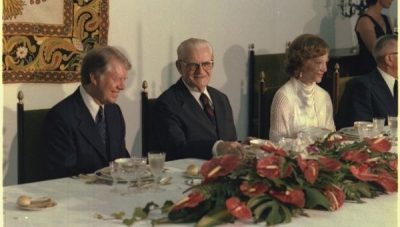
Ernesto Geisel, President of Brazil, hosts a State Dinner for Jimmy Carter and Rosalynn Carter. March 29, 1978 | Photo: U.S. National Archives and Records Administration
A declassified memo from the U.S. Department of State revealed that Brazilian dictator Ernesto Geisel (1974-1979) approved summary executions of “dangerous subversive” people personally, continuing with the extrajudicial methods of his predecessors.
The document was made public back in 2015, but it wasn’t until a few days ago that Matias Spektor, an international relations professor at the Getulio Vargas Foundation (FGV) and a columnist at Brazilian newspaper Folha, found it as part of his research work and posted it on social media, along with a picture of Geisel and Joao Baptista Figueiredo, who later became his successor.
The document narrates a meeting between President Geisel, General Milton Tavares de Souza and General Confucio Danton de Paula Avelino, respectively outgoing and incoming chiefs of the Army Intelligence Center (CIE), along with Figueiredo, who at that time was Chief of the National Intelligence Service (SNI).
“This is the most disturbing document I’ve read in 20 years of research: Just after being sworn in, Geisel authorized the continuation of the regime’s killing policies, but it requires the Army Intelligence Center previous authorization from the Planalto Palace.”
General Milton briefed Geisel about the role of the Army Intelligence Center (CIE) against “the internal subversive target” during the presidency of Emilio Garrastazu Medici, and said that “extrajudicial methods should continue to be employed against dangerous subversives.”
He also informed Geisel that about 104 people falling under this category had been executed by the CIE in the previous year. Figueiredo supported this policy and urged Geisel to continue with it.
According to the memo, Geisel “commented on the seriousness and potentially prejudicial aspects of this policy,” and said he wanted to think about it over the weekend. He decided to go along with it, but to limit the executions to “only dangerous subversives,” and required the CIE to consult Figueiredo for approval before any execution.
The entire CIE would then be under Figueiredo’s control, blurring the line between the CIE and the SNI.
“I didn’t know Geisel had given the Planalto Palace the responsibility over summary execution decision. The government’s leadership was not only aware of the executions but also ordered them. That’s impressive, unheard of,” said Spektor.
The memo was sent by William Colby, who was then Director of Central Intelligence Agency, to then U.S. Secretary of State Henry Kissinger, who also played a key role in promoting military coups against democratically elected governments in Latin America, under the subject “Decision by Brazilian President Ernesto Geisel To Continue the Summary Execution of Dangerous Subversives Under Certain Conditions” and dated April 11, 1974.
First and second paragraphs of the document (7 and 12 and a half lines) are still classified.
After the documents were picked up by Spektor, the Brazilian army stated that any classified documents that could prove Colby’s allegations of the events had been destroyed as it was stipulated by the laws of that period.
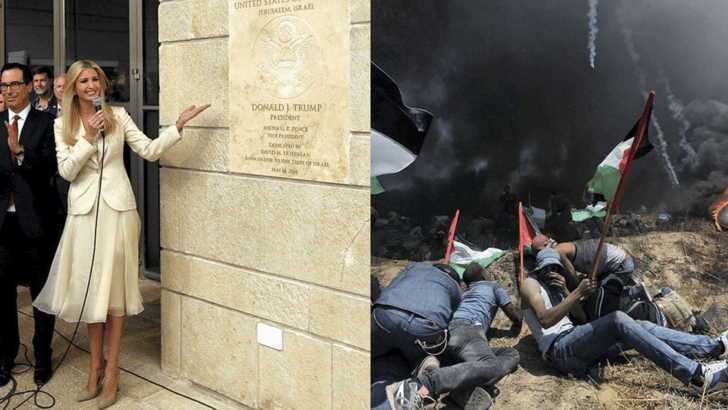
How obscenely ironic. Embassies traditionally symbolize diplomacy and peace. The opening of the US Embassy in Jerusalem was occasioned by a grotesque baptism of murder of Palestinians, heralding wider war in the Middle East.
Not only that, but on the very anniversary of one of the most shameful episodes of ethnic cleansing and dispossession over the past century – the 1948 Nakba or Catastrophe for Palestinians – the US government is brazenly siding with the heirs of that historic violence, the Israeli state.
Trump’s wholesale abandonment of any shame in endorsing Israeli violations against Arab historic rights is an incitement to regional conflagration.
It’s hard to express the horror. Israeli snipers shooting unarmed Palestinian protesters in Gaza, while some 100 kilometers away in Jerusalem, US dignitaries and evangelical pastors were blessing the opening of Washington’s new embassy as ‘God’s work’.
US President Donald Trump’s policy in the Middle East, if you could call it “policy”, has descended into absolute lunacy. No wonder, most European states stayed away from the US reception for unveiling its new diplomatic center.
Trump’s reckless disregard for Palestinian-Israeli peace is plunging the region into a blood bath. This week’s incendiary snub to Palestinians and the wider Arab region followed his tearing up of US obligations to the Iran nuclear accord. That violation of an international treaty has left diplomats from Europe, Russia, China and Iran scrambling to salvage a deal, which if it falls apart will unleash more instability and even war in the Middle East.
When Trump announced in December the moving of his country’s embassy from Tel Aviv to Jerusalem it was roundly rebuked at the United Nations. The move violates decades of international consensus that Jerusalem should be a shared capital between Palestinians and Israelis pending the outcome of peace negotiations.
Trump said his decision was merely a “reflection of reality”. Cynically, it marks US acquiescence to illegal Israeli occupation of Palestinian territory.
To be fair, Washington’s decision to relocate its embassy to Jerusalem was made over 20 years ago in 1995. Presidents Clinton, GW Bush and Obama opted to delay the actual move, claiming that such a move depended on progress in peace talks. Trump has now put into action legislation that was already on the books.
But what his declaration signifies is the jettisoning of any pretense by the US of being an “honest broker” between Israelis and Palestinians. Palestinian leaders now refuse to even engage with US officials, such is their disgust.
Paradoxically, Trump is helping to clarify the situation. The US is openly backing Israeli conquest of Palestinian territory and oppression of Palestinians. Washington is now transparently complicit in criminal Israeli policy rather than hiding behind a facade of mediation.
Israeli Prime Minister Benjamin Netanyahu hailed Trump this week for “making Israel great again”. With typical chutzpah, Netanyahu urged other nations to follow suit, absurdly claiming that by relocating their embassies from Tel Aviv to Jerusalem they would facilitate peace.
The perverse logic, as proven already by the US policy, is that any chance of peace between Palestinians and Israelis is being utterly destroyed.
The hellish conditions that Palestinians are subjected to under relentless Israeli occupation are driving them to the desperate act of lining up in their thousands under the fire of Israeli snipers.
Over the past six weeks since Gaza’s population began the “Great Return March” some 50 unarmed protesters have been murdered by Israeli live fire. On the day of the US Embassy opening, dozens of more civilians were shot dead, within hours of the Jerusalem ceremony.
Israeli commanders have openly admitted that a shoot-to-kill tactic is being used whereby soldiers are even targeting children who dare to approach a separation barrier on Gaza’s eastern border with Israeli-held territory.
The Gaza protests were organized by ordinary Palestinians to highlight their desperate plea against a barbaric occupation and prevention of residents returning to their historic homes, including in Jerusalem. Some 70 per cent of Gaza’s population are descended from refugees who were displaced by Israeli settlers in the 1948 pogroms and later in the 1967 War.
Under Israeli siege, which the UN has described as illegal, Gazans are prevented from moving out of the coastal strip. Some two million people – half of whom are under 18 years old – subsist in unlivable conditions. Over 90 per cent of Gaza’s water supply is contaminated, electricity is available for only a few hours per day, fisherman are prevented from going beyond a few miles from the shore where human sewage runs directly into the sea.
As American historian Norman Finkelstein points out, Gaza is being tormented by military occupation, an inhuman blockade, massacres conducted with impunity by Israeli military, and children being poisoned. It is this context of genocide in which the recent protests are taking place.
Those protests were organized to coincide with the 70th anniversary of Israel’s declared foundation on May 14, 1948. The next day, May 15, is what the Palestinians and many supporters around the world prefer to focus on – the Catastrophe.
Trump’s decision to open the US Embassy in Jerusalem this week could not be more provocative and criminally insane.
It truly is a shockingly callous display of US support for seven decades of barbaric oppression against Palestinians and the wider Arab region.
Jerusalem is seen as a holy site for Muslims and Christians. Washington’s acquiescing to Israel’s declaration of the city as “undivided capital” of the Jewish Israeli state is an outrageous blow to hundreds of millions of people from other faiths. As well as a vandalistic swipe at world opinion based on ordinary principles of justice, morality and compassion towards the long-suffering Palestinian people.
Europe bears a heavy responsibility for the plight of Palestinians. After Hamas won the parliamentary elections in 2006, the EU and the US both moved to sanction the new Hamas government owing to its refusal to recognize the state of Israel. The Israeli siege on Gaza has thus been perpetrated with the complicity of the EU and the US, albeit the latter appearing more brazenly complicit under Trump.
European governments may be discomfited by Trump’s strident contempt for Palestinian rights and international law. But they have contributed to the present deterioration in the Middle East by pandering towards Washington’s policies of sponsoring Israeli occupation, as well as sponsoring reactionary Arab client regimes like Saudi Arabia, and fomenting illegal wars and regime-change operations.
Trump’s impetuousness and ignorance – no doubt encouraged by multi-million-dollar donations from rich Jewish Americans like Sheldon Adelson – has set the US on a collision course with the Arab masses from his insolent indifference to their rights. As if that could not be any more combustible, Trump is pushing the same Israeli-Saudi despot agenda of hostility towards Iran, as evinced by the nuclear accord sabotage.
Europe has for too long tied itself to the shipwreck that is US policy in the Middle East. Surely, European governments must realize by now that if explosive violence and conflict is to be avoided in the Middle East, they must abandon the US shipwreck and begin asserting an independent foreign policy.
A genuine peace process advocating for long-neglected Palestinian rights, and repudiating US attempts to collapse the Iran nuclear accord are two immediate matters for the Europeans to claw back some sanity and respect – before it’s too late.
Zionism promised to solve the Jewish problem. It vowed to fix Diaspora Jews by means of a ‘homecoming,’ to make the Jews loved, empathic, bond them to the soil; in essence, to make them ‘people like all other people.’
The horrific scenes flooding in from Gaza today demonstrate that Zionism failed miserably. The Jewish State is an embarrassment to its original humanist endeavour and to humanity in general.
Just today, at least 43 Palestinian protestors have been killed and 2,200 wounded by Israeli troops at the Gaza border. Some reports suggest that half of the injuries were caused by live ammunition. This is devastating news. The criminality of Israel is institutional. This is not about one odd sniper who laughs as he shoots a young Palestinian in the knee, crippling him for life. Israel is displaying a systematic hierarchic murderous apparatus designed to sustain the oppression of the indigenous people of the land for an unlimited period.
Despite the Zionist dream, the Jewish state isn’t loved by its neighbours. It isn’t loved by the rest of the world either. In fact Israel’s actions evoke global repulsion. Instead of solving the Jewish problem, Zionism has only relocated the problem and amplified the symptoms it vowed to eliminate.
Truth can be a disturbing notion; no matter how much you try to suppress it, truth manages to come out. Accordingly, it is impossible to grasp the history of Jewish suffering without taking into consideration the atrocious actions of the Jewish state. As it happens, Israeli politics is driven by a complete dismissal of the other. The Israeli military operation in Gaza is simply a license to murder. One would hope that a state that names itself the Jewish State would be slightly more vigilant with its excessive use of power.
By now I believe that Israel is going to be remembered as the darkest chapter in Jewish history and beyond.
For some time, critics of President Trump’s policies have attributed them to a mental disorder; uncontrolled manic-depression, narcissus bullying and other pathology.
The question of Trump’s mental health raises a deeper question: why does his pathology take a specific political direction?
Moreover, Trump’s decisions have a political history and background, and follow from a logic and belief in the reason and logic of imperial power.
We will examine the reason why Trump has embraced three strategic decisions which have world-historic consequences, namely: Trump’s reneging the nuclear accord with Iran; Trump’s declaration of a trade war with China; and Trump’s meeting with North Korea.
In brief we will explore the political reasons for his decisions; what he expects to gain; and what is his game plan if he fails to secure his expected outcome and his adversaries take reprisals.
Trump’s Strategic Framework
The underlying assumption of Trump’s strategic thinking is that ‘power works’: the more intransigent his posture, the greater his belief in a unipolar world based on US power. As a corollary, Trump interprets that any ally, adversary, competitor who seeks negotiations, reciprocity or concessions is ‘weak’ and should be pressured or forced to concede greater concessions and further retreats and sacrifices, up to the ultimate goal of surrender and submission. In other words, Trump’s politics of force only recognizes counter-force: limitations in Trump’s policies will only result when tangible economic and military losses and costs in US lives would undermine US imperial rule.
Reasons Why Trump Broke the Peace Accord with Iran
Trump broke the accord with Iran because the original agreement was based on retaining US sanctions against Iran; the total dismantling of its nuclear program and calling into question Iran’s limited role on behalf of possible allies in the Middle East.
Iran’s one-sided concessions; trading military defense for market opportunities encouraged Trump to believe that he could intimidate Iran militarily by closing all its markets.
Trump views President Rohani as a rug seller not a military strategist. Trump believes that an economic squeeze will lead President Rohani to sacrifice his allies in Syria, Lebanon (Hezbollah), Yemen (Houthi), Palestine (Hamas) and Iraq (Shia) and to dismantle its ICBM defense strategy.
Trump pursues the strategic goal of weakening Iran and preparing a regime change, reverting Iran into a client state – as it was prior to the 1979 revolution under the Shah.
The second reason for Trump’s policy is to strengthen Israel’s military power in the Middle East. The Trump regime is deeply influenced by the Zionist power configuration (ZPC) in the US, dubbed ‘the Lobby’.
Trump recognizes and submits to Zionist-Israeli dictates because they have unprecedented power in the media, real estate, finance and insurance (FIRE). Trump recognizes the ZPC’s power to buy Congressional votes, control both political parties and secure appointments in the executive branch.
Trump is the typical authoritarian: at the throat of the weak, citizens, allies and adversaries and on his knees before the powerful ZPC, the military and Wall Street. Trump’s submission to Zionist power reinforces and even dictates his decision to break the peace accord with Iran and his willingness to pressure France, Germany, the UK and Russia to sacrifice billion-dollar trade agreements with Iran and to pursue a policy of pressuring Teheran to accept part of Trump’s agenda of unilateral disarmament and isolation. Trump believes he can force the EU multi-nationals to disobey their governments and abide by sanctions.
Reasons for Trump’s Trade War with China
Prior to Trump’s presidency, especially under President Obama, the US launched a trade war and ‘military pivot’ to China. Obama proposed the Trans-Pacific Pact to exclude China and directed an air and naval armada to the South China Sea. Obama established a high-powered surveillance system in South Korea and supported war exercises on North Korea’s border. Trump’s policy deepened and radicalized Obama’s policies.
Trump extended Obama’s bellicose policy toward North Korea, demanding the de-nuclearization of its defense program. President Kim of North Korea and President Moon of South Korea reached an agreement to open negotiations toward a peace accord ending nearly 60 years of hostility.
However, President Trump joined the conversation on the presumption that North Korea’s peace overtures were due to his threats of war and intimidation. He insisted that any peace settlement and end of economic sanctions would only be achieved by unilateral nuclear disarmament, the maintenance of US forces on the peninsula and supervision by US approved inspectors.
Trump’s unilateral declaration of a trade war against China accompanied his belief that military threats led to North Korea’s “capitulation” – its promise to end its nuclear program.
Trump slapped a trade tariff on over $100 billion dollars of Chinese exports in order to reduce its trade imbalance by $200 billion over two years. He demanded China unilaterally end industrial ‘espionage’, technological ‘theft’ (all phony accusations) and China’s compliance monitored quarterly by the US.
Trump demanded that China not retaliate with tariffs or restrictions or face bigger sanctions.
Trump threatened to respond to any reciprocal tariff by Beijing, with greater tariffs, and restrictions on Chinese goods and services.
Trump’s goals seek to convert North Korea into a military satellite encroaching on China’s northern border; and a trade war that drives China into an economic crisis.
Trump believes that as China declines as a world economic power, the US will grow and dominate the Asian and world economy.
Trump believes a successful trade war will lead to a successful military war. Trump believes that a submissive China, based on its isolation from the ‘dynamic’ US market, will enhance Washington’s quest for uncontested world domination.
Trump’s Ten Erroneous Thesis
Trump’s political agenda is deeply flawed!
Breaking the nuclear agreement and imposing harsh sanctions has isolated Trump from his European and Asian allies.
His military intervention will inflame a regional war that would destroy the Saudi oil fields. He will force Iran to pursue a nuclear shield against US-Israeli aggression and lead to a prolonged, costly and ultimately losing war.
Trump’s policies will unify all Iranians, liberals and nationalist, and undermine US collaborators.
The entire Muslim world will unify forces and carry the conflict throughout Asia, Africa and the Middle East.
Tel Aviv’s bombing will lead to counter-attacks in Israel.
Oil prices will skyrocket, financial markets will collapse, industries will go bankrupt.
Trump’s sanctions and military aggression against Iran will lead to mutual economic destruction.
Trump’s trade war with China will lead to the disruption of the supply chain which sustains the US economy and especially the 500 US multi-nationals who depend on the Chinese economy for exports to the US.
China will increase domestic consumption, diversify its markets and trading partners and reinforce its military alliance with Russia.
China has greater resilience and capacity to overcome short-term disruption and regain its dominant role as a global economic power house.
Wall Street will suffer a catastrophic financial collapse and send the US into a world depression.
Trump’s negotiations with North Korea will go nowhere as long as he demands unilateral nuclear disarmament, US military control over the peninsula and political isolation from China.
Kim will insist on the end of sanctions, and a mutual defense treaty with China.
Kim will offer to end nuclear testing but not nuclear weapons. After Trump’s reneged on the Iran deal, Kim will recognize that agreements with the US are not trustworthy.
Conclusion
Trump’s loud, threatening gestures are a real danger to world peace and justice. But his assumptions about the consequences of his policy are deeply flawed. There is no basis to think his sanctions will topple the Iranian regime; that Israel will survive unscathed from a war with Iran: that an oil war will not undermine the US economy; that Europe will allow its companies to be frozen out of the Iran market.
Trump’s trade war with China is dead in the water. He cannot find alternative production sites for US multi-nationals.
He cannot freeze China out of the world market, since they have links with five continents.
Trump cannot dominate North Korea and force it to sacrifice its sovereignty on the basis of empty economic promises to lift sanctions.
Trump is heading for defeats on all counts. But he may take the American people into the nuclear abyss in the process.
Epilogue
Are Trump’s threats of war part of a strategy of bluff and bombast designed to intimidate, in order to secure political advantages? Is Trump playing the Nixon-Kissinger ‘madman’ tactic, in which the Secretary of State tells adversaries to accept his ‘reasonable’ demands or face the worst from the President? I don’t think so.
Nixon, unlike Trump, was not led by the nose by Israel. Nixon, unlike Trump, was not led by pro-nuclear war advisers. Nixon, in contrast to Trump, opened the US to trade with China and signed nuclear reduction agreements with Russia.
When Google Earth was initially released in 2001, I immediately rushed to locate a village that no longer exists on a map, which now delineates a whole different reality.
Although I was born and raised in a Gaza refugee camp, and then moved to and lived in the United States, finding a village that was erased from the map decades earlier was not, at least for me, an irrational act. The village of Beit Daras was the single most important piece of earth that truly mattered to me.
But I could only find it by estimation. Beit Daras was located 32-kilometers northeast of Gaza, on an elevated ground, perched gently between a large hill and a small river that seemed to never run dry.
A once peaceful village, Beit Daras had existed for millennia. Romans, Crusaders, Mamluks and Ottomans ruled over and, even tried to subdue Beit Daras as in all of Palestine; yet they failed. True, each invader left their mark – ancient Roman tunnels, a Crusaders’ castle, a Mamluk mail building, an Ottoman khan (Caravanserai) – but they were all eventually driven out. It wasn’t until 1948 that Beit Daras, that tenacious village with a population of merely 3,000 was emptied of its population, and later destroyed.
The agony of the inhabitants of Beit Daras and their descendants lingers on after all of these years. The tragic way that Beit Daras was conquered by invading Zionist forces has left behind blood stains and emotional scars that have never healed.
Three battles were bravely fought by the Badrasawis, as the dwellers of Beit Daras are called, in defense of their village. At the end, the Zionist militias, the Haganah, with the help of British weapons and strategic assistance, routed out the humble resistance, which consisted mostly of villagers fighting with old rifles.
The ‘massacre of Beit Daras’ that followed remains a subdued scream that pierces through the hearts of Badrasawis after all of these years. Those who survived became refugees and are mostly living in the Gaza Strip. Under siege, successive wars and endless strife, their Nakba – the catastrophic ethnic cleansing of Palestine in 1947-48 – has never truly ended. One cannot dispel the pain if the wound never truly heals.
Born into a family of refugees in the Nuseirat Refugee Camp in Gaza, I took pride in being a Badrasawi. Our resistance has garnered us the reputation of being ‘stubborn’ and the uncorroborated claims of having large heads. We truly are stubborn, proud and generous, for Beit Daras was erased but the collective identity it has given us remained intact, regardless of whichever exile we may find ourselves.
As I child, I learned to be proud from my grandfather: A handsome, elegant, strong peasant with unshakable faith. He managed to hide his deep sadness so well after he was expelled from his home in Palestine, along with his entire family. As he aged, he would sit for hours, between prayers, searching within his soul for the beautiful memories of his past. Occasionally, he would let out a mournful sigh, a few tears; yet he never accepted his defeat, or the idea that Beit Daras was forever gone.
“Why bother to haul the good blankets on the back of a donkey, exposing them to the dust of the journey, while we know that it’s a matter of a week or so before we return to Beit Daras?” he told his bewildered wife, Zeinab as they hauled their children to navigate an endless exile.
I cannot pinpoint the moment when my grandfather discovered that his “good blankets” were gone forever, that all that remained of his village were two giant concrete pillars, and piles of cactus.
It isn’t easy to construct a history that, only several decades ago, was, along with every standing building of that village, blown to smithereens with the very intent of erasing it from existence. Most historic references written of Beit Daras, whether by Israeli or Palestinian historians, were brief, and ultimately resulted in delineating the fall of Beit Daras as just one among nearly 600 Palestinian villages that were often evacuated and then completely flattened during the war years. It was another episode in a more compounded tragedy that has seen the dispossession and expulsion of nearly 800,000 Palestinians.
But for my family, it was much more than that. Beit Daras was our very dignity. Grandpas’ calloused hands and leathery weathered skin attested to the decades of hard labor tending the rocky soil in the fields of Palestine. It was a popular pastime for my brothers and I to point to a scar on his body to hear a gut-busting tale of the rigors of farm-life.
Later in life, someone would give him a small hand-held radio to glean the latest news and he would, from that moment, never be seen without it. As a child, I recall him listening to the Arab Voice news on that battered radio. It once had been blue but now had faded to white with age. Its bulging batteries were duct-taped to the back. Sitting with the radio up to his ear and fighting to hear the reporter amidst the static, grandpa listened and waited for the announcer to make that long-awaiting call: “To the people of Beit Daras: your lands have been liberated, go back to your village.”
The day grandpa died, his faithful radio was lying on the pillow close to his ear so that even then he might catch the announcement for which he had waited for so long. He wanted to comprehend his dispossession as a simple glitch in the world’s consciousness that was sure to be corrected and straightened out in time.
But it didn’t. 70 years later, my people are still refugees. Not just the Badrasawis, but millions of Palestinians, scattered in refugee camps all across the Middle East. Those refugees, while still searching for a safe path that would take them home, often find themselves on yet another journey, another dusty trail, being pushed out time and again from one city to the next, from one country to another, even lost between continents.
My grandfather was buried in the Nuseirat Refugee Camp cemetery, not in Beit Daras as he had wished. But he remained a Badrasawi to the end, holding so passionately onto the memories of a place that for him – for all of us – remain sacred and real.
What Israel still fails to understand that the ‘Right of Return’ for Palestinian refugees is not merely a political or even a legal right to be overpowered by the ever-unfair status quo. It has long surpassed that into a whole different realm. For me, Beit Daras is not just a piece of earth but a perpetual fight for justice that shall never cease, because the Badrasawis belong to Beit Daras and nowhere else.
On Monday and Tuesday, Palestinians will commemorate the anniversary of the Nakba, or catastrophe, their mass expulsion and dispossession 70 years ago as the new state of Israel was built on the ruins of their homeland. As a result, most Palestinians were turned into refugees, denied by Israel the right to return to their homes.
Israel is braced nervously for many tens of thousands to turn out in the occupied territories this week to protest against decades of its refusal to make amends or end its oppressive rule.
The move on Monday of the US embassy to Jerusalem, a city under belligerent occupation, has only inflamed Palestinian grievances – and a sense that the West is still conspiring in their dispossession.
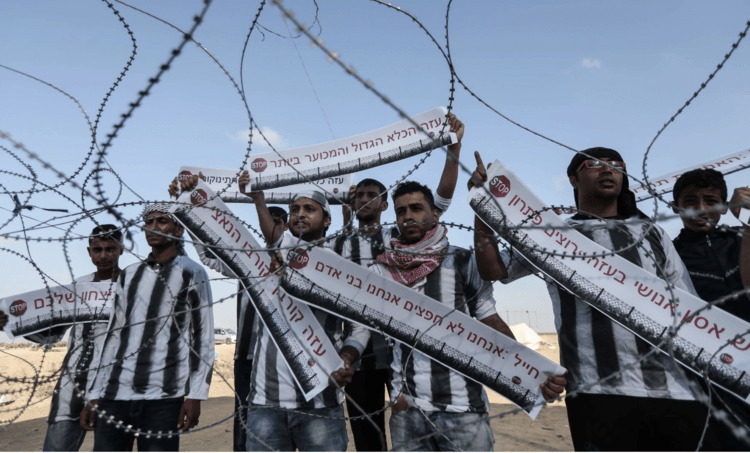
The expected focus of the protests is Gaza, where unarmed Palestinians have been massing every Friday since late March at the perimeter fence that encages two million of them.
For their troubles, they have faced a hail of live ammunition, rubber bullets and clouds of tear gas. Dozens have been killed and many hundreds more maimed, including children.
But for more than a month, Israel has been working to manage western perceptions of the protests in ways designed to discredit the outpouring of anger from Palestinians. In a message all too readily accepted by some western audiences, Israel has presented the protests as a “security threat”.
Israeli officials have even argued before the country’s high court that the protesters lack any rights – that army snipers are entitled to shoot them, even if facing no danger – because Israel is supposedly in a “state of war” with Gaza, defending itself.
Many Americans and Europeans, worried about an influx of “economic migrants” flooding into their own countries, readily sympathise with Israel’s concerns – and its actions.
Until now, the vast majority of Gaza’s protesters have been peaceful and made no attempt to break through the fence.
But Israel claims that Hamas will exploit this week’s protests in Gaza to encourage Palestinians to storm the fence. The implication is that the protesters will be crossing a “border” and “entering” Israel illegally.
The truth is rather different. There is no border because there is no Palestinian state. Israel has made sure of that. Palestinians live under occupation, with Israel controlling every aspect of their lives. In Gaza, even the air and sea are Israel’s domain.
Meanwhile, the right of Palestinian refugees to return to their former lands – now in Israel – is recognised in international law.
Nonetheless, Israel has been crafting a dishonest counter-narrative ever since the Nakba, myths that historians scouring the archives have slowly exploded.
One claim – that Arab leaders told the 750,000 Palestinian refugees to flee in 1948 – was in fact invented by Israel’s founding father, David Ben Gurion. He hoped it would deflect US pressure on Israel to honour its obligations to allow the refugees back.
Even had the refugees chosen to leave during the heat of battle, rather than wait to be expelled, it would not have justified denying them a right to return when the fighting finished. It was that refusal that transformed flight into ethnic cleansing.
In another myth unsupported by the records, Ben Gurion is said to have appealed to the refugees to come back.
In truth, Israel defined Palestinians who tried to return to their lands as “infiltrators”. That entitled Israeli security officials to shoot them on sight – in what was effectively execution as a deterrence policy.
Nothing much has changed seven decades on. A majority of Gaza’s population today are descended from refugees driven into the enclave in 1948. They have been penned up like cattle ever since. That is why the Palestinians’ current protests take place under the banner of the March of Return.
For decades, Israel has not only denied Palestinians the prospect of a minimal state. It has carved Palestinian territories into a series of ghettos – and in the case of Gaza, blockaded it for 12 years, choking it into a humanitarian catastrophe.
Despite this, Israel wants the world to view Gaza as an embryonic Palestinian state, supposedly liberated from occupation in 2005 when it pulled out several thousand Jewish settlers.
Again, this narrative has been crafted only to deceive. Hamas has never been allowed to rule Gaza, any more than Mahmoud Abbas’s Palestinian Authority governs the West Bank.
But echoing the events of the Nakba, Israel has cast the protesters as “infiltrators”, a narrative that has left most observers strangely indifferent to the fate of Palestinian youth demonstrating for their freedom.
Once again, these executions, supposedly carried out by the Israeli army in self-defence, are intended to dissuade Palestinians from demanding their rights.
Israel is not defending its borders but the walls of cages it has built to safeguard the continuing theft of Palestinian land and preserve Jewish privilege.
In the West Bank, the prison contracts by the day as Jewish settlers and the Israeli army steal more land. In Gaza’s case, the prison cannot be shrunk any smaller.
For many years, world heads of state have castigated Palestinians for using violence and lambasted Hamas for firing rockets out of Gaza.
But now that young Palestinians prefer to take up mass civil disobedience, their plight is barely attracting attention, let alone sympathy. Instead, they are criticised for “breaching the border” and threatening Israel’s security.
The only legitimate struggle for Palestinians, it seems, is keeping quiet, allowing their lands to be plundered and their children to be starved.
Western leaders and the public betrayed the Palestinians in 1948. There is no sign, 70 years on, that the West is about to change its ways.
Two million Palestinians in the Gaza Strip are slowly being suffocated. Over 40 per cent of Gazans are unemployed; there is virtually no economy; no electricity; the water is undrinkable; and the medical system has collapsed. It is the Israeli occupation that is responsible for the suffering of Palestinians in Gaza due to its 11-year-old siege imposed on the coastal enclave.
Since 2007, following Hamas’s victory in internationally-monitored elections, Israel has retained absolute control over the movement of people and goods via Gaza’s airspace, territorial waters, and land borders. This blockade subjects Gaza’s population to collective punishment, in contravention of international law.
Confronted with such oppression and the world’s silence in response to Israeli war-crimes, Palestinians in Gaza have no other option than to raise their voices in protest. Seventy per cent of Gaza’s population are refugees, or descendants of refugees, who were violently expelled from their homeland in 1948 to make way for the Zionist state of Israel. Israelis celebrate this land-grab as “independence” but for Palestinians it is the Nakba(catastrophe).
We, Palestinians have never been allowed to return to our land, despite United Nations General Assembly Resolution 194 guaranteeing us this inalienable right. In the Israeli apartheid state, Palestinians are stripped of their humanity; their identity reduced to that of “demographic threat”.
Since 30 March, thousands of Palestinians have been participating in the Great Return March (GRM), sending a united message to Israel and the world: We have the right to return to our homeland that was stolen from us in 1948. We have the right to move freely, to have electricity, to travel, to work. Through the GRM movement, Palestinians are not only demanding the right to return – but also the right to live.
The GRM is not Hamas-driven; it is Palestinian-inspired and driven. It is the embodiment of Palestinian popular resistance involving youth, women, and all Palestinians that steadfastly refuse to collaborate with the occupiers, accept Israeli occupation and submit to Zionist apartheid. They are fighting back, armed only with their rights and international law.
The GRM also shows that the Palestinian people are determined to achieve their freedom, their independence, and their right to return to the villages that they were forced out of 70 years ago.
These protests have also shown the world the brutality of the Israeli occupation government. Israeli forces use jeeps and drones to fire tear gas at paramedics and children. Dozens of snipers, armed with internationally-prohibited explosive bullets designed to permanently maim, have been stationed along the border, targeting and killing unarmed protesters like 15-year old Mohammed Ibrahim Ayoub, and journalists Yaser Murtaja and Ahmed Abu Hussein. Israeli bullets have, so far, killed 50 Palestinians and injured more than 7000 people over the last six weeks.
By killing and wounding so many, Israel had hoped that the masses would retreat, that the protests would subside and, eventually, end. This was not the case, and popular resistance will intensify as we approach 15 May, the 70th anniversary of the Nakba.
Like the apartheid South African government, Israel justifies its decades of state terrorism by demonising legitimate resistance movements, especially Hamas. Hamas was established only in 1987. What then explains the ethnic cleansing of Palestinians since 1948? What explains Israeli settlements and land thefts, Palestinian home demolitions, forced displacement, disproportionate use of force, detention without trial, arrest without due process, denial of entry, land confiscations, and movement restrictions against Palestinians for over 50 years? Israel can no longer rationalise its oppression of Palestinians by blaming Palestinians who exercise their natural and internationally-recognised right to resist.
The GRM is a turning point, just as the 1960 Sharpeville massacre was a turning point in South Africa’s liberation struggle. In Gaza, the world is witnessing an apartheid military regime killing non-violent protesters. The world did not look away from Sharpeville, and it must not look away from occupied Palestine either. The Palestinian call for justice, freedom and dignity must be heard and respected. Seventy years after hundreds of thousands of Palestinians were forced to become refugees through Zionist massacres and violence, we, our children and our grandchildren remain firm on our desire to exercise our right to return home. For Palestinians – and especially Palestinian refugees – the GRM represents a reclaiming of our dignity, and an announcement to the world that we will not accept the oppression of our people. We will continue resisting, the occupation will end, and we will achieve our liberation.
In an exclusive interview with Kathimerini, Syrian President Bashar al-Assad denied that the Syrian Army used chemical weapons against civilians, while taking aim at both Turkish President Recep Tayyip Erdogan and US President Donald Trump.
Saying that Syria gave up its chemical arsenal in 2013, Assad said the
“Western narrative started after the victory of the Syrian Army, not before.”
He accused Erdogan of being “affiliated” with the Muslim Brotherhood Islamist movement and called Turkish troops “terrorists” over their intervention in Afrin.
As for Trump, who has called Assad an “animal,” the Syrian leader said it did not bother him “because I deal with the situation as a politician, as a president.”
Alexis Papachelas: There have been accusations from the US and the Europeans about the use of chemical weapons, and there was an attack after that. What is your response to that? Was there a chemical attack? Were you responsible for it?
President Bashar al-Assad: First of all, we don’t have a chemical arsenal since we gave it up in 2013, and the international agency for chemical weapons conducted investigations about this, and it’s clear or documented that we don’t have any. Second, even if we did have, we wouldn’t use them, for many different reasons. But let’s put these two points aside, let’s presume that this army has chemical weapons and it’s in the middle of the war; where should it be used? At the end of the battle? They should use it somewhere in the middle, or where the terrorists made an advancement, not where the army finished the battle and the terrorists gave up and said, “We are ready to leave the area,” and the army is fully in control of that area. So the Western narrative started after the victory of the Syrian Army, not before. When we finished the war, they said, “They used chemical weapons.”
Second, the use of weapons of mass destruction (WMD) in a crammed area with a population like Douma – the supposed area, it’s called Douma and they talk about 45 victims – when you use WMD in such an area, you should have hundreds or maybe thousands of victims. Third, why do all the chemical weapons – the presumed or supposed chemical weapons – only kill children and women? They don’t kill militants. If you look at the videos, it’s completely fake. I mean, when you have chemical weapons, how could the doctors and nurses be safe, dealing with the chemical atmosphere without any protective clothes, without anything, just throwing water at the victims, and the victims become OK just because you washed them with water. So, it’s a farce, it’s a play, it’s a very primitive play, just to attack the Syrian Army, because… Why? That’s the most important part: When the terrorists lost, the US, France, the UK and their other allies who want to destabilize Syria lost one of their main cards, and that’s why they had to attack the Syrian Army, just to raise the morale of the terrorists and to prevent the Syrian Army from liberating more areas in Syria.
AP: Are you saying that there was a chemical attack and someone else is responsible, or that there was nothing there?
PBA: That’s the question, because the side who said – allegedly – that there was a chemical attack, had to prove that there was an attack. We have two scenarios: Either the terrorists had chemical weapons and they used them intentionally, or maybe there were explosions or something, or there was no attack at all, because in all the investigations in Douma, people said, “We didn’t have any chemical attack, we didn’t see any chemical gas or smell any,” and so on. So, we don’t have any indications about what happened. The Western narrative is about that, so that question should be directed at the Western officials who said there was an attack. We should ask them: Where is your concrete evidence about what happened? They only talk about reports. Reports could be allegations. Videos by the White Helmets – the White Helmets are funded by the British Foreign Office – and so on.
AP: In a tweet, US President Donald Trump described you as “animal Assad.” What is your response?
PBA: Actually, when you are president of a country, you have first of all to represent the morals of your people before representing your own morals. You are representing your country. Does this language represent the American culture? That is the question. This is very bad, and I don’t think so. I don’t think there’s a community in the world that has such language. Second, the good thing about Trump is that he expresses himself in a very transparent way, which is very good in that regard. Personally, I don’t care, because I deal with the situation as a politician, as a president. It doesn’t matter for me personally; what matters is whether something would affect me, would affect my country, our war, the terrorists, and the atmosphere that we are living in.
AP: He said “mission accomplished in Syria.” How do you feel about that?
PBA: I think maybe the only mission accomplished was when they helped ISIS escape from Raqqa, when they helped them, and it was proven by video, and under their cover. The leaders of ISIS escaped Raqqa, going toward Deir ez-Zor just to fight the Syrian Army. The other mission accomplished was when they attacked the Syrian Army at the end of 2016 in the area of Deir ez-Zor when ISIS was surrounding Deir ez-Zor, and the only force was the Syrian Army. The only force to defend that city from ISIS was the Syrian Army, and because of the Americans’ – and of course their allies’ – attack, Deir ez-Zor was on the brink of falling into the hands of ISIS. So, this is the only mission that was accomplished. If he’s talking about destroying Syria, of course that’s another mission accomplished. While if you talk about fighting terrorism, we all know very clearly that the only mission the United States has been carrying out in Syria is supporting the terrorists, regardless of their names, or the names of their factions.
AP: He also used such language with the North Korean leader, and now they’re going to meet. Could you potentially see yourself meeting with Trump? What would you tell him if you saw him face to face?
PBA: The first question you should ask is: What can you achieve? The other: What can we achieve with someone who says something before the campaign, and does the opposite after the campaign, who says something today, and does the opposite tomorrow, or maybe in the same day? So, it’s about consistency. Do they have the same frequency every day, or the same algorithm? So, I don’t think that in the meantime we can achieve anything with such an administration. A further reason is that we don’t think the president of that regime is in control. We all believe that the deep state, the real state, is in control, or is in control of every president, and that is nothing new. It has always been so in the United States, at least during the last 40 years, at least since Nixon, maybe before, but it’s becoming starker and starker, and the starkest case is Trump.
AP: When will you accomplish your mission, given the situation here in Syria now?
PBA: I have always said, without any interference, it will take less than a year to regain stability in Syria; I have no doubt about that. The other factor is how much support the terrorists receive, which is something I cannot tell you, because I cannot predict the future. But as long as it continues, time is not the main factor. The main factor is that someday, we’re going to end this conflict and we’re going to reunify Syria under the control of the government. When? I cannot say. I hope it’s going to be soon.
AP: There has been some criticism lately, because you apparently have a law that says that anybody who doesn’t claim their property within a month cannot come back. Is that a way to exclude some of the people who disagree with you?
PBA: No, we cannot dispossess anyone of their property by any law, because the constitution is very clear about the ownership of any Syrian citizen. This could be about the procedure. It’s not the first time we have had such a law just to replan the destroyed and the illegal areas, because you’re dealing with a mixture of destroyed and illegal suburbs in different parts of Syria. So, this law is not about dispossessing anyone. You cannot, I mean even if he’s a terrorist. Let’s say, if you want to dispossess someone, you need a verdict by the judicial system – you cannot make it happen by law. So, there’s either misinterpretation of that law, or an intention, let’s say, to create a new narrative about the Syrian government in order to rekindle the fire of public opinion in the West against the Syrian government. But about the law, even if you want a procedure, it’s about the local administration, it’s about the elected body in different areas, to implement that law, not the government.
AP: It is clear that your biggest allies in this fight are Russia and Iran. Are you worried they might play too important a role in the future of the country after this war is over?
PBA: If you talk about my allies as a president, they are the Syrian people. If you talk about Syria’s allies, of course they’re the Iranians and the Russians. They are our strongest allies, and of course China that supported us politically in the Security Council. As for them playing an important role in the future of the country, these countries respect Syria’s sovereignty and national decision making and provide support to insure them. Iran and Russia are the countries which respect Syria’s sovereignty the most.
AP: It’s been a few years since you visited Greece. Your father had a very close relation with some of the Greek political leaders. How have the relations been between Greece and Syria these days, and what kind of message would you like to send to the Greek people?
PBA: At the moment, there are no formal relations between Syria and Greece; the embassies are closed, so there are no relations. At the same time, Greece wasn’t aggressive towards what happened in Syria. It always supported a political solution, it never supported war or attacks against Syria. You didn’t play any role to support the terrorists, but at the same time, as a member – and an important member – of the EU, you couldn’t play any role, let’s say, in refraining the other countries from supporting the terrorists, violating the international law by attacking and besieging a sovereign country without any reason, without any mandate by the Security Council. So, we appreciate that Greece wasn’t aggressive, but at the same time, I think Greece has to play that role, because it’s part of our region. It is part of the EU geographically, but it’s a bridge between our region and the rest of Europe, and it’s going to be affected, and it has been affected by the refugee situation, and terrorism now has been affecting Europe for the last few years, and Greece is part of that continent. So, I think it’s normal for Greece to start to play its role in the EU in order to solve the problem in Syria and protect the international law.
AP: How about Turkey? Turkey invaded part of your country. You used to have a pretty good relationship with President Recep Tayyip Erdogan. How is that relationship now after the Turkish invasion?
PBA: First of all, this is an aggression, this is an occupation. Any single Turkish soldier on Syrian soil represents occupation. That doesn’t mean the Turkish people are our enemies. Only a few days ago, a political delegation visited from Turkey. We have to distinguish between the Turks in general and Erdogan. Erdogan is affiliated with the Muslim Brotherhood. Maybe he’s not organized, but his affiliation is toward that ideology, I call it this dark ideology. And for him, because, like the West, when the terrorists lost control of different areas, and actually they couldn’t implement the agenda of Turkey or the West or Qatar or Saudi Arabia, somebody had to interfere. This is where the West interfered through the recent attacks on Syria, and this is where Erdogan was assigned by the West, mainly the United States, to interfere, to make the situation complicated, again because without this interference, the situation would have been resolved much faster. So, it’s not about personal relations. The core issue of the Muslim Brotherhood anywhere in the world is to use Islam in order to take control of the government in your country, and to create multiple governments with this kind of relationship, like a network of Muslim Brotherhoods, around the world.
AP: At an election campaign rally this week, he said that he’s going to order another incursion into Syria. How are you going to respond to that if it happens?
PBA: Actually, Erdogan has supported the terrorists since the very beginning of the war, but at that time, he could hide behind words like “protecting the Syrian people,” “supporting the Syrian people,” “supporting the refugees,” “we are against the killing,” and so on. He was able to appear as a humanitarian president, let’s say. Now, because of these circumstances, he has to take off the mask and show himself as the aggressor, and this is the good thing. So, there is no big difference between the head of the Turkish regime sending his troops to Syria and supporting the terrorists; this is his proxy. So, we’ve been fighting his army for seven years. The difference between now and then is the appearance; the core is the same. At that time, we couldn’t talk about occupation – we could talk about supporting terrorists – but this time we can talk about occupation, which is the announcement of Erdogan that he’s now violating the international law, and this could be the good part of him announcing this.
AP: But how can you respond to that?
PBA: First of all, we are fighting the terrorists, and as I said, the terrorists for us are his army, they are the American army, the Saudi army. Forget about the different factions and who is going to finance those factions; at the end of the day, they work for one agenda, and those different players obey one master: the American master. Erdogan is not implementing his own agenda; he’s only implementing the American agenda, and the same goes for the other countries in this war. So, first of all, you have to fight the terrorists. Second, when you take control of more areas, you have to fight any aggressor, any army. The Turkish, French, whoever, they are all enemies; as long as they came to Syria illegally, they are our enemies.
AP: Are you worried about a third world war starting here in Syria? I mean, you have the Israelis hitting the Iranians here in your own country. You have the Russians, you have the Americans. Are you concerned about that possibility?
PBA: No, for one reason: Because fortunately, you have a wise leadership in Russia, and they know that the agenda of the deep state in the United States is to create a conflict. Since Trump’s campaign, the main agenda was against Russia, create a conflict with Russia, humiliate Russia, undermine Russia, and so on. And we’re still in the same process under different titles or by different means. Because of the wisdom of the Russians, we can avoid this. Maybe it’s not a full-blown third world war, but it is a world war, maybe in a different way, not like the second and the first, maybe it’s not nuclear, but it’s definitely not a cold war; it’s something more than a cold war, less than a full-blown war. And I hope we don’t see any direct conflict between these superpowers, because that is where things are going to get out of control for the rest of the world.
AP: Now, there’s a very important question about whether Syria can be a unified, fully sovereign country again. Is that really possible after all that has happened?
PBA: It depends on what the criteria of being unified or not is. The main factor to have a unified country is to have unification in the minds of the people, and vice versa. When those people look at each other as foreigners, they cannot live with each other, and that is where you’re going to have division. Now, let’s talk about facts and reality – not my opinion, I can tell you no, it’s not going to be divided, and of course we’re not going to accept that, but it’s not about my will or about my rhetoric, to say we’re going to be unified; it’s about the reality.
The reality, now, if you look at Syria during the crisis, not only today, since the very beginning, you see all the different spectrums of the Syrian society living with each other, and better than before. These relationships are better than before, maybe because of the effect of the war. If you look at the areas under the control of the terrorists, this is where you can see one color of the Syrian society, which is a very, very, very narrow color. If you want to talk about division, you have to see the line, the separation line between either ethnicities or sects or religions, something you don’t see. So, in reality, there’s no division till this moment; you only have areas under the control of the terrorists. But what led to that speculation? Because the United States is doing its utmost to give that control, especially now in the eastern part of Syria, to those terrorists in order to give the impression that Syria cannot be unified again. But it’s going to be unified; I don’t have any doubt about that.
AP: But why would the US do that if you’re fighting the same enemy: Islamic terrorism?
PBA: Because the US usually has an agenda and it has goals. If it cannot achieve its goals, it resorts to something different, which is to create chaos. Create chaos until the whole atmosphere changes, maybe because the different parties will give up, and they will give in to their goals, and this is where they can implement their goals again, or maybe they change their goals, but if they cannot achieve it, it’s better to weaken every party and create conflict, and this is not unique to Syria. This has been their policy for decades now in every area of this world.
AP: Looking back, do you feel you’ve made any mistakes in dealing with this crisis and the civil war, when it started?
PBA: If I don’t make mistakes, I’m not human; maybe on a daily basis sometimes. The more you work, the more complicate the situation, the more mistakes you are likely to make. But how do you protect yourself as much as possible from committing mistakes? First of all, you consult the largest proportion of the people, not only the institutions, including the parliament, syndicates, and so on, but also the largest number of people, or the largest part of society, to participate in every decision.
While if you talk about the way I behaved toward, or the way I led, let’s say, the government or the state during the war, the main pillars of the state’s policy were to fight terrorism – and I don’t think that fighting terrorism was wrong, to respond to the political initiatives from different parties externally and internally regardless of their intentions, to make a dialogue with everyone – including the militants, and finally to make reconciliation. So, about the pillars of our policy, I think the reality has proven that we were right. As for the details, of course, you always have mistakes.
AP: How much is it going to cost to reconstruct this country, and who is going to pay for that?
PBA: Hundreds of billions, the minimum is 200 billion, and according to some estimates it’s about 400 billion dollars. Why is it not precise? Because some areas are still under the control of the terrorists, so we couldn’t estimate precisely what the figure is. So, this is plus or minus, let’s say.
AP: There has been a lot of speculation. For example, people say in order for a political solution to be viable, you might have to sacrifice yourself for the good of the country. Is that something that has crossed your mind?
PBA: The main part of my future, as a politician, is two things: my will and the will of the Syrian people. Of course, the will of the Syrian people is more important than my will, my desire to be in that position or to help my country or to play a political role, because if I have that desire and will and I don’t have the public support, I can do nothing. After seven years of me being in that position, if I don’t have the majority of the Syrian people’s support, how could I hold it for more than seven years now, with all this animosity from the strongest and the richest countries? Who supports me? If the Syrian people are against me, how can I stay? So, when I feel that the Syrian people do not want me to stay anymore, of course I have to leave without any hesitation.
AP: A lot of blood has been spilt. Can you see yourself sitting across from the opposition and sharing power in some way?
PBA: When you talk about blood, you have to talk about who spilt that blood. I was president before the war for 10 years. Had I been killing the Syrian people for 10 years? No, definitely not. So, the conflict started because somebody, first of all part of the West, supported those terrorists, and they bear the responsibility for this war. So first of all the West, who provided military and financial support and political cover, and who stood against the Syrian people, who impoverished the Syrian people and created a better atmosphere for the terrorists to kill more Syrian people. So, part of the West, mainly France, UK, and US, and also Saudi Arabia and Qatar and Turkey are responsible for this part. Of course blood has been spilt – it’s a war – but who’s responsible? Those who are responsible should be held accountable.
For the first time in decades, it’s hard to ignore the threat of nuclear war. But as long as you’re far from the blast, you’re safe, right? Wrong. In this sobering talk, atmospheric scientist Brian Toon explains how even a small nuclear war could destroy all life on earth — and what we can do to prevent it. A professor in the Department of Atmospheric and Oceanic Sciences at the University of Colorado-Boulder, Brian Toon investigates the causes of the ozone hole, how volcanic eruptions alter the climate, how ancient Mars had flowing rivers, and the environmental impacts of nuclear war. He contributed to the U.N.’s Nobel Peace Prize for climate change and holds numerous scientific awards, including two NASA medals for Exceptional Scientific Achievement. He is an avid woodworker. This talk was given at a TEDx event using the TED conference format but independently organized by a local community. Learn more at https://www.ted.com/tedx
WASHINGTON – With the 2018 Congressional midterm elections approaching, Republicans – eager to keep their control of both houses of Congress – have been seeking lucrative donations that would give Republican candidates an advantage in the lead-up to November.
On Thursday, those efforts paid off in a big way as the top Republican congressional political action committee (PAC), the Congressional Leadership Fund, secured a massive $30 million donation from Las Vegas casino mogul Sheldon Adelson. Adelson’s massive donation will account for just over 41 percent of all donations made to the group since January 2017.
According to Politico, the deal was brokered in part by Rep. Paul Ryan (R-WI) even though, as a federally elected official, he is not permitted to solicit such eight-figure donations from private donors. In order to get around this inconvenience, Ryan briefly left the room while Norm Coleman of the Republican Jewish Coalition, who was also present at the meeting, asked Adelson for the funds during Ryan’s conveniently timed absence, and thus secured the multi-million dollar contribution.
Adelson’s willingness to help the GOP stay in power come November is unsurprising. The Republican mega-donor gave heavily to the Trump campaign and Republicans in 2016, donating $35 million to the former and $55 million to the top two Republican Super PACs, the Congressional Leadership Fund and the Senate Leadership Fund, during that election cycle.
Getting what he paid for, and more
After investing so heavily in the GOP in 2016, Adelson’s decision to again donate tens of millions of dollars to Republican efforts to stay in power is a direct consequence of how successfully Adelson has been able to influence U.S. policy since Trump and the GOP rode to victory in the last election cycle.
In his media appearances and past interviews with journalists, Adelson has always made it clear that he is a “one-issue voter” and that his central concern is always Israel. Adelson’s belief that Trump would be “good for Israel” was the main driver behind his decision to spend more than $90 million on helping Trump and other Republicans win in the last election.
While Trump’s campaign promises – particularly those populist and anti-war in nature – have rung hollow, the President has notably fulfilled his campaign promises that were of prime importance to Adelson. Those promises were the moving the U.S. embassy in Israel from Tel Aviv to Jerusalem, which Adelson has aggressively promoted and is even helping to finance, and removing the U.S. from the Joint Comprehensive Plan of Action (JCPOA), better known as the Iran nuclear deal.
Adelson has also been successful in installing Iran war-hawks and pro-Israel stalwarts in the top government positions. Adelson-supported appointees include Nikki Haley, long-time recipient of Adelson campaign funds who now serves as U.S. ambassador to the UN; Mike Pompeo, former CIA director who has advocated for bombing Iran and now serves as secretary of state; and John Bolton, a close confidante of Adelson’s who is now National Security Adviser. Adelson was also instrumental in removing Pompeo and Bolton’s predecessors, Rex Tillerson and H.R. McMaster, from their respective posts, due to their support for JCPOA.
If anything, Trump’s presidency has shown that, while Trump has left the promises he made to his base largely unfulfilled, he gladly keeps the promises made to his biggest donor. Adelson’s new donation to the Congressional Leadership Fund shows that he has been extremely pleased with the performance of Trump and the Republican Party.
An alarming vision and a hard line bordering on insanity
Though Adelson has successfully used his donations to obtain policy decisions he has long desired, his work is still not done. Adelson, like many of the government officials he has put into power, is an advocate of a U.S./Israel war with Iran. With the U.S. out of JCPOA and now set to promote regime change as part of its official Iran policy, the foundation is quickly being laid for a military confrontation with Iran. Israel, whose leadership is also funded by Adelson, is also busy preparing for a major conflict with Iran.
Adelson’s perspectives on U.S. foreign policy, particularly towards Iran, are alarming, given that his influence on U.S. politics is set to grow in the wake of his latest donation to the Republican party. For instance, in 2015, Adelson advocated for a U.S. nuclear attack on Iran without provocation, so the U.S. could “impose its demands [on Iran] from a position of strength” during the negotiations that eventually led to the JCPOA.
Per Adelson’s plan, the U.S. would drop a nuclear bomb in the middle of the Iranian desert and then threaten that “the next one is in the middle of Tehran” to show that “we mean business.” Tehran, Iran’s capital, is home to nearly 9 million people, with 15 million more in its suburbs. Were Tehran to be attacked with nuclear weapons, an estimated 7 million would die within seconds. Any sort of diplomatic engagement with Iran, according to Adelson, is “the worst negotiating tactic I could ever imagine.”
Adelson has also given millions of dollars to the Foundation for Defense of Democracies, a pro-war think tank whose “experts” on Iran have pushed for pre-emptive military strikes targeting the country as well as blockades on food and medicine to Iranian civilians. He also has contributed nearly one-third of all donations to the anti-Iran group, United Against Nuclear Iran.
With a $30 million dollar infusion during a difficult and critical midterm election, the Republican party – with Trump still at the helm – will likely show its gratitude towards its most generous benefactor by continuing to heed his beck and call, including driving the U.S. to support a major military confrontation with Iran.
BY LAURENT GUYÉNOT • UNZ REVIEW • SEPTEMBER 6, 2022
Is it true that “9/11 was an inside job”? Yes, insofar as Israel is “inside” the U.S. But for the 9/11 truthers who have identified Israel as the main perpetrators, “9/11 was an inside job” is at best a half-truth, and at worst an integral part of the Zionist operation, like a secondary flag sewn as a lining under the false flag of Islamism. Victor Thorn (1963-2017) wrote in his book 9/11 made in Israel: The Plot Against America (2011): “In essence, the ‘9-11 truth movement’ was created prior to Sept. 11, 2001 as a means of suppressing news relating to Israeli complicity. . . . The slogan ‘9-11 was an inside job’ was quite possibly the greatest example of Israeli propaganda ever devised.” In milder terms, it is “controlled opposition”.
A genuine truth movement would have pointed to Israel as the prime suspect from the start. From day one, it was obvious who would benefit. … continue
This site is provided as a research and reference tool. Although we make every reasonable effort to ensure that the information and data provided at this site are useful, accurate, and current, we cannot guarantee that the information and data provided here will be error-free. By using this site, you assume all responsibility for and risk arising from your use of and reliance upon the contents of this site.
This site and the information available through it do not, and are not intended to constitute legal advice. Should you require legal advice, you should consult your own attorney.
Nothing within this site or linked to by this site constitutes investment advice or medical advice.
Materials accessible from or added to this site by third parties, such as comments posted, are strictly the responsibility of the third party who added such materials or made them accessible and we neither endorse nor undertake to control, monitor, edit or assume responsibility for any such third-party material.
The posting of stories, commentaries, reports, documents and links (embedded or otherwise) on this site does not in any way, shape or form, implied or otherwise, necessarily express or suggest endorsement or support of any of such posted material or parts therein.
The word “alleged” is deemed to occur before the word “fraud.” Since the rule of law still applies. To peasants, at least.
Fair Use
This site contains copyrighted material the use of which has not always been specifically authorized by the copyright owner. We are making such material available in our efforts to advance understanding of environmental, political, human rights, economic, democracy, scientific, and social justice issues, etc. We believe this constitutes a ‘fair use’ of any such copyrighted material as provided for in section 107 of the US Copyright Law. In accordance with Title 17 U.S.C. Section 107, the material on this site is distributed without profit to those who have expressed a prior interest in receiving the included information for research and educational purposes. For more info go to: http://www.law.cornell.edu/uscode/17/107.shtml. If you wish to use copyrighted material from this site for purposes of your own that go beyond ‘fair use’, you must obtain permission from the copyright owner.
DMCA Contact
This is information for anyone that wishes to challenge our “fair use” of copyrighted material.
If you are a legal copyright holder or a designated agent for such and you believe that content residing on or accessible through our website infringes a copyright and falls outside the boundaries of “Fair Use”, please send a notice of infringement by contacting atheonews@gmail.com.
We will respond and take necessary action immediately.
If notice is given of an alleged copyright violation we will act expeditiously to remove or disable access to the material(s) in question.
All 3rd party material posted on this website is copyright the respective owners / authors. Aletho News makes no claim of copyright on such material.

 Aletho News
