Last week it happened that God and the United States Treasury managed to underwrite a record issue of Israel Government bonds to continue the war against the Arabs in Gaza, West Bank, Lebanon, Syria, Iraq – and Iran if necessary.
The war financing comprised $2 billion of five-year bonds, and $3 billion each of 10 and 30-year bonds.
The US Treasury guarantees bond holders that if Israel defaults on repayment of its obligations, the US will pay instead. Notwithstanding this, the Israelis were obliged to offer an extra 1.35%, 1.45%, and 1.75% more in interest over the going rate for US Treasury bonds for the same length of term.
The Reuters news agency headline on March 6 celebrated “Israel sells record $8 billion in bonds despite Oct 7 attacks, downgrade”. The propaganda agency based in New York quoted Israel’s Accountant-General as claiming the bond placement “results showed an “unprecedented expression of confidence in Israel’s economy by the world’s largest international investors”.*
In fact, according to well-informed bond trade sources in Europe, with the higher interest rates the market has just demanded from the Israelis, the spread between the Israel bonds and US Treasuries has never been wider, and the worse this spread will become for Israel. This is a vote of no-confidence from the market which the Israelis, the Americans, and their media are trying to keep secret.
The longer the war is protracted, the more obvious the costs of Israel Defence Forces’ (IDF) failure will become – and the deeper the negative bond sentiment will grow. By converting secrecy into money, the market is signalling that it has begun to turn against Israel – and profit at Israel’s expense.
Also unprecedented is the secrecy in which the “expression of confidence” has been managed by the US, French, and German banks acting as managers of the Israeli bond issue; and of the US Securities and Exchange Commission (SEC), which has had regulatory oversight of the process. The debt financing has been reported as a “private placement”; this has removed the requirement that the Israelis produce a public prospectus explaining how they think their war – plausibly genocide, according to the International Court of Justice in its ruling of January 26, 2024 – is going, and how long the IDF claim it will last.
This does not remove the legal requirement on the two US banks engaged in marketing the bonds to US investors, Bank of America and Goldman Sachs, to submit a formal application for SEC approval of what is called a letter of consent. However, asked to confirm the contents of the letter of consent application for the sale of the Israeli bonds, and its official approval, the SEC has refused to give any answer.
Goldman Sachs was asked the same questions. The bank also refuses to say.
Last October the chief executive of Goldman Sachs, David Solomon,* issued a personal letter to the bank’s employees claiming the Hamas operation was a “violation of fundamental human values”: Solomon then proposed a $2 million gift of bank funds “to organizations providing critical support and humanitarian relief in Israel”; plus additional bank money, three bank dollars for every one contributed by bank staff making donations under $25, and one for one if the staff contribution was over $25. Asked how much money has been raised for Solomon’s gift to the Israelis, the bank is refusing to reply.
In other words, Israel’s public genocide is a private secret among Americans who are paying for it, and among US government officials responsible for regulating the scheme according to US law.
According to well-informed bond traders, this deal-making is worth in fees to the dealmakers, led by Goldman Sachs, about $100 million.
The following week, the downgrade by the Moody’s rating agency confirmed the inflection in market sentiment against Israel, with worse to come.
A month ago, Bloomberg’s Israeli reporter Galit Altstein was assigned the job of printing all the material he could find promoting the sale of the bonds. The headline of his report implied that Israel would be able to finance its war despite the Moody’s downgrade and the longer-term risks in the small print of the Moody’s report.
According to Bloomberg, about $58 billion in new debt would be issued this year, up by a third from the prewar year. About 80% of that total is usually raised in the domestic Israeli market; but if Israeli investors lack the funds or are fleeing to safe havens for their money, a much larger percentage of the issue will have to be raised from international investors, most of them in the US. This, conceded Bloomberg’s Israeli informants, would require “private placements, which are typically bought by a few investors at most. Those have been arranged by banks such as Goldman Sachs and Deutsche Bank.”
“Domestic issuance in the first two months of this year,” Altstein reported for Bloomberg, “is projected to total the equivalent of more than $9 billion, a 350 percent rise from the same period last year… The cost of insuring against an Israeli default — as measured by credit default swaps — is now higher than that for lower-rated sovereigns such as Mexico and Indonesia, indicating some investors are nervous.”
Israeli financial media reporting indicates that the $8 billion in bond sales completed this month were entirely placed outside Israel.
In the money markets, nervousness fetches a rising price; in the case of Israel’s genocide bonds the only way to keep that price rise secret is through private placements. They are operations run by banks like Goldman Sachs which avoid the requirements of issuing a prospectus; obtaining a credit rating from a ratings agency which evaluates the prospectus claims; and making a market with semi-public meetings with investors and answering their questions. What Goldman Sachs does instead, according to those familiar with the bank’s operations, is to “dump the issue in state or institutional pension funds which can be counted on to hold the issue until maturity, and ask no questions.”
But even passive pension fund managers have their fiduciary limits: Israel’s war began to trigger withdrawals from both Israeli state and corporate bonds by Norwegian pension funds last November; by Danish pension funds after the genocide ruling by the ICJ in January.
An index tracking ten Israeli corporate bonds for the banking, telecommunication, pharmaceutical, and real estate sectors, shows market demand for Israeli debt issues fell in the first month of the war, but then began recovering above the pre-war levels.
By opting for private placement, the Israelis, Goldman Sachs and Bank of America agreed to avoid having to issue prospectus claims about the war against the Arabs which, if truthful, might reveal how false Israeli government claims about the war have been so far; and if false, would create a legal liability for the Israelis and the banks to being charged with a Section 17(a) fraud.
In the US Securities Act, which the Securities and Exchange Commission (SEC) enforces, Section 17(a) “makes it unlawful to ‘employ any device, scheme, or artifice to defraud’, ‘obtain money or property’ by using material misstatements or omissions, or to ‘engage in any transaction, practice, or course of business which operates or would operate as a fraud or deceit upon the purchaser.’ This provision is closely tracked by Section 10b of the Securities Exchange Act and Rule 10b-5, which is used more widely by investors suing for fraud.”
The ICJ ruling against Israel in January has not stopped or even paused the IDF operations in Gaza, the West Bank, or on the northern front with Lebanon. However, the court has established a benchmark for “material misstatements and omissions” in what the Israel bond marketeers can say without running into Section 17(a) fraud litigation. This makes Israel’s war financing riskier and a bond prospectus impossible; it also makes the interest rate cost to the Israelis more expensive. For Goldman Sachs and the other banks engaged, that has meant more profit with higher fees.
Asked what the market was thinking about the private placement of the Israeli paper, a veteran European trader refused to reply. Other traders in Switzerland answered in generalities until Israel’s bonds were mentioned; then there was stonewalling. “It’s certain there’s an omerta,” a trade source commented. “The Israeli finance ministry has claimed the bond offer drew 400 investors from 36 countries making bids totalling $38 billion. But there is no mention of how the bonds were actually allocated. I suspect there were many token offers and only a few selected buyers got most of the issues.”
The Israeli financial source Globesclaims “demand for the issue was led by first-rate strategic investors such as pension funds, insurance companies, hedge funds, and institutions that have been holding Israeli securities for many years.”
A bond trade source at an international institution points out that “when issuing a bond, the lead manager charges a fee. The net proceeds are going to be obviously less. The question is how much is Goldman Sachs charging in fees? This is usually stated in a prospectus but we don’t have that in the Israeli case. If the issue is difficult to place, the lead manager will contract with other banks to share the burden. They will then use a portion of the fees to make a market for the issued instruments and stabilize the pricing. Again this should be disclosed.”
In the results given by Israeli officials to Reuters on March 6, it was reported that Israel sold $2 billion of five-year bonds, and $3 billion each of 10 and 30-year bonds. “This is unusual,” the trade source comments. “If you need to restructure your economy you would expect most of the costs will be upfront, with payback from the higher efficiencies or higher profits reimbursing the borrowed funds later. This should not take ten or thirty years, so another calculation is in play.”
He believes the Israel government’s calculation is that the war on the military front is going to get worse, and the economic war for longer than can be acknowledged publicly. “So they are trying to lock in as much money for the long term as they can now, leaving less to pay back in the short term. They say they are aiming to raise $58 billion over this year, but we are already three months in — they have $50 billion still to go. At this rate of timing and at this pricing, they won’t make it.”
“As for the fees charged by a lead manager for an $8 billion debt issue, these can vary depending on several factors including the complexity of the issuance, prevailing market conditions, and negotiation between the government and the lead manager. Typically, lead managers charge a percentage fee based on the size of the offering, often from 0.5% to 2% of the total amount raised. Therefore, for an $8 billion issue, lead manager fees could range from $40 million to $160 million. However, these figures are indicative and could vary based on the specific terms of the deal.”
“I speculate that the fees will be around $100 million. The princes at Goldman Sachs are being rewarded handsomely. We will have to wait and see if they will regret it. The buyers should also be asking the fee question. If there is no answer, then these Israel bonds are not being bought or placed based on financial reasoning. It’s political, ideological, religious.”*
The SEC last published an Israel bond prospectus in June 2018. The amount of the placement is not recorded.
The US Government was identified as the guarantor of the debt paper. “The amount of guarantees that may be issued to Israel under the loan guarantee program may be reduced by an amount equal to the amount extended or estimated to have been extended by Israel for activities that the President of the United States determines are inconsistent with the objectives and understandings reached between the United States and Israel regarding the implementation of the loan guarantee program. Under the program, the United States issues guarantees with respect to all payments of principal and interest on certain bonds issued by Israel. The proceeds of the guaranteed loans may be used to refinance existing debt. Under the $9 billion loan guarantee program, between September 2003 and November 2004 Israel issued guaranteed notes totaling $4.1 billion face value. Israel has not issued any notes under the loan guarantee program since November 2004, and up to $3.8 billion of U.S. loan guarantees (subject to the reductions described above) remains available.”
There has never been a determination by the President that the guarantees should be suspended because of “activities… inconsistent with the objectives and understandings reached between the United States and Israel”. For the Biden Administration, genocide is not an “inconsistent activity”.
The map accompanying the 2018 prospectus shows the occupied West Bank and Golan Heights as subject “to agreements between the State of Israel (the “State” or “Israel”) and the Palestinian Liberation Organization”. The Golan Heights are legally Syrian territory, and there is no agreement. Gaza is marked separately without explanation – and without an agreement with the Hamas administration of Gaza. According to the document, before the date of the prospectus, Israeli military operations against Hamas in Gaza “did not materially affect the Israeli economy.” To claim this now is not only propaganda, it would be a material misstatement — in SEC terminology, a Section 17(a) fraud.
During the marketing of the $8 billion in bonds, there were highly confidential briefings for selected investors. According to Globes, “prior to the offering, Israel’s Accountant General Yali Rothenberg and his team led rounds of extensive meetings in Europe and the US.”
US bond trading sources believe it likely that Goldman Sachs and Bank of America, the two US banks identified as placing the bonds in the US market, sought to protect themselves from what Rothenberg and his Israeli officials said at these meetings, and from later reaction by bond buyers if the war goes longer and much worse for Israel than they were led to believe. A letter of consent seeking approval from the SEC is protective cover from Section 17(a) fraud liability in the absence of SEC review and approval of a prospectus.
Scott Schneider is head of public affairs and press spokesman at the SEC. He speaks for Gary Gensler, chairman of the SEC since 2021.* The SEC was asked by email whether “the widely publicized Israeli government bonds to be issued this year on a private placement basis are subject to SEC supervision to the extent of requiring a formal application for consent to the issues.” He was also asked to say what letters of consent have been approved by the SEC in relation to earlier Israeli issues.
Left to right, Yali Rothenburg, Israel’s Accountant General; Gary Gensler, SEC Chairman; Scott Schneider, SEC press spokesman.
There was no reply to the email, and no reply when the questions were repeated by telephone to the SEC press office in Washington.
When clarification of the letter of consent issue was then requested from Goldman Sachs, the press spokesman in New York, Jen Blackhall, promised a response, but none there came. The stonewalling by Goldman Sachs has also extended to the patsy question asked – how much in charity funds have been donated to Israel on CEO Solomon’s request to his staff last October.
Bond traders in London, Europe, and the US consulted for this story believe that the most reliable indicator that the money markets have begun to turn against Israel can be found in the spread between the interest rates (or yield-to-maturity**) of Israel’s bond issues compared with US Treasuries. For more details, click to read.
COMPARISON OF THE SPREAD BETWEEN 10-YEAR ISRAEL & US BONDS, MARCH 11, 2023-MARCH 11, 2024
The positive-negative spread between Israel’s 10-year government bond yield and the United States’ 10-year Treasury yield indicates when Israel’s yield is lower or higher than that of the US Treasury at that particular point in time.
The source, Worldgovernmentbonds.com, explains: “In the case of government bonds, the yield spread also means credit spread. These countries usually differ regarding credit quality. A positive spread means that the percentage yearly return of one bond over another is higher. For example, if one bond is yielding 5% and another is yielding 3%, the spread is 2%, or 200 basis points (bp).”
What remains unclear is whether the private-placement Israel bonds are included in the charting; if they are excluded, this is an attempt to keep the political and military meaning of the spread from becoming obvious outside the bond market.
The international bond trade source explains: “Until the war, Israel was able to finance itself at a lower cost than the US government, if you look at the 10-year bond spread in basis points [percentage points] between them. Then at the start of the war the situation reverses itself. Israeli bonds lose their advantage. The Israeli government is now having to pay a premium in interest rate over US Treasuries in order to secure buyers. Last week’s reports show that Israel is committing to pay 135 basis points over comparable 5-year US Treasuries, 145 basis points over 10-year Treasuries and 175 basis points over US 30-year bonds. For comparison, US 5-year bonds currently yield 4.15%, 10-year Treasuries are at 4.16%, and 30-year notes yield 4.30%.”
“Note that the chart is lagging behind the new $8 billion placement, and has not yet registered the widening of the spread against Israel. This is because the chart is based on all bonds which have a residual maturity of ten years, so it is showing an average. This average indicated that Israel’s 10- year residual maturity bonds were trading at a positive spread of 4.9 basis points (100 basis points = one percent) to the US equivalents. Worldgovernmentbonds.com does not provide a listing of the issues included in its calculations, but future charting can be expected to reveal the latest private placements will accelerate the widening of the spread. With $50 billion more in private placements still to go, the cost to the Israelis will become higher than ever before – and the spread will be pushed wider. That is if the private placements are included in the charting.”
“The outcome of the latest Israel government bond issue is nothing for them to cheer about. The previously favourable spread compared to their US Government guarantor has evaporated and now reversed itself. The same goes for the loss of money market confidence in Israel.”
[*] When an international court of law determines that a religious organization like the state of Israel is plausibly genocidal, it is relevant to note the religious affiliations of organizations which may be assisting in the genocide with money or propaganda. For example, the Reuters executive responsible for ethics and standards is Alix Freedman, who is Jewish. The SEC Chairman since 2021 is Gary Gensler, who is Jewish. The Goldman Sachs chief executive David Solomon is Jewish.
[**] The yield to maturity (YTM) of a government bond is a measure indicating the total return investors can expect to receive if they hold the bond until it matures, taking into account its current market price, the coupon payments, and the time remaining until maturity. For more details, click to read.
The United States Imperial Government (USIG) claims to be keeping the peace, underwriting the liberal, rules-based international order and safeguarding the global security architecture. This is not true. What the USIG is actually doing is killing people, helping get lots of people killed, and assisting foreign states as they commit corporate suicide. Israel’s ongoing, “plausibly genocidal” slaughter in Gaza and the West Bank is the latest example of this.
The United States is an empire and empire is murder-suicide. Since 9/11, U.S. soldiers have directly killed more than 400,000 civilians and indirectly contributed to the deaths of more than four million civilians. Meanwhile, more soldiers who served in the U.S. government’s Global War On Terror have committed suicide than have been killed in combat. Four times more.
The American People have not escaped suffering as the USIG and its empire have dished out catastrophic devastation in Afghanistan, Somalia, Iraq, Pakistan, Egypt, Yemen, Libya, Syria, and Mali. The cost of living has exploded. Our infrastructure is in shambles. Public trust in government has collapsed. The military’s “recruitment landscape” is in free fall. And things are so bad at home the government has found a new job: attacking “tent cities” filled with “under-sheltered” people. Murder-suicide.
Then there are the vassal or “client” states. In the propaganda, the empire defends these states from…whatever. But in reality, it helps these states murder people all while creating the conditions for these states to kill themselves. This has been demonstrated recently in Afghanistan (state committed suicide), Ukraine (state is trying to commit suicide) and Israel (state is thinking about committing suicide).
In October, 2001, the USIG invaded Afghanistan and smashed the Taliban-controlled state. In its place was installed a new state with a new military, which Libertarian Institute Director Scott Horton describes:
“The new regime was also largely a coalition government of ethnic minorities, the Tajiks, Uzbeks, and Hazaras, being leveraged against the 40 percent plurality Pashtuns, dominant in the east and south of the country where the Taliban are from.”
This coalition regime could not exist without billions of U.S. dollars in its coffers, U.S. boots on the ground, and U.S. air power in the sky. As predicted by Horton, as soon as U.S. forces began their withdrawal from Afghanistan, the Afghan state (along with its military) immediately killed itself. The Taliban resurrected their state which the U.S. had smashed almost twenty years earlier.
In February 2014, the USIG backed a violent, neo-Nazi led coup in Ukraine. Instead of smashing the entire state, the coup overthrew President Viktor Yanukovych’s administration. Unlike Afghanistan’s anti-Taliban government in a box, the Ukrainian government under new management was capable of existing without a massive U.S. military presence. It was not, however, capable of winning a war with Russia. It took eight years, but the USIG managed to provoke a war with Russia.
Ukraine has been defeated but the imperial wizards in DC refuse to admit this truth and seek peace. There could have been a peace deal two years ago, when it was still fashionable for Americans to fly the Ukrainian flag outside their front doors, but the USIG crushed it. The Ukrainian state is bleeding out and continuing the war at this point puts the entire Ukrainian nation at risk. Russia could seize all of Ukraine and downgrade it from sovereign nation to a Russian aircraft carrier.
Israel has been fortunate to never have its state murdered or regime changed by the USIG. Quite the opposite; Israel has intervened in USIG affairs to a shocking extent. The Israel lobby wields massive influence in Washington DC, so much so that President Joe Biden is risking his re-election chances by refusing to stop producing Israel’s “plausibly genocidal” mass killing spree in Gaza.
This gleeful and live streamed spree of sadism has not been good for Israel. Its state is provoking the global community to view it as a deranged pariah, including the great powers of Russia and China. Even within America, the people want a ceasefire. We want it to stop.
Meanwhile, Israeli society is cracking. Approximately 200,000 Israelis have been displaced from their homes in the south and north of the country. The IDF has suffered thousands of casualties, the economy is destabilized, and fear has blanketed the land.
And now Israel is planning an invasion of southern Lebanon. Such an invasion would be a hoped for but unexpected gift to Hamas. Experts such as Col. Douglas Macgregor, Col. Lawrence Wilkerson, Lt. Col Daniel Davis, Alastair Crooke, John Mearsheimer and Robert Pape have all warned against the invasion. They have argued that Israel risks catastrophic fallout from such a move, from mass causalities to provoking a regional war and even suffering strategic defeat.
Israel supporters seem confident in its security state, despite its massive failure on October 7. Tel Aviv appears to be operating with the assurance that the U.S. military will step in with strike packages and boots on the ground if and when needed. And yes, DC will let American cities die while it views Israel as too big to fail.
But the empire is beset by incompetence and anyone who paid attention to the self-immolation of the Afghan state and the slow suicide of the Ukrainian state knows this isn’t going to end well.
Over 7,000 copies sold so far. Not only that, the book is now being circulated among staff in TWO different U.S. Senators office: Rand Paul of Kentucky and Ron Johnson of Wisconsin.
Two years ago, in December 2021, Russia formulated its security interests in separate letters to NATO’s Secretary General Stoltenberg and to US President Biden in no uncertain terms. The West’s reaction: no response! There is much to suggest that Russia’s invasion of Ukraine could have been prevented if the West had negotiated and ruled out the country’s membership of NATO, writes Dr Ensel.
OLDENBURG, Germany | 18 January 2024 (IDN) — Western reporting about the war in Ukraine has many remarkable blank spots about the events that led to the war. Hardly anybody in the West knows that Boris Yeltsin, who was otherwise very close to the West, threatened back in March 1997 the then US President Bill Clinton that if Ukraine joined NATO, it would cross a red line for Russia. This was at the time of NATO’s first eastward expansion and long before Vladimir Putin came to power. It shows that Western plans for NATO expansion into Ukraine dated back to the 1990’s and that Russia had vehemently opposed this for just as long.
The Minsk II agreement was, with the obvious acquiescence of the West, never implemented by the Ukrainian government. The constitutional reforms agreed on in Minsk to provide the Donetsk and Luhansk regions with a special status (like the South Tyrol solution) were ignored by the end of 2015. At the end of 2022, former German Chancellor Angela Merkel confirmed what ‘evil tongues’ had long suspected: The two Minsk Agreements were only to gain time to get the Ukrainian army in shape. Later, France’s former President François Hollande and Ukraine’s former President Petro Poroshenko confirmed this.
It is also little known in the West that in 2021—long before the Russian invasion—Ukraine intensified its attacks against rebel positions in Donetsk with Turkish Bayraktar TB2 combat drones that had “proven their worth in the Karabakh War 2020”. It was also negotiating with Turkey a license to produce them in Ukraine.
Virtually unknown among the Western public is also the fact that since mid-1990, the US armed forces conducted annual military manoeuvres with Ukrainian troops inside the territory of western Ukraine under the code name “Rapid Trident” (formerly named “Peace Shield”). The last US-Ukrainian manoeuvres took place in September -October 2021, together with forces from Bulgaria, Canada, Georgia, Germany, Great Britain, Italy, Jordan, Moldova, Pakistan, and Poland. Since 1997, US naval manoeuvres code-named “Sea Breeze” have regularly taken place off the coast of Ukraine in the Black Sea. In the summer of 2021, these naval manoeuvres involved naval forces from 32 countries.
What would have been the reaction of the West if Russia, together with soldiers from Belarus, Serbia, China, Cuba, Venezuela, Iran and other countries, had conducted regular military exercises in Mexico and held annual naval maneuvers in the Gulf of Mexico off the coast of Florida?
Who knows that on March 24, 2021—exactly eleven months before the Russian invasion—Ukrainian President Volodymyr Zelensky signed Decree No. 117 for a “Strategy for the de-occupation and reintegration of the temporarily occupied territory of the Autonomous Republic of Crimea and the city of Sevastopol”? It aimed to prepare all necessary military measures to “end the temporary occupation” of Crimea and the Donbas.
On August 30, 2021, the USA and Ukraine signed a treaty on military cooperation and, on November 10, 2021, concluded a treaty on “Strategic Partnership”. This treaty stated, among other things: “The United States intends to support Ukraine’s efforts to counter Russia’s armed aggression, including through the maintenance of sanctions and the application of other relevant measures, pending the restoration of Ukraine’s territorial integrity within its internationally recognized borders.” Had the Ukraine, with US encouragement, prepared for war just months before Russia attacked?
And this was not all:
All this took place on the background of other activities that Russia must have seen as existential threats to its security. In 1999 and 2004, NATO expansion brought it directly to the Russian border when 14 Eastern European countries joined the military organization.
By 2001, the US Government under Bush Jr. began dismantling virtually all arms reduction treaties and confidence-building measures with Russia: In 2001, it cancelled the A-CFE Agreement on the Disarmament of Armed Forces and Weapons Systems in Europe and the ABM Treaty on the Limitation of Anti-Ballistic Missile Systems; in 2019, it allowed the phasing out of INF Treaty prohibiting the production and deployment of land-based missiles and cruise missiles with a range of between 500 and 5.500 kilometres and in 2020 it cancelled the Open Skies Treaty, which was intended to create a ‘glasnost’ for both sides in the sense of confidence-building measures through overflight rights. In 2023, Russia responded by suspending the New Strategic Arms Reduction Treaty (New START), the last remaining treaty limiting U.S. and Russian strategic nuclear arsenals. The US had never ratified the Nuclear Test Ban Treaty.
NATO conducted its own wars of aggression, ignoring the UN Charter. In 1999, it attacked illegally the Federal Republic of Yugoslavia and was forced to hand control of Kosovo, formally an autonomous province of Yugoslavia, to NATO forces. In 2003, the US attacked Iraq under false pretext and without a UN mandate. In 2011, it attacked Libya, also under false pretext, ignoring the limitations set in the UN mandate. In a highly “creative” interpretation of the 1997 NATO-Russia Founding Act on Mutual Relations, it began to station NATO troops in countries bordering Russia in 2016. In 2016, the US Aegis Ashore Site became operational in Romania, and in 2023, the US Aegis Ashore Site in Poland became operational. They are all directed against Russia and designed to undermine Russia’s ability to respond to any nuclear attack.
What Russia proposed to NATO and the USA…
On December 17, 2021, Russia sent NATO and the USA a draft treaty to establish legally binding security guarantees for both sides. Are the proposals so absurd and unrealistic as claimed by the US and other NATO states? Was the West justified in ignoring Russia’s security concerns and in taking the position that “Ukraine’s NATO membership is not up for negotiations”? Had NATO fulfilled its obligation under the UN Charter to negotiate any conflict to find a diplomatic solution as and when it arises to prevent war?
In summary, the draft treaty addressed to NATO contained the following proposals:
Both sides should confirm not to regard each other as adversaries;
Return to the principles of “equal and indivisible security” (Paris Charter);
Renunciation of the use and threat of force;
Refraining from creating situations that one side could regard as a threat to its national security;
Restraint in military planning and exercises to avoid “dangerous brinkmanship”, especially in the Baltic Sea region and in the Black Sea;
Revitalization of the NATO-Russia Council and other bilateral and multilateral discussion formats;
Transparency in military exercises and manoeuvres;
Establishment of hotlines for emergency contacts (revitalization of the “red telephone”);
Withdrawal of Western armed forces and weapons systems to the level prior to NATO’s first eastward expansion;
No deployment of land-based short- and medium-range missiles in areas from which they could attack the territory of the other party;
No further expansion of NATO (in particular not to include Ukraine);
NATO to refrain from military activities on the territory of Ukraine and other states in Eastern Europe, the South Caucasus and Central Asia;
Establishment of a largely demilitarized corridor between NATO and Russia.
In summary, the draft treaty addressed to the USA also contained the following proposals:
Reaffirmation of the declaration that nuclear war can have no victor and that every effort must be made to avert this danger;
Renunciation of measures aimed at preparing for war against the other side on the territory of third countries;
Renunciation by the USA of establishing military bases and bilateral military cooperation in and with the states of the post-Soviet space that are not NATO members;
Both sides refrain from stationing armed forces and weapons systems outside their territories, which the other side might regard as a threat to its national security;
Refraining from flights of heavy bombers and the presence of surface combatants in regions from which they could strike targets in the territory of the other Party;
Refraining from stationing nuclear weapons outside its own territory and returning such weapons systems, and destroying the corresponding infrastructure to third countries;
There is no training of personnel in the use of nuclear weapons and no military exercises for their use in countries that do not possess them.
As always, the devil is in the details, and all proposals would have required intensive scrutiny by security policy and diplomatic experts. Moreover, the ‘package demands’ and the ultimate tone of the two letters were highly undiplomatic. Nonetheless, NATO and the USA should have taken the two proposed draft agreements seriously as a clear formulation of Russian security interests, examined them carefully and used them as a basis for negotiations aimed at significantly improving the security situation of all signatory states by finding a negotiated solution to the security concerns of Russia and Ukraine. This would have probably prevented the war, saved the lives and health of hundreds of thousands of mostly young men, and left Ukraine as a sovereign state intact.
… and how NATO responded
On January 7, 2022, an extraordinary digital conference call among all 30 NATO foreign ministers took place to work out a common NATO position on how to react to the Russian proposals. NATO’s response was disappointing: They decided not to negotiate any of the core issues raised by Russia.
At the subsequent press conference, Secretary General Stoltenberg—like US President Biden later—responded in the usual fashion: NATO would continue to support Ukraine and Georgia; and that every country, regardless of its size and the concern of its neighbours, had the right to choose its own alliances. However, by claiming that every member of the OSCE, regardless of its neighbours, has the right to become a NATO member, Stoltenberg and Biden contradicted the spirit of the 1990 OSCE “Charter of Paris” for a New Europe and the Istanbul Document of the 1999 OSCE Summit with its stated principles: “Each participating State has an equal right to security… They will not strengthen their security at the expense of the security of other States.”
Gabriele Krone-Schmalz, the former and well-informed ARD correspondent in Moscow, responding to such a claim, said the necessary things about the alleged general right to NATO membership: “All states have the right to apply to NATO for membership. But NATO has every right in the world to reject applicants if overriding political considerations speak against it!”
Adding further to the tensions, Stoltenberg took this opportunity to call on Finland and Sweden to join NATO blatantly—“the partners with whom we are working more and more closely. NATO’s door remains open!”
Six weeks later, Russia launched its military intervention into Ukraine.
Dr. Leo Ensel (“Look at the other side!”) is a conflict researcher and intercultural trainer focusing on the post-Soviet space and Central/Eastern Europe. He has published about “Fear and Nuclear Armament”, the social psychology of German reunification and studies on images of Germany in the post-Soviet space. In the new West-East conflict, his main concern is overcoming false narratives, de-escalation and the reconstruction of trust. The author attaches great importance to his independence. He feels exclusively committed to the topics mentioned and not to any national narrative.
Del sits down with one of Anthony Fauci’s biggest adversaries, Senator Rand Paul. Hear how his perspective as a physician and politician led to holding Fauci to the fire on his cover-up of gain-of-function research, his push for draconian lockdowns, and refusal to accept the strength of natural immunity against COVID. His new book, Deception: The Great Covid Cover-Up, reads as a forensic investigation, chronicling the disastrous failure of government and public health during the pandemic.
Western states are facing an acute political crisis whereby their established governing parties and leaders are fighting for survival amid a grave loss in legitimacy in the eyes of their electorates.
In the United States, incumbent President Joe Biden is vying for reelection in November with historically lowest poll numbers ever for an occupant of the White House.
Meanwhile, across the European Union, governing parties and leaders are braced for a drubbing from parliamentary elections in June.
The roots of this unprecedented loss of legitimacy among Western political establishments are manifold. But surely one cause is the rank hypocrisy of Western leaders that has now been laid bare. How can political figures expect to have any moral authority when they are seen to be inveterate liars and shamelessly corrupt?
Western governments and their servile media lecture about “democracy”, “human rights” and upholding “law and order”. They claim to be motivated by such principles in their support of Ukraine against alleged Russian aggression. Yet these same governments are complicit in the genocide of Palestinians in Gaza through their unwavering support for the Israeli regime.
Western leaders have been fatally exposed and compromised by the conflict in Ukraine and Gaza. The contradiction is terminal.
That’s not just because of the blatant double standards and duplicity. Western voters are increasingly disgusted by the relentless financial and military support funneled into Ukraine to prop up a scamming regime comprised of NeoNazi ideologues. Under Joe Biden and the incumbent European politicians, the West has flooded Ukraine with weapons and hundreds of billions of dollars in what is the biggest war racket ever.
This is while Western populations, workers, farmers, and businesses are hard-pressed with numerous social and economic burdens.
Western governing parties are rightly seen as elitist and serving powerful minority oligarchic interests such as the military-industrial-corporate-financial nexus. Their declared vows about democracy are a contemptible joke.
The war in Ukraine is increasingly understood by voters to be a disastrous proxy war of choice that was pushed by U.S. and Western imperial objectives to confront Russia.
Despite the squandering of public money to propagate the war, the U.S.-led NATO axis has lost its “great game”. The proxy war has devastated Ukraine, causing up to 500,000 military deaths in two years, as well as destabilizing the rest of Europe from increased migration, fiscal impact, deindustrialization, and the shattering of agricultural industries.
Western populations are furious with their political leaders for having inflicted such chaos and waste of resources – as well as wantonly provoking tensions in international relations with Russia. Western politicians have pushed the world to the brink of an all-out war between nuclear powers. All this crazed folly is based on utter lies and deception – as the horror of Gaza and Western complicity illustrates.
In this cauldron of electoral revolt, Western political leaders are only digging a deeper hole for their eventual collapse.
American President Joe Biden in his State of the Union address this week made a disingenuous pitch to voters. He portrayed the world as facing an existential crisis from Russian “tyranny” and simultaneously claimed the fate of US democracy was under threat from his election rival Donald Trump.
In a dangerous and desperate move, Biden is conflating Trump with alleged Russian aggression. The Democrat president is fighting for political survival against Republican presumptive nominee Trump primarily because Biden is so deeply unpopular among American citizens. To boost his election prospects, Biden is making out that the country is facing an “inflection point” that requires rejection of Trump because he is “bowing down” to Russia.
Trump and many within the Republican Party are opposed to continuing the proxy war in Ukraine, recognizing that it is futile.
Biden and the Democrats, who are more aligned with the U.S. foreign policy establishment, are therefore trying to make the election about an existential “defense of world democracy and peace”. Biden claimed in his State of the Union address that if the U.S. does not supply Ukraine with another $60 billion more in military aid then Russia will overrun the rest of Europe. Biden even invoked the memory of Roosevelt supposedly facing down Nazi Germany in 1941.
Meanwhile, in Europe, the same warmongering high-stakes ruse is being pushed by French President Emmanuel Macron. Macron is calling for the deployment of NATO ground troops in Ukraine to prevent a Russian victory and an alleged threat to the rest of Europe.
The French head of state has become almost hysterical in recent weeks with war talk. He told other French political leaders this week that there would be “no limits” to France’s support for Ukraine against Russia.
What’s lying behind Macron’s belligerent rhetoric are his fears of political defeat from opposition parties in the forthcoming EU parliamentary elections. It is not just Macron who is anxious. All incumbent European leaders are dreading an expected widespread revolt by the electorate.
That is why the French president and his ruling-class ilk like European Commission President Ursula von der Leyen and German Chancellor Olaf Scholz are seeking to dominate the public narrative with war talk and the alleged danger of Russian expansionism.
The irony is that the more the Western establishments pursue militarism and war in Ukraine the worse their states become from economic mismanagement and the more their legitimacy sinks into the gutter. They are seen more and more as a warmongering clique that has not a shred of ethical concern because of their reckless warmongering in Ukraine and their despicable complicity in the genocide in Gaza.
Elections in Western states are over-rated. As the saying goes, if voting changed anything, it would have been banned years ago. The array of current opposition figures and parties facing incumbents is not going to deliver any solutions to the endemic problems of Western systemic failure. Nevertheless, the forthcoming U.S. presidential election and the European parliamentary ballots are shaping up to deliver grievous blows of repudiation to the political establishments.
To offset the political doomsday, charlatan Western leaders like Biden, Macron, Scholz, and Von der Leyen are doing their last-ditch best to talk up war with Russia and the “threat to democracy” as a way to burnish their electioneering efforts. But such cynicism is not turbocharging their prospects. It will backfire.
The U.S.-led NATO proxy war in Ukraine is facing a historic debacle from defeat. But that makes the desperate reaction by Western incumbents scurrying for political survival a dangerous time in the next few months.
The Hamas delegation left Cairo on Thursday and will resume negotiations for a ceasefire in Gaza next week. Time is running out before the Holy month of Ramadan begins. Hamas wants an end to the war, but the U.S. is looking only for a 6-week pause, and Israel is willing to allow a pause but resume the genocide afterward.
UN experts, many world leaders, humanitarian organizations, and millions of civilians across the U.S., UK, Europe, Africa, and Asia agree on one point: the only way to prevent or end famine in Gaza is an immediate and permanent ceasefire. Israel’s unrelenting attack on 2.3 million people in Gaza, day and night for almost five months, has killed over 30,700. If the bombs and bullets don’t kill them all, then starvation will.
U.S. President Joe Biden, the one man in the world who holds the keys to a ceasefire in Gaza, refuses to demand the Israelis end the war. Biden has finally come up with a weak deal to offer Hamas to stop the slaughtering, but just for six weeks, not permanently.
Hamas proposal in Cairo
Hamas representatives have been meeting in Cairo with Egyptian and Qatari negotiators. On Wednesday, March 6, Hamas said they were continuing their efforts to secure a ceasefire in Gaza even though Israel refused to participate in the negotiations.
Osama Hamdan, in Beirut, voiced the demands of the resistance group. They want a permanent end to Israeli attacks and the withdrawal of Israeli forces to allow the people to return to their homes. He stressed that a prisoner swap could only occur after a ceasefire.
Senior Hamas official Bassem Naim said Hamas had presented its draft deal and was awaiting a response from Israel, and that “the ball now is in the Americans’ court”.
The U.S. proposal at the UN
On March 5, Biden said a ceasefire deal was in the hands of Hamas. He was referring to the U.S. deal offered to Hamas, and he never mentioned or referred to the deal Hamas offered to Israel.
Israel is willing to pause the slaughter and genocide in Gaza for a few weeks, but Netanyahu and his radical right-wing partners insist they will never stop the bombardment until Hamas is exterminated.
“It’s in the hands of Hamas right now. Israelis have been cooperating. There’s been a rational offer,” Biden told reporters.
Getting the Israeli hostages out has never been a priority for Netanyahu, but it has been for the families and friends of the hostages. They have been holding protests and marches ever since the conflict began. The families of the hostages expected their government to negotiate for their release, but Netanyahu’s war room ignored their pleas, in favor of revenge killings in Gaza.
From the very beginning of the conflict which broke out October 7, 2023, He is willing to use the phrase ‘humanitarian pause’, and his current deal offered to Hamas is only a pause, with an exact timetable attached to resume the butchery which has killed mainly women and children.
The U.S. is promoting its ‘pause’ deal at the UN, even though the U.S. has vetoed every UN resolution aimed at peace in Gaza, with the most recent U.S. veto on February 20.
Netanyahu says IDF will remain in Gaza for 10 years
The Times of Israel reported recently that Netanyahu has planned for the Israeli Defense Forces (IDF) to remain in a military occupation of Gaza for at least 10 years. This is opposed by the U.S., EU, UN, and most world leaders. Israel may agree to a pause, but a ceasefire and withdrawal is out of the question. This means the Palestinian people and their supporters will remain resisting occupation, which is guaranteed by the Geneva Convention.
The attack was investigated by the Euro-Med Human Rights Monitor. The attack was captured on video in which gunshots and weapon fire were heard. The victims were examined and had gunshot injuries, the scene was strewn with blood on flour sacks and aid boxes, and survivors’ eyewitness testimony attested to the Israeli attack on starving Palestinians in search of food for their families. Many of the survivors stated they were shot in the back while running away from the scene.
Israel tried to blame the deaths and injuries on a stampede in the chaos of scrambling to get the flour. However, the aerial footage the IDF released of the scene proved there were IDF tanks present. The people running in the aerial footage were running from Israeli gunfire directed at them.
After the ‘Flour Massacre’ happened, the first response from the Biden White House, as parroted by CNN on the front lawn, was the Israeli version of events: people stampeded because of chaos while trying to get some food.
However, in the video accompanying the CNN report, sounds of weapons fire are heard over and over again.
Later, Christiane Amanpour of CNN reported on information relayed to her from trusted contacts on the ground in Gaza, humanitarian groups, that those killed at the ‘Flour Massacre’ had gunshot wounds. Amanpour has a career motto: don’t be neutral, be truthful.
“The attack came after Israel has denied humanitarian aid into Gaza City and northern Gaza for more than a month,” said the UN experts, who described “a pattern of Israeli attacks against Palestinian civilians seeking aid”.
In a statement, a group of UN special rapporteurs accused Israel of “intentionally starving the Palestinian people in Gaza since 8 October,” adding: “Now it is targeting civilians seeking humanitarian aid and humanitarian convoys.”
There is mounting evidence of famine in the Gaza Strip, and at least 14 similar incidents have been reported.
On Friday, March 1, the U.S. blocked a statement put forward by Algeria and backed by 15 UNSC members except the U.S. to condemn Israel for the killing of more than 100 Palestinians in the ‘Flour Massacre’. The U.S. claimed it was trying to verify how the people died in light of Israel’s denial of shooting the hungry people.
Biden doesn’t care about protests
Mitch Landrieu, national co-chair of the Biden-Harris campaign, was asked on CNN about Biden’s reaction to being taunted by protesters demanding a ceasefire immediately in Gaza.
Landrieu replied that Biden respects their right to freedom of speech, and “he has no problem with it.”
Biden and his administration, view the call for a ceasefire in Gaza as just an exercise in the right of freedom of speech as guaranteed by the U.S. Constitution. Biden and his administration will gladly tolerate calls for a ceasefire because that is the right of every American.
However, the Biden administration misses the point. Millions of Americans are demanding an end to the slaughter in Gaza, carried out by the American weapons provided without any oversight or conditions by the U.S. State Department. Secretary of State Antony Blinken has faced resignations among his staff because of the unbridled flow of weapons to Israel, which have killed well over 30,000 Palestinians, mainly women and children as reported by the UN and humanitarian groups.
Blinken has the authority to hold up weapons transfers based on the State Department’s own rule, that no weapons can be sent to a country that may use them in war crimes, crimes against humanity, or in violation of humanitarian law. Blinken famously told Netanyahu, that he came to support Israel as a Jew. Blinken was not representing the rules and protocol of the U.S. State Department, but was instead representing his race, and his bloodline having been born of a Jewish mother. Blinken turned the secular system of the American government into a racist and sectarian system in one fell swoop.
The next big protest movement in the U.S. may well be a popular uprising against paying taxes. Americans may ask, “Why do I pay taxes, if Washington, DC. is throwing away money on wars I oppose?”
Gaza is starving
Deliberating starving people amounts to war crimes and genocide under international law. More than 15 children have died from malnutrition in Gaza. The deaths are due not only to hunger but also dehydration. The elderly and small children are very susceptible to dehydration which causes the major organs to shut down.
The humanitarian aid trucks sit parked and idle at the gate to Gaza. Israel has prevented aid from coming to over 2 million Palestinians. Biden has only to pick up a phone and order the gate to be open and the aid to flow in unimpeded, but instead, he has asked the air force to fly over Gaza and drop pallets of food.
Israel has blocked humanitarian supplies to Gaza. On January 26, the International Court of Justice recognized the plausibility of Israel committing genocide and ordered it to allow the delivery of urgently needed humanitarian services and aid to Palestinians. However, since the court’s ruling, the number of trucks Israel has allowed to enter Gaza has fallen to 57 a day – compared with an average of 147 a day before the ICJ ruling.
The hospitals are barely functioning with hundreds of wounded arriving each day, and now they are filling up with people in the last stages of starvation.
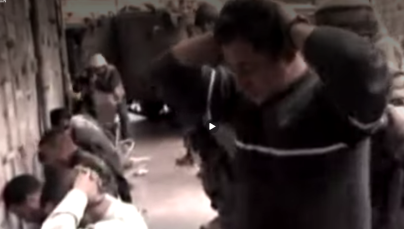
Over the past month, mainstream Israeli television channels have aired what can only be described as snuff films. They depict the systematic torture of Palestinians from Gaza in Israeli jails. Such videos have aired on at least three occasions — twice on Channel 14, and once on the public broadcaster, Channel 13. While Channel 14 is considered right-wing, so is about two-thirds of the Israeli public, and the more “mainstream” Channel 13 has shown no qualms about airing similar footage.
The broadcasts follow prison officials into detention centers to document the mistreatment of prisoners, which seems to be something that the officials — and apparently the viewers — find satisfying rather than revolting. The airing of these snuff films is a demonstration of societal sadism.
As Yumna Patel has recently reported, several rights groups have sounded the alarm over the widespread and systemic abuse that Palestinian prisoners face at the hands of the Israeli authorities. These groups’ calls have been unintentionally buttressed by Israeli soldiers’ unapologetic videos of themselves torturing or demeaning Palestinian detainees, which they boastfully post on social media. Now, it seems that the phenomenon has expanded to mainstream Israeli television.
The two aforementioned reports on Channel 14 (threads with subtitles can be found here and here) contained footage of actual interrogation sessions during which torture was used. The Channel 13 report did not, but it exposed some of the worst prison conditions to be broadcast to the public. These conditions include forcing prisoners to live in inhumane conditions and subjecting them to torture and harassment. Here’s the 11-minute video with translated subtitles.
‘The feeling is one of pride’
“Here, we see the cells in which the Nukhba terrorists are held,” the narrator says.
The “Nukhba” refers to elite Hamas-led fighters who carried out the October 7 attack. In the cell, viewers notice metal bunkbeds without mattresses, and instead of a toilet, there is just a hole in the floor. The room is almost completely dark throughout the day, and prisoners have their hands and legs chained together.
We hear attack dogs barking constantly as prisoners are made to kneel while bound and blindfolded, their heads touching the floor.
“This is how it should be,” a guard says. “This is how a Nukhba prisoner should be… what happened on October 7 will never return.”
In another scene, a guard shouts at prisoners as dogs continue to bark incessantly. “Heads down! Heads on the floor!” he yells.
“There are many prisoners here that I personally saw at the [October 7] events,” a prison official says, taking pride in humiliating them. “The difference is that this time, he is afraid, shaking, with his head on the floor…no Allahu Akbar, nothing. You won’t hear a squeak from him.”
“They have no mattresses,” says a warden shift commander. “They have nothing…we control them 100% — their food, their shackling, their sleep…[we] show them we are the masters of the house.” Even without knowing the background to that phrase, to hear him say it is chilling.
“Masters of the house” was the election slogan of Itamar Ben-Gvir, the Jewish Power leader and current Minister of National Security. Ben-Gvir declared war on Palestinian prisoners long before October 7, and this has included shutting down bakeries that supply bread to prisoners — described by Ben-Gvir as an “indulgence” — and drastically limiting prisoners’ water use. So now it’s become much worse.
While one is tempted to believe that all prisoners here are “Nukhba” members, it turns out that many of them aren’t even suspected of that. Rather, they were rounded up in Gaza after October 7, during mass arrests in which hundreds of Gazan men were stripped and paraded in a most sadistic demonstration of power. The mass arrests also included hundreds of women, including pregnant women detained with their babies. Israeli security officials told Haaretz that by their own estimate, “only 10 to 15 percent of the hundreds of the semi-naked and bound Gazan men arrested in the Strip during the recent days are Hamas members or those who identified with the organization.”
Back to the Channel 13 coverage, viewers can hear the nonstop blasting of the Zionist anthem, Am Israel Hai (“the people of Israel live”).
“The prison authorities claim that it is meant to boost the morale of the staff,” the narrator declares. “But it is clear that this is another part of the psychological warfare against the prisoners.”
Torture, in other words.
It’s hard to imagine the depths to which Israeli society has sunk. The official tells the Channel 13 reporter that “the feeling is one of pride.”
The reason such sadism has become formalized as a matter of policy is because this is what the Israeli public demands. The Israeli Democracy Institute released a survey last week showing that two-thirds of Jewish Israelis oppose “the transfer of humanitarian aid to Gaza residents at this time,” even if “via international bodies that are not linked to Hamas or to UNRWA.” For right-wing voters, the opposition to aid jumps from 68% to 80%.
This is not Israel’s Abu Ghraib moment, because when Abu Ghraib was revealed, most Americans were revolted. Israeli society, on the other hand, is thirsting for genocide. No wonder they consume such videos as entertainment on mainstream TV.
An unpublished report from UNRWA said some of its employees released from Israeli detention were tortured into falsely stating that the agency has Hamas links and that staff took part in the 7 October attacks, Reutersreported on 9 March.
The testimonies are contained in a report by the UN Relief and Works Agency (UNRWA) reviewed by Reuters and dated February 2024.
“Agency staff members have been subject to threats and coercion by the Israeli authorities while in detention and pressured to make false statements against the Agency, including that the Agency has affiliations with Hamas and that UNRWA staff members took part in the 7 October 2023 atrocities,” the report says.
The report included allegations of abuse and torture in Israeli detention, including severe physical beatings, waterboarding, and threats of harm to family members.
Though waterboarding is widely viewed as torture by human rights groups, the Reuters report described Israeli actions only as “coercion” and “pressure” to force detained Palestinians to make false statements.
In addition to describing the torture of UNRWA employees, the report stated that Israel has subjected Palestinian detainees more broadly to beatings, humiliation, threats, dog attacks, and sexual violence. Some detainees have also died after Israel denied them medical treatment, the report added.
UNRWA communications director Juliette Touma said the agency planned to hand the information in the 11-page, unpublished report to human rights investigators at UN agencies and outside rights groups.
“When the war comes to an end there needs to be a series of inquiries to look into all violations of human rights,” she said.
Amid the torture and medical neglect, 27 Palestinians have died in Israeli prisons since the start of the war on 7 October.
Israel has accused UNRWA employees of participation in the 7 October Hamas attack on Israeli settlements and military bases. Israel provided no evidence for the claim, but 16 countries, including the US, paused $450 million in UNRWA funding in response, throwing its aid operations into crisis just as starvation was beginning to grip Gaza.
Israel’s campaign against UNRWA is part of a broader campaign started years ago to dismantle the agency, which helps keep the hope of Palestinian refugees returning to their stolen lands and homes in what is now Israel alive.
A -0.005°C temperature change over a span of 60 years in northern Pakistan (Himalaya region) is ostensibly having “adverse impacts in multiple sectors.”
The first sentence of a new paper’s (Khan et al., 2024) abstract claims:
“Hindu Kush Himalaya region is experiencing rapid climate change with adverse impacts in multiple sectors.”
But in the body of the paper itself the “rapid climate change” is specified as a -0.0047°C mean annual temperature cooling trend from 1960 to 2018.
The title of the paper indicates there have been “increasing extremes” in precipitation in recent decades, but, again, the long-term (635 years) precipitation reconstruction reveals there have been a lack of any obvious wet or dry trends over many centuries.
Even if there were increasing extremes in recent decades, this could not be linked to “climate change” or “global warming” because, as noted, the climate has been slightly cooling in this region. So the “adverse effects” also cannot be linked to anthropogenic global warming either.
The authors also acknowledge that climate change, or wet vs. dry variability, is “largely governed” by natural “dominant forces” like ENSO, PDO, and the AMO.
“Climate and their anomaly of the HKKH and adjacent regions is largely governed by prevailing local to regional general circulation systems in addition to the influence of climatic modes and phases like AMO, ENSO, PDO, and SOI of remote location.”
“The AMO, ENSO, PDO, and SOI are the major climatic modes/phases that influence the seasonal or annual climate variability or anomaly in the HKKH and adjacent regions. The short periodicities of 2.2–8.3 years observed in our reconstruction fall in the band of ENSO cycles. These quasi-cyclic periodicities related to ENSO are some of the dominant forces to local dryness/wetness variation in the South Asian summer monsoon-dominated Himalaya and adjacent regions. In four centuries long spring season streamflow reconstruction in Nepal using composite tree-ring residual chronologies they found predominantly high frequency signal related to ENSO.”
The mass killing of Palestinians in the Gaza Strip “is permissible according to the halakhic principles,” the head of a Jewish religious school in occupied Yafa, Rabbi Eliyahu Mali, stated according to Israeli news website Ynet.
A recording of the extremist’s answers to questions on the Gaza Strip was published a few hours ago on YouTube and is available for the public.
Halakha or Jewish Law, which also translates to “the way to behave or act,” is held as divine law among Orthodox Jews such as Mali, who called for the extermination of Palestinians in the Gaza Strip.
When asked about what should be done to infants and the elderly, Mali simply answered, “The same.”
Mali founded the religious school Shirat Moshe and has called upon his students to strictly follow the orders of the Israeli occupation forces, saying that if IOF soldiers do not kill Palestinians, then Palestinians will kill them. It is worth noting that Shirat Moshe students serve in the IOF, despite other schools of Orthodox Judaism refusing military service.
The extremist stressed that the main principle of the war on Gaza is that “no soul remains alive,” urging Israelis to carry on the genocide against Palestinians.
Among West Asian countries, few face the brunt of foreign intelligence meddling as Lebanon does. Its sovereignty is routinely disregarded by intelligence services from abroad, who operate within its borders with brazen impunity. In some cases, foreign militaries have even sought unrestricted access to the country.
These clandestine activities not only violate Lebanese law but also undermine its national security. The recent incursion of Dutch special forces into Beirut’s southern suburb, a stronghold of Hezbollah, is the latest such incident.
Under the guise of evacuating Dutch nationals, these foreign militants were armed with military-grade weapons, ammunition, and equipment without coordination with Lebanese authorities, demonstrating a level of freedom not permitted even in their own country.
Spying for Israel
Last week, the Beirut Military Court convicted Russian national Yuri Rinatovich Chaykin of espionage, sentencing him to eight years behind bars for spying on behalf of Israel. Chaykin’s expertise in lock picking led him to make an attempted breach into a secret facility belonging to Hezbollah, only to be thwarted by surveillance cameras.
His arrest at Beirut Airport while trying to leave the country unveiled a web of espionage activities, including the collection of sensitive intelligence and reconnaissance missions conducted on behalf of Israel.
During his interrogation, Chaykin admitted that he worked for Israeli intelligence and that he repeatedly visited Lebanon with his wife and child, whom he used as a cover for his activities. He also admitted to collecting information and data in the southern suburbs and south Lebanon at the request of his Israeli handlers, who provided him with maps of Hezbollah facilities and asked him to photograph them.
Chaykin’s conviction marks a notable precedent, as Lebanon has long been considered a playground for foreign intelligence services seeking to gather crucial information about Hezbollah. Often entering the country as tourists, journalists, or diplomats, these operatives typically enjoy diplomatic immunity and are shielded from accountability by their respective governments, evading significant consequences for their actions.
‘Tourists’ and diplomats as tools
Among these is an Italian ‘tourist’ recruited by Israeli intelligence. His first task was to photograph an obituary paper hanging on the wall of a church in the predominantly Christian Jounieh area, east of Beirut.
At first glance, this may seem like a trivial mission, but his Israeli operators were likely seeking to ensure that their agent was actually in Lebanon. His second assignment was to monitor a warehouse on the airport road in the southern suburb near a football field belonging to the Al-Ahed Sports Club affiliated with Hezbollah. It was the same site Israeli Prime Minister Benjamin Netanyahu falsely claimed at the UN General Assembly in September 2018 that Hezbollah had established a factory for manufacturing precision missiles.
The Italian ‘tourist’ surveilled the location by taxi and was able to photograph it using a miniature camera attached to a fishing rod so as not to arouse the driver’s suspicions when he stuck it out of the car window. He asked the driver to pass by the site several times so that he could take as many pictures as possible from different directions.
The Italian operative’s next mission was to make contact with an arms dealer in the town of Brital, situated in the Bekaa region of eastern Lebanon, to procure a grenade launcher. This mission included orchestrating a plan to bomb the warehouse before hastily fleeing to Beirut airport for departure.
But the ‘tourist’s’ inquiries about his arms dealer contact aroused suspicions in the taxi driver, who decided to alert Hezbollah-affiliated security personnel. The Italian spy was swiftly apprehended, but the Lebanese military judiciary, under pressure from the Italian embassy, handed a lenient sentence to the spy.
In a separate incident last month, Hezbollah’s security service intercepted a Spanish diplomat in the Al-Kafaat area of the southern Beirut suburbs, who was caught photographing a street on his mobile phone.
Upon being transferred to the Lebanese General Security Service, the Spaniard claimed he was lost and had been trying to send the pictures to his embassy colleagues to arrange a pickup. Despite possessing a diplomatic passport, he refused to grant investigators access to his phone. The embassy’s intervention secured his release from Lebanese authorities without scrutiny of the phone’s contents.
‘Evacuation plans’
Last week, the Lebanese “Al-Mahatta” YouTube channel revealed that Hezbollah security forces arrested six armed Dutchmen in the Bir al-Abd area of Beirut’s southern suburb. It was discovered that the Dutchmen were special forces and were allegedly in the midst of a security operation simulating the evacuation of Dutch citizens and diplomats – in a Hezbollah-controlled area.
Hezbollah interrogated the six foreign militants for 24 hours before transferring custody the next day to Lebanese Army Intelligence officers. During their questioning, the men admitted to being Dutch ‘soldiers’ operating under orders from their Ministry of Foreign Affairs and were training to evacuate two employees of the Dutch embassy who lived in the southern suburb.
Despite receiving this information about unlawful activities conducted on Lebanese territory by armed foreigners, a Lebanese military judge released the Dutchmen that same day. Had it not been for the insistence of Army Intelligence officers on obtaining their statements, the militants likely would have spent a mere ten hours under interrogation.
Notably, the Dutch embassy in Beirut and its foreign ministry did not issue a formal apology, and Lebanese authorities did not release any official statement denouncing the violation. Such complacency only serves to embolden illegal foreign military missions that flout Lebanese law – and sovereignty – with impunity.
Evacuation planning has been a concern for foreign embassies in Lebanon since the Al-Aqsa Flood operation on 7 October set off widespread military confrontations within West Asia, with a notable escalation along Lebanon’s border with Israel, where hundreds have been killed in heavy clashes.
Foreign embassies have mobilized equipment, weapons, and special forces ostensibly to facilitate the evacuation of their nationals and diplomats in the event of escalated conflict. This was purportedly the case with the Dutch soldiers, as noted by the Dutch daily De Telegraaf.
The US, British, Dutch, and Canadian embassies, among others, have been at the forefront of these special forces arrangements, but doubts persist about the actual objectives of their military missions, particularly given the unwavering support of these nations to Israel’s expanding war against Lebanon and its ethnic cleansing of Gaza.
Moreover, as in past evacuations – and as these very same embassies frequently notify their citizens in Lebanon – nationals are expected to make their own way to exit ports and airports in the event of an evacuation.
Vulnerabilities in Lebanon’s security apparatus
On 5 January, Lebanese newspaper Al-Akhbar cited Lebanese military sources saying that British intelligence services are using dozens of watchtowers on the Lebanese–Syrian border – which the UK helped establish during the Syrian war – to collect information about cross-border weapons transfers to the Lebanese resistance.
The sources said the British were providing Lebanese soldiers in the watchtowers with photographs of Syrian, Iranian, and Russian weapons suspected of being transported into Lebanon so that they could identify and seize them.
Earlier this year, Al-Akhbar also reported that Lebanese Army Intelligence refused to grant a former British officer, now part of a CNN team, an entry permit to southern Lebanon on suspicion of collecting information about the military activities of Hezbollah and the Hamas movement.
The newspaper alleges that Officer “Wayne G” had previously been part of the British military team charged with training the four land border regiments of the Lebanese Army before moving to Ukraine as part of a CNN-affiliated unit where he worked closely alongside Ukrainian forces.
After the events of 7 October, “Wayne G” joined the CNN team in Beirut. Al Akhbar further noted that the former British officer had also tried to obtain a permit to enter southern Lebanon through the BBC team in Beirut.
The absence of robust, official Lebanese measures and judicial rulings that would significantly deter espionage and military activity of individuals recruited by Israel, whether local or foreign, except in rare instances, leaves Lebanon vulnerable to multi-source intelligence breaches targeting the nation’s resistance.
These ramifications extend beyond Hezbollah: British and other foreign intelligence agencies have spent years infiltrating Lebanon’s various intelligence, security, and telecommunications apparatus, posing a threat to the country’s national security and endangering the lives of its citizens.
Living through five or six major wars has hardened me to what I thought were the extremes of inhuman cruelty and brutality.
Two things made those extremes almost bearable: the brutality always revealed – at least according to the media coverage – the viciousness of the enemy. It was therefore quite understandable when our “brave men and women” pulverized the enemy.
Films of Japanese torturing captive Americans somehow justified holding Japanese Americans in internment camps during World War II; and only a small percentage of Americans found the bombing of Hiroshima and Nagasaki unreasonably vengeful at best, at worst, depraved.
The media giants in America portrayed the North Koreans as barbaric beasts with their captives, quite unlike their southern counterpoints – our allies during the Korean War. No one ever felt the need to explain how the South Koreans were a civilized breed while the North Koreans were absolute savages, at least according to the official line.
In Vietnam, our warriors justifiably (or so the media made us believe) dropped napalm on the North Vietnamese who had the gall to hide in villages and tunnels to ravage our invaders. At least it was accepted practice until some rogue photojournalist filmed a young girl screaming down a Vietnamese road in flames. … continue
This site is provided as a research and reference tool. Although we make every reasonable effort to ensure that the information and data provided at this site are useful, accurate, and current, we cannot guarantee that the information and data provided here will be error-free. By using this site, you assume all responsibility for and risk arising from your use of and reliance upon the contents of this site.
This site and the information available through it do not, and are not intended to constitute legal advice. Should you require legal advice, you should consult your own attorney.
Nothing within this site or linked to by this site constitutes investment advice or medical advice.
Materials accessible from or added to this site by third parties, such as comments posted, are strictly the responsibility of the third party who added such materials or made them accessible and we neither endorse nor undertake to control, monitor, edit or assume responsibility for any such third-party material.
The posting of stories, commentaries, reports, documents and links (embedded or otherwise) on this site does not in any way, shape or form, implied or otherwise, necessarily express or suggest endorsement or support of any of such posted material or parts therein.
The word “alleged” is deemed to occur before the word “fraud.” Since the rule of law still applies. To peasants, at least.
Fair Use
This site contains copyrighted material the use of which has not always been specifically authorized by the copyright owner. We are making such material available in our efforts to advance understanding of environmental, political, human rights, economic, democracy, scientific, and social justice issues, etc. We believe this constitutes a ‘fair use’ of any such copyrighted material as provided for in section 107 of the US Copyright Law. In accordance with Title 17 U.S.C. Section 107, the material on this site is distributed without profit to those who have expressed a prior interest in receiving the included information for research and educational purposes. For more info go to: http://www.law.cornell.edu/uscode/17/107.shtml. If you wish to use copyrighted material from this site for purposes of your own that go beyond ‘fair use’, you must obtain permission from the copyright owner.
DMCA Contact
This is information for anyone that wishes to challenge our “fair use” of copyrighted material.
If you are a legal copyright holder or a designated agent for such and you believe that content residing on or accessible through our website infringes a copyright and falls outside the boundaries of “Fair Use”, please send a notice of infringement by contacting atheonews@gmail.com.
We will respond and take necessary action immediately.
If notice is given of an alleged copyright violation we will act expeditiously to remove or disable access to the material(s) in question.
All 3rd party material posted on this website is copyright the respective owners / authors. Aletho News makes no claim of copyright on such material.




 Aletho News
 Aletho News