Kiev gathering information about chemical facilities in Donbass, might use HIMARS to target them
By Uriel Araujo | July 15, 2022
Kiev is now employing the High Mobility Artillery Rocket Systems (HIMARS) provided by Washington to strike Moscow-controlled areas. Such missiles hit warehouses in Nova Kakhovka – in the Kherson region – containing saltpetre, a chemical compound that is used to make gunpowder and fertilizers. Ukraine claims the target was an ammunition dump. The strike caused a major explosion and fires. Shops, gas stations, pharmacies, a church, and other civilian buildings were also hit. At least seven people were killed and 60 have been wounded, according to Vladimir Leontyev, head of the Russian-controlled Kakhovka District military-civilian administration.
The first M142 HIMARS arrived in Ukraine at the end of June and have been linked to explosions in the Donbass region and southern Ukraine. In its counter-offensive, the Ukrainian authorities are indiscriminately attacking the areas whose control they lost and are basically shelling the very population they consider to be their own people – using American weapons for that. City districts have been leveled, with civilian infrastructure destroyed and many civilians killed in the process.
Last week, Alexandr Shulguin, Moscow’s permanent representative at the Organization for the Prohibition of Chemical Weapons (OPCW), warned that Kiev is preparing provocations with chemical weapons at the Nikolaevka thermal power plant and also at other locations in Kharkiv. He told Rossiya 24 channel that a note was sent to the technical secretariat of the OPCW.
Kiev was in control of the Azot chemical factory in Severodonetsk (now taken by the Russians forces), and, on June 25, Ukrainian shelling forced Russian forces to suspend the evacuation of civilians from the plant. Hundreds of people had taken shelter there. Ukrainian troops also shelled the Yasinovka coking chemical plant in the Kirovsky district of Makiivka in the Donetsk People’s Republic (DPR) on June 19.
Already in May there were reports that Ukrainian nationalist battalions were plotting provocations at the chemical facilities in the so-called “chemical industry triangle” (Severodonetsk, Lisichansk, and Rubezhnoye), which is home to over 30 chemical factories. On May 6, Mikhail Mizintsev, chief of Russia’s National Defense Management Center, had already warned about Kiev’s plans to deploy “heavy weapons” against chemical plants in the region. In fact, the Ukrainian military has been gathering information about chemical facilities in the Donbass, both in the DPR and the Luhansk People’s Republic (LPR).
Thus, the Ukrainian strategy that is unfolding now seems to involve attacking chemical plants and facilities. And US-provided missile systems might be used for that very purpose. The environmental hazards of this are quite obvious, not to mention the humanitarian disaster and the potential long-term health effects on the population even after the end of the conflict for many years to come (due to soil and water contamination). A lot of chemicals are stored in Donbass, which is a heavily industrialized region. It is also home to a number of mines which are currently closed. If a dam is broken, mercury and sulfur from the flooded mines could end up in the Sea of Azov.
Currently, eight American HIMARs are in Ukraine and four more are expected to arrive by the end of July. Even though Kiev claims this new development is a game changer, it can only protract the conflict and in fact cannot ensure Ukrainians will retake terrain. Last week, on July 6, the Russian defense ministry announced Moscow had destroyed two Ukrainian HIMARS and their ammunition depots in a village south of Kramatorsk in the Donetsk region.
If Kiev keeps targeting chemical facilities, a Russian offensive is sure to follow, and it will include an aerial onslaught. In this scenario, the HIMARs batteries will be helpless, according to a Ukrainian military official quoted by Jack Detsch, a Pentagon correspondent writing for Foreign Policy.
The proxy war the US-led West is waging against Moscow in Ukraine does not seem to have a way out or an exit strategy right now. Even with all the heavy weaponry provided, Russia and its artillery machine cannot be defeated. In fact, the Russian Federation controls three-quarters of the Donbass and still has five times more artillery than Ukraine. Ukrainian officials say there are 10 Russian canons for every Ukrainian one.
Kiev’s other weaknesses are well known, such as its lack of skilled infantry – not to mention the bad shape of its economy. Moreover, there are no real diplomatic endeavors toward peace or a compromise. So, the Western strategy apparently consists in keeping the flow of weapons to Ukraine to prolong an already disastrous conflict, at an enormous humanitarian, environmental and economic cost.
Ukrainian militants forced mothers and newborns out of maternity wards – Russian MOD
Samizdat | July 14, 2022
The Ukrainian military has been accused, by the Russian Defence Ministry, of throwing mothers and their newborn babies out of maternity hospitals in the southern Odessa Region. Wednesday’s statement added that medical staff who tried to stop them were allegedly assaulted.
“In the settlements of Dobroslav and Krasnoselka of the Limansky district in Odessa Region, Ukrainian militants use hospitals and ambulance stations as command posts and barracks. At the same time, all the patients, regardless of their health condition, as well as maternity ward patients and their newborn children, were ruthlessly kicked out of medical institutions, while medical staff who tried to prevent the neo-Nazis’ cruelty suffered from physical violence,” Mikhail Mizintsev, the head of Russia’s National Defense Control Center, outlined.
He added that the Ukrainian forces set up barracks, firing positions, and ammunition depots in a clinic in Ugledar (a city in the Donetsk People’s Republic), with heavy weaponry, artillery, and mortars stationed nearby.
Mizintsev urged international organizations, including the World Health Organization, to influence Kiev to put an end to the use of medical facilities for military purposes.
“Such actions of the criminal Ukrainian authorities show their complete indifference to the fate of their own citizens and absolute disregard for all moral norms and principles of international humanitarian law,” he said.
Mizintsev’s comments come in the wake of Ukrainian shelling in the Russian-controlled city of Novaya Kakhovka in Kherson Region, which reportedly killed two people and injured at least 90, with seven still missing after a fertilizer storage depot was hit. The explosion also damaged several civilian sites, including a market and a hospital.
Russia sent troops into Ukraine on February 24, citing Kiev’s failure to implement the Minsk agreements, designed to give the regions of Donetsk and Lugansk special status within the Ukrainian state. The protocols, brokered by Germany and France, were first signed in 2014. Former Ukrainian President Petro Poroshenko has since admitted that Kiev’s main goal was to use the ceasefire to buy time and “create powerful armed forces.”
In February 2022, the Kremlin recognized the Donbass republics as independent states and demanded that Ukraine officially declare itself a neutral country that will never join any Western military bloc. Kiev insists the Russian offensive was completely unprovoked.
US provides Kiev with intelligence on Donbass targets – Moscow
Samizdat | July 14, 2022
Washington has not only supplied long-range High Mobility Artillery Rocket Systems (HIMARS) to Kiev, but is also providing intelligence on targets in Donbass and has even “unofficially” sent instructors to Ukraine to help with the hardware, the Russian Foreign Ministry claimed on Thursday.
Moscow alleges that the Ukrainian government has ordered troops to shell civilians in the Lugansk and Donetsk People’s Republics with the help of the US-made weapons.
Speaking at a media briefing in Moscow, Russian Foreign Ministry spokeswoman, Maria Zakharova, said that Ukrainian forces “have used US-supplied multiple-launch rocket systems HIMARS on all fronts” of late. She added that Washington has been actively sharing intelligence on targets with Kiev, and has even “unofficially dispatched instructors, who were helping representatives of the Kiev regime to aim correctly.”
Zakharova linked the recent uptick in Ukrainian shelling with the delivery of the US-made rocket systems.
She noted that the Ukrainian military “has apparently been ordered by Kiev to use the said launchers against civilians without any hesitation.”
Also on Thursday, Russia’s Foreign Ministry issued a statement, saying that Moscow’s “operation will continue despite attempts by the US and its allies to ‘strengthen the security’ of Ukraine.”
Ukraine – global hotbed for mercenaries and terrorists
By Drago Bosnic | July 12, 2022
Western mercenaries are often considered the mainstay of all foreign personnel fighting for the Kiev regime. However, although they’re the ones with the most media exposure, the truth is, there are mercenaries from all around the world fighting for the regime. And although international law outlaws mercenaries, the ones fighting in Ukraine aren’t just “regular soldiers of fortune”, but also international terrorists previously operating in the Middle East and Africa. Even before Russia intervened, information on Islamic terrorists fighting for the Kiev regime was already common knowledge.
Already in late February, Syrian intelligence services intercepted information that the Turks were recruiting troops among the terrorist formations under their control to go fight in Ukraine. According to the information made public at the time, Turks formed and armed at least seven groups of about 100 terrorists in each, which included members of terrorist groups such as Hay’at Tahrir al-Sham (HTS), Harakat Ahrar al-Sham al-Islamiyya and the Islamic Party of Turkestan.
A few weeks later, Iraqi Shia group “Ashab al-Kahf” reported that “military advisors” from the countries of the “anti-ISIS” coalition, namely Lithuania, Italy, Germany and the UK, arrived in Iraq to recruit mercenaries for the Kiev regime forces. Two US bases, Ain el-Assad (Iraq) and Al-Tanf (Syria), were used as headquarters for this operation. Residents from Syria, Iraq, Libya, Turkey, Tunisia, Sudan, Egypt, Jordan, Israel, etc. were given a chance to fight “for democracy”, with priority given to specialists in large-scale urban combat.
On March 8, the Syrian Ambassador to Russia Riyad Haddad announced the threat of “flooding Ukraine with mercenaries and turning it into a big European Idlib.” In early July, he announced the transfer of ISIS terrorists from Idlib to Ukraine, an operation carried out jointly by Turkey, the US and its client states. Earlier, in May, Sergey Ivanov, head of the Press Bureau of the Russian Foreign Intelligence Service, spoke about the transfer of ISIS soldiers to Ukraine by the Americans. In mid-April, Spokesman of the Russian Ministry of Defense, Igor Konashenkov, stated that at that time and since the beginning of Russia’s intervention, at least 200 Turkish-backed terrorists had arrived in Ukraine. This issue further ruined the already murky reputation of the Kiev regime, as its units were now composed of both Neo-Nazi and Islamic terrorist troops.
It’s pretty clear why the Kiev regime is trying to recruit anyone at this point. Simply put, the motivation of regular Ukrainians to fight for the regime is dwindling, as their forces are suffering heavy casualties, reaching the scale of 10:1, and not in their favor. This is almost perfectly consistent with the scale of artillery supremacy of the Russian forces, which is also 10:1. Just how desperate the Kiev regime is to recruit troops for the “Donbass meat grinder” can be seen in the fact that Ukrainian men are now openly being abducted and pushed to the frontlines. Recently, in Transcarpathia, Ukraine’s westernmost region, police were seen going to recreation centers, including public pools, trying to drag men out of the water and send them to military units.
And this doesn’t only apply to Ukrainian citizens, but also to foreigners residing in Ukraine, including college students. At the start of Russia’s special military operation, when foreigners were being evacuated, including African ex-pat students, some were denied access to trains and buses, while others were told they would be conscripted to the Kiev regime forces. An ABC News journalist interviewed a Congolese national who managed to escape this fate and who said: “We were told: ‘We will give you weapons, and you will fight for Ukraine!’ I say: ‘Eh? Will we fight for Ukraine? We are not Ukrainians. We are black. How can we fight for Ukraine?!'”
On the other hand, there were also mercenaries from some African countries, such as Nigeria, who stated they wanted to fight for the Kiev regime. The regime promised to pay for “their services” and additional funds were sent to the Ukrainian embassy in Nigeria. However, in addition to evidence of military experience, Ukrainian diplomats demanded mercenaries pay $1000 for a visa and a flight ticket, promising a monthly salary of $3,300 dollars, although they previously promised twice as much. At the same time, this is also considered a way for many to use the conflict as an excuse to reach Europe.
What is certainly clear from all this chaos is that the political West seeks to dispose of terrorists and also use them against Russian forces in this war to the last Ukrainian. In addition, Washington DC and London are profiting from all this in the long-term, as mainland Europe is bearing the brunt of the costs and consequences of their proxy war against Russia. Many of the mercenaries and terrorists fighting for the Kiev regime will certainly end up being Europe’s problem, provided they survive the conflict. As already noted, the Kiev regime, for its part, will accept anyone willing to fight in its suicidal confrontation with Russia.
Drago Bosnic is an independent geopolitical and military analyst.
Ukraine frees warlord sentenced for torture

Samizdat | July 12, 2022
Ruslan Onishchenko, former commander of the notorious Ukrainian Tornado battalion, whose fighters were convicted of torturing people in Donbass, has reportedly been released from jail and may join the fight against Russia.
Ukraine began selectively releasing inmates who want to serve on the frontline shortly after Moscow attacked the neighboring state in late February.
The now-disbanded Tornado unit was formed in 2014 to fight for Kiev during the conflict in Donbass. Despite the unit’s designation as a volunteer police battalion, former felons were allowed to become members. Onishchenko had three prior convictions before joining the unit.
In 2017, a Kiev court sentenced Onishchenko to 11 years in prison for kidnapping and torture. Several of his fellow fighters also received jail sentences for kidnapping, torture, rape, and looting.
On Monday, Roksolana Khmara, the wife of former MP Stepan Khmara, wrote on Facebook that Onishchenko was released under the guarantees of her and her husband.
Khmara posted a photo of Onishchenko in a Kiev courtroom, while claiming his sentence had been politically motivated.
Newspaper ‘KP v Ukraine’ said that Onishchenko had asked to be allowed to join the fight against Russia.
According to the paper, Onishchenko’s original sentence had been commuted in accordance with a 2015 law that says one day spent in pre-trial detention counts as two days in jail. However, the former commander remained behind bars while awaiting trial for a 2018 prison riot.
“Nearly all of the battalion’s members are now back on the frontline, fighting in various units of the Ukrainian Armed Forces,” Viktor Pandzhakidze, the ex-spokesman for Tornado, told the paper.
17 killed, injured in Saudi attack on Yemen’s Sa’ada Province
Press TV – July 11, 2022
The Saudi-led coalition has once again broken the terms of a United Nations-mediated truce, killing and injuring as many as 17 people in a cross-border attack on the impoverished country.
The casualties were caused on Sunday after Saudi forces opened fire on a border area in Yemen’s Sa’ada Province, which lies to Yemen’s extreme northwest, a security source told Yemen’s official Saba Net news agency.
Most of the wounded, who have been transferred to a hospital in the city of Razih in the western part of the province, are in a life-threatening condition, the source said.
Elsewhere in the province, the coalition targeted the Shada’a District, killing one person and injuring seven others.
Saudi Arabia launched the devastating war on Yemen in March 2015 in collaboration with its Arab allies and with arms and logistical support from the United States and other Western states.
The objective was to reinstall the Riyadh-friendly regime of former president Abd Rabbuh Mansur Hadi and crush Yemen’s Ansarullah popular resistance movement, which has been running state affairs in the absence of a functional government in Yemen.
While the Saudi-led coalition has failed to meet any of its objectives, the war has killed hundreds of thousands of Yemenis and spawned the world’s worst humanitarian crisis.
The UN-brokered truce between the coalition and Ansarullah, which came into effect in April, was extended for another two months on June 2.
As part of the ceasefire, commercial flights have resumed from Sana’a International Airport to Amman and Cairo, while oil tankers have been able to dock at the port city of al-Hudaydah.
The elusive truce has provided a rare let-up in the Saudi-led coalition’s attacks on the Arab country, even though the coalition has been accused of a series of ceasefire violations.
Also on Sunday, the Yemeni National Salvation Government’s health ministry said a total of 31 people had been killed and 356 others injured as a result of the invaders’ violations of the make-or-break ceasefire.
Taiwan: Birth Rate CRATERED -27.66% in June 2022!!!
By Igor Chudov | July 9, 2022
A couple of weeks ago, I wrote an article based on the shocking news that Taiwan’s birth rate in May 2022 fell by 23.34% compared to May 2021.
I explained that in terms of statistics, the change in Taiwan is an unthinkable 26-sigma event of enormous magnitude.
Like most people would, I was hoping, despite evidence from other countries, that this is a data fluke.
Well, it is not, and the data for June was just released in Taiwan. I am very upset.
Compared to June 2021, birth rate in Jun 2022 is down by -27.66%. This is far worse than the previous month (May) drop of -23.34% and indicates a worsening birth rate trend.

Here’s the updated chart:
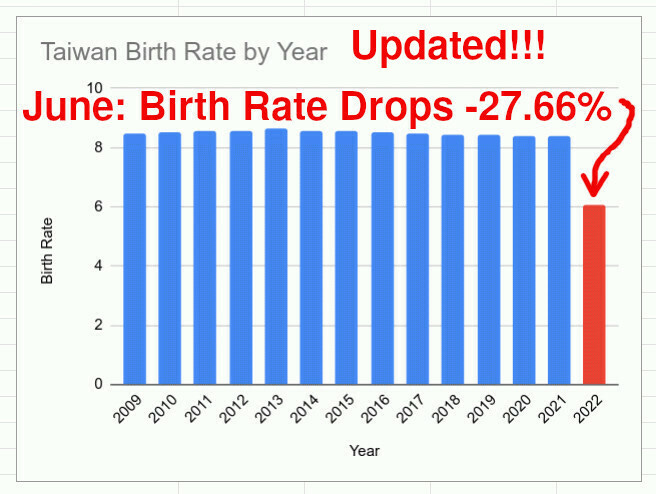
Mind you, last August of 2021, when June 2022 babies were conceived in Taiwan, the people of Taiwan were mostly unaware of what was going to happen, and kept their family making plans intact. They probably did not notice a 27.66% decrease in pregnancies, or an increase in stillbirths. If someone told them, the young people of Taiwan probably thought that it was antivax propaganda that they should dutifully ignore, like their government and TV told them.
Young people were being happily vaccinated.
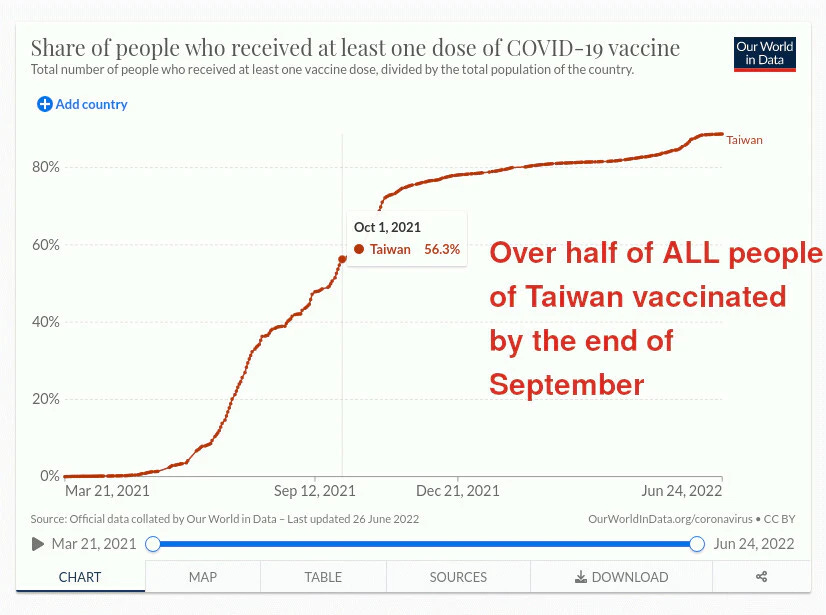
The result? An “impossible” birth rate drop of -27.66% is basically a slow death sentence for the population of Taiwan, if it continues, especially combined with a 26% increase in deaths.
Media Coverage
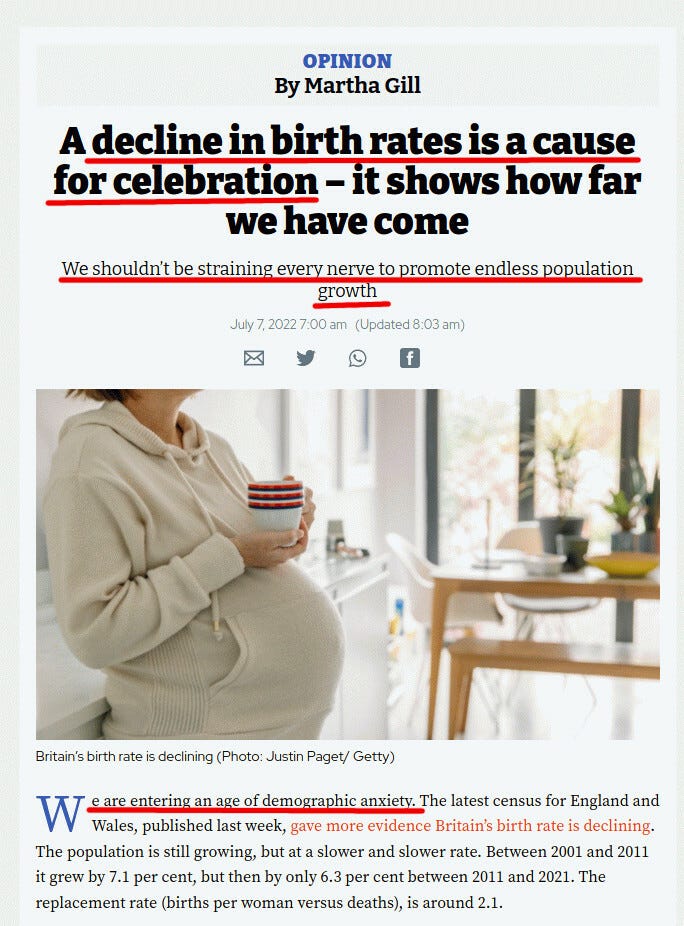
The mainstream media is beginning to cover drops in birth rates:
Further Reading
Concerned?
Check out my “depopulation series”:
Russia calls out American goal in arming Ukraine
Samizdat | July 9, 2022
The US government is aiming to protract the armed conflict in Ukraine for as long as possible, and it is for this purpose that Washington is providing Kiev with four more HIMARS units, the Russian embassy in Washington claimed on Friday.
The diplomatic mission’s statement went on to suggest that the planned delivery of additional multiple launch systems is intended to make up for growing casualties among Ukrainian forces.
It dismissed the Pentagon’s claim that such weapons are being used by Kiev for defensive purposes.
The Ukrainian military and “nationalist groups are deploying US-supplied weapons to destroy cities of Donbass,” the statement insisted.
The Russian diplomats claimed that the “Ukrainian Armed Forces are constantly deliberately targeting residential areas of Donetsk,” including parts of the city where there are no Russian troops. As a result of this, “civilians are dying,” according to the embassy.
“The goal of the Russian Federation is to put an end to the terror of the Kiev regime,” the embassy proclaimed, adding that “Washington with its actions is not bringing peace closer, but on the contrary, is encouraging the Ukrainian authorities to commit new blood crimes.”
Earlier on Friday, a senior Pentagon official revealed that the “White House will be announcing” a new round of military aid for Ukraine, which would include, among other things, four high-mobility artillery rocket systems, HIMARS, and additional ammunition for those units.
The US Department of Defense official stressed that these weapons are “especially important and effective in assisting Ukraine and coping with the Russian artillery battle in the Donbass.”
When asked by a journalist about the total number of HIMARS units that Ukraine would have after receiving the new four ones, the Pentagon representative said Kiev would have 12 such systems at its disposal.
They went on to rebut Russia’s claims that its forces had managed to destroy some of the HIMARS units Washington had previously supplied.
“That is not correct,” the unnamed DoD official insisted, adding that the “Ukrainians have those systems and are making use of them.”
He also revealed that the $400 million package would include 1,000 rounds of 155 millimeter high-precision artillery ammunition.
Ukraine Crisis Highlights Concerns About Whether OPCW Still Has Any Global Relevance, Observers Say
Samizdat | July 6, 2022
The executive council of the Organization for the Prohibition of Chemical Weapons (OPCW) kicked off its hundredth session at The Hague on Tuesday. Last month, the global watchdog assured that it was “monitoring the situation” in Ukraine closely as far as the potential use of chemical weapons is concerned.
The OPCW’s lack of a coherent, objective and fair-minded response to recent crises centered around Syria and Russia demonstrates its politicization and domination by Western interests, and the longer the watchdog stays out of Ukraine, the better, former diplomats, geopolitical observers, and international legal experts have told Sputnik.
“In Ukraine the OPCW has fortunately not been pressed into action. This, I suspect, is because the US is satisfied with the situation as it is, with no need for the US itself to be drawn in, as would no doubt be the case if a chemical attack was fabricated,” Peter Ford, Britain’s former ambassador to Syria, said.
The veteran diplomat, who warned the British government against the folly of the 2003 invasion of Iraq, and stressed that Western powers’ campaign to topple the Syrian government in the 2010s could open a “Pandora’s box” of endless crises, said the Syria case demonstrated clearly that the OPCW is no longer an independent, impartial agency.
“The Syria crisis proved without a shadow of a doubt that the Western powers have bent the OPCW to their own will, destroying in the process the organization’s credibility, probably irretrievably. This is a tragedy for world peace,” Ford stressed, referring to documented OPCW efforts to censor and smear agency whistleblowers who revealed that the watchdog’s report on the April 2018 chemical attack in Douma, Syria was doctored to implicate the Assad government.
In Ukraine, Ford fears, the international community can now only depend on “self-interested restraint on the part of the Pentagon in controlling its proxies rather than the deterrent power of a genuinely impartial international watchdog.”
Chemical Weapons Danger in Ukraine
Since the escalation of the crisis in Ukraine in February, Russia has sent the OPCW and its technical secretariat over two dozen notes warning of possible staged provocations by Ukrainian forces or radical nationalists involving chemical weapons. Last month, the agency assured the international community that it was “closely monitoring the situation in Ukraine” for chemical weapons use.
On Wednesday, Russian military indicated that it had information on plans by Kiev to stage a provocation in the Donetsk People’s Republic using chlorine gas to accuse Moscow on indiscriminate attacks targeting chemically hazardous objects.
Alessandro Bruno, a Toronto-based geopolitical analyst and political observer at Lombardi Letter, says that while the OPCW’s official mission and goals are “certainly worth pursuing,” the problem is the watchdog’s control by Western interests seeking to obfuscate the truth and objectivity in favor of politicized objectives.
“They seem to have targeted only specific sides in specific wars to suit specific aims, which typically are those of Western powers. There have been many efforts to manipulate these organizations by the dominant powers, particularly in the West,” Bruno said.
The scholar recalled instances of claims by the US and its allies about Russia’s use of chemical weapons, from the allegation that Russia poisoned pro-Western Ukrainian presidential candidate Viktor Yushchenko in the mid-2000s, to the 2018 Novichok scandal in Britain, which “many thoughtful journalists have debunked,” to the Alexei Navalny “poisoning” saga of 2020, which doctors treating the opposition vlogger have debunked.
“Yet the accusations of chemical weapons that Russia used have persisted, even though they defied all logic. That’s the biggest issue with these organizations. They must be more neutral. Their headquarters must be in more neutral locations, because the fact that many of these organizations operate from Western capitals makes them more prone to Western media misinformation,” Bruno said.
The geopolitical analyst still fears that the West could use the pretext of ‘Russian chemical weapons use’ in Ukraine “to get more directly involved into the conflict and potentially trigger a much wider physical war.”
“So far, I think, some of the powers came to understand that making an accusation like that in this conflict would be riskier than the accusations they made in Syria and Iraq, Navalny and Yushchenko and so on, that this would have much bigger implications, that this would blow back against the West,” Bruno stressed.
Tool of US Interests
Christopher C. Black, an international criminal and human rights lawyer with 20 years of experience covering war crimes and international relations, echoed Bruno’s sentiments about the OPCW’s noble stated aims and their stark contrast with the body’s actual history, which “shows that [the watchdog] acts to serve the interests of the United States and its NATO and other allies.”
“We saw strong evidence of this when the USA tried to get rid of the Director General Jose Bustani of Brazil in 2002, when the United States was preparing its invasion of Iraq and John Bolton went to The Hague and threatened his family if he did not resign,” Black recalled, pointing to Bustani’s 2018 interview with The Intercept in which the former OPCW chief detailed the threats made against his children living in the United States.
“In August 2020, it was revealed through leaks from Austrian government sources that the OPCW and British claims that Novichok had been found in the blood of the Skripals allegedly poisoned in the UK were false, that in fact no such agent had been found in their blood at all. But the findings were suppressed and a false report issued to back the UK claims,” the lawyer added. “Similar results were seen regarding the alleged poisoning of Mr. Navalny. We can quickly understand what goes on behind the scenes at the OPCW,” Black said.
Black finds it unlikely that the chemical weapons watchdog will change “without a change in the balance of power in the world,” which is taking place, but whose effects on international organizations will be slow to appear.
In Ukraine, the lawyer fears, “We cannot expect any objective consideration of Kiev regime or NATO claims of Russia using chemical weapons in Ukraine for the reasons stated above, despite the fact that Russia has not used them, does not use them and will not use them. To the contrary we have a situation in which Kiev and NATO forces keep making false claims while themselves preparing chemical weapons attacks to be staged as false flag attacks to be blamed on Russia and when Russia asks the OPCW to investigate this, Russia is met with silence,” he said.
How OPCW Can Regain Credibility
Dr. Alfred De Zayas, a lawyer, writer and former independent expert on international order with the United Nations, similarly doubts the OPCW’s ability to reform in its current itteration, saying the agency “has long been instrumentalized to pursue the geopolitical interests of Western powers.”
The international legal expert is confident that agencies like the OPCW, the International Criminal Court and the Human Rights Council can regain their credibility by demonstrating impartiality. “This is possible if the BRICS countries become more vocal and more visible on the international scene. There is no reason why African, Asian and Latin American countries should dance to the tune of the ‘Washington consensus’,” De Zayas stressed.
In Ukraine, the OPCW’s assurance about “monitoring the situation” carries only a “purely propagandistic value,” and is “intended to charge and convict Russia even before there is any evidence of violations of the Chemical Weapons Convention,” the observer believes.
“If the OPCW investigates not only potential Russian war crimes, but also expands its investigation to potential chemical weapons violations and war crimes by Ukrainian forces and by foreign mercenaries, including US, UK, French, Georgian and others, then the OPCW might regain some credibility. That, however, would be ‘out of character’. It is not unlike the ICC, which in the eyes of many observers in the US, Canada, UK, France, Germany, Switzerland – has lost its little credibility and will have no authority unless and until it indicts Western politicians and bureaucrats including Tony Blair, George W. Bush, Paul Wolfowitz, Victoria Nuland, Barack Obama (the king of the drones), Donald Trump, Nikolas Sarkozy, etc.,” De Zayas concluded.
Brazilian mercenaries die in Ukraine

By Lucas Leiroz | July 6, 2022
Two Brazilians were killed in Ukraine in the first week of July after a Russian drone operation in Kharkiv. In all, three Brazilian mercenaries have died in Ukraine since the beginning of the Russian special military operation on February 24th. In the South American country, the mainstrem media has a strong pro-Western ideological orientation, which is why it encourages “volunteers” to go to Eastern Europe. In their speech, the media outlets claim that it is “easy” to fight against Russians because Kiev is supposedly “winning” the conflict. However, upon arriving in Ukraine, the foreign mercenaries are faced with a different and much harsher reality.
 Between the night of July 1 and the morning of July 2 Brazilian mercenaries Douglas Rodrigues Búrigo and Thalita do Valle died after a Russian attack in Khakiv. Douglas was a former soldier of the Brazilian Army and had been fighting in Ukraine since May. Thalita was a model, lawyer, and professional sniper, who had previously worked as a military volunteer and propaganda agent for the Kurdish women’s battalions in the Middle East. Apparently, she died of asphyxiation while trying to flee her accommodation in the face of a drone attack, while Douglas was reportedly hit by shrapnel from mortar shells on the outside.
In June, another Brazilian had already died in Ukraine. André Hack Bahi was fatally shot during Russian bombing raids in Severodonetsk. Bahi was a former fighter in the French Legion and had already participated in some missions in Africa, but he was not able to survive the intense reality of the fighting in Ukraine. It is also necessary to mention that not all the dead have been properly identified yet, which leads one to believe that there may be more Brazilians among the dead in Ukraine, since there is ample participation of mercenaries from the South American country in the region.
There is still no official report by the authorities indicating the precise number of Brazilian citizens who are fighting for Kiev’s side in the conflict, but the number is certainly greater than what was expected from a neutral country with good relations with Russia. Even Brazilian parliamentarians fought in favor of Kiev, such as former deputy Artur do Val, who had a quick and scandalous performance in Ukraine, where he committed acts of sexual harassment against Ukrainian women. It is also known that over the last eight years several Brazilians have tried to join the Ukrainian neo-Nazi paramilitary troops to fight in Donbass, having been rejected due to the anti-Latin racism of these groups. Now these same militants are finding their way into the Ukrainian positions due to Kiev’s policy of accepting all foreign volunteers.
But it is absolutely impossible to analyze the situation without criticizing the destabilizing role that the Brazilian local media has played in its coverage of the events in Ukraine. Pro-Western media outlets report the conflict fallaciously, pointing to a non-existent “Ukrainian victory” and “ease” in fighting Moscow’s forces, portraying voluntary combat as a kind of “hunting safari” against Russians. Obviously, when the “volunteers” (almost all of them being paid private soldiers linked to mercenary companies) arrive on the battlefield, they are faced with situations very different from those reported by the journalists who encourage volunteering.
Agencies also have tried to publicize an image of “heroism” when talking about Brazilians fighting in Ukraine, ignoring important issues, such as the fact that they are cooperating with neo-Nazi militants and supporting a government that practices genocidal policies against the Russian population. Since the beginning of the Russian operation, Brazilian media agencies and Brazilian branches of foreign agencies have praised the “heroism” of the mercenaries who would be “helping to fight the invasion”, which also serves as propaganda and incentive for volunteering.
Brazilian media is not acting alone, but following the agenda imposed by the great world media agencies, which have increasingly bet on the narrative of “Ukrainian victory” as a way to raise the morale of the troops and justify the irresponsible military aid that the Western countries are sending to Kiev.
Private security companies hired to help Kiev are the ones that profit most from the propagation of this fallacious narrative among the public opinion, as they manage to convince an increasing number of volunteers to go and fight in Ukraine. In fact, some of these volunteers are not designated for direct combat but remain in safe places taking photos and videos to publish on the internet, reproducing propaganda to encourage more men to go – always trying to convince that combats are “easy” and “safe”, so that more people enlist in the mercenary companies. The result is that of the deluded enlisted men only a few are directed to propaganda, while others die on the battlefield.
Obviously, for Western countries and for private companies, investing in this type of propaganda is strategic and profitable, but not for Brazil. As a member of the BRICS, not participating in anti-Russia sanctions and being Moscow’s partner in several areas, the Brazilian government should act more incisively to monitor the destabilizing role that its media agencies are playing, seeking to prevent foreign narratives from taking Brazilians to die on the battlefield. Furthermore, it is not at all beneficial to Brasilia’s international image that the country is known for having a large number of citizens volunteering to fight alongside neo-Nazi battalions.
It is important to remember that mercenaries and “volunteers are not considered prisoners of war, but common criminals, which means that Brazilian citizens can be tried by courts in the liberated parts of Ukraine if they are captured. This type of situation will certainly generate diplomatic discomfort and, as Brazil and Russia are members of the BRICS, this is not a favorable condition for either side.
The best thing for the Brazilian government to do is to ban its citizens from volunteering in wars that do not concern the national interest of Brazil.
Lucas Leiroz is a researcher in Social Sciences at the Rural Federal University of Rio de Janeiro; geopolitical consultant.
Featured Video

Broke Princes: Saudi Arabia’s Powder Keg
or go to
Aletho News Archives – Video-Images
From the Archives
Registered Israeli foreign agent driving contrived campus antisemitism crisis
By Wyatt Reed | The Grayzone | December 17, 2023
Lawsuits accusing top US universities of harboring antisemitism all originate from one source: a corporate law firm that fielded the pro-settler ex-US ambassador to Israel, and which was registered as a foreign agent of an Israeli principal as recently as 2021.
The firm now represents professional Israel lobby activists posing as victimized “Jewish students” and seeking to crush the free speech rights of Palestine solidarity activists. … continue
Blog Roll
 Aletho News
- Israeli Soldiers Inadvertently Prove Their Own Genocidal Guilt
- Ukraine arrests woman who exposed Azov battalion’s ‘torture chamber’
- Did Israel lose the midterms?
- How Iran defeated Trump’s Israel First GOP
- De-escalating the conflict: What the OSCE, the UN, and Europe are (not) doing to prevent war
- Desperate For A Renewed Iran War, Israel Dusts Off The WMD Deception.
- US Elections Offer Choice Between ‘Bad and Worse’ as Both Parties Serve War Lobby – ex-UN Expert
- Ghalibaf warns US government not to betray voters who rejected war
- Broke Princes: Saudi Arabia’s Powder Keg
- Albania’s Crisis: Rama, Israeli Investments and the Demand for Accountability
- If Americans Knew
- An error has occurred; the feed is probably down. Try again later.
- No Tricks Zone
- New Study: The Net Fossil Fuel Contribution To Rising Atmospheric CO2 Has Been Zero For 500 Years
- Germany’s Green Energy Transition Becoming Increasingly Expensive…Another 6 Trillion Euros!
- Sudden Stratospheric Warming, Powerful El Niño Combination May Lead To Extreme Europe Cold, Energy Crisis!
- Two New Studies Find Thwaites Glacier Melt Cannot Be Driven By Human Activity Or A Warming Ocean
- E-Cars Reduce CO2 Emissions By Only 41% Compared To Internal Combustion Engine Vehicles
- Predictions Made By Renowned Climate Professor Over Past Decades Have Been Proven To Be Poor
- New Study Suggests Large Regions Of The Pacific Ocean Have Been Cooling For The Last 80 Years
- Germany’s Green Energy Debacle: High Energy Costs Force Kahla Porzellan to Close After 182 Years!
- New Study: 50 Years Of The Most Aggressive ‘Net Zero’ Policies Can Only Affect The Global Climate By 0.03°C
- US September “Heat” Was No Record…Many Records Set Decades Ago

