Official reveals evidence of Arab states’ involvement in US-Israeli war on Iran
Press TV – April 3, 2026
Iranian Foreign Ministry spokesman Esmaeil Baghaei has revealed hard evidence on the involvement of some Persian Gulf Arab states in the unprovoked US-Israeli aggression against the Islamic Republic.
In a post on social media platform X on Friday, Baghaei published photos of a drone, which was shot down in southern Iran on Thursday, noting that only two regional states possess this drone, without naming them.
“This drone was downed by our brave armed forces over the beloved city of Hafiz and Saadi, Shiraz,” he said, referring to the two prominent Persian poets.
“It could be another (hard) evidence of direct participation and active complicity of some states of the region in US-Israel crime of aggression and war crimes against Iran,” Baghaei said.
The spokesman demanded “clarification” by “either of the TWO STATES of the region that are the users of this drone!”
The downed drone initially appeared to be an American MQ-9. However, military experts say it is actually a Wing Loong-2 drone, which is operated by Saudi Arabia and the United Arab Emirates.
Last month, Foreign Minister Abbas Araghchi said Iran’s neighboring countries should “promptly” clarify their position regarding their role in the “slaughter” of Iranian civilians by the Israeli regime and the United States.
In a post on his X account in mid-March, Araghchi said hundreds of Iranian civilians, including children, have been killed in Israel-US bombings.
“Reports claim that some neighboring states that host US forces and permit attacks on Iran are also actively encouraging this slaughter,” the top Iranian diplomat stated.
He said positions should be promptly clarified on the mass killing of Iranian civilians.
The US and Israel started the latest round of unlawful military aggression on Iran on February 28, some eight months after they carried out unprovoked attacks on the country.
The attacks led to the martyrdom of Leader of the Islamic Revolution Ayatollah Seyyed Ali Khamenei and hundreds of Iranian civilians, including women and children, as well as several senior military commanders.
Iran has carried out extensive retaliatory attacks on US assets in the region and on locations in the Israeli-occupied territories since the very first day of the US–Israeli aggression.
The Islamic Republic says it respects the sovereignty and territorial integrity of its neighbors and that its reprisal attacks are directed at US assets and bases on their soil.
It has also warned regional countries not to allow their territory to be used for attacks against Iran.
Greek shipping firms secretly transporting oil, weapons to Israel
The Cradle – April 3, 2026
Greek shipping companies have secretly transported oil, coal, and military cargo to Israel using deceptive maritime tactics, according to a report by the No Harbour for Genocide campaign reviewed exclusively by Middle East Eye (MEE) and published on 2 April.
The investigation found that at least 57 covert crude oil shipments reached Israeli ports between May 2024 and December 2025, during Israel’s genocide of Palestinians in Gaza.
These deliveries, totaling roughly 47 million barrels, were routed via Turkiye with vessels disabling tracking systems and listing false destinations to bypass Ankara’s embargo.
Ships departing from the Turkish port of Ceyhan often reported destinations such as Port Said or Damietta in Egypt, before switching off their automatic identification systems, going dark in the Mediterranean, and later reappearing after docking in Israel, primarily in Ashkelon.
Satellite imagery reviewed by MEE confirmed their presence during these blackout periods.
The majority of these vessels were managed by Kyklades Maritime Corporation and Thenamaris Ships Management, linked to the Alafouzos and Martinos families.
Neither company reportedly responded to requests for comment, MEE said.
In 2025, at least 13 shipments carried military cargo, including ammunition and machine-gun components used by Elbit Systems, with Greek-managed ships involved in multiple deliveries.
Coal shipments were also documented. Between October 2023 and February 2026, eight covert deliveries totaling 751,000 tonnes were transported from South Africa using similar concealment tactics.
“Shipowners turn off their tracking systems, falsify destinations, and endanger seafarers, all to profit from it,” said Ana Sanchez of the campaign. “We know who they are, we know what they’re doing, and now so does everyone else.”
The report states that oil delivered through the Baku–Tbilisi–Ceyhan (BTC) Pipeline was refined into fuel for Israeli military use.
Turkish journalist and author Erman Cete, writing for The Cradle, says Israel’s war effort is sustained by a global energy network anchored in the BTC pipeline, which supplies a significant share of its crude oil needs.
He notes that this supply chain is reinforced by international legal agreements and major energy firms, with oil continuing to flow from multiple countries – including states that publicly criticize Tel Aviv – highlighting a broader system of sustained economic and political complicity.
Trump and the debris of Iran war
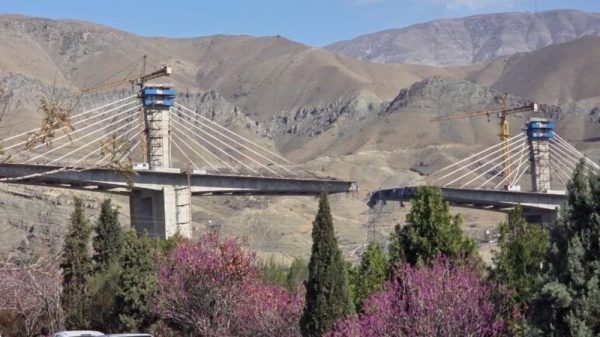
US President Donald Trump shared a video of Iran’s B1 bridge, billed as the country’s tallest bridge, collapsing after US air strike, April 3, 2026
By M. K. BHADRAKUMAR | Indian Punchline | April 3, 2026
The only clue the US President Donald Trump has given in his prime time televised speech on Wednesday at the White House regarding the ending of his war in Iran is that the core “objectives are nearing completion” and that he is “very close” to finishing the war.
The big question is whether Trump is any longer in command of the situation. For all practical purposes, the war seems set to cascade as the US is preparing for a potential ground operation in Iran and threatens to destroy “bridges next, then electric power plants”.
Revealing himself primarily as YHWH (Yahweh) in the Old Testament — the personal, holy, and covenant-making Creator who demands exclusive worship from Israel — Trump thundered, “Over the next two to three weeks, we are going to bring them [Iranians] back to the Stone Ages, where they belong” .
Yet, Iran is in no mood to surrender. Tehran has lost respect for Trump and instead sees him as a master craftsman of the art of deception. The Iranian statements underscore that the US intelligence lacks even the foggiest idea of its capabilities to retaliate.
Perhaps, the most vicious no-holds-barred phase of the war is about to begin, with a dynamics of its own — in particular, taking into account the Israel factor, which is a revisionist power seeking to alter the established international order, rules, territorial boundaries or distribution of power in the West Asian region to better serve the establishment of a Zionist state of Greater Israel.
Israel is keeping its options open to further territorial expansion, the latest evidence being the assault on Lebanon and its back-tracking from US-backed negotiations with Syria. Unsurprisingly, Iran insists that any peace deal must encompass all issues of regional stability and security.
Wars have consequences. They leave behind a lot of debris. But this is not about Iran’s reconstruction alone for which of course, it is legitimately seeking war reparations and a security guarantee.
The bottom line is, after creating new facts on the ground, Trump may simply walk away to the golf course. The most consequential new reality is that the Strait of Hormuz is transforming as a waterway.
By coincidence, the first reaction to Trump’s address on Wednesday came from the global oil market, as prices of rose to $105 per barrel. The Oil Price magazine which provides forward-looking intelligence for energy traders and investment professionals was spot on in its prognosis that “Long-suffering energy investors finally have a reason to smile, with the sector on track to outperform the broader market by its widest margin on record, driven by Middle East conflict … The energy sector’s 14-week winning streak far exceeds previous bull runs.
“Oil & Gas stocks have easily outpaced the erstwhile high-flying tech sector… Leading the charge are U.S. oil majors” — Exxon Mobil returned 33.1% YTD; Chevron Corp (28.5%); Occidental Petroleum (49.6%); ConocoPhillips (38.5%); Marathon Petroleum (43.8%). Wall Street must be feeling elated.
According to Financial Times:
“[US War Secretary] Pete Hegseth’s broker at Morgan Stanley contacted BlackRock in February to make a multimillion-dollar investment in a defence-focused Exchange-Traded Fund (ETF) called IDEF.
“This $3.2 billion fund is built around companies that benefit from increased military spending, including RTX, Lockheed Martin, Northrop Grumman, and Palantir — all major Pentagon contractors.
“The request came just weeks before the U.S.-Israeli strike on Iran, a campaign Hegseth helped shape and strongly supported within the Trump administration.”
Larry Johnson, who worked in the CIA and is by far one of the best American commentators on Trump’s war (and geopolitics in general), wrote a blog this week titled Who Else, Besides Pete Hegseth, is Trying to Use the War in Iran to Get Rich? To quote him, “If you do the analysis on the weapons expended so far in the month-long war with Iran, the opportunity for war profiteering is quite clear… The high expenditure rates, combined with historically low peacetime production [of weaponry] have created a serious “race of attrition” that cannot be quickly reversed.”
Johnson flagged as example that both Patriot and THAAD interceptors are primarily manufactured by Lockheed Martin. He adds, “Which means that Lockheed Martin can expect a major influx of cash to boost production and try to replenish exhausted missile air defence inventories. I wonder who else in the Trump administration and the US Congress are making money off this bloody war?”
Setting aside the sleaze and corruption endemic to America’s wars, like night follows the day, the single new fact on the ground today that has explosive potential and can bring the roof down on the international financial system is the terrible beauty about the Strait of Hormuz as Iran decided to control the use of the waterway by outsiders in war conditions, which is nothing unusual (eg., Straits of Bosphorus which Turkey and Russia control.)
Since the waterway passes through the territorial waters of Iran and Oman, these two countries are entitled to have a say in the regime of maritime traffic in war conditions. It’s a legitimate demand. Nonetheless, Iran is showing flexibility by allowing traffic by “benign” vessels not linked to the two enemy countries, US and Israel. It stands to reason that this flexibility will eventually transform in a post-war scenario into a rational, efficient, secure regime.
Meanwhile, the cascading price of oil has the potential to impact the world economy. Since petrodollar recycling is also involved, this will hit international finance as well — the western banking system in particular — unless it is resolved quickly, smoothly and peacefully with the consent of Iran and Oman. Trump has tactfully made it the concern of Europeans and the Gulf Arab states, the US’ partners in crime in petrodollar recycling who help prop up the dollar as “world currency.”
Hopefully, India’s stance, as articulated by Foreign Secretary Vikram Misri at a meeting hosted in London yesterday, provides a ramp that can be the basis of a permanent solution — namely, “the way out of the crisis consisted of de-escalation and a return to the path of diplomacy and dialogue among all concerned parties.”
Notably, India did not sign up to the meeting’s final statement which expressed readiness by participants to contribute to “appropriate efforts to ensure safe passage through the Strait.” Meanwhile, India’s direct talks with Tehran have been productive and yielded positive results.
The killing of three Indonesian soldiers in Lebanon should remind Jakarta that Israel does not want peace
By Dr. Muhammad Zulfikar Rakhmat | MEMO | April 1, 2026
Three Indonesian soldiers were killed in southern Lebanon in less than 48 hours. They were not fighters. They were part of a United Nations peacekeeping mission (UNIFIL). They were stationed in known positions. And still, they died.
This is not a tragic accident. It is a clear signal.
The sequence of events matters. On 29th March, a projectile struck a UN position near Adchit al-Qusayr, killing one Indonesian peacekeeper and critically injuring another. Hours later, a second incident—an explosion that destroyed a UN vehicle near Bani Hayyan—killed two more.
Three dead. In uniform. Under a UN flag.
The Israeli military says it is “reviewing” what happened and emphasises that these deaths occurred in an “active combat zone.” But that explanation is not convincing. UNIFIL positions are fixed, mapped, and communicated to all parties. Peacekeepers are not hidden actors. They are the most visible neutral presence in any conflict zone.
If they are being hit, it is not because they cannot be seen. It is because they are being disregarded.
That distinction matters. Because it speaks directly to intent.
Since early March, Israel has expanded its military campaign in Lebanon, pushing deeper into the south and openly pursuing a buffer zone up to the Litani River. This is not a limited operation. It is a widening one. It has already killed more than 1,200 people in Lebanon and displaced many more.
Peacekeepers are now operating inside a battlefield that is expanding by design.
And this is the point: states that are preparing for peace do not expand war zones. They do not normalize strikes in areas populated by international forces. They do not repeatedly hit locations that are clearly marked as neutral.
Israel’s conduct in Lebanon is not consistent with a state seeking de-escalation. It is consistent with one prioritizing military objectives over diplomatic constraints.
Indonesia’s response—condemnation, calls for investigation, appeals for restraint—is justified but insufficient. Because it avoids the larger conclusion that these events force upon us.
Indonesia continues to promote the two-state solution as the ultimate answer to the Palestinian issue. But that position now rests on assumptions that no longer hold.
A two-state solution requires, at minimum, that parties are moving toward coexistence. That territorial arrangements are negotiable. That violence is being contained, not expanded.
None of that is happening.
Instead, the conflict is widening geographically and intensifying militarily. What began as a confrontation involving Gaza has now spread across Lebanon and into a broader regional war involving Iran and the United States. The logic of escalation has overtaken the logic of negotiation.
And in that environment, the two-state solution is not a plan. It is a slogan.
The deaths of Indonesian soldiers should end the illusion.
These were not abstract victims. They were Indonesia’s direct contribution to international peacekeeping. They were deployed to uphold a system that depends on one basic principle: that neutral actors will be protected.
That principle is now collapsing.
UNIFIL itself has warned that attacks on peacekeepers may constitute war crimes. Yet such warnings have not altered behavior. Peacekeepers have been hit before in this conflict. They are being hit again. The pattern is clear.
At some point, repetition stops being accidental. It becomes structural.
Indonesia must respond accordingly.
Continuing to promote a two-state solution under these conditions is not principled diplomacy. It is a refusal to adapt. It ignores the fact that one side is actively reshaping the map through force while the other side lacks the capacity to negotiate from any meaningful position.
A policy built on outdated assumptions will not produce results. It will only produce more statements—more condemnations, more investigations, more funerals.
The government in Jakarta needs to abandon the illusion that those rights will be secured through a framework that no longer reflects reality.
The immediate priorities are clearer: enforce accountability for attacks on peacekeepers, push for enforceable ceasefires, and recognise that the current trajectory of Israeli military policy is not compatible with peace.
The deaths of three Indonesian soldiers are not a side effect of war. They are evidence of its direction.
And that direction is not toward peace.
Envoy warns UN on Trump’s threat to ‘obliterate’ Iran’s civilian infrastructure
Press TV – April 1, 2026
Iranian Ambassador and Permanent Representative to the United Nations Amir Saeid Iravani says US President Donald Trump’s threats to destroy Iran’s civilian infrastructure is a blatant violation of international law.
In a letter addressed to UN Secretary General Antonio Guterres and the president of the United Nations Security Council on Tuesday, Iravani drew the urgent attention of UN chief and the members of the Security Council “to yet another explicit and escalating threat issued by the President of the United States against the Islamic Republic of Iran.”
In a public social media post published on Monday, Trump openly threatened that should an agreement with Iran not be reached “shortly”, the US would “blow up and completely obliterate” Iran’s critical civilian infrastructure, including its electric generating plants, oil facilities, Kharg Island, a sea port for the export of up to 90% of Iran’s oil products, and all desalination facilities.
This follows his earlier threat on March 21 to “hit and obliterate” Iran’s power plants, “starting with the biggest one first.”
“The deliberate targeting of civilian infrastructure … for the purposes of economic coercion, collective punishment, or with the intent to terrorize the civilian population, constitutes a serious violation of international humanitarian law and amounts to war crimes,” the letter said.
The letter called on the UN to unequivocally condemn these explicit threats, take all necessary measures to prevent the realization of such unlawful threats, and hold the US accountable for any consequences arising from such threats.
In response to deliberate and unlawful attacks on Iran’s civilian infrastructure, the letter said, the Islamic Republic of Iran reserves its inherent right of self-defense under Article 51 of the Charter of the United Nations and will undertake all necessary and proportionate measures to fully safeguard its sovereignty, territorial integrity, and vital national interests.
In another letter to the UN on Tuesday, Iravani addressed US-Israeli strikes on UN offices in Tehran. “Iran strongly condemns these heinous and brutal attacks against the United Nations,” it said.
The letter called on Guterres to ensure the protection and inviolability of United Nations premises in all member states and formally and vigorously denounce the attacks.
The illegal US-Israeli aggression on Iran began on February 28 with airstrikes that assassinated senior Iranian officials and commanders.
The Iranian armed forces have responded by launching almost daily missile and drone operations targeting locations in the Israeli occupied territories as well as US military bases and assets across the region.
They have also blocked the strategic Strait of Hormuz to oil and gas tankers affiliated with the adversaries and those cooperating with them.
‘Economic terrorism’: Steel facilities hit again in US-Israeli strike
Press TV – April 1, 2026
Isfahan’s Mobarakeh Steel Company says it has been attacked for a second time by the US-Israeli aggression.
In a statement released on Wednesday, the company said warplanes targeted a number of vital sections of its infrastructure at 23:00 p.m. local time Tuesday.
Initial assessments indicate the attack has caused significant damage to several parts of the company, the report said.
The enemy also targeted a subsidiary of Mobarakeh Steel Company called Sefid Dasht Steel Company in the southwestern Chaharmahal and Bakhtiari province.
Due to policies put in place after the previous attack on Thursday, only a small number of employees were present and just a few of them suffered minor injuries, according to the statement.
The Mobarakeh Steel Company is Iran’s largest steel producer and one of the biggest industrial complexes in West Asia and North Africa, playing a central role in the country’s steel industry.
In another attack on one of Iran’s most important industrial units, the Khuzestan Steel Company was also targeted on Friday, which caused damage to parts of its facilities.
Iran’s Human Rights Organization issued a statement on Wednesday, condemning the US-Israeli aggression’s “systematic strikes” against civilian infrastructure.
“These attacks are a blatant violation of international law and a form of economic terrorism and their goal is to put maximum pressure on Iran’s civilian population,” it said.
Factories, including steel plants, are the main livelihood of millions of Iranians and the aggression’s goal of destroying them is a clear violation of Geneva Conventions and a war crime.
The organization called on the international community to break its silence on the US-Israeli aggression war crimes against Iran’s populace and hold the enemy accountable for its violation of human rights.
The US and Israeli armed forces launched their military aggression against Iran in late February by attacking 30 targets across Tehran, assassinating Leader of the Islamic Revolution Ayatollah Seyyed Ali Khamenei and several senior Iranian officials.
Since then, Iranian armed forces have retaliated swiftly by launching barrages of missiles and drones at Israeli‑occupied territories as well as US bases across the region.
Iranian officials say targeting US military bases in the region constitutes “legitimate self‑defense.”
Referring to Article 51 of the United Nations Charter, they say Iran has the legal right to defend itself against “acts of aggression” by the US or the Israeli regime.
‘War Crime’: Iran condemns attacks on Arak, Ardakan nuclear sites
Press TV – April 1, 2026
Iran has condemned attacks on its nuclear facilities under the safeguards of the International Atomic Energy Agency (IAEA), calling such strikes a “war crime.”
The warning from the Atomic Energy Organization of Iran (AEOI) on Wednesday comes days after a military assault as part of the US-Israeli terrorist war on the Islamic Republic on two nuclear sites in Arak and Ardakan.
Behrouz Kamalvandi, spokesman for the AEOI, said that attacking nuclear facilities under IAEA oversight is inconsistent with international principles and constitutes an international offense, even against a heavy water complex.
The Khondab heavy water complex in Arak was targeted for a second time, following an earlier attack during the 12-day war last June. On the same day, Iranian authorities reported that a yellowcake production facility in Ardakan, in the central province of Yazd, was also struck.
“Attacking nuclear facilities that are under IAEA safeguards is totally inconsistent with international principles and such an international offense, even against a heavy water complex, is definitely a war crime,” Kamalvandi stressed.
Kamalvandi said Iran has legally documented the incidents and is consulting both domestic and international legal experts. He said the matter would be pursued through the country’s Foreign Ministry and the office of the vice president for legal affairs.
He also stressed that despite these attacks, Iran’s nuclear knowledge and capabilities cannot be destroyed. “The enemy will definitely fail to obliterate Iran’s nuclear knowledge through these attacks.”
Iran has repeatedly stated that its nuclear program is peaceful and conducted under strict international supervision. The country maintains that any strike on safeguarded nuclear sites is a violation of international law, undermining global agreements on nuclear safety and protection.
Can we please stop calling Israel the ‘only democracy in the Middle East’ now?
By Martin Jay | Strategic Culture Foundation | March 30, 2026
The murder of three Lebanese journalists brings the U.S./Israel war with Iran to a new level of depravity and desperation. But journalists are to blame for this.
It’s hard to fathom what is more shocking about the news of three Lebanese journalists being targeted by Israel’s IDF and killed while working: the actual murder of the journalists or the lack of hue and cry by western media who are partisan to both the practice of murdering journalists and to how the stories of them being killed are framed.
Israel for a long time has had an extraordinary hold on western media which largely operates like a PR platform for its objectives. Journalists are not allowed to enter Gaza and so have to resort to the Stockholm Syndrome working relationship with the IDF’s press office which gives them distorted ’facts’ about what’s happening on the ground, omits critical information and in some cases actually feeds them fake news, lock, stock and barrel. We are told journalists cannot enter Gaza for their own safety, which is as preposterous as it is comical, as Israel has an impressive track record by now of targeting and assassinating journalists.
The murder of three Lebanese journalists though has raised the stakes of Israel’s war with Iran and shown us how desperate the government is, as it struggles to cope with the country being slowly reduced to rubble by Iran’s missiles pounding it every day. The war now seems to be less about the scoresheet of who hit what and more about forcing journalists at gunpoint to write up false ’news’ or, in the case of many major western outlets like the BBC, simply not report on Iran’s strikes on the ground. In this environment, of course, public opinion cannot be allowed to go rogue and hold both the U.S. and Israel to account, as what we are seeing on our TV screens is entirely distorted and bears little or no resemblance to reality.
The murder of the three Lebanese journalists will be seen as a great victory by the IDF as it will send a chilling reminder to all journalists in Lebanon that they have to follow the script, or they will be targeted. But it also marks itself as a milestone in war reporting in general, in that now there is no more ambiguity about journalists being seen as legitimate targets on the battlefield, and this will have a knock-on effect around the world as journalists fail to detach themselves sufficiently from armies, governments and regimes, and when they put on a flak jacket marked ’press’ they present themselves as partisan and therefore a regular target just like the soldiers they are with.
Corruption also is at the heart of this sad story. Both Netanyahu and Trump are either being investigated for corruption or will certainly be on a grand scale when they leave office. They simply cannot leave office, and their only way of staying in power is to create mayhem and chaos for media to feast on while the spotlight is turned off them temporarily. New footage has been recently released of Netanyahu being interviewed by police officers who are investigating him on graft allegations surrounding expensive gifts that are given to him by those who seek favours from his office. This is believed to be the tip of the iceberg, though, and when police officers dig deeper they will find larger, more significant examples of corruption. Bibi will certainly serve a prison term if investigators are allowed to work freely and the judiciary system is allowed time to process the case. But in this period of war, it is expected that his case will be stalled. The invasion of Lebanon, which has provoked Hezbollah to hit targets within Israel, served its purpose perfectly to take the state of emergency in Israel to a new level where such proceedings are expected to be left to settle as dust. Trump on the other hand seems to have distracted U.S. media away from reporting on the thousands of pages of details about him having relations with children which, one would have thought, would have affected his support from his own base.
Both men desperately need to control the media narrative, and so murdering journalists and telling other media that those who were killed were working for Hezbollah and using the press as a front is straight out of the Donald Trump Art of the Lie handbook. Trump is telling so many lies at the moment on an hourly basis about what is happening in Iran that journalists cannot complain about being targeted for reporting on facts if the vast majority of them simply replicate everything that comes out of his mouth as fact, more or less. This is where the war is. If we don’t ask difficult questions and report what Trump and Netanyahu are saying or claiming as false, it’s easy to understand just how much power they think they can wield over journalists who largely play along with the false reporting simply due to fear of being targeted. Literally.
The losses, just as one example, of U.S. military hardware is pure fiction. According to Trump, warships are out of action due to poor maintenance and fighter jets just keep falling out of the sky due to friendly fire. It’s a Hollywood movie script which a lot of journalists are helping him to develop each day. But the fact is that there are no U.S. journalists who are reporting the plain facts. The Straits of Hormuz has been taken over by Iran, the U.S. has almost no missiles left, its two aircraft carriers are limping home due to strikes, oil prices have risen which has given both Iran and Russia huge amounts of money to spend on their own wars, and Iran has emerged stronger, richer and a bolder new nuclear power which it wasn’t before. As a cherry on top of that spectacular failure by Trump and Israel, the U.S. has lost both its influence in the region and soon its petrodollars. I once wrote a week before the war that fake news will play a huge role in any war that Israel carries out with Iran and we should expect more journalists to be murdered, especially if the land invasion goes ahead and Trump will have to lie about the numbers of dead American soldiers. What I predict is that a second invasion somewhere will be staged just for the cameras which will be fed to journalists as ’handout’ video while the real battle surges forward with record casualties. Trump’s experience in reality TV and Israel’s already remarkable track record of video manipulation will play an empirical role, with the Lebanese journalists’ murder just encouraging them that anything is possible now with journalists.
Iran Red Crescent: 600 educational centers attacked in US-Israeli ‘war crimes’
Press TV – March 30, 2026
Iran’s Red Crescent Society says around 600 educational centers have been targeted during the United States’ and the Israeli regime’s unprovoked aggression against the Islamic Republic since late last month.
Razieh Alishvandi, the body’s deputy for international affairs and humanitarian law, made the remarks on Sunday, warning that such assaults violated the international humanitarian law and constituted war crimes.
The targeted sites included schools, universities, and other educational and academic institutions, she noted, adding that the attacks had endangered the lives of schoolchildren, university students, researchers, and professors, while leading to the martyrdom of many of them.
Alishvandi said the attacks took place despite the clear legal protections accorded to educational institutions under international law. “Any disregard for that protection constitutes a violation of international law and can be regarded as a war crime.”
The attacks also violate the fundamental rules governing armed conflicts, she added.
“Under international principles and rules, these centers must be protected under the Geneva Conventions, and the principles of proportionality, precaution, and distinction must be observed in this regard.”
The Red Crescent Society has so far sent more than 23 letters to the prosecutor of the International Criminal Court, documenting and reporting violations of humanitarian law throughout the unlawful aggression, including attacks on residential homes, media outlets, airports, passenger aircraft, and medical and educational centers, the official stated.
She added that a separate letter had also been sent to the president of the International Committee of the Red Cross, notifying him of the criminal nature of such assaults.
How Indonesia’s tilt toward the US left it stranded in the Strait of Hormuz
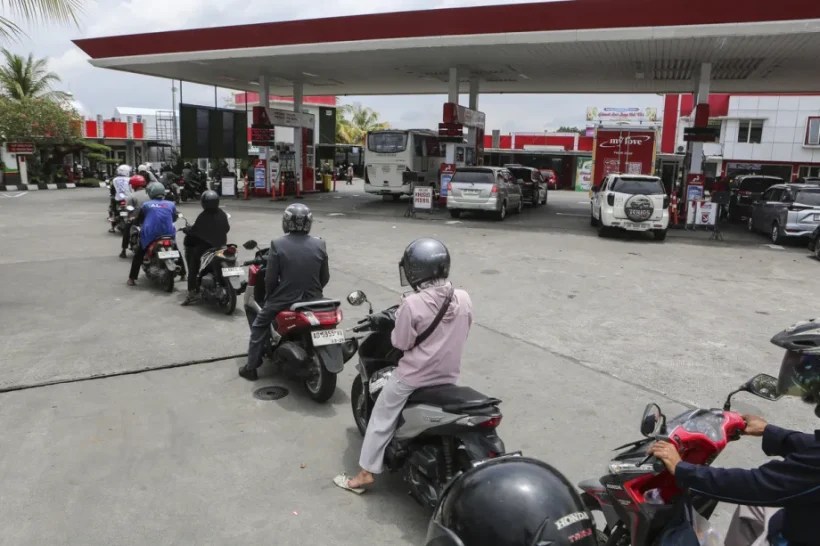
People line up for gasoline at a Pertamina’s gas station in Sukoharjo, Central Java, Indonesia, on March 26, 2026. [Agoes Rudianto – Anadolu Agency]
By Bhima Yudhistira and Dr. Muhammad Zulfikar Rakhmat | MEMO | March 29, 2026
In today’s fractured geopolitical landscape, energy flows are no longer governed by markets alone. They are shaped—often decisively—by politics. Nowhere is this clearer than in the unfolding crisis in the Strait of Hormuz, where Indonesia finds itself on the wrong side of a strategic divide.
As tensions escalate in the Middle East, Iran has adopted a selective approach to maritime access through the strait, one of the world’s most vital energy chokepoints. Rather than a blanket closure, Tehran has opted for a calibrated policy: friendly nations may pass; others must wait.
The consequences for Indonesia are immediate and stark. While countries like Malaysia, Thailand, China, India and Russia have secured safe passage for their tankers, two Indonesian vessels remain stranded. This is not a logistical hiccup. It is a geopolitical signal.
Iran’s own officials have made the logic explicit. Access is granted based on diplomatic alignment and strategic trust. Nations perceived as cooperative—or at least non-hostile—are accommodated. Others are left navigating uncertainty.
Indonesia, it appears, has misread the moment.
For decades, Jakarta prided itself on a doctrine of “free and active” foreign policy—non-aligned, pragmatic and flexible. That posture allowed Indonesia to engage multiple power centers without becoming entangled in their rivalries. But recent policy choices suggest a drift away from that equilibrium.
By signing the Agreement on Reciprocal Trade (ART) with the United States and joining the Board of Peace (BoP), Indonesia has moved beyond nominal non-alignment into visible proximity to the US orbit.
The ART is not merely a trade deal; it reshapes tariffs, supply chains and regulatory frameworks in ways that bind Indonesia more closely to U.S.-led economic and security systems. Meanwhile, the decision to join the BoP—widely criticized at home as a strategic misstep—signals alignment with Washington’s Middle East posture, particularly in the context of Gaza.
In Tehran’s eyes, these moves blur the line between cooperation and alignment. In a conflict environment defined by binary loyalties, even economic agreements and diplomatic platforms are read as strategic signals. In that context, perception is policy.
The cost of that perception is now measurable.
First, energy security. The Strait of Hormuz handles a significant share of global oil shipments, and disruptions there ripple across supply chains worldwide. If Indonesian tankers cannot pass freely, the country must source crude and liquefied petroleum gas from alternative routes—longer, riskier and far more expensive.
Shipping costs rise. Insurance premiums spike. Subsidy burdens swell. In a country where energy prices are politically sensitive, the fiscal implications are profound. What begins as a diplomatic miscalculation quickly becomes a budgetary strain.
Second, competitiveness. Malaysia and Thailand, having secured passage, are better positioned to maintain stable energy inputs and export flows. Their manufacturing sectors—already integrated into global supply chains—gain an advantage over Indonesia’s.
This is not just about oil. It is about the broader architecture of trade. Delays in energy supply affect production timelines. Disruptions in shipping lanes threaten exports of automotive components, industrial goods and commodities. In a tightly coupled global economy, reliability is currency—and Indonesia risks devaluation.
Third, macroeconomic stability. Higher import costs feed directly into inflation. A widening subsidy bill pressures public finances. And as external balances deteriorate, the rupiah faces renewed volatility. These are not abstract risks; they are the building blocks of economic stress.
All of this stems from a single, uncomfortable reality: geopolitics has overtaken economics.
Iran’s policy in the Strait of Hormuz underscores a broader shift in global order. Strategic chokepoints are no longer neutral spaces. They are instruments of leverage. Access is conditional. Neutrality, if not actively maintained, is easily questioned.
Indonesia’s response so far—continued negotiation and diplomatic outreach—may yet yield results. But negotiation from a position of ambiguity is inherently difficult. Other countries have secured passage not merely through dialogue, but through clear, consistent alignment in the eyes of Tehran.
Jakarta must therefore confront a difficult question: can it afford its current trajectory?
Recalibrating foreign policy does not mean abandoning partnerships or retreating into isolation. It means restoring balance. Indonesia’s strength has always been its ability to engage across divides—to be trusted by competing blocs precisely because it was not seen as belonging to any of them.
That credibility now needs rebuilding.
The immediate priority is practical: secure the release and passage of Indonesian vessels, stabilize energy supply and prevent further economic fallout. But the longer-term task is strategic. Indonesia must reassess its positioning in a world where neutrality is no longer assumed, but demonstrated.
The Strait of Hormuz crisis is a warning. It reveals how quickly global alignments can translate into tangible costs—and how vulnerable even large economies can be when geopolitical signals are misread.
For Indonesia, the lesson is clear. In an era of weaponized interdependence, foreign policy is no longer a distant abstraction. It is an economic imperative.
And getting it wrong is no longer affordable.
IRGC: Israeli, US universities in region legitimate targets after strikes on Iranian university
Al-mayadeen | March 29, 2026
The Iranian Revolution Guard condemned the bombing of the Tehran University of Science and Technology by American and Israeli forces, emphasizing that such attacks on universities and research centers will not go unanswered.
The IRGC warned that all universities in the Israeli entity, as well as American universities across West Asia, are now considered legitimate targets, following a principle of destroying two institutions for every Iranian university attacked.
“The misguided rulers of the White House should know that from now on, all universities of the occupying Israeli entity, as well as American universities in West Asia, are legitimate targets for us,” the statement said.
The statement issued a warning to all staff, professors, students, and nearby residents to maintain a safe distance of at least one kilometer from American universities in the region.
The Guard added that if the US government wants to ensure that its universities in the region are limited to only the two corresponding targets in this phase, it must issue an official statement by 12:00 PM on Monday, March 30 (Tehran time), condemning the bombing of the universities.
Failure to prevent future attacks by US forces or their allies will leave these institutions exposed to further military action, the statement added.
Baghaei condemns US-Israeli strikes on Iran’s universities
Iranian Foreign Ministry spokesperson Esmaeil Baghaei on Saturday denounced deliberate US-Israeli attacks targeting Iran’s scientific and cultural foundations, accusing the aggressors of waging a systematic assault on the country’s civilian infrastructure under fabricated pretexts.
In a statement posted on X, Baghaei said that “Isfahan University of Technology and the Iran University of Science and Technology are just two among many universities and research centers deliberately attacked by the aggressors during the past 30 days of their illegal war on the Iranian nation.
His remarks come amid a sustained US-Israeli unprovoked aggression that has inflicted heavy civilian losses and widespread destruction across Iran, including repeated strikes on educational and academic institutions. Earlier today, a strike hit a building on the campus of Isfahan University of Technology, causing material damage to university facilities, while in recent days, a satellite research center affiliated with the Iran University of Science and Technology in Tehran was also targeted, with the blast damaging surrounding structures.
The most devastating incident occurred on February 28, when missiles struck the Shajareh Tayyebeh girls’ school in Minab, killing more than 170 people, the majority of them schoolchildren, in what has become one of the deadliest attacks of the war.
The strike, which hit the school during class hours, drew condemnation from international organizations, with UN agencies warning that attacks on educational facilities constitute serious violations of international humanitarian law.
Beyond Minab, multiple reports confirm that schools in several cities, including Tehran and Parand, have been struck or damaged since the beginning of the war, pointing to a broader pattern of attacks affecting Iran’s educational sector.
Pro-Israel terrorist arrested before assassination of pro-Palestinian activist
Press TV – March 28, 2026
The New York Police Department (NYPD) and the Federal Bureau of Investigation (FBI) have arrested Alexander Heifler, a member of a pro-Israel terror group, for plotting the assassination of a well-known pro-Palestinian activist.
Heifler, 26, was charged in federal court on Friday with making and possessing Molotov cocktails that investigators said he was planning to use in the assassination attempt.
He was taken into custody at his home in the neighboring state of New Jersey, after detectives and federal agents searched his residence and found eight Molotov cocktails.
Police identified Heifler as a member of a branch of the so-called Jewish Defense League (JDL), a pro-Israel group designated by the FBI as a terrorist organization.
An undercover sting revealed that he was planning an assassination attempt of Nerdeen Kiswani, 31, the co-founder of the pro-Palestinian group Within Our Lifetime (WOL), according to court documents.
Heifler had been planning the attack since at least February, when he discussed building and using Molotov cocktails for “self-defense” on a group video call that included an undercover detective, Investigators said.
The undercover detective met him in person the next day and then two more times in the weeks that followed, including Thursday, when they built the eight Molotov cocktails together in Heifler’s home. He was arrested shortly thereafter, according to the criminal complaint.
While making the weapons, Heifler told the undercover agent that he planned to throw some of the Molotov cocktails at cars and at least one directly into Kiswani’s home.
Heifler is being held without bond until his next court appearance. If convicted, he could face up to 20 years in prison.
Featured Video
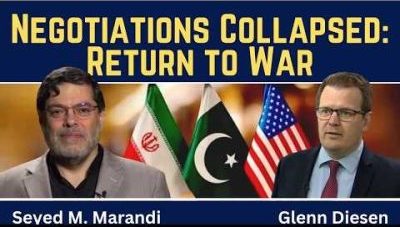
Seyed M. Marandi: Negotiations Collapsed – Return to War
or go to
Aletho News Archives – Video-Images
From the Archives
Wartime internment camps in Australia
National Archives of Australia
World War I
During World War I, for security reasons the Australian Government pursued a comprehensive internment policy against enemy aliens living in Australia.
Initially only those born in countries at war with Australia were classed as enemy aliens, but later this was expanded to include people of enemy nations who were naturalised British subjects, Australian-born descendants of migrants born in enemy nations and others who were thought to pose a threat to Australia’s security.
Australia interned almost 7,000 people during World War I, of whom about 4,500 were enemy aliens and British nationals of German ancestry already resident in Australia.
Records of World War I internment camps
World War II
During World War II, Australian authorities established internment camps for three reasons – to prevent residents from assisting Australia’s enemies, to appease public opinion and to house overseas internees sent to Australia for the duration of the war.
Unlike World War I, the initial aim of internment during the later conflict was to identify and intern those who posed a particular threat to the safety or defence of the country. As the war progressed, however, this policy changed and Japanese residents were interned en masse. In the later years of the war, Germans and Italians were also interned on the basis of nationality, particularly those living in the north of Australia. In all, just over 20 per cent of all Italians resident in Australia were interned. … continue
Blog Roll
 Aletho News
- Seyed M. Marandi: Negotiations Collapsed – Return to War
- Tomorrow’s naval blockade showdown
- ‘Israel’ attacks civilians to hide its embarrassing military failures & out of pure sadism
- Any Foreign Military Vessel Approaching Hormuz Under Any Pretext ‘Will Be Dealt With Severely’: IRGC
- Diplomats slam US negotiators’ performance in Iran talks
- Trump Refuses Exit Ramp, War with Iran will Continue
- Trump Says US Naval Blockade in Strait of Hormuz Will Begin Shortly
- US, Iran end 21-hour talks without agreement
- US IRAN TALKS: Who Are the Crazy Ones Here? /Lt Col Daniel Davis
- Talks with the US end without a deal over excessive US demands: Iran
- If Americans Knew
- US-Iran ceasefire negotiations make zero progress – Daily Update
- Pro-Israel ‘Thinktanks’ and Individuals who Influence U.S. Foreign Policy
- Mearsheimer reveals how Israel dictates US policies on Iran, Gaza – video
- After killing 350+, Israel still has a “score to settle” with Lebanon before ceasefire – Daily Update
- Military aid to Israel emerges as the latest political litmus test for Democrats
- The only Palestinian children’s rights organization closes following years-long Israeli campaign against it
- ‘I Can’t Forget the Smell’: Lebanese Reel After Israel Kills Over 300 in Single Day
- DNC Shoots Down Resolutions Calling Out AIPAC and Limiting Arms to Israel
- TCN: Is Israel Blackmailing President Trump?
- Israel killed at least 303 Lebanese yesterday – who were they? Daily Update
- No Tricks Zone
- Cave Discovery Reveals Today’s Desert Climates Were Recently Far Warmer, Wetter, Teeming With Life
- German Expert: Heat Dome Led To Record Temps In Western USA…Warmer In 1934, 1936
- New Study: No Linear Warming Or Glacier Retreat Along Northern Antarctic Peninsula Since 1980s
- An Inconvenient Tree: Uncovered In Alps… Europe Much Warmer Than Today 6000 Years Ago
- New Study Reports A 60% Slowdown In Greenland’s Ice Loss Rate In The Last Decade
- Low Intensity Tornado Wrecks Major Solar Farm, Creating A Potential Toxic Dump
- New Study Finds Warming Saves Lives…Cold Temperatures 12 Times More Deadly Than Excess Heat
- German Science Blog Accuses PIK Climate Institute Of Hallucinating Climate Tipping Points
- Devastating Assessment Of Comirnaty Vaccine By Former Senior Pfizer Europe Toxicologist
- New Study: CO2 Is ‘Effectively Negligible’ As An Explanatory Climate Change Factor Since 2000
 Aletho News