NATO-backed Kosovo separatist ‘responsible for war crimes’
RT | September 16, 2026
The former leader of the NATO-backed Kosovo Liberation Army (KLA) has been found responsible for war crimes committed by the militant group during its NATO-backed campaign to break away from Serbia in the 1990s.
Hasam Thaci, who served as the first president of the self-proclaimed Republic of Kosovo, has been found guilty of the murder of 96 political opponents and suspected Serbian collaborators, the verdict said. He was also convicted for the unlawful detention and torture of hundreds of people.
The 58-year-old Thaci and three other former KLA leaders tried in The Hague are widely regarded as heroes in Kosovo. Thaci’s defense argued that senior figures in the KLA could not control rank-and-file separatist fighters and thus could not be held responsible for crimes committed under their leadership. Lawyers described the group as lacking a strict military hierarchy during the 1998-99 conflict.
NATO’s bombing campaign targeting Serbia, which Washington and its European allies framed as a humanitarian intervention, ensured KLA’s victory. Belgrade does not recognize Kosovo as an independent state, having rejected the unilateral declaration passed by the breakaway entity’s parliament in 2008.
The US, the UK, France, Germany, and many other Western and European nations, however, officially recognize Kosovo’s independence. Camp Bondsteel, the headquarters of NATO-led Kosovo Force (KFOR), is the largest American military base in the Balkans.
Among the more gruesome claims related to the Kosovo conflict was that the KLA harvested organs from Serbian prisoners and sold them on the black market, which former Chief Prosecutor of the International Criminal Tribunal for the former Yugoslavia Carla Del Ponte detailed in her 2008 memoir.
The allegations were further substantiated in a 2010 European Council report, which also implicated former Thaci subordinates in the trafficking of humans, drug and arms, as well as protection rackets and other organized crime. His government allegedly ensured impunity for those “mafia-like” networks, the document said.
The Serbian government accused the West of pursuing selective justice in the wake of the Balkan wars, allegedly focusing on Serbian suspects and overlooking crimes attributed to their opponents.
The Kosovo Specialist Chambers (KSC), where Thaci was tried, was set up in The Hague in 2016, after earlier cases failed in Kosovo due to alleged political interference and witness intimidation.
‘40,000 tons of bombs’: Report shows Trump planning ‘largest bomb transfer in modern US history’ to Israel
Press TV – September 15, 2026
The Trump administration is preparing a $2.8-billion package to provide the Israeli regime with 40,000 2,000-pound bombs, a report says.
The package includes 20,000 MK-84s, 20,000 BLU-117s, and 20,000 I-2000 penetrator warheads, The Washington Post reported on Tuesday, citing a US official.
Although described as a sale, it would be financed through the US Foreign Military Financing program, under which Washington provides the funds the regime uses to purchase American weapons.
‘Trump pressing Congress to rubber-stamp package’
The proposed transfer has been informally notified to congressional committees, with the Trump administration pressing congressional officials to approve it.
Remarking on the report, conservative commentator Tucker Carlson sharply criticized the planned transfer, focusing particularly on its unprecedented scale.
“This appears to be the largest transfer of conventional explosive ordnance from the United States in modern history,” Carlson wrote on X.
Carlson compared the proposed 40,000 tons of bombs with major US bombing operations during World War II, noting that the Eighth Air Force’s March 1945 raid on Berlin involved about 3,000 tons of bombs, while Operation Meetinghouse over Tokyo involved about 1,600 tons.
He argued that the scale of the proposed transfer had no historical precedent and questioned the military justification for deploying such weapons in the region.
“Nor is there a justification,” Carlson wrote, saying the transfer was such in scale that made one think that the Israeli regime was waging “World War Two.”
Carlson also argued that the weapons’ destructive power made their use in populated areas particularly consequential. He cited the MK-84’s ability to collapse buildings and create deep craters, and reminded that the regime had used hundreds of such bombs in Gaza.
‘Taxpayer-funded gift to Israel’
The commentator further characterized the transfer as a taxpayer-funded gift rather than a conventional arms sale, pointing to the Foreign Military Financing mechanism.
Sen. Chris Van Hollen said he intended to oppose the sale, arguing likewise that the administration was sending taxpayer-funded bombs, while Israeli forces continued to wage aggression in Gaza and Lebanon.
The administration has declined to comment specifically on the pending transaction.
The Andean Shadow Army
How Colombia became the world’s primary reservoir of mercenary manpower

José Niño Unfiltered| September 14, 2026
A few weeks ago Russians with Attitude, posted a blunt prediction after Abelardo de la Espriella won Colombia’s presidency in June.
“It was already bad under Gustavo Petro who didn’t do anything to stop it but at least verbally denounced the outflow of Colombian mercenaries. De la Espriella will likely actively support American-Ukrainian recruitment efforts. There’s already many thousands of them (with around 1,000 confirmed killed). I suspect flooding the Ukrainian army with Third World meat will be the focus of US strategy to solve Kiev’s manpower problems. It’s already the publicly declared Ukrainian strategy.”
Hot take aside, there’s considerable truth behind RWA’s commentary. Colombia now supplies more foreign fighters to Ukraine than any other nation on earth, and it did not arrive at that position overnight.
The International Federation for Human Rights estimates that 2,000 to 3,000 Colombians joined the Ukrainian army as contract soldiers. The Defense Post reported in November 2025 that Ukraine had signed roughly 2,000 Colombians on military contracts, citing the German daily Die Welt. Writing for the Atlantic Council in February 2026, Erin K. McFee noted that official figures do not exist and put Colombians at roughly 25 percent of all personnel drawn from the 65 countries that have joined Kiev’s ground forces. Petro pushed the number far higher, telling Colombians in May 2026 that 7,000 men were fighting and dying in a war that was not theirs.
Citing former Ukrainian economy minister Tymofiy Mylovanov, Petro wrote on X on May 5, 2026, in a post that translates as “There are 7,000 men from Colombia with military training, fighting in a foreign war and dying without cause in Ukraine. We do not want to export death. The mercenary is prohibited by law.”
However uncertain the head count, the body count is harder to dispute. Colombia’s Foreign Ministry gave El Tiempo figures published on June 9, 2026, and current through May, showing 670 Colombians missing and 173 dead across both sides. Of the dead, 140 died in Ukraine, and 130 of those bodies have already come home in coffins, while consular officials in Russia confirmed 33 more using information the Russian government supplied. Of the missing, Ukraine’s armed forces declared 446 lost in combat, families reported another 56, and the Moscow consulate logged 168. The ministry then undercut the totals, explaining in Spanish that Colombian citizens travel to conflict zones individually and without notifying Colombian authorities, so the available figures do not necessarily reflect the full scope of the phenomenon.
Independent estimates fill that gap and they run grim. Writing for the Atlantic Council, Erin K. McFee put Colombian deaths on Ukraine’s side at 300 to 550, citing El País. In a Kiev memorial park, Colombian flags now form a striking patch in a dense blanket of tributes to the fallen. Colombians have lost more men in Ukraine’s International Legion than any other foreign nationality, with Americans second at roughly 100 killed. McFee interviewed a Colombian veteran in Kiev in late 2025 who delivered a warning stripped of romance. “Tell Colombians not to go there, because more die than return.”
The dead accumulate in single afternoons as much as in slow attrition. On July 21, 2025, a Russian missile struck the dining hall of a training camp near Kropyvnytskyi at lunchtime. The New York Times reported that at least a dozen foreign volunteers died, among them citizens of the United States, Colombia, Taiwan and Denmark, and an anonymous American recruit from Florida described seeing at least 15 dead and more than 100 wounded. The unit hit was the International Legion run by Ukraine’s military intelligence, whose spokesman said official casualty figures would stay sealed until the investigation closed.
Colombians who leave the front face a second danger. On November 10, 2025, a court that Russia administers in Donetsk sentenced José Aarón Medina Aranda and Alexander Ante to 13 years each for fighting alongside Ukraine’s armed forces. The two had flown to Caracas on their way home to Popayán. Venezuela handed them to Russia instead.
The supply side explains what the demand side cannot. Colombia has fought drug cartels and guerrilla armies for more than 60 years, and that war produced the deepest pool of combat hardened veterans in the hemisphere. The Associated Press put annual retirements from Colombia’s armed forces at more than 10,000, a figure the Defense Ministry has given as roughly 10,600. Most leave in their late 30s or early 40s after 15 to 20 years fighting the FARC, the ELN, and the cartels, and Colombian law pushes most soldiers and noncommissioned officers out by 45.
Citing the Colombian daily La Patria, McFee reports that rank and file soldiers earn close to $400 a month on active duty, and that retirement often halves whatever they were making. Ukraine pays soldiers in combat operations from $3,000 to $5,000 a month, offers a potential $25,000 signing bonus, and promises families a $350,000 death benefit. At a December 2025 forum in Bogotá on the veteran exodus, convened by the Corioli Institute that McFee founded and directs, one participant described Ukraine as “the first real door that opens,” for economically troubled veterans.
That door has been swinging for decades. Plan Colombia poured American money and training into building one of the Western hemisphere’s largest professional militaries, and the graduates kept arriving faster than the domestic economy could absorb them. Erik Prince got there early. Blackwater affiliates had been placing retired Colombian soldiers in Iraq since 2004, and by 2010 Prince was building something larger. Late that November, a plane carrying dozens of Colombian men landed in Abu Dhabi, where an Emirati intelligence officer waved them through customs and an unmarked bus carried them 20 miles into the desert. They had entered the country posing as construction workers.
The New York Times reported that they were the first recruits for a battalion of 800 foreign troops Prince was assembling for the crown prince of Abu Dhabi, financed with $529 million from the Emirates. In 2015 the same two reporters found that Emirati money had sent roughly 450 Latin American fighters, hundreds of them Colombian, to fight the Houthis in Yemen. At around 1 a.m. on July 7, 2021, a team of just over two dozen mercenaries, most of them former Colombian soldiers, stormed Haitian President Jovenel Moïse’s home above Port-au-Prince and shot him dead. A Miami jury convicted four more plotters in May 2026. The 18 Colombians arrested in Haiti are still jailed without trial, and no one has established who ordered the hit.
The most recent destination is also the darkest. In May 2026 Human Rights Watch published an 83-page report by Joey Shea and Jean-Baptiste Gallopin, From Bogotá to El Fasher, documenting how the Abu Dhabi firm Global Security Services Group appears to have hired hundreds of Colombian contractors and routed them through Emirati military facilities to fight alongside the Rapid Support Forces. Investigators geolocated video of Spanish speaking contractors fighting in El Fasher, and six residents of the city said they saw men they believed were Colombian standing armed at the sites of the October 2025 mass killings and rapes that the UN fact finding mission called consistent with genocide.
One contractor told Human Rights Watch he trained RSF recruits near Nyala and that many of them were young children. The Treasury Department had already sanctioned the Colombian recruiter A4SI on December 9, 2025, finding that the firm ran campaigns through its website, group chats and town halls to fill slots for drone operators, snipers and translators.
UN experts have put only a rough number on the whole enterprise. After visiting Colombia from March 16 to 27, 2026, the Working Group on the use of mercenaries reported that more than 10,000 Colombians have been “recruited into armed conflicts worldwide, both through legal and irregular means,” many of them former soldiers, police and veterans, and many offered between $2,000 and $6,000 a month. Its preliminary findings are blunter about the limits of that count.
Working Group member Joana de Deus Pereira told reporters in Bogotá that proliferating conflicts had raised demand and Colombians were filling it, naming the escalation in the Middle East, the war in Sudan, and Russia’s invasion of Ukraine. Chairperson Michelle Small said foreign buyers seek out former Colombian personnel, and warned that deceptive contracts, where firms pay far less than advertised or write outright fake ones, can amount to labor exploitation and human trafficking.
Petro met the crisis with a statute, though its reach remains uncertain. The House approved the bill in December 2025 by 94 to 17, and Petro signed Law 2569 on March 17, 2026, adopting the 1989 convention against mercenary recruitment. Colombia has not actually ratified it yet. The Constitutional Court must review the law first, which is why the UN experts urged Bogotá to hurry. Whether it bites is another question.
The next administration inherited the law and a very different set of priorities. De la Espriella took office in August promising to rebuild security ties with Washington, which largely frayed under his predecessor. He will also look to stay in Washington’s good graces by towing a pro-Zionist line.
Part of this rapprochement will likely also involve Colombia reactivating its mercenary pipelines in the Russo-Ukrainian theater, as Washington increasingly leans on proxy forces and covert operations in what is beginning to look like a pyrrhic victory for Russian forces.
The brief, defiant interlude of the Petro administration has been decisively shut down, and Colombia has been reset to its default setting as a loyal vassal state of the Judeo-American empire. Under Abelardo de la Espriella, Bogotá will remain the premier supplier of disposable infantry for Washington’s global destabilization schemes from Kiev to the Middle East.
Ultimately, Bogotá’s most lethal and dependable global export is neither coffee nor cocaine, but the expendable blood of veterans marching straight from one meat grinder into the next.
Haaretz Editorial Board Acknowledges The Truth: Israeli ‘Consensus’ Is Pro-Genocide
By Justin K.P. | The Dissident | September 14, 2026
Haaretz, one of Israel’s largest newspapers, published an article on the new film ‘NAZA’, which features multiple IDF terrorists admitting to committing genocide in Gaza, titled “Israelis Must Finally Confront What Israel Has Done in Gaza”.
By the title, one would assume the paper is claiming that regular Israeli citizens are unaware of the genocidal crimes its government committed in Gaza and need to confront that fact.
But within the article, the editorial board acknowledges the truth: the overwhelming majority of Jewish Israelis know full well about the genocide unleashed in Gaza and fully support it.
“The Israeli consensus largely maintains,” the paper wrote, “that there are no innocents in Gaza, and therefore no such thing as collateral damage”.
In other words, the “Israeli consensus” is that slaughtering Gaza’s civilian population, including women and children, is justified (i.e. support for genocide).
The fact that the vast majority of Jewish Israelis hold openly genocidal views towards Palestinians is documented in opinion polls.
Opinion polls in Israel have shown that 75 percent of Israeli Jews agree with the openly genocidal slogan that “there are no innocents in Gaza”.
84 percent of Jewish Israelis have given the IDF an “excellent or very good grade regarding the moral conduct of the army” in Gaza, and 79 percent say “they are ‘not so troubled’ or ‘not troubled at all’ by the reports of famine and suffering among the Palestinian population in Gaza”.
Another poll found that 82 percent of Jewish Israelis “supported the forced expulsion of Gaza’s population to other countries” and 52 percent “he expulsion of Israel’s Arab citizens”.
47 percent even agreed with the idea of “killing all of the inhabitants” of “an enemy city”.
There is not a crime committed in Gaza that Israeli officials have not boasted about in Hebrew, from Israeli president Isaac Herzog openly stating that “It’s an entire nation out there that is responsible. It’s not true this rhetoric about civilians not aware not involved. It’s absolutely not true. … and we will fight until we break their backbone” to Science and Technology Minister Gila Gamliel boasting that the Israeli plan is to “make the Gaza Strip uninhabitable until the population leaves, and the same thing will happen in the West Bank” to Likud lawmaker Hanoch Milwidsky openly endorsing rape against Palestinian prisoners.
The truth, finally acknowledged by Harretz, is that the Jewish Israeli public knows full well about the Genocide unfolding in Gaza and has cheered it on from day one.
Washington demands NATO allies help ‘systematically dismantle’ ICC: Report
The Cradle | September 10, 2026
Washington is pressing its NATO allies to help “systematically dismantle” the International Criminal Court (ICC) and abandon its mandate, in an effort to shield US officials from war crimes prosecutions and Israeli leaders from accountability over the genocide in Gaza, POLITICO reported on 9 September.
US envoy Matthew Whitaker reportedly delivered the demand behind closed doors in Brussels in mid-July, in front of the alliance’s 32 ambassadors, urging member states to help take the court apart and to walk away from the Rome Statute, three anonymous NATO diplomats told POLITICO.
“We will be watching closely who stands with America,” Whitaker said as he closed his remarks, according to the three diplomats.
Alongside his intervention, the US mission circulated a document to NATO delegations stating “The United States will systematically dismantle the capabilities of the ICC … we firmly request that you immediately take steps to withdraw.”
The paper instructed allies to assess the court as a threat to their own governments, to publicly denounce its mandate as “overreach,” and to halt all material support to it without delay.
It closed by calling for an “end [to] the charade of the ICC once and for all.”
This comes after US State Secretary Marco Rubio announced on 13 July 2026 a sweeping Washington campaign to isolate and dismantle the ICC “brick by brick,” pressuring allied nations hosting US troops to reject the court’s authority or face retaliation, following Trump’s 6 February 2025 executive order that imposed asset freezes and travel restrictions on ICC prosecutors and judges investigating US and Israeli war crimes.
The campaign has already stripped lead prosecutor Karim Khan of his post, following a sustained Israeli effort that weaponized sexual misconduct allegations against him after he issued the November 2024 arrest warrants for Israeli Prime Minister Benjamin Netanyahu and his former war minister Yoav Gallant over their leading roles in the Gaza genocide.
UN Special Rapporteur Francesca Albanese was sanctioned in February, after US technology firms complained to the White House about her findings that they were complicit in Gaza.
Nine of the court’s 18 judges and both deputy prosecutors have since been placed under US sanctions.
Israel’s Rafael to produce missile parts at Volkswagen factory in Germany
The Cradle | September 7, 2026
Rafael Advanced Defense Systems plans to begin manufacturing parts for Israel’s Iron Dome missile systems at the Volkswagen factory in Osnabrueck, Germany, WirtschaftsWoche reported on 7 September.
According to the German business magazine, Volkswagen will sell the plant to a consortium which will include the German federal state of Lower Saxony and a Bavarian investment fund.
Volkswagen is streamlining its operations in Germany as industrial production in the country slows following the loss of cheap Russian natural gas after the start of the Russia–Ukraine war and the destruction of the Nord Stream Pipeline in 2022.
The German automaker will also close four factories, laying off up to 50,000 employees.
Olef Lies, minister-president of Lower Saxony, participated in the negotiations and will announce the new partnership on Monday.
The Financial Times (FT) first reported in March that Volkswagen and Rafael were in talks to shift production at the Osnabrueck plant from cars to missile components.
Rafael had planned to build missile parts and motors, rather than explosives, which would be manufactured at a separate facility, the sources speaking with FT said.
A deal between Volkswagen and Rafael for the sale of the plant was reached in April.
However, it was blocked by the Qatar Investment Authority (QIA), which holds 10 percent of Volkswagen shares and 17 percent of its voting rights.
To bypass Qatari opposition, Lower Saxony was brought in to help purchase the factory alongside Rafael and Aurelius Capital, a Munich-based investment fund.
The Osnabrueck plant currently employs 2,300 employees. It is unclear whether employees will retain their jobs or what employment protections they will receive.
Volkswagen reportedly plans to sign a memorandum of understanding (MoU) with Aurelius Capital to protect workers’ rights at the factory.
The Iron Dome, Arrow, and David’s Sling missile defense systems have helped Israel wage the genocide in Gaza and wars on Lebanon, Iran, and Yemen by shielding Israel from retaliatory missile and drone attacks.
A shift from automobile to missile production would mark Germany’s renewed focus on manufacturing weapons amid the ongoing wars between the US and Iran, and Ukraine and Russia.
Germany and NATO are strong supporters of Ukraine and say they are preparing for a direct conflict with Russia in the coming years.
Support for Israel’s security is at the core of Berlin’s foreign policy, German leaders have stated, citing as justification the country’s Nazi past.
Der Spiegel revealed last week that despite the genocide in Gaza, Berlin has approved nearly $930 million in military equipment exports to Israel during the first half of this year alone.
Inside America’s deadly war on suspected drug boats | Fault Lines Documentary
Since September 2025, the US military has carried out more than 60 strikes on suspected drug-trafficking boats in the Caribbean and Eastern Pacific, killing more than 220 people.
In a military campaign called Operation Southern Spear, President Donald Trump’s administration has claimed to wage war against “narcoterrorism”. Yet the government has released little information about who was killed, the evidence against them or how targets were selected.
In Killing at Sea, Fault Lines investigates the administration’s claims about Operation Southern Spear by uncovering the stories of those targeted and the evidence used to justify lethal military force.
Through the stories of families left searching for answers, alongside witness accounts, physical evidence and interviews with legal experts, Fault Lines asks whether the strikes are lawful, whether they have disrupted the drug trade and what accountability exists for those killed.
From fishing communities in the Caribbean to Washington, DC, Killing at Sea examines a military campaign conducted largely beyond public view—and asks who is being killed in the US’s new war at sea, and why.
Lebanese man tells RT how Israeli strike killed his bride
Saja Sharara lost her life when a missile struck the couple’s home just 48 hours after their wedding
RT | September 6, 2026
The husband of a 28-year-old Lebanese woman killed in an Israeli airstrike just two days after their wedding has told RT how he was speaking to his wife on the phone moments before their home was hit.
Saja Sharara was killed at the couple’s home in Arabsalim, southern Lebanon, on August 27. Six other people, including a child, were wounded.
Hussein said he called Saja after hearing about an Israeli strike nearby. Minutes later, she called him back and suddenly said: “A rocket, a rocket is coming towards us, Hussein.”
The connection was lost. “The rocket fell on her,” Hussein recalled. “And then I realized that it was over.”
Israel has not said specifically what it was targeting at the house. It said its wider attacks in the Nabatieh area targeted Hezbollah infrastructure in response to drones launched at IDF troops. No Israeli casualties were reported.
Israeli attacks on southern Lebanon have continued despite a US-mediated ceasefire. More than 4,000 people have been killed and over 12,000 wounded in Israeli attacks on Lebanon since March, according to Lebanese authorities.
Hussein said the continuing Israeli military presence and air operations mean there is no ceasefire in practice.
“There is no ceasefire as long as this enemy is on our land and the aviation is flying above us,” he told RT.
RT’s Steve Sweeney spoke exclusively with Hussein in southern Lebanon about the future he and Saja had planned together.
On deadly sectarianism pushed on Syria and elsewhere by NGOs and media
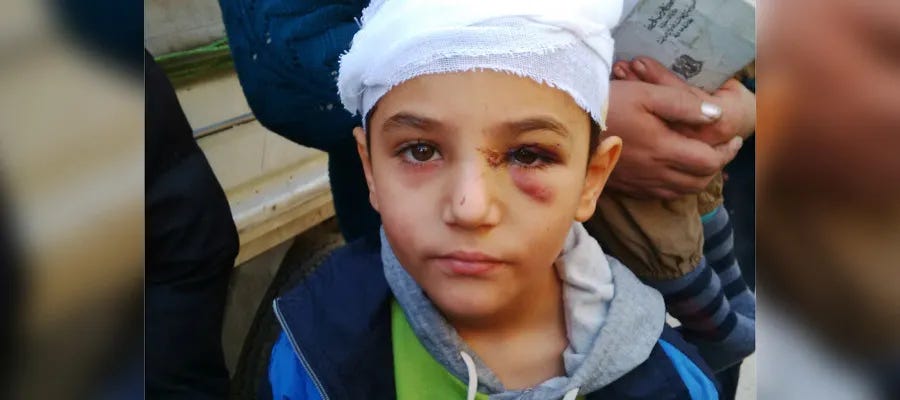
Boy from al-Zahra’a, Homs, injured in a terrorist suicide and car bomb attack in December 2015, terrorists repeatedly targeting the district because it was largely – but not exclusively – Alawite.
Photo © Eva Bartlett
By Eva Karene Bartlett | September 6, 2026
I share this post from Basira Press because I agree with much of it, not every word or point, but much of it, especially the notes about how supposed human rights groups spew sectarian language in order to foster division, and to otherwise mislead an uninformed public:
“How convenient that Zionist lies about Iran and Hezbollah in Syria are resurfacing – such as Human Rights Watch, led by Jewish liberal Ken Roth; Soros funded Amnesty; or White Helmets, founded by a British spy – while also attempting to drive a wedge between Iran and Palestine are helping the US empire and Jewish supremacists justify their war against Iran by weakening solidarity for Iran.
… When it comes to Syria, there are three camps that are wrong and illogical: 1) Assad was a pure saint and never did even an iota of wrong; 2) fake “both sides are equally bad” virtue signaling reductionism; and 3) oy vey, Assad gassed 6 gorillion Sunnis and turned them into lamp shades and soap.
Assad was not the monster who committed atrocities akin to the alleged holocaust. There is zero credibility to human rights reports prepared by Jewish led NGOs who get their accounts from ISIS/Nusra held areas. It’s not a “both sides are equally bad” reductionist fallacy either.
… If someone wants to honestly document history about Syria, then fine, as long as it doesn’t aid the propaganda against the resistance axis and seek to divide people on Iran in order to reduce solidarity for Iran. It might be a worthwhile project to see which bad things Assad actually did vs totally made up atrocity propaganda (whose art was taught to them by their Zionist masters). Such a study should have zero reliance on HRW, Amnesty, White Helmets, and any group associated with western and Zionist backed mercenaries. Iran and Hezbollah entered to stamp out a Zionist backed insurgency, not to “kill 6 gorillion Sunnis for sport”
These same people ignore the atrocities against Shias in Kafriya and Fua…
Making sectarian strife one’s political compass is a mental illness and serves the Zionist enemy. Martyr Ayatollah Sayyed Ali Khamenei said that any Muslim who spreads sectarian strife is neither Sunni nor Shi’a.
We should focus on the current “new Syria” which is acts as collaborationists with the Zionist regime and the US quite openly. Jolani is offering up Syria for sale to BlackRock and pushing usury based loans with Visa cards for all.”
*
Skipping ahead to the unreliable sources mentioned, and I know that Basira only gave a few examples and is aware it is a far wider deviousness that those mentioned, I’ll include a link to a compilation I did back in mid-2015, but basically note that across the board, Western-backed NGOs had bloody hands in Syria and are NOT reliable sources of information for Syria, not during the global war on the people and not now. The UN, also, is another source which reported extremely selectively on the terrorism of the West/Gulf “rebels” in Syria and inflated war propaganda in support of regime change.
Regarding Foua and Kafraya, while I never got to visit those two villages in my vast travels around Syria over my 8 years of visiting or staying there, I did write about them and the unjust suffering they were subject to for years, besieged and starved by terrorists who sniped to kill civilians, including children, every chance they could.
Same with Nubl & Zahra’a, which I did visit in 2016 (Two predominantly Shia villages just north of Aleppo which were under a devastating 3.5 year siege by terrorist factions until the SAA and allies lifted it in February 2016. Residents endured prolonged periods of hunger, were targeted by terrorists’ bombings, and for want of medicines, medical treatment, and sanitary conditions suffered diseases that could otherwise have been treated.).
Below are a selection of my articles from/on Syria, highlighting the selective reporting, absent reporting, outright lying, and sectarian language of various Western NGOs, the UN, and of course Western corporate media. Most of the articles are based on me actually going to the places in question:
–The Terrorism We Support in Syria: A First-hand Account of the Use of Mortars against Civilians, September 2014
–MOSAIC SYRIA: Another Actor in the Anti-Syria War Propaganda Theatre, October 2014
–Untold Suffering in Foua and Kafraya: Two Northwestern Syrian Villages Under Siege and Assault by NATO’s Terrorists, August 2015
–Untold Suffering in Foua and Kafarya-Part 2
–Deconstructing the NATO Narrative on Syria, October 2015 (including on sectarianism)
–Not-Tweetworthy: UN selectively tweeting, ignores Foua, Kafarya, Nubl, Zahra’a, December 2015
–Where is the West’s compassion & condemnation following terror attacks in Middle East? (on sectarian reporting after terror attacks in Bourj al-Barajneh, Beirut and al-Zahra’a, Homs), January 2016
–UN covers up war crimes in Syria, citing U.S. backed Al-Qaeda propagandists, October 2016
–Interview: Father Of Iconic Aleppo Boy (Omran Daqneesh) Says Media Lied About His Son, June 2017
–Syria War Diary: What Life Is Like Under ‘Moderate Rebel’ Rule, Aleppo, August 2017
–Syria War Diary: Order Returns To Madaya & al-Waer, Civilians Recount Horrors Of “Rebel” Rule, September 2017
–UN Feigns Outrage Over Ghouta While Terrorists’ Rockets Rain Down on Damascus, February 2018
–Syrian civilians from ground zero expose Douma chemical hoax, June 2018
–Torture, starvation, executions: Eastern Ghouta civilians talk of life under terrorist rule, June 2018
–Welcome to Hadar: A Village Under Siege by al-Qaeda and Israeli Forces Alike, June 2018
–Liberate Syria’s Idlib, precisely for the civilians that America fakes concern over, May 2019
–The Caesar Act: The Latest Western Attack on Syria, June 19th, 2020
–US sanctions are part of a multi-front war on Syria, and its long-suffering civilians are the main target, July 13, 2020
–Western media quick to accuse Syria of ‘bombing hospitals’ – but when TERRORISTS really destroy Syrian hospitals, they are silent, March 24, 2021
*Human Rights Watch deliberately only scratched the surface in exploring Ukraine’s use of banned ‘petal’ mines, March 2023 (*HRW lies elsewhere)
*Rick Sterling: “AVAAZ, “White Helmets”, HRW, PHR, Amnesty & More: Humanitarians for War on Syria”, March 2015
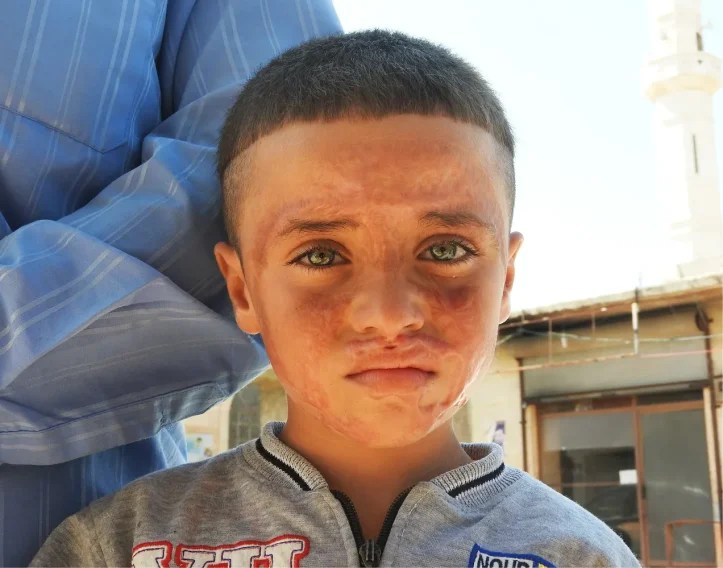
Photo © Eva Bartlett
“The roughly 65,000 people of Nubl and Zahra’a villages, under siege from terrorist factions of the so-called FSA, al-Nusra, and affiliated factions for three and a half years, were on February 3, 2016, liberated from the choke-hold which strangled them. Zeinab, 25, and Mounthaher, 26, each have young children who suffered for want of food and basic elements of life, and who were traumatized by the terrorists’ bombing of the villages. Although corporate media, when deigning to mention the villages, usually focused on their predominately Shia composition, Sunnis also live in the villages. According to Zeinab, “Sectarianism wasn’t a problem before, we were brothers and sisters, we intermarried with neighbouring villages.””
“This boy, 7, has painful face disfiguration from a terrorist-fired mortar which burned his face. Under siege at the time, the boy was only treated with basic medical care in a bare-bones hospital in Zahra’a. The boy is not originally from Nubl, but from Idlib, from which his grandfather fled when terrorists invaded. He is another poster child for the terrorism inflicted upon Syria.”
Aleppo and nearby villages ravaged by the West’s “moderate” terrorists (photo essay)
Trump Slaughters Wedding Guests, Zelenskyy Threatens Airliners
By Kevin Barrett | September 6, 2026
When Zelenskyy threatened to shoot down civilian airliners last week, Putin called it “state terrorism.” Putin is right, of course. But the expression he used, “state terrorism,” is a repetitiously redundant pleonasm.
Virtually all terrorism is state terrorism. So appending the word state in front of the word terrorism isn’t really necessary.
Case in point: Trump’s slaughter of Iranian schoolgirls, female volleyball players, and wedding guests. Such acts fit the definition of terrorism: politically-motivated attacks on civilians. The purpose of attacking civilians is to inspire fear or terror among them, so they will react in ways that further the terrorist’s political plans.
Terrorist Trump and his Israeli owners have made no secret of the fact that they intend to attack civilians and especially civilian infrastructure in Iran—which even the mainstream media acknowledges is a war crime—in hopes of spreading so much pain and misery and death that the Iranian people rise up against their government. But as Caleb Carr explained in his post-9/11 book The Lessons of Terror: A History of Warfare Against Civilians, such “punish-the-civilians” policies rarely work. Hitler’s buzz-bombs didn’t convince the British to rise up and overthrow Churchill, nor did the British and American firebombings of German cities cause the Germans to revolt against Hitler. On the contrary, such terrorist policies typically backfire: the people punished worst are dead, while the survivors feel selected by God or fate or destiny to unite behind their nation’s leadership and fight even more furiously against the foreign terror-mongers attacking their country.
And Iran—where a powerful cult of martyrdom is built into the majority religion—is the last country on earth that anybody is ever going to successfully terrorize into submission. Iran’s war on terror, specifically its war on Zio-American terror, is genuine, and likely to be far more successful than the ersatz US equivalent.
Civilian Casualty Ratios Keep Rising
The West likes to think it is growing increasingly civilized. But its wars grow ever-more barbaric and terrorist. In World War I, about half of the slightly over 20 million deaths were civilians. In World War II, just one generation later, nearly two-thirds of the 60 million deaths were civilians. The Vietnam terror war waged by the USA probably killed far more than the two million official death count, with more than three-quarters of the victims civilians. Likewise, the official death counts in the 9/11 wars against Iraq and Afghanistan—and the covert wars on Syria, Libya, Sudan, Somalia, Lebanon, and of course Palestine—are almost certainly far too low, while the civilian-to-military casualty ratio just keeps getting higher, and is probably in the 80% or higher range. (For high-end casualty estimates that counter the official undercounts in these wars, read Gideon Polya.)
Let’s ask Gemini, which obviously comes with a pro-state bias, who the real terrorists are. Hey Gemini: How many civilians have died in all the wars beginning with World War I, and what percentage were killed by non-state actors?
Gemini: An estimated 110 million to 140 million civilians have died in all wars globally starting from World War I (1914) to the present day, with the vast majority—roughly 95% or more—killed by state actors (governments and their official militaries) rather than non-state actors.
Given Gemini’s bias, we can safely translate “95% or more” as “99%+.” I rest my case: Virtually all terrorism is committed by governments.
But that’s not the way the government’s propaganda apparatus sees it. They want you to believe that the world is a scary-scary place full of evil (non-government) terrorists plotting to bomb you or shoot you or crash your airliners or blow up your buildings. And they want you to run to the real terrorists—the government—for protection.
That’s why they chose 9-1-1 as the date code for their big 2001 psy-op. When you’re terrified and panicked and faced with senseless violence, who do you call? You call the government in hopes they will save you. The three digits 9-1-1 subconsciously represent the trust populations place in their “big mommy and daddy,” their government, to get them out of serious trouble. Specifically, the terrorist perpetrators of 9/11 wanted panicked Americans to volunteer their persons and/or their tax money, not to mention their fervent ideological and emotional support, to their Israeli-occupied government so it could “protect them from further such attacks” by invading the Middle East and destroying Israel’s enemies.
It was in fact Israel’s agents who blew up the Towers after flying remote-controlled planes into buildings. Through Epstein-style blackmail, financial control, and media domination, Israel infiltrated the US government like a parasite hijacking the brain of its host, sending Uncle Sam on a state terrorism spree whose only major beneficiary was the malignant Zionist entity itself.
But even people who imagine that 9/11 was done by al-Qaeda—the same al-Qaeda that the US created and has supported since its inception in the Afghan war against the USSR, the same al-Qaeda whose Syrian chief Trump recently invited to the White House and playfully sprayed with perfume—and who further imagine that al-Qaeda is a non-state entity as opposed to a US-Israeli front—ought to take a hard look at the statistics to get a sense of how nonexistent a threat “non-state terrorism” really is. As I wrote in Questioning the War on Terror:
Statistically, there are good grounds for wondering whether we should bother to worry about terrorism at all. Roughly 3000 Americans have been killed by (allegedly non-state) terrorists during the past century. In other words, a whole century’s worth of terror victims equals three days’ worth of cigarette fatalities, a week’s worth of deaths from bad medical treatment, or a month’s worth of automobile deaths. Shouldn’t we worry far more about cigarettes, doctors, and automobiles than about terrorists?
And how does your chance of being killed by terrorists compare with your chance of being struck by lighting? It turns out that lighting is a vastly greater threat. There are on average about 1000 lightning victims per year in the USA, whereas the average number of terror victims per year—a number wildly skewed upward by the fluke of 9/11—is still only about thirty.
Are terrorists at least more dangerous than… bathtubs? Nope. It turns outthat your chances of drowning in your bathtub are more than ten times as great as your chances of being killed by a terrorist.
Should we declare war against lightning bolts and bathtubs? Should we install PA systems in our bathrooms reminding us that the threat level of bathtub drowning has been raised to orange? Should we create a new Department of Bathtub Security (DBS) empowered to do sneak-and-peak warrantless searches of our bathrooms to make sure that we’re using no-slip bathmats? Should we invade and occupy countries that we falsely blame for bathtub deaths? Would this be any crazier than what we’re doing now, allegedly due to the equally insignificant “terrorist threat”?
So the whole notion of terrorism as a supposedly non-state phenomenon is a scam, a hoax, and a psy-op. Grossly exaggerating the alleged threat posed by non-state terrorists is itself a form of state terrorism, in the sense that the state is using propaganda to terrorize its population for political purposes.
Imagine a sadistic criminal who ties up and tortures his victim, all the while insisting that his actions are motivated by a desire to protect the victim from an imaginary bogeyman. That criminal is the government, the victim is its population, and the imaginary bogeyman is the supposed threat of non-state “terrorists.”
War for a Multipolar World: The Real War on Terror
The covert World War III being waged today appears, on the surface, to be between the Zionist-oligarch-occupied world-domination-seeking West, on the one hand, and the partisans of the multipolar-world, led by China, Russia and Iran, on the other. But beneath the surface, there is a philosophical-ideological war. It isn’t as obvious as the capitalism-vs.-communism Cold War clash, but it’s real nonetheless.
The ideological dimension of World War III can be expressed as follows: Should governments gain legitimacy through terror, or through competent administration in service to the public good?
While no government perfectly embodies either ideal, Israel and its occupied USSA come close to being pure terror states. Both governments purport to be protecting their populations from “terrorist threats” and derive much of their perceived legitimacy from that purported protection. 9/11, and 10/7 (“Israel’s 9/11”) were the sacrificial spectacles that undergird the grossly mendacious ideological foundations of both terror states. Both terror states, built on foundations of state violence and lies, are having trouble maintaining public confidence.
China, for its part, does maintain popular consensus in part through somewhat mythologized but largely accurate accounts of its suffering at the hands of foreign aggressors, from the Opium War and the Century of Humiliation through the brutal Japanese occupation and subsequent US war on China through Korea. But its government primarily derives legitimacy not through violence and sacrifice, but through competent administration in the public interest.
If we ask Western-biased Gemini to contrast public confidence in the respective US and Chinese leadership, we find that worldwide China’s government inspires far more confidence, and that domestically:
United States: Public confidence in U.S. leadership and future direction faces continuous polarization, heavily influenced by shifting political administrations, domestic divisions, and foreign policy friction with traditional allies.
China: Domestic sentiment inside China reflects steady confidence in national economic power, technological growth, and rising global standing, which sustains government legitimacy and popular backing for Beijing’s international posture.
When Covert World War III finally ends with a multipolar victory, insha’allah, let us hope and pray that Chinese-style “competent administration” rather than Zio-American “terror lies in service to Girardian sacrifice” becomes the basis of a reasonably virtuous world authority capable of enforcing international law and punishing the real terrorists.
JD Vance Falsely Claims the US Does Not Murder Civilians
By Kurt Nimmo | Another Day in the Empire | September 5, 2026
Vice President JD Vance is doing a poor job of paving over the war crimes of the Trump administration. On September 1, he declared Iran is lying about the US bombing of a wedding celebration in Kuhestak, southern Iran, that killed five, including a child, and injured at least 60 people. “What I can say with 100% confidence is that unlike the IRGC, the United States never targets civilians in combat,” Vance said, despite an abundance of evidence to the contrary. “We never will do that. We never have done that.”
Since World War II, civilians have accounted for approximately 60–75% of deaths in major wars involving the United States.
James A. Lucas writes “that U.S. military forces were directly responsible for about 10 to 15 million deaths during the Korean and Vietnam Wars and the two Iraq Wars. The Korean War also includes Chinese deaths while the Vietnam War also includes fatalities in Cambodia and Laos.”
Although the aforementioned figure includes all fatalities, including those of military personnel, the vast majority of these deaths are civilian. According to official estimates, approximately 1.5–3 million civilians were killed during the Korean War, while military casualties stand at roughly one million. The US military conducted a “scorched earth” bombing campaign in North Korea. In addition to military targets, the US bombed cities, villages, industrial facilities, and dams.
Mi Young Lee, a Korean filmmaker, discovered a wealth of declassified material while conducting research for the documentary Scorched Earth (Chotohwajagjeon). Among the findings previously unreleased are pilot mission reports that provide documentation or corroboration of accounts of bombings and strafing runs. For instance, these reports detail attacks on North Korean refugees attempting to cross the Imjin River on January 1, 1951.
The US conducted a number of massacres during the Korean War, including the No Gun Ri (Nogeun-ri, South Korea) massacre that killed around 400 civilians. This war crime was perpetrated by the 2nd Battalion, 7th Cavalry Regiment, of the US Army. JD Vance is obviously unaware that the No Gun Ri massacre was ordered by the US military. Survivors and military veterans reported that they were told to “fire on everything, kill ‘em all.” The majority of victims were women, children, and the elderly.
US forces dropped 635,000 tons of bombs on Korea, destroying nearly every major city and town. General Curtis LeMay estimated the US. “eventually burned down every town in North Korea… Over a period of three years or so, we killed off… twenty percent of the population of Korea as direct casualties of war, or from starvation and exposure.”
During the Vietnam War, more than 2 million civilians were killed, in contrast to approximately 1.1 million military fatalities among North Vietnamese and Viet Cong forces, along with the deaths of South Vietnamese, US, and other allied military personnel. However, this is likely an underestimate, as other sources put the number of civilian deaths at more than 4 million.
Is it possible JD Vance never heard of the My Lai massacre? On March 16, 1968 members of Charlie Company from the US military killed between 347 and 504 unarmed civilians, predominantly women, children, and elderly men, in the village of Sơn Mỹ located in Quảng Ngãi province. The official count provided by the U.S. Army is 347, while a memorial in Vietnam records 504 names.
During Operation Speedy Express conducted between December 1968 and March 1969, US military operations resulted in the deaths of thousands of Vietnamese, with subsequent estimates indicating that a significant number were civilians. The Pentagon documented approximately 10,899 enemy fatalities, yet only 748 weapons were seized, suggesting that many of those killed were non-combatants.
The CIA’s Phoenix Program, between 1965 and 1972, designed to assassinate Viet Cong, killed an estimated 26,000–41,000 people, many of them civilians. This program has faced significant criticism due to its high number of civilian casualties and its methods, which involved torture.
More than 150,000 civilians lost their lives due to US bombing campaigns in Cambodia. The bombings in Cambodia resulted in the destruction of numerous villages and the displacement of hundreds of thousands of people. The legacy of these wars continues today, as unexploded ordnance continues to injure and kill people across the region.
During Operation Desert Storm in 1991, the US used “precision bombs” against the Amiriya air raid shelter in western Baghdad, murdering more than 400 civilians. It was the largest single case of civilian casualties that occurred during Operation Desert Storm. In addition to attacking civilians directly during the war, the US targeted the Iraqi electrical grid, water treatment plants, bridges, roads, schools, and other civilian infrastructure, leading to an unprecedented number of civilian deaths.
Sanctions imposed on Iraq during George H.W. Bush’s illegal war, and continued by President Bill Clinton, “were deeply cruel and inhumane. People could no longer acquire basic food products or medical supplies. This led directly to starvation, chronic child malnutrition and other severe health conditions, and death. Conservative estimates indicate that at least two million people died as a direct result of the sanctions,” notes the Transnational Institute in the Netherlands.
Prior to the War on Terror, the US killed an estimated 500–1,000 Somalis during the “Black Hawk Down” operation in 1993, including women and children, along with armed fighters. The NATO bombing of Yugoslavia in 1999, conducted primarily by the United States, killed approximately 500 civilians over a 78-day period. The bombing of a passenger train at Grdelica Gorge killed at least 10 people, and a convoy of ethnic Albanian refugees targeted near Gjakova killed 73.
According to Brown University’s Costs of War project, an estimated 241,000 people died as a direct result of George W. Bush’s invasion of Afghanistan in 2001. Among the fatalities, 71,344 were civilians who lost their lives on both sides of Afghanistan’s extensive and permeable border with Pakistan. Specifically, at least 47,245 civilians have perished in Afghanistan, while 24,099 have died in Pakistan. Bombing and ground operations killed thousands in Kandahar, Sangin and Lashkar Gah, during the Kunduz hospital airstrike, and drone strikes in Kabul, and elsewhere.
In Iraq, between 2003 and 2011, between 200,000 and over a million civilians were killed by the United States (estimates vary depending on the source and methodology). The US “shock and awe” campaign and subsequent fighting killed thousands.
JD Vance believes, or was told, the US does not strike wedding parties, and yet, in May of 2004, a US airstrike on a wedding celebration at Mukaradeeb, a small village in Anbar Province near the Syrian border, killed 42 civilians, including 11 women and 14 children. The United States military has refuted claims that a wedding was struck, asserting that the site was a valid military target and that insurgents were eliminated. Generals of the US military declined to issue an apology for the incident
In Haditha, Iraq, US Marines killed 24 unarmed civilians, including women, children, and an elderly man in a wheelchair, after a roadside bomb killed a Marine. In Baghdad on July 12, 2007, a US Apache attack helicopter murdered Reuters journalists Namir Noor-Eldeen and Saeed Chmagh. Footage of the killing was later made public by WikiLeaks.
“The post-9/11 wars in Afghanistan, Pakistan, Iraq, Syria, and Yemen, the most violent conflicts in which the U.S. government has engaged in the name of counterterrorism since September 11, 2001, have taken a tremendous human toll,” reports the Costs of War project at the Watson School of International and Public Affairs. “Indirect deaths are estimated to be 3.6-3.8 million, bringing the total death toll, including direct and indirect deaths, to 4.5-4.7 million and counting. Precise mortality figures remain unknown.”
Moreover, as of May 2023, more than 7.6 million children under five in post-9/11 war zones suffered from acute malnutrition, while in the same period over 38 million people in from Afghanistan, Iraq, Pakistan, Yemen, Somalia, the Philippines, Libya, and Syria were displaced, either abroad or within their own countries.
Unbeknownst to Vance, a US drone strike in December 2013 targeted a wedding procession in al-Bayda province, Yemen, resulting in the deaths of between 12 and 17 people, predominantly civilians.
As per a Pentagon evaluation, US military actions in 2025 resulted in the deaths of 153 civilians and injuries to 243 others, all linked to three US airstrikes in Yemen during April 2025. Central Command determined that these strikes were “more likely than not” to have caused civilian casualties. Furthermore, an additional 15 incidents in Yemen were still being evaluated as of February 2026.
The United States has carried out numerous drone strikes in countries such as Pakistan, Yemen, Somalia, and Syria. According to the Bureau of Investigative Journalism, drone strikes in Pakistan alone are estimated to have killed between 400 and nearly 1,000 civilians, including approximately 160 to 200 children, from 2004 to 2018.
Between 2018 and 2019, Amnesty International and Airwars documented numerous coalition strikes in eastern Syria, resulting in the deaths of hundreds of civilians, frequently in single-family homes. In 2019, it was reported that the US military admitted carrying out a war crime during a Baghuz airstrike in Syria that killed dozens of people.
The incidents mentioned above account for a small portion of the overall civilian fatalities linked to US military operations. Cumulative estimates for the post-9/11 War on Terror indicate that the total civilian death toll ranges from approximately 387,000 to 801,000. The Costs of War project at Brown University has recorded that more than 432,000 civilians lost their lives directly due to US-led conflicts up to 2021. “An estimated 3.6-3.8 million people died indirectly in post-9/11 war zones, bringing the total death toll to at least 4.5-4.7 million and counting,” the project concluded.
The Trump administration is notorious for twisting facts and promulgating outright lies and falsehoods about everything from the economy to its illegal war against Iran. Despite Vance’s seeming ignorance about the shameful multiplicity of war crimes administered by the US military since the end of the Second World War, there is a mountain of evidence that reveals the United States is not the untarnished and honorable paragon of virtue and restraint Vance and his boss make it out to be.
Featured Video

Iran’s Next Strike May Not Explode. It Could Shut You Down
or go to
Aletho News Archives – Video-Images
From the Archive
Zionism’s Violent Legacy
By Donald Neff | Washington Report On Middle East Affairs | January 1996
On January 4, 1948, Jewish terrorists drove a truck loaded with explosives into the center of the all Arab city of Jaffa and detonated it, killing 26 and wounding around 100 Palestinian men, women and children.[1] The attack was the work of the Irgun Zvai Leumi – the “National Military Organization,” also known by the Hebrew letters Etzel – the largest Jewish terrorist group in Palestine. The Irgun was headed by Revisionist Zionist Menachem Begin and had been killing and maiming Arabs, Britons and even Jews for the previous ten years in its efforts to establish a Jewish state.
This terror campaign meant that at the core of Revisionist Zionism there existed a philosophical embrace of violence. … continue
Blog Roll
 Aletho News
- Trump’s Iran war is on an Israeli leash
- Saudi oil boss issues global supply warning
- Riyadh Says Its Oil System Is Intact. The Numbers Say Otherwise.
- Trump and Netanyahu Want to “Finish the Job” on Iran
- US ‘one-sided dictation’ not Iran’s beliefs makes rational talks impossible: Baghaei
- Iran’s Next Strike May Not Explode. It Could Shut You Down /Col Doug Macgregor
- Iran: US political targets legitimate if assassinations return
- Iraq shuts key border crossing with Iran under US pressure: Report
- Undersea Internet cables could be targeted in retaliation for attacks on Iran: IRGC deputy chief
- EU sending ‘biased’ observers to interfere in Serbian election – president
- If Americans Knew
- The Israel Lobby’s Changing Fortunes
- AIPAC has become such a political liability that it’s shifting to a more “nimble” approach to buying politicians
- At least 160 Israeli settler attacks in 2 weeks
- Will Gaza’s Ancient Christian Community Disappear Forever?
- Israel’s vision of regional security rests on keeping Arab states weak
- Heidi Levine recounts how Palestinian youths helped save her in settler attack
- DAILY UPDATE: Latest essential news on Palestine, Israel, & region
- Trump’s Intensifying Sabotage of the ICC, for Israel’s Sake
- Israeli military detain US and UK volunteers in West Bank including Democratic NY politician Brad Lander
- Americans at National Conservatism Conference held in Israel this year criticize Israel
- No Tricks Zone
- E-Cars Reduce CO2 Emissions By Only 41% Compared To Internal Combustion Engine Vehicles
- Predictions Made By Renowned Climate Professor Over Past Decades Have Been Proven To Be Poor
- New Study Suggests Large Regions Of The Pacific Ocean Have Been Cooling For The Last 80 Years
- Germany’s Green Energy Debacle: High Energy Costs Force Kahla Porzellan to Close After 182 Years!
- New Study: 50 Years Of The Most Aggressive ‘Net Zero’ Policies Can Only Affect The Global Climate By 0.03°C
- US September “Heat” Was No Record…Many Records Set Decades Ago
- Latest European Green Energy Debacle; Portugal’s Largest Flagship Solar Park Insolvent!
- Green Energy Debacle: German Expert Professor Fritz Vahrenholt Warns Of Severe Economic And Social Consequences
- Two More Paleo Reconstructions Affirm Meters-Higher Sea Levels Across Ireland, Brazil 7000-6000 Years Ago
- New Study: Earth And Venus Surface Warmth Largely Explained By Convection And Lapse Rate, Not CO2 Or Radiation


