The famines threatening many parts of the world today have one thing in common: Western aggression and destabilization.
In February of this year, the world’s first famine in six years was officially declared in South Sudan. A month later, the UN’s humanitarian chief Stephen O’Brien warned the Security Council that three other countries – Yemen, Somalia, and Nigeria – also stood on the brink of famine, with 20 million at risk of starving to death within months.
The world, he said, was now “facing the largest humanitarian crisis since the creation of the United Nations.” Unless $4.4billion in emergency funds was raised by the end of March, warned UN Secretary-General Antonio Guterres, 20 million would likely starve to death. When the deadline was reached, he had received less than a tenth of that, a paltry $423 million.
The amount raised has increased since then but stands at little above one-third of the target. It is almost certain not to be met, with donations dropping sharply since mid-May.
For context, the New York Times helpfully pointed out that $4.4 billion is almost the same amount Britain has made selling weapons to Saudi Arabia in the past two years – most of which have been used against the famine-stricken Yemenis, and less than 10 percent of the $54 billion in additional spending Donald Trump pledged for the US military.
Yemen was in the news again this week, twice. First the announcement by the Red Cross that cholera cases in Yemen have now reached 300,000. Then came the ruling by Britain’s High Court – choosing to believe private government assurances over volumes of first-hand eyewitness accounts – that the UK government’s arming of the vicious Saudi war against the Yemeni people is perfectly above board. These two declarations are not unrelated. For it is precisely Britain’s proxy war against Yemen that has led to the medieval levels of famine and disease now sweeping the country.
In October 2015, the head of the International Red Cross wrote that “Yemen after five months looks Syria after five years.” Today, according to Save the Children, one Yemeni child is infected with cholera every 35 seconds. This epidemic comes hot on the heels of a dengue fever outbreak, which the World Health Organization struggled to control due to the “near collapse of the health system,” and “disruption of water supplies” resulting from the Western-supplied bombing campaign. Hospitals have regularly been bombed. Following Philip Hammond’s justification of bombing raids on three Yemeni hospitals in as many months, the MSF warned that targeting hospitals was now becoming the “new normal.”
The bombing of hospitals and grain distribution centers, however, is just part of the story of the West’s genocide against the Yemeni people. Yemen is dependent on imports for more than 80 percent of its fuel, food, and medicine, and 70 percent of these imports come through the Huydadeh port. This port was bombed in August 2015 by the Saudi-led coalition and has been blockaded ever since, directly creating the current situation in which 21 million suffer food shortages, including seven million facing famine. As the UN Special Rapporteur on human rights and international sanctions has noted, this blockade is “one of the main causes of the humanitarian catastrophe,” helping to lead to what he called “this man-made famine.” Needless to say, this blockade – along with every aspect of the Saudi genocide in the Yemen – is fully supported by the US and Britain.
Yemen is not the only place where Western policy is leading to famine.
This week marks the sixth anniversary of the independence of South Sudan. For the second year in a row, the planned celebrations have been canceled because, in the midst of starvation and civil war, there is nothing to celebrate.
The country’s descent into famine was officially announced on 20th February this year, with 100,000 starving and a further one million on the brink of starvation. The established criteria for a famine are that 20 percent of a population must be suffering “extreme food shortages,” 30 percent suffering acute malnutrition, and at least one per 5,000 dying each day. While those criteria are no longer being met; acute hunger has now reached six million, up from five million in February – over half the population. As in Yemen, this is a crisis of biblical proportions. As in Yemen, it is man-made. And, as in Yemen, it is the thoroughly predictable outcome of Western militarism.The US and Britain were instrumental in the partition of Sudan in 2011, and it is precisely this partition which has bequeathed the country’s current tragedy. Just as in Libya, in the same year, a loose coalition of rebels with no unified program was effectively placed in power by Western largesse. And just as in Libya, the inevitable collapse of this coalition has brought total devastation to the country.
The Southern People’s Liberation Movement was formed by rebel army colonel John Garang in 1983, and in the 1990s, under Clinton, the US began pouring millions of dollars into the insurgent movement. Although formally an uprising against the government in Khartoum, it has often relied on an appeal to ethnic chauvanism to galvanize support. According to former national committee member Dr. Peter Nyaba, for example, the movement’s very first mobilization “that took more than ten thousand Bor youth to SPLA training camps in 1983 was not for the national agenda of liberation but to settle local scores with their neighbors, the Murles or the Nuers.” Similarly, Riek Machar’s faction of the SPLM, based mainly within the Nuer community, conducted a massacre of thousands of Dinka civilians in 1991. Dr. Nyaba argues that political training was neglected in favor of, often very brutal, military training, leading to often horrific excesses against the population under their control. After liberating a particular area, said Nyaba, the movement should have instituted “democratic reforms: a popular justice system, a new system of education, health and veterinary services.” Such a move, he says, “would have given the SPLM the opportunity to prove itself to the people and the world and, therefore, to build a solid popular power base making the SPLM/A the authentic representative of the people…the ‘New Sudan’ would have been born in the physical and objective reality of the people, allowing the SPLM/A to acquire political sovereignty and diplomatic recognition.” These, indeed, are the normal steps taken by genuinely successful revolutionary movements the world over. But this is not what happened. Rather, says Nyaba, the SPLM “denigrated into an agent of plunder, pillage and destructive conquest.” It was at precisely this point that the US began funding the movement, with the initial $20 million provided by Clinton soon expanding to $100 million per year under Bush’s satirically-named “Sudan Peace Act” of 2002.
Just as in Libya, the impact of such US largesse has been to enable insurgent groups to achieve their aims without providing the visionary leadership or mass organizational skills necessary to galvanize genuine mass support. Put simply; US support has rendered mass support unnecessary. Genuine revolutions – that is, revolutions attained primarily through the efforts of the masses themselves, rather than through pressure applied by external patrons – can only succeed with a visionary program capable of winning the total commitment of the masses. In South Sudan, the SPLM, thanks to US support, were able to come to power without this. The long-term impact of this lack of popular, inspirational leadership has been an ideological vacuum into which have poured power struggles over patronage and resource networks.
Confident of external support, the SPLM – and its leader since Garang’s death in 2005, Salva Kiir – had no pressing need to win the support of all the tribes of the South. Without Western funding, Kiir would have to have reached out to the Nuer and the Murle and the other non-Dinka groups to secure enough support to force concessions from Sudan’s government. Had he done so, on the basis of a genuine mass program capable of galvanizing all the peoples of southern Sudan on a non-ethnic basis, this very program would have formed the basis of a viable unity government following independence. However, confident of US backing, Kiir had no need to develop any of this. Instead, his clear patronage from the US enabled him to impose a false unity on his Nuer and Shilik rivals, in which his proximity to the US alone was enough to force them to fall in line if they did not want to be completely excluded from the power and the money coming his way. Political struggles for mass support were to be eclipsed by factional rivalries over who would control the flow of resources.The same pattern has continued after independence. Assuming, correctly, US support would continue to flow, President Kiir has had no particular need to endear himself to those outside his primary Dinka constituency, even going so far as to sack his Nuer deputy Riek Machar in 2013, triggering the latest round of civil war. This latest round of war has taken on particularly nasty ethnic dimensions, as the SPLM’s rival factions, for years bound together by US dollars rather than by a genuine program of unity, unravels.
While Yemen’s near-famine was caused by the Western-directed bombing and blockade of that country, then, South Sudan’s actual famine is the result of years of proxy war funded by the West and the disastrous partition it produced. The situation in Nigeria is also a result of war, in this case, the Boko Haram insurgency – an insurgency which owes its massive spread in recent years directly to the NATO destruction of Libya, which opened up the country’s weapons dumps to Boko Haram and its partners. Have no doubt, the latest wave of famine is thus a direct by-product of Western aggression – creating another 20 million victims for whom US and British governments must be brought to justice.
Dan Glazebrook is a freelance political writer who has written for RT, Counterpunch, Z magazine, the Morning Star, the Guardian, the New Statesman, the Independent and Middle East Eye, amongst others. His first book “Divide and Ruin: The West’s Imperial Strategy in an Age of Crisis” was published by Liberation Media in October 2013. It featured a collection of articles written from 2009 onwards examining the links between economic collapse, the rise of the BRICS, war on Libya and Syria and ‘austerity’. He is currently researching a book on US-British use of sectarian death squads against independent states and movements from Northern Ireland and Central America in the 1970s and 80s to the Middle East and Africa today.
July 16, 2017
Posted by aletho |
Timeless or most popular, War Crimes | Africa, Somalia, UK, United States, Yemen |
Leave a comment
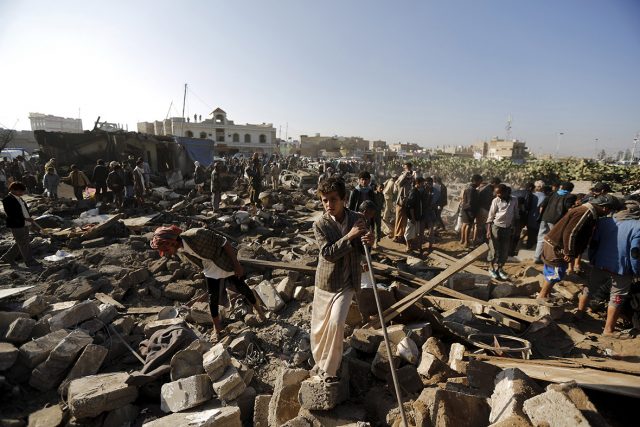
A majority of the British public believes the UK must end arms sales to Saudi Arabia over its large-scale slaughter of civilians in Yemen, according to a new poll.
An exclusive poll conducted by BMG Research for The Independent has found that 58 percent of people say it is wrong for Britain to supply billions of pounds of weapons to Saudi Arabia.
The poll also shows that 64 percent of the public want the government of Prime Minister Theresa May to release a suppressed report into Saudi Arabia’s funding of extremism in Britain, even if it damages relations with Riyadh.
On Wednesday, UK Home Secretary Amber Rudd cited national security reasons for not publishing a report commissioned by former Prime Minister David Cameron that shows the majority of foreign funding for extremism in the UK came from Saudi Arabia.
The survey underscores the public’s deep concern about the UK’s close relationship with an autocracy embroiled in a devastating war in Yemen.
The UK has licensed 3.3 billion pounds worth of weapons since the beginning of Saudi Arabia’s war on Yemen in March 2015.
The United Nations and other international organizations have accused the Saudi-led coalition of bombing hospitals, schools and wedding parties in Yemen.
The UN has declared Yemen a “humanitarian catastrophe,” with sanitation systems destroyed and at least 300,000 people infected with cholera.
The opposition to weapons sales has extended into the government, with key Conservative lawmakers thought to be debating privately for arms sales to be halted.
“This just shows how fast the Conservatives are moving away from public opinion,” said Tom Brake, a Liberal Democrat lawmaker. “Instead of giving the Saudis a stern talking to, ministers are flogging them arms.”
Last week, the UK High Court ruled that London’s weapons sales to Riyadh are not against the law.
The ruling came despite the judges conclusion that there was “a substantial body of evidence suggesting that the [Saudi-led] coalition committed serious breaches of international humanitarian law in the course of its engagement in the Yemen conflict”.
Saudi Arabia has been bombing Yemen since March 2015 in a bid to restore Yemen’s former President Abd Rabbuh Mansur Hadi, a Riyadh ally, to power. Yemen’s crisis began after Hadi stepped down as president and refused to negotiate power-sharing with the country’s Houthi Ansarullah movement.
July 16, 2017
Posted by aletho |
War Crimes | Saudi Arabia, UK, Yemen |
Leave a comment
In yet another landmark legal victory, members of the Scottish Palestine Solidarity Campaign emerged from court victorious today after being accused of racism. Their “crime”? Standing up to Zionism.
The trial ended three years of speculation and pressure for SPSC members whose robust defence of their actions won the day in Glasgow Sherriff’s Court when the verdict was announced on Friday.
Four days of evidence and cross-examinations earlier this month focussed on the actions of two SPSC members who faced charges of racism and aggravated trespass for a protest against Israeli company Jericho cosmetics, which operates around the Dead Sea in the occupied West Bank. The protest was held in the wake of Israel’s 2014 military offensive against Palestinian civilians besieged in the Gaza Strip. More than 2,200 Palestinians were killed by the Israelis during the offensive, including 550 children, before in the war ended on 26 August. During the demonstration on 13 September 2014, the SPSC protesters denounced the killings.
Police were called to the shopping centre where the protest was being held, leading to the arrest of the two SPSC members accused of racism. “In other words,” explained Mick Napier, one of those arrested, “we were accused of being motivated by hatred of Israelis rather than opposition to Israel’s repeated massacres, apartheid across the whole of Palestine and genocidal violence in Gaza.”
During the Glasgow trial, the SPSC was buoyed by a High Court ruling in London that the Conservative government in Westminster acted unlawfully when it tried to prevent local councils in Britain from divesting from companies involved in Israel’s military occupation. The successful legal challenge for the right to boycott was brought by the Palestine Solidarity Campaign in London, supported by War on Want, the Campaign Against the Arms Trade and the Quakers.
However, Napier wasn’t convinced that the result of the latest trial was a foregone conclusion. “Given their past record, we felt it was unlikely that even this High Court ruling in favour of BDS [boycott, divestment and sanctions] would stop Scottish prosecutors’ related efforts to criminalise the campaign in support of Palestinian freedom.”
The prosecutor — called the Procurator Fiscal in the Scottish legal system — claimed in open court that the two accused in the Glasgow case were recycling an ancient anti-Semitic “Jewish blood libel” by speaking about Israeli mass murder of Palestinians. The Procurator Fiscal’s office made these claims, said Napier, while the violated people of Gaza “were still looking for ice-cream freezers and vegetable refrigerators in which to store the bodies of children killed by Israel’s military.”
In their testimony last month, Napier and his co-accused Jim Watson both rejected the claims made by prosecution witnesses, a Chief Inspector of police, the manager of the Jericho stall and two local Zionist activists. The prosecution claim was that staff were intimidated by “racist” placards and the shouting of “racist abuse”; this was the description of the SPSC’s criticism of the pro-Israel counter-demonstrators for supporting Israel’s most recent massacre of Palestinians.
The “racist” placard with which the Procurator Fiscal and Zionist witnesses took particular issue was a symbolic but graphic image of blood dripping under the name “Dead Sea cosmetics”. Napier pointed out that at the time of their protest, the UN Secretary-General was describing Israel’s massacre of thousands of Palestinians as a “moral outrage and criminal act” and a “gross violation of humanitarian law.”
“When the Scottish government joined in by denouncing the ‘deep inhumanity’ of the Israeli massacre,” noted Napier, “the Scottish procurators fiscal were working hand in glove with pro-Israel lobby groups to silence voices of Palestine solidarity.”
The SPSC has faced repeated efforts by pro-Israel lobbyists and Scottish prosecutors to criminalise the group’s pro-Palestine activities. The Zionist record to-date is one of almost total failure; legal action has failed to secure any convictions of pro-Palestine activists. “There was, however, a consolation prize [for the Zionists] when we were both found guilty of refusing to leave the shopping centre when asked to do so by the police,” said Napier. “I was also convicted of aggravated trespass for protesting inside the shopping centre. We will be appealing against both convictions so any celebrations by the Zionists will, I suggest, be a bit premature.”
In February last year, two employees of the pro-Israel Community Security Trust made allegations against SPSC members but that was also thrown out by Kilmarnock Sheriff Court when the Sheriff ruled that the crime as alleged had not taken place. “Had we not had the benefit of an Al-Jazeera Arabic language broadcast of the protest where the CST tried to secure an assault conviction there might have been a different outcome,” added Mick Napier.
Anyone wanting to help the legal fund for this latest appeal can donate on the SPSC website here: http://www.scottishpsc.org.uk
July 14, 2017
Posted by aletho |
Ethnic Cleansing, Racism, Zionism, Solidarity and Activism, Timeless or most popular, War Crimes | #FreePalestine, Gaza, Israel, Palestine, UK, Zionism |
Leave a comment
On Monday 10th July, a ruling was handed down by London’s High Court, which should, in a sane world, exclude the UK government ever again judging other nations’ leaders human rights records or passing judgment on their possession or use of weapons.
The Campaign Against the Arms Trade (CAAT) lost their case to halt the UK selling arms to Saudi Arabia, the case based on the claim that they may have been used to kill civilians in Yemen.
Anyone following the cataclysmic devastation of Yemen would think it was a million to one that the £3.3 Billion worth of arms sold by the UK to Saudi in just two years, had not been used to kill civilians, bomb hospitals, schools, markets, mosques, decimate vital and economic infrastructure and all necessary to sustain life.
In context, a survey released by the Yemen Data Project in September last year found that between March 2015 and August 2016 in more than 8,600 air attacks, 3,158 hit non-military targets.
How casual the slaughter is, Saudi pilots (as their British and US counterparts) apparently do not even know what they are aiming at. So much for “surgical strikes” – as ever:
Where it could not be established whether a location attacked was civilian or military, the strikes were classified as unknown, of which there are 1,882 incidents.
All those “unknown” killed had a name, plans, dreams, but as in all Western backed, funded or armed ruinations “it is not productive” to count the dead, as an American General memorably stated of fellow human beings.
In context, the survey found that:
One school building in Dhubab, Taiz governorate, has been hit nine times … A market in Sirwah, Marib governorate, has been struck 24 times.
Commenting on the survey, the UK’s shadow Defence Secretary, Clive Lewis, said:
It’s sickening to think of British-built weapons being used against civilians and the government has an absolute responsibility to do everything in its power to stop that from happening. But as Ministers turn a blind eye to the conflict … evidence that Humanitarian Law has been violated is becoming harder to ignore by the day.
Forty six percent of Yemen’s 26.83 million population are under fifteen years old. The trauma they are undergoing cannot be imagined.
The original CAAT Court hearing which took place was a Judicial Review in to the legality of the UK government’s arms sales to Saudi, held on 7th, 8th and 10th of February in the High Court.
CAAT stated, relating to the case:
For more than two years the government has refused to stop its immoral and illegal arms sales to Saudi Arabia – despite overwhelming evidence that UK weapons are being used in violations of International Humanitarian Law in Yemen.
They also quoted Parliament’s International Development and Business, Innovation and Skills Committees, who opined in October 2016:
Given the evidence we have heard and the volume of UK-manufactured arms exported to Saudi Arabia, it seems inevitable that any violations of International Humanitarian and Human Rights Law by the coalition have involved arms supplied from the UK. This constitutes a breach of our own export licensing criteria. (Emphasis added.)
UK supplied arms since the onset of the assault on Yemen are:
£2.2 billion worth of ML10 licences (Aircraft, helicopters, drones)
£1.1 billion worth of ML4 licences (Grenades, bombs, missiles,
countermeasures)
£430,000 worth of ML6 licences (Armoured vehicles, tanks.)
Contacting CAAT spokesman Andrew Smith I queried what “countermeasures” might be (point two.) He said technically, protective items. However:
CAAT feels that the overwhelming majority will be bombs and missiles including those being used on Yemen.
On 5th June CAAT had pointed out some further glaring anomalies:
The last two months have seen three terrible terrorist attacks carried out in the UK. The attacks were the responsibility of those that have carried them out, and they have been rightly condemned.
However:
Last week it was revealed by the Guardian that the Home Office may not publish a Report into the funding of terrorism in the UK. It is believed that the Report will be particularly critical of Saudi Arabia.
Andrew Smith commented:
Only two months ago the Prime Minster was in Riyadh trying to sell weapons to the Saudi regime, which has some of the most abusive laws in the world. This toxic relationship is not making anyone safer, whether in the UK or in Yemen, where UK arms are being used with devastating results.
Nevertheless:
Delivering an open judgment in the High Court in London, Lord Justice Burnett, who heard the case with Mr. Justice Haddon-Cave, said: “We have concluded that the material decisions of the Secretary of State were lawful. We therefore dismiss the claim”.
CAAT called the ruling a “green light” for the UK government to sell arms to “brutal dictatorships and human rights abusers”.
Interestingly, in increasingly fantasy-democracy-land UK:
The Court (also handed down) a closed judgment, following a case in which half of the evidence was heard in secret on national security grounds.
What a wonderful catch-all is “national security.”
Moreover:
UK and EU arms sales rules state that export licences cannot be granted if there is a ‘clear risk’ that the equipment could be used to break International Humanitarian Law. Licences are signed off by the Secretary of State for International Trade, Liam Fox. (Emphasis added.)
Mind stretching!
So the oversight of what constitutes a “clear risk” of mass murder and humanitarian tragedy, goes to the Minister whose Ministry stands to make £ Billions from the arms sales. Another from that bulging: “You could not make this up” file.
‘The case … included uncomfortable disclosures for the government, including documents in which the Export Policy Chief told the Business Secretary, Sajid Javid, then in charge of licensing: “my gut tells me we should suspend (weapons exports to the country).”
‘Documents obtained by the Guardian showed that the UK was preparing to suspend exports after the bombing of a funeral in Yemen in October 2016 killed 140 civilians. But even after that mass murder, the Foreign Secretary, Boris Johnson, advised Fox that sales should continue, adding: “The ‘clear risk’ threshold for refusal … has not yet been reached.”
For anyone asleep at the wheel, Foreign Secretary, Boris Johnson, is supposed to be the UK’s chief diplomat. Definition: “a person who can deal with others in a sensitive and tactful way. Synonyms: Tactful person, conciliator, reconciler, peacemaker.” Comment redundant.
‘CAAT presented “many hundreds of pages” of reports from the UN, European Parliament, Red Cross, Médecins Sans Frontières, Amnesty International and others documenting airstrikes on schools, hospitals and a water well in Yemen, as well as incidents of mass civilian casualties.’
However, to further batter the mind:
The reports “represent a substantial body of evidence suggesting that the coalition has committed serious breaches of International Humanitarian Law in the course of its engagement in the Yemen conflict”, the Judges wrote. “However, this open source material is only part of the picture”.
In two eye-watering fox guarding hen house observations:
The Saudi government had conducted its own investigations into allegations of concern, the judges noted, dismissing CAAT’s concern that the Saudi civilian casualty tracking unit was working too slowly and had only reported on 5% of the incidents. The Kingdom’s “growing efforts” were “of significance and a matter which the Secretary of State was entitled to take into account” when deciding whether British weapons might be used to violate international humanitarian law.
So Saudi investigates itself and the Secretary of State overviews his own actions in the State profiting in £ Billions from seemingly indiscriminate mass murder and destruction.
There was “anxious scrutiny – indeed what seems like anguished scrutiny at some stages” within government of the decision to continue granting licences, wrote the Judges. But the Secretary of State was “rationally entitled” to decide that the Saudi-led coalition was not deliberately targeting civilians and was making efforts to improve its targeting processes, and so to continue granting licences.
Pinch yourselves, Dear Readers, it would seem we live in times of the oversight in the land of the seriously deranged.
CAAT’s Andrew Smith, said:
This is a very disappointing verdict and we are pursuing an appeal. If this verdict is upheld then it will be seen as a green light for government to continue arming and supporting brutal dictatorships and human rights abusers like Saudi Arabia that have shown a blatant disregard for international humanitarian law.
Every day we are hearing new and horrifying stories about the humanitarian crisis that has been inflicted on the people of Yemen. Thousands have been killed while vital and lifesaving infrastructure has been destroyed.
The case had exposed the UK’s “toxic relationship” with Saudi Arabia.
On Wednesday 12th July, UK Home Secretary, Amber Rudd again invoked “national security” (something Yemenis can only dream of in any context) and presented Parliament with a paltry four hundred and thirty word “summary” of the Report on the funding of terrorism, origins of which go back to December 2015.
Shadow Home Secretary Diane Abbott encapsulated the thoughts of many, telling Parliament:
… there is a strong suspicion this Report is being suppressed to protect this government’s trade and diplomatic priorities, including in relation to Saudi Arabia. The only way to allay those suspicions is to publish the report in full.
Caroline Lucas, co-Leader of the Green Party said:
The statement gives absolutely no clue as to which countries foreign funding for extremism originates from – leaving the government open to further allegations of refusing to expose the role of Saudi Arabian money in terrorism in the UK.
Liberal Democrat Leader, Tim Fallon condemned the refusal of the government to publish the Report as: “utterly shameful.”
Amber Rudd concentrated on pointing to individuals and organisations which might be donating, often unknowingly to: “ … inadvertently supporting extremist individuals or organisations.”
Peanuts compared to UK arms to Saudi Arabia.
CAAT’s appeal is to go back to the High Court and “If it fails, will go to the Court of Appeal” states Andrew Smith.
It also transpires that Saudi has dropped British made cluster bombs in Yemen, despite the UK being signatory to the 2008 Ottawa Convention on Cluster Munitions, banning their use, or assistance with their use. The Scottish National Party said it was a: “shameful stain on the UK’s foreign policy and its relationship with Saudi Arabia, as well as a failure by this government to uphold its legal treaty obligations”.
Final confirmation that the British government’s relations with Saudi over Arms and Yemen lies somewhere between duplicity and fantasy would seem to be confirmed in an interview with Crispin Blunt, MP., former army officer and Chairman of the Foreign Affairs Select Committee.
In spite of the legal anomalies and humanitarian devastation, he assured the BBC’s Gabriel Gatehouse that the Saudis were “rigorous” in making sure there were no breaches of international law and adopted the sort of high standard of the British army.
In that case, the cynic might conclude, given the devastation caused by the British army in Afghanistan and Iraq, perhaps it is not only arms and money that are the ties that bind the two countries, but scant regard for humanity itself.
Felicity Arbuthnot is a journalist with special knowledge of Iraq. Author, with Nikki van der Gaag, of Baghdad in the Great City series for World Almanac books, she has also been Senior Researcher for two Award winning documentaries on Iraq, John Pilger’s Paying the Price: Killing the Children of Iraq and Denis Halliday Returns for RTE (Ireland.)
July 14, 2017
Posted by aletho |
Corruption, Deception, Timeless or most popular, War Crimes | Saudi Arabia, UK, Yemen |
Leave a comment
The US, UK and France have never shown enthusiasm for banning and eliminating nuclear weapons. It is not surprising, therefore, that they did not participate in the United Nations negotiations leading to the recent adoption of the nuclear ban treaty, or that they joined together in expressing their outright defiance of the newly-adopted treaty.
In a joint press statement, issued on July 7, 2017, the day the treaty was adopted, the US, UK and France stated, “We do not intend to sign, ratify or ever become party to it.” Seriously? Rather than supporting the countries that came together and hammered out the treaty, the three countries argued: “This initiative clearly disregards the realities of the international security environment.” Rather than taking a leadership role in the negotiations, they protested the talks and the resulting treaty banning nuclear weapons. They chose hubris over wisdom, might over right.
They based their opposition on their belief that the treaty is “incompatible with the policy of nuclear deterrence, which has been essential to keeping the peace in Europe and North Asia for over 70 years.” Others would take issue with their conclusion, arguing that, in addition to overlooking the Korean War and other smaller wars, the peace in Europe and North Asia has been kept not because of nuclear deterrence but in spite of it.
The occasions on which nuclear deterrence has come close to failure, including during the Cuban missile crisis, are well known. The absolute belief of the US, UK and France in nuclear deterrence seems more theological than practical.
The three countries point out, “This treaty offers no solution to the grave threat posed by North Korea’s nuclear program, nor does it address other security challenges that make nuclear deterrence necessary.” But for the countries that adopted the nuclear ban treaty, North Korea is only one of nine countries that are undermining international security by basing their national security on nuclear weapons. For countries so committed to nuclear weapons and nuclear deterrence, is it not surprising and hypocritical that they view North Korea’s nuclear arsenal not in the light of deterrence, but rather, as an aggressive force?
The three countries reiterate their commitment to the Non-Proliferation Treaty (NPT), but do not mention their own obligation under that treaty to pursue negotiations in good faith for an end to the nuclear arms race at an early date and to nuclear disarmament. The negotiations for the new nuclear ban treaty are based on fulfilling those obligations. The three countries chose not to participate in these negotiations, in defiance of their NPT obligations, making their joint statement appear self-serving and based upon magical thinking.
If the US, UK and France were truly interested in promoting “international peace, stability and security” as they claim, they would be seeking all available avenues to eliminate nuclear weapons from the world, rather than planning to modernize and enhance their own nuclear arsenals over the coming decades.
These three nuclear-armed countries, as well as the other six nuclear-armed countries, continue to rely upon the false idol of nuclear weapons, justified by nuclear deterrence. In doing so, they continue to run the risk of destroying civilization, or worse. The 122 nations that adopted the nuclear ban treaty, on the other hand, acted on behalf of every citizen of the world who values the future of humanity and our planet, and should be commended for what they have accomplished.
The new treaty will open for signatures in September 2017, and will enter into force when 50 countries have acceded to it. It provides an alternative vision for the human future, one in which nuclear weapons are seen for the threat they pose to all humanity, one in which nuclear possessors will be stigmatized for the threats they pose to all life. Despite the resistance of the US, UK and France, the nuclear ban treaty marks the beginning of the end of the nuclear age.
David Krieger is President of the Nuclear Age Peace Foundation (www.wagingpeace.org). He is the author of Zero: The Case for Nuclear Weapons Abolition.
July 13, 2017
Posted by aletho |
Militarism, Timeless or most popular, War Crimes | France, NPT, UK, United States |
Leave a comment

Campaigners are furious with a High Court decision in London allowing the UK Government to carry on exporting arms to Saudi Arabia for use against Yemenis
The Campaign Against Arms Trade (CAAT) brought the legal action against the Secretary of State for International Trade for continuing to grant export licences for arms to Saudi Arabia, arguing that this was against UK policy, which states that the government must refuse such licences if there’s a clear risk that the arms might be used to commit serious violations of International Humanitarian Law.
It is undeniable that Saudi forces have used UK-supplied weaponry to violate International Humanitarian Law in their war on Yemen. According to the United Nations, well over 10,000 people have been killed, the majority by the Saudi-led bombing campaign which has also destroyed vital infrastructure such as schools and hospitals and contributed to the cholera crisis. 3 million Yemenis have been displaced from their homes and 7 million are on the brink of dying from famine. UNICEF reports that a child is dying in Yemen every ten minutes from preventable causes including starvation and malnourishment.
A crippling naval blockade of the country by the US has been key to the cruel onslaught. The European Parliament and numerous humanitarian NGOs have condemned the Saudi air strikes as unlawful. And 18 months ago a UN Panel of Experts accused Saudi forces of “widespread and systematic” targeting of civilians.
Yet the UK has licensed £3.3 billions worth of arms such as aircraft, helicopters, drones, missiles, grenades, bombs and armoured vehicles to the Saudi regime and refused to suspend the supply of weaponry for use in Yemen in the face of the horrors perpetrated. It is claimed that the Government has even ignored warnings by senior civil servants and its own arms control experts, and that some records of expressed concern have gone missing.
So who is the UK’s helping hand behind that vile regime’s murderous adventure in the Yemen? Why, it’s none other that senior Israel stooge Dr Liam Fox, now Secretary of State for International Trade and the lead on trade and investment in the defence and security sector. He of course oversees export licensing. He also has ‘form’ when it comes to thinking silly thoughts and doing stupid things in the foreign affairs arena, and he’s known as a crazed flag-waver for Israel and a sworn enemy of Iran.
While Secretary of State for Defence, Fox told us: “Israel’s enemies are our enemies and this is a battle in which we all stand together or we will all fall divided.”
Fox was forced to resign as Defence Secretary in 2011 following the scandal involving him, his ‘close friend’ Adam Werritty, the UK ambassador to Israel, and Israeli intelligence figures allegedly involved in plotting sanctions against Iran.
The reason for the British government’s hostility towards Iran was spelled out by David Cameron in a speech to the Knesset in 2014: “A nuclear armed Iran is a threat to the whole world not just Israel. And with Israel and all our allies, Britain will ensure that it is never allowed to happen.” That position carries forward into the present day.
And in June 2015 Fox declared: “It is logical to assume that Iran’s intentions are to develop a nuclear weapons capability and any claims that its intentions are exclusively peaceful should not be regarded as credible… Iran’s nuclear intentions cannot be seen outside the context of its support for terror proxies, arguably the defining feature of its foreign policy. The risks are clear.”
What he omitted to say was that Iran’s intentions must also be seen in the context of Israel’s foreign policy, its refusal to sign the Nuclear Non-Proliferation Treaty and the grave threat posed by the Zionist regime’s 200 (or is it 400?) nuclear warheads. Israel hasn’t signed the Biological and Toxin Weapons Convention either, and has signed but not ratified the Comprehensive Nuclear Test-Ban Treaty, likewise the Chemical Weapons Convention. Iran and all the other nations in the region have every right to feel nervous.
As is well known, Israel and Saudi Arabia have formed a cosy alliance. No entities deserve each other more. And Britain will do anything, it seems, to get at Iran through these repulsive ‘friends’.
Instead of dangling from a lamp-post on Tower Bridge, Fox was quickly rehabilitated and re-promoted to senior office by fellow stooges like Theresa May. Just lately prime minister May has accused Iran of working with Hezbollah, interfering in Iraq, sending fighters to Syria to help Assad, and supporting the Houthis in the conflict in Yemen. The British Government, of course, can meddle where it pleases and do dirty weapons deals with the Saudis which, Mrs May assures us, are for the sake of long-term security in the Gulf. “Gulf security is our security,” she says, arguing that the same extremists who plot terror in the Gulf states are also targeting the streets of Europe.
Toxic relationship with Saudi Arabia exposed
So how did Fox manage to defeat the campaigners in court? After all, as Rosa Curling of Leigh Day (acting for CAAT) said, “The law is clear: where there is a clear risk that UK arms might be used in the commission of serious violations of international law, arm sales cannot go ahead.
“Nothing in the open evidence presented by the UK government to the court suggests this risk does not exist in relation to arms to Saudi Arabia. Indeed, all the evidence we have seen from Yemen suggests the opposite: the risk is very real…. Our government should not be allowing itself to be complicit in the grave violations of law taking place by the Saudi coalition in Yemen.”
Andrew Smith of CAAT said: “If this verdict is upheld then it will be seen as a green light for government to continue arming and supporting brutal dictatorships and human rights abusers like Saudi Arabia that have shown a blatant disregard for international humanitarian law….
“This case has seen an increased scrutiny of the government’s toxic relationship with Saudi Arabia. It is a relationship that more than ever needs to be examined and exposed. For decades the UK has been complicit in the oppression of Saudi people, and now it is complicit in the destruction of Yemen.”
Rachel Sylvester in The Times noted that the judges concluded there was “a substantial body of evidence suggesting that the [Saudi-led] coalition committed serious breaches of international humanitarian law in the course of its engagement in the Yemen conflict”, but the ruling was based on a narrow legal point about whether ministers had followed proper procedures and acted rationally in assessing the risks.
“Whatever the result of the legal process,” she wrote, “it’s time for the government to reconsider Britain’s poisonous relationship with Saudi Arabia, starting with the suspension of arms sales to a country that stands accused of appalling human rights abuses within its own borders as well as the funding of extremism abroad. What is UK foreign policy for if not the promotion of this country’s values around the world?”
And, as she points out, last year the UK committed £85 million to the aid effort in Yemen, making the Department for International Development the fourth largest donor to the crisis.
So, just as we pour £millions of aid into the Palestinian Territories to subsidise the illegal Israeli occupation while at the same time supplying the regime in Tel Aviv with arms to sustain its occupation, we are spending all this taxpayers’ money in Yemen to clean up the mess we’re helping the Saudis to make.
Secret evidence favours the evil
Fox succeeded thanks to ‘closed sessions’. This meant that CAAT and their legal team weren’t allowed to see much of what was presented by the Government, which could only be examined by a security-cleared “special advocate”.
The secret evidence is said to have included Saudi Arabia’s “fast-jet operational reporting data”, “high-resolution MoD-sourced imagery” and “UK defence intelligence reports and battle damage assessments”. The MoD and Foreign Office analysis had “all the hallmarks of a rigorous and robust, multi-layered process of analysis” while the evidence presented by the campaigners was “only part of the picture”. The Court said the secret evidence could not be referred to in open court for reasons of “national security”.
But what has all the MoD’s high-faluting technical tosh to do with justice? Or the basic concept of right and wrong? An especially International Humanitarian Law?
And our national security? Yeah, yeah, yeah. So the slaughter must go on in that distant land…
Labour’s shadow international trade secretary Barry Gardenier suggested in the House of Commons that the “secret” evidence should be made available to MPs for scrutiny “on privy council terms” or handed to the Intelligence and Security Select Committee. Sounds reasonable enough.
But Fox is reported saying: “This idea that somehow, if we have closed sessions, that makes the judgment less valid, I simply don’t accept. Because I don’t accept this idea that we simply can’t have closed sessions that protect our national security or the personnel involved in our national security. Our sources need to be protected.”
Yeah, and so do Yemeni civilians…. from us.
He admitted that “Yemen is indeed a humanitarian disaster” but said it was right to keep selling arms to Saudi Arabia. He may have won the legal point – for now. But he has clearly lost his moral compass, if he ever had one.
As Rachel Sylvester remarks, “So craven is the Whitehall establishment that the government has refused to publish a report on the foreign funding of terrorism, for fear of annoying its Saudi friends.”
*(London, UK. 11th July, 2016. Human rights campaigners dressed as Grim Reapers protest against the Farnborough International arms fair, and in particular against arms sales to Saudi Arabia used in human rights abuses in Yemen, at Waterloo station. Image credit: Campaign Against Arms Trade/ flickr).
July 13, 2017
Posted by aletho |
Deception, War Crimes, Wars for Israel | Israel, Saudi Arabia, UK, Yemen, Zionism |
Leave a comment
Recently discovered documents show Israeli leaders were worried that evidence would come out that Israel’s 1967 attack on the USS Liberty was intentional.
The Liberty was a Navy electronics surveillance ship operating in international waters during the Six-Day War. Israeli forces perpetrated an extended air and sea assault on the ship that killed 34 Americans, injured 175, and damaged the ship beyond repair. Afterward, Israel claimed the assault was an accident and provided $6 million in compensation for the loss of the $40 million ship. (More information here.)
According to the Israeli newspaper Ha’aretz, Israeli historian Adam Raz recently examined hundreds of documents related to the Liberty that had been posted by Israeli State Archives.
(Raz is author of The Battle Over the Bomb,” available only in Hebrew. He also is reported to have written “a fascinating article about Israel’s nuclear secrets in last week’s Hebrew Haaretz supplement.”)
Ha’aretz reports that Raz is “fully aware of the fact that the ‘smoking gun’ won’t be found in the papers in the State Archives, because if Israel really had intended to hit the ship, that would have been known only to a handful of people.”
One of the documents Raz did find is an Israeli Foreign Ministry communication sent from New York to Jerusalem. Ha’aretz quotes the document:
“Menashe [apparently an Israeli official] informed us we had better be very careful… The reason is apparently that the Americans have findings that show our pilots were in fact aware the ship was American.”
And later: “Menashe believes there is a recording on the ship of the conversations between the ship and our pilots, in which the ship’s crew said the ship is American. Menashe says that, in his opinion, our only chance of getting out of the crisis is to punish someone for negligence.”
In another document, the Israeli Embassy in Washington writes to the Foreign Ministry in Jerusalem under the heading “Urgent.”
“We must change the above mentioned letter [to the U.S.], because we certainly won’t be able to say there is no basis for the accusation that the identity of the ship was determined by Israeli planes prior to the attack.”
Other documents show Israeli preparations for the U.S. investigation and the American demands for compensation that were to follow. A telegram from the Israeli Embassy in Washington to the Foreign Ministry said:
“The issue has turned into a malignant wound, which involves serious dangers for all of our relationships on all levels here, whose friendship was ours until now and which are crucial to our status in the United States. In other words, the president, the Pentagon, public opinion and the intelligence community.”
An Israeli Foreign Ministry letter warned:
“In the grave situation that has been created, the only way to soften the result is for us to be able to announce to the U.S. government already today that we intend to prosecute people for this disaster. We have to publicize that in Israel already tonight. This activity is the only way to create the impression, both to the U.S. government and the public here, that the attack on the ship was not the result of malicious intent by the Israeli government – I repeat, the Israeli government – or authorized groups in the IDF. For obvious reasons, it is crucial that our announcement about prosecuting those who are to blame be publicized before – I repeat, before – the publication of the American report here.”
July 12, 2017
Posted by aletho |
Deception, Ethnic Cleansing, Racism, Zionism, Timeless or most popular, War Crimes | Israel, United States, Zionism |
Leave a comment
UK Home Secretary Amber Rudd has confirmed an already much-delayed report into the foreign funding and support of extremist groups in the UK will be banned from publication for “national security” reasons.
Rudd instead released a parliamentary written answer outlining the details of the report, which was commissioned by former Conservative Prime Minister David Cameron.
“Having taken advice, I have decided against publishing the classified report produced during the review in full,” she said.
“This is because of the volume of personal information it contains and for national security reasons.”
“We will be inviting privy counselors from the opposition parties to the Home Office to have access to the classified report on privy council terms.”
According to the Home Secretary’s summary, some key findings include that UK-based individual donors primarily fund extremist organizations in the UK, while some donations also came from overseas.
The report was finished six months ago, and it is thought its publication had been further delayed over government fears diplomatic links with principal Middle East ally Saudi Arabia would be at stake if had been implicated in the foreign financing of UK radical groups.
The summary said foreign aid helped individuals enter institutions that “teach deeply conservative forms of Islam and provide highly socially conservative literature and preachers to the UK’s Islamic institutions.”
Some of those individuals have since become of “extremist concern,” the report added.
The decision to permanently shelve the report has caused an outcry among opposition parties, with Liberal Democrat leader Tim Farron arguing that extremism can only be tackled if full information is released, regardless of what consequences there may be for the UK’s diplomatic ties abroad.
“We cannot tackle the root causes of terrorism in the UK without full disclosure of the states and institutions that fund extremism in our country.”
“Instead of supporting the perpetrators of these vile ideologies, the government should be naming and shaming them – including so-called allies like Saudi Arabia and Qatar if need be,” he said, according to Business Insider.
“It seems like the government, yet again, is putting our so-called friendship with Saudi Arabia above our values. This shoddy decision is the latest in a long line where we have put profit over principle.”
Green Party co-leader Caroline Lucas also blasted the “unacceptable decision” not to publish the report, warning that it fuels speculation the government wants to cover up Saudi Arabia’s terrorist funding.
“The statement gives absolutely no clue as to which countries foreign funding for extremism originates from – leaving the government open to further allegations of refusing to expose the role of Saudi Arabian money in terrorism in the UK,” Lucas said.
July 12, 2017
Posted by aletho |
Deception, War Crimes | Amber Rudd, Middle East, Qatar, Saudi Arabia, UK |
Leave a comment
The use of armed drones by the US in countries such as Iraq, Pakistan, Syria and Yemen is well known, but not well documented. Internal rules governing the program remain opaque, and details on individual strikes and casualty figures are lacking. However, the UK own drone warfare efforts are almost entirely hidden from the public.
As Columbia Law School’s Human Rights Clinic “Out of the Shadows” report made clear in June, the UK’s approach to drone warfare is opaque at all levels.
Officially, the country has no formal drone program equivalent to that of the US — the UK Parliament’s Joint Committee on Human Rights inquiry into targeted killing concluded drone strikes are conducted ad hoc, as but one operational tactic at the disposal of UK forces.
Nonetheless, freedom of information requests indicate that by the end of 2016 over 1,200 airstrikes (both from conventional manned aircraft and drones) were conducted against Daesh targets in Iraq and Syria alone — although the question of whether and where else in the world UK drones have been deployed, and the civilian impact of these strikes, is scant.
Likewise, the legal basis upon which the UK relies for its use of armed drones remains unclear — for instance, does the UK assert the right of self-defense under international law? Such a claim was made after the RAF killed three people, including British citizens Reyaad Khan and Ruhul Amin, in a drone strike near Raqqa, Syria in August 2015.
The strike took place despite Parliament having explicitly voted against UK involvement in US-led airstrikes in Syria in August 2013. Without the Commons’ knowledge or consent, then-Prime Minister David Cameron authorized the strike, relying on a limited parliamentary convention allowing for immediate military action to be taken in self-defense of British national interests.
Contradictorily however, in his official legal notification to the United Nations Security Council, Cameron claimed the action was instead taken pursuant to the right of collective self-defense of any nation subject to armed attack.
In any event, there is ongoing controversy among international law experts as to the theoretical validity of the doctrine of anticipatory self-defense — the UK has long asserted the existence of such a right, but how such a doctrine properly applies in the circumstances of strikes against Daesh overseas is yet to be adequately explained.
Rights Watch UK has requested disclosure or summary of the relevant legal advice underpinning the August 2015 strike, although the request has been rejected. As of July 2017, it remains under appeal, to be heard before the UK Upper Tribunal before the end of the year.
The doctrine of anticipatory self-defense requires a threat defended against must be an imminent one, although the very phrase “imminent” is an elastic one. Moreover, in a January speech to the International Institute for Strategic Studies, UK Attorney-General Jeremy Wright called for an renewed approach to imminence, eschewing the traditional assumption of threat proximity (ie a threat near or incoming to a particular area) to a “factor-based” approach, in which proximity is no longer a necessary condition. The Attorney-General even favors action in self-defense when the UK does not know where and when an attack will take place, or the precise nature of an attack.
In addition to the absence of transparency around the UK’s use of drones, the government is also yet to set out the nature and degree of its involvement in facilitating and supporting the use of armed drones by the US — and depending on the nature of this involvement, the country may be liable under international law for US government actions.
There are a number of legal means by which a state may be held internationally responsible for the actions of another it assists.
For instance, Article 16 of the International Law Commission’s Articles on the Responsibility of States for Internationally Wrongful Acts makes clear a state which aids another in the commission of any wrongful act is responsible if the abetting state does “so with knowledge of the circumstances of the internationally wrongful act” — and the act “would be internationally wrongful if committed” by the assisting state.
Articles 40 and 41 provide a narrower rule — where one state is guilty of a serious breach of international law, other states are prohibited from rendering any assistance in maintaining the situation before or after the event. On notice of a serious breach of international law by a state, other states are obliged not to provide further trade in arms or continue intelligence sharing, for example
Further, the United Nations Charter makes clear a state must not allow its own territory to be used as a launching pad for acts of aggression by other states, even if it is not directly involved itself. Such use of territory could include provision of landing rights for drone strikes, or even allowing partner intelligence agencies to operate out of a state’s military installations.
In February, Rights Watch UK was involved in litigation in the English High Court, arguing the UK government was obliged to consider the UK’s potential liability for aiding and assisting breaches of international law by the Saudi Arabia-led coalition in Yemen through its arms exports to Saudi Arabia.
Far from confirming the UK’s international liability was being seriously interrogated, the government argued the question of liability for aiding and assisting Riyadh’s potentially criminal actions were irrelevant.
As drone use proliferates internationally, the need for transparency and oversight also increases. The failure of the US and UK to provide regular, reliable, transparent information on their participation in drone warfare, or explain whether their actions conform with international legal obligations means neither constituent public can have any confidence their government is acting lawfully.
July 11, 2017
Posted by aletho |
Deception, Timeless or most popular, War Crimes | David Cameron, Iraq, Syria, UK, United States |
Leave a comment

RAMALLAH – Amid what the Palestinian Committee of Prisoners’ Affairs has described as a “frenetic Israeli campaign” against Palestinian authorities’ payment of allowances to prisoners of Israel and their families, the committee published a list on Monday of Israelis convicted of murdering Palestinians and anti-Palestinian extremist organizations, who have received financial and legal support from the state of Israel.
Committee head Issa Qaraqe has accused the Israeli government of “supporting Jewish terrorists and their extremist organizations both financially, socially, and legally through organizations authorized by the Israeli government,” calling Israel “the biggest funder of official terrorism in the Middle East.”
A large number of the criminals mentioned on the list were convicted and received life sentences, “but only served only five to seven years in Israeli jails,” according to the committee. Additionally, the Israelis used “deceitful methods” to bypass law and pardon certain criminals, some of them before ever entering a prison cell, the statement added.
Rights groups have meanwhile documented the discriminatory and racist manner in which the Israel Prison Service (IPS) classifies its prisoners, specifically “to violate the rights of Palestinian prisoners defined as ‘security’ prisoners, while at the same time providing benefits to Jewish prisoners also defined as ‘security’ prisoners,” as legal NGO Adalah put it.
The Jewish Underground movement
The first item on the committee’s list was the Jewish Underground, a right-wing terror organization that carried out and plotted a string of attacks in the 1980s, with some of its members being decorated officers in the Israeli army and widely respected in the Israeli settler community.
Members of the group were convicted in 1985 of committing of a number of attacks — marking the first time a group of Israeli Jews were convicted of being part of a terrorist organization.
Among the Jewish Underground’s crimes were car bombings targeting Palestinian mayors: Nablus Mayor Bassam al-Shakaa lost both of his legs, Ramallah Mayor Karim Khalaf lost a foot, and al-Bireh Mayor Ibrahim al-Tawil was saved when the device planted in his car was discovered.
The defendants also plotted to blow up the Dome of the Rock in Jerusalem, attempted to murder three Palestinian college students in Hebron, and booby-trapped Palestinian buses with bombs.
Menachem Livni, Shaul Nir, and Uziah Sharabaf received life sentences defined as lasting 24 years, while the others received terms of imprisonment ranging from three to nine years. Twenty members were released after less than two years, and none served more than five years. The three life sentences were commuted three times, finally to 10 years. With time off for good behavior, they were released in 1990.
The committee’s statement said that all have received monthly benefits, by order of Israeli law, from the Israeli Social Affairs Ministry and from Israeli National Insurance.
Three of the members of the group currently work at Israeli prime minister’s office. Nathan Nathanson, convicted of involvement in the car bombings against the Palestinian mayors, has since been employed as a political adviser for Israeli Education Minister and chairman of the Jewish Home party Naftali Bennett.
One of the three original founders of the cell, Yehuda Etzion, is the founder and current chairman of the right-wing Jewish group Hai Vekayam, dedicated to allowing Jewish prayer in the Al-Aqsa Mosque compound.
A number of others have since become heads of settlement councils, according to the committee’s statement.
Dani Eizman, Michal Hillel, and Gil Fox
The second group of “Jewish terrorists,” according to the prisoners’ affairs committee, consisted of Dani Eisman, Gil Fox, and Michal Hillel, who were convicted for the 1985 kidnapping and murder of taxi driver Khamis Tutanji, a Palestinian resident of Israel. They were each sentenced to life in prison, but released after serving between five and seven years.
The three also received the usual benefits from the Israeli Ministry of Social Affairs and Israeli National Insurance while in prison.
The case was cited in a report, which indicated that unlike Jewish prisoners who are citizens of Israel and perpetrated acts against Arabs or Palestinians based on ideological motives, Palestinian prisoners who are citizens of Israel have yet to receive any real commutation of their sentence or early release.
David Ben-Shimol
David Ben-Shimol fired an anti-tank missile at a Palestinian bus in 1985, killing one person and injuring dozens. He was sentenced to life, serving only 11 years of his sentence. He also received benefits while in prison, according to the statement.
Ami Popper
After Ami Popper massacred seven Palestinians in 1990, he was found guilty of seven counts of murder and initially handed seven life sentences, before seeing his sentence commuted to 40 years.
He has reportedly been granted furlough more than 100 times in the 18 years since his conviction, marrying three times while in prison custody. He fathered six children while in custody, according to the prisoners’ committee.
The statement said in addition to the usual social benefits, his family has been the recipient of financial support from far-right Israeli NGO Honenu, which is reportedly indirectly funded from tax deductible US donations.
Zeev Wolf and Gershon Hershkovich
Zeev Wolf and Gershon Hershkovich were convicted of hurling a hand grenade at a market in Jerusalem in November 1992, killing one Palestinian and injuring 20 others, according to the statement which didn’t provide further details on the attack. They were released after serving six years and a half in prison, and received social benefits while in prison.
Yoram Shkolnik
Israeli settler Yoram Shkolnik shot and killed Moussa Suleiman Abu Abha multiple times at close range while the Palestinian was blindfolded, bound hand and foot, and guarded by Israeli soldiers after allegedly attempting to detonate a hand grenade in 1993. Shkolnik’s life sentence was later reduced.
In addition to the allowances Shkolnik received from the Israeli National Insurance and the Social Affairs Ministry, the prisoners’ committee said the Israeli government “gave him a grant to start a project of his own,” without providing additional details.
Nachshon Wales
According to the committee, Nachshon Wales was sentenced to life in prison for killing a Palestinian woman in August 1990 while she was tending her olive grove. His sentence was twice commuted, and he was released after serving 11 years. He currently works as a security guard in an illegal Israeli settlement, according to the committee.
Bat Ayin Underground
Members of terrorist organization Bat Ayin were convicted of parking a booby-trapped car in the yard of a Palestinian girls school in East Jerusalem in 2002. Some of the defendants remain in custody, receiving social benefits as well as financial support from the right-wing settler organization Elad, according to the committee, as well as from Honenu.
Dawabsha murderers
The committee’s statement also mentioned the two Israelis convicted of murder for the 2015 deadly arson attack that killed three members of the Palestinian Dawabsha family in the occupied West Bank.
Amiram Ben-Uliel was charged with three counts of murder, while a minor was charged as an accessory to murder and unnamed by Israeli media due to gag orders on the identities of underage Israeli suspects.
The prisoners’ committee’s statement named Yoram Stenhil to have been found guilty of firebombing and killing the Dawabsha family, though it could not immediately be confirmed if this was referring to the minor convicted in the case alongside Ben-Uliel.
Stenhil, in addition to receiving social benefits from the state, allegedly also is funded by Honenu and received 600,000 shekels ($169,000) in one year, according to the statement.
Yigal Amir
After being convicted for the 1995 murder of Israeli Prime Minister Yitzhak Rabin, Yigal Amir was given a life sentence and remains in prison. He has since been married in custody and is allowed to meet with his wife in prison. He receives social benefits and has been receiving “generous donations from extremist right-wing Jewish groups,” including Honenu, the statement said.
Elor Azarya
Israeli soldier Elor Azarya shot dead Abd al-Fattah al-Sharif in Hebron in March 2016 after the young Palestinian had already been shot and incapacitated by another Israeli soldier for allegedly attempting a knife attack. Azarya was convicted of manslaughter and sentenced to 18 months in prison.
The sentence has been appealed by both the prosecution and the defense for being both too lenient and too harsh.
According to the prisoners’ committee, Azarya has continued to receive his salary from the Israeli army, while his father founded a charitable organization and named it after him. The organization has so far received more than 8 million shekels ($2.25 million) in donations, according to the committee.
Bus 300 Affair
Ehud Yatom, a former member of Israeli Knesset and former deputy chief of Israeli general intelligence, was among members of the Shin Bet involved in the Bus 300 Affair of 1984 in which Shin Bet members executed two Palestinian bus hijackers.
Yatom expressed pride over “smashing their skulls” with rocks after capturing them alive.
Yatom, Shimon Malka, and Yosi Genswar were convicted but did not go to jail due to a full presidential pardons.
Honenu organization
The committee’s statement also listed the aforementioned Honenu organization for offering financial and legal support to extremist Israelis who have been convicted or are on trial for terror attacks against Palestinians. The group, which raises funds in the US, also receives approximately 6 million shekels ($1.69 million ) from the Israeli government every year, according to the committee.
Dr. Goldstein organization
Dr. Goldstein organization, named after the US-born Israeli settler Baruch Goldstein who massacred 29 Palestinians inside Hebron’s Ibrahimi Mosque in 1994, “attempts to perpetuate the terrorist Goldstein as a national hero,” the committee said, adding that the group receives direct and indirect financial support from the Israeli government.
Rehavam Zeevi organization
The prisoners’ committee also identified the Rehavam Zeevi organization as an example of Israeli state-sponsored anti-Palestinian extremism. The organization was named after the right-wing Israeli politician who was assassinated by Palestinian gunmen affiliated to the Popular Front for the Liberation of Palestine.
Zeevi was known for establishing the extremist Moledet (Homeland) party that advocates for the population transfer of Palestinians from the West Bank and the Gaza Strip to neighboring Arab countries.
According to the committee, the group receives direct support from the Israeli government.
July 10, 2017
Posted by aletho |
Ethnic Cleansing, Racism, Zionism, Timeless or most popular, War Crimes | Human rights, Israel, Palestine, Zionism |
Leave a comment
London’s High Court has ruled that UK arms sales to the Saudi Arabian regime are “lawful” in response to a judicial review brought by the Campaign Against the Arms Trade (CAAT).
The case hinged on the question of whether the UK failed to suspend sales in line with legal obligations, given the Saudi’s current war in neighboring Yemen, which has been waged in part using British manufactured military equipment.
Documents cited in court showed that civil servants had, in fact, recommended that sales should no longer go ahead, but ministers had ignored the advice.
“This is a very disappointing verdict, and we are pursuing an appeal,” Andrew Smith of Campaign Against Arms Trade said.
“If this verdict is upheld then it will be seen as a green light for government to continue arming and supporting brutal dictatorships and human rights abusers like Saudi Arabia that have shown a blatant disregard for international humanitarian law.”
CAAT’s lawyer, Rosa Curling, said: “Nothing in the open evidence, presented by the UK government to the court, suggests this risk does not exist in relation to arms to Saudi Arabia.
“Indeed, all the evidence we have seen from Yemen suggests the opposite: the risk is very real. You need only look at the devastating reality of the situation there.”
CAAT, who have said they will appeal, had argued that the UK’s continued sales are a breach of international law while the EU’s common council also insists that sales to nations where violations of the law might occur must be halted.
In the last two years, the UK has licensed the sales of £3 billion (US$3.86 billion) worth of arms to the Saudi government, with which Britain is a longstanding ally.
Arm sales have included Typhoon and Tornado jets and the UK has had military personnel embedded in Saudi headquarters throughout the Yemen conflict, which has raged since 2015.
The British government maintains that the personnel are there to support adherence to international law and advice on rules of engagement.
Both Royal Air Force (RAF) and Royal Artillery (RA) personnel have been deployed to train the Saudi military during the war.
The conflict – which has been accompanied with a blockade of major ports – has drastically worsened the humanitarian situation in the already-impoverished gulf nation.
The UN says 17 million people in Yemen are at imminent risk of famine, while dwindling medical supplies and lack of trained medical personnel have led to epidemics.
Leading humanitarian organizations, including the Red Cross, have named the aerial bombing campaign and blockade as the main causes behind the ongoing cholera epidemic in the capital, Sanaa, that has already claimed some 200 lives, while over 11,000 cases of the disease have been registered.
July 10, 2017
Posted by aletho |
Militarism, War Crimes | Saudi Arabia, UK, Yemen |
Leave a comment
In George Orwell’s 1949 dystopian novel 1984, the protagonist Winston Smith’s job was to delve into The Times of London archive and rewrite stories that could cause trouble for the totalitarian government ruling Britain. For instance, if the government made a prediction of wheat or automobile production in their five-year plan and that prediction did not come true, Winston would go into the archives and “correct” the numbers in the article on record.
In writing a response the other day to a critic of my recently published book on Hillary Clinton’s electoral defeat, I was researching how the U.S. corporate media covered a 2016 British parliamentary report on Libya that showed how then Secretary of State Clinton and other Western leaders lied about an impending genocide in Libya to justify their 2011 attack on that country.
I first searched The New York Times archives to find that the paper never did a staff-written story on this explosive parliamentary report. It only ran an Associated Press article. But when you click on the link for the AP article you get a message saying that it is no longer available on nytimes.com.
Using a combination of different keywords, a search of The Washington Post archives was even worse. I could find no story on the parliamentary report at all. A search of The Los Angeles Times archives likewise comes up empty.
Protecting Policy
Ignoring or downplaying a story is one way U.S. corporate media deliberately buries news critical of American foreign policy. It is often news vital for Americans to understand their government’s actions abroad, actions which could mean death or life for U.S. soldiers and countless civilians of other lands.
British newspapers widely covered the story. As did the International Edition of CNN, which has separate editors from CNN’s U.S. website. An online search found no domestic CNN story. There’s also no video online indicating that CNN domestic or CNN International television reported the story.
The Asia edition of The Wall Street Journal had a story. It’s not clear if it appeared in the U.S. edition. Newsweek ran a story online. But it does not mention the United States even once. It laid the blame entirely on the British and French governments, as if the U.S. had nothing to do with the devastation of Libya on false pretenses. The U.S. gave the same false war rationale as the British and French did.
It is a black mark on the Congress’ two foreign affairs committees that neither undertook a similar inquiry (although congressional Republicans did obsess over the Sept. 11, 2012 attack on the U.S. consulate in Benghazi, which occurred about a year after the Obama administration facilitated the military overthrow and brutal murder of Libyan leader Muammar Gaddafi).
Voice of America, which broadcasts outside the United States, ran a story on its website about the British parliamentary report, though the article confined criticism of the U.S. to not being prepared for the aftermath, not for the intervention itself.
A thorough online search shows that The Nation magazine and several alternative news sites, including ConsortiumNews and Salon, appear to be the only U.S.-based media that accurately covered the blockbuster story that undermined the entire U.S. narrative for leaving Libya a failed state.
Rationale for an Attack
The United States peddled its false story of a coming genocide in Libya under the doctrine of Responsibility to Protect to justify military intervention. On its face R2P appears to be a rare instance of morality in foreign and military policy: a coalition of nations with U.N. Security Council authorization would take military action to stop an impending massacre. It would have been hard to argue against such a policy in Libya if indeed its genuine purpose was to stop a massacre, after which the military operation would withdraw.
But that is not where it ended. While arguing that intervention was necessary to stop a massacre in Libya, the real intent, as the British report says, was regime change. That’s not what American officials said at the outset and what corporate media reported.
“In the face of the world’s condemnation, [Libyan leader Moammar] Qadhafi chose to escalate his attacks, launching a military campaign against the Libyan people,” President Barack Obama told the nation on March 28, 2011. “Innocent people were targeted for killing. Hospitals and ambulances were attacked. Journalists were arrested, sexually assaulted and killed. … Cities and towns were shelled, mosques were destroyed, and apartment buildings reduced to rubble. Military jets and helicopter gunships were unleashed upon people who had no means to defend themselves against assaults from the air.”
Hillary Clinton, who according to leaked emails was the architect of the attack on Libya, said four days earlier: “When the Libyan people sought to realize their democratic aspirations, they were met by extreme violence from their own government.”
Sen. John Kerry, at the time chairman of the Senate Foreign Relations Committee, chimed in: “Time is running out for the Libyan people. The world needs to respond immediately.”
Mustafa Abdul Jalil, head of a transitional council that the U.S., U.K. and France recognized as the legitimate Libyan government, pleaded for a no-fly zone. The University of Pittsburgh–educated Jalil was playing the same game as Ahmed Chalabi had in Iraq. They both sought U.S. military might to bring them to power. He said that if Gaddafi’s forces reached Benghazi they would kill “half a million” people. “If there is no no-fly zone imposed on Qadhafi’s regime, and his ships are not checked, we will have a catastrophe in Libya.”
Report Tells a Different Story
And yet the summary of the September 2016 Foreign Affairs Committee report says: “We have seen no evidence that the UK Government carried out a proper analysis of the nature of the rebellion in Libya. … UK strategy was founded on erroneous assumptions and an incomplete understanding of the evidence.”
The report further said: “Despite his rhetoric, the proposition that Muammar Qadhafi would have ordered the massacre of civilians in Benghazi was not supported by the available evidence. While [he] certainly threatened violence against those who took up arms against his rule, this did not necessarily translate into a threat to everyone in Benghazi. In short, the scale of the threat to civilians was presented with unjustified certainty.”
The committee pointed out that Gaddafi’s forces had taken towns from rebels without attacking civilians. On March 17, two days before NATO’s assault began, Gaddafi told rebels in Benghazi to “throw away your weapons, exactly like your brothers in Ajdabiya and other places did. They laid down their arms and they are safe. We never pursued them at all.” The Libyan leader “also attempted to appease protesters in Benghazi with an offer of development aid before finally deploying troops,” the report said.
In another example, the report indicates that, after fighting in February and March in the city of Misrata, just one percent of people killed by the Libyan government were women or children. “The disparity between male and female casualties suggested that Qadhafi regime forces targeted male combatants in a civil war and did not indiscriminately attack civilians,” the report said.
How then could The New York Times and The Washington Post, the most influential American newspapers, refuse to cover a story of such magnitude, a story that should have been front page news for days? It was a story that undermined the U.S. government’s entire rationale for an unjustified attack that devastated a sovereign nation.
There can be only one reason the story was ignored: precisely because the report exposed a U.S. policy that led to a horrible crime that had to be covered up.
History Spiked
Defending U.S. policy appears to be the underlying motive of U.S. news coverage of the world. The Libya story is just one example. I’ve had personal experience of editors rejecting or changing stories because it would undermine U.S. foreign policy goals.
I twice pitched a story about a now declassified Defense Intelligence Agency document warning of the rise of a U.S.-backed Salafist principality in eastern Syria, intended to pressure Syrian President Bashar al-Assad, that could join with Iraqi extremists to become an “Islamic State,” two years before it happened. My story was twice rejected. It would have undermined the entire American narrative on the War on Terror.
On another occasion, I wrote several articles about the lead-up to a U.N. vote to grant Palestine Observer State status. In each article I mentioned that 130 countries already recognized Palestine as a state and many had diplomatic relations, including Palestinian embassies in their capitals. That essential fact in the story kept getting cut out.
Another story I wrote was spiked about the position Russia, Syria and Iran took on who was responsible for the chemical weapons attack outside Damascus in August 2013. The story also included an interview with a Congressman who demanded to see U.S. intelligence backing its accusation against Assad.
Telling both sides of a story is Journalism 101. But not evidently when the other side is a perceived enemy of the United States. There are only interests in international affairs, not morality. A journalist should not take sides. But American journalists routinely do in international reporting. They take the “American side” rather than neutrally laying out for the reader the complex clash of interests of nations involved in an international dispute.
Downplaying or omitting the adversary’s side of the story is a classic case of Americans explaining a foreign people to other Americans without giving a voice to those people, whether they be Russians, Palestinians, Syrians, Serbs, Iranians or North Koreans. Depriving a people of their voice dehumanizes them, making it easier to go to war against them.
One can only conclude that U.S. corporate media’s mission is not to tell all sides of an international story, or report news critical of U.S. foreign policy, but instead to push an agenda supporting U.S. interests abroad. That’s not journalism. That’s instead the job Winston Smith did.
Joe Lauria is a veteran foreign-affairs journalist. He has written for the Boston Globe, the Sunday Times of London and the Wall Street Journal among other newspapers. He is the author of “How I Lost By Hillary Clinton” published by OR Books, from which part of this article was adapted. He can be reached at joelauria@gmail.com and followed on Twitter at @unjoe.
July 7, 2017
Posted by aletho |
Deception, Fake News, Full Spectrum Dominance, Mainstream Media, Warmongering, Timeless or most popular, War Crimes | Hillary Clinton, Libya, Mustafa Abdul Jalil, New York Times, United States, Washington Post |
Leave a comment
 Aletho News
