US bid to ease arms flow to Syria militants endangers Russian forces: Moscow
Press TV – December 27, 2016
Russia has warned that a US decision to ease restrictions on the provision of arms to militants in Syria compromises the safety of Russian aircraft and servicemen operating in the Arab country.
On December 8, the White House said US President Barack Obama had relaxed the so-called Arms Export Control Act for the militants “supporting US Special Forces” in Syria, saying such leniency would contribute to “the national security interests” of the US.
Russia’s Foreign Ministry said on Tuesday that it viewed the decision as a “hostile act,” and cautioned that the Obama administration was attempting to complicate the situation in the world before President-elect Donald Trump took over the White House in January.
Russia has been lending air support to Syria’s counterterrorism operations since last September. It operates two airbases in the Arab country.
Moscow had earlier warned that the US decision to ease the arms flow to the militants in Syria would pose a threat to the entire Middle East. US weapons could end up in the wrong hands, Kremlin spokesman Dmitry Peskov said at the time.
“Certainly, the worst result of this decision would be those weapons, including MANPADs [man-portable anti-air missiles], ending up in the hands of terrorists, which of course poses a serious threat not only for the region, but for the entire world,” he said.
The decision came after the liberation last week of Syria’s second city of Aleppo from militants by the Syrian and Russian militaries.
As the liberation was underway, a ceasefire deal was worked out during negotiations between Russia and Turkey, which were respectively representing the Syrian government and militants. The accord enabled evacuations out of the city.
Russia later proposed comprehensive talks aimed at the establishment of a countrywide ceasefire across the Arab country. On Tuesday, representatives from Moscow and Ankara were reported to hold follow-up talks in the Turkish capital with that end in sight.
Separately, the Russian Foreign Ministry said on Tuesday that the foreign ministers of Russia and Turkey had agreed in a telephone conversation on the same day to push for a nationwide ceasefire in Syria.
During the phone conversation, “the importance was stressed of a rapid completion of agreements on practical parameters to end military actions (in Syria), the separation of the moderate opposition from terrorist groups, and preparations for the meeting in Astana,” the statement read, referring the planned talks in the Kazakh capital to discuss a nationwide ceasefire.
Iran, Russia, and Turkey have previously discussed prospects for resolving the Syrian conflict in the Russian capital.
‘US mercenaries stumbling block to peace in Syria’
Press TV – December 25, 2016
Iranian President Hassan Rouhani and Russian President Vladimir Putin have held their third telephone conversation over the past month. They exchanged views about the latest developments in Syria, particularly since the full liberation of the strategic city of Aleppo from the grip of militants. The two presidents also stressed the importance of boosting cooperation to help resume dialogue among all Syrian factions to find a political solution to the nearly six-year-long crisis.
In an interview with Press TV, Max Igan, radio host and political commentator, cast doubt on the likelihood of a successful peace negotiation between Syrian opposition groups and the government, asserting that many of these groups are not genuine opposition groups.
“It would be really good if this would happen but getting all groups to attend is going to be a problem. Also the problem is what these groups are and where they’re coming from, [and] who’s funding them,” the analyst said.
“It is all very well to have groups with some sort of political ideology attend, but when you have groups such as many of these terrorist forces [which] are in fact a mercenary army, they are going to go where the money leads them. They’re just going to do what they [are] paid to do. That is the unfortunate reality of what is happening in Syria,” Igan underscored.
There are rogue elements within the US establishment who have been funding these groups since the beginning of the war in Syria but the government is not in a position to expose them because it’s going to be the source of massive embarrassment for the whole country, Igan argued.
“I don’t think much will come out of this because you’re going to continue to have this underlying force which is funneling money and weapons in there with one clear goal which is to bring about regime change and to get what they want in Syria. The danger is that this could turn into a global conflict. If the United States is not prepared to address this corruption within its own government and root wrap these criminals,” it could end up in a major conflict between the East and the West, he warned.
Since March 2011, Syria has been gripped by militancy it blames on some Western states and their regional allies.
The Takfiri terrorists operating in the Arab country have suffered major setbacks over the past few months as the army has managed to liberate a number of areas from their grip.
NATO Ramps Up Ukraine War After Defeat in Syria
By Finian Cunningham – Sputnik – December 21, 2016
A surge in military attacks this week by NATO-backed Kiev regime forces on the breakaway eastern Ukraine regions is no mere coincidence.
Hundreds of ceasefire breaches by troops belonging to the Ukraine Armed Forces (UAF) are being reported in the self-declared republics of Donetsk and Luhansk. Over the past few days, several towns and villages have come under intense shelling from artillery, rockets and mortars in stark violation of the Minsk agreement.
That agreement was brokered by Russia, Germany and France during 2014 and 2015 and was meant to facilitate a political settlement between the Western-backed Kiev regime, which came to power in a coup d’état in February 2014, and the breakaway provinces of Donetsk and Luhansk, which refused to recognize the legitimacy of the usurper Kiev cabal.
Houses, schools and water treatment plants have been hit as the UAF and associated neo-Nazi militias move heavy weaponry close to the so-called contact lines. All indications suggest that the NATO-backed Kiev regime is mobilizing for a renewed offensive on the mainly ethnic Russian Donbas region comprising the Donetsk and Luhansk People’s Republics.
So far, the militia of the DPR and LPR have repelled the offensive, with dozens of casualties reportedly suffered by the Kiev regime’s military.
The timing of the large-scale attacks on Donbas comes just as the US and its NATO allies incur a strategic setback in their covert war for regime change in Syria. The liberation of the battleground city of Aleppo last week by the Syrian army, supported by Russian, Iranian and Lebanese allies, portends the end of the nearly six-year conflict in Syria. The routing of jihadist militants from Aleppo, who had been backed covertly by the US and certain NATO powers, including Britain and France, has signaled the end of the regime-change project in Syria to oust the government of President Bashar al-Assad.
NATO member Turkey had played a key role in the US-led dirty war on Syria, serving as a conduit for fighters and arms to the proxy jihadist militants trying to overthrow Assad – a longtime ally of both Russia and Iran.
But now Turkey seems to be aligning with Russia and Iran to bring an end to the war in neighboring Syria. This week, foreign and defense ministers from Russia, Iran and Turkey met in Moscow to declare their commitment to end the Syrian conflict. The New York Times reported: “Russia, Iran and Turkey meet for Syria talks, excluding the US”.
Pointedly, the Times added: “The new alignment and absence of any Western powers at the table all but guarantee that President Bashar al-Assad will continue to rule Syria under any resulting agreement.” In other words, it’s “game over” for Washington and its criminal enterprise to subvert Syria.
The setback for American imperialist scheming in the Middle East cannot be overstated. For decades, US rulers have seen it as their God-given exceptional right to roll over any foreign government deemed unfit for their geopolitical interests. Syria was among target countries on the American hit-list, which came into action back in March 2011 when the US and its NATO partners and regional client regime unleashed hell with terror proxies.
US ambitions of conquest in the oil-rich region have now been dealt a stunning blow after Russian President Vladimir Putin ordered military operation at the end of 2015 to support the Syrian state, along with Iran and the Lebanese resistance movement Hezbollah. Despite a massive propaganda campaign orchestrated by the Western media and Washington puppets at the United Nations, the Syrian army and its allies have won a historic victory in retaking Aleppo from NATO-backed jihadists.
Not only is this a bitter military defeat for Washington. It is a political and moral triumph over Western lies as told through major media corporations. The latter were saturated with claims of atrocities and crimes against humanity committed by Syrian and Russian forces. Those reckless claims have now been exposed as blatant fabrications, as the people of Aleppo openly celebrate liberation from Western-backed jihadists who had imposed a reign of terror on large parts of the city for nearly four years.
It seems significant that only days after the liberation of Aleppo, Russian ambassador Andrey Karlov was brutally assassinated in Turkey’s capital Ankara, when a gunman shot him in the back as he addressed a cultural event. The murder was evidently aimed at derailing the political talks underway between Turkey, Russia and Iran.
Who would benefit from such an atrocity? Obviously, the US-led NATO powers. If NATO military intelligence did not specifically order the assassination of Karlov, we can at least say that Washington and its Western allies certainly created the climate of hatred and demonization that made the Russian diplomat a “legitimate target”.
A further significant development is the renewed offensive by the NATO-backed Kiev regime against the ethnic Russian people of east Ukraine. Again, this provocative move comes only days after the spectacular military victory by Russia and its allies against NATO’s jihadist proxies in Aleppo, and possibly now for the whole of Syria.
Make no mistake, the reactionary junta that seized power in Kiev is a surrogate for NATO’s long-held offensive designs on Russia. Citing unsubstantiated “fears” of Russian aggression, NATO has given itself a license to escalate troops and missiles on Russia’s border. Washington and its European lackeys have financed, armed and trained the Kiev regime.
This week, British defense minister Michael Fallon announced more British army training for Kiev’s forces, claiming that it was to counter Russian aggression. Fallon had the cheek to spout this nonsense in the same week that the assaults on eastern Ukraine have surged.
At a NATO-Russia summit in Brussels earlier this week, the US-led military alliance had the gall to call on Moscow to influence “Russian separatists” in Donbas to “honor the Minsk ceasefire”.
Russian delegate to NATO Alexander Grushko reportedly introduced some reality to the meeting by pointing out the hundreds of violations being committed in recent days by the Kiev regime. Such violations are par for the course, since the NATO-backed junta first launched its offensive on the region back in 2014, and which has resulted in up to 10,000 deaths.
As with the Syrian war, Washington and its NATO allies, aided and abetted by the Western news (sic) media, play with semantics and illusions, and insult common intelligence. In Ukraine, NATO is waging a covert war every bit as it was in Syria where as many as 400,000 people have been killed and from which Europe is struggling with its greatest refugee crisis since the Second World War, including the threat of terror attacks as seen in France and Germany this week.
Shamelessly, Washington and its Western subordinates accuse Russia of hybrid warfare and aggression. The reaction to defeat in Syria through ramping up conflict in Ukraine shows that it is the US-led NATO alliance that is the real culprit of hybrid war and aggression.
Obama Administration Ready to Help Any ‘Destructive Forces’ in Syria – Moscow
Sputnik – 24.12.2016
In its pursuit to change the Syrian government, Obama administration is ready to help any ‘destructive forces’, including Jabhat Fateh al-Sham, Russian Foreign Ministry said in a statement on Saturday.
Commenting on the issue of expansion of the US sanctions against Russia, the Foreign Ministry said that Moscow sees this act as a way to punish Russia for helping Syria battle terrorism which is a threat to the whole world.
“It has long been noticed that, under the current administration, Washington in its pursuit to shift power in Syria is ready to help any destructive forces. [It is] protecting and covering Jabhat al-Nusra terrorist group that is none other but a subdivision of al-Qaeda, which has commited the most horrible terrorist acts in the history of the US,” the statement said.
“It seems that the White House has forgotten that, under the US law, aiding terrorism is a criminal offense,” the Ministry pointed out in the statement.
On Friday, the US Department of Commerce added 23 Russian entities to its Ukraine-related sanctions list. On December 20, Washington sanctioned seven Russian citizens, eight entities and two vessels due to activities related to the conflict in Ukraine.
Tel Aviv rejects ‘shameful & absurd anti-Israel’ UN resolution
RT | December 23, 2016
Israel will not abide by the UN Security Council’s demands for Tel Aviv to halt its settlement activities in the occupied Palestinian lands, the office of Prime Minister Benjamin Netanyahu said in a statement.
“Israel rejects this shameful anti-Israel resolution at the UN and will not abide by its terms,” the statement from the PM’s office said, according to Reuters.
The Obama administration “failed to protect Israel against this gang-up at the UN,” and what is even worse, “colluded with it behind the scenes,” the statement added.
In order to “negate the harmful effects of this absurd resolution,” Israel is looking forward to working with President-elect Trump and with “all our friends in Congress, Republicans and Democrats alike.”
Israel’s ambassadors to New Zealand and Senegal – countries who along with Malaysia and Venezuela tabled the draft resolution – were immediately ordered to return to Tel Aviv for consultations.
Earlier, the Israeli ambassador to the council, Danny Danon slammed the vote as a “victory for terror, a victory for hatred and violence.”
“Who gave you the right to issue such a decree, denying our eternal rights in Jerusalem?” he added.
The UN Security Council resolution, demanding an end to the construction of Israeli settlements on occupied Palestinian territories, was adopted with 14 of 15 UNSC members voting in favor. The US was the only nation to abstain from voting.
The US defended its abstention from Israeli criticism by stating that one “cannot champion settlements and the two state solution” at the same time. The US Ambassador to the UN, Samantha Power, said the US did not veto the resolution as it “reflects the facts on the ground and is consistent with US policy.”
The main US pro-Israel lobby group, AIPAC, said it was “deeply disturbed” by the Obama administration’s reluctance to use its veto in what it described as a “destructive, one-sided, anti-Israel resolution.”
UNSC passes resolution demanding end to Israeli settlement building on occupied Palestinian land
RT | December 23, 2016
The UN Security Council has passed a resolution demanding an end to the construction of Israeli settlements on occupied Palestinian territories after the US abstained from voting.
The resolution was introduced to the UNSC by New Zealand, Malaysia, Venezuela and Senegal on Friday, a day after Egypt withdrew reportedly under pressure from Israel and US President-elect Donald Trump.
Earlier, Trump and Israeli authorities also called on the US to veto the resolution. The document was eventually adopted with 14 of 15 UNSC members voting in favor. The US was the only nation to abstain from voting.
It is the first resolution passed by the UNSC on the Israeli-Palestinian conflict in almost eight years.
The Israeli envoy to the UN Danny Danon criticized the US’ decision to abstain. However, he expressed his confidence that the new US president would “no doubt” usher in a new era in UN-Israeli ties, as well as the new UN Secretary General.
The US Ambassador to the UN Samantha Power responded to the Israeli envoy’s criticism by stressing that one “cannot champion settlements and the two state solution” at the same time. She went on to say that the US did not veto the resolution as it “reflects the facts on the ground and is consistent with US policy.”
Power also stressed that continued settlement building “undermines” Israel’s own security.
Meanwhile, US House Speaker Paul Ryan denounced US abstention by calling it “absolutely shameful” and describing it as a “blow to peace.” The US Republican senator, John McCain, went further and said that the abstention in the UNSC vote made the US “complicit in this outrageous attack” against Israel, reported Reuters.
Danon earlier said that the resolution served as “the condemnation of the sole democracy in the Middle East [Israel].”
The UNSC was initially scheduled to vote on the resolution on Thursday but Egypt pulled its text at the last minute, postponing the vote until after the wrapup of the Arab League ministerial meeting in Cairo. According to Israel’s Haaretz newspaper, Prime Minister Benjamin Netanyahu exerted heavy pressure on Egyptian President Abdel Sissi urging him to delay the vote.
Netanyahu also urged the US to veto the vote on the “anti-Israel resolution” on Wednesday night in a short tweet.
The current Obama administration previously expressed its disapproval of Israeli settlement policies, which Tel Aviv has pursued since 1967. However, in 2011, Washington vetoed a draft resolution condemning Israeli settlements.
Israel occupied Palestinian territories in 1967. Now, more than 500,000 Israelis live in settlements built on occupied territories. Meanwhile, Palestinians have been seeking full independence for the occupied territories for decades and demand full recognition as a sovereign state from both the UN and the international community.
UN Demands ‘Israel’ to Pay Lebanon More than $850 Million for 2006 “Oil Slick”
Al-Manar | December 23, 2016
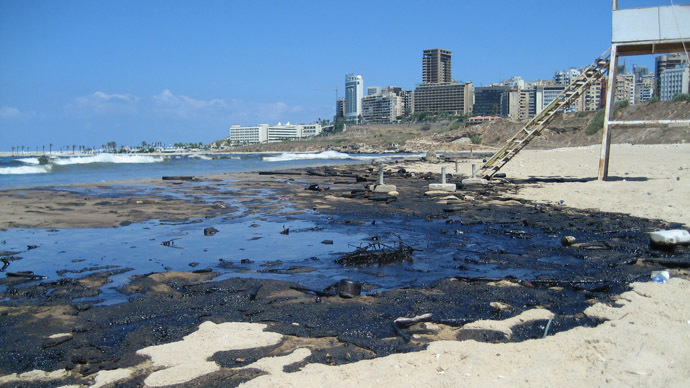
The United Nations General Assembly adopted a resolution titled “Oil slick on Lebanese shores” urging the Zionist entity to pay Lebanon some $850 mn compensation to cover the clean-up cost of an oil spill caused by the Zionist July 2006 war on the country.
The UNGA voted 166 in favor of the non-binding resolution to 8 against (Australia, Canada, the Zionist entity, Marshall Islands, Federated States of Micronesia, Nauru, Palau, United States), with 7 abstentions (Cameroon, Democratic Republic of Congo, Honduras, Papua New Guinea, South Sudan, Tonga, Vanuatu).
Taking into account the 1992 Rio Declaration on Environment and Development, which in principle requires the polluter to pay environmental damage costs, the assembly found the Zionist entity guilty of the July 15, 2006 environmental disaster.
The disaster was caused by a Zionist strike on the oil storage tanks in the direct vicinity of the Jiyeh electric power plant in Lebanon. As a result an oil slick covered the Lebanese coastline entirely, stretching all the way to the Syrian coastline.
By that text, the Assembly considered that the oil slick had heavily polluted the shores of Lebanon with 15,000 tons of oil and partially polluted Syrian shores and consequently had serious implications for the Lebanese economy.
The Assembly decision followed the assessment report by Secretary-General Ban Ki-moon which stipulated the value of damage to be $856.4 million. Now the Assembly is asking the Zionist entity to provide “prompt and adequate compensation.”
The oil slick made by the spill “has had serious implications for livelihoods and the economy of Lebanon,” the resolution read, accounting for inflation of a October 2007 estimate by the United Nations Secretary General that reported the spill caused $729 million in damage.
Lebanon bore the brunt of the spill, but the Syrian coast and other Mediterranean countries suffered as well, the UN said, asking Lebanon to continue clean-up efforts and the international community to increase funding for its environmental restoration.
The resolution noted that the UN chief expressed “grave concern at the lack of any acknowledgment on the part of the government of Israel of its responsibilities vis-a-vis reparations and compensation” to Lebanon and Syria for the oil spill.
Lebanon’s permanent representative to the UN Nawaf Salam hailed the resolution and called it a “major progress.”
“We affirm that Lebanon will continue to mobilize all resources and resort to all legal means to see that this resolution is fully implemented, and that the specified compensation is paid promptly,” he said.
“This resolution also paves the way for further compensation into other areas of damage (health, ecosystem services as habitat, potential groundwater contamination, and marine diversity), that were not considered in the current calculated amount,” Salam added.
For its part, the Zionist mission to the UN rejected the resolution, expressing wonder that it does not cover the environmental damage which occurred in the northern occupied territories following the attack on Lebanon, claiming that the entity launched the July 2006 war on the country as “a consequence.”
The Zionist entity waged a brutal 33-day war on Lebanon in July 2006, killing hundreds of Lebanese people and leaving serious damage to vital infrastructure. The war ended by a UN 1701 resolution which urged the Zionist entity to halt hostilities and withdraw behind the blue line drawn by UN forces after the liberation of most occupied Lebanese southern territories in May 2006.
NY Daily News Joins Daesh in Celebrating Assassination of Andrey Karlov
Sputnik | December 21, 2016
As world leaders and ordinary people expressed their horror following the assassination of Russian Ambassador to Turkey Andrey Karlov, New York Daily News (NYDN) writer Gersh Kuntzmann openly celebrated the public execution, calling it an example of ‘justice [being] served.’
“As Vladimir Putin’s man in Turkey, Karlov was the public face of that murderous dictator’s war crimes around the globe and of oppression at home,” Kuntzmann wrote. “I, for one, am shedding no tears for Andrei Karlov.”
Kuntzmann also repeatedly compared the assassination of Karlov to the killing of Ernst vom Rath, a Nazi German embassy official shot dead in 1938 by Jewish teenager Herschel Grynszpan, while also likening Vladimir Putin, the leader of the government that Karlov served, to the infamous dictator Adolf Hitler. “Like Karlov, Rath was the public face of atrocity — in this case, Adolf Hitler’s genocide, anti-Semitism and coming global aggression… [history] has vindicated Grynszpan — and, indeed, vindicated others who have fought against aggression and fought for freedom.”
While giving a welcome speech at the Ankara Center for Contemporary Art on Monday December 19, Karlov was shot nine times in the back by Mevlüt Mert Altıntaş, a Turkish police officer. The 62-year-old father of one was unarmed and unguarded, and died soon after. Altıntaş’s motivations are not yet clear, but after the murder he yelled “Don’t forget Aleppo, don’t forget Syria!”
The 1961 Vienna Convention on Diplomatic Relations, which nearly every country has signed and ratified, places the safety of diplomats as sacrosanct. Even in wartime, a diplomat’s task of providing reliable means of communication between nations is thought to be apolitical and crucial.
Kuntzmann, however, disagrees. “Karlov’s job in Turkey was to ease tensions over Russia’s atrocities in Syria and its incursions inside Turkey itself — meaning his job was to enable and normalize Vladimir Putin. Given that role, he wasn’t a diplomat, but a soldier, and his death is the same whether it came on a battlefield outside Aleppo or in an art gallery in Ankara.”
Kuntzmann’s comments have been met primarily with outrage on NYDN’s Facebook page. “Shouldn’t we be sad based on the fact he was a human being who was killed on camera? For the whole world & his family? Ridiculous headline. Learn some empathy instead of selling propaganda against Russia over this tragic death,” reads one comment.
“Oh Gersh, do you just stay awake at night trying to figure out ways to be ‘controversial’ or are you really that stupid. Regardless of what he was ‘the face of’, being assassinated by an Islamic terrorist is a bad thing,” reads another.
Many readers were fast to remind the author that the US is also participating in Middle East conflicts, and American diplomats have been killed in the line of duty as well.
“I’m sure there are many in the dung pile who would have said the same about Chris Stephens.. way to “go high”, sickos,” Lynn Peterson reflected.
Others went further. “You have got to be kidding me… the United States has committed human atrocities all over the place… seriously Kuntzman are you oblivious to The American war machine and what it has been doing to innocent lives for decades,” Gord Jacquie Clance charged.
The international response to the death of Andrey Karlov was a combination of outrage and support for Russia, as one of their public servants was horrifically gunned down. Besides Turkey, figures such as US Secretary of State John Kerry, Spanish Prime Minister Mariano Rajoy, French President Francois Hollande, Japanese Prime Minister Shinzo Abe, and countless others have offered Russia condolences.
Others celebrated Karlov’s death. Most prominent among them were Ukrainian nationalist politician Volodymyr Parasiuk, as well as Daesh. They have now been joined by NYDN. Gersh Kuntzmann, who joined NYDN in 2012, is best known for a July 2016 article about AR-15 assault rifles in which he claimed that firing the weapon “gave me a temporary form of PTSD. For at least an hour after firing the gun just a few times, I was anxious and irritable.” It seems, however, that Kuntzmann may have still not recovered from his trauma, as one reader summed up after reading his article: “ Annnnnnd Kuntzman has PTSD again.”
CIA Hawk Called for the US to Deliver a “Painful” Blow to Putin One Week Prior to Ambassador Being Assassinated
By Steven MacMillan | Blacklisted News | December 21, 2016
On the evening of Monday the 19th of December, a day before Russia, Turkey and Iran were scheduled to meet in Moscow to discuss the Syrian conflict, the Russian Ambassador to Turkey, Andrey Karlov, was assassinated while speaking at an art exhibition in Ankara. The assailant has been identified as Mevlut Mert Altıntas, a 22-year-old off-duty Turkish police officer, who reportedly had just returned to duty last month after being suspended over suspected knowledge of the failed July coup attempt. Video footage of the attack shows Altintas shouting ‘Allahu Akbar’ moments after shooting Karlov, in addition to yelling: “Don’t forget Aleppo; don’t forget Syria!” According to certain pro-government newspapers in Turkey, Altıntas may have had ties to the Gülen movement, a movement led by the US-based cleric, Fethullah Gülen. The CIA has been intimately connected to the Gülen movement for years, as the author F. William Engdahl has extensively documented.
Just a Coincidence?
Six days prior to the assassination, the hawkish former Deputy Director of the CIA (who also served as the Acting Director twice), Michael Morell, called for the US to respond to alleged Russian meddling in the US election by retaliating in a way that was both “overt” and “painful to Putin.” It should be noted that the whole narrative of Russia meddling or hacking is a faux one, as no proof has been presented to the public thus far, and is merely the latest effort to demonize Moscow due to the fact that Russia prevented the West and their allies forcing regime change in Damascus. In reality, Morell was advocating retaliation against Russia because Moscow had the audacity to stand up to the US in the Middle East, not because Russia meddled in the US election. Speaking to the Atlantic Council – a Washington-based think tank – on the 13thof December, Morell said:
“In order for a US response to actually result in deterrence two things have to be true: one, it has got to be overt, it has got to be seen; and two, it has got to be painful to Putin. That responsibility for responding to what the Russians did here is largely that of the Obama administration because it happened on their watch. I am a little concerned that the response is going to fall through the cracks of the transition, just the way the US response to the [USS] Cole bombing [on October 12, 2000] fell through the cracks of the transition between the Clinton administration and the Bush administration.”
Perhaps Morell’s comments and the assassination were unrelated, and the shooting was carried out on behalf of militants in retaliation for the Russian military campaign in Syria without the CIA’s knowledge; but then again, perhaps they were related, and the CIA in coordination with other intelligence agencies were involved in the assassination. Franz Klintsevich, the First Deputy Chairman of the Committee on Defense and Security at the Russian Federation Council, has questioned whether the West was involved in the shooting, saying that “representatives of NATO secret services” may have been be behind it.
Morell’s comments certainly reveal the kind of strategic discussions that were (and are) taking place in think tank circles in the West. We know for sure that the assassination was both “overt” and “painful to Putin,” as the shooting took place in a highly public place and Putin had a fairly close relationship with Karlov. The Russian President said in a statement that Karlov was a “good-hearted person” that he knew “personally,” in addition to stating that the assassination was an attempt to disrupt the Russian-Turkish rapprochement and the resolution of the Syrian conflict:
“Ambassador Karlov was a very good-hearted person; I knew him personally, so I’m not speaking from hearsay. Last Autumn, during my visit to Turkey, Ambassador Karlov accompanied me all the time. This murder is clearly a provocation aimed at undermining the improvement and normalization of Russian-Turkish relations, as well as undermining the peace process in Syria promoted by Russia, Turkey, Iran and other countries interested in settling the conflict in Syria.”
Recep Tayyip Erdoğan, the Turkish President, also called the assassination a “provocation,” as well as describing the incident as a “false flag attack:”
“I believe this is an attack on Turkey, the Turkish state and the Turkish people, and also a clear provocation … [in terms of] Turkish-Russian relations. I am sure our Russian friends also see this fact. Both Turkey and Russia have the will not to be deceived by this false flag attack.”
Since Erdoğan apologized to Putin for shooting down a Russian plane on the Turkish-Syrian border in November 2015, Moscow and Ankara have been trying to rebuild ties. Although it has not always been a smooth path, Russia and Turkey appear to be moving closer to each other. The agreement between Ankara and Moscow over the Turkish Stream project – a natural gas pipeline that would run from Russia to Turkey via the Black Sea, and potentially be extended into southeast Europe – is illustrative of the improvement in relations between the two countries. If Turkey, Russia and Iran manage to forge an agreement over Syria, this will bring the Syrian conflict much closer to being resolved, considering the role Turkey has played in supporting the rebels in neighboring Syria.
There was a clear motive for certain factions within the CIA and other intelligence agencies to attempt to impede the Turkish-Russian rapprochement, and disrupt the potential of an alliance between Turkey, Russia and Iran emerging. The shooting may also be an attempt to send a message to Putin that figures close to him can be assassinated with ease. We should not forget that Putin’s favorite driver was killed in a freak road accident in September.
Steven MacMillan is a freelance writer and editor of The Analyst Report.
Featured Video
The Failed Air War Over Vietnam
or go to
Aletho News Archives – Video-Images
From the Archives
USS Liberty Massacre: A Pivotal Moment in the Hostile Takeover of America
By Kevin Barrett | Crescent | Dhu al-Qa’dah 24, 1445
In corporate America, hostile takeovers are commonplace. They occur when an aggressor—a larger corporation or rich individuals—seizes control of a smaller corporation without asking permission.
What few recognize is that the United States itself has been subjected to a hostile takeover. Since the aggressor, the illegitimate settler colony known as “Israel,” is much smaller than the US, the takeover has necessarily been surreptitious.
As of June, 2024, Israel’s gradual takeover of the US has become obvious and undeniable—a proverbial “elephant in the living room.” … continue
Blog Roll
 Aletho News
- Yemeni Armed Forces Warn Airlines Against Using Saudi Airports, Exempt Mecca and Medina
- Iran security chief says powers greater than US tried to conquer Iran but ended in ‘dustbin of history’
- Europe’s mounting social chaos… chickens coming home to roost for proxy war against Russia
- US-Russia Diesel Deal Becomes Massive Defeat for Ukraine
- Hormuz and the Looming Economic Catastrophe
- Dhubab offensive, media blitz and the rapid unraveling of Saudi-backed coalition’s new gambit
- Putin Conveys to Trump Iran’s Vision on Possible Conflict Resolution – Kremlin
- The Search for Truth: Charlie Kirk’s Assassination One Year Later
- ‘Harsh reality’: Iran says France seeks monopoly on power and intimidation, not peace for all
- When Will This White House Madness End?
- If Americans Knew
- For three years, Israel has killed a child in Gaza every 71 minutes – Daily Update
- Israeli forces kill another child in Gaza – Daily Update
- Gaza ceasefire exists in name only, say more than 100 organizations
- Nearly 2 Million in Gaza Need Urgent Shelter Assistance as Winter Looms: IOM Chief Warns
- Suppressing Palestinian resistance: US charity under fire for AI monitoring of Gaza classrooms
- Thousands Are Held in Israeli Torture Camps. This Is What Happens Inside
- Israel puts Gaza’s sick, injured, newborn in peril – Daily Update
- Report claimed Mark Levin used by Israeli government to influence Trump
- Over 2,000 Gazans have died awaiting medical evacuation amid Israel’s continued siege
- How a U.S. Diplomat Suppressed and Altered Reports Critical of Israel
- No Tricks Zone
- Germany’s Green Energy Debacle: High Energy Costs Force Kahla Porzellan to Close After 182 Years!
- New Study: 50 Years Of The Most Aggressive ‘Net Zero’ Policies Can Only Affect The Global Climate By 0.03°C
- US September “Heat” Was No Record…Many Records Set Decades Ago
- Latest European Green Energy Debacle; Portugal’s Largest Flagship Solar Park Insolvent!
- Green Energy Debacle: German Expert Professor Fritz Vahrenholt Warns Of Severe Economic And Social Consequences
- Two More Paleo Reconstructions Affirm Meters-Higher Sea Levels Across Ireland, Brazil 7000-6000 Years Ago
- New Study: Earth And Venus Surface Warmth Largely Explained By Convection And Lapse Rate, Not CO2 Or Radiation
- 2025 Nature Paper Claiming Worsening Global Drought Gets RETRACTED …Heavily Flawed
- New Study: ‘Global Drought Shows No Detectable Recent Acceleration Under Climate Warming’
- Economic Masterminds: German Socialists Suggest Taxing Productivity Gains Stemming From Using AI

