Trump eyes 350-acre US military base housing 5,000 troops in Gaza
Al Mayadeen | February 19, 2026
The Trump administration is preparing plans to construct a military base in Gaza capable of housing 5,000 personnel and covering more than 350 acres, according to “Board of Peace” contracting documents reviewed by The Guardian.
The proposed installation is designed to serve as an operational headquarters for a future “International Stabilization Force” (ISF), envisioned as a multinational military contingent made up of pledged troops. The ISF falls under the authority of the newly established “Board of Peace,” which is intended to govern Gaza. The Board is chaired by US President Donald Trump and partially led by his son-in-law, Jared Kushner.
Documents reviewed by The Guardian outline a phased construction process for a fortified compound measuring approximately 1,400 meters by 1,100 meters. The base would include 26 trailer-mounted armored watchtowers, a small-arms firing range, protective bunkers, and a warehouse for operational equipment. Barbed wire fencing would surround the entire facility.
The site is planned for a barren stretch of land in southern Gaza, marked by saltbush and white broom shrubs and scattered debris from years of Israeli bombardment. The Guardian has examined video footage of the location.
A source familiar with the planning told The Guardian that a select group of international construction firms experienced in operating in war zones has already visited the area.
‘International Stabilization Force’ and Indonesian involvement
Indonesia has reportedly offered to contribute up to 8,000 troops to the force. The Indonesian president was scheduled to attend the inaugural “Board of Peace” meeting in Washington, D.C., alongside three other Southeast Asian leaders.
The UN Security Council authorized the “Board of Peace” to establish the temporary ISF in Gaza. According to the UN mandate, the force would secure Gaza’s borders, maintain internal peace, protect civilians, and assist in training and supporting “vetted Palestinian police forces.”
However, uncertainty remains regarding the ISF’s rules of engagement in the event of renewed Israeli assaults. It is also unclear whether the force would “play a role in disarming Hamas,” an Israeli precondition for reconstruction efforts in Gaza.
Governance concerns and international skepticism
While more than 20 countries have joined the “Board of Peace,” many governments have declined participation. Although the organization was created with UN approval, its charter appears to grant Trump permanent leadership authority.
Adil Haque, a law professor at Rutgers University, criticized the structure of the body. “The Board of Peace is a kind of legal fiction, nominally with its own international legal personality separate from both the UN and the United States, but in reality it’s just an empty shell for the United States to use as it sees fit,” he stressed.
Observers have raised concerns about the Board’s funding and governance transparency. Several contractors told The Guardian that discussions with US officials frequently occur over Signal rather than official government email channels.
A source familiar with the contracting process said the military base document was issued by the Board of Peace with assistance from US contracting officials.
Infrastructure and security measures
The plans detail a network of reinforced bunkers measuring six meters by four meters and 2.5 meters in height, equipped with advanced ventilation systems for troop protection.
“The Contractor,” the document states, “shall conduct a geophysical survey of the site to identify any subterranean voids, tunnels, or large cavities per phase.” The clause appears to reference what it termed “Hamas’s extensive underground tunnel network in Gaza.”
Another section outlines a “Human Remains Protocol.” “If suspected human remains or cultural artifacts are discovered, all work in the immediate area must cease immediately, the area must be secured, and the Contracting Officer must be notified immediately for direction,” the document says. Gaza’s civil defense agency estimates that around 10,000 Palestinian bodies remain buried beneath the rubble.
Legal and political questions
Ownership of the land designated for the base remains unclear, though much of southern Gaza is currently under Israeli occupation. The UN estimates that at least 1.9 million Palestinians have been forcibly displaced during the war.
Diana Buttu, a Palestinian-Canadian lawyer and former peace negotiator, condemned the project. “Whose permission did they get to build that military base?” she asked, describing it as an act of occupation if undertaken without Palestinian governmental consent.
US Central Command declined to comment, directing inquiries to the “Board of Peace”, as per the report.
A Trump administration official also refused to discuss the contract, stating, “As the President has said, no US boots will be on the ground. We’re not going to discuss leaked documents.”
Epstein files may contain ‘crimes against humanity’ – UN
RT | February 18, 2026
Abuses carried out by convicted sex offender Jeffrey Epstein could meet the definition of crimes against humanity, the UN has claimed, while demanding accountability for the suspected perpetrators.
The UN Human Rights Council (UNHRC) released a statement in response to the millions of files released by the US government related to criminal investigations into the late financier.
The files reveal instances of “sexual slavery, reproductive violence, enforced disappearance, torture, inhuman and degrading treatment, and femicide,” reads the document penned by a group of independent experts and published on Monday.
“So grave is the scale, nature, systematic character, and transnational reach of these atrocities… that a number of them may reasonably meet the legal threshold of crimes against humanity,” it states.
Epstein, who according to the authorities died by suicide in jail in 2019, moved in circles that included figures from politics, entertainment, and business. He faced criminal investigations in the US over allegations that he operated a system to recruit and sexually exploit young girls.
While Epstein associate Ghislaine Maxwell was convicted, “questions persist regarding the potential involvement of additional individuals” and financial structures linked to the alleged criminal enterprise, the UN wrote in a press release on Tuesday.
The UNHRC has urged the US and other countries to prosecute those implicated in the scandal, stating that “resignations alone” are not enough.
“It is imperative that governments act decisively to hold perpetrators accountable. No one is too wealthy or too powerful to be above the law,” they state.
The release of the Epstein files, totaling over 3.5 million pages, has triggered a wave of resignations across several countries. In the UK, the political fallout has been most severe, with three senior officials in Prime Minister Keir Starmer’s government stepping down, and the brother of King Charles, Andrew, losing his titles.
In the US, a top Wall Street law firm chairman and a prominent New York arts school chair have resigned. In Europe, national security advisers in Slovakia and Norway have stepped down, along with the president of the Swedish UNHCR and a former French culture minister.
Putin aide urges retaliation to ‘Western piracy’
RT | February 17, 2026
Russia’s response to “Western piracy” targeting its maritime trade should be forceful and not limited to diplomatic means, an aide to President Vladimir Putin has said.
Nikolay Patrushev, a veteran national security official who heads a naval policymaking body, called for stronger action against Western moves targeting vessels described as part of an alleged Russian ‘shadow fleet’.
Attempts to paralyze Russian foreign trade will only intensify, Patrushev warned in an interview with Argumenty i Fakty published on Tuesday.
“Unless we push back forcefully, soon the English, the French, and even the Balts will get brazen enough to try and block our nation’s access to at least the Atlantic,” he said.
“The Europeans are in essence making steps to impose a naval blockade, deliberately pushing towards a military escalation, testing the limits of our patience and provoking our retaliation. If the situation is not resolved peacefully, the Navy will be breaking and lifting the blockade,” Patrushev said.
“Let’s not forget that plenty of vessels sail the seas under European flags. We may get curious about what they are shipping and where,” he added.
Patrushev expressed skepticism that tensions could ease, saying “there is little hope that the West has an ounce of respect for diplomacy and the law.” He argued that “the old practice of ‘gunboat diplomacy’ is being revived,” citing US operations targeting Venezuela and Iran.
Washington has used warships to target suspected drug smuggling boats off Venezuela and intercept outgoing oil tankers, including one sailing under a Russian flag. The Pentagon is now concentrating assets in the Middle East as President Donald Trump pressures Iran to accept restrictions on its missile deterrence against Israel.
In today’s world, the Russian Navy is “a geopolitical tool that combines might with flexibility and is suitable for both peacetime and armed conflicts,” Patrushev said. Its strength is needed to protect Russia’s “ability to export oil, grain and fertilizers, and the normal functioning of the state.”
‘Israel’ threatens to genocide Gaza if Hamas refuses disarmament
Al Mayadeen | February 16, 2026
Senior Israeli officials have threatened to renew the genocide in Gaza if Hamas does not disarm within a proposed 60-day period, although the Israeli occupation continues its attacks on the Strip daily, never adhering to the ceasefire agreement.
Cabinet Secretary Yossi Fuchs, a senior adviser to Prime Minister Benjamin Netanyahu, said that the occupation government intends to give Hamas two months to relinquish its arms. If it does not comply, the Israeli military would “complete the mission” in Gaza, he threatened.
The warnings came against the backdrop of the US-led “Board of Peace”, under which Washington dictated the 60-day deadline.
According to Fuchs, Hamas would be required to surrender all weapons, including small arms such as AK-47 rifles. He emphasized that the Israeli regime would evaluate the outcome at the end of the period.
Netanyahu also reiterated that disarmament must include small arms, claiming that such weapons were used during the October 7 operation. Israeli officials allege that tens of thousands of rifles remain in Gaza.
Reports in The New York Times suggested that a draft proposal discussed by US mediators could initially allow Hamas to retain some small arms while surrendering weapons deemed capable of striking “Israel”. The document is reportedly expected to be shared with the Palestinian Resistance in the coming weeks.
Devastation and aggression despite ceasefire
Despite the ceasefire agreement, officially effective as of October 11, 2025, the Israeli regime has maintained its occupation of vast areas across the Gaza Strip, and continues to attack the Palestinian territory’s infrastructure and civilians.
Since then, over 591 Palestinians, including women and children, have been killed, and more than 1,598 others have been injured.
Since October 7, 2023, more than 72,051 Palestinians have been killed, and over 171,706 have been injured, making the war on Gaza one of the most brutal in modern history. Many victims are still in dire need of treatment. However, hospitals across Gaza have been systematically targeted over the past three years, forcing operations to minimal function, sometimes to a halt.
US seizes oil tanker for ‘defying Trump’s quarantine’
RT | February 16, 2026
US military forces intercepted and boarded a tanker that was sanctioned for carrying Venezuelan oil in the Indian Ocean overnight on Sunday, the Pentagon has announced.
The US launched a military operation to kidnap Venezuelan President Nicolas Maduro in early January, and claims to have seized control of the country’s oil exports. Earlier this year, US President Donald Trump said Washington plans to “control Venezuela’s oil resources indefinitely.”
In a statement on X, the US War Department said the vessel, named Veronica III, was tracked from the Caribbean Sea into the Indian Ocean before being stopped and inspected in what it described as a “right‑of‑visit, maritime interdiction and boarding.”
“The vessel tried to defy President Trump’s quarantine – hoping to slip away,” the Pentagon wrote. “We tracked it from the Caribbean to the Indian Ocean, closed the distance, and shut it down.”
Ship-tracking and maritime data platforms list the Veronica III as a Panama-flagged oil tanker. The action follows a similar boarding last week of another sanctioned vessel.
Trump ordered what he described as a “total and complete blockade” on all US‑sanctioned oil tankers entering or leaving Venezuela in December.
The blockade has continued as part of Washington’s push to redirect Venezuelan oil toward new international buyers. Last week, Israel received its first crude oil shipment from the South American nation, according to Bloomberg.
Reuters also reported last week, citing trade sources, that India’s two state-owned refiners had purchased 2 million barrels of Venezuelan crude for delivery in the second half of April. The agency also said that, according to shipping schedules, 2 million barrels of Venezuelan crude were sent to refineries operated by Spanish oil company Repsol.
At the same time, China, once a top importer of Venezuelan oil, has reportedly turned to discounted Iranian heavy grades to make up for shipments that have stalled under the US blockade, as independent Chinese refiners seek alternatives to Venezuelan supplies.
Moscow has condemned US actions against Caracas, with Russian officials saying Washington’s moves violate international norms. Foreign Minister Sergey Lavrov said last week that the US is trying to take control of all international energy supply routes in an attempt to attain global economic dominance.
Israeli army closes dozens of cases involving killing of Palestinians inside torture camps
The Cradle | February 13, 2026
The Israeli military has closed dozens of war-crimes investigations into its soldiers arising from the first two years of its genocide of Palestinians in Gaza, the Jerusalem Post reported on 8 February.
Publication of the details of the case closures was delayed by fears that doing so would ease the way for the International Criminal Court (ICC) to pursue war crimes charges against the soldiers.
Many of the closed cases relate to the deaths of as many as 98 Palestinian detainees from Gaza held in military detention facilities.
Torture and rape are common in Israeli detention centers, including Sde Teiman, where a 2024 leaked video showed the gang rape of a Palestinian detainee.
The arrest of the soldiers who carried out the rape was widely condemned by Israeli politicians and media commentators, who argued that rape was justified.
According to the Jerusalem Post, cases involving the deaths of detainees in custody constitute a “significant number” of about 100 criminal probes that the military’s legal division has opened into soldiers’ conduct.
However, the 100 cases where a probe has been opened make up just a “small proportion” of the roughly 3,000 cases of alleged war crimes for which a preliminary review took place.
Additional indictments may be filed in the Sdei Teiman cases, the Jerusalem Post added.
That Israel has closed many cases with no prosecutions undermines its argument that the ICC has no jurisdiction to prosecute its soldiers and politicians for war crimes.
Israel claims that it has a “robust, independent, and functioning” legal system capable of investigating any alleged wrongdoing. Therefore, according to the Complementary Principle, the ICC has no jurisdiction over its actions, Israel argues.
The Complementary Principle asserts that the ICC should complement national criminal systems, not replace them.
In November 2024, the ICC issued arrest warrants for Israeli Prime Minister Benjamin Netanyahu and former defense minister Yoav Gallant on war crimes charges, including using starvation as a weapon of war.
Israel and the US responded by issuing threats and imposing unilateral economic sanctions on the court’s judges.
Israel is also facing charges at a separate international court, the International Court of Justice (ICJ), that it is in breach of the Genocide Convention.
In March 2024, the ICJ issued a preliminary ruling requiring that Israel must take provisional measures to stop the possibility of perpetrating a genocide, including halting the military assault it was carrying out on the city of Rafah, allowing humanitarian aid to enter unhindered, and permitting a fact-finding team to enter the strip.
In December 2023, South Africa filed a case at the ICJ alleging Israel is carrying out a genocide of Palestinians in Gaza.
The Jerusalem Post reported that Israel’s response to the South Africa case, due on March 12, is still being prepared by its legal team. It will reportedly include a 1,000-page legal brief, along with 4,000 or more pages of exhibits.
The South African case covers Israel’s actions in Gaza between 2023 and 2024. Pretoria has not yet submitted a detailed attack on the Israeli military’s conduct in 2025. It is expected to do so this spring or summer.
Israel will likely be required to respond by the spring of 2027.
“There are concerns among Israeli lawyers about the genocide charges, not only due to exaggerated public statements made by National Security Minister Itamar Ben-Gvir and Finance Minister Bezalel Smotrich, but also resulting from statements made near the start of the war by more authoritative defense figures,” the Jerusalem Post reports.
Prime Minister Netanyahu, Defense Minister Gallant, Smotrich, Ben Gvir, and many other Israeli politicians have made multiple public statements urging the army to commit genocide against Palestinians in Gaza.
According to the UN, genocide means any of the following acts committed with the intent to destroy, in whole or in part, a national, ethnic, racial, or religious group:
Killing members of the group; Causing serious bodily or mental harm to members of the group; Deliberately inflicting on the group conditions of life calculated to bring about its physical destruction in whole or in part; Imposing measures intended to prevent births within the group; Forcibly transferring children of the group to another group.
French FM under fire over ‘false’ claims about UN rapporteur
RT | February 13, 2026
A lawyers association has filed a legal complaint against French Foreign Minister Jean-Noel Barrot over his accusations against UN Palestinian rights rapporteur Francesca Albanese regarding alleged remarks she made about Israel.
Barrot this week accused Albanese of labeling Israel a “common enemy of humanity” and called for her removal from the UN Human Rights Council. Albanese has rejected the allegations as “shameful and defamatory,” insisting that in her remarks made recently in Doha she was referring to “the system” enabling genocide in Palestine and not to the Israeli people or state.
On Thursday, the Association of Lawyers for the Respect of International Law (JURDI) filed a legal complaint against Barrot, saying that his statements represent “the dissemination of false information,” undermine the independence of UN mechanisms, and could constitute a criminal offence under French law.
Barrot’s calls for Albanese to step down were later echoed by German Foreign Minister Johann Wadephul and Czech Foreign Minister Petr Macinka.
Amnesty International Secretary General Agnes Callamard defended Albanese’s “vital work,” cautioning against political pressure on independent UN experts.
The UN human rights office has also voiced concern. Spokesperson Marta Hurtado warned that judicial officials and rapporteurs are increasingly subjected to personal attacks and misinformation that distract from investigating serious human rights violations.
Albanese has previously labeled Israel’s war in Gaza a “genocide,” and called for a full arms embargo and suspension of trade agreements with the country. She has been sanctioned by the US and has faced mounting accusations of bias and anti-Semitism, which she denies.
Her mandate runs until 2028, and she is due to brief the Geneva-based council next month. While there is no precedent for removing a special rapporteur mid-term, some diplomats cited by Reuters say a motion could theoretically be proposed, though strong support for Palestinian rights within the body makes it unlikely to succeed.
Russian Soldiers Tortured in Secret Ukrainian Prisons
Sputnik – 12.02.2026
MOSCOW – Russian soldiers are tortured in secret prisons of the Ukrainian Armed Forces, being kept in cages, beaten, and denied food and water, Russian Foreign Ministry Ambassador-at-Large on the Ukrainian regime’s crimes Rodion Miroshnik told Sputnik.
“The greatest amount of abuse and torture occurs in secret prisons – dungeons, basements, concrete boxes, often in cages. And it’s there, when no one knows about them, when they are not included in prisoner-of-war lists, when international organizations know nothing about them, that the worst abuse begins,” Miroshnik said.
He said the Ukrainian Armed Forces are trying to extract military information from them in these torture chambers.
“This is a conveyor belt that involves beatings at the entrance, a marathon of torture for these people – electric chairs, psychological pressure, coercion, denial of food and water. Meanwhile, representatives of the security services arrive to try to break people. Representatives of the SBU [Security Service of Ukraine] and GUR [Main Directorate of Intelligence] come, including for staged videos where people are beaten and subjected to severe psychological pressure,” the ambassador said.
Russia has been conducting its special military operation since February 24, 2022. Russian President Vladimir Putin has said the operation aims to “protect people subjected to genocide by the Kiev regime.” According to the president, the ultimate goal of the operation is to completely liberate Donbas and create conditions that guarantee Russia’s security: Ukraine must undergo demilitarization and denazification.
First Gaza, then the world: The global danger of Israeli exceptionalism
By Ramzy Baroud | MEMO | February 11, 2026
While many nations occasionally resort to a “state of exception” to deal with temporary crises, Israel exists in a permanent state of exception. This Israeli exceptionalism is the very essence of the instability that plagues the Middle East.
The concept of the state of exception dates back to the Roman justitium, a legal mechanism for suspending law during times of civil unrest. However, the modern understanding was shaped by the German jurist Carl Schmitt, who famously wrote that the “sovereign is he who decides on the exception.” While Schmitt’s own history as a jurist for the Third Reich serves as a chilling reminder of where such theories can lead, his work provides an undeniably accurate anatomy of raw power: it reveals how a ruler who institutes laws also holds the power to dismiss them, under the pretext that no constitution can foresee every possible crisis.
It is often argued that Israel, a self-described democracy, still lacks a formal constitution because such a document would force it to define its borders—a problematic prospect for a settler-colonial regime with an insatiable appetite for expansion.
But there is another explanation: by operating on “Basic Laws” rather than a constitution, Israel avoids a comprehensive legal system that would align it with the globally accepted foundations of international law. Without a constitution, Israel exists in a legal vacuum where the “exception” is the rule. In this space, racial laws, territorial expansion, and even genocide are permitted so long as they fit the state’s immediate agenda.
Isolating specific examples to illustrate this point is a daunting task, primarily because nearly every relevant pronouncement from Israeli officials—particularly during the genocide in Gaza—is a textbook study in Israeli exceptionalism.
Consider Israel’s relentless assault on UNRWA, the UN-mandated body responsible for the survival of millions of Palestinian refugees. For decades, Israel has sought the dismantling of UNRWA for one reason: it is the only global institution that prevents the total erasure of Palestinian refugee rights.
These rights are not mere grievances; they are firmly anchored in international law, most notably via UN Resolution 194.
While UNRWA is not a political organization in a functional sense, its very existence is profoundly political. First, it stands as the institutional legacy of a specific political history; second, and more crucially, its presence ensures the Palestinian refugee remains a recognized political entity. By existing, UNRWA preserves the status of the refugee as a subject with the legal right to demand a return to historic Palestine—a demand that the “state of exception” seeks to permanently silence.
In October 2024, Israel unilaterally legislated the closure of UNRWA, once more asserting its “exception” over the entire framework of the United Nations. “It is time the international community (…) realizes that UNRWA’s mission must end,” Prime Minister Benjamin Netanyahu had already declared on January 31, 2024, signaling the coming erasure. This rhetoric reached its physical conclusion on January 20, when the UNRWA headquarters in occupied Jerusalem were demolished by the Israeli military in the presence of National Security Minister Itamar Ben-Gvir.
“A historic day!” Ben-Gvir announced on that same date. “Today these supporters of terror are being driven out.” This horrific act was met with bashful responses, mute concerns, or total silence by the very powers tasked with preventing states from positioning themselves above the law.
By allowing this Israeli “exception” to stand unchallenged, the international community has effectively sanctioned the demolition of its own legal foundations.
In the past, Israeli leaders masked their true intentions with the language of a “light unto the nations,” projecting a beacon of morality while practicing violence, ethnic cleansing, and military occupation on the ground. The genocide in Gaza, however, has stripped away these pretenses. For the first time, Israeli rhetoric fully reflects a state of exception where the law is not just ignored, but structurally suspended.
“No one in the world will let us starve two million citizens, even though it may be justified and moral until they return the hostages to us,” Finance Minister Bezalel Smotrich admitted on August 5, 2024. This “justified and moral” stance reveals a localized morality that permits the extermination of a population as an ethically defensible act. Yet Smotrich also lied; the world has done nothing practical to dissuade Israel from its savage pulverization of Gaza.
The global community remained idle even when Smotrich declared on May 6, 2025, that Gaza would be “entirely destroyed” and the population “concentrated in a narrow strip.” Today, that vision is a reality: a genocide-fatigued population is confined to roughly 45% of the territory, while the remainder stays empty under Israeli military control.
Netanyahu himself, who has stretched the state of exception beyond any predecessor, defined this new reality during a cabinet meeting on October 26, 2025: “Israel is a sovereign state… Our security policy is in our own hands. Israel does not seek anyone’s approval for that.” Here, Netanyahu defines sovereignty as the raw power to act—genocide included—without regard for international law or human rights.
If all states adopted this, the world would fall into a lawless frenzy. In his seminal State of Exception, Giorgio Agamben diagnosed this “void”—a space where law is suspended but “force of law” remains as pure violence. While his recent stances have divided the academic community, his critique of the exception as a permanent tool of governance remains an indispensable lens for understanding the erasure of Palestinian life.
Israel has already created that void. In the hands of a genocidal settler-colonial society, the state of exception is a relentless nightmare that will not stop at the borders of Palestine. If this “exception” is allowed to become the permanent regional rule, no nation in the Middle East will be spared. Time is of the essence.
Three-Year-Old Child Among Four Martyrs as Israeli Enemy Strikes Car in Southern Lebanon

Al-Manar | February 9, 2026
A drone strike in southern Lebanon killed three civilians on Monday, including a three-year-old child, as the enemy continued its daily violations of the ceasefire—once again placing children and non-combatants within its target bank.
Al-Manar’s correspondent reported an Israeli drone strike targeting a car in the southern town of Yanouh, in the district of Tyre, leaving casualties.
Ambulances rushed to the scene of the attack as pillars of smoke rose in the area, according to our correspondent.
Lebanese Health Ministry then said the strike in Yanouh killed three citizens including a 3-year-old child.
Local media reported that the victims were Ali Jaber, 3, his father Hasan and Ahmad Salameh, a retired Lebanese army soldier.
The killing of a three-year-old child in a drone strike underscored the nature of the Israeli enemy’s daily aggression in southern Lebanon, where civilians, particularly children, continue to be targeted in flagrant violation of the 2024 ceasefire.
Later on Monday, Al-Manar correspondent reported a citizen was martyred as occupation forces opened fire at him in the outskirts of Ayta Al-Shaab border town.
The town also witnessed bomb attacks as Israeli gliders dropped at least five strun grenades in the area.
Earlier on Monday, Israeli forces infiltrated into the southern town of Habbarieh, assaulted the house of Jamaa Islamiya official Atwi Atwi and abducted him after beating him along with his wife.
Atwi, who was a former mayor of the town, was taken to the occupied territories, as announced by the occupation army.
UK proposes North Sea drone fleet to target tankers – Sunday Times
RT | February 9, 2026
Britain is planning to launch a seaborne drone fleet to seize oil tankers it claims are linked to what it calls a Russian “shadow fleet,” the Sunday Times has reported.
London banned the import of Russian crude and oil products in 2022, along with related maritime transportation, insurance, and financing, imposing sanctions on over 500 vessels.
Despite those measures, Moscow has shipped 550 million tonnes of oil legally through the English Channel with an estimated value of $326 billion, according to the outlet, which said the sanctions are “failing to bite.” At the same time, Politico reported an estimated 40% of diesel-grade petroleum products the UK imported from India and Türkiye over four years originated from Russian oil.
The Royal Navy has drafted proposals for a command center for a remotely piloted flotilla of unmanned boats to police the North Sea. The drones are intended to gather evidence of “illicit activities” by tankers heading to and from Russian ports, which would form the basis for outright seizure of the vessels in the English Channel.
Under the UN Convention on the Law of the Sea, which guarantees freedom of navigation, Western powers lack a clear legal basis to enforce sanctions against cargo on the high seas.
Despite this, two tankers have been seized so far this year: the Marinera by the US with UK support in the North Atlantic, and the Grinch by France in the Mediterranean. British Defense Secretary John Healey confirmed afterwards that the two allies were coordinating to detain more vessels.
The Sunday Times noted, however, that the plan faces a significant financial hurdle, as holding seized tankers incurs high costs. To help offset this, London is reportedly considering selling the oil from impounded vessels.
Russian officials have consistently slammed tanker seizures a “blatant violation” of international maritime law. President Vladimir Putin last October called France’s detention of a vessel in neutral waters “piracy.” Foreign Ministry spokeswoman Maria Zakharova previously characterized piracy as “one of the English traditions,” adding that historically pirates were forbidden to attack English ships but were allowed to plunder rival vessels.
The Toxic Border: How Israel’s Chemical Spraying is Reshaping Life in South Lebanon
By Robert Inlakesh | The Palestine Chronicle | February 8, 2026
Reports that Israeli aircraft sprayed chemical agents along the Lebanese border — later identified as toxic defoliants — have intensified concerns over environmental damage, civilian harm, and possible violations of international law, with similar incidents also reported in southern Syria.
Key Takeaways
- UN peacekeepers suspended patrols after being warned that aircraft would spray chemical agents near the Blue Line.
- The sprayed substance was later identified as a toxic herbicide linked to cancer.
- The campaign is seen as serving both military land-clearing and civilian displacement purposes.
- Similar chemical spraying incidents have been reported in southern Syria.
- Rights groups say targeting farmland may constitute a violation of international humanitarian law.
- Spraying along the Blue Line
Israel is waging chemical warfare against both Lebanese and Syrian lands, a campaign that may not only have dire environmental repercussions but also inflict long-term health problems on local civilian populations.
On February 1, the United Nations peacekeeping forces stationed in southern Lebanon – UNIFIL – were forced to suspend their patrols along what is known as the Blue Line that demarcates the de facto Israeli-Lebanese border. They did so out of safety concerns for their soldiers, after Israel informed them it would be using planes to spray chemical agents in the area.
Tel Aviv initially informed UNIFIL that the chemical agent was “non-toxic.” Nevertheless, the UN reiterated its “concerns” about flight movements in the area, stressing that such activities violate UN Security Council Resolution 1701.
It wasn’t long until it was discovered that the agent being sprayed was, in fact, toxic. Allegedly, the specific agent used, for which a toxicology test was conducted, is a defoliant and herbicide that is linked to cancer.
Israel is currently on its way to violating the Lebanon ceasefire, which went into effect on November 27, 2024, nearly 10,000 times. This makes it the most violated ceasefire deal in recorded history.
Israeli strikes, targeting north to south and even the capital city of Beirut, have killed hundreds. Despite this, there have been no recorded violations by Hezbollah or the Lebanese Army.
A Strategy of Erasure
What is so consequential about Israel’s use of chemical agents in southern Lebanon is that it has two primary purposes. The first is to kill everything it touches, to clear the land for military purposes. The second is that it is being used as a form of collective punishment, a likely intention behind which is to drive Lebanese citizens from their homes.
Perhaps the most horrifying part of this is that there is a dark history of such chemicals being used for the same purposes elsewhere. The most infamous case is that of the US military spraying Agent Orange, also a herbicide and defoliant, during the Vietnam War.
As a result of the callous use of Agent Orange, both the civilian population of Vietnam and US soldiers alike ended up contracting serious chronic health problems. One of the results was birth defects, cancers such as Hodgkin’s lymphoma, and even neurodegenerative diseases. This was in addition to what was labeled ecocide in the country.
While some may argue that the Israelis are simply using chemical agents to clear the land, as a security precaution, this is not plausible. Israel has the capability and has historically used heavy equipment to clear the land.
Deploying chemical agents, which it is of note that they haven’t done so on their side of the Blue Line, is clearly a malicious attack on Lebanese lands and the civilian population living there.
Beyond Lebanon
Israelis have frequently expressed their dismay over the immediate return of Lebanese villagers to their destroyed homes in the south, particularly near the unofficial border, as Israel has never declared its borders.
Meanwhile, a considerable percentage of Israelis, formerly living in settlements like Kiryat Shimona, that were hit the hardest by Hezbollah during the last war, have refused to return.
It has not only been Lebanon that has been subjected to such chemical agent attacks, but southern Syria has also fallen victim to the Israeli military spraying similar chemical agents on its lands.
While the Lebanese government has come under criticism for often ignoring the plight of its citizens in the south, the Syrian government completely refrains from addressing the ongoing occupation and war crimes committed in the south of their country.
The refusal of Damascus to even voice its concern about the chemical warfare being waged against its people and lands has made it less of an issue than in Lebanon, as Beirut has raised its voice.
“The deliberate targeting of civilian farmland violates international humanitarian law, particularly the prohibition on attacking or destroying objects indispensable to civilian survival,” commented the Switzerland-based Euro-Med Human Rights Monitor.
It also demanded accountability for Israel’s “large-scale destruction of private property without specific military necessity amounts to a war crime and undermines food security and basic livelihoods in the affected areas.”
– Robert Inlakesh is a journalist, writer, and documentary filmmaker. He focuses on the Middle East, specializing in Palestine.
Featured Video
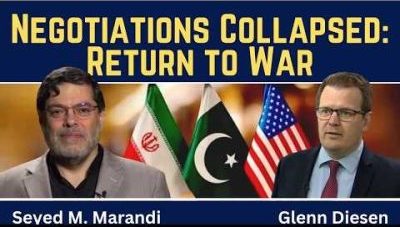
Seyed M. Marandi: Negotiations Collapsed – Return to War
or go to
Aletho News Archives – Video-Images
From the Archives
The US-Iran Scenario That Most Scares Israel
By Ali Haydar | Al-Akhbar | October 9, 2013
Israeli Prime Minister Benjamin Netanyahu issued a series of threats toward Iran and its interlocutors in the West, including the US, as serious negotiations on Iran’s nuclear program seem more plausible.
As a possible rapprochement looms between the US and Iran, Netanyahu has attempted to impose impossible Israeli conditions on the negotiators, such as the full dismantling of Iran’s nuclear program, not to mention threatening military force.
Whatever the deal that could materialize between Iran and the West, Israel is going to find itself before an open-ended path. One can foresee three possible scenarios… continue
Blog Roll
 Aletho News
- UK, Spain reject Trump’s new scheme to blockade Hormuz Strait
- Russian frigate ‘resurfaces’, chases off NATO pirates days after Kiev ‘sank’ it
- Ukraine Targets Russian Merchant Fleet With NATO Intel Support – Presidential Aide
- Russia’s ‘shadow fleet’ makes mockery of UK naval power
- Ukraine plans to attack Russian ships with Norwegian support
- US’s ‘Very Foolish’ Double Blockade of Hormuz Strait Makes Absolutely No Sense: Here’s Why
- China issues rules on countermeasures against foreign states’ unlawful extraterritorial jurisdiction
- Seyed M. Marandi: Negotiations Collapsed – Return to War
- Tomorrow’s naval blockade showdown
- ‘Israel’ attacks civilians to hide its embarrassing military failures & out of pure sadism
- If Americans Knew
- Israeli prison authorities are blocking hundreds of solidarity postcards being sent to female Palestinian prisoners
- ‘I wished for death’: Sexual violence in Israel’s prisons is an ‘organized state policy’
- Israeli army shoots, kills 9-year-old girl in her Gaza classroom
- Israel is attacking Lebanon to sabotage the Iran ceasefire, but the media is hiding its true motivation
- Israel’s restriction of aid into Gaza leads to critical shortages in bread, baby formula, and water
- Critical shortages in Gaza, Lebanon in ruins, “piracy” in Iran – Daily Update
- US-Iran ceasefire negotiations make zero progress – Daily Update
- Pro-Israel ‘Thinktanks’ and Individuals who Influence U.S. Foreign Policy
- Mearsheimer reveals how Israel dictates US policies on Iran, Gaza – video
- After killing 350+, Israel still has a “score to settle” with Lebanon before ceasefire – Daily Update
- No Tricks Zone
- Cave Discovery Reveals Today’s Desert Climates Were Recently Far Warmer, Wetter, Teeming With Life
- German Expert: Heat Dome Led To Record Temps In Western USA…Warmer In 1934, 1936
- New Study: No Linear Warming Or Glacier Retreat Along Northern Antarctic Peninsula Since 1980s
- An Inconvenient Tree: Uncovered In Alps… Europe Much Warmer Than Today 6000 Years Ago
- New Study Reports A 60% Slowdown In Greenland’s Ice Loss Rate In The Last Decade
- Low Intensity Tornado Wrecks Major Solar Farm, Creating A Potential Toxic Dump
- New Study Finds Warming Saves Lives…Cold Temperatures 12 Times More Deadly Than Excess Heat
- German Science Blog Accuses PIK Climate Institute Of Hallucinating Climate Tipping Points
- Devastating Assessment Of Comirnaty Vaccine By Former Senior Pfizer Europe Toxicologist
- New Study: CO2 Is ‘Effectively Negligible’ As An Explanatory Climate Change Factor Since 2000
 Aletho News