Aletho News

ΑΛΗΘΩΣ

Legitimate resistance: should Hamas and Hezbollah learn from the Taliban?

By Ramzy Baroud | MEMO | September 27, 2021

An urgent task is awaiting us: given the progression of events, we must liberate ourselves quickly from the limits and confines placed on the Afghanistan discourse, which have been imposed by US-centred Western propaganda for over 20 years and counting. For a start, we must not allow the future political discourse on this subject to remain hostage to American priorities: successes, failures and geostrategic interests.

For this to happen, the language itself must be challenged. This is critical if we are to glean valuable lessons from Afghanistan and avoid a repeat of the failure to comprehend the US defeat in Vietnam (1955-1975) in the way it should have been understood, not the way that Washington wanted Americans — in fact, the whole world — to understand. Vietnam was not merely an American “debacle”, and did not only culminate in an American “defeat”. It was also a Vietnamese victory and the triumph of the will of the people over the US imperialist war machine.

In US mainstream media and, to a large extent, academia, the history of the Vietnam War was written almost entirely from an American perspective. Even the anti-war version of that history remained US-centric.

Alas, in the case of Afghanistan, many of us, whether in journalism or academia, wittingly or otherwise, remain committed to the US-based discourse, partly because the primary sources from which our information is gleaned are either American or pro-American. Al-Akhdar Al-Ibrahimi, former UN Peace Envoy to Afghanistan from 1997 to 1999, and again from 2001 to 2004, reminded us recently, in an interview with French newspaper Le Monde, of the importance of using proper language to describe the unfolding events in Afghanistan: “Why [do we] always speak of an American defeat? First of all, this is a victory for the Taliban, which must be attributed to their tactical genius.” (Translated from French)

The answer to his question can be deduced easily from his own words because, to speak of a Taliban victory, is to admit to their “tactical genius”. The admission of such a truth can have far-reaching consequences.

The use of the terms defeat vs. victory is critical because it situates the conversation within two entirely different intellectual frameworks. For example, by insisting on the centrality of the question of the American defeat, whether in Afghanistan or Vietnam, then the focus of the follow-up questions will remain centred on American priorities: Where did the US go wrong? What urgent changes must Washington implement in its foreign policy and military agendas to stave off its Afghanistan shortcomings? And where should the US go from here?

However, if the focus remains centred on the victory of the Afghan resistance — and yes, it was Afghan resistance, not merely that of the Taliban or Pashtun — then the questions that follow would relocate the conversation somewhere else entirely. How did poorly armed fighters manage to defeat the world’s combined great powers? Where should Afghanistan go from here? And what lessons can national liberation movements around the world learn from the Afghan victory?

For the purpose of this article, I am concerned with the Afghan victory, not the American defeat.

The rise and fall of the “terrorist” discourse

The collapse of the Soviet Union in 1991 had a massive impact, not only on the geopolitical map of the world, but also on relevant global political discourses. Like the USSR, the Warsaw Pact and its global alliances began to disintegrate, the US moved quickly into action, asserting its dominance from Panama (1989) to Iraq (1991) and beyond. The American objective was not merely a violent declaration of its triumph in the Cold War, but a message to the rest of the world that the “American century” had begun and that no form of resistance to the US stratagem could be tolerated.

In the Middle East, in particular, the new narrative was on full display, with clear and repeated distinctions between “moderates” and “extremists”, friends and enemies, allies and those marked for “regime change”. According to this new logic, anti-colonial forces that were celebrated as liberation movements for decades fell suddenly into the category of “terrorists”. This definition included Palestinian, Lebanese and other resistance groups, even though they sought liberation from illegal foreign occupation.

Years later, the discourse on terrorism — summed up by George W. Bush’s statement in September 2001, “Either you are with us or you are with the terrorists” — became the yardstick by which the world, according to Washington, was to be judged and divided into freedom-loving nations and terrorist, extremist regimes. The latter category was eventually expanded to include Iraq, Iran and Syria. On 29 January 2002, North Korea was also added to Washington’s so-called “axes of evil”.

Afghanistan, of course, topped the American list of terrorist states, under various pretences: initially it was for harbouring Osama Bin Laden and Al-Qaeda and, later, the mistreatment of women, and so on. Eventually, the Taliban was labelled a “terrorist” group, leading an “insurgency” against the “democratically-elected” Afghan government in Kabul. The past 20 years have been spent in the construction of this false paradigm.

In the absence of any strong voices in the media demanding a US withdrawal and defending the Afghan people’s right to resist foreign occupation, there was a near-complete absence of an alternative political discourse that even attempted to raise the possibility that the Taliban, despite all of their questionable strategies and practices, may, in fact, be a national liberation movement.

The reason we were discouraged from considering such a possibility is the same reason why US-Western-Israeli propaganda insisted on removing any distinction between Daesh (ISIS), Al-Qaeda, the Taliban, Hamas, Hezbollah, Al-Houthis and many other such groups. On the one hand, discussing the particularities of each movement requires real knowledge of the history and formation of each one separately, and the political circumstances through which they continue to operate. This kind of knowledge is simply non-existent in the cliché-ridden, soundbite-driven mainstream media. On the other hand, such understanding is inconvenient, as it complicates the deception and half-truths necessary for the US, Israel and others to depict their military occupations, unlawful military interventions and repeated wars as fundamental to some imagined global “war on terror” and, as some European intellectual circles prefer to dub it, a war on “radical Islam”.

However, unlike Al-Qaeda and Daesh, Hamas, Hezbollah and the Taliban are not trans-border militant groups fighting a global agenda, but national liberation movements which, despite their emphasis on religious discourses, are political actors with specific political objectives confined largely within the borders of their own countries; Palestine, Lebanon and Afghanistan, respectively.

Regarding Hamas, London-based author Daud Abdullah wrote in his book Engaging the World: The Making of Hamas Foreign Policy that: “Hamas sees foreign relations as an integral and important part of its political ideology and liberation strategy. Soon after the Movement emerged, foreign policies were developed to help its leaders and members navigate this tension between idealism and realism. This pragmatism is evident in the fact that Hamas was able to establish relations with the regimes of Muammar Gaddhafi in Libya and Bashar Al-Assad in Syria, both of whom were fiercely opposed to the Muslim Brotherhood.”

It was also Abdullah who became one of the first to draw the parallels between Palestine and Afghanistan as soon as the Taliban declared victory in Kabul. In a recent article in the Middle East Monitor, he wrote, “Palestine and Afghanistan are salient examples. Throughout history, their peoples have witnessed numerous invasions and occupations. After two decades the US has finally run out of stamina. Similarly, they will eventually realise the futility of supporting the Zionist occupation of Palestine.”

Indeed, the lesson of Afghanistan must be studied carefully, especially by resistance movements that are undergoing their own wars of national liberation.

Now that the US has officially ended its military operations in Afghanistan, albeit not by choice, the emphasis on the so-called “war on terror” discourse will certainly begin to fade. What, though, will come next? While another interventionist discourse will certainly fight for prominence in the new American thinking, the discourse of national liberation, based on legitimate resistance, must return to the centre of the conversation.

This is not an argument for or against armed struggle, as this choice falls largely, if not entirely, on nations that are struggling for their own freedom, and should not be subject to the selective, frequently self-serving, ethics of Western moralists and activists. It is worth mentioning that international law does not prohibit people from using whatever means necessary to liberate themselves from the jackboot of foreign occupation. Indeed, myriad UN resolutions recognise the “legitimacy of (oppressed people’s) struggle by all means at their disposal, including armed struggle”. (UN Commission of Human Rights Resolution 1982/16)

Nevertheless, armed struggle without popular, grassroots support often amounts to nothing, for a sustainable armed campaign, like those of Hamas, Hezbollah or the Taliban, requires deep-rooted social and socio-economic support. This proved as true in Vietnam as it did earlier in Algeria (1954-1962), Cuba (1953-1959) and even South Africa, where the history of armed struggle has been largely written out in favour of what is meant to appear as a “peaceful” anti-apartheid struggle and transition of power.

For nearly 30 years, partly as a consequence of the dismantling of the Soviet Union and the seemingly uncontested rise of the American empire, almost any form of armed struggle in national liberation contexts has been depicted as “terrorism”. Moreover, in the post-9/11 US-dominated world, any attempt at arguing otherwise earned any daring intellectual the title of “terrorist sympathiser”.

Twenty years have elapsed since the American invasion of Afghanistan culminated in the defeat, not just of the US but also of the US political discourse on terrorism, resistance and national liberation. The resulting victory of the Taliban will extend well beyond the borders of Afghanistan, breaking the limits imposed on the discussion by western-centric officials, media and academia, namely the urgently needed clear distinction between “terrorism” and national liberation.

The American experiment, using firepower to control the world, and intellectual hegemony to control our understanding of it, has clearly failed. This failure can and must be exploited as an opportunity to revisit urgent questions and to resurrect a long-dormant narrative in favour of anti-colonial, national liberation struggles with the legitimate right — in fact, responsibility — to use all means necessary, including armed struggle, to free nations from the yoke of foreign occupation.

September 27, 2021 Posted by | Book Review, Illegal Occupation, Timeless or most popular | , , , , | 2 Comments

Who represents Afghanistan: Genuine activists vs ‘native informants’

By Ramzy Baroud | MEMO | September 22, 2021

Scenes of thousands of Afghans flooding the Kabul international airport to flee the country as Taliban fighters were quickly consolidating their control over the capital, raised many questions, leading amongst them: who are these people and why are they running away?

In the US and other Western media, answers were readily available: they were mostly ‘translators‘, Afghans who ‘collaborated’ with the US and other NATO countries; ‘activists’ who were escaping from the brutality awaiting them once the Americans and their allies left the country, and so on.

Actually, the answer is far more complex than that offered by Western officials and media, which ultimately – although inaccurately – conveyed the impression that NATO armies were in Afghanistan to safeguard human rights, to educate women and to bring civilization to a seemingly barbaric culture.

Though political dissent is a basic human right, there is a clear and definitive line between the legitimate right to challenge one’s government/regime and willingly collaborating with another – especially when that collaboration can have dire consequences on one’s own people.

In the United States and Europe, there are thousands of political dissidents from many parts of the world – from South America, the Middle East, East Asia, and others – who are, sadly, used as cheerleaders for political and military interventions, either directly by certain governments, or indirectly, through lobby and pressure groups, academic circles and mainstream media.

These individuals, often promoted as ‘experts’, appear and disappear whenever they are useful and when their usefulness expires. Some might even be sincere and well-intentioned when they speak out against, for example, human rights violations committed by certain regimes in their own home countries, but the outcome of their testimonies is almost always translated to self-serving policies.

Thousands of Afghans – political dissidents, NATO collaborators, students, athletes and workers seeking opportunities – have already arrived in various western capitals. Expectedly, many are being used by the media and various pressure groups to retrospectively justify the war on Afghanistan, as if it was a moral war. Desperate to live up to the expectations, Afghan ‘activists’ are already popping up on western political platforms, speaking about the Taliban’s dismal record of human rights and, especially, women’s rights.

But what is the point of appealing to the western moral consciousness after 20 years of a NATO-led deadly invasion that has cost Afghanistan hundreds of thousands of innocent people?

In Afghanistan, an alternative narrative is evolving.

On September 11, hundreds of Afghan women protested in Kabul University, not against the Taliban, but against other Afghan women who purport to speak from western capitals about all Afghan women.

“We are against those women who are protesting on the streets, claiming they are representative of women,” one of the speakers said, AFP reported.

While AFP made a point of repeating that the women protesters have “pledged” their commitment to “all Taliban’s hardline policies on gender segregation”, emphasising how they were all covered “head to toe,” the event was significant. Among many issues, it raises the question: who represents Afghan women, those who left or those who stayed?

A large banner held by the protesters in Kabul read: “Women who left Afghanistan cannot represent us.”

The truth is no one represents Afghan women except those who are democratically-elected by Afghan society to represent all sectors of that society, women included. Until real democracy is practiced in Afghanistan, the struggle will continue for real freedom, human rights, equality and, obviously, representation.

This fight can only take place within an organic, grassroots Afghan context – whether in Afghanistan or outside of the country – but certainly not through Fox News, the BBC or US Senate hearings.

The late Palestinian-American scholar, Professor Edward Said, repeatedly warned of the pseudo reality painted by the ‘native informants’ – supposed political dissidents recruited by western governments to provide a convenient depiction of the reality in the Middle East and elsewhere, as a moral justification for war. The consequences, as the 2003 Iraq war and invasion have demonstrated, can be horrific.

Said challenged a particular ‘native informant’, the late Fouad Ajami, a Lebanese academic, whose ideas about the Iraqi enthusiasm for the US war, though proved disastrously wrong, were used by George W. Bush and others as proof that the impending war was destined to be a ‘cakewalk‘.

Ajami’s ideas were long discredited, but the political machinations that still prefer ‘native informants’ to genuine human rights defenders and good scholarship remain in place. Many of the Afghan escapees are sure to be strategically placed through the same channels, which continue to promote interventions and sanctions as sound policies.

The war in Afghanistan has ended, hopefully for good, but the conflict on who represents the people of that war-torn country remains unresolved. It behooves the Taliban to deliver on its promises regarding equal representation and political plurality, otherwise there are may others abroad who will be ready to claim the role of legitimate representation.

In the Middle East, in particular, we have already witnessed this phenomenon of the west-based ‘legitimate’ democratic representations. Ultimately, these ‘governments-in-exile’ wrought nothing but further political deception, division, corruption, and continued war.

War-torn Afghanistan – exhausted, wounded and badly needing a respite – deserves better.

September 22, 2021 Posted by | Progressive Hypocrite | | 1 Comment

That no one will resign for killing Kabul children shows American empire’s true face

Seven children, including Jamshid Yousoufi’s two-year-old daughter Sumaya, died in the American strike, which killed ten civilians in total. © RT
By Nebojsa Malic | RT | September 18, 2021

While finally admitting the “righteous” drone strike against ISIS-K terrorists actually killed civilians and children, the Pentagon won’t punish anyone, because these things aren’t considered war crimes when the US does it.

General Kenneth McKenzie, head of the US Central Command, offered “profound condolences” on Friday to the families of 10 people – seven of them children – killed in the August 29 drone strike in Kabul. It was ordered in “earnest belief that it would prevent an imminent threat to our forces,” but “it was a mistake and I offer my sincere apology,” he said.

McKenzie then did what the Pentagon does best: he put up a powerpoint presentation, explaining how US “intelligence” came to the conclusion that 43-year-old aid worker Zemari Ahmadi going to and from work in his white Toyota was really an Islamic State Khorasan (ISIS-K) terrorist plotting a car-bombing of the Kabul airport.

What he did not do, however, is resign or promise anyone else involved in this atrocity would do the same – or even be reprimanded, counseled, or otherwise disciplined. One might think someone ought to, considering that they killed children.

That’s not how the Pentagon works, though. For two weeks, the US military lied about the drone strike, and the corporate press ran with it.

McKenzie’s CENTCOM initially claimed that the vehicle was an “imminent threat” to the airport and the ongoing airlift, and that there were no civilian casualties. Then they said there might have been civilian casualties, but blamed that on the supposed secondary explosions.

“We know that there were substantial and powerful subsequent explosions resulting from the destruction of the vehicle, indicating a large amount of explosive material inside that may have caused additional casualties,” CENTCOM spokesman Captain Bill Urban said on August 29.

Literally none of this was true.

According to a New York Times investigation published on September 10, what the US thought was a suspicious compound turned out to be the office of a US-funded food charity, where Ahmadi had worked for 14 years. The suspicious bags and containers loaded into his white Toyota? Laptop cases and jugs of water he was bringing home.

Ahmadi had even applied for a visa to emigrate into the US, as one of the “special immigrants” the Kabul airlift was ostensibly trying to evacuate. Someone gave the order, however, and a Hellfire missile obliterated him, his car, and seven children that came to greet him.

The last US flight out of Kabul departed just before midnight on August 30. President Joe Biden addressed the nation the following day, calling the airlift an “extraordinary success.” The day after, Defense Secretary Lloyd Austin and Chairman of the Joint Chiefs of Staff General Mark Milley faced reporters at the Pentagon, patting themselves on the back for a job well done.

Asked about the drone strike, Milley described it as “righteous” and said it killed an ISIS-K “facilitator.”

“Were the[re] others killed? Yes. Who are they? We don’t know,” he said, seeming more interested in talking about his own anger and pain over the war that just ended.

Twelve days later, on Monday after the Times investigation was made public, Pentagon spokesman John Kirby was still insisting that the Kabul strike had prevented an “imminent attack” against the airport and the US forces there. It wasn’t until Friday afternoon, when Washington traditionally releases all the bad news, that McKenzie popped up on the screen at the Pentagon briefing room and delivered his “oops.”

Except this isn’t an “oops.” It’s a war crime. They killed children.

Ahmadi and the children were killed because the White House had to look tough after the August 26 suicide bombing at the Kabul airport killed 13 US troops and 170 Afghans, and demonstrate “over the horizon” capabilities it claimed to have. McKenzie had to look like the withdrawal wasn’t a humiliation. Milley had to look competent – just like when he reassured China in January that “the American government is stable and everything is going to be OK,” while working with the Democrats to sideline President Donald Trump and prepare DC for Biden, according to a book widely quoted on Tuesday.

Resign? Of course not. Besides, Milley said he did nothing wrong, and Biden declared “complete confidence” in him.

Thing is, Joe and Ken and Mark and everyone else involved up and down that chain of command killed children.

Worse yet, they had to have known it right away. Local media reported the civilian casualties immediately, followed by outlets like CNN. RT interviewed the survivors days before the Times investigation was published. Is anyone seriously suggesting the New York Times had the resources and capability that the infinitely better-funded Pentagon and the CIA did not? Or were they too busy studying critical race theory and purging domestic “deplorables” to pay attention to which white Toyota they were blowing up in Kabul? Don’t they all look alike, anyway?

They. Killed. Children.

It’s not even the first time, either. According to the ‘Drone Papers’ published in October 2015 and detailing US drone strikes in Afghanistan, Somalia, Yemen and elsewhere, up to 90% of casualties at one point were innocents – but the military classified them as terrorists anyway.

The man who revealed this, Daniel Hale, was sent to prison for 45 months back in July.

The man who blew the whistle on the CIA’s torture program, John Kiriakou, likewise ended up behind bars. WikiLeaks’ Julian Assange is still stuck in an English oubliette, a decade after exposing US war crimes in Iraq. Meanwhile, the generals and politicians who murder children and commit other war crimes – they get medals and promotions, fawning book accounts, lush retirements in “defense” industries. And power, of course.

That’s how the empire works. Always has been, even as its child-murdering leaders talk about “defending democracy” and “rules-based international order” and “human rights for women and girls.”

Tell that to two-year-old Malika Ahmadi and Sumaya Yousoufi, whom you killed on August 29 in Kabul. I hope their ghosts haunt you for the rest of your miserable lives.

Nebojsa Malic is a Serbian-American journalist, blogger and translator, who wrote a regular column for Antiwar.com from 2000 to 2015, and is now senior writer at RT. Follow him on Telegram @TheNebulator

September 18, 2021 Posted by | Deception, War Crimes | , | 1 Comment

Shocking report exposes how US defense contractors have wasted trillions through fraud and corruption

By Kit Klarenberg | RT | September 15, 2021

The newly released ‘Profits of War’ report from Brown University has revealed in staggering detail the full extent of the corruption unleashed by Washington’s profligate defense spending during the 20-year War on Terror.

It notes that since the start of the intervention in Afghanistan in October 2001, Pentagon spending has totalled $14 trillion, with the US war budget increasing between 2002 and 2003 by more than the entire military spending of any other country. Between one-third and one-half of that total was pocketed by defense firms, which provided logistics and reconstruction, private security services and weapons – along the way, these contractors habitually engaged in “questionable or corrupt business practices,” including fraud, abuse, price-gouging and profiteering.

Wartime conditions meant standard contract processes were circumvented – bidders, bids, and subsequent delivery weren’t subject to significant oversight, so fleecing the Pentagon was extremely easy, particularly for well-connected companies with government ties.

Lockheed Martin, Boeing, General Dynamics, Raytheon, and Northrop Grumman have in recent years been awarded between a quarter to a third of all Pentagon contracts. It’s surely no coincidence that four of the past five US Defense Secretaries previously worked at one of the ‘big five’.

A key focus of the report is Halliburton, which was awarded an open-ended contract without competition, to provide a wide array of support for US soldiers overseas, including setting up and managing military bases, maintaining equipment, catering, and laundry services. A 2003 internal Pentagon review found the company had dramatically overcharged for basic goods and services to the tune of tens of millions, and conducted faulty work on bases that put soldiers at risk.

In some cases, Halliburton billed Washington for services it didn’t actually provide – in 2009, it was determined the number of meals for which it charged the Pentagon was up to 36 percent greater than the true figure. In others, the company’s reckless conduct had fatal consequences. The report documents how, from 2004 to 2008, at least 18 military personnel in Halliburton-built bases across Iraq were electrocuted due to sub-par installations.

It took the death of a Green Beret who was electrocuted while showering for Congress to launch an investigation into the issue, with a resultant review revealing that the wider building was found to have “serious electrical problems” almost a year before he died, but Halliburton did nothing to remedy the situation – not least because its contract didn’t oblige the firm to “[fix] potential hazards.” The company was also found to have employed untrained or inexperienced electricians to do work at a lower rate, while billing Washington for fees provided by professionals.

Despite criminal investigations being launched by the FBI, Justice Department, and Pentagon Inspector General during the mid-00s into Halliburton’s activities in Iraq, not a single employee was ever penalized, its government contracts only multiplied thereafter, and a civil servant who’d raised numerous concerns about the company’s conduct was demoted.

The firm’s insulation from prosecution may well be explained by Vice President Dick Cheney serving as its CEO between 1995 and 2000 – he still held stock options worth millions, and had received millions of thousands of dollars more in deferred compensation for his role, when the War on Terror began.

Cheney was also instrumental in the privatization of US warfare more widely. In 1992, under his direction as Defense Secretary, the Pentagon paid the parent company of Halliburton $3.9 million to produce a report on how private contractors could provide logistics in overseas theaters of conflict.

Numerous examples of fraud, waste, and abuse in Afghanistan are also documented in ‘Profits of War’, including a US-appointed economic task force spending $43 million on a gas station that was never used, $150 million on lavish living quarters for economic advisors, and $3 million for patrol boats for the Afghan police that were also never used.

A cited Congressional investigation found a significant portion of the $2 billion in transportation contracts splurged by Washington ended up as kickbacks to warlords, police officials, or even the Taliban, sometimes as much as $1,500 per vehicle, or up to half a million dollars for each large convoy of 300 trucks. In 2009, then-Secretary of State Hillary Clinton stated such “protection money” was one of the group’s major sources of funding.

Smaller contractors weren’t always bulletproof though. Custer Battles, a firm founded by a former Army Ranger and an ex-CIA operative in the aftermath of 9/11, was awarded a contract – its first ever – to guard Baghdad airport, and collect old Iraqi currency so it could be destroyed. The firm’s chiefs had no experience in airport security, employed security guards with no prior training, didn’t hire translators who spoke Arabic, and acquired no security dogs to detect explosives.

Its operatives also went on a shooting spree in the city of Umm Qasr, firing on civilian cars and crowded minibuses, and only stopping when local authorities and a British military unit intervened. Mercifully, no one was injured or killed – no disciplinary actions arose either, as the staffers bribed witnesses to keep quiet.

Custer’s CEO was paying himself $3 million annually, and company staff on-the-ground lived in supreme luxury, their complexes replete with swimming pools, air conditioning and wireless internet – meanwhile, US troops often stayed in tents and abandoned buildings. In 2004, a consultant to the firm came across an internal document that exposed gross overcharges, provision of fake leases and bills, and use of false front companies by Custer. The company was barred from receiving any further US government contracts, and fined a meagre $10,000.

Still, those repercussions are positively seismic when one considers no major US defense contractor has to date ever suffered significant financial or criminal consequences for their work – or lack thereof – during the War on Terror. What’s more, there’s no indication any lessons have been learned in Washington – quite the opposite, in fact. The report notes the sector has “ample tools at its disposal to influence decisions over Pentagon spending going forward.”

Foremost is a vast and extremely well-funded lobbying effort. Defense contractors have provided $285 million in campaign contributions since 2001, with a special focus on presidential candidates, Congressional leadership, and members of the armed services and appropriations committees. Moreover, these firms have spent $2.5 billion on lobbying since 9/11, each employing over 700 lobbyists annually over the past five years on average, more than one for every member of Congress.

Many of these lobbyists, the report states, have passed through a “revolving door” from jobs in Congress, the Pentagon, National Security Council and other agencies key to determining the size and scope of the US military budget. Company chiefs openly brag about their effective purchase of lawmakers – in October 2001, Harry Stonecipher, then-Vice President of Boeing, declared that “any member of Congress who doesn’t vote for the funds we need to defend this country will be looking for a new job after next November.”

With the War on Terror now seemingly over, “exaggerated estimates of the military challenges posed by China have become the new rationale of choice” for defense contractors, as they seek to bloat the already unbelievably voluminous US defense budget even further.

In 2019, the National Defense Strategy Commission published a scaremongering report, which proposed three to five percent annual growth in the Pentagon budget to address the purported threat of China. Ever since, those figures have become a mantra for hawks in government, think tanks and the media – as the report notes, nine of the 12 members of the Commission had direct or indirect ties to the arms industry.

One can’t help but be reminded of President Eisenhower’s farewell address, in which he offered a prophetic – and clearly unheeded – warning about the ever-growing power of the defense sector.

“We have been compelled to create a permanent armaments industry of vast proportions. Added to this, three and a half million men and women are directly engaged in the defense establishment. We annually spend on military security alone more than the net income of all US corporations,” he reflected. “The total influence – economic, political, even spiritual – is felt in every city, every statehouse, every office of the federal government…We must guard against the acquisition of unwarranted influence, whether sought or unsought, by the military-industrial complex.”

By Kit Klarenberg, an investigative journalist exploring the role of intelligence services in shaping politics and perceptions. 

September 15, 2021 Posted by | Corruption, Deception, Militarism | , | 1 Comment

An Evil Rationalization on Afghanistan

By Jacob G. Hornberger | FFF | September 15, 2021

One of the arguments that interventionists, including many U.S. military veterans, use to rationalize the U.S. defeat in Afghanistan is that U.S. forces were fighting to bring “freedom, democracy, and women’s rights” to the country. In fact, the Pentagon even coined the term “Operation Enduring Freedom” as one of the ways to justify the invasion and occupation of the country. Even though the effort failed, the argument goes, interventionists, including veterans, should nonetheless feel good about their “service” to both America and Afghanistan.

There is a problem with this rationale and justification, however. The problem is that it is evil to the core.

In any invasion and occupation, there are inevitably going to be people killed, injured, and maimed. There is also going to be destruction of homes, business, and infrastructure. That certainly proved to be the case in Afghanistan.
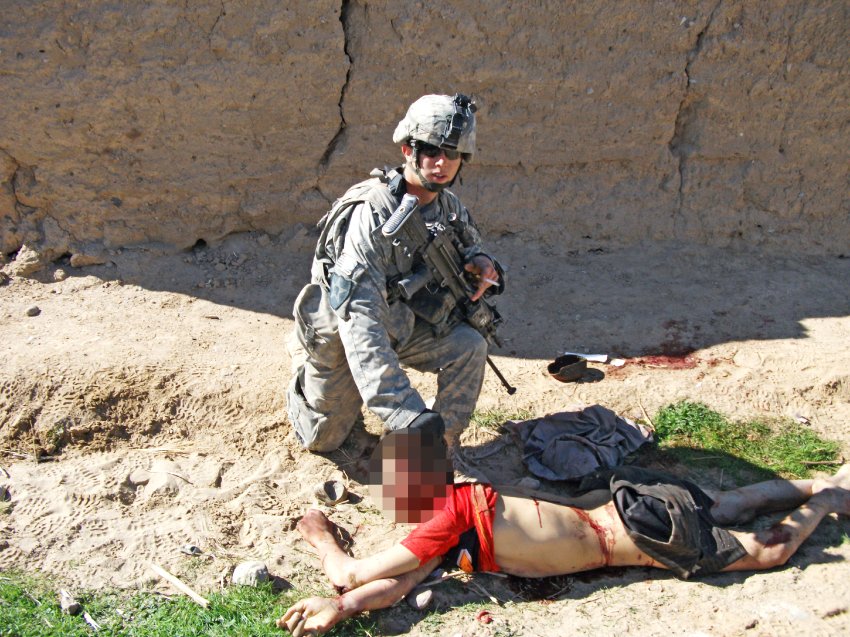
Therefore, what interventionists were — and are — saying is that all those deaths, injuries, and property destruction were worth bringing freedom, democracy, and women’s rights to Afghanistan.

But who died and made these people the arbiters of that type of mathematical life-and-death calculation? After all, those who were killed in the process would never have experienced freedom, democracy, and women’s rights. That’s because they would be dead.

Now, it’s one thing for the citizens of a country to decide for themselves whether to revolt against the tyranny of their own government. Violent revolutions can be very costly in terms of life and property. That’s why people might decide to put up with a lot of tyranny before they revolt. They don’t want to lose their family members, friends, and countrymen by revolting, until the situation gets so bad that they feel that they have no choice but to do so. In the final analysis, the decision to revolt and when to revolt can be highly subjective.

But that’s a far cry from U.S. officials making that decision from afar. Their decision is a cavalier one because they don’t put the same value on Afghan life that the Afghan people do. In fact, interventionists put little or no value on Afghan life. That mindset is reflected by the fact that early in the invasion and occupation, the Pentagon, with the full support of Washington, D.C., officials, made the conscious decision to not even keep track of how many Afghans they were killing. Moreover, there was never an upward limit on the number of Afghan people who could be killed, injured or maimed in the effort to bring freedom, democracy, and women’s rights to the country. It just didn’t matter. Any number of Afghan people killed in the effort would be considered worth it by U.S. interventionists. 

That’s why the purported concern that U.S. interventionists, including many U.S. military veterans, express for the Afghan people rings hollow, given that they were willing to kill or maim any number of Afghans to reach their political goal.

How many Afghan lives were worth the U.S. effort to bring “freedom, democracy, and women’s rights” to Afghanistan? None! It was never morally or religiously justified for the U.S. government to kill even one single Afghan citizen for the sake of a political goal. Killing, injuring, or maiming even just one single Afghan, much less tens of thousands of Afghans, for the sake of “freedom, democracy, and women’s rights” has always been the epitome of evil. 

September 15, 2021 Posted by | Militarism, Progressive Hypocrite, Timeless or most popular, War Crimes | , , | 2 Comments

Israel has concerns about the US withdrawal from Afghanistan

Afghan protesters shout slogans against the US and Israel during a protest in downtown Kabul on December 8, 2017 [WAKIL KOHSAR/AFP via Getty Images]

Afghan protesters shout slogans against the US and Israel during a protest in downtown Kabul on December 8, 2017 [WAKIL KOHSAR/AFP via Getty Images]
Dr Adnan Abu Amer | MEMO | September 14, 2021

Israelis are concerned about the shameful American withdrawal from Afghanistan and think that their government now needs to reassert its ability to protect its own interests in the region and beyond. The general feeling is that the withdrawal will now give Israel’s enemies more freedom to move, especially Iran, which will not hesitate to strengthen its relations with China, which in turn has clear interests in Afghanistan and the Arab Gulf. Events in Afghanistan have rung alarm bells for Israel and its allies in the region.

At the same time, Israelis believe that the US withdrawal from most of its strongholds in the Middle East and Central-South Asia — Iraq first and now Afghanistan, and perhaps Syria later — may push some regional states to move against Israel. The evaluation of America’s role in the Middle East is that US forces can no longer rely on using Arab countries for emergencies. A comprehensive view of the region puts Israel in a better position in terms of US interests, at least according to an uncertain Israeli assessment.

However, the fear remains that what happened in Afghanistan could be mirrored in the occupied West Bank, not least due to the exposure of American weakness. The strategic patience and steadfastness of the Taliban have created an inspiring narrative for the Palestinian Islamic Resistance Movement, Hamas.

In this context, Israelis are asking if events in Afghanistan could be replicated in the Palestinian arena, especially if Israel withdraws from parts of the West Bank in any deal with the Palestinians. Such an exit would almost certainly lead, at least in the short term, to instability, and encourage Hamas to try to expand its influence in the territory.

Although Israel and the occupied Palestinian territories are geographically distant from Afghanistan, the Israeli government claims that it will be required to respond to any development that threatens its security at home and abroad. In this case, it will take into account the current situation in the conflict with the Palestinians, and the de facto reality of a “one-state solution”, with all the negative political and social ramifications that it will have based on successive security warnings.

America’s exit from Afghanistan was embarrassing for Washington, but there were no demonstrations on US streets, either in support of or opposing the withdrawal. Any Israeli withdrawal from even a small part of the occupied West Bank, however, will cause a great stir. A lot of political determination and conviction will be required before such a move could be taken. Indeed, it could be beyond the current government, the survival of which would be threatened.

Israel expects the US withdrawal from Afghanistan to encourage its enemies to attack it. Although the Taliban movement does not pose a direct threat to Israel, it represents a concern for the colonial state, because it shares a border with Iran and the US withdrawal confirms the ongoing reduction of American intervention in the Middle East and beyond. Ideological and political differences aside, Israel knows that successive US presidents have shared a desire to end their involvement in the bloody wars in the Middle East and Central-South Asia. In doing so, believes Israel, America’s ability to challenge Iranian influence may create a domino effect tipping the scales of regional power at the expense of the Zionist state.

Nevertheless, there may be opportunities for Israel to enhance its regional position, because it is not only watching Afghanistan with concern but also, and perhaps more importantly, watching the positions of the Arab regimes that depend on the US for their security, in light of a growing mistrust in its ability to support them. Saudi Arabia and other countries in the region may approach Israel, as a possibly more reliable ally than the US, to fulfil their security needs, even without full normalisation of relations. Security cooperation between Israel and a number of Gulf States is already overt. It is thus likely that such Israeli cooperation with other Arab countries will increase.

Rapprochement and subsequent engagement with Israel may not be limited to “moderate” Arab countries. NATO, for example, could expand its security cooperation with the Zionist state, replacing the US with a willingness to get involved in regional affairs.

All of this is speculation at the moment in the wake of the US withdrawal from Afghanistan. Although not actually part of the Middle East, a Taliban-led Afghanistan is going to play a major role in reshaping the region and how changes might affect Israel.

September 14, 2021 Posted by | Ethnic Cleansing, Racism, Zionism, Wars for Israel | , , , , , | 1 Comment

Door Is Closing on an Iran Nuclear Deal

BY PHILIP GIRALDI • UNZ REVIEW • SEPTEMBER 14, 2021

Critics of the foreign and national security policies of the Joe Biden regime were quick to note that the American soldiers being pulled out of Afghanistan were no doubt a resource that will be committed to a new adventure somewhere else. There was considerable speculation that the new model army, fully vaccinated, glorious in all its gender and racial diversity and purged of extremists in the ranks, might be destined to put down potentially rebellious supremacists in unenlightened parts of the United States. But even given an increasingly totalitarian White House, that civil war type option must have seemed a bridge too far for an administration plagued by plummeting approval ratings, so the old hands in Washington apparently turned to what has always been a winner: pick a suitable foreign enemy and stick it to him.

It is of course generally known that when Joe Biden was running for president, he committed himself to making an attempt to reenter the Joint Comprehensive Plan of Action (JCPOA) of 2015 which placed limits on the Iranian nuclear program and also established an intrusive inspection routine. In turn, the Iranians were to receive relief from sanctions related to the program. In 2018 President Donald Trump withdrew the United States from the agreement based on the false argument that Iran was cheating on the arrangement and was secretly engaged in developing a weapon. Trump’s neocon supporters on the issue also argued without any evidence that Iran was intending to use the agreement as cover for its efforts to accumulate enriched uranium, guaranteeing that they would be able develop a weapon quickly when the inspection regime expires in 2025.

The Trump move was, of course, backed by the Israel Lobby and it was widely seen as deferring to Israeli interests at a time when the agreement was actually good for the United States as it blocked an unfriendly country’s possible nuclear proliferation. Unfortunately, a US government’s bowing to Israel is not exactly unusual and the withdrawal was subject to only limited criticism in the mainstream media.

Joe Biden, who has described himself as a Zionist, is no less prone to pandering to Israel than is Trump. When he raised the issue of JCPOA during his campaign in a bid to appeal to his party’s progressives, he also caveated the move by indicating that the agreement would have to be updated and improved. The talks in Vienna, which Iran and the US are indirectly engaged in, have been stalled for several months due to Iranian elections and over Washington’s insistence that Iran include in the agreement restrictions on the country’s ballistic missile program while also ceasing its alleged interference in the political turmoil in the region. The interference charge relates to Iranian support of the completely legitimate Syrian and Lebanese governments as well as of the Houthi rebels in Yemen who have been on the receiving end of Saudi Arabian aggression supported by Washington.

As Iran insists that any return to status quo ante be based on the existing agreement without any additions, to include relief from sanctions which Washington has rebuffed, it has been clear from the beginning that there is nowhere to go. Recently it has been argued in neocon and media circles (essentially the same thing) that the new conservative president of Iran Ebrahim Raisi means that no arrangement with Iran can be trusted and they point to International Atomic Energy Agency (IAEA) reports that suggest that Iran has started to enrich admittedly small amounts of uranium. To add to the confusion, there have been some reports suggesting that Israel deliberately targeted and destroyed IAEA monitoring equipment in a June raid to make clear assessments of nuclear developments more difficult to obtain.

To finish the charade, which was not expected to result in anything, Secretary of State Tony Blinken, traveling Germany to mend fences over the Afghanistan debacle, has now warned that the US is getting “closer” to giving up on renegotiating the Iran nuclear deal. Blinken declared to reporters that “I’m not going to put a date on it but we are getting closer to the point at which a strict return to compliance with the JCPOA does not reproduce the benefits that that agreement achieved.”

When Blinken refers to benefits he is now of course meaning the full package of demands being made by Washington, which, as noted above, go far beyond the original intention of the agreement. As Iran has repeatedly insisted that it is only willing to discuss the original formulation which would provide for them some sanctions relief, something that Blinken certainly knows, he evades the issue of Washington being the spoiler in the Vienna talks.

Now that Afghanistan has fallen with considerable blowback to the fortunes of the Biden Administration, the situation with Iran becomes potentially more important, even while recognizing that Iran does not threaten the United States or its actual interests in any way. Biden-Blinken are clearly interested in sustaining a purported vital interest in the Middle East so troop levels throughout the region can be maintained. There is a commitment with Baghdad to remove all US “combat troops,” however that will be defined, by year’s end, but there are also American soldiers in Syria fighting a war and large military bases in Kuwait, Doha, and Bahrain. The US also maintains a skeleton presence of air force personnel in Israel as well as large arms supply depots.

To justify all that an enemy is essential and Iran fits the bill. And it should surprise no one that steps are now being taken to confront the evil Persians in their home waters. The United States Navy’s Bahrain-based 5th Fleet announced last week that it will create a special new task force that will incorporate airborne, sailing and underwater drones to confront Iran. In the announcement the spokesmen revealed that in coming months drone capabilities would be expanded to cover a number of chokepoints critical to the movement both of global energy supplies and worldwide shipping, to include the crucial Strait of Hormuz, through which 20% of all oil passes. It also will presumably include the Red Sea approaches to the Suez Canal as well as the Bab el-Mandeb Strait off Yemen.

The systems being deployed by what has been dubbed the 5th Fleet Task Force 59 will include some recently developed innovative technologies, to include underwater, long range, and special surveillance drones. Armed drones will use the same platforms and some of the drones will be small enough to be fired from submarines, which will confuse points of origin and permit plausible denial by Washington if they should be used to deter or intimidate the Iranians.

So, the fall of Afghanistan might be seen as welcome after all these years of mayhem, but it may have opened the door to heightened tension in the nearby Persian Gulf. Washington-Biden-Blinken are intent on proving to the world that in spite of Afghanistan the United States is nobody’s patsy. Unfortunately, putting the screws to Iran yet again is no solution to Washington’s inability to perceive its proper role in the world. The lesson that might have been learned in Afghanistan and also Iraq apparently has already been forgotten.

Philip M. Giraldi, Ph.D., is Executive Director of the Council for the National Interest, a 501(c)3 tax deductible educational foundation (Federal ID Number #52-1739023) that seeks a more interests-based U.S. foreign policy in the Middle East. Website is https://councilforthenationalinterest.org address is P.O. Box 2157, Purcellville VA 20134 and its email is inform@cnionline.org

September 14, 2021 Posted by | Ethnic Cleansing, Racism, Zionism, Wars for Israel | , , , , | 2 Comments

False Flags: The Secret History of Al Qaeda

Corbett • 09/11/2021

We all know the story of bin Laden and Al Qaeda, the story that was repeated ad nauseam in the days, weeks and months after the catastrophic, catalyzing events of 9/11. So often was that story repeated that the hypnotized public forgot that it was, at base, just that: a story. . . .

Watch on Archive / BitChute / Minds / Odysee or Download the mp4 video / mp3 audio

TRANSCRIPT

“Does the Brotherhood exist?”

“That, Winston, you will never know.”

Nineteen Eighty-Four

INTRODUCTION

Kandahar Provice, Afghanistan. May 1998.

John Miller, an ABC News correspondent who would go on to become the FBI’s chief spokesman, ends an 11-day journey through the wilds of the Afghanistan-Pakistan border. The first thing he notices is the rumbling of the generators providing the camp with power and the smell of gasoline. The second thing he notices is a hail of bullets. Bin Laden’s convoy is arriving.

Osama bin Laden is flanked by seven bodyguards, who—as Miller immediately recognizes—are simply there to put on a show. “Their eyes darted in every direction for any attacker,” he later recounted. “This was either merely theatrical or entirely pointless, because with hundreds of rounds being fired into the air, it would have been impossible to pinpoint an assassin.”

Following the security detail into the hut, there Miller became one of the handful of western journalists to interview the elusive Osama bin Laden.

OSAMA BIN LADEN (VIA INTERPRETER): We believe that the biggest thieves in the world are Americans and the biggest terrorists on earth are the Americans. The only way for us to fend off these assaults is by using similar means. We do not differentiate between those dressed in military uniforms and civilians; they’re all targets in this fatwa.

SOURCE: Osama bin Laden: “The Most Dangerous Man You’ve Never Heard Of” – June 10, 1998 – ABC News Nightline

Miller has traveled halfway around the world to interview bin Laden, the reclusive terrorist leader who has just issued a religious fatwa requiring Muslims to kill Americans. But this interview, too, is just for show. Forced to submit his questions in writing ahead of time, Miller is informed that the answers will not be translated for him. There will be no follow-up questions.

It is spectacle. Theater and little else. As such, it is a fitting introduction to the man who would become the bogeyman of the 21st century. The interview was followed in short order by a more explosive drama.

PETER BERGEN: What are your future plans?

OSAMA BIN LADEN: You’ll see them and hear about them in the media . . . God willing.

SOURCE: Exclusive Osama bin Laden – First Ever TV Interview

PART ONE: ORIGIN STORY

Osama bin Laden got his wish. Around the world, a frightened and confused public received their introduction to the age of terror on the morning of September 11, 2001, through the media. It was there, in the flickering images of their TV screens, that the masses began to learn about the world of Islamic terrorism and of the cave-dwelling Saudi exile in Afghanistan who was bringing that terror to their doorstep.

ANCHOR: Tell us a bit about Osama bin Laden, what sort of resources in manpower and money he’s got and what he’s trying to achieve.

SOURCE: September 11, 2001 – 5:28pm EDT (10:28pm BST)

RAY SUAREZ: What is Osama bin laden? Is he a politician? Is he a warrior? Is he a preacher? A little of all?

SCHEUER: A little of all i think, sir. He’s a—

SOURCE: Who Speaks For Islam?

HODA KOTB: —millionaire Saudi businessman believed to be living in exile in Afghanistan.

SOURCE: September 11, 2001 – 5:20-5:30pm EDT on WRC

REPORTER: He controls and finances Al Qaeda, an umbrella network of Islamic militants.

SOURCE: September 11, 2001 – 6:30-6:40pm EDT (11:30-11:40pm BST) on BBC

SCHEUER: . . . he is a a very soft-spoken man . . .

SOURCE: Who Speaks For Islam?

SIMON REEVE: A man who is prepared to use overwhelming force in pursuit of his objectives.

SOURCE: September 13, 2001 – 6:21am EDT on CNN

ANCHOR: He is the face that has been put on this by almost everyone.

SOURCE: September 15, 2001 – 8:20-8:30am EDT on WTTG

SCHEUER: . . . a man of of eloquence . . .

SOURCE: Who Speaks For Islam?

KOTB: He has declared all US citizens legitimate targets of attack

SOURCE: September 11, 2001 – 5:25pm EDT on WRC

JOHN SIMPSON: When I was in Afghanistan just a couple of days ago, I heard that he had—

SOURCE: September 11, 2001 – 5:20-5:30pm EDT (10:20-10:30pm BST) on BBC

DAN RATHER: —operations in at least 55 countries—

SOURCE: CBS Evening News – 2001-09-13

KOTB: Including last year’s bombing of the USS Cole in Yemen—

SOURCE: September 11, 2001 – 5:25pm EDT on WRC

REPORTER: —the mastermind behind the bombings of two US embassies in Africa—

SOURCE: September 16, 2001 – 11:30-11:40pm EDT on CNN

REPORTER: —and the last attack on the World Trade Center eight years ago.

SOURCE: September 11, 2001 – 6:20-6:30pm EDT (11:20-11:30pm BST) on BBC

SCHEUER: Bernard Lewis has called him almost a poetic speaker of Arabic.

SOURCE: Who Speaks For Islam?

KATIE COURIC: Meanwhile, Osama bin Laden is a name that we have been hearing all day long as an individual who may—and we emphasize may—be responsible for these terrorist acts.

SOURCE: NBC News 9-11-2001 Live Coverage 1:00 P.M E.D.T – 6:30 P.M E.D.T

We all know the story of bin Laden and Al Qaeda, the story that was repeated ad nauseam in the days, weeks and months after the catastrophic, catalyzing events of 9/11. So often was that story repeated that the hypnotized public forgot that it was, at base, just that: a story.

In the ahistorical fable of tv soundbites, terrorism is a modern invention—created out of whole cloth by Osama bin Laden and Al Qaeda. And, at the same time, Islamic fundamentalism is a force of nature, something that has always existed in the Middle East—the product, perhaps, of some sandstorm on the Arabian peninsula in the distant past.

But this is a lie. In truth, the rise of Islamic fundamentalism in the modern era and the rise of terrorism as a political tool cannot be understood without confronting some very well-documented but long-repressed history.

Ever since the mid-18th century—when the British East India Company gained dominion over the Indian subcontinent—the history of Islam as a political and cultural force has been intimately tied to the fortunes of Empire and the aims of the Western powers. The British Empire in particular did much to shape the map of the modern day Middle East and to influence the course of its religious and political forces.

This influence can be seen throughout the 18th and 19th centuries.

Britain’s gradual takeover of the Indian subcontinent led to the British Empire becoming, in the estimation of Winston Churchill, “[T]he greatest Mohammedan power in the world.”

The 19th century “Great Game” between Victorian England and Tsarist Russia for control of Central Asia saw the British propping up unpopular Islamic rulers throughout the region as a buffer between Russia and the “crown jewel” of the British Empire, India.

Britain’s desire to maintain its access to India led to the British conquest of Egypt in 1882, resulting in 40 years of British rule and a military presence in the country that was not removed until the Suez Crisis of 1956.

From Khartoum to Constantinople, Jerusalem to Jakarta, no part of the Muslim world could escape the influence of the British crown. Sometimes that influence was used to strengthen the rule of Islamic hardliners. Sometimes, as with the Mahdist rebellion in Sudan, that influence was used to put down Islamic uprisings. But in each case, the British Empire’s goal was clear: to use whatever means at its disposal to undermine movements and governments unfavourable to its rule, and to install and encourage those forces that were willing to cooperate with the crown.

This was evident in India, where George Francis Hamilton, secretary of state for India, wrote in 1886 of the British strategy of using Muslim and Hindu divisions in the country to their advantage along the lines of the old Roman imperial strategy of divide and rule:

I think the real danger to our rule, not now, but say 50 years hence is the gradual adoption and extension of Western ideas of agitation organisation and if we could break educated Indians into two sections holding widely different views, we should, by such a division, strengthen our position against the subtle and continuous attack which the spread of education must make upon our system of government. We should so plan educational text-books that the differences between community and community are further strengthened.

But perhaps no clearer example of the British Empire’s role in shaping the modern Muslim world can be found than the story of the ascendance of the House of Saud and the formation of the modern-day Kingdom of Saudi Arabia. Once again, British fingerprints can be found on every aspect of the story.

When Britain began contemplating a shift from its centuries-long policy of supporting the Ottoman Empire in the Middle East, it was Captain William Shakespear—a British civil servant and explorer—who made the first official contact with Ibn Saud, the progenitor of the Saudi dynasty who would go on to found the Kingdom of Saudi Arabia. In addition to taking the first photographs of the future Saudi king, Shakespear became Ibn Saud’s friend and military advisor, helping to steer the rising Arab leader away from alliance with the Ottomans and into a treaty with the British. Shakespear died on the battlefield at Jarab in 1915, where the British-backed Ibn Saud was battling his Turkish-backed rival, Ibn Rashid.

After Shakespear’s death, another British agent, Colonel Thomas Edward Lawrence, gained international fame as “Lawrence of Arabia” for his role in the Arab Revolt against Ottoman rule in the Middle East. Although his own self-serving autobiography and the Hollywoodization of his story cemented in the popular imagination the idea that Lawrence was motivated solely by his concern for the Arabs and their independence . . .

PETER O’TOOLE (AS T. E. LAWRENCE): We do not work this thing for Faisal.

ANTHONY QUINN (AS AUDA ABU TAYI): No? For the English then?

LAWRENCE: For the Arabs.

TAYI: The Arabs?

SOURCE: LAWRENCE OF ARABIA

. . .the documented history of Lawrence’s actions and motivations tells a very different story. A memo on “The Politics of Mecca” penned by Lawrence for his intelligence handlers in 1916, reveals a more duplicitous British calculus for supporting certain factions of the Arab Revolt:

The Arabs are even less stable than the Turks. If properly handled they would remain in a state of political mosaic, a tissue of small jealous principalities, incapable of cohesion, and yet always ready to combine against an outside force. The alternative to this seems to be control and colonization by a European power other than ourselves, which would inevitably come into conflict with the interests we already possess in the Near East.

Later, in a report on the “Reconstruction of Arabia” Lawrence penned for the British Cabinet at the end of the war, he was even more explicit about the cynical divide-and-rule tactics at play in British support for the Arab Revolt: “When war broke out an urgent need to divide Islam was added, and we became reconciled to seek for allies rather than subjects. [. . .] We hoped by the creation of a ring of client states, themselves insisting on our patronage, to turn the present and future flank of any foreign power with designs on the three rivers.”

ALEC GUINNESS (AS PRINCE FAISAL): Lawrence! . . . Or is it Major Lawrence?

LAWRENCE: Sir!

FAISAL: Ah. Well, General, I will leave you. Major Lawrence doubtless has reports to make. About my people; and their weakness. And the need to keep them weak. In the British interest.

SOURCE: LAWRENCE OF ARABIA

Lawrence and the military and diplomatic personnel of the British empire were indeed busy in the wake of WWI. In many ways, the aftermath of the war represented the zenith of that empire, and the culmination of centuries of British manipulation in the Middle East. Driven by a mixture of political necessity and imperial hubris, the imperial planners had entered into secret agreements that redrew the map of the Middle East and once again affirmed the centuries-old accusation that Perfidious Albion was not to be trusted.

In 1916, the British and French entered into a pact to divide up the territory of the Ottoman empire between themselves should they win the war. This treaty—known as the Sykes-Picot Agreement after the diplomats who negotiated the document—was a direct negation of the web of promises that the British had already made on the land, including the territorial promises they had made to Ali Ibn Husain, the Sherif of Mecca who led the Arab Revolt against the Turks, the Treaty of Darin that had promised Ibn Saud British protection for his conquests in the Arabian peninsula in return for his support in the war, and the Balfour Declaration promising the Zionists a Jewish homeland in Palestine.

Although the revelation of the secret Sykes-Picot Agreement by the Bolsheviks in 1917 proved a considerable embarrassment for the British and French, it did little to hinder their plans. The agreement provided a basis for the ultimate partitioning of the Ottoman empire after the war and the national borders that it helped to create have gone on to shape a century of strife and political conflict in the region.

But it was not enough merely to draw the lines on the maps that would define the post-war Middle East; the British had to shape the development of the region in its own interest, creating entire nations in the process. In the Arabian peninsula, they came to pin their hopes on Ibn Saud, whose sole focus on the conquest of Arabia, they calculated, would counteract the rise of a broader pan-Islamic movement that could challenge Britain’s supremacy in the region. As historian Mark Curtis writes in his book, Secret Affairs: Britain’s Collusion with Radical Islam:

[T]he British government of India had feared British sponsorship of an Arab caliph who would lead the entire Muslim world, and the effects this might have on Muslims in India, and had therefore favoured Ibn Saud, whose pretensions were limited to Arabia.

The subsidy from the British upon which Ibn Saud relied in his quest to unite the peninsula, which stood at £5,000 a month at the end of the war, was raised to £100,000 a year in 1922 by then-Colonial Secretary Winston Churchill. Churchill recognized that Saud’s fighters—the “Ikhwan,” or brotherhood of hardliners and adherents to the strict Wahabbi sect of Islam—were “austere, intolerant, well-armed and bloodthirsty” and “hold it as an article of duty, as well as of faith, to kill all who do not share their opinions and to make slaves of their wives and children.” So why, then, did the British support Saud and his men? “My admiration for him [Ibn Saud] was deep,” Churchill later confessed, “because of his unfailing loyalty to us.”

That loyalty paid off well. The British were the first to formally recognize Ibn Saud’s sovereignty over his newly-conquered territory on the peninsula, and in return Ibn Saud signed a treaty agreeing to stop his forces from attacking Britain’s neighbouring protectorates. In 1932, Ibn Saud became King Saud of the newly-formed “Kingdom of Saudi Arabia.” But even the nation’s new name was British. It was George Rendel, head of the British Foreign Office’s Eastern Department, who suggested it.

The British played similar games throughout the region; arming, funding and encouraging those who would work with them—including violent Islamic radicals—and undermining any potential challengers to British dominance.

In Palestine, the British pardoned Amin al-Husseini—who had been sentenced to 10 years in prison for his involvement in the 1920 Jerusalem riots—and appointed him the Grand Mufti of Palestine (a title invented by the British) on condition that he cooperate with the British authorities.

In Egypt, which became a British protectorate after WWI, the rise of the Muslim Brotherhood—an Islamist mass movement founded by Hassan al-Banna—was at times an explicit threat to the British military presence in the country. Nevertheless, its position as an alternative to both secular nationalism and communism—which Britain regarded as growing threats to its influence in the region—meant that the British were prepared to work with the Brotherhood against their common enemies, even covertly financing the group in 1942.

In Iraq, the British, concerned at unrest in their Mesopotamian mandate, aided Prince Faisal in becoming Faisal I, King of Iraq. Faisal—recommended by T. E. Lawrence, guided (at his own request) by British advisors and traveling at British expense—won a British-backed plebiscite to become the Iraqi king in 1921.

The extent of British influence over the region during the post-war period was, in retrospect, staggering. But the number of machinations, manipulations and shifting alliances that were required to keep this system of mandates, protectorates and puppet governments going was a sign that the British were not all-powerful. On the contrary. Their influence, and indeed their empire itself, was waning, soon to be replaced by the new rising world superpower, the United States.

The US did not even wait till the end of the Second World War and the dawn of Pax Americana to begin its own “diplomacy” with the Muslims in the region.

NEWSREADER: An American destroyer comes alongside a cruiser at Great Bitter Lake on the Suez Canal in Egypt. It brings Ibn Saud, king of the five million people of Saudi Arabia, to a conference with President Roosevelt, stopping off here on his return from the Crimea conference. The destroyer has been decked out with red carpets for the monarch. This 800-mile trip marks the first time that King Ibn Saud has ever left his native land.

SOURCE: Roosevelt Meets Saud

President Franklin Roosevelt’s meeting with King Ibn Saud aboard the USS Quincy on Egypt’s Great Bitter Lake in February 1945 was no ordinary exchange of diplomatic pleasantries. King Saud’s first foreign trip involved a number of unusual requests and special arrangements. The Saudis insisted on bringing a contingent of 48 men even though the Americans had said they could accommodate only 10. They insisted on sleeping in tents pitched on the ship’s deck rather than in the cabins provided. They insisted on bringing their own sheep, as the king believed that good Muslims eat only freshly slaughtered animals.

But, irregularities aside, the meeting was momentous.

Firstly, it demonstrated the importance of the Saudi-US relationship at a time when much of the world knew little and cared less about the happenings on the Arabian peninsula.

Secondly, it established the terms of that relationship: namely, a US guarantee of military defense of Saudi Arabia (including Roosevelt’s promise to “do nothing to assist the Jews against the Arabs”) in return for Saudi concessions, including allowance for US airfields and flyover routes across the kingdom and access to Dharhan, where the California Arabian Standard Oil Corporation (which later became ARAMCO) had drilled the first commercially viable oil well in the country just seven years earlier.

And thirdly, it signaled the dawn of a new era. No longer was the British Empire the primary foreign power driving events in the region. From now on, one of the key foreign policy considerations of the Muslim world was the US and its enormous military and financial resources.

This changeover in world order was not instantaneous. For some time after the end of WWII, the US and British collaborated on operations that furthered their mutual interests in the region. These “interests” included opposing the rising threat of secular nationalist governments that—unlike the House of Saud and other Western-backed monarchies in the Middle East—were less pliable to bribes and more interested in nationalizing their countries’ resources.

In March 1951, the Iranian parliament voted to nationalize the Anglo-Iranian Oil Company—the British oil giant that struck oil near the Persian Gulf in 1908—and offered the premiership of the government to Mohammed Mossadegh, an outspoken secular nationalist. Immediately after taking office, Mossadegh effected the nationalization, stating:

Our long years of negotiations with foreign countries [. . .] have yielded no results this far. With the oil revenues we could meet our entire budget and combat poverty, disease, and backwardness among our people. Another important consideration is that by the elimination of the power of the British company, we would also eliminate corruption and intrigue, by means of which the internal affairs of our country have been influenced. Once this tutelage has ceased, Iran will have achieved its economic and political independence.

The nationalization put Tehran on a collision course with London. But Britain knew that a military intervention was not possible without American approval and, despite harsh economic sanctions on the country and a boycott of the newly nationalized oil industry that was joined by much of the Western world, they could not overthrow the Iranian government themselves. Instead, they had to turn to the US.

Although the Truman administration was initially hesitant to become involved, that changed with the election of Dwight D. Eisenhower and the installation of the Dulles brothers, Allen and John Foster, as Director of Central Intelligence and Secretary of State respectively. By June of 1953, the CIA was already adapting the British coup proposal into their own covert operation, dubbed Operation TPAJAX.

An open secret in the world of intelligence, the CIA/MI6 role in the overthrow of Mossadegh was officially denied by the US government for over half a century and is still unacknowledged by the British government to this day. Nevertheless, the CIA’s own internal history of the operation, first revealed to the public in the year 2000, confirms the extent of the American and British role in the coup. They convinced the Shah of Iran to agree to the plan. They hand-picked General Fazlollah Zahedi as Mossadegh’s successor. They rolled out a propaganda campaign to portray Mossadegh—a devout adherent to democratic nationalism who rigorously excluded the nation’s communist party from his government—as a communist sympathizer who would steer Iran into the arms of the Soviets; they spent hundreds of thousands of dollars bribing journalists, clerics, and even Iranian parliament members themselves to go along with the plot; and they used a network of agents and suitcases full of money to incite riots and protests across the country.

In the end, the operation was a success. Mossadegh was driven from power, General Zahedi took his place, the Western-backed Shah ruled the country with the iron fist of his feared secret police for the next 25 years, and a new agreement on sales of Iranian oil was reached. This time, though, the Anglo-Iranian Oil Company, now rebranded as British Petroleum, would not have a monopoly on the country’s lucrative oil reserves; an international consortium was put together to share in the profits, with American companies Chevron and Standard Oil cut into the deal.

But the eclipse of the old British Empire by the new American superpower became most obvious in Egypt during the Suez Crisis of 1956.

Lying on the key spice and trade routes linking Europe and Asia, the importance of Egypt to the British Empire went back centuries. It was the British Navy under Nelson and the British Army under General Ralph Abercromby that drove Napoleon out of the country during the French campaign there at the turn of the 19th century. But it was the opening of the Suez Canal in 1869 that cemented Egypt’s geopolitical importance for the British Empire.

The Suez Canal—linking the Mediterranean Sea to the Red Sea and drastically reducing sailing distances from Asia to Europe—was technically the property of the Egyptians, but the project had been spearheaded by the French and the concessionary company that operated the canal had been largely financed by French shareholders. An economic crisis in 1875, however, forced the Egyptian governor to sell his own shares to the British. As parliament was not in session at the time of the sale, British Prime Minister Benjamin Disraeli had to turn to his close personal friend, Lionel de Rothschild, for the £4,000,000 required to purchase the shares. After the British conquest of Egypt in 1882, an international agreement was signed declaring the Canal a neutral zone under the protection of the British, whose troops were now installed in the country.

This precarious balance of power lasted in various permutations for over 70 years, first under Britain’s so-called “Veiled Protectorate” of Egypt in the decades leading up to WWI, then in a formal British occupation of the country during WWI and its aftermath, and then under Britain’s unilateral declaration of Egyptian independence in 1922, which stipulated that the British would retain power over Egypt’s defence and foreign policy. Britain’s de facto control over the country was one of the grievances that gave rise to the Free Officers Movement, a cadre of Egyptian nationalists in the ranks of the Egyptian Armed Forces who toppled King Farouk and took over the government in the Egyptian revolution of 1952.

One of the movement’s leaders, Gamal Abdel Nasser Hussein, became President of Egypt in 1954 and began to implement a series of nationalist, anti-imperialist measures that, like Mossadegh, put him at odds with the British forces in his country. These measures culminated with Nasser’s nationalization of the Suez Canal on July 26, 1956.

The Suez Crisis led to a joint British-French-Israeli invasion of the country, but in this case, the US under Eisenhower declined to back the invasion. Instead, Eisenhower—still believing that diplomacy and pressure could turn Nasser from the Soviet orbit and help America leverage its influence over the Arab world—joined the USSR in forcing an end to the invasion.

The crisis marked a definitive turning point. The age of the British Empire were over. The age of the American superpower had begun. From now on, American military and financial power would be the determining factor in the Muslim world, and indeed the world in general.

But the Americans had learned well from their British predecessors. The same tactics of strategic and shifting alliances, double dealings and covert operations that the British had used to maintain their influence for centuries would now be employed by the Americans to leverage their own power.

They applied these lessons in Iran, where they supported the Shah’s brutal dictatorship even as they maintained a secret communication channel with exiled religious leader Ayatollah Khomeini.

They applied these lessons in Indonesia, where the US at various times supported the Islamic factions in their rebellion against the Sukarno government, the Sukarno government itself, and, eventually, Suharto, who slaughtered over half a million people on his US-backed rise to power.

They applied these lessons in the Sinai Peninsula, where, as declassified documents now show, US Secretary of State Henry Kissinger helped engineer the Yom Kippur War so that “the Arabs would conclude the only way to peace was through us” and the Israelis would conclude that “they had to depend on us to win and couldn’t win if we were too recalcitrant.”

And they applied these lessons in Saudi Arabia, where Treasury Secretary William Simon helped enshrine the US dollar’s central role in global geopolitics and saved the US from the 1973 oil crisis by negotiating the petrodollar system, a covert deal with the House of Saud to purchase Saudi oil and sell them weapons and equipment in return for a Saudi pledge to finance American debt by investing their oil revenue in US Treasuries.

This era of American-led intrigue and double dealing would culminate in one of the most important years for the Muslim world in the modern era: 1979.

That was the year of the Iranian revolution, when the American and British overthrow of Mossadegh in 1953 would come home to roost in the overthrow of the Western-backed Shah and the first major victory for the forces of political Islam in the creation of the Islamic Republic of Iran.

That was the year of the seizure of the Grand Mosque in Mecca, when Islamic hardliners shocked the Muslim world by storming the holiest mosque in Islam and, during a dramatic two-week stand off, calling for the overthrow of the House of Saud and the end of its attempts at Westernization.

That was the year Egyptian President Anwar Sadat signed a peace treaty with Israel, normalizing relations between the two countries and leading to Sadat’s assassination by members of Egyptian Islamic Jihad just two years later.

And that was also the year that developments in Afghanistan put in motion a chain of events that would lead to the creation of the group we now know as “Al Qaeda.”

On Christmas Eve, 1979, Soviet troops began an invasion of Afghanistan. Initially, this was portrayed to the American people as a spontaneous act of aggression, the opening salvo in a new campaign by the Russians to conquer the region and upset the world order.

JIMMY CARTER: Fifty thousand heavily armed Soviet troops have crossed the border and are now dispersed throughout Afghanistan, attempting to conquer the fiercely independent Muslim people of that country.

[. . .]

If the Soviets are encouraged in this invasion by eventual success, and if they maintain their dominance over Afghanistan and then extend their control to adjacent countries, the stable, strategic, and peaceful balance of the entire world will be changed.

SOURCE: January 4, 1980: Speech on Afghanistan

But this was a lie. As historians with access to USSR document archives now know, the Soviet leadership was extremely reluctant to become entangled in Afghanistan. Well aware of the country’s reputation as a “graveyard of empires,” Soviet politicians and military leaders knew that any attempt to bring Afghanistan under military and political control would be extremely difficult.

Instead, the invasion was the end result of a series of events that threatened to plunge Afghanistan and the surrounding region into chaos.

Starting in the wake of WWII, the urban, cosmopolitan political elite of the rural and agrarian nation of Afghanistan began a series of reforms and development projects that, they hoped, would bring their country into the modern era. Seeking assistance in this task, these leaders turned to the USSR, who, in addition to providing $100 million in low-interest credit to finance the projects, also welcomed members of the country’s political and military elite for training at Soviet institutions. In turn, these young Afghan elites brought communism back to their country.

The Afhgan communists supported a bloodless coup in Kabul in 1973, overthrowing the king and instituting a one-party state whose government included representation by the People’s Democratic Party of Afghanistan (PDPA), a pro-Soviet, Marxist-Leninist party that boasted ties to the Afghan National Army. But the PDPA, frustrated by a perceived lack of progress toward communist goals on the part of this new government, precipitated another coup in 1978. This new communist government, led by Nur Muhammed Taraki, presided over a period of dramatic reform: Land reforms sought to limit how much land a family could own; social reforms abolished Shariah Law, began education of women and sought to end forced marriage and other traditional practices; and political dissidents were rounded up and resistant villagers massacred.

Violently opposed both by the Islamic fundamentalists and conservatives in the country as well as opposing factions within his own party, Taraki was overthrown in September of 1979 and killed the following month. Taraki’s sucessor and one-time protege, Hafizullah Amin, led an even shorter and more turbulent government. Taking over the presidency in September, Amin—who, the Russians feared, was seeking to improve Afghanistan’s relations with the United States—was deposed when Soviet forces entered the country and assassinated him on December 27th, 1979.

The official history—written by the CIA, echoed by the US State Department and propounded in Hollywood productions—maintains that the US response to the events in Afghanistan—a response that would go on to include billions of dollars in arms, funds and training for the Islamic resistance to the Soviet forces—began after the Soviet invasion in 1979.

TERRY BOZEMAN (AS “CIA AWARD PRESENTER”): The defeat and breakup of the Soviet empire, culminating in the crumbling of the Berlin Wall, is one of the great events of world history. There were many heroes in this battle, but to Charlie Wilson must go this special recognition.

Just 13 years ago, the Soviet Army appeared to be invincible. But Charlie, undeterred, engineered a lethal body blow that weakened the Communist empire. Without Charlie, history would be hugely and sadly different.

And so, for the first time, a civilian is being given our highest recognition, that of Honored Colleague. Ladies and gentlemen of the Clandestine Services, Congressman Charles Wilson.

SOURCE: Charlie Wilson’s War

But this, too, is a lie. In reality, the covert operation to aid the mujahideen “freedom fighters” did not begin after the Soviets invaded, and it was not the work of Charlie Wilson.

As former CIA director Robert Gates revealed in his 1996 autobiography, assistance to the Afghan mujahideen did not start after the Soviet invasion, but six months before, in July, 1979, with President Jimmy Carter signing off on a covert operation to assist and fund the resistance forces in Afghanistan. This was done in the full knowledge that these forces might antagonize and draw the Soviets into the country, which is precisely what a certain faction of the Carter White House—known as “the bleeders” for their propensity to “bleed” the Soviet Union through an engaged guerrilla conflict like the US had experienced in Vietnam—wanted to achieve.

This was confirmed two years later by Zbigniew Brzezinski, Carter’s National Security Advisor, in a 1998 interview.

According to the official version of history, CIA aid to the mujahideen began during 1980, that is to say, after the Soviet army invaded Afghanistan on December 24, 1979. But the reality, closely guarded until now, is completely otherwise: Indeed, it was July 3, 1979 that President Carter signed the first directive for secret aid to the opponents of the pro-Soviet regime in Kabul. And that very day, I wrote a note to the president in which I explained to him that in my opinion this aid was going to induce a Soviet military intervention.

The program that Carter signed off on—dubbed Operation Cyclone and billed as “the largest covert operation in history“—continued and expanded throughout the 1980s, leading to the rise of the Taliban and the encouragement of what Brzezinski called in that same interview “some agitated Muslims.”

KENNETH BRANNAGH: US National Security Advisor Brzezinski flew to Pakistan and set about rallying the resistance. He wanted to arm the mujahideen without revealing America’s role. On the Afghan border near the Khyber Pass, he urged the “Soldiers of God” to redouble their efforts.

ZBIGNIEW BRZEZINSKI (in Pakistan): We know of their deep belief in God and we are confident that their struggle will succeed. That land over there is yours, you’ll go back to it one day because your fight will prevail. You’ll have your homes and your mosques back again because your cause is right and God is on your side.

BRZEZINSKI (interview): The purpose of coordinating with the Pakistanis would be to make the Soviets bleed for as much and as long as is possible.

SOURCE: Soldiers of God (Episode 20)

News of the struggle began to spread throughout the Arab world and soon the stories of the brave mujahideen fighting the communist infidels became a rallying cry for jihad. The Afghan resistance had made Peshawar, just over the border in Pakistan, their headquarters,  and it was there that visitors from around the Muslim world heard first-hand the tales from the battles against the Soviets and saw for themselves the squalor of the refugees who had been forced from their homes by the Russian invaders.

One such visitor was Abdullah Azzam, a passionate young Palestinian whose militant activism had cost him his job as a lecturer at King Abdulaziz University in Jeddah and had prompted him to take a position in Islamabad so he could be closer to the Afghan jihad. But this was still not close enough, and he resigned his position to dedicate himself full time to the Afghan cause. He spent time in the refugee camps and mujahideen base at Peshawar, issued a fatwa arguing that Muslims had a duty to wage jihad in Afhganistan, and made frequent trips to Jeddah, where he recruited young Muslims for the cause. While in Jeddah, he stayed at the guest flat of a rich young Saudi named Osama bin Laden.

Osama bin Laden was the 17th of 54 children of Mohammed bin Awad bin Laden, an itinerant laborer from Yemen who had worked his way up in the Saudi construction industry to become one of the wealthiest non-royals in the Saudi kingdom. Mohammed bin Laden’s business— today known as the Binladin Group Global Holding Company and comprising a sprawling, multibillion dollar multinational conglomerate involved in some of the largest construction projects in the world—started from humble beginnings.

After arriving in Jeddah from his native Yemen in 1930, Mohammed bin Laden took a job as a dockworker, then as a bricklayer for Aramco during the country’s first oil boom. When Aramco sought to subcontract some of the construction work it had undertaken for the Saudi government, bin Laden used the opportunity to grow his own construction firm. His exacting building standards, combined with his energy, his honesty and his willingness to work shoulder-to-shoulder with his men earned Mohammed bin Laden a reputation as a craftsman and a teacher and brought him to the attention of King Ibn Saud’s finance minister.

The aging King Saud, by now largely confined to a wheelchair, gave bin Laden the chance to renovate his palace in Jeddah so that his car could be driven by ramp directly to his second-floor bedroom. Impressed with bin Laden’s work (and bin Laden’s gesture of personally driving the king’s car up the newly installed ramp to make sure it would hold the weight), the king awarded him with a number of increasingly important projects and even appointed him as an honorary minister of public works. Bin Laden’s business, later rebranded as the Saudi Binladin Group, would go on to construct most of the kingdom’s roads, renovate the Prophet’s Mosque at Medina and even renovate the Grand Mosque in Mecca itself.

Although Mohammed bin Laden’s fortune was split between dozens of heirs, and although Osama’s father divorced his mother shortly after he was born, the younger bin Laden was still born into a life of luxury that few in the kingdom outside the royal family would ever know. Osama bin Laden’s share of the family fortune has been estimated at $30 million and it was expected that he would, like many of his brothers, take up the family business. He studied economics and business administration at King Abdulaziz University, where he met and was influenced by Abdullah Azzam, who was by then was already known for his credo “jihad and the rifle alone: no negotiations, no conferences, and no dialogues.”

Accounts of when and how Osama bin Laden first ended up in Afghanistan differ. According to Osama himself, speaking to Robert Fisk in his first interview for the Western press in 1993: “When the invasion of Afghanistan started, I was enraged and went there at once – I arrived within days, before the end of 1979.” Others contend that Osama had never heard of Afghanistan before the Soviet invasion and that he didn’t set foot in the country itself until 1984.

Whatever the case, by the mid-1980s bin Laden was well-known as one of the key fundraisers for the Afghan cause in the Arab world, using his family connection to gather donations from rich Saudis and delivering them to Pakistan to assist the fighters in the field. In 1984, Osama and Azzam co-founded Maktab al-Khidamat (MAK), or the “Office of Services,” which the US government would later identify as “the precursor organization to Al Qaeda.”  The group aimed to recruit the foreign fighters that were taking up Azzam’s call to join the jihad in Afghanistan, with bin Laden providing money through his fundraising connections and with direct contributions.

Initially little more than a guest house in Peshawar where foreign recruits for the Afghan war could stop on their way to the front, the operation quickly expanded as money poured in and more fighters began to arrive. Soon it caught the attention of other figures in the Afghan war, including Gulbuddin Hekmatyar—a brutal Afghan warlord supported by the US to the tune of $600 million who was known for killling more Afghans than Soviets—and Dr. Ayman Al-Zawahiri, the head of Egyptian Islamic Jihad who would go on to become Osama bin Laden’s right-hand man.

The New Yorker has called Zawahiri “The Man Behind Bin Laden.” Syed Saleem Shahzad, a Pakistani journalist with access to senior al-Qaeda commanders, has argued it was Zawahiri, not the “figurehead” bin Laden, who “formulated the organization’s ideological line and devised operational plans.”

Born in a suburb of Cairo in 1951 to a distinguished middle-class family, Zawahiri went on to study medicine at Cairo University, eventually earning a Master’s degree in surgery and serving three years as a surgeon in the Egyptian Army before establishing his own clinic. He wore Western dress, avoided the radical Islamist activism sweeping campus in his university days, and, according to one Westerner who met him in the mid-1970s, didn’t talk or act like “a traditional Muslim.”

But, we are asked to believe, this was all a front. In fact, according to the authors of the officially-sanctioned history of Al Qaeda, Zawahiri was a lifelong radical who had joined the Muslim Brotherhood in 1965 at the tender young age of 14 and was set on his path toward violent jihad the next year, after the execution of the Brotherhood’s then-leader, Sayyid Qutb.

Qutb was famous for his role in inspiring a generation of radical Muslims—including Azzam, Osama and Zawahiri—to take up violent jihad against the West and the forces of modernity in the creation of a new caliphate. Less remembered is Qutb’s assertion that —during the 1960s, when Saudi King Faisal was openly conspiring with the CIA and ARAMCO to stir up anti-socialist Muslim groups and undermine pan-Arabism and Arab nationalism—”America made Islam.”

The then 15-year-old Zawahiri, we are told, responded to Qutb’s execution by helping to “form an underground militant cell dedicated to replacing the secular Egyptian government with an Islamic one.” By the late 1970s, a number of these cells had merged into a larger militant organization, Egyptian Islamic Jihad, which, incensed by President Anwar Sadat’s signing of a peace treaty with Israel, assassinated him during a military parade on October 6, 1981.

Zawahiri was one of over 300 militants rounded up in the wake of the assassination and—having the best command of English among the defendants—became their spokesman for the international press.

PRISONER: For the whole world, this is our word by Dr. Ayman Zawahiri.

AYMAN AL-ZAWAHIRI: Now we want to speak to the whole world. Who are we? Who are we? Why did they bring us here? And what we want to say? About the first question: We are Muslims. We are Muslims who believe in their religion. [inaudible] We believe in our religion, both in ideology and practice, and hence we tried our best to establish an Islamic state and an Islamic society!

SOURCE: The Power of Nightmares Pt. 1

Before being arrested, Zawahiri had already spent some time in Peshawar, seeing first-hand the squalor of the refugee camps and even crossing the border into Afghanistan to witness the fighting itself. After his release from prison in Egypt in 1984, Zawahiri made his way to Jeddah and then back to Peshawar.

Thus, by the mid-1980s, all of the main characters that were associated with the rise of modern Islamic terror and the founding of Al Qaeda—Azzam, Osama, Zawahiri and their early associates—were now directly involved in the war in Afghanistan. They were not a single, cohesive group—Azzam and Zawahiri were rivals for Osama’s funds and attention, with Zawahiri even spreading rumours among the mujahideen that Azzam worked for the Americans. But together, they formed the backbone of what would come to be called the “Afghan Arabs,” an inaccurate term for all of the foreign jihadis who came to fight in Afghanistan, both Arab (including Saudis recruited by Osama and Egyptian members of Zawahiri’s Islamic Jihad group) and non-Arab (Turks, Malays and others from across the Muslim world).

The Afghan Arabs were not the main fighting force in Afghanistan. In fact, some argue they were almost totally irrelevant to the fight; making up only a small percentage of the total mujahideen, they often got into quarrels with the Afghan fighters and were responsible for almost no significant victories in the struggle against the Soviets. But the story of these “holy warriors” who had answered the call of jihad spread throughout the Muslim world, helped in no small part by their own propensity for self-promotion. Azzam launched Al-Jihad Magazine to help publicize the Afghan Arabs’ exploits and, with Osama’s funding behind him, was able to make it an international concern. Distributed in America by the Islamic Centre in Tucson, Arizona, the magazine sold thousands of copies per month in the US alone.

But for some time there has been debate about the nature of the US role in fostering and funding the Afghan Arabs. While historians, scholars and journalists agree that CIA funding for the Afghan jihad—estimated to be well over $3 billion—did find its way to the Arab fighters, it has long been debated whether there was any direct contact between American intelligence and Osama bin Laden.

In the officially sanctioned history  of the Afghan-Soviet War, the Americans were aiding the people of Afghanistan, brave “freedom fighters” who were engaged in a heroic struggle against the evil Soviet Empire.

RONALD REAGAN: The fact that freedom is the strongest force in the world is daily demonstrated by the people of Afghan. Accordingly, I am dedicating on behalf of the American people the March 22nd launch of the Columbia to the people of Afghanistan.

SOURCE: Afghanistan Day Proclamation Speech 

REAGAN: The support that the United States has been providing the resistance will be strengthened, rather than diminished, so that it can continue to fight effectively for freedom. A just struggle against foreign tyranny can count upon worldwide support, both political and material. t

[cut to]

On behalf of the American people, I salute chairman Kalis, his delegation and the people of Afghanistan themselves.

[Applause]

You are a nation of heroes.

SOURCE: President Reagan’s Remarks After a Meeting With Afghan Resistance Leaders on November 12, 1987

RICHARD CRENNA (AS SAM TRAUTMAN): Hard to believe, John.

SYLVESTER STALLONE (AS JOHN RAMBO): What’s that, sir?

TRAUTMAN: Well, I hate to admit it, but I think we’re getting soft.

RAMBO: Maybe just a little, sir. Just a little.

[CAPTION: THIS FILM IS DEDICATED TO THE GALLANT PEOPLE OF AFGHANISTAN.]

SOURCE: RAMBO III

This is the story propounded by the final report of the 9/11 Commission, which holds that the covert aid supplied for the operation by the United States went to Pakistan, who then distributed the funds and supplies directly to the Afghan fighters, not the Afghan Arabs. “Saudi Arabia and the United States supplied billions of dollars worth of secret assistance to rebel groups in Afghanistan fighting the Soviet occupation,” the 9/11 Commission explained in the section of its report dedicated to “The Rise of bin Laden and Al Qaeda.” “This assistance was funneled through Pakistan: the Pakistani military intelligence service (Inter-Services Intelligence Directorate, or ISID), helped train the rebels and distribute the arms. But bin Laden and his comrades had their own sources of support and training, and they received little or no assistance from the United States.”

Here the 9/11 Commission is in agreement with Zawahiri himself, who insisted in his 2001 book, Knights Under the Prophet’s Banner, “that the United States did not give one penny in aid to the mujahideen.” After all, he adds: “If the Arab Afghans are the mercenaries of the United States who have now rebelled against it, why is the United States unable to buy them back now?”

Zawahiri’s rhetorical question has not always been answered in the way he intended it. In fact, numerous sources over the years have pointed to just such direct contact between the US and the Afghan Arabs, and even between the CIA and Osama bin Laden himself.

There was Ted Gunderson, for example, a 27-year veteran of the FBI who claimed to have met bin Laden at the Hilton Hotel in Sherman Oaks, California, in 1986. Osama, Gunderson says, was introduced under the name “Tim Osman” and was in the midst of a US tour with a State Department handler, looking to procure weapons and support for the Afghan jihad. The only document that ever emerged to back this story up, however, was a crude, self-typed, single-page memo of unknown origin that only serves to throw an already dubious story into even further doubt.

Or there was journalist Joseph Trento’s claim in his 2006 book, Prelude to Terror: The Rogue CIA and the Legacy of America’s Private Intelligence Network, that “CIA money was actually funneled to MAK, since it was recruiting young Muslim men to come join the jihad in Afghanistan.” That claim, however, comes from a “former CIA officer” who couldn’t be identified because “at the time of the writing of this book, he was back in Afghanistan as a private contractor.”

Or there was Simon Reeve, who wrote The New Jackals—the first book on Al Qaeda—in 1998. In it, he states that US agents “armed [bin Laden’s] men by letting him pay rock-bottom prices for basic weapons.” This claim, too, sources to an anonymous former CIA official.

In 2000, The Guardian reported on “Bin Laden: the question facing the next US president,” stating flatly: “In 1986 the CIA even helped him [bin Laden] build an underground camp at Khost, where he was to train recruits from across the Islamic world in the business of guerrilla warfare.” No source is provided for the claim, however.

In 2003, MSNBC Senior Correspondent Michael Moran wrote that: “Bin Laden, along with a small group of Islamic militants from Egypt, Pakistan, Lebanon, Syria and Palestinian refugee camps all over the Middle East, became the ‘reliable’ partners of the CIA in its war against Moscow.” However, he conceded that “It should be pointed out that the evidence of bin Laden’s connection to these activities is mostly classified.”

Supporters of the official story, however, make a valid point: of all the things that the multimillionaire heir to the bin Laden family fortune needed on his rise to international infamy, money was not one of them. No, what bin Laden needed for his burgeoning terror group to thrive was not more money; it was protection.

As he turned from “Anti-Soviet warrior” to international terror mastermind, bin Laden needed officials to look the other way as his people moved across borders. He needed routine security procedures to be abandoned at key moments. He needed intelligence agencies to disconnect the dots and fail to act on information at their disposal. When members of his organization got caught, he needed strings to be pulled so his associates could continue their operation.

And, as we shall see, this is precisely the type of protection that Osama bin Laden and his associates were to receive time and again in the coming decades.

Regardless of direct western intelligence involvement in the arming, funding or training of Maktab al-Khidamat, the question soon became a moot point. As the Afghan war was drawing to its inevitable conclusion and the Soviets prepared to march back to Moscow, Osama bin Laden was already planning a new group to consolidate his international network of mujahideen and to take the jihad global.

According to documents obtained from a March 2002 raid of the Sarajevo offices of Benevolence International Foundation—a not-for-profit humanitarian relief organization that was declared a financier of terrorism in the wake of 9/11—the original idea for the founding of Al Qaeda was discussed in a meeting on August 11, 1988. In attendance at the meeting: Osama bin Laden, Ayman al-Zawahiri, Mohamed Atef—an Egyptian engineer and member of Zawahiri’s Egyptian Islamic Jihad who would go on to become Al Qaeda’s military commander—Jamal al-Fadl, a Sudanese militant recruited for the Afghan war from the MAK’s US headquarters in Brooklyn, and a dozen others.

There are conflicting stories about the origin of the name “Al Qaeda,” which means “the base” in Arabic.  Bin Laden claims that “Al Qaeda” was simply the name used for the mujahideen training camps and “the name stayed.” Others attribute it to Abdullah Azzam, who published a brief article in al-Jihad Magazine in April, 1988, entitled “al-Qa’ida al-Subah,” or, “The Solid Base,” in which he wrote:

For every invention there must be a vanguard (tali’a) to carry it forward and, while forcing its way into society, endure enormous expenses and costly sacrifices. There is no ideology, neither earthly nor heavenly, that does not require such a vanguard that gives everything it possesses in order to achieve victory for this ideology. It carries the flag all along the sheer endless and difficult path until it reaches its destination in the reality of life, since Allah has destined that it should make it and manifest itself.

This vanguard constitutes the solid base (al-Qa’ida al-Subah) for the expected society.

In 2005, former British Foreign Secretary Robin Cook claimed that Al Qaeda was literally “the database,” that is, “the computer file of the thousands of mujahideen who were recruited and trained with help from the CIA to defeat the Russians.” He did not, however, provide proof for this claim, evidence of the existence of such a database itself, or an explanation of how he knew this information.

The founding document itself mentions “Al Qaeda Al Askariya” (“the Military Base”), explaining that: “The mentioned Al Qaeda is basically an organized Islamic faction, its goal will be to lift the word of God, to make his religion victorious.”

It lists the “Requirements to enter Al Qaeda”:

  • Members of the open duration.
  • Listening and obedient.
  • Good-manners.
  • Referred from a trusted side.
  • Obeying statutes and instructions of Al Qaida. These are from the rules of the work.

It gives the pledge for new members:

The pledge of God and his covenant is upon me, to listen and obey the superiors, who are doing this work, in energy, early-rising, difficulty, and easiness, and for his superiority upon us, so that the word of God will be the highest, and His religion victorious.

And it ends by noting that there were “thirty brothers in Al Qaeda, meeting the requirements, and thank God.”

The meeting was noted by no one. In the larger scheme of things, it meant nothing. A ragtag band of thirty fighters, even if that ragtag band was led and financed by a Saudi millionaire, could accomplish very little on their own, and in the wake of the seismic forces taking place in Afghanistan at the time, it did not even register as a blip on the radar of anyone in the region. But the assistance and protection that would help steward this group of jihadi miscreants into a brand name for international terror was already in effect.

The early glimmers of this protection could be seen in Maktab al-Khidamat’s efforts to recruit and train mujahideen for the Afghan jihad in the US. Starting in Tucson, Arizona, MAK would go on to open 30 branches in cities across the US, including their most important location, the Al Kifah Refugee Center based out of Brooklyn’s Faruq Mosque. The CIA’s role in aiding MAK and Al Kifah in their recruitment efforts has been an acknowledged fact for decades.

In 2001, Newsweek called the center “a dreary inner-city building that doubled as a recruiting post for the CIA seeking to steer fresh troops to the mujahideen.”

In 1995, New York Magazine explained: “the highlight for the centre’s regulars were the inspirational jihad lecture series, featuring CIA-sponsored speakers. One week on Atlantic Avenue, it might be a CIA-trained Afghan rebel travelling on a CIA-issued visa; the next, it might be a clean-cut Arabic-speaking Green Beret, who would lecture about the importance of being part of the mujahideen.”

J. Michael Springmann, a visa officer at the US Consulate in Jeddah from 1987 to 1989, testified how his decisions to deny visas to enter the United States to clearly unqualified applicants were routinely overridden by CIA officers at the consulate as part of their effort to “help Osama bin Laden’s mujahideen in Afghanistan.”

J. MICHAEL SPRINGMANN: I was being pressured by the Consul, General Jay Philip Freres, by a consular officer—I’m sorry, not a consular officer, a commercial officer—and various other people throughout the consulate: “We need a visa for this guy.”

It wasn’t a visa for a friend, it wasn’t a visa for a prospective business contact. It was for somebody like the two Pakistanis who were going to a trade show in the United States: they couldn’t name the trade show, they couldn’t name the city in which it was being held, but a CIA case officer concealed in the commercial section demanded a visa for these people within the hour of my refusing them.

And I said, “No. They can’t tell me where they’re going, they can’t tell me why they’re going. The law is very clear: these are intending immigrants unless and until they can prove otherwise, and they haven’t done it. Do you have some information that was not available to me when they applied?” He said, “No.” I said, “They’re not going.” He went to justice Stevens, the chief of the consular section, and got a visa for these guys.

[cut to]

And it wasn’t until I was out of the Foreign Service (when my appointment had been terminated for unspecified reasons) that I learned from three good sources—Joe Trento, the journalist; a fellow attached to a university in Washington, DC; and a guy with expert knowledge on the Middle East who had worked for a government agency—they said, “It’s very simple. The CIA and its asset, Osama bin Laden, were recruiting terrorists for the Afghan war.”

They were sending them to the United States for training, for rewards, for whatever purpose and then sending them on to Afghanistan. And most likely the problems they had with the liquor at the consulate large amounts be disappearing and being sold at very high markups and so forth was being used to fund this.

SOURCE: 9/11 Citizens’ Commission – 10. Michael Springman VISAs for Terrorists

In a 1994 debriefing of his experience at Jeddah, Springmann cited Sheikh Abdel-Rahman as one of the “CIA operatives” with “terrorist ties” who were being aided by this program.

Omar Abdel-Rahman, better known as “the Blind Sheikh,” was born in Egypt in 1938 and lost his eyesight at just 10 months old. Studying a braille version of the Qur’an, Rahman was sent to an Islamic boarding school, and, inspired by the writings of Sayyid Qutb, earned a doctorate in quranic interpretation from Al-Azhar University in Cairo. He made a name for himself among Islamic fundamentalists for his forceful denunciations of the secular government of Nasser, who imprisoned Rahman without charge for several months. It was Rahman who issued the fatwa that was used to justify the assassination of Sadat, and it was in prison, on trial for his part in the assassination, that Rahman met Zawahiri.

After his release from prison, the Blind Sheikh made his way to join the jihad in Afghanistan, where, as even mainstream sources note, he “is said to have established links with the Central Intelligence Agency.” The CIA, it was later reported, had paid for Rahman to travel to Peshawar and “preach to the Afghans about the necessity of unity to overthrow the Kabul regime.”

These CIA “links” served the Blind Sheikh well. As one of the most notorious Islamic radicals in the Middle East, the Blind Sheikh was on a US State Department terrorist watch list that should have barred him entry to America. Nevertheless, in May, 1990, he obtained a tourist visa to enter the United States from a consul in the US Embassy in Khartoum. When the visa was first reported to the public in December of that year, a spokesperson for the State Department insisted that the consul had “made a mistake,” explaining that they “didn’t follow the procedures” and failed to check Rahman’s name against the State Department watchlist.

It wasn’t until July of 1993, five months after the bombing of the World Trade Center directed by Rahman and aided by an FBI informant, that the truth was revealed: “Central Intelligence Agency officers reviewed all seven applications made by Sheik Omar Abdel Rahman to enter the United States between 1986 and 1990 and only once turned him down because of his connections to terrorism” reported The New York Times, adding that, “while the practice is somewhat sensitive and not widely known, it is not unusual for a low-level CIA officer to be assigned a post as a consular official, as they had been in each of the seven cases.” It was later reported that the visas had been “a reward for [Rahman’s] services” to the CIA in Afghanistan.

Incredibly, this was not the end of the string of “lucky breaks” that allowed Rahman, the leader of the first Islamic terror cell to operate on US soil, to continue his operations unmolested.

In November of 1990, his CIA-approved tourist visa was revoked, “but because of a procedural error [immigration officials] were not aware that he was in the country” and had to begin an investigation before he could be deported. Despite all of this, Rahman was still able to obtain a green card for permanent residence in the United States in April of 1991. After leaving the country and returning in August of that year, immigration officials identified that he was on a watch list and “began proceedings to rescind his residency status,” but “they allowed him to re-enter the United States anyway.” His green card was revoked in March of 1992 but he was still allowed to remain in the country while he applied for political asylum and plotted the World Trade Center bombing out of the MAK-founded, CIA-connected, Al Qaeda stronghold in Brooklyn, the Al Kifah Refugee Center.

But as remarkable as the Blind Sheik’s story is, it is not unique. Rahman was not the only person associated with Al Qaeda’s Al Kifah Center who proved able to freely enter the US despite being on a watchlist.

In the late 1980s and early 1990s, Ayman Al-Zawahiri, the future leader of Al Qaeda, made at least three visits to the United States. Despite having been imprisoned in Egypt for three years after the assassination of Sadat and despite his known role as the leader of Egyptian Islamic Jihad, Zawahiri was able to enter the US and, using an alias and posing as a representative of the Kuwaiti Red Crescent society, engage in fundraising for his terror group. His trip was made possible by one of his most important operatives, Ali Mohamed, who had arranged the trip and provided him with the fake passport he used to enter the country.

It is in the story of Ali Mohamed, dubbed “Al Qaeda’s triple agent,” that the incredible ties between US intelligence and Al Qaeda are revealed. Indeed, the tale of Mohamed’s unlikely career—described as “the most tantalizing and complex story in the history of al Qaeda’s war against America”—is so utterly unbelievable that a Hollywood scriptwriter would reject it for being too implausible.

The son of a career soldier in the Egyptian Army, Mohamed attended the Cairo Military Academy and obtained two bachelor’s degrees and a master’s degree in psychology from the University of Alexandria. Mohamed followed in his father’s footsteps, joining the Egyptian Army and quickly rising to the rank of major. An intelligence officer in the Egyptian Special Forces, Mohamed was a member of the same unit that carried out the assassination of Sadat in 1981. But he was not in Egypt when it happened. He was training with the US Green Berets at Fort Bragg on a foreign officer exchange program.

The FBI would later allege that it was during this training course that Mohamed was first approached by the CIA, who sought to recruit him as a foreign asset. That same year, Mohamed joined Zawahiri’s Egyptian Islamic Jihad and raised the suspicions of the Egyptian Army not just for his ties to the Sadat assassination unit, but his conspicuous acts of Islamic fundamentalism, including taking time for the five daily prayers and loudly proclaiming his Islamic beliefs to anyone who would listen.

Discharged from the Egyptian Army in 1984, Mohamed—at the behest of Zawahiri—landed a job as a counterterrorism security advisor for Egypt Air. Impressed by Mohamed’s abilities, Zawahiri tasked him with a seemingly impossible challenge: infiltrate an intelligence service of the US government. Remarkably, according to the official history of Al Qaeda propounded by the very intelligence services Mohamed was tasked with infiltrating, that was exactly what he did.

According to that official story, in 1984 Mohamed turned up at the CIA station in Cairo, offering his services. The CIA took him up on the offer, sending him to Hamburg, Germany, to infiltrate a Hezbollah-linked mosque there. Upon arrival in Hamburg, Mohamed immediately announced that he had been sent by the CIA. The agency, learning of the betrayal, officially cut their ties with him, putting Mohamed on a State Department watchlist that should have prevented him from entering the US. But, as government sources later told The Boston Globe, he was able to enter the country in 1985 anyway with the help of “clandestine CIA sponsorship.” According to the report, Mohamed “benefitted from a little known visa-waiver program that allows the CIA and other security agencies to bring valuable agents into the country, bypassing the usual immigration formalities.”

What happened next defies all credulity. On his flight from Athens to New York, Mohamed sat next to Linda Lee Sanchez, a single medical technician from Santa Clara, California 10 years his senior. After spending the flight in conversation, the two agreed to meet again and six weeks later they were married at the Chapel of the Bells in Reno, Nevada. Now applying for US citizenship, Mohamed enlisted in the US Army in August 1986, completing basic training at Fort Jackson, South Carolina, and receiving an Army Achievement Medal for his exemplary performance. Completing jump school and qualifying as an expert marksman on the M-16, Mohamed quickly reached the rank of E-4 and was then inexplicably posted to the Special Operations Command at Fort Bragg, where he had earlier trained as a foreign exchange officer. Working as a supply sergeant for a Green Beret unit, he was soon lecturing on the Middle East to students at the John F. Kennedy Special Warfare Center, the training center for US special forces.

ALI MOHAMED: Islam cannot survive in an area without political domination. Islam itself, as a religion, cannot survive. If I live in one area, we have to establish an Islamic state, because Islam without political domination cannot survive.

SOURCE: The Middle East Focus Series Presented By: Ali Mohamed

Even his commanding officer, Lt. Col. Robert Anderson, was stunned by the incredibly unlikely rise through the ranks of this watchlisted Muslim radical.

“I think you or I would have a better chance of winning Powerball (a lottery), than an Egyptian major in the unit that assassinated Sadat would have getting a visa, getting to California . . . getting into the Army and getting assigned to a Special Forces unit,” Anderson later told The San Francisco Chronicle. “That just doesn’t happen. ”

But it did. And the unbelievable story of Ali Mohamed did not stop there; in fact, it was only just beginning.

In 1987, Mustafa Shalabi, the emir of the Al Qaeda-linked Al Kifah Refugee Center in Brooklyn, transmitted a request from the mujahideen in Afghanistan for Ali Mohamed to come and train rebel troops in the camps there. Mohamed requested a 30-day leave from the Army and made his preparations to travel to Paris, and from there on to Afghanistan using forged documents provided to him by mujahideen agents.

Mohamed made no attempt to hide his plan and Lt. Colonel Steve Neely, the JFK Special Warfare Center instructor who hired Mohamed as a lecturer, was so upset at the idea—a US soldier heading to a war zone to engage in training and, inevitably, combat, without the permission of the Army—that he sent a report up the chain of command informing his superior officers about Mohamed’s plan. But he never heard back.

Ali Mohamed went to Afghanistan where he not only provided training to the mujahideen, but, according to his own story, even fought and killed two Soviet special forces officers. When he returned to his duties at Fort Bragg after his 30 day leave, he even presented one of his mementos—a belt from one of the Soviet soldiers he had killed—to his commanding officer.

NARRATOR: Fort Bragg, North Carolina. A month after he left for Afghanistan, Ali Mohammed returns here 25 pounds lighter and brandishing a war trophy.

LT. COL. ROBERT ANDERSON: Then he came back and gave us a debriefing with maps and even bought back this Russian Special Forces belt. He said that he’d killed the Russian Special Forces soldier.

NARRATOR: Colonel Anderson says he sent two separate reports to his superiors criticizing Ali Mohamed for his Afghan adventure. He receives no response. Anderson says he did not have enough evidence to bring charges against Mohamed.

SOURCE: Triple Cross: Bin Laden’s Spy in America

So outrageous was Mohamed’s behaviour that his commanding officer came to believe that he was being “sponsored” by a US intelligence agency. “I assumed the CIA,” he told The San Francisco Chronicle. Anderson was not alone in this belief. Back in California, Mohamed’s friends also assumed his CIA ties. “Everyone in the community knew he was working as a liaison between the CIA and the Afghan cause,” Ali Zaki, a San Jose obstetrician who was close to Mohamed, told The Washington Post.

CIA sponsorship would explain Mohamed’s incredible ability to break Army regulations at will with complete impunity. While serving in the US Armed Forces, Mohamed spent his weekends traveling from Fort Bragg to Brooklyn, where he lectured at the Al Kifah Refugee Center and began providing military training and stolen US Special Forces documents to a cell of Islamic militants based there.

Despite all of this, Mohamed received an honourable discharge from active duty in November, 1989. Among the commendations he received: one for “patriotism, valor, fidelity and professional excellence.” He remained a member of the US Army Reserve as he returned to his wife in California and began the next leg of his career.

As we shall see, this increasingly implausible story involved Mohamed becoming an FBI informant while simultaneously training and steering the terror cells that would be linked to the World Trade Center bombing, the US Embassy bombings and the other spectacular attacks in the 1990s that would make Al Qaeda synonymous with international terrorism, evading the justice system for years and then disappearing off the face of the planet.

By the time Mohamed left active duty at the end of 1989, the world order was beginning to shift. The Soviets had retreated from Afghanistan and within two short years the Soviet Union itself had ceased to exist. The Cold War was over and the public was promised a new world of peace and tranquility.

GEORGE H. W. BUSH: We stand tonight before a new world of hope and possibilities for our children, a world we could not have contemplated a few years ago. The challenge for us now is to engage these new states in sustaining the peace and building a more prosperous future.

SOURCE: Cold war ended 25 December 1991

But this promised “new world of hope” never arrived. Instead, the world was about to be thrust into a new age of terror. And the public face of that terror, a young Saudi millionaire who was still being touted as an “Anti-Soviet Warrior,” had just cobbled together his band of Islamic militants, his Al Qaeda “base,” in the training camps of Afghanistan.

And, as we will see, as the world plunged into this new era of violence, the planners of the American Empire—like the planners of the British Empire before them—were more than willing to aid, protect and use these radical Muslims to attain their own ends.

TO BE CONTINUED . . .

September 11, 2021 Posted by | Deception, False Flag Terrorism, Timeless or most popular, Video | , , , | 1 Comment

‘They attacked us & killed our children’: Grieving Afghan fathers demand fair investigation of US drone strike

View at Bitchute
RT | September 8, 2021

While it won’t bring back their children, a fair investigation would at least restore their honor, two Afghan fathers from a family of which 10 of members were killed in a US drone strike in Kabul have told RT.

President Joe Biden urged the US military commanders in Afghanistan to “stop at nothing” to make ISIS-K (Islamic State Khorasan Province) pay for the deaths of the 13 American troops who were killed along with 169 Afghans in a suicide bombing and gunfire at the gates of Kabul airport on August 26.

The retaliation came a few days later, just as the US forces were about to complete their evacuation from Afghanistan, now almost entirely controlled by the Taliban. A drone strike was carried out that, according to the Americans, targeted ISIS-K terrorists in an attempt to cripple their ability to carry out further attacks.

But reports soon emerged that a number of members of an Afghan family who had gathered for a celebration at their home in Kabul had perished in the strike. In an instant, the rocket took the lives of 10 civilians, including seven children. The youngest of the victims were two girls, Malika and Sumaya, who were both only two years old.

“On the morning of the bombing, she came and kissed me, and said: ‘Good morning, Father.’ It was our last meeting. I will never see her again,” Emal Akhmadi, Malika’s devastated parent, recalls.
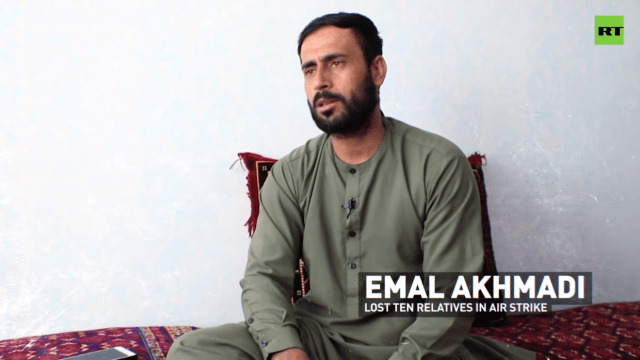
The surviving family members are still “in shock” after the attack and simply can’t return to their home, where they’ve found “parts of the children’s bodies” scattered around, Akhmadi told RT. “Mentally, we are not in a stable condition. The women are dead silent. They don’t speak.”
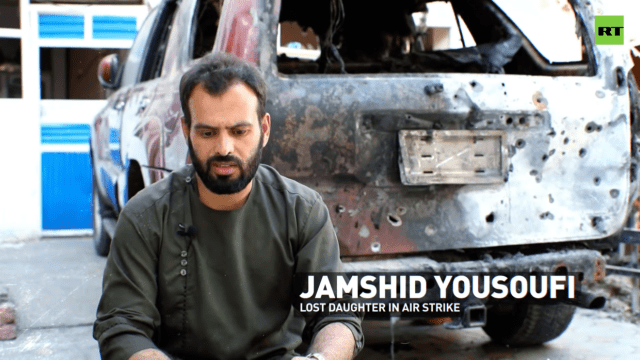
Sumaya’s father has labeled the US drone strike a “stupid thought” and made it clear that the family had no ties with ISIS-K. “They say ISIS-K lived in this house. In this house, were these children members of Islamic State?” Jamshid Yousoufi wondered.

“Without any proof, without any investigation, they attacked us and killed our children, and we will never forgive them.”

Akhmadi branded the Americans “utter liars” for linking the family with the terrorists. “We’ve lost our children. They can’t return to us. So, at least our honor should be restored by a fair investigation,” he said, calling on the international community to make sure the drone strike was fully investigated.

The grieving fathers are the heroes in RT’s documentary series ‘Unheard Voices’. Dedicated to the 20th anniversary of the beginning of America’s War on Terror in Afghanistan, the short film project tells the stories of those whose lives have been forever changed by it. The civilians who lost their loved ones to airstrikes, the inmates of the US prisons at Bagram and Guantanamo who were deprived of their freedom without trial and endured torture, the American troops who found themselves on the brink of suicide after returning from Afghanistan and now question the very need for the US invasion – they have all been interviewed by RT. New episodes will be aired daily, starting Wednesday.

September 9, 2021 Posted by | Timeless or most popular, Video, War Crimes | , | 1 Comment

Top US generals lined their pockets off Afghanistan war

Press TV – September 4, 2021

The top generals who commanded American forces in Afghanistan have amassed fortunes from their postings there despite their disastrous conduct in the occupied country.

Eight American generals leading foreign forces in Afghanistan, including United States Army General Stanley McChrystal, who sought and supervised the 2009 American troop surge, went on to serve on more than 20 corporate boards, according to US media.

In an article titled, “Corporate boards, consulting, speaking fees: How US generals thrived after Afghanistan,” published by Stars and Stripes, the publication reveals how top generals amassed clout despite the failure of the American offensive in Afghanistan.

A review of company disclosures and other releases conducted by the specialized medium showed that the top Americans generals who led the mission in Afghanistan had thrived in the private sector after leaving the war zone.

They have amassed influence within businesses, at universities and in think tanks, in some cases selling their experience in a conflict that left millions of people dead and displaced, and costing the United States more than $2 trillion and concluded with the restoration of Taliban rule, the report said.

Meanwhile, the debate remains hot in the United States over what was the mission and who benefited from the 20-year war against the impoverished country.

A compilation of data from lobbying disclosures archived at Open Secrets, a US-based research group tracking money in US politics, showed that Lockheed Martin, Raytheon, General Dynamics, Boeing and Northrop Grumman were the top 5 military contractors who received $2 trillion dollars in public funds from 2001 and 2021.

Retired Gen. Joseph F. Dunford Jr., who commanded American forces in Afghanistan in 2013 and 2014, joined the board of Lockheed Martin last year. Retired Gen. John R. Allen, who preceded him in Afghanistan, is president of the Brookings Institution, which has received as much as $1.5 million over the last three years from Northrop Grumman.

September 4, 2021 Posted by | Corruption, Militarism | , , , , , , | 1 Comment

Crocodile Tears for Women’s Rights in Afghanistan

By Jacob G. Hornberger | FFF | September 2, 2021

Interventionist dead-enders are crying crocodile tears over the Taliban’s defeat of the Pentagon and the CIA in Afghanistan because, they say, women’s rights are not likely to be protected by the Taliban. 

Oh? 

Well, now let’s see. According to the Watson Institute at Brown University, civilian deaths in Afghanistan and Pakistan from 2001 to date exceed 70,000 people. 

We don’t know how many of those dead people were women but we can safely assume that a large percentage of them were. 

How many of those dead women would have been able to exercise “women’s rights” if the Pentagon and the CIA had won the war? 

Answer: None of them. At the risk of belaboring the obvious, women who are dead cannot exercise “women’s rights.”

The interventionist dead-enders would say that those deaths were “worth it” because the women who survived the invasion and occupation would then have been able, with a U.S. military victory, to exercise “women’s rights.”

But where do the Pentagon and the CIA get the moral authority to sacrifice tens of thousands of  innocent lives — or even just one innocent life — in order that others will have the potential opportunity to exercise “women’s rights”?

Throughout the 20 years of the Afghanistan war, there was a strange and callous indifference to the people who were being killed in Afghanistan. It’s a reflection of what the national-security state way of life has done to the consciences of the American people. We actually don’t even know the exact number of civilians who were killed. That 70,000 is just an estimate. That’s because early in the conflict, U.S. officials made a conscious decision not to count the Afghan dead. What mattered was the number of U.S. soldiers who were being killed, not the number of Afghans being killed.

In Sunday services in Christian churches across America, ministers would exhort their congregations to “pray for the troops” and “thank them for their service.” Hardly ever would American Christian churchgoers be asked to pray for the people, including women, who were being killed by the troops as part of their “service.” Those lives just didn’t matter. 

The interventionist mindset with respect to “women’s rights” was always based on a mathematical calculation. This mindset held that in the quest to establish a regime that protected “women’s rights,” it was morally acceptable to kill some number of Afghan women (and men). The idea was that it was morally permissible to sacrifice the lives of some for the benefit of others. 

Moreover, there was never an upward limit on the number of Afghan women (and men) who could be sacrificed for the greater good of “women’s rights.” 70,000? 100,000? 250,000? It didn’t matter. What mattered to the interventionist dead-enders is that a U.S. puppet regime be installed that would protect “women’s rights” for those who weren’t killed by the violence entailed in installing and maintaining such a regime in power.

Think about all the wedding parties that U.S. forces bombed during the 20 years of conflict. Dead brides. Dead mothers of the brides. Dead mothers of the grooms. Dead sisters of the brides and grooms. Dead flower girls. Dead bridal assistants. None of them would be around at the end to celebrate a U.S.-installed regime that protected “women’s rights.” But it was all considered worth it because those who weren’t killed would be able to exercise “women’s rights.”

It’s one thing for people to deliberately sacrifice themselves in what they consider is a grand and glorious cause. 

It’s quite another thing to knowingly and intentionally kill innocent people so that others can experience “women’s rights.” It would be difficult to find a more evil notion than that.

September 2, 2021 Posted by | Militarism, War Crimes | , , | Leave a comment

Recent drone strikes in Afghanistan prove ‘Over-the-horizon’ is just a buzz phrase for US incompetence

By Scott Ritter | RT | August 31, 2021

Following the Kabul airport attack, the US military conducted two “over-the-horizon” air strikes against suspected ISIS-K targets. The results inspire zero confidence in the efficacy of this approach toward counterterrorism.

The August 26 suicide bombing outside Hamid Karzai International Airport in the Afghan capital killed more than 150 people, including 13 American troops. The Islamic State-Khorasan, or ISIS-K, claimed responsibility for the attack.

That night, in a televised address to the American people, President Joe Biden declared “We will not forgive. We will not forget. We will hunt you down and make you pay,” adding that the US “will respond with force and precision at our time, where we choose and when we choose.”

The next day, August 27, the US carried out what it termed an “over-the-horizon” attack against an ISIS-K “planner” and “facilitator” at a home in the city of Jalalabad in Nangarhar Province in eastern Afghanistan, killing both men and, according to the US, wounding a third accomplice.

US defense sources sources said the men were killed by a special variant of the Hellfire missile, known as the R9X, or ‘flying Ginsu’, a reference to the six blade-like devices which emerge from the missile, killing its target by cutting it to shreds in lieu of the normal high explosive payload carried by the Hellfire. The R9X was developed specifically to handle situations such as the one in Jalalabad, where legitimate targets have taken refuge among a civilian population.

According to reports, the “planner” and “facilitator” were traveling in a three-wheeled vehicle common to the region as public transportation. The men were tracked by an MQ-9 ‘Reaper’ drone which maintained sufficient “eyes and knowledge” of the target to confirm their identities. The three-wheeled vehicle entered a compound believed to be the home of the “planner.” Reportedly, US personnel monitoring the live video images coming from the MQ-9 drone waited until the planner’s wife and children left the compound before launching the ‘flying Ginsu’.

“Initial indications are that we killed the target,” a CENTCOM spokesperson said. “We know of no civilian casualties.” The strike was reportedly authorized by President Biden and ordered by Secretary of Defense Lloyd Austin.

The US assertions about casualties were contradicted by a Jalalabad community elder, Malik Adib, who declared that three people were killed and four were wounded in the drone strike, noting that “women and children are among the victims.”

If the statements of Malik Adib are to be believed, then something went very wrong with the analysis of the imagery used to justify the launching of the missile. While no one has questioned the validity of the US claims that the targets struck were in fact affiliated with ISIS-K (while keeping in mind the US has provided no evidence that corroborates its claim that they were, in fact, ISIS-K operatives), either someone is lying about waiting for the wife and children to leave, or there were other civilians in the vicinity of the attack, one of whom was killed.

Before the media could press the Pentagon about the apparent inconsistencies in the official US account, however, the US launched a second drone strike, this time targeting a vehicle in Kabul, eliminating “an imminent ISIS-K threat” to Hamid Karzai International Airport. According to US officials, the existence of a “large secondary explosion” at the scene of the attack confirmed the assessment about the existence of a car bomb. It is not known if the US used a conventional Hellfire or one of the non-explosive RX9 variants in the attack.

According to unnamed defense sources, the alleged ISIS-K operatives inside the vehicle had been observed placing what was assessed to be a considerable amount of explosives in the trunk of a white Toyota Corolla, before driving the vehicle into the driveway of a home located near the airport. The decision was made to strike, resulting in the destruction of the vehicle. US officials claimed that at least one ISIS-K suicide bomber was killed in the incident. Allegedly, nine civilians also perished as a result of the attack.

“We are aware of reports of civilian casualties,” Major General William Taylor, a spokesperson for the Joint Staff, told the media on Monday. “We take these reports extremely seriously.”

The driver of the vehicle, Zemari Ahmadi, did not fit the profile one would expect of an ISIS-K suicide bomber. Zemari worked for an American-based charity called Nutrition and Education International.

According to his family, he was on his way home from work after dropping off colleagues on Sunday evening. As he pulled into the driveway of his home, where he lived with three brothers and their families, the children of his relatives ran out to greet him. The missile believed to be launched by the American drone struck the rear of the vehicle, killing Zemari and nine others, including seven children, the youngest of whom was two years old. Also killed was Zemari’s nephew, Ahmad Naser, who had previously served as a guard at a US military facility in Herat, and who was awaiting final approval of his Special Immigrant Visa paperwork so that he could leave Afghanistan.

“No military on the face of the Earth works harder to avoid civilian casualties than the United States military,” Pentagon spokesman John Kirby said after reports emerged about possible civilian casualties. “We take it very, very seriously. And when we know that we have caused innocent life to be lost in the conduct of our operations, we’re transparent about it.”

Kirby went on to suggest that the civilians were killed as a result of the detonation of the explosives alleged to have been contained in Zemari’s vehicle. At a later press conference, Kirby maintained this position, but refused to release any imagery that would sustain his contention of a powerful secondary explosion.

The drone strike that killed Zemari Ahmadi and his relatives represented the very scenario the Biden administration was trying to avoid when setting up the “over-the-horizon” strike capability used in the two responses to the suicide-bomb attack on Kabul Airport.

Back in April, when the totality of the failure that was to mark the US withdrawal from Afghanistan remained unknown (although not unknowable – many military and intelligence professionals anticipated the collapse of the Afghan government, but the Biden White House overrode their concerns in favor of better “optics”), General Frank McKenzie, the Marine commanding US Central Command, responsible for all US forces deployed in the Middle East, Central and South Asia, testified before Congress about his command’s efforts to conduct “over-the-horizon” counterterrorism missions once the US drawdown in Afghanistan was completed.

CENTCOM had a long history of conducting “over-the-horizon” (OTH) operations in support of its counterterrorism mission, using a mix of special operations commandos (i.e., the Bin Laden and Abu al-Baghdadi assaults), manned aircraft (the airstrikes against pro-Iranian militias in Syria and Iraq), and drone strikes, such as that carried out against Qassem Soleimani at Baghdad International Airport in January 2020.

“I don’t want to make light of it, I don’t want to put on rose-colored glasses and say it’s going to be easy to do,” McKenzie told the House Armed Services Committee. Any OTH operations in Afghanistan in a post-US drawdown, McKenzie noted, would require significant intelligence support at a time when US intelligence collection capabilities in Afghanistan were diminished to the point of non-existence. “It will be harder to do that, it is not impossible.”

The bulk of the burden of maintaining this OTH capability would fall on the US system of armed drones, which in the past operated from bases inside Afghanistan, providing them with greater reaction time and longer loiter time over the target. Any post-Afghanistan operation of drones in support of OTH operations would mean operating from bases outside of Afghanistan.

According to acting Air Force Secretary John Roth, the US planned on using existing bases in the region to host the drones, noting that the US operated from Al Udeid Air Base in Qatar, Al Dhafra Air Base in the United Arab Emirates, and Kuwait’s Ali Al Salem and Ahmad al-Jaber air bases. The cost of maintaining this OTH capability for fiscal year 2022 was expected to run somewhere around $10 billion.

The Biden White House engaged in a policy review of OTH operations, temporarily placing limits on counterterrorism drone strikes and commando raids, and tightening the approval process for such missions, which had been loosened under the Trump administration.

Biden, according to press reports, was particularly sensitive to the need to limit civilian deaths as it looked into how it would respond to future terrorist threats from Afghanistan and elsewhere in the Middle East. The decision was made to continue the program of drone-based assassination/pre-emptive killing but restrict the ability of field commanders to make the final decision, instead requiring White House permission before any OTH attack could occur.

The MQ-9 drones that were involved in the Jalalabad and Kabul drone attacks were operated out of Al Udeid Air Base in Qatar. The MQ-9 system, however, operates according to what the Air Force calls “remote split operations,” which employs a launch-and-recovery ground control station for takeoff and landing operations at Al Udeid, before passing control of the MQ-9 to a crew based out of Creech Air Force Base in Nevada, which takes control of the aircraft for the remainder of the mission using satellite communication links.

Traditionally, an MQ-9 crew consists of a pilot and a sensor operator, who employ what is known as the Multi-Spectral Targeting System, which integrates an infrared sensor, color/monochrome daylight TV camera, image-intensified TV camera, laser range finder/designator, and laser illuminator, all of which can be viewed together or separately on display screens set up in front of the crew.

The MQ-9 would usually operate as part of an overall “intelligence surveillance reconnaissance” (ISR) package which used a variety of intelligence collection resources to identify and track potential targets. The US drawdown in Afghanistan, however, eliminated most if not all of the supporting infrastructure normally available to the MQ-9 crew to discriminate targets. To help compensate for this loss of capability, the US Air Force developed a special signals intelligence (SIGINT) pod that could be carried by the MQ-9 that provided full-spectrum SIGINT capability to the drone operators, who could now search for, identify and track signals of interest, such as the cell phones, walkie-talkies or satellite phones that comprise the communications network of terrorist organizations like ISIS-K. To better employ this capability, the MQ-9 crew would be supplemented by a linguist who could listen in real time to any conversations of interest, helping with the evaluation of potential targets in terms of both identity and intent.

Intelligence, properly done, is a combination of art and science which requires those involved to be true subject matter experts in the mission they have been given. Imagery analysts need to understand not only what it is they are seeing, but also what it means. Likewise, linguists monitoring conversations need not only be fluent in the language, but adept at slang and other colloquialisms used by people in their daily conversations. For this reason, the best imagery analysts and intercept linguists have been doing their respective jobs for years and, in doing so, are adept at sifting out the unusual from the normal.

However, the airmen operating the MQ-9 most likely did not have this level of experience and expertise. By way of example, the vehicle Zemari Ahmadi was driving was allegedly tracked as “containers containing explosives” were loaded into its trunk. While there is no doubt that an imagery analyst witnessed items being loaded into the trunk of the vehicle, the key question is what was in those containers. Basic identification signatures for car bombs include the use of bags of fertilizer mixed with diesel oil placed in the trunk of a car. However, were the analysts trained to know that Afghanistan blocked the sale of fertilizer back in 2010 because of its extensive use as a bomb-making material, and that the terrorists instead began using potassium chlorate as the primary bomb making material, and that potassium chlorate is loaded into containers virtually identical to those used to store cooking oil?

Moreover, experienced terrorist operatives, which you would expect to be operating from inside Kabul, would anticipate that their communications are being monitored, and as such never use specific words or phrases that could trigger interest on the part of anyone listening in. As such, it is highly unlikely that Zemari or anyone he might have been communicating with would have spoken about explosives or the intent to build a car bomb. He might, however, state that he is picking up cooking oil. If an experienced linguist intercept specialist were listening in, he or she would be able to discern if this was part and parcel of normal activity, or a deviation from the norm. An inexperienced linguist, however, would not possess such insights, and be prone to reading into Zemari’s words content and intent that did not, in reality, exist.

It is unlikely the public will ever know the truth about what happened in Creech Air Base that led the MQ-9 crew to believe that their targets were affiliated with ISIS-K. Despite John Kirby’s assertions regarding transparency, the US military and intelligence community is loath to discuss the specifics regarding intelligence collection capabilities. Likewise, to what extent the extended chain of approval was involved in modifying these assessments as they made their way up the White House will likewise most likely remain secret, further shielding all involved from the kind of scrutiny that full transparency demands.

The Biden administration has placed its hopes for containing terrorism in a post-Afghanistan drawdown on “over-the-horizon” strike capabilities that the president and his supporters believe adequate for the task of identifying and interdicting terrorists before they can carry out an attack against US interests, all the while reducing the likelihood of unintended civilian casualties. If the experience in Afghanistan proves anything, it is that OTH is no panacea when it comes to counterterrorism.

It also underscores the reality that the US intelligence community and military is prone to see what it wants to see. The time-tested adage of “if the only tool available is a hammer, then every problem looks like a nail” holds true in every respect when it comes to OTH in a counterterrorism role: when the only tool available is an MQ-9 drone operated by crews who are not up to the task of properly identifying and tracking targets, then the only solution will be a Hellfire missile which, when employed, will more often than not kill innocent civilians.

August 31, 2021 Posted by | War Crimes | , | Leave a comment