More on this topic
The Cradle | August 29, 2025
Russian Security Council Secretary Sergei Shoigu on 29 August accused western intelligence of plotting to destabilize Afghanistan and rebuild NATO’s military infrastructure there.
Writing in state-owned Rossiyskaya Gazeta magazine, Shoigu said that Russia is seeking to expand cooperation with Afghanistan as it seeks to recover from two decades of US occupation that ended with the chaotic withdrawal of US troops in 2021.
Washington spent $2 trillion to invade and occupy Afghanistan starting in 2001, Shoigu noted, while facilitating the production of opium, much of which was used to make heroin for export to Russia.
Shoigu explained that opium production in the country skyrocketed during the 1980s when CIA-backed extremist groups, known as the mujahideen, sought to destabilize the Soviet-backed Afghan government and later to expel occupying Soviet troops.
When the Taliban first took power in 1996, they immediately cracked down on the opium trade, only for US-backed warlords to revive it after the 2001 US invasion in the wake of 9/11.
When the Taliban took power for a second time in 2021, they all but eliminated the heroin trade once again.
Shoyghu stated that some 20 international extremist groups continue to operate in Afghanistan, undermining stability within the country and posing a serious regional and global threat.
Of greatest concern is the Afghan wing of ISIS, which has training camps and support bases, mainly in the east, north, and northeast of the country.
Shoigu said militants are being moved from other countries by western intelligence to destabilize regions near Russia, China, and Iran.
“There is reason to believe that behind these actions are the special services of a number of western countries, which continue to hatch plans to destabilize the region, to create chronic centers of instability near Russia, China, and Iran by means of extremist groups hostile to the Taliban,” he wrote.
“It is also clear that the western powers, having lost their positions in the Afghan direction, are hatching plans to return NATO military infrastructure facilities to the region,” he added.
Shoigu stated that as a result, Moscow is ready to assist the Taliban in stabilizing the country, including by developing anti-terrorist and anti-drug cooperation with Kabul through law enforcement agencies.
By Laurie Calhoun | The Libertarian Institute | July 1, 2025
On June 16, 2025, President Donald Trump threatened the 10 million inhabitants of Tehran, Iran, with death, for their government’s alleged nuclear aspirations.
The message was posted to the president’s Truth Social account, shared on X/Twitter, and then picked up by all major mass media outlets, making it common knowledge to everyone on the planet that Trump was preparing to join Israel’s war on Iran.
On June 17, 2025, President Trump directly threatened Iran’s Supreme Leader Ayatollah Khamenei with assassination.
Sometimes crazy people issue vague threats which they have no power to follow through on. Such persons are best avoided and ignored. In order to be effective, death threats must be credible, otherwise there is no fear generated in the persons being addressed, for they recognize that they are dealing with no more and no less than a feckless buffoon. Whatever one may think of President Trump, his menacing social media posts are credible threats, given his official role as commander-in-chief with the power to unleash formidable military might on the people of the world. In case anyone did not already know this, Press Secretary Karoline Leavitt reminded the press corps on June 20, 2025, that “Iran and the entire world should know that the United States military is the strongest and most lethal fighting force in the world, and we have capabilities that no other country on this planet possesses.”
Trump’s warning to the entire population of Tehran that they should all evacuate the city was a fortiori a credible threat, given the U.S. government’s wide-ranging “War on Terror,” during which both Afghanistan and Iraq were invaded and occupied. Several other countries were subjected to thousands of missile strikes “outside areas of active hostilities,” that is, where there were no U.S. troops present and thus no force-protection pretext for the use of state-inflicted homicide.
Verbal threats of the use of deadly force by a president often culminate in military action because the commander may be easily persuaded by his advisors to believe that he (and the nation) will lose credibility if he fails to follow through on his words, which, he is told, would be a sign of weakness. Predictably enough, then, on June 22, 2025, President Trump delivered on his threat to bomb Iran, although he claimed to have struck only three specific sites: Fordow, Isfahan, and Natanz. It was at these sites where nuclear enrichment and the development of nuclear arms were allegedly underway. The Trump administration’s Director of National Intelligence Tulsi Gabbard reported to members of congress in March 2025: “The [Intelligence Community] continues to assess that Iran is not building a nuclear weapon and Supreme Leader Khamenei has not authorized the nuclear weapons program he suspended in 2003.”
On June 17, 2025, when a journalist reminded Trump of Director Gabbard’s assessment, the president bluntly blurted out, “I don’t care what she said.” It has become increasingly obvious that Trump’s foreign policy in the Middle East is primarily informed not by his own cabinet but by the intelligence services of Israel, above all, Mossad.
For anyone unfamiliar with the modus operandi and general demeanor of Mossad, I recommend the films Munich (2005), The Gatekeepers (2012), and The Operative (2020).
That Trump has been decisively influenced by the government of Israel was further evidenced by his direct threat against Supreme Leader Khamenei and the fact that Prime Minister Benjamin Netanyahu has been calling for regime change in Iran for decades.
On June 20, 2025, two days before Trump’s missile strikes on Iran, Director Gabbard did an about-face, insisting that her earlier testimony before congress had been misrepresented and ignored her finding that Iran had been enriching uranium:
Gabbard’s retraction, or creative reinterpretation, of her former testimony bears similarities to the case of Bush administration Secretary of State Colin Powell, who initially opposed the 2003 invasion of Iraq and then for reasons which remain unclear suddenly became one of the mission’s most ardent supporters. In Powell’s case, he went even so far as to present the case for war to a less-than-enthusiastic United Nations Security Council. After a colorful Powerpoint presentation featuring an array of ersatz evidence—ranging from speculation about Iraq’s aluminum test tubes, to a receipt for “yellow cake” purchase, to photos of what were claimed to be mobile chemical labs—Powell recognized that he did not have the votes needed to secure U.N. approval and so abruptly withdrew the war resolution. The United States then proceeded to invade Iraq unimpeded, claiming, among other things, that the 2003 military intervention was legal because of previous U.N. resolutions violated by President Saddam Hussein. In other words, after having sought U.N. approval, the U.S. government suddenly denied that it needed such approval before invading Iraq anyway.
Unlike George W. Bush, when Donald Trump bombed Iran “at a time of his choosing,” as they say, he did not have the support of the U.S. congress. Presidents Barack Obama, Joe Biden and Trump all depended on the Bush-era AUMFs as they continued to lob missiles on several countries beyond Afghanistan and Iraq, including Yemen, Pakistan, Somalia, Syria, et al. But the carte blanche AUMFs granted to Bush in 2001 and 2002 had nothing whatsoever to do with the conflict between Israel and Iran. Neocons naturally devise all manner of interpretive epicyclic curlicues to arrive at the conclusion that Iran is in fact “fair game” for bombing. As stated and ratified, however, the AUMFs granted by congress to George W. Bush were intended to facilitate the U.S. president’s quest to bring justice to the perpetrators of the September 11, 2001 crimes.
Lest anyone forget, President Trump was not unique among twenty-first century presidents in bombing countries whose residents had nothing to do with the shocking demolition of the World Trade Center. President Obama effected a regime change in Libya without securing the support of congress because, he claimed, it was not really a war, since he was not deploying any ground troops. Secretary of State Hillary Clinton did her part to persuade Obama that “Gaddafi must go!” She later characterized the Libya intervention as a shining example of “smart power at its best,” even though a few U.S. State Department officials, including the ambassador to Libya, Christopher Steele, were killed in the post-bombing mêlée. Today, Libya is essentially a failed state. Obama himself has confessed that the biggest regret and worst mistake of his presidency (reported in The Guardian) was not having a plan for the aftermath of his supposedly “humanitarian” intervention, which he enlisted NATO to carry out.
In the immediate aftermath of the June 22, 2025 missile strikes, Trump officials followed the Obama administration’s Libya playbook in insisting that his attack on Iran’s nuclear facilities was not the beginning of a long, protracted engagement in Iran. This was meant to draw contrast with the unpopular multi-decade wars in Afghanistan and Iraq. Ignoring Trump’s threat to the residents of Tehran, Vice President J.D. Vance and others recited the Obama administration refrain that the mission was “not a war” with Iran. As Vance explained, the limited missile strikes were carried out only in order to dismantle Iran’s nuclear facilities. According to the government of Iran, a total of 610 people were killed and thousands more injured by the bombs of the U.S. and Israeli governments. However, none of the persons who perished were Americans.
Availing himself of the Obama-era “smart war” trope, Vice President Vance also observed that Trump’s preemptive military strikes differed from those of his predecessors because, unlike Trump, the previous presidents were “dumb”. Oliver Stone produced a film, W (2008), which persuasively portrays Bush as a half-wit, but no one ever suggested that Vice President Dick Cheney or the cadre of other war profiteers and neocons who coaxed Bush into preemptively attacking Iraq were stupid.
In any case, by now, the U.S. government has directly massacred so many thousands of people (and millions indirectly) in so many different countries, often located outside areas of active hostility (war zones or lands under occupation), that the citizenry has become largely inured to it all. Tragically, over the course of the twenty-first century, we have witnessed an apparently permanent paradigm shift to the profligate state use of homicide to terrorize and kill anyone anywhere deemed dangerous or even suspicious by U.S. officials or their contracted analysts. This radical paradigm shift was made possible by a new technology: the weaponized drone, which began to be used by the Bush administration first under a pretext of force protection in Afghanistan and Iraq. The Bush team effectively initiated the Drone Age by firing a missile on a group of terrorist suspects driving down a road in Yemen on November 3, 2002.
As the Global War on Terror stretched on and angry jihadists began to proliferate and spread throughout the region, President Obama assumed the drone warrior mantel with alacrity, opting to kill rather than capture thousands of suspected terrorists outside areas of active hostilities. In his enthusiasm for drone killing, Obama went even so far as to intentionally and premeditatedly hunt down and kill U.S. citizen Anwar al-Awlaki (located in Yemen at the time, in 2011), without indicting him, much less allowing him to stand trial, for his alleged crimes.
Following the Obama precedent, in 2015, U.K. Prime Minister David Cameron opted to execute British nationals Ruhul Amin and Reyaad Khan, who were suspected of complicity in terrorism, after they had fled from the U.K. to Syria, and despite the fact that the parliament had rejected Cameron’s call for war on Syria. Cameron’s missile strikes against British citizens located abroad was all the more surprising because capital punishment is illegal in the U.K. as well as the European Union, of which Britain was a member at that time.
One state-perpetrated assassination leads to another, and on January 3, 2020, President Trump authorized the targeted killing via drone strike of a top Iranian commander, Qassem Soleimani, who was in Baghdad on a diplomatic mission at the time. Trump openly proclaimed, and indeed bragged, that the homicide, which he authorized, was intentional and premeditated. According to the president, Soleimani was responsible for past and future attacks against both Israel and the United States. The summary execution of a specific, named individual would have been considered an illegal act of assassination in centuries past but today is accepted by many as an “act of war” for the sophomoric reason that it is carried out by a military strike rather than undercover spies armed with poisons or garrottes.
In view of Trump’s unabashed, vaunted, assassination of Soleimani, and his full-throated support of Netanyahu, the threat to liquidate Supreme Leader Khamenei was just as credible as the “evacuation order” to the entire population of Tehran. Leaders today exult over their use of cutting-edge technology to eliminate specific, named individuals, as though summarily executing the victims were obviously permissible, given that targeted killing is now regarded by governments the world over as one of the military’s standard operating procedures. Such unlawful actions were fully normalized as a tool of “smart war” during the eight-year Obama presidency.
Shortly after Trump officials went out on the media circuit to insist that the bombing of Iran’s alleged nuclear production facilities was not the initiation of a U.S.-Iran war, Trump took to social media again, this time to suggest that his administration’s ultimate goal might really be regime change:
Less than one day later, the new official narrative became that Trump had masterfully brought the “twelve-day war” to a miraculous close, thanks to his superlative deal-making capabilities.
All of this would be risible, if not for the fact that many millions of persons in Iran continue to live under a persistent threat of death, given the wildly unpredictable comportment of President Trump, seemingly exacerbated by his longstanding commitment to stand by Israel, regardless of how outrageously Netanyahu behaves. The more and more daring acts of assassination perpetrated by the government of Israel clearly illustrate where state-perpetrated homicide and its attendant terrorist effects under a specious guise of “smart war” eventually lead.
Targeting named terrorist suspects allegedly responsible for previous crimes swiftly expanded to include signature strikes against groups of unarmed persons designated potentially dangerous and located anywhere in the world—in Gaza, Lebanon, Syria, Iran, or anywhere else they please. The Israeli government has even deployed exploding cellphones and car bombs, the latter of which was once a tactic primarily deployed by dissident anti-government groups and crime syndicates. The repeated use by the Israeli government of car bombs to kill research scientists illuminates the slippery slope from missile strikes outside areas of active hostilities to what are empirically indistinguishable from Mafia hits. Car bombs have long been used by the Mafia and other nongovernmental organized crime groups, but the Israeli government openly perpetrates the very same acts under cover of “national self defense”.
Washington’s normalization of assassinations has emboldened leaders such as Netanyahu, who today conducts himself according to the principle “everything is permitted” in the name of the sacrosanct State. Witness what has been going on in Gaza since October 7, 2023: terrorism, torture, starvation, and summary execution. All of this is being condoned by every leader in the world who continues to voice support for, or even aids and abets, Netanyahu’s mass slaughter. This support for mass slaughter is provided ostensibly under the assumption that the perpetrators are doing no more and no less than defending the State of Israel.
Following the examples of U.S. Presidents Trump and Obama, and UK Prime Minister Cameron, all of whom publicly vaunted their assassination prowess, Prime Minister Netanyahu, having apparently recognized that the implement of homicide is in fact morally irrelevant, openly and brazenly executes persons determined by Mossad to be dangerous, with no concern for the thousands of innocent persons’ lives ruined along the way. In Operation Red Wedding, the Israeli government claimed to have dispatched, in a matter of minutes, thirty senior officials associated with the IRGC (Iranian Revolutionary Guard Corps) including military chiefs and top commanders located throughout Iran at the opening of the June 2025 “Twelve-Day War.” The operation was praised by the pro-Israel media as featuring “bespoke” acts of targeted killing made possible by “pattern of life” intelligence.
Drone assassination, successfully marketed by the Obama team as “smart war,” smoothed the way to the uncritical acceptance by many citizens of the reprobate expansion of state killing to include acts historically committed by members of nongovernmental organized crime. Looking back, the rebranding by U.S. officials of political assassination as an act of war, provided only that the implement of death is a missile, was a slick and largely successful way of persuading U.S. citizens to believe that extrajudicial, state-inflicted homicide abroad is an acceptable means to conflict resolution. Even though it bypasses all of the republican procedures forged over millennia, including judicial means, for reconciling the rival claims of adversaries.
In the maelstrom of the twenty-first-century wars on Afghanistan and Iraq, assassination was labeled targeted killing and successfully sold to politicians as “smart war,” a surgically precise way to defeat the enemy without sacrificing combatant troops. Whichever label is used, assassination or targeted killing, acts of summary execution by governments involve the intentional, premeditated elimination of persons suspected to be possibly dangerous, a criterion so vague as to permit the targeting of virtually any able-bodied person who happens to be located in a place where terrorists are thought to reside.
There are three differences between “targeted killing” carried out by drone warriors and assassination. First, the weapon being used is a missile. Second, drone operators wear uniforms, while undercover assassins and hitmen do not. Third, far from being “surgically precise,” drone warfare increases the slaughter of innocent bystanders in their own civil societies, which is facilely dismissed as the “collateral damage” of war. In this way, the advent of lethal drones and their use outside areas of active hostility has served to terrorize entire populations forced to endure the hovering above their heads of machines which may—or may not—emit missiles at any given time on any given day.
Credible death threats to heads of state and evacuation orders issued to millions of people not only terrorize the persons being addressed, but also undermine the security of the citizens of the United States. The populace will bear the brunt of the blowback caused by such reckless behavior on the part of officials who operate with effective impunity and are ignorant of or oblivious to the nation’s republican origins. By launching preemptive missile strikes, the Pentagon does not protect but sabotages the interests and well-being of not only U.S. citizens but also the citizens of the world.
Nonetheless, many U.S. politicians and members of the populace, along with heads of state such as Canada’s Prime Minister Mark Carney, U.K. Prime Minister Keir Starmer, Australia Prime Minister Anthony Albanese, et al., having been thoroughly seduced by the “smart war” marketing line, appear to have no problem whatsoever with the tyrannical and arguably deranged death threats of the U.S. president. They have become altogether habituated to the assassination of persons now regarded as a standard operating procedure of war. European Commission President Ursula von der Leyen effectively condoned Trump’s behavior by issuing this statement in the aftermath of the June 22, 2025 U.S. missile strikes against Iran: “Iran must never acquire the bomb.”
If terrorism is the arbitrary killing of or threat of death against innocent persons, then there can be no further doubt that the largest state sponsor and perpetrator of terrorism in the twenty-first century is in fact the U.S. government. President Trump inherited from President Obama and his mentor, drone-killing czar John Brennan (appointed by Obama as CIA director in 2013), the capacity to terrorize entire civilian populations and execute individuals at his caprice. No less than every drone strike launched in the vicinity of civilian populations beyond war zones, Trump’s completely unhinged threat to a group of people with nowhere to seek refuge, and no way of knowing whether the U.S. president is issuing a serious warning or simply bluffing, attempting some sort of perverse ploy to bring Iran’s Supreme Leader Khamenei back to the negotiation table (where he was, before Israel began bombing Iran), was an act of terrorism.
It is not “smart” to terrorize millions of human beings in the name of preventing terrorism. It is a contradiction, pure and simple.
Laurie Calhoun is a Senior Fellow for The Libertarian Institute. She is the author of Questioning the COVID Company Line: Critical Thinking in Hysterical Times,We Kill Because We Can: From Soldiering to Assassination in the Drone Age, War and Delusion: A Critical Examination, Theodicy: A Metaphilosophical Investigation, You Can Leave, Laminated Souls, and Philosophy Unmasked: A Skeptic’s Critique. In 2015, she began traveling around the world while writing. In 2020, she returned to the United States, where she remained until 2023 as a result of the COVID-19 travel restrictions imposed by governments nearly everywhere.
Tales of the American Empire | June 19, 2025
On September 11 2001, FOUR World Trade center buildings in New York were suddenly destroyed. We are told that no one could imagine that terrorists could knock down the two World Trade Center towers, even though Israeli prime minister Benjamin Netanyahu predicted this in his 1995 book. He warned the U.S. Congress this may happened unless the United States joined a war to expand Israel by destroying what he called terror states. Even before the smoke cleared on 9-11, the plotters blamed Osama bin Laden to block investigations into their weak official story.
Note: YouTube demonetized this video claiming “violence throughout”, even though there is no graphic violence, just some collapsing buildings often shown on television.
_____________________________________________________
“Bin Laden says he wasn’t behind attacks”; CNN; September 17, 2001; https://edition.cnn.com/2001/US/09/16…
Related Tale: “The Empire’s Fake War on Terror”;  • The Empire’s Fake War on Terror
Related Tale: “Osama Bin Laden WAS NOT Responsible for 9/11”; • Osama Bin Laden WAS NOT Responsible for 9/11
“U.S. Military Knows Israel Did 9/11 – Dr. Alan Sabrosky”; Augustus Berg; Bitchute; June 30, 2023; https://www.bitchute.com/video/Vsf4v1…
“9/9 and 9/11, 20 Years Later”; Pepe Escobar; Unz.com; September 9, 2021; https://www.unz.com/pescobar/9-9-and-…
Related Tale: “The 1993 FBI Bombing in New York; • The 1993 FBI Bombing in New York
“9/11 Conspiracy Theory Explained in 5 Minutes”; James Corbett; 2022; • 9/11 Conspiracy Theory Explained in 5 Minutes
“”The 9/11 Commission Was A FRAUD” – Curt Weldon EXPOSES CIA Cover-Up, Able Danger & Deleted Evidence”; PBD Podcast; YouTube; May 14, 2025; • “The 9/11 Commission Was A FRAUD” – Curt W…
“Rep. Curt Weldon: It’s Time to Finally Tell the Truth About 9-11”; Tucker Carlson; YouTube; April 14, 2025; • Rep. Curt Weldon: It’s Time to Finally Tel…
Tales of the American Empire | May 22, 2025
It remains unclear why the US military suddenly fled Afghanistan in 2021, leaving behind billions of dollars of equipment. It was clear a decade before that the American occupation was unnecessary and failed to tame the Afghan tribes. By 2021, the US military was needed elsewhere as the war in Ukraine was about to explode while African nations rebelled against their covert French colonial lords. Yet there is hard evidence they left after profits from the secret American opium trade in Afghanistan crashed after Fentanyl became the preferred drug for abusers.
_____________________________________________________
Related Tale: “Protecting the American Opium Trade”; • Protecting the American Opium Trade
Related Tale: “Football Star Murdered in Afghanistan”; • Football Star Murdered in Afghanistan
“100% DROP In Afghan Opium: How CIA Propped Up Drug Trade For Years”; Breaking Points; September 24, 2024; • 100% DROP In Afghan Opium: How CIA Pr…
Related Tale: “The Chaotic Fall of Kabul in 2021”; • The Chaotic Fall of Kabul in 2021
Related Tale: “The Empire Enters the Cocaine Trade”; • The Empire Enters the Cocaine Trade
Sputnik – 13.05.2025
Emerging reports about atrocities perpetrated by British special forces against civilians in Afghanistan may be a part of a “preemptive defense” of the IDF, former Pentagon analyst Ret. Lt. Col. Karen Kwiatkowski told Sputnik.
If and when stories of “the incredibly disturbing activities of the UK- and US-supported IDF in Gaza” come out, the public would already be taught beforehand that “war is awful, civilians and sleeping children are always killed and it’s just a few bad apples.”
Regarding the UK soldiers and officers involved in illegal activities in Afghanistan, Kwiatkowski believes they should be placed on unpaid leave and “tried in a legal court.”
Any key eyewitnesses and whistleblowers “need immediate protection from suicide or accidents,” Kwiatkowski adds.
By Farzad Bonesh – New Eastern Outlook – April 24, 2025
Although TAPI has now taken on more of a bilateral partnership between Afghanistan and Turkmenistan, its earlier implementation will certainly have greater domestic consequences for Afghanistan.
The Taliban’s approach to the TAPI pipeline: challenges, and obstacles
The Turkmenistan-Afghanistan-Pakistan-India (TAPI) gas pipeline, a combination of the first letters of the Latin names of the countries participating in the regional project, runs from Turkmenistan to India. The length of the 1,814-kilometer line is 214 kilometers in Turkmenistan and 816 kilometers in Afghanistan.
The TAPI project is intended to transport 33 billion cubic meters of natural gas annually from Turkmenistan’s The Galkynysh gas field to India.
In 2015, the leaders of the four TAPI participating countries celebrated the groundbreaking ceremony for the gas pipeline in the city of Merv. But apart from the laying of the Turkmen section, virtually no major activity took place.
After the Taliban returned to power, international financial institutions either refused to directly support the project due to legal and political considerations or showed no interest in investing.
The Afghan Taliban is not officially recognized, and international sanctions against the Taliban, political differences between India and Pakistan, and tense relations between Kabul and Islamabad have slowed down the implementation of the project.
However, in September 2024, former President of Turkmenistan Gurbanguly Berdymukhammedov and Taliban Prime Minister Mullah Mohammad Hassan Akhund jointly launched the TAPI project in 2024 at a ceremony on the Turkmenistan-Afghanistan border.
Recently, Hedayatullah Badri, Minister of Mines and Petroleum, and a high-ranking delegation from Turkmenistan, visited the progress of the TAPI gas transmission project in Herat province and emphasized the acceleration of the work process.
Although Pakistan and India have not been involved much in the recent developments of the TAPI gas pipeline, the Taliban, adopting a pragmatic approach, have decided to take this energy transmission project step by step with the cooperation of Turkmenistan.
Political and geopolitical goals and interests of the Afghan Taliban:
From the perspective of TAPI, it is an opportunity to solve the security problem within the country, and Kabul hopes that the opposition will also agree to the construction of this pipeline, considering national interests. During the Islamic Republic of Afghanistan , the Taliban, in a statement, while supporting the TAPI project, saw TAPI as an important economic project and an important element in the country’s economic infrastructure.
Gaining greater regional and global support for this pipeline will further link Afghanistan’s security with regional and global partners. The passage of the TAPI gas pipeline through Afghanistan will link the tangible and real interests of several regional and global countries, and the neighboring countries will also ensure Afghanistan’s security.
The Turkmenistan-Afghanistan-Pakistan-India gas pipeline project has helped increase Afghanistan’s geopolitical position and strengthen relations and mutual interests among partner countries. Taliban leaders seem to believe that TAPI has the potential to expand relations between member countries and strengthen common interests. Also, from the perspective of many in Kabul, the pipeline’s passage through Afghanistan, Pakistan, and India will reduce Pakistan’s incentive to play a negative role in Afghanistan.
Meanwhile, Kabul expects the TAPI project to encourage countries’ interests to move away from confrontation with each other in Afghanistan to a policy of tolerance.
In this approach, accurate and efficient management of the TAPI can have important effects on the public opinion of the people, show government efficiency, deal with the opposition, and satisfy nationalist feelings.
Economic goals and benefits:
Of course, this plan cannot pave the way for an economic revolution in Afghanistan, but it can be very useful for other major construction projects, reconstruction, economic development and production, trade, and transit in Afghanistan.
It will also employ about ten thousand people for the next few decades, creating thousands of direct and indirect jobs and reducing some of the unemployment problem.
Over the past few years, the Taliban have focused on several projects such as the TAP-500 energy system, the revival of important energy transmission and transit projects, including CASA-1000.
In addition, the Taliban have planned and inaugurated some infrastructure and economic projects, such as solar power generation over the past two years. The Taliban consider energy projects important in the development and self-sufficiency of the country, saving Afghanistan from poverty and dependence on expanding energy production, and managing water resources.
The implementation of TAPI can help transform Afghanistan’s energy consumption infrastructure from oil and coal to natural gas, and help increase the country’s production and economic growth.
For the first time, Afghanistan can achieve reliable natural gas for domestic and industrial use. For example, the TAPI pipeline passing through Herat province (the economic hub of Afghanistan) could be a driving force for other local industries.
Afghanistan could be an actor in a major transit route for Central Asia and a bridge between Central Asian energy-consuming and exporting countries. South Asian countries are in great need of energy, and Central Asian countries have abundant gas and electricity resources. Afghanistan has the potential to connect the two sides.
Success in this project could accelerate the construction of power transmission lines, railways, fiber optics, etc., in the field of regional cooperation. If TAPI is completed at a cost of more than $7-10 billion, it could also help attract foreign investment to the country. In addition to meeting the gas needs of its growing economy, Afghanistan could also receive $1 billion in gas transit rights annually. This amount could be a major contribution to the economy.
TAPI could be an important step towards strengthening the economic diplomacy of the Kabul government. Apart from the main role of Turkmen Gas Company, with an 85% stake, in July 2024, Pakistan and Turkmenistan agreed to accelerate the progress of the TAPI gas pipeline project.
Kazakhstan also seems to be willing to join the project. Russian companies may participate in the TAPI project, “as soon as the situation in Afghanistan stabilizes”.
Challenges and Outlook
TAPI suffers from major challenges, from insecurity to political complications, regional instability, the international isolation of the Taliban, and doubts about the investment capacity.
The TAPI project in the Turkmen section has been completed. The Taliban also plan four phases for construction from the Turkmenistan border to the city of Herat; Herat to Helmand; Helmand to Kandahar; and Kandahar to the Pakistani border. But as of April 2025, just 11 kilometers of pipeline have been laid in Afghanistan.
Large investments require security and stability, and major extremist groups such as ISIS can be a significant threat in Afghanistan.
The Afghan section of TAPI (in Herat, Farah, Nimroz, Helmand, and Kandahar provinces) passes through some of the most unstable parts of the country. The Taliban is not yet a legitimate government, with legal standing as an economic contracting party and a reliable partner. Critics have warned that the Taliban government does not have national legitimacy and international and legal recognition.
Pakistan and India appear to be cautiously refraining from immediately participating in the TAPI gas pipeline, waiting for conditions in Afghanistan to change.
While the Taliban has not been recognized yet, it is also not possible to secure financial assistance or loans from international institutions.
In addition, the full and successful construction and operation of the pipeline requires the political will of the leaders of the four countries and serious bilateral and multilateral discussions with all partners.
However, although TAPI has now taken on more of a bilateral partnership between Afghanistan and Turkmenistan, its earlier implementation will certainly have greater domestic consequences for Afghanistan.
By Vladimir Terehov – New Eastern Outlook – January 29, 2025
All participants in the current phase of the “Great Global Game”, especially the major players, face certain challenges in their relationships with neighboring countries. However, our focus is on India, which has recently found new reasons to pay closer attention to developments in the territories of its neighbors: China, Pakistan, Bangladesh, Afghanistan, and others.
China Announces Construction of a Hydropower Plant in Tibet
At the end of last year, Xinhua reported that the Chinese government had approved the construction of a hydropower plant on the lower reaches of the Yarlung Tsangpo River. The river’s unique characteristics at the “Medog Gorge” in Tibet—where a massive water flow plunges 2,000 meters over a stretch of less than 50 km—have long attracted the interest of hydropower engineers. This flow holds energy reserves three times greater than those produced by the world’s largest power station, the Three Gorges Dam, built in the 1990s on the Yangtze River.
Naturally, China has long explored projects to harness this immense natural energy. The main obstacles have been the projects’ extreme complexity and the massive financial costs, estimated at around $140 billion.
But why should this internal Chinese matter concern India? Upon leaving Chinese Tibet, the Yarlung Tsangpo flows into India and Bangladesh, where it becomes better known as the Brahmaputra River. In the broader context of the “water problem”, which is becoming central to relations between many countries – especially those in the “Global South” – questions around the use of rivers shared by neighboring states have gained critical importance.
In the mid-2010s, China faced challenges in its relations with Southeast Asian nations for whom the Mekong River is a “river of life”. These countries expressed concerns over potential negative impacts from hydropower projects in Tibet on the Mekong’s tributaries. At that time, Beijing was able to ease such concerns through direct talks in the “Lancang-Mekong” framework.
Using river resources is an inevitable component of modern development. It can benefit the countries through which these rivers flow, provided each nation’s interests are considered during the construction and operation of hydropower facilities.
It all comes down to the overall state of relations between neighbors. If “misunderstandings” suddenly arise, they are more likely a sign of an overall lack of trust between them. Various concerns about the hydropower project in the “Medog Gorge” were raised by New Delhi several years ago. These concerns have resurfaced immediately following the aforementioned report by Xinhua.
Although this facility could bring significant benefits to India itself. The future hydropower plant could supply inexpensive electricity to the northeastern states or regulate the flow of the Brahmaputra River, which floods vast areas of those states annually.
Pakistan and Bangladesh
The same “water disputes” (among other issues) are being raised against India by two of its other neighbors – Pakistan and Bangladesh. This also reflects the poor state of India’s relations with Pakistan. Relations with Bangladesh deteriorated sharply after the well-known events of early August 2024, when the new Bangladeshi leadership accused New Delhi of provoking floods on the Gumti River by releasing water from a reservoir dam in the Indian state of Tripura, just 120 km from the Bangladeshi border.
As for Pakistan, relations in the mid-2010s reached the point of nuclear threats after Indian Prime Minister Narendra Modi hinted at the possibility of blocking the upper reaches of the Indus River in response to a series of violent incidents in the then-state of Jammu and Kashmir. Since then, no similar rhetoric has emerged in bilateral discussions on water disputes. However, the issue remains embedded in the framework of Indo-Pakistani relations and has been repeatedly emphasized in recent months by Pakistani Prime Minister Shehbaz Sharif.
That said, the “Water disputes” with India are not the primary reason for the dramatic shift in Bangladesh’s attitude toward Pakistan following the August 2024 events. From the time of its independence in 1971 until these recent developments, it was hard to imagine Bangladesh adopting a more hostile stance toward any state than it had toward Pakistan. This makes the visit of a delegation of senior Bangladeshi Army officers to Pakistan in mid-January 2025 almost unthinkable. For India, this is a deeply concerning and alarming signal.
Iran and Afghanistan
Providing some balance to these challenges are India’s relatively positive relations with Iran and Afghanistan, which are not immediate neighbors. Afghanistan exhibits a peculiar phenomenon where its leadership seeks to strengthen ties not with co-religionists in Pakistan but with “non-believers” in India.
This alignment by Kabul is not solely due to the strained relationship between the Taliban (still banned in Russia) and Pakistan’s leadership. Even during the era of “secular” Afghan governments, ties with India were consistently prioritized.
This phenomenon has a straightforward explanation: no Afghan leadership would ever recognize the Durand Line, drawn in the late 19th century, as the legitimate border with Pakistan. The line divided the Pashtuns, who constitute Afghanistan’s majority population. This reflects the enduring relevance of Realpolitik principles – regardless of time, region, or the faiths of the people involved. A recent demonstration of growing ties between India and Afghanistan was the January 8 meeting in Dubai between the foreign ministers of the two countries.
Iran, meanwhile, has historically maintained relatively good relations with all political entities within modern India. Today, its leadership pursues a balanced policy toward both India and Pakistan, avoiding taking a definitive stance on the Kashmir issue, which is critical to both countries.
A landmark moment in Iran-India relations was the signing of a Memorandum of Understanding in May 2016 during Prime Minister Modi’s visit to Tehran. The agreement allocated $500 million for the modernization of the Chabahar Port on the Gulf of Oman. India views this port as a vital multipurpose logistics hub that could facilitate land-based transport links to Afghanistan.
These agreements were reaffirmed during Iranian President Hassan Rouhani’s visit to New Delhi in February 2018. In May 2024, the agreements were extended for another 10 years. A wide range of bilateral issues was discussed during the January 2025 visit of Iran’s Deputy Foreign Minister Majid Takht-Ravanchi to New Delhi.
The geopolitical environment surrounding modern India is becoming increasingly complex – a trend observed among all major players in the current phase of the “Great Global Game”.
But then again, who in today’s world has it easy?
Vladimir Terekhov, expert on the issues of the Asia-Pacific region
RT | January 8, 2025
British SAS operatives were given a “golden pass allowing them to get away with murder” in Afghanistan, a former UK Special Forces officer has told a government inquest. Other witnesses described routine executions of unarmed civilians by British forces.
The officer’s statement was given behind closed doors to the UK’s Independent Inquiry Relating to Afghanistan earlier this year, and included in a trove of documents published by the inquiry on Tuesday.
The former officer raised concerns about the killing of unarmed civilians in 2011, claiming that the SAS was covering these crimes up. The officer said that higher-ups within UK Special Forces – which comprises the Special Air Service (SAS), the Special Boat Service (SBS), and four other clandestine branches of the British military – had no interest in investigating the killings, and that SAS operatives had essentially been handed a “golden pass allowing them to get away with murder.”
The Afghanistan Inquiry is probing night raids carried out by British special forces between 2010 and 2013, when the alleged killings took place.
A junior officer told the inquest that “all fighting age males” were killed in these raids, regardless of whether they were armed or not. SAS personnel sometimes carried weapons to drop beside dead bodies after the killings in order to make them appear as combatants.
Prisoners were sometimes executed after they had been restrained, the witness recounted. “In one case, it was mentioned a pillow was put over the head of an individual before being killed with a pistol,” the document noted.
The inquiry is investigating the killings of at least 80 prisoners.
”I suppose what shocked me most wasn’t the execution of potential members of the Taliban, which was of course wrong and illegal, but it was more the age and the methods and, you know, the details of things like pillows,” the officer said, noting that some of the victims were “100%” aged 16 or younger.
The officer said that he was afraid for his own safety after testifying.
”Basically, there appears to be a culture there of ‘shut up, don’t question’,” another officer told the inquiry.
Claims of war crimes committed by British special forces in Afghanistan have surfaced before, with BBC Panorama, the Sunday Times, and other outlets claiming that civilians were routinely killed on night raids. In one case, the American military reportedly had video footage of one massacre, but mysteriously lost the footage when pressed by a British court.
Late last year, the BBC reported that one of the UK’s most senior generals had withheld from the latest inquiry evidence of soldiers executing handcuffed detainees in Afghanistan.
By Kit Klarenberg | Global Delinquents | December 5, 2024
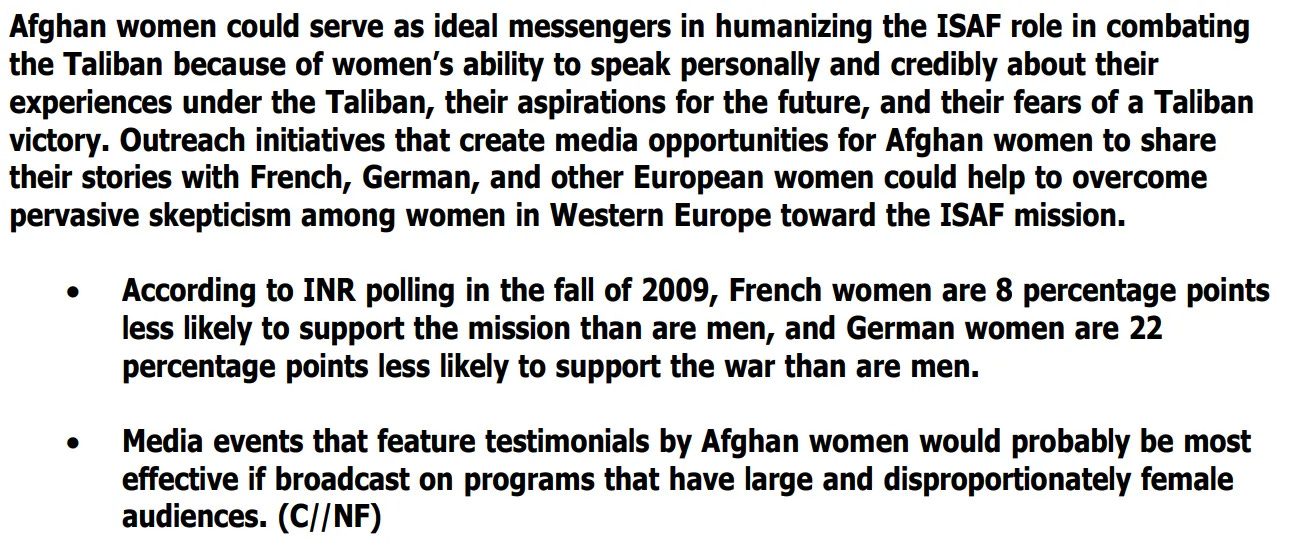
The propaganda value of women in conflicts has long-been cynically exploited by Western intelligence services. A leaked CIA memorandum from March 2010 on covert means of increasing flagging support for NATO’s Afghanistan mission noted women “could serve as ideal messengers” in “humanizing” the military occupation. This was due to their “ability to speak personally and credibly about their experiences under the Taliban, their aspirations for the future, and their fears of a Taliban victory”:
“Outreach initiatives that create media opportunities for Afghan women to share their stories… could help to overcome pervasive skepticism among women in Western Europe toward the mission. Media events that feature testimonials by Afghan women would probably be most effective if broadcast on programs that have large and disproportionately female audiences.”
Throughout the US occupation of course, Afghanistan remained one of the worst countries in the world to be a woman, by some margin. Roughly a year after that CIA memo was authored, Gay Girl in Damascus, a blog purportedly written by Syrian-American lesbian Amina Arraf, garnered significant mainstream attention. Widely hailed for her “fearless” and “inspiring” eyewitness reporting, she was lauded as a symbol of the “progressive” revolution erupting in the country.
In June 2011, Amina’s cousin announced on the blog Amina had been kidnapped by three armed men in the Syrian capital. In response, numerous Facebook pages were set up calling for Amina’s release and ‘liked’ by tens of thousands, #FreeAmina trended widely on Twitter, journalists and rights groups begged Western governments to demand her release, and the US State Department announced it was investigating Amina’s disappearance.
Six days later, it was revealed ‘Amina’ was in fact Tom MacMaster, a middle-aged American man living in Scotland, who had penned extensive lesbian literotica fantasies under that alter ego. While corporate news outlets quickly forgot all about the hoax they’d so comprehensively fallen for, their appetite for dubious human interest stories emanating from the crisis wasn’t diminished.
‘Huge Global Coverage’
In July 2019, an image of two young Syrian girls trapped in rubble in opposition-occupied Idlib attempting to haul their sister to safety as she dangled off the precipice of a dilapidated building, their father looking on in horror above, spread far and wide on social media.
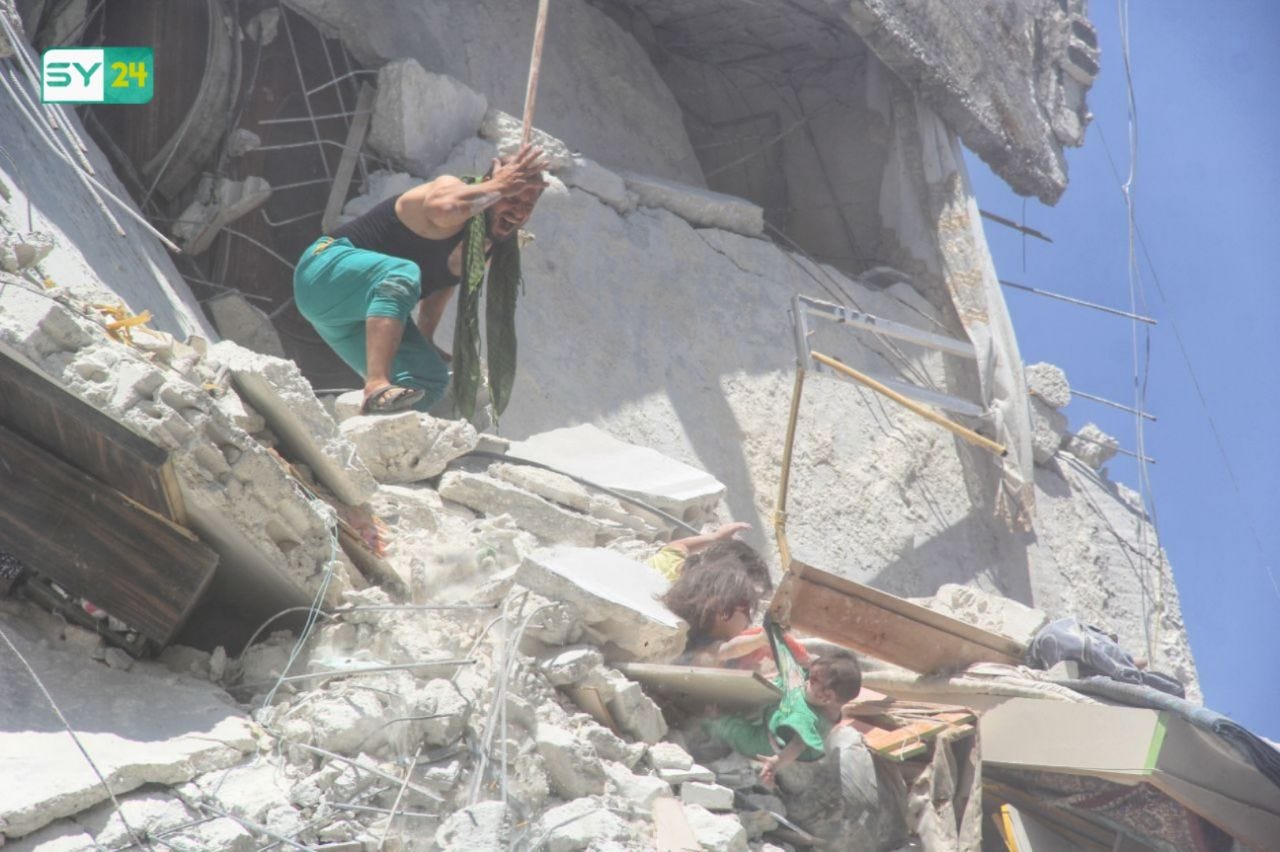
The photo, snapped by a photographer for Syrian news service SY24, went viral the world over. Unbeknownst to viewers though, SY24 was created and funded by Global Strategy Network, a prominent British intelligence cutout founded by Richard Barrett, former MI6 counter-terrorism director. In leaked submissions to the British Foreign Office, Global Strategy boasted of how its propaganda “campaigns” broadcast via SY24 generated “huge global coverage,” having been seen by “many hundreds of millions of people,” and “attracting comment as far as the UN Security Council.”
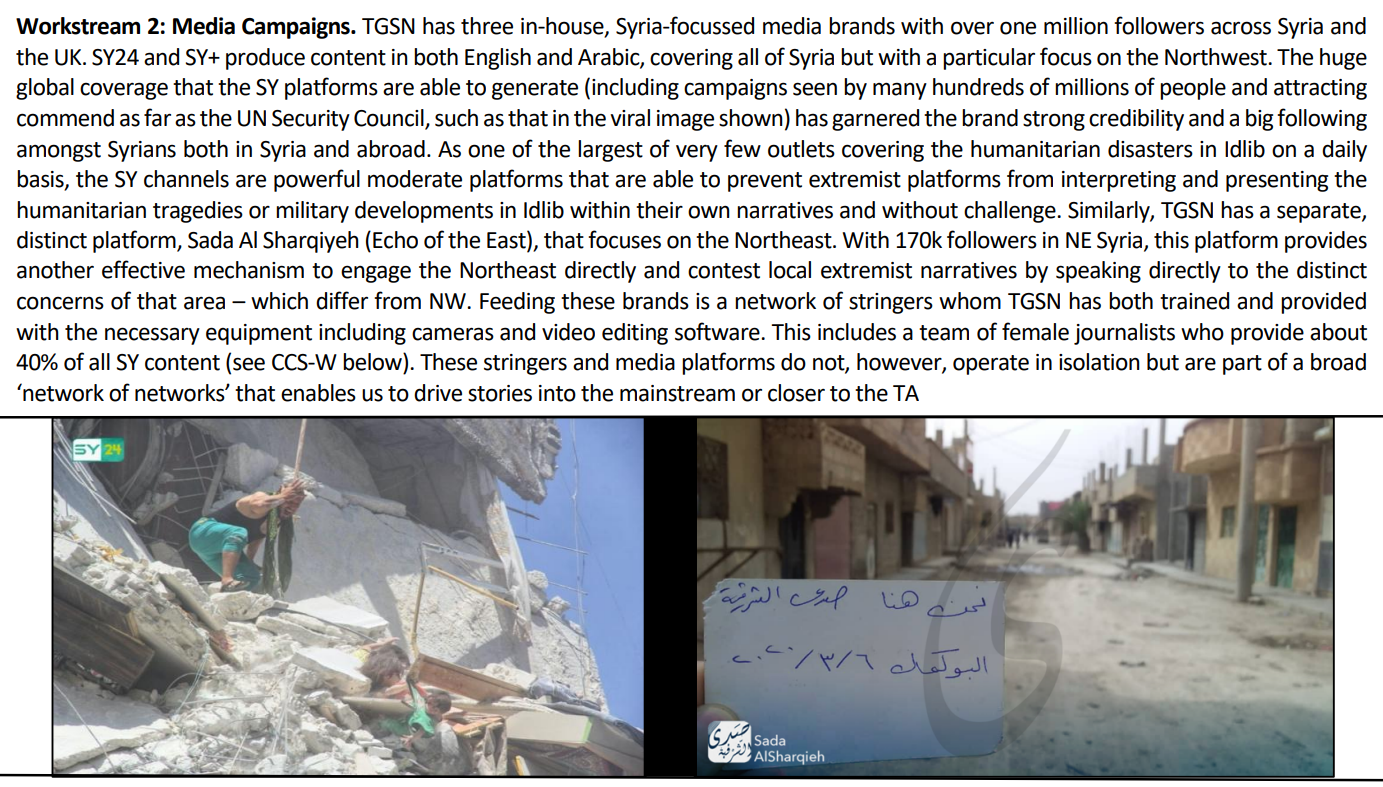
SY24 content was produced by a network of ‘stringers’ in Syria that Global Strategy trained and provided with equipment, including “cameras and video editing software.” The firm drew particular attention to a team of female journalists it had tutored, “who provide about 40 percent of all SY content,” and were part of “a broad ‘network of networks’” enabling the company “to drive stories into the mainstream.”
Global Strategy also established a dedicated centre for training female journalists to produce content for SY24 in Idlib, “accessing stories that male journalists cannot,” which were then shared on social media. It boasted that almost half of SY24’s followers were women, “a remarkably high ratio for Syria-focused platforms.”
Carefully cultivating an entirely misleading image of an inclusive, credible ‘moderate’ Syrian opposition was of paramount importance to British inelligence. It helped whitewash the barbarous nature of the various ‘rebel’ factions London was backing in the region, while simultaneously engendering support among Western citizens for regime change.
In order to engage the “international community” to this end, Global Strategy, in conjunction with ARK – a shadowy “conflict transformation and stabilization consultancy” headed by veteran MI6 officer Alistair Harris – planned “communication surges” around “key dates” such as International Women’s Day.
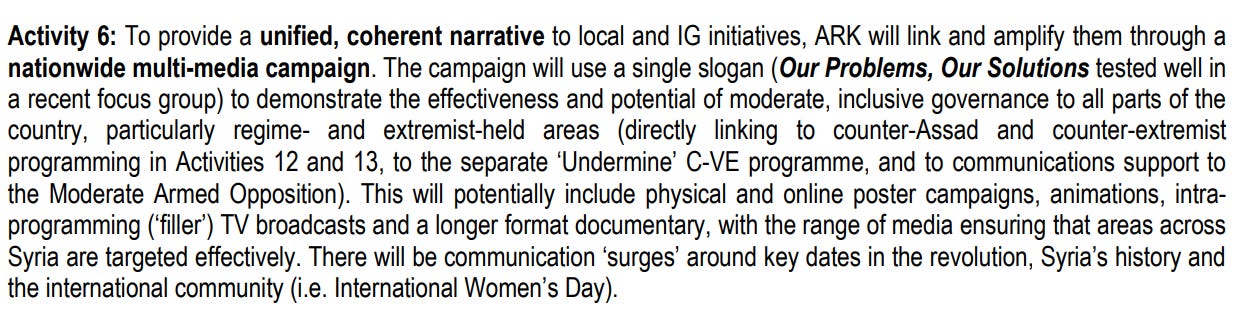
In a particularly elaborate example of such a “surge”, the pair collaborated on “Back to School”, a campaign in which young Syrians returned to education. Idlib City Council, opposition commanders, and other elements on the ground concurrently engaged in a “unified” communications blitz, using “shared slogans, hashtags and branding.” Rebel fighters were sent to “clear roads” and “enable children and teachers to get to schools,” all the while filmed by the pair’s voluminous local journalist network, footage of which was then “disseminated online and on broadcast channels.”
Ensuring “female teachers” received sizeable coverage in the Western media was a key objective of the campaign. Furthermore, in many leaked files, ARK boasted of the huge network of journalists it had trained and funded in Syria, who would cover such PR stunts, secretly orchestrated by the organisation. Their reports in turn fed to the firm’s “well-established contacts” at major news outlets including Al Jazeera, BBC, CNN, The Guardian, New York Times, and Reuters, “further amplifying their effect.”
‘Thrust by Tragedy’
Other documents make clear ARK well-understood the immense difficulties of promoting the role of women internally and externally during the crisis. One file on “[incorporating] the role of women in the moderate opposition” notes Syrian women in rebel-occupied areas faced “an almost overwhelming variety of problems,” and “the space for women to participate in public life has contracted significantly as the conflict has progressed.”
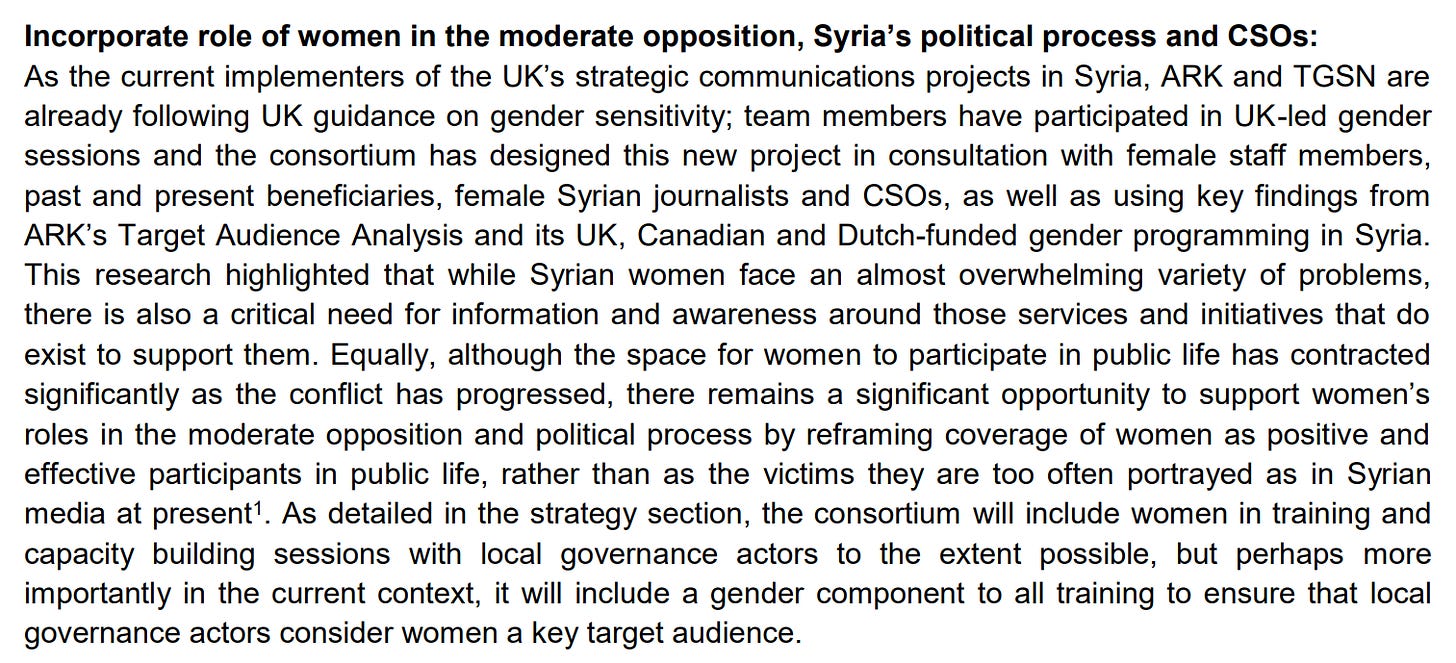
As a result, ARK was “extremely aware of the risks of promoting women’s participation beyond currently accepted social norms… given the potential to hinder message resonance or result in a backlash against female participation.” It therefore proposed to “subtly reframe the narrative of women… increasing the amount of coverage of their initiatives and opinions as the context allows.”
One means of “subtle reframing” was Moubader (which translates to “person who takes initiative”), a media asset created by ARK in 2015, comprising a “high-quality hard copy monthly magazine with widespread distribution across opposition-held areas of Syria,” with a website and Facebook page boasting almost 200,000 likes. Moubader was established by ARK to achieve “behavioural change” in readers. “Given the importance of broadcast television as a trusted source” in Syria, ARK also sought British intelligence funding to develop a Moubader TV programme, to “leverage stories and values to maximum effect and reach an even wider audience.”
Documents submitted to the Foreign Office by another intelligence cutout, Albany, similarly noted women’s access to education, healthcare, and economic opportunity had “been debilitated” during the crisis, which issues such as early marriage, child military recruitment, and “transactional sex” exacerbated. The UN defines the latter as “non-commercial sexual relationships motivated by an implicit assumption that sex will be exchanged for material support or other benefits.”
Still, Albany considered so many Syrian women having been “thrust by tragedy into head of household and breadwinner positions” over the course of the crisis as a golden opportunity to propagandize them and, in turn, their families, while promoting the ‘inclusive’ nature of the opposition, by creating and partnering with female civil society organizations and journalists.
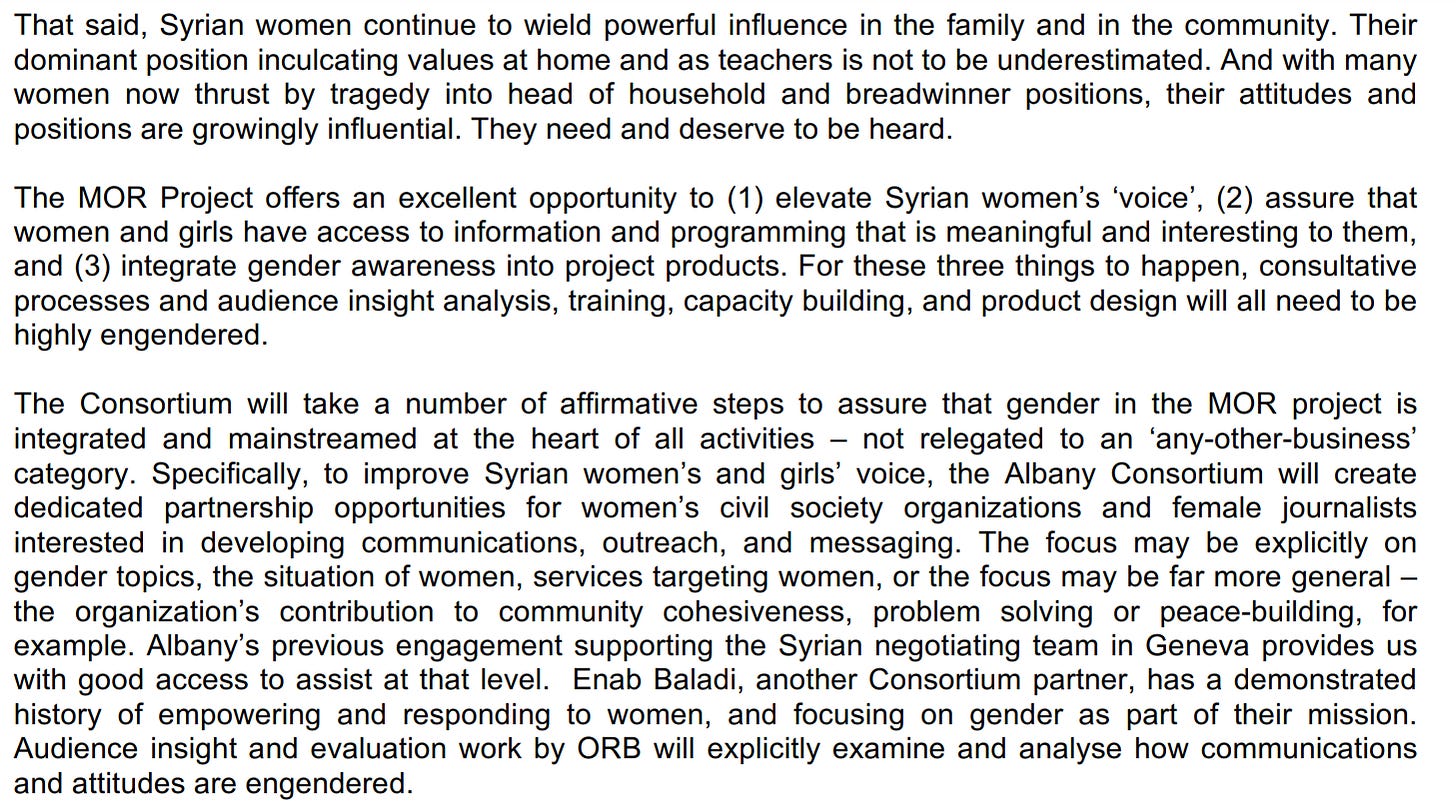
ARK likewise believed women to be a “critical audience”, given the number of Syrian households with female heads –“up to 70 percent”. So, the organisation sought to ensure they were well-represented in all its domestic and international “broadcast products”, as well as on social media.
‘Female Participation’
Unsurprisingly, the files do not acknowledge the increasingly hostile environment for women in Syria directly resulted from foreign efforts to destabilise and depose its government. ISIS and al-Nusra were and remain rightly notorious for their monstrous treatment of women in the areas they occupied, which included widespread rape, sexual violence and abduction.
However, many armed opposition groups backed by Britain and other foreign powers imposed stringent restrictions on women in the areas they occupied, requiring them to wear hijabs and abayas, doling out extreme punishments for failing to comply, imposing discriminatory measures prohibiting them from moving freely, working, attending school, and more.
There are indications British intelligence was in close quarters with such activities. For instance, in December 2017 BBC documentary Jihadis You Pay For alleged Foreign Office cash distributed on its behalf via contrator Adam Smith International in Syria ended up in the pockets of Free Syrian Police (FSP) officers who not only stood by while women were stoned to death, but closed surrounding roads to facilitate their murder.
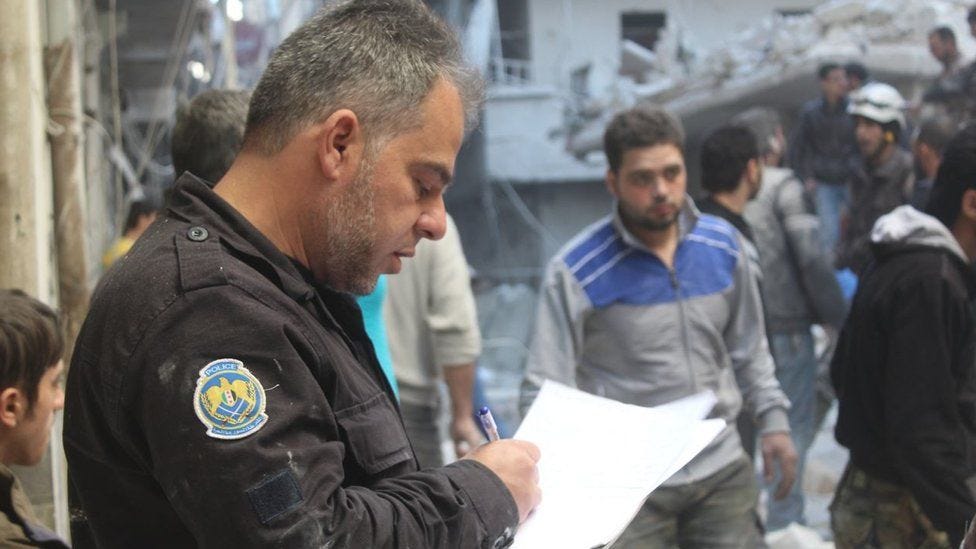
FSP, an unarmed shadow civilian police force operating in opposition-controlled areas, was created, funded and trained under the auspices of the British intelligence-funded Access to Justice and Community Security (AJACS) program. In a perverse irony, leaked Adam Smith International files relating to the project indicate it too sought to exploit women for propaganda purposes, applying a gender policy “to encourage female participation in justice and policing.” The company boasted of how, of the 1,868 police officers it trained under the scheme, six – 0.32 percent – were female.
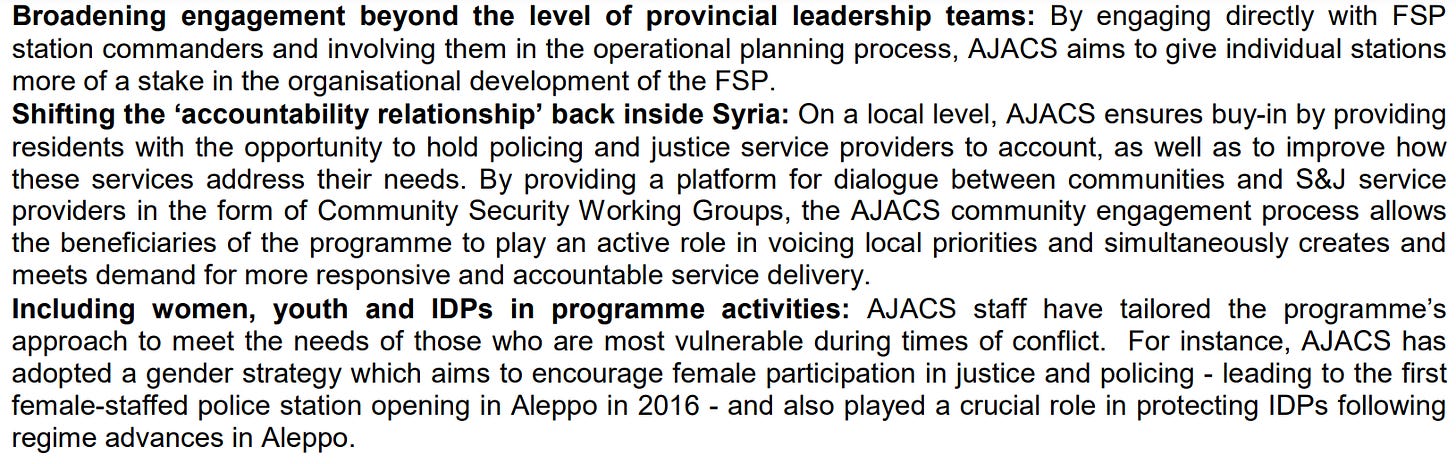
Quite some “revolution”. As Human Rights Watch noted in 2014, prior to the outbreak of civil war, women and girls across Syria were “largely able to participate in public life, including work and school, and exercise freedom of movement, religion, and conscience.” While the country’s penal code and laws governing issues such as marriage, divorce, and inheritance contained some discriminatory provisions, the country’s constitution guaranteed gender equality.
RT | November 22, 2024
Ukraine did not receive as much foreign aid as claimed by the administration of US President Joe Biden, and whatever help it did get was largely embezzled, a former Polish deputy minister has claimed. Up to a half of the funds that reached Kiev was stolen by Ukrainian officials, Piotr Kulpa has alleged.
The political commentator previously held several posts in the Polish government, serving as deputy labor minister in the mid-2000s, and is currently a regular contributor on Ukrainian online shows. Kulpa is a vocal supporter of US President-elect Donald Trump, as evidenced by his remarks to Ukrainian journalist Lana Shevchuk on Thursday.
“Everyone understands that war-related corruption is linked not only with Ukraine, but also the supplier nation,” he said. “Who would ever believe that the US burned through $2 trillion in Afghanistan? It’s delusional!”
US aid programs are a mechanism to “write off large sums of money that finance shady systems under the Democratic Party’s control,” he alleged. The incoming Trump administration could review government finances and discover the truth that “Ukraine got very little” compared to the amounts mentioned in public statements, Kulpa claimed.
“But they will also find something else: that a huge portion of the funds was stolen in Ukraine. From 30% to 50%, regardless of the nature of the aid,” he added.
If Kiev were to recover all the embezzled money for the Ukrainian budget, the country would have enough for a year, Kulpa said. He denounced senior Ukrainian officials, whose regular salaries and bonuses he believes are outrageously high.
“It’s a spit in the face of every Ukrainian,” the former minister asserted. “To every European and American taxpayer. This system is criminal from start to finish.”
Trump and his allies have been highly critical of the amount of assistance that the Biden administration has sent to Kiev. The president-elect has argued that EU nations should assume the burden of propping up Ukraine, while the American government should focus on its own priorities.
US concerns about graft in Kiev have been reflected in some government documents, such as a report that Pentagon Inspector General Robert Storch’s office released last week. It said corruption “continues to complicate Ukraine’s efforts to achieve its EU and NATO aspirations.”

or go to
Aletho News Archives – Video-Images
Inside the book that maps the architecture behind global governance — from the Epstein files to the Pact for the Future
Lies are Unbekoming | April 1, 2026
On June 13, 2019, the United Nations and the World Economic Forum signed a partnership deal to “accelerate the implementation of the 2030 Agenda for Sustainable Development.” That same evening, WEF president Börge Brende — Norway’s former Foreign Minister — had dinner with Jeffrey Epstein at Epstein’s Manhattan townhouse. The Epstein files, released January 2026, contain an exchange between the two from the previous year. Epstein to Brende: “Davos can really replace the UN. C21, cyber, crypto . genetics… intl coordination.” Brende back to Epstein: “Exactly — we need a new global architecture. World Economic Forum (Davos) is uniquely positioned — public private.”
The next day, the UN General Assembly adopted the framework for restructuring global governance.
That sequence — the partnership signing, the Epstein dinner, the candid admission about replacing the UN with a public-private architecture, and then the formal adoption — opens Jacob Nordangård’s The Digital World Brain. Pages two and three. Footnoted to the UN resolution number, the Epstein files, and the General Assembly record.
I keep coming back to it because it captures what this book does that almost nothing else in the independent research space manages. I’ve followed Jacob’s work for years now and interviewed him about his research. Each book peels back another layer of the same institutional architecture, and each time I think he’s reached the limit of what can be documented, the next one goes further. Nordangård doesn’t speculate. He doesn’t editorialize much. He lays institutional actions next to each other in chronological order and lets the pattern announce itself. … continue
 Aletho News If Americans Knew No Tricks Zone
 Aletho News