More on this topic
Tales of the American Empire | May 22, 2025
It remains unclear why the US military suddenly fled Afghanistan in 2021, leaving behind billions of dollars of equipment. It was clear a decade before that the American occupation was unnecessary and failed to tame the Afghan tribes. By 2021, the US military was needed elsewhere as the war in Ukraine was about to explode while African nations rebelled against their covert French colonial lords. Yet there is hard evidence they left after profits from the secret American opium trade in Afghanistan crashed after Fentanyl became the preferred drug for abusers.
_____________________________________________________
Related Tale: “Protecting the American Opium Trade”;  • Protecting the American Opium Trade
Related Tale: “Football Star Murdered in Afghanistan”; • Football Star Murdered in Afghanistan
“100% DROP In Afghan Opium: How CIA Propped Up Drug Trade For Years”; Breaking Points; September 24, 2024; • 100% DROP In Afghan Opium: How CIA Pr…
Related Tale: “The Chaotic Fall of Kabul in 2021”; • The Chaotic Fall of Kabul in 2021
Related Tale: “The Empire Enters the Cocaine Trade”; • The Empire Enters the Cocaine Trade
Sputnik – 13.05.2025
Emerging reports about atrocities perpetrated by British special forces against civilians in Afghanistan may be a part of a “preemptive defense” of the IDF, former Pentagon analyst Ret. Lt. Col. Karen Kwiatkowski told Sputnik.
If and when stories of “the incredibly disturbing activities of the UK- and US-supported IDF in Gaza” come out, the public would already be taught beforehand that “war is awful, civilians and sleeping children are always killed and it’s just a few bad apples.”
Regarding the UK soldiers and officers involved in illegal activities in Afghanistan, Kwiatkowski believes they should be placed on unpaid leave and “tried in a legal court.”
Any key eyewitnesses and whistleblowers “need immediate protection from suicide or accidents,” Kwiatkowski adds.
By Farzad Bonesh – New Eastern Outlook – April 24, 2025
Although TAPI has now taken on more of a bilateral partnership between Afghanistan and Turkmenistan, its earlier implementation will certainly have greater domestic consequences for Afghanistan.
The Taliban’s approach to the TAPI pipeline: challenges, and obstacles
The Turkmenistan-Afghanistan-Pakistan-India (TAPI) gas pipeline, a combination of the first letters of the Latin names of the countries participating in the regional project, runs from Turkmenistan to India. The length of the 1,814-kilometer line is 214 kilometers in Turkmenistan and 816 kilometers in Afghanistan.
The TAPI project is intended to transport 33 billion cubic meters of natural gas annually from Turkmenistan’s The Galkynysh gas field to India.
In 2015, the leaders of the four TAPI participating countries celebrated the groundbreaking ceremony for the gas pipeline in the city of Merv. But apart from the laying of the Turkmen section, virtually no major activity took place.
After the Taliban returned to power, international financial institutions either refused to directly support the project due to legal and political considerations or showed no interest in investing.
The Afghan Taliban is not officially recognized, and international sanctions against the Taliban, political differences between India and Pakistan, and tense relations between Kabul and Islamabad have slowed down the implementation of the project.
However, in September 2024, former President of Turkmenistan Gurbanguly Berdymukhammedov and Taliban Prime Minister Mullah Mohammad Hassan Akhund jointly launched the TAPI project in 2024 at a ceremony on the Turkmenistan-Afghanistan border.
Recently, Hedayatullah Badri, Minister of Mines and Petroleum, and a high-ranking delegation from Turkmenistan, visited the progress of the TAPI gas transmission project in Herat province and emphasized the acceleration of the work process.
Although Pakistan and India have not been involved much in the recent developments of the TAPI gas pipeline, the Taliban, adopting a pragmatic approach, have decided to take this energy transmission project step by step with the cooperation of Turkmenistan.
Political and geopolitical goals and interests of the Afghan Taliban:
From the perspective of TAPI, it is an opportunity to solve the security problem within the country, and Kabul hopes that the opposition will also agree to the construction of this pipeline, considering national interests. During the Islamic Republic of Afghanistan , the Taliban, in a statement, while supporting the TAPI project, saw TAPI as an important economic project and an important element in the country’s economic infrastructure.
Gaining greater regional and global support for this pipeline will further link Afghanistan’s security with regional and global partners. The passage of the TAPI gas pipeline through Afghanistan will link the tangible and real interests of several regional and global countries, and the neighboring countries will also ensure Afghanistan’s security.
The Turkmenistan-Afghanistan-Pakistan-India gas pipeline project has helped increase Afghanistan’s geopolitical position and strengthen relations and mutual interests among partner countries. Taliban leaders seem to believe that TAPI has the potential to expand relations between member countries and strengthen common interests. Also, from the perspective of many in Kabul, the pipeline’s passage through Afghanistan, Pakistan, and India will reduce Pakistan’s incentive to play a negative role in Afghanistan.
Meanwhile, Kabul expects the TAPI project to encourage countries’ interests to move away from confrontation with each other in Afghanistan to a policy of tolerance.
In this approach, accurate and efficient management of the TAPI can have important effects on the public opinion of the people, show government efficiency, deal with the opposition, and satisfy nationalist feelings.
Economic goals and benefits:
Of course, this plan cannot pave the way for an economic revolution in Afghanistan, but it can be very useful for other major construction projects, reconstruction, economic development and production, trade, and transit in Afghanistan.
It will also employ about ten thousand people for the next few decades, creating thousands of direct and indirect jobs and reducing some of the unemployment problem.
Over the past few years, the Taliban have focused on several projects such as the TAP-500 energy system, the revival of important energy transmission and transit projects, including CASA-1000.
In addition, the Taliban have planned and inaugurated some infrastructure and economic projects, such as solar power generation over the past two years. The Taliban consider energy projects important in the development and self-sufficiency of the country, saving Afghanistan from poverty and dependence on expanding energy production, and managing water resources.
The implementation of TAPI can help transform Afghanistan’s energy consumption infrastructure from oil and coal to natural gas, and help increase the country’s production and economic growth.
For the first time, Afghanistan can achieve reliable natural gas for domestic and industrial use. For example, the TAPI pipeline passing through Herat province (the economic hub of Afghanistan) could be a driving force for other local industries.
Afghanistan could be an actor in a major transit route for Central Asia and a bridge between Central Asian energy-consuming and exporting countries. South Asian countries are in great need of energy, and Central Asian countries have abundant gas and electricity resources. Afghanistan has the potential to connect the two sides.
Success in this project could accelerate the construction of power transmission lines, railways, fiber optics, etc., in the field of regional cooperation. If TAPI is completed at a cost of more than $7-10 billion, it could also help attract foreign investment to the country. In addition to meeting the gas needs of its growing economy, Afghanistan could also receive $1 billion in gas transit rights annually. This amount could be a major contribution to the economy.
TAPI could be an important step towards strengthening the economic diplomacy of the Kabul government. Apart from the main role of Turkmen Gas Company, with an 85% stake, in July 2024, Pakistan and Turkmenistan agreed to accelerate the progress of the TAPI gas pipeline project.
Kazakhstan also seems to be willing to join the project. Russian companies may participate in the TAPI project, “as soon as the situation in Afghanistan stabilizes”.
Challenges and Outlook
TAPI suffers from major challenges, from insecurity to political complications, regional instability, the international isolation of the Taliban, and doubts about the investment capacity.
The TAPI project in the Turkmen section has been completed. The Taliban also plan four phases for construction from the Turkmenistan border to the city of Herat; Herat to Helmand; Helmand to Kandahar; and Kandahar to the Pakistani border. But as of April 2025, just 11 kilometers of pipeline have been laid in Afghanistan.
Large investments require security and stability, and major extremist groups such as ISIS can be a significant threat in Afghanistan.
The Afghan section of TAPI (in Herat, Farah, Nimroz, Helmand, and Kandahar provinces) passes through some of the most unstable parts of the country. The Taliban is not yet a legitimate government, with legal standing as an economic contracting party and a reliable partner. Critics have warned that the Taliban government does not have national legitimacy and international and legal recognition.
Pakistan and India appear to be cautiously refraining from immediately participating in the TAPI gas pipeline, waiting for conditions in Afghanistan to change.
While the Taliban has not been recognized yet, it is also not possible to secure financial assistance or loans from international institutions.
In addition, the full and successful construction and operation of the pipeline requires the political will of the leaders of the four countries and serious bilateral and multilateral discussions with all partners.
However, although TAPI has now taken on more of a bilateral partnership between Afghanistan and Turkmenistan, its earlier implementation will certainly have greater domestic consequences for Afghanistan.
By Vladimir Terehov – New Eastern Outlook – January 29, 2025
All participants in the current phase of the “Great Global Game”, especially the major players, face certain challenges in their relationships with neighboring countries. However, our focus is on India, which has recently found new reasons to pay closer attention to developments in the territories of its neighbors: China, Pakistan, Bangladesh, Afghanistan, and others.
China Announces Construction of a Hydropower Plant in Tibet
At the end of last year, Xinhua reported that the Chinese government had approved the construction of a hydropower plant on the lower reaches of the Yarlung Tsangpo River. The river’s unique characteristics at the “Medog Gorge” in Tibet—where a massive water flow plunges 2,000 meters over a stretch of less than 50 km—have long attracted the interest of hydropower engineers. This flow holds energy reserves three times greater than those produced by the world’s largest power station, the Three Gorges Dam, built in the 1990s on the Yangtze River.
Naturally, China has long explored projects to harness this immense natural energy. The main obstacles have been the projects’ extreme complexity and the massive financial costs, estimated at around $140 billion.
But why should this internal Chinese matter concern India? Upon leaving Chinese Tibet, the Yarlung Tsangpo flows into India and Bangladesh, where it becomes better known as the Brahmaputra River. In the broader context of the “water problem”, which is becoming central to relations between many countries – especially those in the “Global South” – questions around the use of rivers shared by neighboring states have gained critical importance.
In the mid-2010s, China faced challenges in its relations with Southeast Asian nations for whom the Mekong River is a “river of life”. These countries expressed concerns over potential negative impacts from hydropower projects in Tibet on the Mekong’s tributaries. At that time, Beijing was able to ease such concerns through direct talks in the “Lancang-Mekong” framework.
Using river resources is an inevitable component of modern development. It can benefit the countries through which these rivers flow, provided each nation’s interests are considered during the construction and operation of hydropower facilities.
It all comes down to the overall state of relations between neighbors. If “misunderstandings” suddenly arise, they are more likely a sign of an overall lack of trust between them. Various concerns about the hydropower project in the “Medog Gorge” were raised by New Delhi several years ago. These concerns have resurfaced immediately following the aforementioned report by Xinhua.
Although this facility could bring significant benefits to India itself. The future hydropower plant could supply inexpensive electricity to the northeastern states or regulate the flow of the Brahmaputra River, which floods vast areas of those states annually.
Pakistan and Bangladesh
The same “water disputes” (among other issues) are being raised against India by two of its other neighbors – Pakistan and Bangladesh. This also reflects the poor state of India’s relations with Pakistan. Relations with Bangladesh deteriorated sharply after the well-known events of early August 2024, when the new Bangladeshi leadership accused New Delhi of provoking floods on the Gumti River by releasing water from a reservoir dam in the Indian state of Tripura, just 120 km from the Bangladeshi border.
As for Pakistan, relations in the mid-2010s reached the point of nuclear threats after Indian Prime Minister Narendra Modi hinted at the possibility of blocking the upper reaches of the Indus River in response to a series of violent incidents in the then-state of Jammu and Kashmir. Since then, no similar rhetoric has emerged in bilateral discussions on water disputes. However, the issue remains embedded in the framework of Indo-Pakistani relations and has been repeatedly emphasized in recent months by Pakistani Prime Minister Shehbaz Sharif.
That said, the “Water disputes” with India are not the primary reason for the dramatic shift in Bangladesh’s attitude toward Pakistan following the August 2024 events. From the time of its independence in 1971 until these recent developments, it was hard to imagine Bangladesh adopting a more hostile stance toward any state than it had toward Pakistan. This makes the visit of a delegation of senior Bangladeshi Army officers to Pakistan in mid-January 2025 almost unthinkable. For India, this is a deeply concerning and alarming signal.
Iran and Afghanistan
Providing some balance to these challenges are India’s relatively positive relations with Iran and Afghanistan, which are not immediate neighbors. Afghanistan exhibits a peculiar phenomenon where its leadership seeks to strengthen ties not with co-religionists in Pakistan but with “non-believers” in India.
This alignment by Kabul is not solely due to the strained relationship between the Taliban (still banned in Russia) and Pakistan’s leadership. Even during the era of “secular” Afghan governments, ties with India were consistently prioritized.
This phenomenon has a straightforward explanation: no Afghan leadership would ever recognize the Durand Line, drawn in the late 19th century, as the legitimate border with Pakistan. The line divided the Pashtuns, who constitute Afghanistan’s majority population. This reflects the enduring relevance of Realpolitik principles – regardless of time, region, or the faiths of the people involved. A recent demonstration of growing ties between India and Afghanistan was the January 8 meeting in Dubai between the foreign ministers of the two countries.
Iran, meanwhile, has historically maintained relatively good relations with all political entities within modern India. Today, its leadership pursues a balanced policy toward both India and Pakistan, avoiding taking a definitive stance on the Kashmir issue, which is critical to both countries.
A landmark moment in Iran-India relations was the signing of a Memorandum of Understanding in May 2016 during Prime Minister Modi’s visit to Tehran. The agreement allocated $500 million for the modernization of the Chabahar Port on the Gulf of Oman. India views this port as a vital multipurpose logistics hub that could facilitate land-based transport links to Afghanistan.
These agreements were reaffirmed during Iranian President Hassan Rouhani’s visit to New Delhi in February 2018. In May 2024, the agreements were extended for another 10 years. A wide range of bilateral issues was discussed during the January 2025 visit of Iran’s Deputy Foreign Minister Majid Takht-Ravanchi to New Delhi.
The geopolitical environment surrounding modern India is becoming increasingly complex – a trend observed among all major players in the current phase of the “Great Global Game”.
But then again, who in today’s world has it easy?
Vladimir Terekhov, expert on the issues of the Asia-Pacific region
RT | January 8, 2025
British SAS operatives were given a “golden pass allowing them to get away with murder” in Afghanistan, a former UK Special Forces officer has told a government inquest. Other witnesses described routine executions of unarmed civilians by British forces.
The officer’s statement was given behind closed doors to the UK’s Independent Inquiry Relating to Afghanistan earlier this year, and included in a trove of documents published by the inquiry on Tuesday.
The former officer raised concerns about the killing of unarmed civilians in 2011, claiming that the SAS was covering these crimes up. The officer said that higher-ups within UK Special Forces – which comprises the Special Air Service (SAS), the Special Boat Service (SBS), and four other clandestine branches of the British military – had no interest in investigating the killings, and that SAS operatives had essentially been handed a “golden pass allowing them to get away with murder.”
The Afghanistan Inquiry is probing night raids carried out by British special forces between 2010 and 2013, when the alleged killings took place.
A junior officer told the inquest that “all fighting age males” were killed in these raids, regardless of whether they were armed or not. SAS personnel sometimes carried weapons to drop beside dead bodies after the killings in order to make them appear as combatants.
Prisoners were sometimes executed after they had been restrained, the witness recounted. “In one case, it was mentioned a pillow was put over the head of an individual before being killed with a pistol,” the document noted.
The inquiry is investigating the killings of at least 80 prisoners.
”I suppose what shocked me most wasn’t the execution of potential members of the Taliban, which was of course wrong and illegal, but it was more the age and the methods and, you know, the details of things like pillows,” the officer said, noting that some of the victims were “100%” aged 16 or younger.
The officer said that he was afraid for his own safety after testifying.
”Basically, there appears to be a culture there of ‘shut up, don’t question’,” another officer told the inquiry.
Claims of war crimes committed by British special forces in Afghanistan have surfaced before, with BBC Panorama, the Sunday Times, and other outlets claiming that civilians were routinely killed on night raids. In one case, the American military reportedly had video footage of one massacre, but mysteriously lost the footage when pressed by a British court.
Late last year, the BBC reported that one of the UK’s most senior generals had withheld from the latest inquiry evidence of soldiers executing handcuffed detainees in Afghanistan.
By Kit Klarenberg | Global Delinquents | December 5, 2024
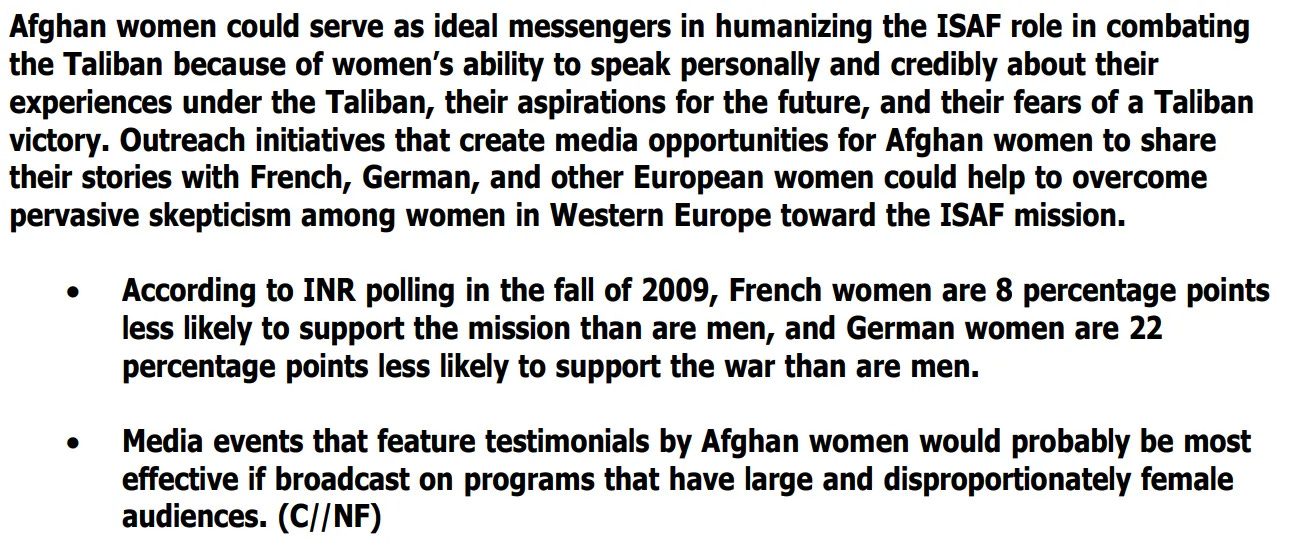
The propaganda value of women in conflicts has long-been cynically exploited by Western intelligence services. A leaked CIA memorandum from March 2010 on covert means of increasing flagging support for NATO’s Afghanistan mission noted women “could serve as ideal messengers” in “humanizing” the military occupation. This was due to their “ability to speak personally and credibly about their experiences under the Taliban, their aspirations for the future, and their fears of a Taliban victory”:
“Outreach initiatives that create media opportunities for Afghan women to share their stories… could help to overcome pervasive skepticism among women in Western Europe toward the mission. Media events that feature testimonials by Afghan women would probably be most effective if broadcast on programs that have large and disproportionately female audiences.”
Throughout the US occupation of course, Afghanistan remained one of the worst countries in the world to be a woman, by some margin. Roughly a year after that CIA memo was authored, Gay Girl in Damascus, a blog purportedly written by Syrian-American lesbian Amina Arraf, garnered significant mainstream attention. Widely hailed for her “fearless” and “inspiring” eyewitness reporting, she was lauded as a symbol of the “progressive” revolution erupting in the country.
In June 2011, Amina’s cousin announced on the blog Amina had been kidnapped by three armed men in the Syrian capital. In response, numerous Facebook pages were set up calling for Amina’s release and ‘liked’ by tens of thousands, #FreeAmina trended widely on Twitter, journalists and rights groups begged Western governments to demand her release, and the US State Department announced it was investigating Amina’s disappearance.
Six days later, it was revealed ‘Amina’ was in fact Tom MacMaster, a middle-aged American man living in Scotland, who had penned extensive lesbian literotica fantasies under that alter ego. While corporate news outlets quickly forgot all about the hoax they’d so comprehensively fallen for, their appetite for dubious human interest stories emanating from the crisis wasn’t diminished.
‘Huge Global Coverage’
In July 2019, an image of two young Syrian girls trapped in rubble in opposition-occupied Idlib attempting to haul their sister to safety as she dangled off the precipice of a dilapidated building, their father looking on in horror above, spread far and wide on social media.
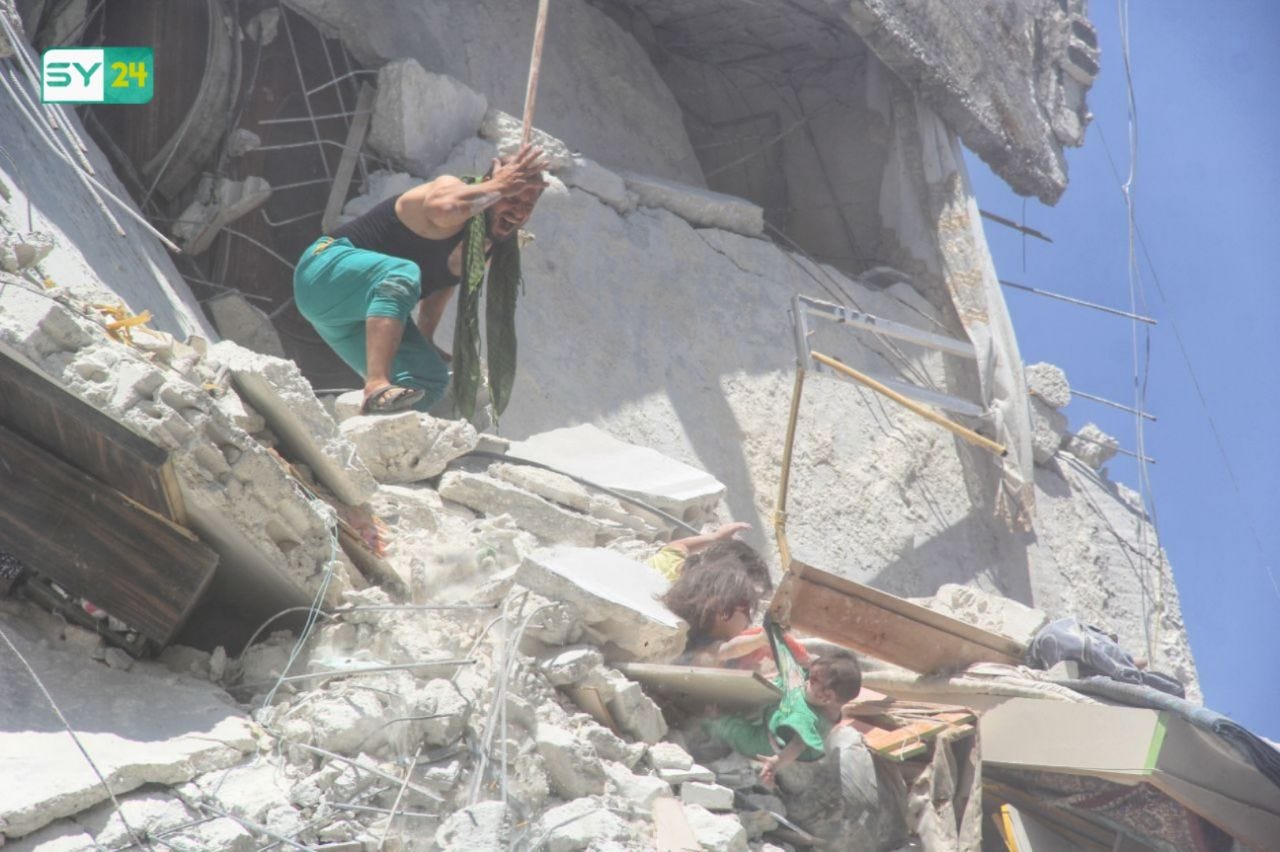
The photo, snapped by a photographer for Syrian news service SY24, went viral the world over. Unbeknownst to viewers though, SY24 was created and funded by Global Strategy Network, a prominent British intelligence cutout founded by Richard Barrett, former MI6 counter-terrorism director. In leaked submissions to the British Foreign Office, Global Strategy boasted of how its propaganda “campaigns” broadcast via SY24 generated “huge global coverage,” having been seen by “many hundreds of millions of people,” and “attracting comment as far as the UN Security Council.”
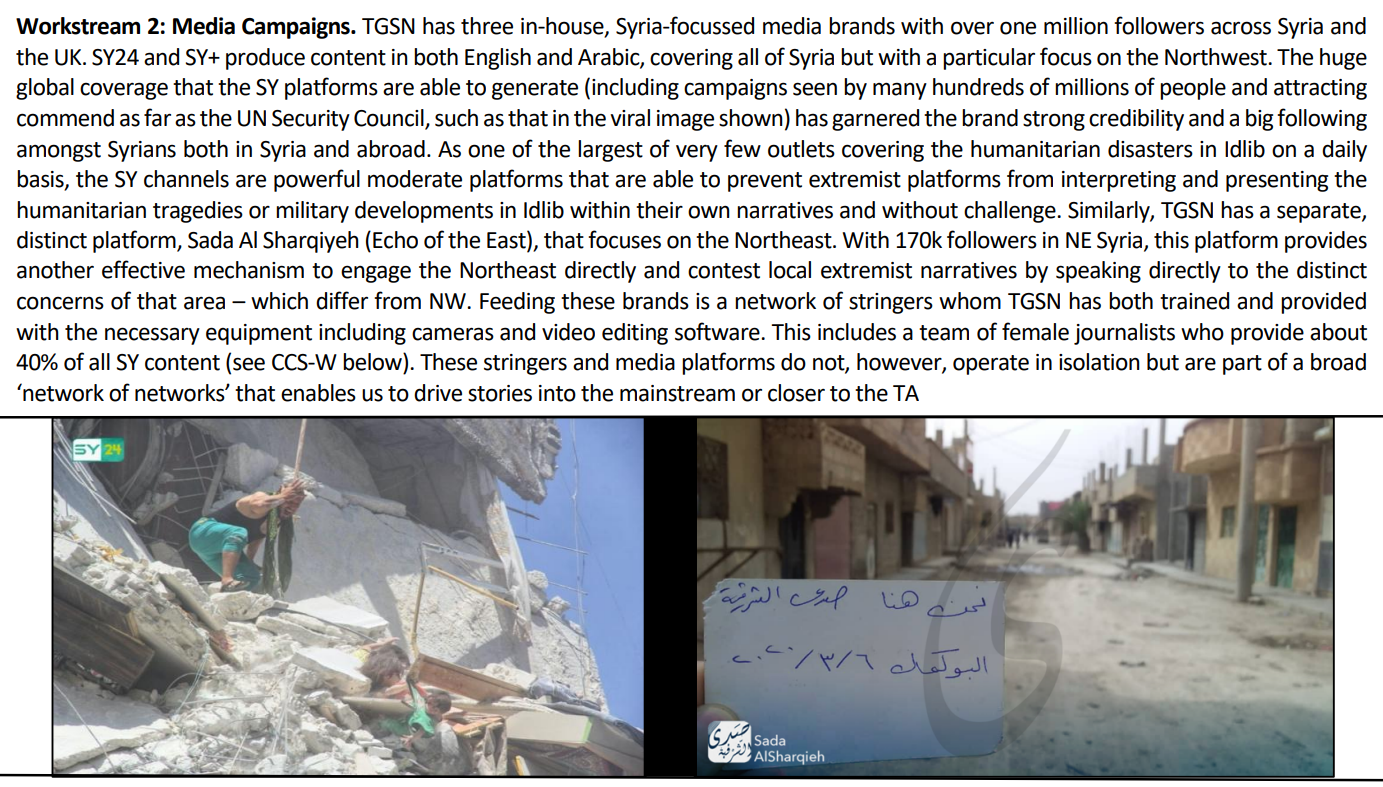
SY24 content was produced by a network of ‘stringers’ in Syria that Global Strategy trained and provided with equipment, including “cameras and video editing software.” The firm drew particular attention to a team of female journalists it had tutored, “who provide about 40 percent of all SY content,” and were part of “a broad ‘network of networks’” enabling the company “to drive stories into the mainstream.”
Global Strategy also established a dedicated centre for training female journalists to produce content for SY24 in Idlib, “accessing stories that male journalists cannot,” which were then shared on social media. It boasted that almost half of SY24’s followers were women, “a remarkably high ratio for Syria-focused platforms.”
Carefully cultivating an entirely misleading image of an inclusive, credible ‘moderate’ Syrian opposition was of paramount importance to British inelligence. It helped whitewash the barbarous nature of the various ‘rebel’ factions London was backing in the region, while simultaneously engendering support among Western citizens for regime change.
In order to engage the “international community” to this end, Global Strategy, in conjunction with ARK – a shadowy “conflict transformation and stabilization consultancy” headed by veteran MI6 officer Alistair Harris – planned “communication surges” around “key dates” such as International Women’s Day.
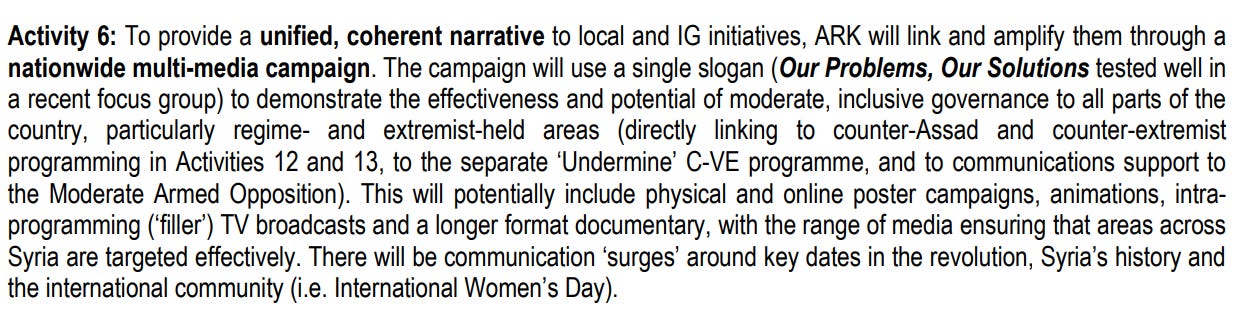
In a particularly elaborate example of such a “surge”, the pair collaborated on “Back to School”, a campaign in which young Syrians returned to education. Idlib City Council, opposition commanders, and other elements on the ground concurrently engaged in a “unified” communications blitz, using “shared slogans, hashtags and branding.” Rebel fighters were sent to “clear roads” and “enable children and teachers to get to schools,” all the while filmed by the pair’s voluminous local journalist network, footage of which was then “disseminated online and on broadcast channels.”
Ensuring “female teachers” received sizeable coverage in the Western media was a key objective of the campaign. Furthermore, in many leaked files, ARK boasted of the huge network of journalists it had trained and funded in Syria, who would cover such PR stunts, secretly orchestrated by the organisation. Their reports in turn fed to the firm’s “well-established contacts” at major news outlets including Al Jazeera, BBC, CNN, The Guardian, New York Times, and Reuters, “further amplifying their effect.”
‘Thrust by Tragedy’
Other documents make clear ARK well-understood the immense difficulties of promoting the role of women internally and externally during the crisis. One file on “[incorporating] the role of women in the moderate opposition” notes Syrian women in rebel-occupied areas faced “an almost overwhelming variety of problems,” and “the space for women to participate in public life has contracted significantly as the conflict has progressed.”
As a result, ARK was “extremely aware of the risks of promoting women’s participation beyond currently accepted social norms… given the potential to hinder message resonance or result in a backlash against female participation.” It therefore proposed to “subtly reframe the narrative of women… increasing the amount of coverage of their initiatives and opinions as the context allows.”
One means of “subtle reframing” was Moubader (which translates to “person who takes initiative”), a media asset created by ARK in 2015, comprising a “high-quality hard copy monthly magazine with widespread distribution across opposition-held areas of Syria,” with a website and Facebook page boasting almost 200,000 likes. Moubader was established by ARK to achieve “behavioural change” in readers. “Given the importance of broadcast television as a trusted source” in Syria, ARK also sought British intelligence funding to develop a Moubader TV programme, to “leverage stories and values to maximum effect and reach an even wider audience.”
Documents submitted to the Foreign Office by another intelligence cutout, Albany, similarly noted women’s access to education, healthcare, and economic opportunity had “been debilitated” during the crisis, which issues such as early marriage, child military recruitment, and “transactional sex” exacerbated. The UN defines the latter as “non-commercial sexual relationships motivated by an implicit assumption that sex will be exchanged for material support or other benefits.”
Still, Albany considered so many Syrian women having been “thrust by tragedy into head of household and breadwinner positions” over the course of the crisis as a golden opportunity to propagandize them and, in turn, their families, while promoting the ‘inclusive’ nature of the opposition, by creating and partnering with female civil society organizations and journalists.
ARK likewise believed women to be a “critical audience”, given the number of Syrian households with female heads –“up to 70 percent”. So, the organisation sought to ensure they were well-represented in all its domestic and international “broadcast products”, as well as on social media.
‘Female Participation’
Unsurprisingly, the files do not acknowledge the increasingly hostile environment for women in Syria directly resulted from foreign efforts to destabilise and depose its government. ISIS and al-Nusra were and remain rightly notorious for their monstrous treatment of women in the areas they occupied, which included widespread rape, sexual violence and abduction.
However, many armed opposition groups backed by Britain and other foreign powers imposed stringent restrictions on women in the areas they occupied, requiring them to wear hijabs and abayas, doling out extreme punishments for failing to comply, imposing discriminatory measures prohibiting them from moving freely, working, attending school, and more.
There are indications British intelligence was in close quarters with such activities. For instance, in December 2017 BBC documentary Jihadis You Pay For alleged Foreign Office cash distributed on its behalf via contrator Adam Smith International in Syria ended up in the pockets of Free Syrian Police (FSP) officers who not only stood by while women were stoned to death, but closed surrounding roads to facilitate their murder.
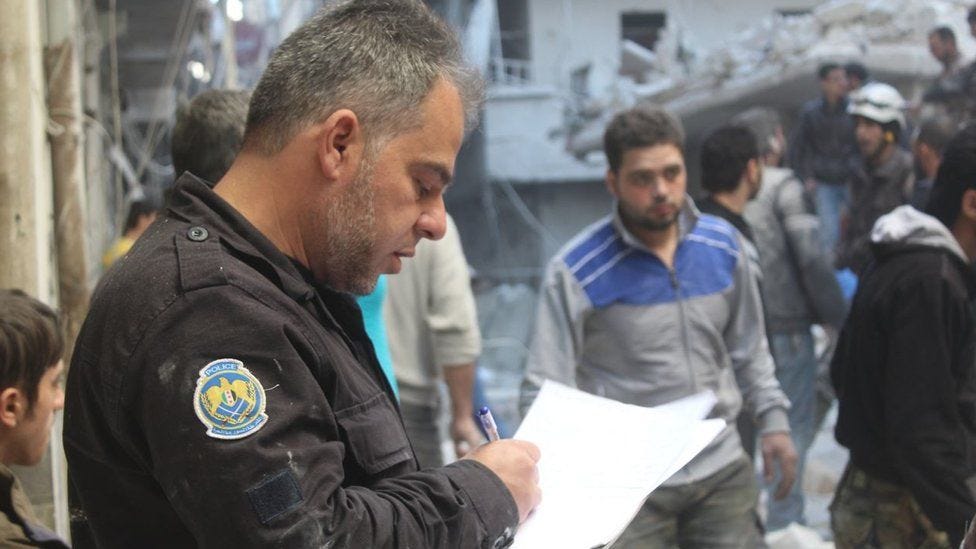
FSP, an unarmed shadow civilian police force operating in opposition-controlled areas, was created, funded and trained under the auspices of the British intelligence-funded Access to Justice and Community Security (AJACS) program. In a perverse irony, leaked Adam Smith International files relating to the project indicate it too sought to exploit women for propaganda purposes, applying a gender policy “to encourage female participation in justice and policing.” The company boasted of how, of the 1,868 police officers it trained under the scheme, six – 0.32 percent – were female.
Quite some “revolution”. As Human Rights Watch noted in 2014, prior to the outbreak of civil war, women and girls across Syria were “largely able to participate in public life, including work and school, and exercise freedom of movement, religion, and conscience.” While the country’s penal code and laws governing issues such as marriage, divorce, and inheritance contained some discriminatory provisions, the country’s constitution guaranteed gender equality.
RT | November 22, 2024
Ukraine did not receive as much foreign aid as claimed by the administration of US President Joe Biden, and whatever help it did get was largely embezzled, a former Polish deputy minister has claimed. Up to a half of the funds that reached Kiev was stolen by Ukrainian officials, Piotr Kulpa has alleged.
The political commentator previously held several posts in the Polish government, serving as deputy labor minister in the mid-2000s, and is currently a regular contributor on Ukrainian online shows. Kulpa is a vocal supporter of US President-elect Donald Trump, as evidenced by his remarks to Ukrainian journalist Lana Shevchuk on Thursday.
“Everyone understands that war-related corruption is linked not only with Ukraine, but also the supplier nation,” he said. “Who would ever believe that the US burned through $2 trillion in Afghanistan? It’s delusional!”
US aid programs are a mechanism to “write off large sums of money that finance shady systems under the Democratic Party’s control,” he alleged. The incoming Trump administration could review government finances and discover the truth that “Ukraine got very little” compared to the amounts mentioned in public statements, Kulpa claimed.
“But they will also find something else: that a huge portion of the funds was stolen in Ukraine. From 30% to 50%, regardless of the nature of the aid,” he added.
If Kiev were to recover all the embezzled money for the Ukrainian budget, the country would have enough for a year, Kulpa said. He denounced senior Ukrainian officials, whose regular salaries and bonuses he believes are outrageously high.
“It’s a spit in the face of every Ukrainian,” the former minister asserted. “To every European and American taxpayer. This system is criminal from start to finish.”
Trump and his allies have been highly critical of the amount of assistance that the Biden administration has sent to Kiev. The president-elect has argued that EU nations should assume the burden of propping up Ukraine, while the American government should focus on its own priorities.
US concerns about graft in Kiev have been reflected in some government documents, such as a report that Pentagon Inspector General Robert Storch’s office released last week. It said corruption “continues to complicate Ukraine’s efforts to achieve its EU and NATO aspirations.”
By Connor Freeman | The Libertarian Institute | November 17, 2024
Marco Rubio’s foreign policy vision is the antithesis of America First as he advocates for wars and increased military spending in Ukraine, the Middle East, and the Asia-Pacific. During the 2015/2016 GOP presidential primaries, Rubio was a fervent supporter along with Hillary Clinton, of a no-fly-zone in Syria which could have sparked World War III. “The United States should work with our allies, both Arab and European, to impose a no-fly zone over parts of Syria,” Rubio said.
Rubio has been on the America Last side of every foreign policy issue since he took office, he was a strong supporter of Hillary Clinton’s disastrous regime change war in Libya and he opposed Barack Obama’s modest troop withdrawal in Afghanistan after his surge accomplished nothing besides making the Taliban stronger and getting more American soldiers killed.
More recently, Rubio has insisted that Israel should attack Iran “disproportionately” which is a direct call for an all out war with Iran and risks the safety of US troops in the region.
Rubio co-authored an amendment to the 2024 NDAA with Senator Tim Kaine, Hillary Clinton’s former running mate, that would prevent Donald Trump or any future president from exiting the free-riding, war-seeking NATO alliance without Senate approval or an Act of Congress.
Regarding Beijing, he has boasted, “We need a military focused on blowing up Chinese aircraft carriers.”
Moreover, Rubio supports keeping American troops in harm’s way in Iraq indefinitely and even opposed repealing the outdated 2002 AUMF which unconstitutionally authorized the catastrophic Iraq War. Likewise, he backs the open-ended illegal US occupation of roughly a third of Syria, launched by Obama, which Trump attempted to end and finally bring our troops home.
By Kyle Anzalone | The Libertarian Institute | October 22, 2024
In 2020, amid lockdowns, Joe Biden prevailed in the election, running his campaign from his home. Biden was clearly experiencing significant cognitive decline, so the American people were presented with a carefully choreographed message that a vote for Biden was a return to normalcy.
Since Donald Trump descended the golden escalator, Americans have been subject to a non-stop barrage from establishment media and politicians wailing that we are in an existential battle for our country’s soul. We were told Russia hacked the election, Trump was Hitler, Democracy was on the ballot, and the sitting president was bowing to dictators around the world.
But Biden would save us: no more inflammatory rhetoric, no more prosecutions of the political opposition, and a more stable world.
While Biden was never going to return the US to a normal country in a normal time, he had the potential to significantly de-escalate America’s foreign entanglements. However, during his time in the Oval Office, 46 has done the opposite, starting wars and undermining international norms.
Upon taking office, Biden had two easy foreign policy victories he could have secured. Firstly, the current White House could have followed Trump’s deal with the Taliban and exited Afghanistan in a coordinated manner during May 2021.
Rather, the White House mishandled the situation, first by pushing back the exit from Afghanistan until September, the height of the Afghan fighting season. By then, the US-built government in Kabul had collapsed. This chaos culminated in an ISIS-K bombing at the Kabul airport that killed hundreds of desperate Afghans and 13 US soldiers.
Botching Iran Talks
The other easy win for the new president was returning to the Iran Nuclear Deal. Negotiated during the Barack Obama administration, the deal implemented additional safeguards on Iran’s civilian nuclear program in exchange for sanctions relief.
Tehran was entirely in compliance with the deal in May of 2018 when Trump unilaterally pulled out of the agreement at Tel Aviv’s behest. Washington then placed crippling sanctions on Iran aimed at cutting the Islamic Republic’s oil output to a minimum.
Upon taking office, Biden could have easily negotiated with the moderate Iranian President Hassan Rouhani to return to the deal and lift the sanctions. But, the Biden team was determined to demand Tehran agree to a “longer and stronger” agreement, and at the same time, looked the other way as Israel began attacking Iranian shipping and nuclear facilities.
Over the following two years, US and Iranian officials would engage in several rounds of indirect talks while Israel continued to attack Iranian shipping and conducted assassinations and other sabotage inside Iran. Under those conditions, a deal was never reached, and talks were abandoned last year.
Pushing Tehran from the table and the crippling economic sanctions on Iran had an important impact on Biden’s Ukraine policy.
After Russia invaded Ukraine in February 2022, Washington and its NATO partners engaged in a two-front strategy to use Ukrainian soldiers to bleed and “weaken” Russian invaders. The first was providing billions in weapons, training, and intelligence. The second was launching an economic war to cripple and isolate the Russian economy and bring the Kremlin’s war machine to a halt.
However, as the Iran Nuclear Deal is what ostensibly tied Tehran to Western economies, once the war broke out, the Islamic Republic saw no downside in strengthening its ties with Moscow. Additionally, as is the case with Iran, Russia’s main export is energy. The law of supply and demand says it would have been easier to push the Russian supply off the market if the US was not attempting to simultaneously remove the Iranian oil supply.
Genocide, War, Annexation
After a few years out of power, Netanyahu returned to his post as Prime Minister of Israel, leading a far-right-wing government in late 2022. That government included two extremist settlers in key positions who made clear a top priority was the annexation of the West Bank.
That government ushered in a brutal regime for the Palestinians, with 2023 killings in the West Bank before October 7 reaching a multi-year high.
Still, when Hamas broke the Israeli siege of Gaza on October 7, the White House pretended that Israel had been a normal democracy, not a declared Jewish state with apartheid oppression directed at the native Arab population.
The White House was a key amplifier of the atrocity propaganda put out by Tel Aviv following the Hamas attack. This gave Israel an unlimited blank check for killing in Gaza.
Netanyahu has cashed in that check for $23 billion in military aid from the US, Washington’s protection from UN resolutions at the Security Council, and the killings of tens of thousands of Palestinians in Gaza, thousands of Lebanese civilians, and hundreds of Palestinians in the West Bank.
The killing has intentionally targeted civilians and civilian targets such as hospitals, schools, shelters, and aid convoys. After each Israeli war crime, the US State Department acts as an Israeli PR firm and insists the world must blame Hamas, not Israel.
What Happened to International Law?
So now President Biden has spent the final year of his presidency providing arms to Netanyahu so his government can commit war crimes every day. This is the same president who has insisted to every American that we must send nearly $200 billion to Ukraine to defend international law.
If Russia was wrong to invade Ukraine, why can Israel invade Lebanon?
If Russia is violating international law to extend its border, why is Israel allowed to continue settlement expansion in the West Bank?
If Russia was wrong to detain American journalists in Russia, why has Israel been allowed to kill at least 170 Palestinian journalists, including Shireen Abu Akleh, an American citizen?
If Russia is wrong to attack civilian targets in Ukraine, why has Israel been allowed to destroy nearly every hospital, school, and shelter in Gaza?
One could go on at some length citing the myriad hypocrisies intrinsic to Biden’s murderous foreign policy. When it comes to starving the people of Gaza, assassinations in Iran, bombing diplomatic facilities in Syria, and attacking UN Peacekeepers in Lebanon, it’s clear that Netanyahu wipes his ass with the international “rules-based order” that Joe Biden claims to love so much on a daily basis.
Currently, Americans care more about domestic issues, but history will evaluate Biden by his elective and catastrophic wars. The x-rays of Israeli bullets lodged into the brains of Palestine’s pre-teen children will define the legacy of Biden and his good pal Bibi during the coming decades.
By Adam Dick | Ron Paul Institute | October 11, 2024
A majority of United States House of Representatives members voted on September 25 to approve a resolution (H.Res. 1469) condemning 15 members of the executive branch “for their role in the Biden-Harris administration’s withdrawal from Afghanistan and noncombatant evacuation operation, which led to the injury and death of United States servicemembers, injury and death of Afghan civilians, abandonment of American civilians and our Afghan allies, and harm to the national security and international stature of the United States.”
Sure, the withdrawal of the US from its war in Afghanistan could have been done better. But, where is the similar condemnatory resolution regarding the people in the US government who started, ramped up, and pursued year after year this long US war? The resolution focuses on deaths in the withdrawal. Yet, those deaths were a small fraction of the overall deaths from the war. The Costs of War project at the Watson Institute for international & Public Affairs tallies 176,000 people were killed directly in the violence of the Afghanistan War, plus several times that many more “killed as a reverberating effect of the wars — because, for example, of water loss, sewage and other infrastructural issues, and war-related disease.” Of course, had there not been a withdrawal, the war deaths total would have increased.
The resolution complains of “a chaotic, precipitous withdrawal that resulted in the death of 13 servicemembers.” But, included in those 176,000 deaths from the Afghanistan War that the Costs of War project reports there were the deaths of 2,324 US military members. If you want to condemn people for deaths of American military members in the Afghanistan War, focusing on the withdrawal seems a peculiar choice.
Of course, death and destruction of the Afghanistan war was mainly inflicted on the people of Afghanistan. That is in line with the usual outcome with US wars abroad.
Americans, though, did pay a large bill via taxes and inflation for the expedition of destruction that redounded no net benefit to the public. For the military-industrial complex, in contrast, the gains were grand.
The failure to condemn the Afghanistan War itself should be no surprise. The US House funded it year after year. Then, it has proceeded to fund the ongoing Ukraine and Israel wars with their combined death toll far exceeding that or the Afghanistan War. War is a big part of the legislative agenda.
Maybe years after the Ukraine and Israel wars finally end, a majority of House members will vote to approve resolutions criticizing how peace was achieved. That will call for some backslapping and other expressions of mutual approval.
The US House of Representatives is sometimes referred to by the nickname of the People’s House. A more appropriate nickname is the War House.
The Cradle | July 24, 2024
On 19 July, a low-altitude drone breached Tel Aviv’s airspace from the sea and detonated, causing one fatality and injuring ten others.
The incident sent shockwaves through the occupation state, with a panicked populace and bewildered policymakers grappling with the Israeli army’s “mega-failure” to intercept a single drone amid prolonged aggression against Gaza and the mounting tensions with Hezbollah in Lebanon.
The attack’s impact was magnified by its direct hit on Tel Aviv, the heart of Israel’s governmental and economic power, starkly exposing inadequacies in its defense strategies and further alarming a population that has for months been questioning the effectiveness of its military preparedness.
It wasn’t long before the de facto Yemeni authorities in Sanaa claimed responsibility for the attack, calling the strike a retaliation for Israeli massacres and threatening more to come.
But how did a Yemeni drone reach the heart of Israel’s most fortified region and strike a blow to Israeli military pride?
Tactical evolution of suicide drones
Suicide drones, as they are known, are a relatively modern weapon, posing significant challenges even for technologically advanced states like the US and Israel. These drones vary in range, warhead size, speed, and guidance methods.
Analysis of the wreckage revealed that the “Yaffa” drone, an enhanced version of Yemen’s Sammad drones, was employed in the operation. The name is deeply symbolic as it references the ancient port city of Jaffa, also known as Yaffa in Arabic, which now forms part of modern-day Tel Aviv.

Its rectangular wing shape and V-shaped tail distinguish it, but it is notably the more powerful 275 cc (16 kW) engine that sets it apart. This engine enables the drone to cover distances exceeding 2000 kilometers – sufficient to reach Tel Aviv from Yemen.
Unlike with ballistic missiles, the difficulty in tracking drones lies in their ability to take unconventional paths, maneuver through winding routes, and hide behind terrain features, making them hard to detect by radar systems.
This detection challenge is a daily issue in northern occupied Palestine, where drones operated by Lebanese resistance groups often go unseen by the increasingly blinded occupation army.

Moreover, drones are typically constructed from lightweight materials such as fiberglass, carbon fiber, or various reinforced plastics that do not reflect radar waves effectively, which is crucial for detection and tracking.
Their low speeds reduce the need for the metallic compositions necessary in constructing conventional military hardware like missiles and fighter jets. Consequently, drones can be mistaken for birds by radar systems. This confusion has occurred regularly in northern occupied Palestine since the war’s onset, with Israel’s Iron Dome defense system spotted expending its limited supply of $50,000 projectiles shooting at birds during this conflict.
Yaffa’s route to Tel Aviv
The suicide drone likely took an unconventional path to evade detection. Previous Yemeni attempts have been intercepted in Egyptian Sinai airspace, with Israeli-allied Arab states such as Saudi Arabia, Jordan, and Egypt contributing to these detection and interception efforts.
On the night of the attack, however, no US aircraft carrier groups were in the Red Sea, and the nearest carrier, the USS Theodore Roosevelt, was positioned in the Indian Ocean. Israel’s air force has suggested that the drone may have taken a non-traditional route via Eritrea, Sudan, and Egypt, crossing near the Suez Canal before entering the Mediterranean and turning east toward Tel Aviv.

Some aspects of that route seem unlikely: the Suez Canal area is heavily patrolled by Egyptian air defense, with its 8th Brigade stationed there, so the Israeli announcement may have been an attempt to pressure Egypt.
Israel’s response: Bombing Hodeidah
On 20 July, Israeli aircraft launched punishing airstrikes on the besieged Yemeni port of Hodeidah, specifically targeting areas designated for fuel and oil storage, as well as destroying port cranes used for loading and unloading cargo and a power station.
But these were civilian targets in a country already suffering from the effects of the Saudi-led coalition blockade, which has caused severe shortages of fuel and essential resources needed for power generation and transportation.
The strike at these particular target banks, which killed at least six and wounded dozens of others, appears to be primarily aimed at creating significant explosions and large fires to help Israeli Prime Minister Benjamin Netanyahu score points at home.
But the Israeli response against civilian targets also reveals that Tel Aviv suffers from a dearth of intelligence on potential Yemeni military targets. It was also evident that the selected targets were ones that Saudi Arabia and the US have refrained from striking due to fears of Yemeni retaliation, which could strike Saudi commercial ports or oil exports in one of the world’s most vital energy passages.
Indeed, Riyadh was quick to deny any involvement in the assault, fearing reprisals from Sanaa, although reports that Israeli jets used Saudi airspace for this attack suggest otherwise.
Video footage shows that Israel used F-35 and F-15 fighter jets, as well as Boeing 707 tanker aircraft, due to the distance involved – a range exceeding 4,000 kilometers round trip. Israeli-released footage suggests that the strikes were carried out using Spice guided missiles launched from outside the Yemeni air defense range.
Some of these missiles are equipped with boosters that extend their range up to 150 kilometers, which only showcased Israeli operational limitations against Yemen in a broader conflict, in which Sanaa’s air defenses will be surely activated against enemy aircraft, drones, and projectiles.
Yemen’s retaliation
Yemeni officials, led by Ansarallah leader Abdul Malik al-Houthi and Yemeni Armed Forces Spokesman Brigadier General Yahya Saree, quickly announced a decision to launch retaliatory strikes against Israel, in which they declared Tel Aviv to be an “unsafe zone” and warned of Yemen’s readiness for a “long war” against the occupation state.
Given the targeting of vital civilian infrastructure, this places several Israeli targets on the list of potential Yemeni target banks. These include fuel tanks in Haifa, clearly shown in video footage taken by a Hezbollah drone weeks ago, as well as fuel tanks in Ashkelon and the power stations adjacent to these tanks.
What concerns Israelis the most, however, is Yemen’s potential targeting of vital gas platforms in the Mediterranean Sea, stationary targets highly susceptible to significant ignition and explosion. While there are currently only three active Israeli gas fields – Karish, Tamar, and Leviathan – in operation, these fields have become essential to Israel’s energy independence.
Underestimating Sanaa’s resolve
The damaging Israeli strike on Hodeidah Port was based on an assumption by Tel Aviv that it would deter a Yemeni counterstrike. But Yemen’s Ansarallah Movement, which has endured years of punishing Saudi, Emirati – and now US and UK – military attacks, has shown no inclination whatsoever to halt its operations in support of Gaza.
While the Israelis may have felt an obligation for a quick military fix by striking Hodeidah – the port, incidentally, has already reopened for business – it comes at the expense of any logical assessments of losses and gains. Already facing strategic defeat in Gaza and unable to follow through with its threats against Lebanon, Tel Aviv has cracked open a new front with Yemen, the most fearless component of West Asia’s Axis of Resistance.
The Israelis are between a rock and a hard place, desperately trying to cleave to old narratives of regional military superiority to keep domestic faith in the Zionist project, yet unable to score victories anywhere.
Based on Yemen’s oft-declared resolve not to retreat from any escalation, it is expected that the outcome of the Hodeidah strike will lead to a compounded retaliatory operation against the occupation state. Israel, however, has limited operational freedom due to issues related to geographic distance – such as the airspace and uninterrupted refueling access required – which makes waging war against Yemen a nonstarter.
Harsher strikes on critical Israeli centers are likely to drive Israel into greater missteps and strategic errors, especially at a time when escalation and the further weakening of its deterrence are counterproductive to its interests.
By targeting the Yemenis directly, Israel has underestimated the resolve and capabilities of a formidable adversary, potentially choosing the worst possible opponents in this round of conflict.
or go to
Aletho News Archives – Video-Images
Reknowned economist M. Shahid Alam offers this excellent critique of Noam Chomsky’s defective analysis of the relative influence of Oil versus the Israel lobby over US foreign policy: … continue
 Aletho News If Americans Knew No Tricks Zone
