The US Air Force dropped an average of 16 bombs per day in August in the wake of US President Donald Trump’s plan to attack “America’s enemies” in the country, according to the most recent Pentagon data on munitions delivered in the country.
US Air Force warplanes including the F-16 “Viper,” the MQ-9 Reaper drone, and the B-52 Stratofortress bomber deployed 1,984 bombs from January to July of this year, according to US Air Force Central Command data published August 31.
Sputnik News therefore calculates that in the first seven months of the year, US jets dropped an average of 227 bombs per month. In August, more than twice as many bombs struck Afghani soil than an average month, at 503 munitions.
Increasing the frequency of bombing raids hasn’t required mobilizing extra aircraft assets to Afghanistan because “we’ve never come back” after arriving so many years ago, US Air Force Chief of Staff Gen. David Goldfein told Military.com, noting he doesn’t envision a “significant plus-up” in the number of US warplanes stationed there.
In a May 20, 2016 Wall Street Journal op-ed, retired US Army general and former CIA director David Petraeus and Brookings Institution senior fellow Michael E. O’Hanlon wrote: “We have a real fight on our hands in Afghanistan, but not a hopeless one … Even a modest US and NATO military contributions have the potential to make a considerable difference … Some might reasonably ask, after 15 years of war in Afghanistan, why do we need to keep at it? The answer is simple – because Afghanistan, effectively the eastern bulwark in our broader Middle East fight against extremist forces, still matters.”
The duo went on to say “air power in particular represents an asymmetric Western advantage, relatively safe to apply, and very effective against massed (or even individual) enemy forces and assets.”
Since O’Hanlon and Petraeus wrote the column, the US has consistently delivered more and more payloads each month to target insurgents in Afghanistan, Pentagon data shows.
The most recent publicly available report on the status of the fight in Afghanistan was released July 30 by the Special Inspector General for Afghanistan Reconstruction (SIGAR) and sheds light as to just how effective the bombs have been. It turns out the situation has given policymakers few reasons for optimism.
“The [US Intelligence Community] assesses that the political and security situation in Afghanistan will almost certainly deteriorate through 2018 even with a modest increase in military assistance by the United States and its partners,” Daniel Coats, Director of National Intelligence, is quoted as saying in the SIGAR report.
September 14, 2017
Posted by aletho |
Illegal Occupation, Militarism, War Crimes | Afghanistan, NATO, United States |
1 Comment
The Power Elite in the Time of Trump
Introduction
In the last few months, several competing political, economic and military sectors – linked to distinct ideological and ethnic groups – have clearly emerged at the centers of power.
We can identify some of the key competing and interlocking directorates of the power elite:
- Free marketers, with the ubiquitous presence of the ‘Israel First’ crowd.
- National capitalists, linked to rightwing ideologues.
- Generals, linked to the national security and the Pentagon apparatus, as well as defense industry.
- Business elites, linked to global capital.
This essay attempts to define the power wielders and evaluate their range of power and its impact.
The Economic Power Elite: Israel-Firsters and Wall Street CEO’s
‘Israel Firsters’ dominate the top economic and political positions within the Trump regime and, interestingly, are among the Administration’s most vociferous opponents. These include: the Federal Reserve Chairwoman, Janet Yellen, as well as her Vice-Chair, Stanley Fischer, an Israeli citizen and former (sic) Governor of the Bank of Israel.
Jared Kushner, President Trump’s son-in-law and an Orthodox Jew, acts as his top adviser on Middle East Affairs. Kushner, a New Jersey real estate mogul, set himself up as the archenemy of the economic nationalists in the Trump inner circle. He supports every Israeli power and land grab in the Middle East and works closely with David Friedman, US Ambassador to Israel (and fanatical supporter of the illegal Jewish settlements) and Jason Greenblatt, Special Representative for International negotiations. With three Israel-Firsters determining Middle East policy, there is not even a fig leaf of balance.
The Treasury Secretary is Steven Mnuchin, a former Goldman Sachs executive, who leads the neo-liberal free market wing of the Wall Street sector within the Trump regime. Gary Cohn, a longtime Wall Street influential, heads the National Economic Council. They form the core business advisers and lead the neo-liberal anti-nationalist Trump coalition committed to undermining economic nationalist policies.
An influential voice in the Attorney General’s office is Rod Rosenstein, who appointed Robert Mueller the chief investigator, which led to the removal of nationalists from the Trump Administration.
The fairy godfather of the anti-nationalist Mnuchin-Cohn team is Lloyd Blankfein, Goldman Sach’s Chairman. The ‘Three Israel First bankerteers’ are spearheading the fight to deregulate the banking sector, which had ravaged the economy, leading to the 2008 collapse and foreclosure of millions of American homeowners and businesses.
The ‘Israel-First’ free market elite is spread across the entire ruling political spectrum, including ranking Democrats in Congress, led by Senate Minority leader Charles Schumer and the Democratic Head of the House Intelligence Committee Adam Schiff. The Democratic Party Israel Firsters have allied with their free market brethren in pushing for investigations and mass media campaigns against Trump’s economic nationalist supporters and their eventual purge from the administration.
The Military Power Elite: The Generals
The military power elite has successfully taken over from the elected president in major decision-making. Where once the war powers rested with the President and the Congress, today a collection of fanatical militarists make and execute military policy, decide war zones and push for greater militarization of domestic policing. Trump has turned crucial decisions over to those he fondly calls ‘my Generals’ as he continues to dodge accusations of corruption and racism.
Trump appointed Four-Star General James ‘Mad Dog’ Mattis (retired USMC) – a general who led the war in Afghanistan and Iraq – as Secretary of Defense. Mattis (whose military ‘glories’ included bombing a large wedding party in Iraq) is leading the campaign to escalate US military intervention in Afghanistan – a war and occupation that Trump had openly condemned during his campaign. As Defense Secretary, General ‘Mad Dog’ pushed the under-enthusiastic Trump to announce an increase in US ground troops and air attacks throughout Afghanistan. True to his much-publicized nom-de-guerre, the general is a rabid advocate for a nuclear attack against North Korea.
Lieutenant General H. R. McMaster (an active duty Three Star General and long time proponent of expanding the wars in the Middle East and Afghanistan) became National Security Adviser after the purge of Trump’s ally Lt. General Michael Flynn, who opposed the campaign of confrontation and sanctions against Russia and China. McMaster has been instrumental in removing ‘nationalists’ from Trumps administration and joins General ‘Mad Dog’ Mattis in pushing for a greater build-up of US troops in Afghanistan.
Lt. General John Kelly (Retired USMC), another Iraq war veteran and Middle East regime change enthusiast, was appointed White House Chief of Staff after the ouster of Reince Priebus.
The Administration’s Troika of three generals share with the neoliberal Israel First Senior Advisors to Trump, Stephen Miller and Jared Kushner, a deep hostility toward Iran and fully endorse Israeli Prime Minister Netanyahu’s demand that the 2015 Nuclear Accord with Tehran be scrapped.
Trump’s military directorate guarantees that spending for overseas wars will not be affected by budget cuts, recessions or even national disasters.
The ‘Generals’, the Israel First free marketers and the Democratic Party elite lead the fight against the economic nationalists and have succeeded in ensuring that Obama Era military and economic empire building would remain in place and even expand.
The Economic Nationalist Elite
The leading strategist and ideologue of Trump’s economic nationalist allies in the White House was Steve Bannon. He had been chief political architect and Trump adviser during the electoral campaign. Bannon devised an election campaign favoring domestic manufacturers and American workers against the Wall Street and multinational corporate free marketers. He developed Trump’s attack on the global trade agreements, which had led to the export of capital and the devastation of US manufacturing labor.
Equally significant, Bannon crafted Trumps early public opposition to the generals’ 15-year trillion-dollar intervention in Afghanistan and the even more costly series of wars in the Middle East favored by the Israel-Firsters, including the ongoing proxy-mercenary war to overthrow the secular nationalist government of Syria.
Within 8 months of Trump’s administration, the combined forces of the free market economic and military elite, the Democratic Party leaders, overt militarists in the Republican Party and their allies in the mass media succeeded in purging Bannon – and marginalizing the mass support base for his ‘America First’ economic nationalist and anti-‘regime change’ agenda.
The anti-Trump ‘alliance’ will now target the remaining few economic nationalists in the administration. These include: the CIA Director Mike Pompeo, who favors protectionism by weakening the Asian and NAFTA trade agreements and Peter Navarro, Chairman of the White House Trade Council. Pompeo and Navarro face strong opposition from the ascendant neoliberal Zionist troika now dominating the Trump regime.
In addition, there is Secretary of Commerce, Wilbur Ross, a billionaire and former director of Rothschild Inc., who allied with Bannon in threatening import quotas to address the massive US trade deficit with China and the European Union.
Another Bannon ally is US Trade Representative Robert Lighthizer a former military and intelligence analyst with ties to the newsletter Breitbart. He is a strong opponent of the neoliberal, globalizers in and out of the Trump regime.
‘Senior Adviser’ and Trump speechwriter, Stephen Miller actively promotes the travel ban on Muslims and stricter restrictions on immigration. Miller represents the Bannon wing of Trump’s zealously pro-Israel cohort.
Sebastian Gorka, Trump’s Deputy Assistant in military and intelligence affairs, was more an ideologue than analyst, who wrote for Breitbart and rode to office on Bannon’s coat tails. Right after removing Bannon, the ‘Generals’ purged Gorka in early August on accusations of ‘anti-Semitism’.
Whoever remains among Trump’s economic nationalists are significantly handicapped by the loss of Steve Bannon who had provided leadership and direction. However, most have social and economic backgrounds, which also link them to the military power elite on some issues and with the pro-Israel free marketers on others. However, their core beliefs had been shaped and defined by Bannon.
The Business Power Elite
Exon Mobile CEO Rex Tillerson, Trump’s Secretary of State and former Texas Governor Rick Perry, Energy Secretary lead the business elite. Meanwhile, the business elite associated with US manufacturing and industry have little direct influence on domestic or foreign policy. While they follow the Wall Street free marketers on domestic policy, they are subordinated to the military elite on foreign policy and are not allied with Steve Bannon’s ideological core.
Trump’s business elite, which has no link to the economic nationalists in the Trump regime, provides a friendlier face to overseas economic allies and adversaries.
Analysis and Conclusion
The power elite cuts across party affiliations, branches of government and economic strategies. It is not restricted to either political party, Republican or Democratic. It includes free marketers, some economic nationalists, Wall Street power brokers and militarists. All compete and fight for power, wealth and dominance within this administration. The correlation of forces is volatile, changing rapidly in short periods of time – reflecting the lack of cohesion and coherence in the Trump regime.
Never has the US power elite been subject to such monumental changes in composition and direction during the first year of a new regime.
During the Obama Presidency, Wall Street and the Pentagon comfortably shared power with Silicon Valley billionaires and the mass media elite. They were united in pursuing an imperial ‘globalist’ strategy, emphasizing multiple theaters of war and multi-lateral free trade treaties, which was in the process of reducing millions of American workers to permanent helotry.
With the inauguration of President Trump, this power elite faced challenges and the emergence of a new strategic configuration, which sought drastic changes in US political economic and military policy.
The architect of the Trump’s campaign and strategy, Steve Bannon, sought to displace the global economic and military elite with his alliance of economic nationalists, manufacturing workers and protectionist business elites. Bannon pushed for a major break from Obama’s policy of multiple permanent wars to expanding the domestic market. He proposed troop withdrawal and the end of US military operations in Afghanistan, Syria and Iraq, while increasing a combination of economic, political and military pressure on China. He sought to end sanctions and confrontation against Moscow and fashion economic ties between the giant energy producers in the US and Russia.
While Bannon was initially the chief strategist in the White House, he quickly found himself faced with powerful rivals inside the regime, and ardent opponents among Democratic and Republican globalists and especially from the Zionist – neoliberals who systematically maneuvered to win strategic economic and policy positions within the regime. Instead of being a coherent platform from which to formulate a new radical economic strategy, the Trump Administration was turned into a chaotic and vicious ‘terrain for struggle’. Bannon’s economic strategy barely got off the ground.
The mass media and operatives within the state apparatus, linked to Obama’s permanent war strategy, first attacked Trump’s proposed economic reconciliation with Russia. To undermine any ‘de-escalation’, they fabricated the Russian spy and election manipulation conspiracy. Their first successful shots were fired at Lt. General Michael Flynn, Bannon’s ally and key proponent for reversing the Obama/Clinton policy of military confrontation with Russia. Flynn was quickly destroyed and openly threatened with prosecution as a ‘Russian agent’ in whipped-up hysteria that resembled the heydays of Senator Joseph McCarthy.
Key economic posts in the Trump regime were split between the Israel-Firster neoliberals and the economic nationalists. The ‘Deal Maker’ President Trump attempted to harness Wall Street-affiliated neoliberal Zionists to the economic nationalists, linked to Trump’s working class electoral base, in formulating new trade relations with the EU and China, which would favor US manufacturers. Given the irreconcilable differences between these forces, Trump’s naïve ‘deal’ weakened Bannon, undermined his leadership and wrecked his nationalist economic strategy.
While Bannon had secured several important economic appointees, the Zionist neoliberals undercut their authority. The Fischer-Mnuchin-Cohn cohort successfully set a competing agenda.
The entire Congressional elite from both parties united to paralyze the Trump-Bannon agenda. The giant corporate mass media served as a hysterical and rumor-laden megaphone for zealous Congressional and FBI investigators magnifying every nuance of Trump’s US Russia relations in search of conspiracy. The combined state-Congressional and Media apparatus overwhelmed the unorganized and unprepared mass base of the Bannon electoral coalition which had elected Trump.
Thoroughly defeated, the toothless President Trump retreated in desperate search for a new power configuration, turning his day-to-day operations over to ‘his generals’. The elected civilian President of the United States embraced his generals’ pursuit of a new military-globalist alliance and escalation of military threats foremost against North Korea, but including Russia and China. Afghanistan was immediately targeted for an expanded intervention.
Trump effectively replaced Bannon’s economic nationalist strategy with a revival Obama’s multi-war military approach.
The Trump regime re-launched the US attacks on Afghanistan and Syria –exceeding Obama’s use of drone attacks on suspected Muslim militants. He intensified sanctions against Russia and Iran, embraced Saudi Arabia’s war against the people of Yemen and turned the entire Middle East policy over to his ultra-Zionist Political Advisor (Real Estate mogul and son-in-law) Jared Kushner and US Ambassador to Israel David Friedman.
Trump’s retreat turned into a grotesque rout. The Generals embraced the neoliberal Zionists in Treasury and the Congressional global militarists. Communication Directory Anthony Scaramucci was fired. Trump’s Chief of Staff General Joe Kelly purged Steve Bannon. Sebastian Gorka was kicked out.
The eight months of internal struggle between the economic nationalists and the neoliberals has ended: The Zionist-globalist alliance with Trump’s Generals now dominate the Power Elite.
Trump is desperate to adapt to the new configuration, allied to his own Congressional adversaries and the rabidly anti-Trump mass media.
Having all but decimated Trump’s economic nationalists and their program, the Power Elite then mounted a series of media-magnified events centering around a local punch-out in Charlottesville, Virginia between ‘white supremacists’ and ‘anti-fascists’. After the confrontation led to death and injury, the media used Trump’s inept attempt to blame both ‘baseball bat’-wielding sides, as proof of the President’s links to neo-Nazis and the KKK. Neoliberal and Zionists, within the Trump administration and his business councils, all joined in the attack on the President, denouncing his failure to immediately and unilaterally blame rightwing extremists for the mayhem.
Trump is turning to sectors of the business and Congressional elite in a desperate attempt to hold onto waning support via promises to enact massive tax cuts and deregulate the entire private sector.
The decisive issue was no longer over one policy or another or even strategy. Trump had already lost on all accounts. The ‘final solution’ to the problem of the election of Donald Trump is moving foreword step-by-step – his impeachment and possible arrest by any and all means.
What the rise and destruction of economic nationalism in the ‘person’ of Donald Trump tells us is that the American political system cannot tolerate any capitalist reforms that might threaten the imperial globalist power elite.
Writers and activists used to think that only democratically elected socialist regimes would be the target of systematic coup d’état. Today the political boundaries are far more restrictive. To call for ‘economic nationalism’, completely within the capitalist system, and seek reciprocal trade agreements is to invite savage political attacks, trumped up conspiracies and internal military take-overs ending in ‘regime change’.
The global-militarist elite purge of economic nationalists and anti-militarists was supported by the entire US left with a few notable exceptions. For the first time in history the left became an organizational weapon of the pro-war, pro-Wall Street, pro-Zionist Right in the campaign to oust President Trump. Local movements and leaders, notwithstanding, trade union functionaries, civil rights and immigration politicians, liberals and social democrats have joined in the fight for restoring the worst of all worlds: the Clinton-Bush-Obama/Clinton policy of permanent multiple wars, escalating confrontations with Russia, China, Iran and Venezuela and Trump’s deregulation of the US economy and massive tax-cuts for big business.
We have gone a long-way backwards: from elections to purges and from peace agreements to police state investigations. Today’s economic nationalists are labeled ‘fascists’; and displaced workers are ‘the deplorables’!
Americans have a lot to learn and unlearn. Our strategic advantage may reside in the fact that political life in the United States cannot get worse – we really have touched bottom and (barring a nuclear war) we can only look up.
Please note James Petras’s most recent book:
THE END OF THE REPUBLIC AND THE DELUSION OF EMPIRE
ISBN: 978-0-9972870-5-9
$24.95 / 252 pp. / 2016
EBOOK ISBN: 978-0-9972870-6-6
ORDER E-BOOK: $19.00
September 6, 2017
Posted by aletho |
Corruption, Deception, Economics, Ethnic Cleansing, Racism, Zionism, Militarism, Timeless or most popular | Afghanistan, Israel, Middle East, Stanley Fischer, Steve Bannon, Syria, United States, Zionism |
2 Comments
Former career diplomat in the Indian Foreign Service, Bhadrakumar Melkulangara, underscored the need for a peaceful, rather than military, solution to the crisis in Afghanistan, while London is reportedly mulling covert operations in the country.
Mr. Melkulangara said that now that all Western attempts to defeat the Taliban have failed, the conflicting sides should start looking for a negotiated end to the 16-year-old conflict.
“What have the US and Britain really achieved by fighting this war for 16 years? I believe that what we need are inter-Afghan negotiations to end the conflict now that the Western powers have completely failed even to explain what they are going to do,” Bhadrakumar Melkulangara wondered.
Meanwhile, the United Kingdom is contemplating waging more covert operations in Afghanistan that will target jihadists groups, The Sunday Times reported.
“In his speech on Washington’s new Afghan strategy, President Trump said that special operations were needed [to fight Daesh terrorists] and I believe that, in a sense, they could be quite effective,” Bhadrakumar Melkulangara said.
He added that the British would clearly fall in line with Washington’s new strategy.
“However, I think that it would be extremely relevant for the British to explain how Daesh figures in the US strategy in the light of the experience of Iraq and Syria. This is what the region is mostly concerned about and there is total silence about this,” Melkulangara pointed out.
The British move comes amid concerns that Afghanistan could be lost to the Taliban if the US troops pull out.
When asked how justified these concerns really are, Bhadrakumar Melkulangara said that it was essentially a propagandistic stunt.
“The Americans want to show that they are irreplaceable, that they have done a marvelous job and that they should continue doing this. Trump didn’t say why the US military bases in Afghanistan should stay on.”
When queried about how the UK special operations could help improve the situation in Afghanistan, Bhadrakumar Melkulangara said that with the 120,000-strong US military contingent still in place in Afghanistan, the several hundred troops London is going to send there will only be playing a secondary role assisting US military and CIA operations.
Regarding widespread fears that British special operations in Afghanistan could result in human rights abuses by Special Air Service (SAS) commandos, Bhadrakumar Melkulangara said that “this is going to be an extremely violent period.” He also mentioned the likelihood of military contractors coming in.
“This is exactly what former Afghan President Hamid Karzai had in mind when he said that there is a very dangerous situation arising because once again we’ll see landing parties, bombings, etc.,” Melkulangara warned.
He added that there would be no lasting peace in Afghanistan unless some of the Taliban’s demands are met and that the terms and conditions of the Taliban’s integration is something everyone should now focus on.
“The thesis that the Taliban would eventually be degraded and brought to the negotiating table is an old tale we have heard under President Barack Obama. The problem is, however, that the Taliban adamantly insists that there must be an end to the country’s foreign occupation.”
Bhadrakumar Melkulangara added that US military bases are the main stumbling block on the way to a peaceful resolution of the Afghan conflict because, with the exception of those in Afghanistan who have vested interests in the continued Western presence in the country, the majority of the Afghan people want the US military bases to leave.
“I think that regional powers should speak up and insist that there is no military solution to this conflict,” he concluded.
The UK is expected to deploy Special Air Service and Special Boat Service operatives to assess what kinds of troops are needed for a new Afghan deployment.
The intentions to introduce special operations in Afghanistan come as UK intelligence agencies warn that the Central Asian country could be lost to the Taliban if the US were to withdraw its troops.
According to The Sunday Times, intelligence agencies have played a crucial role in convincing President Trump to increase the military presence in Afghanistan. There are 500 British troops currently stationed in the country.
The ongoing war has cost UK taxpayers over 40 billion pounds. Nearly 500 military personnel have died in the conflict.
August 29, 2017
Posted by aletho |
Illegal Occupation, Militarism, Timeless or most popular | Afghanistan, CIA, UK |
Leave a comment
Despite the chaos and ugliness of the past seven months, President Trump has finally begun to turn U.S. foreign policy away from the neoconservative approach of endless war against an ever-expanding roster of enemies.
This change has occurred largely behind the scenes and has been obscured by Trump’s own bellicose language, such as his vow to “win” in Afghanistan, and his occasional lashing out with violence, such as his lethal Tomahawk missile strike on a Syrian airfield.
Some Trump advisers also have downplayed the current shift because it may fuel the Democrats’ obsession with Russia-gate as a much-desired excuse to impeach Trump. Every peaceful move that Trump makes is called a sop to Russia and thus an excuse to reprise the dubious allegations about Russia somehow helping to elect him.
Yet, despite these external obstacles and Trump’s own erratic behavior, he has remained open to unconventional alternatives to what President Obama once criticized as the Washington “playbook,” i.e. favoring military solutions to international problems.
In this sense, Trump’s shallow understanding of the world has been a partial benefit in that he is not locked into the usual Washington groupthinks – and he personally despises the prominent politicians and news executives who have sought to neuter him since his election. But his ignorance also prevents him from seeing how global crises often intersect and thus stops him from developing a cohesive or coherent doctrine.
Though little noted, arguably the most important foreign policy decision of Trump’s presidency was his termination of the CIA’s covert support for Syrian rebels and his cooperation with Russian President Vladimir Putin to expand partial ceasefire zones in Syria.
By these actions, Trump has contributed to a sharp drop-off in the Syrian bloodshed. It now appears that the relatively secular Syrian government of President Bashar al-Assad is regaining control and that some Syrian refugees are returning to their homes. Syria is starting the difficult job of rebuilding shattered cities, such as Aleppo.
But Trump’s aversion to any new military adventures in Syria is being tested again by Israeli Prime Minister Benjamin Netanyahu, who is threatening to attack Iranian and Hezbollah forces inside Syria.
Last week, according to Israeli press reports, a high-level delegation led by Mossad chief Yossi Cohen carried Netanyahu’s threat to the U.S. government. The Israeli leader surely has raised the same point directly in phone calls with Trump.
Tiring of Bibi
I was told that Trump, who appears to be growing weary of Netanyahu’s frequent demands and threats, flatly objected to an Israeli attack and brushed aside Israel’s alarm by noting that Netanyahu’s policies in supporting the rebels in Syria contributed to Israel’s current predicament by drawing in Iran and Hezbollah.
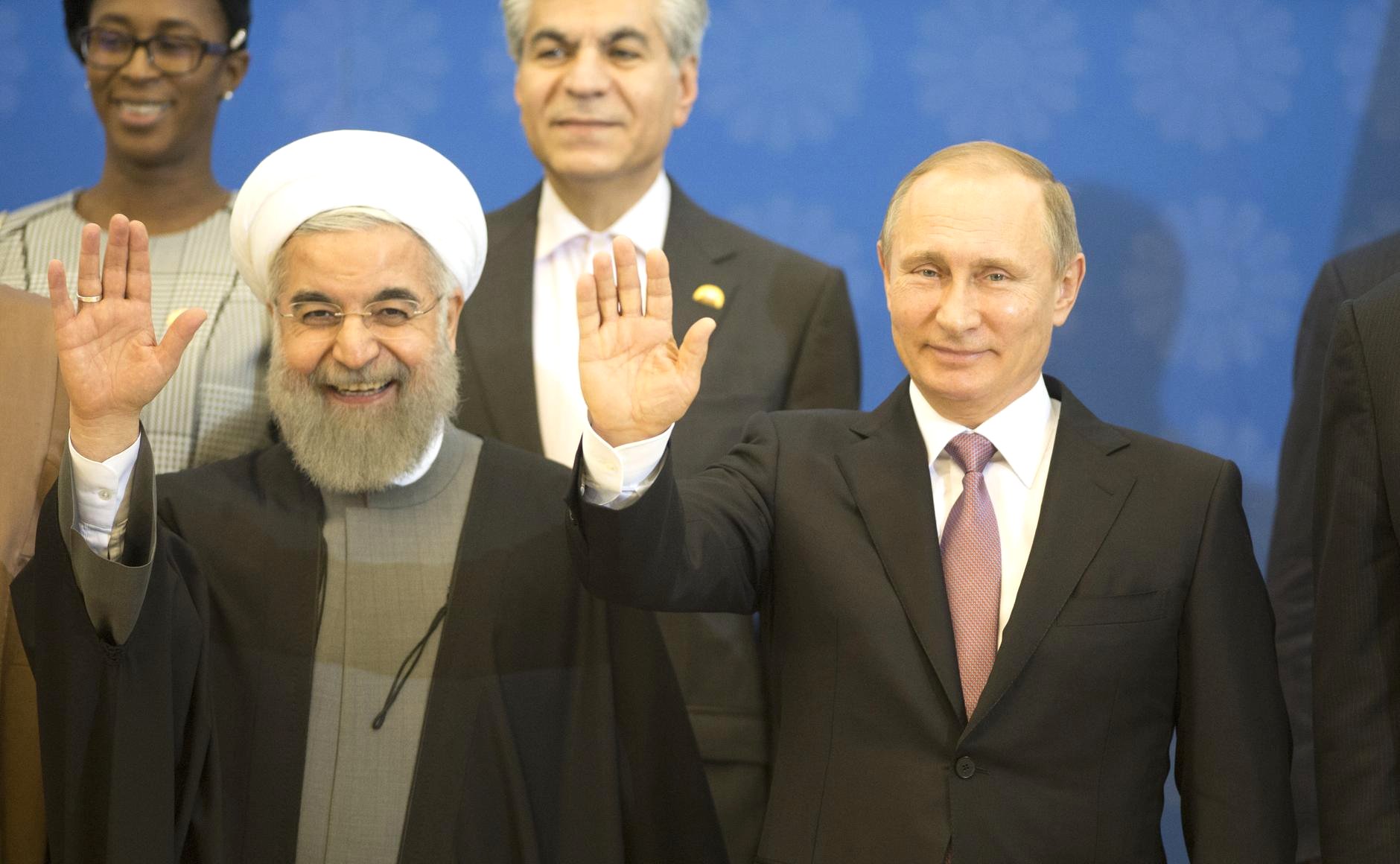
This week, Netanyahu personally traveled to Sochi, Russia, to confront Putin with the same blunt warning about Israel’s intention to attack targets inside Syria if Iran does not remove its forces.
A source familiar with the meeting told me that Putin responded with a sarcastic “good luck!” and that the Russians thought the swaggering Netanyahu appeared “unhinged.”
Still, a major Israeli attack on Iranian positions inside Syria would test Trump’s political toughness, since he would come under enormous pressure from Congress and the mainstream news media to intervene on Israel’s behalf. Indeed, realistically, Netanyahu must be counting on his ability to drag Trump into the conflict since Israel could not alone handle a potential Russian counterstrike.
But Netanyahu may be on somewhat thin ice since Trump apparently blames Israel’s top American supporters, the neocons, for much of his political troubles. They opposed him in the Republican primaries, tilted toward Hillary Clinton in the general election, and have pushed the Russia-gate affair to weaken him.
President Obama faced similar political pressures to fall in line behind Israel’s regional interests. That’s why Obama authorized the covert CIA program in Syria and other aid to the rebels though he was never an enthusiastic supporter – and also grew sick and tired of Netanyahu’s endless hectoring.
Obama acquiesced to the demands of Official Washington’s neocons and his own administration’s hawks – the likes of Secretary of State Hillary Clinton, CIA Director David Petraeus, his successor John Brennan, and United Nations Ambassador Samantha Power.
The Syrian conflict was part of a broader strategy favored by Washington’s neocons to overthrow or cripple regimes that were deemed troublesome to Israel. Originally, the neocons had envisioned removing the Assad dynasty soon after the invasion of Iraq in 2003, with Iran also on the “regime change” menu. But the disastrous Iraq War threw off the neocons’ timetable.
‘Regime Change’ Chaos
The Democratic Party’s liberal interventionists, who are closely allied with the Republican neocons, also tossed in Libya with the overthrow and murder of Libyan leader Muammar Gaddafi in 2011. Then, weapons from Gaddafi’s stockpiles were shipped to Syria where they strengthened rebel fighters allied with Al Qaeda’s Nusra Front and other Islamist groups.
Faced with this troubling reality – that the U.S.-backed “moderate rebels” were operating side by side with Al Qaeda’s Syrian affiliate and its allies – Washington’s neocons/liberal-hawks responded with sophisticated propaganda and devised clever talking points to justify what amounted to indirect assistance to terrorists.
The “regime change” advocates portrayed a black-and-white situation in Syria with Assad’s side wearing the black hats and various anti-Assad “activists” wearing the white hats (or literally White Helmets). The State Department and a complicit mainstream media disseminated horror stories about Assad and – when the reality about Al Qaeda’s role could no longer be hidden – that was spun in the rebels’ favor, too, by labeling Assad “a magnet for terrorists” (or later in cahoots with the Islamic State). For years, such arguments were much beloved in Official Washington.
But the human consequences of the Syrian conflict and other U.S.-driven “regime change” wars were horrific, spreading death and destruction across the already volatile Middle East and driving desperate refugees into Europe, where their presence provoked political instability.
By fall 2015, rebel advances in Syria – aided by a supply of powerful U.S. anti-tank missiles – forced Russia’s hand with Putin accepting Assad’s invitation to deploy Russian air power in support of the Syrian army and Iranian and Hezbollah militias. The course of the war soon turned to Assad’s advantage.
It’s unclear what Hillary Clinton might have done if she had won the White House in November 2016. Along with much of the U.S. foreign policy establishment, she called repeatedly for imposing a “no-fly zone” in Syria to stop operations by the Syrian air force and Russia, a move that could have escalated the conflict into World War III.
But Trump – lacking Official Washington’s “sophistication” – couldn’t understand how eliminating Assad, who was leading the fight against the terrorist groups, would contribute to their eventual defeat. Trump also looked at the failure of similar arguments in Iraq and Libya, where “regime change” produced more chaos and generated more terrorism.
Pandering to Saudis/Israelis
However, in the early days of his presidency, the unsophisticated Trump lurched from one Middle East approach to another, initially following his son-in-law Jared Kushner’s grandiose thinking about recruiting Saudi Arabia to an “outside-in” strategy to settle the Israel-Palestine conflict, i.e., enlisting the Saudis to pressure the Palestinians into, more or less, letting Israel dictate a solution.
Kushner’s “outside-in” scheme was symbolically acted out with Trump making his first overseas visit to Saudi Arabia and then to Israel in May. But I’m told that Trump eventually cooled to Kushner’s thinking and has come to see the Israeli-Saudi tandem as part of the region’s troubles, especially what he views as Saudi Arabia’s longstanding support for Al Qaeda and other terror groups.
Perhaps most significantly in that regard, Trump in July quietly abandoned the CIA’s covert war in Syria. In the U.S., some “regime change” advocates have complained about this “betrayal” of the rebel cause and some Democrats have tried to link Trump’s decision to their faltering Russia-gate “scandal,” i.e., by claiming that Trump was rewarding Putin for alleged election help.
But the bottom line is that Trump’s policy has contributed to the Syrian slaughter abating and the prospect of a victory by Al Qaeda and/or its Islamic State spinoff fading.
So, there has been a gradual education of Donald Trump, interrupted occasionally by his volatile temper and his succumbing to political pressure, such as when he rushed to judgment on April 4 and blamed the Syrian government for a chemical incident in the remote Al Qaeda-controlled village of Khan Sheikhoun.
Despite strong doubts in the U.S. intelligence community about Syria’s guilt – some evidence suggested one more staged “atrocity” by the rebels and their supporters – Trump on April 6 ordered 59 Tomahawk missiles fired at a Syrian air base, reportedly killing several soldiers and some civilians, including four children.
Trump boasted about his decision, contrasting it with Obama’s alleged wimpiness. And, naturally, Official Washington and the U.S. mainstream media not only accepted the claim of Syrian government guilt but praised Trump for pulling the trigger. Later, Hillary Clinton said if she were president, she would have been inclined to go further militarily by intervening with her “no-fly zone.”
As reckless and brutal as Trump’s missile strike was, it did provide him some cover for his July 7 meeting with Putin at the G-20 summit in Germany, which focused heavily on Syria, and also for his decision to pull the plug on the CIA’s covert war.
Saudi-backed Terror
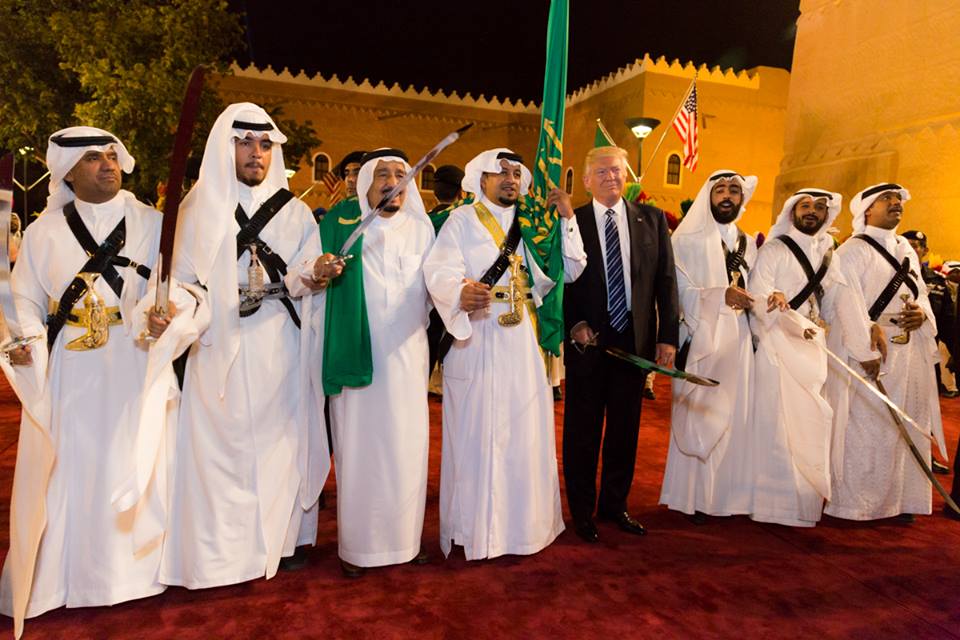
I’m told Trump also has returned to his pre-election attitude about Saudi Arabia as a leading supporter of terror groups and a key provocateur in the region’s disorders, particularly because of its rivalry with Iran, a factor in both the Syrian and Yemeni wars.
(Official White House Photo by Shealah Craighead)
Though Trump has recited Washington’s bipartisan (and benighted) mantra about Iran being the principal sponsor of terrorism, he appears to be moving toward a more honest view, recognizing the falsity of the neocon-driven propaganda about Iran.
Trump’s new coolness toward Saudi Arabia may have contributed to the recent warming of relations between the Sunnis of Saudi Arabia and the Shiites of Iran, a sectarian conflict dating back 1,400 years. In a surprising move announced this week, the two countries plan an exchange of diplomatic visits.
Even in areas where Trump has engaged in reckless rhetoric, such as his “fire and fury” warning to North Korea, his behind-the-scenes policy appears more open to compromise and even accommodation. In the past week or so, the tensions with North Korea have eased amid backchannel outreach that may include the provision of food as an incentive for Pyongyang to halt its missile development and even open political talks with South Korea, according to a source close to these developments.
On Afghanistan, too, Trump may be playing a double game, giving a hawkish speech on Monday seeming to endorse an open-ended commitment to the near-16-year-old conflict, while quietly signaling a willingness to negotiate a political settlement with the Taliban.
One alternative might be to accept a coalition government, involving the Taliban, with a U.S. withdrawal to a military base near enough to launch counterterrorism strikes if Al Qaeda or other international terror groups again locate in Afghanistan [likely an air base from which to threaten Iran – Aletho News ].
Many of Trump’s latest foreign policy initiatives reflect former White House strategist Steve Bannon’s hostility toward neoconservative interventionism. Secretary of State Rex Tillerson, the former Exxon-Mobil chief executive, also shares a more pragmatic approach to foreign affairs than some of his more ideological predecessors.
Albeit still in their infancy, these policies represent a new realism in U.S. foreign policy that, in many ways, paralleled what President Obama favored but was often unwilling or unable to see through to its logical conclusions, given his fear of Netanyahu and the power of the neocons and their liberal-hawk allies.
Still, some of Obama’s most important decisions – not to launch a major military strike against Syria in August 2013 and to negotiate an agreement with Iran to constrain its nuclear program in 2013-15 – followed a similar path away from war, thus drawing condemnation from the Israeli-Saudi tandem and American neocons.
As a Republican who rose politically by pandering to the GOP “base” and its hatred of Obama, Trump rhetorically attacked Obama on both Syria and Iran, but may now be shifting toward similar positions. Gradually, Trump has come to recognize that the neocons and his other political enemies are trying to hobble and humiliate him – and ultimately to remove him from office.
The question is whether Trump’s instinct for survival finally will lead him to policies that blunt his enemies’ strategies or will cause him to succumb to their demands.
Investigative reporter Robert Parry broke many of the Iran-Contra stories for The Associated Press and Newsweek in the 1980s.
August 25, 2017
Posted by aletho |
Timeless or most popular, War Crimes, Wars for Israel | Afghanistan, al-Qaeda, Benjamin Netanyahu, Hillary Clinton, Israel, Middle East, Obama, Saudi Arabia, Syria, United States, Zionism |
Leave a comment
US President Donald Trump appeared to adopt two very different public persona this week, when first he delivered a stern speech announcing a new military strategy toward Afghanistan; and then the next day he regaled supporters at a rally in Arizona with his characteristic blustering style.
American news channel CNN called the differing styles the «Two Trumps». In the first one, there was «teleprompter Trump» in which the president outlined a «sobering» plan for renewed military intervention in Afghanistan. By contrast, in the second appearance, there was «free-wheelin’ Trump», when he fired up his support base at a rally in Phoenix, Arizona, with verbal broadsides against the «sick» US media, illegal immigration, and a vow to build the border wall with Mexico – even if that meant shutting down the federal government in Washington.
CNN didn’t proffer an explanation for its observation of diverging Trump behavior. The implication was hinted that the president was simply being erratic, perhaps with some kind of personality disorder.
But here is a possible explanation for the «Two Trumps». On the issue of Afghanistan, Trump was indeed delivering a serious message on behalf of the US military and foreign policy establishment. His adherence to the teleprompter text was a sign that the president is taking orders from the Deep State when it comes to matters of paramount imperialist objective.
At the other event, when Trump reverted to his barnstorming form, it was just the president throwing his voter base a bit of rhetorical meat to keep them happy. In that rambling, impromptu-style, Trump hit all the populist buttons to the delight of the crowd. That demagogic bravura performance was required because the day before Trump had executed a startling U-turn on his campaign promises, when he declared that US forces would return to Afghanistan.
All during his election campaign for the presidency last year, Trump had whipped up support among blue-collar workers by slamming the wasteful overseas wars of the Bush and Obama administrations. He condemned his Democrat rival Hillary Clinton for fueling these wars as Secretary of State for Obama.
What a staggering U-turn! It’s hard to believe Trump has the chutzpah to do it.
On Monday, addressing troops at Fort Meyer, Arlington, Virginia, President Trump gave notice that the US military would be returning in large numbers to Afghanistan. That 16-year American war – the longest US war in history – was henceforth going to continue for an indefinite number of years. Trump made a cringing attempt to excuse the shameless U-turn as an informed decision made with the responsibility of president on his shoulders as opposed to the callow views of a campaigning candidate.
However, there was no disguising the fact that President Trump was taking orders from the Pentagon. The Joint Chiefs of Staff and numerous other US generals – three of whom are now in senior positions in Trump’s White House – have been pushing for a re-escalation of American military involvement in Afghanistan.
Trump got elected on the back of electoral promises to shut down overseas wars and vowing instead to focus economic resources on reviving the blue-collar Rust Belt states, which have been struggling with industrial decline for decades. His sudden embrace of the Pentagon’s designs on Afghanistan are a stark repudiation of his own «America First» manifesto. In short, a betrayal of voters.
It is no coincidence that Trump’s about-turn on Afghanistan came on the heels of the ouster of his chief strategist, Stephen Bannon last Friday. Bannon had been vehemently against the policy of foreign military adventurism. In particular, he was reportedly against any resumption of large-scale deployment in Afghanistan. According to media reports, it was the military top brass who prevailed on Trump to get rid of Bannon. The White House Chief of Staff, former Marine General John Kelly, and Trump’s National Security Advisor, General HR McMaster were the two main voices calling for Bannon’s exit. That Trump would dump Bannon – supposedly a close ally – with such alacrity shows that the generals are the real power behind the desk in the Oval Office.
So, the «Two Trumps» phenomenon is thus explained: On one hand, the president is being ordered by the Pentagon and the generals in his White House on what the all-important foreign policy agenda is. Afghanistan is a priority. But note also, the increased US military intervention in Syria, Iraq, Yemen, Ukraine, and towards North Korea, Iran, Venezuela, China and Russia – the latter under the auspices of NATO’s eastwards expansion. All of this blatantly contradicts what candidate Trump had been wooing voters with.
The American business of military imperialism is serious. Hence President Trump is told in no uncertain terms by the military-industrial complex to stick to the teleprompter text. No winging it. No deviation from the plan. Just do it.
The debasement of Trump to being a stooge of the Deep State thereby necessitates that Trump, the supposed maverick populist, must go out on occasion to rally the base with barnstorming tirades to let off some steam. (The irony here is that Trump is accused by the Deep State of being a stooge for Russia, when in much more realistic ways he is evidently a stooge for the American Deep State.)
If ordinary Americans were permitted to focus on their betrayal by Trump to the criminal overseas adventurism of the Pentagon and the military-industrial complex, then that could be a cause of dangerous social revolt at home. It is imperative therefore to keep the masses riled up over chauvinistic populist issues like slamming illegal immigration, «sick» news media, and «liberals» trying to erase American history and heritage by removing Civil War statues.
Like a quack doctor, Trump is prescribing nostrums to conceal the real disease, which is that American democracy has now been supplanted by a military cabal in league with Wall Street and Big Business. Trump is nothing but a puppet who – at least so far – is being allowed to «play at being president». Who knows how much longer he will be allowed to sit in the Oval Office.
So degenerated is American politics that even prominent news media like the New York Times are actually welcoming with editorials on the control exerted over an elected president by the military generals «to stop him going off the rails».
Why Afghanistan is such a priority for the American ruling cabal is no doubt manifold. Recent reports highlight the vast but untapped mineral wealth of the country. Another reason is to secure the lucrative heroin drug trade that financially underpins so much of American covert CIA operations around the world. Also, Afghanistan’s war gives Washington cover for pursuing its strategy of engendering conflict and chaos in a vital region. Contrary to official US assertions, Washington doesn’t want the war to end. It wants war-without-end so that it can destabilize Russia on its southern flank, as well as Iran, and to prevent China from galvanizing Eurasian economic integration.
As American political analyst Randy Martin points out: «Afghanistan is a redux of covert US strategy that has been used in Syria and other parts of the Middle East. The United States claims to be fighting terrorism when in actual fact it is covertly sponsoring terror groups to incite sectarian conflict. In that way, Washington gives itself a license to wreak havoc in order to thwart geopolitical rivals».
President Trump is simply following the imperative orders assigned to him by the Deep State. Outrageous as it might seem, we are witnessing a soft military coup against Trump and his earlier vows to promote America First in the interests of ordinary citizens. In other words, American democracy has been subverted in an audacious assertion of the perennial needs of US imperialism – the profiteering lust of the military industrial complex, Wall Street and Big Business.
Of course, the broader context of «Russia-gate» should be mentioned here. For nearly eight months since his presidential inauguration, Trump has been subjected to a relentless media campaign orchestrated by the Deep State vilifying him as a Russian agent and a beneficiary of alleged Russian meddling in the US election. That pressure over a baseless narrative has inevitably led to Trump capitulating to the Deep State to become a willing tool for its strategic objectives. Trump’s capitulation is nevertheless a coup against an elected president, enforcing the Deep State’s geopolitical agenda.
Analyst Randy Martin puts it succinctly with an oblique reference to the CIA’s assassination of President John F Kennedy in 1963. «This time, they didn’t need a bullet».
August 25, 2017
Posted by aletho |
Militarism, Timeless or most popular | Afghanistan, United States |
Leave a comment
Unfounded speculations by US politicians about alleged supplies of arms to the Taliban by Russia are aimed at concealing the truth of America’s obvious defeat in Afghanistan, which Washington is still struggling to postpone, Afghan political observer Vahid Mojda told Sputnik.
US Secretary of State Rex Tillerson’s claim that Russia is arming the Taliban bears no relation to reality, Vahid Mojda, a political observer and former Afghan Foreign Ministry official under the Taliban government, told Sputnik.
“I talked with Talibs about it and they told me that neither Russia nor any other countries provided any assistance to them,” Mojda said in an interview with Sputnik Afghanistan. “They [said] they could get Kalashnikov assault rifles in Afghanistan at a very cheap price. They can buy [the rifles] directly from the Afghan Army. The Taliban usually draws on corrupt [Afghan] politicians to buy weapons from the Afghan military for bribes.”
On Tuesday, during a press briefing, Tillerson claimed that Russia was providing weapons to the Taliban.
“With respect to the comment about Russia, to the extent, Russia is supplying arms to the Taliban, that is a violation, obviously, of international norms and it’s a violation of UN Security Council norms,” Tillerson said, “We certainly would object to that and call Russia’s attention to that. If anyone is going to supply arms, it needs to be through the Afghan government.”
However, the US secretary of state didn’t refer to any credible evidence to back his claim.
In response to Tillerson’s unfounded allegations Russian Foreign Ministry spokeswoman Maria Zakharova highlighted Thursday that Moscow has provided no support to the Taliban movement in Afghanistan.
She pointed out that Moscow has repeatedly rejected similar accusations and has demanded Washington provide evidence that it supports the militant movement.
“There is none. Such statements do not contribute to the establishment of effective cooperation between our countries on Afghanistan,” the spokeswoman stressed.
“If Talibs received weapons from other countries it wouldn’t be Kalashnikov rifles: what the Taliban needs are anti-aircraft guns,” Mojda underscored in his interview with Sputnik. “If the Taliban obtains these [anti-aircraft] weapons, the US will find itself in a heap of trouble in Afghanistan.”
Why does Washington accuse Russia of arming the Taliban?
Mojda assumed that the US is apparently trying to drive a wedge between various groups within the Taliban.
“They are doing this to sow discord among the Taliban by convincing militants that some Talibs are connected to Russia. This is a propaganda campaign against the Taliban,” he noted.
On the other hand, according to the political observer, Washington is making attempts to divert attention away from the obvious fact that the US is losing its war in Afghanistan.
“By pointing the finger of blame to Russia, Pakistan and other countries, they [the US] want to conceal their defeat in Afghanistan,” Mojda stressed. “The goal of Washington’s strategy is not to win in Afghanistan, but to postpone the US’ defeat.”
Commenting on the issue, Russian Senator Frants Klintsevich, the first deputy chairman of the Parliament’s upper chamber’s Defense and Security Committee, denounced Tillerson’s allegations as groundless.
“The United States continues to measure others by its own standards,” Klintsevich told reporters. “The logic of US Secretary of State Rex Tillerson, who accused Russia of arming the Taliban, is absolutely ‘one-dimensional’: [he believes that] if the Americans supported [Afghan] Mujahedin by all means available — including weapon supplies — during the Soviet Union’s Afghan war in the 1980s, Russia cannot but do completely the same. Of course, no proof was presented [to confirm the claim].”
It is not the first time that US policy makers and mainstream media have made unfounded claims about Moscow’s alleged assistance to the Taliban.In March, US Army General Curtis Scaparrotti, who is also NATO’s Supreme Allied Commander in Europe, claimed that he had seen “Russian influence growing” on Taliban insurgents. He went even further suggesting that possibly Moscow could have been helping “supply” the militants. Scaparrotti didn’t specify what kinds of supplies he meant.
A month later the head of US and international forces in Afghanistan, General John Nicholson, stepped up with a similar claim saying that he was “not refuting” reports that Russia was providing support, “including weapons,” to the Taliban.
Neither Scaparrotti nor Nicholson cited any evidence to confirm their assumptions.
Predictably, US mainstream media immediately blew up the story.
Nearly a month ago CNN reported that it obtained a video showing sniper rifles and heavy machine guns “stripped of any means of identifying their origin.”
The media outlet presumed that the rifles appeared to look like Russian-made Kalashnikov guns. Still, the report admitted that “the videos don’t provide incontrovertible proof of the trade.”
The Russian Foreign Ministry’s reply was not long in coming.
“We have said many times that the allegations regarding Russian support for the Taliban, which some Western media make and some Afghan media repeat, are absolutely groundless,” the Foreign Ministry said in an official statement. “So far, neither the Afghan authorities, nor the US and NATO commands in Afghanistan have presented any facts to prove these allegations.”
The ministry called attention to the fact that the “Taliban drove American-made Humvees in a recent attack on the base of the Afghan National Security Forces in Helmand.”
“It is easy to imagine the conclusion that can be made from this news based on CNN’s logic,” the statement said.
August 24, 2017
Posted by aletho |
Deception, Mainstream Media, Warmongering | Afghanistan, United States |
3 Comments

Russia has hinted in the past that the United States is covertly sponsoring the Islamic State in Afghanistan. On Thursday, the Russian Foreign Ministry spokesperson raised the bar by alleging that “foreign fighters” who were transferred by “unknown helicopters” have perpetrated a massacre of Hazara Shias in the Sar-e-Pol province in northern Afghanistan. The spokesperson said:
- We can see attempts to stir up ethnic conflict in the country… Cases of unidentified helicopter flights to territory controlled by extremists in other northern provinces of Afghanistan are also recorded. For example, there is evidence that on August 8, four helicopters made flights from the airbase of the Afghan National Army’s 209th corps in Mazar-i-Sharif to the area captured by the militants in the Aqcha district of the Jowzjan province. It is noteworthy that witnesses of these flights began to fall off the radar of law enforcement agencies. It seems that the command of the NATO forces controlling the Afghan sky stubbornly refuses to notice these incidents.
From the above, it appears that sections of the Afghan armed forces and the NATO command (which controls Afghan air space) are hand in glove in these covert operations. No doubt, this is a very serious allegation. The attack on the Hazara Shias must be taken as a message intended for Tehran. Historically and culturally, Iran has affinities with the Hazara Shia community in Afghanistan. Possibly, the Trump administration, which has vowed to overthrow the Iranian regime, is opening a ‘second front’ by the IS against Iran from the east.
Interestingly, the Russian Foreign Ministry also issued a statement on Friday on the alarming drug situation in Afghanistan. It pointed out that:
- A sharp increase in drug production is expected in Afghanistan this year and one-third of the country’s population is now involved in cultivation of opium poppy.
- The geography of the Afghan drug trafficking has expanded and now reaches the African continent.
- Tonnes of chemicals for processing narcotics are illegally imported into Afghanistan – with Italy, France and Netherlands “among main suppliers”.
- The US and NATO are either unwilling or incapable of curbing the illegal activity.
Russia and Iran cannot turn a blind eye to the hostile activities by the US (and NATO) in their backyard, transforming the anti-Taliban war into a proxy war. They cannot but view the Afghan conflict through the prism of their deepening tensions with the US.
What are Russia’s options? The Russian Defense Minister Sergei Shoigu said at a meeting with the top brass in Moscow on August 18 that the Afghan conflict poses a threat to Central Asia’s stability. He said that Russia plans to hold joint military exercises later this year with Kyrgyzstan, Tajikistan, and Uzbekistan. Russia has military bases in Tajikistan and Kyrgyzstan.
Again, Ambassador Zamir Kabulov, Russian presidential envoy to Afghanistan, said recently that if the Afghan government and the US are unable to counter the IS threat, Russia will resort to military force. Kabulov disclosed that Russia has raised in the UN Security Council the air dropping of supplies for the IS fighters in at least three provinces in northern Afghanistan by unidentified aircraft.
Of course, it is inconceivable that Russia will put “boots on the ground” in Afghanistan. But if the IS breaches the borders of the Central Asian states, it becomes the “red line”, Russia will hit back. Russia is reinforcing its bases in Kyrgyzstan and Tajikistan. Significantly, in a joint military exercise with Tajikistan in July, Russia tested its Iskander-M short-range ballistic missiles, one of the most advanced weapons in the Russian arsenal, with a range of 500 kilometers and a payload of 700 kg. Iskander is equipped with terminal guidance systems with the capability to overcome missile defences. Iskander’s accuracy could be better than 10 meters. (Russia has deployed the deadly weapon to Syria.)
With the exit of White House strategist Steve Bannon, an inveterate anti-war ideologue in the Trump administration who wanted the Afghan war to be brought to an end, the generals now have the upper hand in controlling the US policy. Defence Secretary James Mattis and National Security Advisor HR McMaster favour deployment of additional troops to Afghanistan. The ‘known unknown’ is John Kelly, whom Trump recently appointed as his chief of staff. But there are enough indications that Kelly (a retired Marine Corps general and father of a fallen Marine, 1st Lt. Robert Kelly, who was killed in Afghanistan in 2010) almost certainly shares the opinion of Mattis and McMaster.
The more one looks at it, President Donald Trump’s real challenge is not about winning the war against the Taliban, but the high risk he’ll be incurring, by taking his generals’ advice, to put his imprimatur on a full-fledged proxy war in Afghanistan against Russia, Iran and China.
August 22, 2017
Posted by aletho |
Deception, Ethnic Cleansing, Racism, Zionism, False Flag Terrorism, War Crimes | Afghanistan, Islamic State, Kyrgyzstan, Russia, Tajikistan, Taliban, United States |
Leave a comment
WASHINGTON – The Taliban movement will be unable to achieve a military victory in Afghanistan, however, it may receive a legal status by means of talks, US State Secretary Rex Tillerson said Monday.
“Our new strategy breaks from previous approaches that set artificial calendar-based deadlines. We are making clear to the Taliban that they will not win on the battlefield. The Taliban has a path to peace and political legitimacy through a negotiated political settlement to end the war,” Tillerson said in a statement published by the State Department.
The State Secretary also said that the United States will support talks between the Afghan government and Taliban movement without preliminary conditions.
“We stand ready to support peace talks between the Afghan government and the Taliban without preconditions. We look to the international community, particularly Afghanistan’s neighbors, to join us in supporting an Afghan peace process,” Tillerson said in a statement published by the State Department.
Tillerson’s comments come after US President Donald Trump unveiled a new US strategy in Afghanistan which included expanded authorities to target terrorists. However, Trump said that the United States would not reveal the number of troops or any future military action plans in Afghanistan.
August 21, 2017
Posted by aletho |
Illegal Occupation, Timeless or most popular | Afghanistan, United States |
Leave a comment
There has never been progress by the U.S. military in Afghanistan, unless you are asking the U.S. military contractors or the Afghan drug barons, of whom an extremely large share are our allies in the Afghan government, militias and security forces, there has only been suffering and destruction. American politicians, pundits and generals will speak about “progress” made by the 70,000 American troops put into Afghanistan by President Obama beginning in 2009, along with an additional 30,000 European troops and 100,000 private contractors, however the hard and awful true reality is that the war in Afghanistan has only escalated since 2009, never stabilizing or deescalating; the Taliban has increased in strength by tens of thousands, despite tens of thousands of casualties and prisoners; and American and Afghan casualties have continued to grow every year of the conflict, with U.S. casualties declining only when U.S. forces began to withdraw in mass numbers from parts of Afghanistan in 2011, while Afghan security forces and civilians have experienced record casualties every year since those numbers began to be kept by the UN.
Similarly, any progress in reconstructing or developing Afghanistan has been found to be near [non] existent despite the more than $100 billion spent by the United States on such efforts by the Special Inspector General for Afghan Reconstruction (SIGAR). $100 billion, by the way, is more money than was spent on the Marshall Plan when that post-WWII reconstruction plan is put into inflation adjusted dollars. Oft repeated claims, such as millions of Afghan school girls going to school, millions of Afghans having access to improved health care and Afghan life expectancy dramatically increasing, and the construction of an Afghan job building economy have been exposed as nothing more than public relations lies. Often displayed as modern Potemkin Villages to visiting journalists and congressional delegations and utilized to justify continued budgets for the Pentagon and USAID, and, so, to allow for more killing, like America’s reconstruction program in Iraq, the reconstruction program in Afghanistan has proven to be a failure and its supposed achievements shown to be virtually non-existent, as documented by multiple investigations by SIGAR, as well as by investigators and researchers from organizations such as the UN, EU, IMF, World Bank, etc.
Tonight, the American people will hear again the great lie about the progress the American military once made in Afghanistan after “the Afghan Surge”, just as we often hear the lie about how the American military had “won” in Iraq. In Iraq it was a political compromise that brought about a cessation of hostilities for a few short years and it was the collapse of the political balance that had been struck that led to the return to the violence of the last several years. In Afghanistan there has never even been an attempt at such a political solution and all the Afghan people have seen in the last eight years, every year, has been a worsening of the violence.
Americans will also hear tonight how the U.S. military has done great things for the Afghan people. You would be hard pressed to find many Afghans outside of the incredibly corrupt and illegitimate government, a better definition of a kleptocracy you will not find, that the U.S. keeps in power with its soldiers and $35 billion a year, who would agree with the statements of the American politicians, the American generals and the pundits, the latter of which are mostly funded, directly or indirectly, by the military companies. It is important to remember that for three straight elections in Afghanistan the United States government has supported shockingly fraudulent elections, allowing American soldiers to kill and die while presidential and parliamentary elections were brazenly stolen. It is also important to remember that many members of the Afghan government are themselves warlords and drug barons, many of them guilty of some of the worst human rights abuses and war crimes, the same abuses of which the Taliban are guilty, while the current Ghani government, and the previous Karzai government, have allowed egregious crimes to continue against women, including laws that allow men to legally rape their wives.
Whatever President Trump announces tonight about Afghanistan, a decision he teased on Twitter, as if the announcement were a new retail product launch or television show episode, as opposed to the somber and painful reality of war, we can be assured the lies about American progress in Afghanistan will continue, the lies about America’s commitment to human rights and democratic values will continue, the profits of the military companies and drug barons will also continue, and of course the suffering of the Afghan people will surely continue.
Matthew Hoh is a member of the advisory boards of Expose Facts, Veterans For Peace and World Beyond War. In 2009 he resigned his position with the State Department in Afghanistan in protest of the escalation of the Afghan War by the Obama Administration. He previously had been in Iraq with a State Department team and with the U.S. Marines. He is a Senior Fellow with the Center for International Policy.
August 21, 2017
Posted by aletho |
Deception, Fake News, Mainstream Media, Warmongering | Afghanistan, United States, USAID |
Leave a comment
The Pentagon has spent $76 billion on weapons and equipment for the Afghan army and police since 2001, the US Government Accountability Office said. The report comes as President Donald Trump says he is “very close” to announcing a new strategy on Afghanistan.
The US has paid for 600,000 weapons, including rifles and pistols, for the Afghan army and police, the GAO report released on Thursday said. The funding also went to buy more than 25,000 grenade launchers and almost 10,000 rocket-propelled weapons to be used by the Afghans.
Additionally, the US has given to the government in Kabul 162,643 pieces of communications equipment and nearly 76,000 vehicles.
Earlier this summer, the Special Inspector General for Afghanistan Reconstruction (SIGAR) slammed the Pentagon for spending money on uniforms that Afghan forces didn’t need.
The US has spent $93.81 million over the past decade to provide Afghan troops with uniforms of a “forest” camouflage pattern which is largely unsuitable for Afghanistan’s landscape, a SIGAR report said.
Billions have been squandered on projects that were useless, or lost to waste and corruption, according to SIGAR.
The US’s profligate spending in Afghanistan is “the definition of insanity — doing the same things over and over again, expecting a different result,” Special Inspector General John F. Sopko told NBC News last year.
The US is overall estimated to have spent over $700 billion on military assistance, reconstruction and economic aid to Afghanistan in the past 17 years of war, which began in 2001 as a response to Afghanistan’s harboring of Al-Qaeda following the 9/11 terrorist attacks. With Al-Qaeda in the country largely defeated, the war has morphed into a fight with local Taliban insurgents.
On Thursday, President Trump told reporters that he’s “very close” to announcing his administration’s new strategy on Afghanistan.
“It’s a very big decision for me. I took over a mess and we’re going to make it a lot less messy,” he said.
US officials had earlier promised to deliver an updated strategy by mid-July, but the decision-making stalled.
The commander of US forces in Afghanistan, General John Nicholson, as well as Trump’s national security adviser, H.R. McMaster, suggested adding some 4,000 American troops to the nearly 9,000 already deployed in Afghanistan.
Trump reportedly lashed out at top US military officials in a July meeting for losing ground in Afghanistan and questioned whether America’s longest war is still worth fighting. “We are losing,” Trump said, according to an NBC report.
The president also reportedly considered firing the commander of US forces in Afghanistan.
In 2013 Trump tweeted: “We have wasted an enormous amount of blood and treasure in Afghanistan. Their government has zero appreciation. Let’s get out!”
The US-backed government in Kabul controls about 60 percent of the country – down from 65 percent the same time last year, according to the US military headquarters in Kabul.
Meanwhile, the Taliban is gaining ground. Last week, militants gained control of a key area in Afghanistan’s north Sari Pul province.
Earlier this summer, the Taliban raided and seized the district of Jani Khel in Paktia province, south of Kabul. The fall of Jani Khel marked its third victory in just four days.
Deaths of Afghan security forces in the early months of 2017 were “shockingly high,” SIGAR recently reported.
The Obama administration said a political solution that would involve the Taliban was necessary to end the conflict. The Trump administration has yet to outline its position.
August 11, 2017
Posted by aletho |
Corruption, Illegal Occupation, Militarism, Timeless or most popular, War Crimes | Afghanistan, United States |
Leave a comment
Senator John McCain has blasted President Donald Trump over a lack of strategy in America’s 17-year war in Afghanistan, and filed his own plan for the Senate to vote on. It involves more troops, more bombing and an enduring US presence in the country.
“Now, nearly seven months into President Trump’s administration, we’ve had no strategy at all as conditions on the ground have steadily worsened,” McCain, who is the chairman of the Senate’s Armed Services Committee, said in a statement Thursday. “The thousands of Americans putting their lives on the line in Afghanistan deserve better from their commander-in-chief.”
“We must face facts: We are losing in Afghanistan and time is of the essence if we intend to turn the tide,” he said.
McCain has filed his plan to win the war as a proposed amendment to the annual defense bill. The strategy calls for beefing up the number of US troops in Afghanistan, “significantly” increasing the use of US air power there, as well as getting rid of current withdrawal timelines placed on the military, according to a released copy of the legislation.
The Republican senator’s proposed amendment does not specify the number of additional troops to be sent to fight the war which has gone on for 17 years – longer than any other war the US has been involved in.
President Trump himself reportedly lashed out at top US military officials in a July meeting for losing ground in Afghanistan. “We are losing,” he said, according to an NBC report.
The president reportedly considered firing the commander of American troops in Afghanistan, General John Nicholson.
Nicholson had earlier said that a few thousand more troops were needed to gain an advantage over the resurgent Taliban. The Trump administration was weighing the deployment of 3,000-4,000 additional forces, according to lawmakers briefed on the plans.
When testifying before the Senate Armed Services Committee in June, Secretary of Defense Jim Mattis said the administration would be prepared to brief lawmakers on a new Afghanistan strategy in mid-July. However, the new strategy has yet to come.
The US-backed government in Kabul controls about 60 percent of the country, while the Taliban are gaining ground.
Last week, the militants gained control of a key area in Afghanistan’s north Sari Pul province.
“We requested reinforcement from the central government, unfortunately couldn’t get any support, that is why the forces lost control of Mirzawalang,” Zabi Amani, a spokesman for the provincial governor, told AP.
Earlier this summer, the Taliban raided and seized the district of Jani Khel in Paktia province, south of Kabul. The fall of Jani Khel marked their third victory in just four days.
The Taliban also overran the Kohistan district in the northern Faryab province after storming its government’s headquarters, forcing local security forces to retreat to another base. Just hours after the capture of Kohistan, they seized the Taywara district in western Ghor province.
The US is estimated to have spent over $700 billion on military assistance, reconstruction and economic aid to Afghanistan in the past 17 years. … Full article
August 10, 2017
Posted by aletho |
Illegal Occupation, Mainstream Media, Warmongering, Militarism, Timeless or most popular, War Crimes | Afghanistan, United States |
1 Comment

Atlanta, GA – In just the latest example of CNN operating as a deep state propaganda outlet, on July 25, the cable news network published a bombastic report; releasing two exclusive videos intimating that the Russian government was covertly arming the Taliban, which has returned to significant prominence in Afghanistan since the 2014 cessation of NATO combat operations.
The large-scale anti-Russia propaganda operation, meant to indoctrinate Americans into a mindset that demonizes Russia as “the enemy,” and Putin as a dictator, has been pushed en masse to the American public at a steady rate since the end of the 2016 election cycle.
The explosive CNN report, which was widely reported across the media landscape, noted that two separate groups of Taliban fighters have received “improved weaponry … that appears to have been supplied by the Russian government.” The weaponry reportedly included Kalashnikov rifles, heavy machine guns, and sniper rifles. And while many of the weapons in the video appear to be of Russian origin, there is nothing to connect the Russian government to the weapons.
While the news made headlines and was shared widely across social media — the problem is that CNN’s report has lots of bark and no bite. Aside from a flashy headline, the report provided no evidence of the Russian government providing or transferring weapons to the Taliban. This was established according to weapons experts from U.S. Special Operations Command and several non-governmental conflict arms organizations.
“I’ve watched the video and frankly can’t see anything that is particularly unusual,” James Bevan, a weapons specialist, and director of Conflict Armament Research Ltd, told Task & Purpose in an email. “There are Russian weapons, and derivatives of those weapons manufactured in other states, circulating among state and non-state groups in every country in that region.”
According to the report by Task and Purpose :
The weapons experts consulted by Task & Purpose identified the weapons as Kalashnikov variants that have become pervasive among irregular forces; several U.S.-made M249 Squad Automatic Weapons that fire belt-fed 5.56×45mm NATO rounds, including a mid-90s variant with a long barrel and fixed rifle stock and the lightweight MK-49 paratrooper variant with a stub barrel; the TT-30 Tokarev pistol that’s been a staple of the Russian military since the 1930s, and the Soviet-made 7.62 mm general-purpose PK machine gun that’s been in service since 1961.
None of these weapons touted by the Taliban in the CNN video appear particularly modern, and all but the M249 are regular fixtures of the illicit small arms markets that accounted for 60 percent of the weapons flowing into and out of Afghanistan in the decades leading up to the U.S.-led invasion in the aftermath of the 9/11 terrorist attacks.
“I suspect after years in Afghanistan, these are easy to get,” Capt. Jason Salata, said.
Additionally, the CNN report never establishes any type of chain of custody between Russia and the Taliban. Perhaps more importantly, they never noted that one of the Taliban groups had pillaged the equipment from a rival Taliban faction, while the other received a shipment of arms from across the Tajikistan border. CNN admits that the videos presented as “suggesting” a link between the Taliban and Moscow “don’t provide incontrovertible proof of the trade.”
Yet, somehow, they still attempt to stir the anti-Russia media pot and suggest the weapons could be the work of the Russian government. In reality, however, these types of weapons are readily available on the black market across the globe.
“There is nothing immediately visible to suggest the weapons are new or any indication (from the footage) that they are all of the same type and origin,” according to Bevan. “Governments that supply rebel and insurgent forces rarely supply new weapons and frequently refrain from supplying their own weapons stocks. This makes any connection between the manufacturing country and the supplier country problematic.”
Thus the CNN report, which notes that the weaponry appears “stripped of any means of identifying their origin,” essentially relies on the claims of a few Taliban members as the basis for the entire report.
“Unfortunately, CNN did not fully profile erased markings and other efforts to sanitize the weapons,” Bevan added. “This would be a clear indication of organized, state involvement, but also would be unlikely to incriminate any party without further evidence.”
In typical propaganda fashion, every arms expert in the CNN story was a Pentagon or Afghan government official, except for Benjamin King from the Small Arms Survey independent research group, who bluntly told CNN that the photos and videos he was given to analyze contained virtually no evidence of a recent arms transfer, let alone being able to attribute it to a specific state – such as Russia.
“[CNN] made some jumps that you certainly can’t make from the weapons themselves,” King told Task & Purpose. “I certainly wouldn’t have made the claim that they were new imports. The generic Tokarev pistols and PK machine guns are old and could have been there for a long time. One of the rifles was an AK-74, so it could have been there for the last 40 years or so.”
Of course, the U.S. military need only look in the mirror should they want to understand the flow of foreign armaments into Afghanistan, as a declassified Pentagon audit from 2016 revealed that almost half of the 1.5 million firearms supplied to the Iraqi and Afghani military, including almost 1 million M4 and M16s, have turned up ‘missing’ due to shoddy record keeping and regulations.
Even more damning, in 2014, the Special Inspector General for Afghanistan Reconstruction released a report that found that nearly 43% of arms provided to the Afghan National Security Forces likely ended up in the hands of ISIS or the Taliban.
In just the past few weeks, American and Afghan military personnel have faced off with modern weaponry and equipment in enemy hands. Afghan security forces are increasingly facing off against Taliban fighters armed with M4 carbines outfitted with night vision, infrared laser sights and Advanced Combat Optical Gunsight scopes, according to a July 25 report in the Military Times.
Additionally, a recent propaganda video released by the Taliban appeared to show an FN SCAR (Special Operations Forces Combat Assault Rifle) 7.62mm rifle decked out with a AN/PEQ 5 visible laser, which was likely procured during an ambush or raid on a weapons depot.
“Afghanistan is swimming in guns,” King told Task & Purpose. “These things are expected to show up everywhere.”
Many of these weapons are not Russian made, but instead, are usually deployed by Western militaries — and, like everything else in Afghanistan, they end up in Taliban hands sooner rather than later.
But CNN’s report conveniently fails to mention any of this, and attempts to prop up the demonization campaign against Russia, as a likely pretext to gain public support in the methodical and ongoing movement towards a direct conflict with the Russia.
August 3, 2017
Posted by aletho |
Deception, Fake News, Mainstream Media, Warmongering, Russophobia | Afghanistan, CNN |
Leave a comment