When You Realize You’ve Been Had
BY JOHN LEAKE | COURAGEOUS DISCOURSE | FEBRUARY 6, 2024
In Dante’s Inferno, the 9th and final circle of hell, “the lowest, blackest, and farthest from heaven,” is reserved those guilty of treachery against those in whom they have cultivated a bond of trust.
I often thought about this in 2013, when I was living in Menlo Park, California and became friends with a man of who was a benefactor of the VA hospitals in Menlo Park and in Palo Alto. He was especially concerned about young soldiers who’d suffered traumatic brain injuries in Afghanistan and Iraq.
On a few occasions we made the rounds and visited patients who’d sustained this kind of injury. The strangest were those who had retained motor skills and seemed to recognize us, but who also seemed completely indifferent to us. Some had suffered from speech impairment and seemed frightened of us. A nurse told me that it was common for this kind of patient to have developed a passionate interest in Facebook and to spend most of his waking hours scrolling through it.
In 2013, it was hard for me to fathom that hundreds of thousands of young men in the United States—many with wives and small children—had sustained Traumatic Brain Injuries. Many could still function in their day to day lives, but suffered irritability, frequent headaches, and a feeling of disconnection from their family and friends. On the extreme end of the scale were the completely disabled, doomed to spend the rest of their lives in VA hospitals.
In 2017, Lindquist, Love, et al. published Traumatic Brain Injury in Iraq and Afghanistan Veterans: New Results from a National Random Sample Study. As the opening of the report states:
Traumatic brain injury (TBI) has been called a “signature injury” of Iraq and Afghanistan Conflicts. The Defense and Veterans Brain Injury Center (DVBIC) reports nearly 350,000 incident diagnoses of TBI in the U.S. military since 2000. Among those deployed, estimated rates of probable TBI range from 11–23%.
I thought it notable that the U.S. military was, apparently, completely unprepared for roadside bombs constructed to focus the blast on particular sections of road as a convey is passing by. It wasn’t so much shrapnel and other missiles striking the head as the supersonic, explosive shockwave that does the brain damage. Click on the video below to see an example of a large roadside bomb blasting a U.S. convoy.
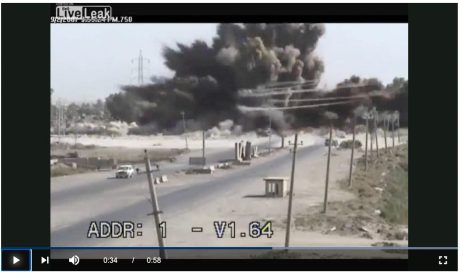
I got to be pals with a psychiatrist who worked at the VA. In public, around his colleagues, he tried to put on an optimistic face about it. In private, over our occasional dinners, he seemed very despondent that anything could be done for these guys.
“No one really knows what to do about these injuries,” he told me. “A lot of doctors who work at the VA will talk to you about promising new therapies, but most of them are more interested in getting grant money for their pet projects than in doing anything for their patients.”
I wondered how many of these young men ultimately realized that the United States government had lied to them—that their mission in Iraq had never been about protecting the American people from a hostile foreign dictator and his alleged terrorist network—but rather to pursue the mad dreams of insane old men in Washington.
This morning I thought about my VA experiences in a decade ago when I saw that the same cabal of old hawks in Washington are now beating the drums of war against Iran—a nation three times the size and with twice the population of Iraq.
I wonder if Joe Biden or Lindsay Graham or Jake Sullivan are even aware of the 350,000 men who suffered Traumatic Brain Injuries in the course of Washington’s disastrous military adventures in the Middle East twenty years ago. I sort of doubt it.
Understanding that one has been deceived is one of the most painful experiences in life. It begins with an uneasy feeling of cognitive dissonance — a sinking feeling that someone you have trusted has not been honest about an important matter. Later it dawns on you that you’ve been had. It’s a traumatic experience, and the greater the deception, the harder it is to recover from it. At root of the trauma, I suppose, is the feeling that you put your faith, heart and soul into something that wasn’t real.
Because most Americans have been insulated from the disastrous consequences of its government’s Forever War policy, they are apparently slow to recognize that they are constantly being conned by the terrible men and women who run the U.S. government—selfish, ambitious, power-hungry men and women who do not care at all about the citizenry they are supposed to represent and serve.
China, Russia pip US to the Taliban hearth
BY M. K. BHADRAKUMAR | INDIAN PUNCHLINE | FEBRUARY 6, 2024
The diplomatic recognition of the Taliban government in Afghanistan on January 31, 2024 by China must be bracketed with two other far-reaching regional policy moves by Beijing in the post-cold war era —the Shanghai Five in 1996 — later renamed as Shanghai Cooperation Organisation in 2001— and the Belt and Road Initiative announced by President Xi Jinping in 2013.
A regional security architecture is emerging with the above three legs reinforcing, supplementing and interchanging in a creative response to the rapidly transforming international environment. If the SCO marked China’s return to Central Asia after nearly a century and the BRI creates massive strategic depth for China’s global rise, the move on Afghanistan has geopolitical characteristics in relation to the Asian Century.
At its most obvious level, Beijing has outwitted the US’ surreptitious, attempts in the recent months to return to Afghanistan after its humiliating military defeat and exit in 2021. The Biden Administration produced in the public domain a back-dated document titled Integrated Country Strategy for Afghanistan on the same day that Xi Jinping received the letter of credentials from the Taliban ambassador at the Great Hall of the People in Beijing on January 30.
The document contained the following core elements:
- “Predatory powers like Iran, China and Russia seek strategic and economic advantage (in Afghanistan) or at a minimum to put the US at a disadvantage;
- “Even as, –- and for as long as –- the United States does not recognise the Taliban as the legitimate government of Afghanistan, we must build functional relationships that fulfil our (US) objectives”;
- “With diaspora Afghans, we discourage support for a new armed conflict through resistance group proxies in Afghanistan — more violence or regime change is not the solution to the Taliban”;
- “we must simultaneously pump unprecedented amounts of humanitarian assistance into the country, convince the Taliban to adopt international economic norms and advocate tirelessly for education”;
- “With the Taliban we advocate for consular access…”
The document is a shameful retreat from the thundering US rhetoric that unless the Taliban fulfilled its conditions, Washington would ostracise the government in Kabul and freeze its bank accounts. Apparently, the Biden administration no longer insists on its demands and is knocking at Kabul gates for entry.
Interestingly, the document, while taking note of the human rights conditions in Afghanistan and the absence of a broad-based government in Kabul, acknowledges that regime change is no longer an option. It calls on the diaspora Afghans (who are largely in the West) to reconcile with the Kabul government, and seeks a consular presence for the US in Afghanistan.
The US is nervous about the Russian and Chinese approaches vis-a-vis the Taliban government. Conceivably, we need to reassess the US invitation to the Pakistani army chief Gen. Asim Munir to pay a 5-day visit to America in end-December, engaging in discussions with senior officials, including Secretary of State Antony Blinken and Secretary of Defence General Lloyd Austin. Going back even further, it is also necessary to contextualise the ouster of former Pakistani prime minister Imran Khan (“Taliban Khan”) from power by the military, with American support. Pakistan’s role becomes crucial as Central Asian states harmonise with Russia and China. (See my blog Decoding Iran’s missile, drone strikes, Indian Punchline, Jan. 18, 2024)
Sensing the American moves to return to Central Asia and reboot the great game, Russia and China are determined to stay two steps ahead in engaging with the Taliban government. Most certainly, China’s diplomatic recognition of the Taliban government is in coordination with Russia. On the same day that Xi Jinping received the credentials letter from the Taliban ambassador, the special envoys of Russia and China visited Kabul and took part in a meeting under the rubric Regional Cooperation Initiative convened by the Taliban government which was attended by diplomats from Russia, China, Iran, Pakistan, India, Uzbekistan, Turkmenistan, Kazakhstan, Turkey and Indonesia. Taliban acting foreign minister Amir Khan Muttaqi addressed the meeting.
All the same, the Chinese decision to recognise the Taliban government cannot be seen through the prism of the great game. In the economic sphere, China is already a big stakeholder in Afghanistan and its equity is growing. Equally, Kabul is an enthusiastic votary of the Belt and Road and potentially, Afghanistan is another gateway for China to the Gulf region and beyond. China is planning a direct road link connecting Xinjiang with Afghanistan via Wakhan Corridor.
At long last, the construction work on the missing link in the China-Kyrgyzstan-Uzbekistan railway is also commencing — a new strategic Eurasia logistic network along the Belt and Road route that can connect Afghanistan with both China and the European market.
Indeed, the geopolitical significance of the China-Afghanistan normalisation is to be measured in global terms in the contemporary world situation. A friendly government in Kabul gives China enormous strategic depth to push back the US’ hostile moves in Asia-Pacific.
The bottom line is that China is establishing formal links with a militant Islamist movement that once harboured Osama bin Laden and that is happening at a time when the US is demonising the resistance movements in the Muslim Middle East and has unleashed a vicious boring campaign against them in Syria, Iraq and Yemen. Of course, the resistance movements in the Muslim Middle East will draw inspiration from China’s example.
Equally, the participation of 9 regional states — Indonesia and India, in particular — in the regional meeting hosted by the Taliban government in Kabul is an assertion of the Asian Century. Addressing the meeting in Kabul, Taliban’s foreign minister Muttaqi emphasised that these nations “should hold regional dialogues to increase and continue the positive interaction with Afghanistan.” Muttaqi asked the participants to take advantage of emerging opportunities in Afghanistan for the development of the region and to also “coordinate the management of potential threats”.
He stressed the need for positive interactions with the countries of the region and asked the diplomats to convey the Taliban’s message of a “region-oriented initiative” to their countries so that Afghanistan and the region can jointly take advantage of new opportunities for the benefit of all. Reports in the Afghan media quoted Muttaqi as saying that the meeting was focused on discussions for establishing a “region-centric narrative aimed at developing regional cooperation for a positive and constructive engagement between Afghanistan and regional countries”. (here)
Without doubt, China has now shown the way that the era of imperialism is buried forever and erstwhile colonial powers should realise that their dubious methods of “divide and rule” no longer works.
The State Department’s Integrated Country Strategy for Afghanistan is quintessentially old wine in a new bottle. Reading between the lines, the US hopes to revive its interventionist policies in Afghanistan for geopolitical purposes, while shedding crocodile tears over the human rights situation. Its strategic calculus is a morbid mix of geopolitics and Neo-mercantilism.
However, Taliban is unlikely to fall for it, being witness to the US’ bombing campaign against Muslim nations on an industrial scale that harks back to the two-decade long western occupation of Afghanistan.
The back-dated state department document is a knee-jerk reaction by the Biden Administration as word spread that Beijing is moving towards diplomatic recognition of the Taliban government with the active support of Moscow and Beijing aiming at creating a firewall to prevent further manipulation of the Afghan situation by the West. Short of an outright recognition, Moscow has extended a vital lifeline for Kabul.
It was no coincidence that Xi Jinping received the new Taliban ambassador at the Great Hall of the People in Beijing on the very same day that the Taliban government unveiled its regional initiative.
India Jumps on Washington’s ‘China Containment’ Bandwagon
By Salman Rafi Sheikh – New Eastern Outlook – 15.12.2023
China’s fast-expanding global influence – especially, in the context of the Gaza war – has already emerged as a key issue for Washington. The US is already in a state of denial, and China’s rising global status is turning into too big an issue for New Delhi to handle without entering into a formal anti-China alliance being put together by the US. Therefore, there is an added incentive for New Delhi to reinforce its alliance with the US in an even more anti-China way. This was the major development out of the fifth annual US-India “2+2 dialogue” held on November 10, 2023, in India. As a result, India is reinforcing Washington’s global position on almost all key flashpoints, ranging from Ukraine, and Palestine to the Indo-Pacific region.
The joint statement that came out of New Delhi points in this direction. The statement noted both countries as “natural and trusted partners” seeking “to promote a resilient, rules-based international order with respect for international law, including the UN Charter, sovereignty and territorial integrity” and taking steps to develop a joint approach to “developments in the Indo-Pacific, Middle East, Ukraine among other regions. The ministers expressed mutual deep concern over the war in Ukraine and its tragic humanitarian consequences”.
The joint vision is a prelude to a strategic alliance between New Delhi and Washington. For decades, India championed ‘non-alignment’. But, in the wake of profound shifts in the world due to the two ongoing military conflicts in Eastern Europe (Ukraine) and the Middle East (Palestine), the geopolitical landscape is shaking badly, forcing a great many countries to adjust their positions.
The fact that India is essentially reinforcing Washington’s position against China (and even Russia vis-à-vis Ukraine) means that India is also supporting Washington against two of its key competitors with a view to neutralising their bid to make the world multipolar. This is the key part of India’s shifting foreign policy. Where India might have previously sensed a place for itself in a multipolar world, that dream remains far from close to being realised within today’s polarised global context. Its reason is that the struggle between the US and China, on the one hand and between Russia and NATO, on the other hand, has strengthened US rivals far more than it has benefitted the US. The fact that China is gaining influence means the gap between India and China is, instead of shrinking, fast expanding. China’s economy is already five times larger than India’s, with a GDP of US$ 17.7 trillion versus India’s GDP of US$ 3.2 trillion. The same goes for both countries’ military power.
It makes sense for India to, at least for now, drive its growth and rise within a bipolar world. And, to achieve that, New Delhi has decided to shake hands with Washington. It needs to have Washington on its side in order to neutralise what New Delhi sees as China’s hegemonic rise in Asia and beyond.
With a view to presenting a competition to China, both Washington and New Delhi are also targeting Afghanistan, where the Taliban appear to have developed strong working ties with Beijing. Notably, the logic of Beijing’s normalised ties with the Taliban is underpinned by non-interference in questions and issues of Afghanistan’s politics and society under Taliban rule. While short of recognition, the Taliban’s ties with Beijing – and the fact that Kabul has been successful in largely preventing terror attacks on Chinese interests in Afghanistan – has strengthened the group’s claims to power. For China, these ties matter because Afghanistan is a strategic territory within Beijing’s BRI projects. Therefore, China became the first country to appoint a formal ambassador to Kabul in October, and both countries are already talking about opening the Wakhan Corridor to boost trade and ultimately open a new territorial link between China and Central Asia via Afghanistan.
However, the US and India see these developments differently. Whereas Washington sees it as yet another diplomatic success for China and a step towards the consolidation of its Silk Roads projects, for India, Beijing’s success means that its hopes for developing any ties with the Taliban have shrunk significantly. There is, therefore, an incentive for New Delhi to join hands with Washington to attack the Taliban because it cannot possibly compete with China in Afghanistan. It is for this reason that Afghanistan featured prominently in the meeting. The joint statement basically sought to de-legitimise the Taliban (to internationally complicate China’s terms of engagement with the group) when it said that,
“The Ministers called on the Taliban to adhere to their commitment to prevent any group or individual from using the territory of Afghanistan to threaten the security of any country, and noted UNSC Resolution 2593 (2021), which demands that Afghan territory not be used to threaten or attack any country or to shelter or train terrorists, or to plan or finance terrorist attacks”.
The statement also targeted the Taliban’s handling of human and women’s rights. This growing convergence could have crucial implications for the future of Asia. India’s growing willingness to toe the US line could significantly militarise Asia. New Delhi is all set to host the next meeting of the QUAD, a group comprising India, the US, Australia, and Japan. Although it is not yet a military alliance, it appears to be moving in this direction due to the recent emphasis we have seen on the security aspect in the “2+2 dialogue”. To quote the joint statement,
“The Ministers reaffirmed the importance of a free, open, inclusive and resilient Indo-Pacific and renewed their shared desire to consolidate their dialogue and collaboration through the Quad. They emphasized the important role of the Quad as a force for global good for the peoples of the Indo-Pacific.”
Being seen as a “force for global good” only implies the idea that the US and India see a lot of geopolitical potential in the alliance in terms of achieving a common global objective, i.e., keeping the US-led “rule-based” international order intact. While the US has long been pushing for making the QUAD a military alliance, India’s close embrace of the US will significantly facilitate this possibility.
Salman Rafi Sheikh is a research-analyst of International Relations and Pakistan’s foreign and domestic affairs.
The Real Problem With US Foreign Policy…

By Ron Paul | December 4, 2023
Over the weekend Defense Secretary Lloyd Austin explained to the American people what’s really wrong with US foreign policy. Some might find his conclusions surprising.
The US standing in the world is damaged not because we spent 20 years fighting an Afghan government that had nothing to do with the attacks on 9/11. The problem has nothing to do with neocon lies about Iraq’s WMDs that led untold civilian deaths in another failed “democratization” mission. It’s not because over the past nearly two years Washington has taken more than $150 billion from the American people to fight a proxy war with Russia through Ukraine.
It’s not the military-industrial complex or its massive lobbying power that extends throughout Congress, the think tanks, and the media.
Speaking at the Reagan National Defense Forum in California’s Simi Valley, Austin finally explained the real danger to the US global military empire.
It’s us.
According to Secretary Austin, non-interventionists who advocate “an American retreat from responsibility” are the ones destabilizing the world, not endless neocon wars.
Austin said the US must continue to play the role of global military hegemon – policeman of the world – because “the world will only become more dangerous if tyrants and terrorists believe that they can get away with wholesale aggression and mass slaughter.”
How’s that for reason and logic? Austin and the interventionist elites have fact-checked 30 years of foreign policy failures and concluded, “well it would have been far worse if the non-interventionists were in charge.”
This is one of the biggest problems with the neocons. They are incapable of self-reflection. Each time the US government follows their advice into another catastrophe, it’s always someone else’s fault. In this case, as Austin tells us, those at fault for US foreign policy misadventures are the people who say, “don’t do it.”
What would have happened if the people who said “don’t do it” were in charge of President Obama’s decision to prop-up al-Qaeda to overthrow Syria’s secular leader Assad? How about if the “don’t do it” people were in charge when the neocons manufactured a “human rights” justification to destroy Libya? What if the “don’t do it” people were in charge when Obama’s neocons thought it would be a great idea to overthrow Ukraine’s democratically-elected government?
Would tyrants and terrorists have gained power if Washington did NOT get involved? No. Tyrants and terrorists got the upper hand BECAUSE Washington intervened in these crises.
As Austin further explained, part of the problem with the US is democracy itself. “Our competitors don’t have to operate under continuing resolutions,” he complained. What a burden it is for him that the people, through their representatives, are in charge of war spending.
In Congress, “America first” foreign policy sentiment is on the rise among conservatives and that infuriates Austin and his ilk. He wants more billions for wars in Ukraine and Israel and he wants it now!
And our economic problems? That is our fault too. Those who “try to pull up the drawbridge,” Austin said, undermine the security that has led to decades of prosperity. Prosperity? Has he looked at the national debt? Inflation? Destruction of the dollar?
There is a silver lining here. The fact that Austin and the neocons are attacking us non-interventionists means that we are gaining ground. They are worried about us. This is our chance to really raise our voices!
Australian whistleblower for Afghan war crimes stands trial
Press TV – November 12, 2023
The Australian government is set to put a former military lawyer on trial for leaking classified documents about the perpetration of crimes by Australian occupation troops during the invasion of Afghanistan.
David McBride is scheduled to appear in the Supreme Court in Canberra on Monday for breaching the Defence Act and unauthorised disclosure of information. He could be facing a “life sentence” if found guilty at the Australian top court.
McBride is accused of leaking classified defence information to three senior journalists at the ABC and the then Fairfax Media newspapers.
The material later formed the basis of “The Afghan Files,” a 2017 ABC expose revealing allegations of misconduct by Australian special forces in Afghanistan, including possible unlawful killings. The disclosures also led to a much-publicised federal police raid on the ABC’s Sydney offices in 2019.
McBride has pleaded not guilty to five charges, including the unauthorised disclosure of information, theft of commonwealth property and breaching the Defence Act.
He has not been the first or only person to reveal information about alleged Australian war crimes in Afghanistan.
Back in 2020, an Australian military investigation confirmed that Australian forces had murdered dozens of civilians and prisoners in Afghanistan between 2005 and 2016.
The report, released by Major General Justice Paul Brereton, determined that Australian special forces had murdered 39 civilians and prisoners, including children, in Afghanistan.
The Australian government had previously spent years trying to gag whistle-blowers or dismiss reports of wrongdoings by the country’s military personnel.
Australia, which is not a member of NATO, has had an active role in Afghanistan since the US, along with a number of its allies, invaded the country in 2001.
US bent on creating insecurity for Afghanistan’s neighbors: Iran envoy
Press TV – October 1, 2023
Iran’s ambassador to Afghanistan says the United States’ main policy on Afghanistan is to create insecurity for the country’s neighbors.
Hassan Kazemi Qomi said on Sunday that the US is continuing to make troubles in Afghanistan two years after it was forced to withdraw its troops after the Taliban group took control of the country.
“(The US) is after creating anxiety and disturbance for countries in the region, including for Afghanistan’s neighbors,” Qomi was quoted as saying in an interview with the IRIB News.
The ambassador made the remarks in Kazan, in southwest Russia, where he attended a fifth regional consultation meeting on Afghanistan known as the Moscow Format.
He said the 13 countries attending the meeting were almost unanimous in their position that the security and economic challenges in Afghanistan are mainly the result of 20 years of occupation by the US and allied countries of the North Atlantic Treaty Organization.
He accused the US of providing indirect support to the so-called Daesh of Khorasan, which is the regional offshoot of the ISIS terrorist group, to create insecurity in Central Asia and to pave the way for setting up a military base in the region with the pretext of fighting terrorism.
“Neighboring countries (of Afghanistan) reached the conclusion that they should change the conditions in Afghanistan through a collective move and a regional initiative and with cooperation with the rulers in Kabul,” said Kazemi Qomi.
The long-serving Iranian diplomat said countries attending the Moscow Format meeting in Kazan also decided to form a regional contact group to coordinate their actions and policies on Afghanistan.
“With the formation of the contact group we can put into operation (the outcomes of) talks on Kabul and the economic and security cooperation around the borders and inside the Afghan territory,” he said.
Dissent Channel, Afghanistan and Confidentiality
By Peter Van Buren | We Meant Well | August 7, 2023
Something quite significant in U.S. diplomatic history is going to take place — a State Department Dissent Channel message, concerning the evacuation and withdrawal from Afghanistan, is going to be shared with Members of Congress.
House Foreign Affairs Committee Chairman Michael McCaul announced his panel investigating the final days of American presence in Afghanistan will view the Dissent Channel cable. McCaul threatened to hold Secretary of State Antony Blinken in contempt if he did not provide him access to the diplomatic cable, which came from a confidential “dissent channel” that allowed State Department officials to discuss views which may be different from administration policy.
It is believed the July 2021 cable discussed concerns from the rank-and-file diplomatic staff not fully shared by senior embassy executives and management about the upcoming American pullout from the country, warning the U.S.-backed Afghan government could fall. The cable specifically advised an earlier withdrawal date than that ultimately chosen by the Biden Administration, and may have addressed the decision to conduct the entire evacuation from a single civilian airport in Kabul.
So what is the Dissent Channel and why is this particular cable so important?
The Dissent Channel was set up in 1971 during the Vietnam War era as a way for foreign service officers and civil servants at State (as well as United States Agency for International Development, the Arms Control and Disarmament Agency, and the former United States Information Agency) to raise concerns with senior management about the direction of U.S. foreign policy, without fear of retribution. The cables (formal, official State internal communications are still referred to as “cables” harking back to early diplomatic days when telegrams were used to communicate between Washington and embassies abroad) are sent to the State Department’s policy planning director, who distributes them to the secretary of state and other top officials, who must respond within 30 to 60 days. There are typically about five to ten each year. “Discouragement of, or penalties for use of, the Dissent Channel are impermissible,” according to the State Department internal regulations.
Use of the Channel covers the scope of diplomatic mission. Historical messages include a dissent over the executive branch’s decision to “initiate no steps to discipline a military unit that took action at My Lai” in Vietnam and the “systematic use of electrical torture, beatings, and in some cases, murder, of men, women, and children by military units in Vietnam.” These actions by U.S. soldiers were “atrocities too similar to those of Nazis.” Another dissent was over the “hypocritical” U.S. support of the Somoza regime in Nicaragua, bemoaning that the U.S. missed a “unique opportunity to intervene for once on the right repeat right side” of history. One older atypical dissent cable complained about having to arrange female companionship in Honduras for a visiting U.S. congressman. In the words of one now-declassified cable, “The Dissent Channel can be a mechanism for unclogging the Department’s constipated paper flow” related to employee dissent against current foreign policy actions.
What the Channel does is one thing; who gets to see it is another. Until now, dissent messages have generally been regarded as something sacrosanct not to be shown to outsiders and not to be leaked. “Release and public circulation of Dissent Channel messages,” State wrote to one inquirer,” would inhibit the willingness of Department personnel to avail themselves of the Dissent Channel to express their views freely.” The messages were first withheld from the rest of government (and the public) by State under the rules which created the system, and later under the Freedom of Information Act’s (FOIA) “predecisional” Exemption 5, until the 2016 FOIA Improvement Act amendments made it illegal for agencies to use this exemption after 25 years. So sharing the Afghan dissent cable with Members of Congress, especially so soon after the administration’s evacuation policy failed in Afghanistan, is a very big deal at the State Department.
One publicized exception to how closely held dissent messages are took place in 2017 when nearly a thousand State Department Foreign Service Officers signed a five page dissent message opposing President Donald Trump’s executive order, “Protecting the Nation from Foreign Terrorist Entry into the United States,” which prohibited seven additional Muslim nationalities from entering the U.S., aka “The Muslim Ban.” As a result of an anti-Trump contingent inside generally liberal and mostly Democratic-leaning State, the message was leaked in its entirety. Even more against precedent, Trump’s spokesman Sean Spicer issued an extraordinary public rebuke to the diplomats: “These career bureaucrats have a problem with it? They should either get with the program or they can go.”
An almost-leak (a State Department official provided a draft, though the final version was not published, to The New York Times) took place in 2016 during the Trump-Clinton presidential election, after 51 Foreign Service Officers criticized the Obama administration via the Dissent Channel for failing to do enough to protect civilians in Syria in what was widely seen as an endorsement of Candidate Hillary’s pseudo-promise to put U.S. boots on the ground in Syria. Other Trump-era dissent cables not shared outside the Department called for consultations on Trump’s removal from office, and rebuked the secretary of state for not forcefully condemning the president over January 6.
To fully understand what the Dissent Channel is requires a better understanding of the State Department culture, academic in nature but frighteningly risk adverse. The academic side reflects the Department’s modern origins as being made up of those who were “male, pale, and Yale” where the tradition of loyal opposition holds sway. But it is the risk adverse side of State that tells how important and internally revealing the Afghan cable is. Dissent messages are signed, no anonymous ones allowed, and while Secretary Blinken has promised to not show the names of those who signed the Afghan cable to Congress, State senior management will know exactly who wrote what.
In addition, Dissent Channel messages must still be cleared for transmission to the secretary of state in Washington at post, though there is no requirement everyone agree with the contents per se (authorization does not imply concurrence.) So one’s colleagues know who wrote what, potential dynamite in an organization where dissent is otherwise not encouraged and corridor reputation plays a deciding role in promotions and future assignments. It is a significant step to write or sign a dissent cable and despite the regulations’ admonishment that use of the Dissent Channel not be discouraged by supervisors, it is discouraged.
Nobody in Embassy Kabul who signed that dissent message, basically telling their boss the ambassador and the Biden Administration they were wrong, expected to have their opinions shown to Congress; quite the opposite. Blinken, by sharing the cable with Congress, is breaking faith with his institution and with his front line workers in a uncollegial way only imagined by them during the Trump administration. Once upon a time something like that would have called for dissent.
US Aid to Afghanistan ‘Was Plundered in Washington’
By Oleg Burunov – Sputnik – 06.08.2023
The Taliban was hardly behind corrupt deals related to US military aid to Afghanistan, Moscow-based political analyst Alexander Knyazev told Sputnik.
US Special Inspector General for Afghanistan Reconstruction (SIGAR) John Sopko has warned of “unanticipated consequences” from possible corruption pertaining to America’s hefty spending on Ukraine.
Speaking hours after Senate Democrats blocked an effort to install greater oversight over the billions of dollars of US military aid to Ukraine, Sopko recalled that Washington has sent more money to Kiev in one year than it spent in Afghanistan in 12 years.
SIGAR said that he was “not opposed to spending that” and he just wanted “to make sure it’s done correctly and there’s oversight.” Sopko especially warned about the risk of fueling graft, stressing that in Afghanistan, “corruption was the existential threat.” According to him, “it wasn’t the Taliban. It was corruption that did us in.”
As far as corruption in Afghanistan is concerned, one can already refer to this evil as a thing of the past, Russian political scientist Alexander Knyazev said.
“As for Afghanistan, I understand that we should now mention this kind of corruption in the past tense. First and foremost, there are few facts about the spread of Western weapons outside Afghanistan. Secondly, even external observers disloyal to the Taliban movement underscore a decrease in the level of corruption in Afghanistan after the Taliban came to power there,” Knyazev pointed out.
He added that over the past twenty years, “all Western aid to Afghanistan has been plundered, which importantly was not the work of Afghans.” One way or another, the analyst went on to say, “this period for Afghanistan is over.”
He also said that “the lion’s share of American aid to Afghanistan did not reach the country at all, [because] it was immediately plundered in Washington.”
“Probably, if someone ever calculates the US’ aid to Ukraine that was stealthily stolen, the sum will likely exceed what was pinched from America’s Afghan aid that came between 2001 and 2021,” Knyazev argued.
With the US spending a whopping $2.26 trillion on Afghanistan-related issues, such as the national army and security, within the above-mentioned period, this huge sum finally didn’t help America prevent the Taliban from seizing power in the South Asian country in August 2021.
This resulted in the collapse of the Washington-backed Afghan civilian government and mass evacuations, something that came amid the chaotic withdrawal of the US-led coalition troops from Afghanistan, which wrapped on August 30, 2021.
Ukraine and the pitfalls of foreign aid
By Paul Robinson | Canadian Dimension | July 24, 2023
Few people came out of America’s 20-year war in Afghanistan looking good. A rare exception was John Sopko, the Special Inspector General for Afghanistan Reconstruction (SIGAR). Sopko was the Cassandra of the American war effort, repeatedly revealing unwelcome truths only to be equally repeatedly ignored. In charge of auditing the vast sums of money that the US government spent on economic aid and reconstruction in Afghanistan, SIGAR’s office issued regular reports detailing waste, incompetence, and corruption on a scale that boggles the mind. Among other things, SIGAR published stories of how the US spent $6 million airlifting nine Italian goats to Afghanistan; spent $486 million buying aircraft for the Afghan airforce which were so dangerous to fly that they were never used and were turned into $32,000 of scrap metal; and spent $150 million building luxury villas to lodge staff of its economic development office. All this was just the tip of a very large iceberg.
The basic lesson of SIGAR’s many reports was that throwing vast sums of money into poor countries doesn’t promote economic development. Instead, it encourages corruption and inefficient economic practices. Formal institutions (laws, governments) depend upon informal ones, such as local customs and social structures, that foreigners do not understand, leading to misguided policies and misdirection of funds. Efforts to impose Western formal institutions on top of these very different informal ones, and then flooding the country with Western advisors and money, ends up being counterproductive. None of this, of course, is particularly revelatory. Critics of foreign aid programs have been saying much the same for years. Still, it is an important message.
Although the United States has left Afghanistan, Sopko is continuing his work. Last week, he published a letter written in response to a request from various US Senators. In this, he discussed how lessons from rebuilding Afghanistan could be applied to Ukraine. All wars come to an end. When that in Ukraine does so, there will no doubt be huge pressure on Western governments to flood that country with development assistance. SIGAR’s letter provides a dose of caution that is well worth listening to.
SIGAR notes that “many of the challenges US agencies faced in Afghanistan—coordinating efforts, dealing with corruption, and effectively monitoring and evaluating projects and programs—will be the same as the ones they will face in Ukraine.” He identifies seven particular lessons. These are:
- “The US government struggled to develop a coherent strategy for what it hoped to achieve in Afghanistan and imposed unrealistic timelines that led to wasteful and counterproductive programs.”
- “Lack of effective coordination—both within the US government and across the international coalition—was a major obstacle to success in Afghanistan and resulted in a disjointed patchwork of ineffective efforts, rather than a united and coherent approach.”
- “Though viewed as our greatest strength, the level of financial assistance in Afghanistan was often our greatest weakness.”
- “Corruption was an existential threat to the reconstruction mission in Afghanistan.”
- “Building and reforming the Afghan security forces was hindered by their corruption, predation, and chronic dependency on the United States.”
- “Tracking equipment provided to Afghan security forces proved challenging well before the government collapsed.” And:
- “Monitoring and evaluation efforts in Afghanistan were weak and often measured simple inputs and outputs rather than actual program effectiveness.”
Sopko makes a number of important points under these headings. One that is, “In Afghanistan, the US government spent too much money, too quickly, in a country that was unable to absorb it.” Yet estimates of how much money will be required to rebuild Ukraine far surpass what was spent in Afghanistan. The US (and by implication other Western states also) must take care not to provide more than Ukraine is able to effectively absorb or more than the donor states are able to effectively monitor. More is not necessarily better.
SIGAR also notes that “Under pressure to produce results quickly, agencies bypassed Afghan institutions and government channels when they encountered corruption, rather than slog through efforts at reform. When aid did flow through Afghan budgets and institutions, the United States prioritized the survival and short-term stability of the Afghan government over following through on anti-corruption efforts.” This is a problem that is likely to be repeated in Ukraine, where corruption is “likely to be a significant obstacle to the country’s recovery” given the country’s status as “the most corrupt country in Europe.”
Strangely, SIGAR misses a key fact, which is that this point and the previous one are connected—corruption feeds off excessive foreign aid. So does poor governance more generally. It is no coincidence that so-called “rentier” states (states that derive their income not from taxes on citizens but from what economists call “rents,” such as revenues from natural resource production or from foreign aid) tend to be corrupt, undemocratic, and generally unresponsive to citizens’ needs. When your revenues come from your citizens, you have to pay attention to what they want. When they don’t, you can afford to ignore them. A post-war Ukrainian government that is dependent on foreign assistance, maintains a huge military and security apparatus that is beyond its means, and has few sources of finance of its own, will have few incentives to listen to its own people or to act in an honest way.
A final point made by SIGAR is that in Afghanistan US agencies “often failed to measure programs and projects against the ultimate outcomes and impacts they sought to achieve. Instead, how much money was spent, and how quickly, became the measure of success, regardless of the actual result. This poured money into a fragile environment with no concept of whether projects achieved their intended goal, or even necessarily where all the money was going.” This is a perpetual problem in aid and development projects. Post-war, Western governments will no doubt feel a strong need to be seen to be “doing something” to help Ukraine. They will therefore be likely to throw money at the problem, publicizing their “success” in terms of funds expended and projects begun, but ignoring the actual outcomes.
SIGAR sees part of the solution as lying in better monitoring and evaluation. The problem with this is that there are generally few incentives to carry out such monitoring, because if one does there is a high possibility that one will come to the conclusion that one’s aid is failing, a conclusion that one cannot politically admit. In addition, the recipient of the aid is very possibly aware of this, and thus lacks incentives to use the aid appropriately. Confident that the donor is politically committed to supporting him come what may, he is free to act as irresponsibly as he wishes.
Simply put, giving money away in large quantities tends to produce perverse incentives that cause people to behave in ways that engender negative results. This isn’t a problem that can be fixed by better monitoring, anti-corruption efforts, and the like. It’s inherent in aid itself. If there is a weakness in Sopko’s reporting, it is that, as an auditor, it’s not his job to say whether aid should be given, just to point out whether it is being used effectively. Consequently, his reports end up consisting of lists of how things could be done better without ever challenging whether they should be done in the first place.
Still, they are vital reading for anybody who wants to think about how to reconstruct war-torn societies. What is clear is that if Western states want to produce better results in Ukraine than they did in Afghanistan, they will have to think a lot more intelligently about what sorts of aid they give and how they deliver it. But it’s not as if they weren’t previously aware of the problems mentioned above. SIGAR warned them repeatedly. Nobody listened. One must wonder if they are listening now.
Paul Robinson is a professor in the Graduate School of Public and International Affairs at the University of Ottawa and a Senior Fellow at the Institute for Peace and Diplomacy. He is the author of numerous works on Russian and Soviet history, including Russian Conservatism, published by Northern Illinois University Press in 2019.
Biden regime obstructing ‘Ukraine aid’ audits
By Drago Bosnic | July 18, 2023
In late November 2022, Washington DC admitted that it was unable to account for approximately $20 billion in weapons sent to the Kiev regime. At the time, the newly elected Republican-dominated Congress vowed to conduct “impending audits” as soon as they took over in January. Officially, the GOP wanted audits to determine and then release information on the massive weapons shipments from the United States to the Kiev regime and how much of that “aid” was ending up “where it’s supposed to be”. Republicans promised to “hold the government accountable” for spending US taxpayers’ dollars for the sake of the deeply corrupt Kiev regime.
At the time, major news media, such as Fox News, claimed that the Biden administration inspected only 10% of approximately 22,000 weapons sent to the Kiev regime from late February to November. However, oversight issues also extended to other “theaters of operation”, such as Taiwan, where approximately $19 billion in weapons sales for China’s breakaway island province were “missing”. In late August, a Defense News report claimed there was a $14 billion backlog in weapons sales to Taiwan. However, the November data indicated that the actual number was nearly $19 billion in delayed deliveries, according to The Wall Street Journal.
“US government and congressional officials fear the conflict in Ukraine is exacerbating a nearly $19 billion backlog of weapons bound for Taiwan, further delaying efforts to arm the island as tensions with China escalate,” the WSJ report claimed. “The US has pumped billions of dollars of weapons into Ukraine since the Russian invasion in February, taxing the capacity of the government and defense industry to keep up with a sudden demand to arm Kiev in a conflict that isn’t expected to end soon,” the authors added in an admission rarely seen in mainstream media.
And yet, close to eight months since promising to conduct the aforementioned “impending audits”, the Republican-dominated Congress never did anything of sorts, while the so-called “aid” has swelled to over $170 billion, according to the data released by the Neo-Nazi junta itself. Strangely, the troubled Biden administration has been successful in preventing Congress from creating an inspector general’s office that would finally provide the much-needed oversight for the massive weapons shipments to the Kiev regime. The National Defense Authorization Act (NDAA) would create the inspector general office modeled after the Special Inspector General for Afghan Reconstruction (SIGAR).
The issues US government experienced during the existence of SIGAR is what likely caused the GOP-dominated Congress to keep postponing its “impeding audits”, despite clear promises it would conduct them. It can even be argued that much of the electorate voted for Republicans precisely because of their promises to heavily scrutinize the so far “unquestionable commitment” to provide the massive amount of “aid” to the Kiev regime. And indeed, the regular reports issued by SIGAR were a source of great embarrassment for any administration in Washington DC during America’s decades-long invasion of Afghanistan. These issues later greatly contributed to the humiliating US defeat in August 2021.
The Afghan-era inspector general John Sopko detailed the unchecked, all-present corruption that led to numerous failures during the truly unprovoked US aggression in Afghanistan. Sopko’s quarterly reports regularly embarrassed US and NATO officials who tried to present the supposed “improvement” of the operational situation as true. He has warned that “an inspector general’s official for the Ukraine war needed to be established to prevent a repeat of the situation American aid created in Afghanistan, which saw massive corruption”. Considering that the “Ukraine aid” is orders of magnitude greater than anything Afghanistan ever got, the scale of corruption in Kiev is virtually impossible to overstate.
“There is an understandable desire amid a crisis to focus on getting money out the door and to worry about oversight later, but too often that creates more problems than it solves,” he wrote in a report submitted to Congress earlier this year, adding: “Given the ongoing conflict and the unprecedented volume of weapons being transferred to Ukraine, the risk that some equipment ends up on the black market or in the wrong hands is likely unavoidable. You’re bound to get corrupt elements of not only the Ukrainian or the host government, but also of US government contractors or other third-party contractors to try to steal the money. There’s just so much money going in, and it’s hard to keep track of.”
Still, the troubled Biden administration keeps insisting that an inspector general for Ukraine would be an “unnecessary hurdle” as the Pentagon is “already monitoring transfers“.
“This expansion is both unnecessary and unprecedented, as oversight of US assistance for the benefit of a country’s people is already provided by the Inspectors General for the Department of State and United States Agency for International Development,” the White House stated.
And yet, according to a June report issued by the Pentagon inspector general, a number of issues with US weapons shipments to the Neo-Nazi junta were found.
“DoD [Department of Defense] personnel did not have the required accountability of the thousands of defense items that they received and transferred at Jasionka, [Poland],” the report claimed, adding: “We observed that DoD personnel did not fully implement their standard operating procedures to account for defense items and could not confirm the quantities of defense items received against the quantity of items shipped for three of five shipments we observed.”
The political West has sent tens of billions worth of weapons to the Kiev regime since before Russia launched its strategic counteroffensive against NATO aggression in Europe. This includes everything from small arms and tactical reconnaissance drones to heavy armor and very likely nuclear-capable fighter jets in the near future. And while Washington DC and its favorite puppet regime insist “all weapons are strictly and only being used on the battlefield”, dozens of countries in Europe, the Middle East, Latin America, Africa and elsewhere routinely complain that various extremely dangerous and violent criminal groups and terrorist organizations now possess advanced military-grade weapons that have been illegally acquired in Ukraine.
Drago Bosnic is an independent geopolitical and military analyst.
Featured Video
Daniel Davis: China & Russia Will Defend Iran
or go to
Aletho News Archives – Video-Images
From the Archives
Sugar: Killing us Sweetly
Staggering Health Consequences of Sugar on Health of Americans
By Dr. Gary Null | Global Research | February 3, 2014
In September 2013, a bombshell report from Credit Suisse’s Research Institute brought into sharp focus the staggering health consequences of sugar on the health of Americans. The group revealed that approximately “30%–40% of healthcare expenditures in the USA go to help address issues that are closely tied to the excess consumption of sugar.”[1]The figures suggest that our national addiction to sugar runs us an incredible $1 trillion in healthcare costs each year. The Credit Suisse report highlighted several health conditions including coronary heart diseases, type II diabetes and metabolic syndrome, which numerous studies have linked to excessive sugar intake.[2]
Just a year earlier in 2012, a report by Dr. Sanjay Gupta appearing on 60 Minutes featured the work of Dr. Robert Lustig, an endocrinologist from California who gained national attention after a lecture he gave titled “Sugar: The Bitter Truth” went viral in 2009. Lustig’s research has investigated the connection between sugar consumption and the poor health of the American people. He has published twelve articles in peer-reviewed journals identifying sugar as a major factor in the epidemic of degenerative disease that now afflicts our country. The data compiled by Lustig clearly show how excessive sugar consumption plays a key role in the development of many types of cancer, obesity, type II diabetes, hypertension, and heart disease. His research has led him to conclude that 75% of all diseases in America today are brought on by the American lifestyle and are entirely preventable.[3]
Until the airing of this program, no one in the “official” world acknowledged anything wrong with sugar, here is a sampling of some the latest research available to them if they chose to look… continue
Blog Roll
 Aletho News
- Lebanon: Between sovereignty and the mirage of normalization
- Ukraine Given $43Bln in Proceeds From Russian Assets Frozen by G7 Since 2024 – Estimates
- The military is babying F-35s to hide their true cost to taxpayers
- Ukrainian military analyst praises use of drones against ‘Russian-Hungarian-Slovak friendship’
- Von der Leyen warns Hungary: We have ways of making you talk
- EU manipulating polls in bid to oust Orban – German opposition leader
- Daniel Davis: China & Russia Will Defend Iran
- The US’ self-directed ‘China nuclear threat’ will only be a waste of effort: Global Times editorial
- Female Iranian academic sentenced to 4 years in prison in France over protesting Israel’s genocide in Gaza
- US university cancels Palestine conference citing sanctions concerns
- If Americans Knew
- Israeli leaders want to buy global legitimacy – Not a ceasefire Day 140
- Israel warns of a Ramadan escalation — while doing everything to provoke one
- Democrats Should Release Their 2024 Election Autopsy – and Stop the Gaza Denial
- Israel responsible for 2/3 of press killings worldwide – Not a ceasefire Day 139
- Are the Jews indigenous to Palestine?
- AIPAC Wants to Kill a Bill that would Ensure Israel Complies with Ceasefire
- Former Israeli PM, in Epstein Files, Dreamed of Israeli Eugenics and Pretty Converts
- Israeli settlers join ‘safari’ tour of Palestinian prisoners
- Flooding in Gaza amid rumors of war; fire in West Bank – Not a ceasefire Day 138
- Fourteen Countries Condemn Huckabee’s Support for Israel Taking Over Most of the Middle East
- No Tricks Zone
- Surprising Discovery: Sahara Is Greening…Billions Of Trees Where Once Thought To Be Barren
- New Research Reaffirms Clouds, Aerosols, And Surface Solar Radiation Are ‘Driving The Climate System’
- Germany: Electric Car Catches Fire At Charging Station, Sets Off Local “Inferno”, Widespread Damage
- New Study: Canada’s New Brunswick Was 1°C Warmer Than Today During The Medieval Warm Period
- Coal Power Back In Trend As Globe Tries To Keep Pace With Growing Demand For Power
- New Study: A 4°C Warmer Beaufort Sea Had ‘No Sea Ice’ 11,700 – 8200 Years Ago
- Unfudging The Data: Dutch Meteorological Institute Reinstates Early 20th Centruy Heat Waves It Had Erased Earlier
- German Gas Crisis…Chancellor Merz Allegedly Bans Gas Debate Ahead of Elections!
- Pollen Reconstructions Show The Last Glacial’s Warming Events Were Global, 10x Greater Than Modern
- Germany’s Natural Gas Storage Level Dwindles To Just 28%… Increasingly Critical
 Aletho News