Sudan’s FM rejects Security Council involvement in talks with South Sudan
Sudan Tribune | April 28, 2012
KHARTOUM — Sudanese foreign minister, Ali Ahmed Karti, on Saturday rejected the involvement of United Nations Security Council in the resolution of outstanding issues with the South Sudan.
Following the recent clashes between the two countries over Heglig, the African Union Peace and Security council adopted a seven point road map demanding the two countries to resume talks and to reach a negotiated settlement to all the pending matters within three months.
As requested by the African Union, the UN Security Council is considering a text of a resolution prepared by the Council chief for April US Ambassador Susan Rice who is seen as hostile to Khartoum.
The draft resolution allows the 15-member Council to “take appropriate additional measures” under article 41 of Chapter VII that allows to impose sanctions to give effect to its decisions.
These sanctions “may include complete or partial interruption of economic relations and of rail, sea, air, postal, telegraphic, radio, and other means of communication, and the severance of diplomatic relations,” as provided in the article 41.
“Sudan confirms that it rejects any efforts to disturb the African Union role and take the situation between Sudan and South Sudan to the UN Security Council,” Foreign Minister Ali Karti said.
The minister in a statement released Saturday renewed Sudan’s confidence in the African Union and its organs the Peace and Security Council and the high level mechanism headed by former South African president Thabo Mbeki.
“However, any action to abort this role, or skip it can not help us in laying the foundations of peace and security in Sudan, especially under the current situation,” the minister further emphasized.
Sudanese officials said recently that the settlement of security issues should be the first issue to discuss between the two countries before to tackle the other issues.
Presidential adviser Mustafa Osman Ismail said on Saturday that Sudan would resume the AU process on the outstanding issues with South Sudan only if Juba withdraw its militias from the Sudanese territory.
The official was referring to the combatants of Sudan People’s Liberation Movement – North (SPLM-N) who fight the Sudanese army in the Nuba Mountains, South Kordofan and Blue Nile.
The minister Karti said several days ago that Juba should stop its support to the rebel groups in the bordering areas.
The SPLM-N, and three Darfurian groups the Justice and Equality Movement, two factions of Sudan Liberation Movement led by Abdel Wahid al-Nur and Minni Minnawi sealed an alliance last November aiming to bring down the Sudanese regime.
Related articles
- World demands South Sudan pullout of Heglig, end to Khartoum’s air raids (alethonews.wordpress.com)
World demands South Sudan pullout of Heglig, end to Khartoum’s air raids
Sudan Tribune | April 12, 2012
KHARTOUM – A chorus of regional and international organizations reacted with concern on Thursday to heightened tension between Sudan and South Sudan following the latter’s takeover of Heglig area, urging Juba to withdraw troops and Khartoum to end aerial bombardment of southern territories.
The seizure on 11 April of Heglig oil-producing town by the army of South Sudan from Sudanese forces has created regional and international alarm as the United Nations (UN) and the African Union (AU) strongly demanded that Juba pull out troops and Khartoum cease aerial bombardment.
South Sudan justified its occupation of Heglig, which officially lies in Sudan’s border state of South Kordofan, by saying it was responding to ground and aerial attacks launched by the Sudanese army inside southern territories.
Salva Kiir, the southern president, refused on Thursday refused to heed calls from the UN and AU for withdrawing his troops while his Sudanese counterpart Omer Al-Bashir accused South Sudan of seeking war and vowed to retake the town.
In Addis Ababa, Ethiopia’s capital, the AU’s Peace and Security Council (AUPSC) held its 317 meeting on Thursday and received briefing on the military escalations along the borders between Sudan and South Sudan.
In an ensuing press release, the AUPSC expressed “deep concern” at the situation on the ground and strong disappointment over the failure of both sides to honor the agreements they signed during post-secession talks under the facilitation of AU mediators led by former South African President Thabo Mbeki.
The AUPSC also condemned in the strongest terms the actions taken by both sides over the last month, saying they “run contrary to all AU and international principles governing relations among sovereign states”
The council has struck a tough tone on South Sudan, describing its takeover of Heglig as “illegal and unacceptable”, citing the fact that the town lies north of the agreed borderline of 1956 between the two countries. It went on to demand the “immediate and unconditional” withdrawal of South Sudan’s army from the area.
Similarly, although less intoned, the council demanded that Sudan put an end to its aerial bombardments in South Sudan.
The council also stressed that both sides should make every efforts to protect oil infrastructure in areas of conflict.
A continent away, meanwhile, the UN Security Council (UNSC) issued a strongly-worded statement in which it expressed deep alarm over the escalating situation and demanded that both sides refrain from hostile activities.
Susan Rice, the US envoy to the council and its rotating president, on Thursday read out a statement saying that the 15 member council “demands a complete, immediate, and unconditional end to all fighting; withdrawal of the SPLA [South Sudan’s army] from Heglig; end to SAF [Sudan’s army] aerial bombardments; end to repeated incidents of cross-border violence between Sudan and South Sudan; and an end to support by both sides to proxies in the other country,”
The council also demanded that both sides redeploy their troops “10 kilometers” outside the 1956 borderline as well as outside the hotly contested region of Abyei, which has been occupied by Sudan since May 2010.
Furthermore, the council urged the two countries to “immediately establish” a safe demilitarized border zone and stick to a deal they signed last year on joint border monitoring.
The council also called on Al-Bashir and Kiir to “meet immediately” in order to compensate for a summit they were supposed to hold on 3 April but was cancelled by Khartoum following earlier fighting around Heglig.
In a press conference held in Geneva Thursday, the UN’s secretary-general Ban Ki-moon echoed similar concerns and urged both government to cease hostilities immediately and arrange for a summit between Al-Bashir and Kiir.
Meanwhile, Sudan’s UN ambassador, Daffa-Alla Elhag Ali Osman, warned that his country would retaliate and strike deep into South Sudan if the latter does not comply with calls for withdrawal from Heglig.
“We in the government of Sudan, we will observe closely the behavior and attitude and the reaction of the government of the South for this call,” said Osman. “If they don’t heed it to this call, we will reserve our right to exercise the right of self-defense and we will chase them out; not only that, we will hit deep inside the south.”
His South Sudanese counterpart, Agnes Oswaha, told reporters in New York that her country supports UN calls for end of fighting and was prepared to negotiate with Khartoum.
However, she said that Juba would not order a withdrwal from Heglig unless a mechanism was put in place to guarantee the area could not be used to launch further attacks against South Sudan” and a neutral international force was deployed to the area until the neighbors reached a settlement on the disputed territory.
In Brussels, the European Union has also condemned South Sudan’s capture of Heglig and Sudan’s aerial bombardment of southern territories.
“The move by the South Sudanese armed forces to occupy Heglig is completely unacceptable. So is continued aerial bombardment of South Sudanese territory by the Sudan Armed Forces,” a spokesman for the EU foreign policy chief Catherine Ashton said on Thursday.
The EU’s foreign policy chief called on both sides “to cease hostilities, withdraw forces immediately and stop support of armed groups in the territory of each other”
Related articles
- South Sudan playing into the hands of foreign states: Bashir (alethonews.wordpress.com)
South Sudan playing into the hands of foreign states: Bashir
Press TV – April 12, 2012
Sudan’s President Omar al-Bashir has accused South Sudan of playing into the hands of foreigners by “choosing the path of war” as border tensions between the two neighbors keep escalating.
“Our brothers in South Sudan have chosen the path of war, implementing plans dictated by foreign parties who supported them during the civil war,” Bashir said on Thursday, referring to the country’s internal conflicts before South Sudan seceded from Sudan in July, 2011.
“War is not the interest of either South Sudan or Sudan but, unfortunately, our brothers in the South are thinking neither of the interests of Sudan or of South Sudan,” Bashir said.
The comments follow three days of heavy fighting between the two sides, in what some fear might lead to an all-out war.
Earlier on Thursday, Sudanese warplanes attacked a strategic bridge near the South Sudanese town of Bentiu.
On Tuesday, South Sudan seized the oil-producing border town of Heglig.
The take-over prompted Sudan to pull out of crisis talks led by the African Union. The talks aimed at resolving the protracted dispute with Juba over oil, border demarcation, contested areas and citizenship issues.
On Wednesday, South Sudan’s President Salva Kiir threatened to seize the disputed oil region of Abyei on the border with Sudan if the United Nations failed to pressure Sudanese forces out of the area.
The African Union has expressed deep concern over the escalating security situation on the contested border, calling for a troop pullout from border zones and the resolution of the problem through peaceful means.
Related articles
- South Sudan and Israel discuss bilateral cooperation (alethonews.wordpress.com)
Mali coup leader seeks foreign help against advancing rebels
Press TV – March 31, 2012
Facing strong international criticism for toppling the legitimate government of Mali, the leader of the recent coup d’état in the African country has called for foreign help.
The plea comes hours after Tuareg separatist rebels entered the strategic town of Kidal, 1,000 kilometres (620 miles) from the capital.
Speaking to the media outlets at a military barrack, which has now become the junta’s headquarters, the leader of the coup, Amadou Haya Sanogo, claimed, “Our army needs the help of Mali’s friends to save the civilian population and Mali’s territorial integrity.”
The coup junta is likely to face potential risk of being frozen out by the country’s foreign allies as the neighboring countries have threatened to impose possible economic sanctions on the landlocked country.
On March 22, renegade Malian soldiers led by Amadou Haya Sanogo toppled Mali’s President Amadou Toumani Toure in a coup and took control of government institutions.
The coup leaders said they mounted the coup out of anger at the government’s inability to contain the two-month-old Tuareg rebellion in north of the country.
Mali has been scene of rebellion by some separatist elements, namely Tuareg fighters in the north of the country, fighting the government to, in their terms “protect and progressively re-occupy the Azawad territory.”
Azawad is the tuareg name for the northern region of the country, covering the areas of Timbuktu, Kidal and Gao.
The coup drew international condemnation. The African Union, the ECOWAS, the European Union, the Organization of Islamic Cooperation, the International Crisis Group, and the United Nations have all denounced the military takeover of the government in the West African country.
Related articles
- Mali renegade soldiers claim control of government (alethonews.wordpress.com)
- Mali: U.S. Africa Command’s New War? (alethonews.wordpress.com)
Featured Video
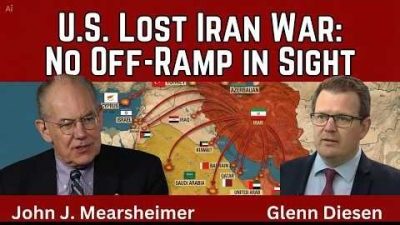
John Mearsheimer: US Already lost Iran war – No off-ramp in sight
or go to
Aletho News Archives – Video-Images
Frlom the Archives
70 Neocons Petition Congress To Effectively Allow Israel To Say When The US Should Attack Iran
By Damian Lataan | January 10, 2014
Seventy senior Israeli-centric neoconservatives have written an open letter to Congress imploring them to do more to ensure Iran complies with the conditions of any agreement finally reached with the P5+1 over Iran’s nuclear program.
While the neocons are ostensibly asking Congress to ensure compliance, it is clear that their real aim is to convince members of Congress to support the bill currently passing through the Senate which calls for tighter sanctions against Iran in the event of any waywardness on Iran’s part.
The neocons are eager to see the bill currently passing through the Senate with enough support to make it veto-proof, not so much because they are concerned about Iran’s so-called nuclear weapons program – there’s still not a skerrick of hard evidence that Iran has a nuclear weapons program – but, rather, because embedded within the bill is this clause:
… if the Government of Israel is compelled to take military action in legitimate self-defense against Iran’s nuclear weapon program, the United States Government should stand with Israel and provide, in accordance with the law of the United States and the constitutional responsibility of Congress to authorize the use of military force, diplomatic, military, and economic support to the Government of Israel in its defense of its territory, people, and existence…
Essentially, the clause is an automatic trigger for the US to attack Iran at any time the Israelis choose to launch a first strike – regardless of whether President Obama is in favour or not.
Partial list… continue
Blog Roll
 Aletho News
- John Mearsheimer: U.S. Already Lost Iran War – No Off-Ramp in Sight
- UK Parliament Plans ISP Blocking and Age Verification Powers
- World cannot remain silent as US and Israel attack ‘heritage of humankind’: Iran
- Emirati billionaire rebukes US senator over call for Gulf states to join war with Iran
- Op. True Promise 4: Iran’s missile blitzkrieg dismantles US war machine in West Asia
- Aramco CEO warns ‘catastrophe’ imminent if Strait of Hormuz remains shut
- What If Iran Says No?
- Trump Threatens to ‘Hit’ Iran ‘Twenty Times Harder’ Over Strait of Hormuz Oil Flows
- Spare the hypocrisy: Baghaei slams Ursula’s support for US
- Iran War Supporters Invent a New and Absurd Justification: It Is All About China
- If Americans Knew
- Israel Decided the War, But Trump’s America Fights and Pays the Bill
- Conscientious Objector Group: Phone ‘Ringing Off Hook’ As Huge Mobilization Underway
- U.S. support for Israel continues to plummet, despite media’s best efforts
- Threats and missiles fly, death tolls soar in Iran, Lebanon, Gaza – Not a ceasefire Day 151
- Lebanon: Israel’s White Phosphorous Use Risks Civilian Harm
- Corporate Media Go All Out To Support The US-Israeli War On Iran
- US-Israel war on Iran is creating a steady growing number of amputees
- Israel planned this war on Iran for 40 years. Everything else is a smoke screen
- The wrong question about the war in Iran
- ‘Your Tax Dollars Being Used to Raise Your Gas Prices’: US-Israel Bomb Major Iranian Oil Depots
- No Tricks Zone
- New Study Documents A 20-Year Pause In Arctic Sea Ice Decline – Driven By Internal Variability
- Wake-up Call: Survey Shows Majority Of Germans Now Favor Postponing Climate Targets!
- Televised! Leading German Political Candidate Tells Schoolchildren CO2 Makes Sun Hotter!
- New Study: A Century Warming Of 1.1°C Is ‘Commonplace’ And ‘Not Unusual’ During This Interglacial
- New Study: ‘Internal Noise’ And Volcanic Forcing Can Trigger 10-15°C Warming Within Decades
- Glaciers Worldwide Are Suddendly Surging, Experts Blame Warming!
- Surprising Discovery: Sahara Is Greening…Billions Of Trees Where Once Thought To Be Barren
- New Research Reaffirms Clouds, Aerosols, And Surface Solar Radiation Are ‘Driving The Climate System’
- Germany: Electric Car Catches Fire At Charging Station, Sets Off Local “Inferno”, Widespread Damage
- New Study: Canada’s New Brunswick Was 1°C Warmer Than Today During The Medieval Warm Period
 Aletho News