Syrian Terrorists Ask Israel for Support, Welcome Netanyahu’s Victory
Prensa Latina | March 21, 2015
Damascus – Ringleaders of terrorist groups deployed on Syrian territory asked Israel to maintain its logistical and military support and send messages of congratulation for the recent election of Israeli Prime Minister Benjamin Netanyahu.
As highlighted by the website HispanTV today, the congratulations were sent through Israeli lawmaker Mendi Safadi, who acts as a mediator between Tel Aviv and Syrian opposition armed groups.
“We received with great hope and joy the news of his victory,” said one of the congratulatory messages sent by Syrian terrorists to the Likud party, winner of the elections in which Netanyahu was reelected.
The website also quoted another message asking the Zionist prime minister to “build better relationships at all levels between Syrian anti-government armed groups and Tel Aviv.”
Among the groups that congratulated Netanyahu are Al-Nusra Front (al-Qaeda branch in Syria), the Free Syrian Army and other extremist armed groups.
Israel provides military, logistic and, particularly, medical services, offering their hospitals to armed rebels wounded in combat, violating Resolution 2170 of the Convention on the Separation of Forces and UN Security Council’s resolutions to fight terrorism.
Since the Syrian crisis began in March 2011, Israel has invested nearly 10 million dollars in medical services for armed groups trying to overthrow the Syrian government.
Tunisia museum attack: Who’s behind it, what are their goals?
RT | March 19, 2015
Groups like IS, which could be behind the Bardo Museum shootings, have a long history of collaborating with the West and may have attacked tourists just to maintain their anti-Western façade, says independent political analyst Dan Glazebrook.
RT: Do you think that the Western tourists were targeted on purpose?
Dan Glazebrook: Yeah, I think so. The thing is with ISIS and these groups – they have a long history of collaborating with the West. It’s fundamental to their appeal that they kind of try to present themselves as anti-Western. If you look over the last several years, they’ve been singing from the same song-sheet – whether it’s on Libya, the fight against Gaddafi; Syria, the fight against Assad. We’ve had revelations about fighters’ passage to Syria to go and fight against Assad being facilitated by MI5, by British intelligence. This all came out in the hearings in Mozambique last year. So these guys are on the same page, they are helping to fulfill the West strategic aims of destabilization in the area. … The thousands and thousands people they’ve killed, the vast majority of them have been other Muslims and non-white people. From time to time they have to kill some Europeans and some Westerners in order to maintain this façade of somehow being opposed to the West, whilst they continue to carry out and facilitate the West’s strategic aims.
RT: A large number of Islamic State fighters reportedly come from Tunisia. Why is that?
DG: It was estimated at one point that the actual majority of foreign fighters in Syria were of Tunisian origin, over 3,000… They’ve also fought in Libya; they’ve fought in terrorist campaigns in Algeria. There are many different reasons; part of it is a kind of extremist backlash against the extremist secularism of the previous President [Zine El Abidine] Ben Ali and his predecessor [Habib Bourguiba]. But I think a lot of it is just simply to do with the economics and finances. There is very high unemployment in Tunisia. It is rumored that you can get up to $27,000 a year for going to fight for ISIS… Billions of dollars were put into these sectarian militias to build up these groups by Saudi Arabia and the USA as a bulwark against the resistance axis of Syria, Iran, and Hezbollah. These billions of dollars are still slushing around.
‘Attack might be publicizing Ansar al-Sharia’s merger with ISIS’
Brian Levin, director of the Center for the Study of Hate and Extremism, also commented on the Tunis museum attack.
RT: No one has claimed responsibility for the attack yet. Who in your view is most likely to be behind it?
Brian Levin: The most likely would probably be Ansar al-Sharia which is a radical Salafist terrorist group which started in Tunisia shortly after the Tunisian revolution in January, 2011. It was formed three months later by a fellow named Abu Ayadh. That is the most likely suspect, although, ISIS affiliates are present in neighboring Libya as well.
RT: Do you think the attackers were pursuing any particular goal with this terrible assault?
BL: Yes, I would think that if it is Ansar al-Sharia or if Ansar al-Sharia is using this to publicize some kind of merger with ISIS – this would be the time and the place to do it. Tunisia, as I said, in an area where ISIS has been exporting its brand of radicalism. That is one thing – Tunisia is Western friendly and it has got a strong economy.
RT: Earlier, a warning for tourists had been issued calling on them not to visit certain areas. Is this kind of attack in Tunisia a rare event and just how dangerous is the country for travelers?
BL: There have been advisories put out about travel to Tunisia. Its biggest industries are in fact tourism and minerals. It is a democratic society and it is Western friendly. Its economy is strong [but] it relies on these exports and tourism. And an attack like this could really hurt the economy in a place where there is fragility with respect to the economic situation. Remember again, Tunisia was the success story of the Arab Spring. This is the time and the place where groups like ISIS and Ansar al-Sharia are trying to make radicalism an imprint there and in the neighboring countries as well.
RT: The EU foreign policy chief Federica Mogherini has said that IS was behind the attack. Do you believe that that is likely?
BL: It could be in a sense to the extent that these actors had the same goal… Ansar Al-Sharia is allying itself with the al-Qaeda affiliates in North Africa. The fact of the matter is it very well could be ISIS. ISIS does have an imprint in North Africa. One of the things that ISIS had wanted to do even when it was just AQI [al-Qaeda in Iraq] back in 2004, they wanted to export their terrorism to places like Jordan, and now has an imprint in places like Libya which neighbors Tunisia.
Read more 17 tourists, 2 locals slain in Tunis museum attack
Washington’s Al Qaeda Ally Now Leading ISIS in Libya
By Eric Draitser – New Eastern Outlook – 09.03.2015
The revelations that US ally Abdelhakim Belhadj is now leading ISIS in Libya should come as no surprise to those who have followed US policy in that country, and throughout the region. It illustrates for the umpteenth time that Washington has provided aid and comfort to precisely those forces it claims to be fighting around the world.
According to recent reports, Abdelhakim Belhadj has now firmly ensconced himself as the organizational commander of the ISIS presence inside Libya. The information comes from an unnamed US intelligence official who has confirmed that Belhadj is supporting and coordinating the efforts of the ISIS training centers in eastern Libya around the city of Derna, an area long known as a hotbed of jihadi militancy.
While it may not seem to be a major story – Al Qaeda terrorist turns ISIS commander – the reality is that since 2011 the US and its NATO allies have held up Belhadj as a “freedom fighter.” They portrayed him as a man who courageously led his fellow freedom-lovers against the “tyrannical despot” Gaddafi whose security forces at one time captured and imprisoned many members of the Libyan Islamic Fighting Group (LIFG), including Belhadj.
Belhadj served the US cause in Libya so well that he can be seen receiving accolades from Sen. John McCain who referred to Belhadj and his followers as heroes. He was initially rewarded after the fall of Gaddafi with the post of military commander of Tripoli, though he was forced to give way to a more politically palatable “transitional government” which has since evaporated in that chaotic, war-ravaged country.
Belhadj’s history of terrorist activity includes such “achievements” as collaboration with Al Qaeda in Afghanistan and Iraq, and of course his convenient servitude to the US-NATO sponsored rampage across Libya that, among other things, caused mass killings of black Libyans and anyone suspected of being part of the Green Resistance (those loyal to the Libyan Arab Jamahiriya led by Gaddafi). Although the corporate media tried to make a martyr of Belhadj for his alleged torture via the CIA rendition program, the inescapable fact is that wherever he goes he leaves a violent and bloody wake.
While much of this information is known, what is of paramount importance is placing this news in a proper political context, one that illustrates clearly the fact that the US has been, and continues to be, the major patron of extremist militants from Libya to Syria and beyond, and that all talk of “moderate rebels” is merely rhetoric designed to fool an unthinking public.
The Enemy of My Enemy is My Friend… Until He Isn’t
There is ample documented evidence of Belhadj’s association with Al Qaeda and his terrorist exploits the world over. Various reports have highlighted his experiences fighting in Afghanistan and elsewhere, and he himself has boasted of killing US troops in Iraq. However, it was in Libya in 2011 where Belhadj became the face of the “rebels” seeking to topple Gaddafi and the legal government of Libya.
As the New York Times reported:
The Libyan Islamic Fighting Group was formed in 1995 with the goal of ousting Colonel Qaddafi. Driven into the mountains or exile by Libyan security forces, the group’s members were among the first to join the fight against Qaddafi security forces… Officially the fighting group does not exist any longer, but the former members are fighting largely under the leadership of Abu Abdullah Sadik [aka Abdelhakim Belhadj].
So, not only was Belhadj a participant in the US-NATO war on Libya, he was one of its most powerful leaders, heading a battle-hardened jihadist faction that constituted the leading edge of the war against Gaddafi. Nowhere was this more clearly demonstrated than when the Libyan Islamic Fighting Group (LIFG) took the lead in the attack on Gaddafi’s compound at Bab al-Aziziya. In this regard, LIFG was provided intelligence, and likely also tactical support, from US intelligence and the US military.
This new information about Belhadj’s association with the suddenly globally relevant ISIS certainly bolsters the argument that this writer, among many others, has made since 2011 – that the US-NATO war on Libya was waged by terrorist groups overtly and tacitly supported by US intelligence and the US military. Moreover, it dovetails with other information that has surfaced in recent years, information that shines a light on how the US exploited for its own geopolitical purposes one of the most active terrorist hotbeds anywhere in the world.
According to the recent reports, Belhadj is directly involved with supporting the ISIS training centers in Derna. Of course Derna should be well known to anyone who has followed Libya since 2011, because that city, along with Tobruk and Benghazi, were the centers of anti-Gaddafi terrorist recruitment in the early days of the “uprising” all through the fateful year of 2011. But Derna was known long before that as a locus of militant extremism.
In a major 2007 study entitled “Al-Qa’ida’s Foreign Fighters in Iraq: A First Look at the Sinjar Records” conducted by the Combating Terrorism Center at the US Military Academy at West Point, the authors noted that:
Almost 19 percent of the fighters in the Sinjar Records came from Libya alone. Furthermore, Libya contributed far more fighters per capita than any other nationality in the Sinjar Records, including Saudi Arabia… The apparent surge in Libyan recruits traveling to Iraq may be linked the Libyan Islamic Fighting Group’s (LIFG) increasingly cooperative relationship with al-Qa’ida which culminated in the LIFG officially joining al-Qa’ida on November 3, 2007… The most common cities that the fighters called home were Darnah [Derna], Libya and Riyadh, Saudi Arabia, with 52 and 51 fighters respectively. Darnah [Derna] with a population just over 80,000 compared to Riyadh’s 4.3 million, has far and away the largest per capita number of fighters in the Sinjar records.
And so, the US military and intelligence community has known for nearly a decade (perhaps longer) that Derna has long been directly or indirectly controlled by jihadis of the LIFG variety, and that that city had acted as a primary recruiting ground for terrorism throughout the region. Naturally, such information is vital if we are to understand the geopolitical and strategic significance of the notion of ISIS training camps associated with the infamous Belhadj on the ground in Derna.
This leads us to three interrelated, and equally important, conclusions. First, Derna is once again going to provide foot soldiers for a terror war to be waged both in Libya, and in the region more broadly, with the obvious target being Syria. Second is the fact that the training sites at Derna will be supported and coordinated by a known US asset. And third, that the US policy of supporting “moderate rebels” is merely a public relations campaign designed to convince average Americans (and those in the West generally) that it is not supporting terrorism, despite all the evidence to the contrary.
The Myth of ‘Moderate Rebels’
The news about Belhadj and ISIS must not be seen in a vacuum. Rather, it should be still further proof that the notion of “moderates” being supported by the US is an insult to the intelligence of political observers and the public at large.
For more than three years now, Washington has trumpeted its stated policy of support to so-called moderate rebels in Syria – a policy which has at various times folded such diverse terror groups as the Al Farooq Brigades (of cannibalism fame) and Hazm (“Determination”) into one large “moderate” tent. Unfortunately for US propagandists and assorted warmongers however, these groups along with many others have since voluntarily or forcibly been incorporated into Jabhat al-Nusra and ISIS/ISIL.
Recently, there have been many reports of mass defections of formerly Free Syrian Army factions to ISIS, bringing along with them their advanced US-supplied weaponry. Couple that with the “poster boys” for Washington policy, the aforementioned Hazm group, now having become part of Jabhat al Nusra, the Al Qaeda linked group in Syria. Of course these are only a few of the many examples of groups that have become affiliated with either the ISIS or Al Qaeda brand in Syria, including Liwaa Al-Farouq, Liwaa Al-Qusayr, and Liwaa Al-Turkomen to name just a few.
What has become clear is that the US and its allies, in their unending quest for regime change in Syria, have been overtly supporting extremist elements that have now coalesced to form a global terror threat in ISIS, Nusra, and Al Qaeda.
But of course, this is nothing new, as the Belhadj episode in Libya demonstrates unequivocally. The man who was once Al Qaeda, then became a “moderate” and “our man in Tripoli,” has now become the leader of the ISIS threat in Libya. So too have “our friends” become our enemies in Syria. None of this should surprise anyone.
But perhaps John McCain would like to answer some questions about his long-standing connections with Belhadj and the “moderates” in Syria. Would Obama like to explain why his “humanitarian intervention” in Libya has become a humanitarian nightmare for that country, and indeed the whole region? Would the CIA, which has been extensively involved in all of these operations, like to come clean about just who they’ve been supporting and what role they’ve played in fomenting this chaos?
I doubt any such questions will ever be asked by anyone in the corporate media. Just as I doubt any answers will ever be furnished by those in Washington whose decisions have created this catastrophe. So, it is for us outside the corporate propaganda matrix to demand answers, and to never let the establishment suppress our voices… or the truth.
The Destabilization Doctrine: ISIS, Proxies and Patsies

By Brandon Martinez | Non-Aligned Media | February 22, 2015
“Islam and the West at War,” reads a recent New York Times headline.
It would certainly seem that way if one were to take at face value the putrid assertions of Western governments that are not particularly known for their honesty or integrity. But astute observers of history and geopolitics can spot a deception when they see one, and the latest theatrical performances being marketed to the masses as real, organic occurrences remind one of a Monty Python sketch.
In the past week we have witnessed a number of expedient events that were designed to legitimize the West’s imperialist foreign policies in the minds of the masses. On Feb. 15 the Islamic State (also known as ISIS) released another highly choreographed and visually striking video allegedly depicting the beheading of 21 Egyptian Coptic Christians. Shortly following the video’s release, the Egyptian dictator Abdel Fattah el-Sissi launched air strikes against ISIS targets in Libya where the execution video was allegedly filmed, although experts are now saying that the production was faked.
ISIS’s continued provocations in the form of carefully crafted, emotionally impactful execution videos (real or faked), such as the recent immolation of a caged Jordanian pilot, cannot possibly be the work of rational actors seeking a military victory in any capacity. The videos only ever work to ISIS’s disadvantage, solidifying the resolve of their current ‘coalition’ opponents as well as creating new enemies upon every release.
Sixty-two countries and groups are presently fighting in the dubious ‘coalition’ against ISIS, most of which have modern militaries with advanced air and ground forces. Why in the world does ISIS continue to entice more countries to join the already over-crowded alliance against them? Why a group that purports to want to establish a ‘state’ which will ostensibly govern millions of people is deliberately seeking more and more enemies and a constant state of war with them beggars belief.
Does ISIS think it can do battle with the whole planet and achieve victory, culminating in world domination? How do people who harbor such ridiculous delusions have the wherewithal and resources at their disposal to organize and recruit thousands of fighters from around the world to an utterly ludicrous cause doomed to sheer failure? How can this be anything but a contrived prank of an operation?
The only logical conclusion that many analysts have come to is that ISIS does not represent a grassroots, organic movement, but rather operates entirely as a cat’s paw of Western foreign policy in the Middle East and North Africa, which is concurrently under the domination of Israel. ISIS’s actions expressly benefit Muslims least of all and Israel/the West most of all, the extent of which increases with every new atrocity and outrage ISIS inflicts upon innocents in Iraq and Syria that gets endless play in Western media. In fact, the Western media’s obsession with ISIS is in and of itself an effective form of PR for the group. Western media outlets are consciously performing an unqualified service for ISIS’s recruiting efforts by affording the terrorist group ‘premium level branding’ that will attract criminally-inclined degenerates, Wahhabist religious zealots and disaffected, suicidal lowlifes from around the world to join a cause predestined to abject failure.
This senile ‘ISIS vs. The World’ spectacle is little more than a melodramatic screenplay engineered in a boardroom by professional propagandists and marketing aficionados. It resembles a classic ‘problem, reaction, solution’ dialectic of deceit. Who in their right mind believes the rancid mythology surrounding this orchestrated ‘good vs. evil’ Hollywood blockbuster?
Proxy Warriors: Cannon Fodder for the Empire
The West is not sincerely at odds with ISIS nor is it seeking to “degrade and destroy” the group, as US President Barrack Obama claims. One piece of information that undermines this good cop/bad cop puppet show is the West’s clandestine support of ISIS beginning with the artificial uprising in Libya. In 2011, the West openly sought to depose Libyan strongman Muammar Gaddafi, and did so by backing ISIS and al-Qaeda-affiliated rebel groups to do it. The maniac rebels who sodomized and then murdered Gaddafi in the street like a dog were hailed as ‘freedom fighters’ by the repellant thugs in Washington, Paris and London, and were fully aided and abetted with NATO air strikes against Gaddafi’s forces. The rebel victory in Libya was only made possible through Western military intervention. “We came, we saw, he died,” said Obama’s former Secretary of State Hilary Clinton in reference to the assassination of Gaddafi by Washington’s foot soldiers, cackling like a witch at the demise of the Libyan potentate.
In a Nov. 19, 2014, article for Global Research, analyst Tony Cartalucci noted that the “so-called ‘rebels’ NATO had backed [in Libya] were revealed to be terrorists led by Al Qaeda factions including the Libyan Islamic Fighting Group (LIFG) and Al-Qaeda in the Islamic Maghreb (AQIM).” During the manufactured ‘uprising’ Gaddafi routinely declared in public speeches that al-Qaeda was leading the way. “Gaddafi blames uprising on al-Qaeda,” read one Al Jazeera headline from February 2011. A March 2011 Guardian report spoke of how “hundreds of convicted members of the Libyan Islamic Fighting Group (LIFG), an al-Qaida affiliate, have been freed and pardoned” under a “reform and repent” program headed by Gaddafi’s son Saif al-Islam. The same article acknowledged that the LIFG, which was established in Afghanistan in the 1990s, “has assassinated dozens of Libyan soldiers and policemen” since its founding and that Britain’s MI6 had previously supported the group. That group formed the backbone of the anti-Gaddafi insurgency, and received all manner of support from the West and allied Gulf sheikhdoms.
In the aforesaid Global Research article, Cartalucci outlines how the synthetic insurrection in Libya was spearheaded by al-Qaeda franchises that were later subsumed into ISIS. A February 2015 CNN report entitled “ISIS finds support in Libya” revealed that since the fall of Gaddafi, ISIS has established a large and menacing presence throughout the North African country. “The black flag of ISIS flies over government buildings,” according to CNN’s reportage. “Police cars carry the group’s insignia. The local football stadium is used for public executions.” It adds that, “Fighters loyal to the Islamic State in Iraq and Syria are now in complete control of the city of Derna, population of about 100,000, not far from the Egyptian border and just about 200 miles from the southern shores of the European Union.”
NATO effectively carpet-bombed Libya into rubble, paving a path of blood for ISIS and al-Qaeda death squads to seize power and institute their medieval ideology. That’s the reward for falling afoul of ‘the West’ and whatever drives it. Cartalucci further proved in another report entitled “Libyan Terrorists Are Invading Syria” that as soon as Gaddafi’s regime collapsed and rebel gangs emerged triumphant, thousands of battle-hardened and fanatical jihadist fighters took their Western training and weapons over to Syria to fight Bashar al-Assad in accordance with Washington’s ‘bait and switch’ scheme. Apparently, these hired mercenaries behave a lot like wild dogs chasing a piece of raw meat.
An absolutely identical scenario unfolded in Syria where Washington and its regional puppets led by Saudi Arabia, Qatar and Turkey have been subsidizing the Islamist guerrillas from the outset. “Do you know of any major Arab ally of the US that embraces ISIL?” US Senator Lindsey Graham facetiously asked General Martin Dempsey at a Senate Armed Services Committee in 2014. To Graham’s surprise, Dempsey responded: “I know major Arab allies who fund them.” US Vice President Joe Biden himself confirmed this in an October 2014 speech wherein he told students at Harvard University that America’s Gulf allies – the Saudis and Qataris especially – were backing ISIS and Jahbat al-Nusra (an al-Qaeda affiliate) with substantive sums of arms and funds. A former US General, Thomas McInerney, told Fox News that the US government helped “build ISIS” by “backing some of the wrong people” and by facilitating weapons to al-Qaeda-linked Libyan rebels which ended up in the hands of ISIS militants in Syria. Retired US General and former NATO Supreme Allied Commander, Wesley Clark, repeated this view in a February 2015 interview with CNN, saying that “ISIS got started through funding from our friends and allies [in the Gulf]” who sought to use religious fanatics to assail the Shia alliance of Syria, Iran and Hezbollah. “It’s like a Frankenstein,” he concluded.
A June 17, 2014, World Net Daily report highlights how Americans trained Syrian rebels who later joined ISIS in a secret base located in Jordan. Jordanian officials told WND’s Aaron Klein that “dozens of future ISIS members were trained [in a US run training facility in Jordan] at the time as part of covert aid to the insurgents targeting the regime of Syrian President Bashar al-Assad in Syria.” Reports in Der Spiegel, the Guardian, Reuters and other mainstream outlets all confirmed that the US, Britain, France and their regional allies were training militants in secret bases in Jordan and Turkey as part of the West’s proxy war against the Assad regime.
The West has attempted to cover-up its support of ISIS and al-Qaeda elements by running a ‘two degrees of separation’ gambit. Washington claims to only provide support to ‘moderate, vetted’ rebel groupings, namely the Free Syrian Army (FSA), but this amounts to a calculated ruse to confound the credulous masses. FSA is the nom de gerre of a loose collection of rebel bandits who don’t operate under a central command framework or authority, rather acting independently or under the umbrella of other factions. Aron Lund, an expert on Syrian rebel groups, discerned in a March 2013 article titled “The Free Syrian Army Doesn’t Exist” that from the very beginning the FSA has been nothing more than a fictional branding operation.
During the initial stages of the insurgency, any militant faction in Syria looking for Western military aid called itself FSA and then took the weapons they received from the West straight to ISIS and Jahbat al-Nusra. The FSA functions as a conduit between Western governments and the Takfiri terrorists fighting Assad as well as an arms distribution network for them. In the aforesaid article, Lund explains that the FSA’s General Staff was set up in Turkey in 2012 “as a flag to rally the Western/Gulf-backed factions around, and probably also a funding channel and an arms distribution network, rather than as an actual command hierarchy.” Thousands of militants fighting under the FSA rubric have since joined or pledged allegiance to ISIS and al-Nusra.
Western governments know this and are apparently totally comfortable with it, revealing their bare complicity and collaboration with the Takfiri insurgents hell-bent on beheading their way to power in Syria and Iraq.
The Counterfeit Campaign
This inevitably creates confusion for people not studied in imperial geopolitics, especially after the West and its Gulf allies ‘declared war’ on ISIS in late 2014. The counterfeit campaign cannot be seen as anything other than a convenient, disingenuous volte-face maneuver designed to whitewash all of the aforementioned facts about the West’s dirty hands behind ISIS. Average plebs who receive all of their information from TV news channels won’t know about the West’s clandestine activities that effectively spawned ISIS and facilitated its rise to prominence in Iraq, Syria and Libya, so they will naturally take the West’s phony confrontation with ISIS at face value.
The West’s crusade to “degrade and destroy” ISIS is a preposterous hoax. In fact, evidence suggests that the West continues to covertly support ISIS with airdrops of weapons and supplies, whilst concurrently ‘bombing’ them in sketchy and deliberately ineffective air strikes.
Iran’s President Hassan Rohani called the US-led anti-ISIS coalition ‘a joke’ considering how many of its participants significantly helped bolster the terrorist group since its inception. In a January 2015 report, Iran’s Fars News Agency quotes a number of Iranian generals and Iraqi MPs who believe that the US is continuing to surreptitiously support ISIS with airdrops of weapons caches and other supplies. General Mohammad Reza Naqdi, a commander of Iran’s Basij (volunteer) Force, said that the US embassy in Baghdad is the “command center” for ISIS in the country. “The US directly supports the ISIL in Iraq and the US planes drop the needed aids and weapons for ISIL,” General Naqdi told a group of Basij forces in Tehran. Fars News cited Majid al-Gharawia, an Iraqi Parliamentary Security and Defense Commission MP, who said that the US are supplying ISIS with weapons and ammunition in a number of Iraqi jurisdictions.
An Iraqi security commission spoke of unidentified aircraft making drops to ISIS militants in Tikrit. Another senior Iraqi lawmaker, Nahlah al-Hababi, echoed these claims about US planes and other unidentified aircraft making deliveries to ISIS. She opined that, “The international coalition is not serious about air strikes on ISIL terrorists and is even seeking to take out the popular Basij (voluntary) forces from the battlefield against the Takfiris so that the problem with ISIL remains unsolved in the near future.” General Massoud Jazayeri, the Deputy Chief of Staff of Iran’s Armed Forces, called the US-led coalition against ISIS a farce. “The US and the so-called anti-ISIL coalition claim that they have launched a campaign against this terrorist and criminal group – while supplying them with weapons, food and medicine in Jalawla region (a town in Diyala Governorate, Iraq). This explicitly displays the falsity of the coalition’s and the US’ claims,” the general said.
The US military claims these air deliveries are mistakenly ending up in ISIS’s possession and that they were intended for Kurdish fighters, but such a ridiculous assertion rings hollow among the true opponents of ISIS – Iran, Syria, Hezbollah and Shiite volunteers in Iraq. Meanwhile, the laughable nature of Washington’s anti-ISIS gambit is underscored by the fact that its initial air strikes against ISIS’s stronghold in Raqqa, Syria, in September 2014 did little more than destroy a bunch of empty buildings. CNN let slip that ISIS fighters had evacuated their command centers in the city 15 to 20 days before US air strikes commenced, indicating that they were probably tipped off. A Syrian opposition activist told ARA News that “the targeted places [in Raqqa], especially refineries, were set on fire, pointing out that IS militants evacuated their strongholds in the last two days to avoid the U.S.-led strikes.”
The Hidden Hand of Zionism
The sham rebellion in Syria was devised and executed by outsiders to serve a nefarious anti-Syrian agenda. All of this seems very confusing if one doesn’t take into consideration the destructive proclivities of the state of Israel in the region.
Israel has essentially used the United States as a cat’s paw in the Middle East, manipulating America’s Leviathan military to smash up her enemies. The formidable Israeli lobby inside the US and its neoconservative lackeys who are a dominant force in the war-making apparatus of the US Military Industrial Complex is a key factor driving the Washington foreign policy establishment’s intransigent approach to the Middle East. When it comes to Middle East policy, the Israelis always get their way. “America is a thing you can move very easily… in the right direction,” Israeli PM Benjamin Netanyahu once bragged. “Don’t worry about American pressure on Israel. We control America,” the former Israeli PM Ariel Sharon boasted.
The destruction of Iraq, Syria, Iran, Lebanon, Libya, Egypt and other Middle Eastern and North African states is a long-standing Zionist policy plan dating back to the 1950s. In 1982 a stunning Israeli strategy paper was published which outlined with remarkable candor a vast conspiracy to weaken, subjugate and ultimately destroy all of Israel’s military rivals. The document was called “A Strategy for Israel in the 1980s,” authored by Oded Yinon, a prominent thinker in Israeli Likud circles. In the vein of the Ottoman millet system, Yinon envisioned the dissolution of Israel’s neighbors and a new Middle East made up of fractured and fragmented Arab/Muslim countries divided into multiple polities along ethnic and religious lines. In Yinon’s mind, the less unified the Arabs and Muslims are the better for Israel’s designs. Better yet, have the Arabs and Muslims fight each other over land and partition themselves into obscurity. Yinon suggests a way to accomplish this, primarily by instigating civil strife in the Arab/Muslim countries which will eventually lead to their dismemberment.
In the document, Yinon specifically recommended:
Lebanon’s total dissolution into five provinces serves as a precedent for the entire Arab world including Egypt, Syria, Iraq and the Arabian peninsula and is already following that track. The dissolution of Syria and Iraq later on into ethnically or religiously unique areas such as in Lebanon, is Israel’s primary target on the Eastern front in the long run, while the dissolution of the military power of those states serves as the primary short term target. Syria will fall apart, in accordance with its ethnic and religious structure, into several states such as in present day Lebanon, so that there will be a Shi’ite Alawi state along its coast, a Sunni state in the Aleppo area, another Sunni state in Damascus hostile to its northern neighbor, and the Druzes who will set up a state, maybe even in our Golan, and certainly in the Hauran and in northern Jordan. This state of affairs will be the guarantee for peace and security in the area in the long run, and that aim is already within our reach today.
He later singled out Iraq as Israel’s most formidable enemy at the time, and outlined its downfall in these terms:
Iraq, rich in oil on the one hand and internally torn on the other, is guaranteed as a candidate for Israel’s targets. Its dissolution is even more important for us than that of Syria. Iraq is stronger than Syria. In the short run it is Iraqi power which constitutes the greatest threat to Israel. An Iraqi-Iranian war will tear Iraq apart and cause its downfall at home even before it is able to organize a struggle on a wide front against us. Every kind of inter-Arab confrontation will assist us in the short run and will shorten the way to the more important aim of breaking up Iraq into denominations as in Syria and in Lebanon. In Iraq, a division into provinces along ethnic/religious lines as in Syria during Ottoman times is possible. So, three (or more) states will exist around the three major cities: Basra, Baghdad and Mosul, and Shi’ite areas in the south will separate from the Sunni and Kurdish north. It is possible that the present Iranian-Iraqi confrontation will deepen this polarization.
Yinon’s vision seems to be unfolding rapidly in Iraq which is today on the verge of partition with the Sunni extremists of ISIS seizing vast swaths of territory for their ‘caliphate’ and the Northern Kurds still battling for independence from Baghdad which is ruled by a Shia clique headed by Haider al-Abadi and Nour al-Maliki. Syria too looks to be falling victim to Yinon’s venomous whims as ISIS has wrested control of large chunks of Syrian territory and presently enforces its brutal sectarianism on the Eastern population of the country.
The themes and ideas in Yinon’s Machiavellian manifesto are still held dear today by the Likudnik rulers in Israel and their neocon patrons in the West. Pro-Israel neocons basically replicated Yinon’s proposals in a 1996 strategy paper intended as advice for Benjamin Netanyahu, although in less direct language. Their report titled “A Clean Break: A New Strategy for Securing the Realm” spoke of “removing Saddam Hussein from power in Iraq” as an “important Israeli strategic objective” that serves as a means of weakening Syria. The Clean Break authors advised that Israel should militarily engage Hezbollah, Syria and Iran along its Northern border. They go on to suggest air strikes on Syrian targets in Lebanon as well as inside Syria-proper. They also stipulate that, “Syrian territory is not immune to attacks emanating from Lebanon by Israeli proxy forces.”
These neocon recommendations seem to be playing out today like a perfectly gauged game of chess. The Syria crisis has unveiled Israel’s plans for destabilizing the region to their benefit. At many points since the unrest in Syria began in 2011, Israel has conducted air strikes on Syrian military sites, just as the Clean Break criminals encouraged. In a January 2015 interview with Foreign Affairs magazine, Syria’s President Bashar al-Assad made note of Israel’s incessant attacks against Syrian army installations during the conflict: “[Tel Aviv is] supporting the rebels in Syria. It’s very clear. Because whenever we make advances in some place, they make an attack in order to undermine the army.” Assad further described Israel as “al-Qaeda’s air force.”
Israel’s support of the Takfiri militants inside Syria goes beyond periodic air strikes in their favor. According to a 2014 UN report, Israel has been providing sanctuary and hospital care to thousands of anti-Assad terrorists, including those of ISIS and al-Nusra, and then dispatching them back into the fight. A Russia Today report on the issue headlined “UN details Israel helping Syrian rebels at Golan Heights” noted: “Israeli security forces have kept steady contacts with the Syrian rebels over the past 18 months, mainly treating wounded fighters but possibly supplying them with arms, UN observers at the Israeli-Syrian border reported.”
Israel’s gains in this situation are manifold. Tel Aviv has been using the fog of war to weaken its primary adversary in Damascus and consequently draw its other foes – Iran and Hezbollah – into the quandary, thereby diminishing their collective resolve to fight Israel itself. The Zionist regime not only views the Takfiris of ISIS and al-Nusra as a “lesser enemy,” but also as proxy mercenaries against Damascus, a strategy explicated in the neocons’ Clean Break document. In fact, Tel Aviv doesn’t view the Takfiris as much of a threat at all; a point that was validated by ISIS itself which declared that it is “not interested” in fighting Israel. “ISIS: Fighting ‘Infidels’ Takes Precedence Over Fighting Israel,” reads an August 2014 headline in Arutz Sheva, an Israeli news outlet.
The former Israeli ambassador to the US, Michael Oren, substantiated all of this in a September 2013 interview with the Jerusalem Post. “’Bad guys’ backed by Iran are worse for Israel than ‘bad guys’ who are not supported by the Islamic Republic,” he told the Post, adding that the “greatest danger” to Israel is “the strategic arc that extends from Tehran, to Damascus to Beirut. And we saw the Assad regime as the keystone in that arc. That is a position we had well before the outbreak of hostilities in Syria. With the outbreak of hostilities we continued to want Assad to go.” Oren further remarked with glee about the total capitulation of the Gulf sheikhdoms – Saudi Arabia, Qatar and the United Arab Emirates – to Israel’s itinerary vis-à-vis Syria, Iran and the Palestinian issue, observing that “in the last 64 years there has probably never been a greater confluence of interest between us and several Gulf States. With these Gulf States we have agreements on Syria, on Egypt, on the Palestinian issue. We certainly have agreements on Iran. This is one of those opportunities presented by the Arab Spring.”
Roland Dumas, France’s former foreign minister, confirmed Israeli intrigue behind Syria’s internal woes. In a June 15, 2013, article for Global Research, journalist Gearóid Ó Colmáin quotes Dumas who told a French TV channel that the turmoil in Syria, which has cost the lives of more than 100,000 Syrians, was planned several years in advance. Dumas claimed that he met with British officials two years before the violence erupted in Damascus in 2011 and at the meeting they confessed to him “that they were organizing an invasion of rebels into Syria.” When asked for his support in the endeavor, Dumas declined, saying, “I’m French, that doesn’t interest me.’’ Dumas further pinpointed the architects of the madness as Israeli Zionists, suggesting that the Syria destabilization operation “goes way back. It was prepared, preconceived and planned [by the Israeli regime].” Dumas noted that Syria’s anti-Israel stance sealed its fate in this respect and also revealed that a former Israeli prime minister once told him “we’ll try to get on with our neighbours but those who don’t agree with us will be destroyed.”
“Israel planned this war of annihilation years ago in accordance with the Yinon Plan, which advocates balkanization of all states that pose a threat to Israel,” writes Gearóid Ó Colmáin in the aforesaid piece. “The Zionist entity is using Britain and France to goad the reluctant Obama administration into sending more American troops to their death in Syria on behalf of Tel Aviv.”
Ó Colmáin argues that the West “are doing [Israel’s] bidding by attempting to drag [the United States] into another ruinous war so that Israel can get control of the Middle East’s energy reserves, eventually replacing the United States as the ruling state in the world. It has also been necessary for Tel Aviv to remain silent so as not to expose their role in the ‘revolutions’, given the fact that the Jihadist fanatics don’t realize they are fighting for Israel.”
ISIS: A Repository of Patsies for the False Flaggers
At long last, this brings us to the ‘second phase’ of the ISIS psyop: scaring Westerners into submission.
It’s no coincidence that the notorious belligerence of ISIS in its quest for a ‘caliphate’ aligns perfectly with the neocon agenda which aims to inculcate in the minds of the masses the myth of a ‘clash of civilizations’ between the West and Islam. In its official magazine, Dabiq, ISIS ideologues advanced a parallel attitude with the neocon desire for a civilizational conflict. Is that merely happenstance? Or has ISIS been manufactured by the neocons to serve as the ultimate boogeyman and straw man caricature of ‘Islamic radicalism’?
The godfather of neoconservatism, Leo Strauss, espoused a dogma of deception, stipulating that in order to corral society behind the wishes of an elite vanguard an ‘external enemy’ must be fashioned. This ‘enemy’ could be real, but enemies usually exist in the eye of the beholder and in the minds of those seeking opposition. Strauss made it clear that if this societal ‘enemy’ did not exist or was not formidable enough to generate an adequate amount of fear required to paralyze and manipulate the masses, then one should be invented or inflated and then advertised to the populace as a real, pressing danger.
For the neocons, this phantom nemesis forms the crux of their strategy of subjugation. Without it, the public would never consent to their lunatic foreign policies, nor would anyone feel threatened enough to willingly relinquish their freedoms in the name of security. This is what ISIS is all about.
As demonstrated earlier, ISIS was cultivated by our own governments to destabilize and ultimately overthrow various regimes in the Middle East and North Africa that fell astray of the Globalist-Zionist program. The Western media has purposely marketed the ISIS ‘brand’ across the globe, making it a household name. The Zionist globalists built up ISIS to do their bidding abroad, but despite media sensationalism the group is not nearly strong enough to pose any serious threat to Western countries. So while ISIS represents no legitimate military threat to the West, its global reputation for brutality and obscene violence is seen as a fantastic propaganda tool to frighten Western populations into consenting to the extirpation of their freedoms at home.
The Zionist globalists have put that carefully crafted ISIS image to work, fabricating a series of perfectly timed ‘terror events’ inside Western countries which have been used to curtail freedoms under the guise of ‘keeping us safe from the terrorists.’ What the gullible commoners don’t realize is that these ‘terrorists’ are controlled by our own governments and are being wielded against us to vindicate the construction of an Orwellian police state.
The string of ‘lone-wolf’ attacks that hit Ottawa, Sydney, Paris and now Copenhagen over the past five months since the West first ‘declared war’ on ISIS are all part of an organized neocon strategy of tension. The intelligence agencies of the West and Israel stand behind them all. In every case, the ‘terrorists’ had long histories of mental illness and/or frequent run-ins with the law; the standard rap-sheet of a patsy whose innumerable weaknesses are exploited by government agents to produce a type-cast ‘fall guy’ to play the part of the ‘wily gunman’ who ‘hates our freedoms.’ ISIS therefore in effect provides the false flag con artists who control our governments with an inexhaustible wellspring of patsies for their operations.
As the researcher Joshua Blakeney pointed out, “Some peasant in Yemen may be angry [enough at the West to want to harm it] but he [could] never [physically carry out] such an attack without it being made possible by the false-flag planners.” A ‘let it happen’ or a ‘made it happen’ scenario amounts to the same thing – without the connivance of the government in question there is no ‘attack’ to even discuss. Since ISIS is a ‘global’ phenomenon, according to our controlled media, authorities don’t even have to prove that these deranged individuals are even members of the group. All they have to say is that they were ‘inspired’ by the group’s message which can be accessed online, and that’s enough to indict them in the court of public opinion. Even if all that were true, it still wouldn’t eliminate potential state involvement, which usually comes in the form of equipping the dupe with the necessary armaments to execute the plot and preventing well-meaning police and intelligence people from intervening to stop it. These are the kinds of queries the West’s big media patently refuses to pursue, knowing full well that the state is almost always complicit with, and keen to exploit, whatever tragedy befalls their population.
All of the latest traumatic terror events in Western capitals have been instantly branded by lying, cynical politicians as attacks on ‘free speech’ and the ‘values of Western civilization,’ a familiar trope first trotted out by George W. Bush and his neocon puppet masters after the false flag attacks of 9/11.
However, what many are starting to realize is that whatever threat some mind controlled junkie might pose to our lives, our own governments are a markedly more dangerous menace to our liberties, well being and way of life. They prove this point every single day with a manifold of new freedom-busting laws that they pass using the comical excuse of protecting us from their own Frankenstein.
That’s the simple truth of the matter that the neocon false flaggers seek to suppress at all costs as they desperately hold up the façade of their artificial power which will inevitably collapse under its own weight.
Brandon Martinez is an independent writer and journalist from Canada who specializes in foreign policy issues, international affairs and 20th and 21st century history. He is the co-founder of Non-Aligned Media and the author of the 2014 books Grand Deceptions and Hidden History. Readers can contact him at martinezperspective[at]hotmail.com or visit his blog at http://martinezperspective.com
Copyright 2015 Brandon Martinez
Al-Qaeda, Saudi Arabia and Israel
By Robert Parry | Consortium News | February 4, 2015
The disclosure that convicted al-Qaeda operative Zacarias Moussaoui has identified leading members of the Saudi government as financers of the terrorist network potentially reshapes how Americans will perceive events in the Middle East and creates a risk for Israel’s Likud government which has forged an unlikely alliance with some of these same Saudis.
According to a story in the New York Times on Wednesday, Moussaoui said in a prison deposition that he was directed in 1998 or 1999 by Qaeda leaders in Afghanistan to create a digital database of the group’s donors and that the list included Prince Turki al-Faisal, then Saudi intelligence chief; Prince Bandar bin Sultan, longtime Saudi ambassador to the United States; Prince al-Waleed bin Talal, a prominent billionaire investor; and many leading clerics.
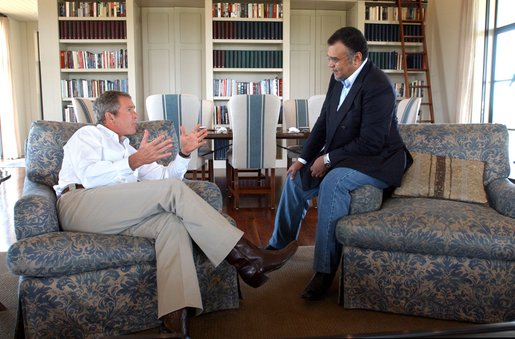
Prince Bandar bin Sultan, then Saudi ambassador to the United States, meeting with President George W. Bush in Crawford, Texas. (White House photo)
“Sheikh Osama wanted to keep a record who give money,” Moussaoui said in imperfect English — “who is to be listened to or who contributed to the jihad.”
Although Moussaoui’s credibility came under immediate attack from the Saudi kingdom, his assertions mesh with accounts from members of the U.S. Congress who have seen a secret portion of the 9/11 report that addresses alleged Saudi support for al-Qaeda.
Further complicating the predicament for Saudi Arabia is that, more recently, Saudi and other Persian Gulf oil sheikdoms have been identified as backers of Sunni militants fighting in Syria to overthrow the largely secular regime of President Bashar al-Assad. The major rebel force benefiting from this support is al-Nusra Front, al-Qaeda’s affiliate in Syria.
In other words, the Saudis appear to have continued a covert relationship with al-Qaeda-connected jihadists to the present day.
The Israeli Exposure
And, like the Saudis, the Israelis have sided with the Sunni militants in Syria because the Israelis share the Saudi view that Iran and the so-called “Shiite crescent” – reaching from Tehran and Baghdad to Damascus and Beirut – is the greatest threat to their interests in the Middle East.
That shared concern has pushed Israel and Saudi Arabia into a de facto alliance, though the collaboration between Jerusalem and Riyadh has been mostly kept out of the public eye. Still, it has occasionally peeked out from under the covers as the two governments deploy their complementary assets – Saudi oil and money and Israeli political and media clout – in areas where they have mutual interests.
In recent years, these historic enemies have cooperated in their joint disdain for the Muslim Brotherhood government in Egypt (which was overthrown in 2013), in seeking the ouster of the Assad regime in Syria, and in pressing for a more hostile U.S. posture toward Iran.
Israel and Saudi Arabia also have collaborated in efforts to put the squeeze on Russia’s President Vladimir Putin, who is deemed a key supporter of both Iran and Syria. The Saudis have used their power over oil production to drive down prices and hurt Russia’s economy, while U.S. neoconservatives – who share Israel’s geopolitical world view – were at the forefront of the coup that ousted Ukraine’s pro-Russian President Viktor Yanukovych in 2014.
The behind-the-scenes Israeli-Saudi alliance has put the two governments – uncomfortably at times – on the side of Sunni jihadists battling Shiite influence in Syria, Lebanon and even Iraq. On Jan. 18, 2015, for instance, Israel attacked Lebanese-Iranian advisers assisting Assad’s government in Syria, killing several members of Hezbollah and an Iranian general. These military advisors were engaged in operations against al-Qaeda’s Nusra Front.
Meanwhile, Israel has refrained from attacking Nusra Front militants who have seized Syrian territory near the Israeli-occupied Golan Heights. One source familiar with U.S. intelligence information on Syria told me that Israel has a “non-aggression pact” with these Nusra forces.
An Odd Alliance
Israel’s odd-couple alliances with Sunni interests have evolved over the past several years, as Israel and Saudi Arabia emerged as strange bedfellows in the geopolitical struggle against Shiite-ruled Iran and its allies in Iraq, Syria and southern Lebanon. In Syria, for instance, senior Israelis have made clear they would prefer Sunni extremists to prevail in the civil war rather than Assad, who is an Alawite, a branch of Shiite Islam.
In September 2013, Israel’s Ambassador to the United States Michael Oren, then a close adviser to Israeli Prime Minister Benjamin Netanyahu, told the Jerusalem Post that Israel favored the Sunni extremists over Assad.
“The greatest danger to Israel is by the strategic arc that extends from Tehran, to Damascus to Beirut. And we saw the Assad regime as the keystone in that arc,” Oren told the Jerusalem Post in an interview. “We always wanted Bashar Assad to go, we always preferred the bad guys who weren’t backed by Iran to the bad guys who were backed by Iran.” He said this was the case even if the “bad guys” were affiliated with al-Qaeda.
And, in June 2014, speaking as a former ambassador at an Aspen Institute conference, Oren expanded on his position, saying Israel would even prefer a victory by the brutal Islamic State over continuation of the Iranian-backed Assad in Syria. “From Israel’s perspective, if there’s got to be an evil that’s got to prevail, let the Sunni evil prevail,” Oren said.
Skepticism and Doubt
In August 2013, when I first reported on the growing relationship between Israel and Saudi Arabia in an article entitled “The Saudi-Israeli Superpower,” the story was met with much skepticism. But, increasingly, this secret alliance has gone public.
On Oct. 1, 2013, Israeli Prime Minister Netanyahu hinted at it in his United Nations General Assembly speech, which was largely devoted to excoriating Iran over its nuclear program and threatening a unilateral Israeli military strike.
Amid the bellicosity, Netanyahu dropped in a largely missed clue about the evolving power relationships in the Middle East, saying: “The dangers of a nuclear-armed Iran and the emergence of other threats in our region have led many of our Arab neighbors to recognize, finally recognize, that Israel is not their enemy. And this affords us the opportunity to overcome the historic animosities and build new relationships, new friendships, new hopes.”
The next day, Israel’s Channel 2 TV news reported that senior Israeli security officials had met with a high-level Gulf state counterpart in Jerusalem, believed to be Prince Bandar, the former Saudi ambassador to the United States who was then head of Saudi intelligence.
The reality of this unlikely alliance has now even reached the mainstream U.S. media. For instance, Time magazine correspondent Joe Klein described the new coziness in an article in the Jan. 19, 2015 issue.
He wrote: “On May 26, 2014, an unprecedented public conversation took place in Brussels. Two former high-ranking spymasters of Israel and Saudi Arabia – Amos Yadlin and Prince Turki al-Faisal – sat together for more than an hour, talking regional politics in a conversation moderated by the Washington Post’s David Ignatius.
“They disagreed on some things, like the exact nature of an Israel-Palestine peace settlement, and agreed on others: the severity of the Iranian nuclear threat, the need to support the new military government in Egypt, the demand for concerted international action in Syria. The most striking statement came from Prince Turki. He said the Arabs had ‘crossed the Rubicon’ and ‘don’t want to fight Israel anymore.’”
Though Klein detected only the bright side of this détente, there was a dark side as well, as referenced in Moussaoui’s deposition, which identified Prince Turki as one of al-Qaeda’s backers. Perhaps even more unsettling was his listing of Prince Bandar, who had long presented himself as a U.S. friend, so close to the Bush Family that he was nicknamed “Bandar Bush.”
Moussaoui claimed that he discussed a plan to shoot down Air Force One with a Stinger missile with a staff member at the Saudi Embassy in Washington, at a time when Bandar was the ambassador to the United States.
According to the New York Times article by Scott Shane, Moussaoui said he was assigned to “find a location where it may be suitable to launch a Stinger attack and then, after, be able to escape,” but that he was arrested on Aug. 16, 2001, before he could carry out the reconnaissance mission.
The thought of anyone in the Saudi embassy, then under the control of “Bandar Bush,” scheming with al-Qaeda to shoot down George W. Bush’s Air Force One is shocking, if true. The notion would have been considered unthinkable even after the 9/11 attacks, which involved 15 Saudis among the 19 hijackers.
After those terror attacks which killed nearly 3,000 Americans, Bandar went to the White House and persuaded Bush to arrange for the rapid extraction of bin Laden’s family members and other Saudis in the United States. Bush agreed to help get those Saudi nationals out on the first flights allowed back into the air.
Bandar’s intervention undercut the FBI’s chance to learn more about the ties between Osama bin Laden and the 9/11 perpetrators by giving FBI agents only time for cursory interviews with the departing Saudis.
Bandar himself was close to the bin Laden family and acknowledged having met Osama bin Laden in the context of bin Laden thanking Bandar for his help financing the jihad project in Afghanistan during the 1980s. “I was not impressed, to be honest with you,” Bandar told CNN’s Larry King about bin Laden. “I thought he was simple and very quiet guy.”
The Saudi government claimed to have broken ties with bin Laden in the early 1990s when he began targeting the United States because President George H.W. Bush had stationed U.S. troops in Saudi Arabia, but – if Moussaoui is telling the truth – al-Qaeda would have still counted Bandar among its supporters in the late 1990s.
Bandar and Putin
Bandar’s possible links to Sunni terrorism also emerged in 2013 during a confrontation between Bandar and Putin over what Putin viewed as Bandar’s crude threat to unleash Chechen terrorists against the Sochi Winter Olympics if Putin did not reduce his support for the Syrian government.
According to a leaked diplomatic account of a July 31, 2013 meeting in Moscow, Bandar informed Putin that Saudi Arabia had strong influence over Chechen extremists who had carried out numerous terrorist attacks against Russian targets and who had since deployed to join the fight against the Assad regime in Syria.
As Bandar called for a Russian shift toward the Saudi position on Syria, he reportedly offered guarantees of protection from Chechen terror attacks on the Olympics. “I can give you a guarantee to protect the Winter Olympics in the city of Sochi on the Black Sea next year,” Bandar reportedly said. “The Chechen groups that threaten the security of the games are controlled by us.”
Putin responded, “We know that you have supported the Chechen terrorist groups for a decade. And that support, which you have frankly talked about just now, is completely incompatible with the common objectives of fighting global terrorism.”
Bandar’s Mafia-like threat toward the Sochi games – a version of “nice Olympics you got here, it’d be a shame if something terrible happened to it” – failed to intimidate Putin, who continued to support Assad.
Less than a month later, an incident in Syria almost forced President Barack Obama’s hand in launching U.S. air strikes against Assad’s military, which would have possibly opened the path for the Nusra Front or the Islamic State to capture Damascus and take control of Syria. On Aug. 21, 2013, a mysterious sarin attack outside Damascus killed hundreds and, in the U.S. media, the incident was immediately blamed on the Assad regime.
American neocons and their allied “liberal interventionists” demanded that Obama launch retaliatory air strikes even though some U.S. intelligence analysts doubted that Assad’s forces were responsible and suspected that the attack was carried out by extremist rebels trying to pull the U.S. military into the civil war on their side.
Yet, pushed by the neocons and liberal war hawks, Obama nearly ordered a bombing campaign designed to “degrade” the Syrian military but called it off at the last minute. He then accepted Putin’s help in reaching a diplomatic solution in which Assad agreed to surrender his entire chemical weapons arsenal, while still denying any role in the sarin attack.
Later, the Assad-did-it case crumbled amid new evidence that Sunni extremists, supported by Saudi Arabia and Turkey, were the more likely perpetrators of the attack, a scenario that became increasingly persuasive as Americans learned more about the cruelty and ruthlessness of many Sunni jihadists fighting in Syria. [See Consortiumnews.com’s “The Mistaken Guns of Last August.”]
Targeting Putin
Putin’s cooperation with Obama to head off a U.S. military strike in Syria made the Russian president more of a target for the American neocons who thought they finally had reached the cusp of their long-desired “regime change” in Syria only to be blocked by Putin. By late September 2013, a leading neocon, National Endowment for Democracy President Carl Gershman, announced the goal of challenging Putin and recognizing his sore point in Ukraine.
Taking to the Washington Post’s op-ed page on Sept. 26, 2013, Gershman called Ukraine “the biggest prize” and an important step toward ultimately ousting Putin. Gershman wrote, “Ukraine’s choice to join Europe will accelerate the demise of the ideology of Russian imperialism that Putin represents. … Russians, too, face a choice, and Putin may find himself on the losing end not just in the near abroad but within Russia itself.” [See Consortiumnews.com’s “Neocons’ Ukraine-Syria-Iran Gambit.“]
However, in early 2014, Putin was obsessed with Bandar’s implicit threat of terrorism striking the Sochi Olympics, thus distracting him from the “regime change” – being pushed by NED and neocon Assistant Secretary of State for European Affairs Victoria Nuland – next door in Ukraine.
On Feb. 22, 2014, putschists, spearheaded by well-organized neo-Nazi militias, drove elected President Viktor Yanukovych and his government from power. Putin was caught off-guard and, in the resulting political chaos, agreed to requests from Crimean officials and voters to accept Crimea back into Russia, thus exploding his cooperative relationship with Obama.
With Putin the new pariah in Official Washington, the neocon hand also was strengthened in the Middle East where renewed pressure could be put on the “Shiite crescent” in Syria and Iran. However, in summer 2014, the Islamic State, which had splintered off from al-Qaeda and its Nusra Front, went on a rampage, invading Iraq where captured soldiers were beheaded. The Islamic State then engaged in gruesome videotaped decapitations of Western hostages inside Syria.
The Islamic State’s brutality and the threat it posed to the U.S.-backed, Shiite-dominated government of Iraq changed the political calculus. Obama felt compelled to launch airstrikes against Islamic State targets in both Iraq and Syria. American neocons tried to convince Obama to expand the Syrian strikes to hit Assad’s forces, too, but Obama realized such a plan would only benefit the Islamic State and al-Qaeda’s Nusra Front.
In effect, the neocons were showing their hand – much as Israeli Ambassador Oren had done – favoring the Sunni extremists allied with al-Qaeda over Assad’s secular regime because it was allied with Iran. Now, with Moussaoui’s deposition identifying senior Saudi officials as patrons of al-Qaeda, another veil seems to have dropped.
Complicating matters further, Moussaoui also claimed that he passed letters between Osama bin Laden and then Crown Prince Salman, who recently became king upon the death of his brother King Abdullah.
But Moussaoui’s disclosure perhaps cast the most unflattering light on Bandar, the erstwhile confidant of the Bush Family who — if Moussaoui is right — may have been playing a sinister double game.
Also facing potentially embarrassing questions is Israeli Prime Minister Netanyahu, especially if he goes through with his planned speech before a joint session of Congress next month, attacking Obama for being soft on Iran.
And, America’s neocons might have some explaining to do about why they have carried water not just for the Israelis but for Israel’s de facto allies in Saudi Arabia.
~
Investigative reporter Robert Parry broke many of the Iran-Contra stories for The Associated Press and Newsweek in the 1980s. You can buy his latest book, America’s Stolen Narrative, either in print here or as an e-book (from Amazon and barnesandnoble.com).
Congress Seeks Netanyahu’s Direction
By Robert Parry | Consortium News | January 22, 2015
Showing who some in Congress believe is the real master of U.S. foreign policy, House Speaker John Boehner has invited Israel’s Prime Minister Benjamin Netanyahu to address a joint session and offer a rebuttal to President Barack Obama’s comments on world affairs in his State of the Union speech.
Boehner made clear that Netanyahu’s third speech to a joint session of the U.S. Congress – scheduled for Feb. 11 – was meant to counter Obama’s assessments. “There is a serious threat in the world, and the President last night kind of papered over it,” Boehner said on Wednesday. “And the fact is that there needs to be a more serious conversation in America about how serious the threat is from radical Islamic jihadists and the threat posed by Iran.”
The scheduling of Netanyahu’s speech caught the White House off-guard, since the Israeli prime minister had apparently not bothered to clear his trip with the administration. The Boehner-Netanyahu arrangement demonstrates a mutual contempt for this President’s authority to conduct American foreign policy as prescribed by the U.S. Constitution.
In the past when Netanyahu has spoken to Congress, Republicans and Democrats have competed to show their devotion by quickly and frequently leaping to their feet to applaud almost every word out of the Israeli prime minister’s mouth. By addressing a joint session for a third time, Netanyahu would become only the second foreign leader to do so, joining British Prime Minister Winston Churchill who never used the platform to demean the policies of a sitting U.S. president.
Besides this extraordinary recognition of another country’s leader as the true definer of U.S. foreign policy, Boehner’s move reflects an ignorance of what is actually occurring on the ground in the Middle East. Boehner doesn’t seem to realize that Netanyahu has developed what amounts to a de facto alliance with extremist Sunni forces in the region.
Not only is Israel now collaborating behind the scenes with Saudi Arabia’s Wahhabist leadership but Israel has begun taking sides militarily in support of the Nusra Front, al-Qaeda’s affiliate in the Syrian civil war. A source familiar with U.S. intelligence information on Syria said Israel has a “non-aggression pact” with Nusra forces that control territory adjacent to the Israeli-occupied Golan Heights.
The quiet cooperation between Israel and al-Qaeda’s affiliate was further underscored on Sunday when Israeli helicopters attacked and killed advisers to the Syrian military from Lebanon’s Hezbollah and Iran. In other words, Israel has dispatched its forces into Syria to kill military personnel helping to fight al-Nusra. Iran later confirmed that one of its generals had died in the Israeli strike.
Israel’s tangled alliances with Sunni forces have been taking shape over the past several years, as Israel and Saudi Arabia emerged as strange bedfellows in the geopolitical struggle against Shiite-ruled Iran and its allies in Iraq, Syria and southern Lebanon. Both Saudi and Israeli leaders have talked with growing alarm about this “Shiite crescent” stretching from Iran through Iraq and Syria to the Hezbollah strongholds in Lebanon.
Favoring Sunni Extremists
Senior Israelis have made clear they would prefer Sunni extremists to prevail in the Syrian civil war rather than President Bashar al-Assad, who is an Alawite, a branch of Shiite Islam. Assad’s relatively secular government is seen as the protector of Shiites, Christians and other minorities who fear the vengeful brutality of the Sunni jihadists who now dominate the anti-Assad rebels.
In one of the most explicit expressions of Israel’s views, its Ambassador to the United States Michael Oren, a close adviser to Netanyahu, told the Jerusalem Post in September 2013 that Israel favored the Sunni extremists over Assad.
“The greatest danger to Israel is by the strategic arc that extends from Tehran, to Damascus to Beirut. And we saw the Assad regime as the keystone in that arc,” Oren told the Jerusalem Post in an interview. “We always wanted Bashar Assad to go, we always preferred the bad guys who weren’t backed by Iran to the bad guys who were backed by Iran.” He said this was the case even if the “bad guys” were affiliated with al-Qaeda.
Saudi Arabia shares Israeli’s strategic view that “the Shiite crescent” must be broken and has thus developed a rapport with Netanyahu’s government in a kind of “enemy of my enemy is my friend” relationship. But some rank-and-file Jewish supporters of Israel have voiced concerns about Israel’s new-found alliance with the Saudi monarchy, especially given its adherence to ultraconservative Wahhabi Islam and its embrace of a fanatical hatred of Shiite Islam, a sectarian conflict between Sunnis and Shiites that dates back 1,400 years.
Though President Obama has repeatedly declared his support for Israel, he has developed a contrary view from Netanyahu’s regarding what is the gravest danger in the Middle East. Obama considers the radical Sunni jihadists, associated with al-Qaeda and the Islamic State, to be the biggest threat to Western interests and U.S. national security.
That has put him in a different de facto alliance – with Iran and the Syrian government – since they represent the strongest bulwarks against Sunni jihadists who have targeted Americans and other Westerners for death.
What Boehner doesn’t seem to understand is that Israel and Saudi Arabia have placed themselves on the side of the Sunni jihadists who now represent the frontline fight against the “Shiite crescent.” If Netanyahu succeeds in enlisting the United States in violently forcing Syrian “regime change,” the U.S. government likely would be facilitating the growth in power of the Sunni extremists, not containing them.
But the influential American neoconservatives want to synch U.S. foreign policy with Israel’s and thus have pressed for a U.S. bombing campaign against Assad’s forces (even if that would open the gates of Damascus to the Nusra Front or the Islamic State). The neocons also want an escalation of tensions with Iran by sabotaging an agreement to ensure that its nuclear program is not used for military purposes.
The neocons have long wanted to bomb-bomb-bomb Iran as part of their “regime change” strategy for the Middle East. That is why Obama’s openness to a permanent agreement for tight constraints on Iran’s nuclear program is seen as a threat by Netanyahu, the neocons and their congressional allies – because it would derail hopes for militarily attacking Iran.
In his State of the Union address on Tuesday, Obama made clear that he perceives the brutal Islamic State, which he calls “ISIL” for the Islamic State of Iraq and the Levant, as the principal current threat to Western interests in the Middle East and the clearest terror threat to the United States and Europe. Obama proposed “a smarter kind of American leadership” that would cooperate with allies in “stopping ISIL’s advance” without “getting dragged into another ground war in the Middle East.”
Working with Putin
Thus, Obama, who might be called a “closet realist,” is coming to the realization that the best hope for blocking the advances of Sunni jihadi terror and minimizing U.S. military involvement is through cooperation with Iran and its regional allies. That also puts Obama on the same side with Russian President Vladimir Putin who has faced Sunni terrorism in Chechnya and is supporting both Iran’s leaders and Syria’s Assad in their resistance to the Islamic State and al-Qaeda’s Nusra Front.
Obama’s “realist” alliance, in turn, presents a direct threat to Netanyahu’s insistence that Iran represents an “existential threat” to Israel and that the “Shiite crescent” must be destroyed. There is also fear among Israeli right-wingers that an effective Obama-Putin collaboration could ultimately force Israel into accepting a Palestinian state.
So, Netanyahu and the U.S. neocons believe they must do whatever is necessary to shatter this tandem of Obama, Putin and Iran. That is one reason why the neocons were at the forefront of fomenting “regime change” against Ukraine’s elected pro-Russian President Viktor Yanukovych last year. By splintering Ukraine on Russia’s border, the neocons drove a wedge between Obama and Putin. [See Consortiumnews.com’s “Neocons’ Ukraine-Syria-Iran Gambit.”]
Even the slow-witted mainstream U.S. media has begun to pick up on the story of the emerging Israeli-Saudi alliance. In the Jan. 19 issue of Time magazine, correspondent Joe Klein noted the new coziness between top Israeli and Saudi officials.
He wrote: “On May 26, 2014, an unprecedented public conversation took place in Brussels. Two former high-ranking spymasters of Israel and Saudi Arabia – Amos Yadlin and Prince Turki al-Faisal – sat together for more than an hour, talking regional politics in a conversation moderated by the Washington Post’s David Ignatius.
“They disagreed on some things, like the exact nature of an Israel-Palestine peace settlement, and agreed on others: the severity of the Iranian nuclear threat, the need to support the new military government in Egypt, the demand for concerted international action in Syria. The most striking statement came from Prince Turki. He said the Arabs had ‘crossed the Rubicon’ and ‘don’t want to fight Israel anymore.’”
Not only did Prince Turki offer an olive branch to Israel, he indicated agreement on what the two countries consider their most pressing strategic interests: Iran’s nuclear program and Syria’s civil war. In other words, in noting this extraordinary meeting, Klein had stumbled upon the odd-couple alliance between Israel and Saudi Arabia – though he didn’t fully understand what he was seeing.
On Tuesday, the New York Times reported that Obama had shifted his position on Syria as the West made a “quiet retreat from its demand” that Assad “step down immediately.” The article by Anne Barnard and Somini Sengupta noted that the Obama administration still wanted Assad to exit eventually “but facing military stalemate, well-armed jihadists and the world’s worst humanitarian crisis, the United States is going along with international diplomatic efforts that could lead to more gradual change in Syria.”
At the center of that diplomatic initiative was Russia, again reflecting Obama’s recognition of the need to cooperate with Putin on resolving some of these complex problems (although Obama did include in his speech some tough-guy rhetoric against Russia over Ukraine, taking some pleasure in how Russia’s economy is now “in tatters”).
But the underlying reality is that the United States and Assad’s regime have become de facto allies, fighting on the same side in the Syrian civil war, much as Israel had, in effect, sided with al-Qaeda’s Nusra Front by killing Hezbollah and Iranian advisers to the Syrian military.
The Times article noted that the shift in Obama’s position on Syrian peace talks “comes along with other American actions that Mr. Assad’s supporters and opponents take as proof Washington now believes that if Mr. Assad is ousted, there will be nothing to check the spreading chaos and extremism.
“American planes now bomb the Islamic State group’s militants in Syria, sharing skies with Syrian jets. American officials assure Mr. Assad, through Iraqi intermediaries, that Syria’s military is not their target. The United States still trains and equips Syrian insurgents, but now mainly to fight the Islamic State, not the government.”
Yet, as Obama adjusts U.S. foreign policy to take into account the complex realities in the Middle East, he now faces another front in this conflict – from the U.S. Congress, which has long been held in thrall by the Israel lobby.
Not only has Speaker Boehner appealed to Netanyahu to deliver what amounts to a challenge to President Obama’s foreign policy but congressional neocons are even accusing Obama’s team of becoming Iranian stooges. Sen. Robert Menendez of New Jersey, a Democratic neocon, said, “The more I hear from the administration and its quotes, the more it sounds like talking points that come straight out of Tehran.”
If indeed Netanyahu does end up addressing a joint session of the U.S. Congress, its members would face a stark choice of either embracing Israel’s foreign policy as America’s or backing the decisions made by the elected President of the United States.
~
Investigative reporter Robert Parry broke many of the Iran-Contra stories for The Associated Press and Newsweek in the 1980s. You can buy his latest book, America’s Stolen Narrative, either in print here or as an e-book (from Amazon and barnesandnoble.com).
Houthi leader sets conditions to end Yemeni crisis
MEMO | January 21, 2015
The Houthis have outlined four conditions to end Yemen’s political crisis, the Anadolu Agency reported the group’s leader as saying.
In a televised speech broadcasted by Yemen’s Al-Maseera satellite channel yesterday, Abdul-Malik Al-Houthi called for a speedy reformation of the National Supervisory Authority which was tasked with overseeing the results of the National Dialogue Conference and which ceased to be active in January 2014.
He also called for amendments to the country’s draft constitution to be expedited, the implementation of the peace and partnership agreement and to conduct comprehensive security reform.
Al-Houthi accused Yemeni President Abd Rabbuh Mansour Hadi of “protecting corruption and lack of seriousness in implementing the peace and partnership agreement, which brought the country to the current situation”.
He also accused him of supporting Al-Qaeda and supplying it with weapons. “President Hadi refused to allow the army to fight Al-Qaeda and gave the group the opportunity to rob banks,” he said.
The Yemeni capital Sanaa was been rocked by violent clashes for the second consecutive day on yesterday between presidential guards and Al-Houthi militants who are said to have seized the presidential palace with Prime Minister Khaled Bahah inside.
Al-Houthi said: “There is a conspiracy against Yemen and its people that is led by forces targeting the entire region. Yemen in on the verge of political, security and economic collapse. The Yemeni leadership is mired in corruption” he said.”
The Houthis seized control of Sanaa in September.
Charlie Hebdo, Zionism & Media Deception – Interview with Hafsa Kara-Mustapha
Brandon Martinez interviews Hafsa Kara-Mustapha on a January 18, 2015 episode of the Non-Aligned Media Podcast.
Hafsa Kara-Mustapha is a London-based journalist and political commentator who has written extensively about the Middle East for publications such as Middle East Magazine, Jane’s Foreign Report and El Watan newspaper. She also appears frequently on Press TV and Russia Today.
Brandon Martinez is an independent writer and journalist from Canada who specializes in foreign policy issues, international affairs and 20th and 21st century history. For years he has written on Zionism, Israel-Palestine, American and Canadian foreign policy, war, terrorism and deception in media and politics. Listeners can contact him at martinezperspective[at]hotmail.com or visit his blog.
The Fantasy of an Iran-US Partnership
By Seyed Mohammad Marandi | Tehran Times | January 6, 2015
Western pundits who blithely assert that the Islamic Republic of Iran can or will cooperate with the United States in Iraq against ISIL ignore a basic problem; how can the US be a serious partner in fighting a terrorist movement that Washington may have played a critical role in creating?
When US Vice-President Joe Biden told an American university audience in October that Turkey, the UAE and Saudi Arabia are responsible for arming al-Nusra, ISIL, and other al-Qaeda-rooted extremists in Syria and that there is no “moderate middle” in the country, there was (as most non-Americans expected) little coverage of this stunning admission in the US mainstream media.
Indeed, what little coverage there was focused on Biden’s subsequent apologies to Turkish, Emirati, and Saudi leaders for having made such comments in the first place.
Predictably, there was no follow-up reporting in The New York Times reminding Americans that the US is itself complicit in funding and arming extremists in Syria.
CIA producing weapons
In early 2013, the newspaper reported what many in the region already knew; that since the beginning of 2012, the CIA had been deeply involved in procuring weapons for anti-Assad forces, airlifting arms to Jordanian and Turkish airports, and “vetting” rebel commanders – all to help US allies “support the lethal side of the civil war”. Other reports pointed out that these shipments were actually paid for by US allies, at the bidding of the Obama administration.
But, after the Biden revelation, the so-called “newspaper of record” made no reference to how the US, in violation of international law, helped to facilitate the Syrian civil war – and, in the process, to enable the rise of ISIL.
Western-backed extremism is neither a new nor regionally-bound concept. Whether it is the “Contra” rebels in Nicaragua or al-Qaeda-like groups in Afghanistan, the objective has always been to achieve strategic objectives through the infliction of mass suffering – for, in the “free and civilised world” of the US and its allies, the utopian end too often justifies the Mephistophelean means.
More recently, an important footnote to the Libyan civil war was the involvement of Abdul Hakim Belhaj, previously the leader of the Libyan Islamic Fighting Group as well as an al-Qaeda member.
He was one of many Libyan militants influenced by a takfiri (apostate) ideology; the groups with which he was affiliated were designated as terrorist organisations by the US State Department.
Nevertheless, he, along with other like-minded militants, became central components in the efforts of western and Arab-backed anti-Gaddafi forces to capture Tripoli, the Libyan capital.
Western willingness to cooperate with al-Qaeda (or “former” al-Qaeda) militants in Libya was a major turning point. Even the subsequent death of the US ambassador to Libya did not change US policy in this regard. Belhaj became the representative of Libya’s interim president after Gaddafi’s overthrow (before the complete ruin of the country).
More importantly, the willingness of the US and European and “Middle Eastern” allies to embrace al-Qaeda-like militants took US and western foreign policy in the region back to what it had been before the September 11, 2001 attacks – a policy of cooperation with violent extremists to undermine regional actors the West considers problematic.
Monster they created
This policy quickly expanded from Libya to Syria and the repercussions are being felt today in countries like Pakistan, Nigeria, Australia, and China.
After Gaddafi’s overthrow, Turkey – a NATO member – allegedly helped Belhaj to meet with leaders of the so-called “Free Syrian Army” in Istanbul and along the Syrian-Turkish border. In the meetings the former al-Qaeda leader discussed supporting the FSA with money, weapons, and fighters, at a time when the CIA was a major conduit for the transfer of weapons from Libya to Syria.
While Belhaj was just one of many al-Qaeda affiliates involved in violent anti-government campaigns in both Libya and Syria, his openly acknowledged role underscores how the supposedly “moderate” FSA was, from early on in the Syrian civil war, as Iran repeatedly warned, deeply associated with and infiltrated by extremists.
US arms sales hit record levels
Over time, the problem grew so large with ISIL’s rise that it became impossible to hide the monster that the US and its allies had created. And so, Washington launched yet another chapter in its never-ending post-9/11 “war on terror”.
Notwithstanding Washington’s professed determination to degrade and, ultimately, to destroy ISIL, Iran remains profoundly skeptical of US intentions.
Even after dramatic gains by ISIL in Iraq and the formation of a US-led coalition of the guilty to fight it, this coalition has, on average, carried out just nine airstrikes per day in both Iraq and Syria.
In comparison, western reports indicate that, in the same period, the Syrian air force alone has at times carried out up to 200 strikes in 36 hours. Even as these largely inconsequential US-led airstrikes are carried out in Iraq and Syria, some regional players continue to provide extensive logistical support to ISIL; along Syria’s borders with Jordan and the Israeli regime, the Nusra Front continues to collaborate with other extremist militias backed by foreign (including western) powers.
In light of these realities, Iranians – who have been indispensable in preventing the fall of Damascus, Baghdad, Aleppo, and Erbil – simply do not buy the argument that a repentant US is now waging a real war against ISIL, the Nusra Front, and other extremist organisations in Iraq and Syria.
Rather, Iranians see the evidence as pointing to a complex (yet foolish) policy undertaken by Washington and its allies for the purpose of “containing” the Islamic Republic.
What, then, would be the justification – under such circumstances and as Iranian allies are successfully pushing back extremists in Iraq and Syria – for the Islamic Republic to cooperate with the US in Iraq?
No matter how much some may try to tempt it, Iran will not play Faust to America’s Mephistopheles.
Seyed Mohammad Marandi is professor of North American Studies and dean of the Faculty of World Studies at the University of Tehran. He can be reached at mmarandi@ut.ac.ir.
Obama secretly extends US combat operation in Afghanistan
RT | November 22, 2014
President Barack Obama has secretly signed an order that expands the United States’ direct combat role in Afghanistan throughout 2015, the New York Times reported.
Signed over the last few weeks, the secret order permits American forces to continue to battle the Taliban and other militants that pose a threat to either the Afghan government or US personnel. According to the Times, US jets, bombers, and drones will be able to aid ground troops – be they Afghan or US forces – in whatever mission they undertake.
Under the order, ground troops could join Afghan troops on missions, and airstrikes could be carried out in their support.
If true, this marks a significant expansion of America’s role in Afghanistan in 2015. Previously, President Obama said US forces would not be involved in combat operations once the new year begins. He did say troops would continue training Afghan forces and track down remaining Al-Qaeda members.
Obama signed the secret order after tense debates within the administration. The military reportedly argued that it would allow the US to keep the pressure on the Taliban and other groups should details emerge that they are planning to attack American troops. Civilian aides, meanwhile, said the role of combat troops should be limited to counter-terror missions against Al-Qaeda.
The Times said an administration official painted the secret order’s authorization as a win for the military… Full article
Syria opposition leader praises Benjamin Netanyahu
Press TV | February 22, 2014
A Syrian opposition leader has praised Israeli Prime Minister Benjamin Netanyahu for expressing support for militants wounded during the conflict in Syria.
Muhammad Badie told Israel Radio Friday that the Syrian opposition is grateful to Netanyahu for his February 18 tour to a field hospital in the (occupied) Golan Heights.
Speaking from Istanbul, the Syrian opposition leader added that Netanyahu’s public presence near the wounded militants sent an “important message.”
Badie also said that he and his friends thanked the Israeli premier for publicly voicing support for injured militants, especially after the collapse of the recent talks between the Syrian government and the opposition in Geneva, Switzerland.
Israel Channel 2 News recently aired footage of a secret Israeli field hospital in the occupied Golan Heights that has treated over 700 Syrians including militants over the past months.
Last year, the Israeli military carried out at least three airstrikes against Syria.
Damascus says Tel Aviv and its Western allies are aiding al-Qaeda-linked militant groups operating inside Syria.

Featured Video

More Iran War fallout: Maritime insurance industry shifts from London to China
or go to
Aletho News Archives – Video-Images
From the Archives
Allies Don’t Need Lobbies
By Jay Knott | Dissident Voice | September 24, 2013
In a recent article on Counterpunch, Rob Urie defended the traditional Marxist analysis of US policy in the Middle East. He argues that support for Israel is driven primarily by economic interest, not the Jewish lobby.
He starts by paying tribute to the idea that Western societies are uniquely racist. He says that the “Western narrative” claims there is an “Arab character”, and that this is “antique racist blather”. He gives no definition of these terms. Further, he establishes his credentials as part of the dominant current in the American left by claiming that “over a million people in Iraq died so ‘we’ in the West can drive SUVs.”1
When he tries to criticize bourgeois economics, he makes it clear he doesn’t understand the developments it has made since Marx’s day, using the mathematical discipline known as “game theory”. He dismisses the basic abstraction of economic theory, the idea of the rational individual, on the grounds that it is “devoid of history, culture and political context”. But abstractions are always devoid of something.
He defends a more concrete economic theory, mostly Marxist, with some input from another theorist of capitalist crisis, Hyman Minsky. This concrete theory leads him to the view that US activity in the Middle East is primarily driven by rational capitalist motives, the need to secure a supply of oil.
“Taking the totality of circumstance — former oil company executives launching war on an oil rich nation on a pretext they publicly proclaimed they didn’t believe shortly before taking office — and that upon launching their war proved to be non-existent, requires a willingness to overlook the obvious — that the war on Iraq was for oil, that is difficult to support.”1
Perhaps I’ve misunderstood him, but based on what he says in the rest of the article, this convoluted sentence seems to argue that, because president Bush and vice-president Cheney attacked Iraq on false premises, and they also said it was all about oil, and they are former oil executives, and Iraq has a lot of oil, it’s difficult to deny US attacks on Iraq are all about oil.
In fact, it’s not hard at all. As Urie points out, at times Bush and co. said that attacking Iraq was “protecting the world’s supply of oil.”1 But, as he also points out, they are congenital liars. Why should we believe them when they say they are trying to “protect” the oil supply? Protect it against what? When politicians “admit” attacks on Middle Eastern countries are wars for oil, they are parroting the neo-con party line, feeding the public, both left and right, with a plausible-sounding pretext. For right-wingers, “it’s a war for oil” is a reason to support war, and for leftists, it’s a way to feel better by complaining impotently about corporate greed. Both approaches help the war drive. … continue
Blog Roll
 Aletho News
- More Iran War fallout: Maritime insurance industry shifts from London to China
- US-Israeli aggression on Iran triggers review of GCC countries’ investment pledges to Washington
- Russia slams UK plan to seize tankers suspected of carrying its oil
- Pakistan ramps up food exports to Persian Gulf nations as war deepens food insecurity
- Iran submits response to US plan, sets terms for war’s end: Tasnim
- US vs Iran: Kharg Island Talk — Bluff or Escalation? Ex-Military Officer Weighs In
- Zelensky unnecessarily involves Ukraine in the Middle East crisis
- Turkish tanker blacklisted by Ukraine hit in drone attack – media
- Canada, the U.S., and NATO: the inescapable trap
- Villains of Judea: Leonid Radvinsky
- If Americans Knew
- Israel may be committing war crimes in Lebanon – Not a ceasefire Day 167
- In the West Bank, life is a constant battle – 3 articles
- Jacob Reses, one of the most powerful pro-Israel operatives in Trump’s Washington
- Israeli-US assaults kill or injure 87 children a day – Not a ceasefire Day 166
- ‘Forever live by the sword’: Understanding Israelis’ massive support for Iran war
- UN’s special rapporteur on human rights says Israel is systematically torturing Palestinians
- Trump White House plagiarized Iran war manifesto from Israel-aligned think tank
- Gaza says 6–10 patients die daily waiting for treatment abroad as Israel blocks medical evacuations
- ‘Substantial evidence’ of double-tap strike in killing of Gaza’s Hind Rajab
- ‘Do Not Want To Die For Israel’: Doubts About Trump’s Iran Strategy Spread Among Troops
- No Tricks Zone
- Devastating Assessment Of Comirnaty Vaccine By Former Senior Pfizer Europe Toxicologist
- New Study: CO2 Is ‘Effectively Negligible’ As An Explanatory Climate Change Factor Since 2000
- Former Pfizer Toxicologist Dr. Helmut Sterz Tells Bundestag Hearing Pfizer Vaccine Should Have Never Been Approved
- Energy Expert: Germany’s Nuclear Phaseout Was A “500 Billion Euro Mistake”
- New Research: South Australia’s Mid-Holocene Sea Surface Temperatures Were 4°C Warmer Than Today
- Storing Green Energy To Last Germany 10 Days Would Require A 60-Million Tonne Battery
- New Studies: UK Sea Levels Were 4 Meters Higher Than Today During The Mid-Holocene
- Destructive Green New Deal: German Energy And Metal Group Warns Of Drastic Crisis
- New Study Documents A 20-Year Pause In Arctic Sea Ice Decline – Driven By Internal Variability
- Wake-up Call: Survey Shows Majority Of Germans Now Favor Postponing Climate Targets!
 Aletho News