Biden claims credit for toppling Syria’s Assad
RT | December 9, 2024
Outgoing US President Joe Biden has claimed credit for the fall of Damascus to a coalition of armed groups, including jihadists from Hayat Tahrir-al-Sham (HTS). Washington had weakened the supporters of former Syrian President Bashar Assad, the American leader has said.
The result of the lightning offensive of anti-government militants in the past two weeks was a “fundamental act of justice” and a “moment of historic opportunity for the long-suffering citizens of Syria,” Biden said in a video address from the White House on Sunday.
“For years, the main backers of Assad have been Iran, [the Lebanese-based militant movement] Hezbollah, and Russia. But over the last week, their support collapsed, all three of them. Because all three of them are far weaker today than they were when I took office,” Biden said.
Washington has been pushing for the ouster of Assad since 2011, when mass protests spiraled into a devastating civil war, in which foreign-armed Islamists emerged as dominant players among anti-government forces. HTS, one of the groups that took over Damascus on Sunday, was formerly known as Jabhat al-Nusra, a Syrian Al-Qaeda affiliate. The war was exacerbated further in 2014 when the terrorist group Islamic State (IS, formerly ISIS) rose as a regional threat amid the collapse of security in Syria.
In his speech, Biden highlighted the sanctions on Syria, as well as the US military presence in the country and its support for Kurdish militias in the northeast, which denied Damascus access to fertile lands and oil fields under their control. The US has also supported Israel in its military campaigns in Gaza and Lebanon and its direct confrontation with Iran, Biden added.
“Our approach has shifted the balance of power in the Middle East,” Biden said, mirroring similar remarks by Israeli Prime Minister Benjamin Netanyahu.
“Through this combination of support of our partners, sanctions, diplomacy, and targeted military force where necessary, we now see new opportunities opening up for the people of Syria and for the entire region.”
The US president claimed that Washington was clear-eyed about HTS and its “grim record of terrorism and human right abuses.” Washington will “assess not just their words, but their actions,” he stated. Biden’s national security adviser, Jake Sullivan, said on Sunday that HTS’ history of terrorism and atrocities is a concern for the US.
Abu Mohammed al-Julani, the current leader of HTS, has had a $10 million bounty posted on his head by the US since 2013. According to the US government, the fighters he led were responsible for kidnappings and massacres of civilians.
Biden’s Parting Shot at America
By Ron Paul | December 2, 2024
The interim between a US presidential election and the swearing in of a new Administration has for most of our history been a non-eventful period where the outgoing Administration winds down operations and the incoming Administration ramps up new personnel before the inauguration.
The 20th Amendment to our Constitution was enacted in 1933 to reduce the “lame duck” period between election and inauguration to January 20th instead of March 4th. Increasing ease in travel and communications made such a long interim unnecessary. However long the transition period, it has been understood that with the new election came a new mandate from the American people and the “lame duck” outgoing administration was meant to quietly quack out its last few days in office without incident.
Then came Biden. In the period since the American people rejected Biden’s neocon interventionists in favor of Donald Trump’s promises to end the wars, the “lame duck” has run roughshod over the will of the American people. Whoever is running Biden – and the answer is unclear – has decided to “Trump proof” foreign policy to bring us to the literal brink of WWIII with Russia. And to top it off, Biden’s people this past week have again unleashed al-Qaeda linked rebels to wreak havoc in Syria!
After solidly opposing the neocon demand that Ukraine be given permission to fire US weapons deep into Russia, President Biden in the waning days of his presidency suddenly reversed course and granted permission. From back in 2022, when Russia first went into Ukraine, Biden had argued against sending offensive weaponry and US troops to fight on Ukraine’s behalf. “Make no mistake,” he said in March of that year, “that’s called World War III.”
Something about losing the popular and electoral vote has led Biden’s people to disregard the threat of WWIII and give the green light for attacks with US missiles deep into Russian territory. Why is this so different than providing tanks or bullets? These missile systems are highly complex and classified and can only be operated by US or NATO personnel. That means that American military officers are shooting American missiles into Russia – something unimaginable even in the depths of the Cold War!
Then, just days ago, we saw the sudden re-emergence of the US former proxies in Syria – extremists whose ties go back to al-Qaeda – sweep halfway through the country in what appears to be a return of Obama’s disastrous “Assad must go” policy. For five years the conflict in Syria had been more or less “frozen,” but Biden’s people have turned it up to a boil.
Why has the Biden Administration suddenly given a green light to these terrorists and how deeply is the CIA involved in stirring up new trouble in Syria? Make no mistake: these US-backed “rebels” would never have made their move without the approval of the Biden Administration.
The American people did not vote for an expansion of war, either in eastern Europe or the Middle East. A recent CBE News/YouGov poll has shown that a majority of Americans favor an end to all US military aid to Ukraine.
Upending the card table just because you lose the game not only shows blatant disregard for the “democracy” his party constantly preached on the campaign trail, but by pouring gasoline on these two very dangerous conflicts as he heads for the door President Biden puts each and every one of us in grave danger.
Terrorist Offensive in Aleppo Reeks of US and Israeli Involvement – Marandi
Sputnik – 29.11.2024
The sudden escalation in Syria where anti-government groups launched a sudden offensive towards Aleppo betrays the involvement of several foreign powers, including Israel and the United States, says Seyed Mohammad Marandi, political analyst and professor at Tehran University.
“We see thousands of foreign fighters affiliated to al-Qaeda from across Central Asia,” Marandi tells Sputnik. “They’ve been mobilized and well trained to carry out this assault.”
The offensive, he points out, takes place “literally a day after Netanyahu said he needs the ceasefire in order to deal with the so-called Iranian threat,” and it appears that the goal of this offensive is “to cut off Syria from the Axis of Resistance in order to isolate Lebanon.”
“Obviously, this is being done in coordination with the United States. The whole dirty war in Syria since 2011 was led by the United States,” Marandi adds. “We know that Jake Sullivan back then, who is now the national security adviser of Biden, said in an email to Hillary Clinton on February 12th, 2012, that in Syria, al Qaeda is on our side.”
Given the long history of the US’ association with terrorist groups in the region and previous efforts by Washington to “create a Salafist entity between Syria and Iraq to isolate Syria,” there is no doubt that the United States and its allies “are a part of this conspiracy against Syria,” the analyst concludes.
That said, Marandi identifies the government of Israeli Prime Minister Benjamin Netanyahu as the “number one beneficiary” of the current crisis in Aleppo.
“Netanyahu needs war, and he only accepted a ceasefire under a great deal of pressure. So no one has faith in the Israelis. The Israelis have always violated commitments,” Marandi says. “After all, it is carrying out a holocaust in Gaza, a regime that carries out the Holocaust and continues to do so in front of the eyes of the world after 14 months is not a regime that can be trusted for anything.”
Syrian military expert Mahmoud Abdel Salyam offers a similar take on the subject, blaming Israel for the current crisis and claiming that Tel Aviv’s plans threaten the security situation in the region.
“Israel essentially wants to solidify its position in the region after the ceasefire in Lebanon,” he says. “So Tel Aviv has no intention of stopping – it wants to sow discord among the other players in the region and to force them to react to such challenges.”
Salyam does note, however, that other global players who are interested in “changing the power balance in the Middle East” will undoubtedly capitalize on this situation.
“Some countries, for example, may use the weakening of the Arab republic to bolster their influence by supporting radical and extremist groups that Israel tries to use in Syria,” he says. “But such dangerous actions will lead to unpredictable consequences, for these countries and for their allies.”
Ukraine in league with Al-Qaeda – Syria
RT | November 12, 2024
Ukrainian agents have been working with Al-Qaeda in Syria, offering them drone warfare training and some of their US-supplied weapons in exchange for manpower, the government in Damascus has told RT.
The terrorist group Jabhat al-Nusra, since rebranded as Hayat Tahrir-al-Sham (HTS) has been reduced to parts of Idlib province in the northwest of the country, thanks in part to Russia helping the Syrian government defeat various rebel militants, including Islamic State (formerly ISIS).
RT’s Roman Kosarev has visited Syria and saw “undeniable evidence” that Kiev has made an alliance with HTS.
“We have real confirmation of the Ukrainian instructors’ presence in Syria,” a Russian soldier, identified only by the callsign ‘Gilza’, told RT. He said Kiev’s operatives have been teaching HTS militants how to fly suicide drones, as well as supplying them with such weapons.
Video footage filmed on a ship showed a US-made Switchblade 600 drone being delivered to the Syrian militants in crates labeled as humanitarian aid. Another video showed a man, wearing a black T-shirt with a Ukrainian trident symbol, chatting with a militant somewhere in Idlib.
Mohammed Hamra, a former government official who had to flee Idlib, has his own sources about what’s going on in the province. He told RT that around 250 Ukrainian instructors have been training HTS militants to kill Syrians and Russians.
Syrian intelligence has confirmed the presence of “several” Ukrainian operatives in Idlib. One of the Syrian officials, who sought anonymity, told Kosarev that Kiev’s instructors have been preparing HTS militants for attacks on government-controlled territory, in particular the Russian base at Khmeimim.
Kiev has delivered drones and even drugs – stimulants to keep militants alert – to HTS through Turkish territory, the Syrian said. In return for advice and technology, Kiev has asked HTS to release Chechen militants from their ranks so they could fight in Ukraine.
Moscow has “reliable information” that Islamic State militants and “similar groups” have been fighting in Ukraine under the guise of Chechen and Crimean Tatar units, according to Alexander Bortnikov, head of the Russian security service FSB.
Russia has accused Ukraine of “openly supporting terrorist groups in Africa,” pointing to an incident in Mali earlier this year involving Touareg militants. Ukraine’s HUR military intelligence agency has boasted about providing the Touaregs with information and drone warfare techniques to help them kill government soldiers and Russian security contractors.
Made in America: The ISIS conquest of Mosul
The Cradle | July 2, 2024
Ten years ago this month, the notorious terror group ISIS improbably conquered Mosul, Iraq’s second-largest city. In only two days of fighting, a few hundred ISIS militants captured the city, forcing thousands of Iraqi soldiers and police to flee in chaos and confusion.
The western media attributed the city’s fall to the sectarian policies of then-Iraqi prime minister Nouri al-Maliki, suggesting that local Sunnis welcomed the ISIS invasion. US officials claimed they were surprised by the rapid rise of the terror organization, prompting then-US president Barack Obama to vow to “degrade and ultimately destroy” the group.
However, a close review of events surrounding the fall of Mosul and discussions with residents during The Cradle’s recent visit to the city shows the opposite.
The US and its regional allies used ISIS as a proxy to orchestrate the fall of Mosul, thereby terrorizing its Sunni Muslim inhabitants to achieve specific foreign policy goals. Says one Mosul resident speaking with The Cradle:
There was a plan to let Daesh [ISIS] take Mosul, and the USA was behind it. Everyone here knows this, but no one can say it publicly. It was a war against Sunnis.
‘Salafist principality’
As the war in Syria raged in August 2012, the US Defense Intelligence Agency (DIA) authored a now well-known memo providing the broad outlines of the plan that would lead to Mosul’s fall.
The memo stated that the insurgency backed by the US and its regional allies to topple Bashar al-Assad’s government in Damascus was not led by “moderate rebels” but by extremists, including Salafists, the Muslim Brotherhood, and Al-Qaeda in Iraq (Islamic State of Iraq).
The DIA memo stated further that the US and its allies, “the western powers,” welcomed the establishment of a “Salafist principality” by these extremist forces in the Sunni majority areas of eastern Syria and western Iraq. The US goal was to isolate Syria territorially from its main regional supporter, Iran.
Two years later, in June 2014, ISIS conquered Mosul, declaring it the capital of the so-called “Caliphate.”
Though the terror group was portrayed as indigenous to Iraq, ISIS only made the “Salafist principality” predicted in the DIA memo a reality with the help of weapons, training, and funding from the US and its close allies.
US and Saudi weapons
In January 2014, Reuters reported that the US Congress “secretly” approved new weapons flows to “moderate Syrian rebels” from the so-called Free Syrian Army (FSA).
In subsequent months, the US Army military and Saudi Ministry of Defense purchased large quantities of weapons from Eastern European countries, which were then flown to Amman, Jordan, for further distribution to the FSA.
After an exhaustive three-year investigation, EU-funded Conflict Armament Research (CAR) found that the weapons funneled to Syria by the US and Saudi Arabia in 2014 were quickly passed on to ISIS, at times within just “days or weeks” of their purchase.
“As far as our evidence shows, the diverters [Saudi and the US] knew what was going on in terms of the risk of supplying weapons to groups in the region,” Damien Spleeters of CAR explained.
The US-supplied weapons and equipment quickly reaching ISIS included the iconic Toyota Hilux pickup trucks, which became synonymous with the ISIS brand.
The Kurdish role
Another way US and Saudi-supplied weapons reached ISIS was through Washington’s main Kurdish ally in Iraq, Masoud Barzani. Discussing the secret funding for weapons approved by the US Congress in January 2014, Reuters noted that “Kurdish groups” had been providing weapons and other aid financed by donors in Qatar to “religious extremist rebel factions.”
In the following months, reports emerged that Kurdish officials from Barzani’s Kurdistan Democratic Party (KDP) were providing weapons to ISIS, including Kornet anti-tank missiles imported from Bulgaria.
Further evidence of Barzani’s support for ISIS comes from a lawsuit currently being litigated in the US District Court for the District of Columbia on behalf of the Kurdistan Victim’s Fund.
The expansive lawsuit, led by former US Assistant Attorney James R Tate, cites testimonies from sources with “direct clandestine access” to senior ranking officials in the KDP, alleging that Barzani’s agents “purposefully made US dollar payments to terrorist intermediaries and others that were wired through the United States,” including through banks in Washington, DC. These payments “enabled ISIS to carry out terrorist attacks that killed US citizens in Syria, Iraq, and Libya.”
Further, the agents made use of “email accounts serviced by US-based email service providers to coordinate and carry out elements of their partnership with ISIS.”
It is unthinkable that Barzani regularly arranged payments to ISIS from the heart of the US capital without the knowledge and consent of US intelligence.
An explicit agreement
In the spring of 2014, reports emerged of a deal between Barzani and ISIS to divide the territory in Iraq between them.
French academic and Iraq expert Pierre-Jean Luizard of the Paris-based National Centre for Scientific Research (CNRS) reported there was “an explicit agreement” between Barzani and ISIS, which “aims to share a number of territories.”
According to the agreement, ISIS would take Mosul, while Barzani’s security forces, the Peshmerga, would take oil-rich Kirkuk and other “disputed territories” he desired for a future independent Kurdish state.
According to Luizard, ISIS was given the role of “routing the Iraqi army, in exchange for which the Peshmerga would not prevent ISIS from entering Mosul or capturing Tikrit.”
In an unpublished interview with prominent Lebanese security journalist and The Cradle contributor Radwan Mortada, former Iraqi prime minister Nuri al-Maliki claimed that meetings were held to plan the Mosul operation in the Iraqi Kurdistan capital, Erbil, which were attended by US military officers.
When US officials denied any involvement, Maliki responded by telling them:
These are pictures of American officers sitting in this meeting … you are partners in this operation.
The UK pipeline
A resident from Mosul speaking with The Cradle states that many of the ISIS members he encountered during the group’s three-year occupation of the city were English-speaking foreigners, in particular the ISIS commanders.
But where did these English-speaking ISIS members come from?
In 2012, UK intelligence established a pipeline to send British and Belgian citizens to fight in Syria. Young men from London and Brussels were recruited by Salafist organizations, Shariah4UK and Shariah4Belgium, established by radical preacher and UK British intelligence asset Anjam Choudary.
These recruits were then sent to Syria, where they joined an armed group, Katibat al-Muhajireen, which enjoyed support from UK intelligence. These British and Belgian fighters then joined ISIS after its official establishment in Syria in April 2013.
Among these fighters was a Londoner named Mohammed Emwazi. Later known as the infamous Jihadi John, Emwazi kidnapped US journalist James Foley in October 2012 as a member of Katibat al-Muhajireen and allegedly executed him in August 2014 as a member of ISIS.
Made in America
The commander of Katibat al-Muhajireen, Abu Omar al-Shishani, also later joined ISIS and famously led the terror group’s assault on Mosul. Before fighting in Syria and Iraq, Shishani received US training as a member of the country of Georgia’s special forces.
In August 2014, the Washington Post reported that Libyan members of ISIS had received training from French, UK, and US military and intelligence personnel while fighting in the so-called “revolution” to topple the government of Muammar al-Qaddafi in 2011.
Many of these fighters were British but of Libyan origin and traveled to Libya with the encouragement of UK intelligence to topple Qaddafi. They then traveled to Syria and soon joined ISIS or the local Al-Qaeda affiliate, the Nusra Front.
“Sometimes I joke around and say that I am a fighter made by America,” one of the fighters told the Post.
There is no indication that the relationship between these fighters and US and UK intelligence ended once they joined ISIS.
‘Maliki must go’
US support for the ISIS invasion of Mosul is evident through the actions Washington refused to take. US planners monitored the ISIS convoys traveling across the open desert from Syria to assault Mosul in June 2014 but took no action to bomb them.
As former US secretary of defense Chuck Hagel acknowledged, “It wasn’t that we were blind in that area. We had drones, we had satellites, we had intelligence monitoring these groups.”
Even after Mosul fell, and as ISIS was threatening Baghdad, Washington planners refused to help unless Maliki stepped down as prime minister.
Maliki claimed in his interview with Mortada that US officials had demanded he impose a siege on Syria to assist in toppling Assad. When Maliki refused, they accused him of sabotaging the Syria regime change operation and sought to use ISIS to topple Iraq’s government.
American sources all but confirm Maliki’s claim. The US military-funded Rand Corporation noted that the US–Iraqi relationship at this time had become strained “because of the willingness of the Maliki government to facilitate Iranian support to the Assad regime despite significant American opposition.”
As Obama’s foreign policy advisor, Philip Gordon explained:
The president was clear he didn’t want to launch that campaign [against ISIS] until there was something to defend, and that wasn’t Maliki.
New York Times journalist Michael Gordon reported that Secretary of State John Kerry traveled to Baghdad two weeks after ISIS captured Mosul to meet with Maliki. Desperate for help, Maliki asked Kerry for airstrikes against ISIS to protect Baghdad, but the latter explained that the US would not help unless the former gave up power.
In July 2014, ISIS fighters were moving captured US artillery and armored vehicles back to Syria across the open desert. Gordon reports further that the ISIS convoys were “easy pickings for American airpower.”
However, when US Major General Dana Pittard requested authorization to conduct the airstrikes to destroy the convoys, the White House refused, saying the “political prerequisites” had not been met. In other words, Maliki was still prime minister.
Geopolitical gains
While claiming to be enemies of ISIS, the US planners and their allies deliberately facilitated the terror group’s rise, including its capture of Mosul.
ISIS relied on US and UK-trained fighters, US and Saudi-purchased weapons, and Kurdish-supplied US dollars – rather than popular support from the city’s Sunni residents – to conquer Mosul.
When self-proclaimed caliph and leader of ISIS, Abu Bakr al-Baghdadi, announced the establishment of the so-called Caliphate at the city’s historic Nuri Mosque, he set up the very Salafist principality outlined in the DIA document by US intelligence heads.
This orchestrated rise of ISIS not only destabilized the region but also served the geopolitical interests of those who claim to be combating terrorism.
Pentagon contradicts White House about US troop presence in Yemen
The Cradle | January 28, 2024
US defense officials claim they have no boots on the ground in Yemen, despite a recent acknowledgement that US forces are indeed present in the war-torn Gulf state, a 27 January report from The Intercept shows.
On 17 January, a journalist asked US Defense Department press secretary Brig. Gen. Pat Ryder if he could give assurances that the US had no troops on the ground in Yemen. Ryder responded, “I’m not aware of any U.S. forces on the ground.”
However, the White House reported to Congress on 7 December that “A small number of United States military personnel are deployed to Yemen to conduct operations against al-Qa’ida in the Arabian Peninsula and ISIS.”
Erik Sperling, the executive director of Just Foreign Policy, who worked on Yemen as a Capitol Hill staffer, told The Intercept it is possible Brig. Gen. Ryder “is trying to skirt the question to avoid greater scrutiny.”
Pentagon officials also deny that the US is at war with Yemen despite bombing it.
“We don’t think that we are at war,” Pentagon deputy press secretary Sabrina Singh said on 18 January. “We don’t want to see a regional war.”
One journalist in the press briefing responded, saying, “We’ve bombed them five times now … if this isn’t war, what is war?”
This month, the US began a new bombing campaign against Yemen, which is now primarily governed by the Ansarallah resistance movement. With US and UK backing, Saudi Arabia and the UAE fought a war against Ansarallah between 2015 and 2022.
This month’s US bombing campaign came after Ansarallah-led Yemeni forces began attacking Israeli-linked shipping vessels in the Red Sea. Ansarallah wishes to stop the Israeli military campaign on Gaza, which has killed over 26,000 Palestinians and is widely viewed as constituting genocide.
But as the US bombing campaign in Yemen began, “defense officials suddenly became more reticent about the American military presence in Yemen,” The Intercept noted.
Though US officials claim their forces are in Yemen to fight Al-Qaeda-linked groups, a BBC investigation released on 22 January revealed that the UAE, a close US ally, has hired Al-Qaeda militants to fight for the Southern Transitional Council (STC), the Emirati-backed government in sparsely populated eastern Yemen.
A whistleblower cited in the investigation provided the BBC with “a document with 11 names of former Al-Qaeda members now working in the STC,” among them former high-ranking operatives of the extremist group.
Nasser al-Shiba, a former high-ranking Al-Qaeda member, is now the commander of the of the STC’s armed units, several sources told the BBC.
UAE enlists Al-Qaeda, US mercenaries to operate in Yemen: Report
The Cradle | January 24, 2024
A BBC investigation released on 22 January reveals that the UAE hired Al-Qaeda militants to fight for the Southern Transitional Council (STC), the Emirati-backed government in Yemen.
A whistleblower cited in the investigation provided the BBC with “a document with 11 names of former Al-Qaeda members now working in the STC,” among them former high-ranking operatives of the extremist group.
Nasser al-Shiba, a former high-ranking Al-Qaeda member, is now the commander of the of the STC’s armed units, several sources told the BBC.
These militants were hired to carry out political assassinations across Yemen at the behest of Abu Dhabi, according to the investigation.
The BBC also points to a shadowy group of US mercenaries, known as Spear Operations Group, hired by the UAE to carry out assassinations.
Isaac Gilmore, a former US navy seal who later became Spear’s chief operating officer, is “one of several Americans who say they were hired to carry out assassinations in Yemen by the UAE.”
“He refused to talk about anyone who was on the ‘kill list’ provided to Spear by the UAE — other than the target of their first mission: Ansaf Mayo, a Yemeni MP who is the leader of Islah in the southern port city of Aden.”
Saudi and UAE-backed mercenary groups have run rampant across Yemen since the start of the war in the country nine years ago. Aside from assassinations, these mercenaries have also been implicated in a number of crimes, including the looting and illegal trading of Yemeni cultural heritage.
Several ancient sites and museums have been looted and stripped of valuable artifacts by UAE-backed mercenary groups in Yemen. There are also accounts of underage girls being raped by militants of such groups.
This is not the first time that UAE-backed armed groups in Yemen have been accused of working or coordinating with Al-Qaeda and ISIS.
According to documents obtained by Yemen’s Al-Masirah media outlet in February last year, Takfiri militants affiliated with the UAE-backed mercenary group, the Giants Brigade, looted large amounts of oil from the reserves in the energy-rich province of Shabwah, south of the country.
“We have all the evidence of the UAE’s relationship with Al-Qaeda and ISIS in Yemen,” Saleh al-Jabwani, Saleh al-Jabwani, a minister in the former Saudi-backed government of Abd Rabbuh Mansour Hadi, said in 2019.
The BBC investigation comes one month after UAE-backed mercenaries came under the spotlight once again, following reports that the US was working to recruit members of these mercenary groups to “distract” Ansarallah from its military operations against Israel.
“The United States is moving to activate factions loyal to the UAE in Yemen to distract Sanaa from continuing to carry out more air and sea attacks against the Israeli entity,” the Lebanese newspaper Al-Akhbar reported on 8 December.
According to Hebrew media, the UAE-backed STC has approached Israel and offered to help protect Israeli shipping in the Red Sea from attacks by Yemen’s Ansarallah resistance movement and the armed forces of the government in Sanaa.
Since November, Yemen’s Armed Forces and Ansarallah have seized one Israeli-linked vessel and have targeted over a dozen other ships, either owned by Israelis or Israeli firms or en route to Israeli ports. The Red Sea blockade by Yemen is in solidarity with the Palestinian resistance, which Sanaa has vowed to continue until the war and siege in Gaza ends.
Yemeni armed forces have also launched drones and missiles towards Israel’s southern port city of Eilat.
These attacks are garnering significant amounts of popular support for Ansarallah in Yemen.
According to Yemeni officials and analysts who spoke with Responsible Statecraft on 24 January, elements of the Muslim Brotherhood-affiliated Islah Party – which has, for the most part, been opposed to Ansarallah throughout the Yemen war – have been providing them with material support and have praised their pro-Palestine operations.
Why a global anti-Hamas coalition pushed by Macron is a bad idea
By Rachel Marsden | RT | November 2, 2023
Last week, standing beside Israeli Prime Minister Benjamin Netanyahu during a visit to Jerusalem, French President Emmanuel Macron suggested recycling the global coalition of 86 nations against Islamic State (IS, formerly ISIS) to focus on Hamas.
“Hamas is a terrorist group, whose objective is the destruction of the state of Israel. This is also the case of ISIS, of Al-Qaeda, of all those associated with them, either by actions or by intentions,” Macron said, betraying a short and selective memory. The stated goal of IS wasn’t to eradicate Israel – it was to establish a caliphate in Syria and Iraq, then broaden it into Arab countries. IS was first and foremost a threat to the stability of Syria – the same country whose government the US and its Western allies actively hindered in its fight against terrorism by making a failed attempt at overthrowing President Bashar Assad through Pentagon and CIA-backed training and equipping of “Syrian rebel” jihadists. As for Al-Qaeda, Israel was even reportedly at one point helping treat wounded militants from the group who were fighting their common enemy, the Iranian-backed Hezbollah, in Syria – in turn effectively hindering the fight against IS, as Syria and Hezbollah worked to destroy it.
The Global Coalition against Daesh (another name for IS), founded in 2014, explicitly excluded Russia, whose invitation by Damascus to help it eradicate the terrorist threat can be largely credited for Syria’s stabilization, and the fact that it’s rare to even hear any talk of IS anymore. Russia’s involvement in neutralizing the terrorist group, coupled with former US President Donald Trump’s refusal to continue funding Washington’s incursion into Syria, beyond hunkering down in the oil-rich Kurdish part, was the ultimate key to IS’ defeat. So with apparently little left for it to do now, Macron recommends that the coalition that mostly sat and watched – while Russia, Iran, and Syria did the heavy lifting – take on Hamas. Who does he think is going to do the work this time? Russia, which is still excluded from the coalition? Syria, which has recently taken incoming missile fire from Israel? Iran’s Hezbollah allies, who lost 1,000 men fighting IS in Syria – and whom Netanyahu has placed in the same basket as Hamas as an enemy of Israel? Good luck with that.
So with the most effective anti-IS fighters excluded from fighting Hamas, who’s left in Macron’s proposed coalition? There’s the Global South, including some African countries that just kicked out French troops for their own failed counterterrorism missions which had led to multiple coups and the flourishing of jihadism. It’s doubtful these nations will now be keen to embark on yet another counterterrorism mission alongside the same forces that they just expelled.
Then there are all those members of the international community who are quietly thinking what United Nations Secretary General Antonio Guterres dared to say aloud last week – that Hamas’ brutal attack on October 7, which left close to a thousand civilians and hundreds of military and security personnel dead, “did not happen in a vacuum.” He was, of course, hinting at Israel’s longstanding, UN-recognized oppression of civilians in Gaza. His statement begs yet another question: Is Hamas really a global threat? Or is it just Israel’s problem?
Anti-Israel unrest has reverberated outside of the immediate conflict zone, including in Western Europe and the US, but these protests have nothing to do with Hamas. Instead, citizens elsewhere in the world are merely reacting to perceived injustices, particularly in light of what they consider to be an overwhelmingly pro-Israel bias on the part of the Western establishment, which initially and drastically minimized concerns over the protection of Palestinian civilians. So any global action against Hamas seems futile.
The anti-IS coalition targeted the terror group’s propaganda, with its website stating that IS’ “use of social media tied to acts of terrorism is well-documented. In response, Coalition partners are working together to expose the falsehoods that lie at the heart” of its ideology. They’re free to do that, but why bother when there’s already open debate among those who have the opportunity to see reports from the ground and assess the situation for themselves? Governments can’t be trusted not to promote their own propaganda under the guise of combating it – all to secure an advantage for their preferred narrative.
Just consider the recent example of propaganda emitted by one of the self-styled gatekeepers of truth: European Commission President Ursula von der Leyen. “Russia and Hamas are alike… their essence is the same,” she said. Nah, actually they aren’t the same at all. And not even Israel has been saying that, but still, “Vladimir Putin wants to wipe Ukraine from the map. Hamas, supported by Iran, wants to wipe Israel from the map,” von der Leyen explained. Besides the hot take on Putin’s intentions regarding Ukraine, that’s like saying that since Warren Buffet has a bank account, and I have a bank account, then I’m also a billionaire. This is exactly the kind of nonsense that Western anti-propaganda campaigns end up spewing.
The anti-IS coalition was made to tackle IS. If that’s no longer an issue, then just toss it in the trash. How many interventionist entities does the West need to spearhead, anyway? There are already more than enough vehicles and coordination mechanisms for intelligence sharing, propagandizing, and security operations. Besides, there’s no proof that better intelligence could have helped Israel when Egyptian and American officials have claimed that Netanyahu had warning of the impending Hamas attack. About the only thing that more useless Western-led bureaucracy would help is the West’s own hunger for more of it.
Rachel Marsden is a columnist, political strategist, and host of independently produced talk-shows in French and English.
UN cross-border aid program for Syria abused by extremists: Moscow
The Cradle | April 28, 2023
Moscow’s permanent representative to the UN, Vasily Nebenzia, said on 27 April that the UN-sponsored cross-border aid mechanism for Syria has “exhausted its capabilities” and is being “used for other purposes.”
The cross-border humanitarian aid mechanism has “has long since exhausted its capabilities and is being used for other purposes, far from addressing the humanitarian situation,” Nebenzia stressed.
The cross-border aid mechanism was established by the UN in 2014 in order to provide aid to northern Syria through the Turkish-Syrian border without authorization from the government in Damascus – a contravention of international regulations.
However, extremist militants in control of large swathes of Syria’s north began taking advantage of the mechanism in order to seize humanitarian aid for themselves, at times to sell for higher prices. Northern border-crossings associated with the UN aid program have even been subject to drug smuggling by armed groups.
Groups such as the Nusra Front, the former Al-Qaeda branch now known as Hayat Tahrir al-Sham (HTS), have also been involved in kidnapping aid workers to demand large ransoms – worsening an already volatile humanitarian situation. The aid program also excludes the majority of the population who reside in government-held territory, where an economy ravaged by sanctions has created significant humanitarian concerns.
“We would like to stress that if our western colleagues in the UN Security Council continue to act as if nothing has happened, and ignore the thwarting of the implementation of the Security Council resolution by international terrorists, we will draw the required conclusions from the current situation while formulating our position on extending the aid transfer mechanism for next July,” Nebenzia added.
The last time the cross-border aid mechanism was extended was in January this year. Russia has called for an end to the program numerous times, and has vetoed its extension in the past.
“It looks like permissions to use two additional checkpoints for three months, issued by Damascus, have de-facto reduced to zero UN enthusiasm to unblock deliveries via the contact line,” the Russian official said.
This refers to the two additional border crossings opened by the Syrian government following February’s devastating earthquake. The crossings, which link government-held territory to the militant-held north, would allow aid to be dispersed conventionally through the Syrian Arab Red Crescent (SARC). However, the UN has yet to lift restrictions on the use of these crossings.
Some have said that this is to perpetuate the idea that Damascus is behind the obstruction of aid delivery across the country, when in fact, HTS and other groups are to blame.
Featured Video
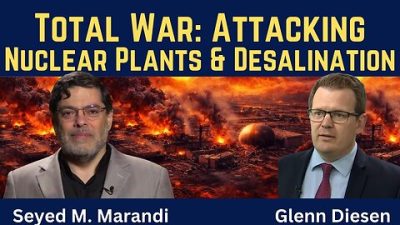
Total War – Attacking Nuclear Plants, Desalination & Infrastructure
or go to
Aletho News Archives – Video-Images
From the Archives
Strike on Israel Shows US Bases Near Iran Are ‘Achilles Heel’
By Svetlana Ekimenko – Sputnik – 14.04.2024
Fears of a greater Middle East escalation were triggered after Iran launched a massive drone and missile attack against Israel, aided by Hezbollah and the Yemeni Houthis. Iran said the attack was in response to Israel’s bombing of the Iranian consulate in Damascus, Syria, which killed seven members of the elite Revolutionary Guard Corps.
Iran’s massive retaliatory attack on Israel from its own territory is a sign that the conflict could “escalate out of control.”
Michael Maloof, a former senior security analyst in the office of the US secretary of defense, told Sputnik that the first ever direct Iranian attack on Israel set a dangerous precedent.
“My concern is that this could easily escalate into something not only between Iran and Israel, but beyond the Middle East region,” he said.
Iran’s assault, which it stated was an act of “self-defense” after the Israeli strike on its consulate in Damascus, was originally intended to be a “limited” one, said Maloof.
Iran first sent in “swarms of drones with lights on as a sign of psychological warfare,” but sending in cruise and ballistic missiles by Tehran was a “distinct escalation,” said Maloof.
The scale of Iran’s attack on Israel suggests that Tehran was sending a message, demonstrating that it possesses “extraordinary capabilities,” said Maloof. … continue
Blog Roll
 Aletho News
- Pakistan PM backs Iran’s right to self-defense amid tensions
- Hungary blasts ‘fake’ EU accusation
- SAFE Debt Trap: Poland’s €43.7 Billion Bet on Unipolar Illusion
- War on Iran threatens global Gulf capital flows: FT analysis
- Mossad De Facto Admits To Inciting Riots In Iran
- Tehran: World grown thoroughly exhausted with US-Israeli ‘false flag storylines’
- Trump ‘stuck between a rock and a hard place’, lacks Iran war strategy: Ex-CIA chief
- Trump’s bombardment of fake news so far is working quite well. But where is it heading?
- Iran to Mine Sea Lanes in Persian Gulf in Case of Attack – Defense Council
- Barak blasts Netanyahu: ‘Stop lying – you can’t destroy Iran’s nuclear, missile capabilities’
- If Americans Knew
- From Sde Teiman, the truth about Israel’s military justice system has been set free
- Child denied life-saving bone marrow transplant by Israel ‘because he is from Gaza’
- Raffi Berg: BBC Middle East Editor Exposed as CIA, Mossad Collaborator
- Jerusalem Archbishop Rebukes Netanyahu’s Statements on Christianity
- US to embed Palantir AI across entire military: Report
- Israeli-US war on Iran to drag on “a few more weeks” – Not a ceasefire Day 164
- Lebanon deaths top 1,200; Palantir AI to be embedded across US military – Not a ceasefire Day 163
- Israel’s assassination game: Take all pragmatists off the board
- Food shortages return to Gaza as Israel tightens aid restrictions under the cover of its war on Iran
- Trump demands trillions in payments from Gulf countries, billions from Harvard – Not a ceasefire Day 162
- No Tricks Zone
- New Study: CO2 Is ‘Effectively Negligible’ As An Explanatory Climate Change Factor Since 2000
- Former Pfizer Toxicologist Dr. Helmut Sterz Tells Bundestag Hearing Pfizer Vaccine Should Have Never Been Approved
- Energy Expert: Germany’s Nuclear Phaseout Was A “500 Billion Euro Mistake”
- New Research: South Australia’s Mid-Holocene Sea Surface Temperatures Were 4°C Warmer Than Today
- Storing Green Energy To Last Germany 10 Days Would Require A 60-Million Tonne Battery
- New Studies: UK Sea Levels Were 4 Meters Higher Than Today During The Mid-Holocene
- Destructive Green New Deal: German Energy And Metal Group Warns Of Drastic Crisis
- New Study Documents A 20-Year Pause In Arctic Sea Ice Decline – Driven By Internal Variability
- Wake-up Call: Survey Shows Majority Of Germans Now Favor Postponing Climate Targets!
- Televised! Leading German Political Candidate Tells Schoolchildren CO2 Makes Sun Hotter!
 Aletho News