Scotland’s Anti-Colonial Struggle
By Craig Murray | February 22, 2016
I have a meeting today in London with the Ambassadors of Venezuela, Bolivia, Cuba, Nicaragua and Ecuador to brief them on Scotland’s continuing struggle for Independence. These nations have been at the forefront of the international movement against colonialism, and know all about the sharp end of neo-Imperialism and the evil-doing of the CIA and other western security agencies.
The test of the Independence of a state is nothing to do with domestic or regional government, or even with bilateral arrangements with the state from which it secedes. The test of Independence is, purely and simply, whether or not you are recognised by other states as independent. That is the very clear cut position in international law. For this reason, it is essential that Scotland reaches out, not just within the EU but to the entire international community. Ultimately we need these people to vote and lobby for us in the United Nations and other international institutions.
Frankly, the SNP is rubbish at this. I am doing this meeting because the hierarchy of the SNP spurned the approach from the Ambassadors, as previously detailed on this blog. This reluctance seems part of the hierarchy’s effort to be NATO friendly and thus CIA friendly. The Ambassadors would far rather be meeting with an official SNP representative than a nobody like me. Unfortunately the SNP won’t do it. That is a disgrace.
I can increasingly foresee, as Westminster governments move ever further to the right and encroach more and more on civil liberties, a situation arising where Scotland wishes to claim its independence without the consent of Westminster. In that situation, we will need all the international support we can get, just as the Palestinians have been making headway in UN institutions. Work needs to be put now into laying the foundations for that support. Personally I would characterise Scottish Independence as an anti-colonial struggle; use of Scots as British cannon fodder and integration of the Scots elite into the Metropolitan elite does not make Scotland any less a colony. Rome had an African Emperor, but still her African possessions were colonies.
But even for those who do not accept that analysis, there is no doubt that Scottish Independence would have a highly beneficial impact on the global balance of power. The weakening of the USA’s most powerful sidekick; the lessening of the UK’s ability to participate in illegal neo-imperial invasions and to host weapons of mass destruction; the re-opening of the question of the undemocratic Security Council structure at the UN.
Then there is also the positive role Scotland can play as a major contributor to UN Peacekeeping Forces, and a voice for sanity, reason, human rights and the pre-eminence of international law. An independent Scotland as a state party will be able to request the International Criminal Court to lay war crime charges against Blair and Straw for the illegal invasion of Iraq, which would be a powerful deterrent to future aggressive war.
I am but one man and a private individual. Everything I can do, I shall.
Garifuna Communities of Honduras Resist Corporate Land Grabs

By Samira Jubis | Council on Hemispheric Affairs | September 23, 2015
The fate of the Garifuna people of Honduras hangs in the balance as they face a Honduran state that is all too eager to accommodate the neoliberal agenda of U.S. and Canadian investors. The current economic development strategy of the Honduran government, in the aftermath of the 2009 coup against the democratically-elected President Manuel Zelaya, has not only benefited the political and economic elite in Honduras, but it has also encouraged the usurpation of some of the territories of indigenous peoples of this Central American nation. The often-violent expropriation of indigenous land threatens the Garifuna’s subsistence.
The Garifuna people are descendants of African slaves and two indigenous groups originally from South America—the Arawaks and the Carib Indians. In 1797, the British deported 5,000 Garifuna, also known as Black Caribs, from St. Vincent to Roatán. Since then, the Garifuna people have immigrated throughout North and Central America.[i]
Triunfo de la Cruz and Punta Piedra are home to two of the forty-eight Honduran Garifuna communities along the Honduran Atlantic coast corridor. Due to an ecologically rich geopolitical position, these regions have attracted foreign-backed investments, including tourist and recreational centers, natural resource extraction industries, and self-governing corporate zones. The concept of “self-governing” does not apply to democratic procedures of native citizens, but to the domination of foreign elites who view the Garifuna land as a mere means to the private accumulation of wealth.
Mega development projects have been advertised as a stimulus to economic growth and employment within the country. However, in practice, they have aggravated discrimination and harassment against indigenous and ethnic groups, whom developers generally perceive as obstacles to the expansion of such economic projects. Hence, the Honduran political system, in thrall to ambitious tycoons and foreign interventionism, has infringed on the Garifuna community’s relationship to and management of their ancestral lands. The displacement of these Honduran Afro-descendant communities from their ancestral lands for the development of economic projects accelerated after the coup d’état of June 28, 2009 against the democratically elected President, Manuel Zelaya, and the installment of a U.S. backed golpista regime.
The United States and Canada perceived the center-left policies of former Honduran president Manuel Zelaya as an intolerable restraint on American and Canadian investment objectives in Honduras. The alignment of Honduras with the left-leaning Bolivarian Alliance for the Americas (ALBA) and PetroCaribe along with stricter domestic reforms to rein in the damage caused by neoliberal policies, emboldened the U.S.-Canadian intervention in the Honduran political system. The coup brought the golpista regime of Roberto Micheletti (June 28, 2009 to January 27, 2010) to power and was followed by the subsequent election of two right wing presidents. Tegucigalpa has pursued policies that are more obedient to the economic consensus of Washington and Ottawa, reversing its march towards progressive land and labor reforms and opening the doors wide to foreign investors. As a result, Honduras has been the bloody stage for human rights violations against those who have resisted some of the more intrusive features of the neoliberal economic model.
The Garifuna community of Triunfo de la Cruz, for example, possessed title deeds of full ownership to their ancestral territories. However, the U.S. and World Bank-backed 1992 Agrarian Modernization Law not only led to the expansion of Tela’s city boundaries, but also stimulated future transactions of ancestral lands without consent of the Garifuna community members.[ii] Grahame Russell is the director of Rights Action and has devoted his life to protecting human rights in Guatemala, El Salvador, and Honduras. Russell points out: “All along the north coast, most particularly in the Tela Bay and Trujillo Bay areas, Garifuna villages are being pressured—with false legal documents, with forced sales and with repression—to sell their lands and territories to international tourism operators that are supported by the illegitimate and repressive Honduran regime.”[iii]
The municipality of Tela sold ancestral territories to a corporation called Inversiones y Desarrollos del Triunfo S.A de C.V. The municipality later issued construction permits for the development of tourist projects, such as the Indura Beach and Golf Resort.[iv] Government officials and foreign investors have overlooked the Garifuna people’s opposition to these projects. In turn, there have been frequent territorial disputes between the investors and members of the Garifuna community. In 2014, the Honduran national police and military officials attempted to violently dislodge the Garifuna population from their lands. Despite the United Nations Educational Scientific and Cultural Organization (UNESCO) declaring that the Garifuna culture is one of the nineteen Masterpieces of the Oral and Intangible Heritage of Humanity (2001), violence and physical force have been constantly used to threaten the livelihood of the Honduran Garifuna communities. Oscar Bregal and Jesus Alvarez, two committed Garifuna leaders, were murdered in 1997 while protesting against the violation of the human and civil rights of the Garifuna communities. Oppression and harsh conditions been the principal causes of displacement and emigration of the Honduran Garifuna inhabitants
According to the Indura Beach investors, the first phase of this US $120 million tourist-complex development has created 400 direct jobs and 800 indirect jobs.[v] The Honduran Tourism Institute insists that these jobs have primarily benefited the communities around the complex, especially the Garifuna communities. These benefits, however, have not reached the hands of the Garifuna population. As a matter of fact, unsustainable tourist projects have threatened the Garifuna people’s food sovereignty. As stated by Miriam Miranda, leader of The Honduran Black Fraternal Organization (OFRANEH), the Garifuna people cannot continue to exist without the land required to grow their subsistence crops. Foods like rice, beans, and yucca not only make up the Garifuna daily diet, but also represent critical components of the Garifuna culture. The women of the communities sow and harvest the land for household consumption and income. The Honduran state’s failure to protect the interests of these Honduran citizens has led Garifuna indigenous communities to request the intervention of international organizations.
From August 24 to August 29, the Inter-American Court of Human Rights held its 53rd period of extraordinary sessions in Honduras. During the sessions, the court visited the Garifuna Communities of Triunfo de la Cruz and Punta Piedra to commence proceedings against the Honduran state. OFRANEH— speaking on behalf of the Garifuna inhabitants of Triunfo de la Cruz, Punta Piedra, and Cayos Cochinos—claimed that Honduras has failed to ensure these communities’ right of land ownership as well as their right to free, prior, and informed consent. Although Honduras has ratified the International Labour Organization Convention no. 169, and the Honduran constitution recognizes the rights of indigenous and ethnic peoples, the Honduran Garifuna communities continue to face discrimination and harassment within the Honduran economic and political systems. The petition of the Honduran Garifuna communities was presented to the Inter-American Commission on Human rights on October 29, 2003. [vi] Following the commission’s hearings, the Honduran state agreed to put in place measures to protect the property rights of the Garifuna people. The state, however, has failed to uphold this agreement.
In February 2013, the commission submitted the case Garifuna Community of “Triunfo de la Cruz” and its Members v. Honduras to the Inter-American court after the Honduran government failed to inform the Commission of the measures it had taken to enforce the property rights of the Triunfo de la Cruz inhabitants.[vii] This case not only confirms state collaboration with the violation of Garifuna people’s rights in Honduras, but it also challenges the effectiveness of the international community—in this case the court’s jurisdiction, in protecting those rights.
It has been 12 years since the petition was presented to the commission and the Honduran Garifuna communities are still living in despair and fear. Do we hear their call for justice in the North? Russell remarks that “while OFRANEH and the Garifuna communities are waiting for the Inter-American Court to render its final decision, which—if justice is to prevail—will find in favor of the Garifuna people, against the actions and omissions of the Honduran State, they are not depending on it.” Furthermore, Russell adds that the Honduran Garifuna communities, “resist peacefully, resolutely, on and on, from one community to the next.”
The usurpation of ancestral territories by multinational corporations backed by the political and security structure of the Honduran state has evoked justified skepticism among the Honduran Garifuna communities in regards to neoliberal economic policies that put profits before human needs and respect for participatory democratic procedures. While the Garifuna communities are still waiting for the court’s final decision on their case against the State of Honduras, they have been committed to voicing their grievances. The leadership and determination of the Honduran Garifuna has encouraged other indigenous and ethnic groups in the western hemisphere to fight against hegemonic neoliberal policies that threaten their ability to live and develop in community.
Featured Photo: Chachahuate, a small Honduran island inhabited by Garifuna communities. From: Dennis Garcia
[i] Escure, Geneviève, and Armin Schwegler. “Garifuna in Belize and Honduras.” In Creoles, Contact, and Language Change Linguistics and Social Implications, 37. Amsterdam: John Benjamins, 2004. http://public.eblib.com/choice/publicfullrecord.aspx?p=622399.
[ii] Brondo, Keri V. “La pérdida de la tierra y el activismo de las mujeres garífunas en la costa norte de Honduras.” Journal of International Women’s Studies, 9, no. 3 (May 2008): 374.
[iii] Grahame Russell, e-mail message to author, September 20, 2015
[iv] IACHR, Merits Report No. 76/12. Case No.12.548, Garífuna Community of “Triunfo de la Cruz” and its Members (Honduras), November 7, 2012, paragraph 159, 160.
[v] Diario El Heraldo Honduras. “Lista Primera Etapa De Indura Beach and Golf Resort.” Accessed September 20, 2015. http://www.elheraldo.hn/alfrente/566419-209/lista-primera-etapa-de-indura-beach-and-golf-resort.
[vi] IACHR, Merits Report No. 76/12. Case No.12.548, Garífuna Community of “Triunfo de la Cruz” and its Members (Honduras), November 7, 2012, paragraph 1.
[vii] The Inter-American Commission on Human Rights, (2013). IACHR Takes Case involving Honduras to the Inter-American Court. Available at: http://www.oas.org/en/iachr/media_center/PReleases/2013/076.asp [Accessed 22 Sep. 2015].
Cuba Better Be Careful What It Wishes For
By Andrew Korybko | Sputnik | December 17, 2014
The US and Cuba have reached a historic deal to swap notable prisoners and establish diplomatic relations after decades of mutual hostility. The announcement caught many by surprise, and begs the question: Are there more sinister geopolitical calculations at work behind the U.S.’ olive branch?
The tradeoff largely boils down to this: the US has released the three remaining members of the Cuban Five in exchange for jailed contractor Alan Gross, 53 US-selected “political prisoners,” and an unnamed intelligence source who was imprisoned over 20 years ago. As a result, both countries will now establish diplomatic relations and the decades-long US embargo will be largely eased.
Many people are rightfully cheering what seems to be an imminent end to U.S. hostility towards Cuba, but all of this may just be a deception. The U.S. needs Cuba more than the other way around, since it wants to use the island as a pivot to reverse the Caribbean Basin’s move to multipolarity and prolong Washington’s full control over its historic “lake.”
Regime Change Done Differently
Cuba no longer needs the U.S. as much as it did at the end of the Cold War, when its economy was in despair and the market hardly functioned. It’s come a long way since then, and although it still has its fair share of problems, it’s proved that it can survive on its own while being officially isolated from its massive northern neighbor. While the U.S. had plenty of opportunity to exploit Cuba when it was at its weakest in the 1990s, it missed the chance to do so, driven by the precondition that regime change must happen first.
Now, however, the tables have turned, and the U.S. is pursuing a policy of engagement first in order to facilitate the same regime change goal it’s been trying to pull off for over the past half century.
“I do not expect the changes I’m announcing today to bring about a change in Cuban society overnight,” Obama said, implying that he still wants the U.S. vision of change to occur. The removal of the embargo would only be a victory for the Cuban people if they are able to retain their independence, sovereignty, and preferred form of government afterwards.
Indirect Inroads
Overt hostility hasn’t worked in the past against Cuba, and it likely won’t work in the future. Plus, there’s been a general trend in recent years for the US to pursue its objectives through covert and indirect means. This is where Cuba is most vulnerable in the recent ‘thaw’ in relations. The American economy doesn’t need Cuba at all, really, and Washington’s opening to Havana is a convenient cover to catch Cuba in its social and economic snare to more directly control the inevitable leadership transition process that will occur with Fidel’s passing. It already tried and failed to use USAID to create a ‘revolutionary Twitter’ on the island, as well as its embarrassing follies with anti-government Cuban rappers, to name but the few most recent regime change scandals there. And it must be kept in mind that Mr. Gross was working for the Agency when he was arrested in 2011 for trying to, as Cuban authorities described it, to “promote destabilizing activities and subvert constitutional order” to foster a “Cuban Spring.”
Cuba is also vulnerable to reverse migration, in that dissident and possibly extremist Cuban-Americans may return to the island in order to build a future Color Revolution’s social infrastructure to deploy when the time is right (likely in the aftermath of Fidel’s death). American businesses can fill a valuable development and investment gap on the island, in exchange for making Cuba ever more dependent on the U.S. This would give the U.S. another lever of influence over the island’s affairs, which could be activated in unison with a Color Revolution to create maximum disorder.
Bucking The Trend
The timing of Washington’s “outreach” to Havana isn’t coincidental, as it coincides with major processes going on in the region that the U.S. hopes to reverse. Most recently, the pro-U.S. Prime Minister of Haiti, Laurent Lamothe, was forced to resign last week amid protests and popular outrage over his corruption and ineffectiveness. Backtracking America’s hold on the region even further, the Chinese are slated to begin construction on the Nicaraguan Canal, which when completed, would create a major breach in America’s control of the Caribbean Sea. Finally, Venezuela has been a center of resistance to American hegemony over the hemisphere ever since the leadership of the late President Hugo Chavez.
Cuba is the symbolic leader of the Latin American resistance movement, and its “Cuban Spring” surrender would be disheartening for the other allied states that defy the U.S. via the ALBA grouping. Congress recently passed sanctions against Venezuela (largely overshadowed by the anti-Russian ones), which is the financial engine of the hemispheric resistance, to facilitate a Color Revolution there as well, as President Maduro himself has previously alleged Washington wants to do.
Venezuela’s economy is also hurting because of the recent oil price slump, which may inhibit its ability to subsidize the allied Nicaraguan, Ecuadorian, and Bolivian ones in the future. With Cuba out of the game, and perhaps even Venezuela, there’d be little ideological or economic support keeping Nicaragua, the future key to the Caribbean, from being next (to say nothing of Ecuador and Bolivia) and the Chinese-sponsored canal from becoming a failed infrastructure project. If this happens, then the U.S. would have reasserted its complete control over the Caribbean and begun to penetrate the Andes, thus tightening the containment noose around Brazil and strangling the future of multipolarity in the region.
Latin American States Denounce Any Possible Aggression against Syria
Al-Manar | September 8, 2013
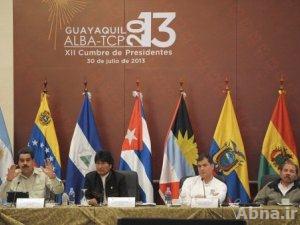 The nine Latin American states (ALBA) have condemned any possible aggression against Syria and announced the dispatching of humanitarian aid to the Syrian refugees in Lebanon.
“The Bolivarian alliance council in American denounces any possible strike against Syria,” ALBA Secretary General said in a statement from Venezuela.
“ALBA asks the U.S. to refrain from launching a military aggression against the Syrian people and government,” he added, accusing the US administration of resorting to the same strategies that it used in Iraq, Afghanistan and Egypt.
ALBA further decided to dispatch humanitarian aid, including foodstuffs, to the Syrian refugees in Lebanon.
Related articles
- At least one Syrian becomes a refugee every 15 seconds – expert (voiceofrussia.com)
- Lebanon opposes military attack against Syria: FM (theiranproject.com)
Featured Video
American Military Failure in Afghanistan
or go to
Aletho News Archives – Video-Images
Frlom the Archives
The Fiction of the Jewish History in Palestine
By Hasan Afif El-Hasan | The Palestine Chronicle | April 8, 2011
Prime Minister Benjamin Netanyahu told NNC Pierce Morgan on March 18, 2011 that he might agree to a Palestinian state through negotiations. And he added, “We will make territorial concessions although it is very painful to do that in our ancestral land.” Netanyahu was not talking about Poland where his ancestors lived. He was talking about Palestine where generations of its indigenous population ancestors lived, cultivated the land and are buried.
By the end of the nineteenth century, Zionism created a new Jewish identity of blood and soil. To mobilize their followers and supporters and appeal to their emotions, the Zionists created myths. Zionism started as a tribal religion without god, but in order to fulfill its function as a unifying force, Zionism required external religious and race symbols, not inner content. Its leaders regarded metaphysical religious belief and purity of race as having value in itself. They created a divine paradisiacal state of merger with the gods. Despite his non-religious ideology, Herzl’s writings were replete with religious references. The Jews should settle in Palestine because, in his words, “the Temple will be visible from long distance, for it is only our ancient faith that has kept us together”.
The Zionists and their supporters have invested tremendous financial and scholarly resources to work within the Hebrew Bible historical narratives to affirm the links between the intrusive Zionist population and the ancient Israelite past, and by doing so assert the right of that population to the land. The political end-game shaped the investigation and the outcome. Tracing the roots of Israel’s ethnic state in biblical antiquity is effectively to silence the indigenous Palestinian claim to the past and therefore to the land. The Biblical scholarship employs a bewildering array of terms for the region: “the Holy Land”, “the Land of the Bible”, “Eretz Israel”, “the Land of Israel”, or “Judah and Samaria.” To the casual reader these names appear interchangeable, but they all imply connection to ancient Israel.
Biblical narratives or poems that cannot be supported by archeology and common sense are treated by the Zionists and their supporters as historical language. … continue
Blog Roll
 Aletho News
- Lawyers’ groups demand end to British military bases in Cyprus
- CIA Assessment: The Resistance Cannot Be Crushed
- Hezbollah Returns: It Didn’t Start a War, It Is Ending One
- EU states seek ‘talks’ with Iran for access to Strait of Hormuz: Report
- Trump on Hormuz: “Others must take care of it” after US falters
- Who Is closer to collapse?
- A War that Backfired: Why the US-Israeli Campaign Is Strengthening Iran
- How Zionist Control Is Hurting US Interests
- Iran warns it may target US missile launch sites in UAE cities
- American Military Failure in Afghanistan
- If Americans Knew
- As US-Israel war on Iran rages, Gaza faces massive dust storm – Not a ceasefire Day 156
- No let-up in attacks on Gaza as Israel takes on Iran, Lebanon – Not a ceasefire Day 155
- ‘Of Course’: IDF Drops Case Against Soldiers Accused of Raping Palestinian Prisoner
- Don’t Fall for the Regime Change Talk. Israel Is ‘Mowing the Lawn’ in Iran
- Will Israel and the US wreck the Gulf States along with Iran?
- US so far burned through ‘years’ of munitions in Iran war: Report
- How the Israeli Tail Wags the American Dog
- Outdated intel likely led to deadly U.S. strike on Iranian elementary school, sources say
- Pentagon insider says high U.S official Douglas Feith reported to Netanyahu
- In fond memory of Walid Khalidi, the historian of Palestine
- No Tricks Zone
- Storing Green Energy To Last Germany 10 Days Would Require A 60-Million Tonne Battery
- New Studies: UK Sea Levels Were 4 Meters Higher Than Today During The Mid-Holocene
- Destructive Green New Deal: German Energy And Metal Group Warns Of Drastic Crisis
- New Study Documents A 20-Year Pause In Arctic Sea Ice Decline – Driven By Internal Variability
- Wake-up Call: Survey Shows Majority Of Germans Now Favor Postponing Climate Targets!
- Televised! Leading German Political Candidate Tells Schoolchildren CO2 Makes Sun Hotter!
- New Study: A Century Warming Of 1.1°C Is ‘Commonplace’ And ‘Not Unusual’ During This Interglacial
- New Study: ‘Internal Noise’ And Volcanic Forcing Can Trigger 10-15°C Warming Within Decades
- Glaciers Worldwide Are Suddendly Surging, Experts Blame Warming!
- Surprising Discovery: Sahara Is Greening…Billions Of Trees Where Once Thought To Be Barren
 Aletho News
