Selective Assassinations of Chavistas by paramilitaries, renegade police and criminal gangs continue
By Arturo Rosales | Axis of Logic | October 12, 2016
The assassination of followers of the late President Chavez continues to increase at a steady pace. From 2013 – when President Maduro was democratically elected – to the present, many local political leaders, public servants, journalists, bodyguards of left wing politicians, military personnel and operatives of the Bolivarian Intelligence Service (SEBIN) have been unfortunate enough to fall into the opposition’s murderous claws.
The ultra-right wing opposition that currently has control of the National Assembly continues with its aim of resurrecting the Fourth Republic in Venezuela. With opposition figures such as the governor of Miranda state, Capriles Radonski, telling his supporters “to take their anger to the streets” and Voluntad Popular’s Leopoldo Lopez whose plan called “The Exit” sparked violent street protests by paid thugs from February to June 2014 costing 43 lives, we can see that unconstitutional political means to gain power are at play here.
Added to these actions by the ultra right wing are assassinations of body guards of revolutionary leaders that are simulated as a robbery or violent street crime, then the right wing media plays its part by putting it all down to “insecurity” caused by an inept government.
Paramilitaries &Policemen
The links established between fascist leaders in Venezuela such as Leopoldo Lopez and ex-Metropolitan Mayor Antonio Ledezma with ex-Colombian President and enemy of Bolivarianism, Alvaro Uribe, since 2009 have resulted in political, economic and media support for the paramilitary gangs that have been infiltrating Venezuela since about 2005. These gangs expanded into the country from the western Colombo-Venezuelan border and reached the center of the country, including Caracas, in a few short years.
Political and legal support was lent by right wing parties such as Voluntas Popular and Alianza Bravo Pueblo. Economic support came from drug trafficking, contraband and a small sector of business; and finally support by electronic media that are financed from abroad such as La Patilla, NTN24 (both financed from Colombia) and Sumarium owned by the Vecchio-Lopez families. (Carlos Vecchio is now exiled in the US and Leopoldo Lopez is serving 14 years in jail). There were also other minor support groups from other political parties of the right such as UNT, Accion Democratica and Primero Justicia.
With the paramilitaries in place, there were various objectives: the political demobilization and demoralization of militant Chavistas in the popular areas (barrios); and take out of circulation valuable revolutionary cadres either by making them disappear or eliminating them physically. The right wing media would then step in and report on these events with the purpose of destroying the memory and reputation of the murdered comrades.
The aim of practicing this kind of politics is to create indignation, fear and anger in the population that lives in the shadow of such insecurity. For this reason each brutal homicide is dealt with immediately and sensationally by the opposition media. The idea is to have some sensational aspect of any given case covered on a daily basis to maintain the fear factor.
Let us not forget that since 2013 the whole population has been subject to the effects of a fourth generation war – a combination of selective assassinations as described above and an economic war making life increasingly difficult. Foods were hoarded, hidden or smuggled to Colombia creating shortages of basic goods and the resulting huge lines as people stood to buy food.
This, the fear factor plus frustration at not being able to buy basic subsidized goods plus induced galloping inflation, was all blamed on an inept President and his ministerial team, day-in day-out, by the local and international media who all combined to encourage voters to either abstain or switch to supporting the opposition. The latter had promised to “make the lines vanish” if they won control of the National Assembly on December 6 last year. They did win but the lines got worse … and according to the media this is still the fault of the government even though 86% of food distribution is in the hands of the private sector.
Of course, the “make the lines vanish” electoral promise was conveniently never mentioned again by the private media.
To achieve the goal of sensationalizing homicides and sowing fear and discord in the population, the opposition media has a team of “info-mercenaries” who in many cases have contacts with corrupt ranks of the security forces and therefore have access to the gory details before any investigation has even started. Such “inside” or “advance” information is illegal under Venezuelan law. There are also journalists that act in concert with the armed gangs especially in the case of “hits” against security personnel, as there is a higher economic incentive if the details are published in the media.
After the recent intervention of the police headquarters in the opposition-run municipality of Chacao in Caracas, it was discovered that this police force had been behind several high profile killings such as that of retired General Felix Velasquez and revolutionary journalist Ricardo Duran.
Obviously the Mayor of Chacao who is the Commander-in-Chief of this police force did not know anything about the activities in his own police headquarters. The opposition is never involved in these murders even though the police forces they control are never above suspicion. At present 4 policemen are awaiting trial for the assassination of General Velasquez and 14 more for the killing of Duran.
Wider Strategy
On repeated occasions President Maduro has stated that these assassinations “form part of a non-conventional war that is being waged against the country – and not just now but for many years. Criminal violence emerges when the right wing does not achieve its objectives”.
There follows a list of the revolutionaries and public servants murdered in contract killings due to the politics of violence of the ultra right wing:
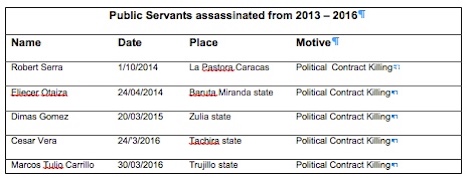


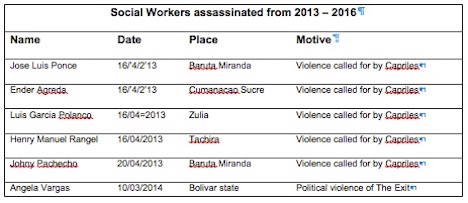
In addition to these politically motivated and contract killings by paramilitaries, police and paid thugs in the streets, there are at least 15 professional bodyguards of high-level Chavistas who have been assassinated from 2013–2016.
All the cases mentioned have proven to be contract killings and have been resolved or are under investigation.
It is worth highlighting the fact that no international human rights organization or any NGO affiliated to the US or Spain – countries that are supposedly democratic and believe in the freedom of expression – have taken any interest or made declarations condemning the persecution and assassination of Chavistas. All they have done is attack the government of President Maduro insinuating that it is he who is violating human rights!
Thus, we have a twisted situation where cases of murdered Chavistas are glossed over and no mention of the violation of their human rights is ever made. And on the other hand, the darling of the international right wing, Leopoldo Lopez, is allegedly having his human rights violated because his iPod was removed from his jail cell.
This is the late Eduardo Galeano’s “Upside Down World!”
© Copyright 2016 by AxisofLogic.com
Colombian Hacker Reveals Espionage Details Meant to Foil Peace Process
Prensa Latina | August 24, 2014
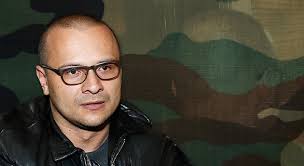 Bogota – The Colombian hacker Andres Sepulveda has revealed his activities and ties at the country’s national intelligence agency (DNI) during its espionage against the government and the FARC-EP guerrillas, currently engaged in peace talks in Havana.
In explosive revelations to Semana magazine, circulating here today, he insisted that the DNI was “like my co-participant and personal assistant. They gave me tools, provided information, suggested lines of attack that we might pursue together, all very much aligned with former president (2002-2010) Alvaro Uribe.”
“Wilson Torres was, for me, the key within the agency,” he said.
Thanks to Torres, for example, Sepulveda gained access to everything, from the database regarding agreed upon weapons caches, to top secret databases regarding enemy forces and the current structure of the FARC (Revolutionary Armed Forces of Colombia – People’s Army, FARC-EP).
“They provided me with information and at the same time, were very interested in receiving information about the agreements being signed and negotiated at the peace talks,” he added.
“They had a pile of drafts they were working on,” he said. The DNI was always looking for a way to get information about the FARC, not as comprehensive as that from the Andromeda base, running from downtown Bogota (where a military intelligence unit was said to be operating undercover).
“In my case,” said Sepulveda, “they were looking for information that might tarnish the FARC and the government.”
According to the hacker, the strategic objective of the espionage against the peace talks is aimed at drastically cutting them short, both militarily as well as in the media. The idea is to push law enforcement against the process, and against the decisions taken by the government, by creating internal rifts, he said.
“I know because I was part of it. They get their instructions from above,” he insisted.
Although his mission was limited to spying on the FARC-EP team at the peace talks, he said he was certain that the government team at the talks had been one hundred percent infiltrated by the Andromeda base.
Sepulveda was hired in January of this year by the former presidential candidate from the Democratic Center party, Oscar Ivan Zuluaga, and the former Colombian ambassador to the OAS (Organization of American States), Luis Alfonso Hoyos.
The hacker’s job was to obtain information about the peace talks, the FARC-EP guerrilla force, along with information about intelligence collected by law enforcement.
Referring to Zuluaga’s presidential campaign team, he said that they hired him because he was an expert in IT security and black ops.
“My real mission,” he added, “was to coordinate attacks against those (like Attorney General Alejandro Ordonez and congressmen like Ivan Cepeda) who did not share Uribe’s ideas.
Zuluaga’s office, located in an upscale neighbourhood on the north side of Bogota, was raided by the attorney general’s office on May 6, resulting in his arrest.
Feeling let down and abandoned to his fate by Uribe, who he supported for ten years, Sepulveda decided to reveal everything he knew, backed up by overwhelming concrete proof.
“I have it all,” he said, “documents, technical manuals, registers, phone calls, documentation, reports, videos, audio everything.”
According to Semana magazine, for having collaborated with authorities and then revealing what he saw, Sepulveda has become one of the most threatened men in Colombia.
To date, four planned execution attempts against him have been uncovered, forcing him to give his press conferences in the company of a full security team from the Attorney General’s office.
In his cell, he sleeps in a bulletproof vest, and at times even a bulletproof blanket, reported the magazine.
Colombia: Who Is Really In Charge?
By John I. Laun | Colombia Support Network | February 18, 2014
In the last several days a number of stunning disclosures have surfaced concerning the role of the Colombia military. First, the Colombian news magazine Semana revealed that military intelligence had conducted wire-tapping and surveillance for an operation called Andromeda from a listening post set up in a site disguised as a small restaurant named “Buggly Hacker” located in Galerias, a Bogota commercial district. Among the phone calls tapped and overheard it appears there may have been calls of members of the Colombian Government’s delegation involved in peace talks with the FARC guerrillas, whose delegation’s conversations may likewise have been tapped and overheard. When news broke of this activity, President Juan Manuel Santos declared publicly that these wiretaps (chuzadas, as they are referred to in Colombia) were illegal and had to be investigated at once. The President said publicly that he did not authorize and knew nothing about this activity. But the next day, President Santos declared that the chuzadas had been done legally!
Two things are very clear. First, that the President of Colombia is not aware of what a significant part of his government is doing, and that’s all right with him. And second, that the military are (quite literally) calling the shots in Colombia. It appears obvious that Mr. Santos changed his opinion overnight on the legality of the secret wire-tapping activity by military intelligence because military officers told him he could not call the activity illegal. In other words, they’re in ultimate control of the government in Colombia!
How could Mr. Santos determine that this activity was legal? There are laws which have provided great leeway to military intelligence. But they certainly do not extend to overhearing conversations between Colombian Government representatives and FARC representatives meeting in Havana supposedly aimed at arriving at a broad peace agreement through which the guerrilla war would be ended. Who would speak freely his or her ideas on what a peace agreement should consist of—a necessary part of peace conversations if they are to be productive— if he or she knew a third party was overhearing what was being said? No one. Particularly if the party overhearing the conversations is the Colombian military, which has a long record of abusive conduct, and even has a representative at the peace talks, General Mora. The chuzadas are a serious impediment to frank and open dialogue between the Colombian Government and the FARC. One suspects that former President Alvaro Uribe Velez is likely the recipient of the information gained from the chuzadas, as he utilizes his close relationship with military officers to obtain information with which to undercut the peace talks, which he has publicly opposed. He earlier obtained the coordinates for movement of two FARC leaders as they came out of their bases to go to Havana—secret information he could only have gotten through a leak from a military or governmental source. Of course, President Santos has not moved seriously to investigate this leak. Why? Because he is not in control of the Colombian government.
This has been made clear by events in the last couple of days. Semana, much to their credit, has carried out and now published the results of an extensive investigation of corruption in the Colombian military. The investigation found military officers discussing how to skim off funds for their personal benefit from monies received by the military, the likely source of which was the United States Government. One of the persons involved in the recorded conversations is the current Commander of the Colombian Armed Forces, General Leonardo Barrero. Another article reported how supposedly disgraced General Rito Alejo del Rio, confined to a military installation in Bogota for his support of illegal paramilitary forces during his time as Commander of the Seventeenth Brigade in Carepa, near Apartado, essentially commands the installation, freely making supposedly-prohibited cell phone calls. And other military personnel who misbehaved had been involved in the “false positives” scandal in which military officers ordered the kidnapping of young men, had them killed, and then falsely presented them as guerrillas killed in combat.
The reports by Semana show an astonishing level of corruption in the Colombian military. President Santos has promised an investigation of these activities, of which he says he had no knowledge. Again, we see Mr. Santos as being out of the loop, heading a government he does not control. The conclusion is inescapable that the military controls the government and Mr. Santos is an uninformed bystander. He seems to believe that his job is to hob-nob with representatives of multinational corporations, as he did on a recent visit to Spain, inviting them to invest in Colombia and remove its valuable mineral resources for a pittance. The Colombian people deserve much better than this!
There is another aspect of the military’s current “dance of the millions” which is very troubling. The funds that are being stolen by military personnel are almost certainly provided by the United States government (i.e., U.S. taxpayers) as a part of the bloated budget of funds the U. S. government provides to the Colombian military. An obvious question is: Did the U.S. government personnel, such as the country’s military attache and Ambassador in Colombia, know what has been going on? And, if not, why not? This scandal calls for a full review of the U.S. aid program to Colombia and an immediate freezing of any funds in the aid pipeline. We in the human rights community have long known of the pervasive corruption in the Colombian military, though we did not know of the brazen theft of funds which Semana uncovered. It is high time that President Obama, Secretary of State Kerry and Secretary of Defense Hagel give their undivided attention to the Colombia situation. And the members of Congress should insist upon a thorough investigation, dismissal of those government personnel who overlooked these very serious problems, and prosecution of those who may have collaborated with the Colombian military to their own advantage.
Featured Video
No Threat Can Force Iran’s Surrender /Trita Parsi & Lt Cl Daniel Davis
or go to
Aletho News Archives – Video-Images
From the Archives
What is the Israeli Lobby in Australia Doing in Interfaith Dialogue?
By Ali Kazak | Dissident Voice | October 11, 2015
For years Israel and its lobby around the world have been trying to normalise their relations with Arabs and Muslims without solving the Palestine Question.
One of the methods they resorted to in the last few years is using human rights and community organizations such as interfaith dialogue and Multiculturalism to achieve this objective and to: isolate the Palestinians, marginalise the Palestine question, end Israel’s isolation, and prevent criticism of Israel, knowing that these organisations will be the first to stand against Israel’s violations, racial and religious discrimination.
The group responsible for this task in Australia is The Australia/Israel & Jewish Affairs Council (AIJAC); its Director of International & Community Affairs, Jeremy Jones is in charge of lobbying religious community organizations, specifically Muslims and Christians. Consequently he convened the Faith Communities for Reconciliation, founding participant in the Australian Partnership of Religious Organisations and the Australian National Dialogue of Christians, Muslims & Jews.
AIJAC is a private political propaganda group. It is recognised as the main Israeli lobby in Australia. It coordinates its activities and works intimately with the Israeli embassy in Canberra and different institutions in Israel. It is privately funded by some Jewish businessmen. It monitors closely Australian politicians, the media, ethnic and religious groups, (especially Arabs and Muslims), unions and academics on their stands towards Israel and the Palestine question. … continue
Blog Roll
 Aletho News
- The war of liberation of the Arab and Islamic peoples expands across the Gulf
- Envoy warns UN on Trump’s threat to ‘obliterate’ Iran’s civilian infrastructure
- The Larak Corridor: Iran’s Rial Gate With No US, No Israel, and No Way Around
- ‘Economic terrorism’: Steel facilities hit again in US-Israeli strike
- ‘War Crime’: Iran condemns attacks on Arak, Ardakan nuclear sites
- Two-thirds of Americans want quick end to Iran war even if goals unmet
- Trump to Give “Important Update on Iran” Wednesday in Prime-Time Speech
- Theodore Postol: Iran’s Missiles & Drones Were Underestimated
- Iran To Target Military Industrial-Tech Complex That Facilitated Gaza Genocide
- Collapsing Empire: The Resistance Disarms ‘Israel’
- If Americans Knew
- Israel wants US to bomb more of Iran’s civilian structures (113,000 is not enough) – Not a ceasefire Day 173
- Ann Coulter Rips Into Fox News for Iran War Coverage
- Joe Kent Urges Americans To Call White House and Congress To Object To Sending Troops Into Iran
- DNC Resolution to Reject AIPAC Funding Puts Democratic Leaders in the Hot Seat
- Swedish foundation to build 400 schools as over 650,000 Gaza children remain without education for 2 years
- Israeli army admits photshopping image of slain Lebanese journalist
- This is how Israel is systematically killing health workers under the cover of war in Lebanon
- Carrying life under fire: Israeli invasion of Lebanon leaves pregnant women facing deadly risks
- Champagne all around for the new death penalty (for Palestinians) law – Not a ceasefire Day 172
- Why are Palestinian books struggling to be seen on Amazon?
- No Tricks Zone
- New Study Finds Warming Saves Lives…Cold Temperatures 12 Times More Deadly Than Excess Heat
- German Science Blog Accuses PIK Climate Institute Of Hallucinating Climate Tipping Points
- Devastating Assessment Of Comirnaty Vaccine By Former Senior Pfizer Europe Toxicologist
- New Study: CO2 Is ‘Effectively Negligible’ As An Explanatory Climate Change Factor Since 2000
- Former Pfizer Toxicologist Dr. Helmut Sterz Tells Bundestag Hearing Pfizer Vaccine Should Have Never Been Approved
- Energy Expert: Germany’s Nuclear Phaseout Was A “500 Billion Euro Mistake”
- New Research: South Australia’s Mid-Holocene Sea Surface Temperatures Were 4°C Warmer Than Today
- Storing Green Energy To Last Germany 10 Days Would Require A 60-Million Tonne Battery
- New Studies: UK Sea Levels Were 4 Meters Higher Than Today During The Mid-Holocene
- Destructive Green New Deal: German Energy And Metal Group Warns Of Drastic Crisis
 Aletho News